




Abstract
In this study, we explored how high school students’ participation in a local history research project about a historically Black cemetery in the Southeast United States contributed to their demonstration of historical empathy. Major findings show that students displayed historical empathy in research activities that occur beyond the traditional classroom through their examination of perspectives concerning representations of race and diversity in the social studies curriculum, the historical contexts about the impact of enslavement and Jim Crow segregation in their community, and affective connections they made to their identities as citizens. We recommend that future studies focus on how social studies teachers, community organizations, and other educational providers can collaborate to promote historical empathy in and outside of schools with equity frameworks and curricular initiatives such as the National Council for the Social Studies College, Career, and Civic Life (C3) Framework.
Nestled in a two-acre wooded area in a metropolitan suburb of the Southeast United States lies a historical Black cemetery (the Cemetery) (Appendix A). Established during the Reconstruction, former enslaved African Americans, and their descendants attended church and buried loved ones there throughout the 1980s. Although the Cemetery fell into disrepair, community organizers, youth groups, and non-profits mobilized to restore the Cemetery (Adams, 2022). In 2021, a college of education, a non-profit student leadership organization, a local historical society, and community members received a state humanities grant to work with a group of high school students to produce documentary films about the history and future preservation plans of the Cemetery. As this project progressed, we grew curious about how students, who were enrolled in the non-profit leadership program, could demonstrate historical empathy (HE) through their local history research that was taking place outside of their schools.
Research Question and Purpose of Study
HE involves the cognitive and emotive process in which students examine contexts and perspectives from the past to make reasoned affective responses to historical content (Perrotta, 2018a; Barton & Levstik, 2004; Brooks, 2011; Endacott & Brooks, 2018; Yilmaz, 2007). Scholarship on promoting HE in social studies classrooms has grown significantly over the past decade through the implementation of debate (Jensen, 2008), Socratic Seminars (Kohlmeier, 2006), narrative writing (Brooks, 2008; Conner & Graham, 2023), viewing documentary films (Metzger, 2012), and primary source analysis of underrepresented historical figures (Perrotta, 2018a, 2018b). However, there are few studies that focus on how students can engage in HE through place-based local history research. Endacott and Brooks (2018) contend that future HE research must focus on the “potential to impact prosocial civic behavior as an extension of the process of classroom-based exercise” (p. 220). Such insights are important for students to consider how their research about the past can impact how they behave and participate in democratic society today (Mai, 2018). Therefore, the questions that frame this study is as follows: How does high school students’ participation in a local history research project about a historical community site for an extracurricular leadership program affect the demonstration of historical empathy?
This project began in 2021 when “new challenges in preparing students for their civic lives” arose in the wake of the social justice protests following the George Floyd murder, the 2020 presidential election, and the COVID-19 pandemic (Muetteries & Bronstein, 2020, p. 155). Given the myriad of issues concerning teaching hard histories and controversial issues pertaining to matters such as race, we sought to find how engaging students in this local history research project about the Cemetery could promote the cognitive and affective tenets of HE. Such findings may be beneficial in expanding how the theoretical and pedagogical aims of HE can be implemented in diverse educational settings that support curricular and instructional aims of social studies education through historical research, personal reflection, and informed action in communities.
Literature Review
Warren (2011) notes that “over the past twenty years, community organizing has emerged as a powerful new form of public engagement for education reform across the country” (p. 139). Since there is a need to expand understandings of the implementation of HE strategies beyond the social studies classroom in order to support prosocial and civic behavior (Endacott & Brooks, 2018), we sought to find how students who engage in local history research about a historical Black cemetery can demonstrate HE through their participation in an extracurricular student leadership program. In this literature review, we highlight studies on the promotion of HE in non-traditional and place-based settings to show how this study contributes to growing scholarship on best practices that foster cognitive and affective tenets of HE through local history research.
Museums
Museums are an ideal place where students can engage in the cognitive and affective tenets of HE that “cannot be duplicated in the classroom” (Marcus et al., 2017, p. 5). Students’ emotive and intellectual interactions with exhibits, recreations, and educators are unique to museum visits because learners can engage in inquiry about how historical contexts and perspectives are interpreted and bear significance to society, thus becoming more “knowledgeable and engaged citizens” (Stoddard & Marcus, 2020, p. 8). For instance, Savenije and de Bruijn’s (2017) study on promoting HE in an exhibit about World War II in a museum at the Hague found that the use of multiple primary sources helped students to contextualize the past “through their identification with particular narratives based on a shared cultural background. This finding underscores the interplay between cognitive and affective dimensions of historical empathy” (p. 842). However, limitations of their study include the temporal nature of a museum visit and the impact of memory about World War II, particularly when exhibits are curated and interpreted in alignment to the mission and goals of a museum. As a result, Savenije and de Bruijn (2017) note that “museums must be aware of the ways in which they implicitly provide various layers of interpretation” for visitors to engage deeper in HE that represents multiple experiences and perspectives (p. 842).
Uppin and Timoštšuk (2019) found that there are challenges for museum educators in Estonia who teach about the “Big Escape” during World War II to implement programming with the explicit goal of promoting HE among student visitors. These challenges are mainly due to the fact that there are vague guidelines on how to develop programming that promotes HE in the short amount of time that students spend at museums. As a result, they found that collaboration with classroom teachers that include primary source analysis can better foster HE when the skills of understanding the perspectives of people in the past continue once the field trip is over (Uppin & Timoštšuk, 2019).
Innes and Sharp (2021) contend that museums that provide interactive guided tours that connect historical testimonies with visiting physical places where historical events occurred, such as the Western Front during World War I, can support students’ demonstration of HE. Specifically, they found that “the importance of being in historically significant places, and exposure to personal testimonies” bolstered students’ affective connections and historical empathetic responses to experiences of soldiers during WWI (Innes & Sharp, 2021, p. 316). Consequently, they argue that HE-specific programming that focus on connections that students can make between the perspectives presented at the museum to their own experiential knowledge can support learning in the classroom (Innes & Sharp, 2021).
Furthermore, Conner and Graham (2023) highlight that the use of museum exhibits that include multiple sources, including narratives and photographs, that illustrate the experiences, choices, perspectives, and contexts of events such as the Holocaust can be effective in promoting HE. Their findings on teaching the Holocaust with narrative writing and discussion techniques in the Southeast align with Uppin and Timoštšuk’s (2019) research regarding the importance of collaborations among students, teachers, and education providers through source analysis and discussion can promote student engagement in HE.
Place-Based Education and Historical Empathy
In addition to museums, place-based educational settings such as libraries, historical sites, and cultural institutions can serve as sites where students can engage in HE through research about “local heritage, cultures, landscapes, opportunities, and experiences” (Vander Ark et al., 2020, pp. 1–2). Place-based education refers to “the process of using the local community and environment as a starting point to teach concepts in language arts, mathematics, social studies, science, and other subjects across the curriculum” (Sobel, 2004, p. 6). Specific to social studies, Morris (2017) notes that place-based education can provide “a link between civics, history, and economics and geography in solving community problem by providing content on how to find community leverage in order to work community players to seek solutions” (p. 76).
While not explicitly stated, effective implementation of place-based education in social studies depends upon the level of empathy that students can demonstrate when engaging in local history research. Waxstein and Cooper (2023) assert that “empathy not situated in the collective good can be especially problematic” (pp. 84–85). Barton and Levstik (2004) contend that HE must involve care about the past, care that past events took place, care for those in the past, and to “care to change our beliefs or behaviors in the present based on what we have learned from our study of the past” (p. 229). Students can exhibit cognitive aspects of HE through identifying historical contexts and perspectives; however, if students do not care about what and who they are studying, they cannot be fully engaged in the affective goals of HE (Barton & Levstik, 2004; Endacott & Brooks, 2018; Noddings, 2002).
Local History Research and Historical Empathy
Local history research projects can also be effective strategies that classroom teachers, museum educators, and educators in place-based settings can implement to promote HE (Perrotta, 2019; Groce et al., 2013). Through engagement in local history research, students can demonstrate HE through discovering a purpose for how to apply what they learned about their community through taking informed action on an issue that they care about (Perrotta, 2019; Barton & Levstik, 2004; Brooks, 2011; Toettcher & West, 2021). Crocco and Marino (2017) note that students who participate in local history research are apt to critically analyzing topics such as discrimination, power, and oppression in broader historical contexts through conducting micro-level studies of how these topics impact their community. As a result, if students display the affective and cognitive aspects of HE through conducting local history research, they may also be able to strengthen their civic engagement in their community (Wood & Samuel, 2012).
Moreover, local history research that is, aligned to inquiry frameworks, such as the National Council for the Social Studies (NCSS) College, Career, and Civic Life (C3), may foster HE among students through historical and contemporary analyses of a community’s needs (Lucman, 2020). The overall purpose of the C3 Framework is to provide students with authentic learning experiences by building upon historical research and personal perspectives in order to cultivate respect for history and diverse cultures through taking informed civic action (NCSS, 2013; Grant et al., 2023). Bartelds et al. (2020) state that “trying to understand a different person with context, history, cultural background, experiences, or a different skin color is not an easy task” (p. 529). Therefore, by connecting students to serving their communities through local history research, students can engage in the process of HE by developing their self-awareness to theirs, and others’, perspectives and biases about historical and contemporary issues (Barth et al., 2014; Nabors et al., 2018). Moreover, students who conduct local history research can support their engagement in HE when examining their own perceptions about how historical contexts shape perspectives of people in the past and contemporary world (McNatt, 2019).
Theoretical Framework
Endacott and Brooks’ (2018) dual-domain conceptualization of HE serves as the theoretical framework for this study. Endacott and Brooks (2018) assert that HE involves “three interrelated and interdependent factors” that include:
Historical Contextualization—a temporal sense of difference that includes deep understanding of the social, political, and cultural norms of the time period under investigation as well as knowledge of the events leading up to the historical situation and other relevant events that are happening concurrently.
Perspective Taking—understanding of another’s prior lived experience, principles, positions, attitudes, and beliefs in order to understand how that person might have thought about the situation in question.
Affective Connection—consideration for how historical figures’ lived experiences, situations, or actions may have been influenced by their affective response based on a connection made to one’s own similar yet different life experiences. (p. 209)
The African Americans who were buried in the Cemetery lived during the nadir of race relations during 19th and 20th centuries during a time where a nearby county had a racial ban in effect until the late-1980s (Loewen, 2005; Phillips, 2016). The students who conducted this research could never completely understand the experiences of those buried in the Cemetery from a 21st-century perspective. Consequently, applying HE as a dual-dimensional framework in this study involves analysis of how students demonstrate the academic ability of researching the historical contexts and perspectives those associated with the Cemetery, and how students could make reasoned affective connections to the experiences of others through reflection of their own experiences and the care they express toward the preservation of the Cemetery through community engagement (Barton & Levstik, 2004; McCully et al., 2021; Noddings, 2002).
Methodology, Data Collection, and Analysis
Case study methodology was implemented for this study. This methodology was chosen in order to provide rich examinations on whether high school students’ experiences conducting this local history research project in their leadership program promoted HE (Prior, 2011; Yin, 2012). Moreover, this methodology was applied for this study to build upon Endacott’s (2010) recommendations that further case studies are needed to gain greater pedagogical understandings on whether student inquiry about underrepresented historical figures, events, and places, such as this historical cemetery, can foster HE.
Mixed-methods data collection and analysis protocols were implemented for this study. A 15-question survey (Appendix B) and 10-item questionnaire (Appendix C) were distributed to students to acquire deeper insights about how their participation in this project supported their demonstration of HE. Next, we interviewed student volunteers to glean deeper insights into how their participation in this project impacted their displays of HE (Appendix D). We also examined students’ reflections that were written after their interviews and developing their film scripts to determine the extent to which they demonstrated HE throughout the research process. Some observational notes were taken during the students’ interviews and film screenings; however, these data were limited because most the students’ work on this project was completed virtually due to the fact masking and social distancing ordinances were still in effect. Notes were also taken during the interviews, which were later transcribed.
Data collected from the observations, surveys, questionnaires, and interviews were triangulated and thematically coded into three categories that aligned with the three tenets of HE—student experiences with (1) analyzing historical contexts, (2) examining different perspectives, and (3) making reasoned affective connections to their local history research. Frequent member checks with students and the executive director of the student organization were conducted to ensure accuracy of the researchers’ interpretation of the data.
Study Site and Participants
Student participants were recruited as a purposeful sample for this study. Twenty-six students from four local high schools located in the Southeast participated in this study. There were 14 sophomores, 11 juniors, and 2 seniors. Students consisted of diverse ethnic, racial, and linguistic backgrounds identifying as Indian, white, Chinese, Korean, and Hispanic. Several participants in this study were first generation American citizens. According to the 2020 census, the city has 82,453 residents, 26.5% Asian, 12.2% African American, 56.9% of white, 7% Latinx, 0.5% Native American, and 2.6% identified as two or more races. Study participants attended four high schools in the city where this project was conducted. According to Niche, which uses a Bayesian method for its data analysis, two schools have an A rating, and two schools have A+ ratings, which are based on factors such as parental feedback, SAT/ACT scores, college acceptances, and graduation rates. There are no Title I in this city. Students applied for acceptance into this student leadership program, which is operated by a non-profit organization. Admission is competitive as approximately 50 students are accepted every academic year based on the content and quality of essays, letters of recommendation, and GPA. Among the requirements for retention and completion of this program includes students planning and executing a community service project.
Researchers’ Subjectivities
As with any type of qualitative research, the researchers’ subjectivities impact interpretation of data. The first author is a cis-gender, white woman who served as the PI and director of this grant project. She lives in the city where this study took place, as well as most of the grant team and the students who participated in this project. Co-authors were doctoral students of the first author. One doctoral student is an African American woman who believes that the structure of the educational system is inheritably biased based on historical factors that lack empathy for her educational, emotional, social, and professional experiences as a “strong black woman.” The second doctoral student is a white woman who is a strong advocate for community-based education and consciously separates her professional experiences in community-based teaching from the participants’ experiences in this study. The third doctoral student is a white woman who has experience designing and instructing community-based curricula for elementary students who are identified as talented and gifted. We used member checks to ensure that our subjectivities do not could our data analysis. However, our teaching and research backgrounds precludes us from being achieving complete objectivity possible.
Instrumentation and Implementation
The project curriculum was implemented in several steps over the course of 10 months from May 2021 to March 2022. First, a Google Classroom was created where the students accessed archival materials from the local historical society, links for web-based meetings, and folders with graphic organizers and templates for students to draft the film scripts and write reflections about their research process. The curriculum was aligned to the C3 Framework to guide students in primary and secondary source research when answering the compelling question for the entire project, and the essential question for of each films’ topic, as seen in Table 1:
Compelling and Essential Questions.
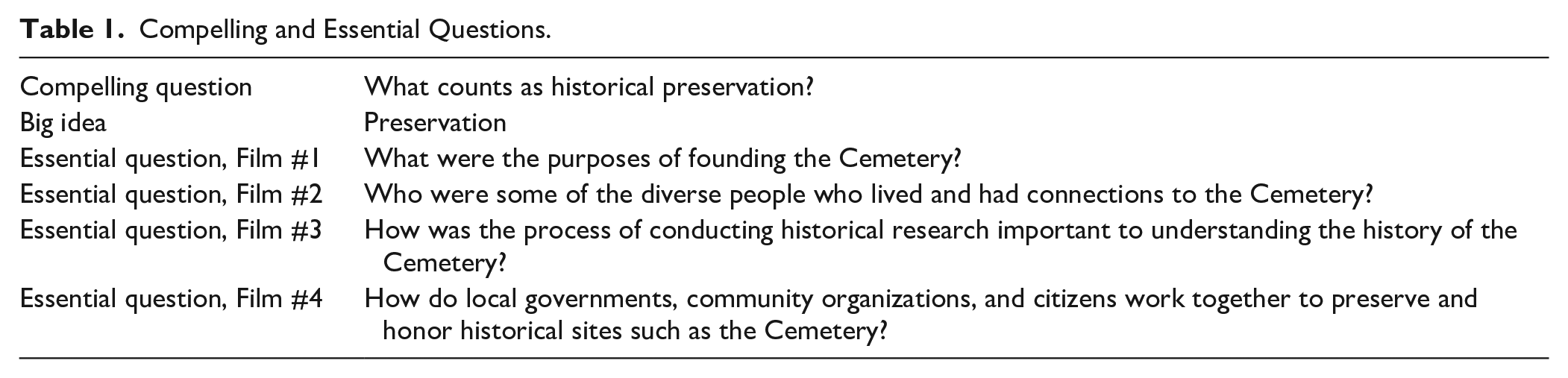
Four groups of eight students were established where they researched four specific topics about the Cemetery to prepare for the filming and production of the documentaries. Film #1 highlighted the historical contexts in which the Cemetery was founded from Reconstruction through the 20th century Great Migration. Film #2 focused on the diversity of their community and how enslaved African Americans, white settlers, and the Cherokee lived. Film #3 centered on the story of a former enslaved resident of the Cemetery and how the process of conducting genealogical research contributes to the process of historical research and preservation. Film #4 film emphasized the current efforts of the city and community to preserve the Cemetery.
Once the groups were established, students engaged in the first task of this project, which was to brainstorm responses to the project’s compelling question and questions that they wanted to ask during their interviews. Ten semi-structured interview questions were written collaboratively by the PI and students from each group. Group #1 interviewed a history professor from a state university about the Reconstruction and Great Migration eras. Group #2 interviewed an educator from a history museum about the interactions between Cherokee, African Americans, and white settlers during the 16th to 19th centuries. Group #3 interviewed a descendant of a resident buried at the Cemetery about his experiences doing genealogical research. Group #4 interviewed a public historian from a state university and a preservation director of another historic cemetery about how and why sites are preserved. Students delegated roles to who asked questions, took notes, transcribed the interviews, and reflected on how the information they learned from the interviews could support their research about the Cemetery.
Next, students analyzed primary and secondary sources pertaining to their topic about the Cemetery’s history that were provided by the local historical society. Students answered document-based questions and cited evidence from the sources to answer the essential question for each of their film topics. Afterwards, students created an outline with citations from documents and their interviews draft their film scripts. The target length of the films were five to seven minutes; therefore, the scripts were expected to be at least three double-spaced pages long. The scripts were finalized after several rounds of revision where the students worked with the PI of this study, historical society president, the leadership executive director, and another history professor (who was not interviewed for the films). One student from each group narrated the scripts that were recorded in the audio-visual lab at one of the participating high schools. The student production crew filmed location shots, included instrumental music, and edited the films. The PI, historical society president, and executive director, worked with the production crew with editing the films for length, clarity, and ensuring the chosen documents and interview clips aligned with the film narrations.
Two community film screening events were planned. The first event took place at one of the participating high schools. Over 200 people were in attendance that included the students, parents, the city council, current and past mayors, superior court judges, school board officials, the county district attorney, and the city’s U.S. House Representative. The second event was held at the university that received the grant in February 2022. Among the dignitaries recognized at this event included interviewees from Films #1 and #3. Students also screened Film #3 at two Rotary Club luncheons in the community.
Findings
Several major findings emerged pertaining to whether students demonstrated HE through conducting this local history research project. Many students believed that their engagement in conducting this research about the Cemetery contributed to their displays of cognitive and emotive aspects of HE, as seen in Table 2:
Survey Results, 24 Participant Responses.

Although these results are positive, the responses were self-reported by students. Therefore, further investigation of students’ insights from their reflections, questionnaires, and interviews were warranted to gain deeper understandings about how their involvement in this project promoted the cognitive and affective aspects of HE.
Examining Historical Contexts
Students explained in their reflections, questionnaires, and interviews that researching the historical contexts in which the Cemetery was founded helped them to become more aware of how diversity and race have entrenched roots in their community that span throughout the continuum of U.S. history. For instance, a student who was part of the group who interviewed the history professor noted regarding historical contexts and understanding the importance of the Cemetery today: The continuous cycle of what African Americans had to do with their circumstances because they had no other choice was saddening to hear. Although, the leaders who strived to make a change in their harsh reality were inspiring as well. The colorism, racism, and money problems discussed are still prevalent today. Knowing what the people buried at [the] cemetery were going through helps us understand the historical significance of this place (Reflection, September 16, 2021).
Furthermore, another student noted: During this project I was able to see that not only [this] is. . .a diverse area currently but also that it had diversity in past as well. I did not expect there to be a sole cemetery for African Americans during that age and the creation of these films really educated me on both status and culture at that time (Questionnaire, February 2, 2022).
Students identified the historical contexts of the Cemetery by analyzing how the socio-economic and political ramifications of the Trail of Tears, Civil War and Reconstruction, Great Migration, Jim Crow, and mid-20th century civil rights movement impacted the racial and ethnic diversity of their community.
Concerning race, students revealed that their participation in this project aided in their awareness of the effects of enslavement and racism in the context of their city’s history. Several participants replied that they felt “shook” about how “the minimal rights that African Americans once had” (Questionnaire, February 23, 2022). Another student stated: It [this project] forced me to open my eyes and dismiss the idea that [or city] is a sort of idealistic bubble — one that is devoid of the problems the rest of our country faces. The history of the. . .cemetery is not a pretty part of our community's history, but it's so crucial to recognize and accept because being ignorant of the struggles of past African Americans in this land would be a disrespect to them (Questionnaire, February 24, 2022).
These findings indicate that students’ research the historical contexts in which the Cemetery and its residents lived served as a catalyst for critically thinking about not only how systemic issues such as racism are relevant to where they live, but also how acknowledging this history can help their community to foster its diversity of cultures and perspectives.
Analyzing Perspectives
Students displayed their strongest engagement in HE through examination of the perspectives of those associated with the Cemetery and the way race is taught in their social studies classes. For example, one student stated, “I’ve been taking AP US History this year, and we learned a lot about what different ethnic and different regions have gone through, and I’ve never really understood that. So, I think doing this documentary really gave me that emotional perspective, and I’m able to apply it every day in class” (Interview, March 7, 2022). This student continued, stating, “I think it’s really interesting to me that those points of view are not included as much as the people who did the enslaving and were the oppressors so their stories get out, but slave stories are not as prevalent in curriculum (Interview, March 7, 2022). Another student asserted: I’ve always learned when we’re talking about slavery and that time and era of US history. This is what President Washington thinks. This is what Thomas Jefferson thinks. This is what Alexander Hamilton thinks. . .These are all perspectives of white, rich men who probably owned slaves, but we never get real true words or opinions from those who were enslaved unless we look for it ourselves” (Interview, March 7, 2022).
Additionally, a student shared about representation of diverse cultures in their schools: But it kind of allowed me to see that this diversity had been in the past, too, and these are the stories that need to be included in our textbooks, That needs to be better included because we actually recently had a Black History Club presentation, and they kind of explained to us more about how the lack of African American representation in our textbooks and how that information is kind of being shut down and not promoted as a whole when it has been such an integral part of our American history (Interview, March 8, 2022).
These students’ cognizance of the lack of representation of the voices, stories, struggles, and achievements of enslaved people and other marginalized groups highlights how their engagement in HE expanded into not only learning about the perspectives of others, but why certain narratives are excluded from the social studies and history curriculum. These sentiments highlight how these students yearned for more nuanced instruction that include greater representations of diverse perspectives and experiences in the social studies curriculum.
Affective Connections
Students demonstrated affective connections to their research at lower rates as compared to their displays of HE through examination of historical contexts and perspectives. According to Epstein and Shiller (2005), social identities refer to how students develop opinions, viewpoints, and biases based upon the gender, religious, racial, and ethnic backgrounds that they identify with. The majority of students in this study were white, East Asian, first-generation Indian Americans or immigrants from India who were not previously aware of the extent matters of racial discrimination played in the history of their community. According to one student, “This project made me realize how diverse the history of this area is, as it isn’t limited to just the immigrants who came to this area some years ago” (Questionnaire, February 1, 2022). Another student stated: I’m the daughter of two immigrants from India, so I’ve always had diversity and inclusion in the back of my mind whenever I’m doing anything. But I think I’ve really been immersed into this different perspective that I never would have been immersed in or would have known about. So, it has got me thinking that hey, there’s other people out there (Interview, March 7, 2022).
Furthermore, a student who researched the Indigenous history of the Cemetery explained: As high school students who live in this area of rich history and significance to the [Indigenous people], we ourselves can provide a unique perspective as a means to emphasize the importance of preserving this land to educate others who are unaware about the significance of this land. By establishing our unique ties to this project, we can craft an effective call-to-action that will convey the importance of preserving and spreading the history of the cemetery (Reflection, October 11, 2021).
These sentiments show that students expressed affective connections to their research by disseminating their research about this history with the documentaries can help with preservation and educational efforts about the Cemetery and the history of racial and ethnic diversity in their community.
Moreover, another theme that was prevalent in how students expressed their emotive responses to their research was through their perspectives on citizenship. According to Zembylas (2014) the affective nature of citizenship includes the “emotional relationships between citizens are recognized and endorsed or rejected, and how citizens are encouraged to feel about themselves and others” (p. 10). One student replied, “As citizens. . .I think our action speaks for itself on how the role of citizens in taking action on these issues is immense, because without them no action would be taken” (Questionnaire February 27, 2022). Another student stated: I was able to see how important the remembrance of ones family in a meaningful way could be. It was evident that not only did [face]struggle as an African American living at that time, but the other people buried in a cemetery who were not free as well. This building of a timeline allowed me to see past experience and further visualize how they have evolved and shaped the community we live in now (Questionnaire, February 2, 2022).
Two students mentioned “duty” regarding how their participation in this project connected to their sense of citizenship. One student said, “as a citizen of the community, I feel now more than ever having done this project, I feel almost the duty to do more of it and to expose and uncover these stories of people who have just been lost in time” (Interview, March 7, 2022). Another student remarked that participating in this project inspired them to post research articles and stories about diverse ethnic and racial groups to show “about how these wrongdoings. . .have been happening for years. . .and being someone who is the daughter of immigrants, it feels like a duty to me. But this project actually had me standing up for everyone and not just myself” (Interview, March 7, 2022). These responses show how students’ identities as citizens was a major factor in considering how they can apply what they learned about the Cemetery to take informed action on issues facing their community in the present.
While many students indicated that they believed that their participation in this project contributed to their appreciation for local history and community, some participants shared that they did not feel like they could identify as a citizen of their city. Two students who were immigrants remarked that while they felt they were part of their community, their citizenship identity was tied to their country of origin (Questionnaire, February 27, 2022). Ultimately, students’ demonstration of the affective elements of HE differed regarding their perspectives about citizenship and connections they had to being part of their community as a citizen. The affective connections might have been different had there been a greater representation of African American, Latinx, and Indigenous students in this project, or if this project was undertaken in a different community consisting of greater socio-economic, ethnic, and racial diversity. Ultimately, the students who participated in this study exhibited care for the community and about the historical significance of preserving and protecting the Cemetery.
Discussion
Our findings show that high school students can demonstrate HE through their participation in a place-based local history research project that is, conducted outside of traditional social studies classrooms due to several factors. First, the grant team’s frequent meetings and strategic planning of curricular design and implementation was crucial for the students to have clear objectives about the purpose of the project, data collection and analysis, and reflection to engage in the cognitive and affective tenets of HE. Clear communication among the college of education, non-profit leadership organization, historical society, and community stakeholders was essential to ensure not only the historical integrity of the documentaries, but to model for the students how to implement best practices when conducting interviews, asking questions, talking with adults and peers, and solving problems when working on community-based research and preservation efforts.
Second, students were able to demonstrate HE because they were able to make frequent trips to the Cemetery. The Cemetery is located in a convenient place where students were easily able to visit to conduct interviews, take pictures, and record film of headstones, trees, and other environmental features for the documentaries. By going to the Cemetery, students were able to interact with the land and the people who are involved with preservation, which made their research about the historical contexts and perspectives of the past much more relevant to the affective connections they made concerning how they felt about learning about Black history, historical preservation, and civic engagement. Students’ heightened awareness of the role of enslavement and racial segregation in the history of their community as expressed in the questionnaires and interview showed how the connections between how the historical context in which the Cemetery was founded during the Reconstruction shaped not only their perspectives about those in the past, but also the curricular deficits regarding African American representation in social studies textbooks and community celebrations.
Third, we found that students’ identities impacted their affective responses concerning their views on their roles as a citizen and the extent to which they could take informed action on a community issue based on their local history research about the Cemetery. Students’ identities as citizens, and their experiences as immigrants and grappling with their identities as citizens, was a driving factor behind their demonstration of HE because they believed it was their “duty” to share their findings about the challenges African Americans who are buried at the Cemetery faced as a way to address “wrongdoings” that had been committed against marginalized people and groups in the past (Interview, March 7, 2022). Ordinary places can bear tremendous meaning to communities. This cemetery is very inconspicuous because it is surrounded by a carwash, shopping plaza and parking lot, and backyards of homes in a country club (Appendix E). Local history research projects that aim to promote HE among high school students can provide powerful learning experiences where they can interact with a site and grapple with issues pertaining to power and oppression and how civic engagement in historical research can serve the community by educating people about why citizens should care about historical sites. In this case, students engaged in HE not only through their historical research about the historical contexts and perspectives of the Cemetery, but their reflections about curricular representations, diversity, inclusion, and what it means to be a citizen of a community.
Furthermore, the students who were involved in this project demonstrated affective connections to their local history research by expressing that they wanted to be involved with more work related to the Cemetery’s preservation. Overall, the students shared their desire to continue with the project but also to find future roles to be active in their community and to be more reflective when visiting new places. As they became more aware of the historical contexts of the Cemetery in their community, they made connections that there are more communities that need this work done. One student noted that this project made them realize that there are “different historical professions. . .I didn’t even consider them as career choices. . . But now after doing this project, I really feel like it could be a career path” (Field Notes, March 8, 2022). Having the opportunity to interview and research potential careers and impacts allowed this student to see how meaningful a career option this would be for them. While not every student shared this sense of finding a career, most of them described their willingness to participate in future civic projects within their community.
Limitations
Despite these findings, there were limitations to this study. Although several students noted that their work on this project exposed them to doing “true historical research” (Interview, March 7, 2022), some participants expressed the desire to conduct more research independent from the curated sources that were provided for them on the Google Classroom. One student shared, “I think it could’ve been better if we were guided on how to conduct research and find our own sources, rather than skipping that and giving us sources” (Questionnaire, February 24, 2022). Unfortunately, COVID-19 restrictions prevented visits to the physical archive. Implementing more project-based techniques that engaged participants in more student-centered collaborative research in developing interview questions, crafting research questions, and finding primary and secondary sources to complete their production of the documentaries could have involved them more in the research process and engagement in HE.
Another limitation to this study is that there were not any African American students who participated in this project. The demographics of the community where this study took place are representative of the student bodies of the schools that participate in the leadership program. The fact that the students who participated in this project are high-achieving and attend schools in more affluent suburban areas also highlights the issue concerning whether a local history research project such as this one could be implemented with students who attend economically disadvantaged schools where opportunities such as this leadership program may not accessible (Johnson & Larwin, 2020; Ricciardi & Winsler, 2021). Eliciting more diverse students from different communities who may be part of organizations such as non-profit leadership groups, museums, and cultural institutions in future studies may provide greater insights on how student engagement in local history research can support the demonstration of HE through community place-based projects (Pendharkar, 2022).
Implications for Future Research
Despite these limitations, there are several avenues for future research stemming from this study. First, there is an urgent need to examine the impact that “anti-divisive concepts laws” that were passed in 17 states, including where this study was conducted, could have on the community partnerships that focus on promoting HE through local history research projects with students about topics such as race (Bernstein, 2022). A major aspect of students’ demonstration of HE in this study were their critiques of the social studies curriculum regarding the absence of the histories about marginalized and underrepresented racial groups and people. Community buy-in of this partnership to conduct this project may have been different if these laws were passed prior to the start of this project about the Cemetery. According to a recent RAND study, 25% of about 8,000 educators who work in states where anti-divisive concepts laws are in effect reported that “limitations placed on how teachers can address topics related to race or gender have influenced their choice of curriculum materials or instructional practices” (Woo et al., 2023, p. 2). Consequently, scholarship is warranted on how these laws may impact whether place-based institutions and community entities can continue to collaborate with schools and students on local history research and HE if exhibits and programs focus on historical and contemporary issues concerning race.
Second, we call for further research on the role of students’ identity when engaging in the affective aspects of HE. According to Perrotta (2018b), an “HE Gap” exists regarding how white and Asian students demonstrate cognitive aspects of HE as opposed to how Black and BIPOC students display the affective tenets of HE. The students in this study were mostly Indian, Southeast Asian, and white who displayed strong cognitive skills concerning analyzing documents to explain historical contexts and perspectives of people from the past. Endacott and Brooks (2018) assert that “it would be valuable to know more about the role that identity plays in students’ engagement in historical empathy” (p. 221), especially where matters of race are concerned. As a result, we recommend that more studies are needed to examine how this “HE gap” can be closed through the implementation of equity-based strategies with culturally relevant pedagogies (CRP) that leverage community resources that support the socio-economic and political consciousness of issues facing communities in spaces in and outside the classroom (Ladson-Billings, 1995).
Third, we recommend that further scholarship be pursued to examine how the implementation of a project such as this one that is, aligned to NCSS C3 Framework can not only promote HE, but also college and career readiness. Several students expressed their realization that the skills they learned from doing this project contributed to their awareness of potential careers in the humanities and social sciences. One student remarked: I will bring up the professionals that we worked with to form the documentary, as I was previously unaware that their field of work existed. Their presence alerted me to the many different fields of work and types of people out there, many of which I still know nothing about (Field Notes, February 27, 2022).
According to research by New et al. (2021), 30 out of 50 states and Puerto Rico that adopted the C3 Framework since 2013, focusing on curricular skills such as citing evidence, developing questions to drive inquiries, evaluate the reliability and credibility of sources, demonstrate basic civic knowledge, and use evidence to support arguments (p. 244). Although the cognitive goals of HE are implied in these standards (Perrotta, 2020), this study did not indicate whether these standards focused on the career preparedness and college readiness, particularly among high school students. For HE to be a sustained aspect of civic life, students need to be able to explore academic studies and career possibilities in professions that involve documentary collection and analysis, and historical inquiry. Therefore, we suggest that future studies be conducted to analyze whether utilization of the C3 Framework in local history and place-based research promotes academic and professional pursuits in the social studies content areas.
Fourth, further studies are needed to examine how establishing and maintaining collaborations between student leadership organizations, place-based educational providers such as museums and historical societies, and community stakeholders can support students’ demonstration of HE. Strand et al. (2003) assert that researchers who forge “long-term relationships” with community partners “characterizes community-based research” (p. 7). Once this study concluded, the PI and executive director of the leadership program pursued another grant opportunity for the following school year to continue engaging students in the leadership program in local history research about the impact of COVID-19 on the community. Some students who worked on the Cemetery project participated in this endeavor, which resulted in the curation of a traveling exhibit of artifacts they collected from community members and publishing of a companion book documenting their research process. Uppin and Timoštšuk (2019) note that maintaining community collaborations “must be an individualized partnership rather than client-customer relationship, if we aspire to teach historical empathy in the museum” or in other spaces (p. 323). Hence, we recommend that future studies focus on how educators in schools, placed-based community entities, and other civic organizations can foster sustained partnerships through program evaluation and assessment to meet the needs and goals of educators and stakeholders through engagement in local history research and HE.
Conclusion
Our findings show that local history research projects that students conduct beyond traditional classroom instruction can foster HE, particularly when the research is relevant to a topic that students care about. Students’ engagement in HE did not end once the community events concluded. In March 2022, students spoke at a city council meeting urging for continued support from the city for restoration and preservation of the Cemetery. Shortly after this meeting, the city’s purchase of the Cemetery was formalized, meaning that there are more municipal funds, and infrastructure available to continue restoration efforts. However, more work needs to be done to raise awareness of the urgency to preserve this space and other local history sites in communities across the country. Our hope is that this project can be a call to action to K-12 teachers and other educational providers that HE can be promoted in and outside of the classroom through local history research to foster historical inquiry and civic engagement that contributes to the common good of communities.
Footnotes
Appendix A
Appendix B
Appendix C
Appendix D
Appendix E
Acknowledgements
Acknowledgments to members of Student Leadership Johns Creek; Mercer University Tift College of Education; Johns Creek Historical Society; interviewees from the Atlanta History Center, Atlanta Metropolitan State College and Georgia Institute of Technology, Kennesaw State University, Hidden Voices LLC, and Oakland Cemetery in Atlanta; A-V faculty at Centennial High School; and all student researchers and film crews from Centennial High School, Chattahoochee High School, Johns Creek High School, and Northview High School.
Declaration of Conflicting Interests
The author(s) declared no potential conflicts of interest with respect to the research, authorship, and/or publication of this article.
Funding
The author(s) disclosed receipt of the following financial support for the research, authorship, and/or publication of this article: This Georgia Humanities grant-funded project was a collaboration between Mercer University Tift College of Education, the non-profit Student Leadership Johns Creek organization, and the Johns Creek Historical Society.
