



Abstract
When the Abraham Accords were announced in 2020, some lauded these deals as a groundbreaking advancement in Israeli–Arab relations, whereas others saw them as backstabbing the Palestinians. The 2002 Arab Peace Initiative (API), largely ignored by Israel, offered normalized relations with Israel in exchange for withdrawal from the 1967 Occupied Territories, the establishment of a Palestinian state, and a resolution to the Palestinian refugee situation. However, the four Arab states that established relations with Israel under the aegis of the Abraham Accords did so despite Israel’s failure to fulfill API conditions. Given the dismay of many in the region regarding this move and the turnaround in decades of official policy toward Israel, this article investigates the rationale provided by the Arab states for making this diplomatic shift, drawing on quantitative and qualitative data. The study examines the messaging of Arab states and analyzes the economic, geostrategic, and sociocultural justifications in the official media outlets of the four states—the UAE, Bahrain, Morocco, and Sudan, including comparisons with US and UK press. Specifically, it seeks to understand the justifications Arab state elites provided for shifting their policies toward Israel despite the historical conditions set by the API and whether they acknowledge the concerns of Palestinians in their discussion of the Accords. Quantitative findings suggest that media coverage of cooperation varied across the Arab signatories. The coverage in the UAE and Bahrain tended to be more frequent, optimistic, and focused on general and economic cooperation with Israel. In comparison, there tended to be more varied media coverage of the Accords in Sudan and Morocco. Qualitatively, results show that overall economic justifications tended to be used more frequently, and Morocco used sociocultural explanations more than others. Further, the agreements were not presented as peace agreements, unlike how the Accords were discussed in the US and UK press.
Introduction
Since the creation of Israel in 1948, most Arab states have refused to engage in official diplomatic relations with it. Although Egypt and Jordan signed formal peace agreements with Israel, many Arab states continued their boycott (at least on paper). A few attempts at normalizing relations between the Arab states and Israel, notably the Arab Peace Initiative (API), which was extended in 2002 and 2005, were ignored by Israel. However, in 2020, the United Arab Emirates (UAE), Bahrain, Sudan, and Morocco recognized Israel and established diplomatic relations under the US-sponsored Abraham Accords framework. Given that many Palestinians and others in civil society rejected these agreements, which contradicted years of official Arab positions and did not require Israel to abide by any of the conditions outlined in the API regarding Palestine. Given the critique leveled at Arab states for shifting their official policy, this study investigates the rationales provided by Arab states for normalizing relations with Israel. In particular, it explores whether the regimes gave economic justifications (tying into the peace through trade and/or neoliberal greed critiques), geostrategic reasons (i.e., shared concern about Iran), or used sociocultural explanations (pointing to shared Abrahamic heritage). In other words, how did Arab states feel they could best “sell” an otherwise unpopular policy position to their populations (Kassin & Pollock, 2022)?
This question sheds light on the evolving relationship between Arab states and Israel and the competing interests of Arab populations and their governing regimes. The Abraham Accords represent a pivotal shift in the geopolitics of the Middle East, with the potential to reshape regional dynamics and alliances, especially with the likelihood of Saudi Arabia also joining the Accords. However, the article’s purpose is not the long-term impact of these Accords, which are still unfolding, but rather how Arab states explained and justified the agreements to their populations.
Background of the Abraham Accords
What is often termed the “Arab–Israeli conflict” has dominated much of the international relations scholarship on the Middle East. Israel has traditionally sought normalization of relations with Arab states, which have collectively boycotted Israel for decades. In contrast, the Arab states have sought Israel’s withdrawal from occupied Arab lands and a resolution to the Question of Palestine. In August 2020, however, the UAE announced it was establishing full diplomatic relations with Israel without any Israeli territorial withdrawal in return. The agreement, brokered by then-US President Donald Trump, included a promise by then-Israeli Prime Minister Benjamin Netanyahu to halt further Israeli annexation of Palestinian territories but not to reverse existing occupation (Bin Zayed, 2020). This agreement marked the beginning of the Abraham Accords—a series of agreements between Israel and Arab states (see Figure 1).
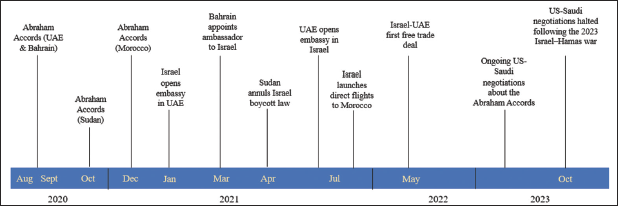
On October 23, 2020, after the United States removed Sudan from the State Department’s blacklist of state sponsors of terrorism, Sudan and Israel announced the normalization of relations (Amin, 2021). After months of denying rumors about normalization with Israel, Morocco—which historically had and still has the largest Jewish minority in North Africa (Boum, 2013)—joined the Accords on December 10, 2020, in exchange for the US recognition of Moroccan sovereignty over the disputed Western Sahara.
The Abraham Accords generated two main responses from the public. One side celebrated these agreements as a milestone for peace in the Middle East. In contrast, others criticized them as a betrayal of the Palestinian cause, suggesting they were motivated by economic and political gains rather than a desire for peace. While they might cement a “negative” or “cold” peace with an absence of armed conflict, they did not reflect what Galtung (1965, p. 2) calls a “positive” peace with a pursuit of rights, freedom, and justice. Israel’s relations with Egypt and Jordan have similarly been described as a “cold peace” since, although their peace treaties have lasted decades, the countries lack “warm” relations with neither extensive cultural dialogue nor a large exchange of tourists (Miller, 2016; Satloff, 1995). Some view the Abraham Accords in a broader geopolitical context (Al Ketbi, 2020). Yossef, for example, argues that the Middle East is divided into two major alignments: the “status quo” alignment and the “revisionist” alignment; the status quo alignment includes Middle Eastern states with close ties to the United States, advocating coexistence with Israel, the revisionist alignment, opposes Western influence and is more confrontational with Israel (Yossef, 2021). He notes that the Accords enabled Israel to improve relations with status quo Arab states, particularly in the Gulf, as they face common threats from the revisionist alignment; in addition, they have shifted the focus away from the Israeli–Palestinian conflict and toward broader regional dynamics.
Some Israeli commentators, however, view the Abraham Accords as introducing newer challenges, touching on geopolitical, religious, and identity-related concerns for Israel. Shmuel Trigano (2021) warns that while the Accords have been portrayed positively by the Israeli media, stressing development and consumer-oriented framings of the benefits (e.g., tourism, business opportunities, etc.), this portrayal downplays complex challenges for Israel, especially in terms of its military and spiritual relations with Muslim and Arab countries and their regional rivals, as well as concerns about the threat of an influx of Muslim pilgrims to Jerusalem and the al-Aqsa Mosque.
However, these analyses do not explore the perspective of Arab signatories or how they tried to sell the Abraham Accords to their domestic audience. By addressing this gap, the article contributes a more comprehensive understanding of Arab state perspectives regarding the relative merits of the Accords to their states. It may also provide insight into gaps between state regimes and their publics. While the article does not examine the public’s responses to the Abraham Accords, particularly in terms of social media and other commentary, due to space constraints, it sets the stage for further research on alternative framings of the Abraham Accords different than those posed in official state media by the Arab state signatories.
The Arab Boycott of Israel and Arab Peace Initiative
The Arab boycott predates the official establishment of Israel. One of its earliest instances is the Fifth Palestine Arab Congress’s 1922 resolution that called for an Arab boycott of Jewish businesses and products in Palestine (Fershtman & Gandal, 1998). The Arab League later spearheaded this boycott after its formation in 1945, aiming at aborting the Zionist political ambition of creating the State of Israel in the then Mandatory Palestine. It was reinforced and extended with the establishment of Israel and the latter’s “refusal to let the 750,000 Palestinians, who had fled in 1948, return to their homeland” (Kalyal, 2001, p. 169).
Following the 1973 October War between Israel, Egypt, and Syria, the United States mediated a peace treaty between Egypt and Israel in 1979, ushering in the first full normalization agreement between Israel and an Arab state. This deal marked a significant shift in the international initiatives to resolve the Arab–Israeli conflict and led to Egypt’s ouster from the Arab League. The Madrid Peace Conference that followed the 1991 Gulf War was another turning point in Arab–Israel relations. Multiple technocratic working groups emerged from the conference, and it laid the foundation for the Oslo Accords, as well as the 1994 Israel–Jordan peace agreement. The controversial Oslo Accords between the Palestinian Liberation Organization (PLO) and Israel also led to a series of meetings and economic summits that included Arab states to pave the way for broader diplomatic and economic relations with Israel (Said, 1993). In late 1994, for instance, the Gulf Cooperation Council (GCC) officially ended the secondary and tertiary aspects of the Arab League boycott of Israel, thereby relaxing its enforcement (Fershtman & Gandal, 1998). In the same year, on October 26, Jordan signed a peace treaty, making it the second Arab state to establish full relations with Israel. The hype surrounding these agreements and the associated US-promised economic “peace dividends” also induced Morocco and Tunisia to exchange liaison offices with Israel and begin direct economic relations (Kalyal, 2001). However, the onset of the Second Palestinian Intifada in September 2000 challenged and even reversed this growing shift toward normalization.
Despite the increased violence and polarization during the Second Intifada, partly in response to the 9/11 terror attacks, Saudi Crown Prince Abdullah unveiled the API at the 2002 Arab League Summit. The API proposed the establishment of full diplomatic relations with Israel in exchange for Israeli withdrawal from the 1967 Occupied Territories, the establishment of an independent Palestinian state, and the resolution of the Palestinian refugee question. Endorsed by the members of the Arab League and Organization of Islamic Cooperation, the API signified the first major shift in Arab states’ “three Nos” (No to peace with Israel, no to recognition of Israel, and no to negotiations with Israel) from the Khartoum Arab League Summit in 1967 (Podeh, 2014, p. 598). Re-issued in 2005, the API never received any official response from or indication of interest by the Israeli government (Podeh, 2014). Podeh attributes this Israeli disinterest in the API to Israel’s unwillingness to make territorial concessions, underestimation of the significance of the shift in the Arab position that the API signified, and the negative reputation the Arab League and Saudi Arabia have in Israel (Podeh, 2014, p. 601).
Normalization: Why Former Enemies Cooperate
In the context of the Arab and Muslim world, normalization (or lack thereof) is a contentious concept that shapes the dynamics of the Arab–Israeli conflict. Normalization can be defined as “the process of building open and reciprocal relations with Israel in all fields, including the political, economic, social, cultural, educational, legal, and security fields” (Salem, 2005). Whereas Israel and most of the West regard the establishment of full diplomatic relations between Israel and Arab states as a positive step toward peace and stability in the Middle East, it is generally associated with negative connotations among the Arab and Muslim public, partly because of the ongoing occupation of Arab territories, including the West Bank, Gaza Strip, and Golan Heights. Critics of normalization assert that such agreements do not acknowledge the unequal power relations between the occupier and occupied, thereby “normalizing” oppression and inequality. True reconciliation from this perspective requires an end to Israeli occupation and the provision of Palestinian self-determination and human rights.
Despite the previous wars and boycotts that characterized Israeli–Arab relations, some diplomatic and political breakthroughs did take place, namely the peace agreements as mentioned above by Egypt and Jordan with Israel. The literature on these agreements provides one set of answers to the question of how and why former enemies choose cooperation and “peace,” albeit negative and cold peace in these cases (Miller, 2016). Although 40 and 25 years respectively before the Abraham Accords, these cases are useful comparisons. Some explanations emphasize economic considerations, while others stress political, geopolitical, and security factors. Powerful third parties, primarily the United States, are essential in realizing these agreements (Aulas, 1983). Critically, these peace agreements were between states that had previously been at war and did not include efforts to reconcile their respective populations in pursuit of a warm peace. The Abraham Accords, in contrast, occurred primarily between states which had not been at war with Israel, and thus cannot be classified as peace agreements.
Economic Explanations
Efforts in support of normalizing Arab–Israeli relations tend to stress the positive role of normalization in increasing mutual gains through interstate cooperation and reducing the likelihood of conflict and regional rivalry. The scholarship in political science and social psychology advances several economic, geopolitical, and sociocultural arguments. The first major explanation for cooperation between former enemies is rooted in liberalism and assumes that economic interdependence and cooperation will incentivize states to focus on absolute, rather than relative, gains (Oneal et al., 2003). A similar line of research stresses the role of interstate peacemaking in setting up conditions conducive to greater interdependence via trade exchanges and common markets; this, in turn, should create incentives to maintain or further cooperation (Efron & Robinson, 2021; Peres & Naor, 1993). Normalization through economic collaboration between Israel and Arab states can create opportunities for trade, investment, and security cooperation, resulting in economic growth, job creation, and improved living standards for the citizens in the region, thereby creating so-called peace dividends (Efron & Robinson, 2021).
The Israeli–Egypt peace agreement increased the hope of legitimacy for Israel through Arab recognition, and normalization provided Egypt with economic benefits, albeit at the expense of temporary regional isolation. For Egypt and Jordan, increased trade with Israel was promoted as an opportunity to access new markets and investment opportunities. For example, following the signing of the Camp David Accords, Egypt secured a significant amount of financial aid from the United States, which helped to stabilize its economy (Ripsman, 2016). Although normalization was opposed by most mainstream Egyptian intellectuals and the general public, Egypt’s leaders felt normalization would reap dividends not only in terms of financial capital but also social capital with Western governments (Abadi, 2019; Cohen & Azar, 1981). The United States extended substantial efforts intervening in Egypt’s internal socio-economic dynamics, hoping to convince elites that normalization was a form of “progress” (Aulas, 1983). Thus, while partially driven by internal economic concerns, external pressures also encouraged normalization.
Geopolitical and Security Explanations
Other explanations for how and why former enemies sign peace agreements stress the role of geopolitical and security considerations. Normalization is seen as a way of mitigating interstate distrust between Arab states and Israel and creating conditions for peaceful conflict resolution and cooperation. International relations scholarship underscores the role of bargaining failure because of incomplete information and points to commitment problems as key causes of interstate conflict (Fearon, 1995). Such explanations imply that establishing formal relations and gradually strengthening interstate ties will increase access to credible information about actors’ intentions, as well as signal commitment to cooperation and peaceful conflict management (Frieden et al., 2015).
Realist scholarship on cooperation points out the role of ideological enemies cooperating to fend off shared enemies that they regard as more threatening; under these conditions, material threats supersede ideological considerations (Mearsheimer, 2001). Illustrative examples include the United Kingdom’s cooperation with the Soviet Union against Germany during World War II, despite British Prime Minister Winston Churchill’s anti-communist attitudes. In the case of the Accords, both Israel and the UAE share security concerns regarding Iran, particularly the latter’s nuclear arms ambitions and regional expansionist ideological and military policies. Recent research, however, challenges this claim in its extreme formulation and offers more nuanced scope conditions, such as ideological vulnerability and distance, to explain the conditions under which enemies of enemies become friends or remain enemies (Haas, 2022).
From a security standpoint, Egypt and Jordan saw the potential for cooperation with Israel to enhance regional stability. For Egypt, normalization reduced the cost of military spending, diminished the risk of future military conflict, and secured its borders. Similarly, for Jordan, the peace treaty reduced the threat of external aggression and helped secure its border with Israel (Haddadin, 2011). Geopolitically, both countries recognized that their alignment with Western powers and cooperation with Israel could help improve their relations with the United States in particular.
According to the literature, peace agreements made for security reasons are often top-down and are often made by heads of state despite social opposition (Ripsman, 2016). While in some cases, a second peacebuilding stage establishes public buy-in through engaging civil society on both sides of the agreement, this has yet to happen with the Egyptian and Jordanian agreements. Hence, Israel’s relations with Egypt and Jordan have often been described as a type of cold peace, rather than warm peace, which would be characterized by high levels of cooperation, mutual trust, and positive interactions—since relations between these states, while lacking any direct confrontation, have been marked by distrust and periodic episodes of tensions (Satloff, 1995).
Sociocultural Explanations
Normalization of relations between former enemies is also argued to create conditions for cultural exchange and interactions that can help the public enhance their understanding of each other. According to contact theory, these sociocultural interactions can help weaken negative stereotypes and prejudices, break *the* us/them divides, and enhance mutual trust, respect, and humanization (Allport, 1954; Pettigrew, 1998). In other words, cultural normalization can help change negative stereotypes, humanize the enemy “other,” and set the stage for peace (Davies & Kaufman, 2002). Sociocultural explanations suggest that peace is built through strengthening ties not between elite leaders but rather between the general population. Such approaches, in contrast to formal peace agreements between states that seek to end the bloodshed, often emphasize the psychological impacts of social hatred and stereotypes and the importance of building connections between civil society groups in the respective populations (Kelman & Fisher, 2017).
Scholars from this perspective differentiate between a settlement that addresses surface tensions and a peace agreement that addresses root causes (Burton, 1990) and stress the need to address psycho-social dimensions, as well as geostrategic and security dimensions of peace (Burton, 1990). Several track-two diplomacy and problem-solving efforts over the decades have built on this approach, with a goal not just of cold peace but also of eventually reaching a warm peace that, in their view, will be more durable than an elite-only agreement (Rafferty, 2017).
Both Egypt and Jordan’s peace agreements with Israel were framed as an opportunity to promote cultural exchange and tolerance between Israelis and Arabs, although this did not come to fruition despite provisions for cultural exchange and tourism between the countries (Akehurst, 1981). Arab elites did not always frame the goals of normalization in these terms, focusing instead on economic and strategic goals; Israeli leaders historically were keener on the possibility of “warm peace” between the states (Cohen & Azar, 1981). Here, the article explores the stated goals of Arab state signatories to the Abraham Accords vis-à-vis cultural normalization.
Research Design
Building on this literature, this article examines whether state elites in the UAE, Bahrain, Morocco, and Sudan cite economic, geostrategic, or sociocultural rationales for their policy shift toward Israel. Whereas previous research has explored Israeli and Moroccan civil society perspectives (e.g., Hallward & Biygautane, 2022, 2023), this article focuses on the perspective of Arab states, exploring which arguments for normalization are used by Arab state elites when discussing this top-down initiative. Specifically, the article tracks which justifications are commonly used in official news outlets that serve as the voice of the regime to their public. Our research question, therefore, asks, which types of arguments for the Abraham Accords are used most prevalently by Arab state elites? How do regimes justify their policy shift to their populations?
Based on the economic, geostrategic, and sociocultural explanations in the previous section, this article explores four testable hypotheses. The first hypothesis tests that the tone of domestic Arab media coverage of relations with Israel following the announcement of the Abraham Accords will likely be more optimistic than pessimistic, although this optimism will be affected by regional conflict events, particularly those involving Israel and Palestine. A second hypothesis examines that domestic media coverage of the Abraham Accords will focus more on economic reasons for cooperation than other forms of cooperation. A third expects signatories with higher shared economic and security interests with Israel, such as the UAE, will demonstrate higher cooperation with Israel than states with lower levels of shared interests, such as Sudan. Finally, hypothesis four expects that Morocco, which has a significant Jewish population, is more likely to emphasize sociocultural approaches to peace compared to the other signatories.
To test these assumptions, the article examines media coverage of the Abraham Accords in the Emirati, Bahraini, Moroccan, and Sudanese media. It first uses quantitative data generated using Google’s Global Database of Events, Language, and Tone (GDELT) project to explore the media coverage of the Arab Abraham Accords signatories of events related to the Accords. The GDELT Project is an open news index that collects, translates, and monitors global news content from 1979 to the present. It codes news data along three main themes: actor attributes and event action attributes (the authors focus on terms such as economic, military, and diplomatic cooperation), as well as the tone of the coverage.
GDELT allows access to the media coverage of countries worldwide and a wide range of event action attributes ranging from cooperation, disputes, humanitarian aid, and so on. To test the article’s hypotheses, the authors limited the results to the UAE, Bahrain, Morocco, and Sudan and focused on event action attributes related to different types of cooperation. Hence, regarding actor attributes, the authors set the UAE, Bahrain, Sudan, and Morocco as ACTOR 1 and Israel as ACTOR 2. For event action attributes, the focus is on Intent to Cooperate (General), Intent to Cooperate Economically, Intent to Cooperate Militarily (as a proxy for geostrategic cooperation), Material Cooperation (General), Economic Cooperation, and Military Cooperation. The “Cooperate Militarily” variable might not fully capture intelligence cooperation since these types of agreements are often agreed on and conducted away from the public eye.
Regarding the tone of media coverage, the authors look at whether it was optimistic or pessimistic, which provides a sense of the extent to which the Accords are portrayed positively or negatively. The article uses the Tableau software package to visualize the data collected from GDELT. Specifically, it analyses the types of cooperation frequently mentioned in the news coverage of the Arab signatories, looking at which types of cooperation were most associated with Israel by the press coverage of Arab states in the time period surrounding the announcement of the Accords. To add context and more nuance to the quantitative data, the authors do a qualitative text analysis of a sample of articles covering the Abraham Accords from two major news sources each in the UAE, Bahrain, Morocco, and Sudan—along with two each from the United States and the United Kingdom for comparative purposes. The authors collected eight articles per signatory country, focusing on coverage immediately surrounding the signing of the Accords (two articles per news outlet, two news outlets per country), and coverage of salient events relevant to our hypotheses, such as high-profile diplomatic visits or additional cooperation agreements. Articles were collected in time frames that corresponded with event spikes in the GDELT data. Table 1 shows the sources of the collected articles.
Sources of the Sample Articles Used for Qualitative Analysis.

Selected newspapers were all state-owned or state-affiliated (including a few independent sources), publicly accessible online, free, and reflected a range of Arab perspectives in English and Arabic. For the first two articles, the authors restricted the Google News search to the first two weeks following the announcement of the Abraham Accords. The authors then picked a second spike in the data for additional sampling. Since GDELT does not provide information on exactly which events are causing the spikes in coverage, the authors either included samples covering both events if there were multiple possible events in the period (e.g., high-profile state visits, embassy openings, etc.) or focused on coverage of only one event across different newspapers if the coverage allowed. The identified news sources did not always report on specific salient events within our specified time frames, and sometimes coverage tended to focus on the domestic implication of events, especially in the case of American news sources. It is worth noting, however, that these instances were limited.
The authors translated the Arabic articles into English prior to analysis. Articles were then coded thematically based on patterns of interest, namely the extent to which explanations for the Accords were couched in economic, geostrategic, security, and sociocultural terms.
Quantitative Findings
Tone of Coverage
Hypothesis 1 suggested that the overall tone of the press toward the accords would be positive. This hypothesis was generally supported. The related prediction that patterns of domestic media coverage about cooperation would be affected by regional conflict events, particularly those involving Israel and Palestine, was also supported by the data.
As Figure 2 shows, between 2020 and 2022, optimistic comments spiked following key events in the UAE (e.g., the signing of the Abraham Accords, economic or military agreements, high-profile visits, etc.); the most notable spike, as expected, is in the period following the announcement of the Abraham Accords in August 2020, which reached a peak of 545 optimistic articles. Pessimistic comments, by contrast, remained exceedingly low during the same period; the only notable exception is a slight increase in pessimistic comments in 2021 at 70 pessimistic mentions in May 2021, which coincided with the Gaza war between Israel and Hamas in May 2021. Israel received critical comments from many international actors during this period, including calls for a ceasefire from some of the Abraham Accords signatories, such as Morocco and the UAE.
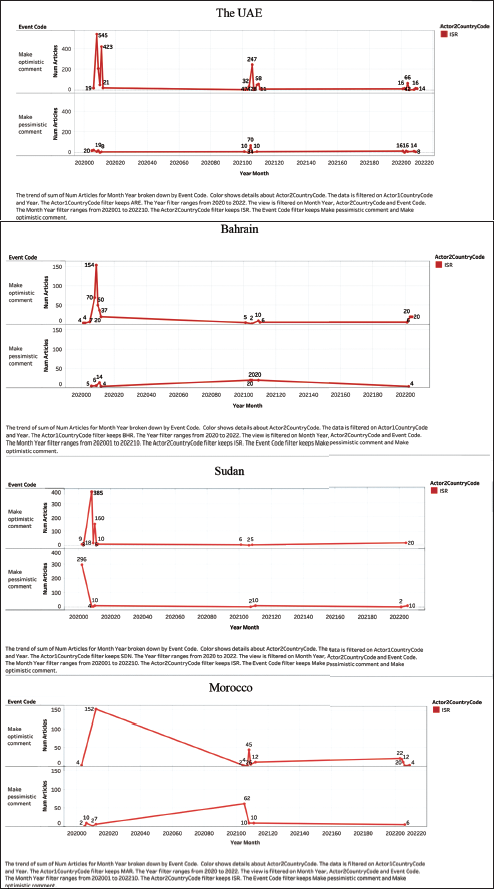
Likewise, Bahraini coverage showed an identical pattern, albeit at a lower frequency. Bahraini newspapers included 154 optimistic mentions in September, following the official signing of the Abraham Accords. This number is high relative to the only 20 pessimistic mentions during the same month but relatively low compared to the Emirati coverage. Like the UAE, Bahraini’s pessimistic coverage increased slightly during the Gaza war. This suggests that although these Gulf countries made dramatic outward shifts in their foreign policy positions vis-à-vis Israel, they still signaled concern about Israel’s actions vis-à-vis the Palestinians.
The coverage of Sudan and Morocco showed more variation in their optimistic and pessimistic comments about Israel and the Abraham Accords between 2020 and 2022. Unlike in the UAE and Bahrain, Sudanese press saw spikes in pessimistic comments before the Accords (296 mentions on February 21, 2021), as well as multiple waves of optimistic comments following the announcement of the Accords in the fall of 2020. Moroccan press showed a sharp increase in optimistic comments after the Accords, followed by a gradual decrease and then a small spike. Simultaneously, pessimistic comments gradually increased, reaching a peak during the May 2021 Gaza War. Interestingly, Morocco saw a relatively higher frequency of pessimistic comments during the Gaza war compared to prior months; this is likely the case since the anti-normalization and pro-Palestine civil society in Morocco is freer and more vocal than that in some of the other Accords signatories.
Overall, these initial results provide some support to hypothesis 1 on tone, although it is less supported in the cases of Sudan and Morocco. Similarly, the data indicates a change of tone in media coverage during the May 2021 war in Gaza.
Types of Cooperation
Hypothesis 2 predicted that domestic media coverage of the Abraham Accords would focus more on economic reasons for cooperation than other forms of cooperation. Hypothesis 3 predicted that signatories with higher shared economic and security interests with Israel, such as the UAE, would demonstrate higher cooperation with Israel than states with lower levels of shared interests, such as Sudan. Figure 3 captures the extent to which Emirati, Bahraini, Sudanese, and Moroccan newspapers mentioned the intent to cooperate in general and to cooperate economically and militarily with Israel. Figure 4 shows media coverage of actual cooperation in these areas.
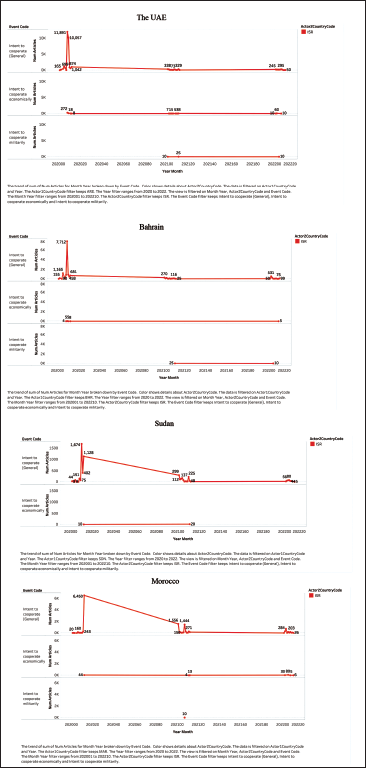
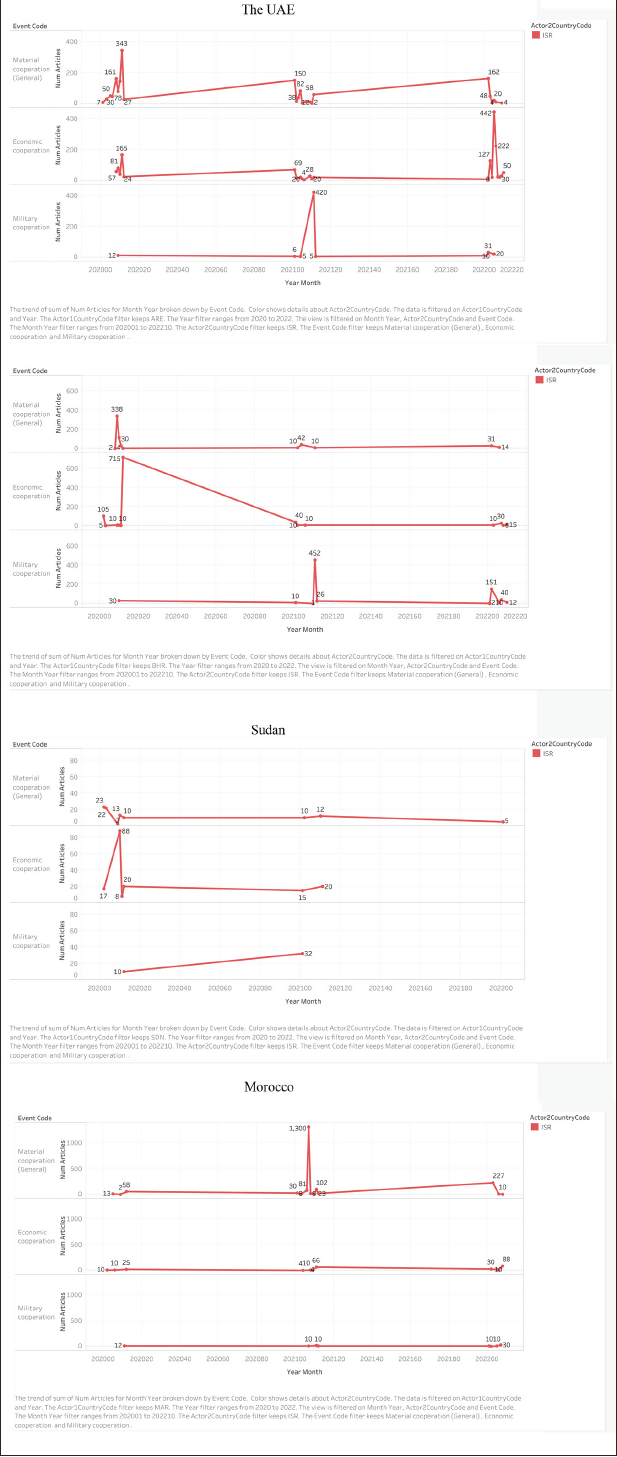
The media in the UAE and Bahrain included significant mentions of engaging in general material cooperation and economic cooperation in the first months following the Accords, indicating that both countries were committed to immediate cooperation. By contrast, in Sudan, there is only a moderate number of mentions related to engaging in general material cooperation. In addition, there is a gradual increase in mentions of engaging in military cooperation in the second year; however, the data suggest that Sudan did not signal an immediate commitment to extensive material and economic cooperation compared to the UAE and Bahrain. In all countries, mentions of engaging in military cooperation were scarce in the first year and only surged in the second year. Overall, compared to the UAE and Bahrain, Sudan’s levels of cooperation with Israel are significantly low at all levels. While these results offer additional evidence supporting hypothesis 3, the fact that these countries also showed evidence of, albeit, delayed military cooperation, in addition to economic cooperation, challenges hypothesis 2, which predicted economic cooperation over other forms of cooperation.
Different from the other three states, the Moroccan press made little mention of engaging in cooperation of any sort in the first year. Engaging in material cooperation spiked in July 2021 at 1,300 mentions, followed by a small increase in November; these bumps in press coverage coincided with the announcement of direct flights between Israel and Morocco in July 2021, cementing the objectives of increasing tourism, trade, and economic cooperation that were outlined in the Abraham Accords (Scheer, 2021). Further, November of 2021 witnessed the signing of the first defense agreement between Israel and Morocco.
Overall, these results indicate that while the UAE and Bahrain were relatively similar in the magnitude and speed of their commitment to various forms of cooperation with Israel, Sudan and Morocco showed greater variation and have taken a slower-paced approach to normalization. One possible explanation is that Morocco and Sudan have more vocal and critical domestic opposition that they need to navigate (Al Jazeera, 2021). Other possible explanations include the relative wealth of the countries, geographic proximity/distance, and shared strategic enemies. These results also support the expectation that the Arab signatories’ media coverage of the Accords would emphasize economic reasons—although military cooperation also appeared significant in the cases of the UAE and Morocco—and that those with closer strategic ties would have more cooperation.
Qualitative Findings
Tone and Timing
The qualitative data have less to say about the overall tone than the quantitative data, given that the sample was small and focused on only short, specific time intervals. While the small sample cannot capture patterns of coverage, several articles mentioned events on the ground in Israel and the Palestinian territories while standing by the intent of the Abraham Accords. At least one article from each country noted that signing the Abraham Accords did not change their countries’ position regarding their support for the Palestinian cause and/or the API. Both Morocco and Sudan also emphasized other political issues at play for their country in the signing of the Accords: In the case of Morocco, “Washington’s recognition of the Moroccanness of the Sahara” (Al-Asri, August 22, 2020) and for Sudan, the “removal of Sudan from the list of terrorism” (Altaghyeer, October 25, 2020), although leaders were eager to separate these events from the signing of the normalization agreement, perhaps due to the active anti-normalization groups in these countries as mentioned above. However, one of the sample articles from the United Kingdom did note that, although “no nation has yet faced serious pressure to downgrade ties with Israel over the [May 2022] crisis (there are hints that countries are having second thoughts about normalization” (Daragahi, May 18, 2022). The British article mentions protests in Morocco calling for an end to normalization with Israel, but the Moroccan sample did not include such mentions. This may be a product of the sampling strategy based on spikes in the overall data, or it could also reflect a press that is less open to criticism of the government or a government feeling pressure to demonstrate adherence to an agreement.
Economic Cooperation
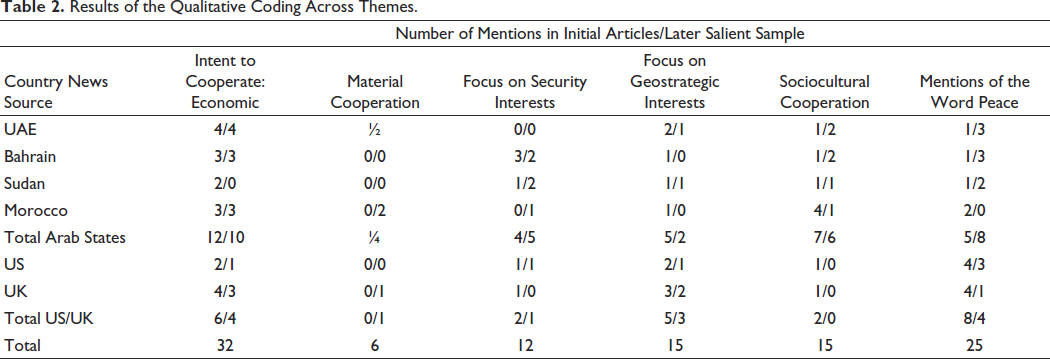
According to the coding of the qualitative articles in our sample, hypothesis 2 is supported. Within the sample, there were a total of 32 articles that mentioned some intent to cooperate economically, or that referenced the potential for economic benefits due to the agreements. Six more articles discussed the material benefits of economic cooperation, either by sharing trade figures or some other tangible economic outcome. This number surpasses any other type of cooperation or benefit mentioned in the sample, with 15 mentions in the next highest category (See Table 2). Both geostrategic interests and sociocultural cooperation were tied for this number overall when including articles from the United States and the United Kingdom. When looking at Arab state sources alone, economic interests weigh in at 22 (27 if including material cooperation), with sociocultural cooperation having 13 total mentions, followed by security with 9, and geostrategic with 7. While security and geostrategic cooperation and interests are somewhat related, even if combined, the score would be below that of economic considerations. The non-Arab news sources also focused on economic considerations more than any other category, with 10 articles on economics compared to 8 for geostrategic concerns.
Results of the Qualitative Coding Across Themes.
Illustrative quotes regarding the importance of economic interests in promoting the Abraham Accords include, “Opening direct ties between two of the Middle East’s most dynamic societies and advanced economies will transform the region by spurring economic growth, enhancing technological innovation, and forging closer people-to-people relations” (Emirates News Agency, August 13, 2020). The Bahraini press also stressed the economic benefits of the Abraham Accords, noting that “every option other than peace would signify destruction, poverty, and human suffering” (Bahrain News Agency, September 15, 2020). Elsewhere, Zayed bin Rashid al-Zayani noted that Bahrain and Israel were “keen to work together in economic and tourism affairs” and that “economic prosperity [is] seen as a way to build stability in the region” (Alwatan News, December 1, 2020). Morocco’s press similarly emphasized that the agreement would “promote a dynamic and innovative economic bilateral cooperation” (Maghreb Arab Press, December 2020) and stressed the benefits from direct flights between Morocco and Israel as well as the “potential for cooperation in the fields of food security, agro-food industry, information technology” among others (MAP, December 29, 2020). In other words, these economic arguments fall squarely in line with neoliberal theory, arguing that interaction through trade can build stability and a negative peace between former enemies.
Sudan’s press also emphasized economic goals, but unlike the UAE, Bahrain, and Morocco, which focused on the benefits of trade and tourism due to agreements with Israel, Sudan focused on the benefits gained from a shift in their relations vis-à-vis the United States. For example, the finance minister noted that it “will allow the flow of American investments and borrowing from the global banking system” and that there was a likelihood for the United States to give Sudan “significant financial support” (Alwatan News, December 1, 2020).
Impact of Shared Interests
Based on the sample of articles reviewed for the qualitative analysis, hypothesis 3 seems supported. There is more discussion of economic cooperation in the articles from the UAE than in the articles from Sudan, with all four articles from the UAE mentioning an intent to cooperate economically in both initial samples (see Table 2). Sudan had two articles that mention economic cooperation in the first sample and none in the second. Both Bahrain and Morocco had three of four articles mentioning economic cooperation in both samples. Thus, it needs to be clarified if Sudan is simply an outlier or if other factors are at play. However, the UAE is more in tune with the economic aspect of the agreements than Sudan, followed closely by Bahrain and Morocco. This also tends to reinforce patterns seen in the quantitative data.
According to one of the sources sampled, since the signing of the agreement, the volume of trade exchange between Dubai and Israel was one billion Emirati dirhams, and economic leaders emphasized that trade between the countries “is translated into building bridges of cooperation, supporting global partnerships across borders, and opening new markets” (Hussein, January 30, 2020). The Bahraini press also emphasized economic trade cooperation and broader interests, including “food and water security, sustainable energy and health care, [and] education” (Hussein, January 30, 2020). News sources from both Bahrain and the UAE discussed various joint seminars and/or trade conferences, as well as concerns for broader regional security and stability. News sources from Morocco documented numerous types of cooperation across multiple fields, with over 20 agreements signed between Rabat and Tel Aviv (Hespress, 2022). In contrast, the articles from Sudan had more limited discussion of cooperation and were more narrowly focused on the political and security situation in Sudan after the coup. One quote did discuss cooperation in “agriculture, energy, health, water, and education, especially in the security and military fields” (Dabanga Sudan, 2023).
Sociocultural Commonalities
Hypothesis 4 is generally supported by the qualitative analysis, with five of the eight Moroccan articles discussing sociocultural approaches to cooperation and/or mentioning sociocultural similarities between the two countries, in contrast to only two or three articles for each of the other three countries. Further, there were many more mentions of sociocultural commonalities in the Moroccan articles in contrast to brief mentions from the UAE, Bahrain, and Sudan. The Moroccan articles emphasize, for example, “the religious ties that link the emirate of believers with the Jewish component throughout history” and “the ties that bind the Moroccan monarch to the Jewish community” (Hespress, December 13, 2020). As one diplomat noted, “Morocco’s relations with Israel are special and distinct from the ties that unite Israel with other countries in the region” (Hespress, December 13, 2020).
These kinds of statements are in stark contrast with those from other countries, such as a statement in one of the Bahraini articles referenced gratitude for “bringing hope to all the children of Abraham,” a reference to the joint heritage of Muslims, Jews, and Christians (Bahrain News Agency, 2020). Articles by the UAE tend to focus on “threats and opportunities in the region” along with “security coordination” (Emirates News Agency, August 13, 2020). There is minimal mention of sociocultural cooperation or coordination, and such mentions are vague references to cooperation in health, education, or tourism. Articles from Bahrain do talk about the goal of building “trust, respect, and understanding between all faiths, races, and nations” (Bahrain News Agency, September 15, 2020), and one of the Sudanese articles mentions the importance of “consolidate[ing] the meanings of tolerance, dialogue, and coexistence among different peoples and religions in the Middle East and the world” (Altaghyeer, 2021). However, they contrast with Moroccan articles discussing Jewish museums in major cities and “a program to restore hundreds of synagogues, cemeteries, and Jewish heritage sites” (Hespress, 2020). Overall, there is support for hypothesis 4 in the extent and depth of the discussion of sociocultural cooperation in the Moroccan news sources compared to those from the other three signatory countries.
Conclusion
Based on both quantitative and qualitative investigation, Arab signatories to the Abraham Accords are found to have used economic, geostrategic, and sociocultural arguments to justify their participation in the accords, but the data demonstrate that economic arguments were emphasized more than other lines of reasoning, although Morocco also discussed sociocultural ties with Israel due to its historic Jewish community.
The quantitative findings suggest that media coverage in the two Gulf signatories was strongly optimistic and produced many articles about cooperation with Israel. The media in Sudan and Morocco, by contrast, exhibited more variation in their coverage of the Accords, reflecting the slower-paced approach to normalization taken by these two governments. For instance, the press in the UAE and Bahrain produced significant articles on general cooperation and economic cooperation in the first year of the Accords; toward the second year, there was a noticeable increase in the number of articles on military cooperation. The media coverage in Morocco and Sudan on cooperation with Israel was low compared with the coverage of the Gulf signatories; Sudan showed the lowest media coverage overall. The difference between the Gulf countries and the African countries might be explained by various factors, including the lack of vocal domestic opposition in the UAE and Bahrain, the differing political contexts for the agreements (i.e., significant US political payouts for Morocco and Sudan), and economic differences between the states.
In addition to generally confirming hypotheses 2 through 4, several emergent themes in the qualitative data added nuance to the explanations provided for the Abraham Accords. First, while there was occasional mention of the term “peace” in formal speeches quoted in the press of the Arab signatories, the term was much more frequently used in British and American news sources. While the British and Americans viewed the Abraham Accords as “peace” agreements, the Arab states were much clearer regarding their status as normalization agreements. They differentiated them from the API and other efforts to address the question of Palestine. Notably, these Arab states never engaged directly in war with Israel. Thus, they were not engaging in a peace agreement per se but rather engaging formally in diplomatic relations with a state they had previously boycotted. Within the Arab press, the emphasis was much more on prosperity and security than peace. While some nods were toward religious and cultural diversity and celebration of shared heritage, most commentaries focused on trade, tourism, and the business community. Further, the Accords should have engaged in substantive peace and reconciliation work between the civil societies of the respective states but rather emphasized top-down, elite-level concerns.
Second, the press coverage emphasized the role of the United States in brokering and encouraging the agreements, particularly in the case of Sudan, where the signing of the Abraham Accords was linked to the removal of Sudan from the terrorism list. However, some actors sought to de-link these two events (Dabanga, October 23, 2020). Similarly, the US recognition of Western Sahara as part of Morocco was an important diplomatic event. It was clear that the case of Palestine was discussed more in the US and UK press than in the Arab press sampled, with the exception perhaps of Bahrain, perhaps because Arab states did not want to be seen as contradicting historical policy stances. Overall, however, the coverage in signatory states downplay the role of peace and Palestine while emphasizing the role of prosperity, tourism, and economic gains. While there was some discussion of sociocultural efforts at peace, notably through health and education, these were less frequent and were seen primarily in Morocco, the only one of the Arab signatories with a Jewish population. Thus, this article finds that Arab state justifications were generally consistent with neoliberal arguments regarding the benefits of trade and economic cooperation bringing former (wealthy) enemies together. In the case of the poorer Sudan, economic interests of another kind—through the removal of sanctions from being on the terrorism list—seem to be at play.
Several implications arise from this study. First, as evident from the deadly violence occurring in Israel and Gaza at the time of writing in October 2023, simply ignoring Israel’s occupation of Palestine for the sake of geostrategic and economic objectives does not make the issues disappear. While the Abraham Accords may have reduced tensions between Israel and Arab States, it did not address the core question of Palestine, which is critical to any lasting peace—cold, warm, or otherwise—in the region. Further, the United States played an important role in brokering the Accords, providing key incentives to Sudan and Morocco in particular, which raises questions regarding the extent to which these Accords might evolve into a “warm” peace; it also suggests the need for strong external incentives for states who have been at war with Israel to sign normalization and/or peace agreements. Finally, the prevalence of economic arguments supports those who claim the agreement was more about economic interests than warm peace between the region’s peoples, particularly given the authoritarian nature of the states involved.
Footnotes
Declaration of Conflicting Interests
The authors declared no potential conflicts of interest with respect to the research, authorship and/or publication of this article.
Funding
The authors received no financial support for the research, authorship and/or publication of this article.
