




Abstract
Narendra Modi became the first Prime Minister of India to undertake a stand-alone visit to Israel from 4 to 6 July 2017. Although India–Israel relations had been normalised in 1992, the nature of this bilateral relationship remained murky as India avoided any explicit recognition. However, with Modi’s visit, the policy of ‘equidistance’ or ‘de-hyphenation’ of ‘Israel’ and ‘Palestine’ was formally operationalised proclaiming that India’s relations with one country will have no impact on relations with the other. Conventional academic wisdom attributes causal determinants to Indian foreign policy vis-à-vis Israel as guided by international and domestic factors. This article contends that a constitutive approach to understanding India’s foreign policy towards Israel and the Middle East offers a viable alternative. Adopting Gearoid O Tuathail’s theoretical framework of practical geopolitical reasoning, this article critically explores the geopolitical representations of ‘India’, ‘Israel’, ‘Palestine’, ‘West Asia’, ‘South Asia’ and ‘Middle East’ in the National Democratic Alliance government’s foreign policy discourse through an analysis of ‘grammar of geopolitics’, ‘geopolitical storylines’ and ‘geopolitical script’. The article demonstrates that re-representation of ‘India’ as a ‘global actor’ and re-representation of ‘Israel’ as a country in ‘West Asia’ have enabled the Modi-led government to implement India–Israel bilateral partnership which underscores strategic cooperation in full visibility via overt normalisation.
Introduction
With a charismatic media campaign, the Narendra Modi-led Bharatiya Janata Party (BJP) made a spectacular history by winning the Indian general election in 2014. With the electoral mandate firmly in favour of the BJP-led National Democratic Alliance (NDA) government, speculations in relation to an overt normalisation of India–Israel bilateral relations became rife. This was partly due to the BJP’s historical attitude towards Israel. The BJP’s predecessor, the Janata Party, during its short stint in 1977, had proposed diplomatic relations with Israel but never enacted upon this stance. However, Narendra Modi’s special affinity with Israel (Tel Aviv had made considerable investments in the state of Gujarat when Modi was the chief minister) led to impending predictions of the political embrace of Indo-Israel ties (Nanda, 2017).
In 2014, the Indian Home Minister Rajnath Singh visited Israel but did not visit Palestine (Sanyal, 2017). Furthermore, in July 2015, India abstained from voting on a resolution against Israel at the United Nations Human Rights Council (UNHRC) that condemned Israel for the ‘alleged war crimes’ in Gaza offensive of 2014 (Haidar, 2015). Then Modi undertook a maiden visit to Israel from 4 to 6 July 2017, skipping a visit to Palestine, which resulted in a series of agreements between India and Israel for cooperation in the fields of space, water management, agriculture, science and technology (Inbar, 2017). Ostensibly, this diplomatic sojourn underscored Modi’s ‘Make in India’ and ‘Digital India’ innovative that emphasised joint development of technology (Roy Choudhury, 2017). However, being the first Prime Minister of India to undertake an official visit to Israel indeed made a political statement that the Indo-Israel relations were no longer under wraps (Marlow, Bipindra, & Arnold, 2017). Henceforth, it is going to be a bilateral relationship that would be ready to confront regional and global strategic challenges in full visibility.
The change in NDA government’s policy towards Israel is significant. India and Israel have a chequered past. While India under the Jawaharlal Nehru-led Indian National Congress (INC) government did recognise Israel in September 1950, bilateral relations remained strained as Nehru’s ‘West Asia policy’ gave significant consideration to the Arab sentiments and opposed the Zionist project in Palestine (Blarel, 2015, p. 6). This did not detract from the fact that India did solicit Israel’s military and intelligence assistance during and after the Sino-Indian War of 1962. As Nicolas Blarel (2015, p. 158) notes in his assessment of the evolution of Indo-Israel bilateral ties: ‘In fact, Nehru created a precedent in obtaining military assistance from Israel without requiring any diplomatic exchange, or even publicly acknowledging the existence of such security assistance’. Only on 29 January 1992, under the premiership of P.V. Narasimha Rao, the Congress government enacted full diplomatic relations with Israel through the establishment of embassies and exchange of envoys. However, overtly, India continued with its pro-Palestine policy. Israel–Palestine conflict remained the primary concern for successive Indian governments that inhibited any Indian prime minister from visiting Israel although some Indian ministers and senior military officials exchanged visits after 1992. A planned 2006 trip by then Defence Minister Pranab Mukherjee was reportedly cancelled because of Israel’s military operations in Gaza. The last Israeli Prime Minister to visit India was Ariel Sharon in 2003, and no defence minister had ever visited despite those ties. Thus, an Israeli Ambassador remarked about the relationship being ‘held under the carpet’ (quoted in Madan, 2016).
The explicit disassociation of ‘Israel’ from ‘Palestine’ was only undertaken in the Modi-led government because the NDA had made it explicit in its West Asia policy that ‘Israel’ and ‘Palestine’ were to be ‘de-hyphenated’ and neither of them were to have an impact on India’s policy towards the other (Parashar, 2017). This policy was confirmed with Modi’s stand-alone Israel visit in 2017 and recognition of Zionism when he paid homage to the grave of Theodor Herzl, considered as the founding father of Zionism (Press Trust of India, 2017). This article seeks to address this overt normalisation of India–Israel bilateral relations under the Modi-led first NDA government (2014–2019) through an analytical framework of practical geopolitical reasoning that focuses on the politics of spatial representation and the concomitant state identity formation as constitutive of NDA’s Israel policy.
Existing literature on India’s foreign policy choices vis-à-vis Israel is largely bifurcated into domestic and international factors as causal forces. 1
A comprehensive literature review on Indo–Israel relations is available in Blarel (2015).
In evaluating domestic and international factors affecting Indian foreign policy towards Israel, the scholarly literature has explicitly relied on realist, neorealist, neoliberal and conventional constructivist understandings which take entities such as ‘West Asia’, ‘Israel’, ‘Palestine’ and ‘India’ as constant physical reality ‘out there’. Positivism is based on empirical analysis and hypothesis testing, through which the world can be understood. The tradition of realpolitik, therefore, assumes the frontiers to be fortified and formalised and the nation state with concrete borders a permanent reality of international geography. As Gearoid O Tuathail and John Agnew (1992, p. 192) note: ‘Geography, in such a scheme, is held to be a non-discursive phenomenon: it is separate from the social, political and ideological dimensions of international politics’. Furthermore, while conventional constructivism does elaborate on ideology and perceptions as a causal force in determining a state’s foreign policy, it still takes state identity as stable and not as inherently unstable in need of reproduction through representational practices (Hopf, 2002; Katzenstein, 1996; Wendt, 1992, 1999). According to post-positivist or critical international relations (IR) theory, traditional realpolitik and conventional constructivist approaches preclude an appreciation of the inherent contestability of terms such as ‘West Asia’, ‘Israel’, ‘India’ or that a concrete understanding of such realities is unachievable. From this view, India’s Israel policy cannot be solely understood from material forces bound with an unchanging geography (Turner, 2013). Instead, geography and the accompanying materiality have to be understood as a social and historical phenomenon which is bound up with the questions of politics and ideology (Tuathail & Agnew, 1992, p. 192). Such a view is imperative, given that material conditions and the accompanied causal factors such as the Indo-Pakistan conflict over Kashmir, sentiments of the Indian Muslim constituency, strong bilateral relationship with Russia, dependence on oil and remittances from the Middle East and historical and ideological ties with Palestine are very much relevant and ongoing concerns for the NDA government, yet the overt normalisation of Indo-Israel relations became a possibility under their tenure.
This article examines India’s Israel policy under the Modi-led NDA government through a theoretical prism of critical geopolitics which focuses on the constitutive dimension. The article demonstrates that practical geopolitical reasoning of the Modi-led government in relation to ‘Israel’ in ‘West Asia’ departs from previous such representations. Conversely, the article demonstrates that the representation of ‘Israel’ in ‘West Asia’ is inextricably bound with the geopolitical identity of ‘India’ in ‘extended neighbourhood’ which signifies a global role and no longer confined to ‘South Asia’. These re-representations of India ‘self’ and Israel ‘other’ allowed NDA to act upon the policy of ‘equidistance’ or ‘de-hyphenation’ of ‘Israel’ and ‘Palestine’, thereby enabling Modi to become the first Prime Minister of India to visit Israel and pursue overt normalisation. This article adopts a discursive framework to understand geopolitics. Geopolitics then becomes a discursive practice through which state elites ‘spatialise’ international politics in such a way so as to represent it as a ‘world’ characterised by particular places and peoples (Tuathail & Agnew, 1992, p. 192). Geography as a discourse is a form of power/knowledge itself. The article first evaluates Tuathail’s (2002) theoretical framework of practical geopolitical reasoning through state’s foreign policy. Thereafter, it analyses ‘grammar of geopolitics’ from 2014 to 2016, particularly focusing on where, what, who, why and so what? that locates NDA government’s representation of ‘Israel’ and the visible attempt to delink ‘Israel’ from ‘Palestine’ in a manner that departs from previous such discursive spatialisation. Next, an emergence of two prominent ‘geopolitical storylines’ in NDA government’s geopolitical discourse from 2016 to 2017 are identified which are then contrasted with Modi’s performative ‘geopolitical script’ in the form of his trip to Israel from 4 to 6 July 2017. Textual data, from primary sources such as statements, speeches, interviews, press reports and governmental publications, are analysed in this context to ascertain elite discourse. The article concludes with final observations and the implications for our understandings of India–Israel relations.
Power, Space and Foreign Policy: Practical Geopolitical Reasoning and the Territorial State
What is a sovereign state? For realism, the sovereign state with defensible centres, hardened borders and inviolate spaces are taken to be definitive units in the international system. ‘Power’ in this system rests upon the states maintaining territorial control on the sovereign spaces and resisting external threats to the borders. Departing from the positivist notion of ‘sovereign spaces’, critical geopolitics understands territory/space as deeply politicised and considers it as a form of political practice (Agnew, 2016; Dalby, 1988; Popke, 1994; Tuathail & Agnew, 1992). As Klaus-John Dodds and James Derrick Sidaway (1994, p. 516) noted, the concepts of power, knowledge and geopolitics are thereby bound together in a provocative way. This means ‘forms of power/knowledge operate geopolitically: a certain spatialisation of knowledge, a demarcation of a field of knowledge, and the establishment of subjects, objects, rituals, and boundaries by which the field (and the world) is to be known’.
Geopolitics, then can be critically re-conceptualised as a discursive practice. Discourses are a set of capabilities people have, as sets of sociocultural resources used by people in the construction of meaning about their world. Discourses are an ensemble of rules by which readers/listeners and speakers/audiences are able to take what they hear and read and construct it into an organised meaningful whole. Discourses permit a certain bounded field of possibilities and reasoning as the process by which certain possibilities are actualised. The actualisation of one possibility closes off previously existent possibilities and simultaneously opens up new series of somewhat different possibilities (Tuathail & Agnew, 1992, p. 193). In short, discourses underscore three main themes: (a) meanings emerge from language and do not pre-exist it; (b) meanings can never be stabilised and can be grasped only in play of difference and deferment and (c) subjects are not prior to the language games or the discourse they utilise, rather discourse enables the sovereign subject with subject-positioning that allow them to derive particular identity or identities (Tuathail, 2002, p. 606).
Geopolitics as a discursive practice then can be understood as spatial practices of representation which involve an imagination of the state with a unified national identity amongst a plethora of identities, establishing a boundary with an ‘outside’ space and unitary ‘internal’ space that seeks to overrule disruptive processes. Practical geopolitical reasoning constitutes a discursive practice that creates these ‘outside’ and ‘internal’ spaces to demarcate a national, a regional and an international spatial state identity. Foreign policy then becomes a repository of meaning-making through which geopolitics can be ascertained and analysed. As Tuathail and Dalby (1998, pp. 1–16) identified, this involves a deconstruction of policy process in terms of ongoing argument over the classification of geopolitical crisis, the development of geopolitical storylines, internal tensions and incoherent geopolitical scripts and the ways in which the foreign policy process defines ‘problems’ and ‘solutions’. Foreign policy, therefore, is constitutive of the state and vice versa, instead of being an external ramification of an already established state. 2
The authors have derived this understanding from the critical IR scholarship of Ashley (1987), Walker (1993) and Campbell (1992).
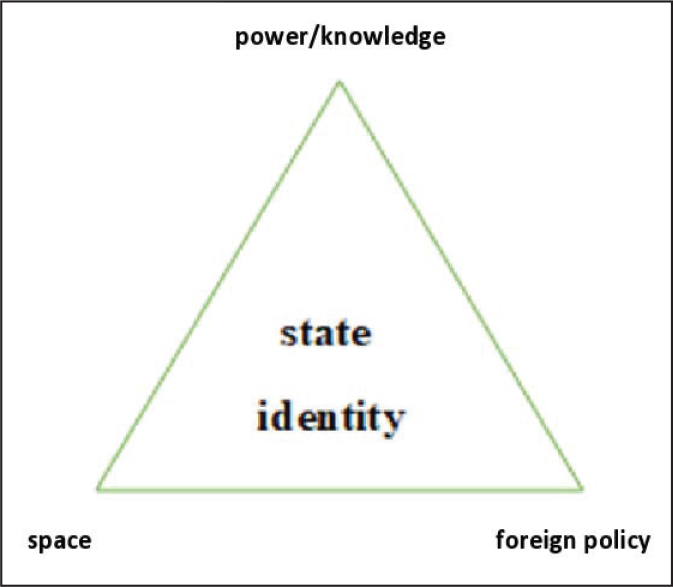
To effectively understand geopolitical reasoning in foreign policy discourse, Tuathail (2002, p. 606)
organises ‘discourse analysis’ into macro-, meso- and micro-level
perspectives. Macro-level discourse analyses are philosophical epistemes that span
history. Michel Foucault’s work on madness and human sciences is best
characterised as macro-level discourse analysis. Meso-level discourse analysis is
less ambitious in historical range and philosophical depth and focuses more on the
everyday working of discourse in public policy and social debate. It accounts for
how discourse helps produce ‘common sense’ understandings and
pragmatic ‘storylines’ that condition and enable routine policy
practices, and hence, it is associated with ‘argumentative turn’ in
public policy planning. Micro-level discourse analysis is associated with focus on
conversation and the building blocks of making sense. Such an approach, Tuathail
claims, does not address questions of power and identity. Meso-level argumentative
approach is ideal to understand geopolitical reasoning in context of identifying
rhetoric in public policymaking. As Tuathail (2002, p. 607) notes: Humans do not converse because they have inner thoughts to express; rather
they acquire ‘thoughts’ because they are able to converse
publicly using a shared ensemble of interpretive resources called a
‘language’. Second, thinking is a creative dialogical process,
proceeding from socialization to a set of interpretive resources, the active
processes of categorization and particularization of positions, and the
assemblage of higher-level sense-making into apparently coherent and
consistent storylines. Criticism and justification are involved at every
level, as we form positions and hold views, within social contexts of
argumentation and debate.
This approach considers political leaders as skilled rhetoricians whose job is to construct arguments that resonate with popular common sense and to create social consensus enabling policy decision making and action. In this process, the coherence and consistency of certain subject-positions is contextually dependent. In other words, the coherence achieved is not random but is dependent on the institutional environment. The fragmentary knowledge is assembled in myriad storylines through which public policy gets operationalised. Geopolitical discourse includes all language of statecraft used by political leaders to constitute and represent the world affairs—in terms of constituent locations, leading protagonists and the roles and strategies that a state must adhere to (Tuathail, 2002, p. 607). The analytical parameters of the geopolitical discourse which gives it a function of the statecraft are ‘grammar of geopolitics’, ‘geopolitical storylines’ and ‘geopolitical scripts’.
In his analysis of ‘grammar of geopolitics’, Tuathail (2002, pp. 608–617)
recognises specific usage of terms like: where—involves
location specification; what—situation descriptions;
who—includes protagonist/actor typifications;
why—includes explanations for causality and so
what—involves strategic calculation. This fragmented grammar of
geopolitics is brought into coherence with the assemblage of regulated but competing
storylines. The performative geopolitical scripts work as a medium through which the
political leaders ‘act out’ certain scripts. Script is a
‘structure that describes appropriate sequences of events in a particular
context’ (Schank &
Abelson, 1977, p. 41 as quoted in Tuathail, 2002, p. 619). They are specific
situational forms of knowledge, ways of doing and acting through certain social
episodes. Tuathail (2002,
p. 619) differentiates between the ‘geopolitical script’ and
‘geopolitical storyline’ where the former refers to the manner in
which foreign policy leaders perform geopolitics in public and the political
strategies that the leaders develop to navigate through foreign policy challenges
and crisis. Geopolitical scripts perform, but storyline is a set of arguments. A
geopolitical storyline provides coherent sense-making narrative for a foreign policy
challenge. In contrast, a script deals with the pragmatics of foreign policy
performance. It is about how foreign policy actors perform in certain speech
situations, and how they are to articulate responses to policy challenges and
problems. Tuathail (2002,
p. 620) specifies that the geopolitical script is: …a public relations briefing book that is not necessarily coherent or
unified, and may contain multiple storylines, voices and positions,
depending on the situation. It is the ‘discursive software’ of
foreign policy practice. It contains formal scripted elements and sequences
but is sufficiently flexible to allow creative ‘freelancing’,
‘improvisation’, and ‘adaptation’ in exchanges
with reporters or diplomatic meetings. Policy speeches are rewritten to
respond to the spin of the day. Classificatory systems are fudged or made
more rigid depending upon the immediate context and political needs.
Emergent metaphors and images are incorporated or resisted in an ongoing war
of position to maintain policy consensus, and ‘public
face’.
Geopolitical script can be considered a medium of performing national identity through spatial representations. Following the analytical paradigms of ‘geopolitical grammar’, ‘geopolitical storylines’ and ‘geopolitical scripts’ at meso-level, this article takes into consideration the foreign policy discourse of the Narendra Modi-led NDA government to ascertain the performative representations which enabled Modi to undertake the visit to Israel in July 2017 as the first Prime Minister of India to do so—thus enabling a symbolic demonstration of flourishing India–Israel bilateral relationship. The next section evaluates ‘grammar of geopolitics’ as the Modi-led NDA government was confronted with a critical question of taking a position on public diplomacy with Israel with its incumbency in 2014.
‘Grammar of Geopolitics’: National Democratic Alliance and the ‘Israel’ Conundrum from 2014 to 2016
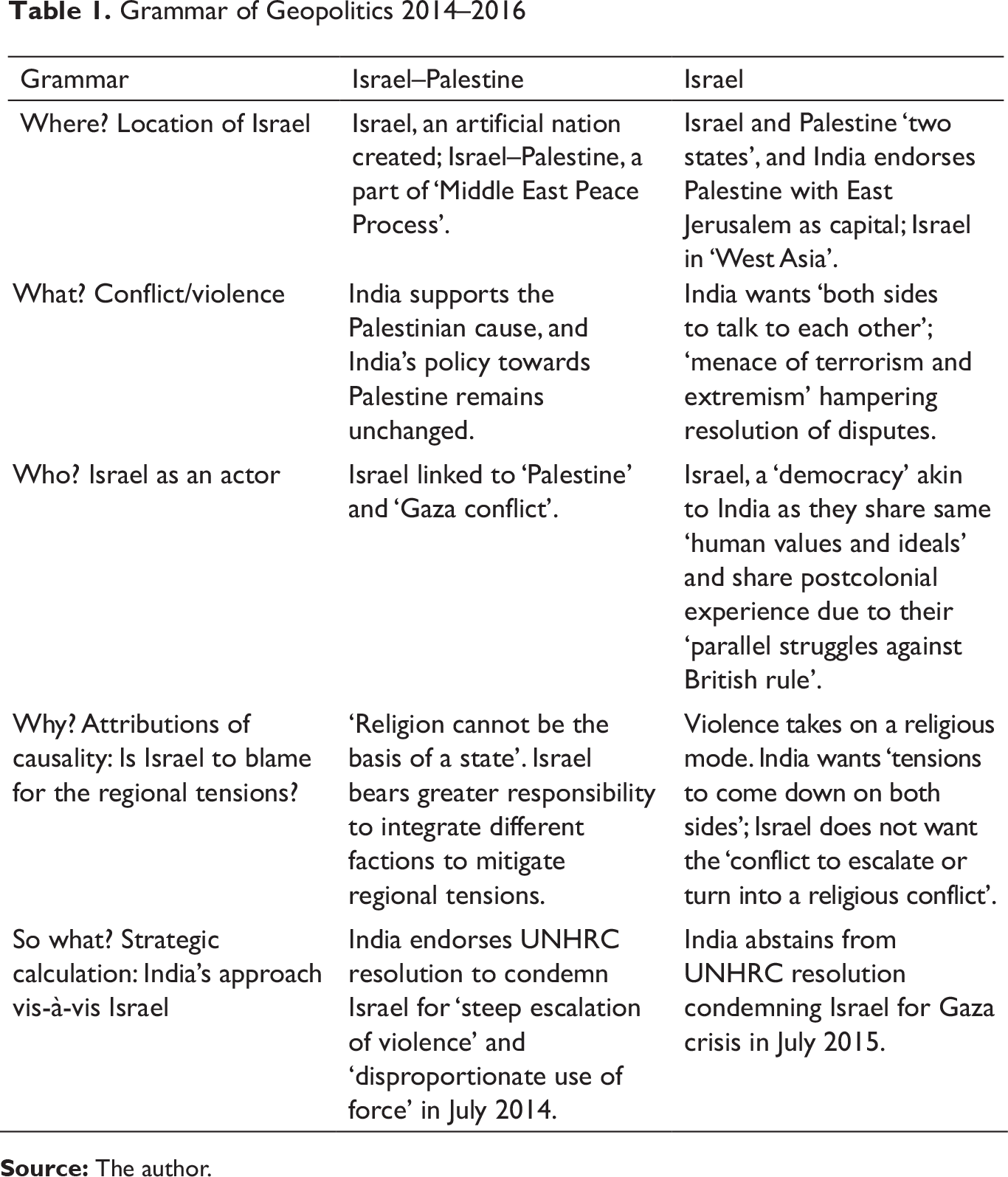
Post-independence Indian foreign policy towards Israel is replete with geopolitical metaphors of Israel’s origins in the Middle East exclusively connected to the fate of Palestine. The NDA government was confronted with these chaotic scenarios even as normalisation of relations with Israel was seemingly prioritised. To analyse the building blocks of storylines alternatively identified as ‘grammar of geopolitics’, a framework of dramaturgical analysis is needed. Tuathail (2002, p. 608) noted that international geopolitics should be considered as a theatrical drama on the world stage. Therefore, it is important to understand how statespersons reason about the daily dramas they face. Borrowing from Kenneth Burke’s (1945) framework of ‘grammar of motives’, Tuathail (2002, p. 609) noted that ‘any complete statement about motives will offer some kind of answer to these five questions: what was done (act), when or where it was done (scene), who did it (agent), how he did it (agency), and why (purpose)’. The dramaturgical analysis based on these questions translates into NDA’s predicament of linking ‘Israel’ with ‘Palestine’ or considering both as independent entities leading to various policy contentions. The NDA’s spatial re-imaginations are particularly evident as they appear in contradiction to the traditional framings of ‘Israel–Palestine conflict’, identifying India’s role in the process.
Where? Location of Israel
Location is central to geopolitical reasoning. Since there are no divine ‘truths’ in terms of irreplaceable land mass or nation state, the ‘politics’ of the ‘space’ is crucial when it comes to evaluating local, regional and global trajectories in a state’s policymaking (Dodds, 2013, p. 29). In terms of locating Israel, the discursive contention of the NDA government focused on local and regional representation of ‘Israel’ and ‘Palestine’, marking distinct spatial locations for Israel that formed the basis of Indian foreign policy choices.
Local: Israel is created and has no historical roots. Israel and Palestine are ‘two states’ with
independent identities. India endorses the state of Palestine with
East Jerusalem as its capital. (Ministry of External Affairs of
India [MEA], 2015a).
As NDA formed the government in 2014, the prevalent discourse on Israel unwittingly correlated to the dominant historical construction of Israel as an outsider and an occupier of territories. The identity of the Jewish state and the current Gaza conflict, therefore, reflects India’s own post-independence ‘self’ on the South Asian subcontinent which resulted in the India–Pakistan conflict. Israel then becomes an outside force akin to colonialism causing regional tensions in the Middle East just like that of British divide and rule tactics in South Asia (Blarel, 2016; Dobhal quoted in Umar, 2014). On the other hand, the ‘two-state solution’ has become a verbal acronym for BJP’s policy of ‘equidistance’ or ‘de-hyphenation’ vis-à-vis Israel and Palestine, whereby both are considered to be independent entities and should be treated as such (Madan, 2016; Roy, 2014). The ‘two-state solution’ promotes a bilateral settlement of the Israel–Palestine conflict in a mutually agreed manner. More importantly, equidistance promotes an equivalent strategy of dealing with Israel and Palestine on their own terms, and India’s relations with them should not become a ‘zero-sum game’ (MEA, 2015b, 2015c).
Regional: Israel–Palestine conflict as part of the ‘Middle
East Peace Process’. Israel a country in ‘West Asia’.
The regional connotation of Israel–Palestine conflict was linked to the spatial imagination of the ‘Middle East’. The Palestinian issue was postulated to be an ongoing part of the ‘Middle East Peace Process’ (MEA, 2015d). The spatial imagination of ‘Israel–Palestine’ in ‘Middle East’ refers to the traditional Indian dilemma that revolves around historical concern of upsetting countries in the Middle East who condemn Israel (Pant, 2004, p. 69). Nevertheless, the spatial imagination of ‘Israel–Palestine’ in ‘Middle East’ was routinely contradicted to the spatial re-imagination of ‘Israel’ in ‘West Asia’. Unlike the former, the latter delimits a policy of ‘equidistance’ which specifically mentions that ‘India’s relations with Israel are part of its engagement with the broader West Asia region and are independent to its relations with any country in the region’ (MEA, 2015c, 2016a). ‘West Asia’ as a spatial reconstruction corresponds to the role that India as a growing and pragmatic power seeks to play in world politics. It hypothesises a role for India as a global actor that is now increasingly venturing beyond the regional confines of South Asia.
What? Describing the Conflict/Violence and Its Relation to Israel
The question of ‘what’ is connected to situation descriptions.
Policymakers constantly construct scenarios that enable them to make a
particular representation meaningful. The construction of
‘violence’ in the region and whether it can be attributed solely
to Israel’s policies was a point of contention within the NDA government
as two opposing explanations emerged: Gaza conflict and violence due to Israel’s occupied
territories. No country is responsible for the violence as the region is
plagued by terrorism.
The BJP-led NDA government was very much at odds in pinpointing the origins of conflict in the Middle East. Thus, even while proclaiming that India should maintain a ‘neutral’ stance in the Israel–Palestine conflict, there were instances where solidarity with the Palestinian cause was explicitly supported (Dave cited in Press Trust of India, 2014). This confusion was evident in the July 2014 Rajya Sabha debate when Sushma Swaraj, the Indian External Affairs Minister (EAM), confirmed that India’s policy vis-à-vis Palestine remained unchanged (Sharma, 2014). The invocation of post-independence Indian foreign policy towards Palestine reconfirms India’s identity as a postcolonial state that has significantly contributed to the anticolonial struggles. As per this discourse, Israel becomes an occupier of the Palestinian territory and an aggressor due to which conflict and violence in the region is a reoccurring process. 3
Gandhi’s discourse on Palestine belonging to the Arabs framed the post-independence Indian foreign policy of pinpointing injustice done to the Arabs through the creation of Israel. See Gandhi (1938, 1946).
Who? Israel as an Actor
In defining Israel as an actor, the NDA policymakers’ grammar alternated
between Israel and Palestine conflict wherein ‘Israel’ as an actor
could not be divorced from the ‘Palestine’ and the ‘Gaza
conflict’ to predominantly considering Israel as a democratic actor
through the policy of equidistance: Israel–Palestine conflict Israel akin to India—a democracy
Israel as an actor was distinctly viewed as a part of Israel–Palestine conflict, wherein India’s support to the Palestinian cause remains consistent with the post-independence Indian stance of voting in favour of Palestine in the United Nations General Assembly (UNGA). ‘Israel’ as an actor, thus, comes to be linked to ‘Palestine’ and the ‘Gaza conflict’ (Sharma, 2014). However, a categorical separation of Israel from Palestine also occurs due to the policy of ‘equidistance’. Herein, Israel was described as a democracy that is countering terrorism in the ‘Middle East’ (MEA, 2016b; RSS quoted in Ghosh, 2014). The framing of Israel as a democracy fighting terrorism in the Middle East enables the policymakers to draw similarities between the ‘self’ and the ‘other’ as both India and Israel are described to be ‘young nations with an ancient history’ that have attained statehood after many tribulations; ‘democracy’ underpins their political systems and both are inspired by same ‘human values and ideals’. The Indian ‘self’ and Israel ‘other’ are also described as postcolonial nations for their ‘parallel struggles against British rule’ (MEA, 2015f, 2015g, 2015h). Akin to India, Israel now comes to be defined as a postcolonial democracy that is a victim of terrorism. Israel’s experience of statehood in the West Asian region is re-projected to be similar to that of India’s experience of statehood in South Asia.
Why? Attributions of Causality: Is Israel to Blame for the Regional Tensions?
The Indian policymakers’ discursive construct of Israel as a cause for
regional violence was debated around two signifiers: first, there was an
articulation of the historic position of India vis-à-vis
Israel—that ‘religion cannot be the basis of a state’; and
second, Israel was not responsible for the violence in the region for it did not
want the ‘conflict to escalate or turn into a religious conflict’
(MEA, 2015b;
2015i). These two
positions caused considerable angst and confusion in NDA’s approach
towards Israel: Religion cannot define a state. Tensions need to be reduced by both sides.
As Tanvi Madan of the Brookings Institution notes in her analysis of India–Israel relations, the Indian President’s statement during his visit to Israel in 2015 that ‘religion cannot be the basis of a state’ led to confusion and consternation with the Indian Ministry of External Affairs having to clarify what the statement actually entailed (Madan, 2016). This can be gleaned from the interaction between Secretary of the East Anil Wadhwa and a journalist during a briefing of the President’s ongoing visit to Israel on 14 October 2015 4
Please note: In accordance to the traditional Indian practice of avoiding stand-alone visit to Israel, the President of India visited three countries, that is, Palestine, Jordan and Israel (as in mentioned order).
Question: Does this not contradict Israel’s consistent stand that it is a homeland for Jewish people, that it is a Jewish state based on Jewish religion? So, did President not contradict the very premise of Israel’s existence?
Secretary (East): I will clarify that because I knew that you would ask this question. There is confusion. Yes, the terminology is a Jewish state but we were talking to people who believe in a two-state solution, the Labour Party. And if you take the ruling party, that is not the path they are pursuing right now. So, there is a difference and they were talking about it in that context that when you have coexistence of a number of religions either within the same country or side by side, within the same country is a solution which has been favoured by the ruling coalition, but the Labour parties always had this stand that two-state solution was something that they negotiated on in the past as well. So, the former Foreign Minister was there during the discussions. It was in that context that these discussions took place. Yes, definitely there is that terminology which exists and will continue to exist. But within that, how you take into account the fact that currently in Israel for instance there are 75 per cent of Jews but the rest 20 per cent will be Muslims and five per cent will be others. (MEA, 2015b)
That religion cannot be the basis of a state reflects a ‘strong’ multireligious component of the Indian postcolonial ‘self’ that prides itself in being the democratic country different from the Pakistan ‘other’ who believed in the religious basis of a state. This also applies to other states in the South Asian subcontinent that fell to military dictatorships post-independence. India’s democratic ethos of ‘debate, dissent and decision’, its ‘pluralistic and multi-religious society’ sets an example for Israel. Reference to Gandhi’s quote in terms of ‘an eye for an eye will only lead to a world full of blind people’, adheres to India’s historical assessments of Israel religious statehood being fundamentally contradictory to postcolonialism. Israel then bears greater responsibility for achieving peace even in a two-state solution through the integration of different religious factions and thereby mitigate the regional tensions (MEA, 2015b). Alternatively, regional instability was attributed to the violence that takes on a religious mode while both ‘Israel’ and ‘Palestine’ are framed to have an interest in de-escalation of the conflict. As Secretary of East remarked in the briefing that both ‘Israel’ and ‘Palestine’ are ‘very conscious’ that this conflict should not escalate or turn into a religious conflict. India, according to the Secretary, wanted ‘tensions to come down on both sides’ (MEA, 2015b, 2015j). Having met the leadership of both countries, President Mukherjee also ‘sensed’ that ‘there is a desire to resolve issues peacefully’ (MEA, 2015i). Thus, the violence in the region was surmised as having its own force, while both countries were doing their utmost to resolve the issues peacefully. Israel then was not directly implicated in the regional tensions.
So What? Strategic Calculation: India’s Approach vis-à-vis Israel
In considering the Israeli and Palestinian question, the NDA policymakers were
inevitably faced with a dilemma of how to proceed with Indian foreign policy.
The larger question for political calculations as Tuathail (2002, p. 616) notes is the
question of ‘What is at stake for “us”?’ It is
noteworthy, that the NDA government did not overlook the Palestinian issue yet
progressed towards recognising Israel as an independent country in the West
Asian region. The two diametrically opposed positions that emerged were: Endorsing the UNHRC resolution to condemn Israel for the Gaza
conflict in July 2014. Abstaining from UNHRC resolution condemning Israel in July
2015 for the 2014 Gaza crisis and continue with India’s
‘strong, substantive and mutually beneficial relationship
with Israel’ (MEA,
2015h).
Contrary to what was expected of the Modi-led NDA government, India took a position of condemning Israel for the Gaza and West Bank violence as per the UNHRC resolution in 2014. Joining the BRICS, the ‘steep escalation of violence’ and ‘disproportionate use of force’ against Gaza were cited as the main reason for this position (Sharma, 2014; Umar, 2014). This demonstrated the NDA government’s preoccupation with the representation of India ‘self’ as a ‘secular’ country while continuing with the ‘non-aligned’ position of Nehru’s Congress Party which was crucial to India’s postcolonial identity (Dasgupta, 2014). Commenting on the government’s decision, C.D. Sahay (quoted in Rediff News, 2014), a former chief of the Research and Analysis Wing, noted that ‘we have a long history of extending support to Palestine. We granted recognition to Israel only recently’; adding further: ‘What we have done at the UN is not opposing, but expressing our concern’, in relation to the escalation of violence. Nevertheless, the position of the NDA government in terms of ‘equidistance’ also entailed normalisation of relations. Thus, with an abstention in July 2015 UNHRC resolution while promoting resolution of the conflict in a mutually beneficial bilateral manner in the context of international efforts—enhancing relations with the ‘Arab world’ and ‘Israel’—was an underlying dimension of India’s relations with ‘West Asia’ (Madan, 2016). The Presidential visit to Israel in October 2015 culminated into the two sides developing a roadmap for expanding cooperation in solar energy, water management, animal husbandry, agriculture, space research, education and economy (MEA, 2016c).
The ‘grammar of geopolitics’ demonstrates the traditional representation of ‘Israel–Palestine conflict’ as connected to postcolonial India ‘self’ and the re-representation of ‘Israel’ and ‘India’ as postcolonial democracies with similar experiences of terrorism. The traditional representation links ‘Israel–Palestine conflict’ to ‘Middle East’ and ‘India’ as a predominantly subcontinental ‘South Asia’ nation, and the latter representational scheme locates ‘Israel’ in ‘West Asia’ conversely framing ‘India’ as a nation concerned with both regional and global issues. The next section considers the emergence of prominent ‘geopolitical storylines’ that incorporated various discursive elements from: where—location specification of Israel; what—situation description in terms of conflict/violence and its relation to Israel; who—Israel as an actor; why—is Israel to blame for the regional tensions? and so what? —strategic choices India has vis-à-vis Israel.
The Emergence of Two Prominent ‘Geopolitical Storylines’ from 2016 to 2017
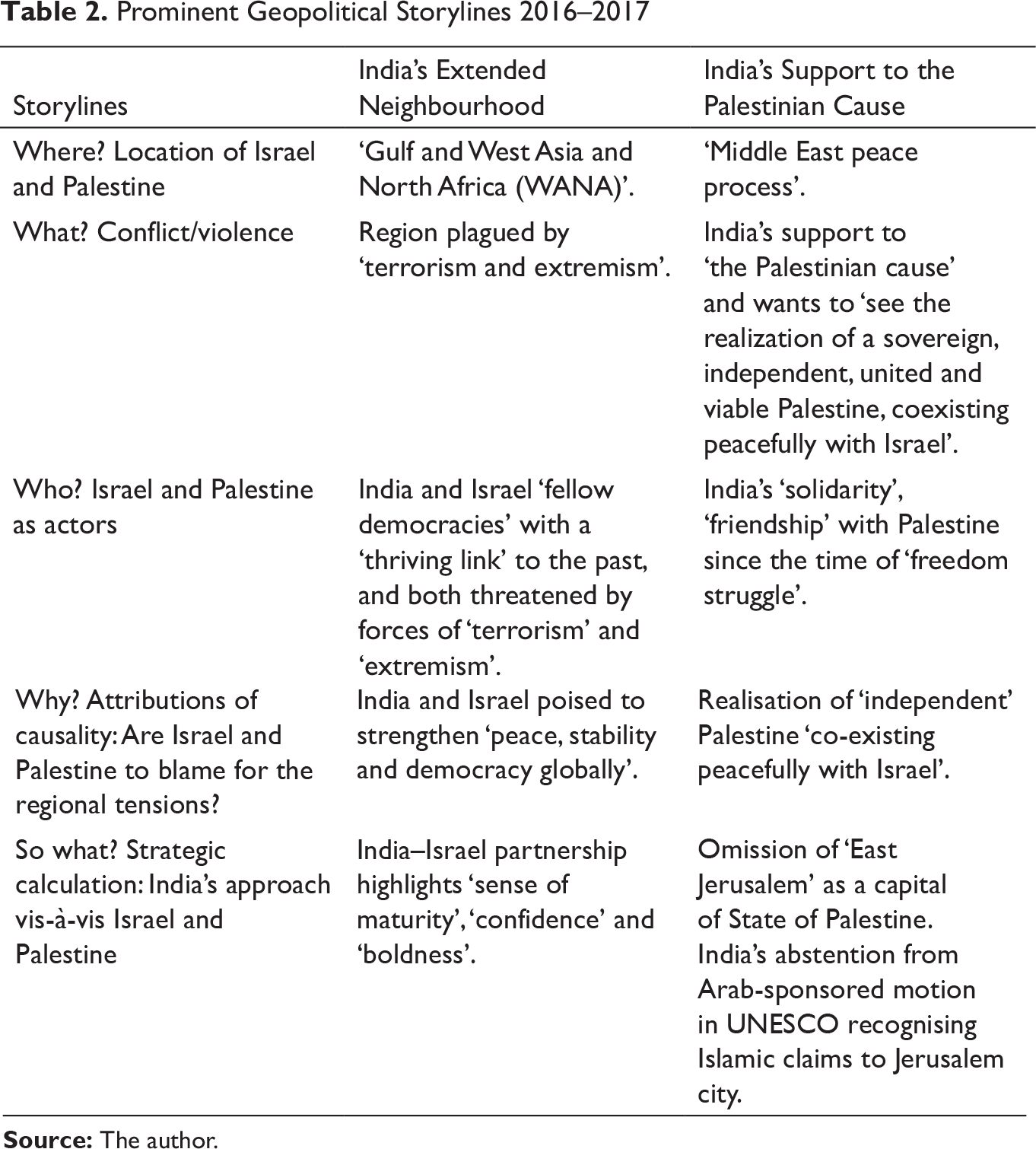
The ‘grammar of geopolitics’ comprises of various signifiers and is therefore fragmentary in nature. As Tuathail (2002, p. 617) notes: ‘From these building blocks higher-level storylines are constructed and refined’. The main function of a storyline is to bring different elements such as protagonists, locations, events, processes and interests together into a coherent and convincing narrative, which underpins particular policy option (Loughlin, Tuathail, & Kolossov, 2004). Different elements in the ‘grammar of geopolitics’ were combined to bring into being narratives of geopolitical meaning and identity which were assembled into two prominent ‘geopolitical storylines’ after the BJP’s election and before Modi’s 3-day visit to Israel in July 2017. The two ‘geopolitical storylines’ utilised signifiers India’s ‘extended neighbourhood’ and India’s support to ‘the Palestinian cause’, through which India-Israel bilateral relations achieved a political denotation.
David Scott (2009) identifies that the concept of ‘extended neighbourhood’ has become synonymous with India’s move eastwards, southwards, northwards and westwards. It implicates opportunities available to India outside of ‘South Asia’. The proverbial usage of this term was repeated in connection to India–Israel relations. EAM Sushma Swaraj elicited in her response to the Lok Sabha session on 4 May 2016 that the ‘Gulf and West Asia and North Africa (WANA) region forms part of India’s extended neighbourhood and is important for security reasons. The Government of India is committed to strengthen relations with all the countries of this region including Israel’ (MEA, 2016d). Relations with Israel were also sought primarily because Israel is a ‘functional democracy’ and ‘its economy is forward looking, modern in orientation’ and therefore suitable for India’s expanding economic needs (MEA, 2016d). India’s relationship with Israel marks a shift in India’s geopolitical identity beyond ‘South Asia’ because as a democratic country and a major economy, India’s dealings with ‘Israel’ underscored an association with the larger region of ‘Gulf’, ‘West Asia’ and ‘North Africa’. These geopolitical representations were confirmed by Daniel Carmon, Ambassador of Israel to India, as he commented that President Reuven Rivlin’s official visit to India from 14 to 21 November 2016 is part of a ‘historical process’ in enhancing bilateral ties (Embassy of Israel in India, 2016). Rivlin surmised that the ‘firm alliance’ between the two states was indicative of their ‘illustrious and greatly inspirational pasts’, where the ‘old world meets the new’, and are ‘thriving democracies’ (Israel Ministry of Foreign Affairs, 2016). India’s past as a subcontinental civilisation and current status as a democracy were premised to be the pillars of mutual cooperation. In a media statement on 15 November 2016, Prime Minister Modi identified that the ‘strong and growing partnership’ was to secure ‘our’ societies which were threatened by the forces of ‘terrorism’ and ‘extremism’ and as ‘fellow democracies’ with a ‘thriving link’ to the past, India and Israel were poised to strengthen ‘peace, stability and democracy globally’ (MEA, 2016c). In separating ‘Israel’ from the ‘Arab world’, Indian Ambassador to Israel Pavan Kapoor (cited in Keinon, 2017) highlighted the ‘sense of maturity’, ‘confidence’ and ‘boldness’ which underlined India’s policy of dealing independently with Israel and Palestine. The dominant geopolitical storyline concentrated on India’s extended neighbourhood in the WANA region and the democratic underpinnings that presented a rational framework for the intensification of India–Israel bilateral relationship for both were espoused to have civilisational links, were victims of terrorism and were politically and economically compatible.
The alternative storyline, which gave credence to India’s support to ‘the Palestinian cause’, can also be recognised for Mahmoud Abbas’s visit to India from 14 to 17 May 2017 was to provide an opportunity to review ‘bilateral relations, Middle East Peace Process, regional and international issues’ (MEA, 2017a). In his press statement on 16 May 2017 during the State Visit of President of Palestine, Mahmoud Abbas, Prime Minister Modi noted that the relationship between India and Palestine was based on ‘solidarity’ and ‘friendship’ since the days of ‘freedom struggle’ and ‘India has been unwavering in its support of the Palestinian cause’ and hoped to ‘see the realization of a sovereign, independent, united and viable Palestine, co-existing peacefully with Israel’ (MEA, 2017b). The ‘cautiousness’ in Modi’s approach signalled to the Arab world and the domestic Muslim population that the BJP does not intend to overlook Palestinian concerns vis-à-vis Israel (Pethiyagoda, 2015). Jyoti Malhotra (2017) noted the same in an article in The Indian Express on 18 May 2017 that due consideration has been given to the Arab world for Modi visited both Saudi Arabia and Iran in 2016, hosted the Crown Prince of Abu Dhabi Sheikh Mohammed bin Zayed for India’s Republic Day in January 2017 and had now received Abbas. The MEA (2017a) statement issued on 13 May 2017 confirmed that apart from ‘the political support to the Palestinian cause, India continues to support developmental projects in Palestine by extending technical and financial assistance’. Nevertheless, Modi did not reiterate India’s traditional position of endorsing ‘East Jerusalem’ as the capital of the State of Palestine in his press statement welcoming Abbas. P.R. Kumaraswamy (2017), an expert on the Middle East at the Jawaharlal Nehru University, classified this shift as a recognition of ground realities that Jerusalem, especially the eastern part of the city, has theological, historical, political and archaeological contestations and claims that have to be resolved through negotiations and accommodation. Aware of these shifting nuances in India’s approach vis-à-vis Palestine, Abbas noted in his interview to The Hindu on 16 May 2017 that the ‘Israeli government is working against the two-state solution and continues to build colonial settlements in our occupied country’ (quoted in Haidar, 2017). Therefore, ‘strong international backing’ including India’s involvement was integral to the realisation of two states based on the 1967 borders (Abbas quoted in Haidar, 2017). While the geopolitical representation confirmed India’s postcolonial identity via an invocation of India’s ‘freedom struggle’ and its association with the State of Palestine, the storyline retained an explicit link between ‘the Palestinian cause’ or the Israel–Palestine conflict and the ‘Middle East Peace Process’. India’s post-independence and postcolonial conundrum with the ‘Middle East’ with a nuanced omission of ‘East Jerusalem’ as the capital of the State of Palestine was solidified under the Modi-led government. NDA’s changing position on India’s support to ‘the Palestinian cause’ albeit with an omission of ‘East Jerusalem’ can be traced in India’s voting pattern in the United Nations Educational, Scientific and Cultural Organisation (UNESCO). In April 2016, India voted in favour of an Arab-sponsored motion that explicitly recognised the Islamic claims to Jerusalem city without any reference to the Jewish history. But then in the two subsequent votes held on 13 October 2016 and 2 May 2017, New Delhi abstained (Kumaraswamy, 2018).
The narratives as forwarded through ‘geopolitical storylines’ of India’s ‘extended neighbourhood’ and India’s support to ‘the Palestinian cause’ provided a repertoire of discursive elements which were then utilised in the performative ‘geopolitical script’ examined next.
Modi’s Visit to Israel: Analysing the Performative ‘Geopolitical Script’ of July 2017
As mentioned earlier, the ‘geopolitical storylines’ are sense-making narratives and a set of arguments that give coherence to a particular ‘reality’. Storylines are power-laden discourses since they legitimise a certain way of representing the world ‘out there’ (Mamadouh & Dijkink, 2006). By establishing the rules for interpretation, storylines provide the possibility for certain practices which carry with them specialised knowledge and particular configuration. For instance, the delineation of space through storylines in terms of West or East, North or South, developed or underdeveloped and democratic or authoritarian creates the possibility and justification for certain types of performance via political actions. A ‘geopolitical script’, in this context, is a performative made possible within the context of ‘geopolitical storylines’. It ‘refers to the direction and manner in which foreign policy leaders perform geopolitics in public, to the political strategies of coping that leaders develop in order to navigate through certain foreign policy challenges and crises’ (Tuathail, 2002, p. 619). As Tuathail (2002, p. 620) noted, ‘geopolitical scripts’ are ‘public relations briefing book’ that contains formal scripted elements and sequences but is also flexible to allow ‘improvisation’ and ‘adaptation’ depending on the immediate context and political needs. It aims at maintaining a policy consensus.
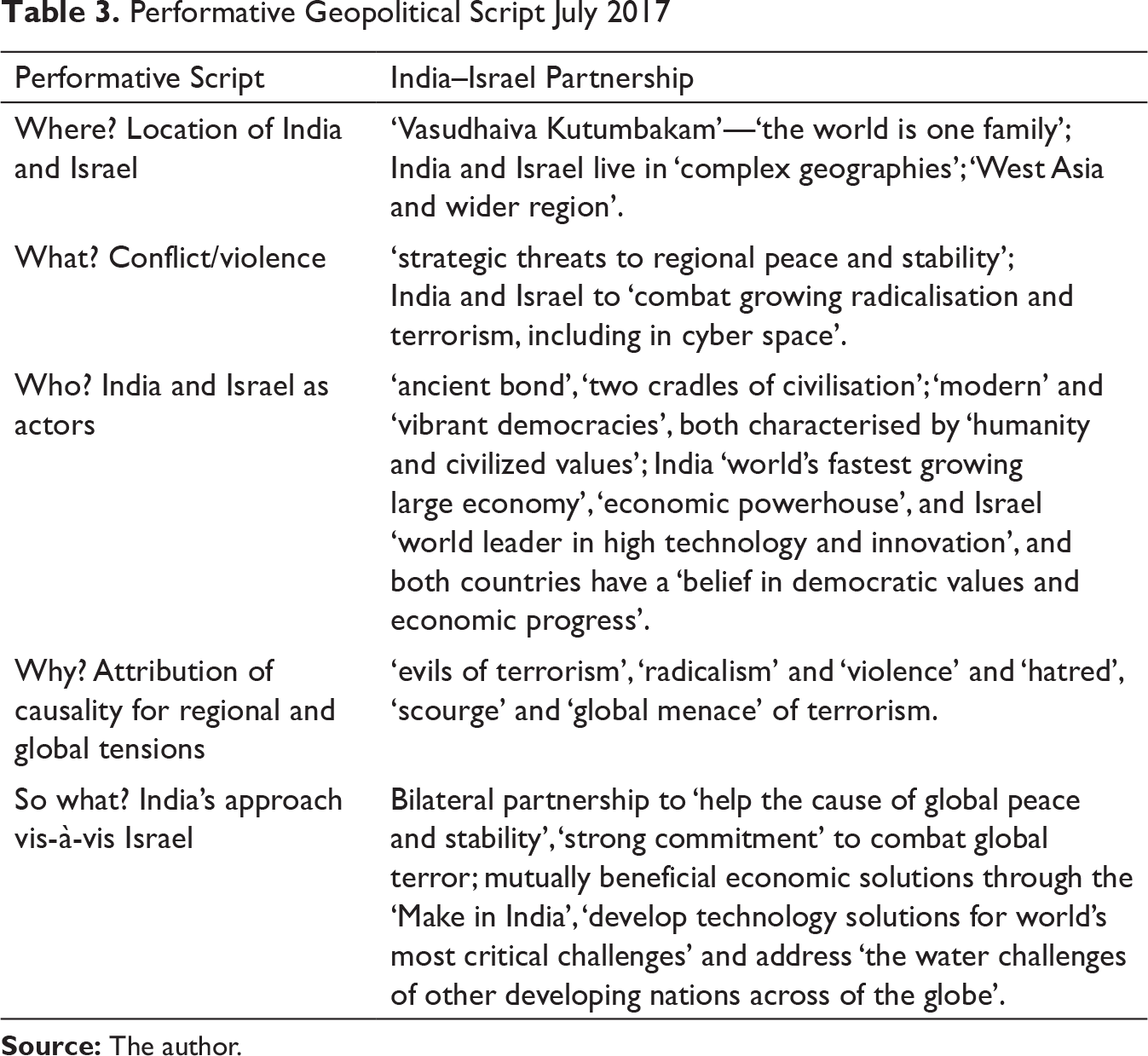
Modi’s visit to Israel utilised elements from the ‘geopolitical storylines’ of ‘extended neighbourhood’ and India’s support to ‘the Palestinian cause’ through a ‘geopolitical script’ of the prime ministerial visit marking a bilateral partnership with democratic–historical links, democratic–defence links and democratic–economic links, whereby India was now increasingly looking towards ‘global peace and stability’ (MEA, 2017c). India’s identity as a ‘global actor’ forwarded through this assertion negated the subcontinental identity of ‘India’ as predominantly a ‘South Asian’ power and ‘Israel’ in the ‘Middle East’.
In terms of democratic–historical links, Modi’s visit to Israel celebrated the ‘strength of centuries old links’ (MEA, 2017d). Other adages defining the connection between two countries were the ‘link between our people go back thousands of years’, ‘ancient bond’ and the countries represented ‘two cradles of civilisation’ (MEA, 2017e, 2017f). The ‘enduring link’ manifested through the Jewish diaspora of Indian heritage in Israel for the Indian civilisation had always welcomed Jews in the past. The Indian soldiers who fought and sacrificed life in the First World War to liberate Haifa were a testament to the continuing proximity of the two nations (Modi, 2017). The historical association was further complimented by the characteristics of India and Israel as ‘modern’ and ‘vibrant democracies’ which drew on their rich historical traditions to strive for a better future of their peoples (Modi & Netanyahu, 2017). Modi’s ‘geopolitical script’ increasingly focused on identity of India as a global actor in the context of which India’s relations with Israel were being forged. In response to an interview question about whether India still considered itself ‘unaligned’ to either ‘the West’ or ‘the East’, Modi (quoted in Bismuth, 2017) proclaimed: ‘We believe in philosophy of “Vasudhaiva Kutumbakam” which means “the world is one family”. We want to engage constructively with both the East and the West’. The citation of the philosophy of world as one family constructs India’s identity as ‘global actor’, no longer mired in the struggles of East and West. The script expands upon and encompasses the concept of ‘extended neighbourhood’ as India’s foreign political engagement of Israel is seen from a prism of world engagement rather than that of any particular regions. As India expert C. Raja Mohan (2015, pp. 1–20 cited in Ogden, 2018) asserts, Modi is ‘unabashed about India’s great power aspiration’ and the significant role it has to play in international politics. Not surprisingly, Netanyahu’s (quoted in Financial Express, 2017) avid portrayal of Narendra Modi as ‘a great leader of India and a great world leader’ endorsed India’s identity as a ‘global actor’.
The performative ‘geopolitical script’ continued with an emphasis on
democratic linkage between the two countries that was a pillar of their defence
partnership, particularly in counterterrorism. Elements from the
‘geopolitical grammar’ and ‘geopolitical storyline’ of
‘extended neighbourhood’ were evident for Israel was represented to be
‘a vibrant democratic nation’, both nations were characterised by
‘humanity and civilized values’ and therefore, as Modi identified in
his pre-dinner press statement on 4 July 2017 that, ‘we must resolutely
oppose evils of terrorism, radicalism and violence that plague our times’
(MEA, 2017e). Modi
further noted in his press statement on 5 July 2017: India and Israel live in complex geographies. We are aware of strategic
threats to regional peace and stability. India has suffered first-hand the
violence and hatred spread by terror. So has Israel. Prime Minister
Netanyahu and I agreed to do much more together to protect our strategic
interests and also cooperate to combat growing radicalization and terrorism,
including in cyber space. We also discussed the situation in West Asia and
wider region. It is India’s hope that peace, dialogue, and restraint
will prevail. (MEA,
2017c)
The term ‘complex geographies’ as connected to India and Israel bearing the brunt of ‘violence’ and ‘hatred’ pointed towards cross-border terrorism that both countries are victims of. Yet the notion of ‘West Asia and wider region’ attained a discursive closure in terms of Israel inhabiting ‘West Asia’ and India’s global role which is distinctly connected to the engagement of West Asia and other regions like North Africa and the Gulf. The global nature of this bilateral defence partnership then becomes apparent for while cooperation against ‘terrorism’ and ‘radicalism’ was imperative to secure the ‘societies’ of India and Israel, it could also ‘help the cause of global peace and stability’ (MEA, 2017c; Modi quoted in The Hindu Business Line, 2017). India–Israel agreement in homeland and public security would therefore address the ‘scourge’ and ‘global menace’ of terrorism (Modi & Netanyahu, 2017; Modi quoted in Bismuth, 2017). Furthermore, the joint development of defence technologies through the ‘Make in India’ initiative also underscored ‘strong commitment’ to combat terrorism in all forms (MEA, 2017f). India’s identity as a ‘global actor’ was reinforced, while the representation of ‘Israel’ in ‘West Asia’ allowed Modi to override regional concerns of Israel–Palestine conflict for both regional and global violence was perpetuated by terrorism.
An emphasis on India as the ‘world’s fastest growing large
economy’ enabled Modi to forward a bilateral democratic–economic
partnership with Israel, while simultaneously allowing a recognition of
India’s identity as a global actor since this bilateral partnership is
postulated to address global developmental challenges (MEA, 2017e). India–Israel
partnership addresses the domestic needs for the ‘belief in democratic values
and economic progress has been a shared pursuit’ of both states (MEA, 2017c). It was
proclaimed that through the ‘Make in India’ initiative mutually
beneficial economic solutions could be obtained. As a blog written by Modi and
Netanyahu in The Times of India on 4 July 2017 specified: India is a growing economic powerhouse with a large market and talent pool.
Israel is a world leader in high technology and innovation. The combination
of India’s and Israel’s human resources and ingenuity will
provide more effective and more affordable solutions for us in diverse
fields that are priorities for both our governments: agriculture, water,
health, environment, education and security.
Notwithstanding the bilateral benefits, the economic partnership of these two democratic nations, as Modi noted on several occasions during his trip, ‘can sow seeds of miracles for betterment of world’, ‘develop technology solutions for the world’s most critical challenges’ and address ‘the water challenges of other developing nations across the globe’ (Modi, 2017; Modi & Netanyahu, 2017; The Foreign Investment and Industrial Cooperation Authority, 2017). The representation of ‘India’ as ‘democratic’, ‘fastest growing’, ‘economic powerhouse’ and ‘developing’ reframed India’s identity as a ‘global actor’ that seeks to address the developmental challenges around the world; and Israel’s representation as a ‘democratic’ country and ‘world leader’ in high technology and innovation allowed Modi to emphasise the ‘tech-based partnership’ between both states (Modi quoted in Bismuth, 2017). In the former, India’s historical subcontinental identity gets annulled, while representation of ‘Israel’ continues with its relation to West Asia which operationalises India’s bilateral engagement enacting upon the claim of ‘de-hyphenation’ between Israel and Palestine. Confirming the same, Vijay Chauthaiwale (quoted in Khalid, 2017), Head of BJP’s foreign policy department, told Al Jazeera before Modi’s trip: ‘We want to build a strong relationship with Israel at the same time as we support the Palestinian cause. And we are not shy about it’. Similarly, Modi (quoted in Bismuth, 2017) also maintained this stance in an interview before the trip as he expounded: ‘We believe in a two-state solution in which both Israel and a future Palestinian state coexist peacefully’.
The ‘geopolitical script’ performed through Modi’s stand-alone trip to Israel as the first Prime Minister of India appropriated geopolitical discourse from both ‘geopolitical storylines’. The primary emphasis on the democratic basis of historical, defence and economic partnership between India and Israel allowed Modi to perform geopolitics of ‘India’ as the ‘global actor’ and ‘Israel’ in ‘West Asia’.
Practical Geopolitical Reasoning as a Medium of Creating State Identity Through Foreign Policy
Grammar of Geopolitics 2014–2016
Prominent Geopolitical Storylines 2016–2017
Performative Geopolitical Script July 2017
Practical geopolitics reasoning functions as regulation and governance or in other words sees a ‘discursive closure’. All geopolitical reasoning is based on analogies and historical parallels and therefore can be considered as an attempt at ‘discursive closure’. The acts of ‘problem definition’ are implicit in the employment of the grammar of geopolitics and assemblage of storylines. A foreign policy challenge and problem identified and the strategy to handle crisis is about ‘geopolitical accommodation’ which then leads to ‘problem closure’ (Tuathail, 2002, p. 621). In Modi-led NDA government’s script, the problem definition was representation of both ‘India’ and ‘Israel’ as ‘democratic’ states inhabiting ‘complex geographies’. The government had already inculcated the process of India’s ‘extended neighbourhood’ as a response, which required India’s involvement in the WANA region. The ‘solution’ to the Israel–Palestine issue was for India to engage with Israel as a country in the WANA region so as to forward democracy for the world advancement while promoting the cause of global stability.
Innate to Modi-led government’s problem solution of ‘Israel–Palestine’ in the ‘Middle East’ was a policy venture to promote India as a ‘global actor’ whose regional identity as a predominantly ‘South Asian’ country was negated in the process. While normalisation of relations with Israel achieved a resolution of the foreign policy problem and attained a discursive closure it also functioned as performative geopolitics to ascertain the global identity of India. In scripted India–Israel bilateral partnership, Modi’s trip became the final outcome as ‘Israel’ and ‘Palestine’ were ‘de-hyphenated’. India was pursuing its civilisational ‘bond’ with a ‘vibrant democratic nation’ that was a ‘world leader’ in technology, and thus the partnership provided mutually beneficial economic solutions. More importantly, this partnership was not only advantageous to India and Israel but also worked towards the betterment of the world, thus realising India’s philosophy of ‘Vasudhaiva Kutumbakam’.
Conclusion
The main aim of this article was to address the change in India’s foreign policy towards Israel in terms of the stand-alone visit of Narendra Modi to Israel between 4 and 6 July 2017. Being the first Prime Minister of India to undertake such a visit signified historic shift as the policy of ‘equidistance’ or ‘de-hyphenation’ between Israel and Palestine attained a formal status. The visit marked an establishment of the India–Israel bilateral partnership—a move which formally recognised Israel, thus ending the obscurity that had enveloped Indo-Israel relations since 1950. India–Israel bilateral relations have now attained the status of overt normalisation no longer ‘held under the carpet’. Departing from the current literature on the topic which identifies domestic and international factors as causal forces ascertaining India’s foreign policy towards Israel, this article evaluated the NDA government’s Israel policy from a practical geopolitical reasoning theoretical angle. When geopolitics is considered as spatial practice of representation, it assumes a discursive dimension which enacts a national state identity. Practical geopolitical reasoning, therefore, comprises a performative that creates an ‘inside’ and ‘outside’ through foreign policy. While practical geopolitical reasoning is a problem-solving discourse, which debates over a problem and finds solutions to attain a discursive closure, it inevitably also works towards creation and recreation of state’s geopolitical identity. The contentious representation of ‘Israel’ as the ‘other’ was a subject of ‘grammar of geopolitics’ with the inception of BJP-led NDA government in 2014–2016. The ‘grammar of geopolitics’ worked towards debating whether ‘Israel’ is a country in ‘West Asia’ or is a part of ‘Israel–Palestine conflict’ connected to the ‘Middle East Peace Process’. In the former representation, India’s geopolitical identity as a global actor came to be naturalised, and in the latter representational mode, India’s geopolitical identity as a postcolonial regional actor of South Asia having an affinity with Palestine was naturalised. The antagonistic ‘grammar of geopolitics’ resulted into two prominent ‘geopolitical storylines’ in the period 2016–2017 that emphasised India’s ‘extended neighbourhood’ which located India’s sphere of influence eastwards, southwards, northwards and westwards, wherein the ‘Gulf and WANA region’ became India’s neighbourhood and thus important for strategic reasons. ‘Israel’ as a part of WANA and as a ‘functional democracy’ became integral to India’s quest of strengthening ‘peace, stability and democracy globally’. The alternative geopolitical storyline of supporting ‘the Palestinian cause’ as connected to the ‘Middle East Peace Process’ reinstated India’s post-independence identity as a postcolonial nation; nevertheless, the omission of ‘East Jerusalem’ as the capital of the State of Palestine indicated the operationalisation of the policy of ‘equidistance’ or ‘de-hyphenation’ of ‘Israel’ and ‘Palestine’. The performative ‘geopolitical script’ of Prime Minister Modi during his official visit to Israel in July 2017 attained a discursive closure since India–Israel bilateral partnership endorsed India’s geopolitical identity as a ‘global actor’ and Israel’s geopolitical identity as a country in ‘West Asia’, whereby their democratic–historical, democratic–defence, and democratic–economic partnership would enable India to engage constructively with both ‘the East and the West’ and put into practice India’s philosophy of ‘the world is one family’. As Tuathail (2002, p. 625) noted, to study geopolitics is ‘to study performative contradictions of a state’ articulated in its foreign policy. Performative acts transform unbounded space(s) into demarcated place(s) (Sullivan, 2016, p. 1). Modi’s seminal visit re-represented ‘India’ and ‘Israel’ as independent democratic countries wherein the former was postulated to have global ambitions beyond ‘South Asia’ and the latter was a country in ‘West Asia’ divorced from the politics of ‘Middle East’.
Footnotes
Acknowledgement
The author would like to thank Dr Andrew Futter for his comments on this article and the anonymous reviewers for their insightful observations.
Declaration of Conflicting Interests
The author declared no potential conflicts of interest with respect to the research, authorship and/or publication of this article.
Funding
The author received no financial support for the research, authorship and/or publication of this article.
