




Abstract
Analytical and creative thinking are essential skills for employers today. Higher education should therefore be about learning how to think, not just what to think. Despite general agreement on the purpose of university, not all students master thinking skills, in part due to widespread difficulties in comprehending what critical thinking is. Two studies sought to make more widely accessible critical thinking descriptions from a common taxonomy by Facione and to explore perceptions of their relative importance. In Study 1, 19 students and educators co-produced readable descriptions of critical thinking skills that were more understandable than the original set of descriptions, as measured by the Flesch–Kincaid metric. In Study 2, 406 students rated all core skills in the taxonomy as important, with no meaningful differences in opinion across discipline or study year. Students’ insights from the interviews in Study 1 supported this finding. Additionally, students expressed lower perceived self-efficacy in self-regulation skills, which they recognized as underdeveloped within their university curriculum. These findings have broad implications for Asian higher education by breaking down barriers to understanding critical thinking concepts, so that educators can design more engaging and effective learning experiences in the classroom.
Introduction
As information grows in complexity, new and frontier technologies have advanced rapidly, and labour markets are becoming increasingly disrupted. The need for individuals to engage with knowledge in analytical, creative and reflective ways is a core skill now sought by employers (World Economic Forum, 2023). Critical thinking is a multi-dimensional concept that encapsulates skills and dispositions that allow individuals to evaluate information carefully, make reasoned judgements or decisions, approach problems with clarity, and navigate the challenges of everyday life. The roots of critical discussion, emphasizing reasonable, reflective thinking, can be traced back to the pre-Socratic Greek philosophers who lived in the sixth and fifth centuries
Conceptual Framework for Critical Thinking
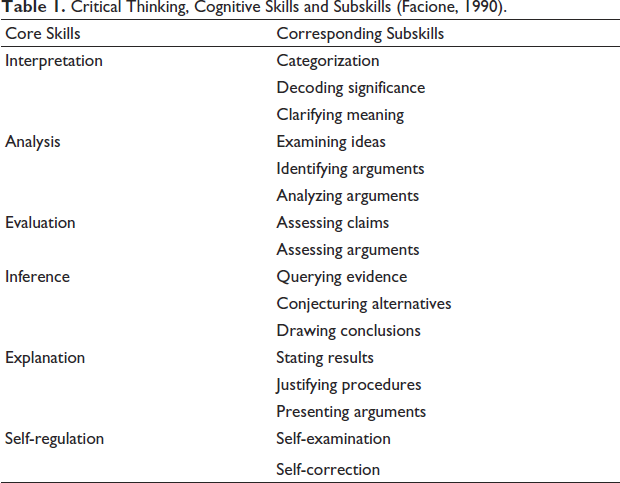
Numerous scholars have proposed taxonomies of critical thinking (e.g., Dwyer et al., 2014; Ennis, 2015; Facione, 1990; Halpern, 1998; Paul & Elder, 2007). Within the academic literature on education, one of the most influential conceptual frameworks was commissioned by the American Philosophical Association (APA) in the 1980s. A group of 46 leading experts were tasked to reach a consensus on the concept of critical thinking relevant at the college level (Facione, 1990). The outcome from the consensus-building Delphi methodology includes a taxonomy of six core cognitive skills (i.e., interpretation, analysis, evaluation, inference, explanation and self-regulation), each of which is characterized by a set of subskills (see Table 1). The findings were intended to support educators in enhancing teaching and evaluation of critical thinking. For example, those skills can be assessed using the California Critical Thinking Skills Test (CCTST, Insight Assessment, 2024), which the test developers claim is the most widely used critical thinking assessment in the world.
Critical Thinking, Cognitive Skills and Subskills (Facione, 1990).
Challenges in Teaching Critical Thinking
A central tenet of higher education is that critical thinking can be taught and learned (e.g., Ennis, 2018; Halpern, 1998). For example, the Malaysia Education Blueprint (2013–2025) and the Indian National Education Policy (2020) both stress the importance of developing higher-order thinking, such as critical thinking and problem-solving skills (Malaysian Ministry of Education, 2013; Ministry of Human Resource Development, 2020). However, national education reforms have had mixed success. There is no longer an assumption that students will acquire the skill in the normal course of their academic studies, and there is ongoing academic research on how learning can be best achieved, especially in different educational settings (Abrami et al., 2008, 2015).
Concepts are Difficult to Explain, and Hence to Teach
Although critical thinking lies at the core of university education, its meaning has not always been clear (e.g. Vandermensbrugghe, 2004). Some educators may consider it a trade-off between imparting critical thinking skills and teaching subject-specific knowledge in limited classroom time (Yen & Halili, 2015). Those that do want to teach critical thinking are often hindered by the multiplicity of definitions of thinking skills, low awareness of the importance of context and lack of training on how to incorporate critical thinking into their lessons (Choy & Cheah, 2009; Stedman & Adams, 2012; Tan, 2017; Vandermensbrugghe, 2004; Yen & Halili, 2015; Zhang et al., 2020). As one Indian professor explains, ‘Teachers can design compelling learning experiences only when they comprehend critical thinking concepts and principles that enable students’ critical thinking skills’ (Kumar, 2024). Definitions of critical thinking have been criticized for being too broad and non-specific, giving no clear indication of what needs to be taught, and what counts as evidence of critical thinking is rarely shared with the student (Egege & Kutieleh, 2004). If educators are not clear about what they are teaching, they are unlikely to have clear goals in place and a clear set of student outcomes to measure.
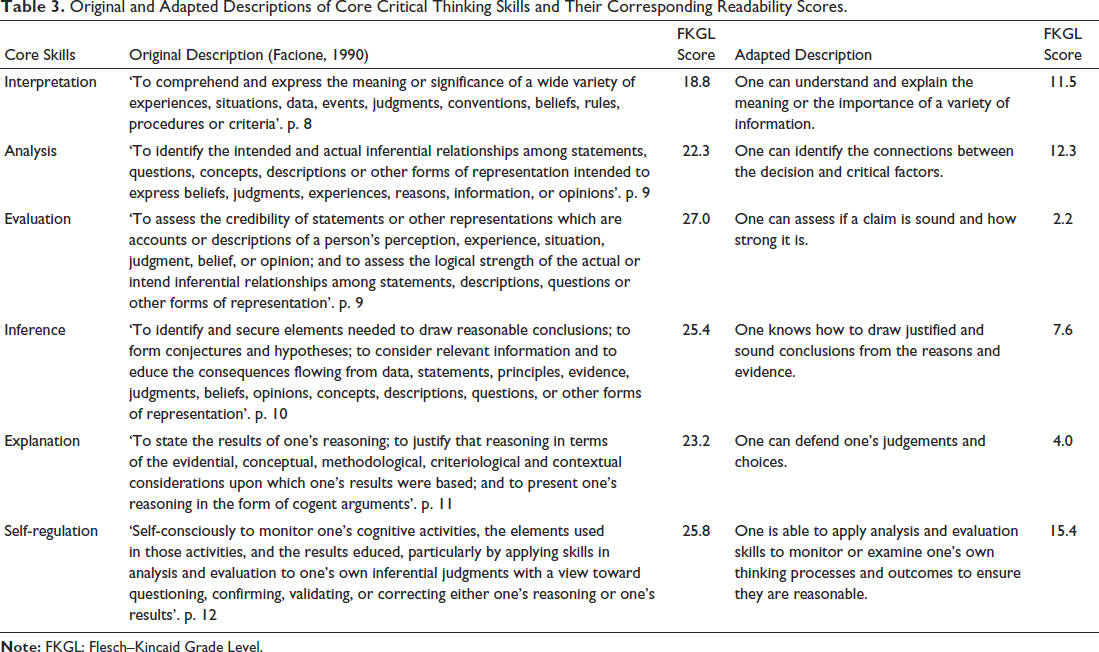
Halpern’s (1998) model for teaching recommends clearly describing which critical thinking skill is being taught in each lesson, using real everyday examples to encourage knowledge transfer and modelling metacognitive monitoring in class (see also Marin & Halpern, 2011). Facione (1990) offers one set of descriptions of the different critical thinking skills. But, while Facione’s (1990) conceptual framework has shaped academic discourse, its descriptions of the core skills (and subskills) are semantically, grammatically and syntactically complex (Table 2). For the 94% of the world’s population who are not native English speakers (Cochrane, 2024), such linguistic complexity further limits access to this conceptual framework.
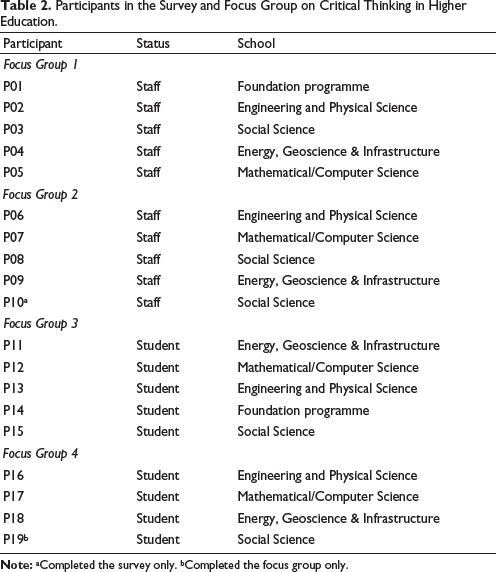
Participants in the Survey and Focus Group on Critical Thinking in Higher Education.
Western Bias
Atkinson (1997) construed critical thinking as a socially constructed concept where an awareness of context is necessary to understand its meaning. Critical thinking is implicitly embedded in Western culture because Western countries have been instrumental in the internationalization of education (Atkinson, 1997; Egege & Kutieleh, 2004; Rear, 2017; Tan, 2017; Vandermensbrugghe, 2004). Such sociocultural conventions affect possibilities and constraints in the non-Western classroom. For example, some educational norms can favour the acquisition and accumulation of knowledge over personal development (Vandermensbrugghe, 2004); expectations of rote learning can hinder critical inquiry and curiosity-driven learning (Vandermensbrugghe, 2004); respect for authority as a cultural norm can suppress challenges to prevailing viewpoints (Rear, 2017); and indirect communication as a social norm can oppose the more direct forms of communication often used in Western critical thinking instruction (Paton, 2005; Rear, 2017). According to this viewpoint, the Western-centric framework, which emphasizes individualism and direct confrontation, conflicts with collectivist values and hierarchical structures common across Asia. For example, the classical Chinese tradition relies heavily on analogy and circular reasoning rather than analysis, logic, argument and the scientific method (Lloyd, 1996; Rear, 2017), although this does not preclude critical thinking in Chinese culture (Paton, 2005; Zhang et al., 2020).
The present investigation first engaged students and educators to create more readable descriptions of critical thinking skills, and then investigated how well Facione’s (1990) conceptual framework for critical thinking was perceived in an Asian cultural context. Findings contribute to a better understanding of critical thinking skills teaching in higher education.
Study 1
Methods
Participants
The setting was a branch campus of a British university in Southeast Asia. Academic staff and students were recruited through referrals and word of mouth. Ten academic staff and nine students (one Foundation programme and eight undergraduates) participated from a range of disciplines (Table 2).
Materials
Readability of the original descriptions and examples by Facione (1990) were quantified using the Flesch–Kincaid Grade Level metric (FKGL) (Readable, n.d.). FKGL is a widely used readability measure designed to estimate the level of education required for a reader to understand a given text easily based on the average number of syllables per word and the average number of words per sentence in a text. The formula is: 0.39 × (words/sentences) + 11.8 × (syllables/words) – 15.59. Ideally, any text intended for the general public should have a readability of approximately grade 8 level, which can be read and understood by 80% of readers in the USA (Readable, n.d.). For example, grades 6–9 are commensurate with a Harry Potter novel (i.e., global ability).
None of the original descriptions of the six core skills met the target readability of grade 8 (FKGL range = 18.8–27.0, median = 23.4) (Table 3). Original descriptions for the 16 subskills typically comprised multiple bullet points, and only two of those had a readability in the acceptable range (FKGL range = 1.3–51.0, median = 16.4) (Appendices A1–A6 in the supplementary material). Grades 15–18 scores are commensurate with an academic journal article (i.e., advanced reader).
Original and Adapted Descriptions of Core Critical Thinking Skills and Their Corresponding Readability Scores.
Procedure
Modified descriptions of critical thinking skills were initially created by the authors, then using the FKGL metrics and feedback from students and educators to create final readable versions. Four focus groups provided further insights into readability.
Initially, the first author read the original descriptions (Facione, 1990) to familiarize with their intended meaning. Over successive iterations, draft versions were given feedback from all co-authors. This generated an interim set of descriptions with substantially improved FKGL scores; skills (range = 3.1–9.7, median = 7.1) and subskills (range = 6.0–11.7, median = 8.5). The adaptation eliminated the multiple bullet points of each of the 16 subskills, instead creating a single statement with three examples that were typical of teaching scenarios in higher education.
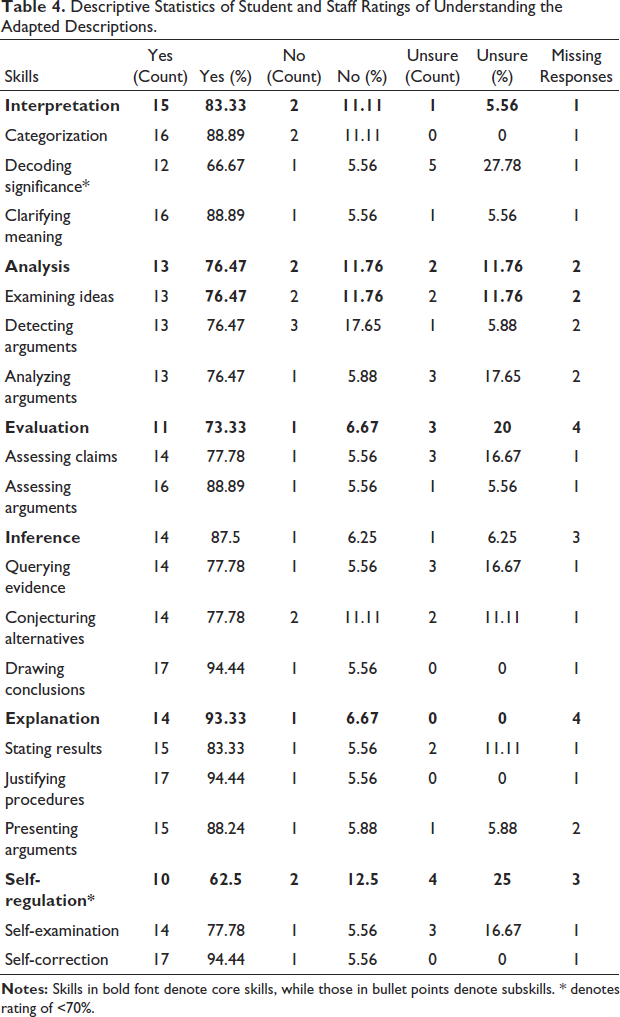
A spreadsheet (Excel, version 2411) was used to gather ratings of understanding (‘Yes—I understand’/‘No—I don’t understand’/‘Unsure’) for each adapted description. In a qualitative complement to the FKGL data, two semi-structured focus groups were convened with the student participants, and another two with the academic staff participants online using Microsoft Teams. Discussion focused on descriptions with less than 70% of participants responding ‘Yes—I understand’. Focus groups explored how well the adapted descriptions could be understood and identified potential for further improving readability. Focus groups with the students also explored what critical thinking skills they felt were poorly developed at university, and what their preferred learning approaches were. Focus groups with the staff focused on challenges faced in teaching critical thinking and preferred teaching approaches. Meetings lasted about 1 h for each session and were recorded for transcription and analysis purposes.
Data Analysis
Ratings of understanding were summarized using descriptive statistics. The audio recordings from each focus group were transcribed verbatim and then anonymized. The focus group discussion was analysed for its conceptual content to identify patterns in the narrative data in response to each question.
Results
Eighteen out of the 19 participants rated their understanding of the adapted descriptions (Table 4). Ratings for decoding significance (‘People are able to understand true meaning of something’, 68.7%) and self-regulation (‘People can think about their thinking and change it if they need to’, 62.5%) highlighted some lack of understanding. In the focus groups, nine out of the ten staff felt that understanding the ‘true meaning of something’ and ‘can think about their thinking’ poorly captured the intended meaning of the original descriptions. Although the rating for analysis (‘People can work out relationships among component parts that lead to a judgement’, 76.5%) was high, three out of the nine students felt that the phrase ‘component parts’ was unclear.
Descriptive Statistics of Student and Staff Ratings of Understanding the Adapted Descriptions.
Eighteen participants contributed to the subsequent focus groups, enabling further exploration of the written survey comments. All feedback was incorporated into new adapted versions (Appendices A1–A6 in the supplementary material). No significant adjustments were made to the other descriptions, apart from minor changes to some wording (e.g., ‘people’ changed to ‘one’). Many of the adapted descriptions of the six core skills met the target readability of grade 8 (FKGL range = 2.2–15.4, median = 9.6) (Table 2). Similarly, for the 16 subskills (FKGL range = 3.7–15.5, median = 7.6) (Appendices A1–A6 in the supplementary material). These median FKGL scores indicate suitability for an average reader. Although some descriptions exceeded grade 8 level, further simplification risked sacrificing some of the original depth of meaning.
Three novel themes emerged from the focus group discussion:
Critical thinking is an essential skill set for academic and professional success
Irrespective of their discipline, students recognized the value of critical thinking skills not just for academic studies but for future careers. Students were aware that critical thinking supports effective decision-making, problem-solving and communication. For example, one student stated: ‘As an actuarial student, observing, doing analysis, problem-solving are all closely related with what I study on daily basis’ (P18). One business student said: ‘… important when it comes to like writing essays for my assignments … critical thinking can be like street smart … important when we started working … like communicate with people, networking connecting relationships …’ (P19).
Higher education neglects to fully develop self-regulation skills
Students talked about explanation and analysis skills they felt were reasonably well developed by their university education, especially for Science, Technology, Engineering and Mathematics (STEM) disciplines. Across both focus groups, students felt greater learning opportunities and curriculum structure were needed to enhance self-regulation abilities. Self-regulated learning refers to one’s ability to regulate one’s learning behaviour, be it knowledge, skill or an academic task. One engineering student said: ‘… there hasn’t been much for now, which like, talk about like, self-regulation and like now to change your way of thinking’ (P13). One Foundation programme student said:
I guess policy is due around … you don’t really get your (exam) papers back to see like your mistakes … they don’t have like a self-set time for you to like look back on your mistakes … It doesn’t really promote a lot of self-regulation and like that mindset. (P14)
One actuarial science student said:
The only one which is commonly neglected by students is the self-regulation. Usually, students in actuarial science are very unsure of the assignments done by themselves because the assignments are difficult to understand, and we have lack of time to go through to learn about the assignment itself. (P18)
Educators should integrate the development of critical thinking into the curriculum
These discussions highlighted a need for academic practitioners to integrate more opportunities for students to practice and cultivate self-regulation. In terms of what further learning might look like, the preference for integrating critical thinking into existing curricula rather than as a standalone course was emphasized. One student said: ‘I don’t think you have to add a particular course like critical thinking to our subjects. Just through learning other subjects for our undergraduate programme … Just add some, few parts of the critical thinking supplementing it into the courses …’ (P12). Staff members typically agreed, adding: ‘I usually incorporate critical thinking into the teaching by encouraging students to consider different perspectives and the significance or impact of various issues under discussion’ (P03) and ‘… is the process of thinking is not like a package that you’re going to install in someone … Sometimes we start to build up critical thinking in kids from the school’ (P01).
The following study examined the perceived importance of the core skills across undergraduate student groups based upon their broad classifications of academic disciplines (i.e., STEM and non-STEM) and year of study.
Study 2
Methods
Participants
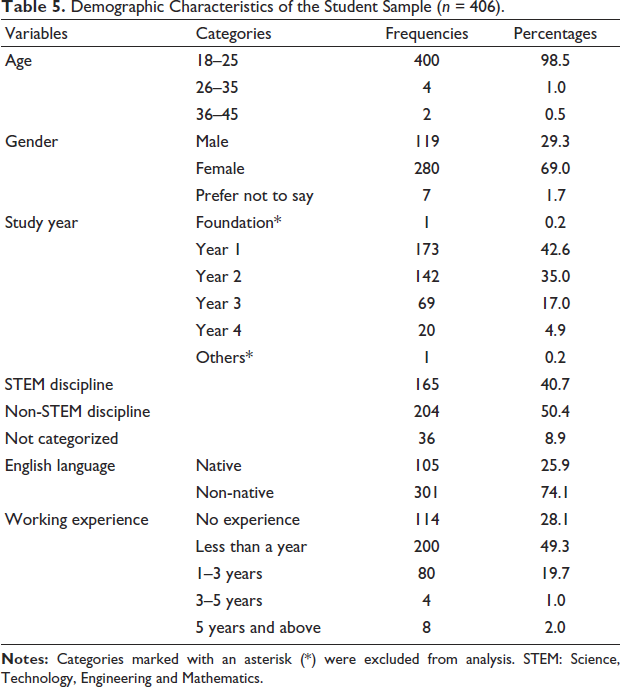
The setting was a branch campus of a British university in Southeast Asia, and other public and private universities co-located around the capital city. The survey was distributed through email, social media platforms, chat messengers, flyers and word of mouth. For populations exceeding 100,000, Israel (1992) suggests that the sample size needed for a 95% confidence level and a precision of ±5% is approximately 400. Therefore, the target sample size for this study was 400, and the final sample size was 406 (see Table 5). Participation was incentivized by a cash prize draw.
Materials
The survey (Surveylab, version 23.3) measured opinions about the importance of critical thinking skills among undergraduate students in Malaysia. Participants were asked to rate the importance of each core skill and subskill in relation to their learning on a nine-point Likert scale (1 = extremely unimportant to 9 = extremely important), plus an ‘unsure’ option. Skills were presented using the adapted descriptions and examples (Table 3, Appendices A1–A6 in the supplementary material). Demographic questions about discipline and year of study helped to characterize the sample, but no information was collected about university of enrolment.
Procedures
Participants accessed the online survey by scanning a QR code or by clicking the embedded survey link included in the invitation materials. Responding to each survey item was mandatory, and so there were no missing data. Data were pseudo-anonymized by assigning a unique identifier code to each participant. These were deleted to fully anonymize the data before analysis.
Data Analysis
Data dimensionality was reduced by averaging ratings for each core critical thinking skill with their corresponding subskills to derive a single composite score. Internal consistency reliability for each set of items was excellent (Cronbach’s alpha = 0.90–0.94). The Likert scale responses were analysed using SPSS (version 29). Data for all six variables were strongly negatively skewed, suggesting that students largely rated all skills as very important. To meet statistical assumptions for analysis of variance (ANOVA), data were log₁₀-transformed. A one-way ANOVA was conducted with critical thinking skill (interpretation, analysis, evaluation, inference, explanation and self-regulation) as the independent variable and importance ratings as the dependent variable. Degrees of freedom were adjusted (using the Greenhouse–Geisser correction) to compensate for violation of sphericity assumptions.
Results
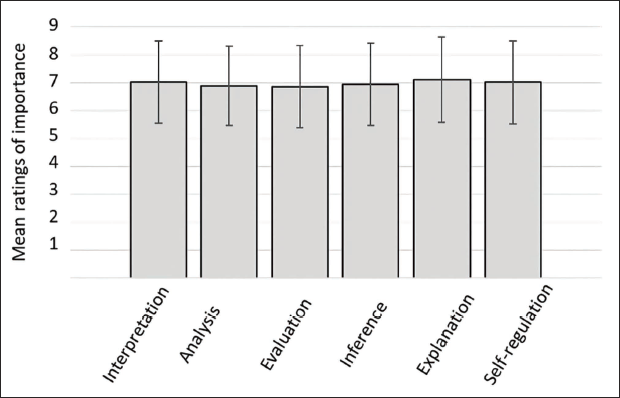
There was a statistically significant effect of critical thinking skills on the perceived importance ratings, F (5, 1771.19) = 11.4, p < .001, with a modest effect size (η² = 0.028). Out of a maximum score of 9, the highest mean rating was for explanation (M = 7.10), followed by interpretation (M = 7.03), self-regulation (M = 7.02), inference (M = 6.94), analysis (M = 6.89) and lastly evaluation (M = 6.86) (Figure 1). Post-hoc tests showed that explanation, interpretation and self-regulation were rated significantly higher than analysis and evaluation (p < .05).
Mean Ratings of Importance for the Six Critical Thinking Skills. Data are Plotted for the Composite Scores. Error Bars Show ±1 Standard Deviation.
Between-subjects two-way ANOVAs were conducted with discipline of study (STEM vs. non-STEM) and year of study (year 1, year 2, years 3 and 4) as independent variables. Statistical significance was interpreted using a Bonferroni-adjusted alpha = 0.008.
There was no evidence for any difference between STEM and non-STEM disciplines in ratings of importance: interpretation, F(2, 395) = 4.04, p = .018; analysis, F(2, 395) = 2.60, p = .076; evaluation, F(2, 396) = 3.23, p = .041; inference, F(2, 396) = 3.98, p = .020; explanation, F(2, 396) = 2.19, p = .114; and self-regulation, F(2, 396) = 0.69, p = .504. Similarly, there was no significant effect of study year: interpretation, F(2, 395) = 0.11, p = .899; analysis, F(2, 395) = 1.93, p = .147; evaluation, F(2, 396) = 1.69, p = .186; inference, F(2, 396) = 1.50, p = .224; explanation, F(2, 396) = 1.50, p = .224; and self-regulation, F(2, 396) = 0.29, p = .751.
Discussion
This investigation produced a simple-to-understand set of descriptions of critical thinking skills according to Facione’s (1990) taxonomy, including illustrative examples relevant to higher education. Strengths of this work include the co-production with students and staff, as well as the careful adaptation process with iterative refinement. The resulting set of descriptions can be incorporated into clear and accessible teaching materials to enable learners to integrate these skills more effectively into their reasoning processes (see Paul & Elder, 2007). The aim would be to promote students’ self-awareness about the thinking process, which is an important factor in developing effective critical thinking (Akcaoğlu et al., 2023), extending learning beyond the disciplinary content into the realm of becoming a professional.
The Universal Importance of Critical Thinking
The focus group discussions with undergraduate students from one university in Malaysia acknowledged the importance of all six core critical thinking skills for their academic and professional success, and the survey data confirmed that this viewpoint was shared by their peers. Although Facione’s (1990) conceptual framework for critical thinking is a Western-centric one, our results demonstrate that undergraduate students and staff in Malaysia readily accept the value of this Western style of critical thinking in their academic studies.
In the twenty-first century, cultural boundaries and identities are becoming increasingly blurred and intermingled under the influence of globalization (Rear, 2017). Consumers of higher education reflect a new generation of youth who grew up in this era of globalization. For example, while Chinese culture historically fostered a critical thinking mode which emphasized intuitive thinking and the role of traditional experience-based knowledge in analyzing problems, Durkin has shown that contemporary Chinese students are readily able to adapt to Western norms of critical debate and argumentation, while still retaining values that preserve social harmony and face (Bai & Pan, 2023; Durkin, 2008).
Malaysia is a regional hub for international higher education in South-east Asia, offering a range of degrees taught in English (Ross, 2024). In many Asian countries, obtaining such a degree is seen as an attractive path to global citizenship; as Vandermensbrugghe (2004, p. 418) says, ‘a passport for the world’. This recognition aligns with the broader understanding of critical thinking as a fundamental skill set necessary for success in modern-day life from the perspective of university and industry sectors alike. For example, the World Economic Forum (2023) surveyed 803 companies employing a workforce of more than 11 million across the globe. Organizations in Central, East and South Asia all share a similar outlook. Analytical thinking is considered a core skill by more companies than any other skill, and across many different sectors of industry. Out of 26 possible workforce skills, about half of those organizations surveyed said that analytical thinking was the highest priority for skills training from 2023 to 2027. In this context, analytical thinking is synonymous with critical thinking because they both invoke judgement and argumentation. Analytical thinking plays a central role in breaking down arguments, understanding relationships between concepts and enabling informed decision-making (Ennis, 2015; Facione, 1990; Halpern, 1998). It is interesting that, despite the rise in digital technology, skills in artificial intelligence and big data were consistently ranked second, below analytical skills, highlighting the global significance of critical thinking. These contemporary trends provide a context for the universality of Facione’s (1990) conceptual framework for critical thinking.
A Neglect of Developing Self-regulation Skills?
The focus group discussions with undergraduate students from one university in Malaysia revealed limited opportunities to master self-regulation skills during their university journey. Self-regulated learners are able to set specific and realistic learning goals, maintain their motivation, regulate their emotions, and monitor and evaluate their progress towards the learning goals (García-Pérez et al., 2021).
Although higher education expects all students to self-regulate, students can choose and adapt their learning strategies according to their knowledge and capabilities as well as the specific circumstances (García-Pérez et al., 2021). Regarding capabilities, Zhang et al. (2015) showed that some students may be vulnerable to self-appraisal and this raises anxiety, reducing the likelihood of engaging in self-regulation. Regarding external circumstances, both the educators and the learning environment can influence opportunities for students to nurture self-regulation skills. On the one hand, the role of an educator is to inculcate self-regulation in students (Choy et al., 2019), but research has shown that educators themselves often do not know how to be reflective or demonstrate reflective thinking (e.g., DeWitt et al., 2016; Yen & Halili, 2015). In terms of the environment, it often does not naturally lend itself to fostering self-regulatory behaviours. Typically, learning activities at university are externally driven by the semester timetable, self-directed learning is governed by a published reading list, deadlines are imposed, essays and reports are more common forms of assessment than reflective journals, formative and peer assessments are underused, and opportunities for discussing individual feedback are limited. Yet other researchers emphasize the role of social systems and cultural values. For example, Zhang et al. (2015) suggested that the traditional Chinese view of education takes studying ‘as a means to an end’ (p. 596) with a narrow focus on marks does not encourage self-regulation.
Demographic Characteristics of the Student Sample (n = 406).
Concluding Remarks
Results offer educators and students an easy-to-access understanding of precisely what critical thinking skills should be emphasized in teaching and learning at university. This is crucial, particularly for those from non-Western educational contexts like Malaysia, where educators often struggle with incorporating thinking skills into their teaching due to a lack of clarity about its definition and how to effectively teach it to students with diverse learning needs (Dinham et al., 2020). We welcome the growing body of research on how to teach critical thinking in an effective way (e.g., Choy et al., 2019; DeWitt et al., 2016; Dinham et al., 2020; Farrukh, 2024; Marin & Halpern, 2011).
Authors’ Contributions
STSS and DAH conceived the work; STSS, RS and DAH contributed to the data analysis; and STSS and DAH drafted the work. All authors made substantial contributions to the design of the work and acquisition of data, reviewed it critically for important intellectual content, gave final approval of the version to be published, and agree to be accountable for all aspects of the work.
Informed Consent and Publication
All participants provided written informed consent prior to participating. Consent included permission for the publication of anonymized data and research findings.
Data Availability Statement
Information about the successive revisions made to the descriptions of critical thinking can be obtained from the first author on request.
Footnotes
Declaration of Conflicting Interests
The authors declared no potential conflicts of interest with respect to the research, authorship and/or publication of this article.
Ethical Approval
Studies 1 and 2 were approved by the School of Social Sciences Ethics Committee, Heriot-Watt University (Ref. #: 2022-2760-5306).
Funding
The authors disclosed receipt of the following financial support for the research, authorship and/or publication of this article: The first author was supported by a James Watt PhD scholarship awarded by Heriot-Watt University Malaysia.
Supplementary Material

Author Biographies
References
Supplementary Material
Please find the following supplemental material available below.
For Open Access articles published under a Creative Commons License, all supplemental material carries the same license as the article it is associated with.
For non-Open Access articles published, all supplemental material carries a non-exclusive license, and permission requests for re-use of supplemental material or any part of supplemental material shall be sent directly to the copyright owner as specified in the copyright notice associated with the article.
