




Abstract
The academic challenges faced by students with neurodevelopmental disorders, including specific learning disorders (SLD) and attention-deficit hyperactivity disorder (ADHD), are reflected in learning processes and academic outcomes. This study examined associations between motivational and metacognitive factors and academic achievement among higher education students with and without SLD/ADHD from Israel, Italy, and Spain. Participants were 687 students, including 223 diagnosed with SLD/ADHD and 464 in a comparison group without disabilities. Academic self-efficacy (ASE), self-regulated learning (SRL), academic satisfaction, and achievement were assessed via self-report questionnaires. Students with SLD/ADHD reported lower achievement (i.e., average grade) as well as lower ASE and SRL than peers without disabilities, but no differences were found in academic satisfaction. Important, ASE and SRL fully mediated the relationship between SLD/ADHD and academic achievement. These findings highlight the critical role of motivational and metacognitive factors in promoting academic success among students with neurodevelopmental disorders in higher education.
Entering higher education can be both a source of excitement and a challenge, with the balance between these experiences laying the foundation for academic success and satisfaction (e.g., Gale & Parker, 2012). This balance is shaped by both individual and environmental factors (e.g., Meehan & Howells, 2017). On the one hand, the experiences and support systems available during university play a crucial role, particularly for students facing specific challenges. On the other hand, the complex interplay of cognitive, emotional, and motivational characteristics of students is equally significant (e.g., Mega et al., 2014). For students with neurodevelopmental disorders, including specific learning disorders (SLD) and attention-deficit hyperactivity disorder (ADHD), the academic demands in higher education are significantly more challenging than for their peers without disabilities. Specifically, these students demonstrate lower academic self-efficacy (ASE), difficulties in self-regulated learning (SRL), along with lower achievements (Ben-Naim et al., 2017; Casali et al., 2024; Mana et al., 2022; Reid et al., 2012; Sharabi et al., 2016; Sharabi & Shelach Inbar, 2024).
Overall, while good cognitive abilities are necessary to achieve successful learning outcomes, they are not sufficient (Ben-Eliyahu, 2019). In fact, motivational and metacognitive factors, such as SRL, appear to be key in overcoming the difficulties typically encountered during the academic journey, such as managing time effectively, maintaining focus, coping with academic stress, and sustaining engagement with learning tasks (e.g., Mega et al., 2014). In the literature, particular attention has been paid to the role of ASE and SRL and their consequences for educational outcomes such as academic achievement (e.g., Casali et al., 2024; Feraco et al., 2022). The purpose of the current study was to broaden this scope by examining the relation between ASE, SRL, academic satisfaction, and academic achievement among students with and without SLD or ADHD from three countries: Israel, Italy, and Spain. Specifically, the study aimed to address a gap in the existing literature by going beyond merely determining whether a diagnosis of SLD or ADHD directly accounts for lower academic performance, and examining whether this relationship is mediated by motivational factors, particularly ASE and SRL. The study also examined the differences between the research variables by comparing students with and without SLD and ADHD from Israel, Italy, and Spain.
Specific Learning Disorders and Attention Deficit Hyperactivity Disorder
SLD and ADHD are common neurodevelopmental disorders that significantly affect daily-life activities. While students with SLD struggle most with developing their learning abilities, which affects their study skills, their peers with ADHD experience difficulties in focusing on tasks and organizing their behavior, which can also impact their learning and study skills (American Psychiatric Association [APA], 2022).
The prevalence of students reporting SLD or ADHD in higher education has increased significantly over the years (e.g., Brunswick et al., 2023; Sedgwick, 2018). Although defined, diagnosed, and treated differently, SLD and ADHD share common characteristics, and previous studies on higher education students have tended to combine the two groups (Kalman-Halevi et al., 2023; Sharabi & Shelach Inbar, 2024). For example, when considering their cognitive profiles, both groups generally show satisfactory intellectual abilities, while their weaknesses are related to basic cognitive processes such as executive functions, working memory, inhibition, cognitive flexibility, and processing speed (e.g., Theiling & Petermann, 2016; Toffalini et al., 2017). Further, SLD and ADHD often co-occur, with approximately 40% of individuals with ADHD also being diagnosed with SLD (DuPaul et al., 2015). Both disorders significantly impact the academic pathway, resulting in students at various stages of their studies, including higher education, tending to achieve lower grades than their peers without disabilities (e.g., Casali et al., 2024). Additionally, these students are at a higher risk for grade retention, truancy, and school dropout (e.g., Fried et al., 2016).
These challenges are only partly due to the cognitive characteristics of the disorders; emotional and motivational components also play a significant role in lower academic outcomes. For example, Ghisi et al. (2016) demonstrated that university students with a diagnosis of SLD experienced emotional issues like low self-esteem, poor resilience, and anxiety or depression more often than students without SLD. Additionally, adults with ADHD more often use nonadaptive emotion regulation strategies, and their emotion dysregulation is tied to symptom severity, executive dysfunction, psychiatric issues, and even criminal behavior (Hirsch et al., 2018; Soler-Gutierrez et al., 2023).
Finally, motivational components also play a role. For instance, both students with SLD and/or ADHD are less able to organize and plan their study activities (e.g., Lewandowski et al., 2016) and tend to hold lower functional beliefs about their abilities, such as lower ASE, compared to their peers (e.g., Casali et al., 2024; Mana et al., 2022; Sharabi & Shelach Inbar, 2024).
Academic Self-Efficacy
Self-efficacy refers to individuals’ belief in their ability to achieve desired outcomes or goals (Bandura, 1997). More specifically, ASE may be defined as the belief students hold about their ability to complete academic tasks at specified levels (Bandura, 2018). As proposed by Bandura, these self-perceptions are influenced by past experiences, challenges, and personal history. Depending on their beliefs about their capabilities and goals, students form different self-concepts and pursue varying courses of action (Zimmerman, 2000). Moreover, self-efficacy beliefs influence the quality of individual functioning through cognitive, motivational, affective, and decisional processes (Bandura, 2012). Higher levels of self-efficacy are usually associated with higher levels of motivation, persistence, and adaptive behavior compared to those who are less confident about their abilities (Pintrich, 2003).
ASE is also closely intertwined with SRL (Casali et al., 2024; Mega et al., 2014). That is, students who perceive themselves as capable are more inclined to engage in planning, monitoring, and adjusting their approach to academic tasks (Casali et al., 2024; Richardson et al., 2012). The association between ASE and academic achievement has been repeatedly demonstrated both in students with and without SLD and/or ADHD and at various levels of education, including higher education. Previous studies have shown that students with SLD report lower levels of ASE and tend to achieve lower academic outcomes than students without disabilities (Ben-Naim et al., 2017; Casali et al., 2024; Stagg et al., 2018). However, comparing students with and without SLD matched on academic achievement, Matteucci and Soncini (2021) found no differences between university students with and without SLD in perceived ASE. This suggests that academic difficulties have a motivational counterpart, independent of the diagnosis.
Compared to research on ASE in students with SLD, relatively few studies have explored ASE in students with ADHD in higher education. In some studies (e.g., Mana et al., 2022), SLD and ADHD groups were considered as separate and were both found to demonstrate lower ASE than their peers without disabilities; also, students with SLD reported higher ASE than students with ADHD. In other studies, students with SLD and/or ADHD, considered as a combined group, reported lower ASE scores than their peers without SLD or ADHD (Sarid & Lipka, 2023; Sharabi & Shelach Inbar, 2024; Tabassam & Grainger, 2002). Finally, ASE was also related to students’ SRL processes and higher grades (Casali et al., 2022; Mega et al., 2014).
Self-Regulated Learning
SRL is a concept that describes how individuals actively initiate and manage goal-directed learning processes, as well as control and regulate their cognitive activities within academic contexts (Puustinen & Pulkkinen, 2001). Self-regulated learners establish effective goals and structure their study activities, utilizing appropriate study strategies and demonstrating metacognitive awareness of their learning processes (Panadero, 2017).
Although various theories have been proposed to explain the dimensions of SRL, they all converge on the core idea that SRL is a multidimensional process characterized by motivation-related variables, active engagement in constructing knowledge, and strategic use of diverse cognitive and metacognitive processes to effectively regulate and enhance academic learning (Mega et al., 2014; Panadero, 2017; Zimmerman, 2000).
Higher education study requires a high degree of organization, planning, and monitoring activities to manage the increase in workload that students typically face in combination with a decrease in parent and teacher supervision (e.g., Broadbent, 2017). This can be particularly problematic for both students with SLD and those with ADHD, who may have difficulties in SRL (Reid et al., 2012). Part of the difficulties in SRL may be related to the executive functioning (EF) deficits that characterize both profiles: indeed, a growing body of literature suggests the importance of considering SRL and EF as closely related (e.g., Hofmann et al., 2012; Howard et al., 2021).
Attention to the role of SRL in academic success has focused particularly on children and adolescents with SLD, whereas fewer studies have considered the case of university students with SLD. In one such study, Iaia et al. (2024) found that university students with SLD used fewer SRL strategies involving elaborative learning, knowledge application, and critical thinking compared to students without SLD, though both groups similarly identified key information and monitored their learning.
The role of SRL and other motivation-related variables may extend beyond academic achievement. For example, Pellegrino et al. (2023) examined the role of motivation-related variables, such as ASE, SRL strategies, and academic satisfaction, in the use of university services of a group of students with SLD. Their findings showed that the frequency of use and appreciation of specific services were positively related to ASE, SRL strategies, and academic satisfaction.
Notably fewer studies have examined SRL in students with ADHD in higher education, despite the likelihood of difficulties in this group. Among existing studies, Shelton et al. (2019) analyzed how ADHD symptomatology was associated with the use of effective SRL strategies by having university students report their levels of inattention, hyperactivity/impulsivity manifestations, and their motivation and learning strategies. Findings indicated that lower levels of motivation and SRL were associated with higher inattentive symptomatology. Furthermore, students who employed more effective SRL strategies tended to achieve better academic outcomes (see also Casali et al., 2022; Richardson et al., 2012). Finally, beyond academic performance, SRL strategies and ASE have also been linked to academic and life satisfaction (e.g., Casali et al., 2022, 2024; Diseth et al., 2012; Feraco et al., 2022).
Achievement and Academic Satisfaction
Academic satisfaction can be defined as a cognitive-affective evaluation of overall contentment with the school-life experience (Huebner et al., 2012). Prior research has shown that academic satisfaction is associated with students’ achievement in higher education (Dhaqane & Afrah, 2016). However, the level of academic satisfaction may vary depending on individual, family, and environmental factors. Among individual factors, the presence of neurodevelopmental disorders can be influential on academic achievement (Sedgwick, 2018), and is also a significant factor influencing academic satisfaction (Hui & Sun, 2010). However, considering the case of higher education students with SLD, Casali et al. (2024) found that while these students had lower achievement, they did not express different levels of academic satisfaction. This can be related to the special situation of students with SLD who are enrolled at university: despite their difficulties, they can express a general satisfaction for having reached higher education and this can contribute to achievement (e.g., Heffner & Antaramian, 2016).
Current Study: Aims and Hypotheses
As reviewed in the literature, a diagnosis of SLD or ADHD may have a negative impact on students’ ASE and SRL. To date, few published studies have examined these two constructs concurrently in relation to academic achievement in higher education students with SLD and/or ADHD. Thus, the objective of the current study was to examine the role of ASE, SRL components, and academic satisfaction in relation to academic achievement among students with and without a diagnosis of SLD or ADHD from three countries: Israel, Italy, and Spain. The main goal of the study was to analyze whether having a diagnosis of SLD or ADHD directly accounts for lower academic performance, or if this relationship is mediated by motivational factors, particularly ASE and SRL. In line with the reviewed literature demonstrating links between SLD/ADHD and negative consequences on academic achievement and motivational aspects (e.g., Casali et al., 2024), we posited the following hypotheses:
Differences between students with and without SLD: We hypothesized that students with SLD/ADHD would report lower academic achievement (Casali et al., 2024), lower ASE (Sharabi & Shelach Inbar, 2024), and lower SRL (Reid et al., 2012) than their peers without disabilities. However, we predicted no differences in academic satisfaction (Casali et al., 2024). Associations between motivational and self-perceived factors in academic learning and academic achievement: Based on previous studies, we hypothesized that SRL strategies (Casali et al., 2022), ASE (Casali et al., 2024), and academic satisfaction (Dhaqane & Afrah, 2016) would be related to students’ academic achievement. The mediating role of motivational and metacognitive factors on academic achievement: Previous studies have shown that high levels of ASE and effective SRL skills are associated with better academic performance (Casali et al., 2024; Feraco et al., 2022; Mega et al., 2014). These abilities may help students to better manage the challenges they face, thereby improving academic outcomes. Therefore, we hypothesized that the relationship between ADHD/SLD and academic achievement would be significantly mediated by ASE and SRL, highlighting their central importance in supporting students’ educational success.
Method
Participants
The sample consisted of 687 students (M = 24.83 years, SD = 6.49) from Israel, Italy, and Spain; 452 were female (65.8%) and 235 were male (34.2%). Of the total, 565 (82%) participants were Bachelor's degree students and 122 (17.8%) were Master's degree students. Across the degree programs, 250 students (36.4%) were in their first year of study, 180 (26.2%) in their second year of study, and 257 (37.4%) were in their third year of study and up. In terms of disabilities, 223 had a diagnosis of SLD and/or ADHD and 464 had no diagnosis. Demographic characteristics for each of the countries are presented in Table 1.
Students’ Demographic Information by Country.
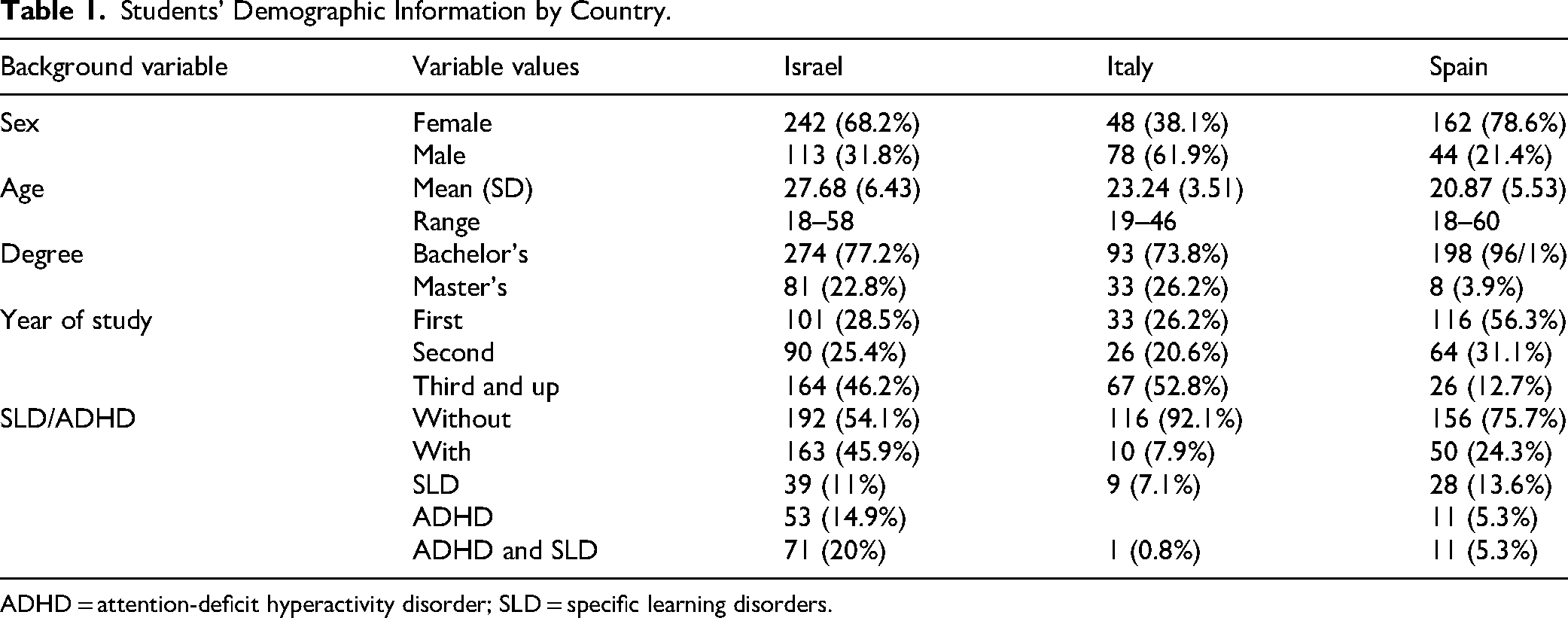
ADHD = attention-deficit hyperactivity disorder; SLD = specific learning disorders.
A one-way analysis of variance (ANOVA) indicated significant differences between the countries in terms of age, F(2,684) = 97.85, p < .001. Bonferroni post hoc analyses revealed that students from Israel were significantly older (Mage = 27.68, SD = 6.43) than students from Italy (Mage = 23.24, SD = 3.59), and Spain (Mage = 20.87, SD = 5.53), and students from Italy were significantly older than students from Spain. Additionally, significant differences were found between the countries in terms of sex, F(2,684) = 97.85, p < .001. The presence of female students in the Israeli sample was higher than in the Italian sample, but lower than in the Spanish sample. In Spain, the presence of female students was higher than in Italy.
Diagnosis of SLD and ADHD in the Participating Countries
In most countries, SLD and ADHD are diagnosed according to the Diagnostic and Statistical Manual of Mental Disorders criteria (DSM; APA, 2022), including the countries in the current study (e.g., Al-Yagon et al., 2012); however, some specificity exists. For example, in Italy, the public healthcare system requires that the diagnosis of SLD and ADHD is based on the International Classification of Diseases (World Health Organization [WHO], 2019). In addition to the general criteria defined in the DSM (APA, 2022), the specific criteria are further detailed in national guidelines (e.g., Istituto Superiore di Sanità [ISS], 2022), which provide directions for diagnosis.
Measures
The following instruments were used as part of the study.
Academic Self-Efficacy Questionnaire
This questionnaire consists of five items measuring the belief that one can succeed in studying (e.g., “How do you rate your study skills?”) on a five-point Likert scale (from 1 = poor to 5 = excellent) (De Beni et al., 2014). The dependent variable was the average of the item scores. The scale has proven reliable both in the original version (Cronbach's α = .80; De Beni et al., 2014) and in the current study (α = .78).
Self-Regulated Learning Questionnaire
The short form of this measure (adapted from De Beni et al., 2014) included 20 items assessing five SRL strategies (four items each): organization (e.g., “In the early afternoon, I plan all the things I have to do”); elaboration (e.g., “When studying, I try to present the contents in my own words”); self-evaluation (e.g., “After a written exam, I know whether it went well or not”); preparing for exams (e.g., “I try to anticipate what kind of exam awaits me”); and metacognition (e.g., “When an exam goes wrong, I try to understand the reasons why I failed”). Seven items had to be reversed to calculate overall scores. After reversing the negative items, we calculated the average score. The short form was proposed by Casali et al. (2024) and showed satisfactory internal consistency (Cronbach's α = .76) also observed in the current study (α = .74).
Academic Satisfaction
This measure was adapted from the Multidimensional Students’ Life Satisfaction Scale—Short Form—School subscale (Huebner et al., 2012). The questionnaire contained five items evaluating satisfaction with university life (e.g., “I enjoy being at the university”). The dependent variable was the average of the item scores. The scale displayed good internal consistency in the original version (Cronbach's α = .88) as well as the current study (α = .88).
Demographics and Grades
This questionnaire, developed specifically for the current study, included 19 open-ended and multiple-choice questions referring to participants’ (a) demographic information (e.g., sex, age, and nationality); (b) diagnosis as SLD or ADHD (type of disability); and (c) academic studies (e.g., degree, year of study, and field of study). Participants were also asked to report their current grades. Since grading systems differ—Spain (0–10, pass = 5), Italy (0–30, pass = 18), and Israel (0–100, pass = 60)—we converted all grades to a five-point scale (1 = base level, 5 = excellent) based on the European Credit Transfer System (ECTS) guidelines to ensure comparability. The values used for the conversion are reported in Table S1 in the Supplemental materials.
Procedure
Approval to conduct the study was received from the ethical review board of the institution of the authors in each of the participating countries. The study was conducted in the second semester of 2023 and 2024. The ASE, SRL, and academic satisfaction questionnaires were translated from the Italian version to English and then to Spanish and Hebrew by a back-and-forth translation procedure. In each country, the students were recruited primarily through an online survey circulated via social media and academic digital platforms. Questionnaires were distributed online with a single link using a snowball procedure. The first page of the survey contained the informed consent form, and beginning the survey constituted provision of consent. It was made clear to participants that participation in the study was voluntary and anonymous and that the study adhered to all ethical guidelines. The study is the product of a long academic acquaintance that gave rise to this research collaboration; each co-researcher collected the data in their own country.
Data Analysis
Analyses were conducted using IBM SPSS 29 for Windows with maximum likelihood estimation. Initially, we performed preliminary analyses, including bivariate correlations, to examine the associations among the research measures, as well as a multivariate ANOVA (MANOVA) to explore group differences (with and without SLD and/or ADHD; Israel, Italy, and Spain). Due to the small number of participants with SLD in Italy, it was not possible to conduct a two-way MANOVA using both Nationality and Group as between factors; therefore, two separate one-way MANOVAs were conducted. In the first analysis, the independent variable was Group (with and without SLD/ADHD), and in the second analysis, Nationality (Israel, Italy, and Spain).
Following these analyses, we conducted a multiple hierarchical regression analysis to test the relative contributions of the interpersonal factors (ASE, SRL, and academic satisfaction) in accounting for variance in the students’ grades. As detailed in the Results section, to control for the demographic variables they were included in the model in the first step. In the second step, we added the interpersonal factors to test their role in explaining the dependent variable. Next, to explore the relationships among the variables and to identify any mediating paths, we used Hayes (2018) bootstrapping approach. Specifically, we utilized Hayes’ PROCESS 4.0 macro for SPSS (Hayes, 2018; model 4) and Preacher and Hayes (2008) bootstrapping method with 5,000 resamples with replacement. In this analysis, group (i.e., no diagnosis, diagnosis with SLD/ADHD) served as the independent variable, students’ average grades served as the dependent variable, and ASE and SRL were the mediators. We also controlled for participants’ nationality. Statistical significance was considered at p < .05.
Results
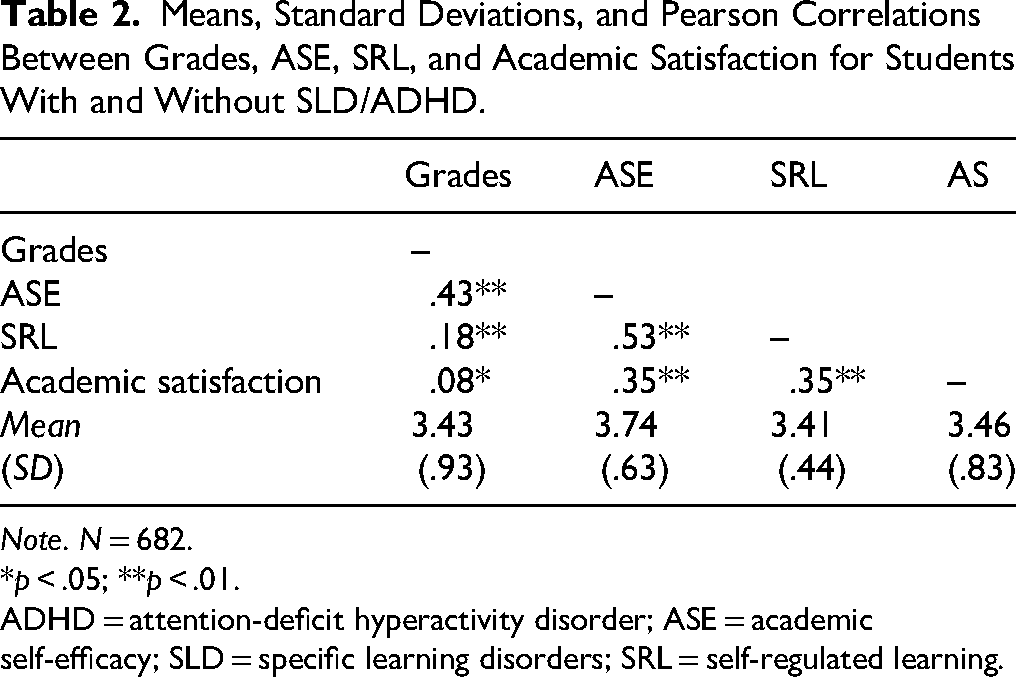
First, to examine intercorrelations between study variables, Pearson correlations were performed (see Table 2). A significant positive correlation between grades and all variables were found, as presented in the following.
Means, Standard Deviations, and Pearson Correlations Between Grades, ASE, SRL, and Academic Satisfaction for Students With and Without SLD/ADHD.
Note. N = 682.
*p < .05; **p < .01.
ADHD = attention-deficit hyperactivity disorder; ASE = academic self-efficacy; SLD = specific learning disorders; SRL = self-regulated learning.
To decrease the chance of type 1 errors, two one-way MANOVAs were conducted. First, with Group (with/without SLD/ADHD) and second, with Nationality (Israel/Italy/ Spain) as the independent variables, and with the following dependent variables: average grade, ASE, SRL, and academic satisfaction. Partial η² was calculated as an estimate of effect size. Results revealed a significant main effect for Group, F(4, 673) = 15.68, p < .001, partial η² = .09, and a significant main effect for Nationality, F(4, 676) = 34.89, p < .001, partial η² = .17.
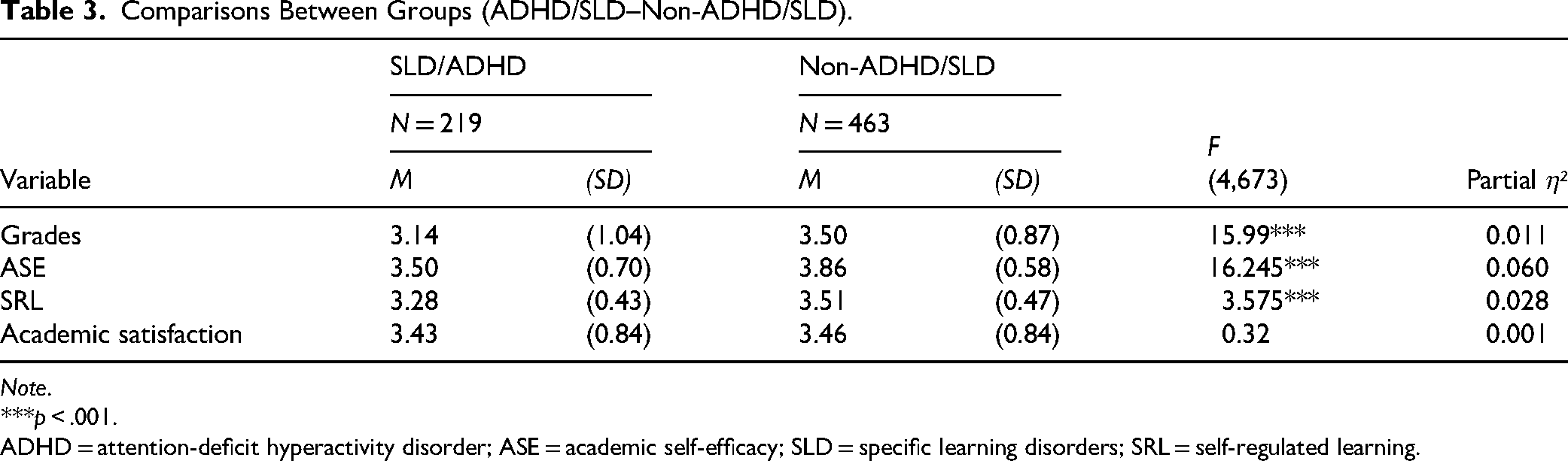
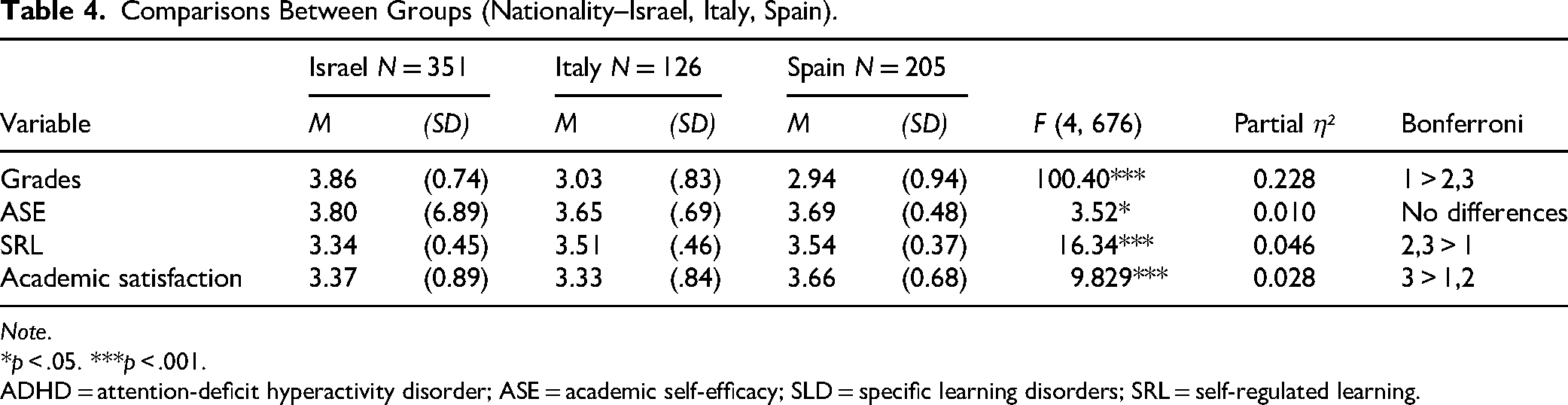
Students with SLD/ADHD reported lower grades, as well as lower ASE and SRL compared to their peers without disabilities, but no differences were found in academic satisfaction (see Table 3). Significant differences for Nationality were found, with Israeli students reporting higher grades than students from Italy and Spain, but lower SRL than Italian and Spanish students (see Table 4). Moreover, Spanish students reported higher academic satisfaction than Israeli and Italian students. Although the mean comparison was statistically significant for ASE, no differences were found in pairwise comparisons, adjusted for multiple comparisons with Bonferroni method, between the three countries. The effect size was small, which may explain the lack of differences.
Comparisons Between Groups (ADHD/SLD–Non-ADHD/SLD).
Note.
***p < .001.
ADHD = attention-deficit hyperactivity disorder; ASE = academic self-efficacy; SLD = specific learning disorders; SRL = self-regulated learning.
Comparisons Between Groups (Nationality–Israel, Italy, Spain).
Note.
*p < .05. ***p < .001.
ADHD = attention-deficit hyperactivity disorder; ASE = academic self-efficacy; SLD = specific learning disorders; SRL = self-regulated learning.
Stepwise Multiple Hierarchical Regressions
We conducted a multiple hierarchical regression analysis to test the relative contributions of ASE, SRL, and academic satisfaction in predicting students’ average grades. To control for the demographic variables of age, sex, year of study (first, second, or third year), nationality (Israel, Italy, and Spain) and diagnosis (with and without SLD/ADHD) were entered in the first step, and showed a significant contribution, F(5, 676) = 46.88, p < .001, explaining 26% of the variance in self-report average grades. Nationality (β = −.47, p < .001), age (β = .09, p < .01), and diagnosis of SLD/ADHD (β = −.15, p < .001) yielded unique explanations, with higher average grades being predicted for older students, Israeli students, or students without SLD/ADHD.
ASE, SRL, and academic satisfaction were entered in the second step, explaining an additional 13.5% of the variance, F(8, 673) = 54.94, p < .001, reaching a total explanation of 38.8%. ASE (β = .34, p < .001) and SRL (β = .09, p < .01) each yielded a unique explanation of the variance in higher average grades (higher ASE and higher SRL predicted higher average grades). Academic satisfaction did not significantly predict students’ average grades.
Mediation Analysis
We used Hayes (2018) PROCESS macro for SPSS (model 4) to test a parallel mediation model, where diagnosis with SLD/ADHD was entered as the focal independent variable and students’ average grades were entered as the dependent variable. In line with hypothesis 3, ASE and SRL were modeled as parallel mediators. Participants’ nationality was included as a covariate. Statistical significance was set at p < .05. The mediational pathways tested are depicted in Figure 1.
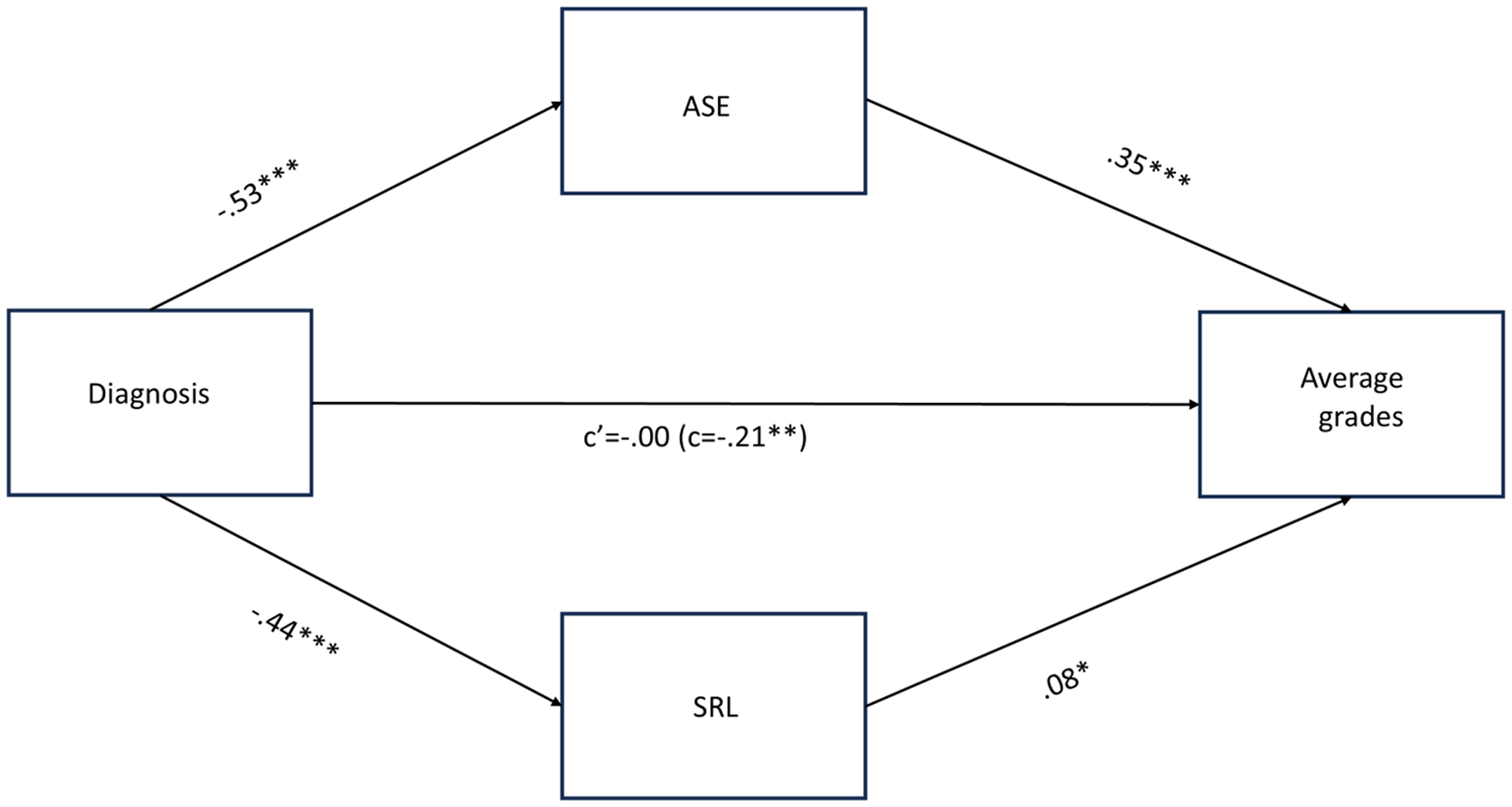
Direct and Indirect Links Between Diagnosis (With and Without SLD/ADHD) and Average Grades Through ASE and SRL—a Serial Mediation Model (Beta Scores).
Results indicate that a diagnosis of SLD/ADHD was negatively associated with average grades, b = −.21, β = −.21, t = −3.05, SE = .07, p < .01, confidence interval (CI) 95% [−.35, −.08]. Diagnosis was also negatively associated with ASE, b = −.34, β = −.53, t = −6.66, SE = .05, p < .001, CI 95% [−.44, −.24] and SRL, b = −.19, β = −.44, t = −5.51, SE = .04, p < .001, CI 95% [−.26, −.13]. In other words, having SLD/ADHD was related to lower grades, ASE, and SRL. Analysis of the indirect effects revealed two significant parallel mediation paths: SLD/ADHD diagnosis predicted ASE, which, in turn, predicted students’ average grades, b = .52, β = .35, t = 9.42, SE = .05, p < .001, CI 95% [.40, .62]. In addition, SLD/ADHD diagnosis significantly predicted SRL, which, in turn, predicted students’ average grades, b = .16, β = .08, t = 2.06, SE = .08, p < .01, CI 95% [.01, .32].
The direct effect of diagnosis on students’ average grades was tested while accounting for the mediating variables ASE and SRL. This analysis revealed a nonsignificant direct effect b = −.00, β = −.00, SE = .065, t = −0.04, p = .96, 95% CI [−.13, .13], suggesting full mediation by ASE and SRL in the relationship between diagnosis and students’ average grades. The overall model was significant, F(4, 677) = 97.58, p < .001, explaining 37% of the variance.
Discussion
Metacognitive and motivational characteristics are crucial aspects of academic achievement, particularly for students in higher education (e.g., Mega et al., 2014). The current study examined the role of ASE, SRL, and academic satisfaction in predicting academic achievement among students with and without a diagnosis of SLD or ADHD from three countries (i.e., Israel, Italy, and Spain). Specifically, the study sought to determine whether a diagnosis of SLD or ADHD directly accounts for lower academic performance, or if this relationship is mediated by ASE and SRL.
Differences Between Students With and Without SLD/ADHD
In line with hypothesis 1, students with ADHD/SLD reported lower ASE, SRL, and achievements as reflected in their average grades. This finding is consistent with those of other studies conducted in higher education in the international context (e.g., Cvitkovic et al., 2024), specifically in two of the three countries included in the current study: Israel (Krisher & Shechtman, 2016; Sharabi & Shelach Inbar, 2024) and Italy (e.g., Casali et al., 2024; Matteucci & Soncini 2021). In contrast, students with SLD/ADHD did not differ from their peers without disabilities in level of academic satisfaction. These findings are consistent with the research of Casali et al. (2024), who found that students with SLD reported lower achievements than their peers, but no difference related to their academic satisfaction (see Feraco et al., 2025, for similar findings among secondary students). These results can be explained considering the support students with SLD/ADHD usually receive in the academic setting in many countries, including the three countries where data were collected (Israeli State Comptroller, 2013; Ley Orgánica del Sistema Universitario, 2023; MIUR, 2012).
Although our main focus was not to compare the three countries, we also examined students based on nationality as a grouping factor and found a number of differences. For example, Israeli students reported higher grades than students from Italy and Spain, but had lower SRL than Italian and Spanish students. Moreover, Spanish students had higher academic satisfaction than Israeli and Italian students. However, no differences were found between the three countries in terms of ASE.
Various factors may explain these findings such as different support systems and grade policies. Further research is needed to examine the relation between metacognitive and motivational components in relation to cultural and diagnostic components in students with and without SLD/ADHD in different cultures/countries.
Associations Among Study Variables
In line with hypothesis 2, a significant positive correlation was found between achievement (i.e., average grades) and all variables among students with and without SLD/ADHD. However, the association between academic satisfaction and achievement was relatively weak. Moreover, as expected, higher levels of ASE (Casali et al., 2022) and SRL (Casali et al., 2024) significantly predicted higher average grades. But, in contrast to our hypothesis (Dhaqane & Afrah, 2016), academic satisfaction did not significantly predict students’ achievement.
These findings underscore the importance of examining aspects of the learning experience that may influence students’ satisfaction with their studies beyond measurable academic outcomes. There is a need to further deepen the understanding of the factors that shape academic satisfaction, particularly as it constitutes an integral part of students’ overall life satisfaction. This topic is especially relevant for students with SLD and ADHD in higher education, who often face challenges both in the learning process and in academic outcomes.
The Mediating Role of Academic Self-Efficacy and Self-Regulated Learning
ASE and SRL play central roles as key factors in the proposed model. Similar to previous studies, SLD/ADHD was found to be related to lower grades, with higher education students with SLD/ADHD reporting lower grades than their peers without disabilities (e.g., Casali et al., 2024; Sedgwick, 2018). Consistent with hypothesis 3, ASE and SRL fully mediated the relations between SLD/ADHD and students’ average grades. In other words, higher levels of ASE or SRL can be instrumental in helping students with SLD/ADHD reach higher academic achievement. These results suggest that motivational and metacognitive variables, such as those examined in the present study, are essential to achieving academic success regardless of the specific characteristics of students.
SRL strategies and ASE were expected to play a more significant role in shaping academic achievement than the mere presence of a diagnosis of ADHD or SLD. However, while ADHD and SLD may initially present challenges to academic performance, these neurodevelopmental conditions are not inherently deterministic of poor outcomes. Instead, the ability to employ effective SRL strategies such as goal setting, time management, and self-monitoring, alongside a strong sense of ASE, can serve as powerful mediators in this relationship.
Limitations
Despite meaningful findings, the current study is subject to a number of limitations. First, the study relied on students’ reports of their SLD/ADHD diagnosis, but they could not be verified due to the restrictions of privacy regulation in three countries and the request for anonymity by the ethics boards of the participating institutions. Additionally, the study relied on self-report questionnaires, which are often subject to social desirability bias. It is recommended, therefore, that future research continue to explore these aspects by integrating in-depth interviews that will provide greater insight into the needs and motives of students with SLD/ADHD. Another limitation is the lack of data on the age at which participants were diagnosed with SLD and/or ADHD. Such information may have helped to clarify differences in academic adaptation, and should be considered in future research.
Along with the advantages of a study that involves participants from several countries and thereby expands the generalizability of the findings, there are nevertheless also limitations. Specifically, there was a difference in the sample size between the countries. As mentioned earlier, the size of the group of students with SLD/ADHD in Italy was too small, which limited our ability to make a specific comparison between students with SLD/ADHD in the three countries. The data were collected through an ongoing collaboration between researchers from the three countries. It is recommended that further studies expand this type of research to other countries to obtain a broader picture that reflects varying populations and cultures.
Conclusions and Implications
The findings of the current study highlight the crucial role of metacognitive and motivational factors, such as ASE and SRL, in promoting academic success, particularly among students with SLD or ADHD. Fostering these components is, therefore, essential to supporting the academic development of these groups of students. Students with SLD or ADHD face significant educational challenges that often begin early in life and persist, and although many of them gain admission to higher education institutions and benefit from existing support frameworks, they continue to encounter substantial obstacles and achievement gaps compared to their peers without these disorders.
The findings of this study emphasize not only the general importance of ASE and SRL, but also their mediating role in the relationship between SLD/ADHD and academic achievement. These insights suggest that developing metacognitive and motivational skills can serve as a key lever for narrowing academic disparities. Accordingly, support centers in higher education institutions around the world should aim to promote these skills alongside the academic accommodations they typically already offer. In addition, the promotion and adaptation of study strategies to the higher education context, as well as time management, organization, and planning, can help develop a better approach to studying. Examples of the effectiveness of interventions centered on these skills with struggling college students, in general, may be found in the literature (e.g., Meneghetti et al., 2021); future research should extend the study of their usefulness to students with neurodevelopmental disorders. Tailoring such efforts to the specific needs of students with neurodevelopmental disorders, while taking into account the diversity of national and cultural contexts, may significantly enhance both these students’ wellbeing and academic outcomes.
Finally, the present study highlights factors that may promote the academic success of students with SLD and ADHD as part of their broader adjustment process. In this context, fostering collaboration between researchers in educational psychology and special education is of great importance, particularly for advancing the identification and cultivation of the strengths that students with SLD and ADHD bring to their academic journeys.
Supplemental Material
sj-docx-1-ldr-10.1177_09388982251388008 - Supplemental material for The Mediating Role of Academic Self-Efficacy and Self-Regulated Learning in Academic Success Among Higher Education Students With SLD or ADHD
Supplemental material, sj-docx-1-ldr-10.1177_09388982251388008 for The Mediating Role of Academic Self-Efficacy and Self-Regulated Learning in Academic Success Among Higher Education Students With SLD or ADHD by Adi Sharabi, Marisol Cueli, Gerardo Pellegrino, Celestino Rodríguez, and Barbara Carretti in Learning Disabilities Research & Practice
Footnotes

Funding
The authors disclosed receipt of the following financial support for the research, authorship, and/or publication of this article: This study was conducted with the support of the Fund for Applied Research at the MOFET Institute, Tel Aviv, Israel.
Declaration of Conflicting Interests
The authors declared no potential conflicts of interest with respect to the research, authorship, and/or publication of this article.
Supplemental Material
Supplemental material for this article is available online.
References
Supplementary Material
Please find the following supplemental material available below.
For Open Access articles published under a Creative Commons License, all supplemental material carries the same license as the article it is associated with.
For non-Open Access articles published, all supplemental material carries a non-exclusive license, and permission requests for re-use of supplemental material or any part of supplemental material shall be sent directly to the copyright owner as specified in the copyright notice associated with the article.
