



Abstract
Virtual mobility has emerged as a new tool for the internationalization of higher education with the advent of information and communication technology in the current scenario. With the outbreak of COVID-19, the landscape of global higher education has altered significantly. In that situation, when physical academic mobility became impossible, the Higher School of Economics, one of the leading universities in Russia, ran a unique digital internship programme for teaching staff from regional universities. In the logic of the digital identity model and push–pull model, the present research has analysed the profiles and motivation letters of 398 teachers from 73 Russian universities which took part in 15 internship programmes since March 2020. The present study fills a gap in the literature by examining how motivation and reasons for participation in virtual mobility may trigger the reduction of inequality in higher education. The findings of the present study revealed that the main reasons highlighted by the teachers for taking part in virtual internship programmes are mostly external and connected with the current tasks imposed by the Ministry of Higher Education and University management. Internal reasons are true mostly for teaching track when teachers are the agents of creating modern pedagogical methods for their courses. Thus, university teaching staff do not feel themselves as the drivers of change. The environment at the higher education level is not ready yet for significant changes.
Background of the Study
The COVID-19 outbreak altered the landscape of global higher education in 2020. It has a dramatic impact on all the stakeholders of society in general and pertinently on the student 1 and staff community. In response to government lockdown measures globally, countries have shut their borders and different regions inside the country. Higher education institutions had closed their premises which brought a major digital transformation in education in general and higher education in particular (Martel & Goodman, 2021; Wu, 2020; Xiong et al., 2020). Students and teachers became more exposed to blended and online learning during the last year. Thus, a shift from traditional mobility 2 to virtual mobility 3 in general and specifically in the current context of COVID-19 is very significant. Open virtual mobility has emerged more clearly as a new model in the domain of internationalization of higher education in the current scenario (Buchem, 2019).
Literature in the domain of internationalization of higher education (Wadhwa, 2016, 2019) reiterated that the most visible and dynamic manifestation of internationalization of higher education is academic mobility. 4 Providing an international perspective to students and staff in higher education has become one of the central objectives nowadays and initiatives such as Erasmus+ in Europe and the Association of Southeast Asian Nations worldwide are its pertinent examples (Buchem, 2019). Unfortunately, geographic and administrative restrictions along with the cost involved in the traditional physical mobility model refrain a majority of students and staff from accessing such an international experience as part of their study and training pertinently who come from less affluent or disenfranchised backgrounds and thus raised an important concern within the purview of inequality in internationalization of higher education (Corbella & Gonzalez, 2014). Therefore, in order to combat the limitations of physical mobility, virtual mobility has emerged as a new tool in the twenty-first century with the emergence of information and communication technology for the internationalization of higher education (Dauksiene, 2013; Giralt et al., 2022; Zass, 2021). The virtual mobility model which has gained pace in recent times is a more inclusive mobility model for connecting a greater number of students and staff and thus offers a wider space for dialogue and relationship building with their global peers (Buchem, 2019). Van der Perre (2007) stresses that the virtual mobility and virtual classes are now on the agenda of higher education institutions across the globe in general and specifically in the context of educational institutions across Russia.
Russia, being part of BRICS countries, holds the potential to establish itself in their region. In the last few years, Russia has emerged as a major destination country and hosts 6% of global mobile students (OECD, 2020). The prime goal of Russia is to build top-ranking universities and improve their global standing. A lot of initiatives have been taken by the Russian government in this regard. 5 In 2022, over 351,000 international students were enrolled in Russian higher education institutions (Andreev, 2023). Its popularity as a preferred study destination is now not limited to the Commonwealth of Independent States but extended towards Asian students. The war in Ukraine is expected to have an impact on Russia’s position as the fifth-ranked host country for international students, but the intensity is not so high. However, despite being diplomatically isolated, it continued to be a popular destination for international students (Adutskevich, 2023). In order to foster the internationalization of higher education and regain its position in the international higher education market, the number of places allocated to foreign citizens for training under the quota of the Government of the Russian Federation will be increased by 5,000 places in 2022 and will amount to 23,000 places and 30,000 places in 2023 (Adutskevich, 2023). Moreover, the target set by the Russian government is to increase the number of international students to 710,000 by 2025 (Vorotnikov, 2017). Based on these facts, we can assume that Russia’s income from foreign students has increased significantly from the previous estimation of an annual $150 million (Smolentseva, 2004).
There are links between student and staff mobility, even if no data are available on this. Teachers are the key players in facilitating the internationalization of higher education. Due to the consistent increase in the number of international students, teaching community all across the globe is facing significant professional challenges in addressing the learning needs of diverse student communities (Tran & Le, 2018). Therefore, professional development and teachers’ skills to negotiate their professional demands to change the landscape of internationalization of higher education are pertinent for the effective teaching-learning process. Hence, virtual mobility, specifically teacher virtual mobility, is a significant tool which contributes to the internationalization of higher education (EuroPACE, 2010). Moreover, virtual mobility practices increase the competition between institutions and thus have positive implications on the quality of teaching and research (Bijnens & Op de Beeck, 2006). Yet, despite numerous virtual mobility initiatives and projects in the last few years (Brey & e-Move Project Partners, 2007; EADTU Network, 2007; EuroPACE, 2010; Reve Project, 2006), the uptake of virtual mobility in higher education is still low, and the possibilities of virtual mobility including virtual campuses, seminars, labs, internships and placements remain unknown to many teachers and students (Buchem, 2019). Thus, research in this area is imperative as virtual mobility is a significant tool for the professional development of teachers, to reduce the inequality among higher education institutions and to give opportunity to teachers and students without crossing the border.
In this context, the present study attempts to investigate the effectiveness of the virtual mobility internship programme offered by one of the leading universities of Russia, that is, the Higher School of Economics (HSE), National Research University for the university teaching staff. The aim of the investigation was to understand who was participating in the internship programme and why university teachers decided to be involved in the virtual mobility programmes. Though the study was conducted in 2020 during the pandemic period but has immense relevance in the current discourse of internationalization of higher education. This subject is also significant in a broader context, since the effects of the internal virtual mobility in higher education exacerbate the socio-economic gap between regions, jeopardizing the development of Russia’s territories. An understanding of the motivations and rationales of the university teaching staff for participation in the internship programme will provide insight to the policymakers to understand the perspective of teachers. The study is organized as follows: In the next section, an extensive literature review is conducted around these issues. In the third section, the conceptual framework and methodology are discussed. In the fourth section, the results are presented. The discussion of the main findings and implications concludes the study.
Literature Review
The conceptual notions of ‘virtual mobility’ have emerged in the literature in the beginning of the twenty-first century with the development of information and communication technology (Bunt-Kokhuis, 2001). The concept of ‘virtual mobility’ constitutes two words: ‘virtual’ + ‘mobility’. The word ‘virtual’ refers to information and communication technologies (ICT) and ‘mobility’ means movement. The most commonly used and quoted definition of virtual mobility is provided by the elearningeuropa.info portal and is defined as ‘the use of information and communication technologies (ICT) to obtain the same benefits as one would have with physical mobility but without the need to travel (Elearningeuropa.info, 2009). The concept of virtual mobility is not yet widely spread, and the European Commission and national agencies and individual institutions have been actively promoting virtual mobility for quite some time, mainly through the financial support of projects within the SOCRATES/Minerva programme and the e-learning programme (Bijnens et al., 2006; Vriens et al., 2010). New European initiatives (UBICAMP, 2012; VMCOLAB, 2012) make further steps in developing joint virtual mobility activities to provide students and teachers with cultural backgrounds and enriched university environment elements such as multilingualism, virtual tours and virtual mobility support kits (Tereseviciene et al., 2015). Thus, the virtual mobility phenomenon is rather new in higher education institutions which leads to different interpretations and uncertainty of its benefits and needs. However, new forms of mobility are not intended in any way to replace traditional physical mobility. Rather, they are designed to be a useful addition and permit the involvement of people at higher education institutions who are unable to be mobile for whatever reason. With the advent of internationalization of higher education and development of ICT, the teaching paradigm has changed from knowledge transfer to knowledge sharing, and the role of teachers has changed from being an authority to being flexible and the new model of virtual mobility fits well in this changing paradigm.
Potential Effects of Virtual Mobility
In virtual mobility, as a result of ICT, it is possible to study part of our degree in a different higher education centre without actually having to move. Virtual mobility, thus, strengthens and compliments physical mobility. At the same time, it is also really effective and efficient in terms of time and cost (Brey, 2007). Thus, the main benefit of virtual mobility is to offer both students and teachers the opportunity to work in an international environment, even if they were unable to take part in physical mobility programmes, in line with the concept of the internationalized curriculum (Beelen & Jones, 2015). Virtual mobility offers meaningful and multilateral interaction for the wider youth and offers the opportunity to build a greater intercultural understanding of different societies and thus expands their worldwide view.
When we face the integration of ICT into the educational process, diverse opinions arise. On the one hand, the experience obtained in online learning, which has failed due to a lack of pedagogical support, and on the other, many innovative technologies, have proven to be less effective for education. On the other hand, online learning has been very welcomed both by students and institutions because of the flexibility it involves and thus leads towards high participation rates of students. With the increase in the number of first-generation students due to more inclusive and equity-enhanced policies, flexibility is very pertinent. The ability to study asynchronously is one of the main reasons why virtual learning is popular.
This is not the only potential offered by virtual mobility. As indicated by various European projects, virtual mobility enriches the educational environments of every institution (Brey & e-Move Project Partners, 2007; EADTU Network, 2007; EuroPACE, 2010; Reve Project, 2006). Teachers and students benefit in linguistic, cultural and educational terms and connect with the experience of their colleagues from all over the world in their academic field (Tereseviien et al., 2011; Vriens et al., 2010). Virtual mobility reduces the social and economic barriers that are present in physical mobility; it integrates students and staff with disabilities and those who are limited by geographical barriers; and it may be used as a channel of information to prepare students for physical exchange programmes (Buchem, 2019; Dauksiene et al., 2010). Many teachers claim that they have found greater satisfaction in virtual interaction with their students, due to the greater quality and depth of their contributions. At an institutional level, virtual mobility increases competitiveness amongst institutions, contributing to more competitive and attractive educational offers in general. Virtual mobility also encourages institutions to analyse and develop their educational models: changes in the content offered and changes in learning tools, including educational and teaching models.
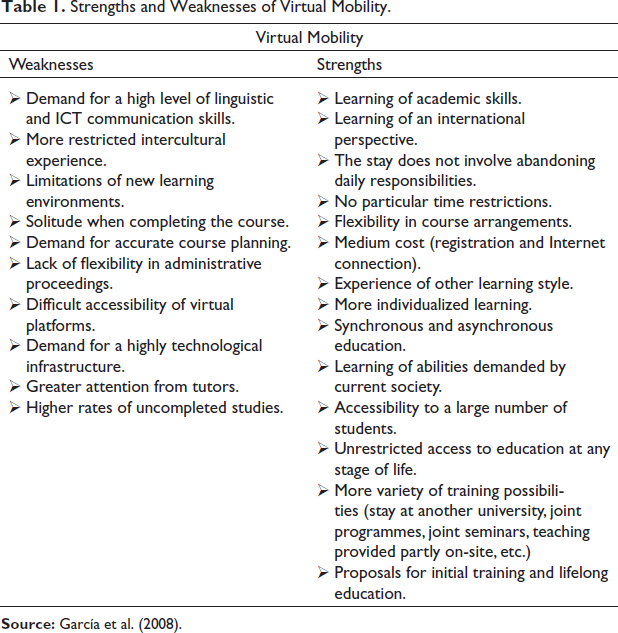
Strengths and weaknesses of the virtual mobility model have been highlighted in Table 1.
Strengths and Weaknesses of Virtual Mobility.
Virtual Mobility of Teachers: Crucial and Understudied
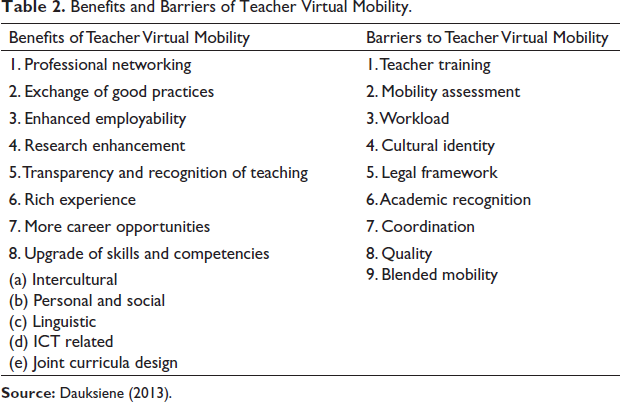
Teacher virtual mobility refers to teachers using higher education institutions outside their own city, region or country without physically leaving their home. It complements ‘classic’ physical mobility in which academics or students travel abroad. In higher education, providing an international perspective to teachers has become one of the central objectives in the twenty-first century because teachers are the most important pillar of the teaching-learning process (Tran & Le, 2018). Although teacher virtual mobility is a challenge for teachers, it creates more opportunities for students. Specifically, teacher virtual mobility 6 leads towards the enhancement of the professional development of teachers by joint course development and delivery by two or more institutions and thus broadens the knowledge horizon of teachers and improves the quality of the course and curriculum (Dauksien et al., 2009; EADTU Network, 2007). In sum, virtual teacher mobility provides a challenging, modern and attractive international context for teachers without having to cross the borders. However, there are some barriers to the implementation of teacher virtual mobility identified in the literature (Fuente et al., 2011). Table 2 summarizes the benefits and barriers involved in teacher virtual mobility. Teachers have to train themselves for specific knowledge in order to be able to prepare the courses that are implemented virtually. The preparation of such courses which have to be delivered virtually requires completely different techniques and tools and dealing with these techniques and tools may be cumbersome for some of the teachers. The courses delivered on the virtual platform have to be flexible so that they can be simply upgraded and changed. Regarding the technical challenges of virtual mobility, these predominantly include challenges relating to stable information technologies, system and platform compatibility and consideration of standards. Another important technical challenge for students is to have a stable internet connection. Another challenge highlighted by Op de Beeck & Mazar (2005) in his study regarding the knowledge of a foreign language. On a virtual mobility platform, the teacher needs to deliver the course to a global audience. But sometimes, the knowledge of a foreign language can be a challenge both for the teachers and even more so for the students in the domain of virtual mobility.
Benefits and Barriers of Teacher Virtual Mobility.
Conceptual Framework of the Study
The ‘push–pull model’ and ‘digital identity model’ were used in order to build up the conceptual framework of the present study. The ‘push–pull model’ is the most important and perhaps the dominating approach in the international mobility literature. This model provides an understanding of the external and internal factors which motivates individuals to move to another country, city and organization. In the present study, this model has been used to understand the decision of the teachers to move to the other university using a virtual mobility programme. The present study will provide insight into whether the decision is motivated by external factors such as administrative prescriptions, lack of resources and opportunities for physical mobility or internal motives like self-development. An effort has been made to understand the key dynamics of push–pull factors which drive the decision of the teachers to apply for the internship programme. Predominantly in the literature, the push–pull model has been used in the context of students and analysis of this theoretical approach in the context of university staff is minimal. Thus, in the context of the present research, this model has been used to investigate why university teaching staff decided to get into virtual mobility within the national context. One of the major focuses of the present research is to understand the best academic practices among progressive teaching staff in Russian universities.
Both push and pull factors are external. For example, push factors in regional universities are poor resources and infrastructure for academic work. University administrators could do nothing with most of the push factors: They could not change the social economic situation in the region or the management system of the university quickly. But somehow, they could reduce the inequality between universities using external resources—resources of the top-ranking university of their own country. Additionally, supporting the social capital of their teaching staff could lead to the sustainable development of the university in a situation where external factors constantly change. An understanding of the motives for the virtual mobility of university teaching staff is important. Motives are the internal factors, and they do not change even if external factors change. A detailed understanding of the motives of those teaching staff that create external (digital) reasons that match the internal one is very pertinent. This approach will help to reduce inequality among higher education institutions by using the new virtual mobility programme. University teachers’ professional identity is understood as the way that teachers, both individually and collectively, view and understand themselves as teachers. On the one hand, teachers may see themselves as a combination of subject-matter experts, pedagogical experts and didactical experts. On the other hand, motives are deeply connected with professional identity. The relational aspect of teacher pedagogic identity indicates that a teacher’s professional identity is shaped by interactions with other team members as well as with their social, cultural and professional environment. In 2020, this environment was transformed into a digital one due to the pandemic, so the situation changed but motives stayed the same and the push–pull reasons became clear.
The motivational theory provides an explanation of why the university teachers of various age groups are interested in virtual internships. Altbach and Knight (2007) underline the fact that motivation is a measure of engagement in the educational process. This means that internal motives play a significant role in making decisions about participation in internships. Several studies have presented the argument that the main motive for the researchers and university teaching staff to get innovation is a profit motive. Thus, innovation and entrepreneurship lead to effective educational change (Lipman, 2011). Griga and Mühleck (2011) studied the motives of Russian higher education teachers and interpreted the results using the motivation theory according to which teachers are primarily motivated by altruistic ideas and internal needs, whereas material benefits are not so important for them. These results correlate with the other studies trying to understand the relationship between teachers’ job satisfaction and motivation. Summing up, the explanatory framework of the present study is based on the two connected approaches: push–pull model (explanation of reasons for moving) and digital identity model (explanation of motives) (Figure 1).
Conceptual Framework of the Study.
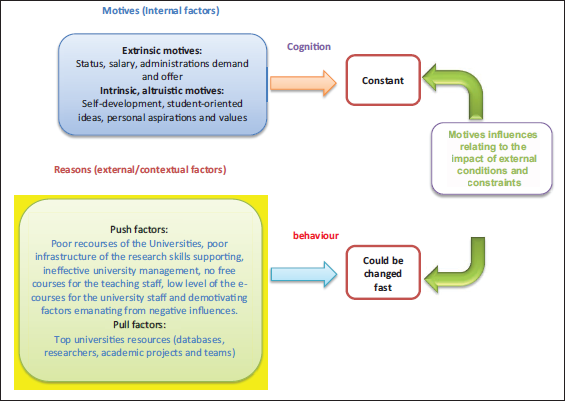
Figure 1 highlights the reasons and motives which reveal the ways and means through which we can work on the motivational aspect of the teaching staff and reduce the gap of the university inequality by grabbing active agents and spreading the practices of teaching, learning and research. By engaging in the learning and design of digital environments based on the suggested design principles, teaching staff could reposition themselves as an active agent.
Based on the literature review, the following hypotheses have been formulated: The typical profile of the intern getting into a virtual internship programme is a young teacher with a scientific degree. The main push factor for getting into the virtual internship programme is a lack of digital competencies among the university teaching staff in regional universities.
7
The main pull factor for getting into the virtual internship programme is the HSE status of the top university, located in Moscow (central city of the country). Internal motivation is predominant among all the interns as far as they see themselves as the agents of change.
Approaches for predicting a possible future effect of virtual mobility for society are focused on the grassroots ideology. Results of a new mobility could be interpreted by the concepts that deal with a civil society. This effect can be interpreted by the grassroots theory. In this case, the new competencies of teachers are interpreted as the result of grassroots in the logic of ‘growing’ civil society from bottom to up. Such practices of ‘growing’ could create the ambassadors of the third mission of the universities. As a result, the university becomes more significant (institutional effect), and the effect of creating a community and new products as a result of virtual internships is broader than just solving scientific and educational tasks—it is the practice of forming an inclusive (activist) type of civil society and the new class of innovators. The involvement in new mobility could predict the grassroots activism among those who chose internship programmes and created their own track into the programme. Grassroots activism consists of items indicating the degree of involvement in public official activities (Straughn & Angie, 2011). This activity could reduce the inequality of the universities in the periphery. For example, grassroots practices helped the poor territories of China reduce income inequality. It would be interesting to analyse that whether the same approach can be replicated in the context of higher education. Why it could not be true for higher education? Thus, the grassroots approach frames the discussion based on the results of the present study.
Methodology
For the proposed research, a database of the virtual mobility survey was collected between April 2020 and December 2020 from the teachers who participated in the internship programmes at the HSE. The sample for the present study has been drawn from the survey of the motivation letters and a short questionnaire from the teachers when they finished the digital internship. The information about the socio-demographic profile and professional items has also been collected. Thus, the present study constitutes a quantitative dataset of 398 interns, and for qualitative analysis, 80 motivation letters have been used in order to analyse the new virtual mobility practices followed by the teachers during the virtual mobility programme. Motivation letters were collected during the application process from the applicants which was mandatory to submit to take part in the programme. Sample selection for the motivation letters was based on a random sampling of 20% of all the letters. The motivation letters sample was constructed from the database of interns who successfully completed their internship at the HSE University Partnership Center. The sample was constructed proportionally to the amount of the 15 thematic groups of interns. Motivational letters explained the topic, reasons for participation in the internship programme, motives, teaching philosophy and description of the possible effects after the internship. The data were based on the participants’ self-assessment. The individual benefits of mobility involve three semantic blocks, operationalized in the following questions: What is your teaching philosophy? Why do you teach in this way? Are you a good teacher and why?
The statistical information for the teaching staff profiling included: socio-demographic, geographical and professional indicators of trainee teachers, the topics of their choice of internship (set by the trainees themselves) and name of the university. The average number of interns who participated in the programme was 398. They represented 73 Russian universities—nearly 10% of all Russian state universities. The online application for the participants contained 12 items with questions targeting the reasons for virtual mobility, procedure of the internship, current results and the future personal effects.
Questions for programme management. Reasons for participation in the programme of the digital internship. Results of the internship. Feedbacks.
Different scales were used for all mentioned sets of questions:
Score from 1 to 5 (Likert scale questions). Multiple-choice questions. Drop-down questions. Yes–no questions. Open-ended questions.
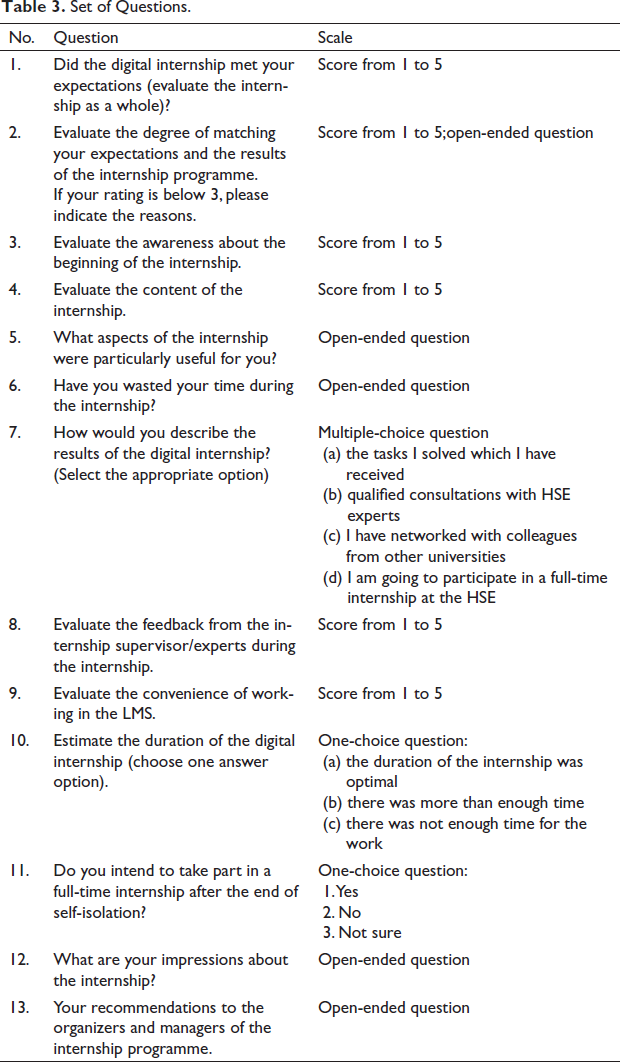
Table 3 illustrates the set of questions for the interns who finished the programme. Interns are requested to answer all the questions.
Set of Questions.
Analysis
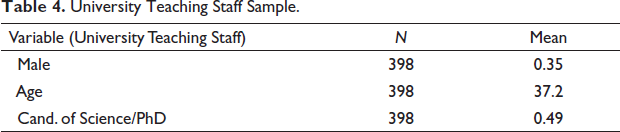
The analysis of the data has been done across gender, scientific status, type of university and the choice of programme. Analysis across gender highlights that 65% of the respondents are women, whereas 35% are men as highlighted in Table 4. That reflects the general statistics in Russian higher education (according to the official data, 58% of university teaching staff is women). Of the majority of the respondents aged 36–50, 49% have a candidate of science degree.
University Teaching Staff Sample.
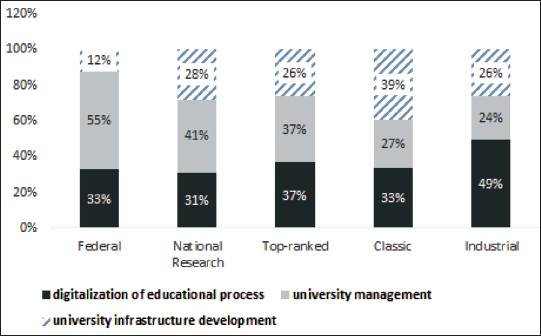
Leading universities such as Federal and National Research are more interested in programmes on university management. Industrial universities, which usually are outsiders in the hierarchy of Russian universities, are more interested in programmes on digitalization of educational processes (49%) as highlighted in Figure 2. This analysis proves the idea that these cohorts of the universities have a lack of resources to develop digital competencies of the teaching staff. This is the biggest reason which motivated teachers to improve their digital teaching skills using the resources of leading universities such as HSE. Classic universities more often choose programmes devoted to university infrastructure development than other cohorts (39%).
Distribution of the Chosen Topics of the Projects Among the Interns from the Different Type of Russian Universities.
The most popular motive of getting into virtual mobility was improving professional competencies (not only digital skills). The main reason for involving in the programme was the external demands at the national level, that is, to fulfil Federal Educational Standards. Surprisingly, personal goals were less important than external factors for the university teaching staff.
The following key findings have been found out from the analysis: 1. From the analysis of motivation letters, it has been found that teachers were predominantly motivated by the factors such as individual educational track, necessity to participate in network programmes for higher education institutions, new teaching technologies for online learning and educational processes followed at the university. The second was about the significance of collaboration with colleagues from other universities (not necessarily leading ones, but those that deal with similar issues, topics of research problems). The second aspect was predominantly highlighted by the university administration interns. 2. Academic leadership of the universities is the main extrinsic factor for most of the interns. This could be the result of the educational policy goals implementation. 3. Two types of consequences (potential effects of the internship) were mentioned in motivation letters: instrumental and global. The first one was described as having a utilitarian perspective for the university and department in which they work within the national context and the second one was having the potential ‘global’ effect apart from the national boundaries. 4. None of the studied motivation letters revealed the reasons and obstacles of not obtaining the relevant skills from their own university. One of the top problems for the interns was a lack of digital competencies but it was not related to the shortage of resources in the universities and did not interpret as a push factor. However, individual push factors were not significant, but the institutional factors were stronger. 5. No one wrote critically about their university: there was no problem-oriented logic in the sample of motivation letters. The major motivation was external, that is, to accomplish the set tasks by someone from the above (university administrators, standards, ministry etc.). 6. The main pull factor for applying for this internship programme at the HSE was not just the status of the ‘top’ university enjoyed by HSE in Moscow, but the fact that HSE was the first university which launched and established themselves in the programmes of management and education. HSE adopted new educational technologies and gained experience by the time when the need for it became crucial. None of the interns has highlighted that the rationale for applying to the HSE University was due to the locational aspect, that is, located in the centre. 7. The interns who wanted to enhance their pedagogical skills differed significantly from the others. The prime motivator for this group was working with the students.
Summary of Findings and Discussion
The analysis and findings of the present study revealed the results contrary to the literature. The findings reveal that the university teaching staff did not start acting as agents of change in Russian higher education. Moreover, the detailed analysis of the profile of university teachers involved in the new digital mobility programme demonstrates two significant points. First, they are in the middle of their 30s with a high position at the university. Second, the profiles of the interns depend on the university rank: the ‘youngest’ participants were located at the classic universities, the most well-established ones at federal one. The findings reveal that the different types of universities have different sorts of demands for the upgradation of the university teaching staff. Findings from the literature reveal that predominantly the motivation is intrinsic and altruistic for the university staff (Beijaard et al., 2000; Boylan, 2016; Mockler, 2011). However, the results of the present study reveal the predominance of extrinsic motivation. This highlights the predominance of the vertical management system in Russian higher education. This finding highlights an important question associated with centralization which acts as a main barrier of the grassroots activities that could potentially reduce inequality in the situation of the shortage of material resources (Kezar & Lester, 2009). But university teaching staff in Russia do not feel themselves as drivers of change because the Ministry of Higher Education administration really is the one.
The findings reveal that the reasons and motives of the university teaching staff for the participation in virtual mobility are not problem-based. Interns have strong intentions to do tasks formulated by the upper institutions. Not even a single intern had mentioned their inner desire for the change but underlined the importance of current tasks that needed to be solved. However, the working tasks and the goals of the education policy could normally mismatch with the real problems. Russian universities from the regions look at the top universities for direction and research. The present study argues for the importance of such practices for the self-development of the university teaching staff and points out some of the challenges that such practices face. According to Albach, the centre-periphery concept, applied to higher education, implies that the ‘central’ institutions are research-oriented and part of an international knowledge system, while the ‘peripheral’ institutions are not creative but simply copy developments from abroad or from the top universities inside the country. That challenge could be reduced by the cross-universities mixed teams of the teaching staff. One of the results (consequences) of the new mobility could be a set of networking among teaching staff. This practice is highly significant as the production of knowledge and new teaching technologies increasingly takes place within the framework of a broad and diverse network of researchers working together in cooperation. The achievement of a successful academic and research career is rooted in their establishment of collaborative ties with other researchers. Cooperative practices also constitute the mechanism for socializing and integrating new researchers into the academic and scientific community.
Conclusion
With the engagement of more and more countries in higher education export, competition has become intensified not only for students but also for qualified academic staff. Nowadays, student mobility, curricular innovations, and the cultivation and maintenance of international partnerships are fundamental aspects of many institutional strategies for the internationalization of higher education. In all three areas, teachers are the most pertinent actors. To sustain the quality at the higher education level, professional training and international exposure of the teaching community are very important. As the model of ‘physical mobility’ has its limitations, ‘virtual mobility’ has the potential to meet the challenges of the twenty-first century. The present research revealed that the programme of virtual mobility emerged as an effective practice for improving the professional skills of university teachers and to enhance the collaboration between universities in Russia. But the virtual internship programme is not reducing the inequalities between universities by supporting active agents and spreading the practices of teaching and research. Further, the findings of the present study highlighted the dominance of external motives of the interns underlines the vertical system of higher education management in Russia. Teachers do not feel themselves as active agents of significant change in their universities and regions.
The Russian higher education system is on the threshold of the next reforms after the withdrawal from the Bologna system. The updated system of higher education of basic (4–5 years) and special (1–2 years) one be implemented from 2025. Based on the results of the study of motives for virtual mobility, we can assume that the next reform will meet tacit resistance among teachers who will not change the content and formats of their work. The higher education institutions in Russia are not ready for significant changes. This conclusion is drawn on the basis of the results which showed the dominance of external factors of change and weak willingness of higher education subjects to change. Thus, there is a risk of changing institutions (external framework) but not the essence of higher education. Now it is too early to talk about the mass transition to open digital education for teaching staff, but the ability to use digital traces of learning and collaborative practices could lead to the transition to online education programmes in Russian regions.
Footnotes
Acknowledgement
We would like to thank our respondents—the interns—for their participation in research.
Declaration of Conflicting Interests
The authors declared no potential conflicts of interest with respect to the research, authorship and/or publication of this article.
Funding
The authors received no financial support for the research, authorship and/or publication of this article.
