



Abstract
Education in its essential meaning should beget a civilized and socio-emotionally intelligent, competent mindset in its stakeholders. However, this seems an ideal situation which is impractical owing to several conditions and constraints that impede the implementation of holistic education. Pedagogical practices initially relied on rote learning and thereafter several reforms in educational policies asserted the importance of nurturing global competency among the learners. However, this shift from rote learning to a more self-directed learning is a challenging transformation which is idealized to a great extent. In this article, we argue that a sudden shift may not be possible, and to realize learner autonomy and their self-directedness, there should be a gradual but steady progress from pedagogy to andragogy and then to heutagogy. Self-directedness and learner-centredness are the crucial aspects of heutagogy. Taking examples from a case study that we conducted with teachers of English from select higher education institutions in India, we analysed the various tenets of heutagogy and its practicality in the Indian context. We investigated how teachers are incorporating aspects of heutagogy in their English classrooms and what major challenges are encountered. Their individual classroom episodes may serve as an initial reservoir of ideas to orient further research in the field. The possibility of embedding the PAH continuum in classrooms is analysed through the lens of socio-constructivist theory. The insights from this study will be valuable for teachers and students who wish to gain a deeper insight into the heutagogical learning paradigm and its integration into language teaching in the classroom.
Keywords
Higher Education and Stakeholder Aspirations
Fundamentally perceived as imperative for the holistic development of the individual, education in the present era encounters several critiquing owing to the methods of teaching and learning that are currently in practice along with several other ethical questions. If we look at the ancient Indian traditions or Greek traditions of education, we see how dialogues played an important part in inculcating knowledge and the initiation of the learners’ pursuit of wisdom. The great teachers, whom we called Gurus, were able to help the learners find their path to knowledge and wisdom. The very infrastructure of an educational institution was defined by the proximity of humans with a certain humane set of values such as empathy, harmony, unbiased perspectives, moral courage and the never-ending quest to find the truth. The Gurus or the great teachers were able, to problematize the nature of truth and they provided a conducive space for the learners to engage in discussions and debates which stimulated several perspectives. While these teachers attempted to kindle knowledge of particular subjects, they never restricted the learners from exploring the nature of truth by themselves. They mentored the learners to be socially and emotionally competent enough to resolve problems of higher order as well as the regular challenges that they may encounter every day.
When we moved to the modern-day education system which went in for several reforms, there was a focus shift from pursuing knowledge to encompassing a broader spectrum of concerns, such as financial gain, migration prospects and various other opportunities (Gurukkal, 2023). Rather than valuing the several knowledge systems and multilingual realities, with colonization being a socio-political and cultural reality, we tend to move towards more materialistic perspectives. In the case of English language education, learners’ pursuit of linguistic proficiency is now not solely rooted in the realm of language acquisition but rather propelled by an intersection of economic and utilitarian needs. Consequently, education has become increasingly confined to the realm of para vidya (Pandey, 2021), a term in ancient Indian philosophy used as a synonym for knowledge that is limited in depth. In our current times, the noble pursuit of education has regrettably become constricted, its purpose reduced to the mere act of succeeding in examinations. For learners to access aparavidya, the highest state of knowledge (Sarmah, 2019), it is necessary to consider an essential change in the approach to teaching. We propose a move towards heutagogy, an approach that emphasizes self-directed learning, as the potential method for practising aparavidya which will instigate more knowledge and skills which enable the major stakeholders to be autonomous, empathetic and lifelong learners.
In the twenty-first century, educational policies highlight the shortcomings in current teaching approaches and suggest humanistic approaches for comprehensive and holistic education. Therefore, it would be inadequate for learners to succeed if they remain passive learners in a classroom. Passionate self-learning would be the first step towards lifelong learning to attain the actual educational goals (Gurukal, 2023). It is necessary to teach learners to educate themselves, and heutagogy makes this possible by facilitating self-directed learning. It is necessary to equip learners with the knowledge and skills to educate themselves, and heutagogy facilitates this process.
Contextualizing English Language Learning
As an international language, English plays a major role in expediting the learning process. Communication is a fundamental component of education. English is widely acknowledged as the language that everyone has to master. Learners worldwide are made to learn English as a part of the curriculum beginning from their early schooling; hence, they achieve proficiency in the language by the time they reach the tertiary level. Ideally, at this juncture, the pedagogical approaches in higher education institutions must promote self-directed learning in accordance with the learners’ own needs.
With the advent of technology, learners are exposed to a wide range of learning opportunities. The concept of heutagogy is rooted in social-constructivist theory as learning does not stop with oneself and is a social process in a classroom setting (Cobb et al., 2003; Gredler, 1997; Vygotsky, 1978). Therefore, the aim must be to accelerate self-learning inside language classrooms through a heutagogical framework. In this regard, we explore the possibilities of implementing a self-determined learning approach in tertiary-level language classrooms by citing a qualitative study that aimed to determine whether a heutagogical method might be included in Indian classrooms at higher education institutions. We attempt to understand the difficulties in teacher-centred classrooms and reflect on how heutagogy could be a practical method for attaining the goals of education and also to find a possible solution for mitigating the challenges the teachers may encounter while fostering heutagogy in classrooms. The feasibility of a heutagogical approach for teachers in both online and traditional classrooms is discussed. We try to analyse how a smooth transition from pedagogy to andragogy and from there to heutagogy could be initiated or effected.
Towards Heutagogy
In the field of language education, pedagogy has been consistently accepted as the dominant method. However, the emergence of technological advancements and its popularization in the backdrop of the COVID-19 pandemic resulted in a profound transformation in the realm of education. This development has driven teachers and researchers alike to critically reassess the prevailing educational framework, as it has facilitated considerably efficient prospects of adaptable teaching models that transcend the constraints of traditional teaching methods.
Conventional classrooms and pedagogical practices have long constituted the boundaries of language education, limiting the learners to the walls of pedagogy. The traditional educational approach has so far followed teacher-centred pedagogy (Hase, 2011). In classrooms, teachers have always occupied the position of power, and the technological interventions and learners’ greater access to knowledge still have not changed the power dynamics in the classroom. ‘Pedagogy’, a term that originated from the Greek language and refers to the art and science of teaching children (Shah, 2021), is largely adapted to refer to the method of teaching, but it does not distinguish between the learners in terms of their age. The framework of pedagogy has undergone criticisms for its rigid nature and inability to adapt to various learning styles, limiting the implementation of personalized learning experiences. In its further development, the concept of pedagogy assumes that learners with their lack of experience and expertise in the subject matter require guidance from a teacher who functions as a mentor to channel the learning process in appropriate directions. In his book Pedagogy of the Oppressed, Paulo Freire (2016) discussed the ‘banking’ system of education (p. 72) and how education operates as an instrument towards liberation for enslaved minds. Similarly, Hooks (2003), Giroux (2004) and McLaren and Leonard (1993) have propelled to reframe the pedagogy using non-traditional methods where critical engagement and dialogues are fostered.
Eventually, educational psychologists focused on the perception of learners and their conceptualization. As several theorists found pedagogy to be limited in its scope, Knowles (1975) proposed ‘andragogy’ as a potential solution. The concept of andragogy evolved in contrast to pedagogy, with the learners at the forefront of education (Agonács & Matos, 2019). Andragogy, as a theoretical framework pertaining to the acquisition of knowledge by adults, recognizes the vast reservoir of life experiences possessed by adult learners, thereby enabling them to exhibit a greater degree of autonomy and self-guidance in their educational pursuits (Agonács & Matos, 2019). Knowles (1975) defines sself-directed learning as the process in which individuals take the initiative, with or without the help of others, in diagnosing their learning needs, formulating learning goals, identifying human, and material resources for learning, choosing and implementing learning strategies and evaluating learning outcomes. (p. 18)
The subsequent progression towards self-directed learning begins with the theory of andragogy and manifests itself as heutagogy.
Hase and Kenyon (2007) found that although andragogy places a strong emphasis on the self-directed nature of adult learners, there may still be elements that are centred on the teacher, particularly in formal instructional settings. In light of these difficulties, Hase and Kenyon (2007) introduced the idea of heutagogy, a progressive combination of andragogy and pedagogy, as a non-linear, self-determined learning approach. Language learning in higher education has shifted from the system of pedagogy to andragogy and is now slowly shifting to heutagogy. Heutagogy, being a holistic and learner-centred educational philosophy distinguished by its emphasis on self-directed learning, unveils itself as an apt approach for the given context, as it holds great potential in cultivating self-exploration and language learning (Blaschke, 2012).
As a result of Knowles’ (1975) extensive critique of pedagogy and his perception of the shortcomings of andragogy, the concept of heutagogy came into existence over time. Heutagogy, also known as self-determined learning, adheres to the ideals of ‘Pedagogy 4.0’ (Boyd et al., 2023; p. 1), thereby meeting the demands of twenty-first-century adult education. It emphasizes the development of learning agility, learners’ autonomy and efficacy. Adult learners are aware of the learning process and often feel comfortable being part of the planning and evaluation during their learning journey. They, therefore, have a strong insight into what they want and, therefore, they would prefer a learner-centric method where the teacher functions more as a coach than as an instructor (Karaferye, 2018; Slaouti et al., 2013). Heutagogy, according to Ashton and Elliott (2007), attempted to promote self directed learning. The core principle of heutagogy is intricately intertwined with one’s life experiences where teachers guide the development of ideas rather than imposing a predetermined mode of thinking upon learners. In the contemporary scene, the efficacy of heutagogical approaches has been amplified owing to the rapid progression of technology and the independence it provides the learners in terms of their access to knowledge and the ease of such access. This evolution has thereby facilitated an increased sense of learner autonomy.
Levy-Feldman (2018), in her study, has explored the role a teacher plays as a facilitator in the heutagogical approach and how teachers can be equipped to mentor learners in this approach. Blaschke (2012), who has extensively worked in the field of heutagogy, discusses how it gained importance during online education and further explores the role Web 2.0 (Cochrane et al., 2012) plays in supporting a heutagogical learning approach. Lock et al. (2021) also discuss the prospects the heutagogical approach can bring in online and blended learning fields. According to Blaschke (2021) and Lock et al. (2021), utilization of heutagogy in online education provides numerous benefits, and this approach rooted in self-directed learning holds great potential for further advancements in online education research. This approach can also benefit immediate learning outcomes and equip learners with lifelong learning skills. Blaschke (2021) also emphasizes the role heutagogy plays in developing self-directed and lifelong learning skills in learners. Stoszkowski and McCarthy (2018), in their study, further review the theories and reflect on the learner’s perspectives on heutagogy after adopting it in an undergraduate class. According to them, learners enjoyed being able to plan and take control of their learning rather than being directed, and they also appreciated this opportunity to own the responsibility for their own learning.
While certain scholarly inquiries have suggested that heutagogy may potentially undermine the authority of teachers within the confines of a classroom, it undeniably fosters a profound transformation in our conceptualization of the process of acquiring knowledge and the institution of pedagogy itself. These transformative shifts hold the potential to foster a generation of learners who exhibit a heightened sense of autonomy and self-directedness in their pursuit of knowledge (Hase & Kenyon, 2013).
PAH Continuum and Social Constructivism
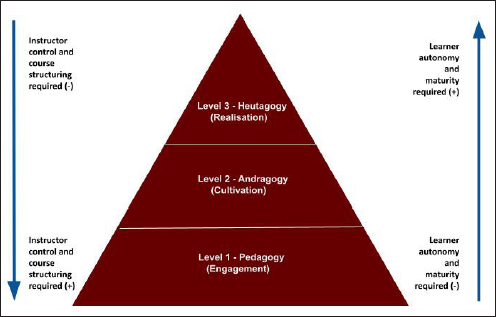
Heutagogy is an extension of both pedagogy and andragogy, and the three of them together are referred to as the PAH continuum (Blaschke, 2016). A learner progresses through the continuum when the learner acquires more maturity and self-organization, thereby becoming more self-dependent (Blaschke, 2016; Garnett & O’Beirne, 2013). Pedagogy begins with a well-known subject that a teacher is comfortable teaching; andragogy involves discussing with the learners how to study that subject in a way that inspires them and heutagogy modifies it by encouraging learners to take ownership of their learning and explore innovative ways to apply their knowledge in real-world contexts (Garnett & O’Beirne, 2013; Merriam, 2001).
Juxtaposing Heutagogy with Social Constructivism
Heutagogy aligns seamlessly with the social-constructivist theory even though it lays emphasis on learner-directed and self-determined learning. Heutagogy’s encouragement of self-directed learning resonates with social constructivism, which holds that learners actively construct knowledge through engagement with their surroundings and social interactions (Kim, 2001). Social constructivism, an approach rooted in the realm of collaborative learning and collective meaning-making, finds its essence in aspects such as interaction, discussion and the dissemination of knowledge (Vygotsky, 1978). The role of the teacher is to execute strategies that involve the learners in the learning process and place them at the centre of this process. Vygotsky (1978) discusses the concept of the Zone of Proximal Development (ZPD), a stage in language development where learners receive assistance from adults or more advanced peers in order to become independent language users (Vygotsky, 1978)
The support provided by the MKO (More Knowledgeable Other) to help the learner perform tasks within their ZPD came to be called scaffolding (Vygotsky, 1978). Bruner’s scaffolding, a concept propounded by Jerome Bruner (1978), proved to be an effective educational strategy aligning with Vygotsky’s social-constructivist theory. The term ‘scaffolding’ refers to particular activities that enhance learning and is used to describe how learners can be helped to achieve higher-level learning with support (Dominguez & Svihla, 2023). The concept of scaffolding has been widely applied in relation to ZPD, despite having originated with cognitive psychologist Bruner in the late 1950s (Vygotsky, 1978).
In the scaffolding process and within the heutagogy model, the role of the teacher transitions from being a provider of knowledge to that of a facilitator or guide. The teacher’s focus is on empowering learners through scaffolding or by fostering self-directedness (heutagogy). These methods, characterized by their collaborative essence, foster an environment conducive to the acquisition of knowledge.
The PAH continuum (refer Figure 1) acknowledges the changing responsibilities of learners as they undergo the transition from supervised teaching to increased independence, enabling a versatile and individualized approach to learning. PAH continuum like social constructivism emphasizes learner involvement, active participation and the development of knowledge. According to heutagogy, learning is assisted by a guide or mentor who in terms of social-constructivist theory is termed an MKO (Vygotsky, 1978, p. 79). Anyone who is more knowledgeable or skilled than the learner, especially with respect to a particular task, concept or procedure, is considered the MKO according to Vygotsky (1978). By not viewing the teacher as the sole purveyor of knowledge and the learners as tabula rasa, PAH continuum provides a practical application of social-constructivist principles within the broader context of varied learning approaches.
Progression from Pedagogy to Andragogy to Heutagogy (Canning, 2010, as cited in Blaschke, 2012).
Employing Heutagogy in English Language Classrooms
It can be noted from the literature that most of the studies have dealt with this learning approach in a theoretically rather than empirically (Agonács & Matos, 2019). Moreover, most of the studies dealing with heutagogy were in engineering and science (Gazi, 2014; Tajudin et al., 2021), medical education (Abraham & Komattil, 2017) and management education (Stoten, 2020). Although there are studies on heutagogy in education, not many studies discussed the possibilities of interspersing heutagogy in English language education. One of the few studies that outline the possibilities of heutagogy in English language education discusses heutagogy’s role in language education in India and its compatibility with listening, speaking, reading and writing (LSRW) skills (Jeyaraj, 2017). The study emphasizes that in order to acquire language skills, teachers and learners must be encouraged to slowly shift to heutagogy through andragogy and pedagogy.
The case study that we have conducted followed an empirical approach in a qualitative mode in order to investigate the subjective experiences of higher education teachers. Employing the empirical method provided the chance to collect objective information and observations, leading to a more thorough understanding of the actual circumstances surrounding the application of heutagogy from the perspective of teachers.
With the integration of heutagogy in higher education classrooms, teachers faced both successes and challenges, which the study aimed to reliably document. This purpose was served by conducting in-depth analyses of data derived from interviews with the teachers. Further, the possibilities of language learning classrooms functioning within a heutagogical framework are suggested with recommendations.
The researchers examined the data and comprehended the efforts taken by the teachers to make the classroom more learner-centred using a heutagogical approach. The subsequent challenges they faced in a conventional academic setting were also noted. Table 1 shows how heutagogy was implemented by those teachers in a classroom setting.
Aspects of Heutagogical learning Employed and the Challenges Encountered.
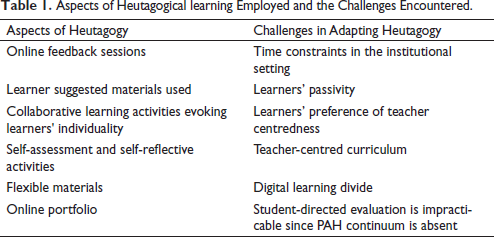
The teachers believed that they were able to foster learner agency by asking learners’ suggestions and including them in classrooms. Videos and other materials were given by learners which were shown in the class after careful consideration. Accommodating the learner-chosen materials and their suggestions regarding classrooms made the learners feel more accommodated and responsible. The teachers also ensured that collaborative activities were included so that learners acquire social skills and assert their individuality in a unique way. Although heutagogy emphasizes individualism, the ‘self’ in self-directed learning has a symbiotic relationship with society (Brookfield, 2009) and the social realities which the learners are rooted in.
Another important aspect of learning in a heutagogical way that was employed by the teachers was self-reflection. Learners were encouraged to reflect on the class activities, comment on them and record them in an online portfolio. They were asked to keep an online portfolio from day 1 to the last day of the class. These portfolios contained reflections, improvements and also the impact the class had on them as individuals. Learners were asked to present this on the final day in their own way with possible evidence. This activity helped the learners to critically analyse their learning and how it affected them as individuals. This activity can be considered the first step towards self-reflection and lifelong learning. Also, one of the teachers designed the assessment questions in a way that demanded the learners to think and apply the concept in order to answer. All questions were logical application-level questions rather than pure textual questions. By asking inferential questions and encouraging critical thinking the teachers eliminated the possibility of rote learning.
Challenges in Moving Beyond the Conventional Paradigm
The teachers agreed that the paradigm shift had its own difficulties. The learners had to be given the opportunity to be involved in the development of course materials. Teachers felt powerless over the intended outcomes of the syllabus as they implemented a profound change contrasting with the existing institutional practices. The teachers also had to conduct small talks and assignments to know the learners’ expectations and thus produce materials that cater to their learning needs. Besides these, the teachers had the responsibility of contributing to the elevation of the natural curiosity of the learners for lifelong learning. Teachers made conscious choices to reinforce self-determined collaborative learning in the classrooms, as a part of their heutagogical framework. The learners determined the extended learning sources that interested them and brought them to class where the teacher monitored the learning process and ascertained that the academic objectives were achieved. The learners shared the materials and learned in groups, which, induced their inclination towards further learning of a particular topic. In the case of evaluation, assessments were based on whatever topics were discussed during class hours. An example question for language assessment is given in Figure 2. As part of this question, two award-winning images were presented to the students for critical analysis. John Moore’s photograph, “The Survivors: Saving Australian Wildlife Following Fires and Drought,” captured animal rescuer Marcus Fillinger rescuing a bushfire burned kangaroo in Peak View, Australia (Moore, 2020). The image provokes reflection on human responsibility and the delicate balance between nature and its inhabitants. Alongside this, a powerful photograph by Carol Guzy, which depicts a 1999 Albanian refugee camp was given. This striking image portrays a two-year-old child being passed over a barbed wire fence, symbolising the vulnerability and desperate hope of displaced individuals fleeing conflict (Guzy, 1999). By presenting these contrasting yet interconnected scenarios, the exercise prompted the students to objectively present their perceptions and engage in an empathetic understanding of the human and environmental stories they portray.
Sample Question from the Question Paper.

COVID-19 has accelerated the transition of education from traditional models to more digitalized modes and these technological advancements mostly have learner-centred education modalities. The teachers had also instructed their learners to create online portfolios over which the learners had complete control. They were able to take control of their learning and manage their learning in their own way at a pace comfortable to them. The decisions about how to learn, what to learn, the pace of learning and how it will be assessed are the fundamental components of heutagogical learning. The teachers were able to achieve this despite other challenges such as rigid teacher-centred syllabus, time constraints or learner passivity. More activities involving learner autonomy should be included in the curriculum to improve self-dependency. One major challenge in adapting the heutagogical method into the teaching is the important aspect of evaluation. If heutagogy has to be completely implemented, the learners should have agency over their evaluation as well. Self-assessment of certain components can be a beginning point before the learners are given total autonomy over their evaluations or assessments.
Fostering Learner Engagement, Autonomy and Self-directedness
The case study that is discussed in this article has emphasized the need for the learners to be in the centre of a heutagogical environment so that a negotiable curriculum and flexible learning process can be implemented. In an academic setting, it is difficult for a teacher to cater to the individual needs of every learner. Whereas discussions, polls and small talks can give a perspective of what the learners need; it helps to redesign the teaching-learning materials. Resources play a major role in the teaching-learning process and the natural curiosity of the learners must be encouraged so that they discover their resources as a part of extended learning (Hase & Blaschke, 2021).
In a language learning class, a PAH continuum which indicates an effective mentorship with the teacher being a coach and the learner an architect (Snowden & Halsall, 2016) must be encouraged to enable the learners to encounter challenges, engage in problem-solving and actively respond to the demands of social life. The learners are expected to apply their knowledge in an uncertain context with confidence. In such cases, extended learning beyond curriculum and collaborative learning practices enhance their capability to be successful. During the interview, the teachers provided the authors with several examples from their classroom situations where successful language learning among the learners was observed. In an academic setting, the role of a teacher is to make the learners active learners rather than being passive listeners.
Every person is an active learner when the learning process is self-determined. The lack of learner motivation to master a second language poses a hindrance in a heutagogical framework. The teachers pointed out that the learners were inclined towards learning their core subjects more and hence, the framework fails at times. Engineering students exhibited self-agency in their engineering course, whereas language skills were given a lower priority. On the contrary, they failed to exercise autonomy in studying the language subjects. Therefore, learner motives play a considerably more important role in self-directed learning (Cronin-Golomb & Bauer, 2023). When the learners are motivated extrinsically with the right amount of mentorship the chances of learning increase.
The present inquiry discussed the methods by which language teachers may assist learners in being self-determined learners. From the case study, it is evident that active participation in collaborative learning activities, such as the creation of posters based on content suggested by learners, serves as an apparent indicator of a profound transformation towards educational environments that prioritize the learner’s needs and preferences.
From the shared experiences of the teachers, it is evident that the motivation of the learners is vital in the case of learning. The teacher can fulfil the role of a coach, providing guidance and support. However, it is the responsibility of the learner to actively engage in the learning process. The activities provided by the instructors served as exemplary instances of motivating the learners to take initiative, thus, unconsciously aiding in the development of their communication skills. To a certain extent, learners are given the opportunity to make decisions on the learning process when the teacher includes them in the process of developing course materials. Authentic materials are chosen for the language courses by the teacher depending on the interests of the learners and the input they receive on a weekly basis. The engagement in such activities served as a catalyst for their development to become lifelong learners as their curiosity about a particular topic increased and extended learning occurred.
Within the confines of language classrooms, a transformative milieu is established, wherein learners undergo a process of refinement, ultimately cultivating the art of effective communication. A flexible curriculum, learner-directed questions, negotiable and flexible assignments, reflective practices and collaborative learning are all the themes of heutagogy that mould learners to be career experts.
The insights derived from this study serve to underscore the imperative nature of reimagining educational objectives and methods of teaching within the context of our contemporary digitized era. So, it is high time, the academic community rethink and review the existing patterns and methods. The teachers stated that a majority of learners were ready to accommodate the shift from teacher-centred to learner-centred classrooms, but some learners still expected teachers to be stricter and more controlling in classrooms.
In order to gain a comprehensive understanding of the extent to which learners will embrace heutagogy and the viability of its application for language learners, it is imperative that a more wide-ranging classroom-based investigation be undertaken from the learners’ perspective. By delving deeper into this subject matter, we can ascertain the potential acceptance of learners towards heutagogy. This study encourages future academicians to take proactive steps in shaping learners as lifelong learners.
As per this research, the paradigm of learner autonomy is undergoing a noticeable change, with technology emerging as an essential indicator in predicting the course of educational prospects. In the years to come, more advanced heutagogical strategies will be a more suitable model to follow. It is crucial that both teachers and learners are ready for the shift in roles during the learning process in order to make it feasible. Furthermore, the crux of the notion of education is to develop the learners holistically by enabling them to ‘learn to learn’. Learning to learn is the step where pedagogy and andragogy intersect with the scaffolding assistance from the teachers. Learners who know how to learn have already progressed towards heutagogy and self-directedness. Identifying one’s own learning styles and devising idiosyncratic learning strategies are crucial aspects of learner autonomy. A change in method, that is a shift from pedagogy to heutagogy can never be a smooth and easy one. There must be more research into the practice of heutagogy especially when a total revamp of the existing educational system may not be feasible. If learning has to be meaningful and if education has to achieve its actual outcome or goal, teachers and learners must drive themselves towards heutagogy which at present can be practised only as vignettes through trial and error methods.
Footnotes
Declaration of Conflicting Interests
The authors declared no potential conflicts of interest with respect to the research, authorship and/or publication of this article.
Funding
The authors received no financial support for the research, authorship and/or publication of this article.
