



Abstract
The relevance of the selected research topic arises from the numerous challenges encountered in the education of prospective mathematics teachers. The purpose of this research is to substantiate the advisability of using the case technology in the formation of information competence for the future teachers of mathematics in the process of their preparation. This study employs a methodological approach that combines literature analysis, synthesis of pedagogical experiences, statistical observation and a pedagogical experiment to assess the impact of case technology on the development of information competence among students in the context of professional education for future mathematics teachers. The main results of this study include the creation of case groups and their integration into the curriculum for students specializing in ‘mathematics’ and ‘mathematics-informatics’, as well as a comparative analysis of the components of information competence among future graduates and their proficiency levels. The study’s findings hold significant relevance for educators at the Higher School of Natural Sciences at Zhetysu University named after I. Zhansugurov, with the overarching objective of preparing competent, highly skilled and competitive mathematics teachers for the job market.
Introduction
A modern teacher should have both the amount of knowledge necessary for the professional activity and the ability to creatively use them in the process of educational activity: determine the goals of students’ cognitive activity, find the rational ways to achieve goals, use a variety of information sources, have the skills to search and select the necessary information, evaluate the results obtained, rationally allocate the own time and find a common language with students (Shamsutdinova, 2013; Tsareva, 2017). A teacher of the twenty-first century should be an active creative person, have the ability to make the right decision in non-standard situations, take responsibility for the decisions made and resolve any conflict situations between students (Nikitina, 2013). For the successful preparation of a competent teacher of mathematics, it is necessary to form a number of competencies at the stage of his training, which will develop and improve in the process of professional activity and the accumulated teaching experience, and as a result, such competencies will reach a high level. Information competence is one of these competencies (Danilov, 2020).
The formation and development of the student’s information competence occurs with the help of interactive forms of training, including the training in extracurricular time (Danilov, 2020). This contributes to the development and self-development of the student, who will be ready to apply in practice the modern information technologies of training in the future, as well as implement the creative projects in the field of his professional activity and increase the level of information competence within the framework of professional tasks (Dmytrova, 2020). In today’s age, where information is readily available, information competency takes on added significance (Nasyrova & Danilov, 2019). It involves not just finding information but also discerning its quality and relevance, synthesizing it effectively and applying it in meaningful ways (Kamenev & Movchan, 2015). Moreover, information competency is not limited to any particular field or discipline but is a cross-disciplinary skill set applicable in education, the workplace and everyday life. Information competency refers to a set of skills and practices that enable individuals to effectively and responsibly navigate, access, evaluate, use and apply information in various contexts (Rasumov, 2020):
The ability to efficiently search for information using search engines, databases and other online resources.
The skill to critically assess the credibility, relevance and reliability of sources, distinguishing between reliable and unreliable information.
The capacity to synthesize information from multiple sources to create a cohesive and well-informed perspective or argument.
Proficiency in using digital tools and software for information processing, data analysis and content creation.
An understanding of copyright, plagiarism and intellectual property rights, coupled with a commitment to using information ethically and responsibly.
Applying information to solve problems or make informed decisions in various domains, such as education, work and personal life.
The ability to keep up with rapidly evolving technology, including learning new tools and platforms as they emerge.
Case technology, also known as the ‘case method’ or ‘case-based learning’, is an educational approach that utilizes specific real-life or practical cases as the basis for learning and problem-solving (Gadzhikurbanova, 2015). In the context of training future mathematics teachers, case technology can be a valuable pedagogical tool. It encourages active learning, critical thinking and reflection while preparing educators to address the challenges they may encounter in their teaching careers.
In case technology, educators select real-life situations or mathematical problems that students may encounter in their teaching careers (Nesterenko, 2023; Kálmán & Poyda-Nosyk, 2023). These cases should be relevant, complex and reflective of the challenges and decisions teachers might face. Each case is accompanied by a structured description that outlines the scenario, the mathematical content involved, and the challenges or dilemmas presented. It may include background information, student profiles and the specific mathematical concepts to be addressed. Students are presented with the case and are encouraged to analyse it, discuss potential approaches and identify mathematical strategies or pedagogical methods that can be applied to solve the problem. This promotes critical thinking and problem-solving skills. Students work individually or in groups to develop solutions to the case. They may create lesson plans, instructional materials or teaching strategies tailored to the case. After solving the case, students reflect on their solutions and the decision-making process. They consider how their solutions align with best practices in mathematics education and what they have learned from the experience (Sulimova, 2018; Zubova, 2014). According to the results of the analysis of the works by I. I. Aslanov and S. E. Gasanova (2021) and I. A. Yurlovskaya (2021), in the field of description and use of case technology in the educational process of training, it can be stated that the case method belongs to the forms of active training and it helps to demonstrate itself in a real-life situation.
The relevance of the case method in the system of higher pedagogical education consists more in the development of information competence rather than in its focus on obtaining the specific knowledge. The theme of the study is determined by this. The purpose of the study is to substantiate the expediency of using the case technology in the formation of information competence for the future teachers of mathematics in the process of their education.
Research Questions
What is the impact of integrating case technology into the education of future mathematics teachers on the development of their information competence?
How does the use of case technology in pedagogical education contribute to the development of real-life problem-solving skills and critical thinking abilities among future mathematics teachers?
To what extent does the systematic use of case technology in mathematics education impact the development of information competence among future teachers of mathematics, as compared to traditional teaching methods?
Materials and Methods
The teachers at the Higher School of Natural Science at the Zhetysu University named after I. Zhansugurov developed a case system that contribute to the formation and development of components of information competence for students of the specialty ‘mathematics’ and ‘mathematics-informatics’. The constructed system of criteria, their indicators and levels as well as the developed case system became the basis for conducting a pedagogical experiment. As part of the study conducted at the Zhetysu University named after I. Zhansugurov, the goal of the experiment was to check the effectiveness of the application of the case technology in the formation and development of information competence in students of the above-mentioned specialties. Two groups of the third-year students of the specialty ‘mathematics’ and ‘mathematics-informatics’ took part in the experiment. The control group included 14 students, and the experimental group included 22 students.
Various methods were employed to solve the tasks. These included an analysis of scientific works authored by prominent figures in the field of pedagogy, specifically focusing on research related to forms of interactive learning and the nuances of employing case technology. It was analysed by the various views of scientists on the modern interactive teaching methods used in the educational process for the future teachers in order to form their information competence. In addition, the features of using the case technology in the process of training the future teachers of mathematics were also analysed. Additionally, synthesis and generalization of pedagogical experiences were conducted to extract valuable techniques and methods for integrating case technology into professional education. In addition, the group of cases of various types and difficulty levels for students of the speciality ‘mathematics’ and ‘mathematics-informatics’ of the Zhetysu University named after I. Zhansugurov were developed. Disciplines have been also determined, and in the process of studying these disciplines the cases as well as their place in the program of disciplines will be applied. The created problem situations contributed to the students’ formation and development of the abilities to independently search, select, process and analyse information as well as transmit it with the help of oral and written communicative information technologies.
Statistical observation played a crucial role in the research process, enabling the collection of relevant data. Furthermore, a pedagogical experiment was undertaken to compare the key indicators of students’ information competence before and after the implementation of case technology. Based on the results obtained, the final conclusions of the scientific study have been formulated, which serve as the final display of these results and determine the main prospects for the use of case technology in the educational process of pedagogical universities in general, in particular, during the training of the future teachers of mathematics.
The study was conducted according to the guidelines of the declaration of Helsinki and approved by the Ethics Committee of Zhetysu University named after I. Zhansugurov.
Results
The Components and Levels of the Development of Information Competence for the Future Teachers of Mathematics
According to the results of analysis of the works by a number of scientists in this field and according to the own pedagogical experience, the authors identified four components of the development of information competence for the future teachers of mathematics: motivational, cognitive, activity and evaluative. In addition, the indicators of the development of information competence components and the levels of indicators’ development were identified for each component.
Indicators of the motivation component are as follows:
Interest in information technologies
Awareness of the needs to use information technology in professional activities
Ability to determine the information needs that have been developed in students by the beginning of learning process at school
Stable emotional attitude towards yourself in the process of work with computer
Indicators of cognitive component are as follows:
Availability and completeness of general knowledge about the hardware and software tools for information technology
Availability and completeness of knowledge about the possibilities of using information technology in the pedagogical process
Understanding of the information topology and the methods of its transformation
Understanding of the principles of information functioning
Indicators of the activity component are as follows:
Ability to use the hardware and software tools for information technology
Ability to choose and use the means of information technology for educational purposes
Skills in determining the indicators of information search
Assimilation of methods to transform information
Possession of techniques and methods of effective use of information
Ability to evaluate information from different perspectives
Indicators of evaluative component are as follows:
Self-assessment of the own qualities and capabilities in the field of information technology
Forecast of the own capabilities when working with a computer
Improving the knowledge, abilities and skills in the application of information technology in teaching
In addition, the authors identified three levels of the information competence development for the future teachers of mathematics:
The initial level (from 0% to 45%): General ideas about information and information technologies, showing an interest in the work with a computer, possession of the simplest skills in working with computer equipment, low level of knowledge about software products that can be used at the lessons of mathematics, the lack of complete understanding of the possibilities of using the various programs in the process of working with students and an assessment of the own capabilities is underestimated.
Basic level (from 46% to 65%): Mastering the techniques of working with computer equipment and software products with the help of more experienced colleagues, understanding the importance of applying information technologies in the process of teaching students, ability to search for the necessary information and the level of self-assessment is average, but it allows determining the directions of self-improvement.
Search level (from 66% to 85%): Interest in using information technology in the work with students, ability to independently master software products, ability to select the necessary programs for work, possession of the skills for searching and selecting the necessary information and the level of self-assessment allows choosing the direction of development in the professional field.
The creative level (from 86% to 100%): Targeted selection of information technologies and the necessary software products for effective work with students both at the math lessons and after school hours, high level of skills to work with information, ability to use information technology as the means for professional self-improvement and self-assessment of the use of information technology in personal and professional development.
Peculiarities of Formation of Information Competence of Students of a Pedagogical University Using Case Technology
The case technology was used in the experimental group during the school year in the process of studying a number of professional disciplines. The students were offered 2–3 cases for solving in practical classes in the disciplines such as ‘methods of teaching mathematics’ and ‘elementary mathematics’ after considering the standard practical tasks. At first, a collective solution to such tasks was provided, and the students were able to express their thoughts, hypotheses and have discussions amongst themselves. In 2 months, the teachers formed micro-groups of 3–4 students and each of the micro-groups received specific tasks. In this situation, it was already discussed not only the correctness of the decision but also the speed of its achievement. As a result, students formed both the components of information competence and the ability to quick, flexible and creative thinking. By the end of the school year, teachers have already practised individual works in the form of cases. Each student worked independently on the task, then several students demonstrated their solution to the situation, and the group collectively discussed the advantages and disadvantages of each individual solution.
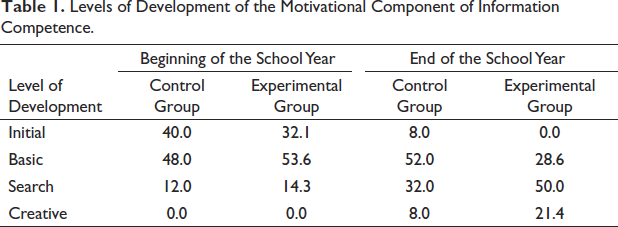
Practical classes for the students of the experimental group were carried out using the traditional methods. Also, the teachers developed a system of tests for checking the indicators for each criterion of information competence identified by the authors. After testing, an integral indicator for each criterion was calculated in percentage in the control group. Testing was conducted among students of the control and experimental groups at the beginning of the school year. At the end, similar testing was carried out for the students of both groups after applying the case technology in practical classes with the students of experimental group. Points were calculated for each indicator for all students, and based on this, it was calculated that how many students have one or another level of development of this information competence component. Below, there are the testing results of students of the control and experimental groups for each criterion at the beginning and at the end of school year. According to the results presented in the Table 1, the number of students with the initial level of the motivational component of information competence in the experimental group decreased by 32%. Similar situation was observed in the control group, with the number of students in the experimental group at a basic level falling by 25% and the number of students in the control group at the same level rising by 4%. The number of students of the experimental group with a search level increased by almost 36% and in the control group, it increased by 20%. The number of students of the experimental group with a creative level increased by 21.4% and in the control group, it increased by only 8%.
Levels of Development of the Motivational Component of Information Competence.
According to the calculations presented in the Table 2, the number of students with the initial level of cognitive component of the information competence decreased by 50% in the experimental group, but in the control group, this indicator decreased a little less which is by 36%. The number of students in the experimental group with a basic level decreased by 9%, while in the control group, it increased by 16%. The number of students in the experimental group with a search level increased by almost 44% and in the control group, it increased by 16%. The number of students in the experimental group with a creative level increased by almost 18% and in the control group, it increased by only 4%.
Levels of Development of the Cognitive Component of Information Competence.
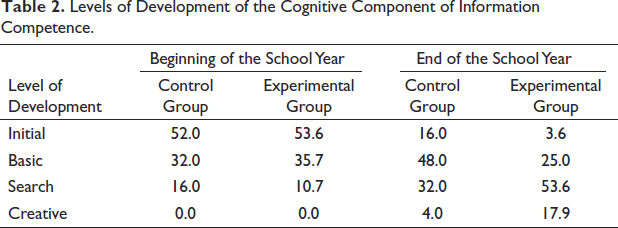
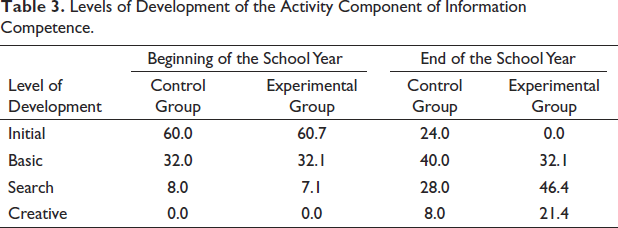
Table 3 shows that the number of students of the experimental group with the initial level of the activity component of information competence decreased by 61%, but in the control group, it decreased a little less, by 36%. The number of students in the experimental group with a basic level did not change, but in the control group, it increased by 8%. The number of students of the experimental group with a search level increased by almost 40%, and in the control group, it increased two times less. The number of students in the experimental group with a creative level increased by 21%, but in the control group, it increased by only 8%.
Levels of Development of the Activity Component of Information Competence.
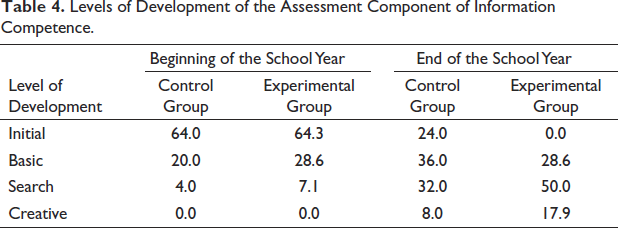
According to the results presented in the Table 4, the number of students of the experimental group with the initial level of evaluation component of information competence decreased by almost 65%, and in the control group, it increased by 40%. The number of students of the experimental group with a basic level did not change, but in the control group, it increased by 16%. The number of students of the experimental group with a search level increased by 43%, and in the control group, it increased by 28%. The number of students of the experimental group with a creative level increased by 18%, but in the control group, it increased by only 8%.
Levels of Development of the Assessment Component of Information Competence.
Then, the integral assessments were calculated for each student, and the levels of development of information competence were determined in general based on this. The results of changes are presented in the Table 5.
Levels of Development of Information Competence According to the Integral Indicator.
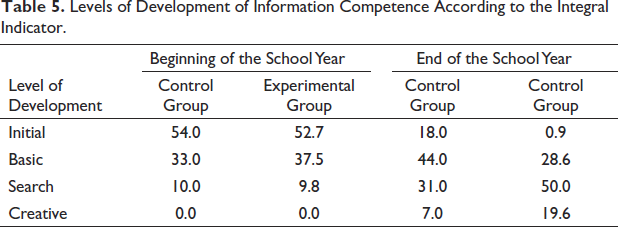
The number of students of the experimental group with an initial level of information competence decreased by almost 44%, the number of students with a basic level decreased by 5%, the number of students with a search level increased by 40% and the number of students with creative level increased by almost 20%. Such significant changes were not observed in the control group. The number of students with an initial level of information competence decreased by 36%, the number of students with a basic level increased by 11%, the number of students with a search level increased by 21% and the number of students with a creative level increased by only 7%. As it can be seen, the changes occurred in the structure of both groups for the better, regardless of whether the case technology was used at the lessons or not. This is due to the fact that the students were mature for the academic year and received a lot of information and practice. Many other factors that surround students influence the level of development of information competence. However, the positive changes in the structure are more intense in the experimental group in which the case technology has been systematically used for a long time than in the control group. This fact proves the effectiveness of using the case technology in the process of training future teachers of mathematics in order to develop information competence for them.
After analysing the results obtained, it was possible to conclude that the use of case technology during the academic year led to fairly high rates. Almost 90% of respondents have experience of work with various sources of information, 93% of students have the skills to prepare an essay, 100% have computer skills, 87% of students know how to use the library funds, 61% of students know how to use various written forms of presenting results and 80% of students are able to critically evaluate information, which indicates a fairly high level of information competence. In addition, a survey conducted among students of the graduate course of the specialty ‘mathematics’ and ‘mathematics-informatics’ made it possible to state the following:
Almost all respondents believe that a high level of information competence is of great importance for their further effective professional activity.
More than 85% of students noted the need for active development of information competence in the process of studying at university.
All respondents state that the use of case technology at the lessons increases their interest in learning, increases their level of activity at the lessons and their skills in working with information.
Analysis of the own pedagogical experience and the results of a study of the scientists’ work in this direction made it possible to identify some problems in organizing the process of formation and development of the information competence for the future teacher:
It is necessary to conduct the process of developing the information competence among students of pedagogical university by means of using the case technology in the educational process discontinuously throughout the entire period of study.
It is necessary to apply the case technologies not only when studying one or two separate disciplines but also to introduce this method into the maximum number of subjects studied, at least when studying individual topics.
Differentiated approach to the development of information competence is important since students have different levels of computer literacy at the beginning of their study at university.
Since information technologies and software are changing rapidly today, it is important to constantly update the content of cases used to achieve the task.
It is possible to achieve a high level of development of information competence in students only if the teachers are fully competent in the information technologies and use this knowledge when creating and using cases.
Discussion
In his research, A. A. Danilov (2020) identifies only two categories of information technology expertise. The first level is the user level, which includes the ability to develop, modify and display office programs, listen to audio and video files in a variety of formats and use remote and cloud technologies in pedagogical activities. The second level is professional, which includes the ability to create presentations and videos, make calculations in a spreadsheet editor, process simple graphic files, automate information processing and retrieval, create websites using the constructor, use cloud and remote technologies in pedagogical activity, organize access to them for students and colleagues, programs and be able to teach this to more senior colleagues. According to M. Niss and T. Højgaard (2019), the structure of information competency has three components, each of which has its own indicators: The motivational-value component provides a mechanism for training future teachers to realize personal creative potential and a mechanism of relation to information competence content, the cognitive and activity-based component is the foundation of the mechanism of cognition through mental activity and the mechanism of cognition through practical activity and the emotional-volitional component consists in an adequate understanding and evaluation of one’s own abilities.
S. Q. A. Aladwan (2022) provides three criteria for assessing a person’s information competence development: informational, technological and reflexive-effective. Each criterion is defined by a set of indicators, and the amount of growth of these indicators indicates the prospective teacher’s informational competence. According to the findings of S. A. Zaitseva’s (2011) research, she developed five criteria for assessing the degree of formation of information competence for future primary school teachers: effectiveness in solving own training and educational tasks, readiness of the future teacher for the formation of computer literacy for students, ability to use information and communication technologies in future professional activities and ability to organize.
The research analysis of M. Petrou and M. Goulding (2010) showed that indicators of criteria of information competence and their levels are distributed differently depending on the quantity and quality of criteria of information competence. Based on the research by modern scientists (Mashood et al., 2022; Özbek & Cho, 2023) in the pedagogical industry, it can be possible to single out the operational components of information competence: selection of information, information processing, creation and publishing of information and organization of communication in the information and educational system. In modern educational institutions, one of the most important requirements for any teacher, including a teacher of mathematics, is the ability to navigate through a huge amount of information, the volume of which is constantly growing, and which is presented in various forms on various media, in particular digital media and the internet (Schoenfeld, 2016).
E. Geraniou and U. T. Jankvist (2019) convinced that it is necessary to follow a certain algorithm for the effective selection of objective, relevant and valuable information. First, it is needed to correctly and clearly set the task that requires some information for the solution. This contributes to a more precise limitation of the field of information retrieval. At the second stage, it is necessary to choose a source of information that should be reliable and contain complete and objective information. The third stage is the correct formulation of the query in the search engine. With a competent and clear formulation of the request, the number of information sources is significantly reduced, which saves time when viewing them. The next step is to save the selected information correctly. Saving information in the right format on a convenient and reliable medium will allow efficient processing of information in the future. The processing of information for its further use in order to solve pedagogical tasks is one of the most important elements of the teacher’s information competence. The main task of information processing is the ability to analyse and evaluate it from the perspective of relevance.
S. Becevic (2023) considers that a modern teacher needs to have knowledge of the criteria that can be used for the effective and competent performance of work at this stage. It is necessary to have the skills to structure information collected from different sources, depending on the task. For example, information that is suitable for educational activities cannot be used in classes, and information that can be used in math lessons for pupils in the 5th–6th grades, it is completely irrelevant for algebra and geometry lessons in high school. The same applies to the choice of the form of information presentation: text, graphic, animation and sound. The same information presented in different forms can be used for different pedagogical tasks. For example, test tasks on the same topic presented in a test form can be used to control knowledge in distance learning, but the same tests presented in the form of presentation can be used for updating the basic knowledge before studying a new topic at the lesson. The use of multimedia and sound effects for demonstrating a presentation at the lesson increases the interest and attention of students when learning new material; however, it can distract their attention during the independent work. The information competence of a teacher is not limited to the selection and processing of ready-made information. The next stage of working with information is to create the own product, which can be a basic lesson scheme, author’s tasks and test tasks. Any teacher creates his own product, namely presentations, based on the information found (Nieminen & Atjonen, 2023).
According to S. Sengil-Akar and I. E. Yetkin-Ozdemir (2022), the information competence of a teacher includes not only basic computer literacy but also the effective use of various forms of information presentation. A teacher of mathematics should be able to structure information and present the results obtained in various forms, carry out numerical processing of results, have a competent approach to the choice of visualization tools for numerical information and use the tools for monitoring and recording the progress of the educational process and its results. In the modern, informatized educational space, each school has its own website, and some educational institutions have a local network in which general information on the organization of educational processes is published. Therefore, the ability to correctly place information is the condition for the teacher’s effective work. Today, information and communication technologies provide great opportunities to train students outside of school. A modern teacher who knows how to create information also needs to have the skills to place this information on educational platforms, on the global internet and create his own blogs.
Conclusions
In the process of this study, the components of the information competence of the teacher of future mathematics were identified. According to each of the components, the indicators and levels of their development were selected. The experiment conducted during the academic year in three stages has shown that the levels of the components of information competence of the third-year students increase in any case, since many factors in the educational process contribute to this. However, the level of indicators and components of information competence increases much more intensively under the condition of the systematic use of case technology in practical classes in professional disciplines. The findings of this pedagogical experiment clearly show that using case technology in the training process improves future maths teachers’ learning outcomes to a great extent. Practice shows that the use of case technology in lessons, in comparison with traditional methods of conducting lessons, contributes to an increase in the level of cognitive activity of students, the development of creative thinking and increased interest in the studied disciplines and the future profession as a whole.
Despite the fact that the development of cases requires a lot of time, effort and experience from teachers, their correct application brings a good result after a while. The study showed both the theoretical and practical significance of the implementation of the results obtained in the educational process of the higher school of natural science at Zhetysu University named after I. Zhansugurov. At the same time, new issues, problems and tasks have appeared that need to be solved. Further directions of research on this issue can be the following: Identifying other factors that contribute to the development of information competence for the future graduates of the specialty ‘mathematics’ and ‘mathematics-informatics’ of pedagogical higher educational institutions, development of new methods for the development of information competence for the future teachers of mathematics, expansion of the diagnostic apparatus in identifying the level of components of information competence of students, development of a methodology for the formation and development of information competence in the system of postgraduate continuous education and introduction of this methodology in advanced training courses for the teachers of mathematics of any age.
Footnotes
Declaration of Conflicting Interests
The authors declared no potential conflicts of interest with respect to the research, authorship and/or publication of this article.
Funding
The authors received no financial support for the research, authorship and/or publication of this article.
