



Abstract
This study reveals the content and methodological features of professionally oriented training of engineering students in higher mathematics. The authors provide examples of applied tasks for students of different technical specialities. The relevance of this article is determined by the fact that a modern higher educational institution sets itself the task of providing graduates with a certain set of competencies, as well as a set of acquired knowledge and skills. Thus, young people in their future life can easily navigate in terms of professional development. Nothing prevents them from easily adapting to the constantly changing social and economic conditions, meeting the current needs of the personnel market. All this allows building a competent process of training future specialists. Young engineers can build mutual understanding, cooperate with representatives of other industries, since solving complex problems and conducting joint research requires, first of all, the presence of a solid foundation consisting of natural science and mathematical disciplines, the establishment of which should take place within the framework of a higher educational institution. It is for this reason that one of the most significant problems should be identified related to the mathematical training of students of technical higher educational institutions. The purpose of the study is to identify and clarify the content and methodological features of professional training of engineering students in higher mathematics. Mathematics has a special and priority place among other sciences studied at the university. The modern course of mathematics is based on a highly developed logical and computational apparatus. Without the current achievements in the field of mathematics, there would be no high technologies that are everywhere today and are found in all areas of human activity without exception. The methods and ideas of mathematics are widely used in the cycle of technical disciplines. Mathematics, due to its inherent applied capabilities, is used in natural science and engineering research.
Keywords
Introduction
The social and economic processes taking place in the state, the dynamic development of science and information technologies have a direct impact on the education system as a whole and higher education as its component. The existence of competitive relations in the sphere of economy and production determines the effect of the competition factor on the labour market, which provides for increasing the requirements for professional training of specialists. A sharp acceleration of the knowledge updating, the emergence of new technologies, continuous technical re-equipment of production requires from a specialist not only high-quality knowledge, but also high professional mobility, the ability to independently navigate through extensive scientific, technical, and economic information, constantly replenish and update their professional knowledge. Each university course is designed to contribute to the implementation of the general requirements of higher education. When training engineering students, a special role belongs to fundamental general theoretical courses, and first of all to the higher mathematics classes. Mathematics is a universal language for describing processes and phenomena of various nature, without mastering which today neither high-quality training nor effective activity of a specialist is unthinkable. No less important is the role of mathematics in shaping the thinking of future designers, technologists, economists, and technical officers.
According to I. A. Goncharov (Russian writer and literary critic): ‘People will always have something to find, discover, invent, because the source of this knowledge is inexhaustible’ (Aleshina, 1990). In confirmation of Goncharov’s words, it should be stated that a special role has always been assigned to engineers in the socio-economic development of the society of any state, and the experience of Kazakhstan in this field is no exception. Returning to the subject matter, it is worth paying attention to the fact that the engineering profession actually allows one to meet most of the basic human needs. Among such needs: respect; social recognition; favourite occupation; developing creative potential; implementing plans and ideas; professional promotion and growth; knowledge of the phenomena occurring in the world around, etc. However, every engineer has mathematics at the heart of their knowledge. Solutions to most complex technical problems, including scientific research, are based on mathematical calculations. Thus, for an engineer, mathematics is a significant tool, due to which:
necessary analysis is being carried out; production and technical tasks are being solved; organizational and managerial tasks are being solved; thinking in the subject area is being formed; quantitative analysis of the real processes of engineering and technical activities, etc. is carried out.
The issue of the professional orientation of training specialists is most fully developed in the field of teacher’s education. Based on the above, the training of future engineering personnel presupposes the presence of serious mathematical prerequisites, since it forms the basis of all specialized technical disciplines (Aleshina, 1982). To date, it is known that there are no specific and reference academic disciplines. Any discipline gives its ‘fruits’ and contributes to the formation of a future specialist. Nevertheless, ‘mathematics’ is a basic subject for engineering students that has a special role and, on its basis, most other technical disciplines are attached.
Students of technical specialities take a training mathematical course according to their own complicated programme. This programme introduces young people to the practical application of mathematics in the course of solving various mathematical problems. At the same time, the training programme implies the solution of such tasks that may arise for future specialists in the field of their professional postgraduate activities. Thus, the problem of the professional orientation of teaching a mathematical discipline should be solved at the university. It is of great importance for the successful and effective process of training future engineering specialists in various fields and specialities (Aleshina, 1991; Nantschev et al., 2020; Steenkamp & Muyengwa, 2018).
Review of Previous Studies on the Selected Topic
Science and technology make progress today. Therefore, the knowledge of future specialists in the field of mathematics should be fundamental. Only a high-quality set of mathematical tools that will be used by a specialist will facilitate the achievement of a high level of skill, and implement any, even the most significant research (Grebyonkina, 2013). The ‘applied orientation’ in the teaching of higher mathematics has been developing simultaneously with the process of introduction of polytechnical education since the beginning of the 1960s. As noted by E. Z. Zharlygasova in her research article ‘Professionally oriented tasks in teaching mathematics to engineering students’—mathematical training of students conducted in a theoretical way will not give the knowledge that can be actively used in future professional activities.
Engineering students, when studying a course of higher mathematics, should be guided by the teacher not on theoretical training, but on obtaining real mathematical knowledge in various practical situations. This ability can be formed, but only if mathematics is studied in parallel with specialized technical disciplines. Learning to solve professionally oriented problems is a tool that can be used as the basis for connections between mathematics and other technical disciplines. In recent years, the theoretical substantiation of the methodology for using problems in the process of teaching mathematics has gained increased popularity (Zharlygasova, 2013).
The authors of this study agree with the opinion of N. D. Kovalenko, who, as part of his PhD thesis, expresses his own point of view, which concerns the study of ‘mathematics courses’. Thus, Kovalenko emphasizes the need for university students to have a sufficient level of mathematical training, which should be aimed at mathematical programmes and courses. This will facilitate the use of various mathematical methods in future professional growth, in the education of mathematical culture and the development of mathematical intuition. The researcher believes that future specialists should have the basics of a body of mathematics. Without this, no practical and theoretical problems can be solved. The main goal of the graduate and future specialist is to acquire logical thinking skills, as well as the ability to freely translate any professional technical problem into a mathematical language (Kovalenko, 1995).
The research article ‘On the applied and practical orientation of teaching mathematics’, the author of which is Yu M. Kolyagin, provides an opinion on the goals of studying mathematics at a university. Thus, in accordance with the opinion of the author, mathematics at the university should teach students to use it in their own professional activities in the future. Nevertheless, in the context of the general goal, in some cases, it is possible to come to excessive formalism (Kolyagin, 1985). Learning goals can be achieved. However, competent work is necessary here, which will lead to the establishment of an optimal combination of methodological and substantive approaches. Special didactic principles include all the achievements of modern pedagogy in their composition and are also constantly being modernized and updated. The system of didactic principles currently regulates:
choice of forms, methods and means of training; selection and structuring of the content of education.
According to the authors of this study, it is necessary to work towards further convergence of special disciplines and mathematics. The fact is that only in the aggregate of studying mathematics and other technical disciplines, the broad possibilities of mathematics can be demonstrated as a discipline that will give a huge potential in the future professional activity of a graduate. In the works of the following researchers, issues related to the professional orientation of training were highlighted: Kudryavtsev (1981), Makhmutov (1985), Konovalova (2006), Popova (2011), Grebyonkina (2013, 2016), Zharlygasova (2013) and others. A theoretical analysis of various sources covering the topic under consideration allowed the study to come to the conclusion that there is still no unified and generally accepted opinion among researchers regarding the definition of the concept of professional orientation. Professional orientation in training, in the studies by A. Ya Kudryavtsev and M. I. Makhmutov is interpreted as a didactic principle.
According to A. Ya Kudryavtsev, which is reflected in the study ‘On the problem of learning principles’,
the main content of the didactic principle is reflected in the need to combine vocational and general education and keeping the main focus on the targeted learning that would allow the students to form a system of knowledge in the area in which they acquire a profession (Kudryavtsev, 1981)
The professional orientation of training is studied by many modern scholars. Recently, in scientific publications on pedagogy, two completely different views on this concept can be found. Professional orientation in training in accordance with the first approach is considered as an orientation to various personal preferences, and as a positive attitude to the profession that a person will receive in the future after graduating from a higher educational institution. To substantiate the effectiveness of this approach, the article ‘On the development of didactic materials in mathematics with a professional orientation’ by T. N. Aleshina provides signs that indicate a professional orientation (Aleshina, 1990).
interdependence and interrelation between social, cognitive and professional orientations; the relationship between the essence of the activity and the professional orientation; psychological readiness and awareness in relation to a certain type of professional activity; generalized and stable interest in the future profession of a graduate, which is based on abilities and propensities.
T. N. Aleshina emphasizes that the professional orientation of teaching is the main motive for learning. In the process of receiving education by the student, it is the professional orientation that acts as an incentive for learning new knowledge. The level of professional orientation is determined by each student independently and applies to individual disciplines. In many respects, everything depends on the student’s attitude to the disciplines and his attitude to the future profession (Aleshina, 1982, 1991). Professional orientation in training in accordance with the second approach affects the problems of selection and construction of the education content. The second approach is based on the connections between different disciplines: special, general professional, and general scientific. The principle of professional orientation of training, according to A. Ya Kudryavtsev, is focused not only on connection with industrial training. According to this researcher, it is necessary to cover at least theoretical training, but also to establish mechanisms of interaction between different disciplines (Kudryavtsev, 1981).
Analysis of Different Theoretical Approaches to the Definition of ‘Professionally Oriented Training’
The authors of this study have analysed various theoretical approaches to the definition of ‘professionally oriented training’. According to the majority of researchers, professionally oriented training is a system-forming principle that underlies the training of students of higher educational institutions. The interpretation of this concept, in most cases, has a different formulation, that is, each author adheres to his own point of view. However, many agree that this principle should be implemented on similar elements. Professional-oriented teaching of higher mathematics is also an important aspect. Professionally oriented tasks in this case have their own specific content. Thus, in the professionally directed teaching of higher mathematics, the disciplinary connections of mathematics and special disciplines are traced (Vallo et al., 2019; Vallo & Valovicova, 2019). Teaching higher mathematics at the university is carried out to achieve the goal, which is to acquire knowledge and skills. They are ‘vital’ and guarantee the successful study of technical disciplines, since they are based on various mathematical methods. This goal can be achieved if:
if a high level of motivation of students is maintained; if there is a steady interest in the study of special disciplines on the part of engineering students.
Thus, the study considers the most complete definition of the professional orientation of training, formulated by M. I. Makhmutov in his article ‘The principle of professional orientation of training’. According to Makhmutov, the principle of professional orientation of training is based on certain use of pedagogical means. The programmes provided for in this case are assimilated by students. There is also a process of forming interest and values in the profession, which leads to the creation of professional qualities of the future specialist’s personality. The professional orientation of training has the pedagogical means inherent in it. Illustrative material allows for revealing the taught material and some techniques, methods and forms of teaching (Knyazeva, 2012).
I. N. Konovalova, in her PhD thesis, expresses her own standpoint regarding the concept of ‘professional orientation of education’. Referring to M. I. Makhmutov, Konovalova understands certain areas of use of various pedagogical tools as ‘professional orientation of education’. Her views converge on the fact that the subject means allow acquiring knowledge, skills and abilities, and as a result, develop a future interest in the profession received by the student (Konovalova, 2006). In some scientific sources on pedagogy, in addition to the principle of professional orientation of training, in recent years, the concept of ‘professionally oriented training’ has become increasingly common. According to the authors of this study, professionally oriented training is the training in the process of which the implementation of the principle of professional orientation takes place. The principle of professional orientation for professionally oriented training is dominant. The other pedagogical principles of teaching should be considered subordinate to it.
In the course of the analysis of scientific sources, it was found out that the unity of opinion of different authors regarding the interpretation of the concept of ‘professionally oriented training’ is still not developed. According to the majority of researchers, it is necessary to pay attention only to the skills and knowledge that students receive in the learning process and when solving professionally significant tasks. In fact, the authors see in this understanding the presence of only one facet, which reflects the relationship between ‘educational potential and the sphere of professional activity’. According to the opinion of R. M. Zaykin, which is expressed in the article ‘What should be understood by professionally oriented teaching of mathematics to humanities students?’ future professional activity, familiarization of students with the possibilities of using mathematical methods in the professional sphere, the development of professionally significant qualities of the student’s personality (Zaykin, 2013).
In turn, S. V. Popova, in her article ‘Professionally oriented training of metallurgical specialists in the study of mathematics’, under the professionally oriented teaching of higher mathematics implies the interdisciplinary links formed between higher mathematics and special technical disciplines. Thus, Popova suggests that there is a process taking place, within the framework of which a continuous study of mathematics (knowledge, techniques, methods) is organized by students, i.e., everything that should be considered necessary for further training of engineering students. Professionally oriented training in higher mathematics allows for achieving significant goals in the process of studying it within the framework of a technical higher educational institution (Polyakova, 2015). To date, there are no doubts on the part of teaching staff about the need to include professionally directed tasks in the higher mathematics course studied at a technical university. The use of professionally directed tasks within the educational process is important since it forms the ability of engineering students to determine various professional relationships and use the acquired knowledge to solve problems in their future work already outside the educational institution. Among other things, the use of applied problems gives students the opportunity to use various mathematical methods and techniques, that is, everything that will help them solve highly specialized problems within a particular technical discipline.
Professionally directed tasks combine scientific research and educational activities. In the process of searching for the optimal method that allows solving such problems, students of technical universities form logical thinking. In addition, engineering and mathematical consciousness is being developed. Nevertheless, when the process of designing the content of the future course of higher mathematics is carried out by tasks that have a certain orientation, certain factors must be taken into account. First of all, it is necessary to pay attention to the level of training of first-year students who have just come from school.
In a number of subsequent years, young people entering engineering specialities have quite serious problems in their knowledge of the main, so-called basic disciplines. First-year students have a critical level of knowledge in mathematics, chemistry and physics, not to mention other disciplines. Against the background of the above negative trends, it is necessary to address the emerging problems concerning the selection of professionally oriented mathematical problems by teachers, which should be studied to reveal the main essence and understanding of various mathematical disciplines. Students of technical specialties do not perceive complex mathematical tasks, which further affects the insufficient level of their mathematical competence outside the educational institution. Thus, the main emphasis has recently been placed on the abstract mathematical apparatus. The point is that the complexity of professionally directed mathematical problems remains low (Colibaba et al., 2020; Kopeika & Zvirgzdina, 2020).
According to the authors of the study, the professional context of individual tasks should be used at the time of studying each section of higher mathematics. Tasks, if possible, should be selected in such a way that the solution of each subsequent task is based on the result that was obtained when solving the previous task. Due to this approach, there is a process of continuous repetition of the previously studied material. In practice, the connection between the techniques and methods that are used in technical and technological tasks is demonstrated. However, there are features that should be taken into account when selecting professionally oriented tasks. This approach will make teaching higher mathematics more effective (Rozin, 2014).
professionally directed tasks should be clearly related to the material that is covered by the teacher at the lecture; educational process should be adjusted in such a way that the course of higher mathematics is as easy as possible for first-year students; when solving each applied problem, there should be a demonstration of what specific knowledge the student should master in the course of higher mathematics.
No less important should be considered the correct definition of the complexity of professionally oriented tasks that are provided to students for solving. Many teachers of higher mathematics face the following circumstances and situations. In the event that a mathematical problem has a classical notation and is formulated in an abstract form, then students usually have no difficulties in solving it. The reverse situation should be considered one in which the teacher gives the same problem to solve (as in the first case), but in its description there are certain terms characteristic of special technical disciplines, and when solving such a problem, many students face certain difficulties. In simple terms, a student cannot fully understand the problem and translate it into a mathematical language for subsequent solutions (Phillips, 2018; Putra & Setyaningrum, 2018).
In some cases, the result already obtained from solving the problem cannot be interpreted by the student in accordance with the conditions of the task. Thus, it follows that applied problems should be selected by the teacher in such a way that for their solution, first-year students do not need to apply knowledge from other related fields (physics, theoretical mechanics, resistance of materials, standardization, etc.). The course of higher mathematics for engineering students does not provide for the presence of goals aimed at building complex mathematical models. Such models are certainly considered by students, but this happens in senior years and outside the framework of higher mathematics, that is, when studying special disciplines.
Thus, the course of higher mathematics should be built on a simple and understandable level. This will allow the first-year students to show all the possibilities of applying the basic methods that allow them to find solutions to engineering problems. Based on the existing experience of the authors, it should be noted that the classes held in higher mathematics may be more interesting to students if the proposed tasks are professionally oriented context. This refers to such tasks that are compiled in accordance with real data and a corresponding link is provided to confirm their validity. Students’ attention is also actively attracted by mathematical tasks that use information that can be called ‘trending’, that is, that which has become known to a wide range of the public recently. As a rule, the use of such tasks causes increased interest on the part of students, but this is already a result, even despite its short duration, it can bear fruit.
As an example, the study will consider some applied tasks that are used in the work of teachers with students in various technical specialties (Table 1). The problems presented in Table 1 correspond to the topic ‘Differentiated equations of the first order’. The chemical and physical processes described in the framework of the proposed tasks are modelled according to the same type of differential equations with separating variables. However, each of the applied tasks presented below is somehow connected with the professional activities of students of technical universities. In the table, column 7 provides, among other things, the formulation of an abstract task that can be offered to students of various universities for solving.
Examples of AppliedTasks for Engineering Students.
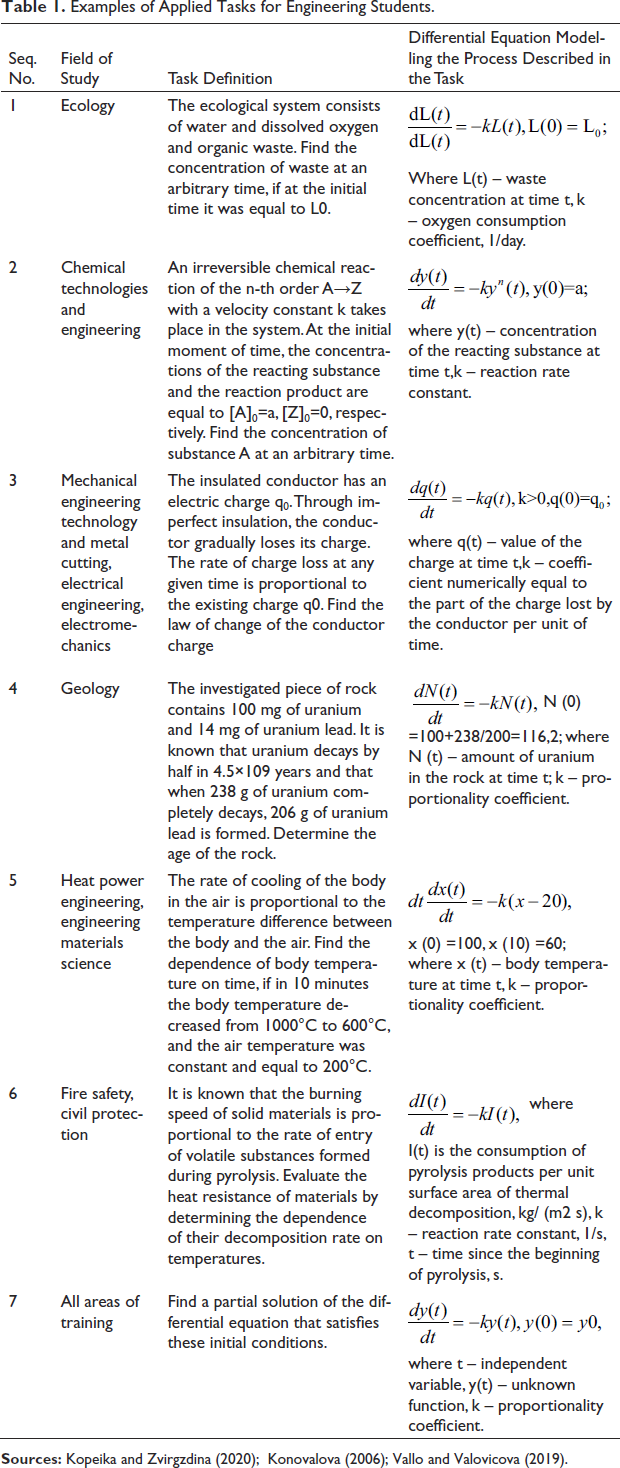
Thus, paying attention to the tasks presented above, it can be emphasized that they are not characterized by high complexity. It follows that the tasks proposed above can be independently performed by the majority of students studying in the relevant technical specialties. The tasks presented above do not require students to have additional knowledge in such disciplines as chemistry, electrical engineering, theoretical mechanics, etc. Furthermore, the currently available methods used to solve differential levels have not lost their abstractness.
Conclusions
In the course of the study, the optimal structure of lectures was identified with the introduction of basic mathematical concepts and methods, which contributes to the establishment of a generalized indicative basis of knowledge, the development of productive thinking of students, the connection of the material presented with professional applications and allows for a topical presentation of educational material. In conclusion, professionally oriented teaching of higher mathematics allows reflecting on the real connection of this discipline with other technical subjects. In the process of solving professionally oriented tasks, students update their existing knowledge and consolidate skills in those areas that correspond to their speciality. The development of algorithms and the search for the optimal method for solving professionally directed tasks contribute to the development of applied skills. In this regard, it is necessary to consider the specific features of each profession and select different methods and tasks if necessary.
Thus, the increased interest of students is caused by the connection of mathematical problems with their future speciality, which is actually a motivation for studying higher mathematics. The experimental verification of the effectiveness of the developed materials confirmed the feasibility of the considered approaches, the validity of the research hypothesis, and proved that the implementation of the professional orientation of teaching higher mathematics to engineering students increases the quality of knowledge and readiness to master the profession. The conclusions indicate that the research objectives have been solved. This study can be continued to create professionally oriented curricula and methodological materials for the higher mathematics course and special courses for students of various specialities in the context of a multi-level specialist training system.
Footnotes
Declaration of Conflicting Interests
The authors declared no potential conflicts of interest with respect to the research, authorship and/or publication of this article.
Funding
The authors received no financial support for the research, authorship and/or publication of this article.
