




Abstract
Purpose and Significance:
Education is regarded as the key to economic development, and COVID-19 has provided all universities the unique opportunity to urgently address their fitness for purpose. Universities can play a significant role in contributing to a more sustainable world by mainstreaming Sustainable Development Goals (SDGs) at postgraduate levels.
The opportunity to utilize United Nation’s Sustainable Development Goals (UN SDGs) as the framework for postgraduate projects in solving real world’s challenges in our communities after the COVID-19 pandemic was explored.
Main Body:
One way of ensuring concomitant attainments of the SDGs with community development is that post-COVID-19 postgraduate projects should be purposively driven to address UN SDGs to make positive social impact in our communities. Through this, higher education institutions (HEIs) will be contributing in no little measures to human capital and social development with sustainable developments driven through interdisciplinary approach.
Conclusion:
The research products upon the completion of master’s and doctoral studies from our different universities should be purposively designed in accordance with the UN SDGs and universities’ visions to solve real-life challenges and therefore make social impacts in our communities. All HEIs should embrace an integrated approach by designing courses with learning objectives that are clearly focused on holistic approaches to sustainable societal development.
Keywords
Introduction
COVID-19 pandemic has challenged the higher education cluster to develop a new norm for postgraduate education, research, and training. This is because many communities will be impoverished with increased inequality resulting from this pandemic, and to address this, higher education institutions (HEIs) should begin to consider interventions that can ameliorate these impacts by creating intercourse between their curricula and real-life societal problems using the United Nation’s Sustainable Development Goals (UN SDGs) as project framework in our different communities. According to Shaoming and Hui-shu (2014), the greatest contribution that higher education can make to sustainable development is by enabling students to acquire the skills and knowledge that allow them to make a lasting difference. This can be attained at the level of postgraduate education through the use of innovative research projects for focused community and societal development over a long period. Knowledge, if properly commodified, has been found to be a chief determinant for driving success and growth through its ability to reduce poverty. Botman et al. (2009) indicate that tertiary education imparts knowledge and produces professionals who directly and indirectly impact the quality of human resources. Thus, HEIs have the responsibility to help accelerate the attainment of SDGs by acting as a knowledge broker, thereby developing societies. Postgraduate education can provide direct input to high-level processes, support a more effective implementation of the goals and actions, and therefore contribute to ensuring the political accountability needed to achieve SDGs (Jha et al., 2016).
African Develoment Bank (2016) reports high rate of unemployment and migration among youths. This is not unconnected to the failure of universities and other institutions of higher learning to adequately equip students with transferrable and research skills required for the real world. These skills are necessary for employment and job creation while the lack of same perpetuates inequality, unemployment, and poverty, hence a reason for migration to other areas of opportunities. Youth unemployment results from Africa’s failure to capitalize on one of the continent’s greatest assets—the growth of its talented young people (African Develoment Bank, 2016). COVID-19 will have a damaging impact on youths, as attempt to migrate from their countries for various reasons such as political conflicts, economy, and unemployment would be on the rise, while there will be nowhere to migrate to. Various governments therefore need to proffer a solution to the possible rise in unemployment among young graduates.
Building on the Millennium Development Goals that were set in 2000, 17 SDGs were formally adopted by all 193 member states of the UN in September 2015, aimed at ending extreme poverty, protecting the planet, and ensuring prosperity for all by 2030. The SDGs expanded the agenda to include issues such as climate change, sustainable consumption, innovation, and the importance of peace and justice, requiring all countries to take action (Annan-Diab & Molinari, 2017). The university valorized by von Humboldt or John Henry Newman in the nineteenth century cannot be the model of the HEI of the twenty-first century (Singh, 2001), not even after the COVID-19 pandemic. HEIs need to do more to serve the primary needs of countries still experiencing the growing pains of dependence on others. It is time to address the important questions facing these countries by re-examining traditional notions of education in developing countries and the value it holds (Botman et al., 2009). Many countries have neither articulated a development strategy linking knowledge to economic growth nor built up their capacity to do so (Saint et al., 2003). COVID-19 has provided all universities the unique opportunity to urgently address their fitness for purpose because education is regarded as the key to economic development. Fadeeva and Mochizuki (2010) suggest that there is no doubt that HEIs can play a significant role in contributing to a more sustainable world by addressing sustainability through their major functions of education, research and outreach. In order for HEIs to play a role in transition to sustainability, they need to go beyond modifying their activities by mainstreaming sustainability components into postgraduate education.
According to Usha and Mary (2016), the demand for higher education has risen in tandem with overall population growth and increasing affluence and has added urgency to the pursuit of sustainability. Universities dispense knowledge that expands the human mind, which is the most important aspect of the human being. University is the seat of knowledge where conceptual abilities are developed. From this submission, the knowledge dispensed by the university should therefore be dynamic, reinventing itself, and beneficial to the entire society. There is clearly a need to embed sustainability into the curricula that is closely monitored by accreditation bodies (Annan-Diab & Molinari, 2017).
The presence of COVID-19 pandemic has forced most higher education training institutions into a remote teaching and learning mode including those that were hitherto not properly prepared for this. Most academics had to be offered short and a crash orientation on e-learning to ensure that teaching and learning were not totally disrupted. A few concerns that HEIs should be prepared to address may include, but not limited to, the following: (a) Will remote learning achieve all the written and unwritten curricula (including the usual unwritten institutional values such as academic honesty, integrity, culture, and tradition)? (b) Will all transferrable skills be achieved through this mode of delivery? (c) How can remote or on-line learning be improved for professions with practical, application, or/ and clinical components? (d) What would be the impact of COVID-19 pandemic on postgraduate education? (e) How will postgraduate students be adequately prepared for employment and the real world?
The opportunity to utilize UN SDGs as the framework for postgraduate projects in solving real world’s challenges in our communities after the COVID-19 was explored under the following subheadings:
Projects should be based on the UN SDGs Integrated and inter-professional group projects Social impact-driven projects for human and social development University vision-aligned postgraduate projects
Projects Should Be Based on the UN SDGs
Boni et al. (2016) report that university is not only excellent for carrying out cutting-edge research, and that other aspects such as commitment to society should be included in the assessment of a university’s activities. It is a well-known fact that university can contribute to the construction of a fairer society and, therefore, to the construction of the SDGs. Focusing on teaching, a university trains the professionals and citizens of society. This is why university education through a practical approach to reality should have a radical importance for tomorrow’s society. According to Zamora-Polo and Sánchez-Martín (2019), education and promotion of SDGs must be understood in the broader context of education for sustainable human development (ESHD) . They further stressed that sustainable human development (SHD) is ‘the expansion of the substantive freedoms of people today while making reasonable efforts to avoid seriously compromising those of future generations’. University has a crucial role in achieving SD and SHD, and Boni et al. (2016) assert that development education (DE) is considered as a strategy, whose main goal is the empowerment of people through a teaching-learning process, developing knowledge, skills, and values, that enables them to become members of a global community.
The concept of development has changed and metamorphosed throughout history from economic development to human development (HD) (Zamora-Polo & Sánchez-Martín, 2019). Then the challenge is clearly to build up structures that support this new construct, that is, sustainability and integral ecology, understood as the way of harmonically enhancing the living conditions of human beings. What is the role of universities in such a paradigm? HEIs are evidently involved in every relevant change or turning point (Zamora-Polo & Sánchez-Martín, 2019). This has been of concern to the African Union as revealed in the African Union’s vision of ‘an integrated, prosperous and peaceful Africa, an Africa driven and managed by its own citizens and representing a dynamic force in the international arena’ through its Agenda 2063 (African Union Commission, 2014). This has become more relevant and realistic in times of the COVID-19 pandemic not only at the political or economic front but also at the academic front. Now is therefore the time when universities within the continent should harness its resources and work together to achieve a common goal in the interest of its diverse people through collaborative teaching, learning, and research at postgraduate levels.
Increased imports of capital goods and numerous publications on Africa have been documented (African Union Commission, 2014) and are worrisome if not properly utilized through internationalization of teaching, learning, research, and community engagements through postgraduate education. African Union Commission (2014) further reports that it is a paradox that about 18 African countries have recorded fourfold increase in imports of capital goods between 2000 and 2011 despite research outputs in universities. Most universities in the continent have also focused on sustainable development for Africa in their mission and visions, with countries reporting a tenfold increase in the number of scientific publications between 1990 and 2010 and, in some cases, more than 1,200 per cent growth during the same period. This is, however, yet to translate into patents and intellectual properties. The questions are, what and why are these universities researching if this increase has not translated to increase in sustainable development or graduate employment. The continent should begin to record export of capital goods but unfortunately, in many respects, Africa is worse off than in 1960, and according to a report on Africa by the G8 countries, Sub-Saharan Africa is the only region of the world that has actually become poorer in the last generation (Britz et al., 2006). This will be worse with COVID-19 if the status quo in our HEIs is left as it is.
Integrated and Inter-professional Group Projects
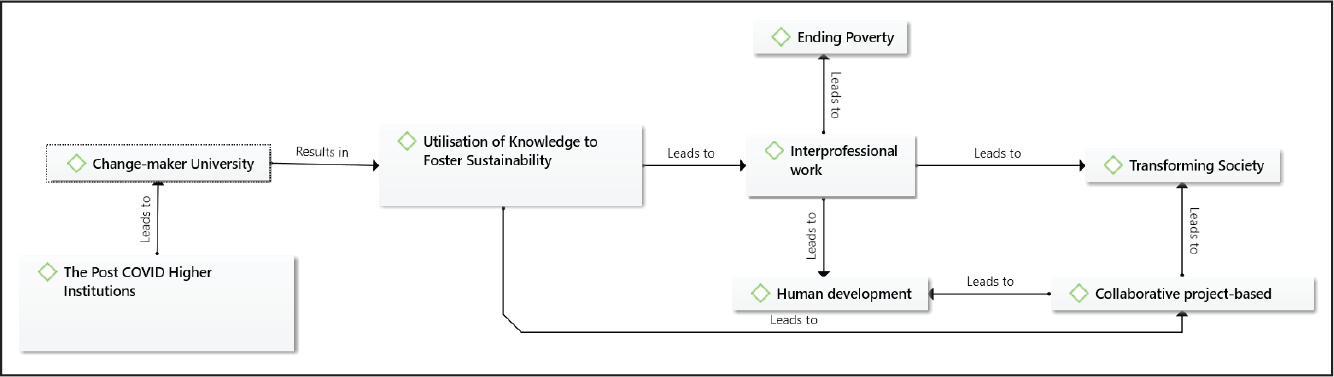
Addressing the SDGs by HEIs must be transversal, involving the joint work of several disciplines and dialogue between different areas of the same discipline (Boni et al., 2016). According to Clark and Wallace (2015), interdisciplinarity is a means to integrate knowledge and methods in the interest of problem-solving. The search for integration has a long and rich history that is reflected in higher education and professional practice elsewhere. Knowledge is generally classified as disciplinary (isolated disciplines), multidisciplinary (two or more disciplines, additive), interdisciplinary (integrative, fusion), transdisciplinary (non-disciplinary), or in other ways that describe different modes of knowledge specialization. No discipline can impart education for sustainable development on its own. Only by following an interdisciplinary approach can sustainable development education be able to confront problems that cross traditional disciplines (Abrahams, 2003; Annan-Diab & Molinari, 2017). Initiatives such as transdisciplinary research which focuses on social needs, knowledge transfer, or the use of teaching methodologies such as service learning can be examples of this transformative university approach (Dlouhá & Pospíšilová, 2018; Zamora-Polo et al., 2019). Some works have described experiences of SDGs at the university level where SDGs have been achieved transversally in a joint master’s degree at cross-border (Dlouhá & Pospíšilová, 2018) or national levels . It is my view that students from different disciplines and groups within and or across faculties in a university should be able to work together to solve SDG-related challenges within the community as depicted in their different visions and missions (Figure 1).
Social Impact-Driven Projects for Human and Social Development
There are several ways of ensuring that our communities are developed with concomitant attainments of the UN SDGs. At the moment, in many of our universities, many dissertations and theses that are submitted as research products upon completion of master’s and doctoral studies present no tangible benefits to our communities. Post COVID-19 pandemic, postgraduate projects should be purposively driven to address UN SDGs to make positive social impact in our communities. Through this, HEIs will be contributing in no little measures to human capital and social development. The contribution of these works will impact directly on all the UN SDGs and many more. These projects should be aimed at achieving a few of the 17 SDGs at a time, and because these goals are integrated, attempting to achieve one will affect outcomes in others.
One of the many ways of ensuring that the UN SDGs are attained might be to share the goals among different postgraduate disciplines in a university and monitor and evaluate the progress periodically through impact assessment. According to Vanclay et al. (2015), the International Principles for Social Impact Assessment indicates that social impacts include all the issues associated with a planned intervention (i.e., a project) that affect concerned people, whether directly or indirectly. Specifically, a social impact is considered to be something that is experienced or felt in either a perceptual (cognitive) or a corporeal (bodily, physical) sense, at any level such as: the level of an individual person, an economic unit (family/household), a social group (circle of friends), a workplace (a company or government agency), or by community/society generally. A pragmatic method of doing this shall be through interdisciplinary research projects; for example, faculties of commerce, agriculture, accounting, health, and economics and relevant stake holders of government and industries can collaboratively work together to achieve UN SDGs 1, 2, 3, and 4 that deal with poverty, hunger, good health, and well-being, respectively. It will also be novel for science and education faculties working to ensure that the four specific disciplines of science, technology, engineering, and mathematics (STEM) through interdisciplinary projects solve the challenge of affordable and clean energy in Africa with its abundant natural sunlight if postgraduate research projects in the disciplines of physics and electronics are well directed and focused.
Our rural communities and societies yearn for development. This is so true for many countries in the developing world. It is disheartening to observe that many immediate rural communities where universities are located do not benefit from the impact of knowledge and its application of the expertise generated from this citadel of knowledge. If we are to achieve a few of the UN SDGs in 5 years, there is need for an improved relationship between HEIs and the communities through a purposively driven research agenda towards attaining some of these UN SDGs. Meanwhile, according to Clark and Wallace (2015), today there is a surplus of pseudo-integrative academic offering from different origins, interests, and individuals. Universities should develop curricula and policies that generate ideas for the continuous growth of our nations (Sulaiman & Ojo, 2018). According to Sulaiman and Ojo (2018), universities and all other HEIs are established to contribute to societal development with the goals of providing improved socio-economic and social outcomes. Most households in Africa believe that obtaining university qualifications assists with the attainment of an entrepreneurial mindset that can assist with finding employment or creating one. This will be most challenging post COVID-19 pandemic, as obtaining academic degrees shall no longer guarantee employment. Some qualifications obtained are now devoid of employable skills because they are no longer relevant to societal needs. It therefore behoves HEIs to be more innovative in the designs of the their curricula because, according to Zamora-Polo and Sánchez-Martín (2019), the bias of university education should be of radical importance in tomorrow’s society.
University Vision-Aligned Postgraduate Project
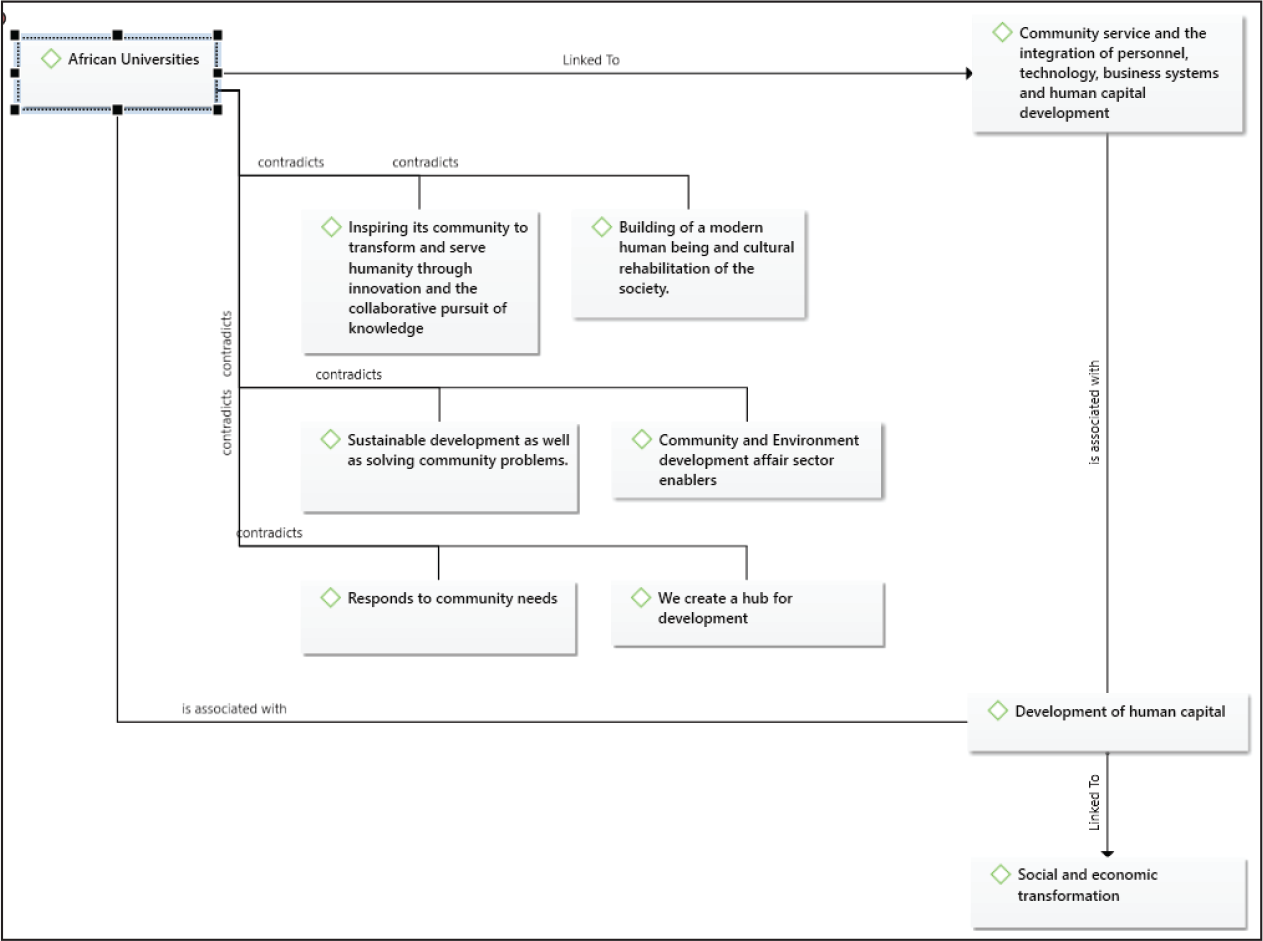
In recent times, most African universities have included in their vision and missions some commitment to the development of the African continent, while in reality, there are very few institutions that connect their curricula to their strategic visions and missions (Figure 2).
HEIs can enhance the analysis of African problems and must become the primary tool for Africa’s development in the new century; strengthen domestic institutions; serve as a model environment for the practice of good governance, conflict resolution, and respect for human rights; and enable African academics to play an active part in the global community of scholars (Botman et al., 2009).To ensure relevance and fitness for purpose, postgraduate projects should align all projects to the universities’ visions. HEIs need to commence conversation on sharing research evidence with policymakers’ communities of practice (Higher Education and Training, 2017). HEIs have been generally considered significant contributors to the promotion of sustainability. The regional universities in particular are expected to closely engage with local communities in networking and productive partnerships, amplifying the capacity of a region to self-organize and operate, and leading to mutually beneficial outcomes (Karatzoglou, 2013). According to Karatzoglou (2013), universities continue to cope effectively and sustainably with the dynamic nature of sustainability by displacing barriers; changing teaching paradigms; developing social competencies, communication skills, and community relations; and deepening their involvement in local and regional initiatives.
Conclusion
Post COVID-19 pandemic, upon the completion of master’s and doctoral studies, all research products from HEIs should be purposively designed in line with the UN SDGs and universities’ visions to solve real-life challenges in the communities. Many HEIs should embrace an integrated approach in their educational activities by designing courses with learning objectives that are clearly focused upon holistic approaches to sustainable societal development. There might still be the challenge of new types of student assessment methods and the changing of many of our teaching paradigms to help to overcome the mono-disciplinary barriers to change (Tomas et al., 2015). We should begin to see tangible benefits of opportunities, enhanced local GDP, and spin-offs (Karatzoglou, 2013) post COVID-19. In the sustainability paradigm, universities should opt for a more collaborative development of knowledge by initiating a society-wide dialogue with other key players that reflects their visions and ethical considerations (Georg et al., 2014). COVID-19 now provides universities the opportunity to restructure their postgraduate programmes to integrate key competencies required to attain the UN SDGs as a new norm for the future.
Footnotes
Declaration of Conflicting Interests
Funding
The author received no financial support for the research, authorship and/or publication of this article.
