




Abstract
The United Nations (UN) has orchestrated a mobilisation of the world community over the past 20 years, to tackle a range of global problems via two consecutive development projects: the Millennium Development Goals (MDGs) and the Sustainable Development Goals (SDGs). Research focused on education in these projects is fragmented, with apparent gaps in knowledge around: i) the definition of education; ii) the links between the education goal and other goals; and iii) the operationalisation of those links. The originality of this study rests in addressing these interrelated gaps, by drawing on the soft governance approach and thematic analysis of 12 key UN policy documents. The findings explain the position of education in both UN projects by highlighting important aspects of its dynamic nature. First, the definition of education has been evolving, along with its links to the different themes covered in both MDG and SDG projects. Second, certain aspects of the process of operationalisation of education remain vague—the UN must work towards clarification of these remaining aspects if the operationalisation of education for sustainable development is to be improved. The significance of these findings is in engendering directions for international policy-making in the upcoming world summits, leading up to the 2030 deadline for the achievement of the SDGs, and in highlighting the fact that education should increasingly be regarded as an indispensable tool for policy-makers involved in this process.
Introduction
Over the past two decades, the United Nations (UN) has been facilitating the improvement of life globally in different areas through two interrelated phases of its centrepiece development project. The Millennium Development Goals (MDGs) officially commenced in 2001 (not in 2000, contrary to the common assumption) and ran until 2015, when they were superseded by the Sustainable Development Goals (SDGs), due to run until 2030. The aim of these interconnected projects is to mobilise local and global actors to tackle problems that threaten the wellbeing of the planet and its peoples. In pursuit of this aim, it is important to appeal to research to inform all areas of relevance, including that of the role of education, which was hypothesised by Annan-Diab and Molinari (2017) to be a potential central driver in our sustainable development.
Previous research on MDGs and SDGs is mainly focused on the international governance of the two projects (Biermann et al, 2017; Fukuda-Parr, 2014; Kanie and Biermann, 2017), on the extent to which the SDG project became an improved version of the MDG project (Carant, 2017), and on evaluating the achievements and challenges in the design and implementation of both sets of goals in national contexts (Assefa et al, 2017; Fukuda-Parr et al, 2013; Jacob, 2017). Each of the projects includes a goal focused on education, Goal 2 within the MDGs (MDG 2 ‘Achieve universal primary education’) and Goal 4 within the SDGs (SDG 4 ‘Quality Education’) (Unterhalter, 2014; Sinha, 2016). Prior research focused specifically on education in both UN projects is fragmented. Although the scope of this current research on education will be detailed later in the article, a brief account of it is necessary at this point to highlight the knowledge gaps that inform the focus of this article.
While many studies focus on successful implementation of the education goal in both the MDGs (Goal 2) and SDGs (Goal 4) projects (Unterhalter, 2014; Sinha, 2016; MacNaughton and Koutsioumpas, 2017; Wagner, 2018; Webb et al, 2017), they do not unpack the definition of education with which these projects operate. This is one of the gaps this article helps to address. Additionally, this study examines the links between the education goal and other goals. There is only a small body of literature (see, for instance, Vladimirova and Le Blanc, 2016; Persaud, 2017; Annan-Diab and Molinari, 2017) that considers the interconnections between SDG 4 and other SDGs. Addressing this gap is important to build the foundation for understanding the MDGs legacy of the interrelationship between education and other areas of development in the SDGs project. This article will also identify lessons for improvement in the implementation of this interconnection. While some work has been undertaken that focuses on the links between SDG 4 ‘Quality Education’ and other SDGs, the question on how operational (feasible to implement in practice) these links are in both MDGs and SDGs projects has not yet been answered. This is, therefore, another important gap to fill in before planning a response to the recent call by Annan-Diab and Molinari (2017: 74) that asks for ‘an interdisciplinary approach to education for sustainable development’.
This study addresses the three aforementioned gaps by drawing on the soft governance model. Soft governance, or the open method of coordination, is an umbrella term used in the literature as a mode of governance different from more traditional centralised legislative methods: hard governance (Delfani, 2013). The soft governance approach is based on voluntary participation, common objectives and best practices identification, deliberation and dissemination, as well as the absence of punishment for the failure to fulfil commitments (Grek, 2008; Grek et al, 2009; Young, 2010; Delfani, 2013). Furthermore, concepts such as policy orchestration, and material and symbolic types of policies, are utilised under the soft governance theoretical approach. Moreover, a thematic analysis of 12 key relevant UN policy documents was conducted, following Rubin and Rubin’s (2012) guide, in order to explore what position the UN orchestration has created for education in both UN development goals projects. This article also reviews how the term soft governance has been theorised in the literature and what aspects of it inform analysis of the position of education in both UN projects. In addition, the context of how the UN has been governing the MDGs and SDGs in general, and the education-related goals in particular, is presented and empirical methods for this research are outlined. Lastly, the findings are reported and discussed.
Soft Governance of International Policy Through Orchestration
This section explains theoretical considerations that inform the analysis in this article. The concept of soft governance explains the management process of different matters, specifically on the international scale, which relies on the participation of country representatives and various stakeholders in the main international governing establishments, such as the UN. Moreover, Fejes (2006: 224) argues that governing is no longer implemented through legislation, but instead through different techniques/tactics. Although soft power at an international scale has partially reduced the power of countries in directing their domestic matters (Grek et al, 2011), it is still too early to disregard the authority countries have to steer the development of their domestic contexts, as well as to fully shape the international policy scale itself. As Hudson (2011: 671) suggests, soft governance may be ‘as powerful as direct control mechanisms [mandatory implementation through legislature]’.
Soft power is a broad notion, which allows different international organisations to govern their projects in different ways, all possibly still being classified as soft governance. For instance, Abbott et al (2016) distinguish orchestration from delegation, although they acknowledge that the distinction is made for analytical purposes as the two models overlap in practice. According to these scholars, delegation is based on the principal-target actor contractual relationship, whereas orchestration is based on orchestrator-intermediary-target actor relationship, which is more fluid. Orchestration through the three actors suggested by Abbott et al (2016) has been turning into a much more complex issue in practice, as orchestration has been emerging as a new powerful method of governance through the growth of ‘orchestrated networks’ (Viola, 2015: 24). Viola further explains that these networks have one or more focal or nodal institutions that orchestrate – in other words, lead through facilitation. When focal institutions cannot engage in direct regulation, they rely on other public or private organisations that are volunteers in this process and share a common goal. This way, organisations exert the indirect control that allows them to construct the world in which they operate.
In scrutinising the actors involved in the orchestration of SDGs, Abbott and Bernstein (2015) explain that the term ‘orchestration’ is a metaphor for the UN High-level Political Forum on Sustainable Development. This Forum is a subsidiary body of both the United Nations General Assembly and the United Nations Economic and Social Council, responsible for sustainable development policy-making. The Forum became the ‘platform through which governments can promote the coordination and combination of policies to diffuse and integrate the Sustainable Development Goals into global, country-level, and marketplace policies and practices’ (Bernstein, 2017: 214). Additionally, according to Weiss (2018: 1), ‘The UN system was born plural and decentralised and was never intended to approximate a formal world government’. This system is composed of three elements: the First UN, which is the UN institutional framework of member states, the Second UN – the secretary-general and the international civil service that are independent from the member states, and the Third UN – a range of NGOs, experts, corporate executives, media representatives and academics. These elements form an interconnected network that extends its cooperation with other institutions, particularly within member states. Thus, the UN works as ‘the orchestrator of orchestrators’ (Bernstein, 2017: 214). Since any policy actors in the UN orchestration network for SDGs are volunteers, the orchestrator cannot prescribe what to do, and can only point to directions for work which results in both opportunities and challenges (Bernstein, 2017). Although orchestration is not discussed explicitly in relation to MDGs, it may as well have been the method of governing in that project too as polycentrism in sustainable development during the MDG project is noted by Ostrom (2010).
One of the challenges may be in the type of policies produced in the UN’s orchestrated network. Prunty (1985: 138) argues that ‘it is important for the policy analyst to recognise the difference between symbolic and material policies. Indeed, the former type dovetails snugly with the critical theorist’s concern about symbolic forms of domination. Assuming that a just and equitable policy statement is produced in the policy process, this in itself is no assurance that material change will occur’. The distinction between material and symbolic policies remained a useful analytical tool in policy analysis up to now. For instance, Hardy and Woodcock (2015) apply it to their research and detail the meaning of these two types of policies. According to the authors, symbolic policies are broad, vague and ambiguous with little resource at disposal and with a lack of a precise plan for the implementation. The key mechanism of the production and existence of symbolic policies is the production of a common discourse. Hoppers (2009: 47), meanwhile, states that ‘partnership and collaboration have become buzzwords’, particularly in the area of international education. Additionally, Fejes (2006: 208) mentions ‘the planetspeak discourses of the knowledge based society, employability, mobility, lifelong learning, and quality assurance’, and Novoa (2007: 145) refers to a ‘hackneyed terminology such as rigour, efficiency, accountability, responsibility, autonomy, market, choice, customers, etc’. The other type of policy includes material or substantive policies which are more focused in terms of their meaning and goals with concrete strategies for implementation, and which ultimately target a return of investment. Which type of policy dominates in the UN’s orchestrated network for MDGs and SDGs is debatable. The lack of prescription by the orchestrator of what to work on and how to work suggests that, at their core, MDGs and SDGs may be symbolic policies – vague and abstract. These policies may then eventually turn into material policies, which will depend on the will of the intermediaries involved.
Another challenge lies in structuring the content of policy. There are two approaches to this, particularly in the areas of education and soft power, which could be applied to the analysis of MDGs and SDGs. The first approach is two-fold. On the one hand, some scholars define soft power not as governing education, but rather equate education with soft power to argue that education impacts other areas (Polglase, 2013; Sayamov, 2013). For instance, education is positioned as the soft power in the global sustainability debate because it contributes to the formation of certain human habits related to sustainable development (Sayamov, 2013). On the other hand, many scholars position education as an area which is impacted by soft power. Soft governance tends to be used in leading on different international matters such as education (Grek et al, 2011). Soft governance creates a space in which actors are drawn to work within it and to produce it (Lawn, 2006). Benchmarks and the mobility of actors within growing networks are drivers of the soft governance of education (Grek et al, 2009). Unterhalter (2014) suggested that education might have been one of the most important areas for supporting MDGs and that it should certainly become one in the SDG project. It happened apparently as there is a limited number of studies that highlighted the driving role of education in the SDG agenda overall (Vladimirova and Le Blanc, 2016; Persaud, 2017; Annan-Diab and Molinari, 2017; Bengtsson at al, 2018). So education in MDGs and SDGs may be seen as governed by soft power, but education seems also to have been gradually emerging as a soft power tool of the UN to orchestrate progress in other developmental goals, at least in the SDG project.
One more challenge in the orchestration of the UN’s developmental goals projects may be the operationalisation of the policy discourse of the symbolic policies and enabling them to eventually turn into material policies: all MDGs and SDGs focused on education, and those for which education is a driving tool. It is done through data generation at the heart of the establishment of the list of MDGs and SDGs, their relevant targets and indicators and their further specification through growing networks. Data – performance indicators, benchmarks and standards – are at the heart of ‘fabricating’ an education space (Grek, 2008; Grek et al, 2009; Lawn & Grek, 2012) and governing the world more generally in the age of the rise of metronomy (Madsen, 2021). Data generation and metrology is what invites us to view UN’s soft power not as the opposite of hard legislative power but rather as a continuum. According to Ravinet (2008), the realm of national policy-making represents hard governance and turns international unbinding declarations into binding commitments.
Pitfalls in the Orchestration of Both UN Projects
MDGs and SDGs have been led by a set of goals, targets, and indicators. This indicator-led development agenda has been criticised for allowing these indicators to drive development agendas, rather than being used to measure progress towards broader development aims. Some authors have argued that the indicators used in the MDGs are proxies for more complex concepts (Fukuda-Parr & Orr, 2014) and that these indicators usually specify outcomes, but not the process by which these outcomes should be met (Nayyar, 2012). In addition, there are some concerns about the appropriateness of the specific indicators selected (as well as the quality of data used to measure progress towards indicators) (Attaran, 2005; Hickel, 2015), and whether they provide appropriate diagnostics of the development challenges to be addressed (Fukuda-Parr & Orr, 2014; Satterthwaite, 2014).
The above is an example of an array of reasons why the orchestration of both sets of goals may be challenged. In addition they are, arguably, utilitarian, rather than transformative: the MDGs were developed by Western countries and did not take a participatory approach (Ogujiuba & Jumare, 2012), unlike the SDGs which sought input from governments, civil societies and individuals from the My World Survey (Gellers, 2016). Despite the fact that the UN stepped up its effort in orchestrating shared design of the SDGs, the SDGs are failing in other respects. Indigenous peoples and women remain marginalised, despite the universality and participatory nature of the SDGs (Winkler & Satterthwaite, 2017). There is also a lack of emphasis on higher education in the SDGs, without which developing countries cannot really advance (Heleta & Bagus, 2021). The goals are meant to be comprehensive, interrelated and universal. However, the language is not strong enough, policies and funding provisions are not always clear, and the goals are still strongly embedded in neo-liberalism and traditional economic growth (Assefa et al, 2017; Fukuda-Parr et al, 2013; Jacob, 2017).
Education-Focused Goals in both UN Projects
This section details the gaps in the literature about MDG 2 and SDG 4 briefly mentioned in the introduction to this article. Prior research focused specifically on education in both UN projects is fragmented; its primary focus has been on evaluating the implementation of the education goal in both projects: MDG 2 ‘Achieve universal primary education’ (Unterhalter, 2014; Sinha, 2016) and SDG 4 ‘Quality Education’ (MacNaughton and Koutsioumpas, 2017; Wagner, 2018; Webb et al, 2017). While this is important, the definition of education in the two UN projects has not been scrutinised, other than in some of its aspects. For instance, Landorf et al (2008: 221) analysed UNESCO’s initiative entitled The Decade of Education for Sustainable Development and defined ‘education for sustainable human development as . . . educational practice that results in the enhancement of human well-being, conceived in terms of the expansion of individuals’ agency, capabilities and participation in democratic dialogue, both for now and for future generations’.
Another gap in the literature relates to the interconnectedness of the education goal and other goals, particularly in the MDG project. The idea that education may determine the development of all other areas of life was recognised by Chabbott (2013) at the end of the MDG project, and a few studies since have explored this but only in the realm of the SDG project (Vladimirova and Le Blanc, 2016; Persaud, 2017; Annan-Diab and Molinari, 2017). Annan-Diab and Molinari (2017) suggest the use of an interdisciplinary approach in teaching to establish a link between education and other SDGs, in order to aid their implementation. Persaud (2017) and Vladimirova and Le Blanc (2016) recognise that links exist between education and other SDGs in the way the SDG project is designed. Persaud (2017) relies on a particular three-dimensional framework of integration amongst the SDGs: horizontal integration is about links between education and other sectors (not necessarily the goals), vertical integration across national and sub-national level, and lateral integration of state and non-state actors. Vladimirova and Le Blanc’s (2016) work on the links between education and other SDGs is the closest to how the links are viewed in this article. They analysed 37 global reports and identified links between education and all other SDGs, except for SDG 14 about oceans. These authors explain that while some areas received much more attention than others, those links are quite casual. In particular, the reports fail to detail relevant constraints. These authors also suggest a few policy options to act on those links. The focus on the links in this article is very similar, with the exception of examining different documents – as well as looking not only for the links between education and other SDGs but also the claims about the interconnectedness of the SDGs in general.
While some work has been done into the links between SDG 4 ‘Quality Education’ and other SDGs, the extent to which these links are feasible to implement in practice has not been researched. The originality of the present study is therefore in addressing these three interrelated gaps by drawing on the soft governance theoretical approach, particularly the ideas around policy orchestration, as presented above.
Methodology
The gaps in prior research about education in both UN projects prompted us to seek answers to the following important questions. We seek to understand what position the UN orchestration has created for education in both UN development goals projects, as presented in the relevant key international policy documents:
What definition of education informs the education-related goals in both UN projects?
What links existed between education and other development goals in both UN projects?
How operational are the links between education and other development goals in both UN projects?
The key international policy documents that inform the answers to the questions above include 12 documents of different types: UN conference outcomes related to the implementation of the SDGs, UN conference outcomes for the implementation of the SDG related to education (Goal 4), the World Education Forum organised by UNESCO about the international education commitments for the MDGs project, and outcome documents relating to relevant UN General Assemblies (Appendix 1). These documents were collected from UN online repositories in spring 2019. The choice of these specific documents was guided by their relevance to the mapping, implementation and assessment of the goal’s impact internationally.
The documents were thematically analysed following Rubin and Rubin’s (2012) guide for open and axial coding. Thematic coding involves reading through transcripts to identify broad codes and then re-reading the transcripts to specify the codes (Rubin and Rubin, 2012). This could be associated with open coding: the first of two stages of coding. It entails breaking down the data into categories and sub-categories while being open to different insights. Open coding was done around the categories or themes stemming from the soft governance theoretical ideas outlined earlier, predominantly: (1) vague discourse of symbolic education policies related to education-focused goals; (2) the emergence of education as a soft governing tool for the rest of the goals in both projects, and consequently, the development of interlinks between education and other goals in the targets and indicators of those goals; (3) feasibility of operationalisation of the education goals in both projects through the assigned targets and indicators, and the links between the education goals and other goals. All relevant quotations were included under each of the categories and sub-categories. In this first step, different words associated with the concepts of formal and informal definitions of education were used as a starting point, including words such as school, know-how, knowledge, and teaching. However, as the analysis of the documents was proceeding, new words were added to the initial list, such as literacy, research, and capacity-building.
The second stage of coding – axial or analytical coding – was conducted by reading through the sub-categories of each of the three themes multiple times to reveal relationships between categories and sub-categories. For example, the thematic analysis of the nuances of the first theme about the definition of education in the education-related goals in both UN projects highlighted that a vague symbolic discourse about the meaning of education has been historically the case. The development of UN’s conception of education was traced back in the analysis to the UN Universal Declaration of Human Rights (1948) which emphasised such ideas as respect for human rights, development and the promotion of peace. The specific terminology and broad ideas they denote, used in that definition, were then traced in the documents for the two initiatives that are tightly related to the development goals projects, such as the discussion of education in the Education for All scheme (1990-2015) and Education 2030 Incheon Declaration and Framework for Action (2015-2030). The former document which later informed the relevant MDG does not provide a definition of education, but a broad vision of equitable education could be gathered by collating relevant quotations. This is despite the absence of information about the specific marginalised groups that were targeted in the achievement of equality. The absence of such information suggests that this is a silenced area in the definition of education. The analysis of the later document showed that some of the gaps in the definition of education from the MDG era were addressed since, for example, there were quotations about specifying who is targeted when negotiating equality in education; however, some other gaps are still overlooked as they are not mentioned in the document, such as the quality of and equality in higher education specifically.
In this study, the relationships between the categories, obtained after the open coding, were primarily shaped by the theoretical framework rooted in the ideas of soft governance, as demonstrated in the example above. Categories from the open coding were regrouped in the axial coding, consequently highlighting the nature of the position of education in both UN projects.
The place of education in UN Development Goals Projects
This section presents the findings from the in-depth thematic analysis of the policy documents and discusses them in light of the theoretical framework and the literature review outlined earlier. The discussion below highlights important aspects of the dynamic nature of the position of education in UN projects: the definition of education has been evolving, along with its links to different areas covered in both projects, and the improvement of the operationalisation of education for sustainable development is conditional upon the UN’s effective orchestration of the clarification of the remaining vague aspects.
The definition of education in the education-related goals in both UN projects
The UN’s conception of education dates back to the UN Universal Declaration of Human Rights (1948, article 26, clause 2), prior to the development goals projects: ‘Education shall be directed to the full development of the human personality and to the strengthening of respect for human rights and fundamental freedoms. It shall promote understanding, tolerance and friendship among all nations, racial or religious groups, and shall further the activities of the United Nations for the maintenance of peace’. The UN’s conception of education has been developed further through other initiatives that coincided with the timeframes of the two projects under scrutiny in this article. Some of these initiatives have been explicitly related to the development goals projects, such as the discussion of education in the Education for All scheme (1990-2015) and the Education 2030 Incheon Declaration and Framework for Action (2015-2030). These documents relied on the definition provided above as, for instance, ‘the rights-based approach to education supported by the Universal Declaration of Human Rights’ was the foundation of the Dakar Framework for Action (World Education Forum, 2000: 3) discussed below.
The Education for All scheme commenced after the UN conference ‘Education for All’ in Thailand in 1990, where the World Declaration on Education for All was signed. It was revised in 2000, becoming the foundation for the Dakar Framework for Action, or the six regional Frameworks of which it consists (World Education Forum 2000), which became linked to the education-related MDG. This somewhat artificial linking of the Education for All scheme embodied in the Dakar Framework has been a matter of heated discussion amongst stakeholders. Unterhalter (2013:13) states that ‘the relationship between the Dakar Framework and the MDGs has been a matter of some debate and controversy within the Education for All community for many years.’ This manner of linking a key education Framework to the relevant MDG gives us room for speculation that the education-related MDG operated with the definition of education, which the Framework relied on. This highlights the need to find out what the definition in the Framework was, and to what extent it was used in the MDG project.
A single explicit definition, such as ‘education is . . .’ does not exist in the document. Nevertheless, there is a plethora of statements from which the meaning of education can be pieced together. For instance, ‘education is a fundamental human right’ (p8), hence it is education for all; education is ‘the key to sustainable human development’ (p36); and ‘sustainable development and peace and stability within and among countries, and thus an indispensable means for effective participation in the societies and economies of the twenty-first century, which are affected by rapid globalization’ (p.8). Therefore, ‘education must be seen as a fundamental dimension of any social, cultural, and economic design’ (p76). To achieve this, the Framework put forward six goals for education for all which extend ‘well beyond the confines of formal education systems’ (p17) (Appendix 2).
These goals are specified further in the document, particularly with reference to what education must provide for certain disadvantaged groups. However, this does not detail sufficiently why, for instance, the main focus was on early years and primary formal education, and how any other marginalised groups are supposed to be supported. MDG 2 ended up being an even more condensed version of this as it focused on gender in primary education with its only target being ‘To ensure that children universally – including both boys and girls – will be able to complete a full course of primary education by 2015’ (The Millennium Project, 2001). The criticism of the Framework’s vagueness is provided with reference to specific marginalised groups, such as disabled children (Peters, 2007), the failure of Education for All as a political strategy in general (Hayneman, 2009), and the neo-liberal nature of the Dakar Framework which highlighted the inequalities between different regions in the world (Tamatea, 2005). This resonates with the weaknesses in the design and implementation of the education-related MDG and the MDGs as a project overall (eg Fukuda-Parr et al, 2013) as explained earlier in this article. While this is significant, these findings about the vagueness of the definition of education in the Dakar Framework (that was later linked to the education-related MDG) do not aim to criticise the conceptualisation per se. Instead, the aim is to highlight the aspects of the definition and theorise them in light of the soft governance approach.
Following what Hardy and Woodcock (2015) defined as symbolic policies, The Dakar Framework could be understood as the basis for the education-related MDG 2. While the precise ‘boundaries’ of who are the ‘all’ in the Education for All are lacking, the overarching idea of inclusivity is there. This is not to say that the policy was not implementable such as in the case of material policies. It is to argue that the conception of education as presented in the key document linked to MDG 2 leans towards symbolic policie
We can witness a similar story developing with the conception of education and the relevant SDG. The linked Framework here is the Education 2030 Incheon Declaration and Framework for Action issued in 2016 (UNESCO, 2016). The connection between this policy initiative and the SDG is much clearer than in the scenario described above. This is because the Education 2030 Incheon Declaration and Framework for Action was designed specifically ‘for the implementation of Sustainable Development Goal 4’ (UNESCO, 2016: 1). However, the 2030 Agenda is broader than the area of education. The conception of education here relies on that in the Dakar Framework: ‘we reaffirm the vision of the worldwide movement for Education for All initiated in Jomtien in 1990 and reiterated in Dakar in 2000’ (UNESCO, 2016: 6). That definition, in turn, stemmed from the UN Universal Declaration of Human Rights, as explained earlier. The definition of education in the Incheon Declaration echoes that in the Dakar Framework and addresses some of the uncertainties around who the ‘all’ are. This is in response to the realisation that ‘we are far from having reached education for all’ (UNESCO, 2016: 6): ‘All people, irrespective of sex, age, race, colour, ethnicity, language, religion, political or other opinion, national or social origin, property or birth, as well as persons with disabilities, migrants, indigenous peoples, and children and youth, especially those in vulnerable situations or other status*, should have access to inclusive, equitable quality education and lifelong learning opportunities’. The asterisk (*) specifies that ‘. . . “marginalized and vulnerable groups” refers to all groups in this list. It should be noted that the list . . . is not exhaustive and that countries and regions may identify and address other status-based vulnerability, marginalization, discrimination and exclusion in education’ (UNESCO et al, 2016: 25).
SDG 4 ‘Ensure inclusive and equitable quality education and promote lifelong learning opportunities for all’ seems to have encompassed the definition of education focused around equality more than did MDG 2, as it did not focus only on certain groups and levels of education. The overall image of SDGs as an improved version of MDGs (Carant, 2017) justifies this. Addressing old gaps in the new project could have given SDG4 some characteristics of material policies, in Hardy and Woodcock’s (2015) terms. However, not emphasising certain levels of education does not mean silencing some of them. For example, higher education remains largely overlooked in SDG 4 (Heleta & Bagus, 2021) which emphasises lifelong learning. This suggests that the SDG 4 is, to an extent, a symbolic policy.
The above discussion demonstrates that the definition of education has been evolving and becoming more detailed throughout the two projects, with its key idea of being a human right stemming from the UN Universal Declaration of Human Rights. Studies about MDGs and SDGs do not unpack the definition of education in the MDG and SDG projects with which they operate, which is one of the gaps this section has started to address.
The emergence of education as a soft governing tool for the rest of the goals in both projects
We have already pointed out that the Dakar Framework for Action necessitated assigning a central position of education in different areas of national and international policy-making. This was suggested to be a source of education emerging as a soft-governing tool in the MDG project. What follows below confirms and details this with regard to both the MDGs and the SDGs projects.
Education and the MDGs
In the General Assembly held in 2010 (Document 8: 4), the United Nations (UN) recognised that ‘all the Millennium Development Goals are interconnected and mutually reinforcing’ and underlined the need to pursue the goals through an all-inclusive and comprehensive approach. When analysing the eight different MDGs, education is clearly present across all of them to different extents. For example, education is more frequently mentioned for Goals 1 (eradicate extreme poverty and hunger) and 3 (promote gender equality and empower women), than for the other Goals (excluding goal 2, the one related to education). Additionally, apart from the specific goals, education is recurrently present when concerning other specific topics of concern to the United Nations such as terrorism (Document 9: 23), human rights (Document 9: 29; Document 8: 21; Document 6: 36), sports and physical activity (Document 8: 13).
In Goal 1, poverty and hunger are linked to low levels of education. In the general assembly held in 2010 (Document 8: 14), the UN declared a willingness to accelerate progress in order to achieve this goal by promoting “skills enhancement and technical training programmes, vocational training and entrepreneurial skills development”. Moreover, the UN also committed to take the appropriate steps to provide support for social and economic development, including universal education as a way to eradicate extreme poverty (Document 8: 16). Additionally, it was recognised that the implementation of measures such as ‘school meals’ can have multiple benefits that extend beyond nutritional assistance (Document 6: 3). Finally, education was also mentioned as one of the main strategies to provide the skills that can lift families out of extreme poverty, in particular when society facilitates girls’ empowerment through education (Document 6: 3).
Goal 3 is another goal that has a clear link with education. In this goal, the only target defined is about eliminating gender disparity in different levels of education, which encourages equal access of women and girls to education (Document 9: 17). Moreover, the UN recognised the importance of gender equality and empowerment of women to achieve the Millennium Development Goals (Document 8: 11). The UN committed to accelerate the progress to achieve this goal (ie Goal 3) by ensuring access to primary education and successful schooling of girls by removing barriers through measures such as ‘providing free primary education, a safe environment for schooling and financial assistance such as scholarships . . ., promoting supportive policies to end discrimination against women and girls in education’ (Document 8: 19), or ‘empowering women, in particular women living in poverty, through, inter alia, social and economic policies that guarantee them full and equal access to all levels of quality education and training and vocational training’ (Document 8: 16). The complementarity between gender equality, empowerment of women, and education is noticeable in this goal. These ideas are aligned with a variety of feminist discourses. We can identify some of the ideals characteristic of the second wave of feminism, such as the notion of equality, considering the gender gap and divide between work and domestic life, and the recognition that individual, social and political inequalities are inevitably interlinked (Phillips and Cree, 2014: 940). This resonates with the removal of various barriers towards equality for women in education as framed in the MDG 3. Furthermore, the emphasis on women’s empowerment in Goal 3 may be also seen as resting on the foundations of third-wave feminism. Although there is a recognition of women’s different needs, and the different ways of empowering them, there is also the acknowledgment that this empowerment can be facilitated by addressing complex inequalities linked not only to gender, sex and sexuality but also to, for instance, class and ethnicity (Phillips and Cree, 2014).
When it comes to reducing child mortality (Goal 4), there is a connection with Goals number 1 (eradicate extreme poverty and hunger) and 2 (achieve universal education). There is an emphasis on the need to provide training materials, community training programmes and relevant information, especially to mothers (Document 8: 22-23). Additionally, lack of education is mentioned as one of the major contributing factors to maternal and child mortality (Document 6: 21). Following this idea, Goal 5 notes that the great majority of maternal deaths could be prevented if women had, amongst other things, access to basic literacy. Additionally, there is recognition of the need to expand family planning within local communities by upgrading and intensifying formal and informal training in sexual and reproductive health care (Document 8: 24).
Education also has a role in combating HIV/AIDS, malaria and other diseases (Goal 6). The need for women’s empowerment, accelerated research and nutrition programmes, along with formal and informal education, are identified as necessary to quickly improve progress in order to achieve Goal 6. Strategies such as ‘expanding the role of schools as community resource and care centres’ (Document 6: 23) or the need for ‘education for all’ (Document 6: 46) are also emphasised. Research and education are also valuable in protecting the environment and biodiversity (Goal 7). The UN recognised the need for a strengthened scientific knowledge that would include “preserving and maintaining knowledge”, and increasing community participation to promote technical know-how and capacity-building (Document 8: 26-28). The last goal (Goal 8) gives credit to science and technology for their vital role in the achievement of the development goals (Document 9: 18). There is an emphasis on the need to strengthen and promote initiatives to support research and development, along with an urgency to strengthen national innovation, research and development capacity across different areas (Document 8: 30-32). There seems to be a determination to reverse the decline in official development assistance and focus more on poverty reduction, education and health to help countries realise the Millennium Development Goals, overcoming traditional barriers to better education by opening the door to e-learning (Document 11).
Education and the SDGs
The UN announced in the 2030 agenda for Sustainable Development (Document 5: 10) ‘17 Sustainable Development Goals with 169 associated targets which are integrated and indivisible’. When analysing the data for the SDGs project, the link between education and other goals is also noticeable. Furthermore, education is explicitly presented as a soft governing tool for achieving sustainable development in SDGs too, through ‘recognizing the important role of education as a main driver of development and in achieving the other proposed SDG’ (Document 5: 7).
Similarly to the MDGs, there is a connection between the end of poverty in all its forms (Goal 1) and education. There is the willingness to expand social protection programmes that include ‘school feeding’, and a recognition that a ‘holistic understanding of poverty is needed’ including political, social and economic inclusion and participation (Document 2: 3). Traditional knowledge has also been pointed out as a relevant route to promote sustainable agriculture as part of the targets for Goal 2. Furthermore, increasing access to smallholder farms, especially for women in rural areas, is encouraged through ‘training, capacity-building, knowledge and innovative practices’ (p4), along with the promotion of nutrition-sensitive cross-sectional policies (that include education) (Document 2).
Goal 3 is also linked with education to some extent. When analysing the data, access to information and education appeared as ways to ensure healthy lives and promote well-being (Document 5: 11). Additionally, a substantial ‘increase of health financing and recruitment development, involving training and retention of the health force’ (Document 5: 21) is also a clear link between this goal and education. When considering gender equality and the empowerment of all women and girls (Goal 5), education is heavily mentioned as strongly associated with these achievements. Women’s empowerment through education and the need to ensure ‘women’s full and effective participation and equal opportunities at all levels’ (Document 5: 22) is comprehensively mentioned across the different documents (Document 5, Document 2). The existing link between education and Goals 6, 7 is recognisable in the documents but not as evident as the others.
The goal that promotes work and economic growth (Goal 8) is again consistently linked with education. This includes the creation of income opportunities through training: promoting employment through vocational training is mentioned (Document 8: 2), along with the need to promote young people’s employment and training by promoting education, vocational training and productive skills (Document 5: 12). The need to increase the use of information and communication technology is emphasised (Document 2: 8). The main idea to retain from all these goals and their relation to education is that education seems to be present across all of them. While the promotion of people’s employment through improvements in education is advantageous for them, the utilisation of education for economic growth is presented by some (eg Wrigley, 2008; O’Brien, 2017) as a negative feature of the neoliberalising world. They critique the policies of non-state or para-statal organisations as being sites of reproduction of neo-liberal ideology that transforms education into a marketable commodity.
Overall, the idea that education can determine the development of all other areas of life (Chabbott, 2013) seems to be highlighted in the way that different goals in both projects are somehow dependent on education. This appears to suggest the potential role of education as a soft governance tool since it seems to be a relevant intermediary to achieve targets across the different goals.
Feasibility of the operationalisation of the education goals in both projects
When discussing the definitions of education used in the MDGs and SDGs projects earlier in the article, some potential flaws in the way the goals are operationalised were highlighted but not discussed in detail. Although education seems to be a relevant tool, used in order to achieve different goals across both projects (emerging as a soft governance tool), it is not clear how education can be used in order to achieve these goals in practice. Additionally, as recognised by the UN in their plan for the Sustainable Development Goals (Document 5), ‘baseline data for several of the targets remains unavailable, and we call for increased support for strengthening data collection and capacity-building in Member States, to develop national and global baselines where they do not exist. We commit to addressing this gap in data collection so as to better inform the measurement of progress’ (Document 5: 17). This suggests that, more than a challenge in efficacious and objective operationalisation of the goals, this lack of data for some of the targets questions whether the targets and indicators proposed for the different goals are as ‘operational’ as they could be.
Surveys across different countries do not ask the exact same questions, which sows a seed of doubt about the reliability of the comparative data. Measurements can vary due to disparities of formal education across these different countries. This can lead to challenges when comparing data from these countries as proxies have to be used in some cases (Document 11). Additionally, programmes implemented in different countries may be influenced by different cultural characteristics, potentially resulting in difficulties when implementing different indicators in different countries. Challenges can also be faced when trying to account for evolution of the goals across time, as the targets and indicators change from project to project. It is, therefore, difficult to keep track of the evolution/development and outcomes of the goals in both projects (MDGs and SDGs).
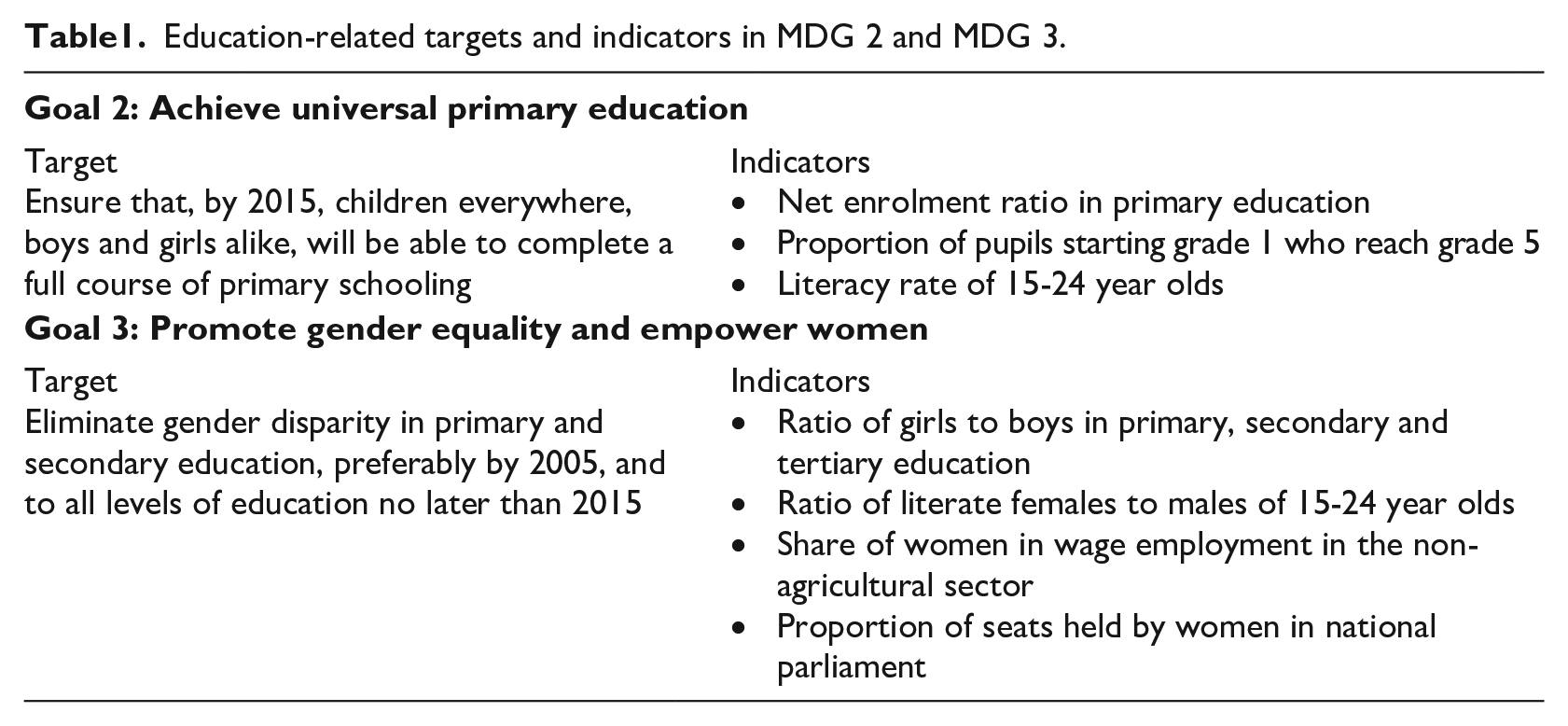
When analysing the MDGs project it is noticeble that although education is in some way mentioned in every goal, it is rarely present in the related targets and indicators. Since the targets and indicators are an operational way to achieve the goals, its feasibility can be questioned in light of these inconsistencies. For example, from all the eight goals, education is only present in the targets and indicators for Goals 2 and 3. For Goal 2, education is present in the goal, target and indicators. There seems to be some consistency across the three different levels, but when it comes to the indicators, what and how they are going to be assessed and evaluated is not clear. For Goal 3, although education is not mentioned in the goal title, it is present in the corresponding target and indicators. However, what does not seem to be evident, for example, is how the ratio of girls to boys in primary, secondary and tertiary education is going to help promote gender equality and empower women, as there is no clear indication as to how this is going to be implemented and the impact the targets and indicators will have in achieving the goal (see Table 1).
Education-related targets and indicators in MDG 2 and MDG 3.
When analysing the data from the SDGs project, the link between the goals, targets and indicators does not necessarily seem to relate to or follow a clear line of operationalisation. When considering all the SDGs, education is mentioned in some of the goals, such as Goals 2, 3, 8, 9, 12, 13, 14, and 17. Similarly to the MDG project, inconsistencies exist in the way in which the goals, targets and indicators relate. For example, Goal 2 mentions traditional knowledge in one of its targets, in order to help promote sustainable agriculture, but this is not mentioned in any of the indicators, which are meant to illustrate the practical way in which goals can be implemented. Another good example of the lack of consistency across the goals, targets and indicators is Goal 8. Education is not mentioned in the goal title, but is mentioned in the target ‘by 2020, substantially reduce the proportion of youth not in employment, education or training’ and in the indicator ‘proportion of youth (aged 15-24 years) not in education, employment or training’. However, the challenge seems to be similar: from these targets and indicators it is not clear how full and productive employment and decent work for all is going to be achieved. Goal 12 is another example worth highlighting, as it is about ensuring sustainable consumption and production patterns but the targets related to this goal do not mention education: they only identify the need to ensure that people have relevant access to information. However, the indicators associated with this goal (and target) include the “extent to which (i) global citizenship education and (ii) education for sustainable development (including climate change education) are mainstreamed in (a) national education policies; (b) curricula; (c) teacher education; and (d) student assessment”. Apart from the fact that there seems to be no clear link between the target and indicator, it is also not obvious how the idea of global citizenship education (for example) is identifiable in the mainstream national education policies or curricula.
The examples provided for both projects suggest that, although education emerged as a possible soft governance tool in both projects (MDGs and SDGs) as proposed above, the applicability of this tool can raise some concerns. Following what Hardy and Woodcock (2015) defined as symbolic policies, these goals could be understood as symbolic policies because they are vague, ambiguous, do not outline the necessary resources, and lack a plan for implementation. A parallel with Duranti’s (2017) so-called ‘conservative’ view of human rights could be drawn here: restrained enthusiasm for the promotion of individual rights. Whilst this is an area worthy of attention for a separate research enquiry, an implementation gap of the education-related goals is apparent. Overall, the education goals seem to be in line with the idea of orchestration (based on an orchestrator-intermediary-target actor relationship), and they seem to act as a soft governing tool across the different goals which do not appear, however, to be feasible to implement in practice. This means that although the links between the educational goals and the other goals across both projects exist, there seem to be inconsistencies in the way they are operationalised.
Conclusion
This study has considered the position of education in both UN projects jointly by highlighting important aspects of its dynamic nature. First, the definition of education has not been static, it has been evolving through the course of the two projects and there are still a few ‘grey areas’ in it. Second, the interconnectedness of the education-focused goals and the other goals in both projects, as discussed earlier, has been strengthening, and the emergence of education as a soft power to govern the other goals in the SDG project has its roots in the MDG project, albeit still weak at that time. Third, the improvement in operationalisation of education for sustainable development is conditional upon the UN’s effective orchestration of the clarification of the remaining vague aspects of the meaning of education, and its links with the other goals through integrating education in a more straightforward way in the targets and indicators for the other goals.
This analysis highlights the directions for international policy-making in the upcoming world summits in order to maximise the work of countries towards achieving the SDGs by 2030 through using education as an indispensable tool in this process. This analysis also bridges the literature about the MDGs and SDGs in a novel way. Rather than showing how the position of education within the SDGs has improved since the MDGs, as some literature suggests (see, eg, Wagner, 2018), this study considers the position of education in both UN projects jointly by highlighting its important aspects related to the development of the meaning of education, and its interconnectedness with other areas of world and human development. The results presented in this article emphasise the need for international policy-making to stream its efforts to promote a world consensus around the meaning of the scope of education and its potential for development, and to work out more practical ways in which education can support and facilitate sustainable development.
Footnotes
Appendix 1: Documents
Appendix 2: Education for All Goals
World Education Forum (2000: 8).
Funding
The author(s) disclosed receipt of the following financial support for the research, authorship, and/or publication of this article: Iryna Kushnir received funding for this research from Research England, awarded through Nottingham Trent University Quality Research scheme.
