




Abstract
Chief executive officer (CEO) succession is a critical event for Small and medium-sized enterprises (SMEs), often leading to significant organizational and strategic changes, uncertainty, and the risk of failure if mishandled. An essential yet underexplored topic is how CEO succession influences the long-term strategy of organizational ambidexterity (OA). This inductive multiple-case study investigates this influence by comparing three family and two nonfamily SMEs in Norway. Using the knowledge- and resource-based theories, the findings indicate that maintaining OA post-succession requires: (1) a clear strategic intent for OA before succession; (2) successors who have ambidextrous leadership abilities, the ability to acquire these skills, or the capability to build ambidextrous teams; (3) effective transfer of knowledge and networks; (4) appropriate organizational structures; and (5) a culture that supports OA. The study highlights similarities and differences between family and nonfamily firms, offering insights into how and why CEO succession affects strategic continuity in SMEs.
Keywords
Introduction
Chief executive officer (CEO) succession is a critical event for firms, often triggering organizational change, uncertainty, and potential risks of failure if mishandled (Le Breton-Miller et al., 2004; Schepker et al., 2017). Moreover, CEO succession frequently leads to strategic shifts regardless of external conditions (Choi & Benner, 2025; Haddadj, 2011). Small and medium-sized enterprises (SMEs) are especially vulnerable due to their reliance on top managers (Lubatkin et al., 2006). Notably, fewer than 30% of SMEs survive beyond 10 years (Daspit et al., 2016), with succession being a key factor for failure (Cabrera-Suárez & Martín-Santana, 2012; Daspit et al., 2016; Durst & Katzenschlager, 2014). Despite SMEs’ central role in the global economy (The World Bank, 2020) and the impact of CEO succession on strategic continuity, research within this field remains scarce (exceptions include Durst & Katzenschlager, 2014; Fiegener et al., 1996; Haddadj, 2011; LeCounte, 2022). In this study, “CEO” refers to the individual responsible for top managerial functions, even if they do not formally hold the title of “CEO.”
March’s (1991) seminal work emphasized the importance of balancing exploration (innovation, risk-taking) and exploitation (efficiency, execution) for organizational long-term success. This balance, known as organizational ambidexterity (OA; Tushman & O’Reilly, 1996), is linked to growth and sustained performance, particularly in large firms (Chakma & Dhir, 2024; O’Reilly & Tushman, 2013, 2016; Tushman & O’Reilly, 1996). For SMEs, the benefits of OA remain debated, with some arguing that SMEs typically lack the resources to pursue OA effectively (Wenke et al., 2021), while others emphasize its necessity for long-term survival (Chakma & Dhir, 2024; Dolz et al., 2019).
OA research mainly examines OA within the current top-management context (Raisch & Birkinshaw, 2008), offering little insight into how ambidextrous heritage is passed down through generations and leadership succession in family firms, and even less so in nonfamily firms (Chakma & Dhir, 2024; Dolz et al., 2019; Hannevig & Bertheussen, 2024; Mazzelli et al., 2020; Preciuk & Wilczyńska, 2020). The limited understanding of how and why CEO succession impacts OA strategy continuity in SMEs calls for further investigations (Mazzelli et al., 2020). This study examines how and why CEO succession influences OA by investigating its impact on four key factors identified by O’Reilly and Tushman (2016) as crucial for long-term OA success. First, strategic intent toward OA is necessary. Furthermore, scholars argue that effective succession planning is essential for maintaining an OA strategy through CEO succession (Durst & Katzenschlager, 2014; LeCounte, 2022). However, despite their importance, many SMEs lack such plans (LeCounte, 2022).
Second, CEOs are vital in promoting OA (O’Reilly and Tushman, 2016). Scholars suggest that to understand OA at the organizational or macro level, examining how ambidextrous managers impact OA through initiation and implementation at the individual, group, and firm levels is required (Mom et al., 2015; Mueller et al., 2020). Experienced managers with broad organizational knowledge are well-equipped to pursue OA (Mom et al., 2015). However, as older generations retire, firms risk losing their leaders’ accumulated tacit knowledge, networks, institutional memory, and experience (Cabrera-Suárez et al., 2018; Joe et al., 2013). Hence, successful CEO succession relies on transferring knowledge and leadership abilities from incumbents to successors (Cabrera-Suárez et al., 2001; Daspit et al., 2016). Thus, more research is needed on how successors acquire, integrate, and adapt relevant internal and external knowledge to become ambidextrous leaders (Cabrera-Suárez & Martín-Santana, 2012; Rosing et al., 2011). In addition, how externally recruited new leaders’ prior experience and ambidextrous capabilities influence the continuity of an OA strategy through leadership succession requires further exploration (Mom et al., 2015).
Third, OA strategies create tensions that require balancing mechanisms (O’Reilly & Tushman, 2016). To manage OA-related tensions, firms can adopt various internal structuring methods (Foss & Kirkegaard, 2020; O’Reilly & Tushman, 2013; Tushman & O’Reilly, 1996) and leverage network cooperation (Schell et al., 2018). In SMEs, operations are often informally structured around the founders or owner-managers, emphasizing their central role in shaping organizational structures and resolving tensions associated with an OA strategy (Durst & Edvardsson, 2012; Lubatkin et al., 2006). Moreover, given the significance of networks and social capital, questions have been raised on how to transfer network relationships and train successors to develop the social skills required for nurturing such relationships at all levels (Cabrera-Suárez & Martín-Santana, 2012; Nave et al., 2022).
Fourth, achieving OA requires an identity and a shared culture encompassing unity and reducing internal competition for resources between exploratory and exploitative teams (O’Reilly & Tushman, 2016). During succession, a firm culture based on mutual respect, trust, loyalty, learning, and open communication is essential to facilitate effective knowledge transfer and smooth transitions of power (Cabrera-Suárez et al., 2001, 2018; Daspit et al., 2016). Therefore, scholars call for further investigations into how a culture of trust, loyalty, and commitment can be fostered early in the succession process to reduce misalignments between successors and predecessors (Daspit et al., 2016).
By integrating the knowledge-based view (KBV; Grant, 1996), resource-based view (RBV; Barney, 1991), knowledge management perspective (Nonaka et al., 2006), and OA view (Tushman & O’Reilly, 1996), this study offers a new lens to investigate OA continuity through CEO succession in SMEs. Due to limited research on this topic (Mazzelli et al., 2020), an inductive qualitative multiple-case study design was chosen (Eisenhardt, 1989a) where three family- and two nonfamily firms from Norway were investigated, providing a solid foundation for theory development (De Massis & Kotlar, 2014; Eisenhardt & Graebner, 2007, p. 27). The following research question guides this study:
How and why can CEO succession impact organizational ambidextrous strategies in SMEs?
This study makes several contributions by addressing research gaps on how and why CEO succession can influence OA strategy continuity (O’Reilly & Tushman, 2016). First, expanding on LeCounte (2022) to the context of OA, the findings suggest that effective succession planning, including successor selection, supports OA continuity through CEO succession in SMEs. Furthermore, building on Zellweger et al. (2012), the study highlights how balancing efficiency with socioemotional factors can support OA continuity through CEO succession for family firms. However, although socioemotional goals and hiring family successors can promote a long-term orientation that supports OA (Lumpkin & Brigham, 2011), the findings indicate that they can also foster nepotism and limit adaptability (Dyer, 2003). The nonfamily firms preferred to hire externally. While this approach fostered flexibility, these firms experienced high CEO turnover rates, partly due to communication issues, trust deficits, and a weaker organizational culture for OA, disrupting strategic continuity.
Second, the study illustrates that ambidextrous leadership can be a learned skill developed through structured knowledge and network transfer through mentorship and prolonged relay phases (Mom et al., 2015; Tao & Zhao, 2019). Thus, the findings indicate that SME managers and business owners should incorporate mentorship, preserve networks, and, if possible, plan for extended relay phases in the succession planning to retain tacit knowledge and develop new leaders’ ambidextrous capabilities (Tao & Zhao, 2019).
Third, the study highlighted differences in how the firms were structured during CEO succession between family and nonfamily firms. The family firms primarily adapted their organizational structures to their successors’ capabilities, personal interests, and family constellations. In contrast, the nonfamily firms demonstrated greater structural flexibility. Fourth, the findings indicate that trust, loyalty, shared values, and a long-term orientation, paired with openness to innovation and change, are critical for knowledge and network transfer and sustained OA strategies (Cabrera-Suárez et al., 2001; Daspit et al., 2016; Lumpkin & Brigham, 2011). The findings indicate that family firms should balance socioemotional goals with exploration to avoid path dependency, while nonfamily firms should cultivate trust and a culture for OA to enhance strategic continuity.
The following section reviews relevant literature. First, the relationship between OA and CEO succession is examined in the context of SMEs. Then, the relevance of the knowledge-based and resource-based views for OA is presented in the context of succession. After describing the applied research method, the empirical findings from three family firms and two nonfamily SMEs are presented and discussed. Finally, the study presents its conclusions, implications, and recommendations for future research.
Theoretical background
Effective OA strategies involve balancing exploration and exploitation and dynamically adjusting this balance to adapt to environmental changes (Lavie et al., 2010; Luger et al., 2018). This study follows March’s (1991, p. 71) description of exploration activities as those “understood in terms like research, variation, risk-taking, experimentation, play, flexibility, discovery, and innovation” and “exploitation to include improvement, choice, production, efficiency, implementation, and execution.” While exploiting current opportunities can provide immediate performance benefits, organizations must also invest in exploring new opportunities to ensure future growth and survival despite the uncertainties, risks, and delayed returns involved (March, 1991).
However, balancing exploration and exploitation can create organizational tensions as both sets of activities compete for limited firm resources (Lavie et al., 2010; March, 1991). Effectively managing these tensions is essential to prevent organizational conflict and stagnation (O’Reilly & Tushman, 2016). Some scholars suggest structurally separating exploratory and exploitative activities into different units to mitigate tensions (Lavie et al., 2010; Tushman & O’Reilly, 1996). Contextual ambidexterity offers an alternative approach, particularly relevant for smaller firms that often lack the resources and hierarchical structures to separate exploration and exploitation (Gibson & Birkinshaw, 2004; Lubatkin et al., 2006). In this model, individual top managers or dedicated teams balance these activities simultaneously or sequentially to align with organizational needs (Gibson & Birkinshaw, 2004). For SMEs, temporarilly alternating between exploitation and exploration—focusing on one before shifting to the other—is a viable strategy, especially in slower-moving environments or when resources are limited (see O’Reilly & Tushman, 2013 for an overview). In addition, firms can pursue OA strategies through external collaboration (Kauppila, 2010; Lavie & Rosenkopf, 2006). Networks can provide access to additional resources, knowledge, and ideas while modifying OA-related risks. Firms can structure collaborations by forming partnerships along the value chain or engaging with partners offering complementary skills and knowledge (Kauppila, 2010; Lavie et al., 2010). Resource-constrained SMEs often combines internal capabilities and structures and external resource acquisition and collaboration to pursue an OA strategy (Foss & Kirkegaard, 2020; Schell et al., 2018).
While structural solutions help manage OA, they are insufficient alone (Mueller et al., 2020). The microfoundation perspective highlights individuals as key drivers of OA (Eisenhardt et al., 2010). Within this view, achieving OA requires a multi-level approach connecting individual actions to organizational outcomes (Mueller et al., 2020). Several microfoundations contribute to OA, including leadership capabilities to handle OA (Chakma & Dhir, 2024; Gibson & Birkinshaw, 2004; Rosing et al., 2011), knowledge-sharing abilities (Cabrera-Suárez et al., 2018), leadership flexibility, and tension management (Kafetzopoulos, 2022). Hence, gaining deeper insights into developing and transferring ambidextrous leadership abilities at the micro-level is essential for maintaining strategic continuity and preventing knowledge loss at the macro-level through CEO succession (Laser, 2022; Rosing & Zacher, 2023). Following Rosing et al. (2011), this study conceptualizes ambidextrous leaders as those who encourage and facilitate a balance between explorative and exploitative behaviors and resolve OA-related tensions at both individual and organizational levels.
SMEs frequently lack slack resources, knowledge, and hierarchical systems to effectively manage OA-related tensions, making the role of senior leadership particularly important in navigating this strategy (Lubatkin et al., 2006). Thus, in SMEs, ambidextrous senior managers play a vital role in fostering OA by providing strategic direction and vision, resolving tensions, structuring the firm, facilitating learning and knowledge management, promoting innovation, allocating resources, leading organizational change, and cultivating a culture that balances exploration and exploitation (Durst & Edvardsson, 2012; Jamrog et al., 2006; Lubatkin et al., 2006; Rosing & Zacher, 2023). However, finding ambidextrous leaders capable of handling OA is challenging due to contradictory leadership requirements (Laser, 2022; Rosing et al., 2011). An alternative is forming ambidextrous top management teams with complementary skills (Rosing et al., 2011). This approach requires high coordination and is challenging to maintain over time (Rosing et al., 2011).
The role of ownership in management selection
Succession planning involves selecting internal and external candidates (Durst & Katzenschlager, 2014; LeCounte, 2022; Quigley et al., 2019). Much of the research on SME succession focuses on family firms, where succession typically involves transferring ownership and leadership to family members (Cabrera-Suárez & Martín-Santana, 2012; LeCounte, 2022; Nave et al., 2022). Family firms are firms in which “a family has enough ownership to determine the composition of the board, where the CEO and at least one other executive is a family member, and where the intent is to pass the firm on to the next generation” (Miller & Le Breton-Miller, 2003, p. 127).
When choosing successors, family- and nonfamily SMEs often follow fundamentally different processes and strategic priorities (Nave et al., 2022). In family firms, succession involves preparing the next generation, with motivations extending beyond financial performance to include tradition, family harmony, family values, emotional attachment, and legacy (Colot & Bauweraerts, 2014; Lumpkin & Brigham, 2011; Nave et al., 2022; Preciuk & Wilczyńska, 2020; Su & Daspit, 2022). Family businesses can embody social capital, such as an entrepreneurial heritage, reflecting a deeply ingrained perception of entrepreneurship passed down from the founder through generations (Wilmes et al., 2024). Dyer (2003) describes familial social capital as the advantages gained through strong family ties, such as privileged access to information and networks. If successfully transferred, a shared legacy and its core values can become valuable strategic resources (Cabrera-Suárez et al., 2018; Preciuk & Wilczyńska, 2020).
Scholars suggest that family firms cannot be fully understood without considering both the family dynamics and business logic (Dyer, 2003; Zellweger et al., 2012). Family firms tend to focus on long-term socioemotional goals (Mazzelli et al., 2020). According to Gómez-Mejía et al. (2007), these goals revolve around maintaining socioemotional wealth (SEW), including non-financial factors such as strong family identity, family control of the firm, and family ownership continuity. Zellweger et al. (2012) suggest that prioritizing family over business logic can lead to path dependency, while overemphasizing business efficiency may undermine family trust and limit access to patient capital. Hence, to ensure longevity, family firms must balance business efficiency with socioemotional considerations (Zellweger et al., 2012).
Filser et al. (2018) suggest that SEW factors significantly influence innovation intensity in family firms, both positively and negatively. In family firms, strong social ties and family bonds link past and present, facilitating the transfer of tacit knowledge, internal and external networks, firm-specific practices and processes, and shared family values, norms, and beliefs across generations, strengthening family firms’ innovation capacity (De Massis et al., 2016; Filser et al., 2018; Wilmes et al., 2024; Zellweger et al., 2012). Strong family attachment can foster a greater willingness to innovate since families typically seek to secure the business’s long-term survival (Filser et al., 2018). In such cases, the perceived long-term benefits of innovation can outweigh the risks (Filser et al., 2018). However, altruism, multiple potential successors—often siblings or relatives, and unclear family-business boundaries can complicate succession, leading to tensions and challenges such as nepotism, governance conflicts, strained family relationships, lack of innovation, and inertia (Cabrera-Suárez & Martín-Santana, 2012; Daspit et al., 2016; Dyer, 2003; Filser et al., 2018; Wilmes et al., 2024).
Many SMEs are nonfamily or family firms without suitable successors (Durst & Katzenschlager, 2014). These firms may recruit externally or internally based on leadership potential and alignment with firm strategy and performance goals (Durst & Katzenschlager, 2014). Outside hires are considered “outsiders” if they join the firm less than 2 years before CEO succession (Quigley et al., 2019). When selecting nonfamily successors, key criteria can include firm knowledge, good network capabilities, proactiveness in exploration, and business management skills (Durst & Katzenschlager, 2014). Smaller firms may prefer external candidates due to a lack of strong internal options (Durst & Katzenschlager, 2014), poor performance, distrust in current management, or the need for change (Berns & Klarner, 2017; Quigley et al., 2019). CEOs hired externally often bring fresh perspectives, enabling necessary strategic changes (Barron et al., 2011; Quigley et al., 2019; Schepker et al., 2017). However, outside CEO successors can also face cultural mismatches and strategic missteps (Quigley et al., 2019).
While research suggests that incumbents prioritize exploitation and successors favor exploration, Choi and Benner (2025) argue that CEO succession alone does not drive exploratory shifts. Instead, the balance between exploration and exploitation can shift in either direction, depending on the firm’s prior performance and the new CEO’s strategic orientation, tenure, power, and experience.
The role of knowledge in sustaining OA strategies through succession
This study draws on the RBV (Barney, 1991) and the KBV (Grant, 1996). These theoretical perspectives are widely used to understand OA in SMEs (Chakma & Dhir, 2024). The RBV highlights how unique resource development can lead to sustained competitive advantages for firms (Barney, 1991). The KBV, an extension of the RBV, emphasizes knowledge as a strategic resource central to organizational learning (Grant, 1996). The KBV provides a foundation for understanding the “multi-level social processes through which knowledge is sourced, transferred, and integrated within and across organizations” (Eisenhardt et al., 2000, p. 2).
Effective knowledge management is essential for sustaining OA strategies and should be prioritized in succession planning (Cabrera-Suárez & Martín-Santana, 2012; Durst & Edvardsson, 2012; Schepker et al., 2017). This includes transparent communication, knowledge transfer, and training of new ambidextrous leaders. This study adopts Durst and Edvardsson’s (2012, pp. 879–880) definition of knowledge management as “the processes and structures provided in SMEs to support different knowledge processes, such as transfer, storage, and creation.”
Knowledge can be explicit or tacit (Nonaka et al., 2006). Explicit knowledge is codifiable and communicated through formal language, often managed by establishing refined routines (Nonaka, 1994; Su & Daspit, 2022). Tacit knowledge can provide firms with sustainable competitive advantages because it is personal, context-specific, and difficult to replicate (Cabrera-Suárez et al., 2001; Nonaka & Toyama, 2015; Woodfield & Husted, 2017). Due to resource constraints in SMEs (Lubatkin et al., 2006), leveraging firm-specific resources—such as tacit knowledge, ambidextrous leadership skills, and external partnerships—is crucial for sustaining competitive advantages (Iborra et al., 2020; Nonaka et al., 2006; O’Reilly & Tushman, 2016).
Transferring both tacit and explicit knowledge throughout a firm is vital for strategic continuity, as new ideas, concepts, and knowledge creation tend to emerge in the interplay between tacit and explicit knowledge (Nonaka, 1994). However, tacit knowledge can only be transferred through experience to individuals with the absorptive capacity to understand and apply it (Cabrera-Suárez et al., 2001; Cohen & Levinthal, 1990; Grant, 1996). Absorptive capacity, the “ability to recognize the value of new external information, assimilate it, and apply it to commercial ends” (Cohen & Levinthal, 1990, p. 128), is crucial for successful knowledge transfer between incumbents and successors (Cabrera-Suárez et al., 2018).
Succession is increasingly seen as a gradual, multistage process rather than a single event, requiring mutual role adjustment and learning between the founder and next-generation leaders (Cabrera-Suárez et al., 2001). Mom et al. (2015) suggest that long-tenured managers are more ambidextrous and perform better in uncertain environments and interdependent positions than inexperienced ones. They emphasize that gaining familiarity with a firm and its networks requires time, making long tenure and cultivating network relationships vital for developing managers’ ambidextrous behavior. In addition, long CEO tenure signals stability to internal and external stakeholders and can mitigate unfavorable strategic shifts and tensions associated with succession (Durst & Katzenschlager, 2014; Tao & Zhao, 2019). To avoid loss of knowledge and networks, scholars recommend that incumbent CEOs and their successors collaborate for extended periods to facilitate knowledge and network transfer and ensure strategic continuity (Chakma & Dhir, 2024; Durst & Katzenschlager, 2014; Schell et al., 2018; Tao & Zhao, 2019). Internal succession, closely tied to long tenure, promotes strategic continuity and facilitates precise strategic adjustments by leveraging firm-specific knowledge (Schepker et al., 2017). In contrast, appointing external CEOs can bring new perspectives, networks, and knowledge into the firm, potentially driving necessary strategic changes (Barron et al., 2011; Quigley et al., 2019; Schepker et al., 2017).
Methods
This study employs a qualitative multiple case-study methodology to explore how and why CEO succession in three-family and two-nonfamily SMEs affects the continuity of OA strategies in these firms (De Massis & Kotlar, 2014; Eisenhardt, 1989a; Eisenhardt et al., 2010). Case studies are suitable for in-depth exploration of complex phenomena, hard-to-measure constructs, and business dynamics in real-life contexts and are a common choice in qualitative research (De Massis & Kotlar, 2014; Eisenhardt, 1989a; Yin, 2014). Using multiple cases enables replication logic and cross-case comparisons, offering diverse perspectives (Eisenhardt, 1989a; De Massis & Kotlar, 2014). Given the limited research on the influence of CEO succession on OA strategies, an inductive design was chosen (De Massis & Kotlar, 2014; Eisenhardt, 2021; Haddadj, 2011). An interpretive paradigm with a phenomenological-epistemological perspective was applied to investigate the phenomenon within a real-world context (Cope, 2005; De Massis & Kotlar, 2014). Derived from the findings, testable propositions were formulated to aid theory development (Eisenhardt & Graebner, 2007).
Sample and research design
The case firms were theoretically sampled (Eisenhardt, 2021) based on their OA strategies and succession stages, as detailed in Supplemental Appendix 1. Only SMEs operating for at least 10 years and having started the succession process at least 2 years prior to the study were included. Firms with similar characteristics, such as size and geographic location in Norway, were chosen to enhance external validity and minimize unobserved heterogeneity due to cultural or size differences (De Massis & Kotlar, 2014; Yin, 2014). All the firms had Norwegian owners that served both international and Norwegian customers. Firms A, B, C, and D operated in the seafood and tourism sector, while Firm E provided shipyard services. The findings indicate that industry affiliation was less important than ownership structure in terms of how the CEO succession processes affected OA strategy continuity in the investigated SMEs.
A polar-type sampling strategy was used (Eisenhardt & Graebner, 2007), selecting a mix of three family- and two nonfamily-owned firms to compare ownership structures. Firms A and B were considered suitable for this study despite shared ownership between the two brothers since the two firms operated separately in different industries (pelagic fisheries and salmon farming). One brother and his family managed Firm A, while the other brother and his children ran Firm B. The CEO of Firm A focused on succession planning within his family, while his brother did the same in Firm B: “My brother and his family carry out the day-to-day operations in the salmon farming unit. (. . .). My sons and I run everyday operations in” (Firm A) (Incumbent CEO, Firm A).
Data collection
The author made initial contact and requested participation via phone with the incumbent CEOs of Firms A, B, and C and the succeeding CEOs of Firms D and E. This was followed by an email outlining the study’s scope. Subsequent calls were made to arrange in-person interviews. Other relevant respondents were identified using a snowball sampling method during these calls (Patton, 1990). Incumbent and succeeding CEOs were interviewed to mitigate bias from a single perspective (Eisenhardt & Graebner, 2007; De Massis & Kotlar, 2014). In addition, at least one other individual close to the succession process was interviewed in each firm for a broader perspective.
A semi-structured interview guide was developed before the first interview (Supplemental Appendix 3). This guide, divided into three parts, covers the firm’s history, strategy, and succession process. By explaining the scope of the study to the respondents, the emphasis was put on OA and how exploration and exploitation were balanced through leadership succession in these firms. Following inductive research methods (Eisenhardt, 1989a), follow-up questions were asked during the interviews when considered fruitful, allowing the interview directions to vary.
The study includes 26 interviews with 19 respondents, with at least 4 interviews per firm (see Supplemental Appendix 2 for details). To enhance reliability, all the initial interviews followed identical entry-exit sequences (Yin, 2014). The author conducted the interviews longitudinally over 4 years (June 2019–July 2023). Initial interviews lasted about 90 minutes, while follow-ups ranged from 15 to 30 minutes. All interviews were audio-recorded and transcribed in Norwegian, with selected quotes translated by the author to illustrate the findings. Anonymity was maintained, though respondents were informed that some identification might still be possible. A phenomenological inquiry approach allowed participants to share their “lived world” experiences (Cope, 2005).
Secondary sources, including newspaper articles, company websites, and public databases, provided supplementary insights (Berg et al., 2022; Proff.no, 2023, 2024; Solstad, 2017). For instance, news articles documented how Firm C navigated the COVID-19 crisis (Berg et al., 2022). Company websites offered supplementary data and background information on operations and markets. On-site observations during firm visits provided impressions of the firm culture. Data triangulation between these sources and the interviews contributed to the author’s understanding and enhanced credibility and depth (De Massis & Kotlar, 2014). The author’s 25 years of experience and the networks established while working in private firms within the same geographic area and related industries influenced the case selection and provided access to these ambidextrous SMEs undergoing succession. Moreover, industry knowledge was beneficial for understanding the context when analyzing the findings.
Eisenhardt (2021) emphasizes theoretical saturation when performing multiple case studies, recommending continued data collection until additional information offers minimal incremental insights. Instead of adding more cases, longitudinal studies were conducted to deepen the understanding of succession processes in the selected firms. Along with secondary sources, follow-up email correspondence and additional team calls contributed to data saturation.
Data analysis
The interviews were coded using NVivo, a qualitative analysis software, through multi-staged in vivo coding. NVivo added rigor to the data analysis by allowing systematic coding, categorizing, and tracing of linkages of large data volumes (De Massis & Kotlar, 2014). However, NVivo has limitations, such as reliance on the coder’s interpretation, which can introduce bias or errors. Moreover, statements often fit multiple codes, creating categorization uncertainty. The high number of codes (75) made data compression challenging. To address these issues, the author personally conducted, transcribed, coded, and analyzed the interviews, ensuring close familiarity with the data.
A within-case analysis of each firm was conducted to describe the empirical context and identify patterns (Eisenhardt, 1989a). This was followed by a cross-case comparison, searching for patterns between the cases (Eisenhardt, 1989a). After identifying the main findings, the results were aggregated into five higher-level constructs (Figure 1). The constructs were abductively compared to theory to deepen the understanding of the mechanisms and factors revealed from the empirical findings to aid theory development (Eisenhardt, 1989b; Eisenhardt & Graebner, 2007; Figure 1). The constructs informed the formulation of propositions presented in the next section (Eisenhardt, 1989b; Eisenhardt & Graebner, 2007). This methodological approach strengthened the study’s theoretical foundations and increased its internal validity, consistency, and reliability. Moreover, the empirical findings indicated that the RBV (Barney, 1991), the KBV (Grant, 1996), and, by extension, the knowledge management perspective provided the most suitable theoretical lenses for interpreting and analyzing the findings (Cabrera-Suárez & Martín-Santana, 2012; Durst & Edvardsson, 2012; Nonaka et al., 2006).
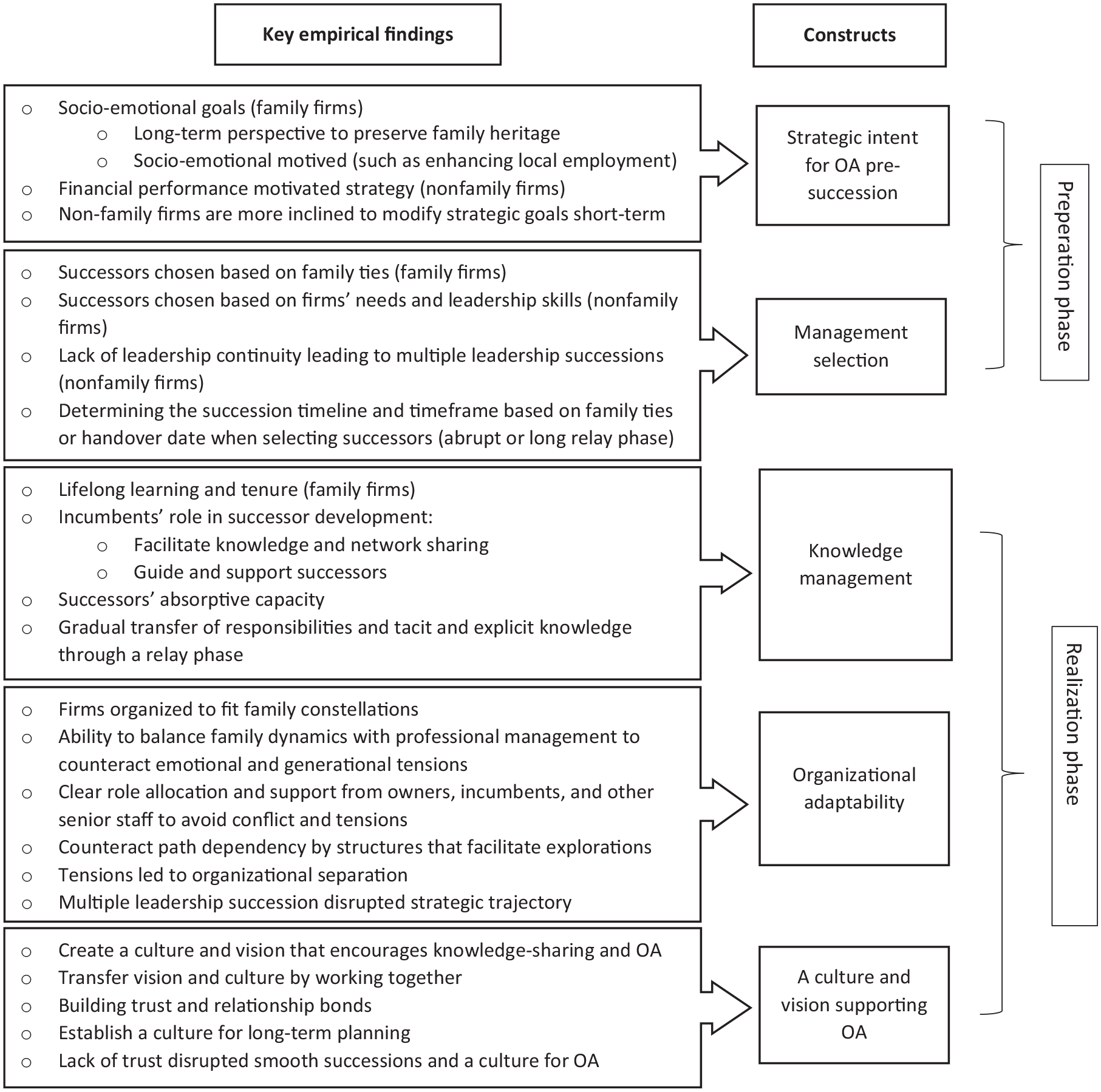
The influence of CEO succession on OA strategies in SMEs: key empirical findings and conceptual synthesis.
Findings and discussion
The following presentation and discussion of the main findings explore how and why CEO succession can influences the continuity of an OA strategy in SMEs by drawing on four factors O’Reilly and Tushman (2016) identified as critical to the successful pursuit of this strategy. The findings revealed both similarities and notable differences between three family firms and two non-family firms regarding the succession process and its impact on strategic continuity. These differences appear to arise primarily from the unique characteristics of family businesses, mainly from SEW factors (Gómez-Mejía et al., 2007) such as the choice of family successors, family values, decision-making processes, commitment, and tacit knowledge passed through generations (Cabrera-Suárez et al., 2001). This chapter examines succession planning and realization based on the key findings summarized in Figure 1.
Succession planning and preparation
Succession planning and preparation begin when owners or departing CEOs decide to transfer the CEO’s position or the entire business to family members, employees, outside hires, or external buyers (Durst & Katzenschlager, 2014).
Strategic intent for OA
O’Reilly and Tushman (2016) argue that firms must have a strategic intent for OA to enable its long-term continuity. The case firms mainly pursued an OA strategy prior to succession (Supplemental Appendix 1). Despite the potential risk of business failure if succession is mishandled (Le Breton-Miller et al., 2004; Schepker et al., 2017), none of the five case firms had formal written succession plans or protocols outlining their intended strategies post-succession. This lack of planning is common among SMEs (LeCounte, 2022). However, leadership succession was prioritized, and informal plans were evident. Despite having informal succession plans, the findings suggest that CEO succession impacted the strategic directions of all five firms to varying degrees, supporting Haddadj’s (2011) and Choi and Benner’s (2025) argument that CEO succession can significantly alter firm strategy. Moreover, notable differences emerged between the family and nonfamily firms regarding their approaches to succession planning.
The family firms
The empirical findings indicate that the family firms’ strategic commitment to OA was strongly shaped by SEW factors such as legacy preservation, emotional attachment, and continuity across generations (Colot & Bauweraerts, 2014; Filser et al., 2018; Lumpkin & Brigham, 2011; Nave et al., 2022). This long-term orientation fostered a commitment to exploration and innovation, aiming to ensure business survival over multiple generations (Wilmes et al., 2024), exemplified by one heir in Firm C:
If we only focus on what we do today and fail to adapt, we will not last 100 years. We will stagnate and fall behind in the market. I want to ensure that the generation after me and (CEO2) still have a business to run. (BM, Firm C)
Similarly, in Firm B, a strategic intent to ensure longevity across generations and prioritizing socioemotional goals, such as local employment, fostered strategic continuity:
The main goals are to produce good salmon, create value, and take good care of our employees (. . .). We must contribute to creating jobs and income for the municipality. (Succeeding MM, Firm B)
However, reflecting on the work of Zellweger et al. (2012), these firms recognize the need to balance socioemotional goals with a focus on maintaining business performance to ensure long-term survival and growth:
We place great emphasis on ensuring that the businesses we develop ultimately lead to increased employment, particularly in the north (of Norway), and, of course, have a solid economic foundation. They must also be sustainable—not just environmentally but economically—the entire concept of sustainability must underpin the effort. (Incumbent CEO, Firm B)
The successors in the family firms were involved in strategic planning from a young age, fostering entrepreneurial heritage and strategic alignment and continuity (Wilmes et al., 2024), as highlighted by the heir and skipper in Firm A:
They (incumbent CEOs in Firms A and B) were good at taking us along and were very interested in what we wanted to do in the future. They often asked us what we thought about different investment opportunities. (Succeeding Skipper, Firm A)
While SEW-driven long-term focus promotes strategic stability, it can also introduce rigidity and resistance to strategic shifts (Dyer, 2003; Preciuk & Wilczyńska, 2020). For instance, for Firm C, the two heirs had strategically divergent views, leading to tensions that disrupted the continuity of OA. The succeeding CEO2 envisioned a primarily exploitative future strategy, while his brother (B.M.) emphasized an ambidextrous approach focusing on innovating to meet future challenges:
Our future strategy is to improve the dog-sledding experience. (Succeeding CEO2, Firm C) For years, I have consistently stressed to my mother the importance of developing new products. We should consider what will happen if the snow winters become even shorter and what our main product should be in that case. (Succeeding BM, Firm C)
Meanwhile, the incumbent CEO 1 leaned toward exploration:
I am an entrepreneur. I like to develop and try new things. We must explore new things continuously because I do not want us to stagnate. (Incumbent CEO1, Firm C)
In Firm C, the absence of formal succession plans and strategic intent for OA led to inconsistencies in the heirs’ strategic perspectives, posing a risk to long-term strategic continuity. These findings support the following proposition:
Proposition 1a: In family firms, strategic continuity is often guided by informal long-term goals rooted in legacy and socioemotional priorities, and formal strategic plans are rarely developed. Reliance on unwritten strategies can lead to strategic disruption, particularly when successors have divergent priorities.
The nonfamily firms
The nonfamily Firm E faced declining performance for several years before hiring an external CEO in 2018. The decision to replace the CEO aimed to improve performance and was taken despite the incumbent’s reluctance to step down.
Maybe he did not want to retire, but was a bit pressured to do so. (Succeeding CEO, Firm E)
In addition, in 2019, the firm appointed an external chairperson (C.B.) who introduced strategic changes, shifting the firm’s focus from exploitation to OA.
(CB) has contributed a lot by sharing his networks (. . .). He has worked to enhance the board’s effectiveness and develop new strategies, which is key in steering our focus toward aquaculture and establishing it as a priority for the board. (Succeeding CEO, Firm E, 2022)
This supports the theory suggesting that firms often recruit external leaders when dissatisfied with firm performance and seeking strategic change (Quigley et al., 2019). This typically allows successors of forced CEO exits greater freedom to implement strategic changes (Berns & Klarner, 2017).
The former CEO (now MM) has been CEO for a long time and will soon retire (. . .). It is natural for all firms to change management regularly because outsiders bring new ideas and knowledge that enable them to develop further. (CB, Firm E, 2022)
Under the new leadership, the strategy shifted towards new markets, such as services for the aquaculture industry, led to 64% performance growth from 2019 to 2023 (Proff.no, 2024). According to the succeeding CEO, CB’s extensive experience and network were instrumental in this transformation, illustrating how external experience can strengthen firms’ OA capabilities (Mom et al., 2015). However, in 2022, Firm E’s owners decided to sell the firm, leading to the replacement of CB.
We have replaced the chairperson. It was suitable for the business. The new chairperson is the son of one of the shareholders. (. . .). One of the reasons why we chose him is that almost all the owners, including his family, now wish to sell the firm. (. . .). We believe he will look after our interests. (MM, Firm E)
Despite this change, the former CEO (MM, Firm E) claimed that the firm’s strategy remained unchanged:
Of course, new owners can change the strategy. However, we want to be attractive to employees, customers, and our business environment, and stay technically and financially competitive. (MM, Firm E)
Nevertheless, the change of Chairperson unintentionally shifted the firm’s focus back to an exploitative approach (March, 1991), underscoring CB’s role in advancing OA in Firm E.
(The new chairperson) is more operationally oriented than the previous one, and the firm has shifted its focus towards running operations. CB was a more explorative type of leader. (Successor CEO, Firm E, 2023)
The study gives examples of how and why changes in top management can influence firm strategy (Haddadj, 2011). Furthermore, the findings suggest that nonfamily firms’ strategic direction often reflects the priorities of their current leadership (Choi & Benner, 2025; Kafetzopoulos, 2022). Aligning with Choi and Benner’s (2025) findings, the leadership transition from CEO1 to CEO2 in Firm D reinforced OA, while in Firm E, replacing CB led to a strategic shift away from OA. In addition, Firm E demonstrated how changes in strategic intent can influence the choice of new leaders. Based on the findings, the following proposition is formulated:
Proposition 1b: In non-family firms, strategic intent is primarily driven by market-oriented objectives and financial performance. However, the absence of formal strategic plans increases the likelihood of strategic shifts during succession, particularly when external pressures or leadership changes favor short-term exploitative goals.
Management selection
To ensure strategic continuity, firms should appoint CEO successors who align with the firm’s strategic intent (Berns & Klarner, 2017; Durst & Katzenschlager, 2014; Laser, 2022). Consistent with Quigley et al. (2019), the findings suggest that management selection significantly influences firms’ strategic directions, whether internal or external. However, notable differences emerged between family and nonfamily firms in the selection process.
The family firms
All the family firms selected family members as successors. The study demonstrates that grooming potential CEO candidates is a long-term process, particularly when successors lack experience (Mom et al., 2015). In the case-firms, this process began in the successors’ early childhood.
I was born and raised here. (. . .) My mother and I spent a lot of time dog sledding. (. . .) I have always wanted to continue developing what my mother started—it is a lifestyle. (Succeeding CEO2, Firm C)
Succession in family firms can be complex since personal and emotional ties may influence the choice and the roles of succeeding leaders (Filser et al., 2018; Miller et al., 2003). However, this did not appear to be an issue in the studied firms. Heirs displayed varying interests, facilitating role allocation based on skills and personal preferences and mitigating conflicts over positions. For example, in Firm C, the succeeding CEO2 was a passionate dog sledder, while his brother (BM) was more interested in marketing and developing new technology.
(BM) is not an “outdoor” person like me. He is more oriented towards markets, booking systems, and data. (. . .). He is much better than I at those things. (Succeeding CEO2, Firm C)
In addition, a prolonged relay phase in the family successions enabled a gradual evaluation of heirs’ commitment and competencies (Tao & Zhao, 2019).
She may be the most natural choice to take over as CEO (in Firm B). (. . .). She works hard to acquire the necessary knowledge to equip her to take over. (Succeeding Skipper, Firm A)
The findings reveal that family firms primarily selected successors based on family heritage rather than strategic consideration. Despite little emphasis on future strategy during selection, the study supports prior research indicating that management selection significantly impacts strategic direction, with internal hires of family members generally resulting in less strategic change (Quigley et al., 2019; Schepker et al., 2017), leading to the following proposition:
Proposition 2a: In family firms, the choice of CEO successors is primarily motivated by familial ties and long-term involvement rather than strategic fit. While this fosters continuity and alignment, it may disrupt ambidextrous strategies if successors lack ambidextrous capabilities, or strategic priorities differ among family members.
The nonfamily firms
Unlike the family firms, CEO successions in the nonfamily firms were influenced by ownership shifts (Firm D) and performance-related forced retirements (Firm E). Both nonfamily firms recruited external CEO successors. In Firm D, the first CEO succession occurred when the founder (PM, Firm D) divested his majority share and became a project manager (PM). In the first interview in 2020, the chairperson (later succeeding CEO2) stated that to maintain the balance between exploration and exploitation when the incumbent founder (PM) wished to focus on exploration, the firm intentionally selected an exploitative CEO intending to build an ambidextrous top management team (Rosing et al., 2011).
My strength is the entrepreneurial part: exploring, seeing strategic opportunities, building networks, and engaging partners. (Incumbent PM, Firm D).
Thus, the first succeeding CEO was chosen for her experience in administrative efficiency.
I am strong in planning events, providing services, and forming routines (. . .). As CEO, my role is to make us more efficient and enhance performance. (Succeeding CEO1, Firm D)
However, as Rosing et al. (2011) suggested, creating an ambidextrous team proved difficult. Tensions arose between CEO1 and PM, resulting in a lack of coordination, cooperation, and trust, ultimately leading to the failure of the ambidextrous team.
Since I arrived, I have noticed that (PM) may have been struggling to fulfill his role. I also struggle to gauge his feelings about me, making the situation challenging. (. . .). After all, the owners decided to hire me as CEO and to let the founder work on what he likes best: innovation. However, I do not think he is content with his choice to step aside. (Succeeding CEO1, Firm D)
The succeeding CEO1 assessment appeared accurate, as the founder (incumbent PM, Firm D) expressed regrets over relinquishing majority ownership:
I invested all my resources, connections, and everything else into the firm. (. . .). I should have kept 51% of the shares. (Incumbent PM, Firm D).
In addition, the other owners were dissatisfied with the PM’s work:
(Incumbent PM, Firm D) has been dedicated to exploring and designing new services. (. . .). I will say nothing negative about him, but nothing has happened in the last four years. (Succeeding CEO2, Firm D, first interview 2020)
Although CEO1’s role focused on optimizing daily operations, the chairperson, who later became CEO2, questioned CEO1’s lack of ambidextrous skills:
We have a good but very operationally oriented CEO. (. . .) However, she must also be challenged to focus on exploring new solutions. (. . .). Having a cost focus is good, but it cannot be the only focus. (. . .). It is also necessary to focus on development. It does not work to just lay off everyone and hope things go away (referring to the COVID-19 pandemic). This strategy is overly defensive. (Succeeding CEO2, Firm D, first interview 2020)
By 2023, the PM had sold his remaining shares, and both he and CEO1 had left Firm D, leading to a second CEO succession. In a 2022 follow-up interview with the succeeding CEO2, the author could not determine the exact reason for these exits. However, dissatisfaction among the owners prior to their exit was evident. When the succeeding CEO2 took over, the firm shifted toward an operational OA strategy.
In small firms like this, the CEO must focus on both daily operations and further development. (Succeeding CEO2, Firm D)
In Firm E, the succeeding CEO (Firm E) was appointed to oversee financial and administrative functions while managing daily operations and the firm’s real estate portfolio (Solstad, 2017). In practice, these tasks were mainly exploitative. The CB led the firm’s explorative activities. After the departure of the CB, despite stating that Firm E aimed to hold a competitive edge by continuously exploring new opportunities, the former CEO and minority owner (MM, Firm E) seemed content with the succeeding CEO’s focus on exploitation.
He (the succeeding CEO) is interested in and has been very involved in daily operations. When he learned how the firm operates, he noted things he believed did not work optimally and wanted to improve these things. (MM, Firm E)
These examples illustrate that strategic intent is insufficient for sustaining OA. The findings demonstrate that management selection and clearly defined role allocation between incumbents and successors are crucial to preventing tensions and maintaining strategic continuity (Barron et al., 2011), leading to the following proposition:
Proposition 2b: In non-family SMEs, the successful continuity of ambidextrous strategies through CEO succession depends on selecting leaders who are either ambidextrous themselves or capable of building ambidextrous teams while maintaining a long-term perspective.
The findings support Schepker et al. (2017), indicating that internal CEO hires generally lead to less strategic change, as seen in the family firms. In the nonfamily firms, the strategy tended to shift with each leadership change, often causing strategic disruption. Supporting and extending Laser (2022) into the SME context, the findings suggest that selecting or developing CEO successors capable of becoming ambidextrous leaders or leaders able to form ambidextrous teams (Rosing et al., 2011) is critical for post-succession OA. The findings indicate that while family firms may have an advantage in cultivating ambidextrous leaders over time, external hires with ambidextrous capabilities, such as CB in Firm E, can drive strategic renewal. Moreover, these findings support research indicating that CEO succession alone does not drive exploration (Choi & Benner, 2025). Its impact depends on prior firm performance and the new CEO’s strategic orientation, tenure, power, and experience (Choi & Benner, 2025).
The realization phase of CEO succession
The realization phase of CEO succession begins with the new CEO’s arrival, marking the starting point for transfers of knowledge, networks, and power (Durst & Katzenschlager, 2014).
Knowledge and network transfer
O’Reilly and Tushman (2016) emphasize that leadership support is crucial for successful OA strategies. In all five firms, findings indicated that incumbent CEOs’ knowledge was largely tacit and undocumented (Nonaka, 1994). Failure to capture and transfer this knowledge can lead to losing valuable insights, networks, institutional memories, and expertise when the older generation retires (Durst & Edvardsson, 2012; Joe et al., 2013). Thus, knowledge transfer is critical for OA strategy continuity during succession. However, the findings reveal notable similarities and differences between family and nonfamily firms in knowledge management and ambidextrous leadership development (Nonaka et al., 2006; Rosing et al., 2011).
The family firms
Aligning with Schepker et al. (2017) and Dyer (2003), prolonged introduction to management roles and access to senior leaders holding key experience and networks can facilitate family successors’ organizational knowledge and strategic alignment. In Firms A and B, successors held various roles from an early age, enabling a smooth leadership succession and knowledge transfer while allowing other organizational members and network partners to become acquainted with them (Durst & Katzenschlager, 2014; Tao & Zhao, 2019).
I have transferred much of the day-to-day operations to my sons. I stand behind and observe. (. . .). I must let the youth take over. (Incumbent CEO, Firm A) Since I was young, I have been going out to the salmon cages to feed the salmon. (. . .). As I got older, I started taking summer and weekend jobs at the salmon plant and slaughterhouse. (Succeeding MM, Firm B)
It appeared that initially, the successors primarily focused on understanding their firms and learning from their predecessors.
To learn (succeeding MM, Firm B) follows my uncle closely, almost like a shadow. (Succeeding Skipper, Firm A)
Over time, Firm B’s succeeding MM gradually adopted an ambidextrous mindset, supporting Mom et al.’s (2015) assertion that familiarity with the firm and its networks takes time and is essential for ambidextrous behavior.
Demanding times often lead to personal growth, which can give you the confidence to share new ideas within the group. It is undoubtedly true that my perspectives have changed since the last time we spoke. (Succeeding MM, Firm B, 2022)
However, a narrow focus on specific areas within the firm can lead to inertia and hinder ambidexterity (Mom et al., 2015). This was evident in Firm C, where CEO1 and CEO2’s strong personal bonds and shared passion for dog sledding led to some degree of path dependency, unilateral focus, and an exploitative mindset.
I believe I can live on storytelling about dog sledding for the rest of my life. (. . .). My mother and (BM) are much more entrepreneurial than I am. (Succeeding CEO2, Firm C)
Since family successors had limited external work experience, apprenticeships were crucial in knowledge transfer and leadership development (Tao & Zhao, 2019). The findings suggest that ambidextrous leadership is a learned capability for these successors, supporting Mom et al. (2015) that job rotation and cross-functional experience are essential for developing ambidextrous leaders.
We (the sons and the incumbent CEO) collaborate closely. We work together, do things together, and almost live together. Hence, I think the flow of knowledge is very good. (. . .). They must gradually learn about all aspects of the fishery. (Incumbent CEO, Firm A)
However, transferring outdated knowledge can hinder adaptability to changing business environments and lead to path dependency, inertia, and tensions, disrupting the pursuit of OA strategies (Cabrera-Suárez et al., 2018; Preciuk & Wilczyńska, 2020). Firm B’s incumbent CEO acknowledged this risk.
The goal is to transfer knowledge, which must simultaneously be balanced with acquiring new knowledge we do not yet possess. The firm must not be left stuck with old ways of thinking. (Incumbent CEO, Firm B)
For effective knowledge transfer, predecessors must demonstrate open-mindedness, risk tolerance, patience, clarity, motivation, trustworthiness, and strong communication skills (Samei & Feyzbakhsh, 2015). The family firm incumbents appeared to display these qualities, taking pride in mentoring their offspring.
(Succeeding CEO2) had to step into the lead guide role fairly young. (CEO2) has grown step by step and is an incredibly nice person and a very skilled guide. (Incumbent CEO1, Firm C)
Curado and Vieira (2019) suggest that respect and acknowledgment motivate learning. During the interviews, all the heirs expressed admiration for their parents’ accomplishments, as illustrated by the following statement.
It was her (incumbent CEO1) dream, her gaze toward tourists in the 90s, and her ability never to give up. (. . .). She is experienced. Hence, I take what she says to heart. (Succeeding BM, Firm C)
Importantly, learning in these firms was reciprocal. Successors gained insights from their predecessors, while incumbents also learned from the next generation. Scholars argue that this mutual learning cycle is crucial for successful succession (Cabrera-Suárez et al., 2001).
They (the successors) have a much deeper understanding and awareness of the digital world than we have or likely ever will. (. . .) To succeed, we must combine our knowledge with their expertise in digital technology. (Incumbent CEO, Firm B)
Long-term planning and extended relay phases that enhanced knowledge and network transfer (Cabrera-Suárez et al., 2001) made the family firms well-prepared to develop new ambidextrous leaders (Rosing & Zacher, 2023), supporting the continuity of OA strategies through CEO succession. These findings led to the formation of the following proposition:
Proposition 3a: In family firms, knowledge transfer relies heavily on tacit knowledge passed through extended relay phases and the early involvement of successors. This approach fosters alignment with ambidextrous strategies but risks creating path dependency and inertia if new knowledge is not integrated effectively.
The nonfamily firms
The nonfamily firms appointed external successors, who initially lacked familiarity with the firms’ tacit knowledge and network. In these firms, the relay phase lasted a maximum of 2 years. However, during the relay phase, Firm D struggled with trust and communication issues between incoming and outgoing CEOs, hindering knowledge transfer and complicating the succession process. Moreover, due to the shorter relay phase, the nonfamily firms relied on successors’ existing ambidextrous abilities, experiences, and knowledge and network sharing from current leaders, board members, and other senior staff, as illustrated in the following example:
We shared the CEO position for two years from when I started in March 2018. After that, I gradually took over. (. . .). I have worked very closely with both chairmen. (. . .). I have learned much from them and (MM, Firm E). (Succeeding CEO, Firm E)
The findings indicate that network collaboration provided access to new ideas, knowledge, and resources, facilitating growth (Iborra et al., 2020; Jamrog et al., 2006; Lavie & Rosenkopf, 2006). The incumbent CEO in Firm E exemplified the importance of transferring these networks:
The most valuable knowledge I can impart to the incoming CEO is information about the market and our customers (. . .). Additionally, it is crucial to introduce him to our other networks, such as suppliers. These two areas are the focus of our knowledge transfer. (MM, Firm E)
Like Firm B’s incumbent CEO, Firm E’s succeeding CEO was aware of the risks of path dependency and inertia regarding knowledge transfer (Cabrera-Suárez et al., 2018). Hence, he avoided having the most experienced staff train new employees.
We have had little turnover (of employees), for better or for worse. This often results in tasks being carried out according to long-standing traditions and practices. Therefore, we do not let the oldest seniors train the apprentices because we risk stagnation. Instead, we let younger, experienced employees teach the apprentices. (Succeeding CEO, Firm E)
Overall, the findings suggested that shorter relay phases in nonfamily firms can lead to knowledge loss and weakened network ties, reinforcing the importance of an extended relay phase (Tao & Zhao, 2019). However, while prolonged relay phases are important for developing new ambidextrous leaders (Mom et al., 2015; Rosing et al., 2011), shorter phases can promote necessary strategic changes and prevent inertia (Schepker et al., 2017). Moreover, while strong incumbent support can enhance knowledge and network transfer, tensions (Cabrera-Suárez et al., 2001), lack of trust, limited time to transfer knowledge, and weak collegial ties may hinder these processes, potentially disrupting OA strategy continuity. These findings lead to the following proposition.
Proposition 3b: In non-family firms, knowledge transfer can be constrained by shorter relay phases, tensions, lack of trust, and weak collegial ties between incumbents and successors. This can disrupt the continuity of ambidextrous strategies. However, new knowledge from external successors can enhance ambidexterity.
Organizational structures through succession
Tushman and O’Reilly (1996) emphasized the significance of organizational structures in promoting OA. However, the empirical findings reveal notable differences in organizational adaptability between family and nonfamily firms during CEO succession.
The family firms
Preciuk and Wilczyńska (2020) advocate for clear organizational structures to facilitate positive interaction and resolve succession challenges in family firms. This study suggests that family constellation, number of heirs, and heirs’ personal interest were the primary drivers for the organizational structuring in these firms. For instance, although Firms A and B shared ownership, the three children of Firm A’s incumbent CEO succeeded their father in top and middle management roles, and the two children of Firm B’s incumbent CEO assumed leadership positions in Firm B.
(Incumbent CEO, Firm A) sons concentrate on fisheries. They only want to be sporadically involved in the salmon farming part. It is the same the other way around. We must discuss how this should be done in the future. We may have to solve it at the board level. (Incumbent CEO, Firm B)
In Firm C, tensions emerged between heirs due to differing priorities regarding exploration and exploitation. As a result, BM established a separate business unit focusing primarily on booking, sales, and service innovations. In addition, he considered further separation of firm activities upon his mother’s retirement. Despite these challenges, the brothers wished to stay involved in the firm.
I have had to moderate myself and remind myself that this is my mother’s business (. . .). Our close relationship can lead to misunderstandings. (. . .). Nevertheless, I think it works very well between us now because I have stepped back. My office is away from the main facilities. (. . .). The day my mother withdraws, I think I will withdraw even more. My brother and I will probably become owners, but I think my brother can have 100% control over the core operations, and then I will build up the booking unit. (. . .). The booking unit is currently a part of (Firm C). We are considering splitting it into a subsidiary. (BM, Firm C)
Su and Daspit (2022) argue that shared history and strong family ties can help resolve tensions. Firm C’s incumbent CEO acknowledged her sons’ differences but remained optimistic that mutual respect and time would resolve them:
(Succeeding CEO2) thinks entirely differently from (BM). I wish (CEO2) would have faith in him (BM), (. . .), but that will be resolved eventually. Family members must respect each other despite their different opinions. (Incumbent CEO1, Firm C)
The findings suggest that SEW factors, such as strong family bonds and entrepreneurial heritage, can be valuable assets when heirs effectively cooperate and leverage their diverse skills (Filser et al., 2018; Wilmes et al., 2024). This can help resolve tensions and build ambidextrous teams, ensuring long-term strategic sustainability. This is particularly relevant for family firms with multiple heirs assuming top management positions. If Firm C succeeded in forming an ambidextrous leadership team, it could enhance OA strategy continuity (Rosing et al., 2011). However, as Miller et al. (2003) noted, previously cooperative explorative and exploitative units may become drift apart due to different interests and tensions among successors, potentially undermining synergies.
In addition, tensions and conflicts can stimulate innovation and enhance performance (Kellermanns & Eddleston, 2004). Involving other family members in the firm can bring diverse knowledge and experiences, potentially fostering constructive debates (Colot & Bauweraerts, 2014). For instance, despite resource constraints, BM at Firm C explored ways to overcome these challenges, illustrating how tensions can strengthen OA.
I think appointing a product developer would be good, focusing on exploring products that are not dependent on snow. (. . .). One of our most significant weaknesses is that in the summer, which is the low season, people have time to come up with new ideas, but no one implements them when winter comes. Then, the focus is only on operations. (BM, Firm C)
SMEs often benefit from network partnerships, which provide new ideas, information sharing, innovation initiatives, and access to additional resources and knowledge (Durst & Katzenschlager, 2014; Schell et al., 2018).
Historically, I believe that the ability to collaborate with others has driven the salmon farming industry. One of the most important things we have learned is to utilize close collaborations, especially for smaller players like us. (Incumbent CEO, Firm B)
Respondents emphasized the importance of transferring these networks to successors, aligning with the resource-based view that considers networks’ critical intangible resources for knowledge-sharing and financial performance (Cabrera-Suárez et al., 2018).
Networking is crucial. That is why I have taken (my sons) to fairs and meetings and introduced them to a world where we meet others. (Incumbent CEO, Firm A)
Early introduction into firm networks provided successors in family firms with a strong foundation for future collaboration.
I have known the people we sell (salmon) to since childhood. (Succeeding MM, Firm B)
The findings indicate that network partners were central to the family firms’ OA strategy by providing access to extended resources and knowledge. Based on the empirical findings, the following proposition is formulated:
Proposition 4a: Family firms often prioritize harmony over strategic alignment, adapting organizational structures to accommodate heirs. While strong network connections developed over time can enhance an OA strategy, high conflict levels may result in firm splits, disrupting synergies and firm culture, and ultimately jeopardizing the continuity of a long-term ambidextrous strategy.
The nonfamily firms
Nonfamily firms can structure their firms without familial constraints. Despite this flexibility, Firm D’s organizational structure after the first CEO succession reflected its founder’s (incumbent PM, Firm D) preference for exploration, while the responsibility for exploiting existing operations fell on the succeeding CEO1. However, aligning organizational structures with personal preferences proved ineffective. Thus, when the second succession occurred, the firm restructured to align with performance goals and capitalize on product and market opportunities. These findings highlight the importance of structuring organizations to align with the strategic objective rather than individual leadership preferences to support OA. In contrast, succession in Firm E did not significantly impact the organizational structure.
A dedicated project manager and I will likely be responsible for new explorative projects. (Succeeding CEO, Firm E)
A common challenge for SMEs is resource limitations in managing OA (Lubatkin et al., 2006), as illustrated in Firm E:
He (CB) was able to raise his gaze and point out several things that I had consciously or unconsciously overlooked or not had time for, because there had been so much to solve on the operational side. (Succeeding CEO, Firm E)
The findings indicate that SMEs must deliberately prioritize explorative activities at the organizational level to allocate time and resources effectively for exploration. Otherwise, leaders risk being consumed by operational demands, limiting time and resources for innovation, leading to the following proposition:
Proposition 4b: Nonfamily firms have structural flexibility to organize their firms based on strategic needs. However, multiple leadership successions can lead to frequent structural changes, disrupting OA strategies.
Creating a culture for ambidexterity
The findings support O’Reilly and Tushman’s (2016) argument that organizational culture and vision are critical for OA strategies. Extending this argument to CEO succession, this study reveals differences and similarities in how and why succession influences firm culture and trust levels in family and nonfamily firms.
The family firms
The study findings suggest that conflict resolution and problem-solving abilities varied across family firms. Firms A and B encouraged open discussions and swift conflict resolution, supported by a culture of trust and strong family bonds (Woodfield & Husted, 2017).
I do not think there have been prolonged conflicts. There have been disagreements, but we talk about things. There have never been any significant conflicts. (Incumbent CEO, Firm A)
Aligning with theory, this environment was shaped by SEW factors such as early participation, mutual respect, a legacy of entrepreneurship, close emotional bonds, and shared values (Gómez-Mejía et al., 2007; Preciuk & Wilczyńska, 2020; Su & Daspit, 2022; Wilmes et al., 2024).
My grandfather, great-grandfather, and father were fishermen, so I am a fisherman. We are part of the crew on board, and it becomes a “family-number-two” relationship with them. (Succeeding Skipper, Firm A)
Predecessors placed significant importance on sharing their values, long-term goals, and strategic approaches with their successors.
I think it is essential to share my thoughts on the development of the firm and our participation in the development of the local municipality. (Incumbent CEO, Firm A)
These findings highlight the strategic advantages of shared history and socioemotional ties, strengthening these firms’ ability to resolve tensions (Mazzelli et al., 2020). Conversely, despite strong family bonds, Firm C experienced succession-related tensions.
(Succeeding CEO2) does not understand (succeeding BM)’s expertise. (BM) had 7-8 years of work experience in the media industry when he joined the firm. (. . .). He is incredibly skilled with data. (. . .). He is the one who developed the booking system. (Incumbent CEO1, Firm C)
Firm C illustrates how socioemotional factors sometimes intensify tensions rather than resolve them (Dyer, 2003). Differences between heirs led to structural separation within the firm and disrupted OA strategy continuity. This suggests that while SEW factors can foster unity, they can also amplify strategic misalignments if not adequately managed.
Despite differences between heirs, the findings indicate that a prolonged relay phase fostered a culture of bidirectional knowledge-sharing and open dialogue between senior, incumbent, and junior staff (Tao & Zhao, 2019; Woodfield & Husted, 2017). This enhanced the likelihood of OA strategy continuity and reduced the risk of firm breakup, leading to the following proposition:
Proposition 5a: In family firms, a shared culture and strong socioemotional ties promote trust, collaboration, and continuity of ambidextrous strategies. However, these ties can also amplify conflicts and tensions during succession, potentially undermining strategic alignment.
The nonfamily firms
Consistent with Mazzelli et al. (2020), the nonfamily firms demonstrated greater strategic flexibility and organizational adaptability. However, a lack of mutual trust, crucial for knowledge-sharing and smooth power transfer, appeared to disrupt strategic continuity. The results indicate that leadership changes led to strategic shifts toward exploration, exploitation, or OA, depending on the leaders’ strategic focus (Choi & Benner, 2025). For instance, in Firm E, the lack of an ingrained ambidextrous culture resulted in increased exploration intensity following CB’s arrival, only for the firm to revert to an exploitative focus after his departure, despite a stated strategic intent for OA. In Firm D, a lack of trust and communication hindered knowledge transfer between the incumbent founder (PM) and his successor (succeeding CEO1). This complicated the succession process, resulting in multiple successions and strategic disruption, leading to the following proposition:
Proposition 5b: In non-family firms, cultural alignment is often weaker due to reliance on external hires and shorter relay phases. This can hinder a culture of trust and collaboration, increasing the likelihood of disrupted ambidextrous strategies post-succession.
A proposal for a tentative theoretical framework
This inductive multiple-case study examines the impact of CEO succession on four key factors critical to OA strategy success, as identified by O’Reilly and Tushman (2016). Given the limited prior research in this area (Mazzelli et al., 2020), the study performs a multiple-case study comparing three family- and two nonfamily SMEs to identify similarities and differences in their CEO succession approaches and how and why this can influence post-succession OA strategy.
The key empirical findings, presented in Figure 1, link the successful continuity of an OA strategy during succession to five constructs. Discussing the findings in relation to theory led to the development of several propositions (Eisenhardt, 1989b). These findings and propositions are integrated into a tentative theoretical framework, illustrated in Figure 2. Figure 2 is intended as a preliminary and simplified framework, offering an overview rather than an exhaustive analysis of all potential relationships and their relative strengths (Eisenhardt & Bourgeois, 1988).
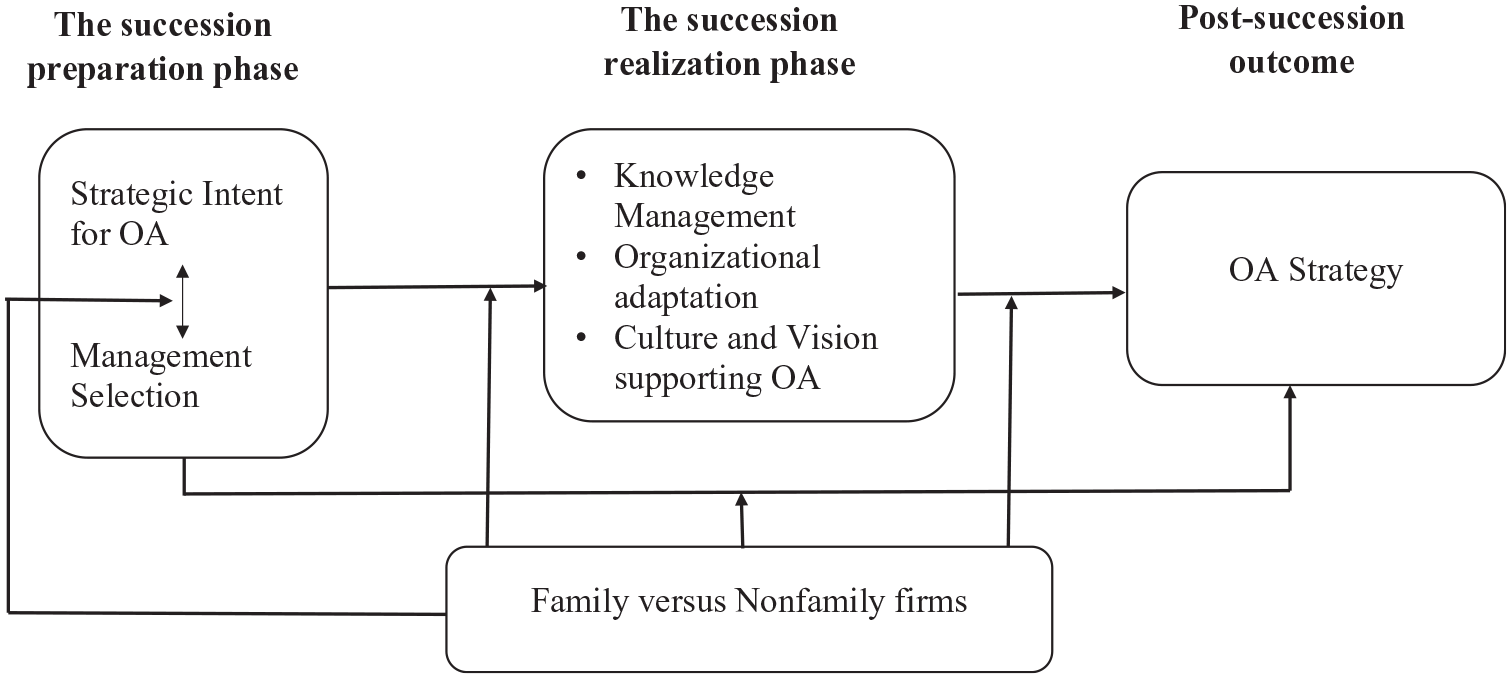
Tentative theoretical framework: continuing a dynamic ambidextrous strategy through the CEO succession process.
While the findings indicated several similarities in how the investigated firms addressed challenges associated with CEO succession, notable differences emerged between family and nonfamily firms. First, in the succession preparation phase, the absence of formal succession planning for future strategic intent for OA in both the family and non-family firms influenced strategic continuity (Propositions 1a & 1b). However, family firms benefited from a long-term strategic focus on preserving their heritage (Wilmes et al., 2024) and fulfilling socioemotional goals (Filser et al., 2018; Mazzelli et al., 2020). As seen in Firm C, although family firms emphasized the importance of OA, SEW-driven succession choices occasionally resulted in heirs prioritizing exploitative over explorative strategies, weakening OA continuity post-succession. This supports Zellweger et al.’s (2012) argument that a strong SEW orientation can lead to path dependency if firms fail to balance SEW considerations with business considerations. However, in Firms A and B, a dual focus fostered a long-term perspective that alleviated strategic disruptions stemming from the absence of formal succession planning. This drove exploration while maintaining running operations post-succession (Filser et al., 2018; Proposition 1a). Conversely, nonfamily firms lacked SEW-driven stability, such as legacy preservation, emotional attachment, and trusting family bonds (Filser et al., 2018). This led to greater flexibility in adapting to market conditions. However, the findings suggest that the lack of SEW factors in non-family firms can lead to communication issues and trust deficits, which may disrupt leadership succession. As a result, successors may choose to leave, requiring multiple succession attempts (Proposition 1b).
Second, the findings revealed that the management selection process and the underlying factors guiding these choices differed between the family and non-family firms. In the family firms, heirs were chosen as successors based on heritage rather than strategic fit. While this fostered continuity and alignment, OA strategies were disrupted when successors lacked ambidextrous capabilities or when strategic priorities diverged among family members (Proposition 2a). Conversely, the nonfamily firms primarily appointed external top executives aligned with their strategic focus (Proposition 2b). However, multiple leadership successions in these firms led to a fluctuation in OA strategies, depending on whether the new leader prioritized exploration or exploitation. Moreover, while new external leaders contributed to new ideas and fresh perspectives that counteracted path dependency and inertia, frequent leadership changes disrupted strategic consistency. Extending Laser’s (2022) insight to the SME context, the findings suggest that, for both family and nonfamily firms, selecting ambidextrous leaders, developing such leaders internally, or appointing CEOs capable of forming ambidextrous teams is crucial for sustaining long-term OA.
Third, all the case firms emphasized the importance of knowledge and network transfer for OA continuity (Propositions 3a & 3b). A key distinction between the two ownership types was that the family firms benefited from extended relay phases, enabling long-term mentorship by senior family members, facilitating smoother knowledge, networks, and power transfer (Proposition 3a; Dyer, 2003; Rosing et al., 2011; Tao & Zhao, 2019). Moreover, family firms with long relay phases provided successors ample time to develop ambidextrous leadership skills, supporting long-term OA strategies (Mom et al., 2015; Rosing et al., 2011). In addition, family firms emphasized bidirectional knowledge-sharing to avoid path dependency, ensuring that seniors and juniors learned from each other. In contrast, the nonfamily firms experienced more significant knowledge loss between incumbents and succeeding CEOs due to shorter relay phases, tensions, and weak collaboration, negatively affecting OA continuity (Proposition 3b). However, externally hired CEOs contributed new knowledge and networks, enhancing OA continuity. The nonfamily firms relied on younger senior staff to mentor newcomers to counteract path dependency.
Fourth, management selection strongly influenced organizational structuring in both family and non-family firms (Propositions 4a & 4b). The family firms primarily structured their firms based on successors’ capabilities, personal interests, family dynamics, and conflict resolution needs (Proposition 4a). However, high conflict levels in family firms can sometimes lead to firm splits, eroding synergies, partnerships, and shared culture, ultimately disrupting an OA strategy post-succession (Proposition 4a). Nonfamily firms had the flexibility to structure operations based on strategic needs (Proposition 4b). However, repeated leadership transitions resulted in frequent structural changes, disrupting the long-term trajectory of OA strategies.
Finally, while both family and nonfamily firms experienced succession-related tensions, their actions to resolve these tensions differed significantly. The findings suggested that SEW factors, such as strong family ties, shared culture, mutual trust (Cabrera-Suárez et al., 2001; Gómez-Mejía et al., 2007), and entrepreneurial heritage (Wilmes et al., 2024), facilitated knowledge transfer, contributing to resolving tensions and supported the development of ambidextrous leaders and teams, all of which were crucial for sustaining OA through CEO succession (Proposition 5a; Rosing et al., 2011; Su & Daspit, 2022). However, strong family ties could also lead to conflicts due to emotional dynamics and generational tensions (Preciuk & Wilczyńska, 2020). In line with Mazzelli et al. (2020), nonfamily firms struggled with leadership discontinuity despite being more adaptable. Frequent leadership changes were partly caused by dissatisfaction with current CEOs’ performance and partly by a lack of trust, collaboration, and failure to resolve tensions between incumbents and successors, negatively affecting long-term OA strategies (Proposition 5b).
Role ambiguities and tensions appeared to disrupt strategic direction more in nonfamily firms than in family firms, as strong family ties and other SEW factors (Gómez-Mejía et al., 2007) seemed to mitigate tensions and contribute to long-term business continuity.
Conclusion
This study addresses the call from Mazzelli et al. (2020) by examining how and why CEO succession influences OA strategies in SMEs. The findings identify five key constructs essential for OA continuity (Figure 1), emphasizing the role of succession planning, including strategic intent for OA, management selection, knowledge and network transfer in a trusting learning environment, structural alignment, and culture that supports OA.
The study highlights significant similarities and differences between family and nonfamily firms in CEO succession management. A primary difference between family and nonfamily firms lies in the selection of successors. Family firms selected family successors and aimed to balance long-term socioemotional goals with business considerations (Dyer, 2003; Filser et al., 2018; Zellweger et al., 2012). This fostered strategic alignment; however, at times, it led to nepotism and reduced adaptability (Dyer, 2003; Gómez-Mejía et al., 2007). In contrast, the nonfamily firms appointed external successors. This promoted strategic flexibility. Still, some leadership discontinuity arose due to communication issues, trust deficits, and tensions between incumbents and their successors (Daspit et al., 2016; Lumpkin & Brigham, 2011), leading to multiple CEO succession attempts.
Knowledge and network retention were central to OA continuity in both firm types. To preserve knowledge and networks, the family firms benefited from prolonged relay phases and SEW factors (Gómez-Mejía et al., 2007). The non-family firms relied on the new CEO’s individual capabilities and external experience, alongside senior firm members’ ability to transfer networks and firm-specific knowledge to the successor (Mom et al., 2015; Tao & Zhao, 2019). Overall, the study underscores that ambidextrous leadership is a learned capability cultivated through mentorship and structured knowledge transfer (Mom et al., 2015; Wilmes et al., 2024).
In addition, whereas family firms primarily structured themselves around the capabilities, personal interests, and family dynamics of their successors, nonfamily firms demonstrated greater structural flexibility, aligned with their strategic goals. Finally, trust, loyalty, shared values, and a long-term orientation, combined with openness to innovation and change, were identified as critical for effective knowledge transfer and sustained OA strategies through CEO succession (Cabrera-Suárez et al., 2001; Daspit et al., 2016; Lumpkin & Brigham, 2011).
Theoretical implications
This study contributes to OA research by integrating the RBV (Barney, 1991), KBV (Grant, 1996), and knowledge management perspectives (Nonaka et al., 2006) to examine the impact of CEO succession on OA continuity. It extends the theory by demonstrating that selecting ambidextrous leaders—or developing them through structured knowledge and network transfer—is crucial for sustaining OA in SMEs (Rosing et al., 2011; Tao & Zhao, 2019). In addition, it supports and extends Mom et al. (2015) by suggesting that ambidexterity is a learned leadership skill.
Furthermore, the study illustrates how family firms’ SEW and entrepreneurial heritage shape long-term strategic continuity (Filser et al., 2018). However, sustaining OA strategies through leadership succession requires balancing SEW factors with openness to change and business considerations to prevent stagnation and path dependency (Cabrera-Suárez et al., 2001; Daspit et al., 2016; Zellweger et al., 2012). While nonfamily firms benefit from structural flexibility that enables strategic adaptation, they can struggle with trust deficits and leadership discontinuity. Thus, the findings suggest that trust-based organizational cultures are vital for OA continuity while mitigating succession-related disruptions (Cabrera-Suárez et al., 2001; Daspit et al., 2016).
Managerial implications and recommendations
For SME leaders, this study provides actionable insights on managing CEO succession while preserving OA strategies. First, SMEs should formalize succession planning and establish a clear strategic intent for OA to minimize strategic disruptions (LeCounte, 2022). In addition, leadership selection should align with long-term OA objectives, ensuring that successors either possess or can develop the necessary ambidextrous skills, networks, and strategic vision to sustain OA (Barron et al., 2011; Cabrera-Suárez et al., 2018; Mom et al., 2015; Rosing et al., 2011).
Second, knowledge and network transfer should be prioritized to ensure the continuity of the OA strategies. Family firms can leverage prolonged relay phases and mentorship, whereas nonfamily firms —where extended relay phases may be impractical or impossible—should implement structured transition plans to counteract knowledge and network loss (LeCounte, 2022; Tao & Zhao, 2019). To balance exploration and exploitation, firms should encourage bidirectional knowledge exchange, integrating both incumbent and successor perspectives (Wilmes et al., 2024; Woodfield & Husted, 2017). Third, SMEs should allocate resources for exploration instead of relying solely on operational efficiency. Family firms should balance socioemotional priorities with business considerations to avoid stagnation (Zellweger et al., 2012). Conversely, nonfamily firms should cultivate trust and stability among leadership teams to maintain continuity (Cabrera-Suárez et al., 2001). Fourth, the findings emphasize that organizational structures should align with strategic objectives for OA rather than personal leadership preferences. Finally, a strong, trust-based organizational culture is crucial for resolving tensions and maintaining OA post-succession (Filser et al., 2018). Thus, family firms should leverage shared SEW values to facilitate smoother succession, while nonfamily firms should focus on building trust and aligning leadership expectations (Filser et al., 2018).
Limitations and future research directions
This study has several limitations. The qualitative nature of the research and the specific selection of case firms limit the generalizability of the findings (Yin, 2014). Future research could enhance methodological diversity by testing the proposed propositions quantitatively with a larger sample of SMEs (Eisenhardt & Graebner, 2007). In addition, longitudinal studies extending beyond the succession realization phase (Figure 2) could assess the long-term impact of knowledge and network transfer from incumbent leaders to successors and how different CEO succession models influence the sustainability of OA.
A further limitation of this study is that all investigated case firms had a relay phase lasting at least 2 years (Tao & Zhao, 2019). Since some firms may struggle to establish relay phases between outgoing and incoming CEOs, and given the crucial role of knowledge transfer in sustaining OA strategies, future research could examine alternative methods for SMEs to retain knowledge and networks through CEO succession. In the nonfamily firms, individual leadership capabilities significantly impacted OA strategies. Further research could investigate how leadership continuity and the capabilities of outside successors influence SMEs’ strategic direction, extending Mom et al. (2015). In addition, exploring how other SMEs handle tensions during CEO succession could provide valuable insight into conflict management strategies. Moreover, future research could also examine how SEW factors influence the success of OA strategies in SMEs.
Finally, the applicability of this study’s findings to the continuity of other strategies beyond OA in SMEs calls for further exploration. Future studies could investigate how external factors, such as market dynamics and technological- and environmental changes, shape the effectiveness of OA strategies during succession. Future research could also explore a broader range of SMEs across different geographical, cultural, and economic contexts.
Supplemental Material
sj-docx-1-brq-10.1177_23409444251343099 – Supplemental material for The influence of CEO succession on ambidextrous strategies in family versus nonfamily SMEs: A knowledge- and resource-based view
Supplemental material, sj-docx-1-brq-10.1177_23409444251343099 for The influence of CEO succession on ambidextrous strategies in family versus nonfamily SMEs: A knowledge- and resource-based view by Hilde Hannevig in BRQ Business Research Quarterly
Supplemental Material
sj-docx-2-brq-10.1177_23409444251343099 – Supplemental material for The influence of CEO succession on ambidextrous strategies in family versus nonfamily SMEs: A knowledge- and resource-based view
Supplemental material, sj-docx-2-brq-10.1177_23409444251343099 for The influence of CEO succession on ambidextrous strategies in family versus nonfamily SMEs: A knowledge- and resource-based view by Hilde Hannevig in BRQ Business Research Quarterly
Supplemental Material
sj-docx-3-brq-10.1177_23409444251343099 – Supplemental material for The influence of CEO succession on ambidextrous strategies in family versus nonfamily SMEs: A knowledge- and resource-based view
Supplemental material, sj-docx-3-brq-10.1177_23409444251343099 for The influence of CEO succession on ambidextrous strategies in family versus nonfamily SMEs: A knowledge- and resource-based view by Hilde Hannevig in BRQ Business Research Quarterly
Footnotes
Acknowledgements
I would like to thank Professors Bernt Arne Bertheussen and Svein Ottar Olsen for their exchange of ideas, thorough editorial supervision, and insights. Furthermore, I would like to thank all the participating firms for making this study possible. Also, I would like to thank Editage ( ) for English language editing.
Funding
The author(s) received no financial support for the research, authorship, and/or publication of this article.
Declaration of conflicting interests
The author(s) declared no potential conflicts of interest with respect to the research, authorship, and/or publication of this article.
Supplemental material
Supplemental material for this article is available online.
References
Supplementary Material
Please find the following supplemental material available below.
For Open Access articles published under a Creative Commons License, all supplemental material carries the same license as the article it is associated with.
For non-Open Access articles published, all supplemental material carries a non-exclusive license, and permission requests for re-use of supplemental material or any part of supplemental material shall be sent directly to the copyright owner as specified in the copyright notice associated with the article.
