




Abstract
This article investigates the influence of specific key organizational factors (i.e., enabling formalization, coercive formalization, and trust) as antecedents of ambidexterity. Moreover, we propose a new way of operationalizing ambidexterity, under a holistic vision, including the synergies between exploration and exploitation. The study has been developed in the Spanish organic agro-food industry; a total of 239 usable responses were received from two respondents from each company—the general manager and the quality manager. The findings show that enabling formalization and organizational trust are positively related to ambidexterity, but contrary to our predictions, we found no evidence to show that coercive formalization is related to ambidexterity. In turn, we found different results for trust as a moderating factor on the types of formalization and ambidexterity.
Introduction
Ambidexterity is an important concept in organizational theory. It metaphorically refers to the ability to use both hands with equal skill to characterize those organizations that are capable of exploitation activities and learning through a specific fine-tuning and improvement of what already exists, and exploration and learning through completely new processes, planned experimentation, and play (March, 1991). It implies achieving opposing objectives: efficiency versus flexibility, stability versus adaptation, short-term profits versus long-term growth, alignment with current activities versus adaptation to and anticipation of future change, and competition in mature markets versus development of new products/services in emerging markets (Gibson & Birkinshaw, 2004; Moreno-Luzon & Valls Pasola, 2011; Tushman & O’Reilly, 1996).
The need to balance exploration and exploitation activities is a key competitive capability that makes organizational ambidexterity an intriguing issue for both academics and practitioners (Pertusa-Ortega & Molina-Azorín, 2018). Although knowledge on this subject has increased exponentially during the last two decades, most of the studies have focused on investigating the effects of ambidexterity (e.g., on business performance), while recent research has suggested the investigation of its background (Junni et al., 2015; Pertusa-Ortega & Molina-Azorín, 2018).
This article intends to contribute to the investigation of the determinants of organizational ambidexterity with the aim to improve our knowledge of the internal characteristics that firms need to achieve it. We focus on two specific antecedents: formalization and trust. In particular, the present research addresses the following research question:
Regarding formalization, in this study, it refers to the regulations which must be adhered to and the standardization of processes and different procedures/guidelines be they specified or not in written documents and manuals (Moreno-Luzon & Lloria-Aramburo, 2008). According to previous literature (Damanpour, 1991; Eva et al., 2017; Gilson & Shalley, 2004; Jansen et al., 2006; Zander & Kogut, 1995), formalization is a determinant of ambidexterity as it can slow exploration and encourage exploitation, or encourage both of them. These mixed results reflect that some conditions that may affect the relationship between formalization and ambidexterity remain hidden. Adler and Borys (1996) identified two types of formalization—enabling formalization (EF) and coercive formalization (CF). Since most of the empirical evidence demonstrating the formalization–ambidexterity relationship is based on case studies (Junni et al., 2015), quantitative research is needed to test hypotheses that generalize our understanding of the link. Moreover, a better grasp of how EF and CF individually contribute to the development of ambidexterity could be key to understanding the real effect of formalization on ambidexterity.
The second antecedent this research investigates is trust. This study considers it as a key behavioral attribute for organizations, thus adopting Gibson and Birkinshaw’s (2004) view, and argues that when there is an organizational context of trust, behaviors that result in initiative, cooperation, and learning can emerge in firms, facilitating ambidextrous environments. Also Adler et al. (1999) pointed to the relevance of employees’ training and trust in relationships with management as the key source of ambidexterity. Trust promotes the exchange of knowledge, increases the wealth of the process of continuous learning in the organization, and is a key facilitator in guaranteeing a cooperative environment (Ghoshal & Bartlett, 1994). Although trust is considered to be one of the most important behavior attributes in the organizational context, given its positive effects on organizational capabilities (Altuntas & Baykal, 2010), there is very little literature that investigates the relationship between trust and ambidexterity.
In addition, this study considers trust as a crucial contextual variable to investigate the relationship between formalization and ambidexterity. In fact, by facilitating coordination and enriching the process of continuous learning in the organization (Arranz & Arroyabe, 2012; Fryxell et al., 2002; Van der Valk et al., 2016), organizational trust (OT) can compensate for the rigor of formalization and standards, thus acting as a moderator for the relationship between EF and CF and ambidexterity. This study also examines these moderating effects and aim to provide a better understanding of how organizations may successfully respond to different types of formalization through the pursuit of exploratory and exploitative innovations.
To address the research question, this study uses data from a sample of 239 Spanish organic agro-food companies. The organic agro-food industry has been considered particularly appropriate to investigate the interaction between formalization and trust as antecedents of ambidexterity. In fact, recent research on this sector concluded that it is progressively facing major challenges arisen as a result of the sharp and sustained growth in the demand for organic products, and of the strict requirements imposed in the specific regulations applicable to firms in this industry (Moreno-Luzon et al., 2018). These formal regulations are necessary to create secure environments for international trade. Improvements in efficiency bring cost and price adjustments that are essential to ensure competitiveness. Although organic products are still considerably more expensive than non-organic goods, the fact that the sector is maturing determines greater competition in terms of prices, making the need for improved, more efficient processes absolutely essential. Therefore, companies in this sector need to reduce operating costs and be competitive pricewise. Moreno-Luzon et al. (2018) report the results of two panels of experts in this industry, one including representatives from the public sector and academia, the other with managers. The experts underlined the needs of these companies of being ambidextrous, exploiting knowledge for improving processes and products and be efficient to compete in costs, and at the same time exploring in new markets and products. They were concerned for the constraints that the extreme formalization could have on the capability to explore. They also pointed out OT as an important factor for success.
In synthesis, the main intended contributions of the article focus on the following: (1) To offer a better understanding of the role of formalization as an antecedent of ambidexterity, also exploring the individual contribution of EF and CF; (2) To clarify the role of trust as antecedent of ambidexterity and its moderating role on the influence of formalization on ambidexterity; (3) To offer managers in the organic agro-food industry, some guidelines to pursue organizational ambidexterity through formalization and trust; and (4) To offer a refinement of the current measurements of ambidexterity. We consider that ambidexterity may require not only to consider it as the existence of exploration and exploitation activities simultaneously, because these two are also complementary in some aspects. The way ambidexterity has been operationalized in this article includes the development of synergies between exploitation and exploration.
The article is organized as follows. First, the theoretical framework and hypotheses are presented. Then, the main characteristics of the methods employed in the empirical study are described. This is followed by the “Results” section, and finally, we discuss some theoretical and practical conclusions.
Theoretical background and development of hypotheses
Organizational ambidexterity
Ambidexterity is a term that refers to the ability to pursue two different things simultaneously, for example, exploitation and exploration (March, 1991), efficiency and flexibility (Adler et al., 1999), and alignment and adaptability (Gibson & Birkinshaw, 2004). In organizational literature, numerous scholars have studied and characterized ambidexterity as an effective organizational strategy to address the tension between exploitation and exploration (De Visser et al., 2010; Dolz et al., 2019). It has been conceptualized as a manager’s behavioral orientation (Mom et al., 2009), as a top management team ability to engage in paradoxical cognitive processes (Smith & Tushman, 2005), as an organizational capability (O’Reilly & Tushman, 2008)—something which is rooted in one’s behavior (Gibson & Birkinshaw, 2004), and as a way of shaping organizational structure (Duncan, 1976; O’Reilly & Tushman, 2004). The concept and its typology have been refined in relevant studies (Gupta et al., 2006; Simsek, 2009; Simsek et al., 2009). It has been viewed from different perspectives and angles such as the strategic and technological innovation perspective (He & Wong, 2004; Rothaermel & Alexandre, 2009), the organizational theory of dynamic capabilities (O’Reilly & Tushman, 2008), organizational learning (Levinthal & March, 1993), organizational behavior (Gibson & Birkinshaw, 2004), and strategic management (Smith & Tushman, 2005). There are different ways in which the literature can explain how organizations can achieve ambidexterity; some of these approaches are framed in structural, contextual, and sequential ambidexterity (O’Reilly & Tushman, 2013; Raisch & Birkinshaw, 2008; Vahlne & Jonsson, 2017).
Initially, researchers like Duncan (1976) tried to understand the fact that companies are under pressure to think beyond satisfying existing clients and to anticipate possible changes. This requires striking a balance between the exploitation of what the organization does and the exploration of new fields that can generate profitability in the future. However, it was March (1991) who proved that organizations need to effectively balance exploitation and exploration activities to achieve long-term survival and success. Exploration affords new opportunities to achieve congruence with the changing business environment, while exploitation generates opportunities to ensure efficiency benefits (Gibson & Birkinshaw, 2004; Raisch et al., 2009). This suggests that exploitation and exploration are fundamentally different forms of searching and learning, and it also posits that they have very different consequences. Exploitation is the search based on refinement, efficiency, control, certainty, and reduction of variance. Conversely, exploration is the search and learning based on variation, experimentation, play, flexibility, and discovery (Diaz-Fernandez et al., 2017; Gschwantner & Hiebl, 2016).
According to Enkel et al. (2016), exploitation can be characterized as routine learning in which companies undertake their core search activities based on using existing knowledge and reinforcing existing structures. An example of exploitation is the improvement of existing products or the streamlining of existing distribution channels. Conversely, exploration implies going beyond an internal search. It requires new knowledge, or the diversion of existing knowledge, to facilitate new combinations. An example of exploration is the implementation of a set of new technologies and products that make existing technologies obsolete or non-competitive.
Ambidextrous companies must deal with the inherent tensions that exist between exploration and exploitation activities (Chang & Hughes, 2012). This tension is caused by demands for contradictory tasks and design requirements of competing companies. However, exploration and exploitation are also complementary in some aspects. Orchestrating their complementarity in spite of their inherent contradictions is a challenging management task (Medcof & Song, 2013).
Our research is aligned with the perspective of the organizational theory of dynamic capabilities applied to ambidexterity (Birkinshaw et al., 2016; Jansen et al., 2009; O’Reilly & Tushman, 2008). This is a widely accepted approach in the literature. Jansen et al. (2009) conceptualize organizational ambidexterity as a dynamic capability at the organizational level, and argue that structural differentiation and integration play a crucial role in a company’s ability to pursue exploration and exploitation simultaneously.
Other researchers have also studied ambidexterity as a dynamic capability to try to better explain the concept, namely, a firm’s ability to integrate, build, and reconfigure internal and external competences to purposefully adapt its resource base to rapidly changing environments (Teece et al., 1997). In fact, dynamic capabilities involve both activities based on existing processes and new markets, and they are also orchestrated repeatedly and intentionally (Katila & Ahuja, 2002; Raisch et al., 2009). They depend to a great extent on monitoring, and they perceive the need for change. Thus, organizations can use these capabilities to select the most appropriate means to reconfigure and orchestrate their resources, exploiting existing competencies (i.e., exploitation) or exploring new opportunities (i.e., exploration) (Souza & Takahashi, 2019).
Just as dynamic capabilities depend on the dynamism of the environment (Ambrosini et al., 2009), ambidexterity can also allow the company to focus on exploration and exploitation according to environmental conditions (O’Reilly & Tushman, 2008, 2013), enabling adjustments to permanent environmental changes (Eisenhardt & Martin, 2000; O’Reilly & Tushman, 2008; Teece et al., 1997).
To better understand the concept of ambidexterity, we use Ambrosini et al.’s (2009) framework, which differentiates between three categories of dynamic capabilities: (1) incremental dynamic capabilities, focused on the continuous improvement of the firm’s resource base; (2) renewing dynamic capabilities, aimed at updating, adapting, and increasing the firm’s resource base; and (3) regenerating dynamic capabilities that affect the firm’s current set of dynamic capabilities. These three levels modify the way in which the firm changes its resource base. Following this framework, exploitation is associated with incremental dynamic capabilities, since it is based on using existing knowledge to produce predictable results and incremental improvements in a firm’s resource base, conserving its value in stable contexts. Exploitation as a dynamic capability is seen as the firm’s ability to continuously improve its existing resources, leading to the dynamic transformation of new competencies (Yalcinkaya et al., 2007). Exploration is associated with renewing dynamic capabilities, since it enables firms to develop new products and services that are different from the existing ones (Yalcinkaya et al., 2007), modifying the firm’s resource base and using new knowledge to create or tailor products to changing business environments. It is recognized that it is more difficult for ambidextrous companies to perform exploration activities than exploitation activities due to the greater risks and costs involved (Cao et al., 2009; March, 1991; O’Reilly & Tushman, 2004). We consider that exploration occupies a higher dynamic capability level than exploitation, due to the various different efforts required to achieve it. In this second order, as Ambrosini et al. (2009) state, the development of renewing dynamic capabilities is important to obtain a competitive advantage in changing environments. Finally, ambidexterity can be associated with a regenerating capability. We consider that ambidexterity is not only the balance of two capacities but that it also implies the development of synergies between exploitation and exploration, since they contain processes that need to be combined and embedded to generate synergistic results (Cao et al., 2009; Floyd & Lane, 2000). Accordingly, ambidextrous companies can alter the combination of their exploitation and exploration, enabling them to modify their resource base in new ways according to changes in the business environment.
The consideration of synergies in the frame of ambidexterity is a promising focus to better define the concept. It implies to consider ambidexterity as a whole, as an entity that is much more than a balance between exploration and exploitation. Synergy derives from the holistic conviction that the whole is more than the sum of its parts. According to the Oxford Advanced Dictionary (2020), synergy can be defined as the “extra energy, power, success, etc. that is achieved by two or more people, companies or elements working together, instead of on their own.” Synergy is one of the main concepts of the System Theory (proposed in the 1940s by Ludwig von Bertalanffy and furthered by Ross Ashby in the 1956). This theory is related to the transdisciplinary study of the abstract organization of phenomena, and investigates the principles of complex entities and the models to describe them. It is widely known that, in the 1960s, Organization Theory was influenced by System Theory and Cybernetics, announcing a new vision of organization as open systems (Kast & Rosenweig, 1972; Katz & Kahn, 1966; Thompson, 1967).
Although the conceptualization and the measurement of synergies as an important part of ambidexterity is a novel perspective, the systemic and unifying vision of this organizational reality is not novel, there is a wide interest of researchers in studying organizational tensions as paradoxes and opportunities, instead of dilemmas and problems. Cameron and Quinn (1999) proposed the concept of paradoxical vision between contradictions as a framework to understand the complexity of organizational life; however, recently, it has received great attention in the literature of organizational theory, because organizations have become more complex and dynamic. This paradoxical vision gave us a new understanding of ambidexterity thanks to some researchers (Andriopoulos & Lewis, 2009; Smith & Lewis, 2011; Smith & Tushman, 2005), they have stopped seeing organizational tensions as a dilemma in which exploration and exploitation are seen as opposites, where organizations tend to make more efforts in one than in the other; to a vision of paradoxes where the two tensions (exploration and exploitation) are considered unified parts, like the symbol of yin and yang (Moreno-Luzon, 2017). This concept implies that exploration and exploitation would be more interrelated and would complement each other. This is a systemic and unifying vision of this organizational reality, and although, in this paradoxical view of the concept, the synergies are not explicitly mentioned, in our view, they underlie the explanation of the phenomena.
Since the beginning of the study of ambidexterity, the understanding of the tensions of exploration and exploitation has been adopted as a dilemma (March, 1991). However, some researchers have focused on a paradoxical approach (Papachroni et al., 2015). This new paradoxical perspective brings with it great implications for academics and managers, as it evolves paradoxical opposites. This new approach could allow managers to go beyond the supposed conflict between exploration and exploitation, to new ways to achieve them simultaneously.
Our conceptualization of ambidexterity emphasizes that an organization is ambidextrous if it can use the results obtained by exploration activities in exploitation activities and vice versa, facilitating the transformation and recombination of dynamic capabilities of these companies. Following the differentiation of three types of dynamic capabilities of Ambrosini et al. (2009), we can consider ambidexterity is a third-level dynamic capability, a regenerating dynamic capability, which affects the firm’s current set of dynamic capabilities. This capability can change the form or alters the mix of exploitation and exploration capabilities—which are dynamic capabilities as well, but of a lower level (Birkinshaw et al., 2016)—through synergies that allow learning, integration, and reconfiguration between them. Then, we define the capability of obtaining synergies from the use of exploitation as well as exploration activities as the firm ability to integrate efforts of exploration into exploitation and vice versa; allowing existing resources to be used to obtain new capacities, as well as to allow new knowledge to be integrated into existing resources, evidencing integrative efforts to achieve ambidexterity.
Summarizing, we propose equating ambidexterity with a regenerating capability because it is not simply about the firm’s ability to do two things simultaneously, it also involves the development of synergies between exploitation and exploration (Smith & Tushman, 2005), given that they involve interdependent processes that need to be combined and embedded to generate synergistic results (Floyd & Lane, 2000). This means that the ambidextrous organization can alter the combination of its exploitation and exploration routines, which allows them to modify its resource base in new ways according to changes in the business environment. Some examples of these synergetic effects are when companies are able to use routines for generating new knowledge, when they can create new products and services using existing technologies and current employees’ skills and experience, or if they are capable of reconfiguring existing processes for creating new products.
Internal antecedents of organizational ambidexterity
The impact of formalization on organizational ambidexterity
Based on the definitions widely used in the literature on formalization (Adler & Borys, 1996; House & Rizzo, 1972; Jansen et al., 2006; Mom et al., 2009), we postulate that formalization is the degree to which work activities are formally defined by rules, procedures, instructions, and communications that are regulated by means of written documentation, that is, procedure manuals or workplace guidelines. Formalized procedures emphasize following rules and procedures, and creating patterns to regulate the behavior of employees so that it dovetails with the processes of the organization (Eva et al., 2017). In his pioneering analysis on the bureaucracy of organizations, Gouldner (1954) promoted two types of formalization: representative and punishment focused. Representative formalization is oriented toward acting and preventing problems. Conversely, formalization focused on punishment is used to control and punish. In their attempt to offer a more comprehensive analysis of formalization, Adler and Borys (1996) conceptualized it in a different way and investigated how work practices and employee motivation are affected by the characteristics and implementation of enabling formalization (EF) and coercive formalization (CF). The former is designed to enable employees to master their tasks, whereas the latter centers on enforcing effort and compliance with tasks. Using these concepts, Adler and Borys (1996) explained why bureaucracy can have a positive or negative impact on the commitment and attitudes of employees. Whether bureaucracy facilitates or coerces will ultimately depend on how the formal system is designed.
Researchers have proposed that formalization promotes exploration and exploitation activities, but it also depends on the level of formalization adopted by the organization (Jansen et al., 2006; Marri et al., 2020). Formalization implies that procedures can store knowledge and information. So formalization can remove barriers to knowledge sharing as procedures can offer incentives to encourage collaboration among employees. This can drive organizational ambidexterity (Rao-Nicholson et al., 2020).
The debate on the impact of formalization on organizational ambidexterity is still open (Gieske et al., 2020), particularly because of the contradictory effects found in the literature in the relationship between formalization and exploration. Some researchers have argued that formalization can hinder exploration, emphasizing that routines hinder experimentation with new methods, discourage the generation of new ideas, and inhibit creative problem solving (Eva et al., 2017). It has also been argued that formalization makes activities rigid and obstructs creativity (Hartline et al., 2000), and that new ideas are limited by strict formal rules (Pertusa-Ortega et al., 2010). Paradoxically, other researchers have found that formalization encourages organizations to seek other sources of information, to think creatively, to set aside preset actions, and to engage in new approaches (Gilson & Shalley, 2004). They argue that regulations and procedures stimulate the creation of knowledge and facilitate work (Damanpour, 1991; Gilson & Shalley, 2004), thereby promoting innovation (Donaldson, 2001).
The lack of consensus on whether formalization prevents or encourages exploration is not surprising given that most of the previous research on the topic has not paid enough attention to different types of formalization (i.e., EF and CF), even though these can have an effect on an organization’s exploration, exploitation, and ambidexterity capabilities.
On one hand, EF is designed to help employees interact with the organization. It provides a memory within the organization that captures the lessons learned from experience, and provides best practice templates (Pertusa-Ortega & Molina-Azorín, 2018). According to DiPaola and Hoy (2001), this type of formalization serves to promote change and organizational improvement by creating greater understanding of the process and maintaining a certain degree of flexibility in the organization. This can stimulate employees to participate in a creative process and explore new activities. So, EF allows employees to understand their own tasks and encourages them to participate in creative processes and explore new processes and activities. It maintains the flexibility to learn from mistakes, and turn them into opportunities, thus driving innovation (Marri et al., 2020). Therefore, it can favor exploration.
EF can also facilitate the improvement of routines that increase efficiency. This type of formalization considers the intelligence and experience of employees, encouraging them to form mental models of current activities, and modify them to accomplish tasks, so that the procedures are not constructed in a rigid manner (Ahrens & Chapman, 2004; Johari & Yahya, 2009; Pertusa-Ortega & Molina-Azorín, 2018), but rather in a way that enables employees to handle inevitable contingencies effectively, that is, in an understandable and useful way. It encourages employees to propose improvement models for the activities they perform, and helps them deal with surprise and crisis. EF can help employees perform their tasks, solve current problems, and improve organizational routines. Therefore, EF can promote exploitation innovation through the improvement of current products, in addition to promoting the improvement of current tasks, which means that it can favor exploitation efforts (Marri et al., 2020; Pertusa-Ortega & Molina-Azorín, 2018).
Hoy and Sweetland (2001) affirmed that some of the characteristics of enabling rules and procedures are evoked in the participation of an interactive dialogue, seeing problems as opportunities, learning from errors, facilitating problem resolution, and creating relevant characteristics in the organization (e.g., job security, a more professional perspective, and greater employee participation). All of this facilitates enhanced coordination in the organization. Therefore, EF can positively influence exploration and exploitation, and in turn favor ambidexterity. Accordingly, this leads us to postulate the following hypothesis:
Conversely, CF is designed to enforce mandatory compliance, which represses creativity, demotivates employees, and fosters dissatisfaction (Adler & Borys, 1996). These types of practices and structures are implemented in organizations whose objective is to produce an infallible system, where the imposition of the managers’ logic wins. This type of formalization is very similar to traditional models of control that focus on the net fulfillment of planned standards (Ahrens & Chapman, 2004) and inhibit the potential for constructive organizational change. It is associated with bureaucratic obstacles that limit innovation and flexibility (Marri et al., 2020). Instead of promoting organizational learning, CF can discourage employees from the experimentation necessary to address ambiguities (Shahzadi & Khurram, 2020) and restrict the creation of new knowledge, enforcing compliance and limiting the flexibility to move away from current skills and routines (Pertusa-Ortega & Molina-Azorín, 2018).
In short, CF can restrict the creation of new knowledge by forcing compliance with rules and limiting experimentation, thus hindering exploratory efforts. Moreover, by obliging employees to obey rules and pushing them to follow the assigned work instructions, this type of formalization impedes problem solving and inhibits incremental improvements in the organization, thus restricting exploitation efforts.
Hoy and Sweetland (2001) state that some of the characteristics of coercive rules and procedures are evoked in the frustration of bidirectional communication, seeing problems as obstacles, punishing errors, and following the rules one hundred percent of the time. This generates characteristics that coerce the organization, for example, excessive control, employee insecurity, autocratic perspective, and limit employee experiences.
Therefore, CF can hinder or limit the efforts for both exploration and exploitation and have a negative influence on the organization’s ambidexterity. This leads to the following hypothesis:
The impact of trust on organizational ambidexterity
The concept of trust has been studied from different disciplinary angles: sociology, philosophy, economics, psychology, organizational management, international relations, automation, computing, and work networks. To integrate the essential components of the different approaches to trust, Mayer et al. (1995) defined the concept as the willingness of a party to be vulnerable to the actions of another party based on the expectation that the other will perform a particular action important to the trustor, irrespective of the ability to monitor or control that other party. (p. 712)
Following this idea, trust means the will of one party to be vulnerable to another party, be it an individual, a group, or an organization. The concept of OT is the positive belief, attitude, and expectation that the organization will act appropriately in certain situations. Therefore, OT refers to the belief that the organization is fair, trustworthy, competent, and non-threatening. This cannot be reduced to a specific individual, but rather contemplates the collective characteristics of the organization, which must guarantee the continuity of activities in a reliable manner (Malik et al., 2017). Trust is one of the constructs that has been studied most frequently in the area of organizational management, and it has been considered a fundamental aspect of any work relationship that implies interdependence, cooperative behaviors, and teamwork (De Jong et al., 2016; Walumbwa & Hartnell, 2011).
According to several scholars, OT is a critical factor in achieving ambidexterity, since it has contextual characteristics that influence it (e.g., openness and flexibility), it is based on dialogue, and it can help existing capabilities to achieve greater efficiency and greater flexibility (Adler & Heckscher, 2013). It can also facilitate the exchange of knowledge and encourage a climate that is favorable to enhanced knowledge creation and a decreased fear of risk (H. Lee & Choi, 2003). In organizations where there is trust, employees tend to be encouraged and are more willing to collaborate with each other, and to provide efficient and effective work that is focused on organizational objectives, for example, the search for new opportunities to adapt to changes in the organization’s environment. Trust also enables the refining of existing products and services (Chang, 2015), and facilitates the activities evoked by exploration and exploitation endeavors.
Reliable environments facilitate acquiring, sharing, and assimilating new knowledge. These characteristics are fundamental for the improvement and refinement of existing and new processes. Trust can lead the organization to find proactive solutions to their challenges through more active participation in organizational learning activities. When something goes wrong, the organization can adapt to solve it quickly; this generates loyalty and confidence. These circumstances enable learning to continue, even in times of crisis (Cegarra-Navarro, 2007).
OT is an important factor because it improves flexibility, increases cooperation and learning, and reduces certain costs (Nielsen & Gudergan, 2012; Schweitzer & Gudergan, 2011). On one hand, trust improves exploration since it strengthens the mechanisms that encourage employees to monitor their work environment and make the essential changes required to explore new opportunities (Patel et al., 2013). Organizations with a climate of trust help with decision making, experimentation, the expression of ideas, openness, and the acceptance of risks (Guinot et al., 2014). Trust could also decrease the anxiety generated by experimentation and even change, allowing more effective communication between employees to generate new and better strategic initiatives (Chams-Anturi et al., 2019; Fainshmidt & Frazier, 2017). On the other hand, trust improves exploitation since it encourages more stable relationships between employees and reduces coordination costs. It encourages beneficial behaviors and routines, and improves decision-making processes (C. Li, 2013; McEvily et al., 2003). In addition, trust increases the transfer of existing knowledge between members of the organization, since employees will be willing to share their knowledge in circumstances in which they can trust the receptor (Connelly & Kelloway, 2002). Therefore, trust can positively influence exploration and exploitation, accordingly encouraging ambidexterity. This leads us to postulate the following hypothesis:
The moderating role of OT
When EF in a firm promotes improvements in current processes and existing tasks, and encourages employees to innovate and explore new processes, trust plays a fundamental role by facilitating knowledge flows and information exchange and thus minimizing interpersonal conflicts and other negative emotions (Dyer & Chu, 2003). In addition, employees in a trusted environment are likely to be more willing to help each other and work together in a constructive manner, resulting in increased engagement, as well as lower levels of stress, anxiety, and tension in the workplace (Lau & Tan, 2006). So, when there is trust in the organization, employees could work more efficiently, focused on the organizational objective, such as the search for new opportunities that allow adapting to changes in the environment, and refining existing products and services (Chang, 2015), facilitating activities evoked by exploration and exploitation efforts, without being inhibited by a restrictive bureaucracy. In the presence of trust, abuse and vulnerability of others are avoided (Kidron et al., 2016).
Trust supports how employees who are engaged in EF understand the challenges of achieving ambidexterity and building synergies between exploration and exploitation to achieve organizational goals.
Based on the above, we consider that the positive influence of EF on ambidexterity will be reinforced by OT as stated in the following hypothesis:
CF is associated with bureaucratic obstacles that can limit innovation and flexibility and, therefore, exploratory and exploitation activities (Zhang et al., 2018).
However, the application of standards in bureaucratic environments is less ambiguous and opportunistic when there is trust (Puranam & Vanneste, 2009). Likewise, trust reduces uncertainty, encourages openness, promotes knowledge sharing and joint problem solving, as well as lowering control costs (Lumineau, 2017).
In addition, the lack of stimuli and motivation attributed to CF can be compensated by the increase in self-realization and happiness at work perceived in organizations where there is trust (Altuntas & Baykal, 2010).
When there is high CF, employees can have a negative perception of norms. However, if ambiguity in the application of these norms and opportunistic behaviors is reduced, and there is also an environment of self-realization and employee happiness, this negative perception toward norms is substantially reduced, making the development of organizational ambidexterity more viable. Then trust will improve the negative perception of employees immersed in an environment with coercive rules, making ambidextrous results easier to achieve.
Based on the above, we consider that the negative influence of CF on ambidexterity will be weakened by OT as stated in the following hypothesis:
Methodology
Sample and data collection
To evaluate the hypotheses proposed in our research, we obtained survey data from Spanish organic agro-food companies with at least five employees, as this is the minimum recommended firm size to study organizational capabilities (Kauppila, 2015). We chose organic agro-food manufacturers because they are affected by both formalization and trust. On one hand, they are subject to the implementation of quality management systems, to comply with the required standards for organic produce and also to strict food safety regulations. On the other hand, they perceive trust as being a fundamental factor in the food value chain, which creates security and adds value to the company; with trust, firms can communicate and share information, reducing opportunism and enabling changes to be adopted in new scenarios, given the potential growth of this industry in the future (Moreno-Luzon, 2017). Organic agro-food manufacturers have undergone robust development in Spain over the past 6 years, and sales are expected to increase in both national and international markets. It should be noted that the Spanish productive structure has reached a high level of development, which has enabled companies to compete in global markets. Spain stands out as the country with the fourth highest availability of registered organic land and the fifth largest number of organic industries. Spain is also the world’s fourth largest exporter of organic products, the fourth largest organic producer, and it ranks third among the countries that dedicate the largest amount of cultivation areas to organic production (Prodescon, 2017).
In addition, this industry is characterized by the special need to be ambidextrous to enter new markets, improve product innovation, and be competitive on price compared to conventional agro-food companies. On one hand, there is pressure to explore, so as to include technological changes and product innovation, meet customer demands, and stave off competition. On the other hand, companies also have to exploit due to short-term competitive pressure, the need to reduce costs and compete on price, and the growing importance of economies of scale (Moreno-Luzon et al., 2018).
We built a database with information from the Spanish Ministry of Agriculture, Fisheries, Food and the Environment, and carried out an exhaustive search of contact information for Spanish organic agro-food manufacturers. In parallel, we reviewed publications dealing with the concepts this study intended to investigate (i.e., ambidexterity, formalization, and OT), and drafted a questionnaire with the relevant validated measurement scales. This preliminary draft of the questionnaire was discussed with managers and expert academics to ensure that the items included were understandable to the recipients.
Then, a pilot test was carried out in which interviews were conducted with the managers of five companies. The process, which was performed by practitioners and academic researchers, was important to assess the content validity of the construct scales, giving them consistency, coherence, and understandability.
Later, the final questionnaire was sent by email with a link to an online survey to two informants in each targeted company: the general manager and the quality manager (formalization items were answered by quality managers, and trust and ambidexterity items were aimed at general managers). To increase the response rate, we sent a reminder email 2 weeks after sending the first email, and we also made phone calls asking companies to respond to our survey. Two weeks later, we repeated the same reminder process.
Due to invalid email addresses and changes in company management, the potential sample was narrowed down to 2,317 Spanish organic agro-food industries. A total of 239 questionnaires were answered by two respondents for a satisfactory response rate of 10.3% over a period of 2 months. Response rates between 10% and 15% are typical for questionnaires sent via email in studies aimed at managers (Patel et al., 2013). Our response rate was similar to previous studies (Kammerlander et al., 2015; Messersmith & Guthrie, 2010).
To check for non-response bias, we studied differences between respondents and non-respondents for the final sample. A t-test was conducted and the result showed no significant differences between the early response and late response groups (Armstrong & Overton, 1977). Therefore, this study did not have a problem of non-response bias. With regard to common method bias, we followed Podsakoff et al. (2003) who suggested a series of a priori and a posteriori countermeasures. On one hand, we adopted pilot testing to identify ambiguities and assure item clarity, and confidentiality to increase response accuracy. On the other hand, we performed a Harman’s single-factor test, which showed a poor fit (χ2/df = 10.79, comparative fit index [CFI]: 0.53, root mean square error of approximation [RMSEA]: 0.20). An additional exploratory factor analysis for all items of interest revealed 20 factors with eigenvalues greater than 1. Therefore, common method bias is not a major concern in our research.
Measures
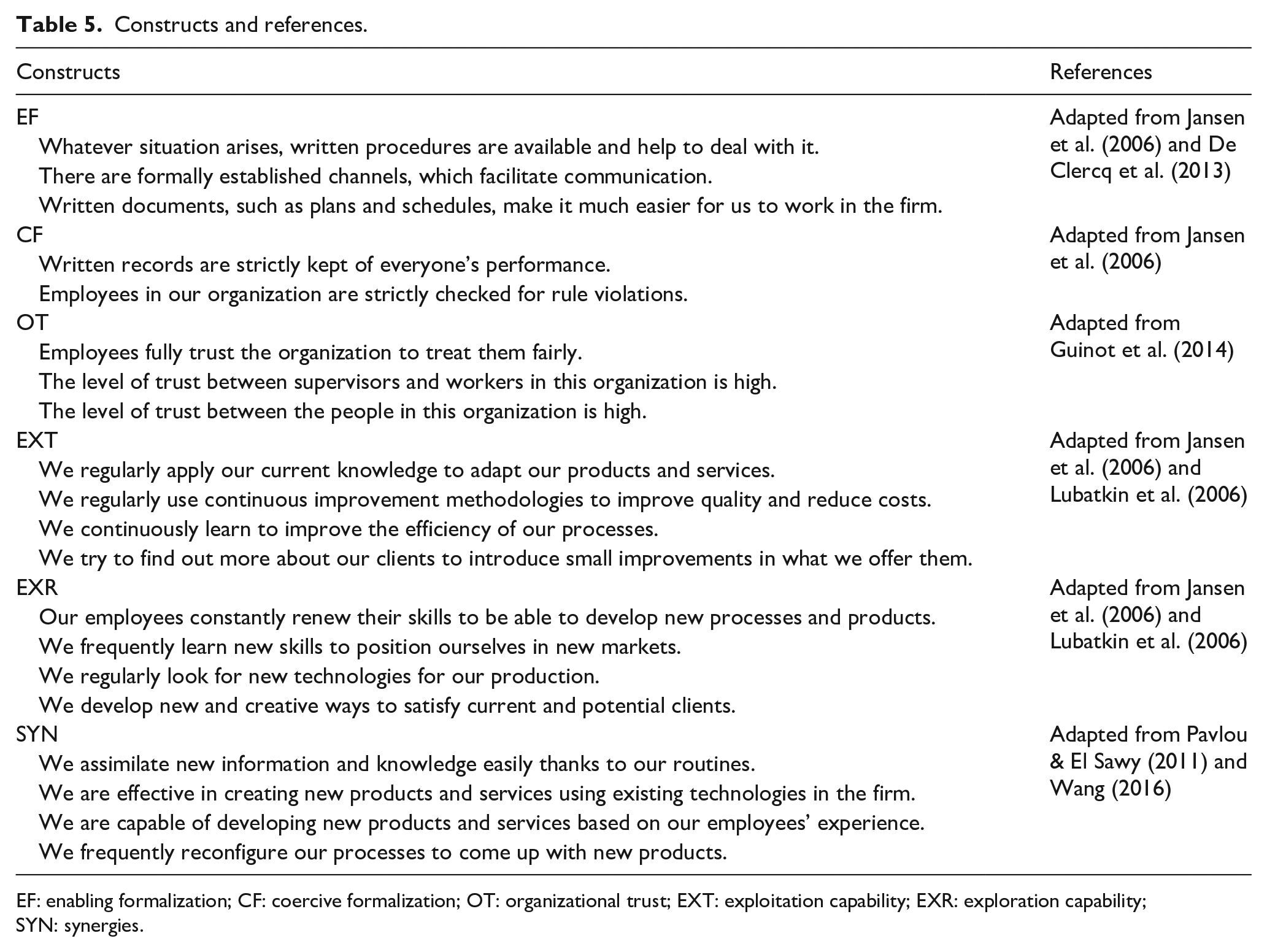
We measured the constructs of this study using scales adapted from the existing literature. Their reliability and validity were verified through standard methods of analysis. All the items were measured using a Likert-type scale, with values ranging from 1 (“strongly disagree”) to 7 (“strongly agree”). All the measures were originally written in English, and we translated them into Spanish to ensure the accuracy of the meaning of the questions. The measures used in this study are shown in Appendix 1.
Organizational ambidexterity
In literature, organizational ambidexterity is operationalized in different ways. From a mathematical point of view, we found measures based on subtraction (Hsu et al., 2013), addition (Blome et al., 2013), and multiplication (Gabler et al., 2017; Kauppila, 2015; Lee et al., 2017) of exploration and exploitation. Each of these ways of operationalizing ambidexterity implies a different understanding of the balance of exploration and exploitation, and the conceptualization of ambidexterity.
According to Rosing and Zacher (2017), if we consider the operationalization of ambidexterity as the subtraction between the exploration and exploitation scores, we would not capture the level of balance between them, since an organization with low levels of exploration and exploitation and an organization with high levels of exploration and exploitation are considered ambidextrous. In the case of the multiplication of exploration and exploitation, it implies that these two activities are independent and that the effects depend on each other. So organizations are highly ambidextrous when they score with high levels of exploration and exploitation, in contrast to the low levels of both. Finally, operationalizing ambidexterity as the sum of exploration and exploitation activities implies that high levels of exploration and exploitation are needed to be highly ambidextrous, but exploration and exploitation can compensate for the lower levels of other activity. Although some researchers have criticized these conventional-ambidexterity operationalizations due to the possible confusion of their effects (Rosenkopf & McGrath, 2011; Rosing & Zacher, 2017), a meta-analysis revealed that the ambidexterity multiplication measure is one of the most complete and common ways to operationalize ambidexterity (Junni et al., 2013). We contribute to the literature through an alternative approach to operationalize ambidexterity.
To better capture the concept of organizational ambidexterity (OA), in line with authors who have studied the concept under the dynamic capability framework (see “The impact of formalization on organizational ambidexterity” section), we operationalized OA as the balance between exploration and exploitation and also included the development of synergies between them. This concept implies that exploration and exploitation would be more interrelated and would complement each other

In our questionnaire, respondents answered questions about the level of development of synergies between exploitation and exploration in their companies, using a Likert-type scale of 1 to 7 points, where 1 is a low level and 7 is a high level. To capture the effect of synergies on our concept of ambidexterity, the value obtained from synergies must be reversed—as seen in equation (1). Another similar way to contrast our equation is by multiplying exploitation, exploration, and synergies. However, we decided to reverse the value of synergies because in this way, mathematically, it allows us to compare the conventional measurement of ambidexterity with the proposed measure, showing more clearly the effect of synergies.
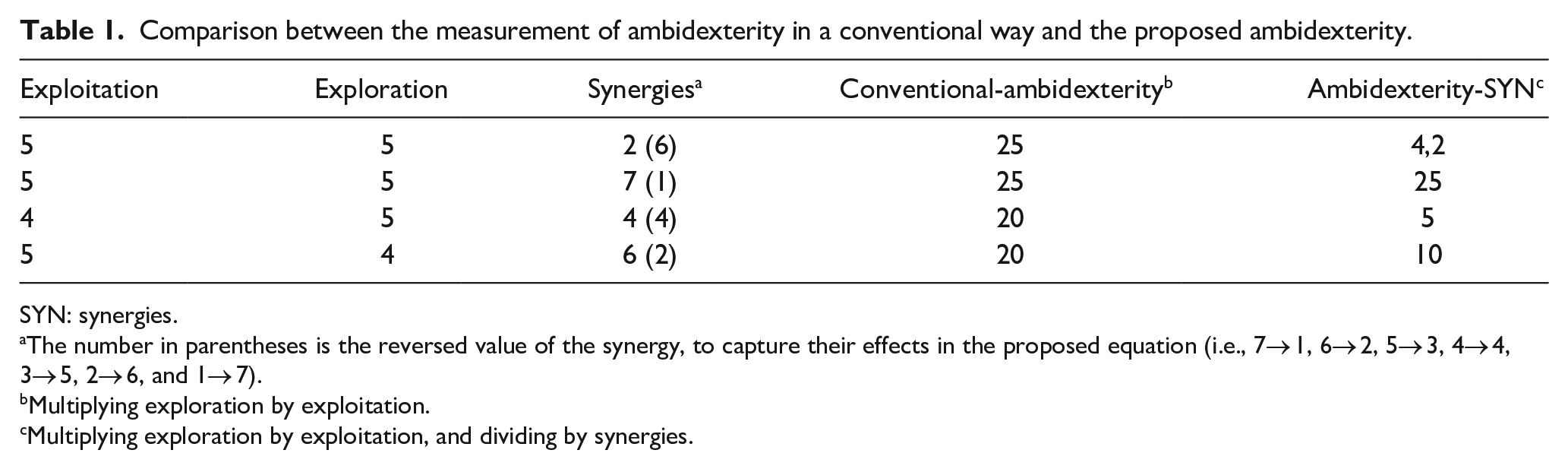
To better understand the effect of equation (1), below we show an example in which we compared the conventional measurement of ambidexterity with the proposed measurement (Table 1).
Comparison between the measurement of ambidexterity in a conventional way and the proposed ambidexterity.
SYN: synergies.
The number in parentheses is the reversed value of the synergy, to capture their effects in the proposed equation (i.e., 7→ 1, 6→ 2, 5→ 3, 4→ 4, 3→ 5, 2→ 6, and 1→ 7).
Multiplying exploration by exploitation.
Multiplying exploration by exploitation, and dividing by synergies.
In the examples illustrated in Table 1, we can see the contrast between those companies that carry out exploration and exploitation activities; and those companies that are synergistically integrated. Following the first line in Table 1, we note that companies with a rating of 5 points of both exploitation and exploration activities would have a score of 25 points (conventional measurement of ambidexterity). But when we consider the role of synergies with a rating of 2 points, the value of the ambidexterity capability decreases to 4.2 points, which shows that it is not enough for a company to only develop exploration and exploitation, but that these capacities must be integrated. If we review the second line in Table 1, we again observe a company with a rating of 5 points of both exploitation and exploration, with a score of 25 points for its conventional measurement of ambidexterity; however, in this particular case, the value of the synergy is 7 points, and therefore, a high level of ambidexterity is obtained, increasing the value to 25 points. This new way of measuring ambidexterity according to our conceptualization would illustrate that an organization is really ambidextrous if it can use the results obtained by exploration activities in exploitation activities and vice versa, facilitating the transformation and recombination of dynamic capacities of these companies. In general, the proposed measure offered a more versatile and pragmatic representation of organizational ambidexterity.
As reported in Appendix 1, in this study, exploitation and exploration capabilities were measured with four-item and 7-point scales adapted from Jansen et al. (2006) and Lubatkin et al. (2006). Synergies were measured with a four-item 7-point scale adapted from Pavlou and El Sawy (2011) and Wang (2016).
EF and CF
Following Adler and Borys (1996), we differentiated between two types of formalization. EF was measured with a three-item 7-point scale adapted from Jansen et al. (2006) and De Clercq et al. (2013). CF was measured with a two-item 7-point scale adapted from Jansen et al. (2006).
OT
The OT construct was measured with a three-item 7-point scale adapted from Guinot et al. (2014).
Control variables
Firm size, firm age, and firm focus were used as the ambidexterity control variables. Given the high departure from normality, firm size was measured as the log of the total number of employees, and firm age was calculated as the square of the organic product line age. Firm focus was measured as a dichotomous variable (0 for firms that only marketed organic products, and 1 for firms that marketed both organic and non-organic products).
Construct validity and reliability
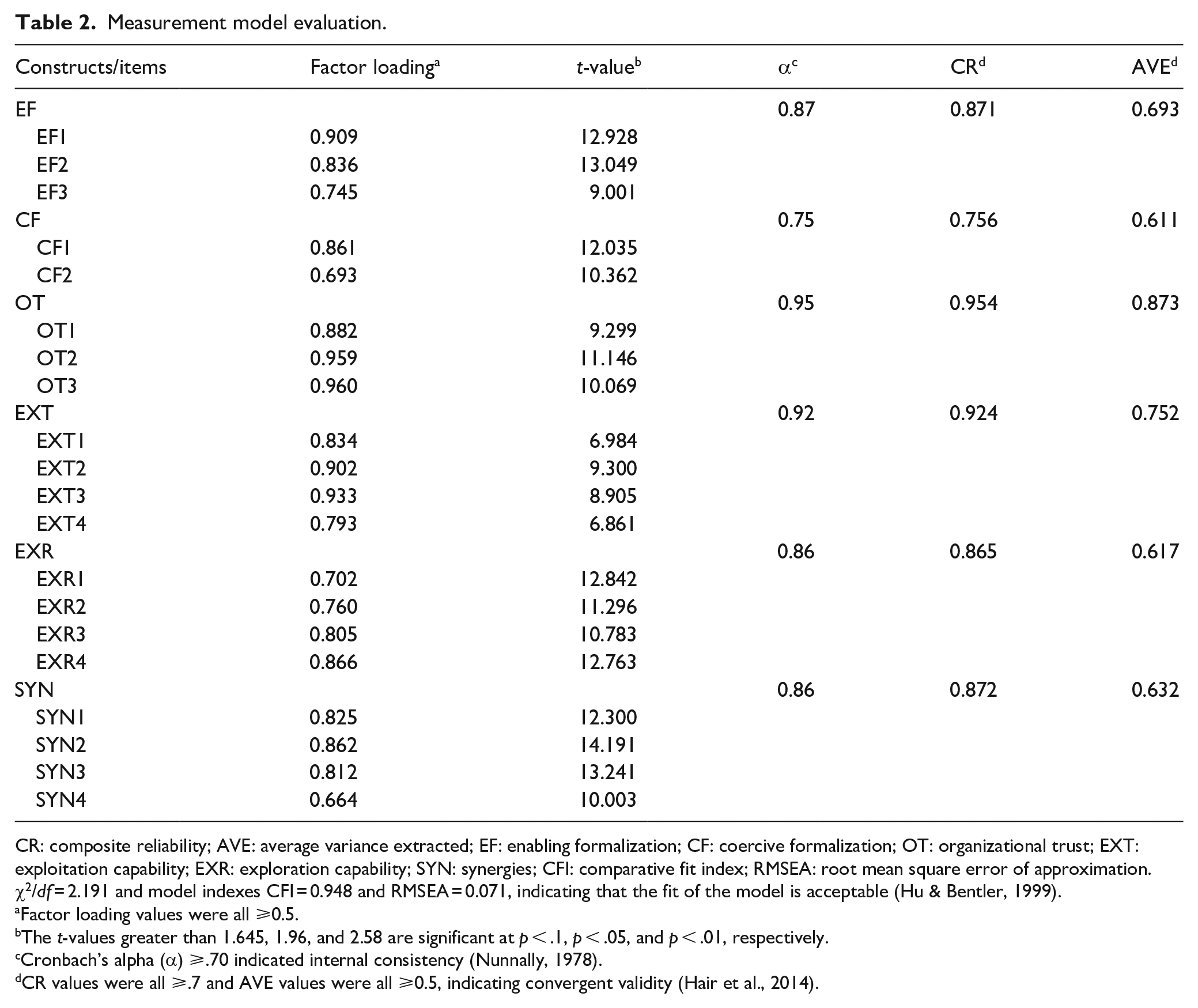
A reliability test was conducted by calculating Cronbach’s alpha coefficient and the composite reliabilities. As shown in Table 2, all the Cronbach’s alphas and composite reliabilities ranged from .75 to .95, which are above the recommended threshold value of .70 (Fornell & Larcker, 1981; Nunnally, 1978).
Measurement model evaluation.
CR: composite reliability; AVE: average variance extracted; EF: enabling formalization; CF: coercive formalization; OT: organizational trust; EXT: exploitation capability; EXR: exploration capability; SYN: synergies; CFI: comparative fit index; RMSEA: root mean square error of approximation.
χ2/df = 2.191 and model indexes CFI = 0.948 and RMSEA = 0.071, indicating that the fit of the model is acceptable (Hu & Bentler, 1999).
Factor loading values were all ⩾0.5.
The t-values greater than 1.645, 1.96, and 2.58 are significant at p < .1, p < .05, and p < .01, respectively.
Cronbach’s alpha (α) ⩾.70 indicated internal consistency (Nunnally, 1978).
CR values were all ⩾.7 and AVE values were all ⩾0.5, indicating convergent validity (Hair et al., 2014).
Using AMOS 21.0, we built a confirmatory factor analysis (CFA) model where each item was connected with its respective construct, and the covariances between constructs were estimated to assess convergent and discriminant validity (Fornell & Larcker, 1981; O’Leary-Kelly & Vokurka, 1998). Table 2 shows that average variance extracted (AVE) values were greater than 0.5, composite reliability values were greater than .6, and standardized factor loadings were greater than 0.5. These provide convergent validity support (Hair et al., 2014).
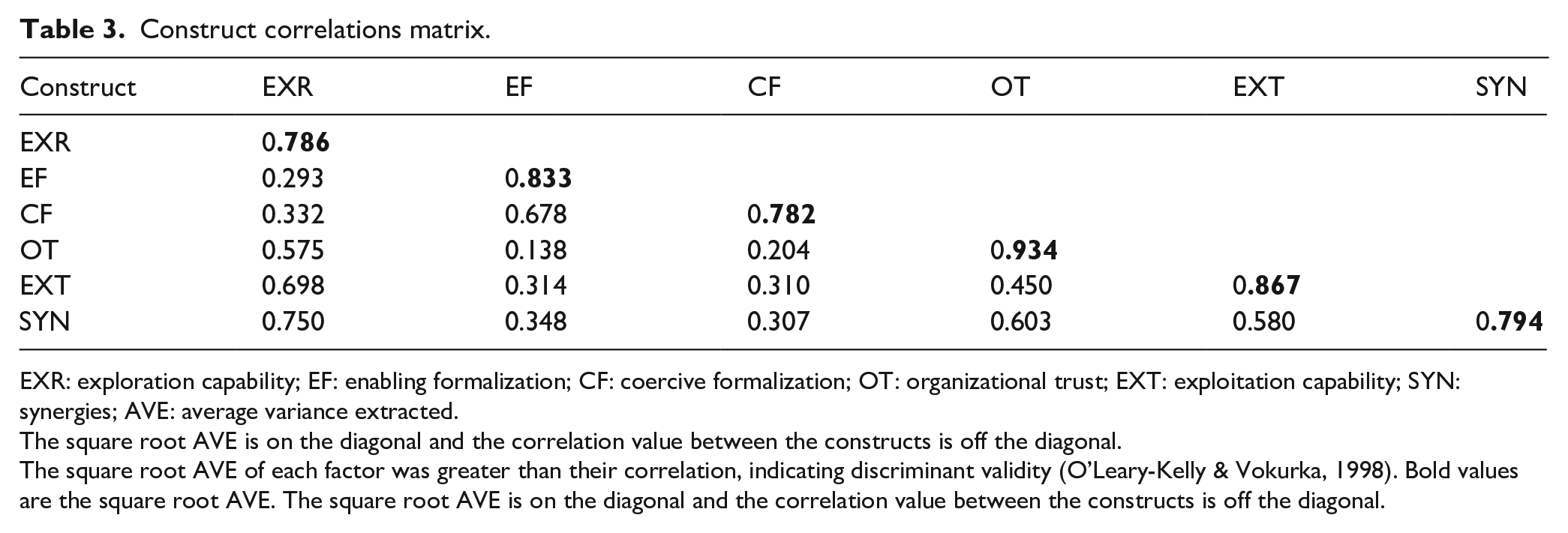
To evaluate discriminant validity, we checked that the square root of the AVE of each construct was higher than their correlations with the other constructs (O’Leary-Kelly & Vokurka, 1998). Table 3 indicates that our measures have discriminant validity.
Construct correlations matrix.
EXR: exploration capability; EF: enabling formalization; CF: coercive formalization; OT: organizational trust; EXT: exploitation capability; SYN: synergies; AVE: average variance extracted.
The square root AVE is on the diagonal and the correlation value between the constructs is off the diagonal.
The square root AVE of each factor was greater than their correlation, indicating discriminant validity (O’Leary-Kelly & Vokurka, 1998). Bold values are the square root AVE. The square root AVE is on the diagonal and the correlation value between the constructs is off the diagonal.
AVE values for all constructs were higher than the square correlation between constructs, supporting discriminant validity (Fornell & Larcker, 1981; O’Leary-Kelly & Vokurka, 1998). We also tested discriminant validity with the delta chi-square test (Bagozzi et al., 1991). To do so, two CFA models were conducted for each pair of constructs. In the first CFA model, the correlation between the constructs was unconstrained, and in the second one, the correlation was constrained to 1. A significant chi-square difference supports discriminant validity. Chi-square differences ranged from 50.534 to 666.574, demonstrating that all constructs are different from each other (Δχ2 > 3.4). The chi-square values are described in Appendix 2.
Results
To study the relationship proposed in this research, we used multiple regression analysis because it enabled us to statistically model the relationship between dependent variables and a set of independent variables. There are three main ways to perform a multiple regression analysis: standard multiple regression, hierarchical multiple regression, and statistical regression (Ho, 2006). These ways differ in how they handle multicollinearity and the criteria used to determine the order of entry of independent variables in the model (Tabachnick & Fidell, 2001). In this research, we used hierarchical regression analysis because (1) it enabled us to determine the order of entry of the independent variables in the regression equation based on logical or theoretical considerations and assess their additional explanatory power (Ho, 2006). Therefore, through this technique, we were able to verify whether our independent variables explained a significant amount of the dependent variable variance. (2) As we tested some moderating hypotheses, we used hierarchical regression analysis, which is commonly used in the literature for this purpose (Hair et al., 2014). (3) The computation of ambidexterity was carried out by multiplying exploration and exploitation and dividing this result by synergies. Appendix 3 shows the results of the hierarchical regression analyses, with ambidexterity measured as the multiplication of exploitation by exploration (conventional measure) to compare the results obtained with our proposed measure of ambidexterity.
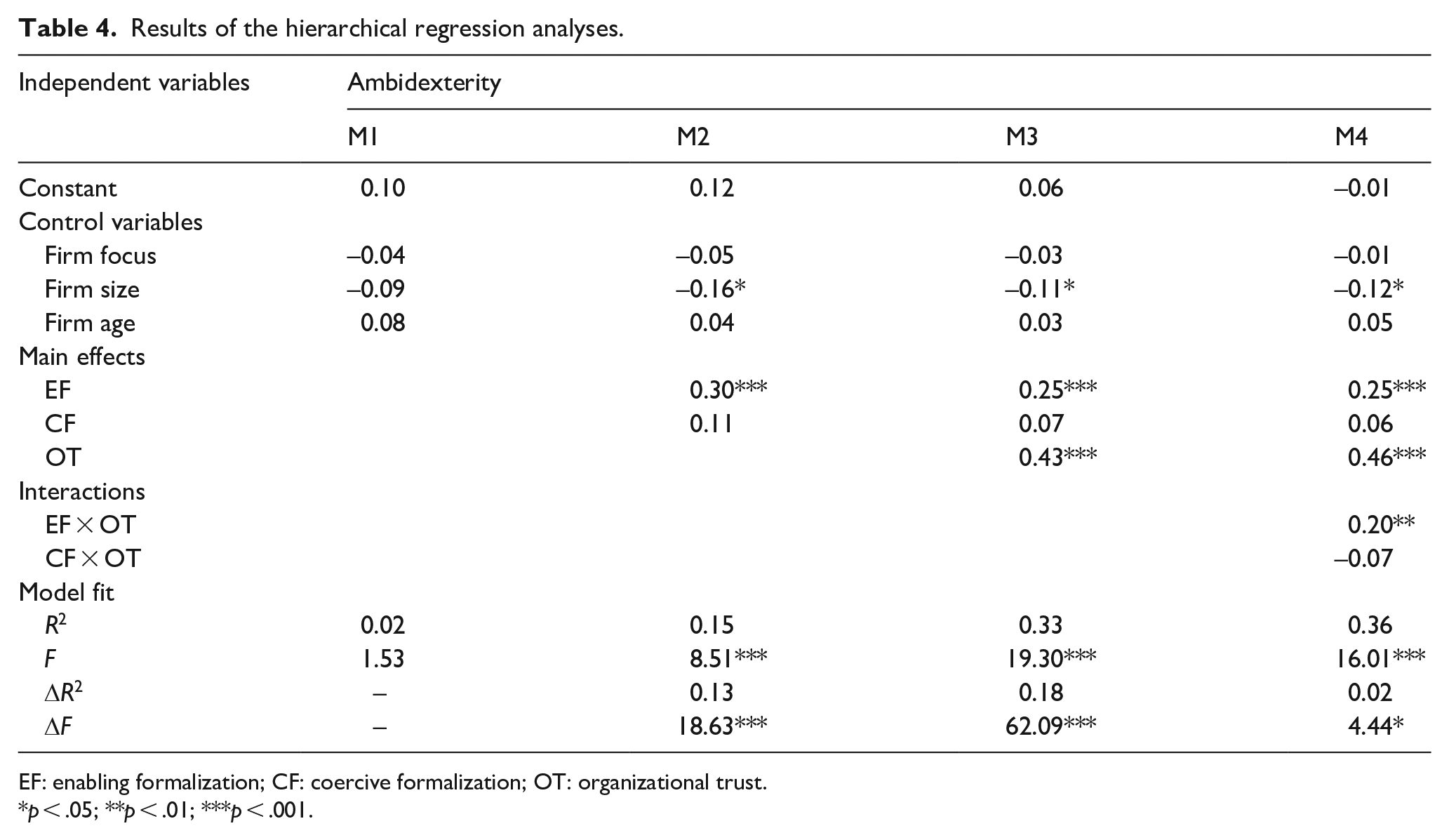
The hypotheses were tested using a hierarchical regression procedure using R software with ambidexterity as a dependent variable. The evaluation of regression assumptions of normality, homoscedasticity, and linearity were satisfactory. In addition, to reduce the problems related to multicollinearity when product terms are included in an equation and correct standardized regression weights are generated, all the variables were z-standardized before the analysis. The results are shown in Table 4 and Figure 1.
Results of the hierarchical regression analyses.
EF: enabling formalization; CF: coercive formalization; OT: organizational trust.
p < .05; **p < .01; ***p < .001.
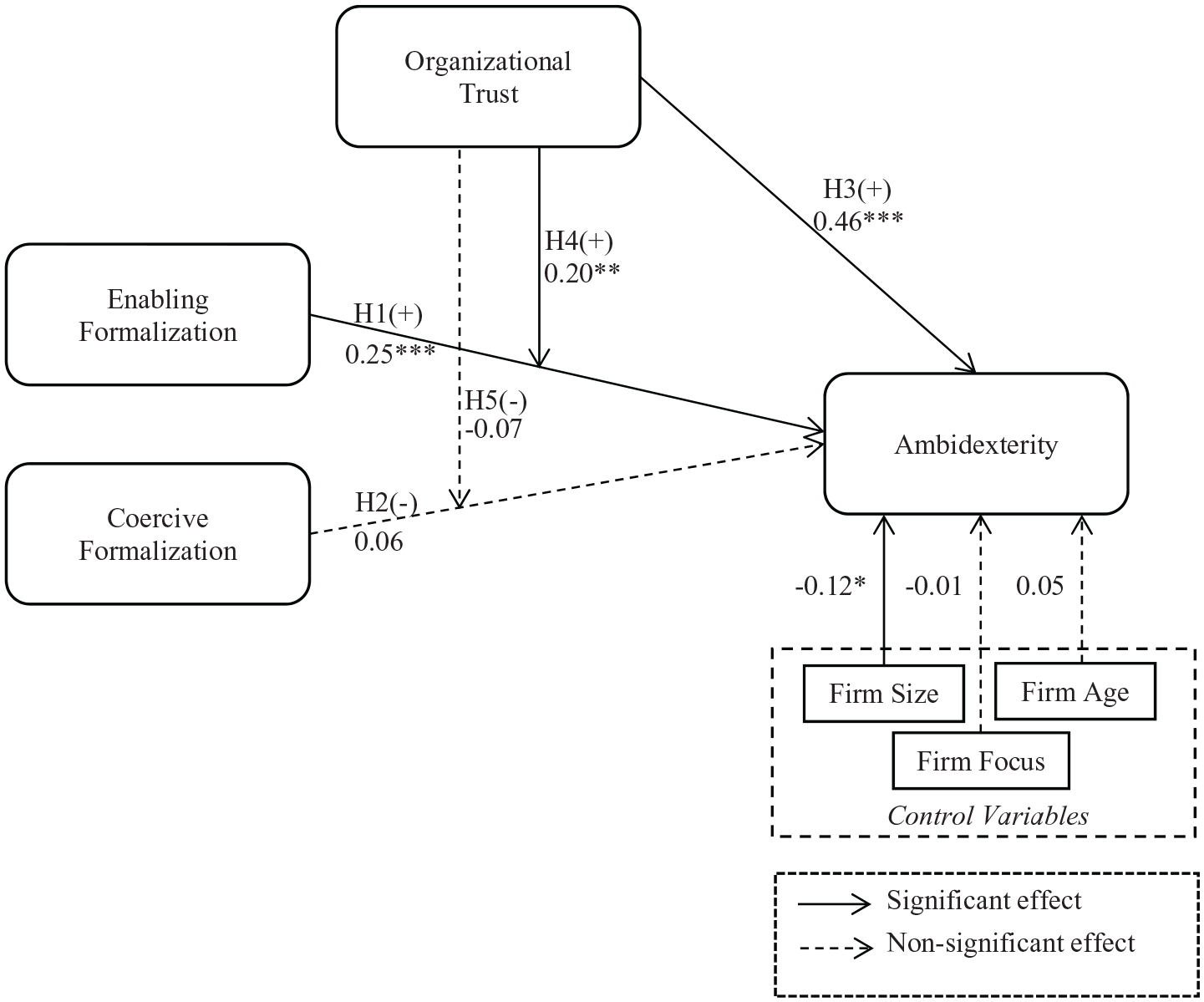
Hypothesized model and empirical results.
The hierarchical regression provides empirical evidence that both EF (β = .25, t-value = 3.75, p < .001) and OT (β = .46, t-value = 8.32, p < .001) had a positive and significant influence on ambidexterity, supporting H1 and H3. These results seem stable, being confirmed both in M3 and M4. Contrary to what was expected, H2, stating that CF has a negative influence on ambidexterity (β = .06, t-value = 0.97, p > .1), was not supported.
The interaction between OT and EF had a significant positive effect on ambidexterity (β = .20, t-value = 2.75, p < .01), supporting H4. Conversely, we did not find support for H5 that the interaction between OT and CF has a significant effect on ambidexterity (β = –.07, t-value = –0.95, p > .1). Figure 2 provides a graphical illustration of the significant interaction between OT and EF. It shows that the effect of EF on ambidexterity is dependent on OT. Compared with firms with a low level of trust, those with a high level of trust demonstrated a stronger positive relationship between EF and ambidexterity. In other words, EF has a stronger positive influence on ambidexterity when there is greater trust.
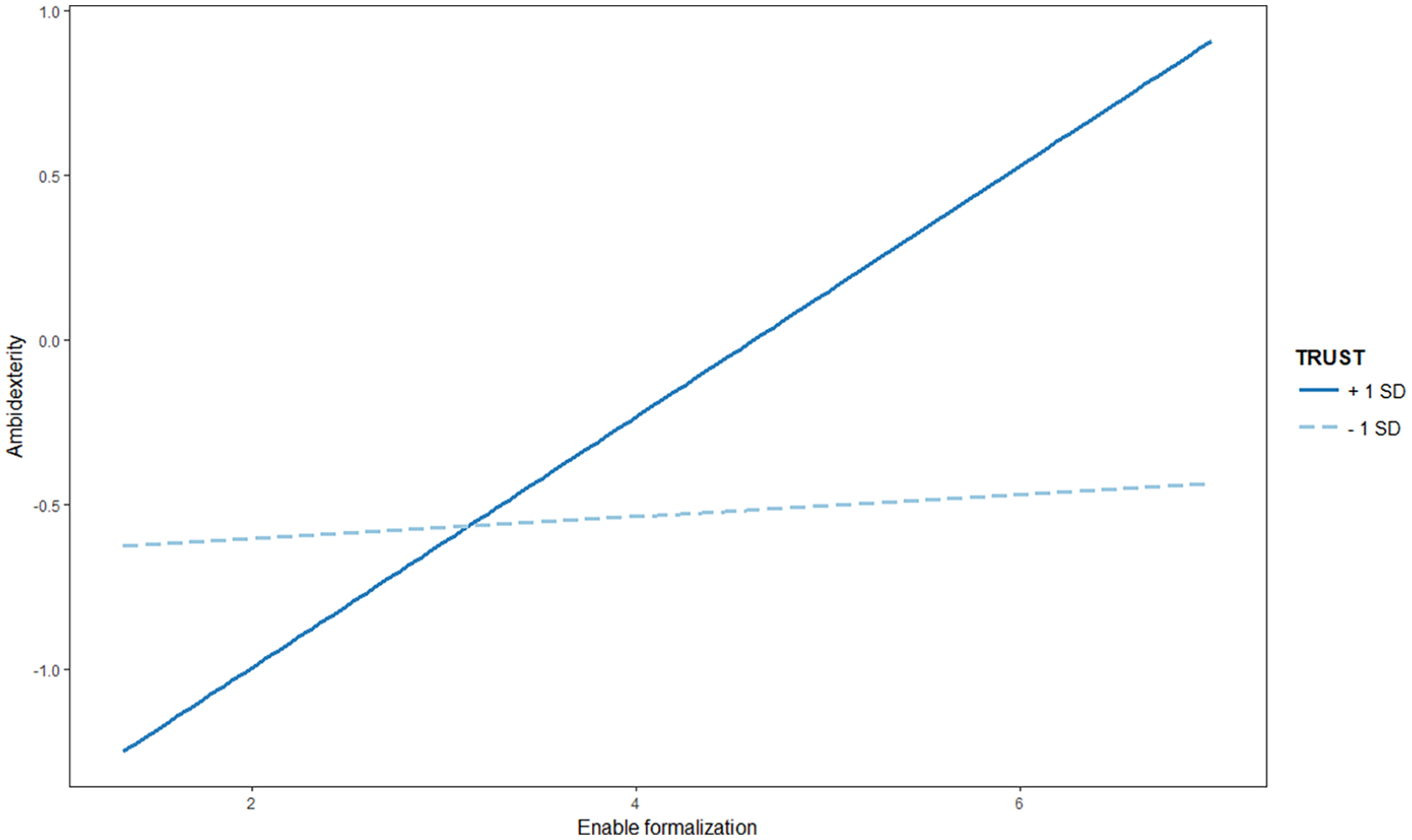
Interaction between organizational trust and enabling formalization on ambidexterity.
Discussion and conclusion
Conclusion
This study aimed to investigate formalization and trust as antecedents of organizational ambidexterity. Moreover, we propose a new way of operationalizing ambidexterity, under a new conceptualization that implies a synergistic vision between exploration and exploitation. We hypothesize that (1) trust and the two types of formalization have distinct impacts on ambidexterity and that (2) the impact of EF and CF on ambidexterity depends on the level of trust. The findings extend the recent stream of literature on the drivers of ambidexterity (Junni et al., 2015; Pertusa-Ortega & Molina-Azorín, 2018) by shedding light on the interactions between the antecedents of ambidexterity.
In particular, we highlighted the different findings from studying ambidexterity as a dynamic capability (Table 4) and as the simple balance of exploration and exploitation (Appendix 3). We will refer to ambidexterity to identify the concept that includes the synergies between exploitation and exploration, as we did above, but we will add the term “conventional-ambidexterity” to indicate the concept that includes the balance between exploitation and exploration but not the synergies between them.
On one hand, our results support the stream of literature that argues that EF facilitates ambidexterity (DiPaola & Hoy, 2001; Pertusa-Ortega & Molina-Azorín, 2018). It favors this dynamic path by capturing the benefits of balanced exploitation and exploration in an organization and facilitating their synergistic combination. However, our study does not confirm that CF has a significant negative influence on ambidexterity. We found that CF had a significant positive influence on conventional-ambidexterity. This result seems to come into conflict with the common view on the negative effects of CF (Adler & Borys, 1996; Ahrens & Chapman, 2004; Hoy & Sweetland, 2001).
Nevertheless, our results support the literature that infers that OT plays a fundamental role in the achievement of ambidexterity (Gibson & Birkinshaw, 2004). Our study also highlights different moderating effects of trust on the relationship between the two formalization types and ambidexterity. We support the findings that the relationship between EF and ambidexterity is stronger when OT is higher compared to when it is lower. We also found that the interaction between OT and CF had a non-significant effect on ambidexterity. Controversially, we found that the interaction between OT and CF had a significant negative effect on conventional-ambidexterity. In this scenario, CF seems to have a lower influence on conventional-ambidexterity when trust is high compared to when it is low.
Theoretical implications
We can derive three major contributions from this study.
First, we move beyond the view of organizational ambidexterity as balanced efforts on exploration and exploitation activities that prevail in most previous studies by investigating the concept from the dynamic capability approach and explicitly including the development of synergies between exploration and exploitation. Although this view is not new in the literature (Birkinshaw et al., 2016; S. Lee & Rha, 2016; Y. Li & Huang, 2012; O’Reilly & Tushman, 2008), as far as we know, this is the first piece of research that includes the empirical measurement of the synergies between exploitation and exploration.
Our analysis has not confirmed that CF has a significant negative influence on ambidexterity, and that OT moderates this negative impact. However, we found that CF has a significant positive influence on conventional-ambidexterity and that OT negatively moderates this impact. We found similar findings for ambidexterity and conventional-ambidexterity for EF and trust.
The second contribution consists of the identification of the distinct effects of different types of formalization on ambidexterity. Most of the previous literature considered formalization as a general concept, which has generated multiple paths of knowledge regarding its effect on exploration and exploitation. Here, centering on Adler and Borys’s (1996) distinction between CF and EF, this research offers a more nuanced and richer reflection on how formalization affects ambidexterity. On one hand, our results empirically support the stream of literature that conceptually argues that EF facilitates ambidexterity (DiPaola & Hoy, 2001; Pertusa-Ortega & Molina-Azorín, 2018). EF promotes flexibility and efficiency while encouraging and influencing the organization’s exploration and exploitation capabilities (Pertusa-Ortega & Molina-Azorín, 2018). Specifically, it favors this dynamic path by helping to exploit existing capabilities and routines, and by enabling the replication and dissemination of exploratory innovations (Jansen et al., 2006), capturing the benefits of both and integrating them strategically. Therefore, EF not only favors the balance between the organization’s exploitation and exploration but also allows their synergistic combination. On the other hand, unexpectedly, we did not find a negative effect of CF on ambidexterity. Instead, we found a positive effect, but only on conventional-ambidexterity. This result seems to conflict with the common view on the negative effects of CF (Adler & Borys, 1996; Ahrens & Chapman, 2004; Hoy & Sweetland, 2001) and requires some explanation. We believe that because of the characteristics of the organic agro-food industry, companies do not perceive formalization as strict monitoring or compliance with the rules. In fact, this industry is strongly regulated (even more so than other sectors), especially with regard to quality and food safety. Therefore, these companies are used to exploiting and exploring in a coercive environment. Yet it is extremely difficult for these firms to develop strategic integration between these activities. Therefore, these companies are used to exploring and exploiting under coercive rules, explaining why CF does not have a negative effect on exploration and exploitation and, therefore, on ambidexterity in the context of these companies. We can also contrast these effects with the effects of the types of organizational structures in the literature—mechanical and organic—which play an important role. It has been argued that there is a relationship between mechanical structures with exploitation (based on standardization, centralization, and efficiency), and organic structures with exploration (characterized by their levels of decentralization and flexibility that support autonomy) (Burns & Stalker, 1961). So it is understood that organizations require both structures: organic to create innovations, and mechanistic to implement them.
The third contribution concerns the impact of OT. Our results support the literature (Gibson & Birkinshaw, 2004) that infers that behavior attributes in an organizational context, in particular trust, play a fundamental role in the achievement of ambidexterity. As argued by Adler and Heckscher (2013), we confirmed that trust is a key facilitator to guarantee a cooperative environment, as it can help to achieve greater efficiency and flexibility in firms. Moreover, this study highlights different moderating effects of OT on the relationship between two formalization types and ambidexterity. On one hand, we found that the relationship between EF and ambidexterity is stronger when OT is higher rather than when it is lower. This is due to the fact that trust generates closer cooperation between employees, enabling the flow of knowledge and the exchange of information, which are key in formalized environments to create a balance between organizational capabilities. As stated by Du and Williams (2017), trust reduces system complexity and decreases managerial monitoring. Therefore, this generates more enthusiasm for employees to innovate. Conversely, we found that the interaction between OT and CF had a non-significant effect on ambidexterity. Instead, we unexpectedly found that the interaction between OT and CF had a significant negative effect on conventional-ambidexterity (Figure 3 in Appendix 3). Thus, CF seems to have a poorer influence on conventional-ambidexterity when trust is high compared to when it is low. This is due to the fact that trust decreases uncertainty and monitoring costs, which are crucial in coercive environments to create a balance between organizational capabilities. Therefore, when there is high trust, managerial monitoring decreases, generating more enthusiasm for employees to explore and exploit their organizational capabilities. As stated by Puranam and Vanneste (2009) and Yang et al. (2011), trust reduces opportunism to be accommodated, contributing to decision making and promoting the use of organizational capacities.
Practical implications
Regarding practical implications for the analyzed sector, first of all we would like to point out that, simultaneously with the revision of the literature framework, to better understand the sector, we organized two panels with experts in the organic agro-food industry in which government officials and entrepreneurs participated. These two panels helped us to understand the challenges and opportunities in which this industry is immersed. Some of the main challenges stated by the participants in the panels were framed by levels of trust and by the excess of norms and regulations. Participants highlighted the need for the industry to reconcile the strict quality and safety standards and requirements that are only feasible in an environment where trust prevails, in addition to the need for employees to really cooperate to achieve an enabling environment which fosters business success, in which managers can really explore and exploit their resources and that they are integrated, in such a way that a current and future viability of companies is achieved. Our results confirm the importance given by the experts to trust, and the achievement of an EF over a CF, where trust is a key aspect to achieve ambidexterity.
Several implications for managerial practice can be derived from this study. The organic agro-food industry is progressively facing major challenges mainly as a result of the exponential growth in the demand for organic products, and the strict requirements stipulated by the specific regulations for companies in this industry. Our study highlights some important organizational structural features and behavior attributes that managers should contemplate to facilitate the achievement of organizational ambidexterity, being able the organic agro-food industry to combine exploitation to reduce operating costs and compete on price and exploration, to be receptive to product innovation and technological change.
On one hand, excessive regulation and duplication of requirements set by the government can reduce flexibility and increase the complexity of the system, which could make it difficult for new innovative entrepreneurs to enter the sector. According to our study, managers can use organizational structure to simultaneously perform exploration and exploitation activities and to generate synergies between them. The more formalized the organizational structure (not coercively, but in an enabling manner), the more ambidextrous a company can be. EF can improve the identification of new exploration and exploitation opportunities; it allows for solving inevitable contingencies effectively and encourages employees to participate in interactive dialogues that encourage seeing problems as opportunities and learning from past errors. This guarantees job security and greater participation thanks to better coordination, thus favoring ambidexterity. The above mentioned can be an advantage for the agro-food sector as it can ensure consumers greater food safety and quality, strengthening the system and facilitating innovation in the sector.
On the other hand, organic agro-food industry perceives trust as an essential factor in the food value chain, which generates security and adds value to the firms—given the potential growth of this industry in the future (Moreno-Luzon, 2017). According to our study, organizational behavior attributes, such as trust, can favor the simultaneous development of exploitation and exploration activities and their synergies. Trust could help managers to achieve objectives in their organization, promoting changes in their employees and therefore making them more committed to the firm. Since trust improves information and knowledge flows, promotes greater experimentation, improves coordination, and strengthens processes, managers could encourage members of the organization to share their ideas and therefore generate new strategic initiatives for the firm. In addition, companies with a high level of trust can contribute to and support EF to understand the challenges of achieving ambidexterity and to take advantage of potential synergies to achieve organizational goals.
Limitations of the study and future research
The study also has some limitations that should be addressed in future research. First, we only studied trust, EF, and CF as background factors to ambidexterity. Future research could examine the effects of other contextual factors (e.g., discipline and commitment), other organizational characteristics (e.g., centralization), or consequences of ambidexterity (e.g., business performance) to enrich the research. Second, our empirical study was cross-sectional in nature. Future research could use a longitudinal study method, which could generate more relevant findings. Third, like other studies (Lee et al., 2017; Pertusa-Ortega & Molina-Azorín, 2018; Walrave et al., 2017), it is not easy to generalize our findings, given that the results provided evidence from a specific context (i.e., the organic agro-food industry) and a specific country (i.e., Spain). However, these results may be relevant in other industries with similar characteristics. Future research could test our hypotheses in different industries and countries to confirm the results and generalize them. Fourth, all the variables in this research were measured in a perceptual manner so that socially desirable responses could be obtained from managers and quality directors. Future research could improve our measurement scales by including objective measures. Fifth, our study examined at information from two informants in each targeted company—the general manager and the quality manager. Future research could include the relevance of interviewing the employees of these organizations, which would provide information on more informant. Finally, it is unlikely that a model like ours has captured all the possible moderating effects of the organizational environment. Future research could address other factors (e.g., cultural values), offering new insights into how these additional variables affect the relationship between formalization and ambidexterity.
Footnotes
Appendix 1
Constructs and references.
| Constructs | References |
|---|---|
| EF | Adapted from Jansen et al. (2006) and De Clercq et al. (2013) |
| Whatever situation arises, written procedures are available and help to deal with it. | |
| There are formally established channels, which facilitate communication. | |
| Written documents, such as plans and schedules, make it much easier for us to work in the firm. | |
| CF | Adapted from Jansen et al. (2006) |
| Written records are strictly kept of everyone’s performance. | |
| Employees in our organization are strictly checked for rule violations. | |
| OT | Adapted from Guinot et al. (2014) |
| Employees fully trust the organization to treat them fairly. | |
| The level of trust between supervisors and workers in this organization is high. | |
| The level of trust between the people in this organization is high. | |
| EXT | Adapted from Jansen et al. (2006) and Lubatkin et al. (2006) |
| We regularly apply our current knowledge to adapt our products and services. | |
| We regularly use continuous improvement methodologies to improve quality and reduce costs. | |
| We continuously learn to improve the efficiency of our processes. | |
| We try to find out more about our clients to introduce small improvements in what we offer them. | |
| EXR | Adapted from Jansen et al. (2006) and Lubatkin et al. (2006) |
| Our employees constantly renew their skills to be able to develop new processes and products. | |
| We frequently learn new skills to position ourselves in new markets. | |
| We regularly look for new technologies for our production. | |
| We develop new and creative ways to satisfy current and potential clients. | |
| SYN | Adapted from Pavlou & El Sawy (2011) and Wang (2016) |
| We assimilate new information and knowledge easily thanks to our routines. | |
| We are effective in creating new products and services using existing technologies in the firm. | |
| We are capable of developing new products and services based on our employees’ experience. | |
| We frequently reconfigure our processes to come up with new products. |
EF: enabling formalization; CF: coercive formalization; OT: organizational trust; EXT: exploitation capability; EXR: exploration capability; SYN: synergies.
Appendix 2
The chi-square values are shown for all pairs of constructs. Chi-square differences range from 50.534 to 666.574, which indicates that all constructs are different from each other (Δχ2 > 3.4).
Appendix 3
In addition, an ambidexterity model measured as the multiplication of exploitation by exploration (conventional measure) was also tested to compare the results obtained with our proposed measure of ambidexterity. This measure yielded some results that were similar to the ambidexterity measure, such as enabling formalization (β = .16, t-value = 2.42, p < .05) and organizational trust (β = .50, t-value = 9.24, p < .001), which had a positive effect and significantly influenced conventional-ambidexterity, as did the moderating effect of organizational trust on the relationship between enabling formalization and conventional-ambidexterity (β = .15, t-value = 2.12, p < .05). However, different results were also observed, in that coercive formalization exerted a positive and significant influence on conventional-ambidexterity (β = .16, t-value = 2.49, p < .05), as did the moderating effect of organizational trust on the relationship between coercive formalization and conventional-ambidexterity (β = –.14, t-value = –1.90, p < .10).
Declaration of conflicting interests
The author(s) declared no potential conflicts of interest with respect to the research, authorship, and/or publication of this article.
Funding
The author(s) disclosed receipt of the following financial support for the research, authorship, and/or publication of this article: This research is part of the ECO2015-71380-R Project funded by the Spanish Ministry of Economy, Industry and Competitiveness and the State Research Agency. It has been co-financed by the European Regional Development Fund (ERDF).
