



Abstract
In recent years, people management has embraced artificial intelligence (AI), which presents both challenges and opportunities. Yet, it is clear that the marriage of HRM and leadership in this domain has only just begun, and the bandwagon is carried by other disciplines such as computer science and engineering. This yields potential issues as approaches and research agendas are not aligned. We address these issues with an objective and comprehensive review. We employed two bibliometric approaches, document co-citation and bibliographic coupling, and included 863 primary and 42,664 secondary documents. Our review shows the current state of the people management and AI discussion and identifies potential future trends of this discussion based on emerging research. Based on our review we provide key findings and potential future suggestions on how the linkage between the three fields could further evolve.
Introduction
Artificial intelligence (AI) refers to man-made systems comprising algorithms and software programs capable of recognizing, analyzing, deriving insights, and learning from data to accomplish specific objectives and tasks (Chowdhury et al., 2023). AI holds the potential to significantly impact organizations and their employees, offering opportunities such as augmenting employee creativity (Jia et al., 2024), improving selection decisions (Purdy & Williams, 2023), enhancing talent management (Claus, 2019), or powering HR analytics (Xiao et al., 2023). However, AI also presents considerable challenges, including gender and racial biases in AI algorithms (Wellner & Rothman, 2020), potential job displacement due to AI (Ko et al., 2021), and negative employee reactions to AI integration in organizations (Mirowska & Mesnet, 2022).
People management is essential for navigating these challenges and capitalizing on the opportunities presented by AI (Varma et al., 2023). People management refers to the go-together of human resource (HR) duties and leadership behaviors in line managers’ implementation of human resource management (HRM; Leroy et al., 2018; Purcell & Hutchinson, 2007). Research shows that both leadership (Brock & von Wangenheim, 2019) and HRM (Strohmeier & Piazza, 2015; Tambe et al., 2019) are vital and complementary forces in the successful implementation of AI within organizations. HRM provides specific practices such as recruitment, training, and performance management, while leadership establishes the strategic direction and oversees the practical implementation. Both leadership and HRM share the common goal of effectively coordinating people (Leroy et al., 2018) and are crucial to the complex social systems that embed AI and other technologies in organizations (Khoreva et al., 2022; Kim et al., 2021; Ko et al., 2021).
The role of people management in the implementation of AI is increasingly recognized in the literature. For instance, the central role of leadership and HRM-related aspects is emphasized in the AI capability framework by Chowdhury et al. (2023). This growing recognition is also evident in recent overview works that have specifically addressed people management topics in the context of AI (Basu et al., 2023). However, while several overview works on AI have emerged in recent years, they tend to focus on only one side of the people management equation. Most of these works concentrate predominantly on the intersection of AI and HRM (Basu et al., 2023; Budhwar et al., 2022; Kaushal et al., 2023; Pan & Froese, 2023; Prikshat et al., 2023), often at the expense of exploring the important complementary role of leadership (Lee et al., 2023) or presenting a unified approach that integrates both leadership and HRM insights. Some overview works even adopt the label “people management” (Varma et al., 2023) but pay little attention to leadership. In general, AI overview works with a central focus on leadership appear scarce. This is problematic, as it risks reproducing the disparity between leadership and HRM (Leroy et al., 2018) in this line of research.
Tapping into this issue, this article aims to systematize existing academic literature on AI and people management. Synthesizing past research findings is one of the most important tasks for advancing a field of research characterized by extensive growth of publications (Župič & Čater, 2015). Our review is guided by two key questions: What are currently the most important topics at the intersection of AI and people management? How are these topics likely to change in the near future? We answer these questions through a bibliometric review, a method increasingly embraced in management research. This approach unveils citation patterns, document clustering, and provides a more objective overview of the AI, HRM, and leadership interface (Batistič et al., 2017). Unlike qualitative reviews, bibliometric reviews offer a more unbiased perspective while offering tools to visualize the intellectual landscape, research frontiers, and emerging trends (Maícas et al., 2023; Župič & Čater, 2015). By including a broader range of documents such as books and engaging in interdisciplinary debates, our study addresses the limitations of previous reviews (Vrontis et al., 2021) and offers a comprehensive exploration of this complex and multifaceted subject.
Hereby, this article makes three contributions. First, we focus on people management (Purcell & Hutchinson, 2007), bringing together insights from AI research within leadership and HRM. Leadership and HRM are inherently connected, both striving to influence people in organizations toward desired behaviors and outcomes, with leadership emphasizing interpersonal aspects and HRM focusing on formal organizational systems and practices (Leroy et al., 2018). Accordingly, we explore areas where leadership and HRM can complement each other in overcoming AI-related challenges in organizations. In doing so, we overcome the narrow scope of prior reviews and address the importance of leadership for the implementation of both HRM and AI (Khoreva et al., 2022).
Second, in examining the intersection of AI and people management, our focus is on strategic HRM. Strategic HRM, which emphasizes HRM systems and bundles, has long been a cornerstone of HRM research. Scholars have consistently advocated for this comprehensive approach over narrower focuses on individual practices (Boon et al., 2019). This contrasts with some recent overviews of AI and HRM that tend to prioritize singular practices (Basu et al., 2023; Chowdhury et al., 2023). By addressing AI in the context of leadership and strategic HRM, we aim to reconnect scholarly discussions on AI with the core concerns of HRM.
Finally, we bridge ongoing debates in AI with those in leadership and strategic HRM, addressing the fragmentation and lack of structure that makes navigating these disciplines challenging (Pan & Froese, 2023). Previous reviews, particularly among management scholars, have often limited their scope to more familiar fields like business and psychology, bypassing the interdisciplinary nature of AI, leadership, and HRM discussions (Bauwens & Cortellazzo, 2025; Pan & Froese, 2023). This study overcomes that limitation by synthesizing research from not only these “usual suspects” but also from technical domains such as computer science and information systems. By doing so, we identify key trends and propose future research directions that foster cross-disciplinary dialogue, exchange of best practices, and integration of research designs and theoretical frameworks in this rapidly evolving field.
Background
Leadership, HRM and organizations’ adoption of AI
There are many concurrent definitions of AI. This study defines AI as a “manmade system comprising of algorithms and software programs, [with the ability] to identify, interpret, generate insights, and learn from the data sources to achieve specific predetermined goals and tasks” (Chowdhury et al., 2023, p. 2). Central in this definition is that AI not only processes data, but also exhibits advanced capabilities such as learning, reasoning, and self-correction or adaptation. In this sense, this definition distinguishes AI from more traditional systems and approaches like decision support systems, which lack such autonomous reasoning (Ford, 1985), or AI applications in HR analytics, which rely on more descriptive and predictive analyses (Levenson & Fink, 2017).
In recent years, many organizations have turned to AI into their daily business, driven by motivations of process optimization or cost reduction, improved decision-making, innovation, gaining insights from big data, and/or staying ahead in the digital and knowledge economy (Basu et al., 2023; Chowdhury et al., 2023). Examples include customer service chatbots that serve as first-in-line to common customer requests, AI screening algorithms that look for suitable candidates based on resume keywords or self-checkout registers that detect unusual patterns in buying behavior. These examples illustrate that the adoption of AI is driven by both operational efficiencies and strategic goals, such as improving organizational agility and fostering innovation (Basu et al., 2023). However, successful implementation requires addressing challenges related to people, including employee resistance, trust issues, and ethical concerns. Leadership plays a crucial role in overcoming these challenges by promoting a culture of openness and adaptability, while HRM ensures that systems are in place to support employees in acquiring the necessary AI-related skills (Pak et al., 2023). This combined approach highlights the importance of integrating leadership and HRM perspectives in AI implementation. However, despite these promising results, the current state of AI adoption varies significantly across organizations, with some companies fully leveraging AI’s potential, while others face significant such as trust issues and skills gaps. Since a significant share of these challenges are human-centric in nature, the implementation of AI in organizations also calls for a human-centric approach (Fenwick et al., 2024). This is where people management comes into play. People management refers to the go-together of HRM and leadership (Leroy et al., 2018; Purcell & Hutchinson, 2007), emphasizing that these two elements are complementary in their shared goal of influencing behavior and achieving desired employee outcomes. Leadership plays a vital role in shaping the vision and direction for integrating technology, such as AI, within organizations. Leaders act as change agents who inspire employees to embrace AI-driven transformations by emphasizing its potential benefits for both individual growth and organizational success (Bauwens & Cortellazzo, 2025). By fostering a culture of innovation and adaptability, leaders can reduce resistance to technological change and ensure alignment between organizational goals and workforce capabilities. Concurrently, HRM adapts organizational processes to facilitate this transition by implementing tailored training programs that equip employees with AI-related skills, revising performance metrics to account for AI-driven tasks, and ensuring equitable access to AI-related opportunities across the workforce (Pak et al., 2023). Together, leadership and HRM create a cohesive framework for navigating the complexities of AI adoption, where leadership provides strategic guidance and vision while HRM operationalizes these strategies through systems that support employees during technological transitions.
Leadership and HRM are not only key to implementing AI, but they are also reshaped by AI’s introduction into the workplace. Research shows that technology-influenced leadership emphasizes vision, collaboration, and communication (Bauwens & Cortellazzo, 2025). The influence of AI on leadership follows a similar pattern. Although AI tools offer many possibilities, using them to add value for employees or clients requires a strong leadership vision. In an AI-driven era, where AI can handle much of the communication, leadership communication skills, such as prompting and authenticity, become even more crucial. In addition, future developments may see leaders collaborating with AI coworkers (cobots), or even having leadership roles automated, which introduces new challenges for leaders (Wesche & Sonderegger, 2019).
AI also has the potential to significantly transform HRM functions. Techniques like data mining can optimize tasks such as human resource planning, recruitment, training, compensation, and performance management (Budhwar et al., 2022; Strohmeier & Piazza, 2015). Furthermore, AI can elevate HR into a more strategic role by providing data-driven insights and standardizing practices across the organization. However, the integration of AI into HRM also raises challenges, including concerns about data privacy, fairness, and security, which must be carefully addressed (Prikshat et al., 2023; Vrontis et al., 2021). To tackle these challenges, researchers have emphasized the importance of examining the interaction between HRM and leadership (Bauwens & Cortellazzo, 2025).
Bibliographic methods and results
We conducted a bibliometric review consisting of two different bibliometric techniques: document co-citation (Small, 1973) to reveal the intellectual structure and theoretical foundations of the field, and bibliographic coupling (Kessler, 1963) to identify the current research front. Such a two-method triangulation procedure follows past bibliometric reviews (Batistič et al., 2017; Batistič & van der Laken, 2019). We started by identifying a sample of primary documents (i.e., documents identified from our keyword search citing other documents). Following earlier bibliometric studies (e.g., Batistič et al., 2017; Santana & Díaz-Fernández, 2023), data was collected from Web of Science (WoS). We selected WoS as our primary database due to its rigorous indexing standards, comprehensive coverage of high-impact journals, and strong representation of computer science and management disciplines, which are central to our study’s focus on AI, HRM, and leadership. WoS is widely recognized as one of the most influential databases for bibliometric research, providing reliable and high-quality data for research evaluations (Birkle et al., 2020; Mongeon & Paul-Hus, 2016; Župič & Čater, 2015). WoS is frequently recognized for its high data quality and citation accuracy. Jasco (2005) noted that WoS uses strict criteria to index peer-reviewed journals and reputable publishers, making it a dependable resource for bibliometric studies. In addition, Bar-Ilan (2018) emphasized that WoS offers effective tools for citation analysis, essential for co-citation and bibliographic coupling. These features make WoS ideal for our study’s methodology.
We began by searching keywords capturing leadership (e.g., leadership and leader), HRM (e.g., human resource management system and HRM systems), and AI (e.g., artificial intelligence and machine learning). We chose these search terms based on previous review studies in the respective fields to capture AI, leadership, and HRM as broadly as possible (cf. Bauwens & Cortellazzo, 2025; Boon et al., 2019; Lee et al., 2023; Zawacki-Richter et al., 2019), and to make the results more relevant, we refined our search to the following categories: management, business, business finance, computer science artificial intelligence, computer science; informational systems, industrial relations labor, economics, psychology applied, education, educational research (Öztürk et al., 2024).
We restrict our analysis to English journal articles, as they represent “certified knowledge” that has undergone rigorous peer review, ensuring reliability (Ramos-Rodriguez & Ruiz-Navarro, 2004). The application of such inclusion and exclusion criteria returned 863 primary documents and 42,664 secondary documents (i.e., documents cited by the primary documents). As indicated in Table 1, our search was conducted in March 2024. The dataset includes primary publications spanning from 1991 to 2024, with a notable increase in publications related to AI and people management in recent years. Specifically, while only 11.1% (n = 96) of the primary documents were published before 2018, 77.8% (n = 672) were published between 2020 and 2024, reflecting the rapidly growing interest in this field. The majority of publications (50.5%, n = 436) are concentrated in the years 2022–2024, indicating an exponential increase in research on AI applications in people management in recent years. Although not all documents directly focus on the intersection of AI, HRM, and leadership, all primary documents are specifically related to the intersection of AI and people management. See Table 1 for an overview of our research process including the results for each step.
Keywords, search strings, and inclusion/exclusion criteria.
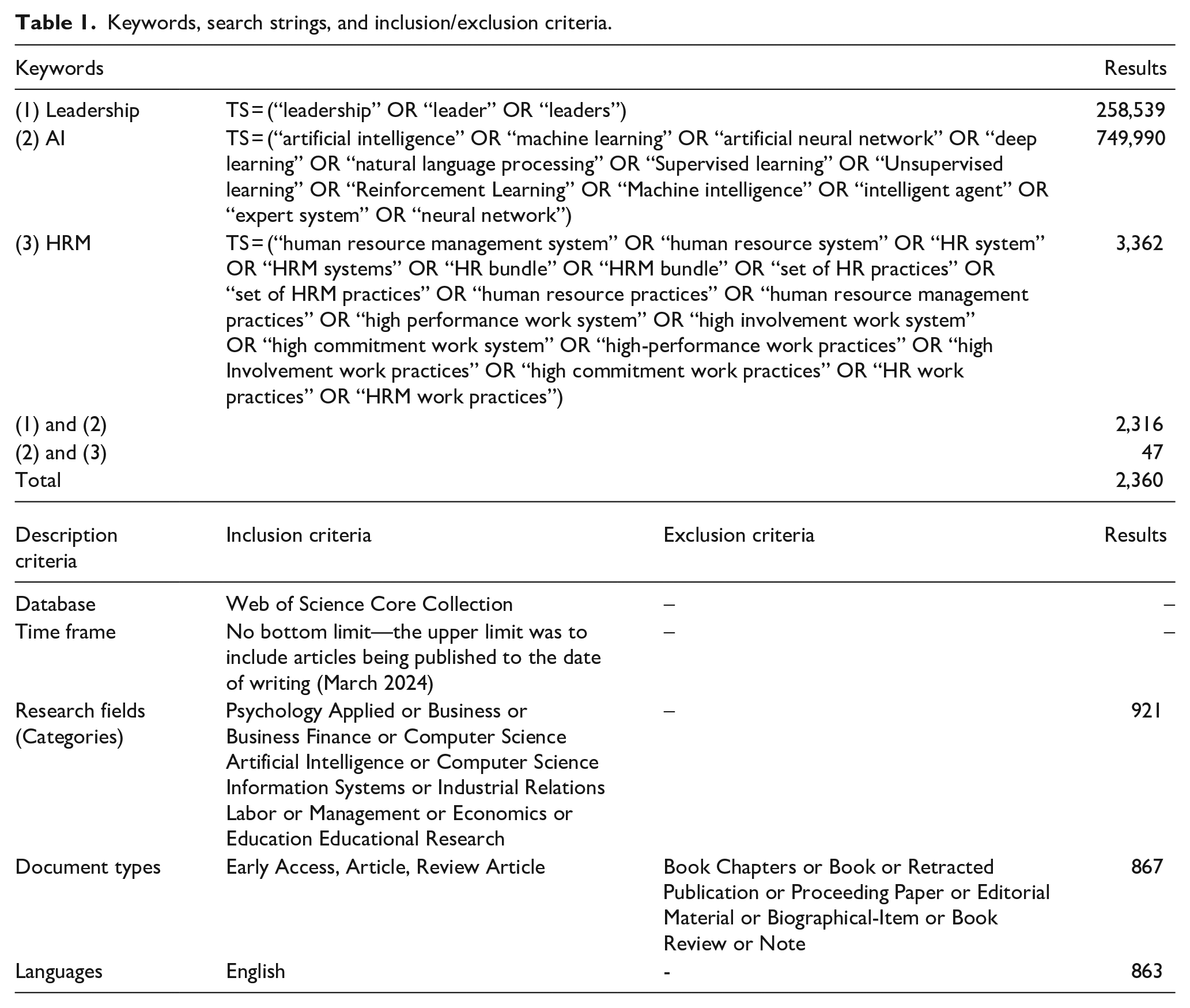
Our study utilizes a comprehensive bibliometric approach, employing document co-citation and bibliographic coupling without the need for manual screening of all abstracts. This choice is based on key methodological considerations specific to bibliometric research. First, co-citation analysis naturally filters out less relevant articles by focusing on citation patterns and the intellectual frameworks within a field (Small, 1973). This approach prioritizes the strongest connections in the literature. Second, implementing a well-constructed search strategy that incorporates relevant keywords and database categories is crucial for ensuring a high level of relevance in our initial dataset. By defining rigorous and precise search terms, we enhance the accuracy of our bibliometric review, as emphasized by Župič and Čater (2015).
The present network of AI in people management research
Document co-citation methods
Document co-citation focuses on how primary documents cite pairs of secondary documents together, indicating semantic similarity. Such an approach highlights two important things, namely(1) the degree of co-citation strength and (2) the visualization of the clustering of the co-cited secondary documents. Both give insights into “invisible colleges” or how groups of scholars communicate regarding a shared interest (Vogel, 2012).
First, co-citation strength refers to the frequency with which two secondary documents are co-cited by primary documents. The top 120 documents ranged in co-citation strength from 7 to 159, with an average strength of 53.2 (SD = 29.6). The higher a document’s co-citation strength, the more likely it is semantically related to other documents, and the more important is its role in the field (Small, 1973). The underlying assumption is that the co-citation of secondary documents (i.e., referred to in the same primary document) reflects content similarities (Small, 1973). Co-citation strength is dynamic as citation frequencies change over time and older documents accumulate more citations (Batistič et al., 2017).
In addition to indicating co-citation strength, document co-citation visualizes clusters of co-cited documents. Due to a large number of unique secondary documents (42,664), we only visualized the secondary documents with the highest co-citation strength and a citation threshold >1. This allows a manageable size of documents, avoids trivial results and mitigates computational power limitations. VOSviewer was used for the co-citation, which normalizes the data via association-strength normalization analysis (van Eck & Waltman, 2014). Normalization considers that some secondary documents are more popular with more connections than less popular documents. VOSviewer then arranges the secondary documents in a two-dimensional space such that strongly related nodes (i.e., papers) are located close to each other while weakly related nodes are further apart. The papers are then assigned to a cluster—a set of closely related papers and the clusters are visualized with different colors to indicate differences.
Document co-citation results
The co-citation network is visualized in Figure 1 and summarized in Table 2. The 120 secondary documents were published between 1974 and 2022. Major outlets include Automatica (n = 8), Academy of Management Review (n = 4), California Management Review (n = 4), IEEE Transactions on Automatic Control (n = 4), IEEE Transactions on Neural Networks and Learning Systems (n = 4), International Journal of Information Management (n = 4), and Strategic Management Journal (n = 4). The results of the document co-citation analysis show six clusters or knowledge domains. Documents in Cluster 1 (green), Cluster 2 (red), Cluster 4 (yellow), and Cluster 5 (purple) appear to be closely connected, all dealing with AI applications in management domains, while documents in Cluster 3 (dark blue) and Cluster 6 (light blue) seem more dispersed and disconnected, representing more technical AI clusters.
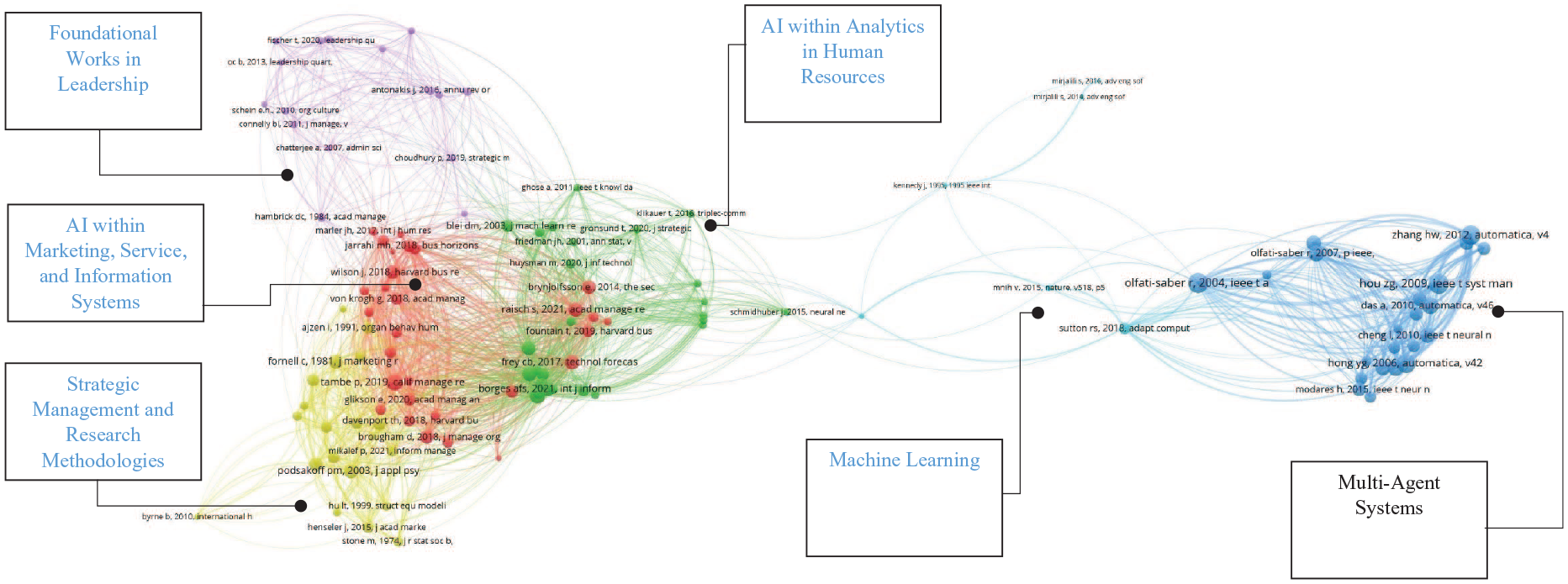
Co-citation network containing the 120 most important secondary papers within six clusters.
Results of the bibliometric analysis for the past field of people management and AI.
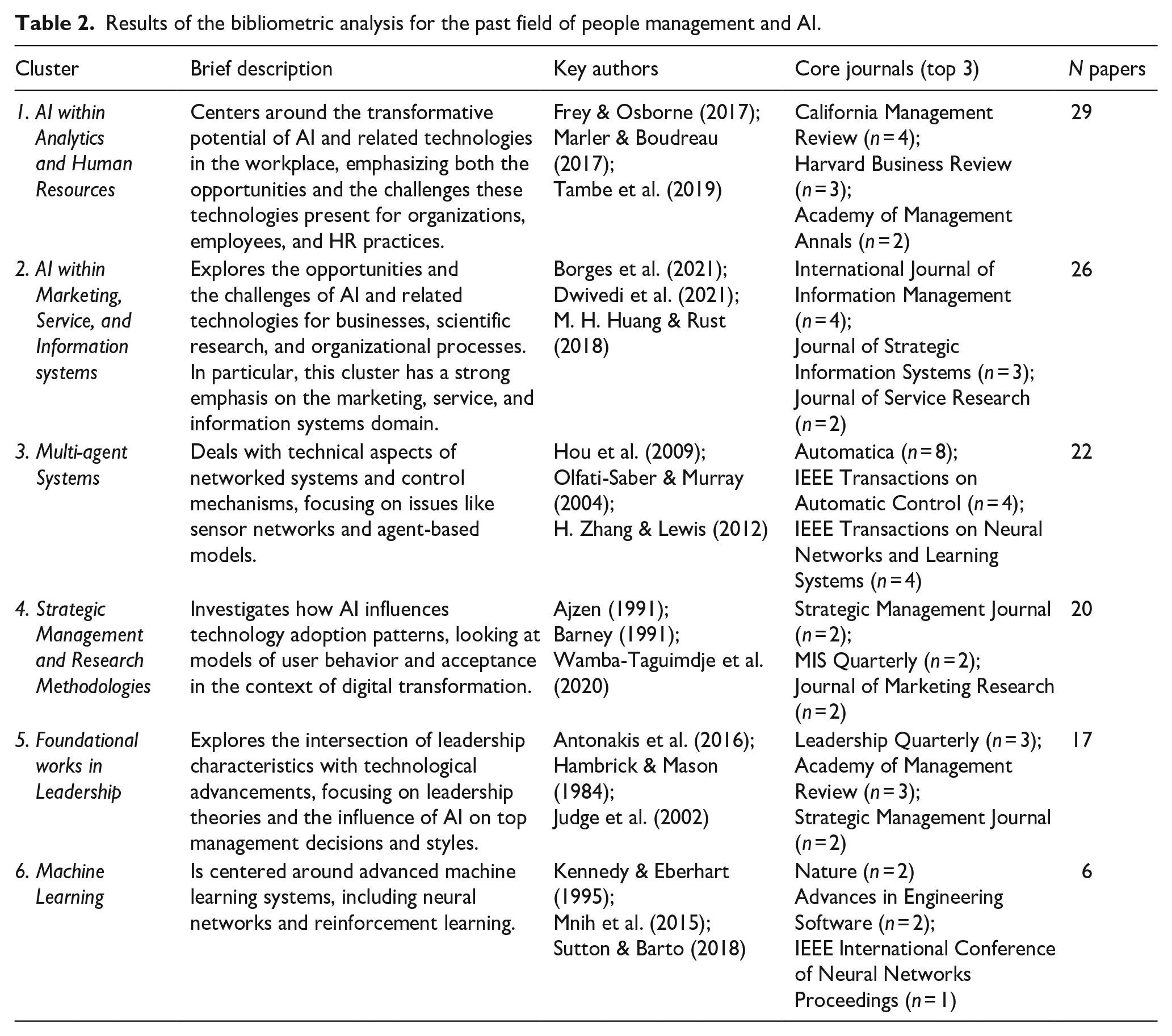
Cluster 1 is the largest co-citation cluster and focuses on AI within Analytics in Human Resources. The document with the largest co-citation strength (CCS) in this cluster is Tambe et al. (2019; CSS = 116), a conceptual piece discussing the challenges and opportunities of AI in HRM. It argues that the application of AI in HRM lags behind other business domains due to the complexity of HR phenomena. Most of these documents focus on topics such as HR analytics (Angrave et al., 2016; Kellogg et al., 2020; Marler & Boudreau, 2017), human-AI interaction (Arslan et al., 2022; Gombolay et al., 2015), and the future of work. This latter theme is represented by seminal works like Frey and Osborne (2017) and Raisch and Krakowski (2021). Frey and Osborne (2017) discuss technology and employment, suggesting potential job loss due to AI in organizations, while Raisch and Krakowski (2021) imply that technological applications like AI, which have the potential to enhance autonomy (e.g., saving work time), often end up restricting that very same autonomy (e.g., layoffs due to saved work time). To a lesser extent, leadership is also addressed in this cluster, for example, in De Cremer’s (2020) book on leadership qualities needed to manage AI. Furthermore, the presence of Gioia et al. (2013) suggests the emphasis in this cluster is more on qualitative research.
Cluster 2 discusses AI within Marketing, Service, and Information Systems. The document with the largest CCS in this cluster is Dwivedi et al. (2021; CSS = 105). Similar to Tambe et al. (2019) in the previous cluster, this work presents a multidisciplinary expert account of the challenges and opportunities of AI, highlighting issues such as explainability and the impact of AI within small organizations, public organizations, and emerging markets, where resources are scarce compared to larger private organizations in established markets. Other overview works in this cluster are more specific and deal with the implications of AI for information systems research (Benbya et al., 2021; Huysman, 2020), where a key question is how AI distinguishes itself from other technologies examined in this discipline. Another group of papers focuses on AI in service (M. H. Huang & Rust, 2018) and marketing research, for example by looking at specific applications like the mining of consumer reviews (Archak et al., 2011).
Cluster 3 represents one of the more “technical” clusters, dealing with Multi-agent Systems. Multi-agent systems are defined as “loosely coupled network[s] of problem solvers that interact to solve problems that are beyond the individual capabilities or knowledge of each problem solver” (Argoneto et al., 2008, p. 41). These agents or problem solvers can, for example, be robots or software programs (e.g., group of flying drones or simulated agents in a program). The document with the largest CSS in this cluster is Hou et al. (2009; CCS = 176), which also has the largest CSS in the entire co-citation network. This article, along with many others in the cluster, addresses the consensus problem in multi-agent systems. This problem involves coordinating different agents in a system or network to agree on certain actions or values (e.g., a collection of vehicles performing a shared task; Fax & Murray, 2004). This coordination is often complicated by real-world obstacles and uncertainties (e.g., uneven terrain). Papers in this cluster propose various solutions, such as using neural networks (L. Cheng et al., 2010), which draw directly on AI, robust adaptive control (H. Zhang & Lewis, 2012), and decentralized algorithms (Fax & Murray, 2004), which can be enhanced by AI.
Cluster 4 deals with Strategic Management and Research Methodologies. The document with the largest CSS in this cluster is Fornell and Larcker’s (1981) work on structural equation modeling (CSS = 95), which suggests that this is a more empirical cluster. This is supported by the presence of other important methodological works (e.g., Podsakoff et al., 2003). In terms of content, this cluster includes significant theories from strategic management, such as the resource-based view (Barney, 1991), the dynamic capabilities model (Teece et al., 1997), and institutional theory (Dubey et al., 2019). Together, these studies highlight that AI adoption is influenced by pressures from competitors, governments, and professional bodies (institutional theory), that AI can be seen as a strategic resource for competitive advantage (resource-based view), but that it also requires organizations to continually adapt, innovate, and transform their processes and resources (dynamic capabilities). In addition, this cluster includes micro-level theories related to behavioral change, such as the theory of planned behavior (Ajzen, 1991) and the technology acceptance model (Venkatesh et al., 2003), which might explain how employees respond to AI.
Cluster 5 focuses on Foundational works in Leadership. The two documents with the highest CSS in this cluster are Antonakis et al. (2016) on charismatic leadership (CSS = 36) and the upper echelons theory by Hambrick and Mason (1984; CSS = 36). The relevance of these documents is further emphasized by other papers in this cluster, which explore leader traits and characteristics, particularly those of CEOs (A. Chatterjee & Hambrick, 2007). These papers illustrate the importance of leaders who are committed to AI for its successful implementation in an organization, especially those at higher organizational levels, as upper echelons theory dictates that leader characteristics are mirrored throughout the organization. The presence of works on facial and text analysis (Choudhury et al., 2019) and critical methodological pieces (Fischer et al., 2020) suggests that this cluster employs more innovative methods.
Cluster 6, which is the smallest cluster in the co-citation network, focuses on Machine Learning. The document with the highest CSS in this cluster is Sutton and Barto (2018; CSS = 62), a seminal work on reinforcement learning. Papers in this cluster cover various algorithms and methods used in AI for optimization and learning, inspired by natural behaviors and advanced by combining multiple techniques like neural networks and reinforcement learning. Examples include particle swarm optimization (Kennedy & Eberhart, 1995), the gray wolf optimizer (Mirjalili et al., 2014), and the whale optimization algorithm (Mirjalili & Lewis, 2016).
Overall, the document co-citation analysis reveals that research on AI and people management strongly intersects with seminal discussions on the future of work (e.g., Frey & Osborne, 2017; Raisch & Krakowski, 2021), strategic management (Barney, 1991; Teece et al., 1997), and leadership (Antonakis et al., 2016; Hambrick & Mason, 1984). However, these topics are notably distinct from one another. With some notable exceptions (De Cremer, 2020), discussions on leadership rarely appear in the more HR-oriented cluster (Cluster 1), and HR insights are almost absent from the leadership-oriented cluster (Cluster 5). This separation is atypical of a comprehensive people management approach, which integrates both leadership and HR insights (Leroy et al., 2018). Furthermore, while there is some connection among the more management-oriented clusters (Cluster 1, Cluster 2, Cluster 4, and Cluster 5), their intellectual discussions seem distant from those in the more technical clusters at the edge of the network (Cluster 3, Cluster 6). To explore how future research might develop, we next adopt bibliographic coupling.
The research front network of AI in people management research
Bibliographic coupling methods
Bibliographic coupling focuses on the primary documents and what secondary documents they are currently citing (thus looking at the present). Because the primary documents are more recent than the cited secondary papers, the coupling analysis helps to detect trending discussions. The analysis investigates if two primary documents have at least one reference (i.e., secondary document) in common (Kessler, 1963). The more the bibliographies of two primary documents overlap, the larger the coupling strength, or document weight. We used the same dataset for the bibliographic coupling and visualized the data in VOSviewer, applying the same procedures as in the co-citation analysis. Of the 863 total primary documents, we again applied a cutoff point of one as the minimum number of primary document citations and visualized the primary papers with the highest coupling strength to identify active research areas.
Bibliographic coupling results
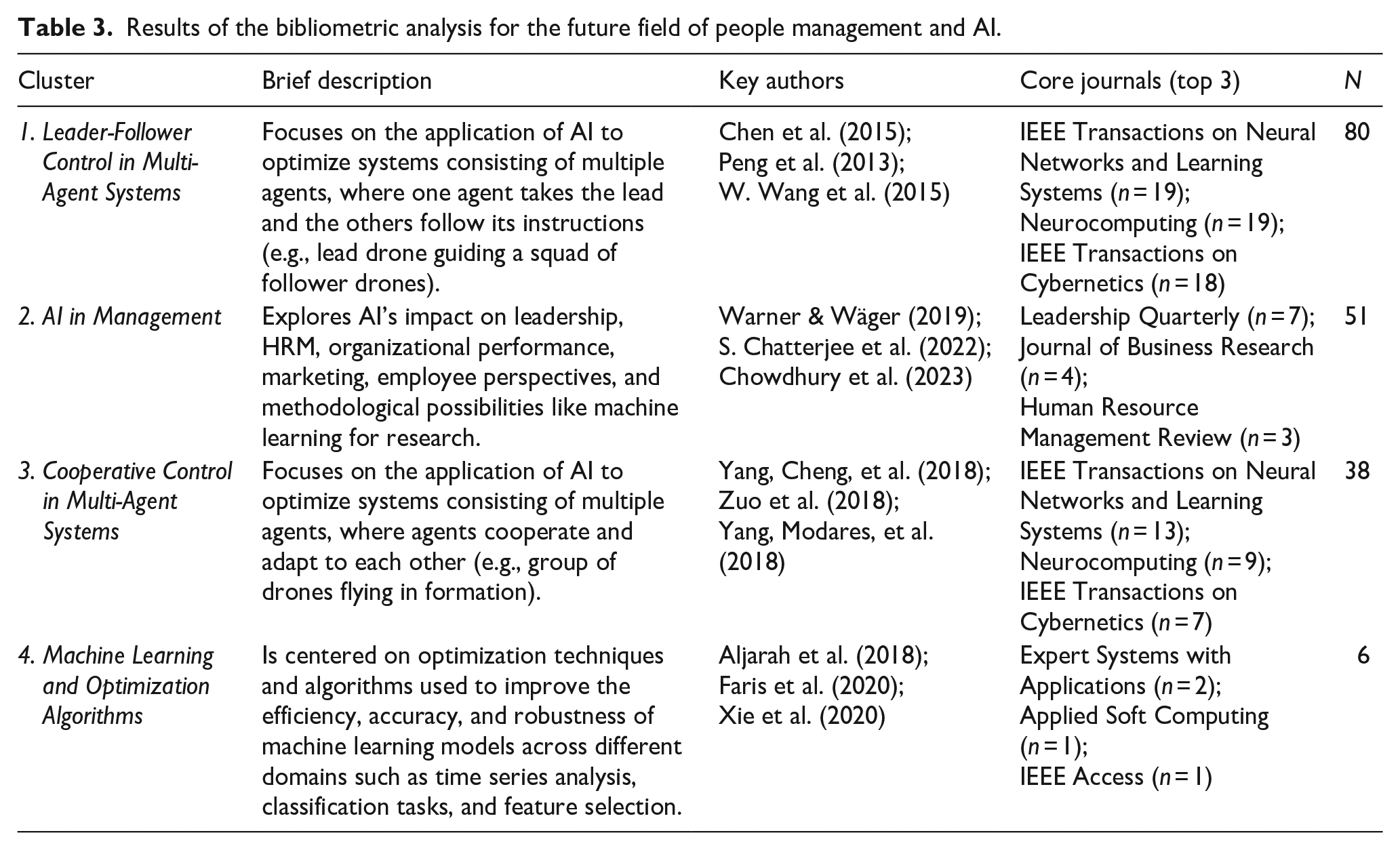
The bibliographic coupling network is visualized in Figure 2 and summarized in Table 3. The 175 secondary documents were published between 2010 and 2024. Major outlets include EEE Transactions on Neural Networks and Learning Systems (n = 32), Neurocomputing (n = 28), IEEE Transactions on Cybernetics (n = 25), IEEE Access (n = 9), and Leadership Quarterly (n = 7), which is the only management journal in the top 5. Regarding the overall structure, the coupling analysis revealed four bibliographic coupling clusters. Cluster 1 (red) and Cluster 3 (blue) represent two closely connected “technical” clusters, concerned with multi-agent systems. On the right side of Figure 3, we observe a disconnected Cluster 2 (green), which represents a more “management-oriented” cluster. Cluster 4 (yellow), a smaller “technical” cluster on machine learning and optimization algorithms, stands in the middle and acts as a bridge between the other clusters. Six critical papers broker between clusters, all of which employ different AI techniques including machine learning (Lee et al., 2023; H. Liu et al., 2021), reinforcement learning (Zhao et al., 2020), feature selection algorithms (Faris et al., 2020), and optimization algorithms (Xie et al., 2020). We deduce that these might be the specific techniques most suitable for research on AI and people management in the future. These techniques are applied to problems such as collision avoidance (Sui et al., 2021) and formation control (Faris et al., 2020) in an uncertain environment, inferring personality traits from online reviews (H. Liu et al., 2021) and the application of AI in leadership research (Lee et al., 2023).
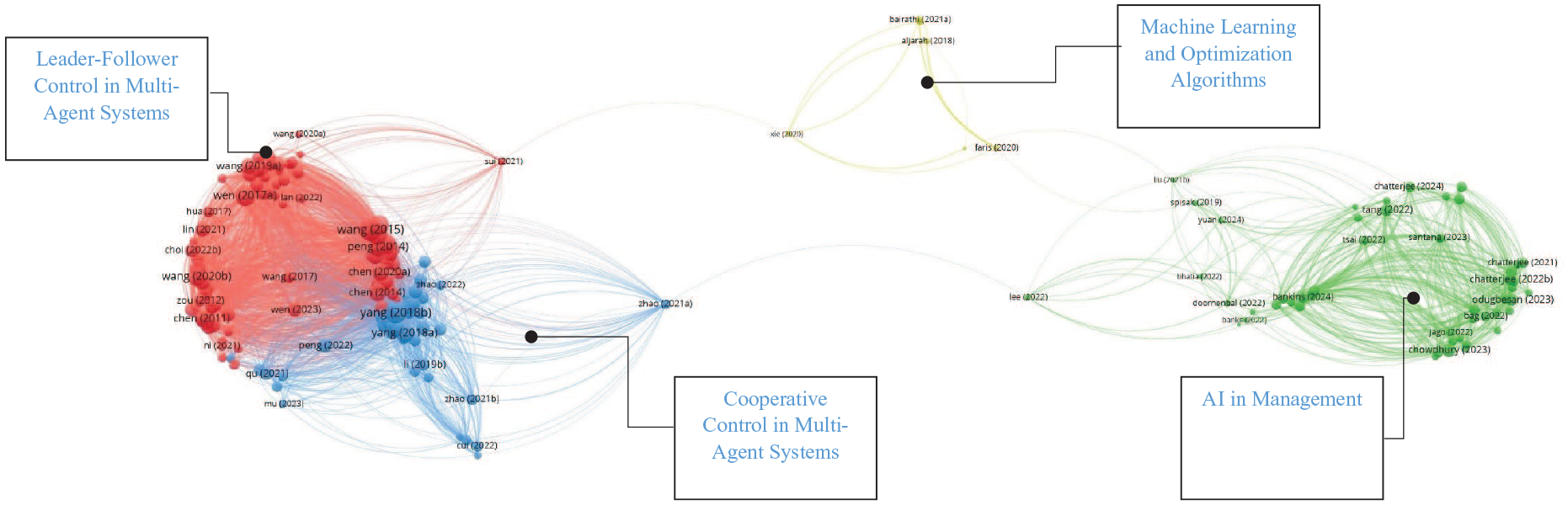
Bibliographic coupling network containing the 175 most important secondary papers within four clusters.
Results of the bibliometric analysis for the future field of people management and AI.
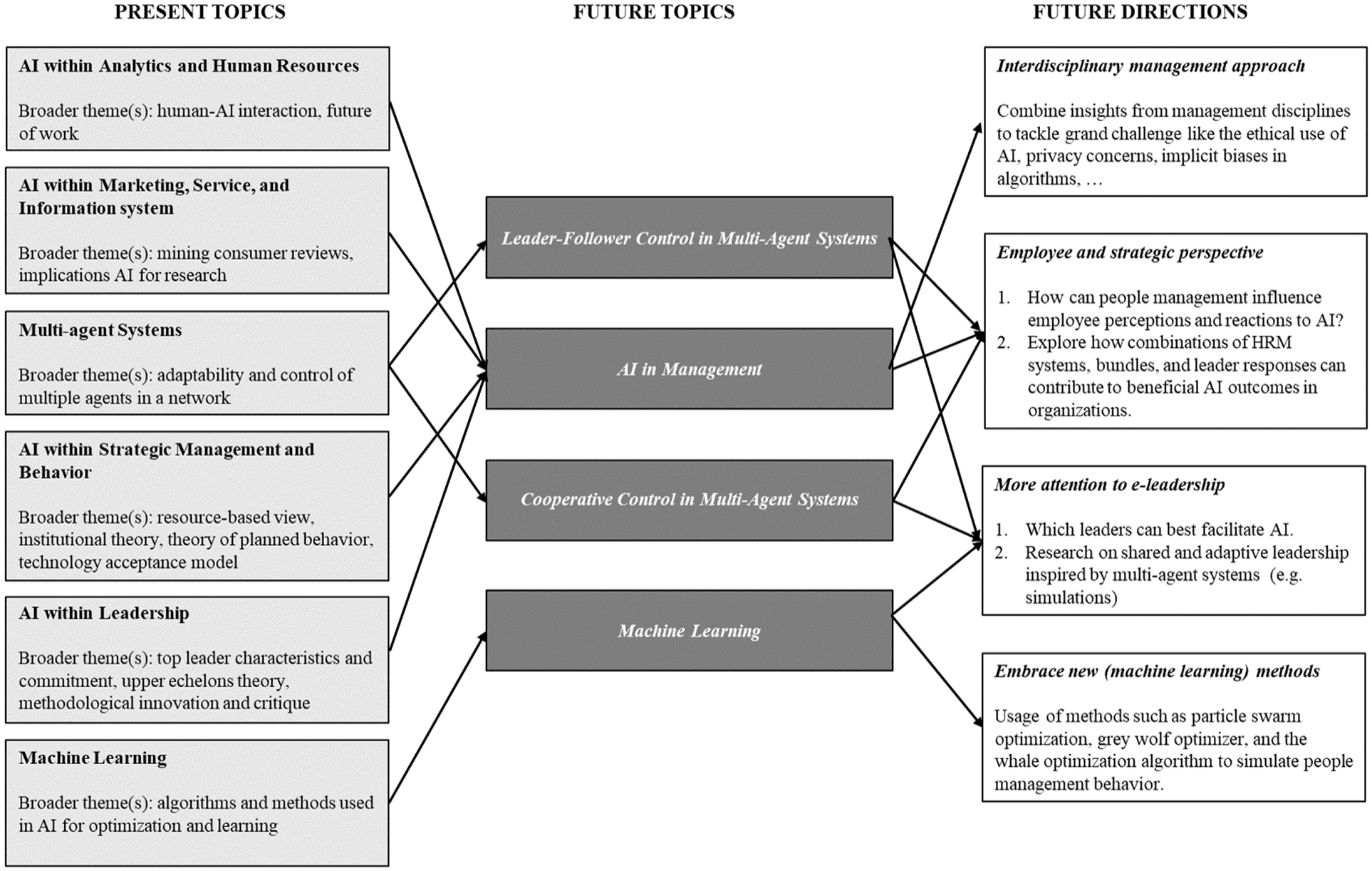
Comprehensive framework of the intersection between AI, people management, and leadership research.
Cluster 1 deals with Leader-Follower Control in Multi-Agent Systems. This cluster explores the application of AI to optimize multi-agent systems where one agent takes the lead and the others follow the leader’s state (e.g., lead drone guiding a squad of follower drones). The document with the largest coupling strength (CS) in this cluster is W. Wang et al. (2015; CS = 430), a work that develops a method to address the consensus problem in multi-agent problems, which was also highlighted in Co-citation Cluster 3. Most papers within this cluster explore a variety of optimization strategies including reinforcement learning (Sui et al., 2021; Yan et al., 2020), neural networks (Y. Zhang et al., 2020), fuzzy logic (Ren et al., 2019), and adaptive control strategies (P. Wang et al., 2023). These strategies are applied to simulated multi-agent systems, or autonomous vehicles, addressing challenges such as communication, collision avoidance, consensus control, and system stability. Overall, this cluster is the largest (n = 80 secondary papers) and shows great topical similarity with Co-citation Cluster 3, emphasizing the continued importance of the cluster topic in the future.
Cluster 2 deals with AI in Management. The document with the largest CS in this cluster is Chowdhury et al. (2023; CS = 158), which reviews the literature on the organizational resources required to successfully adopt and implement AI in HRM, and presents an AI capability framework, providing a structured approach for organizations to develop the necessary capabilities to harness AI effectively. Other papers in this cluster deal with a diversity of issues. First, AI and its implications for the type of leadership that is required, tapping into discussions on e-leadership (Banks et al., 2022; Rožman et al., 2023). Second, AI and its implications for strategic HRM (Bag et al., 2022; Yuan et al., 2024). Third, AI and organizational performance, dealing with AI from a more strategic perspective (Basu et al., 2023; Chowdhury et al., 2023). Fourth, AI and marketing, delving into issues like customer relations management (S. Chatterjee et al., 2022; Koenigstorfer & Wemmer, 2022). Fifth, AI and the employee perspective, dealing with topics like employee AI awareness (Ding, 2021) and AI-induced job crafting (B. Cheng et al., 2023). Finally, some papers tap into the methodological possibilities of AI applications like machine learning for research (Doornenbal et al., 2022; Spisak et al., 2019).
Cluster 3 emphasizes Cooperative Control in Multi-Agent Systems. The document with the largest CS in this cluster is Yang, Cheng, et al. (2018; CS = 402), which presents an approach combining advanced control techniques and reinforcement learning to manage groups of agents, ensuring they remain within a safe area. This cluster shares a strong focus on multi-agent systems, neural networks, and reinforcement learning with Co-citation Cluster 3 and Bibliographic Coupling Cluster 1. However, Co-citation Cluster 3 takes a more general approach and coupling Cluster 1 focuses on leader-following dynamics. In contrast, Cluster 3 is concerned with cooperation and adaptation among leaderless agents (e.g., group of drones maintaining formation). It delves into topics such as formation control and output regulation (e.g., H. Liu et al., 2020; Yu et al., 2021), featuring more theoretical development and simulation-based research compared to the more practical orientation of Cluster 1 (e.g., H. Liu et al., 2021).
Cluster 4 focuses on Machine Learning and Optimization Algorithms. The document with the highest CS in this cluster is Aljarah et al. (2018; CS = 154), which deals with enhancing feature selection. The papers in this cluster cover topics such as developing advanced metaheuristic algorithms (L. Zhang et al., 2023), and training neural networks (Bairathi & Gopalani, 2021). This cluster’s focus on machine learning is similar to Co-citation Cluster 6. However, the two clusters differ in the specific algorithms they emphasize and their applications. Co-citation Cluster 6 mostly references established algorithms like particle swarm optimization, the gray wolf optimizer, and the whale optimization algorithm. In contrast, Bibliographic Coupling Cluster 4 highlights newer optimization algorithms, such as the salp swarm algorithm and the bare-bones particle swarm optimization. Moreover, the applications in Co-citation Cluster 6 are broader and more general, while Bibliographic Coupling Cluster 4 targets more specific applications, such as medical imaging (L. Zhang et al., 2023).
Overall, the bibliographic coupling analysis reveals three main observations. First, while co-citation analysis distinguishes different management clusters, the bibliographic coupling analysis suggests that these management clusters are likely to become more integrated in the future. This integration has significant implications. On one hand, it supports the convergence of leadership and HRM into a unified people management approach, addressing the current separation between these fields. This could suggest a consolidation of research efforts and a more integrated approach to management studies to AI. On the other hand, it raises a concern that management studies of AI might become more homogeneous, potentially losing their unique multidisciplinary perspectives. However, for people management, this integration is currently not a cause for concern. Nearly a third of the papers in this cluster (15 out of 51 secondary papers) focus on people management topics, indicating a continued representation in this area. Second, research on multi-agent systems will likely grow in importance and split into different more specialized subfields. This indicates a deeper and more focused exploration of the topic, addressing specific challenges and advancements in this area. Finally, machine learning seems to remain a pivotal topic in the future, with the potential of bridging management research with research on multi-agent systems to gain a better exploration and exploitation of AI.
Discussion and conclusion
The fields of leadership and HRM are dispersed, especially in a fragmented literature like AI. To that end, this article adopted co-citation analysis and bibliographic analysis to offer a unique insight into the present and research front of the intellectual discussions at the crossroads of AI and people management. Below we summarize five key trends, followed by their implications for research, before concluding with some future research directions.
Key trends
Convergence of management research on AI
While current scholars lament the disjunction between research on leadership and HRM (Leroy et al., 2018), particularly in the study of workplace technology such as AI (Bauwens & Cortellazzo, 2025; Khoreva et al., 2022), our bibliographic coupling analysis predicts an integration of management research efforts with AI. This is promising, as AI could address many organizational challenges that necessitate a multidisciplinary approach (e.g., contributions from HRM, leadership, marketing, and information systems researchers) and a multilevel perspective (Bankins et al., 2024). Examples of such challenges in our analyses include sustainability (Bag et al., 2022), innovation (Lee et al., 2023), and the ethics surrounding AI and workplace digital transformation (De Cremer & Narayanan, 2023; Varma et al., 2023). The integration of leadership and HRM, in particular, is likely to generate positive synergies, such as in areas like employee responses to human versus AI supervisors (Lanz et al., 2024) and the combined role of leadership and HRM in the implementation of AI applications in recruitment (Islam et al., 2022) and HR analytics (X. Huang et al., 2023). However, given that the bibliographic coupling analysis suggests an integration that extends beyond leadership and HRM to include areas such as information systems and marketing, we caution that there could be risks associated with the predicted consolidation of management research on AI. One major risk is that people management might lose some of its unique focus and contributions. For instance, with notable exceptions (Bag et al., 2022), research on strategic HRM systems or bundles appears to be receding into the background in favor of research on isolated practices. While individual HRM practices play a key role in organizational functioning and are typically guided by an overarching strategy, focusing on HRM systems or bundles emphasizes how these practices interact and reinforce one another, especially in the context of implementing or responding to AI. In other words, while individual practices are important, their full impact is best understood within the broader framework of HRM systems or bundles (Boon et al., 2019).
Most key discussions are not in management journals
Research at the intersection of AI and people management transcends disciplinary boundaries, extending beyond traditional management journals. Our bibliographic coupling analysis suggests that contributions from journals like Journal of Business Research, Human Resource Management Review, and Leadership Quarterly are likely to persist, but future discussions are poised to flourish in computer science journals like IEEE Transactions on Neural Networks and Learning Systems and Neurocomputing. This is in line with earlier observations about scholars in computer science and engineering increasingly committing themselves to people management topics (Kim et al., 2021; Strohmeier & Piazza, 2015). This raises two issues. First, while the involvement of more “technical” domains in people management issues can lead to cross-fertilization and bring fresh perspectives, there is also a possibility that this could inadvertently divert attention from important topics and questions that are central to people management scholars (Caldwell, 2010; Charlwood & Guenole, 2022). Second, there is the risk of a growing disconnect between more data-driven scholars in information systems and operations versus more theory-driven management scholars (Tambe et al., 2019). This follows and extends an earlier review study about big data, analytics and performance (Batistič & van der Laken, 2019) and is illustrated in the bibliographic coupling analysis, where we observed that management-oriented clusters had multiple references to key theoretical works (e.g., Ajzen, 1991; Barney, 1991; Dubey et al., 2019; Teece et al., 1997; Venkatesh et al., 2003), while in “technical” clusters, such theoretical references were sparse or absent. However, we should also nuance such claims. Data-driven approaches could influence theory by shedding light on important relations and introducing more inductive research to people management research (Lengnick-Hall et al., 2018; McAbee et al., 2017). Therefore, more interdisciplinary collaboration between data-driven technical clusters and theory-driven management clusters might be necessary to reclaim the field, but also to ensure sufficient integration of technology in existing leadership and HRM theories (Basu et al., 2023; Bauwens & Cortellazzo, 2025; Kim et al., 2021; Quaquebeke & Gerpott, 2023).
Research on multi-agent systems to set the tone
Our analyses revealed that research on multi-agent systems is highly dominant in both the co-citation analysis (present) and the bibliographic coupling analysis (research front). Currently, this line of research is represented by a single cluster. However, our bibliographic coupling analysis predicts the emergence of multiple specialized clusters within the network, such as one focused on leader-follower control and another on cooperative control (cf. Rocha et al., 2023). While these clusters are large, they remain disconnected from leadership, HRM, and other management disciplines. Given the prominence of multi-agent systems and their disconnection from management fields, it is important to explore what people management can learn from multi-agent research. This field relies heavily on simulation studies to assess how leaders or groups of followers can make optimal decisions in uncertain environments. Such simulations could be valuable for mimicking certain behaviors and organizational situations, allowing us to assess the effectiveness of various leadership-HRM constellations, either powered by AI or designed to enhance certain AI capabilities within organizations (Chowdhury et al., 2023). For example, using AI to determine what leadership approaches and HRM systems are required to respond to the dynamic business environment. The emphasis of multi-agent research on collaborative dynamics can also inform our understanding of informal leadership approaches such as emergent, shared, or participative leadership in simulations with HRM and AI. Such calls are not new (see, for example, Will, 2016), but they remain unanswered.
Machine learning to connect management and technical disciplines
Both the co-citation analysis (present) and the bibliographic coupling analysis (research front) reveal a small cluster focused on machine learning and/or optimization algorithms. The central position of this cluster, bridging more “technical” clusters on multi-agent systems and more management-oriented clusters, suggests that machine learning could play a crucial role in integrating these different disciplines. People managers can enhance their existing HR analytics and selection decision algorithms by leveraging machine learning techniques (Marler & Boudreau, 2017). In addition, the emphasis on reinforcement learning within the machine learning clusters highlights the importance of feedback and adaptation. This implies that AI-driven people management could benefit from an iterative learning approach, continuously adapting to feedback mechanisms within organizations, much like how algorithms evolve over time (Stone et al., 2020). Overall, we believe that research on multi-agent systems and management can be effectively bridged by adopting specific algorithms and learning principles from the machine learning cluster.
AI in practice versus AI as a research method
AI has not only become a central research topic but also an increasingly prevalent research method. Currently, it appears that scholars in strategic management, marketing, service, and technical domains such as computer science are primarily the ones adopting these methodological innovations. In contrast, people management scholars tend to adhere to more traditional research methods. This trend is evident in the co-citation analysis, where the strategic management cluster frequently references advanced AI techniques like latent Dirichlet allocation (Blei et al., 2003) and deep learning in neural networks (Schmidhuber, 2015). These methods heavily incorporate AI. However, the leadership and HR co-citation cluster focuses more on organizational applications of AI, such as AI-driven HR analytics and human–AI interactions, with occasional references to facial and text analysis in leadership research (e.g., Arslan et al., 2022; Marler & Boudreau, 2017). Fortunately, the bibliographic coupling analysis suggests that this divide may narrow in the future. For example, Spisak et al. (2019) and Doornenbal et al. (2022) highlight the advantages of machine learning (e.g., lasso and random forests) over mainstream regression approaches.
Theoretical contributions
This article offers several contributions. First, this article sheds light on the current and research front topics at the intersection of AI and people management, specifically focusing on strategic HRM and leadership and how both can overcome AI-related challenges (Tambe et al., 2019) and go beyond past reviews that are narrow in scope (e.g., Khoreva et al., 2022). Regarding current topics, our co-citation analyses reveal ongoing discussions within the HRM literature (Co-citation Cluster 1), encompassing broad debates on the future of work, fairness, human-AI interaction, and the application of AI in HRM processes like HR analytics. In the leadership literature (Co-citation Cluster 5), this integration is reflected in discussions on top leader characteristics and innovative methods. For future topics, we predict an increased focus on the employee perspective, e-leadership, novel methodological possibilities of AI, and a more strategic approach that considers people management alongside other organizational domains, such as marketing and information systems (Bibliographic Coupling Cluster 2).
Second, we contribute to advancing both theory and practice in strategic HRM. Our review of people management and AI aligns with earlier studies on HRM and AI, highlighting the lack of research on HRM systems compared to specific practices (e.g., Renkema, 2022). This gap is significant, as the HRM literature emphasizes the importance of adopting a comprehensive approach that explores synergies and complementarities between practices, rather than examining individual HR practices in isolation (Boon et al., 2019). To address this issue, we offer several future research recommendations such as employing optimization algorithms to test and refine various HRM system configurations (Prikshat et al., 2023), using machine learning techniques to explore more complex relationships and alternative methods for drawing causal inferences between HRM systems and their outcomes (Valizade et al., 2024), and integrating AI into existing HRM systems (Pan & Froese, 2023).
Third, we believe that our results provide novel insights into how AI can foster and benefit from a unified approach to people management. This is a significant contribution, as the term “people management” has often been used in past research to denote either the HRM or leadership perspective exclusively. While our co-citation analysis confirms that current discussions on leadership and HRM are distinct and clustered separately, our bibliographic coupling analysis predicts that these fields will likely converge into a broader management cluster in the future. This supports theoretical propositions that (1) AI can bridge the gap between leadership and HRM and that (2) the field will benefit from a multidisciplinary and strategic approach that triangulates people management insights with those from related fields like marketing and information systems.
Finally, our analysis extends beyond the typical business and psychology-focused reviews, offering a cross-domain perspective that provides several advantages. For starters, it enabled us to (1) identify distinct technical clusters, such as those on multi-agent systems and machine learning, in both the co-citation and bibliographic coupling analyses; (2) establish connections between these technical clusters and the AI, HRM, and leadership clusters, highlighting their relevance (while most management clusters are distinct, we found that technical clusters are more dispersed and less integrated with management topics. However, this may change in the future, with clusters like machine learning potentially acting as bridges between multi-agent systems and management applications); (3) uncover specific techniques, such as reinforcement learning and feature selection, that offer promising new research avenues in HRM and leadership, which might have been overlooked in reviews focused solely on management.
Future directions
To further enrich the ongoing discourse, we propose four main research directions, which are detailed in Figure 3, providing an integrative framework of our findings and future research directions.
AI calls for an interdisciplinary management approach
In the co-citation analysis (present), we observed that HRM, leadership, marketing, and information systems are represented within distinct clusters. However, the bibliographic coupling (research front) predicts a convergence of these clusters into a single, comprehensive management cluster. This anticipated convergence may indicate that addressing grand challenges, such as AI, requires a broader, interdisciplinary approach that spans multiple levels and management disciplines (Bankins et al., 2024). One such grand challenge is the ethical use of AI, encompassing issues ranging from privacy concerns to implicit biases in algorithms (Tambe et al., 2019). This area has seen significant recent developments (Charlwood & Guenole, 2022; Varma et al., 2023), and the continued prominence of works on AI and ethics within the management cluster, as revealed by the bibliographic coupling analysis (e.g., De Cremer & Narayanan, 2023), along with real-world developments such as the implementation of the European Artificial Intelligence Act (European Commission, 2024), suggest that this topic will remain a key focus in the near future. For instance, while marketing departments can leverage AI for customer analytics, they must also address potential biases in customer segmentation and targeting. To do so, marketing could collaborate with HR departments to manage the human aspects of AI implementation, such as training and change management, and with IT departments to ensure the use of explainable, bias-free algorithms. Indeed, future research could explore how HR, marketing, IT, and other management disciplines can work together to safeguard the ethical use of AI, addressing issues of privacy, bias, fairness, and compliance. Such collaborations are crucial to ensure that AI is implemented in a manner consistent with organizational strategies and ethical values.
Continue the development of an employee and strategic perspective
While management clusters may converge in the future, HRM should maintain its unique perspective within the broader people management approach. We identify two key future directions: a focus on employee perceptions and strategic HRM, which can be integrated into a multilevel inclusive framework. The emphasis on employee perceptions is evident in both co-citation (e.g., Arslan et al., 2022) and bibliographic coupling analysis (e.g., Ding, 2021; Varma et al., 2023). AI integration poses significant challenges to employee perceptions and reactions (Del Giudice et al., 2023; Malik et al., 2023), often causing anxiety and inefficiency that hinder AI’s full potential (Del Giudice et al., 2023). Therefore, research at the intersection of AI and HRM should focus on understanding how employees perceive and experience AI to design better interventions and develop skills that build resilience against AI’s challenges (Santana & Díaz-Fernández, 2023).
Leadership plays a crucial role here, as both HRM and leadership aim to shape desired attitudes and behaviors (Leroy et al., 2018), especially in the context of modern technology (Bauwens & Cortellazzo, 2025). Leadership research already highlights the importance of employee perceptions (Banks et al., 2022; Boon et al., 2019), and effective leaders are essential for cultivating a culture that embraces technological innovation. They can drive AI adoption in HRM by communicating its benefits, providing training, and addressing ethical concerns, thereby enhancing employee engagement and trust in AI-driven processes (Zhai et al., 2024).
The second direction, strategic HRM, which focuses on research concerning HR bundles and systems, is notably absent from the current landscape. In the co-citation analysis (present), studies in this domain are not mentioned, and in the bibliographic coupling analysis (research front), while indicating potential future interest, this line of research is represented by only a single paper (Bag et al., 2022). Most studies in the analysis concentrate on isolated practices such as recruitment (Islam et al., 2022). This shift away from a strategic focus is concerning, as it neglects the core of HRM research (Boon et al., 2019). To that end, we offer a couple of suggestions for scholars of people management and AI to engage more deeply with HRM systems and practices. One suggestion is the use of optimization algorithms to test and refine different HRM system configurations (e.g., Prikshat et al., 2023). Finding the optimal combination of HR practices in an HRM system can be challenging due to the interaction of various variables and constraints. However, optimization algorithms like particle swarm optimization (Kennedy & Eberhart, 1995) can be employed to explore different HRM configurations in a multidimensional space and identify which combinations contribute to specific outcomes. Another suggestion is using machine learning techniques to broaden the largely positivist, null-hypothesis-driven paradigm in strategic HRM research. Machine learning offers several advantages over traditional analytical methods, such as the ability to test complex relationships (e.g., nonlinearity, multiple dependencies), handle very large datasets, and uncover new opportunities for exploratory research (Valizade et al., 2024). For example, random forest analysis (cf. Doornenbal et al., 2022) can be used to explore interactions or dependencies between different HRM practices within a larger HRM system that might be overlooked by traditional regression methods or in smaller datasets. Another suggestion is to investigate how the integration of AI into HRM systems affects the effectiveness of these systems and the alignment between their different practices. For example, Tambe et al. (2019) and Renkema (2022) suggest that AI-based performance management systems could help in identifying successful employee characteristics that can then inform selection and recruitment or training and development. All of these suggestions can enhance our understanding of HRM systems, their individual practices, and outcomes, while also guiding organizations on effective implementation strategies.
Finally, both the exploration of employee experiences with AI and the strategic HRM perspective could be integrated into a novel multilevel people management framework. Although developing such a framework is beyond the scope of the present study, this could be the focus of future research. Researchers might consider using the AI capability model by Chowdhury et al. (2023) as a foundation, as it already addresses the organizational (e.g., technical infrastructure, leadership), team (e.g., team coordination, team structure), and individual levels (e.g., job satisfaction, motivation, trust). However, this model does not incorporate specific HRM systems, bundles, or practices, a gap that future studies could address.
More attention to e-leadership in people management discussions of AI
While discussions on e-leadership are absent in the co-citation analysis (present), the bibliographic coupling analysis (research front) indicates that this topic is gaining momentum (Banks et al., 2022). E-leadership refers to leadership that is mediated by information technology. In recent years, it has become a catch-all term for distilling the characteristics associated with effective leadership in the context of technology (Bauwens & Cortellazzo, 2025). A significant avenue for future research involves exploring how leaders (and which type of leaders) can best facilitate the adoption of AI (Quaquebeke & Gerpott, 2023) and how organizations can leverage AI to automate certain leadership processes (Lanz et al., 2024). To advance this field and foster stronger connections with technical clusters, scholars in people management can draw insights from research on multi-agent systems. For instance, studies on leader-follower control in multi-agent systems focus on how leaders and followers adapt to changing environments, often utilizing simulations to recreate these scenarios. In addition, research on cooperative control in multi-agent systems highlights that leadership is not necessarily hierarchical but can emerge from collaborative dynamics among followers. Adaptiveness and shared leadership have long been identified as crucial components of e-leadership (Bauwens & Cortellazzo, 2025), and simulations inspired by multi-agent systems offer valuable tools to test and refine these theoretical propositions.
Embrace new (machine learning) methods
Our bibliometric review demonstrated a dispersion between management scholars and those in technical domains. Given the central position of machine learning the respective networks and earlier calls to expand the methodological toolbox of management researchers (Batistič & van der Laken, 2019; Doornenbal et al., 2022; Spisak et al., 2019), we advocate for the adoption of innovative research methods to address real people management problems and help mature the field. Applied studies and the prominence of machine learning techniques in the literature underscore the potential of methods such as particle swarm optimization (Kennedy & Eberhart, 1995), the gray wolf optimizer (Mirjalili et al., 2014), and the whale optimization algorithm (Mirjalili & Lewis, 2016). These nature-inspired algorithms are well-suited for simulating actual behavior. Furthermore, some of these algorithms incorporate hierarchical structures and roles (e.g., alpha and beta wolves in the gray wolf optimizer), aligning with certain people management dynamics and behaviors in organizations. This is a particular area where leadership and HRM scholars could jointly benefit (Minbaeva, 2021). HR managers can enhance their existing HR analytics and selection decision algorithms by leveraging machine learning techniques (Angrave et al., 2016), with leadership providing essential support for implementing these technologies and guiding strategic decision-making (Bauwens & Cortellazzo, 2025). Alternatively, machine learning can be used to simulate and adapt specific HR and leadership scenarios, such as predicting the potential outcomes of various recruitment or training strategies, to optimize their approaches. However, long-term success in employing these methods necessitates cross-disciplinary collaboration with technical domain experts and a robust integration of theories from leadership and HRM domains. By aiding each other in the development of a comprehensive people management agenda for AI, people management scholars can retain their relevance in the evolving landscape, ensuring their contributions align with the forefront of technical domains. Scholars from leadership and AI domains are encouraged to merge technical expertise on machine learning with employee-centered perspectives from HRM (Arslan et al., 2022). Such alliances could bring vital discussions back to management outlets, elucidating how joint HRM and AI implementation can benefit from specific leadership characteristics and approaches.
Limitations
We acknowledge several limitations. First, while our bibliometric approach provides a systematic and objective overview, not manually screening all titles and abstracts may include some less relevant articles. However, manual screening is prone to researcher bias and variability in interpretation, which can compromise the objectivity and replicability of the results (Polanin et al., 2019). While the inherent filtering mechanisms of bibliometric methods (Marzi et al., 2025; Small, 1973) and our rigorous search strategy largely mitigate this risk, future studies could explore combining this with selective manual screening, aided by machine learning to reduce the workload (Burgard & Bittermann, 2023). This hybrid approach could further enhance the precision of the literature selection while maintaining the benefits of bibliometric analysis. Second, our study primarily focuses on academic journals. While this approach ensures a high level of academic rigor, since journal articles represent “certified knowledge” that has undergone thorough peer review (Ramos-Rodriguez & Ruiz-Navarro, 2004), it may not fully capture the latest developments, particularly in fields like AI where cutting-edge research often appears first in conferences. This may result in missing some recent innovations and trends presented in conference proceedings (Montesi & Owen, 2008). A final limitation of our study is the reliance on WoS, which, like any database, has its own inherent biases, such as language, regional, and disciplinary coverage. While these biases have been acknowledged in past research (Mongeon & Paul-Hus, 2016), more recent studies (e.g., W. Liu et al., 2024) note that WoS has expanded its coverage to address some of these issues and remains one of the primary databases for bibliometric analyses (Bar-Ilan, 2018).
Practical implications
Our review emphasizes the increasing importance of viewing AI in the context of leadership and HRM as interconnected domains rather than separate ones. This integrated perspective has significant implications for people management policies and practices. Organizations should strive to develop comprehensive AI implementation strategies that address both technical aspects and human elements. It is essential to recognize that the success of AI relies on effective leadership and well-designed HRM systems. This includes fostering a culture of trust and transparency surrounding AI, providing employees with the necessary training and support to adapt to AI-driven changes, and ensuring that AI systems align with ethical principles and organizational values (Chowdhury et al., 2023; Tambe et al., 2019). Furthermore, our findings suggest that organizations need to move beyond focusing solely on individual AI-driven HR practices and instead adopt a more strategic, system-wide approach. This involves aligning AI initiatives with overall business goals, integrating AI into existing HRM systems, and promoting synergies between AI and leadership development programs (Boon et al., 2019; Khoreva et al., 2022). By taking a holistic perspective, organizations can unlock the full potential of AI to enhance employee engagement, improve organizational performance, and create a more human-centered workplace.
Footnotes
Declaration of conflicting interests
The author(s) declared no potential conflicts of interest with respect to the research, authorship, and/or publication of this article.
Funding
The author(s) disclosed receipt of the following financial support for the research, authorship, and/or publication of this article: The first author acknowledges funding from an EU MarieCurie Fellowship under Grant Agreement No. 896698 for this project.
Data availability statement
Raw data supporting the findings of this study are available from the corresponding author on request.
