




Abstract
Self-employed workers worldwide encountered significant mental health challenges during the COVID-19 pandemic. Nevertheless, it remains unclear whether the pandemic has affected the mental health of the self-employed more significantly than employees. To address this question, we analyzed data from more than 4,000 self-employed individuals across the 27 European Union (EU) member states. We found that the pandemic had a more significant impact on the mental health of the self-employed in the EU, especially those working in the health and education sectors and countries with the highest stringency measures. Our findings also reveal that the pandemic has prompted self-employed individuals, particularly self-employed women, to be more open to talking about their mental health challenges at work, suggesting a shift in their perception of mental health stigma. This study highlights an opportunity and a need for EU policymakers to introduce targeted measures to support the self-employed in building back better in the post-COVID-19 world.
Introduction
The COVID-19 pandemic has caused a global health crisis, leading to adverse economic and social impacts on businesses, industries, and individuals worldwide (Batjargal et al., 2023; St-Jean & Tremblay, 2023). While governments have implemented measures such as lockdowns and curfews to contain the spread of the virus, these efforts have also resulted in severe economic downturns, making it challenging for entrepreneurs 1 and businesses to survive (Hale et al., 2021; Stephan, Rauch & Hatak, 2023).
Self-employed workers, comprising about 14% of the European Union’s (EU) labor force (Eurostat, 2019), have been hit particularly hard since the early stages of the pandemic. Compared to the employees, self-employed individuals have experienced a significant reduction in working hours (Eurostat, 2022), and, as a result, they have been seeking social support and clear guidelines for accessing governmental aid to navigate the significant challenges of running their businesses (Hansson et al., 2022). These unprecedented times have also been linked to a decline in their mental health and obstacles in their career progression (Torrès et al., 2022).
In this study, we draw on data from the 2022 EU-OSHA Flash Eurobarometer—OSH Pulse survey (EU-OSHA, 2022) to explore the differing impact on the self-employed and employees regarding work-related stress levels, as well as their openness to discussing mental health and stress-related issues at work. Our findings show that, across the 27 EU member states, the COVID-19 pandemic has had a more significant impact on the mental health of the self-employed as compared to the employees. This is particularly evident in the health and education sectors and those countries where the stringency measures to face the spread of the epidemic were more rigid. In addition, our analysis suggests that the pandemic may have disproportionately impacted self-employed women in the EU, in line with extant research from the early stages of the pandemic indicating that they faced additional challenges, such as balancing work and family responsibilities, financial uncertainty, and a lack of social support (Brieger et al., 2023; Caliendo et al., 2023). Furthermore, our findings reveal that self-employed workers, especially women, have shown an increased openness to discussing their mental health challenges due to the pandemic, suggesting a shift in their perception of mental health stigma and a greater willingness to seek help.
Our study contributes to the current body of research on self-employed well-being (Gish et al., 2022; Stephan, Rauch & Hatak, 2023; Wiklund et al., 2019) by illustrating the impact of the COVID-19 pandemic on their mental health in the 27 EU member states. In addition, we emphasize how the pandemic crisis has shaped their perceptions of mental health stigma, presenting an unexpected opportunity for policymakers to provide additional support in addressing mental health challenges in the workplace.
Literature review and hypotheses
Mental health spans a spectrum of well-being and ill-being (EU-OSHA, 2020; Gish et al., 2022). Self-employment can bring about unique mental health challenges compared to being an employee (Stephan, Rauch & Hatak, 2023), offering greater well-being resources (Shir et al., 2019; Stephan et al., 2020), while also exposing individuals to intense stressors (Baron, 2010; Rauch et al., 2018). Multiple factors, such as work characteristics, personal resources and vulnerabilities, firm and financial attributes, social support and stressors, physical work environment, and contextual factors (e.g., country), all play an important role in impacting the mental health of the self-employed (Stephan, 2018). For example, work autonomy, time flexibility, coping skills, reduced fear of failure, and social support can positively impact mental health. On the contrary, financial stress and work-family conflicts can have detrimental effects (Stephan, 2018). In addition, market and cultural factors, as well as crises, can also affect the mental health of self-employed individuals (Stephan, Zbierowski, et al., 2023).
Since the outbreak of the COVID-19 pandemic in 2020, several studies have explored its impact on the mental health of self-employed individuals and employees. For example, research from Germany indicates that in the first year of the pandemic, both self-employed individuals and employees experienced significant declines in their mental health, suggesting that the pandemic had a devastating impact on both groups (Caliendo et al., 2023). Similarly, self-employed individuals and employees in the United Kingdom reported higher financial worries during the pandemic, linked with increased stress levels (Wolfe & Patel, 2021). Conversely, Patel and Rietveld (2020) suggest that the COVID-19 pandemic has disproportionately affected the self-employed in the United States, resulting in heightened financial insecurity and psychological distress. Similarly, Yue and Cowling (2021) found that self-employed in the United Kingdom suffered more significant reductions in working hours and income during COVID-19 than waged workers, negatively impacting their well-being. Backman et al. (2023) observed a similar trend in Sweden in 2021, with entrepreneurs experiencing higher stress levels than employees due to the pandemic.
Furthermore, there is an increasing body of evidence indicating that the mental health of self-employed individuals has been particularly impacted by the COVID-19 crisis (Batjargal et al., 2023). A study conducted across 20 countries by Stephan, Rauch & Hatak. (2023) found that during the first year of the pandemic, entrepreneurs faced increased adversity and reduced well-being due to severe national lockdowns and restrictions on economic activity. Similarly, Torrès et al. (2022) observed an increase in burnout levels among French entrepreneurs during the pandemic, while St-Jean et al. (2023) suggested that the COVID-19 crisis has caused a career shock to entrepreneurs in Canada, which could lead to elevated stress levels, emotional exhaustion, and declining career commitment, potentially resulting in quitting their entrepreneurial career permanently.
Overall, there are indications that the pandemic has disrupted the previously expected positive effects (resources) and exacerbated the negative impacts (stressors or vulnerabilities) of self-employment on individuals, affecting both their well-being and ill-being as interdependent aspects of mental health (Stephan, Zbierowski, et al., 2023). The adverse effects of the pandemic on mental health appeared to be even more pronounced among self-employed women, who faced additional hurdles mainly due to increased work-family conflicts (Birhanu et al., 2022; Brieger et al., 2023; Caliendo et al., 2023; Kalenkoski & Pabilonia, 2022). Considering these insights, we hypothesize that self-employed individuals, especially women, across the EU member states experienced higher levels of work stress as a result of the COVID-19 crisis compared to their employee counterparts.
H1: Self-employed individuals in the EU (H1a), particularly self-employed women (H1b), experienced higher levels of work stress due to the COVID-19 crisis compared to employees.
Furthermore, in light of Hypothesis 1, we propose an additional hypothesis that focuses on whether the mental health stigma experienced by self-employed individuals in the EU during the COVID-19 crisis acted as a significant barrier to seeking help and support, ultimately affecting their well-being.
Mental health stigma is a combination of stereotyping, status loss, and discrimination. It includes perceived (social) stigma and personal (self) stigma affecting openness about mental health challenges and help-seeking behaviors (Tóth et al., 2023). Research conducted during the early stages of the COVID-19 pandemic emphasized the importance of self-employed individuals overcoming the mental health stigma by discussing their challenges openly and seeking help to support their well-being (Batjargal et al., 2023; Stephan et al., 2021). For example, findings by St-Jean and Tremblay (2023) indicate that Canadian entrepreneurs with access to personal and organizational resources were better equipped to handle the stress brought about by the pandemic. Personal relationships (relational resources) were beneficial in reducing stress and promoting overall well-being, while access to organizational resources helped mitigate the harmful effects of work-related stress on well-being.
Before the pandemic, existing literature indicated that self-employed individuals often avoided seeking mental health support due to concerns about the mental health stigma they might face, both personally and professionally (Cardon et al., 2011; Cubbon et al., 2021; De Sordi et al., 2022; Kameyama et al., 2011; Lunner Kolstrup et al., 2013; Torske et al., 2016). However, the unprecedented challenges posed by the COVID-19 crisis appear to have changed the narrative around mental health, suggesting that entrepreneurs’ attitudes toward mental health stigma may have evolved, resulting in greater acceptance of seeking support (Stephan et al., 2021). In this context and building on Hypothesis 1—which posits that the pandemic had a more pronounced impact on work stress levels among self-employed, particularly self-employed women—we hypothesize that during this extraordinary period, self-employed individuals across the EU member states, especially women, became more willing to discuss stress and mental health issues at work. This increase in openness is likely to be particularly noticeable when compared to the experiences of employees during the same period and in contrast to the pre-COVID era.
H2: The pandemic crisis has made it easier—compared to the pre-COVID-19 era—for the self-employed in the EU (H2a), particularly for the self-employed women (H2b), to be open to discussing stress and mental health challenges in comparison to employees.
Method
Data
This study draws on data from the Flash Eurobarometer—OSH Pulse survey, commissioned by the European Agency for Safety and Health at Work (EU-OSHA) and carried out in Spring 2022 (EU-OSHA, 2022). The survey aimed to investigate how the COVID-19 pandemic affected workers’ health and well-being and related workplace measures, also in combination with the increasing work-related use of digital technologies.
A probability sample of 27,250 working individuals (either as employees or self-employed) aged 16 and older in the EU member states (EU-27, total sample size: 25,683) and two associated countries (Iceland and Norway, total sample size: 1,567) was interviewed over the telephone. 2
Collected data were consequently weighted 3 to match the Eurostat official statistics on the survey target population, 4 that is the population of employed individuals by country, geographic regions (NUTS-2), sex, and age classes (16-24; 25-34; 35-44; 45-54; 55-64; 65 +) in 2022. The sample includes both employees and self-employed individuals, identified through a specific question about employment status. 5
The survey covers all the economic sectors and focuses on the following thematic areas:
psychosocial risk factors, stress, and mental health,
health outcomes (e.g., musculoskeletal disorders, infectious diseases, eyestrain),
occupational safety and health (OSH) preventive measures with a focus on mental health,
opinions and experience of OSH in the workplace,
digitalization and use of digital technologies.
It is worth stressing that this survey 6 allows for comparative cross-country analyses on the reported impact of the COVID-19 pandemic on workers’ health and well-being. At the same time, it also offers an opportunity to look into existing practices and initiatives to prevent or address workers’ mental health issues.
Our analysis focuses on weighted data for the EU-27 countries. It is a contribution to the debate on the impact of the pandemic on the mental health and well-being of self-employed and allows us to test the research hypotheses. Self-employed in the sample included in the subsequent analyses are 4,267 overall, corresponding to 16.6% of the total EU-27 countries sample. They account for the second most numerous group of workers in the sample, being employees on a permanent basis the majority (almost 69% of the total respondents). Employees on a temporary basis are the least numerous group (about 15% of the total respondents). Some self-employed work alone (11.5% of the total self-employed workers), while the vast majority of them work with other people 7 (Table 5, Appendix 1).
Compared to the employees, self-employed are more frequently highly educated (66.6% versus 64.4% of permanent employees and 58.2% of temporary employees), older (53.8% of self-employed are more than 45 versus 48.5% of permanent employees and 31.9% of temporary employees), and predominantly men (63.4% versus 52.4% of permanent employees and 48.1% of temporary employees; Table 6, Appendix 1).
When it comes to the economic sector of activity, self-employed in the OSH Pulse survey sample are employed more frequently than employees in agriculture (8.3% versus 3.9% in total), manufacturing (11.6% vs. 8% in total), commerce, transport and logistics, accommodation, and food services (18.5% vs. 16.5% in total), and ICT, finance, professional and technical services (16.2% vs. 14.6% in total; Table 7, Appendix 1). 8
In addition to the individual responses from the OSH pulse survey, we included some country-level variables in our analysis based on the models discussed below. In particular, to reflect the differentiated measures implemented by EU Member States’ governments to face the pandemic, we consider the related measures drawing from the global panel database of pandemic policies thanks to the global Oxford COVID-19 Government Response Tracker (OxCGRT) project (Hale et al., 2021) which covers over 180 countries. The project 9 outlines the policies and interventions of national and, for some countries, sub-national governments through a standardized set of indices and indicators, drawing up a set of composite indices providing systematic cross-national and cross-temporal metrics in the range from 0 to 100. Using the updated information for 2022, we included in further analyses country-level composite measures for the EU27 member states, related to both the stringency measures and the subsequent economic support measures, as it will be further described.
Variables of interest
In order to test the research hypotheses, specific response items were selected from the OSH Pulse survey dataset. To test Hypothesis 1 (H1: Self-employed individuals in the EU (H1a), particularly self-employed women (H1b), experienced higher levels of work stress due to the COVID-19 crisis compared to employees), the response item E2_4 10 was selected from the OSH Pulse dataset. To test Hypothesis 2 (H2: The pandemic crisis has made it easier—compared to the pre-COVID-19 era—for the self-employed in the EU (H2a), particularly for the self-employed women (H2b), to be open to discussing stress and mental health challenges in comparison to employees), we consider the response item E2_3. 11
Analytical approach
Because the two selected response variables of interest are measured on a four-point Likert-type scale (“Strongly agree,” “Agree,” “Disagree,” “Strongly disagree”), response patterns are analyzed using Ordered Probit models (Agresti, 2010; Tutz, 2011). Based on a set of explanatory variables, such an approach allows for disentangling the effects of individual, business and country-level variables on the subjective perception of stress and openness to talk about one’s mental health (Liddell & Kruschke, 2018).
We aimed to examine the responses while accounting for the heterogeneity among respondents, which may be influenced by the varying conditions in different countries. Considering the limited sample size of self-employed individuals at the country level in the source dataset, which would not allow for a robust analysis of the effect of individual countries on response patterns, we have discarded multilevel modeling. We opted instead for a more robust analysis carrying out a straightforward modeling specification in which response patterns are analyzed by clustering countries according to the conditions of stringency measures and economic support provided in the EU countries, and therefore homogeneous in terms of country-level response to tackle the COVID-19 crisis.
In the framework of the Ordered Probit models, an underlying assessment is estimated as a linear combination of the explanatory variables and a set of cutpoints. A wide literature suggests treating the ordinal (response) variables as approximately continuous (Norman, 2010) as proxies of non-observable latent variables. In this framework, the probability of observing the outcome j corresponds to the probability that the estimated linear function, plus random error, is within the range of the cutpoints estimated for the outcome. Estimates were obtained using STATA 14, and the ordinal variables are treated as factors. It is well known that for the intermediate response categories, the interpretation of the coefficients in the Ordered Probit model is complex as the coefficients’ sign and magnitude do not offer a clear indication of each explanatory variable partial effects. Therefore, such effects for some categories may result unclear (Greene, 2008). However, with respect to the extreme response categories (e.g., strongly agree/strongly disagree), the sign of the estimates can be meaningfully interpreted. The model is formalized as follows:

where, as usual, the error terms following a Normal distribution ui ∼ N (0, σ2i), xi = (x1i, x2i . . ., xhi)′ is the vector of the observed h variables for ith observation, the coefficients (β1 . . . βh) and cutpoints k1 . . . kJ−1 are the parameters to be estimated, J is the number of possible outcomes and, as usual, k0 is taken as −∞ and kJ is taken as +∞.
Two models for the hypotheses sketched above have been estimated. In order to assess if and how being a self-employed worker exerts some (statistically significant) effect on the responses, a dummy variable referred to employment status has been added to the model. The other explanatory factors are a selection of variables such as stringency and economic support classes, sector of activity, company size, gender, age, health outcomes, and perceived health status. These factors were selected at the country, business, and individual levels, in line with existing research regarding the impact of the COVID-19 crisis on entrepreneurs (Brieger et al., 2023; Stephan, Rauch & Hatak, 2023).
In the modeling analysis, the EU countries are grouped according to their score of stringency composite index from OxCGRT data. We have taken into account the daily stringency and economic support measures offered by the database and averaged them over the period 1 April 2021 - 30 April 2022; this allows us to have the indices covered within the time span prior to and during the OSH-Pulse survey fieldwork (for more detail, see Figure 3 in Appendix 1).
The percentile distribution of member states for the stringency composite index ranges from the lowest value of Lithuania (32.56) to the highest one of Greece (66.62), with the median value being 42.73. Therefore, we may identify three groups of countries. 12 Similarly, we proceeded to clustering countries 13 based on the distribution of the composite index relating to the financial support provided by national governments to households (see Figure 4 in Appendix 1), ranging from 17.97 in Denmark to 100 in Austria, Cyprus, and Ireland, with the median at 56.96.
Results
For each of the two models employed for this study, the estimated coefficients are presented in Tables 1 to 4, and their statistical significance is discussed in the following. As previously mentioned, the interpretation of model results can be challenging since the marginal effects of each explanatory factor on the response variable should be considered. Therefore, we illustrate the impacts of specific variables on the dependent one using given respondents’ profiles, separately estimated by economic sectors and stringency classes, focusing on male and female self-employed individuals.
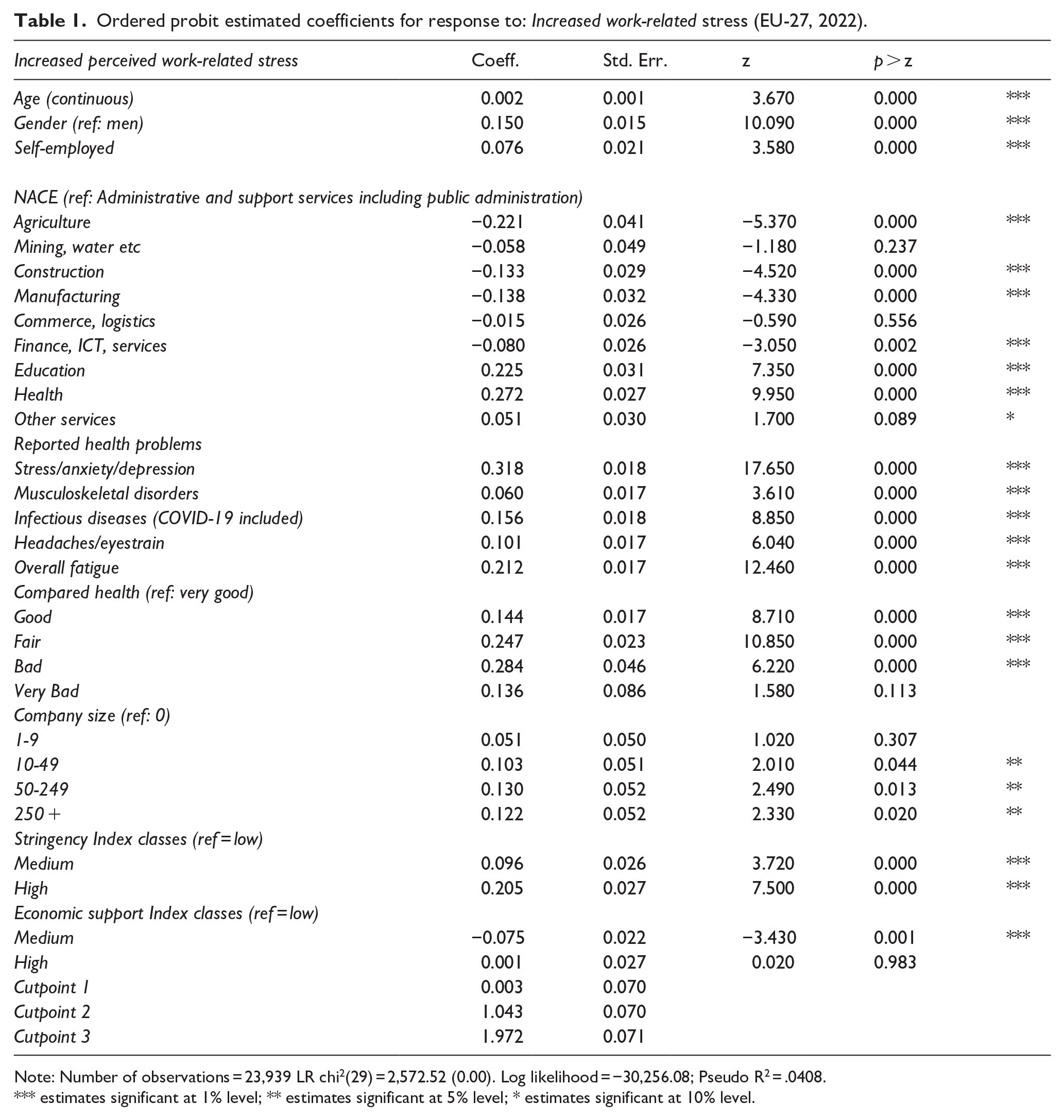
Ordered probit estimated coefficients for response to: Increased work-related stress (EU-27, 2022).
Note: Number of observations = 23,939 LR chi2(29) = 2,572.52 (0.00). Log likelihood = −30,256.08; Pseudo R2 = .0408.
estimates significant at 1% level; ** estimates significant at 5% level; * estimates significant at 10% level.
Ordered probit estimated coefficients for response to: Increased work-related stress with interaction effect (Gender*Self-employed) (EU-27, 2022).

Note: Number of observations = 23,939 LR chi2(30) = 2,573.20 (0.00). Log likelihood = −30,255.74; Pseudo R2 = .0408.
estimates significant at 1% level; ** estimates significant at 5% level; * estimates significant at 10% level.
We included in the models the following control variables: gender, age (continuous variable), economic sector, reported mental and physical health issues (stress, anxiety or depression, musculoskeletal disorders, infectious diseases (including COVID-19), headaches and eyestrain, and overall fatigue), perceived health, company size, stringency, and economic support country classes.
Model 1—variable of interest: increased stress as a consequence of the COVID-19 pandemic
The first model analyzes the trend of increased work-related stress perceptions in the aftermath of the COVID-19 pandemic crisis in 2022 (item E2_4 of the OSH Pulse questionnaire). Table 1 shows the estimated coefficients for both self-employed and employees.
Focusing on the self-employed respondents, the analysis displays that the estimated coefficient for the dummy variable identifying the self-employed individuals is positive and statistically significant. This indicates that self-employed individuals are more likely to agree with the statement that their work-related stress has intensified due to the COVID-19 pandemic.
Table 2 displays the model coefficients when including an interaction effect between gender and self-employment variables. While the overall results in this case are in line with those presented in Table 1, and gender and self-employment variables are significant when considered individually, their interaction is not.
Figure 1 presents the estimated probabilities of self-employed individuals strongly agreeing with the statement “my work-related stress increased as a result of the COVID-19 pandemic.” These estimates are categorized by gender and reported separately for each NACE sector, as well as across different levels of stringency measures (Low, Medium, and High). All other ordinal variables are held to their modal categories in this analysis, while age is set to its mean value.
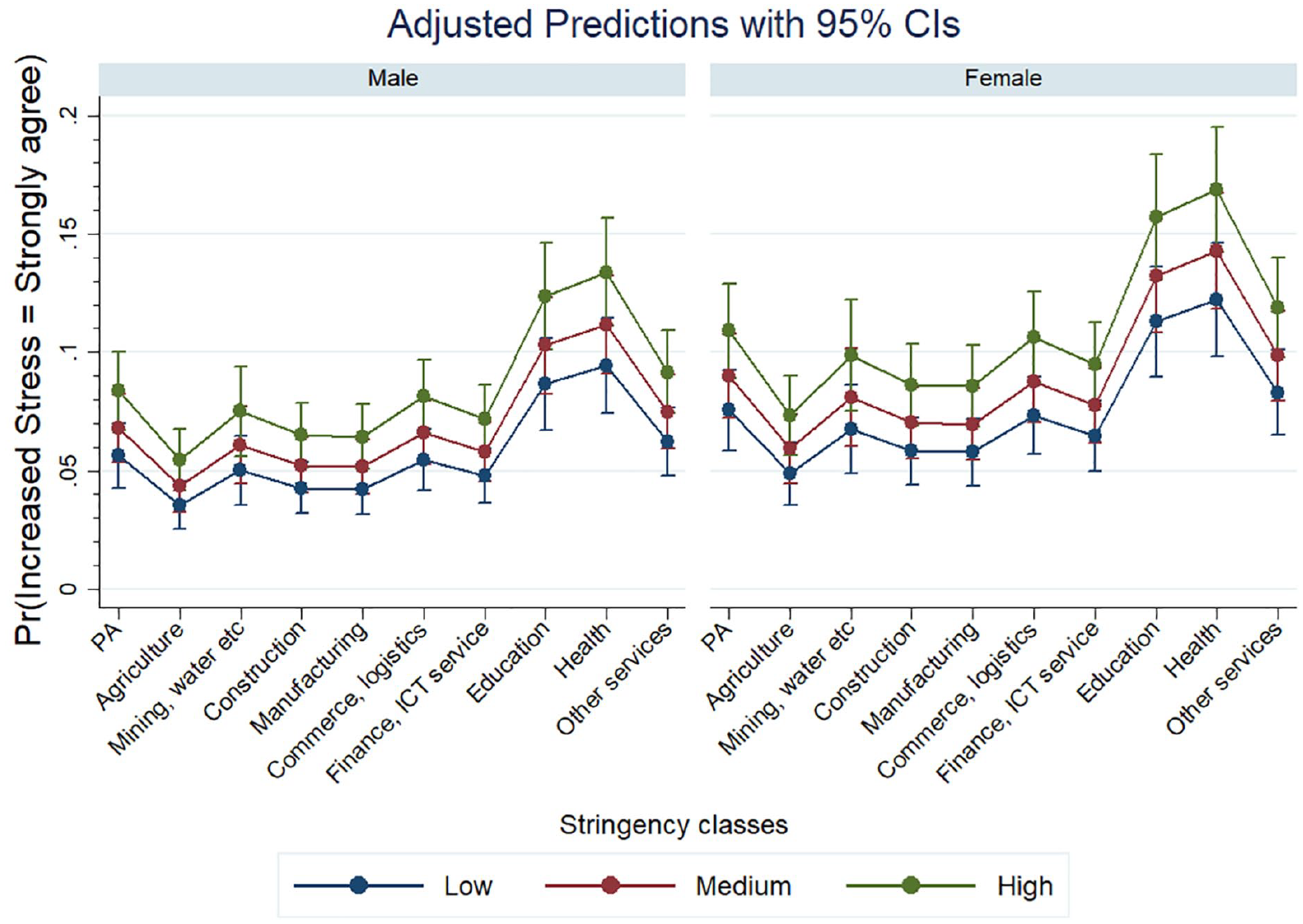
Estimated probabilities and 95% confidence intervals for “strongly agree” for reporting increased stress due to the COVID-19 pandemic by NACE sectors and Stringency Index classes, self-employed respondents.
First, the estimated probabilities enable us to clearly appreciate the varying response behavior between men and women. The results display that the self-employed respondents report the most increased levels of occupational stress in countries with the highest level of stringency index. Overall, it can be observed that the probability of being in strong agreement with the item is not very high. However, it is well evident that people working in the health care and education sectors generally display the highest levels of agreement, the two mentioned sectors having been significantly impacted by the pandemic, the former as a result of the shutdown of schools and the online teaching and the latter directly by the health emergency and increased hospitalizations. This is even more noticeable with respect to gender: Women in particular tend to report a higher level of increased stress at work than men, especially in the aforementioned sectors. When observing the response pattern by distinguishing the level of stringency index, it is evident that the perception of increased stress is influenced by the level of restrictions that have been imposed in the country, especially when considering the trend of responses in countries with high stringency index scores.
To conclude, regarding hypothesis 1 (H1), which posits that self-employed individuals in the EU (H1a), particularly self-employed women (H1b), experienced higher levels of work stress due to the COVID-19 crisis compared to employees, the results clearly support hypothesis 1a (H1a), while they are not conclusive with regard to hypothesis 1b (H1b).
Model 2—variable of interest: has the pandemic made it easier to talk about stress and mental health at work?
The second model analyzes the item associated with question E2_3, “Has the pandemic made it easier to talk about stress and mental health at work?” as the response variable. The selected drivers for this model are the same as those employed in the first model. The estimated coefficients and related statistics for both self-employed and employees are presented in Table 3.
Ordered probit estimated coefficients for response: Increased perceived easiness to talk (EU-27, 2022).

Note: Number of observations = 23,063 LR chi2(29) = 419.91 (0.00). Log likelihood = −28077.358; Pseudo R2 = .0074.
estimates significant at 1% level; ** estimates significant at 5% level; * estimates significant at 10% level.
Ordered probit estimated coefficients for response: Increased perceived easiness to talk with interaction effect (Gender*Self-employed) (EU-27, 2022).

Note: Number of observations = 23.063 LR Chi2 (30) = 430.26 (0.00). Log likelihood = −28,072.184; Pseudo R2 = .0076.
Estimates significant at 1% level; ** Estimates significant at 5% level; * estimates significant at 10% level.
Focusing on self-employed individuals, we observe a significant effect of the dummy variable representing self-employment. This indicates that self-employed workers are more likely than employees to agree with the statement that the COVID-19 pandemic has made it easier to talk about stress and mental health at work.
Table 4 presents the model coefficients and includes an interaction effect between gender and self-employment variables. The overall results are in line with the results in Table 3, and gender and self-employment variables and their interaction are all significant.
In Figure 2, we present the estimated probabilities of the self-employed workers strongly agreeing with the statement, “Has the pandemic made it easier to talk about stress and mental health at work?,” based on their gender, sectors of activity and stringency measures score clusters (Low, Medium and High). As in the previous model, the values of the remaining drivers are put at their modal category or mean.
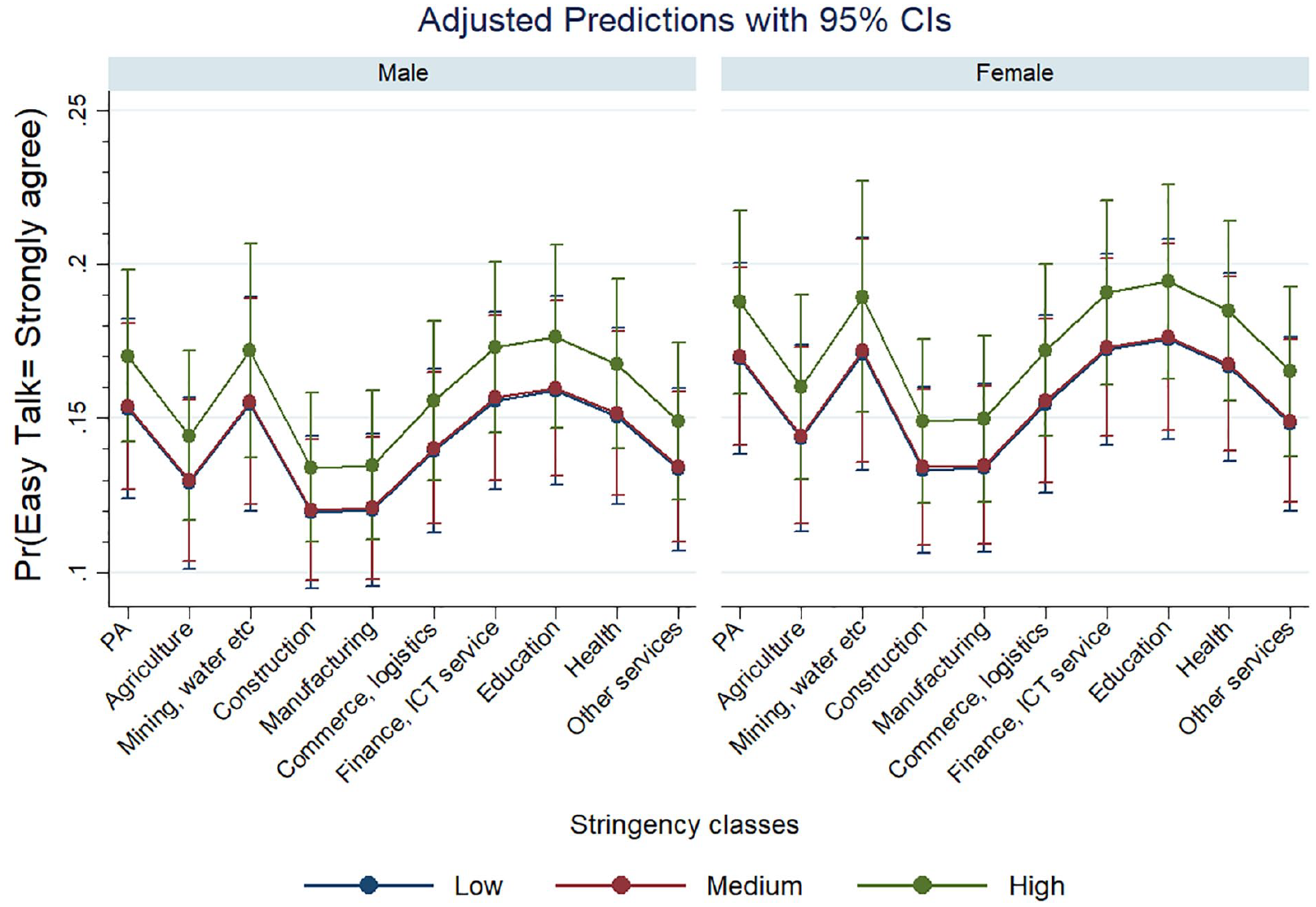
Estimated probabilities and 95% confidence intervals for “strongly agree” for reporting increased easiness to talk due to the COVID-19 pandemic by NACE sectors and Stringency Index Classes, self-employed respondents.
According to the results, self-employed women are somewhat more likely to report that the COVID-19 pandemic made it easier for them to talk about stress and mental health at work. In addition, although the estimated probabilities of being in strong agreement are not very high, some differences emerge when considering the economic sector of activity and the level of restrictions imposed. Specifically, self-employed respondents working in the health, education, ICT, finance, and professional and technical services sectors appear to have reacted slightly differently than those in other sectors with respect to being able to talk openly about their mental health, showing higher 14 estimated probabilities. Furthermore, with respect to stringency scores, in countries where the measures were more impactful, response patterns show slightly higher probabilities, particularly when compared with countries where stringency scores were comparatively lower. The overall results indicate that the pandemic impacted the perception of being more open to talking about stress and mental health at work, particularly in the case of women, in sectors more affected by the pandemic, and in countries with stricter stringency measures.
To conclude, the results clearly support hypothesis 2 (H2), indicating that the pandemic crisis has made it easier—compared to the pre-COVID-19 era—for the self-employed in the EU (H2a), particularly for the self-employed women (H2b), to be open to discussing stress and mental health challenges in comparison to employees.
Discussion and conclusion
First, our analysis reveals that self-employed individuals in the EU experienced higher work stress levels due to COVID-19 compared to employees (H1a) and supports evidence from various countries indicating that the pandemic has had a severe impact on the mental health of the self-employed (Stephan, Rauch & Hatak, 2023; St-Jean et al., 2023; Torrès et al., 2022), especially in comparison to employees (Backman et al., 2023; Patel & Rietveld, 2020; Yue & Cowling, 2021). Our analysis further indicates that this trend is particularly evident in sectors such as healthcare and education, which were heavily impacted during the crisis (Billaudeau et al., 2022; Saragih et al., 2021). In addition, this trend is more pronounced in countries where the stringency measures were implemented more heavily, possibly due to the importance of social interaction and support for maintaining mental health and well-being, which were hampered by the social distancing measures and national lockdowns in these countries.
Furthermore, although the results are not conclusive, our analysis suggests that self-employed women in Europe across all sectors and country clusters may have experienced higher levels of work-related stress than men during the pandemic (H1b). This finding illustrates the need for further research into the gendered impact of the COVID-19 pandemic across Europe and underscores the necessity for additional support measures for self-employed women. Along these lines, extant research highlights that female entrepreneurs suffered from weaker mental health compared to their male counterparts at the onset of the COVID-19 pandemic, primarily due to the challenges of balancing work and family responsibilities (Birhanu et al., 2022; Caliendo et al., 2023). For example, data from the 27 EU member states during the early stages of the COVID-19 pandemic indicated that female entrepreneurs experienced poorer mental health than men due to work–family conflict (Brieger et al., 2023). Similarly, a study in the US by Kalenkoski and Pabilonia (2022) revealed that self-employed women were more likely to leave their jobs than men due to the prescribed gender norms and traditional division of labor within households, which results in the so-called “double burden” for working women.
In addition, our analysis indicates that the pandemic crisis has made it easier—compared to the pre-COVID-19 era—for the self-employed in the EU to discuss stress and mental health challenges in comparison to employees (H2a), especially among self-employed women (H2b). This signals a positive shift in the way the self-employed perceive mental health stigma and their willingness to ask for help, providing an opportunity that the COVID-19 crisis has presented for policymakers to assist them further with resources to support their mental health (Stephan et al., 2021).
To conclude, the COVID-19 pandemic has had a significant impact on the mental health of self-employed workers across the 27 EU member states. This underscores the need for national and EU-level policy actions to develop new approaches for increasing support resources and protections for self-employed workers, improving their mental health, and enhancing their resilience to better cope with future crises and challenges. One of the lessons learned is that, along with extending social protection measures to the self-employed to enhance their resilience in periods of crisis and limited access to financial resources, priority areas of intervention to support them are those of mental health prevention and support, and the area of education and training (EU-OSHA, 2024).
In the first area, specific measures made available to self-employed could include the provision of counseling and psychological support services, information on existing supporting schemes and activities provided by a range of actors (e.g., public authorities, business organizations, charities), and information and advice on how to prevent and manage stress and other mental health issues. In the area of education and training, initiatives made available to the self-employed should be aimed at providing the knowledge and skills to face issues related to occupational safety and health (OSH) in general and mental health and psychosocial risk factors at work in particular (including, for example, conducting risk assessments covering also psychosocial risks). This would help fill the knowledge gap that self-employed have to face, unlike employees, who can count on information and training to prevent OSH risks provided by their employer as an obligation imposed by EU law. 15 Finally, it is imperative to explicitly and specifically target self-employed women with these measures to empower them, enhance their resilience, and strengthen their position in the labor market.
Limitations and future research
Our study provides strong evidence that entrepreneurial well-being has been precarious during the COVID-19 crisis in the EU. In addition, the findings reveal a change in the way the self-employed perceive mental health stigma, leading to a greater willingness to talk about their mental health and seek help to enhance their well-being. Nonetheless, this study has limitations that present opportunities for future research. For example, future research could provide additional evidence of the impact of the COVID-19 pandemic on the well-being of self-employed women in the EU, as our findings point out. Moreover, one area of exploration could be the mechanisms through which the COVID-19 crisis affected both entrepreneurial well-being and ill-being as interconnected pieces of the mental health puzzle (Gish et al., 2022). Future studies could also consider how contextual and individual factors influenced these outcomes in the EU countries. Furthermore, investigating in detail the effects of the COVID-19 crisis on mental health stigma among the self-employed would provide valuable insights. A longitudinal approach could further shed light on changes in help-seeking behaviors during the COVID-19 crisis, as our findings suggest, and in the current post-COVID context. Finally, our findings indicate that exploring the link between rising mental health challenges and shifting mental health stigma during the pandemic could offer further insights into why self-employed individuals may be more or less willing to discuss mental health issues and seek support.
Footnotes
Appendix 1
Workers by employment status and sector of activity, EU-27 (%, 2022).

| Employment status | Sector of activity | ||||||||||
|---|---|---|---|---|---|---|---|---|---|---|---|
| A—Agriculture | BDE—Mining and water, gas, electricity supplies | F—Construction | C—Manufacturing | GHI—Commerce, transport and logistics, accommodation, and food services | JKM—ICT, finance, professional and technical services | NO—Administrative and support services and public administration | P—Education | Q—Health and social care activities | RS + LTU—Other service activities | Total | |
| Self-employed | 8.3 | 1.2 | 6.1 | 11.6 | 18.5 | 16.2 | 8.2 | 4.2 | 12.5 | 13.2 | 100.0 |
| Employee with a permanent contract | 2.8 | 2.6 | 11.1 | 7.2 | 15.8 | 15.1 | 15.8 | 9.2 | 12.5 | 8.0 | 100.0 |
| Employee with a temporary contract | 3.9 | 2.6 | 8.0 | 7.8 | 17.8 | 10.4 | 13.8 | 10.4 | 13.1 | 12.2 | 100.0 |
| Total | 3.9 | 2.3 | 9.8 | 8.0 | 16.5 | 14.6 | 14.2 | 8.5 | 12.6 | 9.4 | 100.0 |
Source: Authors’ elaboration on EU-OSHA OSH Pulse survey, 2022.
Declaration of conflicting interests
The author(s) declared no potential conflicts of interest with respect to the research, authorship, and/or publication of this article.
Funding
The author(s) disclosed receipt of the following financial support for the research, authorship, and/or publication of this article: Stefania Capecchi would like to acknowledge the financial support by the grant SI-WCWB from the University of Naples Federico II (FRA 2022), Rectoral Decree no.3429, 07/09/2023 (CUP: E65F22000050001).
