




Abstract
Well-being is important to entrepreneurs, yet entrepreneurship does not necessarily foster well-being. Stressful work conditions such as venture distress might put entrepreneurs’ well-being under pressure. Drawing upon self-determination theory, we investigate the conditions that enhance entrepreneurs’ thriving after experiencing venture distress. We test this model on a survey-based sample of 177 entrepreneurs in Belgium who either persisted with their distressed venture or started a new one after their distressed venture had failed. Our findings reveal that personal attributes of self-compassion and learning from venture distress can buffer the potential negative effects of venture distress experiences on entrepreneurs’ subsequent thriving. In addition, this protective capacity is not mitigated by the failure of the distressed venture. We further discuss the theoretical and practical implications of these findings.
Keywords
Introduction
Entrepreneurs’ well-being is often an outcome of their entrepreneurial engagements (Nikolaev et al., 2019; Wiklund et al., 2019). Yet, entrepreneurship can either strengthen or diminish individuals’ well-being (Dimov & Pistrui, 2024; Lerman et al., 2021; Stephan, 2018; Wiklund et al., 2019). On the one hand, scholars have suggested that entrepreneurs experience higher levels of well-being than wage employees because of higher degrees of autonomy and independence in their job (Benz & Frey, 2008; Shir et al., 2019; Stephan, Rauch, & Hatak, 2023). On the other hand, scholars have pointed to the well-being costs caused by entrepreneurship-related “hindrance” stressors such as resource constraints (Williamson et al., 2021), high workload, and uncertainty (Lerman et al., 2021; Patel et al., 2019; Rauch et al., 2018; Stephan, Rauch, & Hatak, 2023). Such stressors are even more prevalent when entrepreneurs encounter venture distress or underperformance according to their expectations (Yamakawa & Cardon, 2017). However, despite these assumed well-being costs, many entrepreneurs seem to persist with their distressed venture (Coppens & Knockaert, 2021; Mayr et al., 2022) or establish a new one after their venture failed (for a recent review, see the study by Costa et al., 2023).
While the literature on entrepreneurial persistence and re-entry has provided valuable insights into why entrepreneurs persist with an underperforming venture (for a recent review, see the study by Yan et al., 2023) or restart after a venture failure (for a review, see the study by Tipu, 2020), less is known about the well-being of these entrepreneurs as they continue their entrepreneurial journey. This gap also exists in the literature on entrepreneurial stress and well-being, in which studies have mainly investigated the effect of entrepreneurial engagement and stress on the well-being of early-stage entrepreneurs (e.g., Lanivich et al., 2021; Uy et al., 2017) or have compared entrepreneurs’ well-being to that of employees (e.g., Ardianti et al., 2022; Bencsik & Chuluun, 2021; Shir et al., 2019). As such, to date, we have limited insights into the factors that enable entrepreneurs to protect their well-being along their journey and to overcome adverse encounters such as venture distress or failure.
To address this research gap, we investigate the potential enabling role of personal factors on entrepreneurs’ thriving after a venture distress experience. Thriving—an element of eudaimonic well-being (Stephan, 2018)—refers to a psychological state in which individuals experience a joint sense of aliveness and continuous improvement in their occupation (Spreitzer et al., 2005). This sense of vitality and improvement in the job fosters individuals’ performance and well-being at work (Spreitzer et al., 2005). While existing studies have explored antecedents of employees’ thriving in large—typically stable—work organizations, we know relatively little about the factors that enhance thriving at work across entrepreneurs operating in unpredictable work environments. Yet, such insights are vital to understanding why some entrepreneurs keep thriving when confronted with adversity, and thus persist, while others do not. In investigating entrepreneurs’ thriving, we draw upon self-determination theory (SDT), which states that the satisfaction of individuals’ basic psychological needs for autonomy, competence, and relatedness is key for their thriving (Deci & Ryan, 2000; Ryan & Deci, 2000). By supporting the satisfaction of these needs, personal and work-related factors can enhance individuals’ motivation and well-being at work (Deci et al., 2017). Following this reasoning, we argue that personal attributes, and more specifically, self-compassion and learning from venture distress, can help entrepreneurs to keep thriving after a distress experience. In line with SDT, we further expect these positive effects of personal attributes on entrepreneurs’ thriving to be mitigated by an important work-related factor, namely the failure of the distressed venture.
To test our conceptual framework, we collected survey-based data from entrepreneurs in the Flemish region of Belgium. This highly dynamic entrepreneurial region has a significant presence of micro-, small-, and medium-sized companies (MSMEs), mirroring the broader European economy (Stephan, Zbierowski, et al., 2023). As it is difficult to identify and approach entrepreneurs with prior distress experience (Byrne & Shepherd, 2015; Jenkins et al., 2014), we collaborated with a Belgian support agency for distressed ventures. We distributed our survey among entrepreneurs who had contacted this agency between 2015 and 2020. Our dataset contains information on 177 entrepreneurs, including 141 who were persisting with their distressed venture in 2020, and 36 whose distressed venture had failed and had set up a new one by 2020.
Our study has important academic and practical implications. First, it adds to the recent surge of research into entrepreneurs’ well-being (e.g., Nikolaev et al., 2019; Ryff, 2019; Shir et al., 2019; Stephan, Rauch, & Hatak, 2023; Wiklund et al., 2019). Indeed, while existing studies have investigated well-being components such as work and life satisfaction across early-stage entrepreneurs (Lanivich et al., 2021) or entrepreneurs in comparison to wage employees (Ardianti et al., 2022; Bencsik & Chuluun, 2021; Shir et al., 2019), this study focuses on thriving at work across entrepreneurs who have continued their entrepreneurial journey after a venture distress experience. In doing so, it identifies self-compassion as an important, yet understudied, enabler of entrepreneurs’ well-being in adverse contexts. Second, our study enriches the existing literature on thriving at work, which has predominantly focused on employees (Kleine et al., 2019; Liu et al., 2021; Walumbwa et al., 2018). Specifically, it points to important antecedents of thriving at work, particularly for those entrepreneurs who have experienced a venture distress situation. Finally, the study provides valuable practical implications as it helps entrepreneurs, business support providers, and policymakers to understand why some entrepreneurs are better able to keep thriving in the face of adversity than others, and how they can help in supporting them. In particular, it reveals the importance of a self-compassionate and learning-oriented mindset, a finding which may be of high relevance for the selection and coaching of entrepreneurs in entrepreneurship support programs.
Theoretical and hypotheses development
Well-being and entrepreneurship
Well-being refers to the overall quality of individuals’ experiences and functioning (Warr, 2013). It is an umbrella term that has multiple dimensions (Wiklund et al., 2019) and includes a great number of components (Keyes et al., 2002; Stephan, Rauch, & Hatak, 2023; Warr, 2013). These different components are also reflected in the two main psychological approaches to well-being (Wiklund et al., 2019). The hedonic approach to well-being includes people’s evaluations of their lives (and work) and their moods and emotions (Diener et al., 1999). It is typically operationalized as a combination of high satisfaction with life (i.e., cognitive well-being), frequent positive emotions, and infrequent negative emotions (i.e., affective well-being) (Diener, 1984; Diener et al., 1999). As such, the hedonic approach is oriented toward a specific outcome (Ryan et al., 2008), namely an emotionally pleasant and satisfying life (Homan, 2016). The eudaimonic approach, in contrast, focuses on the process involved in living well (Ryan et al., 2008) and entails individuals’ psychological functioning and thriving (Ryan & Deci, 2001). It has been operationalized either as subjective vitality—since being vital and energetic is important to be psychologically well (Cowen, 1994)—or through six dimensions that together capture the essence of being fully functioning. These dimensions include self-acceptance, autonomy, environmental mastery, positive relationships with others, personal growth, and purposeful striving (Ryff, 2019). So far, entrepreneurship studies on well-being have often focused on hedonic well-being components such as life and work satisfaction (Ryff, 2019; Stephan, 2018; Wiklund et al., 2019). Yet, eudaimonic well-being components are also highly relevant to entrepreneurship and might be important indicators of who will persist or exit entrepreneurship under the stressful conditions of long working hours, complex demands, and uncertainties (Ryan & Deci, 2001; Ryff, 2019). Hence, greater scholarly attention to entrepreneurs’ eudaimonic well-being is needed to identify factors that enhance thriving and personal growth in entrepreneurial pursuits (Ryff, 2019; Stephan, 2018; Wiklund et al., 2019).
One way to do so is by incorporating insights from the extensive body of research on work-related well-being in other domains. In recent years, entrepreneurship studies have relied on validated theoretical frameworks from occupational health and psychology research to shed light on the complex relationship between entrepreneurship, stress, and well-being. For example, by extending the challenge hindrance stressor framework (CHSF) (Boswell et al., 2004; Lepine et al., 2005) to the context of entrepreneurship, Lerman and colleagues (2021) show that challenge stressors have an insignificantly positive effect on entrepreneurs’ well-being, whereas hindrance stressors have a significantly negative effect on well-being. Moreover, this negative effect appears to be twice as strong for nonentrepreneurs as compared to entrepreneurs. Other work integrated these insights from the CHSF in the stressor-detachment model of recovery from work stress to investigate the use and role of recovery-enhancing mechanisms in protecting entrepreneurs’ well-being (Williamson et al., 2021). In doing so, Wach and colleagues (2021) discovered an inhibiting effect of certain challenge and hindrance stressors (i.e., cognitive and emotional demands) on entrepreneurs’ psychological detachment from work in the evening, which in turn reduced their well-being the next morning. While the aforementioned studies of Lerman et al. (2021) and Wach et al. (2021) only provide partial snapshots, the broader entrepreneurial process is depicted in the computational model of Dimov and Pistrui (2024). In this model, the authors bring together findings on entrepreneurs’ stress, performance, and well-being with insights on the effects of individual characteristics on performance (Rauch & Frese, 2007), thus connecting research from organizational psychology, entrepreneurship, and entrepreneurship psychology into one holistic system.
These examples illustrate the relevance of knowledge spillovers between organizational psychology research and entrepreneurship research regarding human well-being in different work contexts. In this study, we aim to extend these knowledge spillovers by integrating organizational research findings on thriving at work in the entrepreneurship field. In particular, we build upon the literature on SDT and the socially embedded model of thriving at work (SEMT) (Spreitzer et al., 2005) to investigate the potentially enabling effect of personal and work-related factors on entrepreneurs’ thriving in the aftermath of stressful encounters.
Thriving at work from a self-determination perspective: The enabling role of work-related and personal factors
In this study, we introduce thriving at work as a type of eudaimonic well-being that captures both individuals’ subjective vitality (feeling alive, vigorous, and energetic (Cowen, 1994)) and their sense of continuous improvement (i.e., acquiring and applying skills and knowledge) at work (Spreitzer et al., 2005). Subjective vitality equips individuals with the energy to persist and overcome barriers (Hahn et al., 2012), whereas the acquisition of skills and knowledge facilitates personal development and growth (Porath et al., 2012). In other words, individuals thrive at work when they feel alive and energetic (not depleted) and are getting better at what they do (Spreitzer et al., 2005). This subjective experience helps individuals to assess whether what they are doing and how they are doing it is helping them to increase their functioning and adaptability at work. As such, this temporal psychological state can help them navigate and change their work context to foster personal development (Spreitzer et al., 2005) and to realize their full potential.
In the past two decades, motivational studies have applied a self-determination perspective to investigate the antecedents and consequences of individuals’ thriving at work in large organizations (for recent reviews, see the study by Kleine et al., 2019; Liu et al., 2021). These studies have particularly pointed to the enabling effects of work-related factors such as supportive work environments (e.g., supportive coworkers and managers) and resources produced while working (e.g., knowledge and meaningful connections with coworkers) and individual factors such as personality traits (e.g., psychological capital) on employees’ thriving in large organizations. Building on the SDT, these studies have shown that such factors can (help) satisfy individuals’ basic needs for autonomy, competence, and relatedness, as such fostering their motivation to engage in agentic (i.e., active and purposeful (Bandura, 2001)) work behaviors. This motivation, in turn, fuels their thriving at work (Spreitzer et al., 2005).
While employees in large organizations often work in relatively stable but more rigid environments, entrepreneurs typically operate in more extreme work contexts characterized by high uncertainty and flexibility (Rauch et al., 2018). As such, entrepreneurs usually experience high levels of autonomy and work control (Benz & Frey, 2008), allowing them to choose the content of their work and how they schedule it (Parker, 2014), as well as the social connections they rely on to access and acquire resources (van Burg et al., 2022). This self-organizing nature of entrepreneurship facilitates the satisfaction of motivational needs—particularly the need for autonomy—and the sense of meaningfulness at work, leading to higher levels of (eudaimonic) well-being (Shir et al., 2019; Stephan et al., 2020). At the same time, entrepreneurs are exposed to more stressful work conditions than employees, including increased levels of risk and uncertainty, more severe financial constraints, high responsibility, and intense workloads (Baron et al., 2016; Reid et al., 2018). While certain stressors such as complex demands and time pressure can challenge entrepreneurs and promote their personal growth (i.e., challenge stressors), other stressors such as work overload and lack of resources can demotivate entrepreneurs and hinder it (i.e., hindrance stressors). These “hindrance” (work) stressors are highly present in contexts of venture distress, whereby the venture is underperforming according to the entrepreneur’s expectations (Yamakawa & Cardon, 2017). Unfortunately, as many new ventures fail, many entrepreneurs encounter periods of venture distress or underperformance along their journey. When doing so, they typically feel forced to focus their attention and energy on avoiding negative outcomes (such as debt escalation) and feel highly restricted in their choices and actions (Stephan, Zbierowski, et al., 2023). Prior studies indeed showed that entrepreneurs experience reduced levels of well-being following financial difficulties and threatened venture survival (e.g., Doern, 2021; Torrès et al., 2022; Wolfe & Patel, 2021; Yue & Cowling, 2021).
Besides the influence of work context on well-being at work, organizational scholars have pointed to the potential enabling role of personal attributes such as psychological capital on need satisfaction and motivation (for a review, see the study by Kleine et al., 2019), fostering thriving at work. According to existing entrepreneurship research, successful entrepreneurs possess key personal resources such as self-efficacy, need for achievement, psychological capital, and emotion regulation capabilities. These resources help them to navigate the highly demanding and stressful working conditions inherent in entrepreneurship (Baron et al., 2016; Patzelt & Shepherd, 2011). Entrepreneurs who persist with their distressed venture or start a new one after the failure of the distressed venture likely possess (some of) these personal resources, allowing them to protect their well-being against the potential negative effects of venture distress. In what follows, we explore two personal factors that might facilitate entrepreneurs’ thriving in the aftermath of stressful encounters, namely self-compassion and learning from venture distress.
The relationship between self-compassion and entrepreneurs’ thriving after venture distress
Self-compassion is a personality trait that involves treating oneself with kindness, care, and concern when confronted with adverse life events (Neff, 2003; Terry & Leary, 2011). It is distinct from self-esteem as self-esteem reflects favorable global evaluations of the self (Baumeister et al., 1996; Homan, 2016). Self-compassionate individuals are kind to themselves, and they consider distress and failure experiences as a part of the general human experience (i.e., something everyone goes through) and, importantly, can regulate the negative emotions evoked by these experiences (rather than exaggerating or suppressing them; Neff, 2003). A self-compassionate mindset can thus help individuals manage the setbacks they experience in work by mitigating the negative feelings that are related to it (Ginting-Szczesny et al., 2023). By weakening the effects of negative experiences through cognitive-emotional reframing, rather than amplifying the positive experiences, self-compassion can contribute to a positive mindset (Zessin et al., 2015). This self-regulation could then allow entrepreneurs to keep operating in highly uncertain and challenging work environments, and in doing so, to keep feeling alive and vital at work. A few entrepreneurship studies on this topic have indeed shown that self-compassion can enhance entrepreneurs’ coping with potential and actual experiences of distress and failure (Engel et al., 2021; Shepherd & Cardon, 2009). In particular, the study of Shepherd and Cardon (2009) has demonstrated that higher levels of self-compassion can help individuals to protect their need satisfaction (for autonomy, competence, and relatedness) from being harmed by negative emotions evoked by a failure experience. As SDT suggests that this need satisfaction enhances individuals’ motivation and subsequent well-being at work, we hypothesize a positive relationship between self-compassion and entrepreneurs’ thriving following a venture distress experience:
Hypothesis 1 (H1). Self-compassion is positively related to entrepreneurs’ thriving after venture distress.
The relationship between learning from venture distress and subsequent thriving as an entrepreneur
While venture distress and failure are known to cause important financial, psychological, and social resource losses for the involved entrepreneurs and their families (Cope, 2011; Nikolova et al., 2021; Shepherd et al., 2009; Singh et al., 2007), they also provide valuable learning opportunities (Boso et al., 2019; Cope, 2011; Liu et al., 2021). In the organizational behavior and management literature, failure is even said to be more important for learning than success (McGrath, 1999; Sitkin, 1992). Learning from venture distress or failure occurs when entrepreneurs use the information that is available on why the venture is/was underperforming to revise their knowledge of how to manage a venture effectively (Shepherd, 2003), and to gain more insights into venture and personal strengths/weaknesses (Cope, 2011). Such learning is self-regulating to the extent that learners actively interpret and use available information to take control over their learning while being influenced by self and social factors (Hadwin & Oshige, 2011). The improved knowledge built through entrepreneurial learning might not only foster recovery (Shepherd, 2003) but also allow individuals to better cope with future critical events (Lattacher & Wdowiak, 2020). While empirical studies on entrepreneurial learning have provided insights into the effects on entrepreneurial re-engagement (for a review, see the article by Lattacher & Wdowiak, 2020), less is known about the effect of entrepreneurs’ learning from venture distress on their subsequent thriving as entrepreneurs. This is surprising as, building on SDT, studies on thriving at work have pointed to the enabling effect of work-related knowledge and skills acquisition on individuals’ motivation to act agentic and thus to keep thriving at work. SDT indeed argues that work-related factors can foster thriving at work through their positive effect on need satisfaction. Learning particularly contributes to individuals’ basic need for competence (Spreitzer et al., 2005). Hence, while contextual factors such as venture distress might harm the satisfaction of entrepreneurs’ needs for autonomy, competence, and relatedness in their job, these needs can be partly restored through learning from the venture distress experience. This learning might help entrepreneurs to sustain their motivation to engage in agentic work behaviors and, by doing so, to further experience this joint sense of vitality and continuous improvement at work. By consequence, we hypothesize a positive relationship between learning from venture distress and entrepreneurs’ thriving after venture distress.
Hypothesis 2 (H2). Learning from venture distress is positively related to entrepreneurs’ thriving after venture distress.
The moderating effect of the distressed venture’s failure
While self-compassion and learning from venture distress likely enhance entrepreneurs’ thriving after a distress experience, we expect this enabling effect to be contingent on whether or not the distressed venture eventually failed. Venture failure is pervasive (Nikolova et al., 2021) and can have a serious and detrimental effect on different aspects of entrepreneurs’ life (Cope, 2011; Ucbasaran et al., 2013). When entrepreneurs lose their venture, they lose not only the work context in which they operated but also important work-related resources, such as relationships with stakeholders (Cope, 2011), personal income (Jenkins et al., 2014), and invested time, energy, and personal savings (Yamakawa & Cardon, 2017). According to SDT, these losses might cause unfulfilled psychological needs for autonomy, competence, and relatedness, and thus reduce individuals’ motivation to engage in similar agentic behaviors in the future, which in turn diminishes their thriving at work (Spreitzer et al., 2005). The literature on venture failure has indeed pointed to declines in failed entrepreneurs’ self-esteem and beliefs in their ability to perform similar tasks with success in the future (Jenkins et al., 2014; Ucbasaran et al., 2013). In addition, failed entrepreneurs have reported losses of social networks and relationships, for instance, due to the stigmatization of failure (Cope, 2011; D. Shepherd & Haynie, 2009; Singh et al., 2007). The health and life satisfaction declines related to a venture failure can persist for two or more years after losing self-employment (Nikolova et al., 2021). By consequence, we expect a venture failure to weaken the protective effects of self-compassion and learning from venture distress on entrepreneurs’ thriving, whereas we expect the conservation of the distressed venture to strengthen them. We offer the following hypotheses:
Hypothesis 3a (H3a). The positive effect of self-compassion on entrepreneurs’ thriving is weakened by a venture failure and strengthened by the venture’s conservation following a period of venture distress.
Hypothesis 3b (H3b). The positive effect of learning from venture distress on entrepreneurs’ thriving is weakened by a venture failure and strengthened by the venture’s conservation following a period of venture distress.
We visualize our conceptual framework in Figure 1.
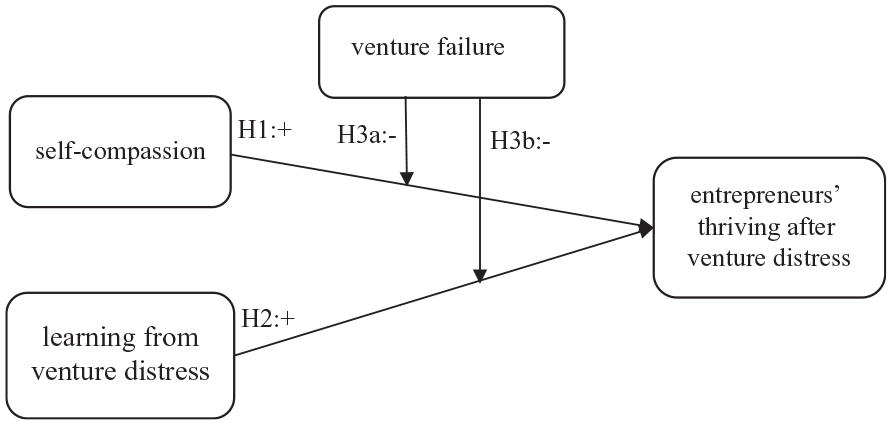
Conceptual model.
Research methodology
Research context
In this study, we investigate the impact of a venture distress experience on entrepreneurs’ subsequent thriving across a sample of venture owners in the Flemish region of Belgium. Flanders has a highly dynamic entrepreneurial climate and hosted in 2020 almost 62% of all ventures in Belgium subject to value-added tax, totaling 646,596 ventures (Statbel, 2021a). Of these ventures, 82.96% had no employees, 13.74% had one to nine employees, and 3.16% employed 10 to 250 people in 2020 (Statbel, 2021b). Hence, 99.86% of the ventures in Flanders are micro-, small-, and medium-sized enterprises (MSMEs), which is similar to the 99% share of SMEs, including self-employed, in the European economy (Stephan, Zbierowski, et al., 2023).
Data collection and sample
As entrepreneurs in distressed ventures are typically hard to identify and reach out to (Byrne & Shepherd, 2015; Jenkins et al., 2014), we collected the data for this study in collaboration with Dyzo. Dyzo is a government-funded agency which provides free business, psychological, and legal support to entrepreneurs facing venture distress. More specifically, the organization helps entrepreneurs reorganize unprofitable venture activities, navigate insolvency procedures, and re-enter entrepreneurship after a business failure. Concretely, we developed a survey that the agency distributed among entrepreneurs who had relied on their support services in the period 2015–2020 and who had indicated that the agency could contact them for research purposes. The initial request to fill out the survey was sent to 8,133 individuals in June 2020, with 1,312 emails bouncing back. After one reminder e-mail, the questionnaire was filled out by 579 individuals (out of the 6,821 who had received the emails well). While a response rate of 8.5% may seem quite low, research by Rutherford and colleagues (2017) demonstrated the limited impact of nonresponse bias in entrepreneurship research. In particular, they found little evidence of selective reporting when response rates are low and there is virtually no evidence of a meaningful influence of response rates on relationships tested in entrepreneurship research.
By coincidence, our survey was distributed shortly after the COVID-19 outbreak in Belgium. As many entrepreneurs (temporarily) had to close down their businesses during the pandemic, we asked respondents to indicate their main professional occupation just before the pandemic hit Belgium (at the beginning of March 2020). The findings revealed that almost 39% of the respondents were full-time entrepreneurs (223) at that time, while 22% had switched to paid employment (127), and 16% (94) had no professional occupation (and 29% did not answer the question). In our main analyses, we only focus on those individuals who were still full-time entrepreneurs at the beginning of March 2020. However, as we are aware of the fact that simply excluding the other observations from the dataset may induce selection bias, we follow the recommendations of Certo et al. (2016) to prevent, and if necessary, correct for, sample-induced endogeneity. Particularly, we ran a Heckman two-stage model on our overall sample (including employees and respondents without professional occupation). In this model, the first stage (i.e., selection equation) modeled the likelihood of respondents being a full-time entrepreneur in March 2020, with the predictor dummy variable reflecting whether respondents had contacted the support agency for assistance regarding the continuation (= 1) or closure of the venture (= 0). This predictor variable was significantly related to respondents still being entrepreneurs in 2020 (B = 1.08; p = .00) but was not directly related to entrepreneurs’ thriving (and thus not included in the second stage). The second stage then models the relationship between the hypothesized dependent (i.e., entrepreneurs’ thriving) and the independent variables (i.e., self-compassion and learning from distress) in the final sample of full-time entrepreneurs in March 2020. Given that our independent variables from the second stage were not significant predictors in the first stage (i.e., did not predict whether individuals were still full-time entrepreneurs in March 2020 or not) and that the lambda-coefficient in the model was not significant (B = −0.15; p = .67), our analyses are unlikely to suffer from selection bias (Certo et al., 2016). As such, in what follows, we test our theoretical model by applying ordinary least squares (OLS) regression analyses to the sample of entrepreneurs, without including the Heckman selection stage.
After excluding missing observations for the main variables in our sample, the sample included the responses of 177 full-time entrepreneurs. In March 2020, 141 (79.6%) of these entrepreneurs were still running the venture for which they had called upon the support agency, while the others were running a new venture after the failure of their distressed venture. We further completed the survey data with more general data retrieved from the agency’s database, namely entrepreneurs’ gender and the date of intake (first help request) at the agency.
Measures
Entrepreneurs’ thriving
We use the widely applied thriving at work scale (10 items) developed and validated by Porath et al. (2012) and based on Spreitzer and colleagues’ (2005) conceptualization of thriving at work, to measure individuals’ thriving as entrepreneurs in March 2020, after a prior venture distress experience. Examples of items are: “At work, I feel alive and vital,” “At work, I have energy and spirit,” “At work, I feel alert and awake,” “At work, I see myself continually improving,” and “At work, I am developing a lot as a person” (Porath et al., 2012, p. 256). Responses ranged from 1 (strongly disagree) to 7 (strongly agree). To check the construct validity of the scale, we applied a confirmatory factor analysis (CFA) in which all items were loaded on one latent variable. All standardized factor loadings ranged between .408 and .974 and exceeded the minimum threshold of .4 as recommended in the social sciences (Cardon & Kirk, 2015; Yli-Renko et al., 2001). By averaging the scores of all 10 items, we obtained a composite score for each participant, with higher scores indicating higher levels of thriving (α = .91, M = 4.66; SD = 1.11).
Self-compassion
This variable was measured by using the widely accepted Self-Compassion Scale–Short Form (SCS-SF) developed by Raes and colleagues (2011), which is a shortened but reliable and structurally equivalent version of the long SCS developed by Neff (2003). This SF scale consists of 12 items and measures the three central components of self-compassion (four items/component): self-kindness versus self-judgment (sample item: “I try to be understanding and patient toward those aspects of my personality I don’t like”), common humanity versus isolation (sample item (reversed): “When I’m feeling down, I tend to feel like most other people are probably happier than I am”), and mindfulness versus overidentification (sample item: “When something painful happens, I try to take a balanced view of the situation”). Responses ranged from 1 (strongly disagree) to 7 (strongly agree). A CFA with all items loading on one latent variable showed that the factor loadings of three items, namely Item 5 “I try to see my failings as part of the human condition” (common humanity), Item 6 “When I’m going through a very hard time, I give myself the caring and tenderness I need” (self-kindness), and Item 10 “When I feel inadequate in some way, I try to remind myself that feelings of inadequacy are shared by most people” (common humanity), did not meet the minimum threshold of .4. These items were therefore removed. The factor loadings of the remaining items ranged between .415 and .718. The scores of these nine items were averaged to obtain a composite score for each participant, with higher scores indicating higher levels of self-compassion (α = .80, M = 4.34, SD = 0.84).
Learning from venture distress
We adapted the project dimension of the “learning from project failure” scale developed by Shepherd et al. (2011) to measure entrepreneurs’ venture distress-related learning. More specifically, the entrepreneurs were asked to indicate whether—following the difficulties with their ventures—they (a) had learned to better execute a venture’s strategy, (b) could more effectively run a venture, (c) had improved their ability to make important contributions to the venture, (d) could “see” earlier the signs that the venture is in trouble, and (e) now realized the mistakes they had made that led to the venture’s difficulties. Responses ranged from 1 (strongly disagree) to 7 (strongly agree). Based on a CFA, we removed Item 5 (e) as the factor loading did not meet the minimum threshold of .4. After removal of this item, the Cronbach alpha increased from .82 to .90 (M = 4.97; SD = 1.11). By averaging the scores of the remaining four items, we obtained a composite score for each individual.
Venture failure
Venture failure refers to the entrepreneur’s cessation of involvement in the venture because it has not met his or her minimum threshold of economic viability (Ucbasaran et al., 2013). Hence, this dummy variable takes value 1 if the distressed venture was closed or sold (before or after the intake at the agency) due to underperformance, while it takes value 0 if the entrepreneur indicated in our survey that he or she was still running that venture at the beginning of March 2020. In our sample, 29 entrepreneurs had lost their distressed venture through bankruptcy while seven others had engaged in a distress sale or liquidation resulting in personal debts. Hence, 20.4% of the entrepreneurs in our sample had faced a venture failure.
Control variables
We control for a range of factors on the individual and contextual levels which may affect thriving. First, we control for the entrepreneur’s gender (1 = male), as prior studies pointed to gender differences in entrepreneurial behavior (e.g., Justo et al., 2015). We obtained this information from the agency’s CRM system and found that 67% of the entrepreneurs in our sample are men. Second, we assess respondents’ entrepreneurial experience by asking how many years respondents had been working as entrepreneurs at the time of the survey, in June 2020. This is on average 18.15 years (SD = 10.97) in our sample. We control for this variable as prior research has pointed to the differential impact of entrepreneurial stressors on experienced versus novice entrepreneurs (Kollmann et al., 2019). Third, we assess the entrepreneur’s internal locus of control (α = .59). This psychological trait has been highly studied in entrepreneurship research as it is believed to be instrumental in motivating entrepreneurial behavior (Mueller & Thomas, 2001). We therefore expect this variable to relate to individuals’ thriving as entrepreneurs. Using the modified Rotter I-E Scale (Rotter, 1966) of Mueller and Thomas (2001), we asked respondents to indicate the extent to which they (dis)agreed with the following four items (on a seven-point Likert-type scale): “My life is determined by my own actions,” “When I get what I want, it is usually because I worked hard for it,” “Whether or not I am successful in life depends mostly on my ability,” and “I feel in control of my life.” For reasons of completeness, we also measured respondents’ external locus of control (α = .77), using the six other items in the modified Rotter I-E Scale (sample item: “To a great extent my life is controlled by accidental happenings”). Fourth, we control for years since distress, namely the number of years between the venture distress situation (i.e., the intake at the support agency) and the moment of the survey (June 2020), which is on average 2.8 years (SD = 2.49) in our sample. We asked respondents to indicate the year of first contact at the agency in the survey and checked this with the registration of their first help request in the agency’s CRM system. We measured this because we expect the impact of venture distress to decline as time passes, as this is also the case for individuals’ recovery from a venture failure (e.g., Shepherd, 2009). Finally, prior research on thriving at work has highlighted the importance of contextual factors, such as family support (Merrill Weine et al., 2013). Accordingly, we evaluate the level of family social support entrepreneurs received during and after experiencing venture distress. We measured this using the seven-item family social support scale (α = .92) of Rice and Longabaugh (1996), with responses ranging from 1 (strongly disagree) to 7 (strongly agree). Examples of sample items are: “My family gives me the moral support I need” and “Most other people are closer to their family than I am.” In addition, we control for the availability of alternative income in the household at the moment of the survey, in June 2020, as prior research has revealed that this variable affects entrepreneurs’ persistence with a distressed venture (Coppens & Knockaert, 2021). Almost half of the entrepreneurs in our sample did not have alternative household income and thus fully relied upon income from the entrepreneurial venture (48%, SD = .49).
Results
Main results
Table 1 presents the descriptive statistics and correlations among all variables in our model. As the table indicates, all correlations are below .5. Given that the variance inflation factors range between 1.04 and 1.35, multicollinearity is unlikely to be an issue in our study (Hair et al., 2014). The table also indicates that entrepreneurs, who have experienced venture distress, have an above-average level of thriving (M = 4.66; SD = 1.11).
Descriptive statistics and bivariate correlations.
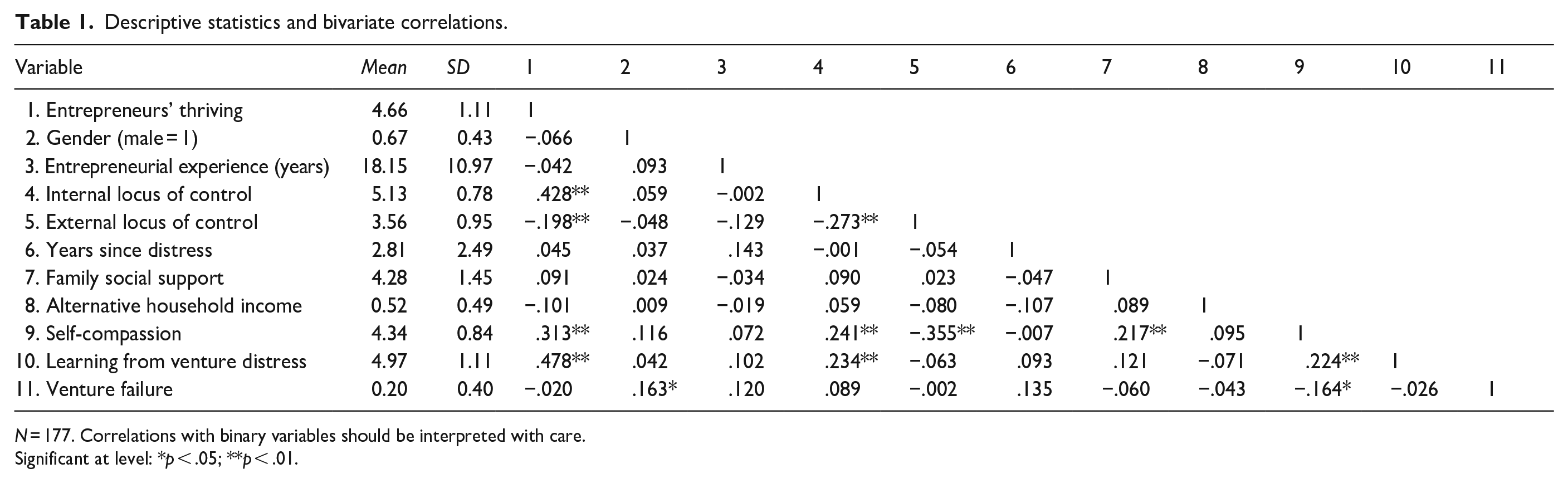
N = 177. Correlations with binary variables should be interpreted with care.
Significant at level: *p < .05; **p < .01.
Table 2 reports the results of our hierarchical OLS regression analyses, which we performed in the open-source program R. In Model 1, the baseline model, we introduce our control variables. Model 2 measures the direct effect of the independent variables self-compassion and learning from venture distress on entrepreneurs’ subsequent thriving in the same or a newly founded venture. In Models 3 and 4, we measure the interaction effect of a venture failure on the relationship between self-compassion and thriving, and learning from venture distress and thriving, respectively. Finally, in Model 5, the full model, we test both interaction effects simultaneously.
Hierarchical regression analyses predicting entrepreneurs’ thriving.
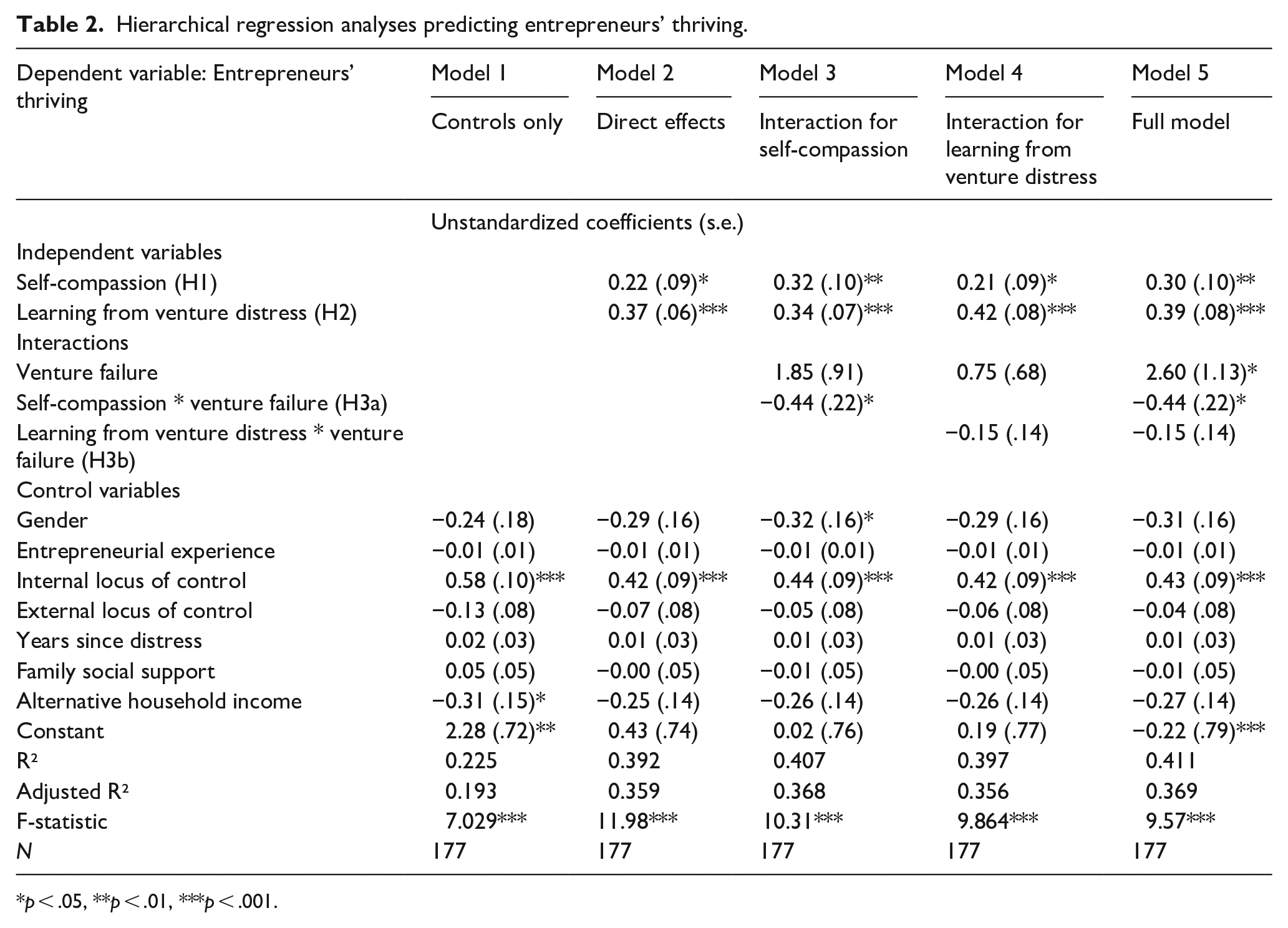
p < .05, **p < .01, ***p < .001.
Considering the control variables in the baseline model (Model 1), we find a significantly positive relationship between internal locus of control (LOC) and entrepreneurs’ thriving. The control model further shows that entrepreneurs’ thriving is lower when they have alternative income (e.g., from a life partner) in their household.
In Model 2, the direct effects of entrepreneurs’ self-compassion and learning from venture distress on their thriving after venture distress are tested. We find for both variables a significantly positive effect (B = 0.22, p < .05; B = .37, p < .001), which is in line with our theoretical reasoning about the protective or restoring effect of these personal attributes. Hence, we accept H1 and H2. By adding the moderator variable venture failure in Models 3, 4, and 5, we test for H3a and H3b. We find that venture failure has a statistically significant moderating effect (B = −0.44, p < .05; Model 5) on the relationship between self-compassion and entrepreneurs’ thriving (H3a), while it does not have a significant moderating effect (B = −0.15, p > .1; Model 5) on the relationship between learning from venture distress and entrepreneurs’ subsequent thriving. Hence, we find some support for H3a while we do not find support for H3b.
To fully understand the identified interaction effect in H3a, we carry out a more detailed marginal effects analysis. The results in Table 3 reveal that the average marginal effect of a one-unit change in self-compassion (i.e., the slope or coefficient of self-compassion) on thriving is positive and significant for entrepreneurs who continued with their distressed venture (venture failure = 0) (AME = 0.2989, p < .01), which is in line with our expectations. We further find a negative but insignificant average marginal effect of self-compassion on thriving for entrepreneurs who started a new venture after the distressed venture had failed (AME = −0.1444, p > .1). In other words, we find a significant difference in the slope of self-compassion between both values of the moderator (venture failure = 0 or 1), which is reflected by the coefficient of the interaction effect in Models 3 and 5 (B = −0.44, p < .05). We also find the simple slope of self-compassion to be significant for entrepreneurs who continued with their distressed ventures, but not for entrepreneurs who started a new venture after the failure of the distressed venture. Hence, the positive effect of self-compassion on entrepreneurs’ thriving is indeed slightly strengthened by the venture’s conservation following a period of venture distress while it is not significantly weakened by the failure of the distressed venture. We therefore partly accept H3a. The plot in Figure 2 gives a visual representation of the marginal effect of self-compassion on entrepreneurs’ thriving after venture distress for both values of the moderator. We observe that for entrepreneurs who continued with the distressed venture, the predicted values of thriving increase together with the levels of self-compassion, whereas the effect for entrepreneurs whose venture failed is visually less pronounced, in line with our slope analysis reported above.
Average marginal effect (AME) of self-compassion on thriving after venture distress.

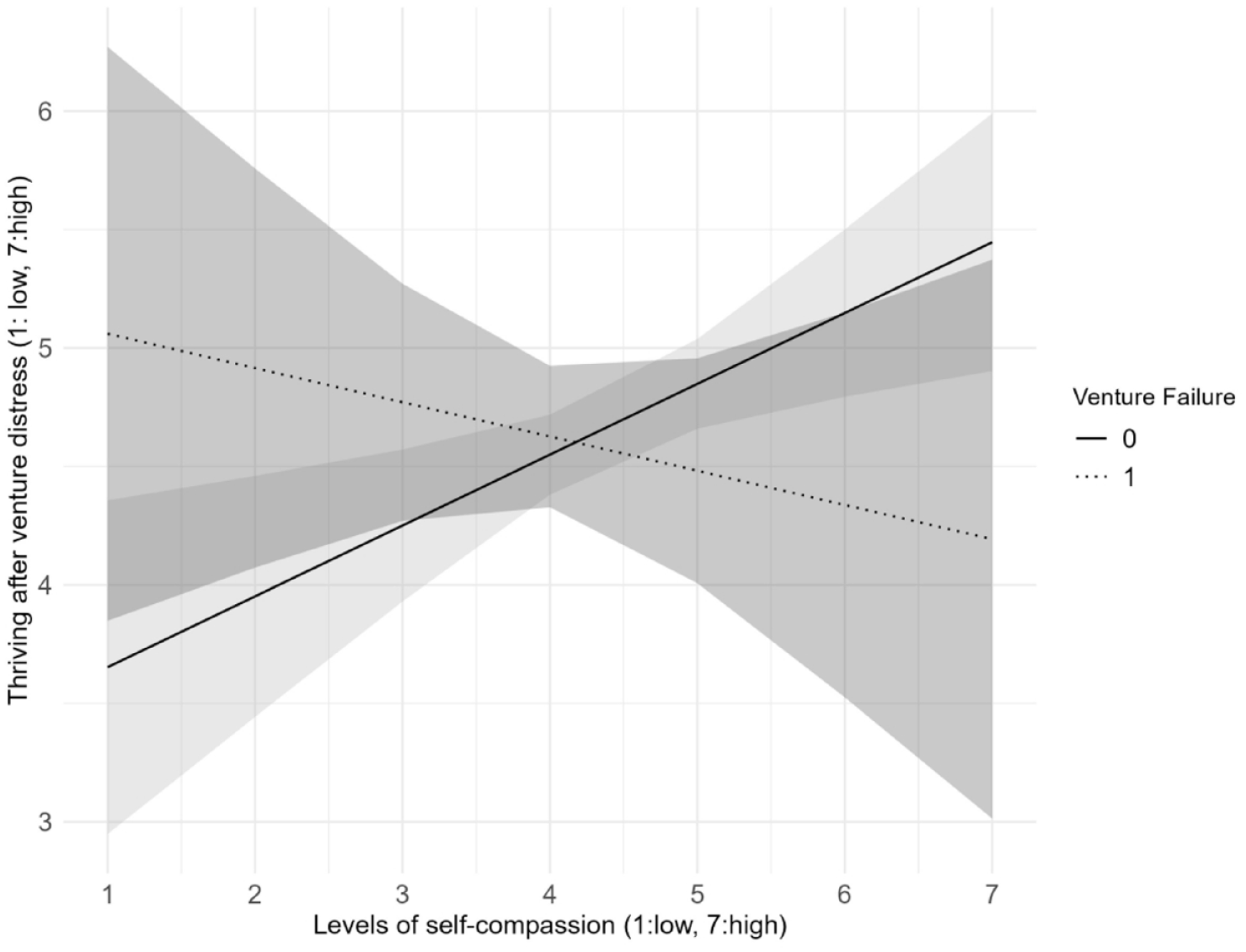
Interaction effect of self-compassion and venture failure on entrepreneurs’ thriving after venture distress (predicted values of thriving at different values of self-compassion and venture failure).
Robustness tests
To verify the validity of our findings, we carried out several robustness tests.
First, given that common method variance (CMV) can occur in cross-sectional data designs with self-report measures (obtained from individual respondents), we applied two techniques to confirm that models containing only one or two factors do not provide a better fit for our data. To start, we performed a confirmatory factor analysis (CFA) to verify whether the fit of our proposed three-factor model (i.e., self-compassion, learning, and thriving loading on three separate factors) is significantly different from any possible two-factor model or the single-factor model. Both the single- and two-factor models had significantly higher chi-squares. The chi-square differences ranged from 275.28 to 685.6, which indicates a worse fit for the two-factor and single-factor models in comparison to our proposed three-factor model. We conclude that the main constructs in our model are distinct from each other and thus unique. Given that the single-factor model fitted the data rather poorly (χ2 = 1635.998, df = 230, p = .000, SRMR = 0.17, CFI = 0.468, RMSEA = 0.186 [90% CI = [0.177, 0.194]; Δχ2 = 685.6, Δdf = 3, p < .000), 1 we conclude that common method bias is not a major problem in our data. This was also confirmed by the Harman post hoc one-factor test (Podsakoff et al., 2003) run in SPSS, which indicated that the total variance extracted by one factor was 32.57% in our data. This is well below the threshold of 50%, and thus indicates that common method bias is not present in our data. In addition, based on our CFA, we deleted three items in the self-compassion scale and one item in the scale measuring entrepreneurs’ learning from venture distress. While the deletion of items with poor factor loadings improves the model fit, it might at the same time reduce the theoretical coverage of the scales. However, this does not appear to be the case in our regression analyses as we obtain highly similar results when testing our models with the full scales for self-compassion and learning from venture distress.
Second, the vast majority of our sample are entrepreneurs whose ventures did not fail. As it is highly likely that the extent to which these entrepreneurs have managed to turn around the distress situation will affect their thriving, we considered it relevant to conduct a robustness test in which we controlled for venture progress since distress (i.e., intake at the agency) among a subsample of entrepreneurs who continued with their distressed venture. In particular, we asked the entrepreneurs to indicate the extent to which their ventures’ sales and profitability had changed in the period from intake to the moment of the survey. We measured these two items using a 7-point Likert-type scale (1: strong decrease, 7: strong increase) and labeled this measure “performance comparison” (α = .92). As this variable is likely to affect entrepreneurs’ thriving at the time of the survey, we reran our OLS hierarchical regression analyses on this subsample of 141 entrepreneurs (whose venture had not failed), hereby controlling for it. We find that the initial results are maintained (strong direct effect of self-compassion and learning from venture distress), and we also find a significantly positive relationship between the variable “performance comparison” and entrepreneurs’ thriving in the venture (B = 0.16, p < .001).
Third, existing studies on self-compassion have indicated that self-compassion can stimulate learning from venture failure by regulating the negative emotions caused by such failure experience (Shepherd & Cardon, 2009). Hence, we tested whether learning from venture distress could also mediate the relationship between self-compassion and entrepreneurs’ thriving. However, we did not find evidence for a significant mediation effect.
Finally, since our data collection also provided data on entrepreneurs who had switched to paid employment after their venture distress experience (subsample of 127 individuals), we tested the effects of self-compassion and learning from venture distress on their thriving as a salaried employee (in March 2020). However, we did not find these variables to have a significant effect, suggesting that employees’ thriving at work is enhanced by other personal attributes different from those influencing entrepreneurs’ thriving at work, probably as a result of the differences in work context between employees and entrepreneurs. This again emphasizes the relevance of this study to investigate thriving at work not only in contexts of salaried employment but also in contexts of entrepreneurship.
Discussion
Despite the potential well-being costs associated with venture distress and failure experiences, many entrepreneurs persist with their distressed ventures or initiate new ones after experiencing venture failure. These entrepreneurs seem able to protect or restore their well-being when facing stressful work conditions. In this study, we investigate the personal factors that enable individuals to sustain or regain their sense of thriving after experiencing stressful encounters such as venture distress and failure. Consistent with our theoretical expectations, our findings reveal higher levels of thriving after venture distress for entrepreneurs who are more self-compassionate and have learned relatively more from the venture distress situation. Interestingly, contrary to our theoretical expectations, we find that a failure of the distressed venture does not significantly reduce the positive effects of self-compassion and learning from venture distress on entrepreneurs’ thriving after venture distress. A potential explanation could be that a self-compassionate and learning-oriented mindset helps entrepreneurs to not only regulate the negative emotions caused by the distress experience but to also value the learning from it and thus consider it as a chance for personal development and growth.
Implications for research
The findings presented above have several implications for research. First, they contribute to the entrepreneurship literature in multiple ways. To start, this study enhances the emerging body of research on entrepreneurs’ well-being (Nikolaev et al., 2019; Shir et al., 2019; Stephan, Rauch, & Hatak, 2023; Wiklund et al., 2019) by focusing on an eudaimonic well-being aspect, namely thriving at work. Previous studies on entrepreneurial well-being have largely concentrated on cognitive well-being aspects such as life and work satisfaction (e.g., Bencsik & Chuluun, 2021; Lanivich et al., 2021; Shir et al., 2019) or affective aspects such as exhaustion and burnout (e.g., Torrès et al., 2022). In response to recent calls for research into eudaimonic well-being (e.g., Ryff, 2019; Stephan, Rauch, & Hatak, 2023), this study investigates and reveals the enabling role of personal attributes—namely self-compassion and learning—in sustaining or restoring entrepreneurs’ thriving after experiencing venture distress. This insight deepens our understanding of why some entrepreneurs might be better equipped to keep thriving despite adversity than others. In doing so, it also complements existing research on entrepreneurs’ recovery from work stress, which has explored stress recovery strategies such as psychological detachment, sleep, and physical exercise (e.g., Wach et al., 2021; Weinberger et al., 2018; Williamson et al., 2019). In addition, it identifies self-compassion as an important yet understudied self-regulation mechanism in entrepreneurship that helps entrepreneurs protect or restore their well-being in challenging work contexts. Indeed, while self-compassion in the workplace has received large scholarly attention (for a review, see the study by Dodson & Heng, 2022), only a few studies have investigated self-compassion in samples of entrepreneurs (Engel et al., 2021; Ginting-Szczesny et al., 2023; Shepherd & Cardon, 2009). The study’s findings further enrich the literature on entrepreneurial persistence. First, by focusing on potential outcomes of persistence, it complements prior research that has traditionally focused on the antecedents of persistence rather than crucial outcomes such as well-being. Second, our insights regarding the enabling role of self-compassion and learning on entrepreneurs’ thriving in challenging work contexts address a recent call to examine the interplay of personal and contextual factors in shaping persistence (Yan et al., 2023).
Second, this study contributes to the literature on thriving at work by investigating this phenomenon in the context of entrepreneurship, as opposed to salaried employment. Surprisingly, existing research has primarily investigated the antecedents (and consequences) of employees’ thriving, with a particular emphasis on the enabling role of personal and work-related factors (Kleine et al., 2019; Liu et al., 2021). However, this approach has overlooked the conditions under which entrepreneurs thrive. Yet, existing entrepreneurship research has identified significant differences in work context, personality, and well-being profile between entrepreneurs and employees (e.g., Baron et al., 2016; Gish et al., 2022; Stephan, 2018). This study underscores the relevance of personal attributes such as self-compassion and learning from venture distress within an entrepreneurial context. Furthermore, through one of the robustness tests, the study reveals that these factors do not significantly affect the thriving of ex-entrepreneurs who transitioned to paid employment after their distressed ventures failed. This finding suggests that the enabling role of certain personal factors is context-dependent and may differ markedly between entrepreneurs and employees.
Implications for practice
This study provides valuable practical insights for entrepreneurs, business support providers, and policymakers by highlighting the significant buffering effects of self-compassion and learning from venture distress in mitigating the negative impact of distress and failure on entrepreneurs’ subsequent thriving. As nearly half of the newly founded ventures fail within the first 5 years (Eurostat, 2020), it is important to understand why some entrepreneurs keep thriving in the face of adversity while others do not. For entrepreneurs, these findings underscore the importance of embracing personal limitations, identifying support needs, and adopting behaviors that foster resilience and well-being in the face of challenges. For business support providers, the results suggest a need for nuanced assessments when advising entrepreneurs. Encouraging persistence in the entrepreneurial journey may be particularly beneficial for those with high levels of self-compassion and strong learning orientation, while those with low levels of these attributes may benefit more from transitioning to paid employment. Finally, the study’s insights encourage policymakers and business support providers to target individuals with a self-compassionate and learning-oriented mindset for their business startup and accelerator programs. These individuals are more likely to sustain their entrepreneurial efforts and to keep thriving when confronted with setbacks and obstacles, making them ideal candidates for such initiatives. Alternatively, these parties may benefit from being aware of the importance of these attributes and may actively help entrepreneurs scoring low on these factors in self-regulating their thoughts and emotions during setbacks or failure.
Limitations and future research
Despite the inclusion of robustness tests and validated scales, this study has several limitations providing interesting avenues for future research. First, our study consists of cross-sectional data, meaning that we measured entrepreneurs’ thriving after venture distress and its antecedents at one point in time using self-report measures. As such, it does not shed light on how entrepreneurs’ thriving after venture distress evolves, and it cannot fully exclude the risk of reverse causality. Future research could therefore embrace a longitudinal design and observe the evolution and drivers of individuals’ thriving over time (most likely observing multiple ups and downs along the process following distress), both for entrepreneurs who continued along the entrepreneurial journey (in the same or a different venture) and those who switched to paid employment. In doing so, it could control for additional work-related variables such as job control, job demand, hours worked, and venture performance, which we did not capture in our survey, but which may be relevant to include in future research. In addition, longitudinal research could check whether entrepreneurs’ self-compassion, which has frequently been conceptualized as a relatively stable personality trait (Neff et al., 2021), can be trained through self-compassion interventions, as suggested by recent research (e.g., Engel et al., 2021; Neff et al., 2021).
Second, to identify and reach out to entrepreneurs who had experienced venture distress, we collaborated with a Belgian support agency. While we do not have reasons to believe that this collaboration may have biased our findings, future research could consider collaborating with different organizations or using other identification mechanisms to identify entrepreneurs who have experienced venture distress. In addition, future research could investigate the impact of business support interventions during venture distress or in the aftermath of venture failure on subsequent thriving and venture performance.
Third, we used SDT as a theoretical framework to help explain the relationships of interest in this study, but we did not measure its underlying mechanisms. Future research can benefit from measuring the mediating effect of need satisfaction when investigating the enabling effect of personal and work-related factors on entrepreneurs’ thriving.
Finally, our study focuses on entrepreneurs’ thriving in the aftermath of one particular type of adversity, namely venture distress. However, future research could investigate the antecedents of entrepreneurs’ thriving in other contexts of adversity such as after natural disasters, in war zones, or in developing countries.
Conclusion
Despite these limitations, our study was one of the first to investigate an important element of eudaimonic well-being, namely thriving at work, for entrepreneurs who had been faced with venture distress before. The study particularly pointed to important personal factors, namely self-compassion and learning from distress, for subsequent thriving within the same or a new venture. The study demonstrates that self-compassion, that is, treating yourself with kindness and care when facing adversity, and learning from venture distress are important self-regulation mechanisms that enable entrepreneurs to keep thriving after venture distress and failure experiences.
Footnotes
Declaration of conflicting interests
The author(s) declared no potential conflicts of interest with respect to the research, authorship, and/or publication of this article.
Funding
The author(s) received no financial support for the research, authorship, and/or publication of this article.

1.
The standardized root mean square residual (SRMR), Root mean square error of approximation (RMSEA), and the comparative fit index (CFI).

