



Abstract
Nurses are known for having to work in a demanding work environment. As a result of this, nurses often quit their job, hoping to get better working conditions elsewhere. In this wave of change, how do nurses experience postturnover re-employment? Based on self-determination and person-job fit theory, this article aims to explore the postturnover experiences of nurses working in Dutch health care. 56 interviews were conducted where nurses reflected upon experiences at their former and current employment. Three main themes were identified: (1) improved levels of mental and physical well-being, (2) alignment of job skills and job needs to work environment, and (3) enhanced professional network. Our findings are congruent with self-determination theory and person-job fit theory and extend the knowledge base on individual postturnover implications, highlighting that turnover, although often seen as a negative phenomenon from the perspective of an organization, can benefit those who change employers.
Introduction
Employee turnover has been a staple research topic for decades in which most research is concerned with investigating the antecedents of turnover (Bolt et al., 2022; Díaz-Fernández et al., 2020; Hayes et al., 2012; Labrague et al., 2020). This emphasis overshadows understanding the implications of changing employers, the so-called “outcomes” (Bolt et al., 2022, p. 16) or “postturnover implications” (Hom et al., 2017, p. 10). Research on the consequences of turnover has typically taken the perspective of the organization. Such research stresses adverse consequences, such as reduced operational performance (Mohr et al., 2012) and high staff replacement expenditure (Roche et al., 2015). Most research that views turnover through the lens of the organization finds negative implications (Bolt et al., 2022).
Equally important is to understand the experiences of changing employers through the lens of the individual employee. The body of knowledge on employee experiences in changing jobs is smaller, but developing, and hints at important consequences to employees, such as an increased workload (Heale et al., 2018) and higher errors (Paquet et al., 2013). While these implications are merely negative, few research acknowledges that changing employers can be advantageous as a new employee brings in new skills and abilities, ideas and creativity (Mowday et al., 1982). Likewise, entering a new organization can benefit the employee by being able to develop new skills and abilities (Buchan, 2010).
While the smaller body of knowledge on postturnover implications presents a diverse range of implications, several issues exist. First, the literature seems to be undertheorized (Equeter et al., 2018; Sylva et al., 2019), where there is little theoretical underpinning or refinement (Lowman & Harms, 2022). Another issue rests in the presence of a dominant analytical mind-set (Allen et al., 2014) where most prior research uses quantitative methods (Equeter et al., 2018; Swaen et al., 2002; Sylva et al., 2019). This method does not allow for exploring meanings and experiences through description and interpretation, which can be a useful method to bring together diverse implications found in existing research. Also, there is a lack of a specific occupational focus where multiple occupations are combined and studied. This approach fails to recognize that different occupations have distinct needs (Cafferkey et al., 2020). A specific occupational focus can benefit the development of context-specific strategies.
In an attempt to address the aforementioned issues, our research adopts qualitative descriptive phenomenology (Sundler et al., 2019) to explore individual postturnover experiences. This study draws together self-determination (Ryan & Deci, 2000) and job-fit (Edwards, 1991) theories. Self-determination theory (Ryan & Deci, 2000) is relevant in this context as the theory specifies that humans are driven by intrinsic and extrinsic motivation when they undertake activities, in this research to change employer, either for work or personal reasons. Job-fit theory (Edwards, 1991) considers the needs and desires of employees and how well these are matched by the job they are required to fulfill. To contextualize the research, we focus on the perspectives of individual nurses. Nursing presents a relevant occupational focus given the scarcity of nurses in the labor market (Lowman & Harms, 2022). The research is only concerned with those nurses who changed to another health care employer and thereby considers the specific type of turnover (re-employment) and turnover destination (another health care organization) (Hom et al., 2017). The research question developed for this study is as follows:
Research Question 1 (RQ1). How do nurses experience postturnover re-employment?
Overall, this article makes three significant contributions to the turnover literature. First, the findings hint to the possibility to further refining job-fit theory as some of the findings relate to two types of fit, which we have called intra-individual fit and person-network fit. The intra-individual fit lens includes the degree of fit employees have with themselves as a result of changing employers. The person-network fit lens includes how individuals fit within their professional and personal network upon changing employers. We fully acknowledge these results are preliminary and would encourage future research to further (quantitatively) disentangle the possibilities for the existence of multiple types of fit with postturnover experiences. Second, through qualitative inquiry, this study advances knowledge of the kind of impact turnover has on individuals. While these findings do not provide evidence of statistical relationships, they do indicate a wide variety of important experiences, providing avenues for future research. Third, the findings contribute to the debate that turnover can have positive implications when viewed from the individual perspective, contributing to balancing the negative perception of turnover existing in the literature (Bolt et al., 2022).
The rest of this article is organized as follows. The literature review on postturnover research is presented next and provides the theoretical background to frame the study. We then describe the descriptive phenomenology method used to assess postturnover experiences, including data collecting and analysis, and describe the findings. The study ends with the discussion by outlining contributions to theory and literature, limitations, and suggestions for further research.
Literature and theoretical background
Definition
Despite calls for more research into postturnover implications (Aguinis et al., 2022; Bolt et al., 2022; Hom et al., 2017), a definition of postturnover implications appears absent from the literature. There appears to be some overlap between the meaning of postturnover implications, turnover, career, and mobility. Turnover is usually described as the voluntary departure of employees from an organization in which there was an opportunity to stay (Morrell et al., 2001). The definition of a career is “A pattern of a career actor’s positions and condition within a bounded social and geographic space over their life to date.” (Gunz & Mayrhofer, 2018, p. 70). Mobility is defined as “any transition from one position to another” (Forrier et al., 2009, p. 741). Postturnover implications differ from the career and mobility concepts because turnover only covers a small part of the broader career. Focusing on the transition period and experiences is key when considering the postturnover implications. Another difference in emphasis is that mobility often refers to accepting international assignments (Kollinger & Koris, 2022). Louis (1980) followed a similar line of argument suggesting that the concepts of newcomer experiences and turnover somehow overlap but are also distinct as they hold a different philosophical position, reflect different settings, methodological perspectives and views of what constitutes data and knowledge. Based on this argument, we define postturnover implications as the experiences, attitudes, and behaviors of employees as they move from one employer to another.
Postturnover implications
As research on postturnover implications focuses mainly on the organization’s viewpoint, there is a tendency to investigate variables that affect organizational performance negatively, as revealed by the review of Hayes et al. (2012) where nurse turnover impact was discussed in terms of economic impact, nursing care impact, and patient outcomes. Other examples of such research include Heale et al. (2018), whose study investigated the impact of turnover on remaining nurses, also called “stayers,” and found that they face an increased workload (Heale et al., 2018). Similarly, Paquet et al. (2013) found increased overtime and absenteeism, and Rantanen et al. (2016) found increased work stress for remaining nurses because of the leaving of fellow nurses. Temkin-Greener et al. (2020) found a deteriorating effect on the safety culture nurses have with patients following the turnover of fellow nurses. Dewanto and Wardhani (2018) found that nurse turnover led to increased patient complaints due to poorer care. Organizations with higher nurse turnover reported higher medical errors (Paquet et al., 2013) and indicated an increased risk for patients to contract infections as a result of employing lesser experienced nurses who were not skilled enough to place central venous catheters (Mirabel-Chambaud et al., 2016). While these findings present predominantly negative findings, it is important to acknowledge that turnover can, in some instances, be beneficial for organizations, for example when poor-performing employees leave and when the organization’s staffing needs are seasonal and employees quit off-season (Hom et al., 2020). Managing turnover has also been considered relatively manageable when it is mainly employees with low strategic value and low skill uniqueness who quit (Lepak & Snell, 2002).
The small amount of research on postturnover implications from the perspective of the individual presents a diverse range of implications. According to research by Sylva et al. (2019), employees who made job changes experienced improved person-job and demands-abilities fit. This meant that their knowledge and skills matched their jobs better than employees who had stayed in the same job. Swaen et al. (2002) included 12,140 health care workers who worked at 45 different health care organizations in The Netherlands and found that employees who changed jobs experienced improved physical and emotional well-being, improved job autonomy, more task diversity, and lesser conflicts with superiors. Similarly, Wright and Bonett (1992) and Equeter et al. (2018) found that employees who quit and were re-employed experienced improved mental health. O’Neill et al. (2011) found job and life satisfaction to be improved after turnover, findings similar to the study of Kalleberg and Mastekaasa (2001). However, research also contrasts this positive perspective when the temporal nature is considered. Boswell et al. (2009) studied newcomer job satisfaction over time. They found a decrease in job satisfaction as time duration at the new employer increased, indicative of the honeymoon-hangover effect of initially very high satisfaction resulting in lower satisfaction over time. Other research found slightly increased wages (Ribas et al., 2012), job satisfaction and commitment (Semmer et al., 2014), and work engagement (Equeter et al., 2018) of individuals who changed jobs.
Self-determination and person-job fit perspectives
Self-determination theory (Ryan & Deci, 2000) is a theory of human motivation to work and other aspects of life (Deci et al., 2017). Self-determination theory aims to understand, through human motivation and personality factors, why individuals involve themselves in certain activities and, therefore, takes an individual perspective to understanding human motivation. Self-determination theory proposes that people have the inherent need for growth and psychological needs that, together, form the basis for self-motivation. The three psychological needs are: autonomy (i.e., I can do it myself), competence (i.e., I have the capability to do it), and relatedness (i.e., I belong to this organization). Self-determination theory suggests employees who experience sufficient levels of these psychological needs will experience improved personal and professional well-being. It is at the latter angle where self-determination theory becomes relevant to the current research.
Adequate levels of autonomy, competence, and relatedness may stimulate nurses to stay in the team and/or organization they work in; however, when discrepancies in any of these three aspects occur, nurses may be self-determined to look for an organization where they will gain a balanced level of autonomy, competence and relatedness. For nurses, autonomy is experienced when they are given the freedom to make their own choices while fulfilling job tasks. Competence is shaped by the knowledge, skills and abilities nurses develop at work and consequently possess, and the possibility to apply this knowledge to work-related tasks. Relatedness refers to the sense of belonging at work. For nurses, this includes having a social support network that stimulates feelings of belongingness, for example, during emergencies.
Person-environment fit theory (Kristof-Brown et al., 2005) suggests that workplace compatibility is achieved when an individual’s characteristics align well with the work environment they are in. Over the years, more specific types of fit have emerged from this broad definition. These include a person’s fit with their job, organization, team, and supervisor (Kristof-Brown et al., 2005). The person-job fit perspective (Edwards, 1991) aligns with the individual perspective this research aims to assess. Key to person-job fit theory is the congruence between an individual’s knowledge, skills, and abilities and job demands as well as the congruence between employee desires and job supplies (Edwards, 1991).
While person-job fit theory and self-determination theory have commonly been applied in the fields of management (Abdalla et al., 2018), psychology (Chang et al., 2010) and business (Gu et al., 2022) to better understand turnover and other employee outcomes (Sarmah et al., 2022), there is a dearth of research and application of person-job fit theory to explain postturnover implications. Individuals who change jobs search for and select occupations that match their self-concepts as well as their primary interests (Holland, 1985). Taking a person-job fit theoretical perspective will allow examining if expectations indeed meet the characteristics of the new environment. Taken together, we propose that self-determination theory and person-job fit theory can be used as theoretical frameworks to comprehend how switching jobs affects the person who makes the change and the various consequences that come with it, addressing the central question this research aims to address:
Research Question 1 (RQ1). How do nurses experience postturnover re-employment?
Method
A qualitative research methodology was employed to give voice to nurses who had experienced a change of employer in health care. In line with our research question, this research adopts qualitative descriptive phenomenology (Sundler et al., 2019). We chose to do in-depth semi-structured interviews to explore experiences as they allow for depth and richness in descriptions needed to understand lived experiences (Denzin & Lincoln, 1994). To obtain a broad range of insights into nurses’ experiences when changing employers in health care, the research team contacted various health care organizations in cities and smaller towns across the Netherlands via personal visits, phone calls, and emails. Health care in the Netherlands presented a suitable context for this research as the sector suffers from high nurse turnover (Berends et al., 2020; Ernst & Young, 2022), meaning that there were expected to be many nurses with postturnover experiences.
None of the researchers had prior affiliations or connections with the six health care organizations that participated in this research. Discussions were held with HR, quality assurance, and nursing managers to discuss the purpose, methodology, role of the researcher, the organizational requirements, and the use of data collected to seek organizational participation. Once agreement was reached, the key stakeholders assigned an HR employee to assist the researchers in identifying participants–employed nurses who had voluntarily changed employers as nurses within a timeframe of 3 years (unit of analysis). The timeframe of 3 years was set as a boundary to reduce the influence of retrospective recall bias. This study focused exclusively on nurses who made sideways moves. This means that the participants did not encompass nurses who changed employers because they were offered a promotion elsewhere. Confidentiality and anonymity are respected for the organizations and participants.
Procedure
50 female and six male nurses participated in the study. This number of interviews is at the high end of what Saunders and Townsend (2016) recommend for high-quality research in multiple organizations, enhancing transferability by permitting a varied line of inquiry and reducing individual organizational bias. All nurses were employed full-time. In terms of switching employers, most changed to eldercare, with 29 changing from eldercare and 11 changing from a hospital. The average occupational tenure was 18 years. Most (29 nurses) held a bachelor’s education qualification, and 26 participants held a vocational education qualification. The average time since leaving was 22 months.
Face-to-face interviews were held at the participants’ preferred locations, including organizational premises, local cafés, and homes. The average duration of each interview was 45 min, and all interviews were recorded. Prior to the start of the interviews, participants were briefed on the aim of the research and the use of data and were given the opportunity to ask questions. A common question nurses asked was about how the results would be shared with their organization. After their questions were fully addressed, all participants voluntarily agreed to be interviewed and signed the consent form.
Interview protocol
In line with the thematic analysis approach developed by Braun and Clarke (2019), the interview protocol was theoretically informed by self-determination theory and job-fit theory as well as extant literature (Bolt et al., 2022), and was concurrently developed by all researchers of this study. Examples of theoretically informed interview questions are provided further below. Refinement to the interview scheme took place after the conducting of two pilot interviews, and minor amendments were made to replace jargon with commonplace words. The interview schedule started with a discussion of demographic details. Next, the interview continued by asking participants to explain their most recent voluntary turnover experience, which ensured the capturing of both the motives for leaving and the resulting postturnover implications. The motives for leaving are beyond the scope of this research.
To ensure congruence between participant responses and the self-determination theoretical lens employed in this study, participants were encouraged to discuss experiences such as the impact of turnover on themselves and their families (relatedness), the application of knowledge, skills and abilities (competence), and professionalism of nursing (autonomy). The job-fit theoretical lens was mobilized by asking questions related to how the change of employer influenced the nursing role they practiced. Examples of interview questions were “reflecting on your experiences with changing employer, how do you feel?,” “how did the voluntary changing of employer influence you as a person and as a professional nurse?” and “what were the personal consequences of turnover to you, your family, and friends?.” At the end of each interview, the researcher summarized the interview to seek confirmation of interpretation. The interview protocol remained constant across all interviews. Participants were provided with the option to read the transcribed interviews to make corrections or provide further clarification. The interview script is provided in the supplementary material.
Data analysis
Qualitative data analysis software, Atlas.ti, was used for structured data storage and interview coding (Friese et al., 2018). Data analysis was an iterative process following the guidelines set in thematic analysis (Braun & Clarke, 2006). Practically speaking, this meant a reflexive thematic analysis (Braun & Clarke, 2019) approach was taken for which all interviews were read multiple times, and specific attention was given to postturnover implications that participants mentioned associated with the theoretical position of this research. All interviews were inductively analyzed by the primary author who applied theoretical reflexivity and had a thoughtful and prolonged engagement with the data and analytical process (Braun & Clarke, 2019). Members of the research team met frequently to discuss the coding process of the primary researcher. During these meetings, the primary researcher explained to the senior researchers in the team how codes and categories were assigned to textual content and how these formed themes. These meetings were held to ensure the confirmability of the data verbatim. To identify trends and patterns in the data, the codes were clustered, and these were pooled in thematic maps (Ritchie & Spencer, 1994). The first and fourth authors performed the back-to-back translation of the interview excerpts, fluent in both Dutch and English, and checked by the second and third authors, both native English speakers.
Findings
All participants could address positive postturnover implications and all but one was generally satisfied with having changed employer. The changing of employers led to many different individual outcomes and all participants emphasized that thinking of turnover, considering other employers, leaving former colleagues and patients, and the entry into a new organization were very stressful matters. However, none regretted the process and change of employers and reflecting on the change, most addressed positive postturnover implications. The structure of the findings follows the logic of the themes and categories presented in Figure 1. The three identified themes serve as first-level subtitles, while the categories are examined in depth using illustrative codes and participant quotes. We conclude the chapter by relating the findings to self-determination and person-job fit theory.
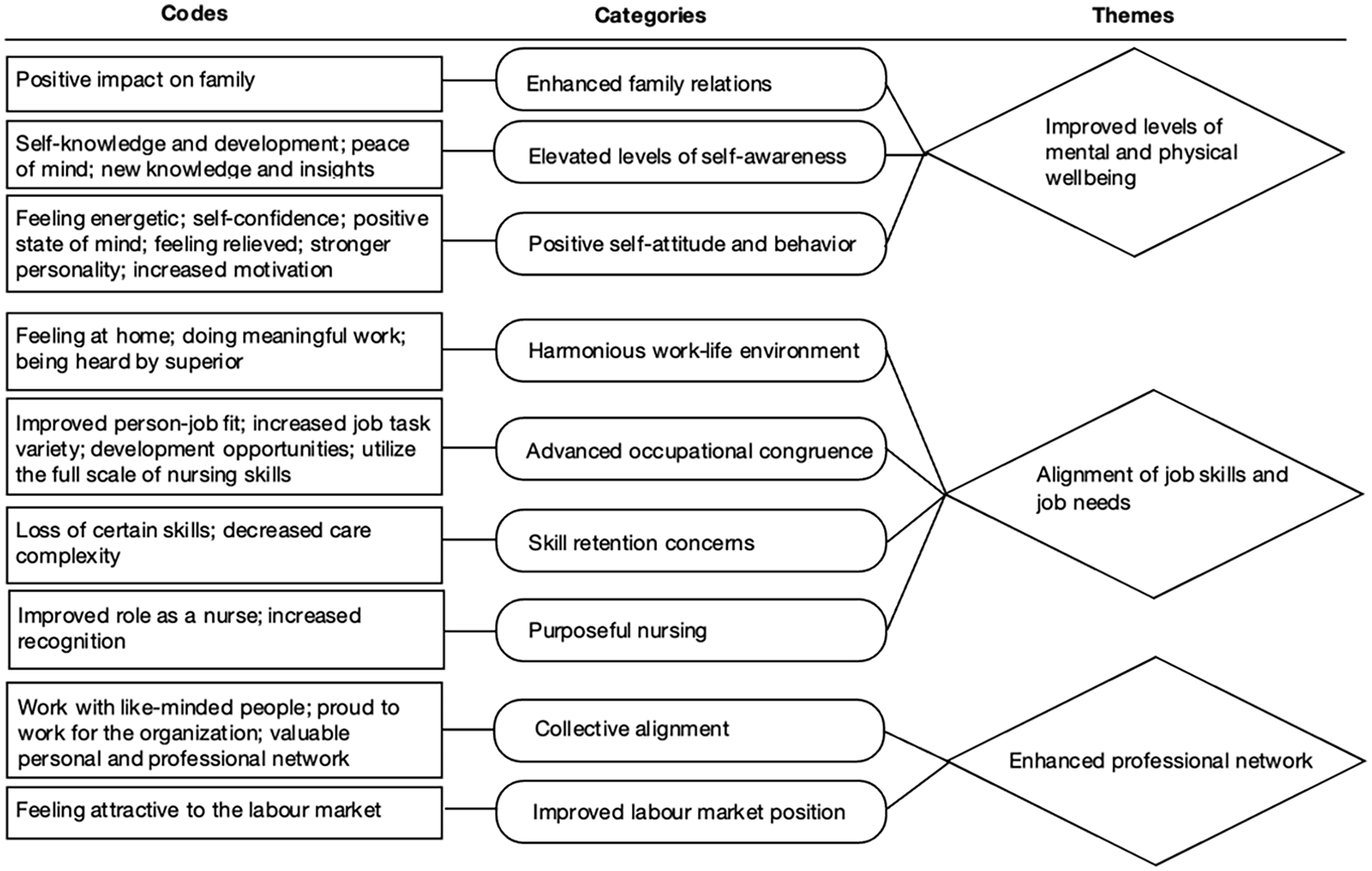
Research themes, categories, and codes.
Preliminary screening of results and participant characteristics through the code-document manager in Atlas.ti revealed that some postturnover experiences were more prevalent for participants belonging to certain demographic groups. For example, self-knowledge and development, self-confidence, and the utilization of the full range of nursing skills were the most prevalent postturnover implications for participants in the age group 41–50. The postturnover implication of feeling energetic was most prevalent among younger nurses aged between 21 and 30. In terms of occupational tenure, doing meaningful work and new knowledge and insights gained increased importance as tenure prolonged. Increased job-task variety was mostly experienced by nurses with an occupational tenure of between 16 and 25 years. Feeling attractive to the labor market was a prevalent postturnover implication across participants both for occupational tenure and age.
Theme 1: improved levels of mental and physical well-being
When participants reflected on how they experienced changing employers, typically, they first spoke about the positive impact the changing of employers had on their mental well-being and subsequent relationship with their family. Some participants experienced the positive impact on family by not complaining about work at home. One participant said, I was talking about how everything was going at work, all the things that went wrong [. . .] I still talk about my work from time to time, but it is not the main topic to be spoken about like I did before. (P17; Female; Age 58)
Other participants experienced a positive impact on the family in terms of being able to spend more time at home by saying: “I live much closer to work now, saving myself 5 hr of commuting, seeing my children much more” (P9; Male; Age < 50); or spend time at home in a more relaxing way by saying: “At home with family everything became more relaxed, less stress, my home, it became mentally and physically relaxed and peaceful when I changed employers” (P21; Female; Age 56). Several participants shared that their family expressed to them that they “saw a different kind [more relaxed and approachable] of mother and partner at home” (P25; Female; Age < 40). These codes and quotes form the category “enriched family relations.”
Participants also highlighted the insights the changing employers had given to understanding themselves. In terms of self-knowledge and development, participants described, “You get to know yourself so much by changing employers, what are my strengths and weaknesses, who am I as a person?” (P22; Female; Age 49) and “I know much better what I do and do not want in life and work” (P23; Female; Age < 50). Related to understanding oneself, participants stressed the importance of having peace of mind by “not arriving home frustrated from work and not having to spend time at home thinking about work issues” (P5; Female; Age 30) and “not having to worry about whether I wanted to stay on the current job, how I want to work and live my life” (P48; Female; Age 54). Other participants stressed the gaining of new knowledge and insights by narrating, “having changed employer allowed me to understand and protect my personal boundaries, what makes me happy and what doesn’t” (P24; Female; Age 38), and “personally I learned a lot from changing employer” (P44; Female; Age 61), as well as, “If you change employer you grow at a personal level, something that I don’t foresee would have happened when staying with an organization for a long time” (P3; Female; Age 31). Together, these form the category “elevated levels of self-awareness.”
Further probing about the impact of changing employers had resulted in numerous participants sharing that they were feeling energetic by experiencing “a boost to personal energy levels, having more energy to be present throughout the day” (P50; Female; Age 44). Other participants shared, “Changing employers make you stronger and more self-confident as a person in the sense that you realize you do not need to be part of a specific organization to be who you are” (P14; Female; Age 60) and “I feel less insecure having changed employers knowing that I am performing well and having made the choice for myself” (P44; Female; Age 61), together representing the code self-confidence. Participants stressed that changing employers affected their mood by “feeling more positive, motivated, personally well, happy, happiness is a beautiful state” (P6; Female; Age 26). Like this experience, nurses experienced feeling relieved, illustrated by “I experienced changing employer as winning a match, it is all exciting and at times you feel nervous, but it was such a relief once I changed employers” (P19; Female; Age 58). Another common impact discussed among participants was experiencing a stronger personality, derived from the following quotes “I became much stronger through the things I experienced while changing employers, I now dare to speak up when I need to” (P14; Female; Age 60), and “I looked at myself in the mirror when I thought about changing employers, thinking ‘who am I?’ and picturing this to changing employers” (P20; Female; Age 39). Finally, some participants reported an increased motivation to perform at work at their new employers by expressing, “I had to motivate myself at my former employer constantly reminding myself that patients needed me, but here it comes all naturally, I want to go to work and perform, feel more motivated to put in effort” (P17; Female; Age 58). Another participant experienced increased motivation to explore knowledge, narrating “I am much more motivated at my current employer, for example, to search for specific information” (Nurse 25; Female; Age < 40). The aforementioned codes and quotes form the category “positive self-attitude and behavior,” and together with the categories “enhanced family relations” and “elevated levels of self-awareness” form the theme: improved levels of mental and physical well-being.
Theme 2: alignment of job skills and job needs to work environment
When participants were asked about the job skills and needs they possessed as nurses and how they were required to perform these in their work environment, a variety of implications were mentioned related to the work environment, performing the nursing occupation, and the purpose of nursing. In terms of feeling at home, one participant said, At the current employer it is like feeling at home, at my former employer I had a connection with patients as their ethnic background was similar to mine, the language, smell, people, but at the present employer I can be the nurse I always was, practicing nursing skills, using technical nursing knowledge. (P30; Female; Age 62)
Another participant similarly experienced this by saying, “I feel at home here and I have the feeling I get support in the areas I need and want it” (P45; Female; Age 59). However, some participants expressed no change as “being here does not feel any better but certainly not any worse” (P31; Female; Age 60). Other quotes such as “I enjoy performing my work and I also feel that my work really matters here, that I am important to the people and that I can really mean something to them, creating meaning out of work” (P19; Female; Age 58), and “I am performing the nursing job in a meaningful way here to patients which makes it much nicer to me compared to my former employer” hinted to the code doing meaningful work. Related to the work environment, participants reflected that they felt being heard by superiors, expressing “they ask you questions, they ask you to take part in thinktanks, communication is smooth and superiors are accessible, they listen to you and allow opportunities for us nurses to speak up” (P22; Female; Age 49), “we are allowed to share our thoughts and feel have influence on decision-making” (P33; Female; Age 33), and “they ask me ‘Hey do you want to share your thoughts and try this out?’ which shows they are willing to listen to what I have to say” (P48; Female; Age 54). Together, the codes feeling at home, doing meaningful work, and being heard by superior form the category “harmonious work environment.”
Further probing the impact of changing employers to the nursing job resulted in several additional insights, including participants experiencing improved person-job fit. One participant remarked, In this organization, there is a much wider need to apply a broad variety of nursing skills. I need to use many more skills. I sometimes face scenarios where I think “oh it’s been a long while since I did that particular nursing skill” or “I have never done that,” but that gives the right challenge I need in the job, something exciting and new. For example, I was made responsible for a patient with a trachea, a condition that I had never cared for before. The organization gives me the training, it is not that you must do it right away, they provide training. Once trained you can follow a colleague and do it yourself when you feel comfortable. Such new aspects are exciting, and they also give you a good feeling like “Yes I can do that too.” (P25; Female; Age <40)
Another impact discussed was experiencing increased job task variety. Participants expressed having to practice a diversity of job duties, for example overseeing health care indications, having to work at multiple locations, and performing administrative duties. One nurse narrated “I walk into someone’s house and have to help the patient put their socks on, then I walk out and move on to the next house, finding someone who is terminally ill and needs different care, it is very interesting” (P5; Female; Age 30). Another participant said, “I enjoy performing different tasks, different patients come and go, I love this continuous change of patients, the dynamics, I’m a fan of it!” (P39; Female, Age 31).
The code development opportunities was derived from several participants indicating that, contrary to their experiences at their former employer, they were able to access training and development courses at their new employer. One participant outlined the differences between the former and latter employer, expressing “It was different at my former employer, it was patient first and employee second, but my current employer puts us first, is interested in enhancing our development as nurses, helping us develop” (P21; Female; Age 56). Another participant shared a similar experience, explaining, At my former employer, we were not allowed to pursue any self-development training beyond what they offered. However, at my current employer, I have the freedom to engage in various types of training, and I can even count training hours as part of my working hours. (P25; Female; Age <40)
Also, some participants expressed that changing employers allowed them to utilize the full scale of nursing skills where they were able to “practice variety in nursing skills that allowed for maintaining skill levels adequate to perform the nursing job” (P49; Male; Age 31) which led them to “feel aligned as a nurse to the job, more challenge, that your skills matter” (P46; Female; Age 41). Together, the codes improved person-job fit, increased job task variety, development opportunities and utilize full scale of nursing skills form the category “advanced occupational congruence.”
While most nurses were positive about the change and its impact to skills and development, some participants expressed some concerns. These concerns were described as “not being able to practice the full range of nursing skills to the extend I could at my former employer” (P9; Male; Age < 50) and “as an area nurse I had to place catheters and give injections, but now I don’t have to do that anymore as the care provision is different and I think I am losing out on these skills” (P10; Female; Age 41). These quotes reflect a concern over potential loss of certain skills. A related issue was also described, where one nurse outlined her concern over keeping nursing skills up with time, narrating “Nursing skills continuously develop and I am afraid if I stay in this setting too long that I won’t keep up to speed with developments outside this facility” (P13; Female; Age < 30), forming the code decreased care complexity. These two codes, loss of certain skills, and decreased care complexity form the category “skill retention concerns.”
Overall, nurses expressed experiencing an improved role as a nurse by saying “in the hospital I was mainly busy practicing technical skills, whereas here I am a bit of everything, practicing technical and communication skills, looking after someone’s diet, really wanting to make that difference to the patient” (P19; Female; Age 58), and “I have the feeling I can finally put in practice everything that I’ve learned over the years” (P27; Female; Age 48) and “by being able to practice a broader set of tasks at this employer, for example preparing a health care plan, I am involved in more than just the technicalities, so I feel can better perform the nursing job here” (P34; Female, Age 24). Finally, the code increased recognition was derived from the following quote: At the current employer there is much more recognition for yourself as an individual and the work you do. Yes! This is because you receive responsibility and trust from the employer to do your thing and to resolve issues yourself. Also, there is open communication with the nursing director. You can speak to him using his first name, you can e-mail him, you can call him, you can have discussions. You feel recognition and belongingness because you get the trust from the employer. (P41; Female; Age 43)
Altogether, the codes improved role as a nurse and increased recognition form the category “purposeful nursing.” Since all these categories relate to the alignment of nursing practice demands and skills, they form the theme: alignment of job skills and job needs.
Theme 3: enhanced professional network
When the participants were asked about whether the changing of employers made any difference to their relationships with colleagues, they frequently said “I now have very good contact with patients and colleagues, we laugh a lot, I found my way” (P30; Female, Age 62), and “in this organization we do things together, we communicate well with each other” (P6; Female; Age 26) and “we, colleagues, are all at a similar level here and that makes it easier to discuss things which I really enjoy” (P4; Female; Age < 40), hinting to the code work with like-minded people. Related to this, participants expressed that they felt proud to work at their new organization by saying “I am generally proud to work for this organization and even managed to motivate my sister to apply here,” “I am proud on this employer and on the people that work here.” Also, many participants expressed that their professional network grew because of changing employers and that they make use of their former network at their current employer: I personally have an interest in wounds, and I have a friend, an ex-colleague, who is specialized in wounds. I am not specialized officially, and although I do know a lot about wounds, I will contact her when I am not sure. I will tell her “I see this and that, do you have any advice? Or do you think I should do something differently?” Such contact and recommendations are very valuable. (P47; Female; Age 60)
and “I use my former network to check whether there are beds available elsewhere” (P24; Female; Age 38), hinting to the codes valuable personal and professional network. Together, the codes form the category “collective alignment.”
Some nurses found themselves more attractive to the labor market after changing employers through increased experience having been employed at multiple health care organizations. This varied experience allowed to develop their skills and abilities, which they deemed highly valuable in the current labor market, where nurse shortages are high and care complexity increases. The code feeling attractive to the labor market was derived from the following and similar quotes Well, the changing of employers gave me more experience. Simply because I have experienced all kinds of care. I worked inside many organizations, even if it sometimes was only a year, my experience grew. This definitely gave me more chances on the labour market, not only the job experience but also life experience. (P21; Female; Age 56)
This and similar experiences form the category “improved labour market position.” Together, the discussed categories form the theme: enhanced professional network.
Figure 2 displays the primary findings of the study in the context of self-determination theory and person-job fit theory. The value of both theories as analytical tools for understanding postturnover outcomes becomes apparent when interpreting the implications that follow turnover. Figure 2 presents the dimensions of self-determination theory on the left side, illustrating the alignment to specific codes, categories and themes found in this study. For example, the “relatedness” dimension in self-determination theory is reflected in the study’s findings, indicating a positive impact on the family. The “competence” dimension appears in this study’s findings through the alignment of job tasks and application of skills. The discovery that some nurses have concerns about skill retention adds a nuanced perspective to the somewhat negative implications of changing employers related to competence. The concept of “autonomy” closely aligns with the nursing profession, where nurses need to work in an environment that allows for the independent practice of nursing skills. Such an environment is facilitated within an organization through collaboration with like-minded individuals who share similar values and goals. This alignment empowers nurses to take ownership of their work and extend their professional networks beyond the confines of their organization.
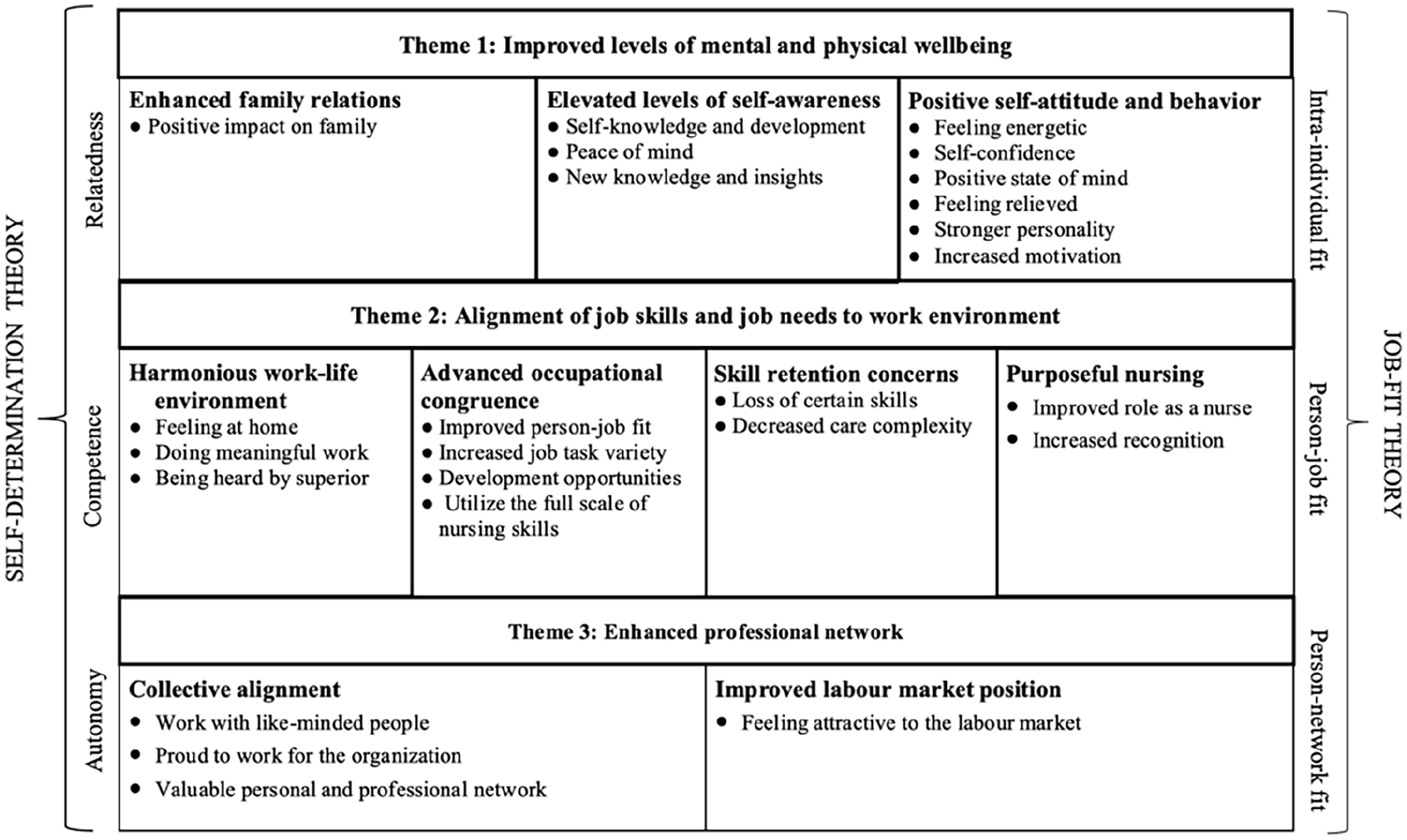
Postturnover implications at the nexus of self-determination theory and job-fit theory.
On the right side of Figure 2, the dimensions of job-fit theory are presented. These include “person-job fit,” “intra-individual fit,” and “person-network fit.” The findings demonstrate that nurses’ person-job fit is improved when they engage in meaningful work, apply a variety of their skills, have opportunities for skill enhancement, and overall perceive an enhancement in their role as nurses. While a few nurses expressed skill retention concerns, at the time of the interviews, this was merely a concern, but it has the potential to lead to reduced feelings of job fit in the future. The findings also offer preliminary evidence of the existence of an “intra-individual fit” lens and “person-network fit” lens. In this study, intra-individual fit pertains to the individual’s alignment with themselves, including how they feel in the new setting, their mental and physical well-being, and the knowledge they possess as a result of changing employers. Person-network fit relates to the congruence of a person within their professional network. Changing employers allowed nurses to form new connections while also maintaining relationships with employees from their former institutions. By maintaining these relationships, especially with former colleagues whose skills were deemed highly valuable, nurses experienced a better fit within their professional network as they continued to build upon their former networks at the new employer. In summary, each dimension of self-determination theory corresponds to a dimension of job-fit theory, and at the same time, these dimensions are related to specific themes and corresponding categories and codes identified in this study.
Discussion
Nurse turnover is a primary concern in health care. A large body of research investigated the impact of turnover, taking the organization’s perspective. While turnover can have benefits to organizations (Hom et al., 2020), most research is framed around the negative impact of turnover (Bolt et al., 2022). In an attempt to better understand the complex dynamic of turnover, we explored whether this was similarly the case for employees who changed jobs, taking experiences from nurses who changed employers. Drawing on self-determination and job-fit theory, this research explored postturnover implications of nurses working in Dutch health care, addressing the question:
Our findings extend previous research on postturnover implications. For example, Sylva et al. (2019) found several positive implications to employees who changed employers, such as improved job autonomy, task diversity, and lesser conflict; however, their study did not emphasize a specific context. This research confirms these implications to the nursing occupation, providing contextual nuance considered necessary by Cafferkey et al. (2020) to postturnover implications. Also specific to the nursing context, our research found additional postturnover implications such as the loss of mostly technical nursing skills. Our research also extends the research conducted by Swaen et al. (2002), who found health care workers to experience improved work perception, measured as job satisfaction and commitment. The findings of our research provide nuance to this by having discovered nurses experiencing an improved nursing role fit as they were provided with opportunities to practice a wider range of nursing skills, although these were not always more advanced technical skills. Our study further contributes by having discovered that nurses develop a larger professional network. Specifically, this meant that nurses sometimes called colleagues from their former employer to ask questions related to the availability of beds and training on specific nursing skills, somewhat indicating that the leaving of nurses can provide benefits to organizations when effective and positive relationships are maintained with leavers. Finally, most of this study’s findings present positive postturnover implications. This is important as turnover is often initially stressful and presented in the turnover literature as mainly a negative phenomenon (Bolt et al., 2022), however, this study found that turnover can have many positive implications for the individual who changes employer.
Theoretical implications
The analysis of findings shows that nurses in the Dutch health care context experience a multitude of postturnover implications reflecting the importance of self-determination theory (Ryan & Deci, 2000) in explaining their experiences. In terms of autonomy, the participants stressed that they gained instant self-confidence after changing employers as they felt personally in charge of their own careers and actions taken to change employers, although initially stressful. Also, close to half of the participants highlighted that they gained increased recognition and more variety in job tasks to be performed independently, which is indicative of increased autonomy received at the new employer. In terms of competence, nurses stressed that they gained more self-knowledge and job-related knowledge after changing employers, which highlights the importance of professional and personal development for nurses. Relatedness, the third central aspect of self-determination theory, was experienced through being able to maintain connections with former colleagues through informal nursing networks and nurses realizing that they do not have to remain part of a specific organization to maintain connections with former colleagues, who often became friends they could still consult with. Having found this, this study contributes to the knowledge on postturnover implications by leveraging self-determination theory and reconciles such postturnover implications by taking the perspective of the person who changed employers.
Second, the findings demonstrated congruence with job-fit theory (Edwards, 1991) as participants experienced job role improvement by being able to practice a broader range of nursing skills as well as being recognized for the work they perform. Besides congruence, this article hints at the possibility of the presence of multiple fit lenses through which postturnover implications can be viewed. Specifically, our findings hint to the preliminary presence of an intra-individual fit and person-network fit lens. A fully developed theoretical fit framework is beyond the scope of this research and we would encourage future researchers to delineate the possibility for the existence of multiple types of postturnover fit lenses.
Conclusions and future research
Our findings contribute to turnover research at the intersection of self-determination and person-job fit theory. Our findings indicate (1) a broad range of postturnover implications that highlights the need for health care organizations to cater to the three basic needs of human beings: relatedness, competence, and autonomy (2) mostly positive postturnover implications specific to person-job fit that help balance the negative perception of turnover; (3) that the act of turnover itself is not the end state of the turnover experience, although employment ties abandoned, for the individual there is still a mental and physical “after” process, which endures long into re-employment.
This research revealed that nurses particularly value having mental and physical peace, fully practice the nursing occupation in terms of skills application, and generally enjoy being part of a more extensive professional nursing network. Practitioners can embark on these findings by first ensuring their health care organization has practices in place to help nurses maintain mental and physical balance. Such practices could include providing training on how to maintain mental well-being, time management, as well as exercise to remain physically fit. Workplace intervention strategies could be implemented to assess the effectiveness on employee outcomes, such as turnover intention, withdrawal behaviors, and actual turnover. Training and development opportunities to maintain and develop a range of nursing skills, including communication and technical skills, should also be emphasized. Since nurses also enjoyed being part of a larger nursing network and at times explored this professional network at their new employer, health care organizations can take a more proactive role in establishing formal networks, for example, by taking an example from education, where networks are maintained through alumni relationships. Also, the nursing workforce could benefit from nurses who are able to contribute to a much more diverse and autonomous image of the nursing profession because such a change would help prevent nurses leaving the profession (van der Cingel & Brouwer, 2021).
Like any other research, this study has several limitations. One of these limitations is that only the perspectives of nurses were considered but the perspectives of former colleagues and the employing health care organization would also have been valuable in assessing the impact. Also, although we consider the specific occupational focus as a strength of this study, postturnover implications of nurses leaving for other occupations could be explored as well to allow for a better understanding of whether postturnover implications are occupation or domain-specific. Another limitation of the study is that using a retrospective reflection may underestimate or overestimate the implications based on the successfulness of experiences. While this allows for a better understanding of how individual nurses experienced changing employers, it could be that because the nurses that took part in this research had mainly positive experiences with changing employers, they were more likely to take part in this research. This means the findings may not necessarily represent the experiences of other nurses who change employers. Additional research should be conducted to see whether other nurses similarly experience such positive implications. Also, this research did not control for time employed at the destination organization, the specific type of health care organization that is left or joined, and whether the new role is a promotion or has any fundamental differences to the previous employment that would be anticipated at the time of change. We encourage future research to conduct additional analysis on control variables, addressing questions such as: are there fundamental differences in postturnover experiences for employees who made sideway moves and upward moves? Finally, the subjective interpretations of experiences in our study hint to positive and negative experiences, but we did not have any quantifiable measures in place to classify experiences as positive or negative. Future research could ask participants to specify on a scale to what degree experiences are positive or negative as this would enable the assessment of a honeymoon-hangover effect. Finally, to further contribute to the use of theory in turnover research, it would be interesting to use the abilities, motivation, opportunities (AMO) framework to understand postturnover experiences. Bos-Nehles et al. (2023) point to the interactive nature of the AMO characteristics, and it is clear from our research that employees are faced with new “opportunities” and, often, increased motivation in their new role. Overall, our study contributes to the body of knowledge on postturnover implications and these recommendations will further enhance knowledge on postturnover experiences.
Footnotes
Funding
The author(s) received no financial support for the research, authorship, and/or publication of this article.
Declaration of conflicting interests
The author(s) declared no potential conflicts of interest with respect to the research, authorship, and/or publication of this article.
