




Abstract
We examine entrepreneurial ventures in a post-conflict context to identify practices that are helpful for companies operating in conflict zones while contributing to the United Nations’ Sustainable Development Goal 16 (SDG 16)—Peace, Justice, and Strong Institutions. Using emancipatory entrepreneuring as our theoretical lens, we analyze entrepreneurial ventures where ex-combatants seek to create economic opportunities and challenge the status quo of violence, poverty, and inequality in their rural communities. We develop four qualitative case studies of ex-combatant entrepreneurship to identify the activities that enable them to grow their businesses while promoting peace. We identify actor distance and entrepreneurial stage as key dimensions for defining a matrix of relationship arrangements that facilitate venture success and peacebuilding efforts. We conclude with a summary of our contributions and implications for research and practice.
Introduction
This article focuses on entrepreneurial practices in extreme contexts that allow ventures to prosper while contributing to the Sustainable Development Goal (SDG) 16—Peace, Justice, and Strong Institutions. This SDG states that societies must strive to end violent conflict, strengthen institutions at all levels, and promote inclusiveness and justice (United Nations, 2015). These issues are relevant to private enterprises in all countries, not just those operating in war-torn regions, because all societies experience some degree of these challenges. SDG 16 has been identified as an enabler of the other SDGs 1 (Sachs et al., 2019) since peace and the rule of law are prerequisites of a stable society and, thus, economic development (North, 1990; Robinson & Acemoglu, 2012). Moreover, peacebuilding and development cannot be top-down processes but rather must be bottom-up and local (Autesserre, 2021; Christensen et al., 2019) and must draw on a broad range of actors and interest groups (Melin, 2016). Therefore, the private sector can have a fundamental role to play by providing resources for peace and development, jobs to populations affected by conflict, and legitimacy to peace processes (Rettberg, 2020).
Although SDGs are receiving a great deal of attention (e.g., Rosati & Faria, 2019), SDG16 is often neglected: less than 1% of firms that joined the UN Global Compact (UNGC) explicitly tackle SDG 16 in their sustainability strategy (Reade, McKenna, & Oetzel, 2019). Moreover, B-Lab’s B Impact Assessment (BIA) database (B Lab & United Nations Global Compact, 2020) shows that not a single firm answered any of the seven questions regarding peacebuilding activities and human rights in their survey. In fact, 40% of respondents answered only one question out of the 40 related to this SDG. In addition, few studies directly address SDG 16. They focus mainly on multinationals (MNCs) lobbying and public/private partnerships to achieve various SDG 16 targets and not on how a firm’s everyday business activities can lead to peace (e.g., Silva, 2021). Indeed, the problem is that we do not know much about which practices may help firms prosper in challenging contexts like (post)conflict zones.
In this article, we study four ex-combatant entrepreneurial ventures in a post-conflict zone to identify which practices are useful for companies operating in a disrupted context—unique and unprecedented events external to the firms (Hällgren et al., 2018). Post-conflict transitions are highly challenging contexts where extreme violence and injustice are common. In the transition to peace, rebels must not only disarm and demobilize but also return to civilian life, reintegrate into society and participate in the legal economy. The difficulty of this undertaking is increased by the fact that ex-combatants are highly stigmatized (McMullin, 2013). To overcome these challenges, some ex-combatants have pursued entrepreneurship to reintegrate into their country’s social and economic life. The success of these ex-combatant ventures will have a de facto contribution to peace by virtue of reducing recidivism.
Applying the lens of entrepreneurship as emancipation, which views entrepreneurial activities not only as profit generators but creators of positive social change and liberators from the status quo (Rindova et al., 2009), we recognize that these ex-combatant entrepreneurs use their ventures not only to reintegrate economically but also to repair the social fabric damaged during the conflict. This lens highlights three dimensions of emancipation: autonomy seeking (breaking free of constraints), authoring (defining new relations and rules for positive change), and making declarations (communicating emancipatory intent). We build upon recent work which relates this lens to peace and conflict: entrepreneuring can help rehabilitate former religious terrorists (Chandra, 2017), and overcome the stigma of refugees (Adeeko & Treanor, 2022) and ex-combatants by crossing social boundaries (Fajardo et al., 2019), among others.
Our contribution is threefold. First, we develop a matrix of actor engagement that shows useful practices for companies operating in (post)conflict zones, which also sheds light on the study of peacebuilding entrepreneurship, that is, inclusive and value-creating practices (Fort, 2016; Joseph & Van Buren, 2021). Understanding how ex-combatant ventures build relationships with different actors and acquire, allocate and distribute resources to be economically viable can help us guide firms operating in difficult contexts while building peace (emancipate ex-combatants and their victims). Second, our framework allows for furthering emancipatory entrepreneuring since we provide more formal constructs to study and further develop this theoretical lens and better understand the autonomy seeking, authoring, and making declarations dimensions. Finally, we link the observed firm-level activities to the targets of SDG 16.
The article is organized as follows. The second section presents a brief overview of the literature that addresses businesses and SDG 16 (directly and indirectly). The third section develops the emancipatory entrepreneuring lens. The fourth section discusses the context of our research setting, sample, methodology, and sample case studies. The fifth section presents our results and analysis of the characteristics of the emerging ventures and their processes, practices, and activities. We continue with a discussion of the findings, limitations, and implications of the study in the sixth section. Finally, we present our conclusions.
Literature background
Business, SDG 16, and peacebuilding: from MNCs to entrepreneurship
Studies on business and SDGs have focused primarily on understanding how firms, especially MNCs, tackle the social and environmental SDGs such as climate change or poverty alleviation while overlooking governance-focused issues like those under SDG 16 (Reade et al., 2019). Such research focuses on studying firm-level actions addressing environmental and social impacts but less on how firms can tackle the institutional-level sustainability challenges of governance, democracy, and civil society. Since many of the targets of SDG 16 are outside the scope of firms’ operational reach, such as target 16.9—By 2030, provide legal identity for all, including birth registration—(United Nations, 2015), firms and researchers may have the impression that the private sector cannot directly contribute to this SDG (Van Zanten & Van Tulder, 2018).
The focus of firms and researchers on environmental and social sustainability issues reflects the somewhat inconsistent makeup of the SDGs. Some SDGs define a clear set of problems and targets that are more accessible to traditional managerial action. In contrast, others focus on socially complex and institutionally interconnected challenges, which seem beyond the conventional reach of a single firm’s management decisions since they require complex cross-sector and stakeholder partnerships (Van Tulder & Keen, 2018). This bias toward tangible SDG targets exists despite arguments that the socially complex SDGs are more crucial to sustainable development. For example, SDG 16 is acknowledged as both essential to achieving other SDGs (Sachs et al., 2019), since peace is necessary to ensure a healthy and productive society (Wesley et al., 2016) and, according to the United Nations (2020), as the foundation of both sustainability and firm performance:
The themes of SDG16, peace, justice and strong institutions, are core to sustainable business—they are the foundation not only for business responsibilities, but also business success. However, it can be difficult to understand concretely how these concepts relate to a business’s strategies, operations and relationships. (United Nations, 2020)
SDG 16 remains overlooked by businesses and management researchers since it is seen as external to the firm. Few studies explicitly look at how firms address SDG 16. For example, Van Zanten and Van Tulder (2018) outline a research agenda for engaging MNCs with SDGs. Their exploratory survey shows that companies engage more with SDGs that have actionable targets. Also, Silva (2021) draws on the FTSE 100 list to show how firms respond to different SDGs and finds only a handful of companies address SDG 16. Finally, Montiel et al. (2021) suggest that multinational investment geared toward reducing harm to social cohesion could not only have a positive impact on the host country’s SDG agenda but also reduce negative externalities for the firm and boost competitiveness.
Beyond these studies explicitly linking firms and SDG 16, both management and political science scholars have studied how firms, in particular MNCs, fare in conflict regions or how they contribute to peace. However, these two research disciplines rarely intersect so there is little systematic analysis of how firms and other actors seek or impact peace (Melin, 2016). The business literature has addressed peace issues on topics such as the effects of conflict on MNC operations (e.g., Dai et al., 2013), and MNC responses to conflict and peace accords (e.g., Albino-Pimentel et al., 2021; Jallat & Shultz, 2011). This has been dubbed the peace-through-commerce literature (Williams, 2008). More recently, the Business for Peace (B4P) literature presents a paradigm shift in which businesses are put at the forefront of peacebuilding alongside public actors, thus changing the balance between public and private authority and responsibility in ensuring successful conflict management and institutional development (Schouten & Miklian, 2020). This is reminiscent of corporate diplomacy, that is, activities in the intersection of business, politics and society to create value for firms and stakeholders (Henisz, 2016).
Indeed, the private sector can be fundamental in building peace by providing resources for peace and development, jobs to populations affected by conflict, and legitimacy to peace processes (Rettberg, 2020). According to Miklian (2017), there are five ways in which MNCs promote peace at a grass-roots level: improving the dividends of peace (economic opportunities), promoting local capabilities development, importing international norms that encourage accountability, constraining root causes of conflict (such as poverty and inequality), and even undertaking diplomatic actions themselves. In other words, through employment, business-to-business trade, and stakeholder engagement, among other actions, firms can impact governance, peace, and justice—either as enablers or as disablers (Miklian & Medina Bickel, 2020).
Beyond MNC activity, a recent line of research has focused on peace entrepreneurs (Fort, 2016), that is, firms that focus on peace within their corporate strategy. However, as Joseph and Van Buren (2021) point out, businesses in conflict zones may either build peace or foster conflict depending on how they make their profits. Indeed, it is not enough for an entrepreneurial venture to have an economic impact; it also has to make beyond-business contributions. To be peacebuilders, entrepreneurs have to be inclusive and value-creating. In other words, ventures have to create a shared identity within conflict zones to promote integration between stakeholders and create societal value beyond simple profit, like community engagement and above-average working conditions and wages.
To analyze ex-combatant entrepreneurial practices as peacebuilding, we use the lens of emancipatory entrepreneuring, which we turn to in the next section.
Ex-combatant ventures as emancipatory entrepreneuring
Emancipatory entrepreneuring states that entrepreneurs are motivated to start new ventures not just for profit-seeking but to emancipate themselves or society from the status quo (Rindova et al., 2009). It has three dimensions: autonomy seeking (breaking free of constraints), authoring (defining new relations), and making declarations (communicating emancipatory intent). We utilize this lens as we study our sample of entrepreneurial firms to identify how they contribute to SDG 16. By focusing on the specific activities inherent in these three dimensions, we hope to surface firm-specific activities that impact peacebuilding and SDG 16. In this section, we first explain the three components of emancipatory entrepreneuring and then situate our work within the literature.
Autonomy Seeking refers to the entrepreneur’s efforts to escape, change, or circumvent perceived constraints in their economic, political, or social environment (Rindova et al., 2009). This has also been characterized as seeking methods and activities to break free from the oppression of their status quo, in the act of establishing their venture (Chandra, 2017). Therefore, we should see examples of specific activities, business models, and firm missions that address the post-conflict challenges surrounding our ventures. In our sample, the status quo is riddled with constraints such as inequality, bias, a history of mistrust, and competing social philosophies that result from many decades of violence. Therefore, studying ex-combatant ventures’ autonomy-seeking dimension should shed some insights into specific activities or venture decisions that directly impact SDG 16.
Authoring is the second dimension of the process, where the entrepreneur seeks to define “relationships, arrangements, and rules of engagement that preserve and potentially enhance the change potential of a given entrepreneuring project” (Rindova et al., 2009, p. 483). The complexity of the authoring process is dependent on exactly how far the venture plans to impact or stray from the institutions of the status quo. In our sample, the very identity of our entrepreneurs is a significant challenge to the status quo, let alone the specific products or social goals of their ventures. Their authoring decisions regarding employees, customers, suppliers, and other actors are essential to the success of their ventures in surviving and achieving the emancipatory goals of their founders. Understanding how these firms engage in bricolage of their physical, social, and institutional inputs to construct their resource base and accomplish their organizational goals (Mair & Marti, 2009) can reveal insights on how exactly firm-level stakeholder engagement can impact the broad peacebuilding goals of SDG 16.
The final dimension is Making Declarations, where the venture telegraphs its contradictions with the norms of the environment in “an effort to generate stakeholder support for the intended change in the status quo” (Rindova et al., 2009, p. 485). But it is uncertain which declarations will gather support and which may threaten stakeholder relationships. It may seem that with a goal of peacebuilding that any declarations would be well received; however, our firms have a complex history with their communities. Any declaration by an ex-combatant venture could likely spark contestations from other economic actors, challenging the veracity or authenticity of the ventures claims toward peacebuilding. Studying the declaration choices of our ex-combatant ventures can provide significant insight into how firms can promote or advertise their SDG 16 efforts while maintaining the viability of their business models.
The literature on entrepreneurship as emancipation has developed into two streams. One stream focuses on the entrepreneurs’ emancipation from individual constraints and the second on the broader emancipation of society from the status quo (Zayadin et al., 2022). In the first, studies have focused on exploring how entrepreneuring in a number of traditional industries can liberate entrepreneurs from the constraints of their identity. This includes freedom from gendered constraints for women entrepreneurs in India (Roy et al., 2021), the stigma of refugee status for refugee women entrepreneurs in the United Kingdom (Adeeko & Treanor, 2022), extremist religious ideology for Indonesian religious-based terrorists (Chandra, 2017), and identity-based obstacles for reintegrating ex-combatants in Colombia (Fajardo et al., 2019). In addition, this stream has addressed the emancipation from structural, cognitive, and emotional constraints of entrepreneurs operating in a stigmatized industry, that is, the sex industry (Ruebottom & Toubiana, 2021). The results of the studies in this first stream include recommending additional dimensions to the emancipatory entrepreneuring framework (Chandra, 2017), identifying three types (structural, cognitive, and emotional) of individual emancipation (Ruebottom & Toubiana, 2021), and evidence that the benefits of emancipation from individual constraints can be limited if not followed by emancipation of societal constraints more broadly (Adeeko & Treanor, 2022; Roy et al., 2021).
The second stream of the literature addresses the potential of entrepreneurs to emancipate their society or community from the constraints of the status quo. A study of Indigenous-owned small- and medium-sized enterprises in Canada (Pergelova et al., 2021) operationalizes the main constructs of the emancipatory entrepreneuring framework using archival data and identifies linkages across the dimensions of Autonomy Seeking, Authoring, and Making Declarations (Rindova et al., 2009). The study finds that Authoring and Making Declarations practices mediate the relationship between entrepreneurs’ motivation (whether seeking individual vs. collective autonomy) and venture outcomes (Pergelova et al., 2021). Indigenous communities face unique challenges competing in a socioeconomic status quo that has historically excluded them and is built on vastly different cultural principles of property ownership, and this study finds that indigenous entrepreneurs can create benefits of employment and service to the broader indigenous community (Pergelova et al., 2021). Another study focuses on 25 entrepreneurs in Jordan and how their efforts might emancipate from the “wasta” social network system that limits access to economic opportunities (Zayadin et al., 2022). Zayadin et al. (2022) find evidence that these entrepreneurs can emancipate from the individual constraints imposed by the “wasta” system. Still, despite pro-entrepreneurial government policy, none of these entrepreneurs enacted venture practices that provided emancipation to the broader society.
Both streams of the emerging emancipatory entrepreneuring literature address themes and contexts relevant to our proposed study. The studies include contexts of indigenous communities, conflict zones, and terrorism. And both address themes regarding overcoming stigma, promoting employment, and challenging institutional inequality. Our study builds on the second stream of the literature (emancipation from the status quo more broadly) by exploring firm-level activities of ex-combatant ventures founded and motivated by the goal of peacebuilding. We now turn to our research design.
Setting, sample, and methodology
To explore how ex-combatant entrepreneuring ventures can survive and build peace, we conduct inductive qualitative research based on a multiple-case method. This method is appropriate to explore how and why questions and for theory building (Yin, 2009), in our case building on emancipatory entrepreneuring. To fit and build on this theory, we chose four ex-combatant entrepreneurial ventures in Colombia that allow us to identify themes within and across cases: Cerveza La Roja, Muñecas Ex-combatientes, Confecciones la Montaña and Café Paramillo. As Eisenhardt and Graebner (2007) exemplify, we chose these four cases by first selecting one main case (La Roja) and then adding three additional cases to increase the analytical power, as we explain later.
Research setting: ex-combatant entrepreneurship in Colombian post-conflict zones
We propose studying the link between business and SDG 16 in an extreme context, such as economic recovery after a civil war. Our research setting is the ex-combatant entrepreneurship in post-conflict Colombia, specifically the ventures of former FARC members, who demobilized in 2016 after signing a peace agreement with the government. The country’s 60-year-long civil war left more than 220,000 dead, 45,000 missing, and close to seven million displaced, and FARC was one of the conflict’s principal antagonists with more than 18,000 fighters (Baumohl, 2020). Surveys of ex-combatants by the government reincorporation agency reveal that a vast majority, 96%, dream of starting their business ventures (Colombia2020, 2019).
This research setting is appropriate for our study of the links between business practice and SDG 16 for three reasons. First, this type of post-conflict zone fits Hällgren et al.’s (2018) definition of disrupted contexts. A disrupted context is initiated by unique and unprecedented events external to the core activities of the organizations under study (Hällgren et al., 2018). While the end of a civil war is a positive environmental change, it is still a context riddled with uncertainty and risk, as well as the broken institutions and damaged social fabric created by the war itself. Exploring the practices and processes of firms operating in disrupted contexts is said to provide insight into “how knowledge and skills are mobilized to help safeguard well-being, security, and human freedoms” (Hällgren et al., 2018, p. 145).
Second, by studying the decisions and actions of firms operating in a post-conflict zone, we can identify what opportunities businesses have for promoting peace and avoiding a return to hostilities, therefore contributing to SDG 16. Finally, these entrepreneurs operate in a unique institutional environment stemming from novel cross-sector collaborations that resulted from the Colombian peace process, which allows engaging and collaborating with multiple and diverse stakeholders. We study entrepreneurial ventures taking place in Espacios Territoriales de Capacitación y Reincorporación (ETCRs), which translates to territorial spaces for training and reincorporation. They are the physical locales in which FARC ex-combatants are reincorporated into civil society while living in and contributing to the economic life of nearby communities (Comisión de Conciliación Nacional, 2017). These special conditions make Colombia a unique setting for exploring the theorized dynamics and challenges of organizations tackling complex societal challenges (Bryson et al., 2015).
Case selection, data collection, and data analysis
As in previous research using inductive qualitative research, we selected cases in a purposive and adaptive manner following the principle of theoretical sampling (Eisenhardt & Graebner, 2007; Gallo et al., 2018). Our sample consists of four ex-combatant entrepreneurial ventures created in Colombia after the 2016 signing of the peace accords. We start by first selecting one of the firms that had gathered the most media attention, and based on analyses of the collected data about the company and its emerging themes, further cases were purposely selected to gather additional evidence for theory building and variance generation (Corbin & Strauss, 2014; Yin, 2017). A further advantage of this approach is that the comparisons allow for eliminating purely idiosyncratic findings, therefore ensuring that the theory built upon the cases is more generalizable (Eisenhardt & Graebner, 2007).
Our first case was Cerveza La Roja, a firm that has gathered wide local and international media attention. It is one of the flagship firms of the post-conflict process in Colombia. As we collected data from La Roja and started analyzing it, other important ventures continued appearing in national media or peacebuilding conferences and events we attended. The second project that caught our attention was Muñecas Ex-combatientes por la Paz, which utilized a different business model and was founded by a team of all-female entrepreneurs. This case also became an essential part of our sample because the project failed during our study, giving us contrasting patterns in our data and more details unidentified in our first case (Eisenhardt & Graebner, 2007).
Following more data analysis, our third case, Confecciones La Montaña, stood out as an interesting entrepreneurial venture because they used pre-existing combatant knowledge, resources (facilities, etc.), and capabilities, to start the venture. They turned their combatant uniform workshop, materials, and know-how into an outdoor apparel firm that created gear with sufficient quality to compete with brands like North Face, Columbia, and Patagonia. The product quality resulted from their founders’ years of experience manufacturing outerwear for the extreme heat and humidity of Colombia’s rainforests. Our final case chosen was Café Paramillo, which engages in one of Colombia’s most traditional and internationally successful industries. This case allows for analyzing two important aspects of entrepreneuring for peace in our particular context: first, rural Colombia (i.e., agricultural regions) was the hardest hit in the conflict by FARC itself, and second, Colombia’s coffee industry requires engaging with multiple stakeholders, especially farmers. Therefore, Café Paramillo confronted the challenge of working directly with FARC victims.
The cases offer some similarities in being founded by ex-combatants after the peace agreement and all operating with minimal start-up budgets. Still, they are different enough in their business models to offer unique insights into the activities, relationship building, and decision-making of ex-combatant entrepreneurs. Most of the data were collected from secondary sources such as local, national, and international news articles, press releases, and videos. These sources were used to construct the narratives of the four chosen ventures, which we present in the next section. These narratives do not include all relevant details but provide a useful introduction and summary to the firms. However, the full richness of these sources was used in our coding and analysis.
We did not schedule official interviews with ex-combatants because our attempts to contact them through their intermediaries were unsuccessful. However, we attended events where they presented their stories, ventures, and products. These events included ex-combatants, representatives from the private sector, Colombian Government, The United Nations and nongovernmental organization (NGOs) engaged in supporting ex-combatant ventures. After these events, we could speak informally with members of three of the four projects under study. We asked them about their funding, sourcing and distribution challenges, and current performance and prospects. Finally, we conducted some informal interviews with sustainability managers at traditional firms in relevant industries and the director of a peace and economic development foundation.
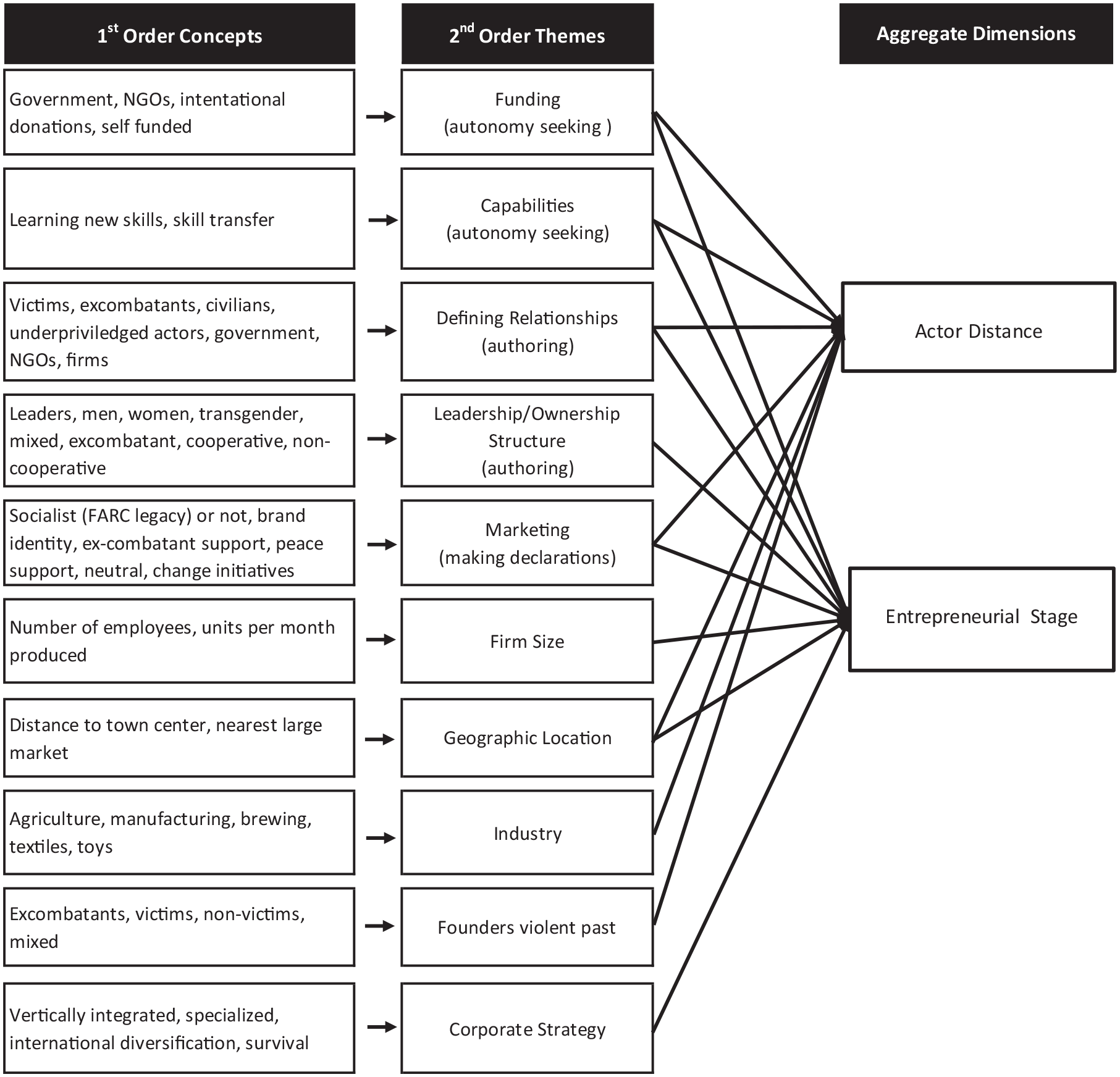
In these four case studies of ex-combatant ventures, we observed various operational practices, industries, and actor relationships. Similarities existed in commitment to prior political ideals, acute concerns about safety, and uncertainty about institutional promises. All three authors began manually micro-coding the secondary data for each case. As we added cases to our sample and used our primary data from our informal interviews, we identified additional micro coding items of interest until reaching saturation and finally grouped them to create a 45-item codebook. The following techniques included open and axial coding, category creation and abstraction for the final aggregate dimensions (Corbin & Strauss, 2014; Elo & Kyngäs, 2008). Using the codebook, each author open-coded the secondary data for three cases to generate overlap that allowed comparisons and triangulation. Then, all authors revised each other’s coding and a further iterative consensus-building process was used to resolve any inconsistencies. We grouped the items into first-order concepts, which we then analyzed and grouped, taking into account key items relevant to entrepreneurial ventures such as size, location, industry, founders, and ownership structure and also through the emancipatory entrepreneuring lens to identify elements related to seeking autonomy, authoring, and making declarations. We then refined these categories into 10 second-order themes in consensus, which led us to identify two key underlying dimensions.
The following section presents the narratives of the four cases.
Ex-combatant ventures case studies
Cerveza La Roja
La Roja is an artisanal beer produced by ex-combatants residing in the ETCR—Antonio Nariño, founded in November 2018. At the heart of this micro-brewery’s origin story lies the strength of personal bonds and childhood friendship. Nicolas Hurtado and Wally Broderick were adolescent friends who took very different paths shortly after graduating high school. Of Irish/Colombian descent, Broderick left the country and traveled to Europe to pursue higher education opportunities. Hurtado remained in Colombia and joined the FARC at 18 under the pseudonym Carlos Alberto. The two friends eventually reunite when Broderick returns to Colombia to teach English in the capital city of Bogota. The English professor learns that his childhood friend is serving an 11-year sentence for crimes related to his membership in FARC and decides to reach out and visit Hurtado in prison (Atehortua, 2019). After the Peace Agreement of 2016, Hurtado turned himself in at the ETCR-Antonio Nariño in the department of Tolima, about 124 kilometers from Bogota. Broderick continues to visit with his childhood friend, now at the ETCR, and also starts to volunteer as a literacy instructor.
Hurtado and Broderick’s friendship played a crucial role in the formation of La Roja. Broderick introduced the idea of producing beer as a potentially successful business venture for Hurtado and his partners. Broderick had a long-standing interest and passion for brewing, and after teaching a brewing class to members of the ETCR he helped Hurtado, and four other members, brew 25 liters of beer in October of 2018 (Atehortua, 2019). The six founders distributed this initial batch of beer by word of mouth. They named the beer “La Roja,” meaning the red, symbolizing their strong socialist sympathies. After they supplied beer to the anniversary celebration of the communist party, the resulting buzz and attendees’ social media postings gave the nascent beer brand a substantial boost in recognition. With this popularity and the founders reinvesting their profits in the venture, they grew to 600 liters/month production capacity by January 2019 (Atehortua, 2019).
The beer built a decent customer base in Tolima’s local bars but was also available in specialty shops in Bogota and through online orders (Viaño-Montaña, 2019). In online videos and crowdfunding pitches, the founders claim that demand has continuously outpaced their production capabilities, reaching only 800 liters/month by November 2019 (DW Español, 2019). The venture was founded with minimal capital investment and needed significant funding to meet its growth ambitions. In fact, at presentations and sales events, we heard from firm representatives regarding frustrations with the national government’s lack of support for the venture. They had plenty of demand for their products but felt they did not have the capital support nor the infrastructure development in the ETCR to support their growth and development. According to Ruben Dario, a La Roja representative, the infrastructure challenges included a poor-quality connection to the electric grid and a lack of good roads (Menéndez, 2019). They turned to crowdfunding and outside investors with a pitch emphasizing the pride of a Colombian-based artisanal beer brand.
Cerveza La Roja is an example of a successful ex-combatant venture, managing to grow demand for a new beer brand while supplying ownership and job opportunities for ex-combatants looking to reintegrate into civil society. By April 2019, they employed 29 ex-combatants, 11 of whom were women, while being named one of the three most popular ex-combatant brands by a national newspaper (Forero-Rueda, 2019). The company still faces many challenges, including achieving less than 1% of its crowdfunding goal as of June 2020 and the challenging economic times precipitated by the 2020 COVID-19 pandemic. This hasn’t stopped them, however. La Roja moved production from the ETCR to a stainless-steel brewing facility in Bogota, closest to their largest market (Redacción Colombia, 2020).
La Roja has demonstrated a commitment to the peace process and their local and ex-combatant communities. In the last 3 months of 2020, the firm introduced a special edition amber ale, whose proceeds would support the construction of kindergartens in three ETCRs. These early childhood education centers would be available to the children of the ex-combatants and locals from neighboring communities (Redacción Colombia, 2020). Two other ex-combatant beer brands joined this fundraising initiative, demonstrating the willingness to collaborate across firms when the results benefit their children’s future. This initiative is precisely the type of social sustainability activity that theory predicts these types of embedded cooperative ventures are likely to seek (Gallo et al., 2018).
Muñecas Excombatientes Por La Paz (Ex-Combatant Dolls for Peace)
Muñecas Excombatientes Por la Paz (Muñecas) was a rag doll company founded in 2018 by ex-combatant women residing in the Monterredondo ETCR in the Cauca department, 50 km away from the third-largest city of Colombia, Cali. The women’s initiative focused on dolls that portray a political, social, and cultural message to preserve the collective memory of the conflict and reconciliation and messages against discrimination against ethnic minorities and sexual violence toward women (United Nations, 2018). The project was initially pitched to academic and government institutions at the workshop “Seedbeds of Peace.” It was classified by the United Nations Verification Mission in Colombia as a fast-impact project after its official founding in 2018.
The project leader was Francis Restrepo, a local artisan and social leader who came to help in the reincorporation process in the ETCR. She shared the business idea with a group of ex-combatant women she met at the workshop and encouraged them to make dolls with her sewing machine. Since they were tired of waiting for government funding, they took on Francis’ challenge. Francis taught them how to sew. Since they had no materials, they started using their camouflaged T-shirts to make some parts of the dolls. Later, an ETCR leader contributed about 80 USD to help purchase supplies. By early 2020, there were 14 women employed: eight ex-combatants and six victims of the armed conflict with FARC (Forero, 2019). These ex-combatant women said the project signified their liberation through self-improvement and the desire not to return to arms. They felt proud and gained new skills, which increased their economic opportunities.
The company produced four types of dolls representing different Colombian communities: (1) the Afro-Colombian characterizing Colombia’s Pacific Coastal region, the country’s poorest, most neglected region; (2) the Nasa doll embodying the country’s indigenous tribes; (3) the peasant doll representing rural women; finally, (4) the Miranda doll, made of old guerrilla uniforms, representing ex-combatants. Using old ex-combatant uniforms, they hoped to give them the new meaning of what was once used for war can now bring joy and peace to children (Diario del Cauca, 2020). In addition, each doll carries an actual seed as an accessory in her basket. The seed symbolizes protection of the environment and their territory, a direct response to multinationals that they believed had stolen the knowledge of traditional medicine and corrupted it by creating transgenic seeds.
The company started by producing as little as six dolls a week but increased production when single orders reached 120 dolls. In December 2018, they procured four machines and materials worth around 14,000 USD through international cooperation to help the company increase capacity and meet their growing demand. The company soon started getting significant media attention with radio, TV, and print interviews (Peña, 2019).
Unfortunately, sales were low due to challenges in commercialization. The women received training in sales and promotion by entities affiliated with the reintegration process, such as the Office of the High Commissioner for Peace (OACP), the United Nations (UN), the Agency for Reincorporation and Normalization (ARN), and the Municipality of Miranda. They were invited to craft fairs in major cities and to give talks at universities. Attendees learned firsthand the laborious handcrafted manufacturing process, the conditions in which they were made, and the symbolism and stories of each doll (UN, 2018). Unfortunately, these commercialization efforts were not enough to sustain them through the economic impact of the COVID 19 pandemic. The women could no longer promote their products face-to-face, a key tactic, and sales declined. The venture went out of business in late 2020.
Regardless of the business failure, the company symbolized ex-combatant women’s empowerment and highlighted how ex-combatant and peasant women could become entrepreneurs in harsh conditions. One ex-combatant now believes her role as an empowered woman is to continue strengthening her community and showing the world that women and stigmatized people can make their dreams come true. Another ex-combatant who decided to stay in the ETCR hopes to continue the struggle for a better life despite her adversities and difficulties. Her experience with the dolls has given her the skills and confidence to be employable or start a new company. Through their dolls, this all-women company representing the country’s diverse women carried a message of peace and reconciliation, female empowerment, and women’s role in peacebuilding and equitable economic development.
Confecciones La Montaña
Confecciones La Montaña is an apparel company based in the ETCR La Plancha in the municipality of Anorí (Northeast of Medellín, the capital of Antioquia). It focuses on outdoor activewear with a core group of 25 ex-combatants with experience producing uniforms and gear for FARC (Redacción Digital BLU Radio, 2019). Like other cooperative projects, La Montaña started out of need: because of delays in government assistance, the livelihood of the ETCR members and their families was at stake, so the tailors decided to start the business with sewing machines they took out of their jungle encampments. The business’s original participants were 10 FARC members with their nuclear families (Monsalve Gaviria, 2019).
These particular ex-combatants had acquired tailoring skills because they had suffered war injuries and could not engage in active combat for Front 36 of FARC (Valencia González, 2019). Despite their injuries, they still wished to contribute to the cause and were put to work retailoring uniforms and other clothing so that FARC members could operate in rough terrain such as mountain forests. Their work has been so successful that La Montaña has started to sell its wares internationally (Carranza Jiménez, 2019). La Montaña is a clear example of a successful translation of skills honed during the war into economically productive skills for peace.
Cooperative leader and former Front 36 leader Andrés Zuluaga, better known for his alias Martín Batalla, explains that issues with the implementation of the peace accords have left the ETCR underfinanced, which has meant that demand for La Montaña products has highly exceeded their production capacity. Thus, he continues, since the government did not keep its promise to roll out funding for economic projects for FARC, La Montaña (and the cooperative in general) has had to finance itself and slowly grow its capacity (Redacción Digital BLU Radio, 2019).
Members of La Montaña have been proactive in seeking training and public relations. With the support of the National Learning Service (Servicio Nacional de Aprendizaje, SENA) and the international community, members have honed their sewing and tailoring skills. In addition, they have successfully solicited resources from the international community, including the French Embassy, which provided sewing machines and raw materials to continue with capacity expansion (Valencia González, 2019).
The business and its operating tailor shop have become integral to the local municipality: inhabitants of nearby rural areas travel to the ETCR to procure their apparel or get quick tailoring fixes (Pareja, 2018), which has given La Montaña a steadier income and enabled better relations with the community. Regarding the latter, Guillermo León Chansé, a leader of the ETCR, argues that cooperatives and their projects are concrete alternatives for the recovery of the social fabric in the communities (Gutiérrez, 2019). As such, offering tailoring services in addition to the products they sell has turned out to be a helpful tool to create goodwill for the ex-combatants trying to reintegrate in a zone where they were very active militarily.
Indeed, many of the inhabitants of Anorí suffered at the hands of FARC during the conflict, but now thanks to La Montaña and other projects they are turning over a new leaf. La Montaña has become not only a valued business in the region but also an employer: it employs women from the nearby communities (Semana Rural, 2019) and even some returning members of the community that had been displaced during the conflict (Pareja, 2018), which is a clear sign of successful reintegration and reconciliation.
As Chansé argues, they serve as an example so that these people see themselves as active, rather than passive, subjects of peace (Gutiérrez, 2019). La Montaña has successfully embedded itself in the community and has become a referent of peace and reconciliation: business meetings and informal gatherings between former combatants and the community regularly occur in the tailor shop. Moreover, community members that house the ETCR argue that their community has changed for the better since the arrival of the ex-combatants: infrastructure has been developed and some essential services like health care are now being provided (Pareja, 2018).
Café Paramillo
Café Paramillo is an ex-combatant entrepreneurial initiative located in Santa Lucía (Antioquia), about 200 km from the departmental capital of Medellin. It is named after a nearby national park, invoking regional and territorial pride. The brand sources coffee beans from small third-party producers and plants and harvests beans with the help of locals, ex-combatants, and victims of the conflict. Café Paramillo operates under the auspices of a regional cooperative, Cooperativa Multiactiva de Emprendedores del Campo Colombiano (CMECC). The beans are shade-grown under native trees or subsistence crops vital to the region’s sustainability. This practice ensures the community’s nutritional needs are met while also contributing to the coffee beans’ quality (ARN, 2019).
The venture is fully vertically integrated: planting, harvesting, drying, processing and roasting the beans for sale in 1-kg bags for retail customers. At a University speakers’ panel, an ex-combatant of Café Paramillo emphasized that the venture is committed to paying farmers a fair price for their beans and that their operations promote reconciliation because the community is engaged in the venture. He also indicated that financial support promised by the national government had yet to materialize, so their growth has been self-funded. Finally, the firm’s biggest challenge was access to domestic markets and here, the representative made a direct plea in a packed auditorium to private enterprise to provide market access or marketing resources.
Café Paramillo is mainly sold locally in Ituango but hopes to grow markets in other territories and even venture internationally. However, distribution and marketing have proven challenging. One form of assistance came from the national government. To increase the demand of ex-combatant products, the Agency for Reincorporation and Normalization (ARN), Colombia Compra Eficiente and the Unit for the Comprehensive Care and Reparation of Victims managed to modify the guidelines for government purchasing. Now, both victims of the conflict and ex-combatants in the process of reincorporation are guaranteed a percentage of the state’s purchasing of goods and services. Indeed, 20% of public purchases made at the national level, not only of coffee but also of other products, should consist of people in reincorporation (Sputnik Mundo, 2020). Because of these changes, the bidding process included Café Paramillo and other coffee brands from associations or organizations that involve ex-combatants in reincorporation and or victims of the former armed conflict.
A second marketing opportunity arose from a unique collaboration with a firm outside the traditional coffee value chain. Café Paramillo was one of three ex-combatant coffee brands featured by the digital magazine Arcadia at the 2019 Festival of Books and Culture in Medellin (ARN, 2019). Arcadia hosted a tent at the festival with the title “the coffee of the morning (future),” playing off the fact that “morning” and “tomorrow” are the same word in Spanish. The tent had space for over 150 attendees who were invited to sample the three coffee brands while engaging in a spirited salon focused on the future of art, culture, and the peace process’s progress. Representatives of Café Paramillo were on-site with a booth selling from their retail inventory.
Finally, Café Paramillo’s marketing efforts have benefited from ex-combatants’ entrepreneurial efforts outside the ETCRs. The cooperative “Knitting Peace” (Cotepaz) consists of 104 members in the Aburrá Valley where Medellin is located (Ruiz, 2019). Cotepaz sells products produced in the ETCRs. In the 2019 Christmas shopping season, Cotepaz had tremendous success with gift baskets featuring Café Paramillo. It was so successful that they exhausted their supply. These gift baskets were delivered to customers’ doorsteps, who were mostly young working professionals living in luxury apartment complexes (Ruiz, 2019).
These three opportunities provided Café Paramillo with access to new markets and further brand awareness expansion throughout the country. However, the firm did not capitalize on its opportunities. In conversations with representatives selling the product at various educational and promotional events, there was a lack of effort to establish long-term brand loyalty. The company did not provide information on means to further engage with the brand. Likewise, despite their ecological and fair-trade practices, they did not know about third-party certifications that could help them break into more international markets and higher price points.
Café Paramillo’s short-term focus on sales and lack of marketing sophistication may be a direct consequence of their harsh environment. As it turns out Santa Lucia was located in the middle of strategic trade routes for illegal activities and the residents were constantly at risk of violence between competing bands of smugglers, so much so that 12 ex-combatants were assassinated (Lopera, 2020). Santa Lucia became the first ETCR that had to be officially re-located to Mutatá by the national government (Lopera, 2020). In addition, the COVID 19 pandemic significantly impacted the operation of the small shops and village plazas where Café Paramillo was sold. Therefore, operations were put on hold for much of 2020, only recommencing in the Fall. Although Café Paramillo will continue from Mutatá, their partners are still in Santa Lucía, which means that their security situation may bring more issues to the venture.
Results
The preceding case studies allowed us to identify helpful practices for companies operating in (post)conflict zones. As described before, we analyzed the cases to identify first-order concepts relevant to entrepreneurial ventures and then used the emancipatory entrepreneuring lens to determine which were related to each of its three dimensions (autonomy seeking, authoring, and making declarations) when refining the elements into second-order concepts. Several of the second-order themes from our analysis could be directly linked to one of the three dimensions. Finally, we aggregated the second-order concepts into two categories, actor distance and entrepreneurial stage, which capture the various processes and practices of our four ex-combatant ventures. Figure 1 illustrates the coding process.
Coding process based on Gioia et al., 2013.
We also identified relationships between actor distance and entrepreneurial stage and the three dimensions of the emancipatory lens. Seeking autonomy clearly maps onto the early stages of entrepreneurship, as Rindova et al. (2009) explain, whereas authoring and making declarations include activities that occur during both early and late-stage entrepreneurship. Likewise, the three dimensions of the theoretical lens refer to breaking with, building, or strengthening stakeholder relationships; therefore, actor distance can be a useful category for characterizing activities across these dimensions.
By combining the lens of emancipatory entrepreneuring and the two aggregate dimensions that emerged from our analysis, we present a framework for organizing the variety of relationship engagement practices these firms pursued to help their businesses build peace. Indeed, how these ventures manage and build relations has allowed them to be peacebuilding entrepreneurs, that is, they are inclusive and value-creating (Joseph & Van Buren, 2021). Below, we summarize the two key categories we identified in our coding process and present our actor engagement matrix.
Actor distance
Geography played a central role in Colombia’s civil war and the subsequent peace process. Safety and violence varied greatly throughout the country, with the most remote and hard-to-reach regions falling under a reign of lawlessness or guerilla control. The peace process provided for the ETCR structure, and these settlements were situated in remote rural locations. Therefore, the distance between the ex-combatant entrepreneurs and any stakeholder they wished to partner with is a significant variable that impacts the type and strength of relationships that are possible.
The importance of actor distance is perhaps most evident in creating engagement with distributors and/or customers. La Roja was able to find local customers for their beer simply through word of mouth, with local restaurants and bars in the Tolima region regularly seeking out a new supply of the nascent beer brand. However, breaking into Bogota’s larger and distant market required a stronger network tie. The ex-combatants had strong ties to the communist party, and it was through this pre-existing relationship that they were able to supply the party’s anniversary celebration. Therefore, making declarations related to their peacebuilding agenda and social principles allowed them to extend their market distribution across longer distances.
We also see distance playing a role in the engagement of employees and suppliers. Café Paramillo sought relationships with local farmers as bean suppliers and locals (both ex-combatants and victims) as employees in their fledgling venture. Therefore, proximity and shared autonomy-seeking motivations have allowed these ex-combatants to forge relationships with individuals with vastly different ideologies and even with possible traumas related to the civil war. The authoring decision to hire locally is facilitated by the autonomy-seeking goals that motivated the venture in the first place. This exemplifies how the emancipatory entrepreneurship dimensions are linked and emancipate ex-combatants from their stigma while also healing the communities they embed (Fajardo et al., 2019; Chandra, 2017). However, relationships across greater distances seem to require some familial or intimate ties. In La Roja’s case, it is the close friendship between Broderick and Hurtado that is essential to introducing Broderick to the members of the ETCR and allows him to bring the entrepreneurial idea to start a brewery and become a founding member of the venture.
These examples identify this key association between actor distance and the reliance on existing similarities versus the ability to forge connections over sociopolitical differences by relying on physical proximity. When these ex-combatants moved to the ETCR locations, they were able to become members of the local community. Despite the stigma of their combatant past, the familiarity and shared living experience created similar autonomy-seeking goals that allowed them to forge working relationships with the locals (landowners, farmers and workers, military guards, and businesses). However, relationships forged across geographical distance seemed to require some pre-existing connection or shared interest (signaled by making declarations) that allowed a business relationship to form.
Entrepreneurial stage
The implementation of the peace accords between FARC and the Colombian government started at the close of 2016. And most of these firms are under 2 years old at the time of this writing, having been founded in and around 2019. However, even in these young firms, we can discern different stages of entrepreneurship, namely start-up versus growth. Across these two stages, we did observe differences in relationship engagement. It could signify that the ventures have different needs at various development stages that require differing relationships. Or the types of relationships that are conceivable may depend on the firm’s developmental stage.
Two of our case study firms required significant outside actor engagement through their start-up phase. Both La Roja and Muñecas needed outsiders to generate the business idea and capability training. In the case of Muñecas, the ex-combatant women got the idea of sewing dolls and their first sewing machine from a local social leader. While this woman was not an ex-combatant, she was dedicated to social justice and equality. In Colombia’s current political climate, rural social leaders are some of the country’s most vulnerable and targeted individuals, with many social leaders assassinated in the last couple of years: 300 in 2019 and 450 in 2020 (ACLED, 2021). It is this identity as a social leader that makes her almost as equally marginalized as the ex-combatants. These early-stage relationships are not merely transactional; they are profound ties across which resources, capabilities, and ideas are shared. And in the case of Muñecas, the ex-combatant women were able to build such a strong tie with an outsider because of their shared marginalization and commitment to female empowerment. In this example, we see that venture activities related to autonomy seeking and authoring promoted inclusiveness and value creation for both the entrepreneurs and the community more broadly.
When firms looked to grow their businesses at a later stage of entrepreneurial development (growth), we observed different relationship activities. La Montaña provides an excellent example of the different engagement practices with actors during a firm’s growth stage. The outdoor gear company had successfully launched its venture utilizing its existing capabilities and physical assets. But, as demand for their products grew, they required capital to build their production capacity. Almost all the cases mention the challenges in collecting the Colombian government’s promised capital investments and traditional banking options were not readily available. La Montaña was able to reach out internationally and secure capital from the French embassy through donated sewing machines and equipment. Obviously, the French embassy is not a standard stakeholder in the Colombian textile industry. The firm could capitalize on its identity as an ex-combatant venture, integral to the Colombian peace process, to attract outside actors with a vested interest in promoting peace. Therefore, once they have established the viability of their business model, these ventures can reach out and forge regional, national, and even international relationships with NGOs, sovereign wealth funds, and foreign government entities seeking to promote development and peace. In terms of emancipation, the growth phase of entrepreneurship is where we witness activities of authoring and making declarations that amplify the autonomy seeking established during firm start-up.
Moreover, in line with making declarations, these types of relationships can also exist for marketing purposes. Café Paramillo’s partnership with a digital magazine to co-host a salon discussion at the arts and culture festival is another example. The Café Paramillo story and contribution to the peace process was enough of a hook to attract a partnership with a digital magazine. Whereas media may be seen as a traditional stakeholder in the sense of coffee companies buying ad space, this relationship was utterly unique. The two firms co-sponsored the event, but Café Paramillo merely had to provide their coffee. This collaboration boosted the firm’s visibility and allowed for a declaration of their peacebuilding and social equity ambitions to a new audience.
Firms have different needs and levels of attractiveness to potential stakeholders at each entrepreneurial stage (start-up and growth). Therefore, the exact type and form of relationship these entrepreneurs can build will vary depending on their stage of entrepreneurial development. We illustrate a variety of actor relationships for these entrepreneurial firms at these two distinct development stages.
Matrix of actor engagement
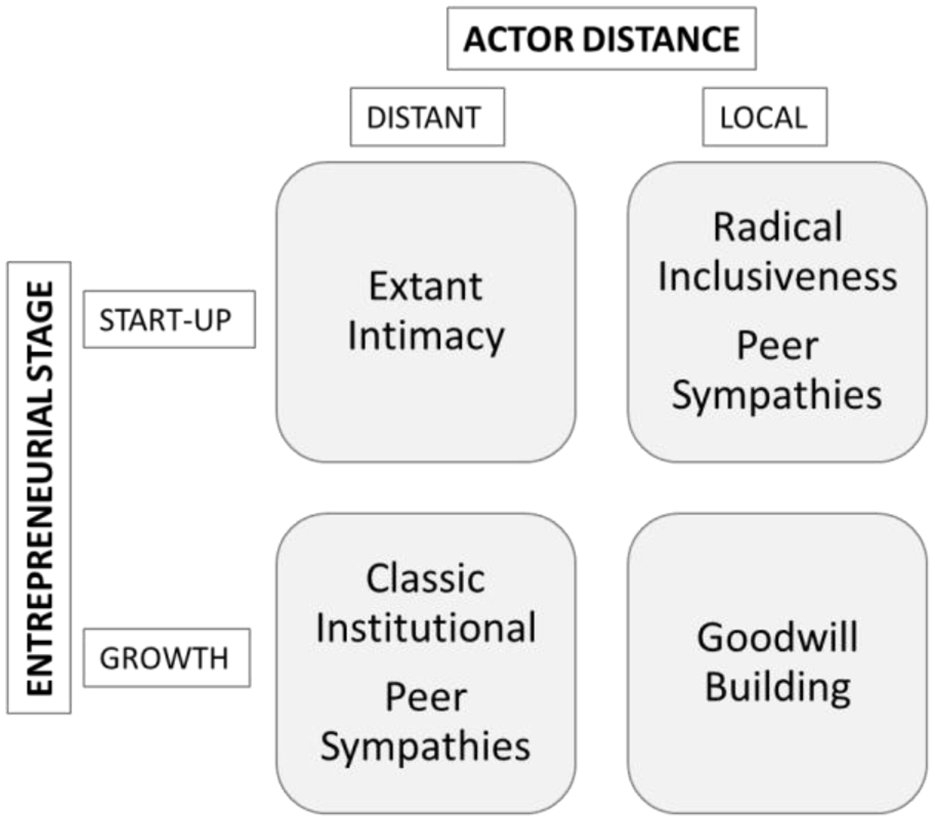
Some examples from our four cases address both dimensions we have identified. For example, La Roja’s engagement with Broderick is with a distant actor during the venture’s start-up phase. Given this reality, we found that using the dimensions of actor distance and entrepreneurial stage as the matrix axes provided a valuable means to organize our findings. The resulting matrix, Figure 2, identifies four distinct contexts of actor engagement:
I. Local Start-Up—relationships with geographically close actors during the idea generation, founding, and initial start-up phase.
II. Local Growth—relationships with geographically close actors during the growth phase of the venture.
III. Distant Start-Up—relationships with geographically distant actors during the idea generation, founding, and initial start-up phase.
IV. Distant Growth—relationships with geographically distant actors during the growth phase of the venture.
Matrix of actor engagement.
The four categories in this matrix identify distinct contexts in which firms may utilize different relationship tactics. These categories are not mutually exclusive, as any given firm can pursue actor engagement in each category at different times. The matrix structure helps precisely frame the types of engagement options available in other contexts. Our analysis identified five distinct relationship arrangement practices that fit along with this matrix, as shown in Table 1.
Five practices for exchange relationship arrangements.
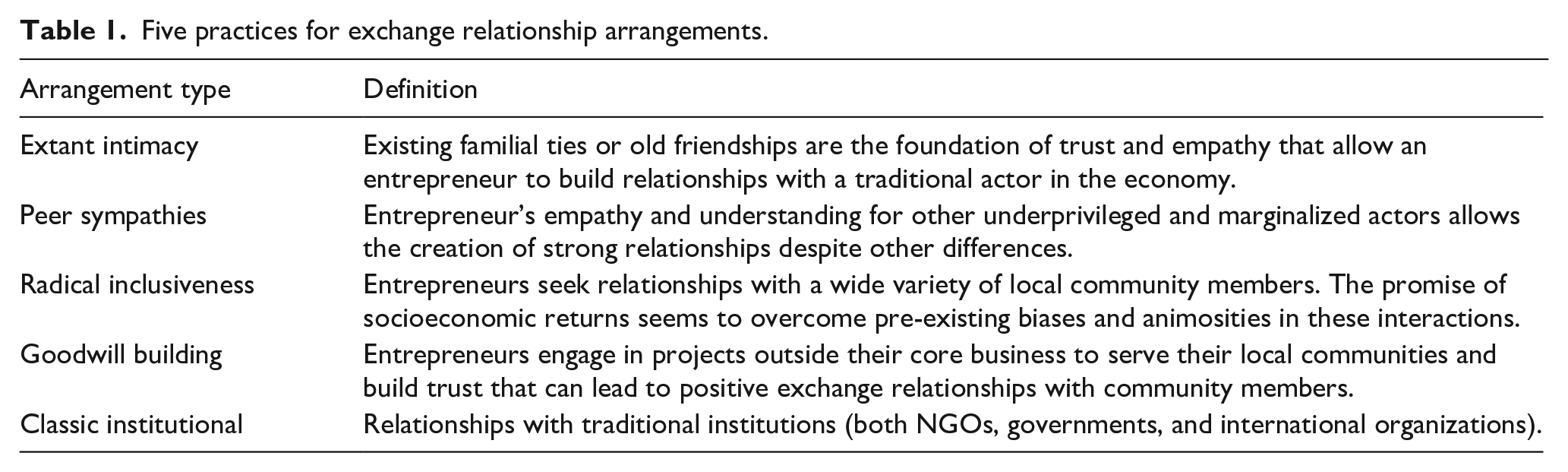
Café Paramillo’s reliance on local suppliers and engaging both ex-combatants and victims demonstrates a type of radical inclusiveness relationship that can occur in the Local Start-Up context. Likewise, the example of Hurtado and Broderick’s childhood friendship is the type of extant intimacy necessary in the Distant Start-Up context. La Montaña provides examples of relationship arrangements for both of our remaining growth categories: their partnership with the French embassy demonstrates the classic institutional arrangement that is possible in the Distant Growth context, whereas their efforts to provide tailoring services and community meeting space to their local community exemplifies the goodwill building engagement utilized in the Local Growth context. We also identified peer sympathies relationships in Muñecas’ partnership with a local social leader and Café Paramillo’s coffee distribution through a retail cooperative of ex-combatants in Medellin, Colombia. Interestingly, these two examples fall in different contexts: Local Start-Up and Distant Growth. This could suggest that peer sympathies is a practice that is useful in multiple contexts. It is also possible that we are overstating the relationship between Café Paramillo and that retail cooperative: the cooperative did quickly replace Café Paramillo coffee with another brand when they ran out. This suggests a lack of coordination and commitment one would expect from a strong relationship.
Mapping firm activities to SDG 16 targets
Finally, we found that these firms contribute more to SDG 16 than merely preventing recidivism. They engage in firm-level activities that allow peacebuilding entrepreneurship, that is, inclusive and value-creating practices (Joseph & Van Buren, 2021), such as inclusive hiring, community engagement, and partnerships to transform the institutional landscape. We mapped the firms’ activities to the 12 national monitoring targets established for SDG 16 (United Nations, 2020). However, as shown in Table 2, it was challenging to match specific firm activities to these targets; we only found four matches.
SDG 16 monitoring targets in excombatant entrepreneur cases.
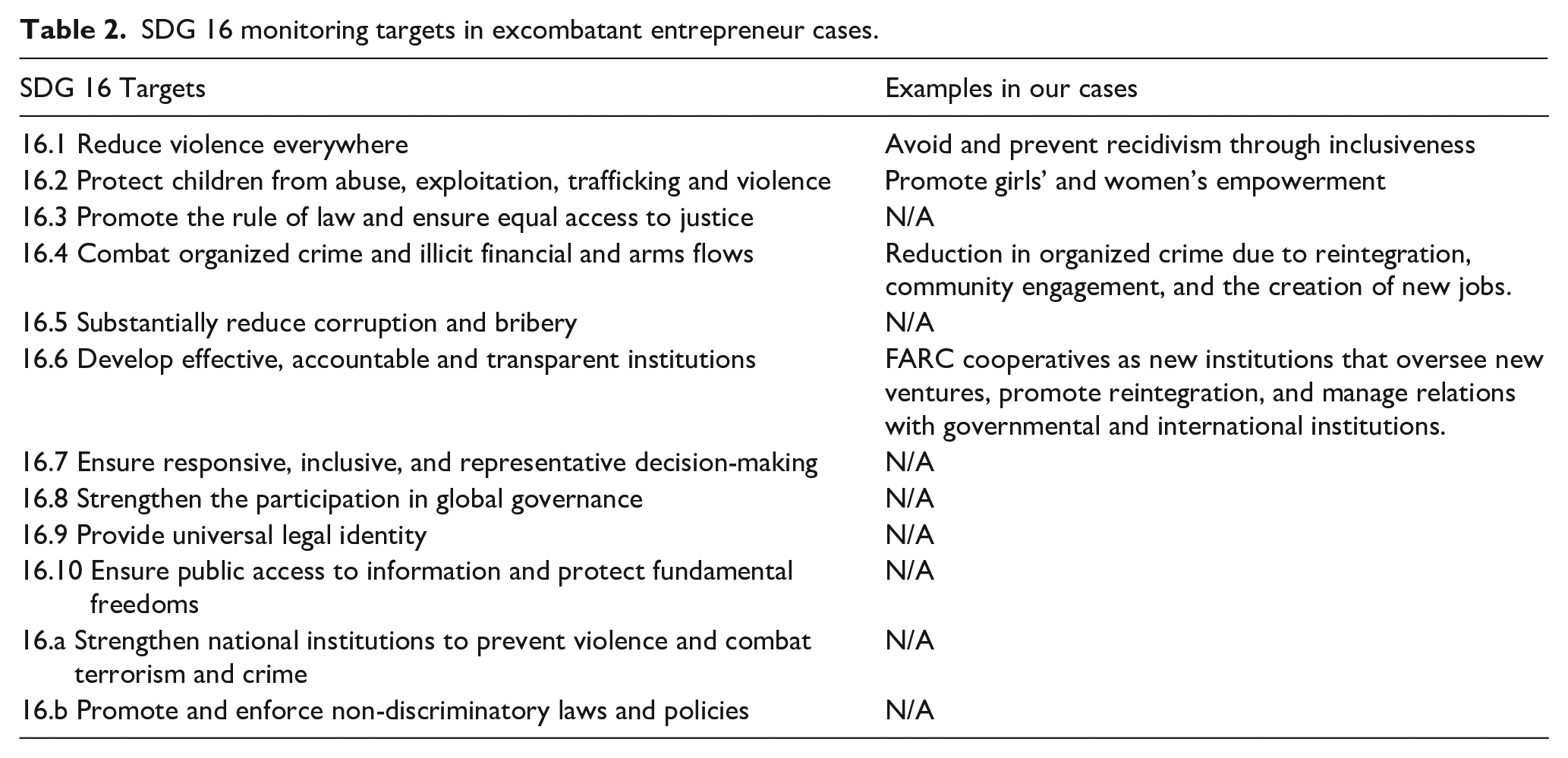
The mere fact that these ventures employ and support ex-combatants returning to civilian life means they are no longer engaged in violent activities. Therefore, all of our cases have been helpful in preventing recidivism and reducing violence (target 16.1), as well as preventing criminal activities, illegal economies, and arms flows (target 16.4). Regarding target 16.2, we find that Muñecas explicitly tackles the issue of protecting children and empowering girls and women, since their product, aimed at children, helps to raise awareness and promote gender equality from an early age. Finally, regarding target 16.6, ex-combatants have developed a new institutional environment for cooperation and accountability for themselves through their cooperatives, and, since these manage relations with international agencies and the government, they also allow for managing stakeholders and keeping other actors accountable in the peace process.
However, the nature of the other targets made it challenging to demonstrate how a single firm’s activities could be successfully attributed to the full metric. Indeed, some specific targets of SDG 16, such as equal access to justice, combat organized crime, legal identity for all, and strengthening the participation of developing countries, are considered to be the sole responsibility of governments. Nevertheless, further mapping of firm activities to this SDG in future research could be possible by focusing on the three principles of SDG16 (inclusion, institutions, and justice).
Discussion and limitations
This study offers three contributions. First, our analysis yielded five relationship arrangement practices that we could categorize along two critical dimensions (actor distance and entrepreneurial stage). The matrix of actor engagement that we have built based on our four case studies not only provides two additional dimensions to further develop the lens of entrepreneuring as emancipation, but also five possible practices for exchange relationship arrangements that have allowed ex-combatant entrepreneurs to start or grow their businesses while contributing to peacebuilding and therefore SDG16. Therefore, some practices that enable ex-combatants to start or grow their ventures in difficult or extreme contexts ultimately help foster peace. Indeed, simply creating a business in a (post)conflict zone does not necessarily lead to peace, as Ganson (2017) argues. Still, instead, it is the engagement practices that we have found that positively mediate the relationship between entrepreneurship and peace.
Second, the matrix of relationship arrangements allows for furthering emancipatory entrepreneuring. We follow Chandra’s (2017) work and integrate our findings with the lens of emancipatory entrepreneuring (Rindova et al., 2009) to provide more formal constructs to study and further develop this theory. These relationships and dimensions we identified can be used to further understand the autonomy seeking, authoring, and making declarations processes of emancipatory entrepreneuring. For instance, future studies could use the matrix of actor engagement to develop hypotheses in other contexts. In addition, these practices can be used by entrepreneurs looking to build essential relationships in support of their venture’s success and, in doing so, contribute to SDG 16.
Finally, we have mapped firm-level activities of the ventures to SDG16 targets. However, we could only map activities onto four of the 12 targets. The challenge of mapping firm-level activities to SDG16 targets is not the lack of peacebuilding activities but rather the focus of the SDG 16 targets. Although these targets are undoubtedly essential in measuring SDG 16 across countries and time, they are not appropriate for capturing individual firms’ SDG 16 activities. The lack of a formal measurement instrument for an individual firm’s contribution to SDG 16 is a significant limitation to our study, and perhaps may explain the dearth of management literature addressing SDG 16 specifically. This limitation suggests that future work could be done to build and validate a more formal instrument for capturing firm engagement toward SDG 16.
Overall, our study shows that some entrepreneuring practices allow for both starting and growing ventures while at the same time contributing to SDG16. Specifically for the Colombian case, these firms’ continued operation contributes to peace and violence reduction, given that recidivism can be prevented through economic development (Collier et al., 2008). That is, while the ex-combatants are actively engaged in managing their entrepreneurial ventures and providing some economic gains to the founding team and the ex-combatant employees, they are not engaged in their prior hostile activities. Therefore, these ex-combatants are building peace by devoting their time to creating enterprises and adding value to the communities in which they are embedded. In other words, ex-combatant entrepreneuring is crucial for achieving SDG 16 in the Colombian case.
However, it is also possible to flip the perspectives on these tactics and provide guidance to traditional firms seeking to engage with local communities. Understanding these five tactics and the particular contexts in which they are most useful is valuable information for any firm wishing to contribute to peacebuilding in disruptive contexts (Hällgren et al., 2018). Comprehending the entrepreneurial stage and distance of the actors they are hoping to engage can help identify a practice that our study has demonstrated has been successful in that context. Of course, a limitation of our study is that we have built our findings on only four case studies. It is possible that a larger sample would identify more practices and possibly even more contexts. While this is true, and we hope that future studies will include a greater sample size, it does not diminish our findings’ usefulness.
Conclusion
This study focused on identifying how entrepreneurial ventures could contribute to the advancement of SDG 16 through their everyday business practices. To that end, we chose to study an extreme environment where peacebuilding challenges were particularly salient and focus on the actions of marginalized ex-combatant ventures. We intentionally chose to study both, an extreme context and actors seeking to free (emancipate) themselves from a woeful status quo, to identify practices, activities, and tactics that succeed in advancing the ventures while achieving positive societal outcomes. In other words, we study how entrepreneurship can indeed be peacebuilding (Joseph & Van Buren, 2021). We framed our study using the lens of emancipatory entrepreneurship, which acknowledges that these ex-combatant ventures seek to achieve outcomes with societal benefits beyond profit-seeking (Rindova et al., 2009). Next, we build on this theory from case studies (Eisenhardt & Graebner, 2007) of FARC ex-combatants struggling to develop businesses in the reintegration spaces—ETCRs—established in the wake of the 2016 Colombian peace accords.
Our four ex-combatant entrepreneurial ventures encompassed various industries and regions of the country and studying their practices yielded some useful findings that contribute to the SDG and entrepreneurship literature. First, our analysis yielded a matrix of actor engagement that captures various relationship-building tactics across two key dimensions (actor distance and entrepreneurial stage). We showed that these practices enabled ex-combatants to build their ventures while at the same time fostering peace in the post-conflict environment of Colombia. Second, we argue that these practices are essential in the autonomy seeking, authoring, and making declaration dimensions of emancipatory entrepreneuring, therefore furthering the theoretical lens. Finally, we were able to identify activities at each firm that contributed directly to promoting inclusion or building institutions, two primary principles of the SDG 16 definition, although mapping these directly to the SDG16 targets proved difficult.
This framework provides valuable guidance to peacebuilding entrepreneurs seeking to start or grow their businesses but can be equally suitable to traditional firms seeking to partner with fringe stakeholders (Hart & Sharma, 2004). The tactics outlined in our framework can support any firm’s effort to address SDG 16 in challenging business environments. Peacebuilding, particularly in war-torn contexts, is some of the most challenging work that any private firm could seek to engage in and requires complex multi-stakeholder partnerships (Sachs et al., 2019). The practices identified in this study allowed some of the most feared and even hated members of Colombian society to build businesses in some of the country’s poorest and most remote regions. Therefore, imagine the impact if resource-rich firms and multinationals would engage in these practices to build exchange relationships in these challenging environments and contribute to inclusion, institutions, and justice for all.
Footnotes
Acknowledgements
We thank the editorial team of the special issue and the anonymous reviewers for their constructive comments. We also thank the experts in corporate sustainability (Claudia Rivera), excombatant reintegration (Dalida Villa) and cooperatives (Maria Clara Piedrahita), for sharing their knowledge and experience. Finally, we thank Sistema B, B Lab, B Academics, Academia B, and the International Development Research Centre (IDRC).
Declaration of conflicting interests
The author(s) declared no potential conflicts of interest with respect to the research, authorship, and/or publication of this article.
Funding
The author(s) disclosed receipt of the following financial support for the research, authorship, and/or publication of this article: This research was supported by Sistema B, B Lab, B Academics, Academia B, and the International Development Research Centre (IDRC) with a grant awarded under their program “The Role of Business in Achieving the Sustainable Development Goals in the Global South”.
