




Abstract
This study explores how (in)congruence of desired and actual behaviors of servant leaders shape the outcomes of followers’ work engagement, well-being, and turnover intentions. We underline the significance of cultural context in influencing follower outcomes and, thus, integrate a gender-cultural perspective to highlight the moderating role of gender inequality on a country level. In so doing, we postulate a strong relationship between the effects of actual/desired behaviors of servant leaders upon follower work outcomes, especially in contexts where gender inequality is high. Our results from documenting the perceptions of full-time employees (n = 2,960) across 10 countries using polynomial regression analyses show that followers’ turnover intentions are lower and work engagement is higher when there is a congruence between followers’ perception of servant leadership and desired servant leadership. Moreover, we found that followers’ well-being is higher when actual and desired servant leadership is congruent as opposed to incongruent. In addition, the results show that the beneficial impact of congruence (as opposed to incongruence) is stronger in the cultural context where gender inequality is high. We contribute to the literature by showing the important impacts of (in)congruence between desired and actual servant leadership on followers’ outcomes.
Introduction
With growing interest in research around employees’ well-being and engagement, the notion of servant leadership has taken a sharp turn recently toward addressing issues such as commitment, citizenship behaviors, follower relations, and perceptions of leaders (e.g., Joseph & Winston, 2005; Liden et al., 2008; Walumbwa et al., 2010; Yang et al., 2018). Despite this newfound focus, servant leadership actually dates back to the seminal works of Greenleaf’s (1970). They position servant leaders as individuals who put other people’s needs, aspirations, and interests above their own (Sendjaya & Sarros, 2002, p. 57). Servant leaders tend to set aside their self-interest in favor of followers’ need for growth, development, and prosperity, which in turn satisfies followers and influences organizational outcomes (Chiniara & Bentein, 2018; Liden et al., 2008). By demonstrating servant conduct, research (e.g., Zhang et al., 2012) notes a positive relationship between employees’ perceptions and supportive behavior of servant leaders, which strengthens their engagement at work. Showing certain behaviors such as nurturing relationships, “servanthood,” “empowering followers,” “emotional healing,” and “helping subordinates grow and succeed” remain central to servant leadership, as noted by Liden et al. (2008, p. 162).
Despite the proliferation of studies on servant leadership, there are areas where further research is needed. An important question that would benefit from research attention relates to the role of (in)congruity between perceptions of desired and actual behavior of servant leaders and how these perceptions impact follower outcomes (e.g., Audenaert et al., 2018; Walumbwa et al., 2010). We position congruence as the index of similarity (or fit) between two distinct behavioral constructs (i.e., actual vs. desired) that are likely to affect followers’ perception of a servant leaders’ conduct (e.g., De Clercq et al., 2017; Edwards, 1994; Nahapiet & Ghoshal, 1998). When such perceptions of behavioral congruence are high, we theorize that followers are more likely to trust servant leaders and their authenticity (e.g., van Dierendnock, 2011; Vancouver & Schmitt, 1991; Zhang et al., 2012). In fact, this calls into question Liden et al.’s (2008, p. 162) behavioral dimension of “behaving ethically,” (i.e., “interacting openly, fairly and honestly with others”) and whether servant leaders’ behavior remains in line with employee perceptions of reasonable conduct. Congruent behavior that fits with employee perceptions of desired and actual conduct can, however, elicit positive employee behavior and commitment (Liden, Panaccio, et al., 2014). The literature (e.g., McAllister & Bigley, 2002) suggests that employees tend to establish perceptions based on their interactions with and perceptions of others and whether there is congruity in how they are treated by their leaders. To understand how (in)congruence affects follower outcomes in the workplace, our first goal in this study is to examine the discrepancies between leaders’ desired and actual behavior and how these discrepancies shape followers’ work outcomes including work engagement, turnover intentions, and well-being. We mobilize concepts from social exchange and role theory (e.g., Katz & Kahn, 1978; Matta et al., 2015; Ng et al., 2008) to hypothesize about the (in)congruence between leader behavior and follower outcomes and to make sense of the relational shift caused by expected and exhibited behaviors of servant leaders.
Our second goal is to integrate and examine the role of context on the associations between (in)congruence of servant leadership and follower outcomes. Although incongruence may arise between actual and desired perceptions of servant leaders’ behavior at the individual level, incongruity might also be subject to different contextual perceptions of supervisors’ behavior. Thus, our theoretical argument centers around the connection between servant leaders’ behavior and employee perceptions within given cultural contexts. We believe that context plays a critical, yet understudied role in shaping the divide between what is expected and exhibited by servant leaders and the impact this has on followers’ work outcomes (e.g., Oc, 2018). Zhou and George (2001) note that congruence is in fact a contextual construct which is often associated with the anticipation of a desired action. The interdependency between individual perceptions and contextual factors is necessary for (in)congruence to occur (e.g., De Clercq et al., 2017). We, therefore, examine the moderating effect of context, such as contextual practices upon servant leadership.
We further propose that studying employees’ perceptions through boundary-riding conditions, such as culture and gender, can offer deep insights into what is expected of servant leaders and how (in)congruence can shape the impact of follower outcomes (e.g., Brodbeck et al., 2000). Our particular focus upon gender as a moderating variable is inspired by the assumption that servant leaders tend to exhibit perceptions of fairness among employees (e.g., Greenleaf, 1970; Mayer et al., 2008). Demonstrating an authentic behavior, one that promotes fairness, can, therefore, be challenging in cultural contexts where employees perceive regimes of inequality across the organizational climate, such as gender, class, and race. (e.g., Acker, 2006). Harel et al. (2003, p. 257) argue that high-performing organizations aim to “provide fairer opportunities for the advancement for women, a factor which, in turn, is significantly correlated with organizational effectiveness.” They further note that gender equality has a profound effect on work outcomes, an aspect which we believe has been given less attention in relation to demonstrating fair, yet authentic behavior by servant leaders (e.g., Avolio & Gardner, 2005). To start addressing this gap, we adopt a culture-gender perspective to servant leadership literature and focus on gender inequality index (GII). This index assesses aspects related to differential educational attainment, and economic and political participation of men and women in any given country, representing gender inequality at the national level (United Nations). Here, we draw upon theoretical perspectives (e.g., House et al., 2004; Oc, 2018; Parker, 1996) that emphasize the role of wider context (e.g., gender and national culture) to hypothesize factors that are likely to shape follower expectations of servant leaders’ behavior.
This study aims to make three main contributions. First, it advances the servant leadership literature by empirically investigating follower expectations, particularly when followers do not get what they desire regarding leader behavior in the workplace (Sy et al., 2018; van Dierendonck, 2011; Zhang et al., 2012), thus directing scholars to study the behavioral effects of (in)congruence on follower outcomes. Central to this contribution is the notion of “mutuality” of perceptions regarding what behaviors are desired of leaders and exhibited by them and these behaviors’ relation to employee well-being, satisfaction, and turnover intentions (Ilies et al., 2007; van Dierendonck et al., 2014).
Second, our study expands the focus of servant leadership by using the GII as a contextual and cultural indictor to understand the impact of servant leader (in)congruent behavior on follower outcomes (Ayman & Korabik, 2010; Brunetto et al., 2012). By closely studying the dynamics of leader–follower relations and the extent to which they are susceptible to their context, a better understanding of the role of perceptual discrepancies is presented (Oc, 2018). Although this study conceptualizes (in)congruence as the (im)balance between perceived and overtly observable behavior, leadership roles are subject to variation in terms of role expectations (Katz & Kahn, 1978), thus creating skewed perceptions among followers (Zohar & Polachek, 2014). These misalignments can become intensified in cultures where supervisory relations and supportive behavior are shaped by the national context (see Bosch et al., 2018; Las Heras et al., 2015), particularly for leaders whose behaviors may be idealized in advance by employees (e.g., Collinson, 2011; Kempster & Carroll, 2016; Schyns & Schilling, 2013).
Third, our study situates servant leadership within a cross-cultural context, providing empirical evidence and insights from 10 countries about the effects of higher gender inequality on followers’ satisfaction, well-being, and turnover intentions. This is an important contribution to servant leadership literature, which is predominantly shaped by studies conducted in the U.S. and European contexts (Eva et al., 2019). Next, we present the development of our hypotheses, followed by our methods and findings (see Figure 1 for our conceptual model).
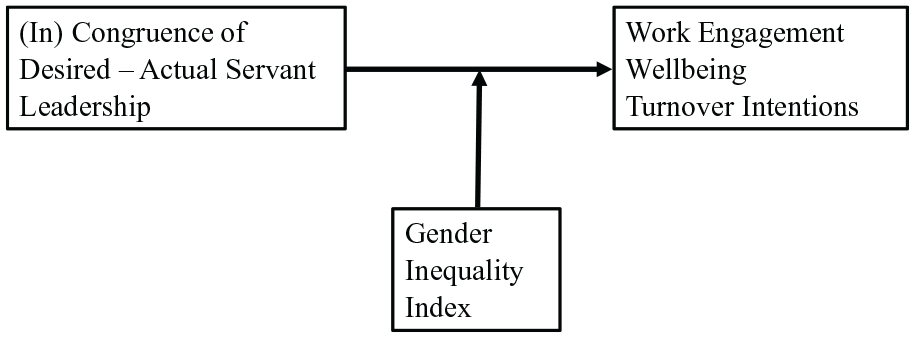
Conceptual model.
Theory and hypotheses
(In)congruence of servant leadership and follower outcomes
For decades, scholars have studied the impact of leadership on the functioning of groups, organizations, and even countries (e.g., Bligh & Kohles, 2009; Thomas et al., 2013; van Dierendonck, 2011). Extant literature has mostly focused on what makes leaders effective in achieving positive results such as the effect of leaders’ personality traits (such as narcissism and extroversion) (Avolio, 2007; Kirkpatrick & Locke, 1991), the consequences of leadership styles (such as paternalistic style, transactional style, and transformational style) (Bass et al., 2003; Jung & Avolio, 1999), and the role of the quality of the relationships between leaders and followers (e.g., LMX and fairness) (Graen & Uhl-Bien, 1995).
Despite the existing literature on leadership, little is known regarding the (in)congruity between the kind of behavior employees expect from leaders and the behavior leaders actually display. We suspect that such (in)congruence might play a critical, yet largely understudied, role in supplementing the effectiveness of leadership in shaping follower outcomes, particularly in organizations situated within a culturally diverse context (e.g., Eva et al., 2019; Ng et al., 2009). We are interested in studying (in)congruence in relation to a leader’s desired and actual behaviors to address the need for research which argues the importance of creating conditions (including supportive relationships) that nurture positive employee behavior at work (e.g., Audenaert et al., 2018; Walumbwa et al., 2010).
Among the growing research on leadership, one emerging stream underlines servant leadership as a positive means for cultivating and eliciting positive employee behaviors (Liden, Panaccio, et al., 2014). Servant leadership is marked by a desire to help followers (Greenleaf, 1977; Luthans & Avolio, 2003) as compared with leadership theories where focus is usually placed on organizational goals. Employees working for leaders who display servant leadership behaviors show a wide range of positive attitudes at work, such as affective commitment (Ilies et al., 2007), job satisfaction (Liden et al., 2008), and behaviors including work performance (Reed, 2015), innovation and helpful behaviors toward colleagues (Hunter et al., 2013). Laub (1999) notes that a servant leader is concerned with developing high-quality relations with followers, and enabling them to grow, as well as achieve their own potential at work. Reviewing and synthesizing previous literature, van Dierendonck (2011) identifies six tenets that define servant leaders: empowering followers, humility, authenticity, interpersonal acceptance, providing direction, and stewardship. A shared feature of these tenets is that servant leaders prioritize the interests and goals of their followers (Ferris et al., 2009).
The core of the relationship between the servant leader and follower is marked by the expectations of each party. Such relationships between servant leaders and their followers lead to creating a mutuality of perceptions, recognition, acknowledgment, and the realization of each person’s abilities as well as expectations (Greenleaf, 1998; van Dierendonck et al., 2014). The expectation-matching process is similar to leader categorization processes (Rosette et al., 2008) in which employees compare their leaders with their own perceptions of an ideal leader (e.g., ideal leader prototype). If the leader matches the employee’s ideal leader prototype, the employee will show a positive attitude toward his or her actual leader (van Quaquebeke et al., 2011). In this sense, servant leadership is similar to the ideal leadership prototype (e.g, Kenney et al., 1996; Lacroix & Verdorfer, 2017). In the current article, we focus on (in) congruences between employees’ perceptions of servant leadership by comparing the actual servant leadership and the desired servant leadership. The difference between the ideal leader prototype and servant leadership is that employees’ ideal leadership does not necessarily fall into desired servant leadership; their ideal leadership could be transformational leadership or other favorable leadership types. In this article, if the employee’s desired leadership is not servant leadership, but the leader actually exhibits servant leadership, we conceptualize this as an incongruence between employee perceptions of servant leadership.
Servant leaders do not rely on their power but rather try to persuade, convince, and receive recognition from their employees (Reinke, 2004). It seems that there remains an implicit, and agreed-upon understanding regarding what followers expect from their leaders, in terms of the services these might provide, and the service they actually provide (van Dierendonck, 2011). Yet, to our knowledge, this implicit assumption has gone unchecked in the literature. This gap leaves researchers and practitioners blind to, for instance, whether there is a negative effect of exceeding employees’ expectations or whether the positive effect is amplified when those expectations are met. To date, research has focused on the positive effects of higher levels of servant leadership, regardless of the expectations of its recipients.
Formulating our hypothesis, we conceptualize (in)congruence as the (im)balance between observable (actual) leader behaviors and the desired actions that are subjectively interpreted by employees as expectations (e.g., Jacobsen & Bøgh Andersen, 2015). In this article, we integrate the social exchange theory and the role theory to explain the impacts of (in) congruence of employees’ perceptions of servant leadership on employees’ outcomes. As supported in the review study by Ng et al. (2008), mobilizing concepts of social exchange theory can offer ways to understand the inherent quality of the relationship between servant leaders and followers. Servant leaders and their followers exhibit relatively higher levels of mutual understanding, trust, expectations, and recognition when there is congruence between what is perceived and desired from the leader (Wang & Xu, 2019). In servant leadership literature, studies have adopted the social exchange theory to explain how servant leadership affects employees’ creativity (Chen et al., 2022), OCB (Aboramadan et al., 2022), and work engagement (Zhou et al., 2022). In this article, we propose that congruent perceptions of servant leadership would be reciprocated by employees to have favorable outcomes (e.g., higher work engagement, lower turnover intention, and higher well-being).
Moreover, role theory (Graen & Scandura, 1987) offers further insight into such leader–follower interpersonal dynamics, suggesting that the leadership process unfolds through a series of overt role behaviors (e.g., Matta et al., 2015; Strauss et al., 2009), which leaders and followers enact, resulting in either the strengthening or weakening of their relationship (Graen & Uhl-Bien, 1995). From the perspective of followers, achieving congruence between the desired and actual behaviors of servant leaders is crucial, as it allows followers to focus on work rather than make continuous adjustments to reconcile the discrepancies and their expectations of servant leaders (Matta et al., 2015). We make further use of Katz and Kahn’s (1978) conceptualization of role theory in relation to servant leadership, suggesting that incongruity can occur as leader roles are subject to differentiation between desired and actual role expectations by followers, which perhaps have the tendency to become misaligned when followers least expect a behavior (see also, Farmer & Aguinis, 2005; Zohar & Polachek, 2014). Put differently, incongruence between exhibited and desired behaviors by servant leaders may lead to confusion, frustration, and depletion of energy in their followers, thus hindering them from functioning effectively (Bashshur et al., 2011). This would mean that incongruence between desired and actual servant leaders’ behaviors might have a detrimental impact on followers’ attitudes and functioning at work.
In this article, we explore the effects of (in)congruence between the expected and actual behaviors of servant leaders, as we anticipate they are crucial for understanding the positive outcomes in their followers. More specifically, we propose that congruence, in regard to the expectations of servant leadership and leaders’ actual behaviors, impact subordinates’ work engagement and well-being positively while reducing their turnover intentions. Expectation discrepancies have important consequences for work engagement (Kahn, 1990) and well-being. Extending notions of role theory, as noted earlier, we structure our argument around (in)congruence to suggest that for an interacting set of incumbents, “the more consensus they have on the expectations for their own and the others’ positions, the more gratification members of a group will derive from the occupancy of their positions” (Gross et al., 1958, p. 213). Discrepancies in expectations and actual behaviors of servant leaders are thus likely to produce stress, tension, and a diminished sense of competence and effectiveness in followers (Matta et al., 2015), leading to deteriorated work engagement and a sense of well-being. These employees are also likely to leave their organization, given that their expectations for their managers in terms of training, skill development, and career progress do not match, potentially leaving them distressed and frustrated in their work. Our first hypothesis is as follows:
Hypothesis 1 (H1). Congruent (vs. incongruent) perceptions of servant leadership are associated with lower employee turnover intention (Hypothesis 1a [H1a]), higher employee work engagement (Hypothesis 1b [H1b]), and higher employee well-being (Hypothesis 1c [H1c]).
The moderating role of gender inequality
We further propose that gender inequality moderates the relationships between (in) congruence of servant leadership perceptions and employee outcomes (turnover intention, work engagement, and well-being). Gender and culture, as noted by Ayman and Korabik (2010, p. 157), “co-exist in a symbiotic relationship,” having “parallel dynamics for leadership.” Oc (2018) further notes that several studies (including Dorfman et al., 2004; Martin et al., 2013; Oc et al., 2015) in the literature have operationalized culture as a key construct to advance our understanding of how followers construe leadership in specific contexts. It is noteworthy that as the world is becoming more global, there is a growing body of research which explores whether, and if, leadership differs across cultures. Moreover, findings from the Global Leadership and Organizational Behavior Effectiveness project (Javidan et al., 2004), one of the pioneer studies in the cross-cultural leadership field, support the idea that many leadership attributes are culturally contingent; they are desirable and effective in some cultures yet not in others. Despite decades-long research related to the effect of context on leadership (including culture), the so-called regime of contextual leadership still remains broad in the existing literature (e.g., Ayman & Adams, 2012 and Porter & McLaughlin, 2006).
We developed our argument based on situational strength theory (Meyer et al., 2010) and servant leadership literature. Situational strength theory shows that situational strength leads to individuals’ psychological pressure to engage or refrain from their behaviors (Meyer et al., 2010). In servant leadership literature, situational strength theory could be adopted to explain how situational contexts affect the impacts of servant leadership on employees and organizations (Eva et al., 2019). For example, previous research examines the moderating role of national culture (e.g., power distance and individual collectivism) in investigating the impacts of servant leadership on employees’ outcomes (e.g, organizational citizenship behavior [OCB] and job performance) and team-level performance (Lee et al., 2020; Y. Zhang et al., 2021). Moreover, previous research also underlines the role of national context as a situational factor in leadership research. In a study including Latin American countries, recent research found that resources (measured by social expenditure) and demands present in the national context (measured by rates of unemployment) affect the relationship between family supportive leadership (e.g., FSSBs) and employees’ turnover intentions and work performance (e.g., Las Heras et al., 2015; Rofcanin et al., 2017). Utilizing a cross-cultural sample of countries including Kenya, the Netherlands, Brazil, and the Philippines, the findings in Bosch et al. (2018) demonstrate the importance of GII on the associations between family-supportive supervisor behaviors (FSSBs) and employees’ motivation, underscoring the importance country-level contextual elements play in shaping employees’ perceptions of leadership, and thus impacting their outcomes. Finally, in the context of servant leadership, the findings in Mittal and Dorfman (2012) show that cross-cultural characteristics (e.g., empowering, developing others, empathy, humility, moral integrity, and egalitarianism) shape how servant leadership is perceived across different cultures, calling for research to explore the differential impact servant leadership might have on employees’ work outcomes.
The introduction of other contextual factors, such as gender, can, however, offer interesting insights into the unfolding of leader–follower dynamics in diverse cultural settings (Antonakis et al., 2003). Both factors, that is, gender and culture, are interrelated and impose conditions that shape the impact of leadership on follower outcomes (e.g., Brodbeck et al., 2000). Driven by this logic, we propose that gender inequality perceptions, that we operationalize using the GII, can act as a key contextual condition in influencing our proposed associations. By employing the GII to study servant leadership, we are not only adding to the contributions made by previous studies (e.g., Bullough et al., 2012 and Hoyt, 2010) that draw upon the notion of gender in leadership. Rather, we aim to extend their findings in the context of servant leadership and expand our understanding of the effects of leader behavior on follower expectations beyond the leader–follower dyad (e.g., Oc, 2018).
The GII measures critical issues related to differential educational attainment, economic and political participation, of men and women in any given country, accounting for overlapping inequalities at the national level. Thus, GII is a key national context feature that we expect to play a boundary role in translating the impacts of (in)congruence of servant leadership on employee outcomes.
Drawing on this nascent line of research, we propose that the impact of (in) congruence of servant leadership perceptions on employees’ outcomes depends on GII across countries. Specifically, we propose that the impact of servant leadership (in) congruence is stronger and more significant on employee outcomes in countries characterized by high GII. We base our reasoning on the consideration that in contexts characterized by high GII, people tend to perceive paid work more valuable compared with unpaid work. Unpaid work is, in turn, mostly realized by women, especially in countries with high GII (Keizer & Komter, 2015). This suggests that in contexts where GII is high, supportive workplace resources, such as servant leadership behaviors which are aimed at developing followers’ skills, abilities, and career progress at work, are regarded as more valuable (Bolton & Muzio, 2008). This is mainly because contexts defined by high GII usually lack key humane and developmental aspects which offer support to employees, respect and equality, thereby placing servant leadership as an important and substitute workplace resource for employees to benefit from. On the contrary, in contexts marked by low GII, the impact of (in)congruence of servant leadership is less likely to have an impact on employees’ outcomes. The underlying logic for this argument is that low GII reflects higher levels of welfare, development, and respect for gender equality in all levels of tasks, hierarchies, and career progress that in some way or another employees benefit from through various opportunities of self-growth and career progression (e.g., Bosch et al., 2018). In light of these arguments, we hypothesize
Hypothesis 2 (H2). Gender inequality moderates the relationships between (in)congruence of servant leadership perceptions and employee outcomes (turnover intention, work engagement, and well-being) such that the relationships between (in)congruence of servant leadership perceptions and employee outcomes (turnover intention, work engagement, and well-being) are stronger (vs. weaker) in high (vs. low) GII countries.
Methodology
Sample and procedure
We collected data from full-time working employees in 10 countries: Argentina, Colombia, Spain, Philippines, Guatemala, Mexico, Peru, Dominican Republic, Chile, and South Africa. Across these 10 countries, there is a wide variation in gender inequality: Guatemala ranked 113th across the world while Spain ranked 15th across the world, for example. Data were collected between 2015 and 2016 through the involvement of a leading European business school and the help of professional companies which aim to enhance work experiences of employees working in these countries.
After deleting incomplete data, we obtained a final sample consisting of 2,960 respondents employed across the 10 countries mentioned above. In total, 90% of respondents worked under a full-time contract as opposed to a part-time one. Our participants mainly come from finance, tourism, and the broader service industries. We got an equal percentage of samples from each industry of each country to ensure our samples are representative. The average age of the sample was 41.36 (SD = 9.80), and respondents had on average 9.65 years of tenure in their organization (SD = 9.58). In total, 52.8% of participants were males. In total, 12.5% of the sample had a relatively low education (i.e., a high school diploma or less), while a majority (84%) had obtained a bachelor’s or community college degree. The remaining 3.5% of the sample had achieved a master’s or doctoral degree. In total, 67.2% had one or more children. Table 1 summarizes the sample per country.
Sample description per country.
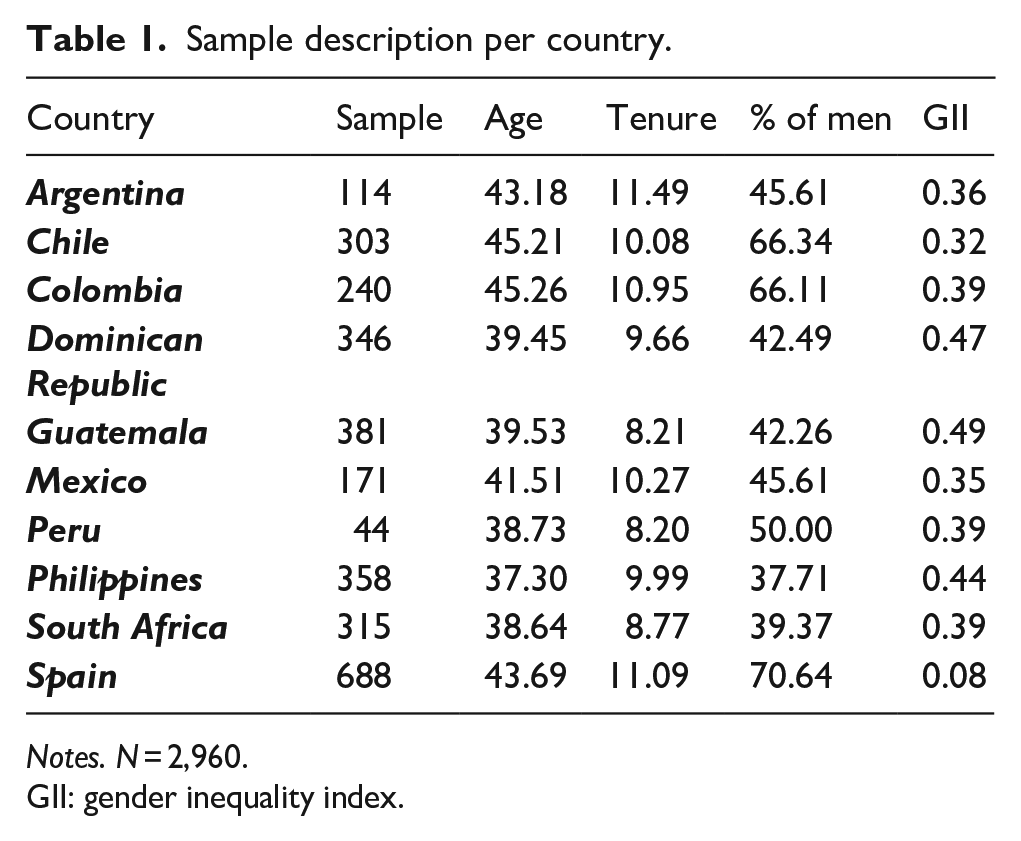
Notes. N = 2,960.
GII: gender inequality index.
Measures
Servant leadership
This was measured using the short version of the scale developed by Liden et al. (2008). While the original scale is comprised of 28 items capturing seven dimensions of servant leadership, the short version makes use of the highest loading item for each dimension. Employees rated their supervisor’s actual servant leadership behaviors on a scale from 1 to 7, using items such as “my manager can tell if something work-related is going wrong” (Cronbach’s alpha = 0.85). Its validity as a short measure has been supported in the past (e.g., Liden et al., 2015). To measure desired servant leadership, we asked respondents to indicate the extent to which they think their supervisor should exhibit servant leadership behaviors (e.g., “he or she should be able to tell if something work-related is going wrong”). This was rated on a scale from 1 (should not at all) to 7 (should all the time) (Cronbach’s alpha = 0.72).
Work engagement
This variable was assessed through the short version of the Utrecht work engagement scale (Schaufeli et al., 2006). A 7-point scale from 1 (never) to 7 (every day) was used to ask respondents to judge the frequency with which they felt vigorous, absorbed and dedicated in their work. A total of nine items measured this concept (e.g., “At work, I feel bursting with energy”; Cronbach’s alpha = 0.92).
Well-being
In line with Vansteenkiste et al. (2007), well-being was measured using three separate indicators: job satisfaction (“I am satisfied with my job”), life satisfaction (“In general, I am satisfied with my life”), and life happiness (“Overall, I am happy with my life”). These items were to be answered on a scale from 1 (totally disagree) to 7 (totally agree). These one-item measures have been tested valid in past research (e.g., Pavot & Diener, 1993; Wanous et al., 1997).
Turnover intention
We captured turnover intention using three items which probe employees’ desire to leave their current job and organization (e.g., “I frequently think about quitting my job”; Cronbach’s alpha = 0.90). These items were to be answered on a 7-point scale ranging between 1 (totally disagree) and 7 (totally agree) and were based on a measure developed by O’Reilly et al. (1991).
Gender inequality
This was operationalized using the GII, which is a measure developed by the United Nations. 1 It captures the inequality between men and women for three different aspects: (1) reproductive health (i.e., maternal mortality rates and adolescent birth rates), (2) empowerment (i.e., the proportion of parliamentary seats occupied by women and the proportion of adult women and men aged 25 years and older with at least some secondary education), and (3) economic status (i.e., labor market participation and labor force participation rate of men and women aged 15 or older). For the purpose of this study, we used the values of the year 2015, which is the year when we collected data. This index is available for 159 countries across the world and ranges from 0.04 (Switzerland) to 0.77 (Yemen), respectively, indicating low to high inequality between men and women.
Control variables
Drawing on the most recent reviews of servant leadership (e.g., Eva et al., 2019; van Dierendonck, 2011), we used control variables that have been shown to correlate with work engagement, turnover intention, and/or well-being; that is, work contract (full time vs. part time), tenure (in years), educational level (high school or less, bachelor’s degree, community college, and master’s degree or higher), gender, children (yes vs. no), and relationship status (living with a partner or not). Moreover, because respondents were nested in countries, we verified the need to control for within-country correlations. The intraclass correlation coefficient 1 (ICC1) values for the different items related to servant leadership, work engagement, turnover intention, and well-being ranged between 0.01 and 0.10. This resulted in considerable design effects ranging from 3.06 to 31.67 (Muthen & Satorra, 1995). To account for these correlations, we made use of the COMPLEX procedure in MPLUS with country as the clustering variable.
Analytical strategy
To test our hypotheses, we make use of polynomial regressions combined with a surface response analysis (Edwards, 1994). As opposed to moderation analyses, polynomial regression analyses have the added advantage of being able to capture the impact of (in)congruence between two variables on an outcome variable (Shanock et al., 2010). In that sense, this technique allows us to map the consequences of (in)congruence between desired and actual servant leadership on employee outcomes (i.e., turnover intention, work engagement, and the three indicators of well-being). To perform polynomial regressions, five variables need to be entered into the regression: actual and desired servant leadership behavior, the squared value of both variables and their interaction. Equation (1) below illustrates this, where Y depicts the outcome variable, A refers to actual servant leadership behavior, and D refers to desired servant leadership behavior. Both Variables A and D were scale-centered to avoid multicollinearity (Edwards, 1994).

Results
Descriptive statistics
Table 2 summarizes the means, standard deviations, and correlations between our focal variables. First, there is a moderate positive correlation between desired and actual servant leadership (r = .23, p < .001). This shows that discrepancies between the two variables do exist and are considerable. Splitting the data in three groups based on this discrepancy shows a relatively even distribution. For 34.4% of respondents, what they think that leaders should do, in terms of servant leadership, and what they actually do is highly similar, or congruent (i.e., within a range of plus and minus half a standard deviation of each other; Shanock et al., 2010). In contrast, 36.4% of respondents report having a leader that displays higher levels of servant leadership than they deem leaders should display. Finally, 29.2% report the opposite, that is, their leader displays levels of servant leadership that are lower than what they think they should display. Second, actual servant leadership behavior correlates positively with work engagement (r = .46, p < .001) and well-being (r = .38, p < .001), and negatively with turnover intention (r = –.47, p < .001).
Descriptive statistics.
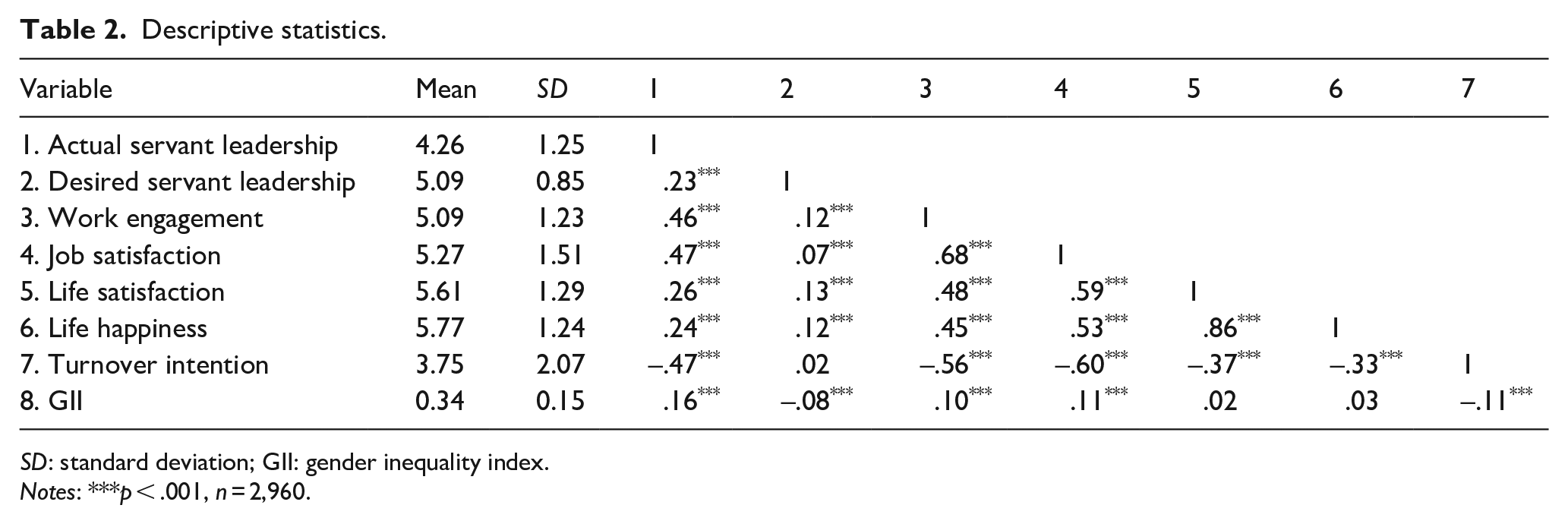
SD: standard deviation; GII: gender inequality index.
Notes: ***p < .001, n = 2,960.
Direct effects of (in)congruence between actual and desired servant leadership
We estimated Equation (1) for all outcome variables. We included all control variables into the equation. We summarize the results of these analyses in Table 3. In addition, a surface response analysis is necessary to interpret these results (Shanock et al., 2010). This means that the regression coefficients are used to test the slope and curvature of two lines: the congruence line (A = D) and the incongruence line (A = –D). The incongruence line indicates the outcome variables where the highest degree of disagreement exists (at both the far left and far right of the line) and demonstrates how the outcome variables shift as the levels of disagreement decrease. The slope and curvature of this incongruence line indicate whether the congruence is better than incongruence and whether the direction of the slope matters. The congruence line indicates when an employee has a congruent perception of servant leadership how the outcome variable changes, as there is a congruence between strong servant leadership or a congruence between weak servant leadership. The slope and curvature of the congruence line also indicate whether the direction matters and the shape of the relationship (whether the relationship is linear or curvilinear). These lines can subsequently be used to create a graph which visually depicts the relationship between actual and desired servant leadership (Figure 2).
Polynomial regressions: direct effects of desired–actual servant leadership congruence on outcome variables.
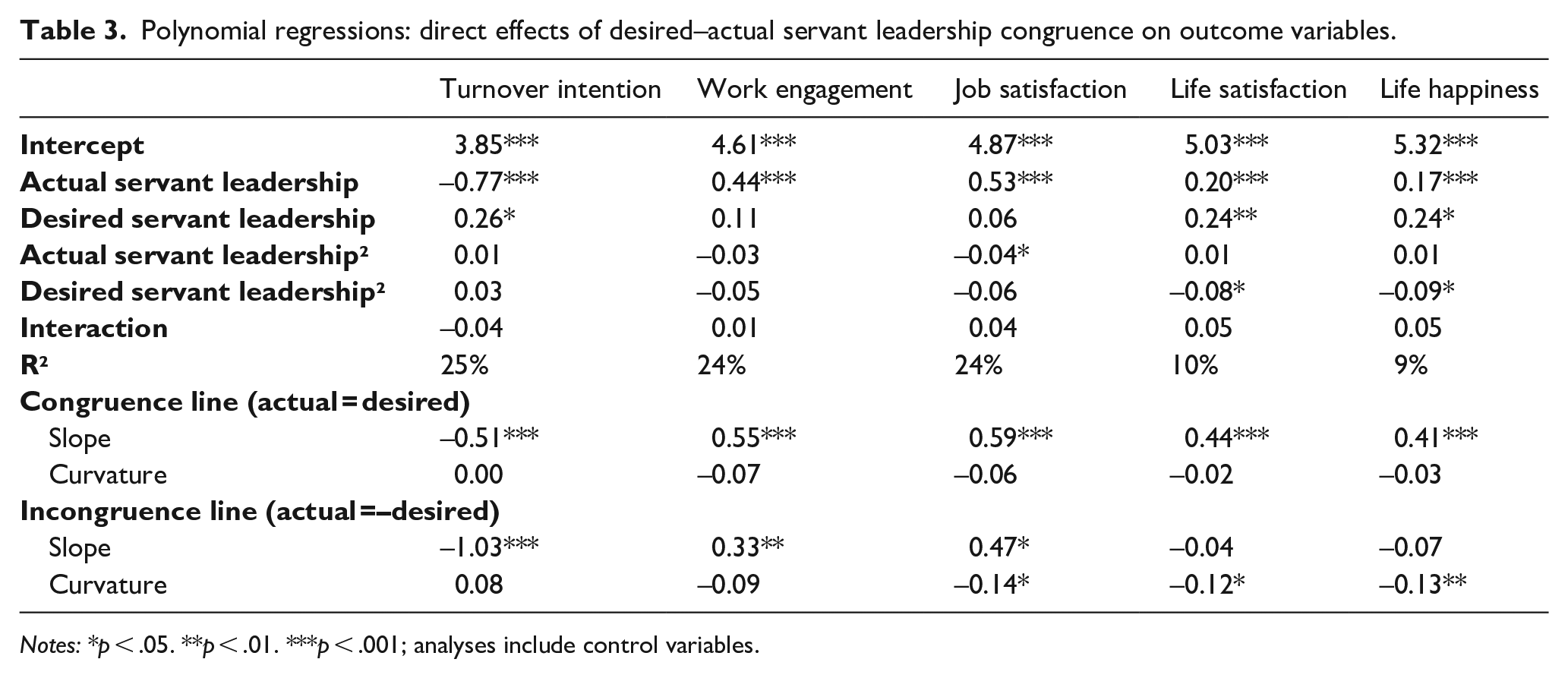
Notes: *p < .05. **p < .01. ***p < .001; analyses include control variables.
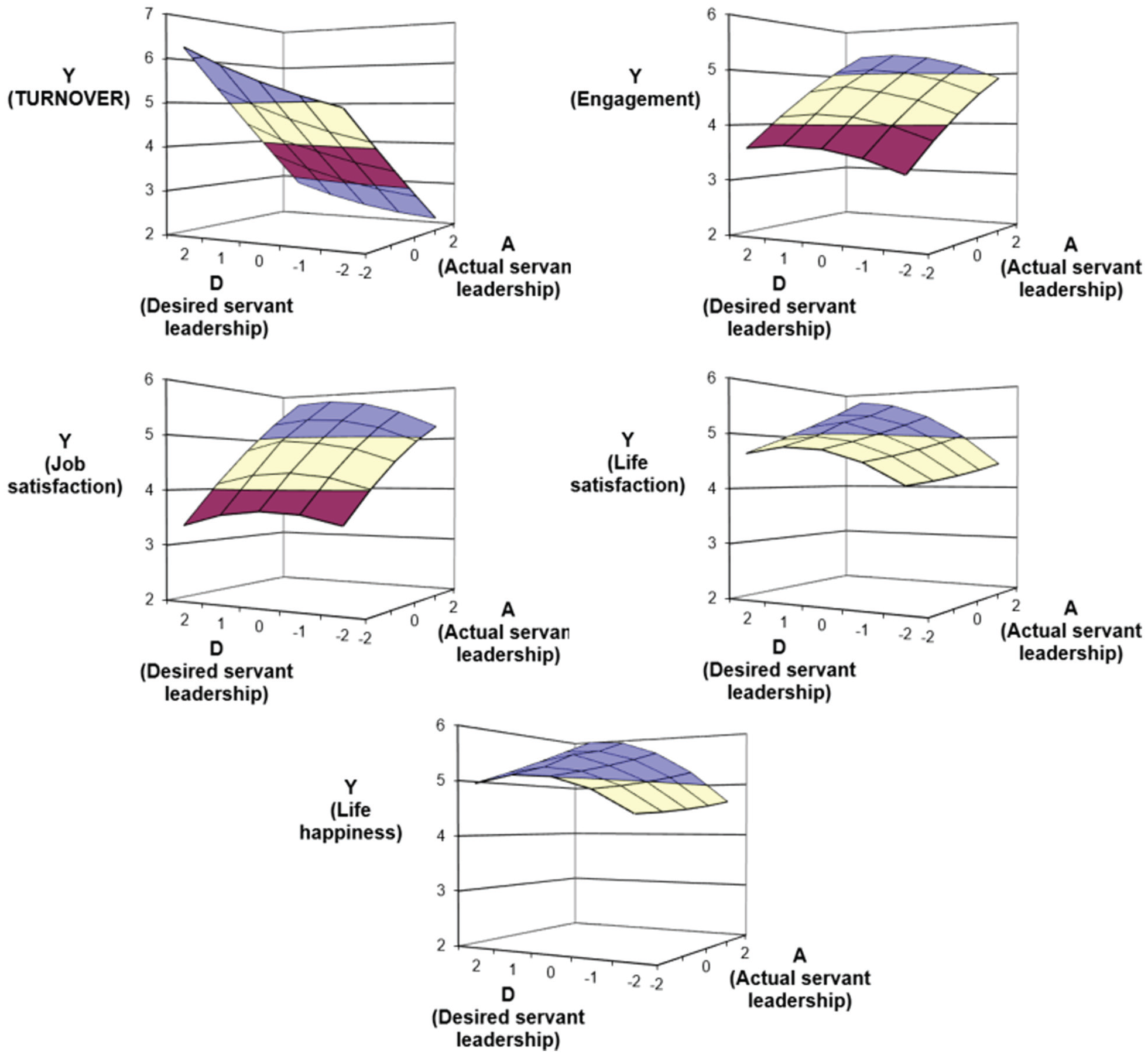
Surface response analyses.
H1 proposed that congruent (vs. incongruent) perceptions of servant leadership are associated with lower employee turnover intention (H1a), higher employee work engagement (H1b), and higher employee well-being (H1c).
Turnover intention
For H1a, turnover intention, the slope of the congruence line is significant (β = –0.51, p < .001). This means that when both actual and desired servant leadership are congruent and high, turnover intention is lower as opposed to when both actual and desired servant leadership are congruent but low. Figure 1 visually shows this, as turnover intention is lower at the back of the graph (where both predictor variables are high) as opposed to the front of the graph (where both are low). Second, the slope of the incongruence line is significant (β = –1.03, p < .001), showing that turnover intention is lower when actual servant leadership behavior is higher than desired, as opposed to the opposite situation. Figure 1 shows this, as turnover intention is lower on the right side of the graph (where actual > desired) as opposed to the left side (where actual < desired). Finally, we find no evidence that incongruence is generally better for turnover intention as opposed to congruence, as the curvature of the incongruence line is not significant (β = 0.08, p > .05).
Work engagement
The results for work engagement are similar. For H1b—which suggested that work engagement (H1b) is higher (vs. lowest) for congruent (vs. incongruent) perceptions of servant leadership—our results show that work engagement is higher when both actual and desired servant leadership are high, as opposed to low (slope of the congruence line β = 0.55, p < .001). Moreover, work engagement is higher when actual servant leadership behavior is higher than desired, as opposed to the inverse situation (slope of the incongruence line β = .33, p < .01). Yet, also here, we find no evidence that congruence is better than incongruence (curvature of the incongruence line β = –0.09, p > .05).
Well-being
However, we do find evidence that congruence is better than incongruence for the three indicators of well-being. Specifically, for job and life satisfaction as well as life happiness, we find evidence that well-being is higher when actual and desired servant leadership are congruent as opposed to incongruent (curvatures of the incongruence line ranging from −0.12 to −0.14; p < .05). Moreover, when both actual and desired servant leadership behaviors are high, all three indicators of well-being are significantly higher as opposed to when both predictor variables are low (slopes of the congruence line ranging from 0.41 to 0.59; p < .001). For job satisfaction, we, in addition, find that when actual servant leadership is higher than desired, job satisfaction is higher as opposed to the reverse situation. Hence, H1 is partially supported.
Moderation of gender inequality
H2 proposed that gender inequality moderates the relationships between (in)congruence of servant leadership perceptions and employee outcomes (turnover intention, work engagement, and well-being), such that the relationships between (in)congruence of servant leadership perceptions and employee outcomes (turnover intention, work engagement, and well-being) are stronger (vs. weaker) in high (vs. low) GII countries. To test the moderating role of gender inequality in the relationship between actual/desired servant leadership (in)congruence and the outcome variables, we made use of moderated polynomial regressions (Bono & Colbert, 2005; Edwards & Rothbard, 1999). This means that Equation (1) was extended with five interaction terms resulting in Equation (2) mentioned below (where GI stands for gender inequality). In a second step, we performed simple slope analyses which test the impact of actual/desired servant leadership (in)congruence at high and low levels of gender inequality (one standard deviation above and below the mean). In a final step, we repeated the surface response analyses, yet this time at high and low levels of gender inequality.
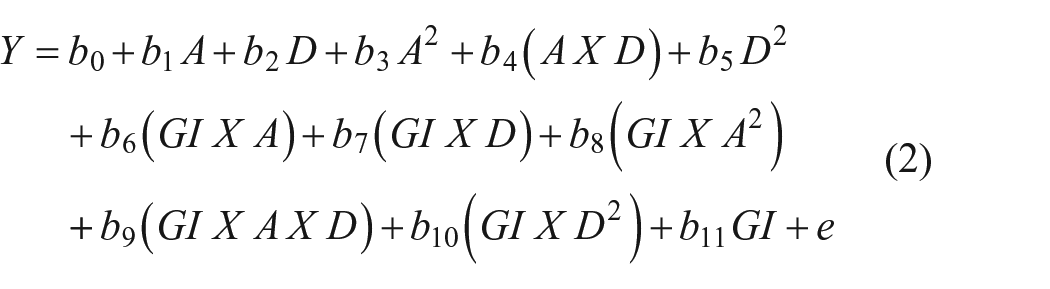
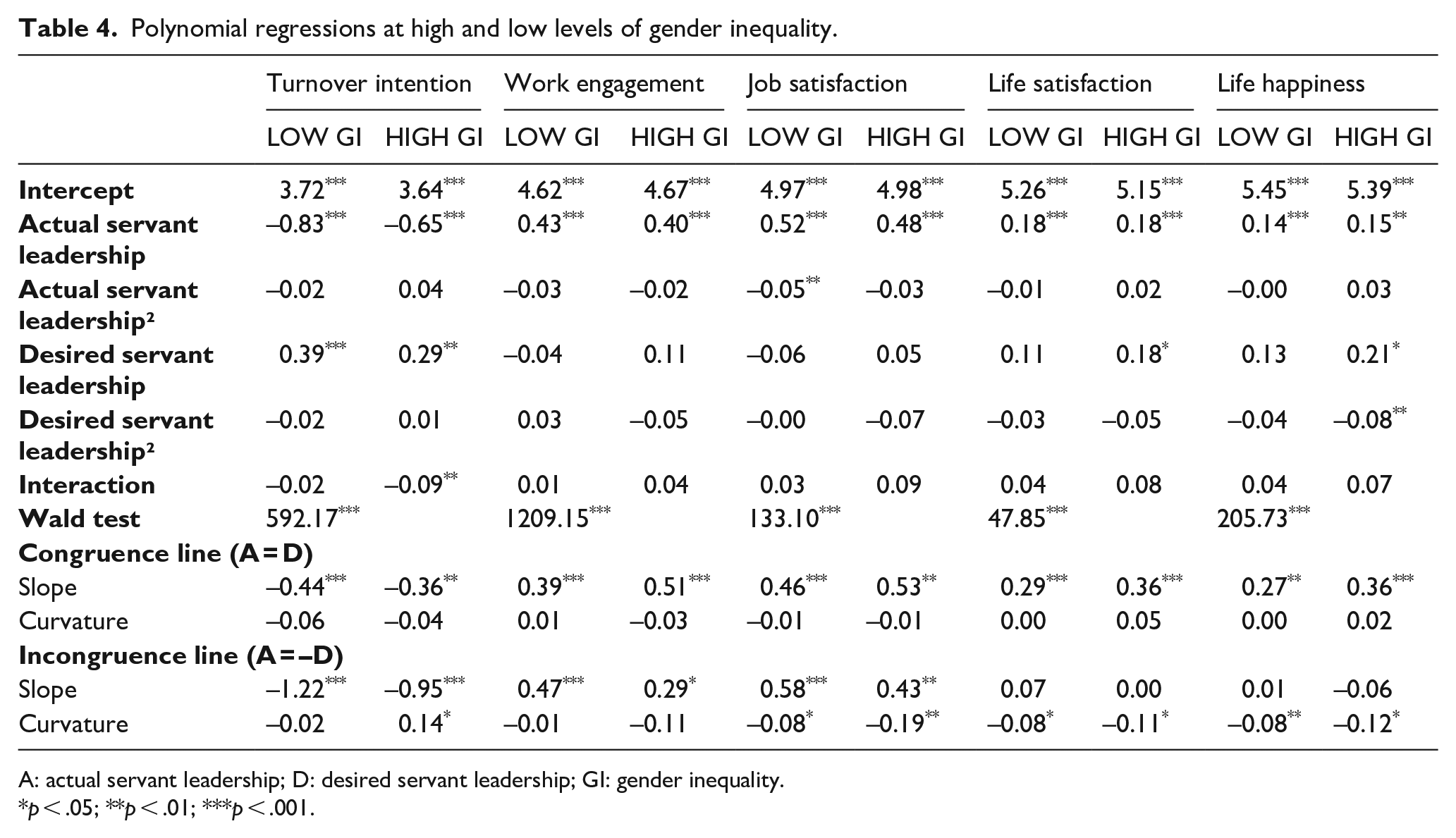
The results of these analyses are summarized in Table 4. To test whether the polynomial regression coefficients, together, were significantly different in the low and high gender inequality condition, we made use of a Wald test of parameter constraints. For all outcome variables (turnover intention, work engagement, and well-being), the five polynomial regression coefficients were, together, significantly different in the low and high gender inequality conditions. To explore the nature of this interaction, we need to look at the slopes and curvatures of the (in)congruence line. In general, the relationships we find are stronger in cases of high gender inequality as opposed to low gender inequality.
Polynomial regressions at high and low levels of gender inequality.
A: actual servant leadership; D: desired servant leadership; GI: gender inequality.
p < .05; **p < .01; ***p < .001.
Turnover intention
For turnover intention, we only find that congruence in actual/desired servant leadership leads to less turnover intention than incongruence when gender inequality is high (β = 0.14, p < .05). In contrast, when gender inequality is low, no difference is found between incongruence and congruence. Both in the case of high and low gender inequality, the direct effects mentioned above are confirmed: high actual/desired servant leadership is better than low actual/desired servant leadership and actual servant leadership that is higher than desired is better than vice versa.
Work engagement
For work engagement, we find that the impact of having high actual/desired servant leadership as opposed to low is stronger where there is higher gender inequality.
Well-being
For all three indicators of well-being, we find stronger effects of actual/desired servant leadership congruence. Specifically, the impact of having high actual and desired servant leadership (as opposed to low actual and desired servant leadership) is stronger for all three well-being indicators when gender inequality is high. Similarly, the beneficial impact of congruence (as opposed to incongruence) is stronger when gender inequality is high. Hence, H2 is partially supported.
Discussion
Theoretical contributions
Consistent with the notion that mutuality of perceptions, exchanges, and acknowledgments between followers and their leaders lies at the center of servant leadership (Liden et al., 2014), we investigated the impact of the (in)congruence of servant leadership on followers’ work outcomes. Findings reveal complex and interesting results: Regarding H1, in conditions when actual and desired servant leadership are high and congruent, turnover declines and work engagement increases. Similarly, well-being is higher when actual and desired servant leadership is congruent. Only within job satisfaction (a subdimension of well-being) is the best condition achieved when actual servant leadership exceeds the expectations of the followers. Moreover, we find positive outcomes (i.e., lower turnover intention, higher work engagement, and higher well-being) when actual servant leadership behavior is higher than desired. A possible explanation for this might be that although employees did not desire higher servant leadership, the leader’s actual show of servant leadership will still implicitly affect employees’ behaviors (e.g., lower turnover intention and higher work engagement). Based on to social exchange theory (Blau, 1964), employees will reciprocate the leader’s positive servant leadership behaviors. Hence, the higher actual servant leadership still positively relates to employee outcomes. In addition, for both turnover intention and work engagement, we surprisingly find no evidence that congruence is better than incongruence. There are two possible situations that give way to incongruence: when actual servant leadership is high and the desired servant leadership is low; and when actual servant leadership is low and the desired servant leadership is high. In the first situation, as we discuss above, the actual servant leadership will still be positively related to employees’ favorable outcomes. In the second situation, a possible reason for this result might be that although the employee desires higher servant leadership, the leader failed to exhibit this higher level of servant leadership, though still exhibits other favorable leadership types (e.g., employees’ ideal leadership prototype), which could positively be related to employee outcomes. This may be the reason why no evidence shows that congruence is better than incongruence. Therefore, we encourage future research to consider the possible impacts of employees’ ideal leader prototype when studying the impacts of any other intended leadership types. Regarding H2, GII moderated the impact of the (in)congruence of servant leadership on all outcomes, providing support for the hypothesis. We discuss the implications and theoretical contributions below.
Our first contribution lies in conceptualizing and empirically validating the importance of the (in)congruence of servant leadership. Serving followers constitutes a core characteristic of servant leaders (Z. Chen et al., 2015), and this necessitates an understanding of the perceptions and expectations of followers (van Dierendonck, 2011). Although research (e.g., Schaubroeck et al., 2011; Taylor et al., 2007) demonstrates an interrelationship between servant leaders’ and followers’ perceptions of trust and integrity, scant attention has been given to the relation between leader–follower behavior and work-related outcomes. Despite the presumed role of followers and mainly their expectations of their servant leaders in literature (Audenaert et al., 2018; Liden et al., 2015), no empirical work to date has explored what happens when followers do (not) see eye to eye in regard to their leaders’ servant leadership characteristics. Our focus thus contributes to recent research which has started delineating how servant leaders elicit positive follower behaviors and attitudes (Newman et al., 2017; Sy et al., 2018). A major stream of research on servant leadership has focused on the bright side, underscoring various mechanisms (e.g., social exchange, role modeling, and social identity) in unraveling how servant leaders impact followers positively (e.g., Newman et al., 2015; van Dierendonck et al., 2014). However, theory suggests that leaders with servant leadership characteristics may not always be effective in eliciting followers’ positive behaviors and attitudes (van Dierendonck et al., 2011). For example, Lapointe and Vandenberghe (2018) found that servant leadership was positively associated with sacrifice commitment, which is expected to deplete from followers’ limited reservoir of resources and leads to antisocial behaviors.
Taking a first step, our findings demonstrate that for the three outcomes of followers, congruence in terms of actual and expected behaviors of servant leaders matters significantly and in conditions of congruence, meeting the expected behaviors of followers by exhibiting actual servant leadership behaviors yields the most desirable follower behaviors and attitudes. This finding is in line with Eva et al. (2019, p. 1), who note that when leaders prioritize the “well-being and growth” of their followers, they in turn become more “engaged and effective” at work. Similarly, Pucic (2015, p. 657) maintains that “a leader’s success is determined by meeting the expectations of followers, while those expectations remain overtly situated within leader’s observable behavior.” He further suggests that the effectiveness of a leader’s behavior is, however, dependent upon whether actions or consequences of their actions reflect “normatively appropriate conduct” as envisaged by followers (p. 658). While this finding does not deny the importance of servant leadership for followers, it points toward an important caveat of previous research: From a follower perspective, if there is discord between the expected and actual servant leadership behaviors, then perceptions of a high servant are likely to have little impact in boosting follower outcomes. This understanding is important, as it allows leaders a better opportunity to mutually align their behavior with the expectations of followers (e.g., Han et al., 2015) while also ensuring that followers feel at ease and comfortable working with their leaders (e.g., Matta et al., 2015).
A second way our study contributes to servant leadership is through our integration of situational strength theory (Meyer et al., 2010) and focus on GII as a contextual variable that could shape the impact of (in)congruence of servant leadership on employee outcomes. By employing situational strength theory, we answer the call from previous review articles that encourage researchers to adopt alternative theoretical lenses to investigate the boundary conditions of the impacts of servant leadership (Eva et al., 2019). We also enhanced our understanding of situational factors that would shape the impacts of servant leadership on employees. Moreover, as noted earlier, gender co-occurs with its broader context in a like-for-like relationship (Ayman & Korabik, 2010), which in fact reveals parallel dynamics for servant leader’s behavior and follower outcomes in relation to job satisfaction, turnover intention, and well-being (e.g., Brunetto et al., 2012; Harris et al., 2009). We find that literature around a contingency approach to servant leadership is helpful in that it shows how the impact of servant leadership does not occur within a vacuum (Walumbwa et al., 2010); environmental conditions, such as culture and gender, impact and shape how employees perceive the behaviors of their leaders. Taking a first step, this research introduces GII as a novel and macro-level contingency variable, which corroborates recent research: Findings in H. Zhang et al. (2012) reveal that for employees working in family supportive organizations, servant leadership was not effective because they received advice and feedback appropriate for family related issues from their organization. This study and the following research advocated the role of contextual conditions (e.g., team, organizational culture, and national level factors) as substitutes for servant leadership. Turning to our findings, in countries characterized by high GII, congruence of actual and desired servant leadership mattered and was significant; high congruence was positively associated with work engagement, all indicators of well-being and reduced followers’ turnover intentions.
A possible explanation in support of our substitute effect could be related to work-family related support and opportunities available in countries characterized by low GII. These countries showcase examples of wealth and development in terms of social and economic aspects. Furthermore, institutional systems and organizations in these countries reflect a culture that demonstrate respect and dignity for both genders when it comes to division of labor and career growth. Thus, it may be that employees in countries with low GII can share their family concerns with their colleagues, receive support from their organizations and benefit from personal growth and developmental opportunities that are usually made available to them irrespective of the characteristics of the leader they work for (i.e., servant leadership). Thus, they may not view servant leadership as particularly beneficial to their work engagement as well-being, as they are likely equipped with and have access to these resources in the wider context of their country.
An important strength of our study is that we use data from 10 countries that represents a wide range of cultural contexts. In addition, most of them are under studied. Our study provides empirical evidence from a different cultural context with a high range of gender inequality representing a wide spectrum of levels of human development. The countries in our sample rank from a GII score of 0.08 (Spain) to a score of 0.49 (Guatemala). This is important because the context, measured by the level of gender inequality, is likely to influence the impact of (in)congruity between the expected level of servant leadership and the actual level of servant leadership and its impact on followers’ outcomes (van Dierendonck, 2011). Our findings also concur with Peng et al. (2007), who study the effects of leadership on family-friendly programs in East Asian and African countries, and whose results demonstrate a positive correlation between family supportive leadership behaviors, organizational commitment, and turnover intentions.
From a cross-cultural perspective, our study adds to and expands recent research: Drawing on the measures of the GLOBE project, the findings in Mittal and Dorfman (2012) revealed the effectiveness of servant leadership across cultures. However, an important limitation of Mittal and Dorfman (2012)’s study is that the authors derived the measure of servant leadership from the GLOBE dataset rather than using the empirically validated version of the scale. A more recent study by van Dierendonck et al. (2017) supports the cross-cultural equivalence of the servant leadership survey across eight countries (The Netherlands, Portugal, Germany, Iceland, Italy, Spain, Turkey, and Finland). The focus and findings in our study differ from that by van Dierendonck et al. (2017) in terms of representing more underdeveloped and understudied contexts in servant leadership literature and linking GII, an index of cross-cultural differences, to the consequences of in(congruence) of servant leadership.
Limitations and future research suggestions
As in all studies, there were limitations which should be noted. A first limitation is that the study design was cross-sectional, preventing us from making definitive causal inferences. However, we relied on research on the consequences of in(congruence) of servant leadership in forming our hypotheses, and collected data from both supervisors and subordinates regarding the expected and actual servant leadership behaviors, respectively. Moreover, we utilized objective data for GII, obtained from United Nations dataset. Nevertheless, we suggest that a time-lagged, longitudinal design be tested to demonstrate the causal patterns of associations among our study variables.
A further limitation of our study is that we focused only on turnover intention, work engagement, and well-being of subordinates as consequences of in(congruence) of servant leadership. It could be argued that distinctive characteristics of servant leaders can encourage employees to engage in other behaviors such as being more humble, influence their creativity, and that their empowerment may impact subordinates’ proactive behaviors positively. Future studies can expand on our model by integrating these behavioral and attitudinal outcomes. Furthermore, it would be interesting to explore if and how in(congruence) of servant leadership impacts subordinates’ nonwork domains, such as their family or friend relationships.
As boundary conditions to explore how in(congruence) of servant leadership impacts on employee outcomes, we focused on GII as a cross-cultural variable, representing 10 different countries. Contextual conditions at various levels, such as work-family culture as an organizational characteristic, team orientation, and organizational policies for employee development at the team level, and proactivity and self-determination, as well as relational dynamics with one’s manager (e.g., LMX, LMX social comparison, or LMX differentiation) can be considered as potential boundary conditions in future research.
Footnotes
Data availability
The data of this article are not shared with any other projects nor articles.
Declaration of conflicting interests
The author(s) declared no potential conflicts of interest with respect to the research, authorship, and/or publication of this article.
Funding
The author(s) received no financial support for the research, authorship, and/or publication of this article.