



Abstract
This study relies on the dual model of passion to explore the direct and conditional effect of passion on firm growth. The study proposed persistence and environmental uncertainty as pathways through which passion influences firm growth. The model of firm growth was tested on a sample of 381 small-scale businesses located in Nigeria. The findings suggested that passion is significantly related to firm growth and that persistence partially mediated the link between passion and firm growth. Furthermore, the study failed to establish the conditional effect of environmental uncertainty on the indirect effect of passion on firm growth. The study has established the applicability and relevance of the dual model of passion in the context of entrepreneurship confirming its predictive power in accounting for the variation in firm growth.
Introduction
Small- and medium-scale enterprises (SMEs) are recognized as the drivers of economic growth, economic transformation, and wealth creation. Defined variously by different institutions and countries, SMEs are central in an entrepreneurial ecosystem with targeted policies designed to expand their capacity to scale their innovative programs, processes, products, and services for the economic, social–cultural, and political benefits of the society. Governments around the world are, therefore, focused on how best to promote and sustain the performance of SMEs to address fundamental issues, such as income inequality, unemployment, economic prosperity, wealth creation, and general wellbeing of nations. This scenario has been replicated in Nigeria through programs and frameworks designed to promote the growth and development of the SME sector. Such intervention programs include the Small and Medium Enterprises Development Agency of Nigeria (SMEDAN) established in 2004, Microfinance Policy, Regulatory, and Supervisory Framework launched in 2005, Small and Medium Enterprises Equity Investment Scheme, Small and Medium Scale Enterprises Guarantee Scheme, and business incubation programs (Iyortsuun, 2017) among others.
Despite the attempt by the Nigerian government to promote and support the SME sector, there is a significant dismal performance recorded in the sector. SMEs account for only approximately 8% of total exports with a contribution to gross domestic product of 48% comparably less than other countries (Akaeze & Akaeze, 2018; SMEDAN, 2019). This is particularly true for data on the failure rate of SMEs, which puts the percentage of failed SMEs at 60%, 49.6%, and 39.5% within 2, 4, and 6 years, respectively (Nnamseh & Akpan, 2015). Okpara (2011) concurs that the failure rate is generally higher in developing countries compared to developed countries. These unpalatable statistics have elicited both policy and academic interest to understand what factors account for the variation in firm performance.
The roots of the development of models of firm performance are found in the field of psychology, industrial organization theory, and strategic management. Earlier models explaining firm performance or growth were focused on the characteristics of the individual or entrepreneur (Sandberg & Hofer, 1987) as the most important determinant of firm performance. Proponents of organization theory championed industry structure while those of strategic management theory emphasized strategy as the focal antecedent of firm performance models. Observing the inherent inadequacies in the models of firm performance, Sandberg and Hofer (1987) proposed a parsimonious model of firm performance as a function of the entrepreneur or individual, industry structure where the entrepreneur or individual operates; and its business strategy. While McDougall et al.’s (1992) extension of the Sandberg and Hofer (1987) model included an interaction effect of industry structure and business strategy, Chrisman et al.’s (1999) extension included resources, organizational structure, processes, and systems. The interest in the models of firm performance gave rise to firm performance antecedents, such as entrepreneurs’ access to resources, opportunity choice, and managerial capability (Thakur, 1999); psychological characteristics and background of entrepreneurs; scanning intensity and industry dynamics (Box et al., 1993); entrepreneur characteristics, organizational, and environmental variables (Baum et al., 2001; Baum & Locke, 2004); and entrepreneur characteristics, resources, strategy, industry, and organizational structure and systems (Wang & Fang, 2012).
However, the biological and psychological profiles of individuals or entrepreneurs have been increasingly suggested as dominant and recurring themes in models of firm performance, some of which are passion and persistence. Such perspectives have promoted passion as a necessary ingredient of firm performance, the “fire in the belly” (Cardon et al., 2009) that drives success in business. However, few studies have looked at understanding firm performance from the perspective of the passion and persistence an entrepreneur has toward his business. It is on the basis of this that this study hopes to ascertain the impact of passion and persistence toward business activities on the growth of small-scale businesses in Nigeria. The study is, therefore, expected to apply the dual model of passion (Vallerand et al., 2003) in understanding the direct effect of passion toward business activities on firm performance, especially in the Nigerian business landscape. Till date, little is known about how passion and persistence interact to influence firm performance. Furthermore, Cardon and Kirk (2013, p. 15) suggested “that including entrepreneurial passion in a study of persistence may be an important contribution.” This study, therefore, attempts to extend the Cardon and Kirk model to understand how passion and persistence toward business activities interact to affect business growth. Finally, the study would assess the moderating role of environmental uncertainty on the persistence-performance link to illuminate the effect of the context in which individuals or businesses situate on the relationship between persistence and performance.
The study proceeds by reviewing literature on the theoretical foundation of the study before discussing the concepts of business passion, performance, and the potential mediating influence of persistence on the passion–performance link. The literature review also covered the moderating role of environmental uncertainty on the direct link between persistence and business performance. The next section covered the methods, results, discussions, implications of the study, and finally, limitations and suggestions for further studies.
Theoretical and hypotheses development
One theoretical perspective to understand the nature of passion is the dual model of passion propounded by Vallerand et al. (2003). Deriving their roots from positive psychology as a paradigm to understand the meaningfulness of life, Vallerand et al. (2003) proposed a duality theory of passion on the premise that “passion can fuel motivation, enhance well-being and provide meaning in everyday life” (p. 756). Central to their theory of passion is the concept of identity and internationalization which determines the nature of passion. Vallerand et al. (2003) define passion as a strong inclination toward an activity that people like, that they find important, and in which they invest time and energy. Thus for an activity to represent a passion for people, it has to be significant in their lives, something that they like and something at which they spend time on a regular basis. (p. 757)
Therefore, an activity is a passion when three conditions exist. First the person engaging in the activity likes it. There exists an emotional component inherent to the activity (Mageau et al., 2009). Second, the person finds that the activity is an important part of who he or she is (identity). There is an element of value attached to the activity, which is the element that distinguishes passionate activities from other activities that are intrinsically motivated (Mageau et al., 2009). The activity is so valued that it becomes a central feature of the person’s identity (Donahue et al., 2012). Third, the person devotes significant time and energy in engaging in the activity (internationalization). Internationalization is what distinguishes the types of passion expressed, conceptualized as harmonious passion and obsessive passion. However, the theory of passion as argued by Vallerand and his colleagues insists that if one of the elements in the theorization of passion is missing, then there is absent the existence of passion for the activity. Bonneville-Roussy et al. (2013) give an example to depict this argument that if an individual likes an activity and devotes significant time to the activity but does not value the activity, that is the activity does not define who he is, then the individual would only be characterized as intrinsically motivated toward the activity rather than being passionate about the activity. Therefore, the existence of the three activities defines the person leading to passion toward that specific activity (Vallerand et al., 2007).
The self-determination theory, a theory of motivation, and personality gave Vallerand and his colleagues the foundational base of their classification of passion. Because individuals operate in social systems to address the psychological needs for competence (interacting effectively with the environment), autonomy (strong feelings for personal initiative), and relatedness (strong feelings to connect with others) to achieve optimal level of functioning (Bonneville-Roussy et al., 2013; Vallerand et al., 2007), they exhibit distinguishing characteristics with respect to the integration and assimilation of external stimuli arising from the social system. Their identity, which reinforces the value attached to the activity, produces two distinct internalization processes: autonomous and controlled internalization. An autonomous internalization is characterized by volition, freedom, and motivation in engaging in the activity while controlled internalization is characterized by the absence of volition and pressure and benefits derivable from the engagement in the activity (Vallerand et al., 2003). Autonomous internalization leads to harmonious passion while controlled internalization produces obsessive passion.
Using the duality theory of passion as proposed by Vallerand et al. (2003) as the underpinning theory and acknowledging that the link between passion and firm performance is distal including recognition of the important role of behavior (Iyortsuun et al., 2019), this study proposes that an individual’s passion for his business will have an indirect effect on firm performance through persistence. As a dominant level of analysis in entrepreneurship research (Davidsson & Wiklund, 2001; Sarasvathy, 2004) and as argued by the upper echelons theory (Hambrick & Mason, 1984), an individual has an overwhelming influence on firm performance in terms of direction, activities, processes, actions, or inactions (Joardar & Wu, 2011; Lau et al., 2007) especially in small organizations (Rauch et al., 2009).
Furthermore, an individual’s contact with the environment has the capacity to modify positively or negatively his or her capacity to function invariably having an effect on his or her performance (Adomako et al., 2016) leading to the proposition that the relationship between persistence in business activities and firm performance will be moderated by environmental uncertainty. Contingency theory (Covin & Slevin, 1989; Lumpkin & Dess, 2001) provides the theoretical support to argue for a multi-level (Hitt et al., 2007) analysis of the persistence–firm growth relationship. Researching entrepreneurship without taking cognizance of the environmental factors fails to capture the boundary conditions under which entrepreneurial phenomenon occurs (Gartner, 1985; Kollmann et al., 2007; Miller, 2011; Sarasvathy, 2004). Including environmental uncertainty in a model of firm growth may provide a clear picture of the relationship between passion, persistence, and firm growth. It is on this basis that we propose the following conceptual framework of this study (Figure 1).
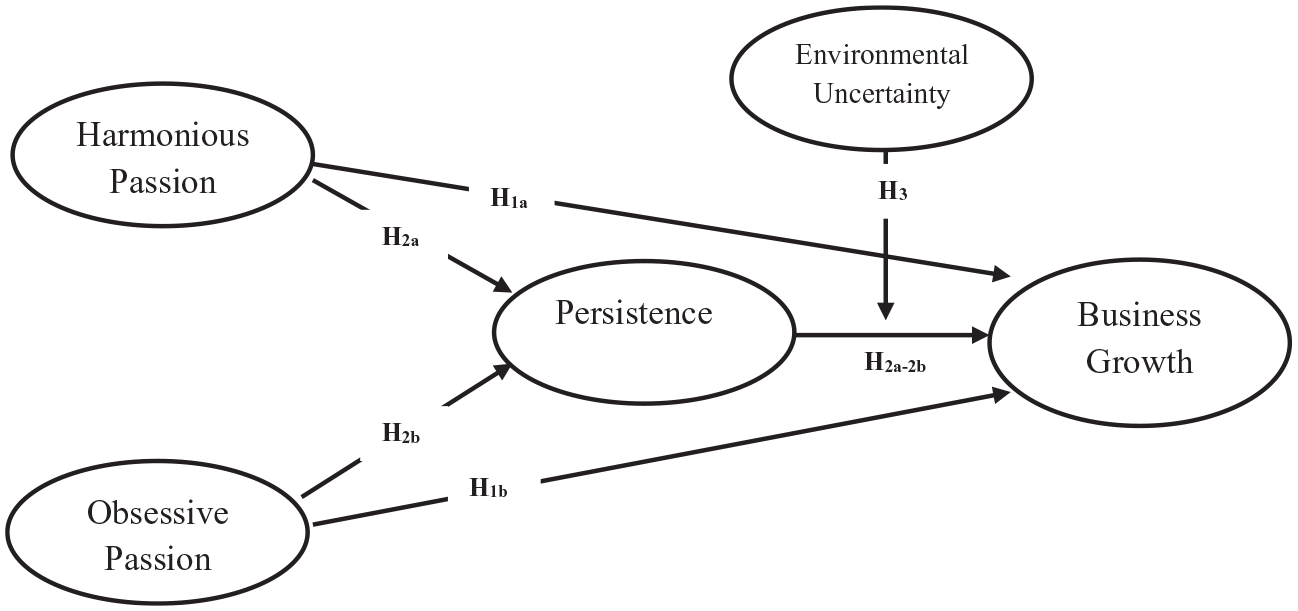
Hypothesized model.
Passion
The concept of passion has fascinated writers, philosophers, and researchers over the centuries with early writers espousing passion as a negative feeling that enslaves an individual. Later, writers argued for a positive perspective of passion that drives individuals to be engaged in valuable activities, championed by positive psychology. Different perspectives of passion arose with varying conceptualizations, such as an extreme or strong preference or interest (Gagne, 2007), as a personality trait (Baum & Locke, 2004), an inseparable factor that engenders creativity (Amabile, 2001; Amabile & Fisher, 2009), a component of the triangle of love (Sternberg, 1986), as romance (Renzulli et al., 2006), as a motivator (Fredricks et al., 2010), and passion in terms of entrepreneurial activities (Cardon et al., 2009). Vallerand et al.’s (2003) seminal work changed the landscape and gave direction to the research on passion.
The duality model of passion as expounded by Vallerand et al. (2003) is activity-oriented. Their study covered 150 activities, which were categorized into individual sports/physical activity, team sports, passive leisure, active music, reading, active arts, work/education, and interpersonal relationships (Vallerand et al., 2003) and lately applied to cover the activities engaged in by owners, owners/managers, or managers of small-scale businesses. Statistics seemed to indicate that passion is important in business especially in Nigeria where this study is domesticated. The global entrepreneurship monitor (GEM) report indicates that Nigeria’s entrepreneurial intentions rate is 44.3% versus the global average of 24.22%. Furthermore, the study reports a global average of 13.55% versus Nigeria’s average of 39.86% regarding the total early-stage entrepreneurial activity (defined as the percentage of 18–64 population who are either a nascent entrepreneur or owner-manager of a new business). Also, Nigeria’s average for established business ownership rate (defined as the percentage of 18–64 population who are currently an owner-manager of an established business) is 17.51% while the regional and global average is 12.70% and 8.52%, respectively. These statistics confirm the general notion held that Nigerians are industrious in nature. The individual or entrepreneur, industry structure, business strategy, resources, organizational structure and processes, and systems (Chrisman et al., 1999); and environmental factors (Baum et al., 2001) could be factors in illuminating this scenario. However, this study focuses on the individual factor, specifically, his affective, cognitive, and behavioral components in an attempt to understand business performance in the context of Nigeria.
Firm performance
Quantifying as a metric, the effectiveness and efficiency of business actions has continued to be a central topic of debate and empirical attention by scholars in organization and strategic literature (Murphy et al., 1996) especially regarding small-scale businesses. Because of their relatively small size compared to large established firms, the measurement of the performance of small businesses is rather challenging (Venkatraman & Ramanujam, 1987; Williams, 2018) what Venkatraman and Ramanujam (1986, p. 801) refer to as “the thorniest issues confronting the academic researcher.” This is exacerbated by the argument that financial information of privately owned businesses is difficult to access. Because the legal and institutional framework does not require that privately held companies make public their performance, it becomes a challenge assessing their objective performance measures. Furthermore, the state of the SME sector in most countries (Nigeria inclusive) characterized by inadequate record keeping and lack of a comprehensive performance measurement system (Sousa et al., 2006) have contributed to the search for alternative approaches of measuring firm performance. Therefore, researchers are increasingly favoring subjective perceptual measures over objective measures especially where objective measures are absent (Murphy et al., 1996; Weinzimmer et al., 1998) and also following increasing evidence of a high correlation between objective and subjective measures of performance (Wall et al., 2004). Specifically, research has narrowed to exploring “the relationship between a given independent variable and a given performance dimension” (Murphy et al., 1996, p. 21) provided there is ample justifiable explanation and rationale.
While size is a static measure, growth is a dynamic measure “defined as a relative measure of size overtime” (Weinzimmer et al., 1998, p. 238) occurring in different areas of business operations. Growth is evident as change in cash flow, market share, sales, employment, customer base, net profit, CEO/owner compensation, labor expense to revenue, assets, and capacity (Chandler & Hanks, 1993; Chrisman et al., 1999; Gilbert et al., 2006; Murphy et al., 1996; Weinzimmer et al., 1998). Because empirical results indicate high correlation between changes in cash flow, market share, sales and employment growth (Chandler & Hanks, 1993; Gilbert et al., 2006), they are selected as the measures of business growth. Furthermore, because the study is based on small businesses in Nigeria and given the underdeveloped nature of the sector (Eniola & Entebang, 2015), change in customer base, assets, and net income are added as measures of business growth given that owners/managers of SMEs can easily identify whether significant changes occur in those aspects of business operations. Therefore, a confluence of changes in cash flow, market share, sales, employment, customer base, assets, and net profit forms the measure of business growth in line with the suggestion by Murphy et al. (1996), Weinzimmer et al. (1998), and Richard et al. (2009).
Passion and firm growth
Vallerand et al.’s (2003) theory of passion has been exhaustively tested on outcomes, such as employee work performance (Pradhan et al., 2017; Vallerand et al., 2007), affect (Breugst et al., 2012; St-Louis et al., 2016), quality of interpersonal relationships and emotion (Philippe et al., 2010), employee work passion (Li et al., 2017), burnout (Fernet et al., 2014), organizational identification (Astakhova & Porter, 2014), life satisfaction (Lafreniere et al., 2013a), and mindfulness (St-Louis et al., 2016). However, few studies have evaluated Vallerand et al.’s theory on an outcome variable, such as business performance. One of such studies is the study by Ho and Pollack (2014) in the United States using a sample of 206 members affiliated with Business Network International (BNI). Their study neither established a direct link between passion and financial or overall business performance nor did it establish an indirect link through network centrality. The lack of empirical studies using the duality model of passion and the inconclusive research findings of the Ho and Pollack’s study influenced the development of a model of firm growth based on the dual model of passion.
Harmonious passion and firm growth
The social context in which a business owner operates influences him or her. The business owner or manager engages in business activities in attempts to leverage the task environment to create sustained and profitable value to him and to the society. Such business or entrepreneurial activities include scanning the environment for opportunities and markets, developing and commercialization of new ideas, products, services, systems and processes, assembling needed manpower, financial resources and equipments, increasing turnover, and implementing strategies for expansion and diversification (Iyortsuun et al., 2019). When these activities reinforce the business owner or manager’s identity or have the potential to do so, he will increasingly see the activities as valuable, therefore, spending more time and resources engaging in them and becoming passionate toward them. When business owners or managers engage in these activities out of volition, without any contingencies attached to them (Vallerand et al., 2003) they are said to be harmoniously passionate. The engagement in these activities is done willingly because of the characteristics of the activities rather than benefits derivable and also the activities do not interfere with their other life’s activities (Mageau et al., 2009; Vallerand et al., 2003, 2007).
Like obsessive passion, harmonious passion is associated with “different affective, cognitive and behavioral outcomes” (Bonneville-Roussy et al., 2013). Harmonious passion has been found to be positively related to general outcomes, such as mastery goals (Bonnevile-Roussy et al., 2013a; Vallerand et al., 2007), fun and enjoyment, and perception of challenge and control (Mageau et al., 2005), positive emotions and quality of interpersonal relationships (Philippe et al., 2010), life satisfaction (Lafreniere et al., 2013), mindfulness (St-Louis et al., 2016), subjective well-being and vitality (Salama-Younes & Hashim, 2017), flow, vigor, dedication, concentration, and absorption (Carpentier et al., 2012; Stoeber et al., 2011; Vallerand et al., 2007). A business owner or manager that exhibits positive outcomes as such would be expected to be psychological balanced and emotionally sound in the pursuit of business activities conducive for positive experiences. Their self-regulation mechanism will allow them to participate fully in the business activities voluntarily because of the characteristics of the activities, and the affect and value for the activities thus dedicating time and resources in the pursuit of the activities. It is expected that such positive outcomes will contribute to a positive impact on firm growth. Consistent with these findings and the theoretical arguments above, we propose that:
H1a. Harmonious passion is positively related to growth of small-scale businesses.
Obsessive passion and firm growth
St-Louis et al. (2016) argue that despite harmonious and obsessive passion having the same level of intensity, they differ in their quality of activity engagement. While harmonious passion leads to positive benefits because of the adaptive self-regulation processes, obsessive passion limits access to adaptive self-regulation processes. Obsessively passionate business owners and managers also engage in the same activities that harmoniously passionate business owners do. However, what distinguishes the former from harmoniously passionate business owners or managers is that because of controlled internalization, they exhibit an “ego-invested or false self” (Mageau et al., 2009, p. 605) and “rigid and conflicting form of task participation” (Bonneville-Roussy et al., 2013, p. 607), which leads to “less than optimal functioning within the confines of the passionate activity as well as when prevented from engaging in it” (Vallerand et al., 2007).
The obsessively passionate business manager or owner’s passion “originates from intrapersonal and/or interpersonal pressure either because certain contingencies are attached to the activity . . . takes disproportionate space in the person’s identity and causes conflict with other activities in the person’s life” (Vallerand et al., 2003, p. 757). Therefore, the business owner or manager is forced to engage in such business activities as commercialization of ideas, products, and services, increasing turnover and implementing strategies for expansion and diversification, and so on, because of the benefits attached to what commercialization of products brings or increased turnover brings. The business owner or manager will, therefore, be obsessively engaged in the activity to the extent that the activity occupies a significant part of who he is, causing conflict with other life activities and preventing him from “fully focusing on the task at hand” (Vallerand et al., 2007, p. 509). Therefore, because of the effect of obsessive passion impacting the ability of a business owner or manager on focusing on the task at hand coupled with the myriad of negative impacts, an obsessively passionate business individual is proposed to have a negative effect on firm growth. This proposition is confirmed by research findings establishing a non-significant or negative effect of obsessive passion on positive emotions (Philippe et al., 2010), mindfulness (St-Louis et al., 2016), performance by artists (Vallerand et al., 2007), life satisfaction and subjective well-being (Lafreniere et al., 2013), personal accomplishment (Fernet et al., 2014), and financial performance (Ho & Pollack, 2014). It is on the basis of these that we propose the following hypotheses:
H1b. Obsessive passion is negatively related to growth of small-scale businesses.
Indirect effect: persistence
Focusing on the individual as a variable in a model of firm growth, this study in answering the call that passion is a distal antecedent of business performance (Cardon et al., 2009; Iyortsuun et al., 2019) proposed a mediator of the passion-business performance link. This position is particularly true given that Baum and Locke’s (2004) seminal study found an indirect link between passion and venture growth. The journey in exploring the indirect link between passion and business performance have taken many forms with mediators, such as motivation (goals), entrepreneurial behavior and self-efficacy (Iyortsuun et al., 2019), and cognition and entrepreneurial behaviors (Cardon et al., 2009). Following from the dual model of passion (Vallerand et al., 2003), persistence, which is a core element of the model (Bonneville-Roussy et al., 2013) and also as a dimension of entrepreneurial behavior (Iyortsuun et al., 2019) is proposed as a mediator of the passion–business performance link.
The construct persistence has attracted labels, such as grit, perseverance, tenacity, and endurance to mention a few. Constantin et al. (2011, p. 100) define persistence as “sustained involvement in an activity, renewal of commitment and intensification of efforts when facing obstacles (lack of rewards, presence of alternative desirable goals).” Persistence is, therefore, a central core in the dual model of passion taking its roots in the value element. Because the activity is valuable, considerable time and energy is devoted in the pursuit of these activities and, therefore, business owners or managers persist in the pursuit of these activities over a long period of time as Studies 3 and 4 of the Vallerand et al.’s (2003) study indicate. This finding was replicated using a sample of 129 firms from the Dun & Bradstreet to be maintained DB in the United States by Cardon and Kirk (2013) who also found a significant positive relationship between entrepreneurial passion and persistence. It will, therefore, be expected that because business owners or managers are passionate about activities associated with the formation and management of a business, they are expected to be persistent in ensuring the growth and success of their businesses. However, the path of this growth will be dependent on the type of passion exhibited by the business owner or manager (Vallerand et al., 2003).
Vallerand et al. (2003) argued that individuals who are harmoniously passionate about their activities are persistent in the activity engagement, but can “terminate the relationship with the activity if they decide it has become a negative factor in their life” (p. 758). This implies that when harmoniously passionate individuals experience positive affect toward an activity that is valued devoting time and resources to such an activity, they will show flexible persistence that is in congruence with his or her life domain (Bonneville-Roussy et al., 2013; Donahue et al., 2012). However, obsessively passionate individuals’ would exhibit rigid persistence to an activity despite costs associated with the activity engagement. For example, Vallerand et al. (2003, Study 3) reported that obsessively passionate individuals were found to be engaged in the activity of cycling even during the winter period. Internal pressure, social acceptance or social environment, external contingencies and benefits and self-esteem (Mageau et al., 2009) create rigid persistence in the activity engagement which ultimately interfere with the experience of positive affect, absorption, flow, concentration, and attention with the attendant negative effect on activity engagement (Ho et al., 2011; Holland & Garrett, 2015; Stoeber et al., 2011). Bonneville-Roussy et al.’s (2013) study, therefore, found significant positive effect of harmonious passion on persistence while obsessive passion relationship on persistence was negative but non-significant. This study, therefore, expects that owners or managers of small businesses that exhibit harmonious passion would be expected to grow their businesses more than those with obsessive passion because of the positive passion–persistence relationship. We expect that the potential direct effect of the two types of passion (harmonious and obsessive passion) would be mediated by persistence onto firm growth. We, therefore, propose the following hypotheses:
H2a. The positive effect of harmonious passion on growth of small-scale businesses will be mediated by persistence.
H2b. The negative effect of obsessive passion on growth of small-scale businesses will be mediated by persistence.
Moderating effect: environmental uncertainty
Dess and Beard (1984) are recognized as one of the earliest contributors to the debate on organizational task environment. Citing the population-ecology theory and resource dependence theory, they classified the environmental dimensions into munificence (capacity), dynamism (stability–instability, turbulence), and complexity (homogeneity–heterogeneity, concentration–dispersion). Environmental uncertainty as an exogenous factor, complements the dimensions of munificence, dynamism, and complexity by focusing on the “future direction of the market along with the actions of external rivals and competitors” (Wang & Fang, 2012), which pose the challenge of being understood, predicted, and anticipated (Dess & Beard, 1984). Wang and Fang (2012) define environmental uncertainty “as the inability to accurately perceive something about the external environment because of difficulties of anticipating and assimilating environmental conditions” (p. 316). Their study confirmed the positive impact of environmental uncertainty on performance of new ventures. However, the nature of the environmental uncertainty takes differing forms. While Wang and Fang (2012) consider environmental uncertainty as unpredictability or instability in markets and technology, Bstieler and Gross (2003) extend the concept to include uncertainty or rapid change in research and development, elements that bear on the performance of business.
Acknowledging the reality that individuals or entrepreneurs operate in social systems, the study proposed the moderating effect of environmental uncertainty on the positive relationship between persistence and business performance (Bonneville-Roussy et al., 2013) implying that the uncertainty in the environmental factors existing in the study context have the capacity to influence the positive relationship between persistence and growth of small-scale businesses. A careful review of the Nigerian business space seems to support this proposition. For example, economic variables, such as lending rate (18.23% at April, 2019), growth rate (2.01% in Q1, 2019 compared to 2.38% in Q4, 2018), current inflation rate of 11.37% with employment 23.1% (in Q3, 2018; SMEDAN, 2019) pose tough economic challenges for small-scale businesses. Furthermore, a recent study by Gisaor et al. (2019) involving 400 SMEs in Benue State lists challenges facing SMEs as a result of the unpredictable political and economic environment as including poor access to finance, high interest rate, poor power supply, poor infrastructural facilities, and limitation resulting from access to technology and unhealthy regulation. All these factors have the capacity to dampen the persistence of business owners or managers to drive business success. Perhaps, this accounts for the low rate of investment in entrepreneurial activities by Nigerians which stands at .46 compared to the regional proportion of .87 and global average of 3.10 with Nigeria also ranking low (at 2.06) compared to the global average (at 2.76) on motivation index (GEM, 2012). SMEs could possibly be overwhelmed as a result of the environmental uncertainties in the system with the inherent capacity to reduce the positive relationship between persistence and firm growth. Furthermore, the empirical link between persistence and firm performance is conflicting at best. While a significant relationship is established between persistence and firm performance (Holland & Garrett, 2015; Jachimowicz et al., 2018; Mueller et al., 2017), non-significant persistence–firm growth link has also been reported (Baum & Locke, 2004; Howard & Crayne, 2019) justifying the use of a moderator in an attempt to understand this complex relationship. It is on the basis of this that we propose the following hypothesis:
H3a. The indirect effect of harmonious passion on growth of small-scale businesses will be moderated by environmental uncertainty.
H3b. The indirect effect of obsessive passion on growth of small-scale businesses will be moderated by environmental uncertainty.
Methods
Sample and procedure
Small-scale business was defined as businesses with employees that are less than 50 and are largely owned and operated by entrepreneurs who established them. Therefore, we tested our propositions using a population of 1,783 (SMEDAN, 2019) small-scale businesses that have been in operation for at least 2 years and are registered in a state in North Central Nigeria. We specifically wanted to focus on small businesses as the entrepreneur is most likely not to have decoupled yet from the business and his identity (person, personality, and passion) would still be relevant in driving the business and its success. Large and established businesses are most times managed by those other than the individuals that established them hence are not relevant in this study. Therefore, 500 small-scale businesses were purposively targeted and included in the sample. Sixty-three small businesses were excluded because they did not satisfy the criteria, resulting to a sample size of 437. Furthermore, 56 of the 437 small businesses were further removed because of the incomplete information they provided, producing a final usable sample size of 381 used for further analysis. The selection of the SMEs was done without bias to any particular sector to produce a model that is generalizable. In addition, the selection of SMEs was done without taking into cognizance the ethnicity of the owners, owner/managers, and managers due to the sensitive nature of the information as noted by Van Caeneghem (2019) and Rudloff and Vinson (2021).
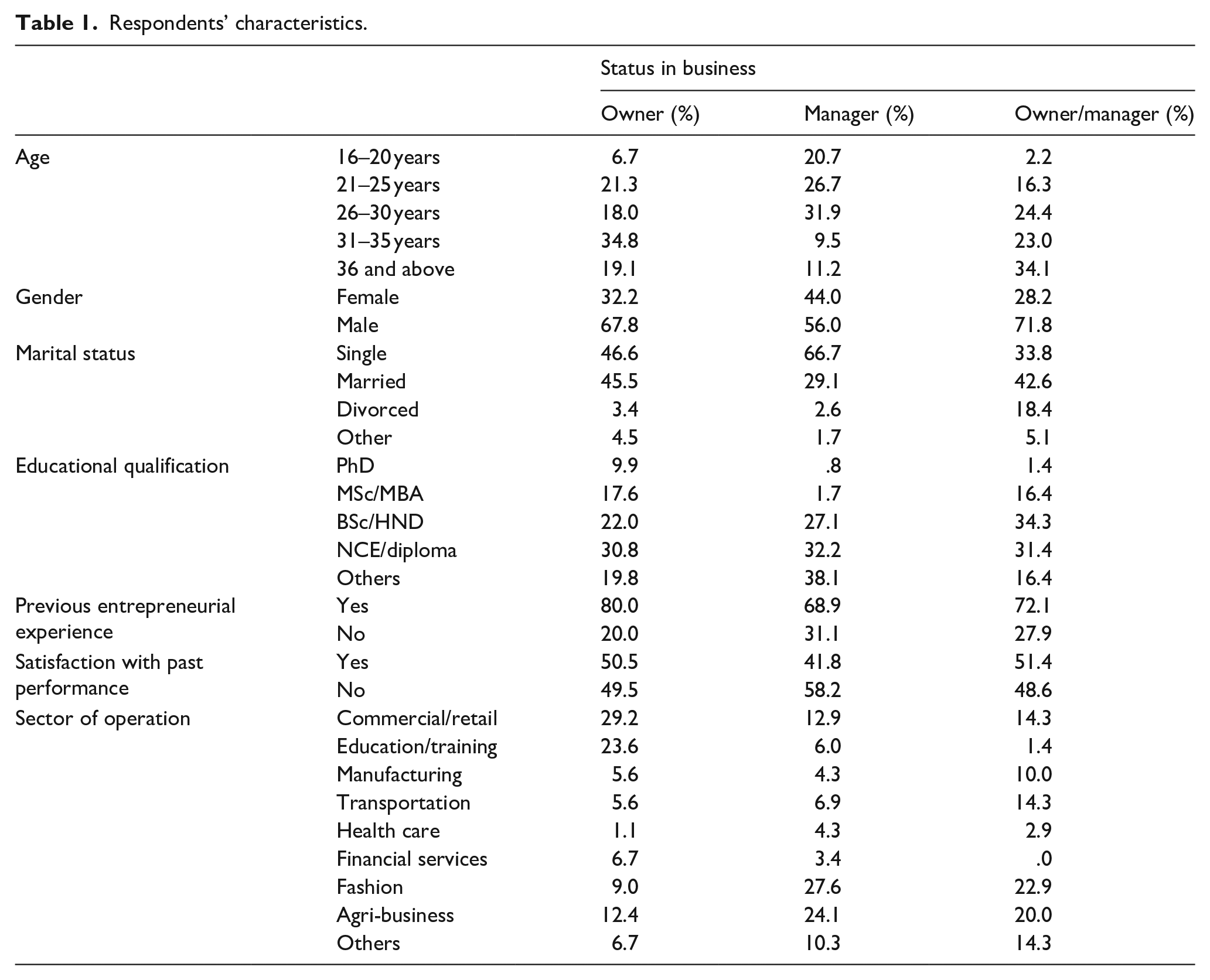
The respondent characteristics as indicated in Table 1 show that managers of sampled businesses are younger compared to owners or owners/managers. In terms of the gender distribution, males were higher than females with most not married as indicated in all the categories. Considering their educational qualification, majority of sampled respondents in all categories held an undergraduate, diploma or some form of professional certification rather than a postgraduate degree. In addition, most respondents whether they are owners, managers or owner/managers indicated that they had previous entrepreneurial experience. While the managers sampled were not satisfied with the past performance of their businesses, the owners or owner/managers held a contrary perspective which indicated that they were satisfied with the past performance of their businesses. Finally, while the owners sampled were more into commercial/retail and education/training sub-sector, the managers and owner/managers were more into fashion and agro-based businesses.
Respondents’ characteristics.
A one-way between-groups analysis of variance (ANOVA) was conducted to explore whether there is an expected mean difference in the levels of harmonious and obsessive passion in business owners, owners/managers, and managers. Levene’s test for homogeneity of variances of mean scores was not significant for both harmonious passion, F(2, 350) = 0.611, p = .544, and obsessive passion, F(2, 350) = 0.528, p = .590. The ANOVA results show that there was no statistically significant difference in mean scores in harmonious passion, F(2, 350) = 0.091, p = .913, and obsessive passion, F(2, 350) = 0.552, p = .576, of business owners, owners/managers, and managers. This implies that business owners, owners/managers, and managers do not differ in terms of their harmonious and obsessive passion in the Nigerian context.
Non-response bias was accessed by implementing a subgroup comparison (MacDonald et al., 2009) of age and gender for early and late respondents. No statistically significant difference was found suggesting that non-response bias was not an issue in this study. Procedural techniques were used to reduce the likelihood of common method variance (CMV), which was achieved through protecting the anonymity and confidentiality of the respondents, and improving scale items by removing ambiguity and implementing temporal separation in the measurement of the predictor and response variables (Podsakoff et al., 2003). To test for CMV using statistical procedure, an exploratory factor analysis with only one factor extracted did not account for more than half of the average variance extracted (AVE) indicating that CMV does not account for a large proportion of variance in the data and, therefore, not an issue in this study.
Measures
All constructs were measured on a 5-point Likert-type scale of strongly agree to strongly disagree unless otherwise indicated.
Passion
Passion was measured using Vallerand et al.’s (2003) 14-item scale. Seven items, each captured harmonious and obsessive passion. A principal component analysis (PCA) revealed a two-factor structure with four items loading on the harmonious passion scale while seven items were maintained on the obsessive passion scale. Sample items for harmonious passion: “engaging in business activities allow me to live a variety of experiences” and “engaging in business activities allow me live memorable experiences” while the obsessive passion scale had items, such as “I have a tough time controlling my urge to manage my business,” “I have almost an obsessive feeling for my business,” “I cannot live without engaging in the management of my business,” and “I am completely taken in with the management of my business.” The reliability scale was found to be .741 and .891 for harmonious and obsessive passion, respectively.
Persistence
Persistence was measured using the validated scale developed by Constantin et al. (2011). Their 13-item scale measured specific aspects of persistence of an individual within the context of time, which they conceptualized as long-term purposes pursuing (LTPP), current purposes pursuing (CPP), and recurrence of unattained purposes (RUP). Recognizing the specific context in which the study was conducted and focusing only on the current and long-term goal striving, persistence was measured using eight items of LTPP and CPP. However, a PCA revealed a seven-item persistence scale with the item “I remain motivated even in activities that spread on several months” dropped from further analysis. Sample items included “I purposefully pursue the achievement of the projects I believe in,” “I have a good capacity to focus on daily tasks,” and “the more difficult a task is, the more determined I am to finish it.” The reliability scale for persistence is .830.
Environmental uncertainty
Bstieler and Gross’s (2003) measures were adapted to measure environmental uncertainty focusing on aspects, such as market development, market competition, and technological/service or process development. A PCA resulted in the dropping of two items resulting to a five-item scale for environmental uncertainty. Cronbach’s alpha for environmental uncertainty in our data was .782.
Firm growth
Adopting multiple measures of the growth dimension of firm performance, a seven-item scale was used to measure business growth (Brush & Vanderwerf, 1992; Chandler & Hanks, 1993; Gilbert et al., 2006; Murphy et al., 1996; Weinzimmer et al., 1998). The argument that objective measures of performance are superior to subjective measures has been invalidated (Chandler & Hanks, 1993; Dess & Robinson, 1984; Venkatraman & Ramanujam, 1987) suggesting that the use of perceptual data, which has been found to correlate strongly with objective data “can be employed as acceptable operationalization of business economic performance” (Venkatraman & Ramanujam, 1987). Business growth was, therefore, assessed using perceptual data in terms of the following indices: cash flow, market share, sales, employment, customer base, assets, and net profit. A PCA led to the removal of cash flow and employment. Reliability coefficient was found to be .758.
Control variables
A number of control variables were used in this study. Sex and age were both measured as a dichotomous variable with age divided into five categories. Educational qualification was also categorized into five categories, while previous entrepreneurial experience and satisfaction with past business performance was measured as a dichotomous variable, with 1 indicating “yes” and 0 indicating “no.” In addition, sector of operations was also controlled for, categorized as commercial/retail, health care, agri-business, transport, education/training, manufacturing, and others. Finally, size of business was measured using number of employees in the business while years in business were measured using number of years business is in operations.
Analysis and results
Preliminary analysis
Structural equation modeling (SEM) in Analysis of Moment Structures (AMOS) was used to test the hypothesized structural relationships. Multiple model fit statistics besides the chi-square (χ2) goodness-of-fit statistic used to assess the structural model was root mean square error of approximation (RMSEA), goodness-of-fit index (GFI), adjusted GFI (AGFI), comparative fit index (CFI), normed fit index (NFI) with values close to .95 suggesting good fit, whereas RMSEA values close to .50 are indicative of reasonable fit (Hu & Bentler, 1999; Schumacker & Lomax, 2010). Before evaluating the structural model, convergent and discriminant validity was tested by calculating the AVE and construct reliability. The minimum threshold for AVE > .50 and construct reliability of .70 (Bagozzi & Yi, 1988; Hair et al., 2010) was satisfied for all the constructs used in the study (see Table 2). Therefore, because the calculated AVE was greater than .50, the constructs show convergent validity. For discriminant validity, the correlations among the constructs were checked to ensure that they were less than the threshold value of .70 (Hair et al., 2010) as Table 2 shows. Furthermore, discriminant validity was further confirmed by comparing whether the square root of every AVE value is larger than any correlation among any pair of constructs. Table 2 shows that this condition is also satisfied indicating that the constructs show both convergent and discriminant validity (Hair et al., 2010). Finally, the authors checked for multicollinearity, which revealed that both the tolerance (.632–.703) and variance inflation factor (VIF; 1.423–1.582) were both within the acceptable threshold (Hair et al., 2010) implying that multicollinearity is also not of concern in this study. Table 2 shows the results of the descriptive statistics, correlation, AVE, CR, squared AVE.
Descriptive statistics, AVE, CR, and square root of AVE.
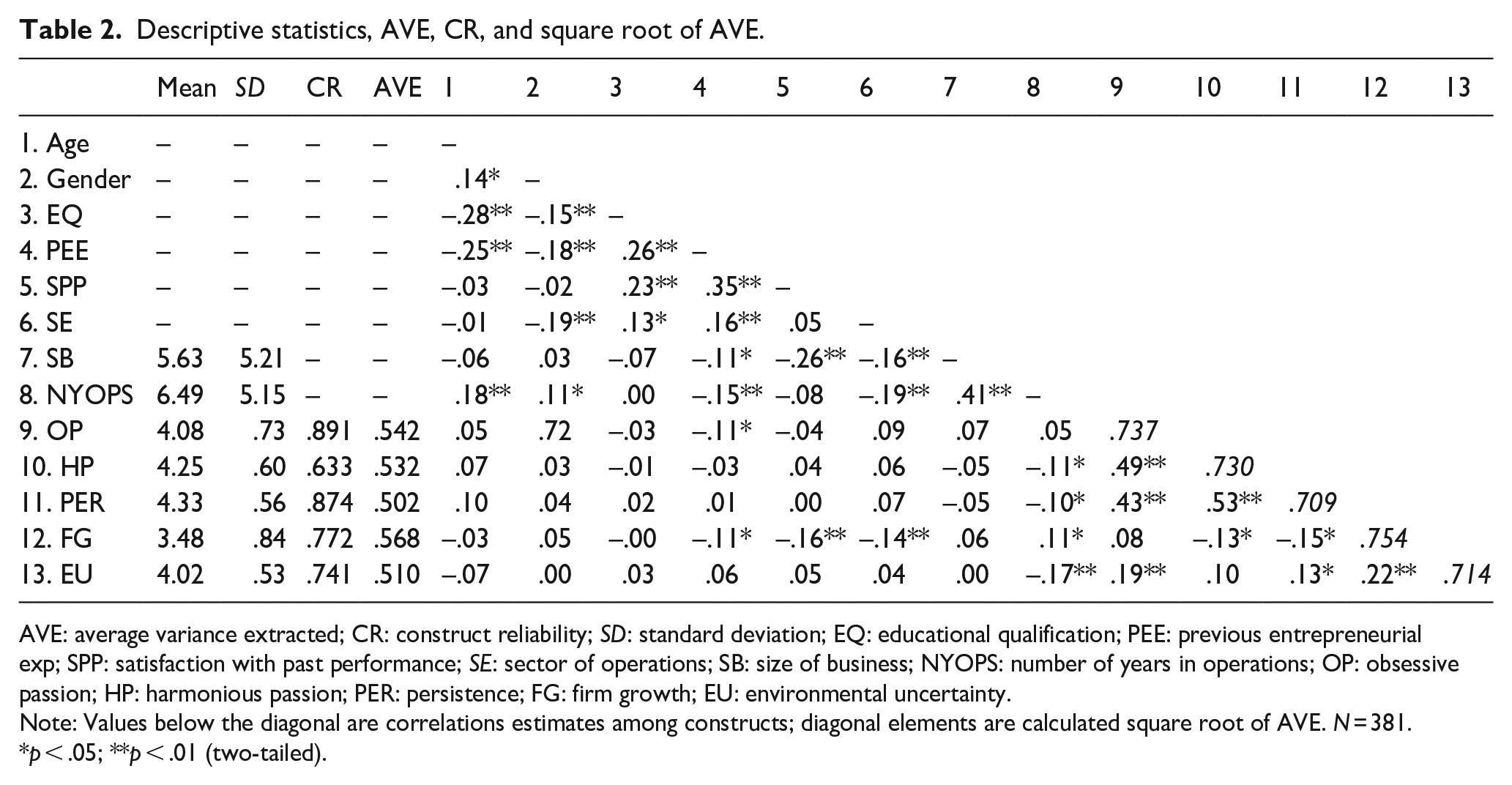
AVE: average variance extracted; CR: construct reliability; SD: standard deviation; EQ: educational qualification; PEE: previous entrepreneurial exp; SPP: satisfaction with past performance; SE: sector of operations; SB: size of business; NYOPS: number of years in operations; OP: obsessive passion; HP: harmonious passion; PER: persistence; FG: firm growth; EU: environmental uncertainty.
Note: Values below the diagonal are correlations estimates among constructs; diagonal elements are calculated square root of AVE. N = 381.
p < .05; **p < .01 (two-tailed).
Structural model
A structural model to assess the proposed hypothesized relationship provided adequate fit: GFIs, χ2 (3) = 2.353, p = .502; RMSEA = .04; GFI = .998; AGFI = .988; NFI = .992; CFI = 1.00. Figure 2 depicts the results of the hypothesized model. When the hypothesized model was run with all the proposed control variables, all but satisfaction with past business performance (β = –0.24, p < .01) was significant, hence was included in the final structural model.
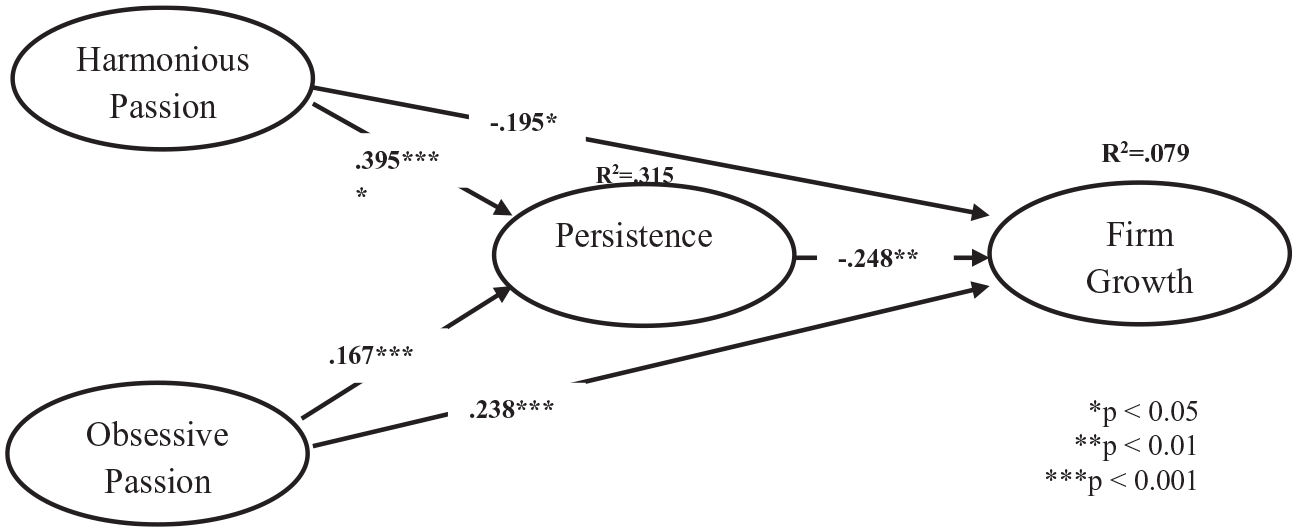
Hypothesized model and results.
The structural model indicated that harmonious passion has a significant effect on business growth (γ = –.20, p < .05) confirming H1a. H1b was also confirmed as obsessive passion was significantly related to business growth (γ = .26, p < .01). In testing the mediation analysis, bootstrapping procedure recommended by Preacher and Hayes (2004) was implemented. Persistence partially mediated the relationship between harmonious passion and business growth (B = –.098, 95% CI = [–0.166, –0.038], bootstrapping resamples = 5,000). This provides support for H2a. H2b was also confirmed which also showed that persistence partially mediated the relationship between obsessive passion and business growth (B = –.041, 95% CI = [–0.076, –0.016], bootstrapping resamples = 5,000). In total, the variance in the endogenous variables that was explained by harmonious and obsessive passion totaled 31.5% for persistence (p < .001) and 7.9% for business growth (p < .01).
Moderated mediation result
The conditional process analysis was tested using PROCESS MACRO (Hayes, 2018) in SPSS v.23. Therefore, to examine the conditional effect of harmonious and obsessive passion on growth of small-scale businesses through persistence, Model 14 of the process macro was implemented. Harmonious and obsessive passion, persistence, and business growth were treated as independent, mediator, and dependent variables, respectively, while environmental uncertainty was treated as the moderator of the persistence–business growth relationship. The overall significance of the moderated mediated model was assessed by what Hayes (2018) refers to as the index of moderated mediation using a statistically significant criterion of 95% confidence level generated by the bias-corrected bootstrap method set of 5,000 iterations. Tables 3 and 4 summarize the results of the moderated mediation analysis.
Moderated mediation model of HP, PER, and EU predicting FG.
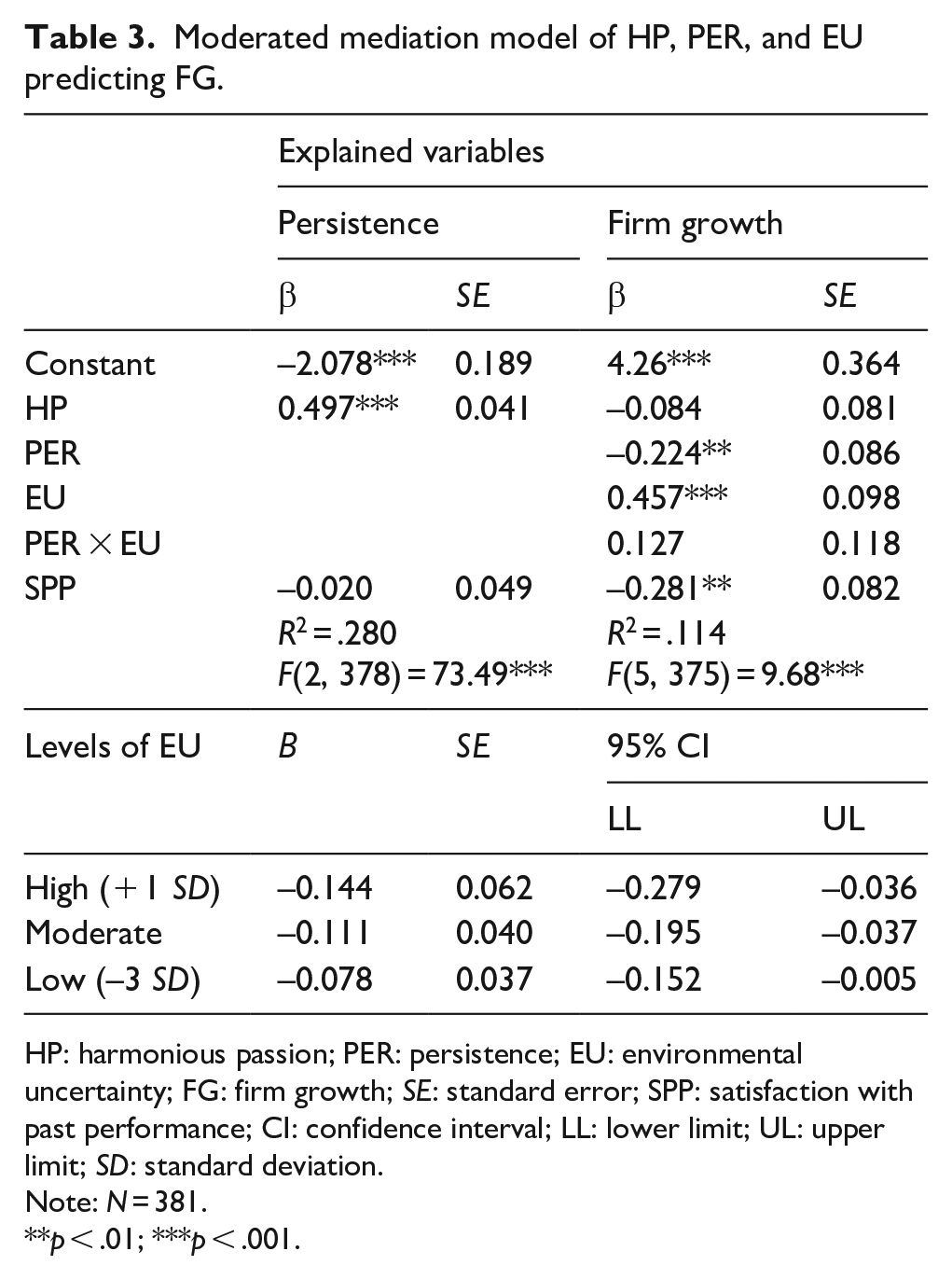
HP: harmonious passion; PER: persistence; EU: environmental uncertainty; FG: firm growth; SE: standard error; SPP: satisfaction with past performance; CI: confidence interval; LL: lower limit; UL: upper limit; SD: standard deviation.
Note: N = 381.
p < .01; ***p < .001.
Moderated mediation model of OP, PER, and EU predicting FG.
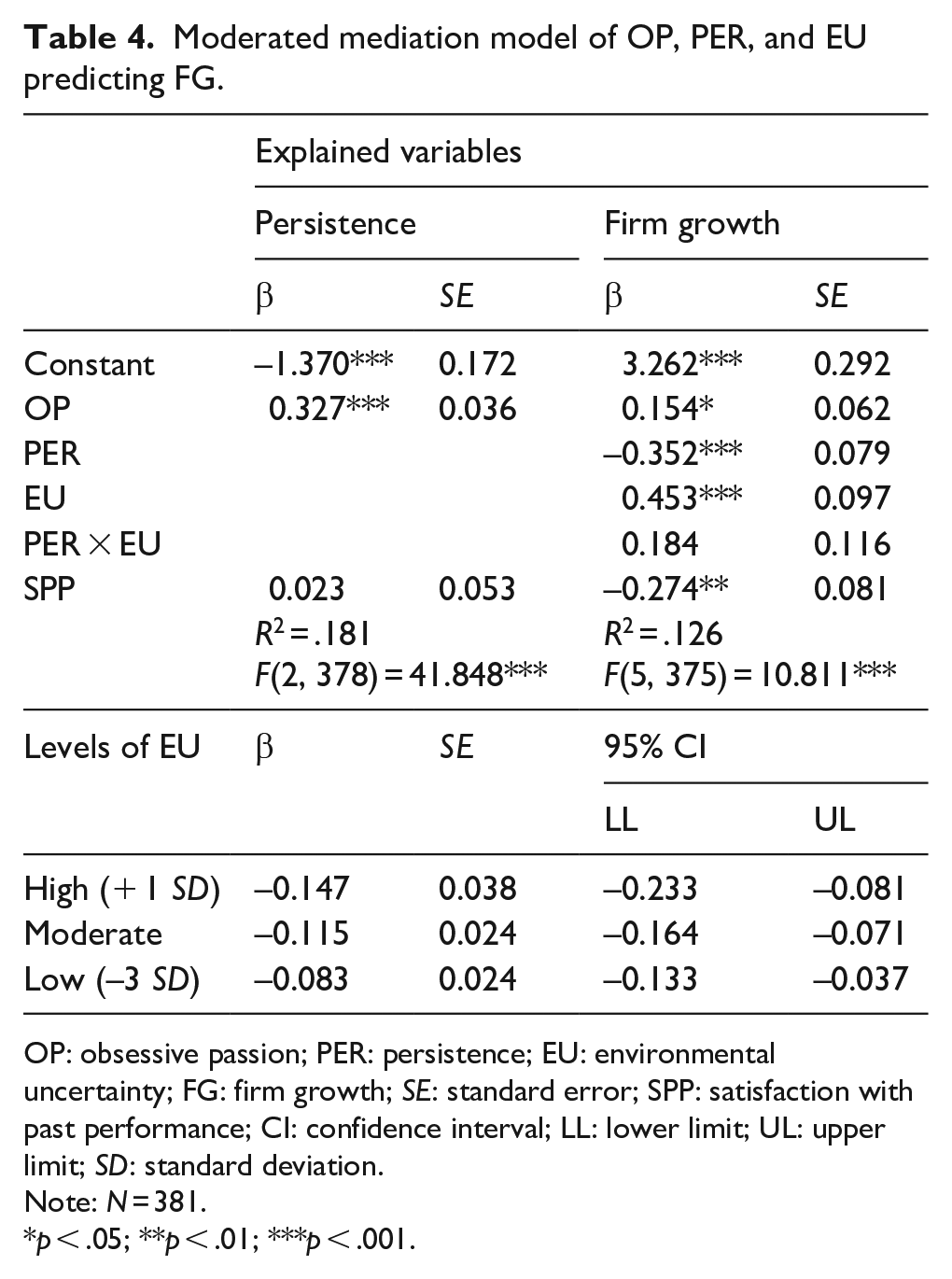
OP: obsessive passion; PER: persistence; EU: environmental uncertainty; FG: firm growth; SE: standard error; SPP: satisfaction with past performance; CI: confidence interval; LL: lower limit; UL: upper limit; SD: standard deviation.
Note: N = 381.
p < .01; ***p < .001.
The result in Table 3 somewhat supports the link between harmonious passion and firm growth as reported in the SEM result. Whereas harmonious passion significantly relates to persistence (β = 0.50, p < .001), it fails to be significantly related to business growth (β = –0.08, ns). Also, of note is the non-significant effect of the interaction effect of persistence and environmental uncertainty on firm growth (β = 0.13, ns). Furthermore, the result shows that the index of moderated mediation is not significant (β = 0.06, 95% CI = [–0.044, 0.196]). This indicates that the indirect effect of harmonious passion on business growth is not moderated despite the result showing that at different levels of environmental uncertainty, the proposed indirect effect is supported. At lower levels of environmental uncertainty, the conditional effect of harmonious passion on business growth via persistence was significant but negative (β = –0.14, 95% CI = [–0.279, –0.036]), likewise at moderate levels (β = –0.11, 95% CI = [–0.195, –0.037]) and at higher levels (β = –0.08, 95% CI = [–0.152, –0.005]). Because the direct effect of harmonious passion on business growth was not significant (β = 0.08, 95% CI = [–0.243, 0.075]), this conditional effect is a full moderated mediation model. In sum, the results fail to support H3a indicating that environmental uncertainty is not a likely moderator of the pathway from harmonious passion to business growth through persistence.
The result of the conditional effect of obsessive passion is captured in Table 4, which mirrors the findings reported in the SEM result. Obsessive passion is significantly related to both persistence (β = 0.33, p < .001) and firm growth (β = 0.15, p < .05). In addition, the interaction effect of persistence and environmental uncertainty on business growth in this model was also not significant (β = 0.18, ns). In terms of evaluating the conditional effect, an evaluation of the index of moderated mediation was found to be insignificant (β = 0.06, 95% CI = [–0.009, 0.151]). This indicates that the conditional effect of obsessive passion–persistence–firm growth model is unsupported despite the result showing that at different levels of environmental uncertainty, the proposed indirect effect is supported. At lower levels of environmental uncertainty, the conditional effect of obsessive passion on firm growth via persistence was significant but negative (β = –0.15, 95% CI = [–0.233, –0.081]), likewise at moderate levels (β = –0.12, 95% CI = [–0.164, –0.071]) and at higher levels (β = –0.08, 95% CI = [–0.133, –0.037]). However, because the direct effect of obsessive passion on firm growth was significant (β = 0.15, 95% CI = [0.031, 0.276]), the conditional effect is a partial model.
Discussion
A model of firm growth based on the dual model of passion (Vallerand et al., 2003) was explored in this study. Passion, persistence, and environmental uncertainty were used as antecedents in the model. The study assumed that passionate entrepreneurs would persist even through environmental uncertainties to grow their businesses. This proposition was tested using a sample of small-scale businesses in a state in North Central Nigeria with the evidence as follows. The evidence supports the generally held belief that passion has an influence on business performance. Specifically both harmonious and obsessive passion was found to be significantly related to growth of small-scale businesses. A surprising finding was that while harmoniously passionate entrepreneurs were initially believed to contribute positively to the growth of their businesses, the evidence failed to support such assertion implying rather that harmoniously passionate entrepreneurs rather contribute less to the growth of their business. On the other hand, the initial assumption was that obsessively passionate entrepreneurs’ influence on the growth of their businesses would lead to less growth but surprisingly, the results showed otherwise, implying that obsessively passionate rather than harmoniously passionate entrepreneurs grow their businesses. This echoes the study by Thorgren and Wincent (2015), which found that habitual and serial entrepreneurs show obsessive passion rather than harmonious passion. These finding mirrors earlier reported evidence which support the fact that obsessively passionate individuals achieve higher levels of performance compared to harmoniously passionate individuals (Vallerand et al., 2003).
Persistence was introduced as a mediator of the relationship between passion and firm growth. By including persistence, the authors expected that the positive influence of harmonious passion on firm growth through persistence would be sustained while obsessive passion’s negative effect on firm growth through persistence would be curtailed. Evidence supports the later proposition rather than the former. As expected, persistence partly mediated the relationship between both harmonious and obsessive passion and firm growth. However, the evidence failed to support the proposed direction of effect. While the study had hoped that the positive effect of harmoniously passionate entrepreneurs would be sustained through persistence, the actual result indicated that persistence contributes little to improving firm growth. In terms of obsessively passionate entrepreneurs, the presence of persistence in the model failed to improve business performance in terms of growth of the firm. Reasons adduced to account for these results could be based on the arguments provided by the dual model of passion. The autonomous nature of harmonious passion is insufficient in providing a fertile ground for persistence to be effective in impacting firm performance positively. This could, therefore, explain why harmonious passion–persistent link does not improve firm growth. On the other hand, the dual model of passion argues that the controlled nature of obsessive passion would likely create an unhealthy level of passion and persistence that would ultimately impact firm performance. This is because persistent individuals or entrepreneurs may still pursue an objective or a task despite overwhelming evidence to the contrary leading to maladaptive outcomes endemic to the optimal performance of the individuals, ultimately impacting on entrepreneurial activities and firm performance. Therefore, for both types of passion, the presence of persistent business owners or managers does not contribute to improving firm growth.
An interesting finding was revealed when environmental uncertainty was included in the model. Passion’s effect on firm growth was still significant even with persistence but the introduction of the environmental factor better illuminated these relationships. Specifically, the conditional effect of passion on firm growth through persistence and environmental uncertainty was not significant for both types of passion. The finding that environmental uncertainty does not moderate the relationship between persistence and firm growth for the different types of passion is informative. It is, therefore, not surprising to find that the indirect effect of harmonious and obsessive passion on firm growth is not moderated by environmental uncertainty. This implies that environmental factors bear minimal influence on the relationship between passion, persistence, and firm growth. This could be possible perhaps because of the way the environmental factors are viewed and also because of the level at which the entrepreneurs sampled viewed themselves on the persistence scale (M = 4.33; SD = 0.56) which explains why persistence in this study rather than contributing to firm growth, contributes less. It could, therefore, be argued that entrepreneurs in the study context show high persistence and a passion toward venturing activities to the extent that environmental factors bear no effect on how passionate or persistent they are to firm growth. Another surprising finding revealed that despite entrepreneurs having high levels of persistence in venturing activities, firm growth still suffers. This finding supports the generally held belief that African entrepreneurs, especially in Sub-Saharan Africa, show a high level of persistence and resilience as the 2012 report by the GEM indicates. Their report presented Nigeria as an entrepreneurial nation leading the world in enthusiasm for business. This enthusiasm probably translates to the high level of persistence and passion they have toward their business activities. It could, therefore, be rightly argued that the enthusiasm shown by entrepreneurs in the study context overshadow whatever environmental factors that are capable or seen as capable of negatively affecting firm growth. This may account for the explanation why the overall moderated mediation model is not significant for both harmonious and obsessive passion.
Implications and contributions
This study offers a number of theoretical and practical contributions and implications. First, the study has established the contributory role of an individual’s affective and behavioral dispositions toward the performance of their ventures. However, this contribution is marginal implying that factors other than passion account for a larger variation in firm growth. In addition, the study has recognized the applicability and relevance of the dual model of passion in the context of entrepreneurship by establishing its predictive power in explaining firm growth. In essence, the study has contributed to the theoretical debate on affect in entrepreneurship. By implication, policy attempts to help entrepreneurs develop and build their passion toward venturing activities would be beneficial. One of such policy attempts recommended to build passion in entrepreneurs could be entrepreneurship education, a framework that helps entrepreneurs build their self-efficacy and the capacity to be successful at venturing activities. Such a suggestion is supported by empirical evidence indicating that passion could be taught and built through frameworks, such as entrepreneurship education (Dakung et al., 2019; Olakundun, 2017; Puni et al., 2018). Other policy suggestions to boost passion could be role models. Also, focus could be made on entrepreneur’s success stories, which builds inspiration in prospective entrepreneurs ultimately helping them to develop passion toward venturing activities. Practitioners should also focus more on encouraging entrepreneurs to be obsessive if they are to be successful in business. Showing harmonious passion to venturing activities contributes less toward firm growth, therefore, the emphasis should be on encouraging entrepreneurs to be obsessively passionate toward entrepreneurial activities if they are to be successful.
Second, the study has shown that passion rather than persistence contributes more to firm growth indicating that persistence has a dark side in explaining the variation in firm growth. Unhealthy persistent makes the firm to suffer. Also, persistence alone is insufficient in improving business performance. Policy implications should, therefore, consider this nuanced perspective by encouraging and educating entrepreneurs to show less persistence especially if it is “blind persistence,” that is persistence that is oblivious to the reality on ground. The evidence that persistence contributes less to business growth could explain the paradox evident in the report by GEM (2012) and Herrington and Kelley (2012) that Nigerian entrepreneurs lead the world in terms of enthusiasm for business, but at the same time ranks lower in terms of productivity, entrepreneurial intentions, new business ownership rate, and total entrepreneurial activity than its peers in Sub-Saharan Africa. The challenges in the Nigerian business environment makes the entrepreneurs to show high level of persistence, but the evidence in this study indicates that, being persistent is not enough to ensure business success, rather being passionate is, hence, policy attempts should take into cognizance this finding and incorporate it in policy recommendations appropriately. Policies should, therefore, acknowledge the contributory role of passion in business performance. This is particularly true given that environmental uncertainty has been shown to be noise in the passion–persistent–firm growth link; hence the need for policies directed at building and sustaining passion in entrepreneurs if firm growth is the target. Finally, the study provided a multi-level perspective which helps us better appreciate the complex nature of the relationship between passion, persistence, and business performance. The study has provided a foundation upon which future studies would be built to better explore the passion–persistence–business performance relationship.
Limitations and future research
In most cross-sectional research designs, one of the identified limitations is the inability to establish causation. Because this study is cross-sectional, causation is an issue and, therefore, a limitation. Future research could, therefore, explore the possibility of implementing a longitudinal research design to establish causality of the passion–persistence–firm growth link. Second, the sample rather than consisting of only entrepreneurs also included managers. Despite the benefits that such a sample brings to exploring the passion–persistence–performance phenomenon, a clear-cut theoretical contribution may benefit from research that focuses on either entrepreneurs or non-entrepreneurs. This line of research exploring the dividing line between entrepreneurs and non-entrepreneurs in the Nigerian context needs further analysis. Could agency theory or upper echelon’s theory provide a strong theoretical foundation in future research exploring this line of research? Third, common method bias also posed a threat to the validity of the research findings. However, both procedural and statistical remedies suggested by Podsakoff et al. (2003) were implemented to reduce the likely effect that common method bias would have had on the research conclusions.
Fourth, future studies could explore a model of firm growth using other conceptualizations of passion (Cardon et al., 2009). For example, the Cardon et al. conceptualization of passion is developed taking into cognizance activities distinct to the entrepreneurial process. Also, such models could explore firm growth using specific dimensions of growth rather than a composite measure of firm growth as tested in this study. Such a model would better capture the passion–performance relationship. In addition, such models could be tested in other populations to establish their predictive ability. Also, other moderators could be used in future studies. Future research could explore what other external factors may influence the passion–persistence–performance relationship. Finally, the respondents rate high on the persistence scale such that it accounts for a negative relationship on firm growth implying that too much of persistence is bad for business. Future studies could explore at what level persistence is adequate in achieving a maximal level of firm growth or business performance. Also future studies could explore why persistence is negatively related to firm growth and whether the relationship between persistence and firm growth is curvilinear in nature. It is hoped that this model of firm growth would guide future research studies on the link between passion, persistence, environmental uncertainty, and business growth.
Footnotes
Declaration of conflicting interests
The author(s) declared no potential conflict of interest with respect to the research, authorship, and/or publication of this article.
Funding
The author(s) received no financial support for the research, authorship, and/or publication of this article.
