



Abstract
How family firms adopt a certain corporate social responsibility (CSR) approach remains a relatively unexplored matter in family firm and firm ethics research. Hence, we study how and why the CSR approach (broad vs. narrow; benefits vs. costs) differs within family firms, addressing the influence of the socio-emotional wealth (SEW) dimensions, individually or combined. We used empirical evidence gathered through 13 case studies of firms from the Andalusia region and we used the interpretative approach of the grounded theory based on case study data. Results of our analyses lead to propose that family firms with a higher identification and more positive than negative valence with regard to emotional attachment and family enrichment dimensions will be more likely to exhibit a broad approach of CSR. Likewise, those family firms adopting CSR actions with stakeholders due to instrumental use of image and reputation dimension will more probably display a benefits approach.
Introduction
Based on the model of Quazi and O’Brien (2000) and drawing on the theoretical view of socio-emotional wealth (SEW, as discussed, for example, in Gómez-Mejía et al., 2007), this study examines the heterogeneity of family firms (FFs) in terms of their corporate social responsibility (CSR) approaches. Specifically, we address the following research question: Which of the SEW dimensions, either individually or combined, seem to have the most favorable or unfavorable impact on the choice of a CSR approach? Therefore, this work provides an in-depth analysis of what approaches FFs maintain as regards CSR, depending on what their key reference points (SEW dimensions) are. Hence, this study contributes to understanding how and why the heterogeneity in FFs in terms of SEW may help us to explain the non-homogeneity in FFs regarding CSR approaches.
Family business literature has recognized the relevance of SEW, originally conceptualized as “the non-financial aspects of the firm that meet the family’s affective needs such as identity, the ability to exercise family influence, and the perpetuation of the family dynasty” (Gómez-Mejía et al., 2007, p. 106). SEW is the key factor differentiating FFs and establishes that when FFs make strategic decisions, like adopting a specific CSR approach, they consider the consequences of these decisions in their affective endowment (Berrone et al., 2012). Accordingly, the research surrounding CSR within FFs based on SEW has increased in the past years (Berrone et al., 2010; Cruz et al., 2014; Dyer & Whetten, 2006). Yet there is no consensus regarding whether FFs are more or less socially responsible than non-FFs (Cruz et al., 2014). While some authors have shown that FFs were more likely to be engaged in corporate social activities because these maintain and improve their accumulated endowment (Cennamo et al., 2012; Dyer & Whetten, 2006; Gallo et al., 2004), others found just the opposite (Morck & Yeung, 2004). This can be due to, for instance, “amoral familism” or a distrust of outsiders (e.g., the family board’s distrust of non-family CEOs) (Banfield, 1958; Dyer & Whetten, 2006) or the “dark side” of SEW (like nepotism or self-serving behaviors, among others) (Kellermanns et al., 2012). This previous evidence indicates both that FF may not be a uniform firm type in terms of CSR engagement (Dick et al., 2020) and that the dual-valenced nature of SEW (Kellermanns et al., 2012) makes FFs heterogeneous when it comes to CSR (Mitchell et al., 2011). There are two reasons why there may be more differences with regard to CSR within FFs than between FFs and non-FFs: (1) the higher discretion to act that this sort of firm may demonstrate and (2) them considering SEW as their main frame of reference (Chrisman & Patel, 2012).
Consequently, previous literature directs scholars to focus on examining “why” FFs are different from each other (Van Gils et al., 2014) regarding their CSR behavior (Cruz et al., 2014). Thus, very recent research has started to revolve around heterogeneity in FFs regarding CSR engagement based on SEW (Dick et al., 2020; Marques et al., 2014). However, these studies have been focused mainly on highlighting the effect of only certain SEW dimensions on CSR engagement, namely family influence and control and identification, thus in essence ruling out the effect of other SEW dimensions on CSR behavior. Therefore, it is not known which dimension is more influential, nor is it known which dimensions of SEW act similarly and which affect CSR differently. Furthermore, to shed light on the heterogeneity in FFs with respect to CSR, and given the dual nature of SEW in general terms, a more appropriate question to ask is what CSR approach they are likely adopt based on which dimensions of SEW, individually or combined, are their key reference points. Therefore, and despite the SEW perspective being a prevalent theoretical framework that enables academics to better explain why FFs perform distinctly in terms of social issues (Berrone et al., 2010; Neubaum et al., 2012), prior literature has not addressed, to the best of our knowledge, whether a wide range of properly assessed SEW dimensions, individually or combined, determine the CSR approach of FFs, considering a wide spectrum of CSR actions. Given that FFs are not homogeneous in terms of CSR (Lamb et al., 2017), we need to have a more comprehensive understanding of the net influence of different SEW reference points of family actors (Dick et al., 2020) on the CSR approach chosen.
To capture the individuals’ actual subjective thoughts, feelings, motivations, behavior, experiences, and interpretations through their own words (Graebner et al., 2012; Jiang et al., 2018) regarding CSR engagement in their FF, we pursued a qualitative study approach, specifically, a multiple study method. We followed an intentional sampling approach. We identified the FFs taking part in this inductive study through preliminary interviews with some experts from the Confederation of Employers and Industry of Andalusia (CFA). From January to October of the year 2018, we carried out 30 interviews in 15 FFs located in southern Spain, with two participants per FF. The analysis of the data indicates that identification, emotional attachments, and family enrichment are the key SEW dimensions that help to explain how and why FFs opt for a narrow versus broad CSR approach. Likewise, image and reputation, as the true driver of binding social ties, is the paramount SEW dimension for understanding FF heterogeneity in terms of CSR costs versus benefits.
This study contributes to the current research, both in terms of theory building and empirical testing, with regard to the integration of prevalent family differences (Powell & Eddleston, 2017; Ruesch & Bateson, 2017) in their CSR approach. In this study, we highlight that different dimensions of SEW may determine distinct CSR approaches, further elucidating the reasons behind FF heterogeneity and refining our knowledge of FFs (Jaskiewicz & Dyer, 2017). Our study is among the first to study the heterogeneity of FFs with respect to CSR engagement using the SEW approach as a reference. Also, this exploratory analysis of the influence of SEW on the CSR approach, not just from a general point of view but rather analyzing each particular dimension of SEW, is totally new in the research. With regard to CSR, it is also quite original as it draws on Quazi and O’Brien’s model, adopting a comprehensive perspective that integrates both classical and modern paradigms and allows us to better understand the heterogeneity of FFs in CSR. Thus, this research not only identifies SEW dimensions that were previously included in different SEW frameworks (identification, emotional attachments, family enrichment) to shed light on the broad versus the narrow approach, it also identifies the underlying SEW dimension explaining social ties, namely image and reputation, to understand the choice between the benefits versus costs approach. This study also posits that FFs choose a certain CSR approach considering both the relevance of the bright and the dark sides of particular SEW dimensions, namely identification, emotional attachments, and family enrichment, and the instrumental use or non-instrumental use of image and reputation when engaging in CSR. Thus, this article also defies prior research establishing that SEW is always a pro-social and favorable incentive. Finally, this study is also an excellent antidote against the risk of the reification of SEW (Jiang et al., 2018) since it measures SEW using a qualitative/interpretative approach, adopting a comprehensive view that makes it unlikely to dismiss the influence of any SEW dimension on the CSR approach.
Theoretical background
A framework to study CSR approach in family firms
The maximization of profits as the sole objective of the firm is something that, for some decades now, has been seriously questioned in the business context. Although it is relatively difficult to locate its origin, CSR has gradually acquired a significant role in business management since Bowen (1953) linked the interests of firms and society in the long term. CSR has been defined in a variety of ways over the years. The most popular definition of CSR is proposed by Carroll (1979): “the social responsibility of business encompasses the economic, legal, ethical, and discretionary expectations that society has of organizations at a given point in time” (p. 500). And more recently, McWilliams and Siegel (2001) defined it as “actions that appear to further some social good, beyond the interests of the firm and that which are required by law” (p. 117). The link between CSR and sustainability is strong. Marrewijk (2003) suggested that “in general, corporate sustainability and CSR refer to firm voluntary activities, by definition demonstrating the inclusion of social and environmental concerns in business operations and in interactions with stakeholders” (p. 102). However, there is no single universally accepted definition of CSR. Rather, there are dozens of them proposed by academics and organizations. In most of them, voluntariness and stakeholder orientation appear as differentiating features of CSR (Dahlsrud, 2008).
The greater or lesser degree of responsible behavior of the firm is linked to its vision of CSR. However, reality shows that firm decisions do not only depend on criteria of responsibility toward third parties but are also conditioned by the costs and benefits that may derive from them. With the intention of combining these two dimensions, Quazi and O’Brien (2000) define a two-dimensional model in which they consider not only the broad or narrow vision that the firm has of CSR, but also the influence that costs and benefits have on decision-making, since any decision will change the net profits. The two extremes of the horizontal axis are “narrow responsibility” (right) and “wide responsibility” (left). “Narrow responsibility” represents the conventional business outlook, according to which a firm’s short-term objective is strictly profit maximization. “Wide responsibility” represents the broader social outlook, in which companies, beyond mere compliance with regulations, choose to engage in community development, environmental protection, and conservation of natural resources, among other things. The two extremes of the vertical axis are “benefits from CSR action” and “costs from CSR action.” Firms placing emphasis on short-term results tend to be concerned about the cost of CSR actions and therefore gravitate toward the lower, negative end of the spectrum. Firms with a focus on long-term results, on the assumption that the benefits eventually exceed the costs, move toward the upper, positive end of the model (Melo et al., 2012; Quazi & O’Brien, 2000).
The two-dimensional CSR model by Quazi and O’Brien (2000) developed and validated the constructs and measurements to evaluate how firm leadership views CSR. In comparison with other models, Quazi and O’Brien facilitate the analytical power to comprehend the intricate phenomena of CSR and to recognize the inconsistencies between the opinion and the employment of the principles of the CSR approach (Ortega et al., 2016). This model brings together both classical and modern CSR paradigms, making it possible to take into account aspects of both when examining managerial approaches to CSR (Jamali & Sidani, 2008). Moreover, this CSR model with two axes has a wide scope, allowing for the determination of managers’ perceptions in different economic and cultural contexts (Gallardo et al., 2013). In fact, this model has been tested empirically across different countries and cultures (transnational model) (see Cabrera et al., 2005; Jamali & Sidani, 2008; Melo et al., 2012), in FF contexts (Déniz & Cabrera, 2005), and in more diversified settings (Jamali et al., 2009; Virijevic et al., 2020). Likewise, the implementation of the Quazi and O’Brien (2000) model has provided encouraging findings in FF literature, in which the model has been considered both directly (Cabrera et al., 2005; Déniz & Cabrera, 2005; Hernández et al., 2017; Ortega et al., 2016) and indirectly (Aragón et al., 2019; Aragón & Iturrioz, 2016).
SEW and CSR in family firms
Certainly, research has used Behavioral Theory to explain why FFs are different from non-FFs: emotional value of ownership, preservation of SEW, and altruism (De Massis et al., 2015). FFs strive for particular family-centered, non-financial goals, while non-FFs will do so very rarely or not at all (Miller & Le Breton-Miller, 2014). In other words, when making decisions, including those related to CSR, FFs employ a mix of both family-oriented and business-oriented goals (Mahto et al., 2010). In addition to financial wealth, FFs give a special relevance to SEW, defined as the “non-financial aspects of the firm that meet the family’s affective needs” (Gómez-Mejía et al., 2007, p. 106).
In the literature, arguments assessing the link between FFs and CSR are mixed (as in Berrone et al. (2010); El Ghoul et al. (2016)), indicating that FFs may not be a homogeneous group as regards how they approach CSR (Déniz & Cabrera, 2005). FFs usually seek to achieve family-centered goals (Chrisman et al., 2012), managing social issues differently (Bingham et al., 2011; Sharma & Sharma, 2011), although this does not necessarily mean that FFs have a higher CSR engagement than non-FFs. Some studies provide us with arguments that confirm a better behavior related to CSR than non-FFs. In FFs, there is a greater incentive than in other organizations to ensure the satisfaction of all stakeholders, both internal and external, assuming a set of challenges and prioritizing the most important ones (Mitchell et al., 2011; Zellweger & Nason, 2008). This may be due to the family’s concern for its reputation (Sageder et al., 2018; Zellweger et al., 2013), image, and to protect its assets (Dyer & Whetten, 2006). The prevalence of the family’s core values has led FFs to pay more attention to the needs of their employees and internal stakeholders than other kinds of firms (Huang et al., 2009). In this regard, the special type of socialization that takes place in an FF helps define an affective climate that explains the high levels of identification, involvement, and loyalty that employees usually have in these types of firms (Vallejo & Langa, 2010). Family ownership also positively influences the employees, as well as the environmental, legal, and ethical responsibilities of the firm (Zhou, 2014). FFs are less likely to engage in corporate misbehavior (Litz & Stewart, 2000) and often have higher degrees of community involvement (Ding & Wu, 2014). Moreover, as regards social issues, FFs are more interested in and disseminate a greater variety of CSR reports than non-FFs (Campopiano & De Massis, 2015). However, a different pattern also emerges from other evidence. The unique conditions of FFs can lead to some family members engaging in opportunistic behaviors or ethically dubious actions, which can impede the success of the firm and generate a negative impact on employees, customers, and other stakeholders (Kidwell et al., 2012). In the same vein, some factors such as altruism or nepotism, among others, tend to damage the longevity and efficiency of the FF (Carney, 2005).
FFs, in relation to CSR, are not only different from non-FFs, but also different from each other. Consequently, not all FFs behave in the same way in terms of CSR. The literature identifies different characteristics of this type of firm that determine their greater or lesser commitment to CSR. Not all FFs are equally involved with socially responsible behavior, due to variables such as gender, linkage, or community cohesion (Uhlaner et al., 2004). Families’ features, values, and culture (Déniz & Cabrera, 2005) and age, educational level, and living in the same community (Niehm et al., 2008) have also been identified as factors that explain the heterogeneity of FFs with regard to CSR behavior. Thus, FFs have been linked to positive and negative behaviors with respect to their employees, customers, and other stakeholders, which showcase the diversity of perspectives these firms have of CSR (Cabrera et al., 2005). In addition, since CSR is a multidimensional concept (Block & Wagner, 2014), FFs can behave responsibly in some dimensions of CSR and irresponsibly in others at the same time (Cruz et al., 2014; Godfrey et al., 2009).
SEW is seen as the most important differentiator of the FF as a unique entity and it can help us to understand why FFs are not a homogeneous group with identical characteristics, behavior, and interests (Berrone et al., 2012). Distinct dimensions of SEW may explain the different reference points and specific FF decisions regarding CSR, based on the priority given to different SEW dimensions (Dick et al., 2020). Hence, we aim to examine how distinct SEW dimensions may, individually or combined, impact the CSR commitment of FFs. Although there is no consensus on what SEW represents (Brigham & Payne, 2019), in this theoretical background, we will take the SEW dimensions included in the FIBER construct as a reference to analyze how and why they may impact CSR, being perhaps the most influential conceptualization of SEW dimensions (Swab et al., 2020). FIBER measures the affective endowments by accounting for family control and influence, identification of family members with the firm, binding social ties, emotional attachment of family members, and the renewal of family bonds through succession (Berrone et al., 2012). In this sense, and although Berrone et al. (2012) appear to assume that all dimensions of SEW are linked to positive aspects, SEW may have a dark side as well (Kellermanns et al., 2012). As a consequence, we argue that SEW is neither always beneficial nor always destructive in terms of CSR engagement, and therefore we identify both the bright and the dark side of SEW dimensions in FFs as they apply to CSR.
Retaining and even extending family control is often one of the crucial drivers for the behavior of FFs (Cruz et al., 2014). This SEW dimension illustrates the overall impact that family members can have on the firm, evalua-ting to what extent family members own the majority of the shares, control the firm’s strategic decisions, occupy executive positions, choose non-family managers and directors, compose the board of directors, and are committed to preserving family control and independence and, ultimately, of their SEW (Berrone et al., 2012). The long-term outlook involved in family control and succession should enhance CSR policies (as discussed in Berrone et al. (2010)) due to CSR engagement usually involving long-term vision and continuous commitment (Aragón & Sharma, 2003). These requisites are more likely to be met as family control increases, given that there is a higher willingness to perpetuate the FF and to make decisions that favor future heirs through a “generational investment strategy that creates patient capital” (Sirmon & Hitt, 2003, p. 343). Even so, exerting family control and ensuring family trans-generational sustainability may also lead to hiring family members and/or these individuals furthering their career in the FF without them having the appropriate expertise (Haynes et al., 2015), conflicting with providing equal career opportunities and wages for all staff (European Commission, 2001). Tighter family control can also make FFs less likely to voluntarily disclose their corporate governance practices (Ali et al., 2007) or even make them more likely to infringe on good practices in this regard (Martin et al., 2016).
The identification between the family and the firm is often another main reference point. This SEW dimension comprises the degree of the family members’ sense of belonging to the organization, to what extent they feel the family business’s success is their own success, whether the firm has a great deal of personal meaning for them, whether being a member of that family defines them deeply and makes them proud, and finally, whether clients usually associate the family name with the FF (Berrone et al., 2012). This is why the differences in the social behavior among FFs might also be based on the concern for preserving the family’s identification with the organization (Cruz et al., 2014; Gómez-Mejía et al., 2011). Family members, who identify more with the FF, will tend to be socially responsible because they deeply assume the organization and family’s goals and desire to remain in and perpetuate the organization (Marques et al., 2014), contributing to enhancing the family SEW (Deephouse & Jaskiewicz, 2013). Therefore, as identification increases, FFs may be more likely to carry out socially responsible business practices (Marques et al., 2014), because the social disapproval stemming from being irresponsible corporate citizens could be more detrimental for family members since it stains the family’s name (Gómez-Mejía et al., 2011). Despite that, a high level of identification between the family and the firm may also cause successors to feel locked into and dependent upon the business (Schulze et al., 2001), which may be associated with emotional pain, frustration, and lack of autonomy. This may discourage them from placing a greater emphasis on CSR activities.
Another influential SEW dimension is binding social ties, which refers to an organization’s binding social relationships generated by means of family and social ties. It represents relationships with both internal and external stakeholders that are based on trust and reciprocity and grounded in the long term (Berrone et al., 2012). FFs can display a different attitude toward CSR actions targeting stakeholders. FFs may also be more willing to engage in CSR activities because this implies generating more robust bonds with their internal and external stakeholders, for the sake of generating caring dynamics (Cruz et al., 2014) and of accumulating social capital (Arregle et al., 2007). FFs are generally aware of the relevance of treating employees as “part of the family” through workplace CSR actions, because maintaining an excellent relationship with these crucial collaborators is likely to produce caring behavior that results in more involvement in decision-making (Saleem et al., 2020). Likewise, family members are inclined to be profoundly dedicated to their suppliers, customers, and competitors, rooted in their communities and very active in their close social environment, by means of marketplace, environmental, and social CSR engagement (Cennamo et al., 2012). Thus, FFs with more solid bonds with external stakeholders are more likely to show a greater concern for social initiatives and the broader collective welfare (Bingham et al., 2011) and to adopt a more proactive social engagement position (Cennamo et al., 2012). This creates a positive feedback loop of increased robust relationships that contribute to preserving and enhancing their SEW. On the other hand, FFs may also display favoritism and nepotism, discriminating against non-family employees and being reluctant to engage in CSR workplace initiatives (Zientara, 2017). This is because they perceive that this behavior does not necessarily result in detrimental outcomes for the firm or the employees, nor will it tarnish the family’s image and reputation (Zellweger et al., 2013). Likewise, FFs may place less emphasis on external stakeholders since a high level of commitment to these stakeholders might, by limiting the discretion of family actors (Dick et al., 2020), jeopardize SEW endowment. In short, there are also FFs who determine that ignoring stakeholder-related CSR issues does not necessarily have to be irrational or self-defeating, nor produce undesirable outcomes for SEW endowment. As a result, they may not adopt CSR initiatives toward stakeholders if they are not likely to obtain SEW gains from this type of actions.
Likewise, CSR engagement may also be improved due to emotions within the organization. This particular SEW dimension represents the influence of emotions and relationships between family members on business decision-making and comprises aspects such as a feeling of protection, personal identity, and warmth toward one another (Berrone et al., 2012). The need for belonging, affection, intimacy, and/or cohesion may be met when family members, after implementing CSR activities, receive recognition (Schulze et al., 2003) and social support from friends and acquaintances (Corbetta & Salvato, 2004). Thus, family members showing greater emotional attachment to the firm are more likely to manifest greater social concern (Berrone et al., 2010). However, emotional attachment has also been shown to lead to battles for control among family lines and potential heirs (Gordon & Nicholson, 2008), making it more likely for them to seek self-serving interests and less probable for them to cultivate CSR activities.
In short, the literature has identified the two-pronged nature of SEW dimensions in terms of hindering or facilitating CSR, revealing the inadequacy of considering SEW in general or only some dimensions of SEW to explain CSR behavior in FFs, since this gives rise to contradictory findings. Consequently, and given the dual nature of SEW, it would be more beneficial to ask what CSR approach FFs adopt. This is why we investigate how and why the CSR approach differs within FFs depending on the weight and importance of each SEW dimension to the decision maker. In this sense, in principle we do not want to impose a link between the SEW dimensions and those of the Quazi and O’Brien model based on unclear assumptions from previous publications. Rather, and although we extract certain theoretical arguments from the existing literature, we use a multiple case study to shed light on the above inadequacies and contradictions, gathering data and building interesting findings by capturing individuals’ own experiences and interpretations. Therefore, in the current section, we have only identified a set of dimensions that should be looked at to spot the major SEW-based differences within FFs regarding the CSR characteristics. This will be used as a lens through which to gather and interpret the empirical evidence collected during the multiple case study.
Methods
Case selection
FFs in Spain account for 89% of the total firms in the country, representing around 1.1 million firms (Family Firm Institute, 2017), which gives us an idea of their importance for the Spanish economy. In this article, we consider an FF as a firm in which family plays a significant ownership and managerial role (De Massis et al., 2015). Specifically, we adopted the following criteria to identify FFs: (1) 50% or more of ordinary voting shares are owned by members of the family, related by blood and/or marriage (Westhead et al., 2001); (2) the CEO belongs to the family (Cruz et al., 2014); and (3) the firm is perceived by the chief executive officer to be an FF (Westhead et al., 2001).
When selecting FFs for the current research, we followed an intentional sampling approach, which entailed seeking the so-called maximum variation (Patton, 1980), a form of sampling in which the people selected as interviewees represent the general population trends and include proven cases (Lincoln & Guba, 1985). Our research is also based on polar sampling, since this allows us to understand extreme cases to observe contrasting patterns in the data with greater ease (Eisenhardt & Graebner, 2007). More in detail, we identified the FFs taking part in this multiple case study through preliminary interviews with some experts from the CEA, an organization that includes more than 150,000 firms in this region of southern Spain and is a member of the National Confederation of Firm Organizations. These CEA members helped us to configure an initial FF sample, with which we were able to illustrate all the population trends concerning the CSR approach according to the Quazi and O’Brien scale. This allowed us to analyze all the different approaches (broad vs. narrow; benefits vs. costs) and to observe very distinct cases to scrutinize divergent CSR approaches in the data. In short, the initial sample selected allowed us to illustrate representative firms for each and every quadrant from the Quazi and O’Brien (2000) model. Having FFs with broad versus narrow and benefit versus cost approaches allowed us to identify differences in the CSR approach due to SEW heterogeneity. In short, by taking advantage of the expertise at the CEA, we could identify an initial sample of 15 FFs which were heterogeneous in terms of CSR approach and general characteristics such as industry, size, geographical location (we focused indeed on firms headquartered in Southern Spain, for the sake of convenience), FF generation, and the number of generations in charge.
Questionnaire
Our research is based, from the SEW perspective, on the commitment of FF managers with CSR and the benefits/costs that this implies. We collected these preliminary data from a limited internet questionnaire completed by the managers and/or owners of the firm. Using this questionnaire, we first explored what the firm’s CSR approach was; each firm was requested to self-identify its vision (modern, socioeconomic, classical, or philanthropic) according to the statements/scale developed by Quazi and O’Brien (2000). In this sense, according to this scale, the firms that opted for socially responsible actions because they were convinced of the economic benefits thereof have a modern vision (broad and benefit approach). They consider that the firm must maintain a broad relationship with society and that CSR actions imply short and long-term benefits. Firms with a socioeconomic vision (narrow and cost approach) have a reduced vision of CSR but accept the importance of CSR measures, because they can generate net benefits for the firm. Firms with a socioeconomic view pursue both the maximization of firm benefits and paying attention to social requirements. Firms that have a classic view (narrow and cost approach) of CSR have no objective other than maximizing profits and believe that socially responsible decisions are only going to imply an increase in net costs and no real benefits. Finally, those firms with a philanthropic vision (broad and cost approach) prioritize the benefit that their actions have on society over the cost that this may have for them. They are eager to carry out responsible social actions even though these may have a net cost for the firm.
Likewise, each firm assessed its FIBER dimensions in the questionnaire, using Likert-type responses, on the basis of the SEW measure proposed by Berrone et al. (2012). The FIBER scale includes five dimensions and its letters stand for Family control and influence (F), Identification of family members with the firm (I), Binding social ties (B), Emotional attachment of family members (E), and the Renewal of family bonds to the firm through dynastic succession (R) (Berrone et al., 2012; Murphy et al., 2019).
To sum up, using the questionnaire responses, we identified which potential social responsibility approach the firm had and what dimension(s) of FIBER was/were more prominent in each firm in accordance with their own perception. This allowed us to initially distinguish FF heterogeneity and identify CSR behavior patterns to design interviews, which are explained in detail in a specific section below due to their importance in this study.
Research approach
Our qualitative research, associated with interpretative propositions (Meetoo & Temple, 2003), uses the case study method. In this, it becomes necessary to analyze contemporary and practically new phenomena (Yin, 2003) using several data collection methods to obtain information from one or more entities (Benbasat et al., 1987). From a case study analyzed, it is possible to generate important concepts or principles that may be extrapolated to others (Gioia et al., 2012).
Specifically, we used a multiple case study, one of the four possibilities that Yin (2003) includes in this research data, to understand how and why the broad/narrow approach and the costs/benefits of CSR differ within FFs. Thus, we utilized an inductive approach, which is particularly appropriate to build theoretical ideas from case study data (Strauss & Corbin, 1998). We focused on understanding the content of the opinions and the beliefs that the mana-gers interviewed have regarding our main research question, their trends in this context, and the main implications of the most representative actions, as Nag and Gioia (2012) did. A rationale for using this methodological route is obtaining the individuals’ own subjective experiences and interpretations regarding what motivates a firm’s CSR approach, without imposing a specific theoretical framework on the data prior to data collection (Graebner et al., 2012). This methodological approach could also identify themes and/or variables that may not have been included in previous theoretical views and that may essentially explain why and how FFs adopt a particular CSR approach.
The recommended number of firms to analyze in an investigation depends on the existing knowledge of the subject and the information that can be obtained by incorporating additional case studies (Eisenhardt, 1991). The topic addressed in this article is scarce in the literature, which allows us to justify the choice of a limited number of cases. Furthermore, to reinforce the choice of the number of firms finally selected, we utilized a data saturation strategy (Eisenhardt, 1989a; Suddaby, 2006), which implies that if an additional study case is added and does not generate any new knowledge, it is then understood that the number of cases used is the correct one. Thus, we initially gathered data from 15 FFs, but saturation was reached with 13 firms, which defined the final sample of the study.
The characteristics of the sampled firms are shown in Table 1. We can observe that there are heterogeneous firms with regard to size and industry within each and every CSR approach, confirming that neither size nor industry are the variables that best explain FF behavior in terms of CSR approach (Reverte, 2009).
The study cases.
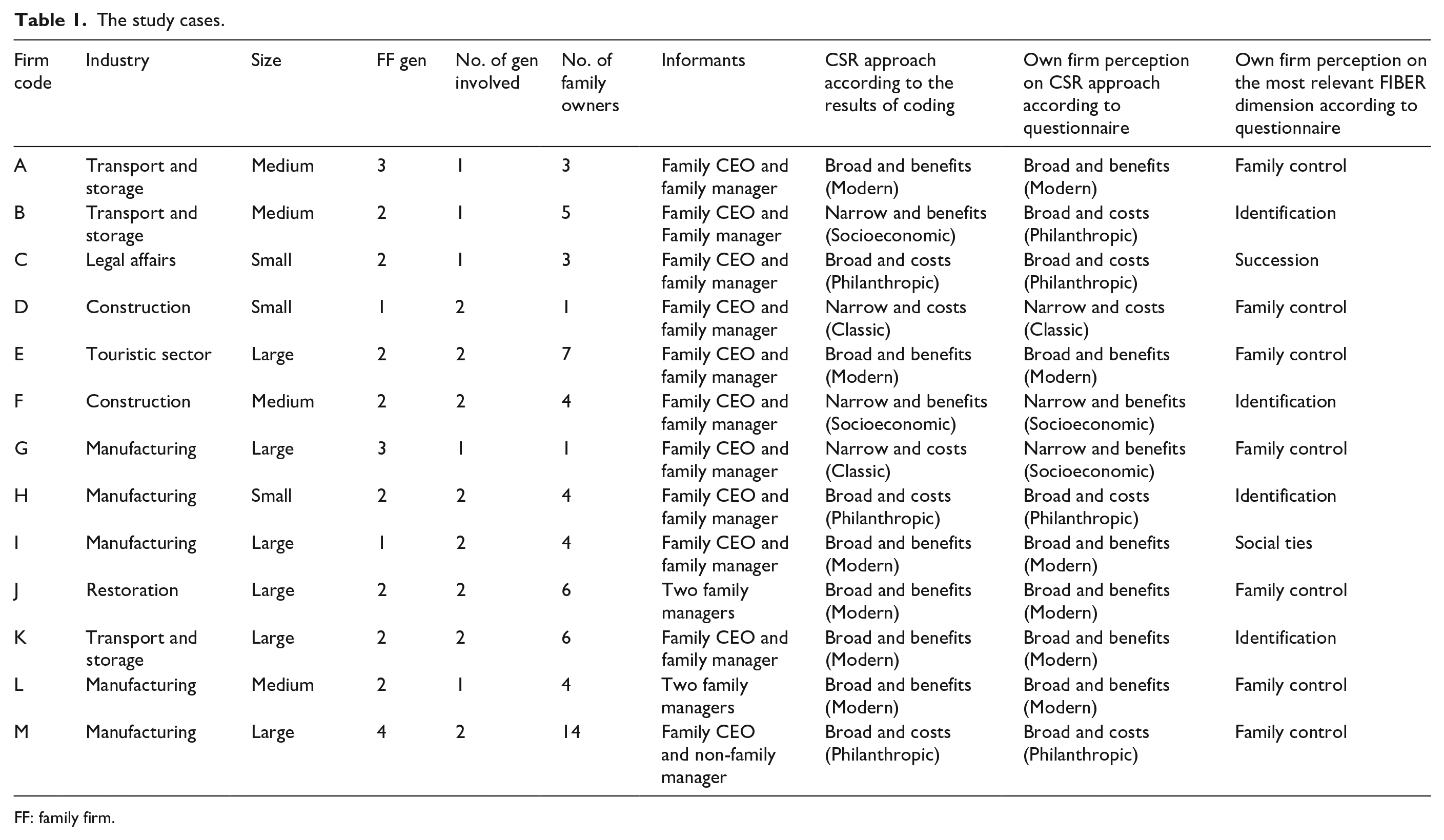
FF: family firm.
Data collection and data analysis
As a preliminary step before preparing for and carrying out the interviews, information from the firms was processed by applying data reduction, data display, data categorization, and data contextualization (De Massis & Kotlar, 2014). Likewise, we held a first meeting with a senior manager of the firm to explain the objectives and motivations of the research project.
From January to October of 2018, we carried out 30 interviews at 15 FFs located in southern Spain. These interviews were conducted with the CEO, managers, or executives who were knowledgeable about the firm’s global CSR strategy. In this way, with at least two informants per FF, we got a more complete view of the context studied in each firm. We also carried out informal interviews with the firm’s founder in 70% of the firms, to understand the sources of the SEW foundation for the FF. As for the remaining 30% of the firms, we could not hold these interviews because the firm’s founder was not active in the firm for one reason or another.
The interviews were conducted at the headquarters or other locations specifically indicated by the firm managers or executives. Moreover, all firms were provided the emails and institutional telephone numbers of the researchers in case, after the interview, anyone wanted to provide additional information if we required it. The structure of the interviews carried out was as follows: general information about the firm, specific information regarding the firm’s CSR policy, information about the manager/executive interviewed (academic training, professional experience, etc.), explanation of the research we carry out, and research questions. The interviews lasted on average 1.5 hr, resulting in approximately 45 hr of meetings, as is typical in this sort of research (Nag et al., 2007). We manually transcribed each of the 30 interviews. At least two researchers were always present in the interview to gather every important piece of data. We collected information mainly from direct interviews with open questions about CSR strategy and actions, reading each interview several times to understand the similarities and differences between the interviewees and their firms (Nag & Gioia, 2012). Particularly, our phenomenon of interest was studying the motivations behind why each and every FF adopts a particular CSR approach. This is why each participant was asked what type of CSR they usually carried out. They were then asked to discuss the reasons that motivated those CSR actions. Furthermore, we also collected information from secondary data, such as firm documents, internet, or the press, that is, we used various data sources in our research, as recommended by Yin (2003), working with qualitative and quantitative evidence (Eisenhardt, 1989b). Using multiple sources of data allows us to triangulate, making our findings more convincing and robust (Tracy, 2010). We carried out both triangulation of data, temporary triangulation, in which data were collected on different dates to check whether the results were consistent, and personal triangulation, looking for differences and similarities between the different subjects interviewed in the selected FFs.
The coding process led us to better understand what the interviews were all about, classifying our data into different groups considering the varying language used by the interviewees that describe equivalent concepts. In the initial coding process, we observed that our interviewees’ narratives often included non-financial aspects of their family businesses and saw how these non-financial issues were essential to explaining decisions regarding CSR. This discovery led us to consider SEW as the most appropriate theoretical framework to address why and how SEW dimensions can determine the CSR approach in an FF context. Initially, we considered that FIBER dimensions might be enough to examine our research questions. However, following the advice of an anonymous reviewer, we paid attention to other categories that we might consider SEW but were unable to fit into the FIBER dimensions, namely family enrichment and image and reputation. Family enrichment refers to considering the happiness of family members outside the business, family harmony, and taking into account the needs of the family in the firm’s decision-making (Debicki et al., 2016). Image and reputation have been also considered a particular dimension of SEW (Zientara, 2017), image being the global impression that is transmitted to stakeholders outside the firm, and reputation being how outsiders view the firm and the family (Dyer & Whetten, 2006), considering the joint information and assumptions that stakeholders have regarding them (Brown et al., 2006). This deeper investigation allowed us to come up with a more interesting and insightful contribution. Table 2 shows the initial coding process for a section of the interview with FF “A.”
Sample of initial coding.
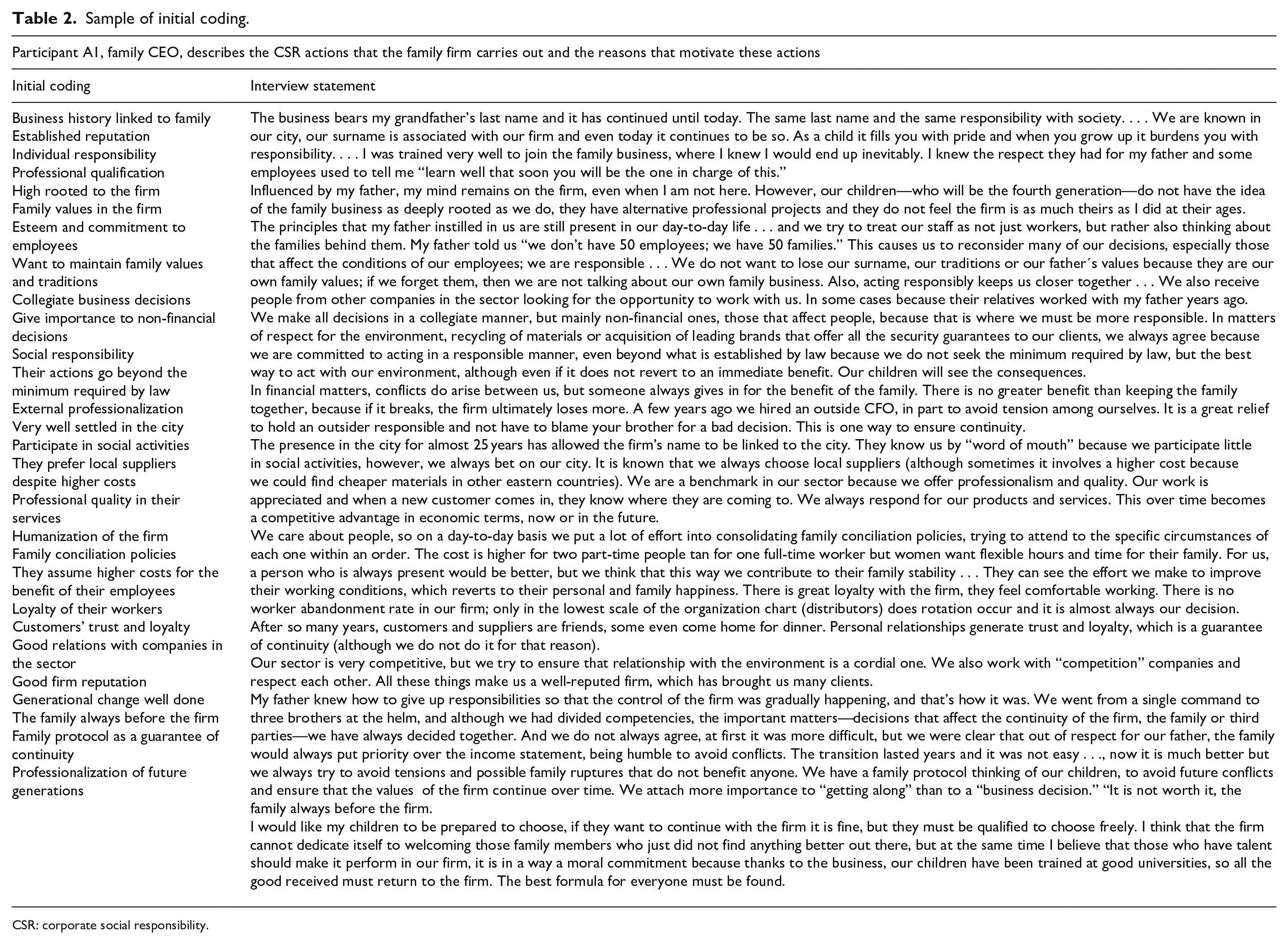
CSR: corporate social responsibility.
After the initial coding stage, we continued with further examination of the interviews and identified different dimensions based on SEW theoretical framework as motivators of CSR approaches. Therefore, we advanced from a descriptive stage (initial coding) to a more conceptual stage (selective coding) (Charmaz, 1996; Glaser, 1978). Table 3 shows how we moved from our first-order categories to our second-order categories. For example, the interviewee from FF “A,” while describing how they relied on local suppliers to foster community development, recognized how this choice implied higher production costs in the short term but also led to them having a better reputation, increased product quality, and, ultimately, enhanced long-term competitiveness. We therefore interpreted that seeking a good reputation is linked to a benefits approach.
Sample of selective coding.
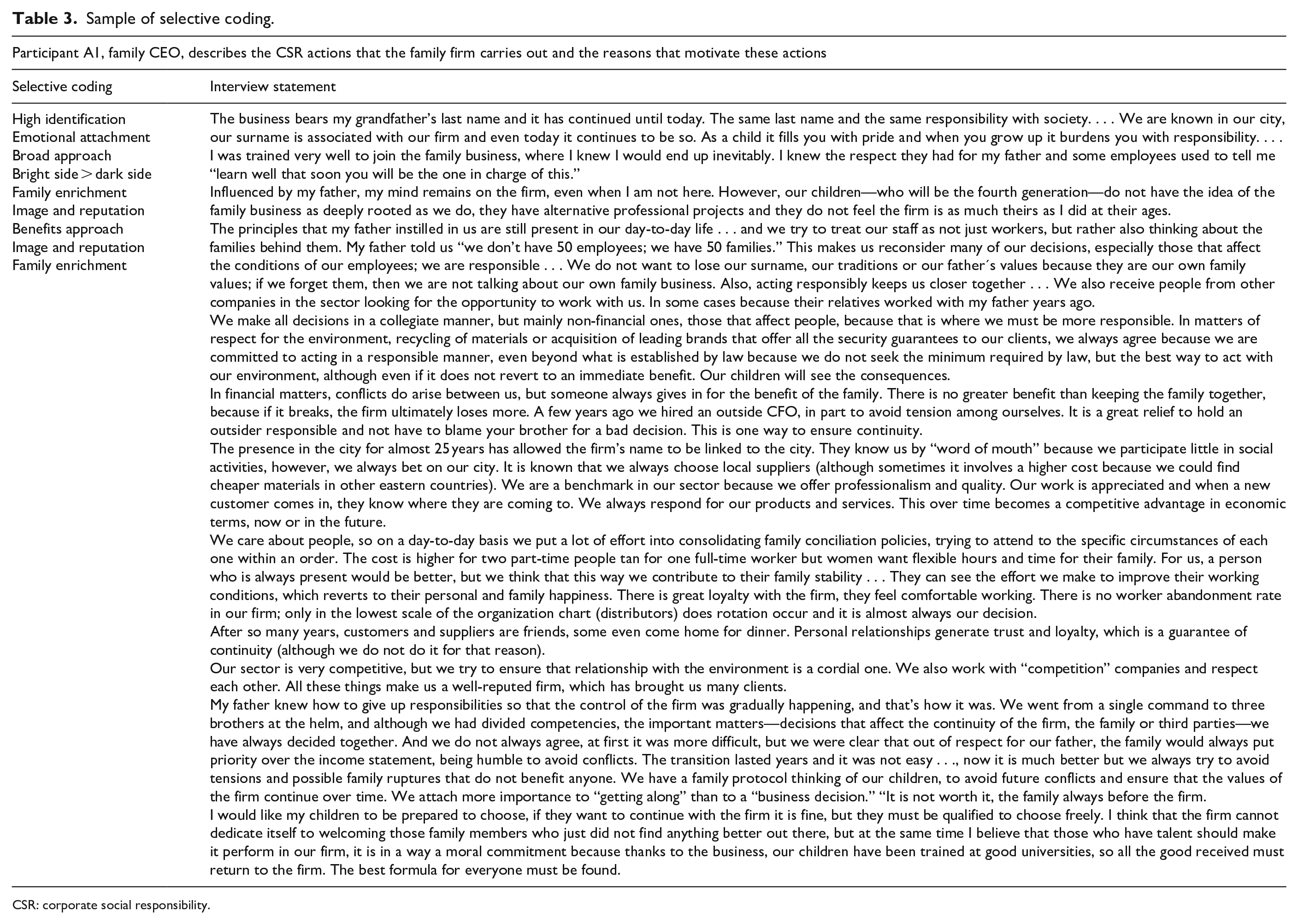
CSR: corporate social responsibility.
Another noteworthy aspect was that when we found that no new knowledge had arisen with our data collection and analysis, and there were signs of repetition of information and confirmation of existing themes (Suddaby, 2006), we determined that we had obtained saturation. Next to the informants’ quotes in our findings section, we include more quotes in Table 4 to further show how reiteration in our raw data drove us to deduce that saturation was achieved.
Second-order themes and empirical evidence.
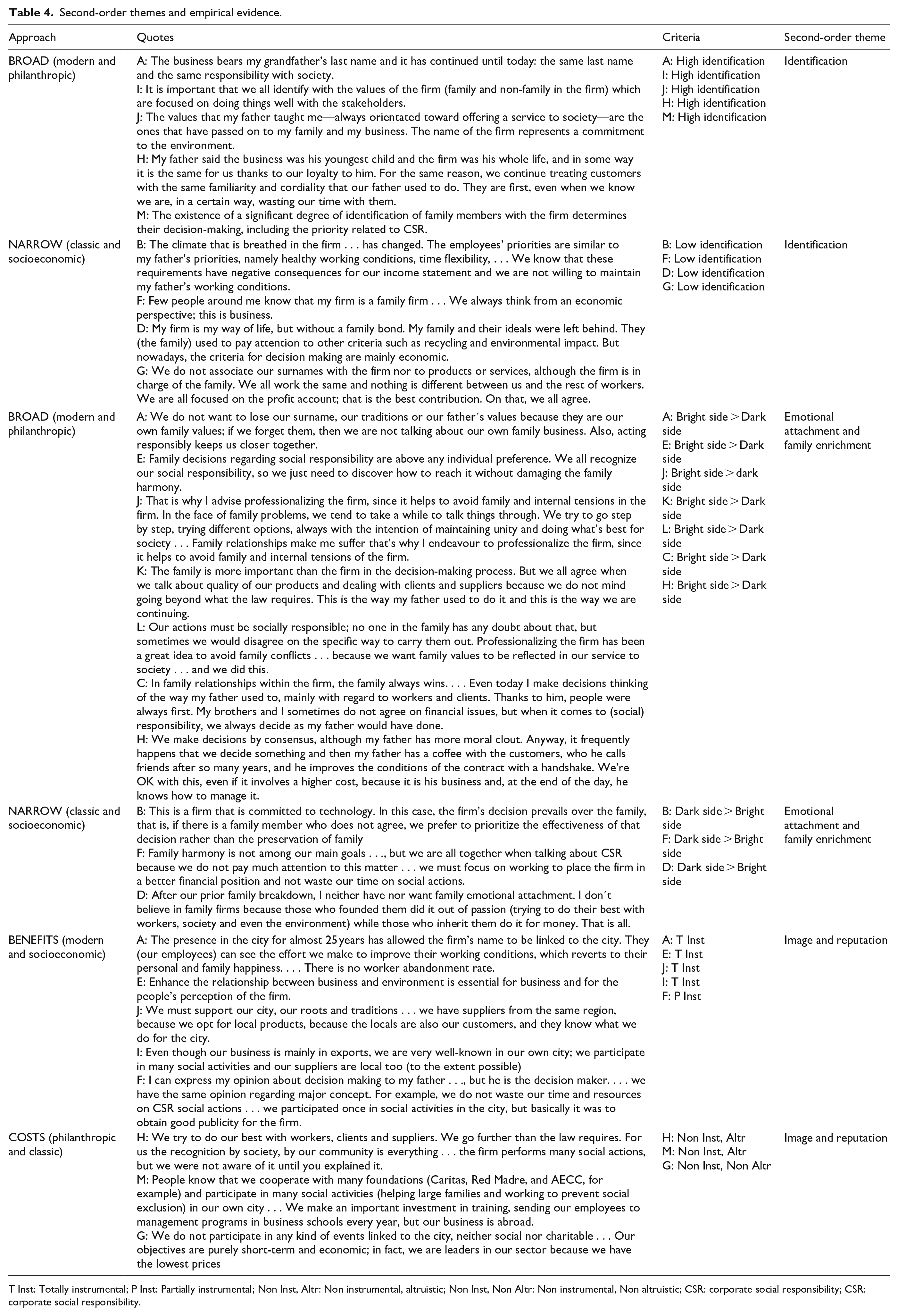
T Inst: Totally instrumental; P Inst: Partially instrumental; Non Inst, Altr: Non instrumental, altruistic; Non Inst, Non Altr: Non instrumental, Non altruistic; CSR: corporate social responsibility; CSR: corporate social responsibility.
Finally, it should be noted that initially, as explained in section “Questionnaire,” we took advantage of the questionnaire answers to identify what approach to social responsibility every firm displayed and what dimensions of FIBER were more important in shaping each particular approach, based on their own perceptions. However, after examining the data, the authors discussed the participants’ comments and the results of data analysis thoroughly and agreed on the approach that every firm actually demonstrated and the more important SEW dimensions that motivated the adoption of each particular approach according to the results of coding. We were able to conclude that for many of these FFs, their own perception of the CSR approach adopted, and what they consider the most influential SEW dimension, as expressed on the questionnaire, do not coincide with the CSR approach actually adopted and the SEW dimensions identified as the most important according to the results of coding of the interviews conducted (see Table 1).
Findings
The evidence from this multiple case study is available from the authors. We were able to find firms with different CSR approaches (broad vs. narrow; benefit vs. cost) in our sample, and based on the analysis of the evidence, we suggest several testable propositions, as we explain below.
Propositions: relating SEW dimensions to CSR approach
Non-decisive SEW dimensions for the adoption of a specific CSR approach
First of all, using these interviews, we address those dimensions of the SEW that were not decisive in differentiating distinct CSR views, namely those comprising family continuity. Under family continuity, we have encompassed dimensions such as family control and influence and the renewal of family bonds through dynastic succession. As in previous studies (Déniz & Cabrera, 2005), the FFs interviewed are characterized by a strong family control and an enormous family influence on decision-making. In some cases, this strong control is associated with a broad CSR strategy (firms included in the modern and philanthropic approaches) and in others with a narrow CSR strategy (firm included in the classic and socioeconomic approaches). Therefore, it seems that, given that all the firms interviewed had similar levels of family control and family bonds, this did not allow us to establish a distinction between them regarding the CSR approach adopted (see Table 1).
Broad versus narrow approach
Comparing firms with broad and narrow vision is, in our specific case study, equivalent to investigating why firms having modern and philanthropic views are different from firms with classic and socioeconomic views. We discovered that the key SEW dimensions here are the identification of family members with the firm and the levels of emotional attachment and family enrichment.
In firms with a broad approach, the identification of family members with the firm implies a commitment to CSR policies, since the values of the family become the values of the firm. One such example is the interviewee saying, The principles that my father instilled in us are still present in our day-to-day lives . . . and we try to treat our staff as not just workers, but rather also thinking about the families behind them. My father told us, “we don’t have 50 employees, we have 50 families.” This causes us to reconsider many of our decisions. (A)
Another remarked, My father said the business was his youngest child and the firm was his whole life, and in some way it is the same for us thanks to our loyalty to him. For the same reason, we continue treating customers with the same familiarity and cordiality that our father used to do. They are first, even when we know we are, in a certain way, wasting our time with them. (H)
In short, the identification of family members with the firm is a consequence of the pride they have in belonging to it. Their surnames are identified unequivocally with their firms, and in this sense, they try to ensure that their CSR actions are in line with their principles and values. They aim to ensure CSR policies, not only through family members, but also by encouraging non-family members to identify with the values of the family. Robust family member identification with the firm generates a similar mindset among employees, a contagion effect, improving the level of identification with, commitment, and responsibility to the firm. This way, the CSR strategy is doubled.
The close relationship between the family and the firm allows the actions carried out with the personnel, suppliers and other external agents to be taken from a CSR perspective, being aware that their family values permeate these decisions and create traditions to be applied in the firm. (K)
Thus, a higher degree of identification increases CSR engagement and is a crucial factor for explaining heterogeneity within FFs concerning CSR behavior, as previous research suggested (Bingham et al., 2011; Marques et al., 2014).
By contrast, firms with a narrow approach display a low degree of identification between family and firm, which is manifested by sentences such as My firm is my way of life, but without a family bond. My family and their ideals were left behind. They (the family) used to pay attention to other criteria such as recycling and environmental impact. But nowadays, the criteria for decision making are mainly economic. (D)
In firm B, the family CEO claims that The atmosphere in the firm has changed. The employees’ priorities are similar to my father’s priorities, namely healthy working conditions, time flexibility, etc., and they do not care about the profit. We know that these requirements have negative consequences on our income statement and we are not willing to maintain my father’s working conditions. (B)
Furthermore, he admits that in Firm B there is no equality between all workers, between family members and non-family members. Consequently, family members of firms with a narrow approach appear to not be putting aside their personal interests for the sake of the firm, increasing their conflicts of interest and negatively impacting the identification with the FF, which in turn leads to reduced CSR engagement. Our interviews seem to show that the employees of firms with a low degree of identification may consider the behavior of the family in charge as a “mafia,” which makes them feel distanced from the firm’s goals and generates envy, suspicion, and mistrust. That is, a low degree of identification may materialize as selfishness and nepotism, hindering the CSR perspectives.
In short, the identification of family members with the firm appears to have a favorable impact on the choice of a broad vision of CSR. Thus, we propose the following:
Proposition 1: The greater the identification of family members with the firm, the greater the likelihood of displaying a broad vision of CSR.
Upon analyzing firms with broad and narrow visions, we also confirm that there are different levels of emotional attachment and family enrichment in FFs and we find that the CSR behavior is different depending on whether emotions and family enrichment lead to more favorable than unfavorable outcomes or vice-versa. Thus, the way of managing the emotional component and family harmony also seems to determine the CSR approach, based on two possible situations: First, that in which the bright side of emotional bonding and family enrichment is higher than their dark side (broad approach) or conversely that the bright side of the emotional and family harmony dimensions is lower than their dark side (narrow approach).
Firms with a broad vision are usually committed to maintaining family harmony and emotional attachment, contributing to actions based on the values and traditions of the family.
In family relationships within the firm, the family always wins. . . . Even today I make decisions thinking of the way my father used to, mainly with regard to workers and clients. Thanks to him, people were always first. My brothers and I sometimes do not agree on financial issues, but when it comes to (social) responsibility, we always decide as my father would have done. (C)
There are firms that openly acknowledge that emotional ties and family harmony have a decisive influence on CSR decision-making, since family breakdowns and firm breakdowns in previous generations have marked them in a considerable way, and they have changed the vision of the organization and the family, always giving priority to the family over the firm (A and L). For these firms, having a strong emotional attachment, ensuring family happiness, and satisfying their affective needs are essential features that explain their engagement in CSR activities, trumping the selfish and utilitarian values often justified based on survival and safety needs.
We make decisions by consensus, although my father has more moral clout. Anyway, it frequently happens that we decide something and then my father has a coffee with the customers, who he calls friends after so many years, and he improves the conditions of the contract with a handshake. We’re OK with this, even if it involves a higher cost, because it is his business and, at the end of the day, he knows how to manage it. (H)
Family conflicts and the harmful consequences they entail, including making family members’ relationships collapse, may have an unfavorable impact on CSR engagement. Some FFs with a broad approach become fully professionalized to diminish the negative outcomes of emotions and family enrichment, their dark side.
That is why I advise professionalizing the firm, since it helps to avoid family and internal tensions in the firm. In the face of family problems, we tend to take a while to talk things through. We try to go step by step, trying different options, always with the intention of maintaining unity and doing what’s best for society . . . (J)
From professionalism derives The delegation of responsibilities/tasks and the freedom that reigns in the firm. There is a lot of closeness, receptivity, empathy, speed in decisions and delegation. There is no influence peddling and there is not as much bureaucracy as in other firms of similar size. (M) What kills a family business are family relationships. We are continuously trying to make the firm run less like a family . . . In making decisions on which we may not agree (for example, this happened with my proposal to create rest areas for our staff within the firm) but we have to reach an agreement . . . Our actions must be socially responsible; no one in the family has any doubt about that, but sometimes we would disagree on the specific way to carry them out. Professionalizing the firm has been a great idea to avoid family conflicts . . . because we want family values to be reflected in our service to society . . . and we did this. (L)
Thus, it seems that professionalism in some FFs with a broad approach contributes to decreasing the destructive side of emotions and family enrichment, such as family conflicts, and to strengthening the beneficial outcomes, such as higher social concern and positive behavior toward employees, which positively affect their CSR engagement in the end.
On the other hand, in relation to the firms with narrow approach, the dark side of family enrichment and emotions is larger than their bright side.
This is a firm that is committed to technology. In this case, the firm’s decision prevails over the family, that is, if there is a family member who does not agree, we prefer to prioritize the effectiveness of that decision rather than the preservation of family harmony. (B)
In other words, these firms tend to carry out CSR activities only basing them on economic outcomes, placing more importance on economic rationality than on family relationships and bonds.
Therefore, as prior literature suggested, the emotional bond between the family and the firm and maintaining family harmony influence how the firm is managed (Baron, 2008), particularly in the decision-making related to CSR activities.
Based on the former arguments, we propose the following:
Proposition 2: If FFs are more positively than negatively valenced regarding emotional attachment and family enrichment dimensions, the likelihood of having a broad vision of CSR will be higher.
Costs versus benefits of CSR approach
Comparing firms with a costs versus benefits-based CSR approach entails, in our specific case analysis, finding out why firms with modern and socioeconomic approaches (benefits approach) are distinct from firms with classic and philanthropic views (costs approach). We identify one essential SEW dimension here to distinguish the costs versus benefits CSR approaches: image and reputation as the true motor for encouraging social ties.
Among FFs with a benefits approach, firms displaying a modern vision show a special commitment to their immediate environment, especially with regard to local and regional suppliers. They also place emphasis on their involvement with society in general. These firms want to preserve their SEW and believe that being more responsible and meeting stakeholders’ requirements will protect their image and reputation. But they also say they are aware that these CSR policies may have a direct impact on the income statement. Certainly, their commitment to prioritizing the local or regional economy may lead these firms to making decisions that involve a higher initial cost. However, they are convinced that these actions will ultimately result in a net benefit for the firm.
We must support our city, our roots and traditions . . . we have suppliers from the same region, because we opt for local products, because the locals are also our customers, and they know what we do for the city. (J)
“Even though our business is mainly in exports, we are very well-known in our own city; we participate in many social activities and our suppliers are local too (to the extent possible)” (I). Therefore, these firms promote social ties to obtain a benefit in the medium and long term. “Using local suppliers is important, even if this implies a reduction in profits. However, this commitment to the region also represents an advantage that we already perceive” (A). Likewise, they are convinced that the responsible treatment of employees is likely to result in SEW benefits for the family.
This is a male-dominated sector and there is only one woman in the Administration department . . ., and her daughter is the one who sets the firm’s working hours. She chooses her holidays first and nobody questions it. If we collaborate with her on family stability, the work goes much smoother . . . thanks to her family, she knows how to manage conflicts and resources better. (A)
In short, these firms will address CSR actions with both internal and external stakeholders because they are convinced that only by being socially responsible with both groups will they improve their image and reputation. They are aware that image and reputation can be tarnished by irresponsible behavior toward either external or internal stakeholders. Therefore, these firms will carry out these CSR initiatives supported by instrumental motives as a means of serving the family’s interests in terms of SEW.
For its part, firms with a benefits approach showing a socioeconomic focus only perform social actions as part of the search for a financial return: “Relationships with suppliers and customers are a priority of the firm” (B). However, close or quasi-family relationships with employees are not encouraged: The employees’ priorities are similar to my father’s priorities, namely healthy working conditions, time flexibility, . . . We know that these requirements have negative consequences for our income statement and we are not willing to maintain my father’s working conditions. (B)
Thus, this firm is seemingly able to be, at the same time, socially responsible with external stakeholders and socially irresponsible with internal stakeholders.
I can express my opinion about decision making to my father . . ., but he is the decision maker. . . . we have the same opinion regarding major concept. For example, we do not waste our time and resources on CSR social actions . . . we participated once in social activities in the city, but basically it was to obtain good publicity for the firm. (F)
Thus, firm (F) sees CSR actions as a marketing instrument that is offered to stakeholders to simultaneously achieve the firm’s economic goals and meet the needs of these groups. Thus, the selfish behavior of FFs framed in the socioeconomic approach is brought to light when the FF, specifically worried about its image and reputation, only opts for CSR actions that are more beneficial to the requirements of external rather than internal stakeholders.
However, in the firms framed within a costs approach and exhibiting a philanthropic vision, we have observed that the CSR policies that create and strengthen social ties are not made to obtain a medium and/or long-term economic compensation. Rather, they are a consequence of the objectives and values of the family. They conserve and improve their non-financial preferences and SEW and make them more likely to engage in social activities and also show a sincere and solid personal responsibility toward their employees. The objective of being integrated into the local community, by principles, legacy, and family tradition, that is the main determinant of the carrying out specific CSR actions, regardless of the economic return. “For us the recognition by society, by our community is everything . . . the firm performs many social actions, but we were not aware of it until you explained it” (H). “There is a very close relationship with our customers. Many started with my father. There is a relationship of friendship, not strictly work” (C). Hence, CSR engagement benefiting stakeholders generates pride and a sense of well-being, which in turn creates a further commitment to philanthropy and community development, improving firm reputation. Firm “M,” for instance, does its business far from the city where the firm’s headquarters is located. It really only has a warehouse and logistics at its headquarters, but suppliers, manufacturing, and sales are all outside the city. This means that they only receive a minimal economic compensation from what they often do for the city. The firm’s reputation in the city is flawless.
People know that we cooperate with many foundations (Caritas, Red Madre, and AECC, for example) and participate in many social activities (helping large families and working to prevent social exclusion) in our own city . . . We make an important investment in training, sending our employees to management programs in business schools every year, but our business is abroad. (M)
Consequently, they are willing to make donations, even if they are perceived as a net cost to the firm. Hence, firms which have a philanthropic outlook seem to be willing to bind social ties through CSR actions altruistically. These firms will engage in CSR actions due to non-instrumental motives—they just believe their conduct is “basically good and ethically right,” regardless of whether it results in reputational gains or not.
Finally, firms classified as showing a cost approach but categorized under the classic vision recognize “having no commitment to society” (G), “nor having social roots” (D). Thus, for purely economic reasons, this type of firm neither has nor intends to have social ties. “We do not waste our time and resources on CSR social actions” (F). These firms consider that social implication generates a net cost and no real benefits.
We do not participate in any kind of events linked to the city, neither social nor charitable . . . Our objectives are purely short-term and economic; in fact, we are leaders in our sector because we have the lowest prices. (G)
Therefore, these firms are not willing to engage in any type of CSR with stakeholders because to them the image and reputation dimension hardly matters.
In short, what distinguishes firms which place different emphasis on the costs versus benefits of CSR is whether the image and reputation dimension is actually valued and whether this dimension, as the true engine for encouraging social ties, is instrumental or not. Consequently, we propose the following:
Proposition 3: If FFs are adopting CSR actions with stakeholders due to instrumental use of image and reputation dimension, the likelihood of having a benefits vision of CSR will be higher.
To help interpret the several concepts and their relationships in our data, we built Table 5 and Figure 1, which summarize and generalize our main findings, graphically showing the propositions made during our study.
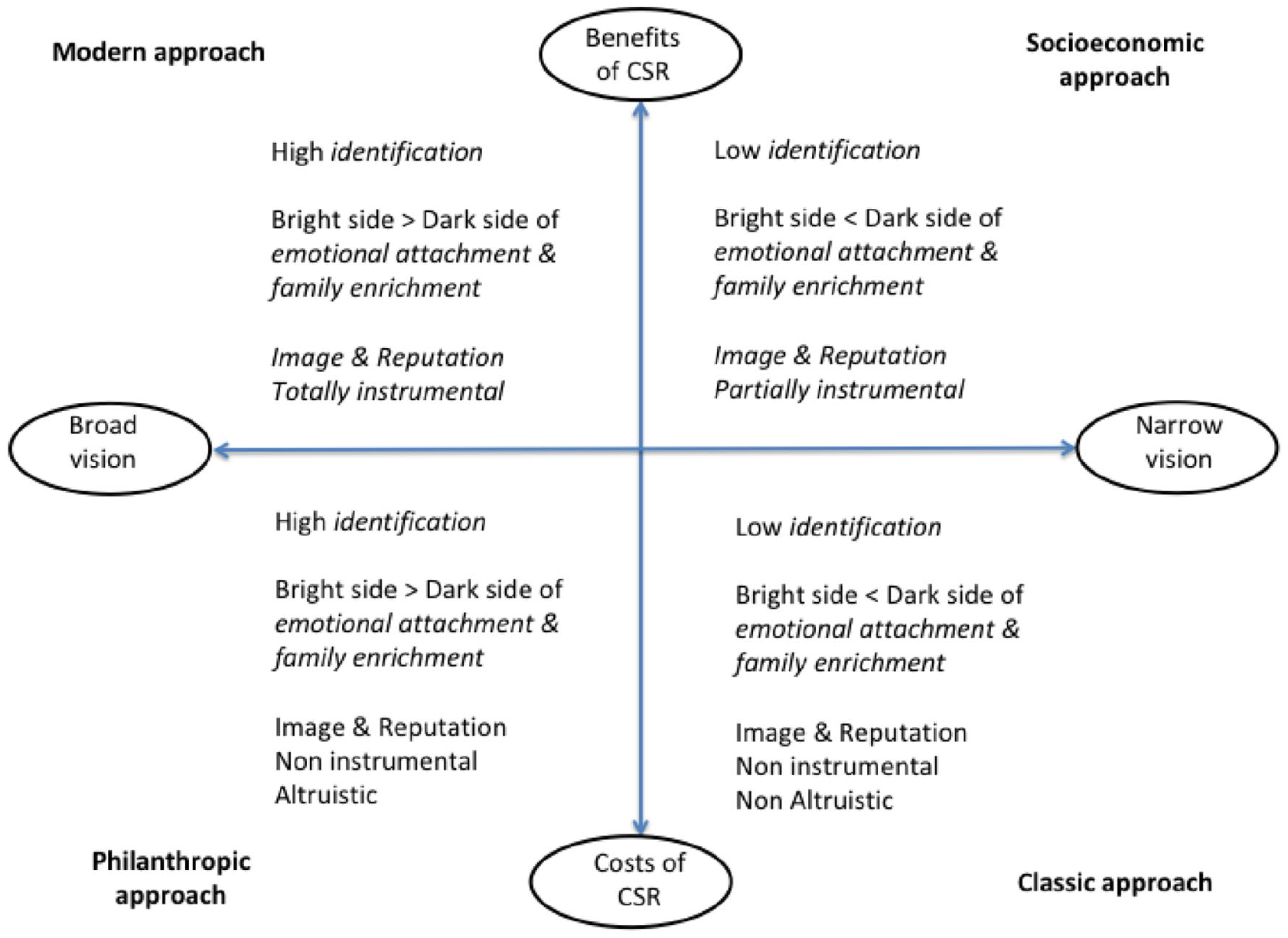
FIBER dimensions determining approaches to corporate social responsibility.
SEW dimensions, CSR approach, and propositions.
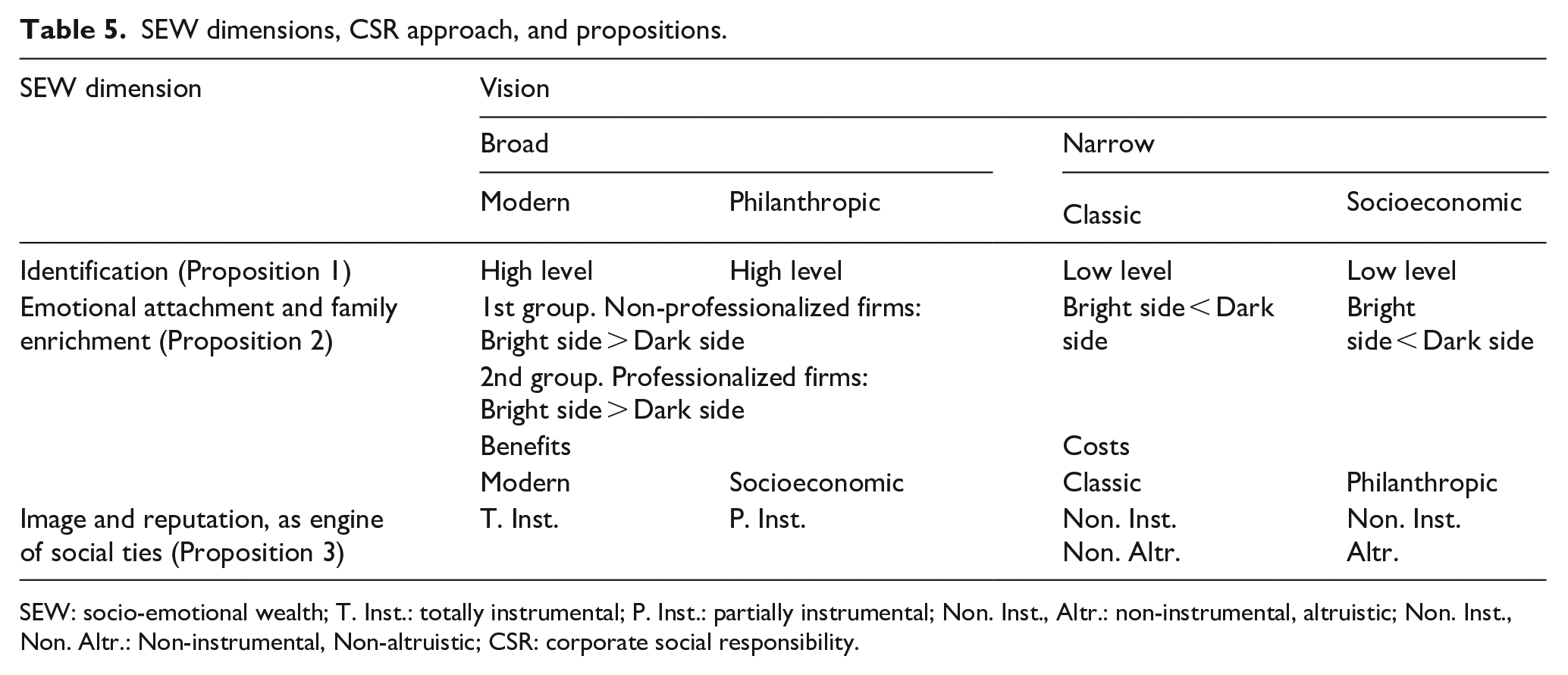
SEW: socio-emotional wealth; T. Inst.: totally instrumental; P. Inst.: partially instrumental; Non. Inst., Altr.: non-instrumental, altruistic; Non. Inst., Non. Altr.: Non-instrumental, Non-altruistic; CSR: corporate social responsibility.
Conclusion, implications, limitations, and future research
Considering the increasing attention that family scholars are paying to CSR, the lack of consensus regarding whether FFs are more or less socially responsible (Cruz et al., 2014), and the absence of a comprehensive overview of how and why different dimensions of family heterogeneity may affect FF behavior and strategic choices (Jaskiewicz & Dyer, 2017), namely CSR, this article investigates the differences in CSR approaches between FFs depending on the importance assigned to their SEW dimensions. Drawing on an SEW perspective and using an exploratory multiple case study as an empirical research strategy, the article finds that FFs can vary from one another with regard to CSR approaches depending on how they perceive the distinct dimensions of SEW.
Our results indicate that the family continuity SEW dimension, which usually includes family control and renewal of family bonds, does not show whether an FF will adopt a specific CSR approach. As they are present in every FF, these do not allow us to define differences between FFs with regard to the CSR approach taken. Yet, the analysis of the interviewees’ statements showed that there are some prominent SEW dimensions (Berrone et al., 2012) explaining the heterogeneity of FFs regarding CSR approach: identification, emotional attachment, family enrichment, and image and reputation as the main driver of binding social ties. We confirm that the heterogeneity of FFs as regards their CSR approach is likely to appear from dissimilarities among these former dimensions. The importance assigned to these noteworthy dimensions is not assumed to be similar for every FF, which makes it possible for observable distinctions to appear in FFs.
We propose that FFs adopting a broad vision of CSR show a high level of identification, while FFs with a narrow vision of CSR demonstrate a low level of identification. FFs with a high degree of identification see the firm as a reflection of their self-esteem, self-worth, and the paramount values of the family (Westhead et al., 2001).
Likewise, FFs intermingle emotional, sentimental, and firm factors, thus impacting the FF’s decision-making process (Baron, 2008), including that for CSR behavior. We propose distinguishing two groups within FFs, based on the importance assigned to emotional attachment and family enrichment for CSR engagement. In the first group, the positive side of altruistic emotions and sentiments is dominant (Cennamo et al., 2012), overcoming their more negative side, and this explains their great tendency to engage in internal and external CSR actions (broad approach). Moreover, we suggest that although the bright side of emotions and family harmony outshines their dark side, these firms aspire to be more professionalized to minimize the effects of their dark side (Schulze et al., 2003). The second group appears to be negatively valenced, with the detrimental consequences of emotional attachment and family enrichment being more prevalent than their positive effects in terms of CSR.
We also suggest that image and reputation, as the main underlying dimension promoting social ties, are the key SEW dimensions to differentiate between FFs that view social involvement as a cost disadvantage from FFs that perceive social responsibility as a source of competitive advantage. FFs’ social relationships imply collective social capital, relational trust, and reciprocity (Ganong et al., 1990) along with perceptions of proximity and interpersonal cooperation (Uzzi, 1997). Thus, FFs with a benefits approach will engender strong reciprocal bonds with their stakeholders and the community (Berrone et al., 2012), being considered excellent corporate citizens, to really propel their image and reputation (Lyman, 1991). Some of these FFs behave responsibly toward external and internal stakeholders because they are convinced that any irresponsibility with both types of stakeholders will tarnish the reputation of the firm and the family (modern). By contrast, others will adopt an unequal conduct, responding to the needs of external stakeholders and discriminating against internal ones (socioeconomic). There are FFs with a costs approach, either because they are not motivated to foster social ties that boost the image or reputation dimension, considering them as a waste of time (classic), or because they are willing to improve CSR behavior even when it might imply a net cost for the firm, pursuing the well-being of those around them although there is no economic benefit to be derived from this behavior, and thus showing their authentic concern for the broader social good (philanthropic) (Brickson, 2007; Zientara, 2017).
Our propositions are aligned with the proposals of Cennamo et al. (2012), which claimed that FFs adopting identification, the binding of social ties and/or emotional attachment as the main frames of reference were more likely to proactively involve stakeholders, this being rooted in normative motives. They are also in line with the findings of Swab et al. (2020), who proposed recently that the dimensions of the SEW construct vary in terms of necessity and sufficiency. They suggest that the family continuity dimension alone does not imply that FFs show the willingness among the main decision makers to pursue SEW, being a necessary but not sufficient condition for SEW. Apart from that, identification, social bonds, and emotional dimensions are necessary but not sufficient conditions of SEW and represent the willingness to pursue SEW. We extend these former studies confirming that the cornerstone of FF heterogeneity in terms of CSR approach lies in the identification, emotion, enrichment, and image and reputation (as the basic explanation for social ties) dimensions. Likewise, our propositions are in line with the results of Marques et al. (2014), who confirmed the importance of identification, binding social ties, and emotional attachment to the workplace and community in CSR. We expanded on their findings, examining the CSR approach instead of CSR engagement and broadening our SEW framework beyond the FIBER scale. However, our propositions do not seem to agree with the findings of Dick et al. (2020), which suggested that the family control dimension of SEW prevails over reputational concerns when shaping CSR engagement. Nevertheless, they were mainly focused on CSR engagement that involves high reputational benefits and that may jeopardize family control, disregarding other possible influential SEW dimensions, such as emotional attachment or family enrichment, which our study has captured.
Our study contributes to the previous research in some important ways. Whereas prior evidence regarding the CSR of FFs has shown their heterogeneity regarding CSR orientation (Déniz & Cabrera, 2005), our study is one of the first to analyze this dissimilarity using SEW as a basis. The exploration of the relationship between SEW dimensions and CSR approach is completely new in the literature.
Our findings reveal that FFs do not constitute a homogeneous group with regard to CSR approach due to every FF being able to choose different SEW dimensions, individually or combined, as their key reference points. Specifically, we maintain that, while the family continuity dimension will manifest in every FF, the crux of family heterogeneity regarding CSR approach lies in the identification, emotion, enrichment, and image and reputation dimensions. We also contend that FFs’ CSR approach is explained not only by the importance of both the bright and the dark sides of identification, emotion, and enrichment but also by the instrumental use or non-instrumental use of image and reputation when addressing CSR engagement. Our study challenges, as Zientara (2017) did, the underlying assumption dominant in prior research, that SEW is always “a prosocial and positive stimulus” (Kellermanns et al., 2012, p. 1176). Specifically, this article argues that emotional attachment and family enrichment dimension may be double-valenced, a driver of CSR engagement but also a cause of irresponsible practices. Likewise, the originality of this study also lies in that it allows for clarification as to whether and how a particular dimension of SEW is driving CSR engagement. Our study highlights that when analyzing the effect of SEW on CSR approach of FFs, we should be specific about whether it is, for instance, the influence of a family enrichment concern or a reputational issue on CSR approach that is being analyzed, rather than just simply establishing the impact of SEW. Furthermore, our qualitative methodological approach allowed us to identify and work with SEW dimensions included in different SEW frameworks, such as the FIBER or the SEW scale, and even recognize the underlying SEW dimension explaining social ties, namely image and reputation. Finally, to protect against SEW reification (Jiang et al., 2018), this study allows us to understand how family members really think, feel, and behave in SEW phenomena (Schulze & Kellermanns, 2015). Particularly, and using a qualitative/interpretative methodology, we were able to capture SEW dimensions properly, which allows us to have a comprehensive overview that takes into account the impact of all SEW dimensions on the CSR approach. This is a real contribution to the previous literature on SEW, in which a direct measurement of SEW phenomena has been practically non-existent and constructs are just beginning to take form (Debicki et al., 2016; Hauck et al., 2016; Marques et al., 2014; Murphy et al., 2019; Schepers et al., 2014).
Our study also has strong implications for research and practice. First, academics studying FFs have only just started to investigate why FFs are different from each other regarding their CSR engagement (Van Gils et al., 2014) and very recently to research the role of SEW in this phenomenon (Dick et al., 2020; Marques et al., 2014). This study provides evidence of FF heterogeneity in terms of CSR approach and our findings advance our understanding of how these differences may be explained by how FFs manage certain SEW dimensions. Our findings also appear to suggest that SEW dimensions are dual-faceted, and therefore financial and non-financial aims need not be opposed but they can also complement and even strengthen each other reciprocally. Therefore, CSR and FF scholars could benefit from theoretically and empirically considering how SEW dimensions could influence a CSR approach. Second, the findings of our study could also be useful to FF consultants and managers, particularly those working in CSR. These individuals are encouraged to not assume that all FFs must uniformly adopt the same CSR approach—by reinforcing certain SEW dimensions they could contribute to better CSR behavior and results. For instance, by strengthening identification, making the positive side of family emotions and enrichment greater than the negative side, and adopting an instrumental perspective with stakeholders, FFs will be more likely to display a modern approach to CSR, and this in turn will result in reputational gains, higher organizational commitment, and attracting better job applicants and customers, among other outcomes. Thus, practitioners and managers should encourage firms to move from one approach to another while knowing which SEW dimension is likely to enhance CSR behavior. Furthermore, FF scholars and practitioners should not be tempted to label an FF as socially responsible by looking only at how it behaves in certain CSR actions or according to its participation in certification schemes. Instead, they should analyze the CSR approach it takes to fully understand their behavior and the ultimate rationale behind it. Finally, policy makers could develop suitable incentive policies to foster CSR if they knew what particular CSR approach each FF is displaying currently and could invite FFs to develop those specific SEW key dimensions that lead to superior CSR practices and performance.
Finally, this study is not free of limitations, and recommendations for future research may be proposed. First, our propositions are consistent with prior research showing the heterogeneous behavior of FFs regarding CSR (Campopiano & De Massis, 2015; Déniz & Cabrera, 2005). The exploration of the SEW dimensions and their association with CSR approaches is new in FF and CSR research. Empirically testing the connection between the different dimensions of SEW and CSR approaches might allow scholars to open additional lines of future research. For instance, quantitatively demonstrating which SEW dimension(s) is/are paramount to explaining the CSR approach could be a special area of interest. Future research could also empirically investigate to what extent the mixed importance of the various identified dimensions drives FF behavior differently in terms of CSR approach. Second, our findings should not be extrapolated to any populations of firms, as our study is exploratory. Yet, this study, taking advantage of the valuable information gleaned from case studies, could explore thoroughly how and why FFs adopt a specific CSR approach, and we hope that our propositions will inspire FF and CSR researchers to analyze whether our results may be applicable. We have addressed FF heterogeneity considering SEW dimensions. However, there are other sources of heterogeneity that may impact CSR approaches and that future research may examine, such as family structures, functions, interactions, or events (Jaskiewicz & Dyer, 2017). Third, all the FFs approached decided to take part in this research project, which could indicate a potential bias in the sample selection. However, the in-depth exploration of the CSR approaches confirmed that we obtained representatives of every approach in our sample of FFs. This result diminished our concerns regarding selection bias. Fourth, to explore SEW in FFs, the individual family member is often contemplated as the suitable unit for examination (Berrone et al., 2012), as we have considered. Yet, founder SEW, family SEW, and firm SEW may be conceptualized and collected differently (Brigham & Payne, 2019). Future research could analyze this in depth, as each way of measuring SEW may make a particular contribution to the decisions related to the CSR approach taken. Finally, Murphy et al. (2019) have recently studied how SEW originates, develops, and impacts the life and decisions of FFs. Future research may study how and why different SEW evolution in FFs can push them to change from one CSR approach to another. In short, we suggest that future research analyzes how SEW changes over the life cycle of FFs affect CSR approach.
Footnotes
Declaration of conflicting interests
The author(s) declared no potential conflicts of interest with respect to the research, authorship, and/or publication of this article.
Funding
The author(s) disclosed receipt of the following financial support for the research, authorship, and/or publication of this article: Authors want to acknowledge the funding received by the Firm Feasability Chair at the University of Malaga, in the form of research fund for hiring Marta Campos-Valenzuela for several months, to develop Chair actions, and thereby, this paper.
