




Abstract
This research examines the effectiveness of Family Constitution or Family Protocol agreements in mitigating each type of agency conflict in family firms. We performed a qualitative analysis, through a case study, and found that the succession process is the main driver for implementing this family governance mechanism. Our findings also show that a family constitution is useful in reducing three of the four agency conflicts described in the literature, specifically between family owners and managers, between family shareholders, and with the family at large. Key agreements include training and experience terms for family members to join the firm, transfer clauses of shares inter-vivos and causa mortis, and the development of family governance bodies. However, creditors are generally unaware of the protocol’s existence, hindering its potential positive effects, which has important implications for practitioners. Creditors point out its potential usefulness as a hint of orderly and structured continuity of the business.
Introduction
Each year approximately 150,000 family firms disappear in the European Union because of an unsuccessful succession, which means an annual loss of 600,000 jobs (Official Journal of the European Union, 2016). The main goal of family protocols is to promote the continuity of the firm (Gallo & Ward, 1991). A family protocol is a family governance mechanism through which the family self-regulates the influence of their interests in the business, establishing bases to avoid or manage conflicts (Pavón, 2018). The term family protocol, also known as “family constitution” or “family agreement,” was settled on by Miguel Angel Gallo and John Ward (1991). A family constitution usually addresses (1) the firm’s mission and values, (2) participation of the owning family in the firm, (3) ownership arrangements, (4) dividends policy, and (5) family involvement in boards (Montemerlo & Ward, 2011). A family constitution requires a communication process between relatives in a family firm which leads to the signing of agreements about family–business relations (Gallo & Tomaselli, 2006; Suess, 2014; Tapies & Ceja, 2011). In addition, it usually reinforces unity between family members and their commitment to the firm’s success (Brenes et al., 2011; Corbetta & Montemerlo, 2000). Family constitutions aim to reduce family conflicts and thus ensure the survival of the firm (Berent-Braun & Uhlaner, 2012; Botero et al., 2015; Brenes et al., 2011). The process of discussion and writing the protocol is even more important than its content (Gallo & Tomaselli, 2006; Montemerlo & Ward, 2011). The implementation of a family constitution is a delicate process which can fail due to family feuds and divergence of interests (Montemerlo & Ward, 2011). The family members must agree on their commitment to the business, the norms for family and business relations, and the goals of the family and the firm.
Despite the growing interest in the implementation of family constitutions in family firms (Fleischer, 2018), there is scant research on this topic (Matias & Franco, 2018). The pioneering descriptive study by Gallo and Ward (1991) points out that family constitutions help with firms to be professional and institutionalizes family values. Gallo and Tomaselli (2006), in a case study of 12 Spanish firms, showed that success in the implementation of a protocol depends mainly on the most influential family members’ attitude and interest. A survey of 12 family firms in Costa Rica by Brenes et al. (2011) noted the family protocol as a guide for both firm and family order and structure, which improves family unity. Matias and Franco (2018), in their exploratory analysis in Portugal, also noted that family constitutions create a unity, commitment, and motivational spirit crucial for the continuity of the firm. Montemerlo and Ward (2011) described the implementation process, the type of agreements, and the content of a family constitution, highlighting the importance of motivation and commitment for its success. Botero et al. (2015) emphasized that agreements must be adapted to the family context and legislation in each country. Berent-Braun and Uhlaner (2012) took a sample of 64 cross-country firms from an international association of family businesses and found a positive relationship between firm performance and family governance practices (using a single scale to assess the usage of family constitution, family code of conduct, clear selection and accountability criteria, family council, formal family communication mechanisms, and family meetings). Arteaga and Menéndez-Requejo (2017) analyzed a sample of 530 Spanish firms and saw a positive relationship between the implementation of family constitutions and firms’ performance. Although family business literature assumes that family constitutions aim to prevent or solve conflicts (Berent-Braun & Uhlaner, 2012; Brenes et al. 2011; Suess, 2014), we did not find any research examining which conflicts the different protocol agreements effectively mitigate, which was also pointed out by Alvarado-Alvarez et al. (2020).
The management of family conflicts is key to the survival of family businesses over generations (Martin, 2001; Suess, 2014). Agency Theory and Family Business literature allow to identify the most significant conflicts in family firms and their unique characteristics. Family firms usually have overlap between ownership and management, as well as ownership concentration, which reduces principal–agent conflicts (Anderson & Reeb, 2003; Villalonga & Amit, 2006), although conflicts between majority and minority shareholders or between blockholders may arise (La Porta et al., 2002; Morck et al., 2005; Zellweger & Kammerlander, 2015). Moreover, the multiple roles of family members in the business foster singular conflicts with family members outside the business or ownership group (or “super-principals”) (Chrisman et al., 2003; Villalonga et al., 2015), while family firms’ long-term orientation lessen agency conflicts with creditors (Anderson & Reeb, 2003). Thus, family involvement in the firm shapes agency conflicts, which require specific governance mechanisms (Chua et al., 2009). Family firms need governance structures that promote cohesion, shared vision, and reduce conflict, taking into account the duality of economic and non-economic goals and the complexity of their stakeholder structures (Mustakallio et al., 2002).
We aim to investigate which conflicts are reduced by the different family constitution agreements. The main research question is: How do family constitutions reduce the different conflicts in family businesses? Starting from the conflicts identified by agency theory, we investigate the usefulness of family constitutions in mitigating conflicts between managers and shareholders, between majority and minority shareholders, between “blockholders,” between family shareholders and the family at large, and between shareholders and creditors. The research methodology is case study, since that allows us to examine real-life events through analyzing empirical evidence. Qualitative analysis emphasizes the qualities of entities and processes that cannot be measured in terms of quantity, intensity, or frequency (Denzin & Lincoln, 1994). In addition, qualitative research in family governance is underrepresented (Suess, 2014).
This study contributes to the literature in several ways. The first contribution is to enhance the understanding of how family governance mechanisms may lead to effective mitigation of conflicts in family firms (Berent-Braun & Uhlaner, 2012). Building on agency theory, we investigate which agreements in family constitutions reduce each of the agency conflicts. Second, this article contributes to expanding the literature on agency theory by considering the least studied conflict, with extended family (Villalonga et al., 2015). We jointly consider the four agency conflicts that the literature associates with family businesses. Third, this study responds to the common call for research on privately held family firms (Carney et al., 2015). Most family business research considers listed companies, although they are not the most representative. Furthermore, the control exercised by the capital market alters the importance of the different agency conflicts.
Our findings show the usefulness of family constitutions in mitigating conflicts between family owners and managers, between family shareholders, and between active family members and the extended family. Nevertheless, creditors usually ignore the existence of a family protocol, which precludes its effectiveness in reducing conflicts in this relationship. The results of this study have implications for practitioners by pointing out the most common agreements of the protocols and their effectiveness. Our research also sheds light on the reasons to implement family governance mechanisms (Suess, 2014), with succession being the main driver of family constitutions.
The remainder of the article is structured as follows: section “Theoretical framework: family constitutions and agency conflicts” describes the four agency conflicts and their potential relationships with family constitutions. Section “Methodology” outlines the qualitative case study methodology, and the criteria for case selection and data collection. Section “Results and discussion” presents the findings regarding the usefulness of the family constitution agreements in mitigating each type of agency conflict. Finally, section “Conclusion” includes the conclusions, contributions, limitations of the research, and proposals for future research.
Theoretical framework: family constitutions and agency conflicts
Family involvement generates additional conflicts in businesses (Harvey & Evans, 1994). Moreover, the achievement of non-economic goals creates unique additional and complex challenges for family firms (Chua et al., 2009). Family governance mechanisms, primarily referring to family meetings, family councils, or family constitutions, play a particularly important role in the long-term success of a family business (Mustakallio et al., 2002; Suess, 2014). Family governance mechanisms order the family’s relations with the business (Mustakallio et al., 2002; Suáre & Santana-Martín, 2004) and contribute to family unity and conflict resolution (Brenes et al., 2011). The family constitution may implement mechanisms for the prevention or resolution of conflicts, based on promoting communication between family members and fostering the relationship between the family and the business (Suess, 2014). Grounded in agency theory, our aim is to examine how the different agreements in the family constitution can contribute to mitigate each agency conflict, that is, those between family owners and managers, between the shareholders, with the extended family, and with creditors.
Family constitutions in the manager–shareholder relationship
Information asymmetry can generate a problem of moral hazard when a family firm (principal) hires a non-family manager (agent) (Mayer, 1999). The opportunism of the agent can erode the principals’ interests (Barney & Hesterly, 2006; Jensen & Meckling, 1976). This principal–agent conflict will be least severe with a CEO of the owning family (Villalonga et al., 2015). Family management entails a natural alignment of interests with ownership (Jensen & Meckling, 1976). However, firms with a family manager are not immune from this type of agency conflict. The heterogeneity of goals between family members also threatens information flow and the firm’s operation (Van den Berghe & Carchon, 2003). Counterpoints to the benefits of family management include potential nepotism and altruistic behaviors that harm the firm’s performance. Parents’ altruism is directly related to their children’s attitudes of shirking responsibilities and acting in their own interests (Buchanan, 1975). Altruistic behavior makes it difficult for owners to sanction inappropriate family practices (Schulze et al., 2003b) and even discourages the effort of family managers (Chua et al., 2009), protecting their entrenchment. This asymmetric altruism between family members (Schulze et al., 2001) limits the recruitment of talent, discourages competition between agents, reduces the professionalization of managers (Van den Berghe & Carchon, 2003), and may favor overpaying family managers in relation to their effort (Chua et al., 2009).
A family constitution can promote the professionalization of family managers, by implementing succession plans, training, and the need for experience to join the firm. To avoid conflicts, the appointment and promotion of family members within the firm needs written standards in favor of competency, qualification, and merit (Suess, 2014). Professionalization is a general goal of family constitutions which does not necessarily depend on the hiring of a non-family CEO (Dekker et al., 2015). Associating professionalization with non-family CEOs wrongly presupposes that family members are not professionals (Bennedsen et al., 2006; Levinson, 1971).
In the case of a non-family manager, agent–principal conflict mitigation requires designing effective incentive compensation and performance evaluation system for managers, especially in the case of family firms with both family and non-family managers (Chua et al., 2009). Career plans for non-family managers are other types of incentive that retain talent, facilitate control over the CEO, and professionalize management. In addition to agreeing on incentives, a family constitution can establish control mechanisms for the members of the board of directors and the management team to discipline agents and correct conflicts (Zellweger & Kammerlander, 2015).
Family constitutions and conflicts between shareholders
The diversity of preferences within shareholders increases the complexity of family firms (Zellweger & Kammerlander, 2015). Conflicts may arise between majority shareholders (“blockholders”) which can be more intense between different family branches. In turn, the risk of conflict increases as families age, since members of new generations are incorporated who have different interests and there is less social interaction between them (Gersick et al., 1997; Mustakallio et al., 2002; Schulze et al., 2003a), in addition to increasing the number of family members who no longer actively participate in the business (Suáre & Santana-Martín, 2004). Succeeding family generations weaken familial bonds and reduce family members’ identification with the firm, making family governance mechanisms more necessary (Mustakallio et al., 2002; Suess, 2014).
Majority shareholders can also reinforce their power with “dual class” or pyramidal structures, acquiring voting rights that are substantially greater than they have over “cash flows.” Then agency conflict may arise due to the expropriation of minority shareholders or “tunneling” (Johnson et al., 2000; La Porta et al., 2000). Majority shareholders can take advantage of their position to obtain private benefits, in favor of their financial or non-financial interests, at the expense of minority shareholders (Grossman & Hart, 1980; La Porta et al., 2000; Zellweger & Kammerlander, 2015). Should investors anticipate this opportunistic behavior from majority shareholders, it will increase the firm’s cost of capital and will hinder its financing and growth (Grossman & Hart, 1980; Jensen & Meckling, 1976; Morck et al., 2005).
A family constitution can be useful in solving conflicts between shareholders since it promotes and establishes mechanisms of governance (Montemerlo & Ward, 2011). Thus, the protocol usually agrees rules for the inclusion of different family branches on the board of directors. In addition, disputes over transfer of ownership can be mitigated with typical family constitution agreements on testamentary limitations, marriage regimes, exit plans, and contractual deals such as tag-along and drag-along. Tag-along agreements enable a shareholder to participate in the sale of their shares under the conditions agreed by another owner with a buyer. Drag-along·agreements guarantee the seller the right to drag the other shareholder in a sale deal with a third party (Lacave & Gutiérrez, 2010). These contractual agreements protect shareholders from opportunistic behaviors by the other owners (Lacave & Gutiérrez, 2010).
Shareholder exit plans are other types of agreements that protect their interests and the continuity of the family firm by specifying sale conditions for shares in the firm. They can refer to the right of first refusal of the other partners, to the valuation of the shares, and to the establishment of a payment method in order to protect the firm from the risk of decapitalization in the event of sale. The objective of these agreements is to avoid abuse by some shareholders, in addition to neutralizing expropriation strategies, exit decisions, and redistribution risks (Chung, 1991). Thus, a family constitution could mitigate shareholder conflicts by means of: (1) representation agreements of groups of shareholders, (2) separation between ownership and management, and (3) through ownership transfer and shareholder protection agreements.
Family constitutions and conflicts between family shareholders and the family at large
Family firms can have an additional specific agency conflict, which has been studied less widely than the classic conflicts. Family relationships between shareholders and the other relatives who do not own or work in the firm can interfere with family business decisions (Villalonga et al., 2015). Moreover, the inheritance of family firm shares, its purchase or other form of transfer, establishes new relationships between the new shareholder and the family. The new family shareholder represents the family, that is, they act as an agent of the family. The family at large acts as a “super-principal” in this agency relationship. Their goals may be diverse and generate conflicts between shareholders and the family at large.
Passive shareholders, those who do not participate in the management or on the board of directors, may influence dividend distribution policies, limiting the liquidity and growth of the firm, against the interests of the other shareholders (Villalonga et al., 2015). Furthermore, their influence on the family members who run and control the firm can interfere in decision-making, especially in organizations with a weak governance structure. Moreover, “outsider” family members, those who are not shareholders, directors, managers, or workers in the firm, can also interfere in family firm decision-making. Their family ties can allow nepotic decisions detrimental to the performance and competitiveness of the business.
The implementation of a family constitution usually entails the development of other family governance mechanisms, such as family meetings or family councils. These institutions establish areas of communication and discussion for decision-making and conflict resolution (Tapies & Ceja, 2011). Family meetings or assemblies are informative, but non decision-making bodies. They usually have an informal annual meeting, partly for pleasure, and partly for communication and transmission of values. A family council is a decision-making body in which a selected representative group of family members addresses internal problems that can negatively affect the firm’s competitiveness (Blumentritt et al., 2007) and creates a nexus between the board of directors, the top management, and the family (Suáre & Santana-Martín, 2004; Suess, 2014). It regulates how the family operates in its relations with the firm, holds periodic meetings, and institutionalizes family gatherings (Koeberle-Schmid et al., 2013). The family council discusses values, behaviors, and points of view about the firm (Gersick et al., 1997). In short, family governance mechanisms facilitate the transmission of family interests to the firm, contributing to the cohesion and survival of family ownership (Zahra & Pearce, 1989).
Family constitutions in the relationship with creditors
Agency relationships with creditors also have their particularities in family businesses. The long-term perspective of family firms, given their typically undiversified portfolio, with substantial wealth at risk, along with the goal to pass the firm on to their heirs, contributes to building trust between the firm and the financial institutions (Steijvers & Voordeckers, 2009). Family firms’ long-term orientation, conservative investments of family owners, and high-quality ties with financers lessen agency conflicts with creditors (Anderson & Reeb, 2003; Minichilli et al., 2016). The importance of socio-emotional wealth (SEW) in relation to reputation and preserving wealth for future generations make banks perceive family firms as more creditworthy. Family firms’ strong incentives for continuity in the future reduce agency conflict in the borrower–lender relationship in comparison to non-family firms (D’Aurizio et al., 2015).
In turn, family firms demonstrate great adaptation to economic contingencies, alternating between risk-aversion and risk-taking when firm continuity and economic context requires it (Minichilli et al., 2016). Family control and the aim of passing the firm on to their heirs leads families to financially support the business in downturns (Crespí & Martín-Oliver, 2015; van Essen et al., 2015; Villalonga & Amit, 2010). In addition, their long-term commitment allows family firms better access to debt than nonfamily firms, even in periods of financial restrictions (Crespí & Martín-Oliver, 2015). Family control also influences debt maturity, facilitating access to long-term debt (Croci et al., 2011; Díaz-Díaz et al., 2016). Majority family controlling shareholders will prefer long-term debt, to reduce risk exposure, although it may generate conflicts with minority shareholders, because of the lower frequency of lender monitoring that it entails (Díaz-Díaz et al., 2016; Schmid, 2013).
However, parental altruism, potential nepotism, and self-control in some family businesses could negatively influence their relationships with financial institutions (Schulze et al., 2003a; Steijvers & Voordeckers, 2009). Parental altruism and nepotism may prevent external executives and protect a lack of competence in family managers (Schulze et al., 2003a). Family owners and managers could also pursue personal benefits, perquisites, and privileges at the expense of the business and promote special dividend payouts, excessive compensation, or risk-shifting behavior (Anderson & Reeb, 2003; Claessens et al., 2002; Schulze et al., 2003a). Thus, family goals may conflict with those of the banks. Soft information perceived by the loan officer in repeated personal interactions with the family firm, such as work ethics, reputation, honesty, and professionalism, will be particularly important in reducing agency conflicts (Berger & Udell, 2002; D’Aurizio et al., 2015; Steijvers & Voordeckers, 2009). The solvency and continuity of the business are essential for the creditors. We expect family protocols to be a positive sign of the family’s commitment to the business, its continuity, and professionalization. The implementation of a family constitution indicates interest in implementing mechanisms for continuity of the firm, in addition to strengthening a project of unity, commitment, and motivation (Gallo & Ward, 1991). Furthermore, creditors may have a positive perception of non-financial aims in a family constitution. The protocol also usually addresses and therefore might mitigate potential conflicts between majority and minority shareholders. Thus, the implementation of a family constitution could improve access and financing conditions for family businesses.
Methodology
In order to investigate the usefulness of family constitutions in managing agency conflicts, we performed a case study. This qualitative methodology allows an in-depth analysis of current phenomena within a real context (Stake, 1995; Yin, 2003). The case study was carried out on family firms in Spain. Spain has a long history of institutions linked to family firms, such as the Institute of Family Businesses (www.iefamiliar.org), one of the forerunners of the “Family Firm Institute” (www.ffi.org), and has an outstanding network of family business university chairs nationwide. Furthermore, family firms and consultants in Spain stand out for their experience in implementing family constitutions. In fact, the Spanish Senate Finance Commission recommended the formalization of family constitutions in a report in 2001.
We performed the case study through in-depth interviews, with the implementation of a family constitution as the unit of analysis. We triangulated by interviewing people in different roles in each family firm, in order to correct for inaccuracies in memory or subjective opinions (Patton, 1987). The research incorporated new ideas into the study, checking that it was consistent with the initial theoretical framework and combining deductive and inductive methods.
We performed a multiple case study, thus avoiding having to rely on a single case (De Massis & Kotlar, 2014), and sought to also avoid the problems from an excessive number of cases (Eisenhardt, 1989). In order to determine the number of cases to study, we followed a saturation strategy that allowed us to test the proposals and provided robustness to the research (Eisenhardt, 1989; Suddaby, 2006). As detailed below, the final number of cases analyzed was eight (24 interviews).
Selection of cases
The case study methodology requires selection criterion that allows replication of findings in a large number of firms (Eisenhardt, 1989). Although the sampling variation typical for statistical generalization was not necessary (Yin, 2003), we did not analyze a random sample, but we did consider the following criteria:
(1) Geographical selection (territorial diversity).
(2) Firm selection (different activity sectors, sizes, and family generation).
(3) Interviewee selection (different perspectives in the implementation of the family constitution).
This was not a statistical study, although we ensured diversity in the geographic selection of family firms interviewed between regions. In turn, we considered regions both large and small, based on their population with respect to the national average. Thus, we selected companies in regions of the upper population tertile (more than 5.5 million inhabitants) and in the lower tertile (up to 2.5 million inhabitants). Then in each case, we chose regions that have offered public aid to implement family constitutions and others that have not, as summarized in Table 1.
Geographical case distribution.
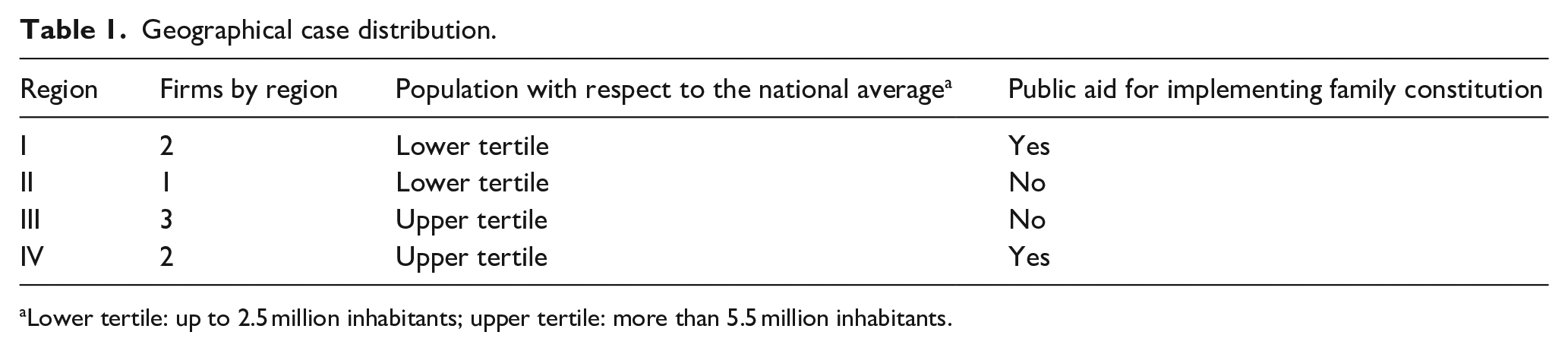
Lower tertile: up to 2.5 million inhabitants; upper tertile: more than 5.5 million inhabitants.
In order to identify the firms of interest, we contacted university chairs specializing in family business and regional family business associations and consulted various sources of information, such as the press and relevant websites. The family firms interviewed must have had a family constitution for at least 2 years, to ensure that they have sufficient experience of them. We were looking for representative cases of private family firms. We considered private family businesses to be those with more than 50% of the firm owned by a family, as did Crespí and Martín-Oliver (2015) and Hernández-Linares et al. (2020) in Spain, Molly et al. (2012) in Belgium and Luxembourg, and Ang et al. (2000) and Steijvers and Voordeckers (2009) in the United States, among others. With this percentage, the family has control in any case. The 50% threshold also ensures that there is only one family controlling the firm. The selection of cases also requires the second or subsequent generations to be incorporated. Thus, we consider what Miller et al. (2007) called true family businesses, those in which multiple family members are involved, either contemporaneously or over time. In addition, implementing a family constitution implies a certain level of business and family complexity (Suess, 2014), since it produces agreements between family members involved in the firm, so it will be useful from the incorporation of new family members to the business. At the lone founder stage, the conflicts that require an agreement between potential family stakeholders have not yet arisen. However, family governance mechanisms become more necessary as the number of family shareholders grows and their emotional cohesion and interest in the business weakens (Suess, 2014). We also selected family firms that have a goal of continuity as a family firm (Cabrera-Suárez, 2005; Chua et al., 1999). Initially, we looked for hints about that aim of continuity on the company website and in published interviews with family members. In all cases, this goal of continuity as a family firm was confirmed in the subsequent personal interview.
Table 2 summarizes the characteristics of the cases analyzed with respect to the age of the firm, activity sector, size according to income and number of employees, latest generation incorporated, and family branches.
Characteristics of the family firms interviewed.
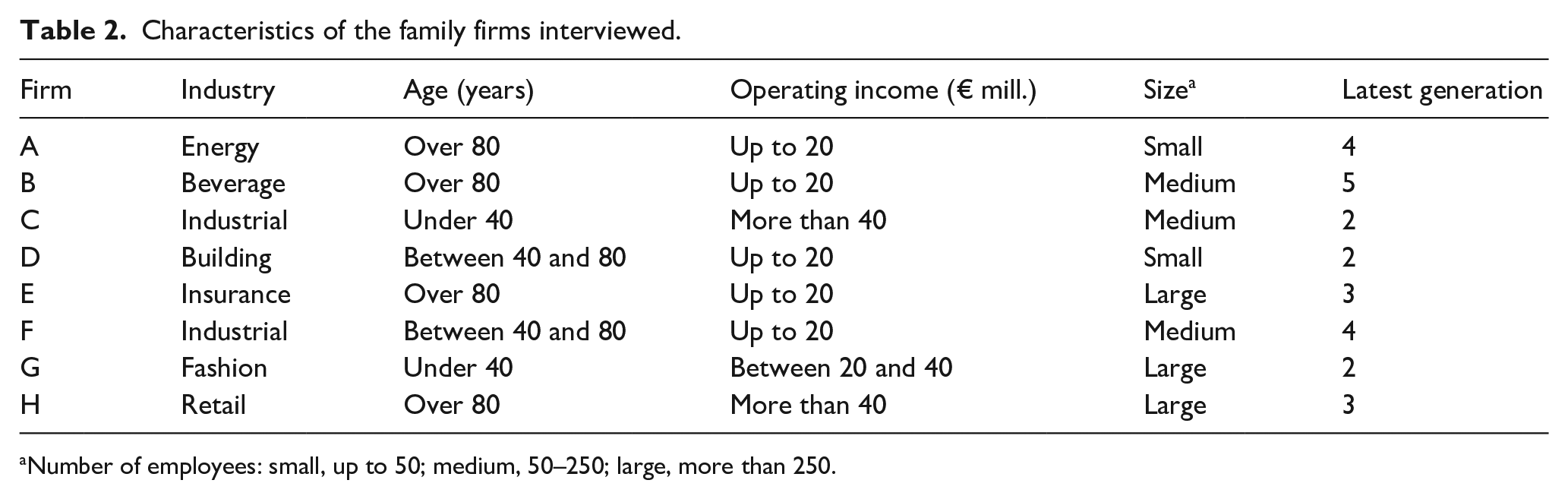
Number of employees: small, up to 50; medium, 50–250; large, more than 250.
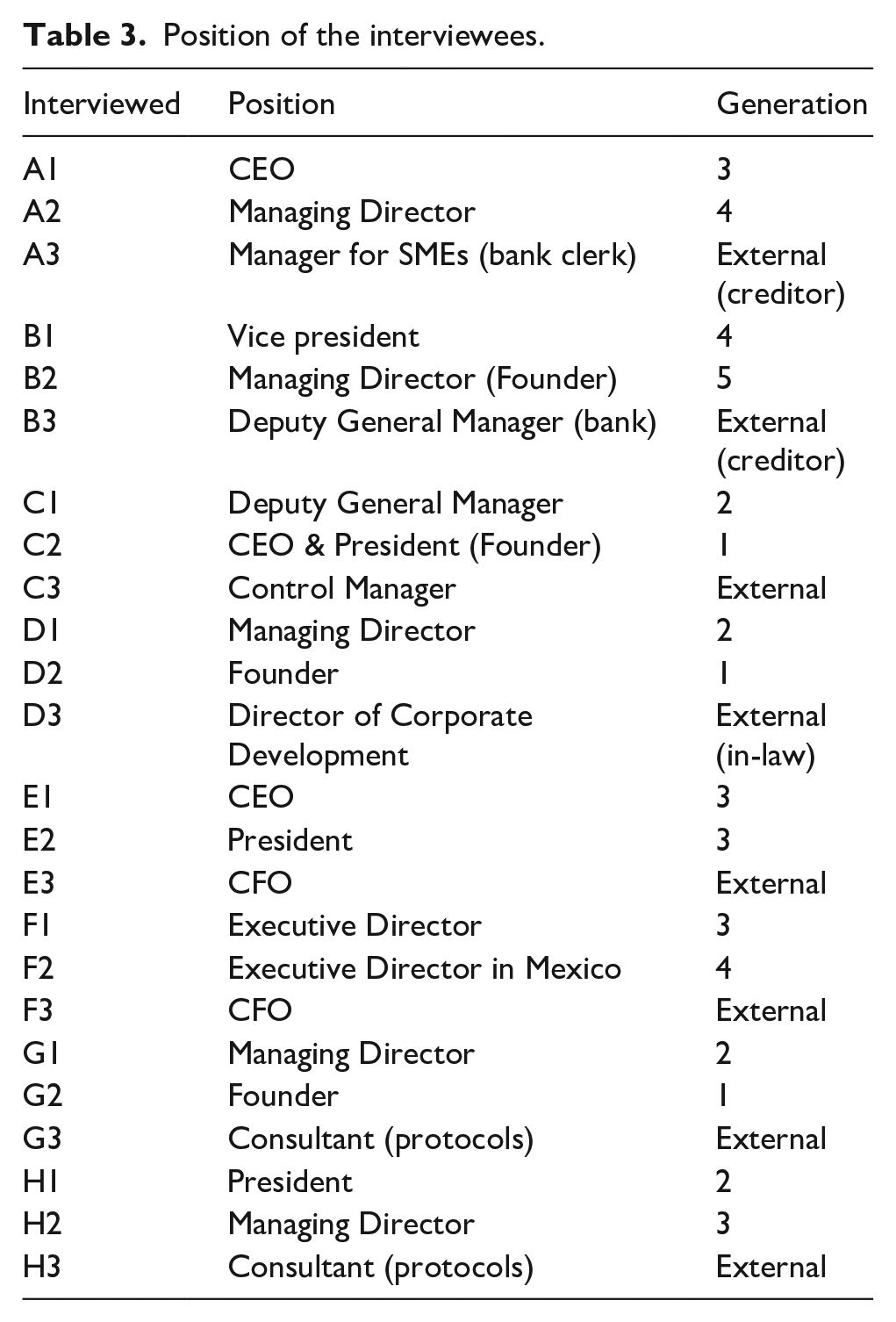
We collected relevant information about each firm, consulting public sources of information, such as web pages of firms and their business environment, publications on the history of each company, as well as the Iberian Balance Analysis System (SABI) database about firms’ financial statements. Subsequently, we performed three semi-structured in-depth interviews in each firm (24 interviews in total), in order to triangulate and reinforce the validity of the results. In each company we interviewed two family managers or members of the board of directors of different generations involved in the protocol (except in company E, in which only the third generation was active). In each case we also interviewed a non-family member, linked to the firm as a manager, bank officer, or family business consultant. Table 3 details the positions of the interviewees and the generation they represent, or their relationship as an external. The different profiles and family generations of the interviewees contributed to the robustness of the research.
Position of the interviewees.
Data collection and analysis
First, we interviewed a family member from each company, between June and November 2019. Before each in-depth interview, we specified the topics to be addressed with the interviewee and we signed a confidentiality commitment. The validation interviews, with another family member and a non-family member, were conducted between June and September 2020. This time difference between the two rounds of interviews in each company also allowed us to delve into issues which emerged in the first interviews. The interviews investigated the content and usefulness of the family constitution for managing conflicts in the family firm. The questions of interest were organized into five major topics:
(1) Family constitution: reasons for implementation, process, most important content, characteristics.
(2) Professionalization (family and non-family managers): requirements for family members to join the firm.
(3) Shareholder agreements: deals and limitations on ownership transfers, blockholders, and minority shareholder protection agreements.
(4) Relations with creditors: mission, values, shareholders’ commitment, long-term goals.
(5) Corporate and family governance agreements: usefulness of the board of directors and the family council (characteristics, performance, and utility).
Each interview lasted between 1 and 1.5 hr. We carried out half of the interviews by telephone and the other half in person. We addressed emerging topics during the interviews in order to delve into the specific circumstances of the implementation of the family constitution. We recorded most of the interviews and transcribed them within 6 hr of completing them. Subsequently, we reviewed the content of each interview to check the consistency of the interpretation. Likewise, we sent a draft of the article to the interviewees, to check the correct interpretation of their contributions. The aim of the research is the generalization of a theoretical framework (analytical generalization) and not the mere enumeration of frequencies of a sample (statistical generalization). The purpose of the research is to develop a logic that can be transferred to other cases (Yin, 2003) about the usefulness and content of a family constitution.
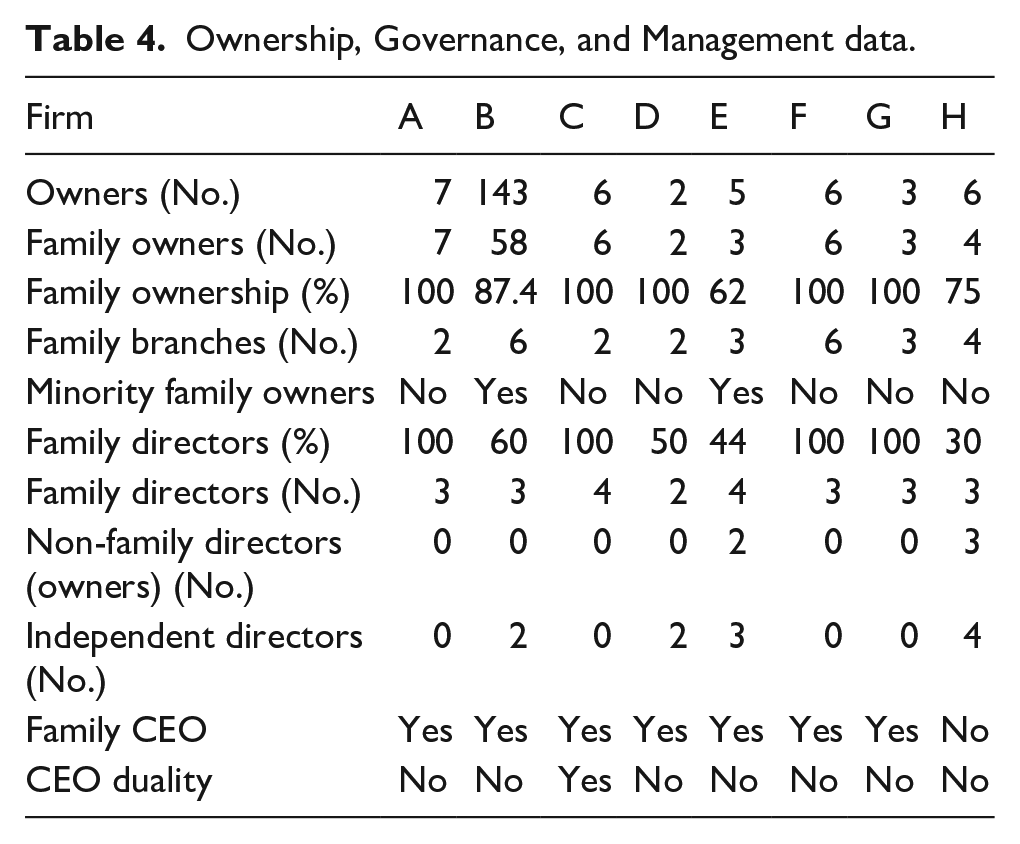
We also investigated firms’ ownership and corporate governance structures, as summarized in Table 4. In five of the firms, 100% of the ownership belonged to the family, and it was over 60% in the remaining three cases (two of these also had some minority family shareholders). The board of directors had independent directors in all firms that had some non-family owners, but only in one of the 100% family-owned firms. Seven out of the eight companies had a family CEO. Only one firm had CEO duality.
Ownership, Governance, and Management data.
In the following section, we show contextual descriptions and quotes from the interviewees to examine the usefulness of the agreements included in the protocols. The information was simplified before being organized, producing tables and texts that make it easier to analyze the collected data. We also examined the circumstances of the family firm when it decided to develop the family constitution, the family generation that promoted it, and whether there were problems of professionalization or family conflicts before and during the discussion of the protocol.
Results and discussion
Analysis of the in-depth interviews provided important information about factors that encourage the implementation of a family constitution and the usefulness of the agreements in managing agency conflicts. All of the family constitutions examined included clauses on the professionalization of the family firm, the protection of shareholders, the continuity of the firm, and the development of family governance and corporate governance bodies.
Circumstances that promote the implementation of a family constitution
Despite the growing amount of research devoted to family governance, there is no consensus as to why family firms decide to implement family governance mechanisms (Suess, 2014). The interviews we performed allowed us to identify the main reasons and circumstances that motivated implementation of family constitutions. We asked about who promoted it, which generation it was implemented in, and what the reasons were for deciding to develop a family constitution. We also asked about the development process and how long the signed document was.
The main driver for implementing a family constitution was succession in almost all of the cases examined, in particular, the first succession process with more than one family candidate. The generational change in family businesses often causes a level of stress in the family and in the company that affects the dynamics of both, generating conflicts, lack of competitiveness, and loss of resources (Pavón, 2018). Table 5 shows interviewees’ observations about the reasons for starting the process, when they chose to do it, and the aims. Most firms decided to implement the protocol immediately after a succession process due to organizational problems and fear of decision-making that emerged. Successors pointed out problems of a lack of professionalism, hierarchical disorder, and difficulties in decision-making. Only three companies implemented family constitutions prior to succession. In two of those three companies, the interviewees said that the main reason for implementing the family protocol was to facilitate a smooth, professional transition:
It was necessary to resolve a situation of hierarchical confusion where everyone is dedicated to everything. My father was still making decisions, me too, so there were three different opinions on the same issue. (D1)
Reasons for implementing the family constitution.
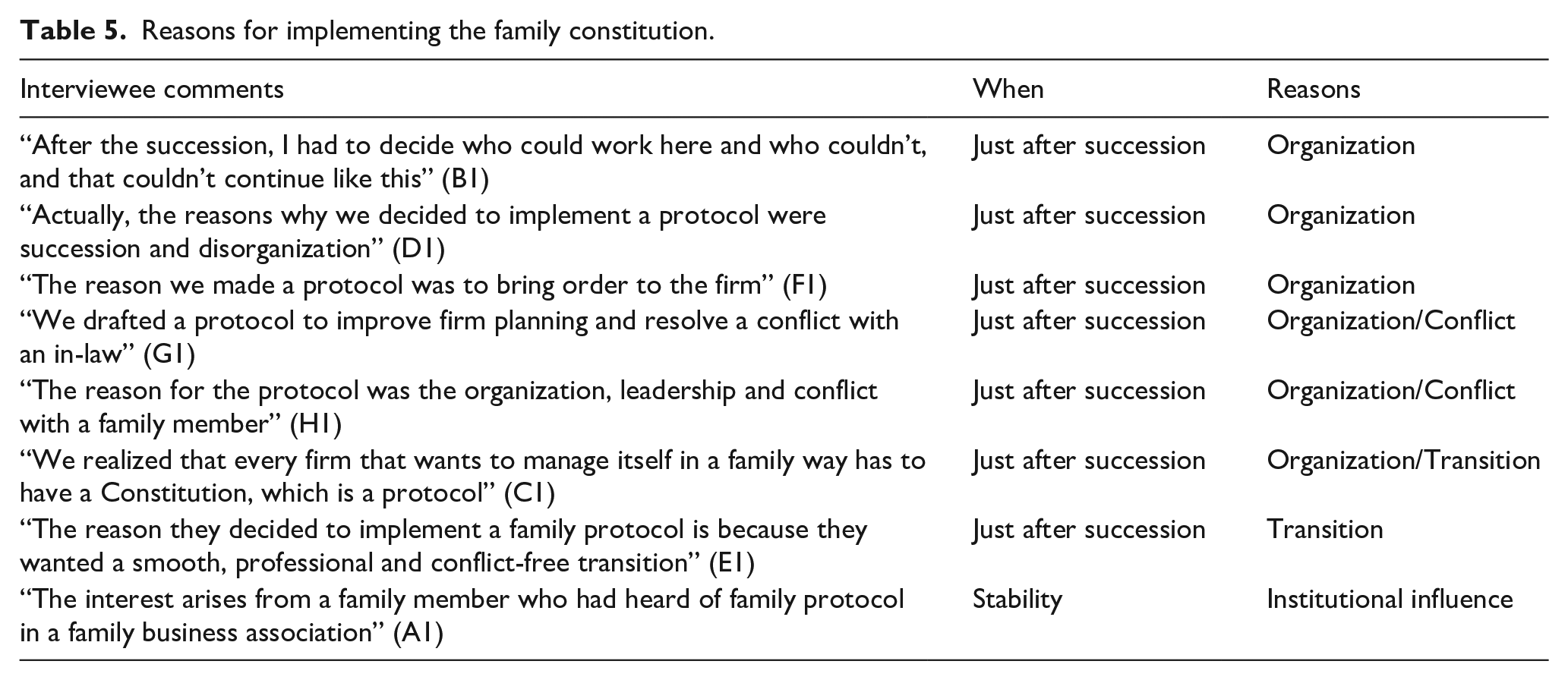
The initiative to implement a family constitution started from the second generation in most of the firms examined. In only two cases were the founders the promoters, and in only one was a relative not involved in the management of the firm. When the third or subsequent generation took the initiative, the complexity of those firms was similar to that of a second-generation firm, because the shareholders were the only children, explaining the absence of conflicts between heirs.
The discussion of a family constitution can generate conflicts that threaten the continuity of the firm. In three of the cases, the process of drafting the protocol gave rise to family tensions. In two cases, the conflict ended with the sale of shares by a family branch and ownership restructuration. Although interviewees indicated that developing a family protocol is demanding, all of them agreed that the effort was worth it:
Significant effort for two years, without knowing very well what a family constitution was, with doubts about its usefulness and with meetings on Saturdays, sometimes until eleven at night. Without a doubt, the result is worth it. (A1) The writing of the protocol generated differences in the family. (B1) The process of implementation was delayed due to conflicts between family branches. Finally, a family branch acquired all the shares and the protocol drafting process was restarted. (A1) The implementation of the protocol generated tensions in the family and also in the family firm. (C1)
It is interesting to note the importance of a consultant in Firm B to remove differences and motivate family members into participating in the writing of the family protocol:
Another consultant was contacted who got the interest and support of the most reluctant family members to implement the protocol. (B1)
Although the process of the family constitution has a risk of failure that can affect family relationships inside and outside the business (Montemerlo & Ward, 2011), in two cases the protocol discussion process resolved conflicts before implementation:
During the discussion of the protocol, a conflict between one of the siblings and an in-law who participated in the management of the firm was resolved. (G1) The development of the protocol allowed the resolution of a conflict between a descendant and the rest of the family. (H1)
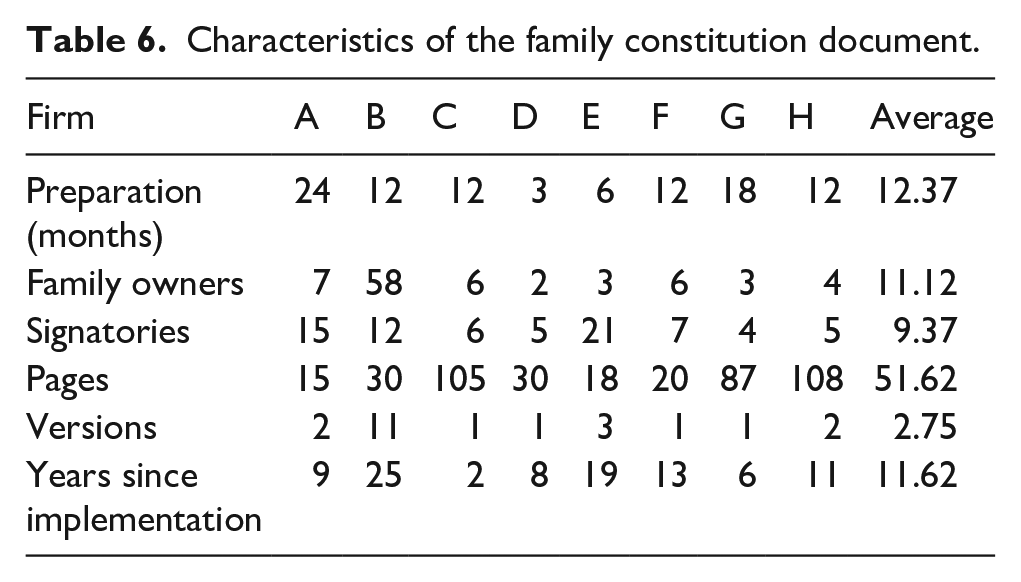
Table 6 summarizes the data related to the drafting of the document in the firms examined, time taken to draft it, number of family owners and signatories, length, versions, and age of the family constitution. The average family constitution needed 12 months for implementation. The average length was 52 pages, with the shortest being 15 pages long and the longest 108 pages. The numbers of signatories varied considerably, averaging 9 but ranging between 4 and 21. Although the signing of the family constitution is voluntary, all family owners have signed it, except for company B, which has 58 family shareholders (out of a total of 143 owners). The high number of owners in this case meant that only representatives of each family group signed the protocol, 12 in total. However, at present, this company has initiated a process for all family owners to sign the protocol. The decision to sign the family constitution shows the interest and motivation to be part of the agreements adopted, despite the difficulties and effort required for its implementation. In some companies, in addition to family shareholders, the protocol had been signed by non-owner family members of legal age, including some in-laws and members of the previous generation who had already transferred ownership to their successors.
Characteristics of the family constitution document.
Regarding the content of the agreements, the most important issues addressed by family constitution in the firms interviewed can be grouped into:
(1) Agreements on criteria for family participation in the management teams.
(2) Agreements regarding the transfer of ownership.
(3) Development of family and corporate governance bodies.
The interviewees concurred, highlighting these three topics as the most important in family constitution. Next, we look more deeply at the content of these agreements, examining their usefulness for managing conflicts of interest and agency problems in family firms.
Usefulness of family constitution in reducing conflicts with managers
The incorporation of training and experience requirements for family members who want to participate in the management teams limits owners’ nepotism in the selection of managers and promotes professionalization of the firm. These agreements are especially important in firms with a family successor, since the altruistic behaviors of parents can encourage nepotism and a lack of professionalization (Caselli & Gennaioli, 2013).
The interviewees agreed that the implementation of a family constitution promoted the professionalization of the firm. All of the family protocols examined included training and experience requirements for family members to participate in the firm’s management teams. In some cases, the family constitutions detailed the minimum age for inclusion and even a required level of a second language:
Minimum age 25, degree and masters qualifications. Experience between two and five years in another firm (preferably in a related sector). Second language advanced level and third language medium level. Incorporation into a rotating training program. (H1)
The family members interviewed agreed that they would not lower the requirements. They all preferred a family successor, but if there is no one who meets the required training criteria, they will agree to hire an external manager:
The protocol establishes that family members who work in the firm have to demonstrate professional performance to continue in the family business. (B1) In the next ten years we will have to incorporate a third-generation family member into the management, God willing!, but it is not essential. (D1) We deem that it is important to choose well, by meritocracy, and that it will not be a problem if in the next generation we have to resort to external professionals. (E1)
Regarding the incorporation of in-laws into the firm, most family constitutions specifically prohibit their participation in management teams. Most of the interviewees did not consider in-laws as part of the family firm. They agreed that the participation of in-laws in firms increased the risk of conflicts in the family. Their participation is only allowed in three cases, if they meet certain training and experience requirements:
It would be very difficult for me to argue with a family member and go to eat at his/her house on Sunday. I think limiting access for in-laws is very good for preserving family life. (F1) The in-laws are not Relatives. They can access the firm, but under the same conditions as an outsider. (B1) In-laws may work in our group of companies as long as they meet the following requirements: that their job position is designed, that their functions are specified, that they have appropriate training for the position and that they are monitored by external directors. (D1)
In short, the family constitution establishes procedures that promote the professionalization of the firm:
Of course, the family constitution promotes the professionalization of the firm due to the demands of training and experience. (A1) The protocol favours professionalization because it establishes management systems that, although very common in large companies, are not so much in family businesses. (C3) Yes, the protocol promotes the professionalization of the firm through the development of standards and the strategic plan. (G1)
Non-family managers we interviewed stated that family constitution clarified the career plans of family and non-family members. They also felt that the demanding requirements agreed in the protocol for positions of greater responsibility and remuneration were a great professional incentive for them, because it limited access to managerial positions for family members who did not meet those demands. The usual business continuity agreements were another motivation for non-family managers to align their goals with those of the business:
The training and experience requirements agreed in the family protocol guarantee that the positions are not decided only by the family relationship. (D3) The existence of a family protocol also gives us non-relatives a future perspective. Just as the continuity objective gives banks confidence, it also gives security to non-family members. (C3)
According to the above, we propose that the family constitution improves the professionalization of the firm and limits nepotism, positively influencing the resolution of agency problems between managers and shareholders:
Proposition 1.a. Family constitutions promote the professionalization of the firm.
Proposition 1.b. Family constitutions reduce conflicts between shareholders and managers.
Usefulness of family constitution in reducing conflicts between shareholders
The interviewees highlighted the importance of family constitutions in regulating the relationship between shareholders. The family constitution develops agreements to avoid conflicts between “blockholders” in different branches of the family and contains clauses for the transfer of ownership, in addition to protecting minority shareholders.
The family constitution includes clauses of representation and defense of the shareholders’ interests. In most companies, each family branch has a similar share in the board of directors. Owners usually discuss their concerns informally in their family branch, whose representatives forward the proposals to the appropriate governing bodies. In some cases, the protocol establishes a minimum percentage of shares of stock to constitute a new group of family members:
Each owner is represented and protected by his/her family group. (B1)
In most firms, family constitutions agreed limitations on ownership transfer, through clauses related to matrimonial property regimes, and inter-vivos or causa mortis ownership transfers. The objective of these agreements was to retain family ownership. Although the relatives were free to sell their shares, the constitutions established agreements in order for property to remain in the family:
We do not want the family firm to be a mousetrap that cannot be left. (E1)
The most common agreements referred to the right of first refusal by the rest of the family, although sometimes they began with the seller’s family branch and continued with the other family branches. Share valuation agreements were also frequent in the event of an “exit.” The agreed value per share is what the firm would pay the owner who decided to leave the firm. This valuation was to be reviewed annually and did not correspond in any case with the market value of the shares, but was agreed by the owners, as were the payment terms. The firms guaranteed the purchase of the shares under the agreed conditions; therefore, they did not establish liquidity premiums. The aim of these agreements is to retain ownership control and avoid decapitalization of the firm if any partners depart. Two of the family constitutions included tag-along and drag-along anti-lock clauses. Tag-along agreements allow minority shareholders to sell under the conditions agreed by another owner. Drag-along agreements protect majority shareholders’ interests, as they guarantee the right to drag other shareholders after a sale agreement to a third party.
The family constitutions examined established anti-block mechanisms to avoid paralysis of the governance bodies and abuse by some of the parties. Blockades occur when it is not possible to achieve the necessary majorities to reach agreements in the normal course of events. In all cases they established anti-blocking mechanisms through qualified majorities, and in cases where there were only two family branches, through the casting vote of the president. In one of the family protocols with two family branches, they agreed that to avoid blockages, one of the branches would have 51% of the ownership and this dominance position would pass to the other family branch in the subsequent generation:
We have defined how to resolve blocking situations through mediation and arbitration. Now that we get along very well, we have decided what to do when we would get on badly. We have also agreed on a penalty system. (C2) So far there has been no problem of blocking decision-making, but if that were the case, we have agreed in the family constitution that the owner of the 1% could unlock the agreement. (D2) Family protocol establishes that decision making has to be by consensus. If consensus is not reached we are obliged to try again. If it is finally impossible, the President will decide, who has a casting vote. (F1)
Companies with few owners do not have minority shareholders, but ownership is distributed equally. The firms with some minority shareholders indicate that there are no conflicts between majority and minority owners, since they can approach the representatives of their family branch if they believe that their rights are being violated. Only one of the interviewees indicated that the dividend distribution could be an annual source of discrepancies with minority shareholders. But, transparency and information about the goals and growth plans of the business facilitated understanding between all shareholders.
Shareholder protection agreements and their importance in all of the cases examined are consistent with the following proposals with respect to the usefulness of family constitutions in reducing agency conflicts between shareholders:
Proposition 2.a. Family constitutions reduce conflicts between blockholders.
Proposition 2.b. Family constitutions reduce conflicts between majority and minority shareholders.
Usefulness of family constitutions in managing conflicts between family shareholders and the family at large
Family constitutions usually agree on other family governance mechanisms, which encourage decision-making and communication between family members. Family governance generates areas for discussion and resolution of family conflicts and limits interference in decision-making.
Before the implementation of the family constitution, none of the firms had established a family council. The interviewees valued its usefulness in promoting communication, cohesion, and avoiding interference in the firm. One of the interviewees summarized the usefulness of the family council saying,
The greatest utility of our family council, which we have always encouraged, is creating, maintaining, and promoting family-firm and firm-family cohesion. (A1) The family council has improved communication. We aim that neither minority, in-laws nor passive owners can significantly influence the firm’s decisions. (E1) A family constitution does not favour communication, but a family council does. There is undoubtedly a risk of interference in the management of the firm, but the family constitution limits this interference. (G1)
Once family councils were established, their agreements are given particular importance.
Decisions will depend on the family council at the request of the board of directors. (F1) One of the aims of the family constitution is to improve communication. The family council allows us to know the concerns of the family members. However, it cannot be denied that there may be attempts to influence decision-making. (B1)
The family meeting or family assembly is another family governing body in which the entire family participates. Its mission is to report on the progress of the firm, for the family to get to know each other and transmit the values and contents of the family constitution. The family assembly is generally held in the firm, to provide space for the whole family to meet and to show the facilities to the younger generations. Some interviewees pointed out that their meetings take place in the family home. There were family assemblies in five of the eight companies examined. In the other three, the interviewees said that they were still firms with few family members, so the members of family assemblies would be almost the same as in the family councils. Family assemblies are very useful for promoting unity, communication, and interest in the firm’s activities among family members, especially the youngest. In one case, they even created a junior committee with activities linked to a small budget, to promote interest in the firm for new generations. Family cohesion and the transmission of values are extremely useful for aligning interests, reducing conflicts, and facilitating generational change. In the family assembly, they propose topics for debate in the family council. It is an opportunity for all family members to express their ideas, both those who work in the firm and those who do not.
The family protocol may also contain agreements regarding the relationship with the management team and the board of directors, to avoid interference:
If you don’t work in the business, you can’t make decisions. You have to delegate your vote to a relative who works in the firm. (C2) The main contribution of our protocol to avoid tension and interference in management is the agreement not to hire in-laws. (F1)
Thus, we see that the development of family governance bodies promotes organization, communication, the transmission of values, and decision-making. Although the attempt to interfere may be inevitable, the family council and the family meeting are the main frameworks for communication and transmission of values in the family firm. These family governance mechanisms limit the scope of possible interference and reduce conflicts between family members. Based on the previous arguments, we make the following propositions:
Proposition 3.a. Family constitutions favor communication in the family.
Proposition 3.b. A family constitution reduces the interference of relatives from outside the firm.
Usefulness of family constitutions in reducing conflicts with creditors
The protocol is a private family document. In Spain, the content of the family constitution or its existence can be published in the Commercial Register (Royal Decree 171/2007), but companies rarely do so. The interviewees stated that they did not usually inform the banks either. In only two of the cases we examined (Firms B and C), did the creditors know that the family had implemented a protocol. The ignorance on the part of the creditors prevents them from assessing the agreements included in the family constitution:
Creditors don’t know that we have a family protocol. It is something internal. (A2) No one has asked us about the protocol. (F1)
Although bank creditors sometimes hold a seat on the board of directors (Fama, 1985; Kaplan & Minton, 1994), this was not the case in any of the eight firms studied. Nor have these companies received proposals from the banks to participate in ownership. The two banking professionals interviewed indicated that
The involvement of the bank in the ownership and on the board of directors can generate a conflict of interest, in addition to limiting the financing to a single creditor. (A3) As a general rule, I consider it an error for the bank to participate in the ownership or on the board of directors of the firm, although obviously each specific case must be analysed. (B3)
Almost all of the firms had long-term multi-banking relationships with between 2 and 6 banks simultaneously, with gradual incorporation of new financial entities. Only one of the companies was financed by a single bank. In all cases, the main creditor belonged to the top five Spanish banking groups. The level of indebtedness of these companies was between 25% and 50%. Family members interviewed highlighted the personal frequent interaction with bank officers:
The banks we work with know the firm and its managers very well. That gives them a guarantee and that there is continuity from parents to children. (D2) We usually work with the same banks. They know the firm and the managers very well, but they do an independent borrower risk assessment of each operation. (D2)
All the interviewees agreed that the family status of the firm encouraged agreements with creditors. Family values are expected to be aligned with the interests of creditors, which improves access to financing and its conditions:
Lately, it is highly valued to be a family business. They consider us strong, long-term organizations. Financial institutions are more aware that the family business has an added value. (D1) Being a family firm positively affects the relationship with creditors. Most family firms have rooted principles, seriousness and a will for continuity. We have been working with some suppliers for forty years. (F1)
Creditors pointed out that banks were always interested in learning new information about companies and their managers, decision-making criteria, family situations, training, experience, or the proximity of a generational transition. They also appreciated firms informing the bank of the existence of a family constitution, as it is a sign of continuity of the business. This encourages them to grant loans, although it does not influence the financing conditions:
The risks assumed by financial institutions must be based on trust and transparency between the bank and the client. Companies should communicate and value the existence of the protocol. (B3) The protocol is useful information for the bank, favourable for granting financing, although not for financing conditions. It also reduces uncertainties about the succession. (A3) Undoubtedly, one of the aspects that concern financial institutions in long-term risk analysis is the succession of the business, especially in family firms. The existence of a family constitution favours the continuity of business in an orderly and structured way. (B3)
Therefore, the case analysis we performed does not allow us to conclude that a family constitution improves the agency relationship with creditors. However, the information provided by the interviewees has important practical implications, as we detail in the concluding section. In brief, knowing that the firm has implemented a family constitution would convey positive information about business continuity to creditors.
Proposition 4. The general ignorance of the existence of a family constitution means that creditors are unable to positively evaluate its content.
Conclusion
The unique characteristics of family firms warrant specific mechanisms for family governance, which can make a difference to their success (Mustakallio et al., 2002). The supervision and monitoring role of boards of directors is not enough. Family governance mechanisms, primarily referring to family meetings, family councils, and family constitutions, order the family’s relations with the business and contribute to family unity and conflict resolution (Mustakallio et al., 2002; Suáre & Santana-Martín, 2004; Suess, 2014). Family constitutions are the least researched of the three family governance mechanisms (Suess, 2014). We have to bear in mind that reliable information on family protocols is extremely difficult to obtain, since it is private and confidential information of the family owners. Starting from agency theory and previous literature pointing out that family constitution aims to prevent or solve conflicts (Berent-Braun & Uhlaner, 2012; Brenes et al., 2011; Suess, 2014), this research examines which conflicts are effectively mitigated by the different protocol agreements.
We performed a qualitative analysis using a case study methodology, in order to focus our attention within family firms. The research identified succession as the main trigger for the development of a family constitution. The interviewees agreed that succession revealed organizational problems in the management of the firm related to a lack of planning, hierarchical disorder, and fear of decision-making. This explains why some of the most important content in the family constitutions are the professionalization of the firm and the development of family governance bodies.
Our research confirms family constitutions as a valuable mechanism for family governance, in particular to manage conflicts with the managers, between shareholders, and with the extended family. The most intriguing finding is that creditors are generally unaware of the protocol’s existence, hindering its potential positive effects. However, the banking professionals interviewed highly value that family firms implement a family constitution. The family protocol signals the aim of continuity of the business in an orderly and structured way, which is of great interest to the creditors. In addition, the protocol favors the professionalization of management, since it establishes requirements for family members to join the firm. This is a key issue for the bank in credit risk analysis, along with a successful generational transition. What is relevant for the bank is not whether or not the firm is family-owned, but whether it has professionalized management and continuity.
Our study shows that family constitutions usually reach agreements on training and experience requirements for managers, on ownership transfers, and on the development of other family governance mechanisms. The interviewees stated that the agreements on training and experience for family members to join the firm promote professionalization, limit owners’ nepotism, and reduce conflicts between shareholders and managers. The family members also noted that family constitutions develop agreements on ownership transfers, which mitigate conflicts related to firm exits, inheritance, and the participation of in-laws in ownership. The agreements include drag-along and tag-along clauses, inter-vivos and causa mortis transfer of share agreements, share valuation, and payment method if a family member or group requests to sell their shares and exit agreements with right of first refusal clauses. Likewise, the interviews revealed key issues in family constitutions that prevent extended family interference, in terms of the development of other family governance mechanisms, such as family councils and family meetings, which open areas of communication, exchange of opinions, and transmission of values, promoting family cohesion and the continuity of the firm.
Contributions
This research contributes both to the literature on family governance and to agency theory. First, we contribute to the literature on family governance, by investigating how the agreements on family constitutions mitigate the main agency conflicts, that is, conflicts of family owners with managers, between family shareholders, with the extended family and with creditors, taking into account the unique nature of family ownership. Our findings broaden the understanding of the least studied of the three main family governance mechanisms (Suess, 2014), which, as we saw, promotes the other two mechanisms in turn: family councils and family meetings. The qualitative analysis, which is also underrepresented in research into family governance mechanisms (Suess, 2014), allowed us to deepen our knowledge of the characteristics of the protocol and its effectiveness in reducing conflicts in family firms. Our findings also shed light on the reasons for implementing family governance mechanisms (Suess, 2014), with succession being the main driver of the family constitution.
Second, we contribute to the incipient study of the agency problem related to relationships between family shareholders and the family at large (Villalonga et al., 2015). This is an additional conflict specific to family firms, relating to interference in the business decisions of passive shareholders and extended family. The implementation of the protocol helps mitigate this type of conflict, by promoting information and communication between family members and channeling their demands. We also examined the usefulness of the family constitution as a tool to mitigate other agency conflicts in family firms. While the family protocol achieves to mitigate conflicts among family shareholders, with the extended family and with managers, the same does not occur in their relationship with creditors. Family firms often do not inform creditors about their family constitutions. However, creditors point out its potential usefulness as a hint of orderly and structured continuity of the business.
Third, we respond to the increasing calls for deeper research on private family firms (Carney et al., 2015). Although most family firms are privately held, studies on listed family firms predominate. Private family businesses have largely been underrepresented in research because of the limited availability of data. But agency conflicts for listed firms have their peculiarities, due to the control exercised by the stock markets. Therefore, the conclusions drawn from listed family firms may differ from those derived from the study of privately held family firms. Likewise, qualitative research on family governance is scarce (Suess, 2014). Our research contributes by providing new qualitative evidence on family governance practices in private family firms.
Practical implications
Our findings have several practical implications for family owners and practitioners, summed up in the usefulness of implementing a family constitution and communicating its existence to creditors. Family business leaders and owners should promote appropriate family governance systems. The results of our qualitative research advise family firms to develop family protocols to favor their professionalization, minimize conflicts between shareholders, and avoid family interference in the business. Key agreements include training and experience terms for family members to join the firm, transfer clauses of shares inter-vivos and causa mortis, and the development of other family governance mechanisms, such as family councils and family meetings. Our research finds a great shortcoming in the disclosure of family protocols to creditors. A family constitution could improve the firm’s relationship with creditors, but this does not happen because creditors are not aware of it. The banking professionals we interviewed indicated that it should be the companies that communicate and stress the value of implementing the protocol. It makes the business’ continuity more credible, improving the perception of its creditworthiness. They also recommend developing the legal regulations, in relation to the commercial register, to be able to reliably incorporate this information. This would be very helpful. Our findings also speak to loan officers, pointing to the usefulness of inquiring about the existence of a family constitution in their personal interactions with managers. Agreeing on a family protocol generally shows a stronger commitment to the continuity of the family business, which is relevant soft information for assessing borrower risk. They usually incorporate succession plans and agreements on shares sale and financing. These agreements between shareholders in the protocols are especially useful to ensure their commitment in downturns. Our results also have implications for policymakers in designing the mechanisms to support the continuity of family businesses, which are key for national economies. Policies aimed at granting financial aid to implement protocols will be of interest. Likewise, it is advisable to promote knowledge of family constitutions and their characteristics by family owners and managers, business consultants, creditors, and business associations.
In Spain, there is an interesting regulation in favor of the disclosure of family protocols, though it is little known or used. The Royal Decree (Act) 171/2007 (9 February 2007) regulates the voluntary publication of family constitutions. This law establishes three levels of publication of family protocols through the Commercial Register, namely: (1) mention that the firm has a family constitution, (2) register all or part of the protocol with the annual financial statements, or (3) public registration of some of its agreements. This experience may inspire the design of similar regulations in other countries. We also encourage policymakers to spread the knowledge of these tools to companies, consultants, and creditors.
Future research
Despite the legal support, the lack of disclosure regarding the existence of a family protocol by its signatories leads us to pose new research questions, which future research might address. Does the goal of SEW preservation make it preferable not to report on family constitution? Concern for preserving family control of the firm is a critical element of family SEW (Gómez-Mejía et al., 2007, 2011), which may advise against disclosing protocol information, considering it private. On the contrary, we also wonder whether the implementation of a protocol contributes to preserving SEW (Gómez-Mejía et al., 2010) or whether some protocol agreements (such as those making it difficult for family members to achieve managerial positions) erode SEW (Gómez-Mejía et al., 2010; Kellermanns et al., 2012). Which SEW components, in the “FIBER” sense (Berrone et al., 2012), enhance or erode the family constitution: family control and influence (F), identification of family members with the firm (I), binding social ties (B), emotional attachment of family members (E), and renewal of family bonds to the firm through dynastic succession (R)?
Limitations
Our research is not without limitations. These include the limitations of case study methodology, the selection of cases, and the interpretation of the data by the researcher. Moreover, Spanish firms may have a specific culture, which may influence the findings. In any case, the nature of case study methodology prevents extrapolation of the results. Although Spain is a particularly suitable setting for analyzing family constitutions, future studies could consider extending this research to other institutional environments. Another extension of our research would be to analyze whether the conclusions hold in firms where the family owns less than 50%, or the case of firms with several owning families, each of which could have their own family protocols. Likewise, future studies could provide statistical analysis in those aspects that may be quantifiable.
Above all, we hope to open a discussion about the usefulness and characteristics of family constitutions in promoting the continuity of family firms.
Footnotes
Acknowledgements
The authors gratefully acknowledge the Associate Editor, Maria José Sanchez-Bueno, and the two anonymous referees for their many insightful and useful comments that significantly improved the paper. We would also acknowledge Dr Manuel Pavón, a prominent expert in family protocols, for sharing his valuable professional experience, as well as the helpful participation of the family and non-family managers interviewed.
Declaration of conflicting interests
The author(s) declared no potential conflicts of interest with respect to the research, authorship, and/or publication of this article.
Funding
The author(s) disclosed receipt of the following financial support for the research, authorship, and/or publication of this article: This work was supported by the Spanish Science and Innovation Ministry (grant number PID2019-108503RB-I00).
