



Abstract
This article explores the extent to which the regional higher education system (HES) influences the location of foreign research and development (R&D). To do so, we use a dataset with information on the location choices of new foreign R&D establishments within Spain from 2005 to 2013. Similarly, we use a multiple measure of the three university missions, distinguishing between research capacity training, scientific research, and technology transfer. We find that the probability of a foreign R&D establishment being located in a region is positively affected by the strength of the region’s HES missions, and more specifically by the quality of its scientific research, while its research training capacity and knowledge transfer activities do not seem to play a significant role. Moreover, the strength of the research mission has a positive influence on the location choice of foreign units conducting research activities but is weak to explain the location of those performing development activities.
Introduction
A fundamental issue in economics is the spatial distribution of economic activity. In the past, the location of an industry was essentially influenced by the physical environment. 1 Cotton mills, for instance, thrived along the river Derwent in the late eighteenth century, while the Ford Motor Co. opened up a factory complex by the river Rouge in the late 1920s. Similarly, research and development (R&D) moved into laboratories, which were integrated within factory complexes. By the early twentieth century, Siemens had already established an R&D lab in a manufacturing plant. Yet, production methods have markedly changed since then. Supply chains have fragmented and become increasingly global (Dedrick et al., 2010).
In this scenario, corporate (basic 2 and applied) research, the “R” of R&D, has eventually slimmed down (Arora et al., 2018; Tijssen, 2004). This trend has been particularly evident in a technologically frontier economy such as the United States, where data from the National Science Foundation (NSF) indicates that the share of research performed by corporations has declined from 52.8% in 1960 to 39.5% in 2010 and has remained at that level thereafter. Although corporations are still keen on applied research, they are somewhat less willing to support in-house basic research, which is since long contracted out to universities (Añón Higón, 2016; Arora et al., 2018). In this regard, data from the NSF show that higher education institutions (HEIs) have become the largest performer of basic research in the United States. While 34% of basic research in the United States was conducted by universities in 1960, that share increased to 50.4% in 2010, remaining around this level since. Similarly, this pattern can be observed in the case of Spain, see Figure 1, where HEIs contribute to around 60% of all basic research and their relative importance has increased since 2004 in detrimental of business and other non-profit private entities. Thus, if basic research is essentially conducted in universities, the complementarities between corporate and academic research should influence the location of foreign R&D labs.
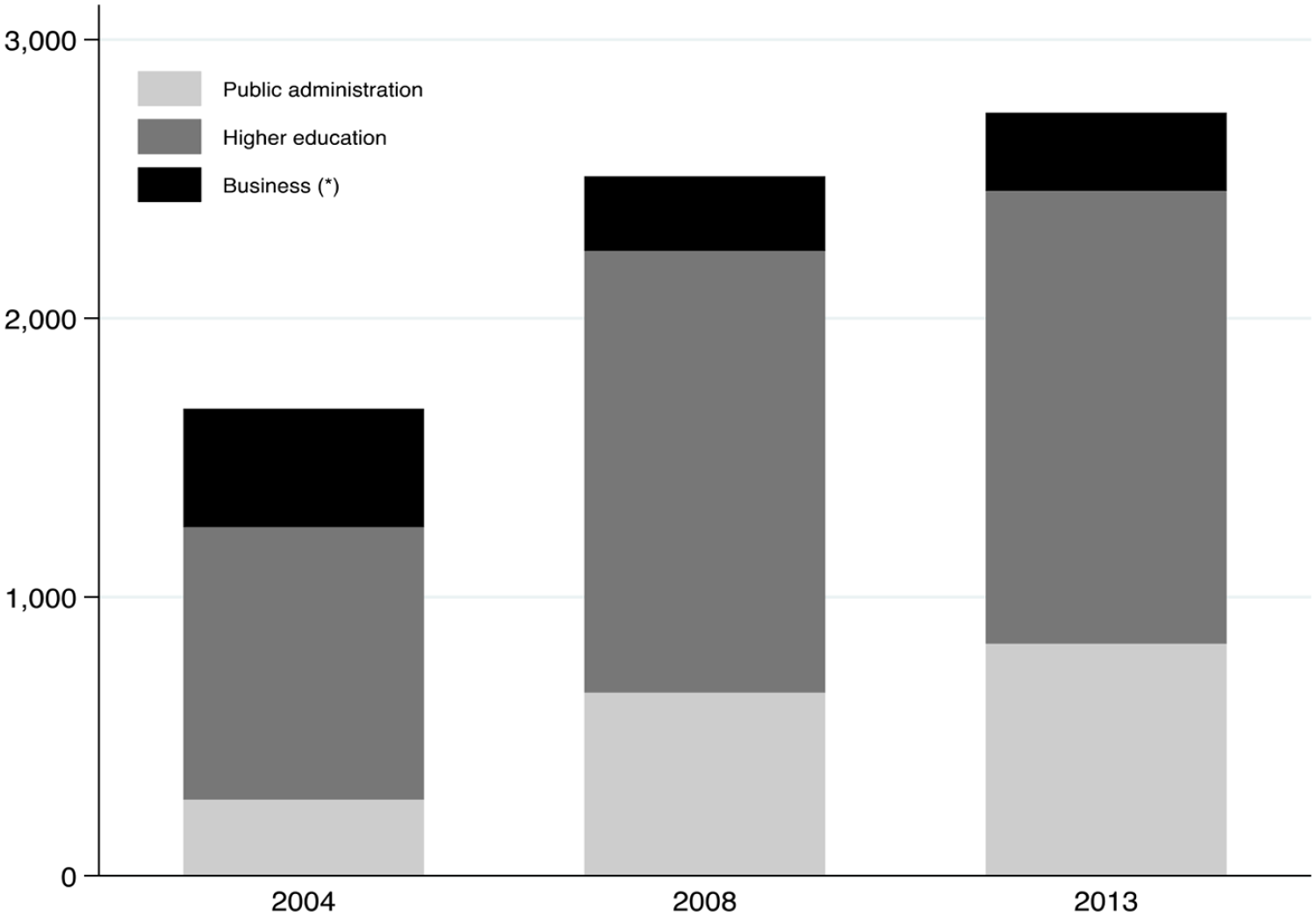
Basic research expenditure by performer type in Spain, 2004–2013 (millions of Euros).
Although there has been a widespread interest in the location choice of foreign affiliates (Barry et al., 2003; Crozet et al., 2004; Head & Mayer, 2004; Maza & Villaverde, 2015; Villaverde & Maza, 2015), the literature focusing on the determinants of R&D investments by multinational corporations (MNCs) abroad is scarcer. There are indeed some similarities with other downstream activities, but also differences regarding R&D-specific factors (Crescenzi et al., 2014). The well-documented internationalization of R&D nowadays responds more toward the need to tap into worldwide centers of knowledge, rather than to the traditional purpose of adapting existing technologies to host market conditions (Dunning & Lundan, 2008; Narula & Zanfei, 2005; OECD, 2008). As the importance of knowledge-augmenting motives for offshore R&D grows (Cantwell et al., 2004), the role of universities as “magnets” of foreign R&D investment is gaining interest.
In this context, this article aims at examining whether the higher education system (HES) has affected the location choice of new foreign R&D labs in a particular setting, Spain 2005–2013. In contrast to extant studies analyzing the role of universities as drivers of the location choice of R&D investments (Abramovsky et al., 2007; Alcácer & Chung, 2007; Belderbos et al., 2017; Siedschlag et al., 2013), we contribute by examining two issues rarely considered. First, and following Sánchez-Barrioluengo (2014), we look at the Spanish HES through the lens of their missions: teaching or training, research, and knowledge transfer, also known as the “third mission.” 3 Second, we also explore the potentially different effects that the Spanish HES may play depending upon whether firms conduct research or development tasks.
In doing so, this study exploits a dataset with information on the location choices of foreign R&D labs in Spain from 2005 to 2013, draw from The Technological Innovation Panel (PITEC). The location choice set is the Spanish NUTS2 (Nomenclature of Territorial Units for Statistics) regions. 4 We use a multiple-item measure of the three university missions with information published by the Observatory of Spanish University Research Activity (IUNE) on the quality of private and state-owned universities, which are then assigned to each region. Although the Ministry of Education still monitors the legal framework, it is worth mentioning that the Spanish HES has been gradually decentralized since 1983, when the Ley de Reforma Universitaria (LRU) was passed, thereby implying that public universities largely depend upon regional governments. 5 In addition, we follow previous literature and control for other factors that can influence the location choice, such as market potential or agglomeration economies, among others.
The remainder of the article is structured as follows. The theoretical framework, research questions, and contributions are introduced in the section “Theory and research questions.” The section “Data and methodology” describes the data and the empirical methodology. The findings are presented in the section “Findings.” Finally, the section “Concluding remarks” concludes.
Theory and research questions
The location of foreign R&D activities
The location of foreign affiliates has been recurrently studied (Basile et al., 2008; Cantwell & Piscitello, 2005; Crozet et al., 2004; Villaverde & Maza, 2015). Following the internationalization of R&D (Dunning & Lundan, 2008; OECD, 2008), an expanding literature has focused on the determinants of foreign R&D location (Belderbos et al., 2014, 2017; Shimizutani & Todo, 2008; Siedschlag et al., 2013). These studies conclude that the motives to locate R&D activities abroad differ from those related to other downstream activities (Crescenzi et al., 2014).
In this line of thinking, the international business literature has traditionally proposed two main reasons for conducting R&D abroad (Dunning & Narula, 1995; Kuemmerle, 1999). First, there is a “home-based exploiting” motive by which a corporation decides to invest R&D abroad to support foreign production and to adapt products and services to local market conditions. Still, it appears that nowadays offshoring R&D essentially follows a “home-based augmenting” motive (Cantwell et al., 2004). That is, MNCs locate R&D activities abroad to access local knowledge, including scientific knowledge from host universities, from which to tap into and source foreign technology to enhance or create new capabilities (Almeida, 1996; Kuemmerle, 1999).
The existing literature has found quantitative evidence for both motives. For example, it has been shown that large markets with high per capita income attract R&D investment, which in turn help companies to be at the forefront of consumer’s demands (Kumar, 2001). Similarly, the location choices for R&D have been influenced by the existence of a supply of skilled workers, such as scientists or engineers, and its wage cost level (Kumar, 2001). However, the contracted term “R&D” prevents from disentangling the inherent differences between research and development activities (Barge-Gil & López, 2014). In this regard, only a few studies have considered the different location drivers of both activities (see Shimizutani & Todo, 2008; von Zedtwitz & Gassmann, 2002). These studies found that while the internationalization of Research responds more to “home-based augmenting” motives, particularly to the technological strength of the host country, the offshoring of development activities is driven by the need to adapt products and processes to local conditions. To our knowledge, however, there is no prior study relating the regional strength of academic missions as location drivers of research versus development investments.
Universities and the location of R&D
The literature on innovation and economic geography has emphasized that proximity to HEIs or universities might benefit firms from knowledge spillovers (Anselin et al., 1997; Fitjar & Gjelsvik, 2018; Mukherji & Silberman, 2021). The mechanisms by which academic knowledge may spill out and benefit proximate firms are diverse and closely relate to the different missions of HEIs. On one hand, firms may benefit from proximity to universities by gaining access to a greater supply of skilled workers such as engineers, scientists, or consultants. This is indeed related to one of the main academic missions, teaching or training. Besides, the (basic) research generated in HEIs, the research mission, can be the platform on which business corporations base their applied R&D (Mansfield, 1995). University-based knowledge helps firms gain a better understanding of the technological landscape in which they search for new products and processes, informs them about the most profitable directions for applied research, avoiding wasteful experimentation, and helps them even to gain first-mover advantages (Añón Higón, 2016; Fleming & Sorenson, 2004).
Finally, knowledge transfers, namely the third mission, through formal collaboration agreements, contracted R&D, patent licenses, spin-offs, or consultancy are other relevant mechanisms. In fact, several studies have found evidence that contracting out academic research, and, particularly, collaborating with academia increases firms’ innovative performance (Acs et al., 1994; Añón Higón, 2016; García-Vega & Vicente-Chirivella, 2020). Thus, the interaction between academia and industry leads also to the development of local networks that spill knowledge out (D’Este et al., 2013).
Academic research is the first and most studied mechanism of knowledge spillovers originating from universities. Although academic research is codified through publications in specialized peer-reviewed journals, this codified knowledge may not be easily accessible. Understanding and leveraging this often requires a sound comprehension of the underlying basic research. Then, having access to academics or research groups can be extremely helpful in this regard. Moreover, a major source of competitive advantage comes from the ability to access and absorb academic knowledge before it is published or made public, and this may only be possible by co-locating in the vicinity of HEIs. Consequently, even firms whose main activity draw predominantly on codified knowledge tend to locate near HEIs (Asheim et al., 2007). Therefore, it is expected that places with HEIs generating frontier basic research might attract business corporations with R&D activities.
While there is substantial evidence that university–industry links enhance firms’ innovativeness (Añón Higón, 2016; Cassiman et al., 2008; Sorenson & Fleming, 2004), not much effort has been devoted to digging deeper into the specific factors by which the proximity to HEIs affect the corporate decision of offshoring R&D activities (exceptions being Abramovsky et al., 2007; Alcácer & Chung, 2007; Belderbos et al., 2014, 2017; Siedschlag et al., 2013). Furthermore, it is worth noting that HEIs are not all alike since they not just differ in resources but also in the relative importance conferred to their missions and in the quality of their research output. In this regard, existing evidence suggests that the positive effects arising from the local presence of HEIs mainly result from high-quality or frontier academic research (Belderbos et al., 2014; Cowan & Zinovyeva, 2013). Similarly, Zahringer et al. (2017) have shown that not all research has the same impact, being higher-quality academic research associated with higher-quality industrial innovation. Nevertheless, no prior study has explored the different roles that the academic missions play in the MNC’s location decisions of offshoring R&D.
Research questions
This review of the literature enabled us to frame the main research questions. First, we aim at determining the role of host universities as attractors of foreign R&D activities, controlling for other factors. Only a handful of empirical studies have examined this. In general, these studies have used different measures of academic strength, but the relative importance played by each of the missions of HEIs in attracting foreign R&D investment is ignored. For instance, Siedschlag et al. (2013) measure regional academic strength as a dummy indicating whether the region has at least one university ranked in the top 500 universities according to the QS World University ranking. Alcácer and Chung (2007) use a binary variable taking the value of one if the particular industry–region–year patent count from academic sources was greater than zero. In the study by Abramovsky et al. (2007), university strength is based on the ranking achieved by the university department in the 2001 UK Research Assessment Exercise. In the study by Belderbos et al. (2014, 2017), this is measured as the number of publications with university-affiliated authors at the level of NUTS1 region, or country, weighted by the probability that they are relevant to the technological field of the focal firm. All in all, these studies find a positive relationship between academic strength and MNC’s location choice.
We contribute, following Sánchez-Barrioluengo (2014), by explicitly introducing in the analysis the academic missions (teaching or training; research; and knowledge transfer) to empirically assess which specific mechanism is more relevant for the location decision of R&D affiliates. For this, we first derive regional indicators for the strength of each mission, which are linked to the mechanisms by which university-based knowledge spills out (Mansfield, 1995). Besides, and in line with previous studies, we assess the role of the research mission from a quantitative and a qualitative perspective since it is expected that higher-quality academic research will have a greater impact.
As pointed above, the three missions are related to different ways in which a foreign firm can benefit from proximity to local HEIs. Given the increasing importance placed by MNCs in offshoring R&D to access foreign knowledge, it seems logical to expect that the strength of the host regional HES, together with other home-based augmenting factors, will have an important attraction effect. In contrast, home-based exploiting factors will play a minor role. However, from a theoretical point of view, given that the three university missions have been regarded as channels of knowledge transfer, it is not clear which of them may exert a larger attraction effect.
Second, we also aim at shedding light on the location choice of different R&D tasks. Previous studies have paid relatively little attention to the possibility that the benefits from close proximity to universities differ across firms depending on the R&D activity. As stated above, R&D includes a myriad of heterogeneous activities. While Research aims at acquiring new knowledge, the purpose of Development is directed toward the introduction of new or improved products with a commercial end. Since the purpose, features, and managerial styles of both activities differ (Barge-Gil & López, 2014), we argue that university-based spillovers affect these activities differently.
More specifically, the research carried out at HEIs should be more beneficial to foreign firms actively engaging in research rather than those that only perform development activities. This is because, in line with the absorptive capacity theory (Cohen & Levinthal, 1990), the firms conducting research develop science-based research capabilities that allow them to better evaluate, assimilate, and exploit external scientific knowledge. Therefore, we argue that MNCs performing research activities attribute greater importance to the region’s academic excellence in their R&D location choices, relative to those performing only development activities. Moreover, we posit that the quality of the research mission will be the determining factor in driving the location of foreign research units.
Data and methodology
Data sources
The data are drawn from a yearly survey called The Technological Innovation Panel (PITEC). 6 The survey, conducted by the Spanish National Institute of Statistics (INE) contains questions characterizing the innovative activities of a panel of more than 12,000 Spanish firms. 7 Since 2005, the response rate to the survey is above 95%. While the sample is representative of the population of large firms (with 200 or more employees), the representativeness of small and medium-sized firms is biased toward firms having internal and/or external R&D. Regarding the geographic distribution of foreign subsidiaries within Spain, Holl and Rama (2016) have shown that PITEC is highly representative.
PITEC provides detailed information on firms’ innovation strategies. More specifically, the questionnaire asks firms about the percentage of R&D spending and the number of R&D personnel in each of the 19 NUTS2 regions in Spain. This information allows us to identify the location of each R&D unit, independent of the main location of the firm. Moreover, the survey provides information on the firm’s ownership, allowing to distinguish which firms are foreign-owned. Thus, a firm is defined as foreign-owned if at least 50% of its capital is owned by a foreign entity.
Similarly, PITEC also gathers information on the three types of intramural R&D expenditures: basic research, applied research, and experimental development. Following Shimizutani and Todo (2008), we classify foreign subsidiaries into two types depending on the R&D activity performed. As they are not exclusive activities, a majority of R&D subsidiaries combine research and development tasks. Therefore, those subsidiaries engaged in basic or applied research are defined as subsidiaries performing “Research activities” 8 independent of whether they do some development tasks, whereas subsidiaries only engaged in development or design are defined as performing “Only Development.”
Although PITEC offers information for manufacturing and services, our analysis is conducted only for manufacturing firms. Similarly, we restrict our study to the period 2005–2013 and peninsular Spain, thereby excluding the autonomous cities of Ceuta and Melilla in North Africa and the archipelagos of the Balearic and Canary Islands. 9 We exclude these territories as foreign R&D investment in these locations represents a very rare event (two or fewer new foreign entries for the whole period considered). Moreover, public firms and research associations are excluded. Our main results are thus based on a sample of new foreign R&D establishments that entered for the first time in one of the Spanish regions, including those that entered by acquiring a former Spanish-owned firm. 10
As regards the Spanish HES, data come from the IUNE observatory (2015 edition). The IUNE observatory is an entity supported by the Ministry of Education that offers yearly information on the scientific and innovation activity conducted in both public and private universities.
Dependent variable
The dependent variable is a binary variable indicating the region in which a foreign firm locates a new R&D establishment over the period 2005–2013. This variable takes the value of one if a foreign firm has set up a new R&D establishment in a particular Spanish region in a given year and zero otherwise. Figure 2 illustrates the number of new foreign R&D establishments between 2005 and 2013 by major type of R&D activity. All things considered, the 2007–2008 crisis marked the beginning of a negative trend, which came to a halt in 2011. Interestingly, the fall in the number of new foreign R&D establishments appears to be more acute for those conducting research activities, as opposed to the “Only Development” ones.
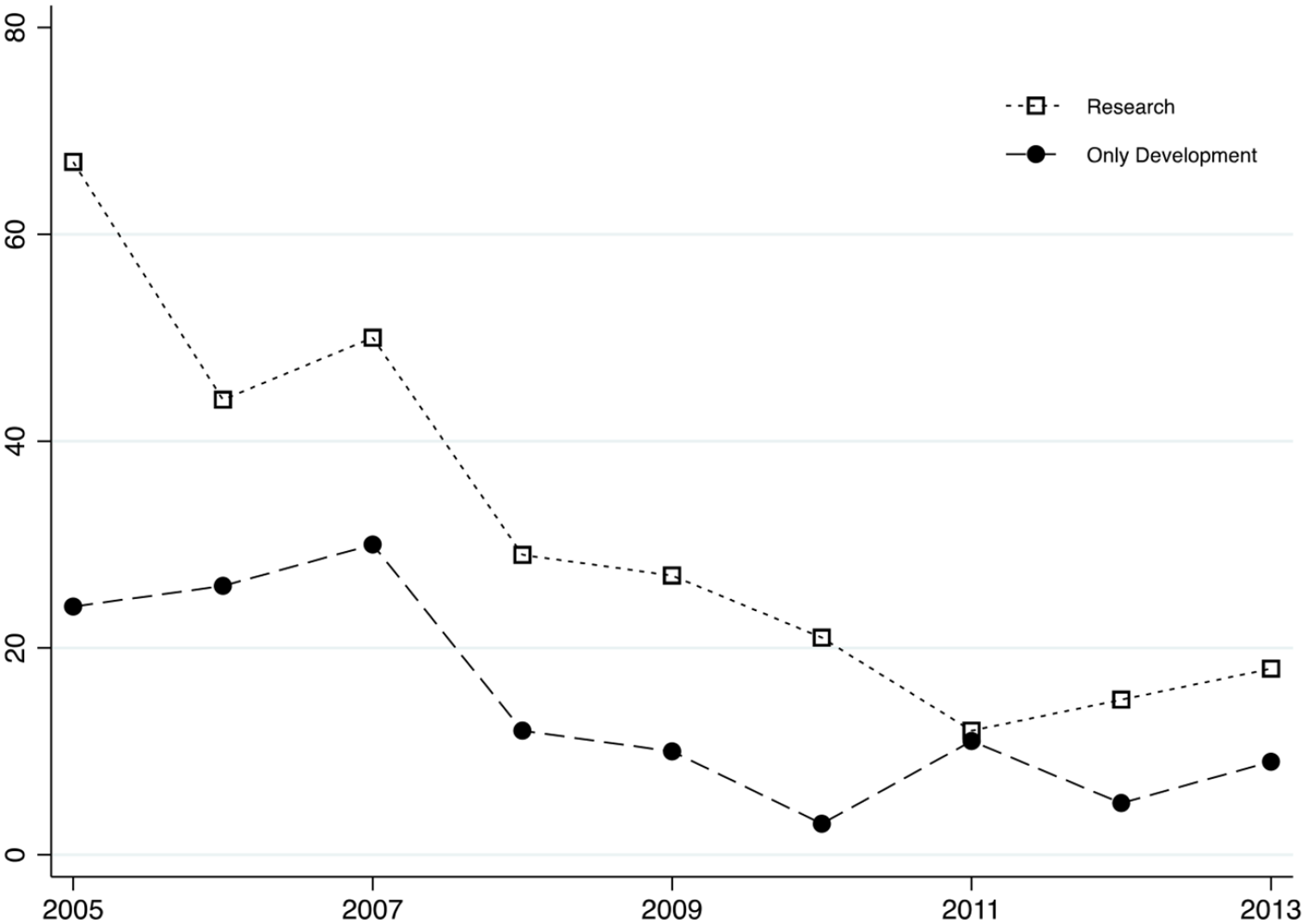
New foreign R&D establishments by major activity, 2005–2013.
Figure 3, on the contrary, displays the geographic distribution of new foreign R&D establishments by major R&D activity. Between 2005 and 2013, most foreign firms choose Cataluña to locate their R&D establishments. Madrid, the Basque Country, and the Comunidad Valenciana follow suit, whereas La Rioja, Cantabria, Extremadura, and Murcia are the least attractive regions. Similarly, “Research activities,” as opposed to “Only Development,” seems to predominate, though the share of each type of R&D varies across regions.
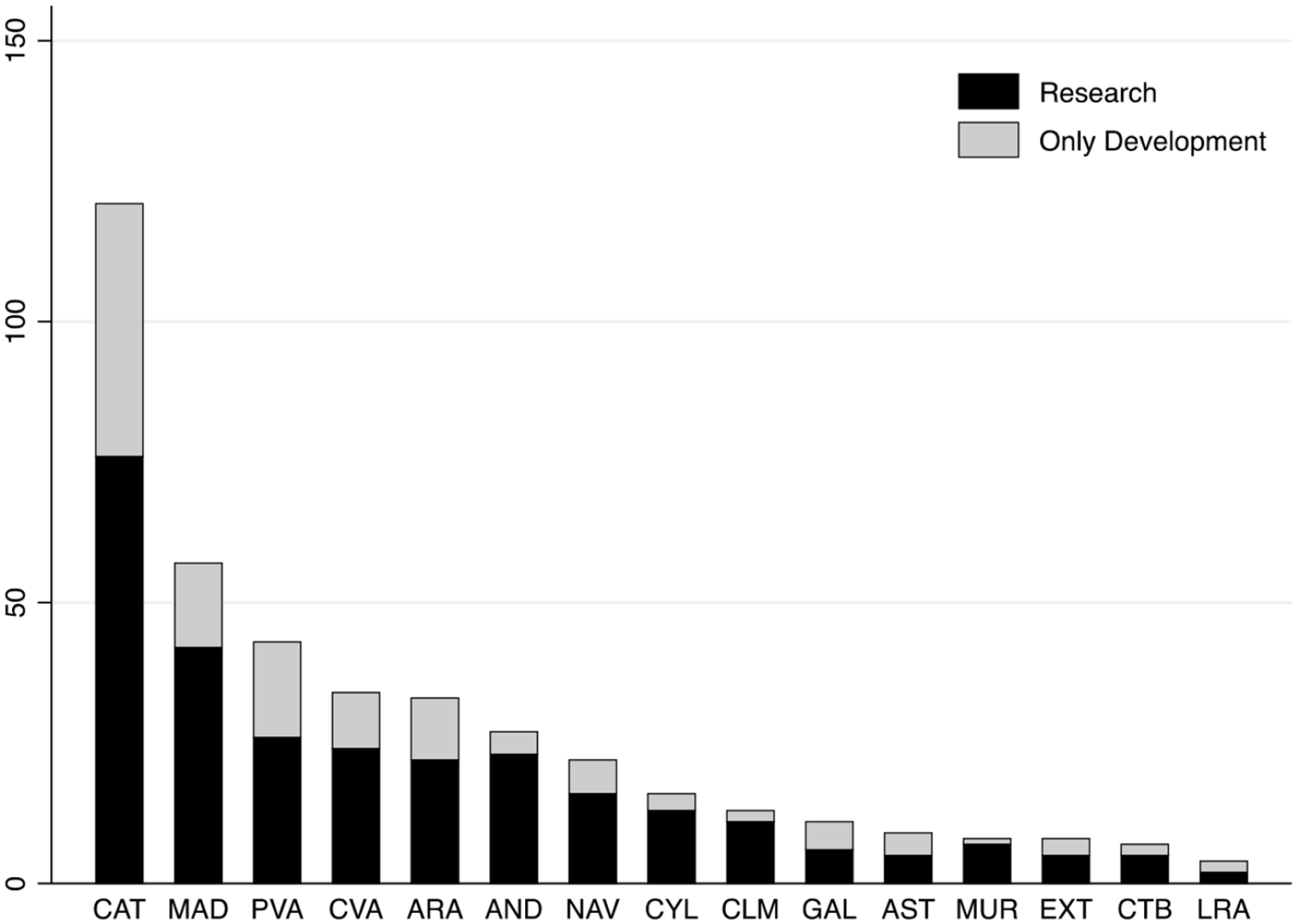
The location of new foreign R&D labs by activity and NUTS2, 2005–2013.
Finally, Figure 4 provides information on the nationality of new R&D subsidiaries by major type of R&D activity. As expected, the majority of new foreign subsidiaries are originally from EU-12, followed by North America (United States, Canada), other EU, and Japan, while the rest of the world and Latin America contribution can be labeled as marginal.
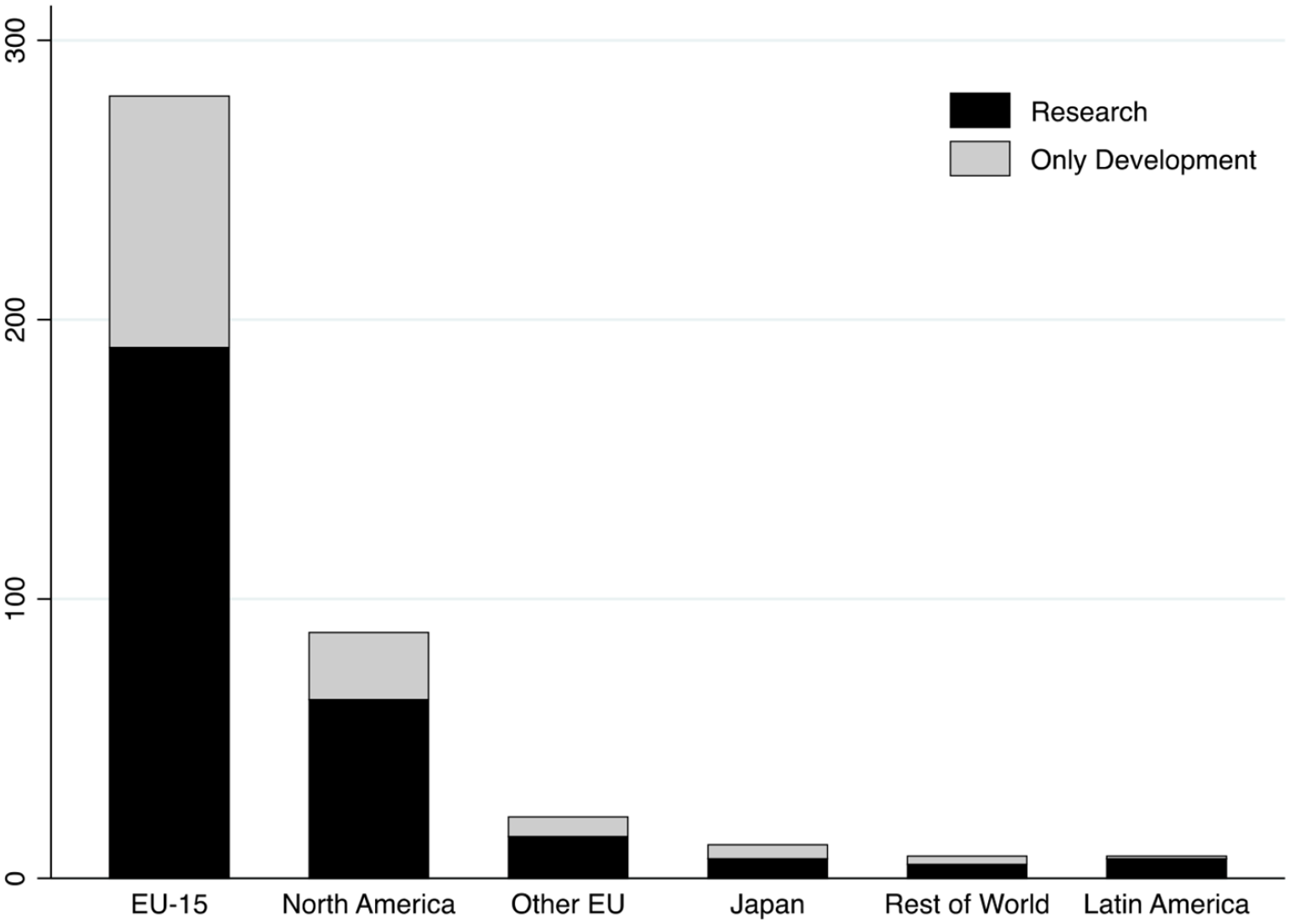
New foreign R&D establishments by activity and nationality in Spain, 2005–2013.
Spanish HES
To evaluate the role of the Spanish HES in the location of new foreign R&D investment, we derive a set of indicators with data from the IUNE observatory. For this, we exclude distance learning and the so-called special universities. In Spain, since the early years of the decentralization of the national education system in the 1980s, the HES is administered at the regional, NUTS2, level. Then, universities are organized by NUTS2. Our goal is to construct a multiple-component index that reflects the university missions, namely, training, research, and knowledge transfer. When computing the index of each mission, we first normalized every component to z-scores for each year and then add them up. This outcome is then standardized again to a z-score, which has a standard deviation of one. For example, to capture training, we use three components: (1) the number of PhD dissertations submitted by each university, (2) the number of research training grants (FPI) and university professor training grants (FPU), and (3) the number of post-doc Juan de la Cierva and Ramón y Cajal contracts. 11 Each of these has been normalized to z-scores. Therefore, an index for training results from adding up these z-scores and standardizing the outcome. The index ranges from 0 to 1, with a minimum value of 0.032 for Extremadura-2008 and a maximum of 1 for Madrid-2005.
Similarly, to measure research, we use three distinct components. The first one considers only quantitative aspects of scientific research (RES1), and it is based on the number of publications with university-affiliated authors from Web of Science (WoS), the number of projects awarded in national plans, and the number of projects awarded in EU Framework Programmes. The second one (RES2) considers qualitative aspects of scientific research, and it is based on the number of citations resulting from publications in a particular year, 12 the number of publications in the first quartile of Journal Citation Reports, 13 and the university position in the Shanghai ranking. The third one (RES3) combines the quantitative and qualitative dimensions. Finally, we capture knowledge transfer with the annual number of patents granted to each university by the Spanish patent office, the university’s revenues generated by licenses, and the number of spin-offs.
Other explanatory variables
To assess the role of the university missions in attracting foreign R&D, we have to control for other regional characteristics that may affect the decision to locate R&D abroad. A large number of socio-economic factors have been proposed in the literature as regional determinants of foreign direct investment (FDI) (Maza & Villaverde, 2015), but not all have been shown relevant for attracting R&D activities overseas (Crescenzi et al., 2014). Thus, to operationalize the regional characteristics for attracting foreign R&D investment, we include those that previous empirical studies have found relevant (Belderbos et al., 2014; Frenken et al., 2007; Siedschlag et al., 2013). First, the literature on the internationalization of R&D suggests that the overall attractiveness of a region depends upon its technological strength. Thus, we use the business expenditure on R&D (BERD) intensity of a region, measured as the business spending in R&D as a share of gross domestic product (GDP), as an indicator of the level of technological development and innovation activity (Siedschlag et al., 2013).
Another important control variable is market potential. The literature suggests that the size of a market is important for attracting foreign R&D, particularly if firms aim at adapting home technologies or products to local conditions. Following the study by Siedschlag et al. (2013), we measure market potential of each region as their GDP in constant prices and as a distance-weighted sum of GDP in all other regions.
Furthermore, it can be argued that unemployment might also be an important determinant. On one hand, a high unemployment rate may be conducive to foreign investment if it signals labor availability (Head et al., 1995). On the other hand, higher unemployment may also signal adverse business conditions and labor market rigidities that could discourage investors. Therefore, the ultimate impact of unemployment cannot be a priori determined. In addition, following Kumar (2001), we control for the wage cost of skilled R&D personnel, which is proxied by the average annual earnings of high-skilled employees at the regional level.
To account for agglomeration economies, we use the total number of establishments in the region in the same two-digit industry to which the foreign subsidiary belongs. This variable can be seen as an indicator of the extent of localization externalities, which are associated with the concentration of a particular sector in a region (Frenken et al., 2007). We additionally use a measure of the relative region’s industrial specialization (RSI) by means of the location quotient. This is obtained as the ratio between the share of industry i’s production in region j relative to total production of industry I, and the share of region j’s production relative to total production in the overall economy.
Following the study by Belderbos et al. (2014), we also control for the geographic distance between the home country of the R&D subsidiary and the host region. Particularly, we include the inverse of that distance, expecting that a shorter distance decreases the communication and coordination difficulties between the parent and the subsidiaries. This, in turn, should improve the effective transmission of knowledge from foreign R&D centers to the parent firms (Almeida & Kogut, 1999).
All explanatory variables are lagged one period with respect to the dependent variable and all specifications include time dummies. A one-period lag is commonly used in investment-based models to account for the fact that investment decisions are lagged in time and to avoid possible endogeneity problems (Siedschlag et al., 2013). In the estimated models, we also cluster standard errors at investing firm level. Definition of the variables and summary statistics are displayed in Table 1. Table 2 shows pair-wise correlations among all explanatory variables. 14
Definition and summary statistics.
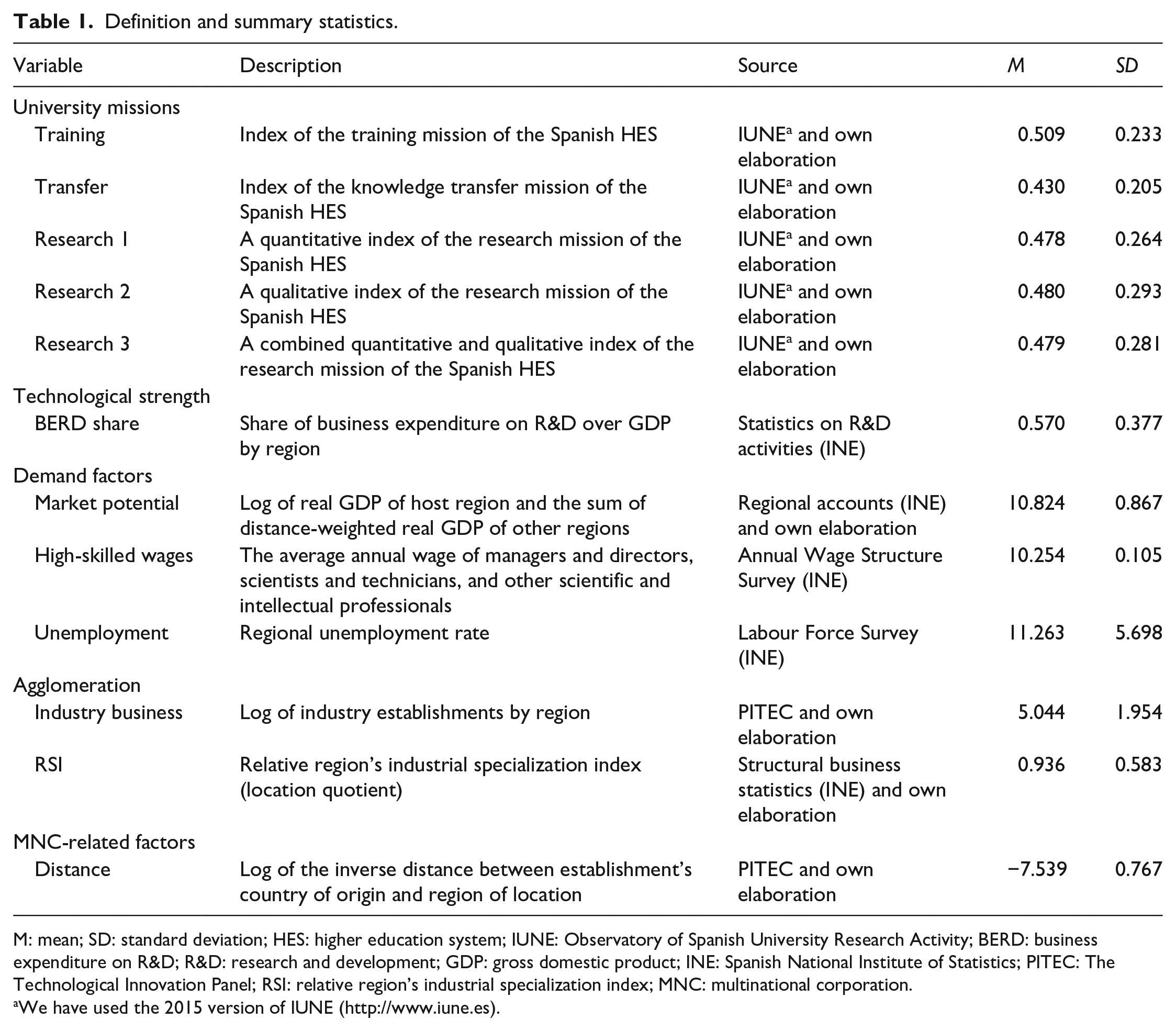
M: mean; SD: standard deviation; HES: higher education system; IUNE: Observatory of Spanish University Research Activity; BERD: business expenditure on R&D; R&D: research and development; GDP: gross domestic product; INE: Spanish National Institute of Statistics; PITEC: The Technological Innovation Panel; RSI: relative region’s industrial specialization index; MNC: multinational corporation.
We have used the 2015 version of IUNE (http://www.iune.es).
Correlations of explanatory variables.
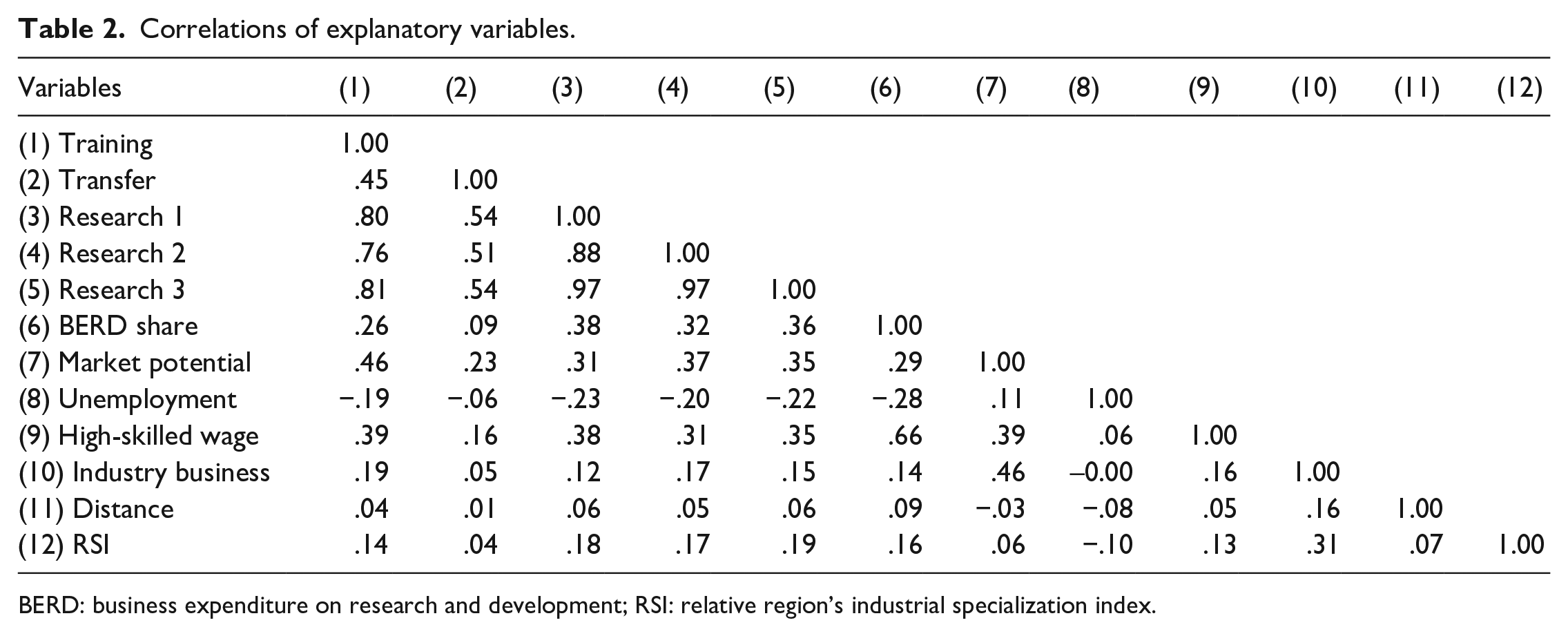
BERD: business expenditure on research and development; RSI: relative region’s industrial specialization index.
Empirical model
The determinants of the regional location choice of new foreign R&D establishments are estimated with a conditional logit model (CLM), following the study by McFadden (1974), as well as with a mixed logit model (MLM), following the study by Train (2003). These approaches have been used in the literature to estimate location choices in situations where agents have to choose one alternative among J known mutually exclusive possibilities (Alcácer & Chung, 2007; Basile et al., 2008; Belderbos et al., 2014). The advantage of the MLM over the CLM is that it allows to relax the independence of irrelevant alternatives (IIA) assumption.
Consistent with the random utility maximization (RUM) framework, the conditional and mixed logit models assume that the evaluation of a decision-maker (firm) among a set of spatial choices can be represented by a profit (utility) function. Considering the existence of J spatial choices within Spain with j = 1, . . ., J or NUTS2 regions and N decision-makers with i = 1, . . ., N, then the profit derived by the foreign firm i if she locates in region j is given by

where xij is the vector of observed attributes of each location choice, β is the vector of parameters to be estimated, whereas ε ij is a random term capturing non-observed heterogeneity and random components. The probability that a foreign firm i chooses to locate an R&D establishment in a region j as opposed to any other region k is then equal to the probability of π ij being the largest of all π i1 , . . ., π iJ . Given that ε ij is unknown, to solve the above equation, we must impose a probability density function on εij. The traditional CL model assumes that is independently and identically distributed (IID), with type I extreme value distribution (McFadden, 1974). Under these assumptions, the probability that the foreign R&D firm chooses to locate in region j can be obtained as a closed-form expression of

where the coefficients of vector β are then estimated through maximum-likelihood procedures.
While in the CLM the β coefficients are set to be equal across firms, in the MLM these coefficients are decomposed into a fixed part and a random part, accounting for the possibility of preference heterogeneity among firms over location attributes and correlation across alternatives. Accordingly, the profit derived by the foreign firm i if she invests in R&D in region j in the MLM may be modeled as

where γi is a vector of randomly distributed parameters with density g(.) over all firms, and
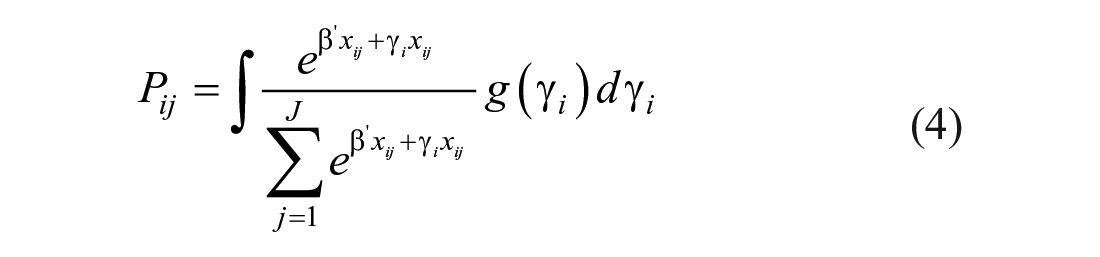
where
Findings
In Table 3, we show the estimates of the baseline CLM for new foreign R&D establishments. First, as a benchmark, in Model 0 we follow the existing literature and estimate the determinants of location choice without including our variables of interest proxying for academic strength. The results show that the probability, on average, to locate a new foreign R&D establishment is positively associated with the technological strength of regions. Furthermore, market potential appears to be, as otherwise expected, positive and significant. 16 More specifically, the average probability elasticity 17 of market potential indicates that doubling market potential increases the probability that a region is chosen by a new foreign R&D establishment by 65%. As expected, agglomeration economies and the inverse of distance also have a positive and statistically significant effect on the location decision of foreign R&D establishments. However, unemployment and high-skilled wages, although appearing with a negative sign, are not statistically significant. Thus, the results presented for Model 0 are in line with the existing evidence (Abramovsky et al., 2007; Kumar, 2001).
The determinants of the location of new foreign R&D units in Spain, 2005–2013: The conditional logit model (CLM).
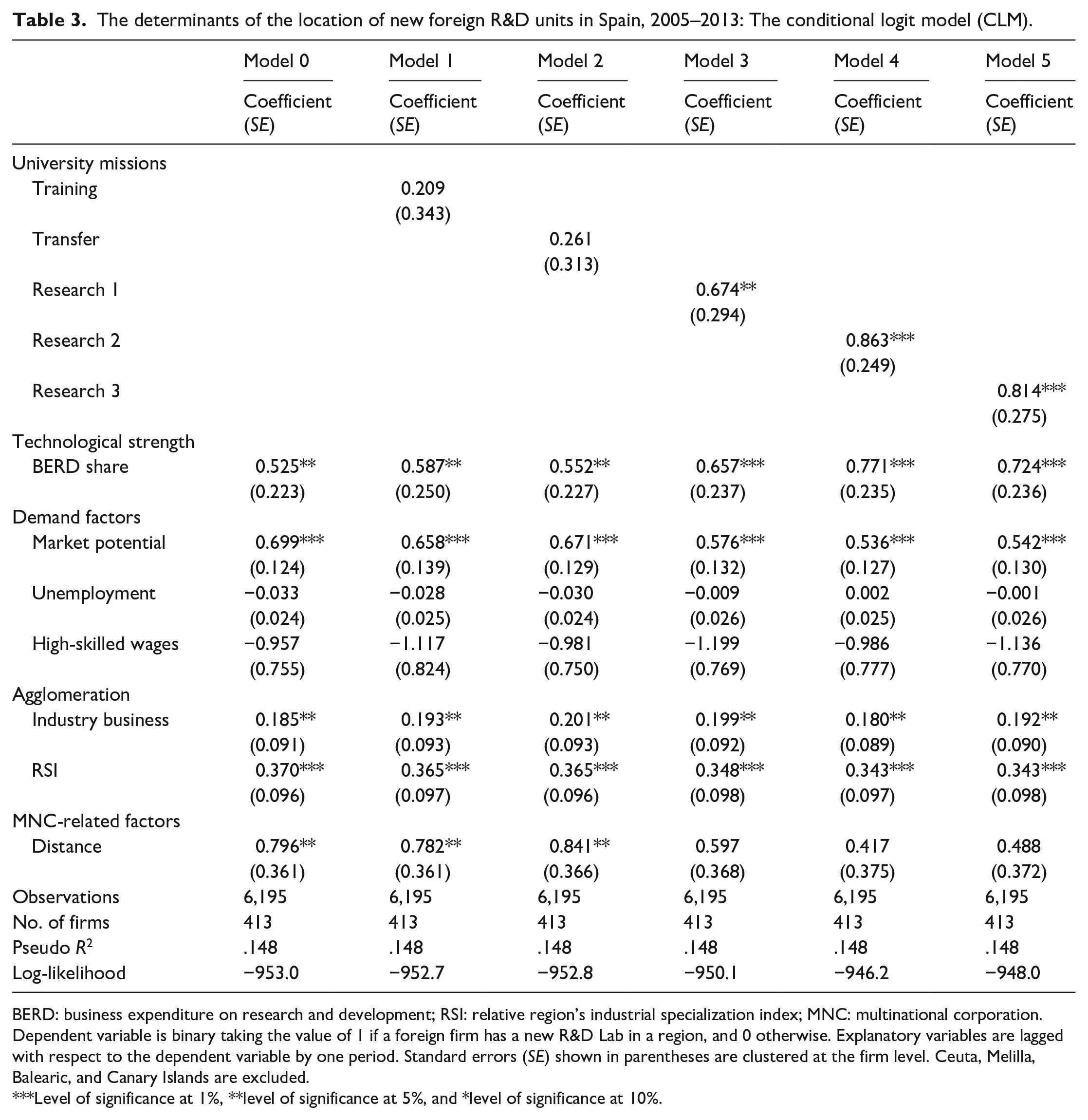
BERD: business expenditure on research and development; RSI: relative region’s industrial specialization index; MNC: multinational corporation.
Dependent variable is binary taking the value of 1 if a foreign firm has a new R&D Lab in a region, and 0 otherwise. Explanatory variables are lagged with respect to the dependent variable by one period. Standard errors (SE) shown in parentheses are clustered at the firm level. Ceuta, Melilla, Balearic, and Canary Islands are excluded.
Level of significance at 1%, **level of significance at 5%, and *level of significance at 10%.
In the following columns of Table 3, we add the contribution of the regional HES through their three-university missions of training (Training) in Model 1, knowledge transfer (Transfer) in Model 2, and research (Research) in Model 3 to Model 5. More specifically, the research mission will be measured using either quantitative measures (Research 1); qualitative (Research 2), or a combination of both (Research 3). In contrast to previous studies, our study disentangles academic strength according to the university missions. As such, we find that only research activities seem to be positive and statistically significant related to the location of a new foreign R&D establishment, and this appears to be more relevant once we consider qualitative measures (Research 2). In contrast, neither the research training capacity nor the university knowledge transfer appears to significantly attract the location of foreign R&D labs. Therefore, our results reinforce the belief that foreign R&D firms exhibit a greater propensity to locate in regions with high-quality research.
Similarly, the rest of the variables remain consistent. That is to say, after including the university missions in our baseline model (Model 0), regional technological strength, market potential, and agglomeration economies remain positive and statistically significant. Therefore, it appears that the preliminary evidence points to the relevance of university-based research as an important factor determining the location choice of R&D activities by foreign firms.
We run a series of sensitivity tests. First, we relax the IIA assumption of the CLM, and in Table 4 we present the results using the MLM. These are mostly similar to those of the CLM. More specifically, the results suggest that universities play a significant role in attracting foreign R&D to the region, particularly through their research mission. Other factors influencing this decision are the regional technological strength, the market potential, and agglomeration economies. The results of the MLM also show that regional research strength appears heterogeneous across foreign firms. Nevertheless, a likelihood ratio test comparing the MLM with the CLM shows that these two models are not significantly different from each other. Therefore, in what follows we present the results for the CLM.
The determinants of the location of new foreign R&D units in Spain, 2005–2013: The mixed logit model (MLM).
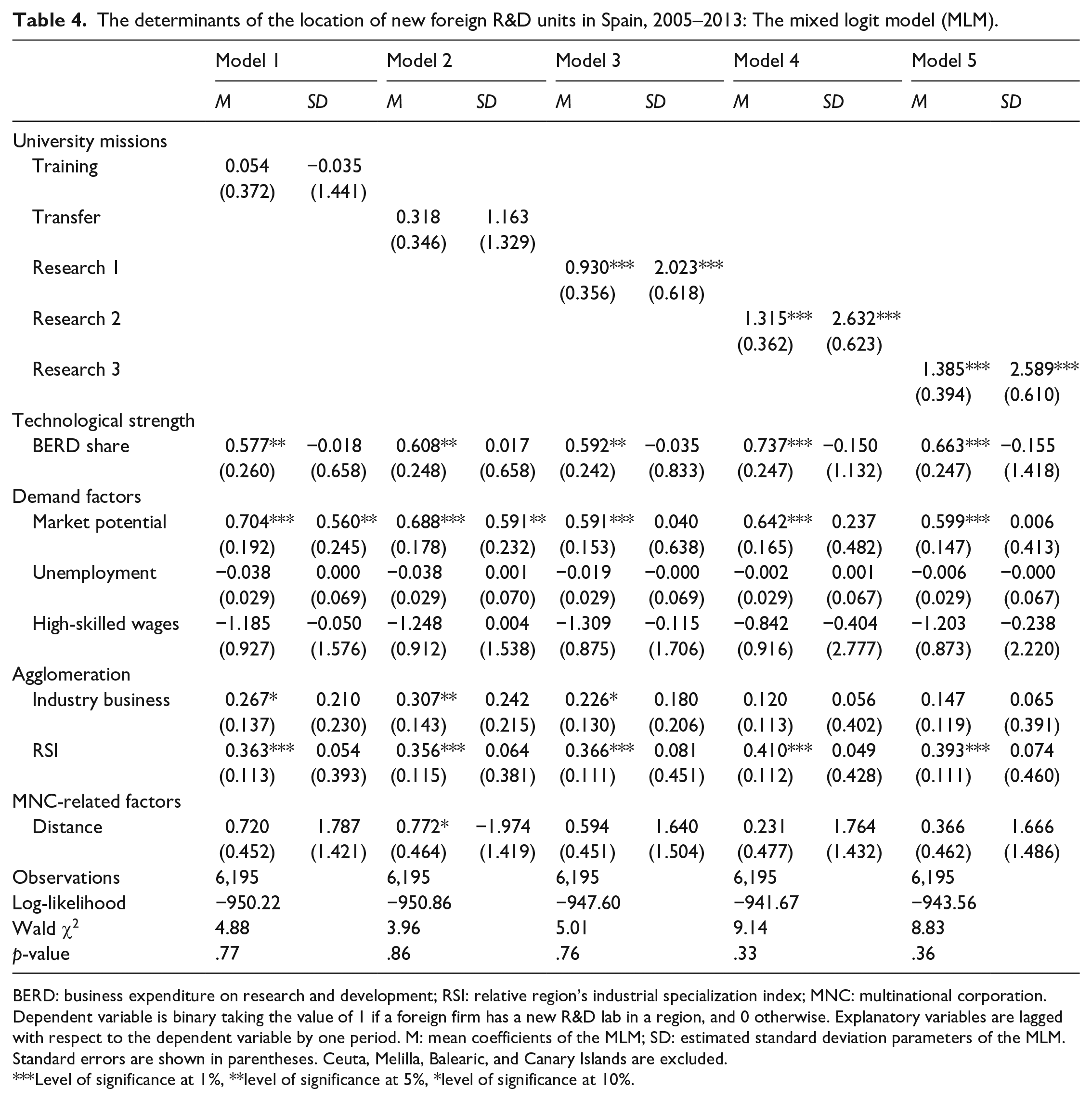
BERD: business expenditure on research and development; RSI: relative region’s industrial specialization index; MNC: multinational corporation.
Dependent variable is binary taking the value of 1 if a foreign firm has a new R&D lab in a region, and 0 otherwise. Explanatory variables are lagged with respect to the dependent variable by one period. M: mean coefficients of the MLM; SD: estimated standard deviation parameters of the MLM. Standard errors are shown in parentheses. Ceuta, Melilla, Balearic, and Canary Islands are excluded.
Level of significance at 1%, **level of significance at 5%, *level of significance at 10%.
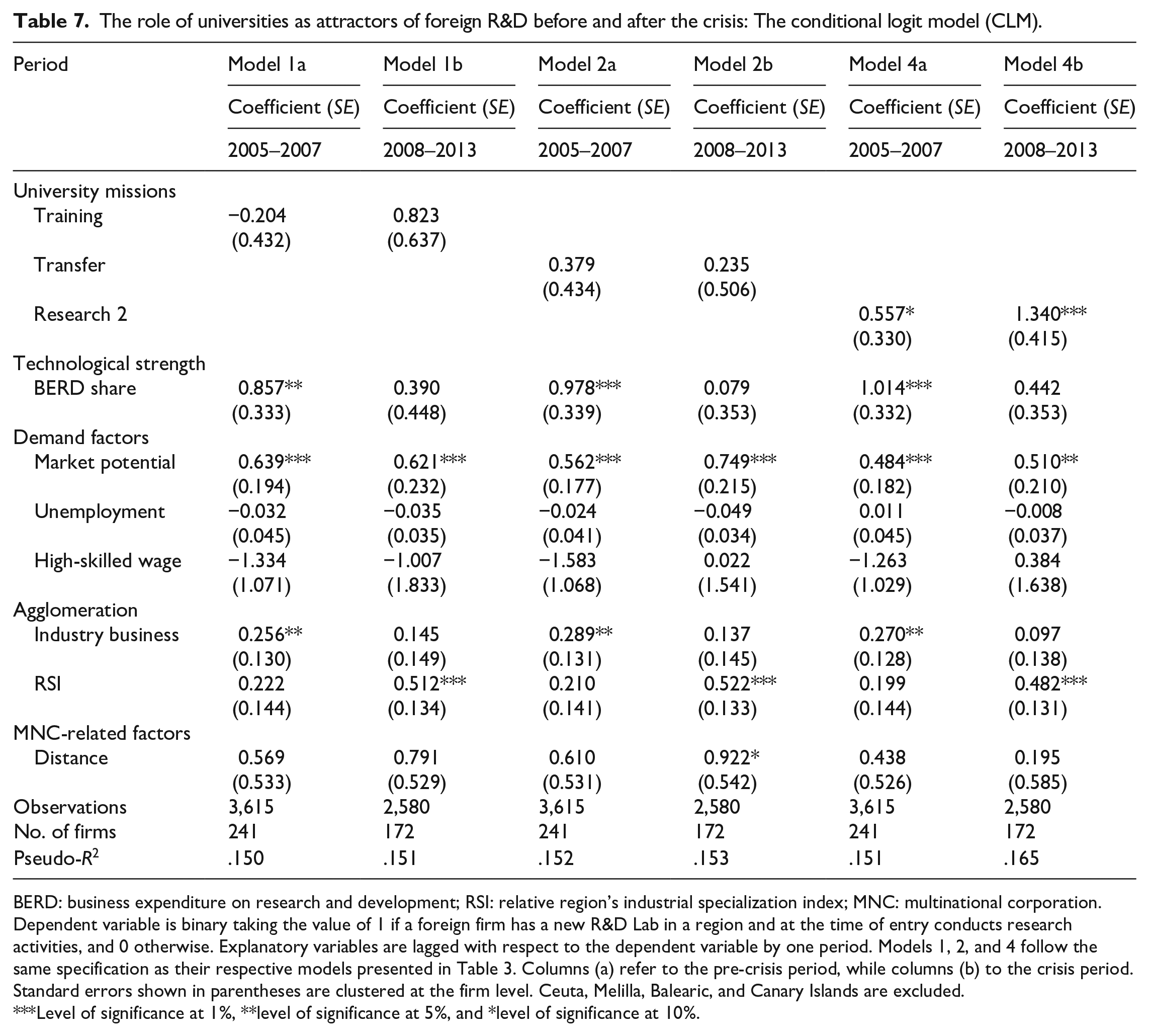
Second, we look at the role that the 2008 financial crisis may have had on the attractiveness of universities for foreign R&D investment. For this, we use the same CLM specifications presented in Table 3, but here we split the sample into two periods, before and after 2008. As our results suggest that the impact of the research mission is best captured by the qualitative measure, we will present here the results using Research 2 as the proxy for the research mission. The results are presented in Table 7 in Appendix 1. Irrespective of the period of analysis, the research mission arises as an important attractor of foreign R&D, increasing its relevance after the crisis. However, the other two missions do not play a significant role. While market potential exerts a positive influence through both periods, this is not the case for other factors. The regional technological strength and the agglomeration of economic activity lost their significant effect since 2008, while the regional specialization index became significant thereafter.
Our approach has until now assumed that R&D establishments are alike. However, as discussed, subsidiaries may engage in basic or applied research (“Research activities”) and in development or design (“Only Development”). In principle, we have argued that universities are expected to be more relevant for the former, that is, for basic or applied research. Thus, Tables 5 and 6 display the results when our sample is divided into new foreign establishments with “Research activities” and with “Only Development.” The results in Table 5 show that from the three missions of the HES, just research strength is an important factor determining the location choice of foreign investors conducting research activities. Thus, foreign affiliates performing research activities have the absorptive capabilities to benefit from high-quality scientific research performed at universities. In contrast, neither training nor technology transfer seems to significantly influence the location choice of foreign R&D investors with local research units. Besides the university research mission, other home-augmenting factors, such as the region’s technological strength, affect the location choice of offshored research activities. The region’s industrial specialization (RSI) and the market potential also contribute to increasing the probability that a new foreign research unit is attracted to the region.
The location choice of foreign firms conducting research activities.
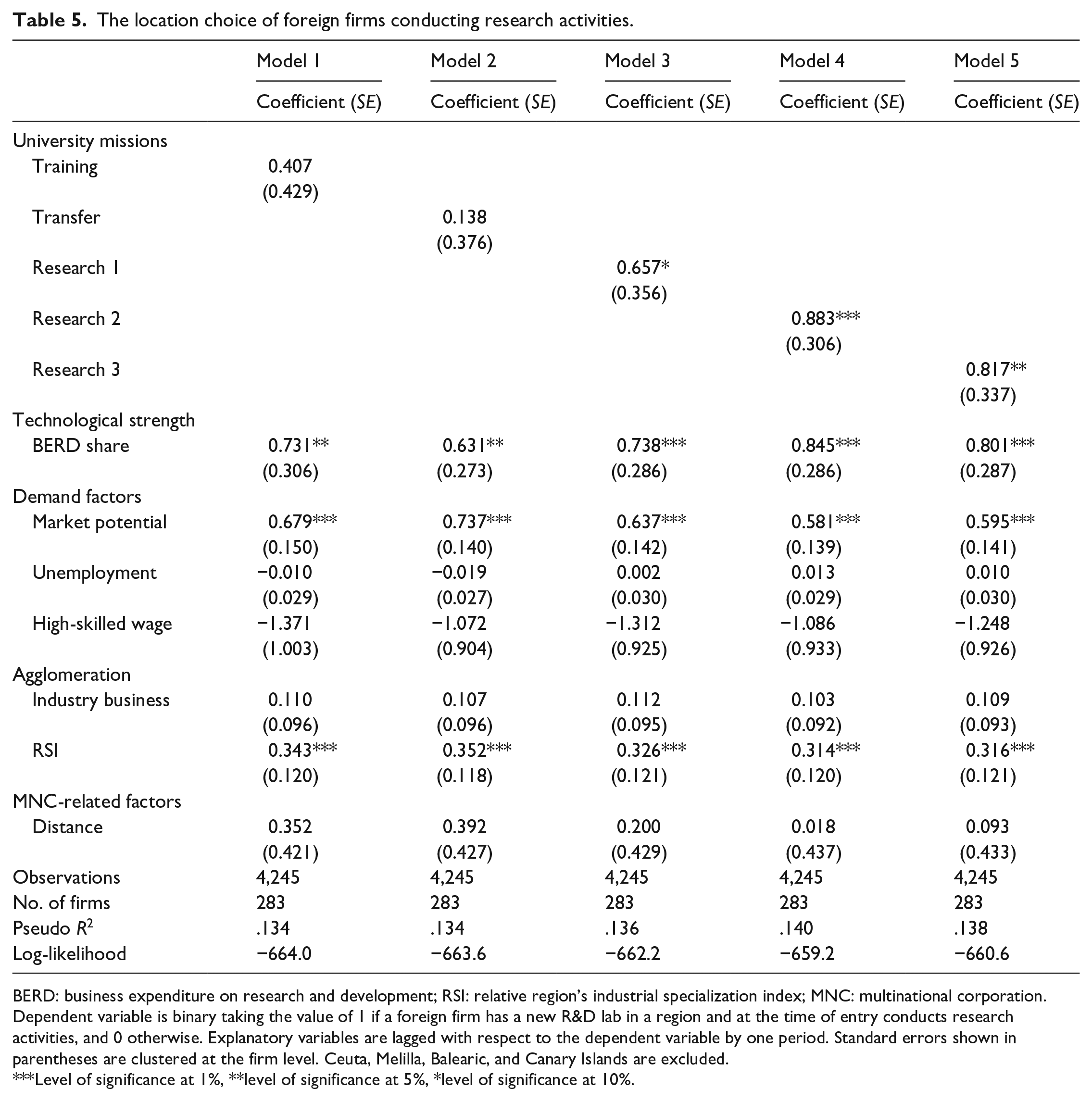
BERD: business expenditure on research and development; RSI: relative region’s industrial specialization index; MNC: multinational corporation.
Dependent variable is binary taking the value of 1 if a foreign firm has a new R&D lab in a region and at the time of entry conducts research activities, and 0 otherwise. Explanatory variables are lagged with respect to the dependent variable by one period. Standard errors shown in parentheses are clustered at the firm level. Ceuta, Melilla, Balearic, and Canary Islands are excluded.
Level of significance at 1%, **level of significance at 5%, *level of significance at 10%.
The location choice of foreign firms conducting only development activities.
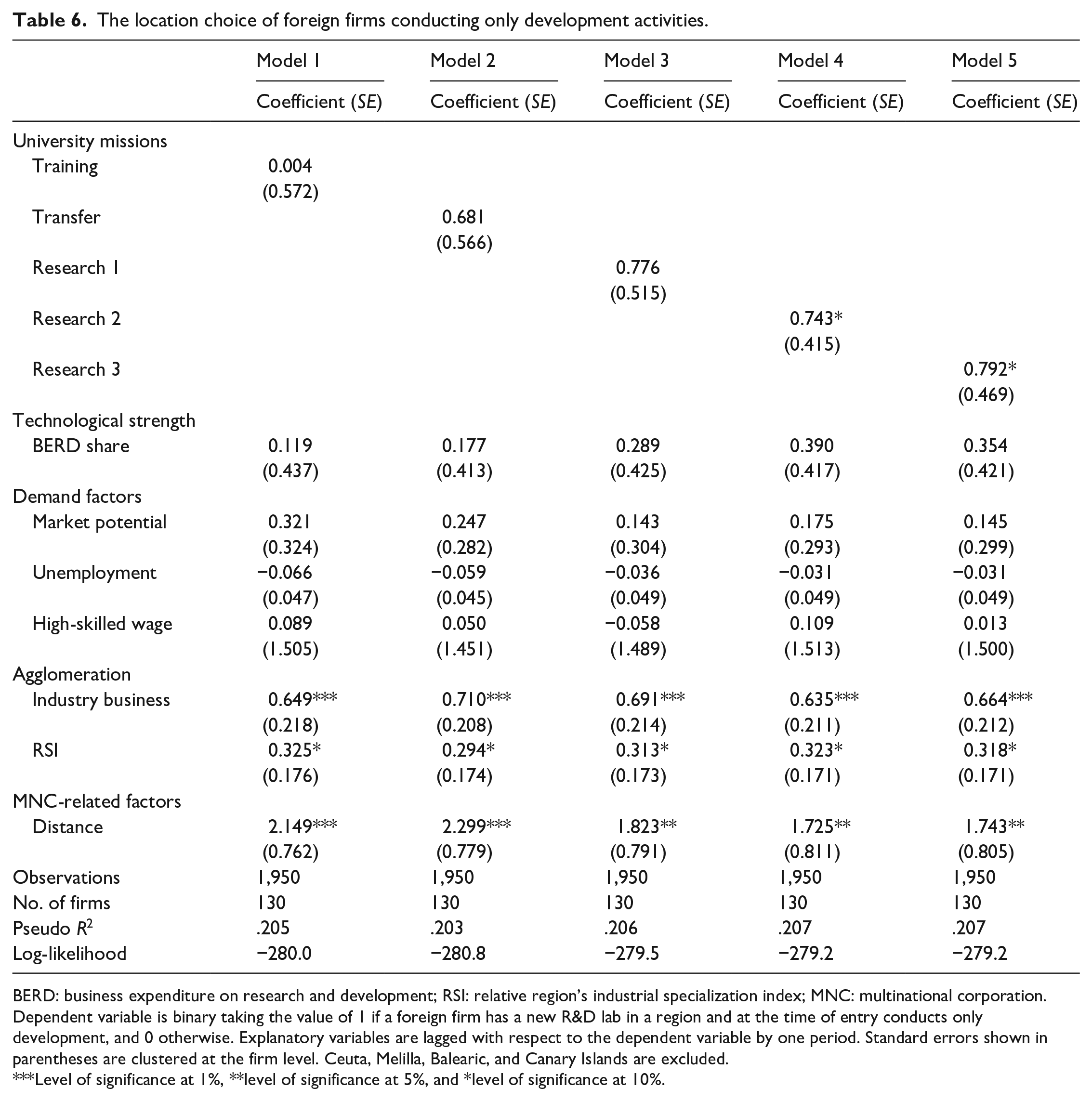
BERD: business expenditure on research and development; RSI: relative region’s industrial specialization index; MNC: multinational corporation.
Dependent variable is binary taking the value of 1 if a foreign firm has a new R&D lab in a region and at the time of entry conducts only development, and 0 otherwise. Explanatory variables are lagged with respect to the dependent variable by one period. Standard errors shown in parentheses are clustered at the firm level. Ceuta, Melilla, Balearic, and Canary Islands are excluded.
Level of significance at 1%, **level of significance at 5%, and *level of significance at 10%.
On the contrary, the results in Table 6, show that regional academic research strength loses significance in explaining the location choice of foreign investors conducting only development activities. It turns out that for those businesses the most important factors at the regional level driving their location choice are agglomeration economies as well as the distance to their headquarters. While distance to the parent firm does not play a relevant role for foreign firms performing research, it does so for development units. As development activities mostly pursue the adaptation of home-based technologies and products to the local conditions, MNCs may consider relevant when offshoring these activities the high coordination costs between the parent and the affiliate units in distant locations.
Concluding remarks
In this study, we have analyzed to what extent the universities “three-missions” (teaching or training, research, and technology transfer) affect the regional location of offshored R&D. In doing so, we have used a rich and novel dataset combining information on the location of new foreign R&D establishments in Spanish regions over the period 2005–2013, with quantitative and qualitative measures of the regional HES. Our findings suggest that the probability of a foreign R&D establishment being located in a given region is positively affected by its academic research excellence. This is in line with previous studies (Abramovsky et al., 2007; Belderbos et al., 2014, 2017). Scientific training and technology transfer, however, do not appear to significantly drive the location choices of foreign R&D investors in Spanish regions. Moreover, results are robust after controlling for the technological strength, market potential, and agglomeration economies, among other factors.
In addition, we find that the strength of the academic research mission plays a different role depending on the main corporate R&D activity. For MNCs actively engaged in research activities, this appears to be a significant determinant, while this is not the case for foreign affiliates exclusively performing development and design tasks. This may be explained by the greater capacity of research units to absorb and leverage scientific knowledge. On the contrary, for foreign affiliates performing only development activities, regional agglomeration economies, as well as the distance to the headquarters, seem to be the most significant location drivers.
From an academic point of view, this study contributes to the literature on international business, innovation, and economic geography. Specifically, we link the missions of universities to the channels through which knowledge from HEIs spill out and benefits nearby firms; thus, influencing their location choices. Although few studies have shown how the existence of university spillovers influence the MNC’s location decision of R&D activities (Abramovsky et al., 2007; Alcácer & Chung, 2007; Belderbos et al., 2014, 2017; Siedschlag et al., 2013), they have not fully disentangled the precise spillover transmission channel. Second, we add to the literature by providing novel evidence that Research and Development are offshored by different motives (Shimizutani & Todo, 2008; von Zedtwitz & Gassmann, 2002). Particularly, this study reveals that the regional strength of the academic research mission matters for attracting foreign research activities rather than design and development activities.
From a public policy perspective, this study suggests that knowledge sourcing from the HEIs attracts foreign R&D. Thus, if regional governments aim at attracting R&D investment from abroad, they should not only reinforce their technological capabilities but also consider measures to strengthen their HEIs, and more specifically the research mission. Our findings, however, do not imply that incentives should be introduced to increase academic output per se, but rather to promote high-quality research. The absence of frontier academic research may hinder the attraction of foreign R&D, having long-lasting economic implications. As the knowledge society seems to be the way forward, attracting foreign R&D investment could be critical. Not only because more skilled workers could be employed, but it may eventually lead to the development of a knowledge network that allows Spanish regions not to lag behind globally frontier regions.
Although this study provides relevant insights, it is not without limitations that future research should address. First, the insignificant effect of the training and knowledge transfer missions may be because we are not able to identify the precise mechanism by which knowledge from universities is transferred to foreign R&D firms. For instance, more detailed information on the theses, research grants, and post-doc contracts may be needed to identify specific fields more conducive to R&D, such as STEM disciplines. Similarly, and regarding the third mission, data that allow distinguishing university collaborations from other technology transfer modes may be required, as previous literature has shown the former to have a greater effect on firms’ innovativeness (Añón Higón, 2016). Second, Spanish public HEIs suffered important budgetary restrictions following the 2008 financial crisis, particularly after the passing of the Royal Decree-Law 14/2012 of 20 April. Therefore, future research should assess whether this external shock had an asymmetric impact on the role that the quality of academic research and the other missions have played as attractors of foreign R&D in Spanish regions. Furthermore, the relationship between the strength of HEIs, the agglomeration of economic activity, and the location choices of foreign firms may be far more complex than what this study suggests. As firms in clusters face increased competition, future research should address the possibility that in highly competitive environments, the potential knowledge leakages to competitors may offset the learning effects from being proximate to HEIs and other local firms. Finally, while we have analyzed the role played by the geographical distance between Spanish regions and the MNCs’ country of origin, which has been shown as relevant in the offshoring of development activities, the importance of “psychic distance” has been overlooked. Thus, an avenue of further research would be to analyze the direct and moderating role that “psychic distance,” including cultural and institutional distance, may exert on the location of foreign R&D activities.
Footnotes
Appendix 1
The role of universities as attractors of foreign R&D before and after the crisis: The conditional logit model (CLM).
| Period | Model 1a | Model 1b | Model 2a | Model 2b | Model 4a | Model 4b |
|---|---|---|---|---|---|---|
| Coefficient (SE) | Coefficient (SE) | Coefficient (SE) | Coefficient (SE) | Coefficient (SE) | Coefficient (SE) | |
| 2005–2007 | 2008–2013 | 2005–2007 | 2008–2013 | 2005–2007 | 2008–2013 | |
| University missions | ||||||
| Training | −0.204 | 0.823 | ||||
| (0.432) | (0.637) | |||||
| Transfer | 0.379 | 0.235 | ||||
| (0.434) | (0.506) | |||||
| Research 2 | 0.557* | 1.340*** | ||||
| (0.330) | (0.415) | |||||
| Technological strength | ||||||
| BERD share | 0.857** | 0.390 | 0.978*** | 0.079 | 1.014*** | 0.442 |
| (0.333) | (0.448) | (0.339) | (0.353) | (0.332) | (0.353) | |
| Demand factors | ||||||
| Market potential | 0.639*** | 0.621*** | 0.562*** | 0.749*** | 0.484*** | 0.510** |
| (0.194) | (0.232) | (0.177) | (0.215) | (0.182) | (0.210) | |
| Unemployment | −0.032 | −0.035 | −0.024 | −0.049 | 0.011 | −0.008 |
| (0.045) | (0.035) | (0.041) | (0.034) | (0.045) | (0.037) | |
| High-skilled wage | −1.334 | −1.007 | −1.583 | 0.022 | −1.263 | 0.384 |
| (1.071) | (1.833) | (1.068) | (1.541) | (1.029) | (1.638) | |
| Agglomeration | ||||||
| Industry business | 0.256** | 0.145 | 0.289** | 0.137 | 0.270** | 0.097 |
| (0.130) | (0.149) | (0.131) | (0.145) | (0.128) | (0.138) | |
| RSI | 0.222 | 0.512*** | 0.210 | 0.522*** | 0.199 | 0.482*** |
| (0.144) | (0.134) | (0.141) | (0.133) | (0.144) | (0.131) | |
| MNC-related factors | ||||||
| Distance | 0.569 | 0.791 | 0.610 | 0.922* | 0.438 | 0.195 |
| (0.533) | (0.529) | (0.531) | (0.542) | (0.526) | (0.585) | |
| Observations | 3,615 | 2,580 | 3,615 | 2,580 | 3,615 | 2,580 |
| No. of firms | 241 | 172 | 241 | 172 | 241 | 172 |
| Pseudo-R2 | .150 | .151 | .152 | .153 | .151 | .165 |
BERD: business expenditure on research and development; RSI: relative region’s industrial specialization index; MNC: multinational corporation.
Dependent variable is binary taking the value of 1 if a foreign firm has a new R&D Lab in a region and at the time of entry conducts research activities, and 0 otherwise. Explanatory variables are lagged with respect to the dependent variable by one period. Models 1, 2, and 4 follow the same specification as their respective models presented in Table 3. Columns (a) refer to the pre-crisis period, while columns (b) to the crisis period. Standard errors shown in parentheses are clustered at the firm level. Ceuta, Melilla, Balearic, and Canary Islands are excluded.
Level of significance at 1%, **level of significance at 5%, and *level of significance at 10%.
Acknowledgements
The authors gratefully acknowledge the helpful suggestions received from the Associate Editor and two anonymous reviewers.
Declaration of conflicting interests
The author(s) declared no potential conflicts of interest with respect to the research, authorship, and/or publication of this article.
Funding
The author(s) disclosed receipt of the following financial support for the research, authorship, and/or publication of this article: The authors acknowledge financial support from the Ministerio de Economía y Competitividad (grants ECO2015-71534-REDT; ECO2017-86793-R), from the Ministerio de Ciencia, Innovación y Universidades (grant PGC2018-095821-B-100), and from Generalitat Valenciana (grant PROMETEO/2019/095). Usual caveats apply.
