




Abstract
In this article, we apply a proportional hazard model to analyze the determinants of success in a large sample of 1,656 entrepreneurs and former entrepreneurs. We base our research on the theory of entrepreneurship by Edward Lazear, according to which individuals with broad educational and professional experience, in comparison to specialists, are more likely to become entrepreneurs. We extend this theory by verifying whether breadth of education and professional career also contribute to the likelihood of entrepreneurial success. According to our findings, breadth of education not only influences the propensity to start a business but also positively influences the chances of business survival. The breadth of professional experience proved to have a significant impact on business survival, but this result did not hold for extensive managerial experience.
Introduction
All over the world, most firms do not survive their first years in business. According to the Small Business Association (SBA, for years 1994–2013), only about 30% of companies survive 10 years in business. Eurostat business demography statistics show that in the European Union, the survival rate of firms created in 2012 and still active in 2017 was less than 50%. These commonly known facts open the door for research not only on the determinants of entrepreneurial entry but also on the phenomenon of business survival, especially as, following Strotmann (2007), business survival is more difficult and challenging than the entry itself. However, when we look at the entrepreneurship literature, whatever school of thought is followed—trait theory, or the behavioral or cognitive stream—researchers tend to focus more on the antecedents of entrepreneurial behavior and predispositions to launch a business, trying to meet the expectations of the growing start-up culture as many practitioners and decision-makers argue for.
This does not mean that the literature on business survival does not exist. On the contrary, it is quite rich and broad, and the issue is extensively discussed within economic and industrial organization studies. As a result, we have numerous studies related to business survival carried out at firm level (e.g., Giovannetti et al., 2011; Kim & Lee, 2016; Persson, 2004), at firms’ environment level (e.g., Buenstorf, 2007; Dunne & Roberts, 1991; Namini et al., 2013; Reynolds et al., 1994; Strotmann, 2007) and those that pertain to human capital (e.g., Arribas & Vila, 2007; Åstebro & Bernhardt, 2005; Boyer & Blazy, 2014; Gimeno et al., 1997; Saridakis et al., 2008). They all see the problem of business survival from different angles and levels, but they often arrive at inconclusive or heavily context-dependent results on the factors of business survival (Unger et al., 2011).
We speculate that there might be another way to investigate business survival. The problem we identify is that, in the literature, business entry and business survival are treated as two distinct and separate phenomena. Business survival is seen as if it was not preceded by business entry. Trying to diagnose this problem, we also noticed that business start-up and survival are often investigated by scholars who represent related but different fields. For example, entrepreneurship scholars are more interested in the processes related to venture creation, and they problematize around antecedents of entrepreneurial behavior and thinking, whereas business management and economics academics tend to debate the results of these processes and their continuation (Kurczewska & Mackiewicz, 2020; Landström, 2020). In consequence, there are not many studies that examine determinants of business start-up and business survival on the same sample (Arauzo et al., 2007; Lay, 2003). However, knowing the factors responsible for both business start-up and survival, we are able to grasp the essential success factors in entrepreneurship.
Therefore, in this article, we challenge the dominating approach to business survival and propose investigating it through the well-established and empirically proven business start-up/entrepreneurship theory. The question that we are interested in is: What qualities that lead individuals to launch their own business are the same ones necessary for the business’s survival? In this article, we follow the reasoning that companies are endowed with knowledge and experience through the human capital of their founders (Dencker et al., 2009). Like Sharma and Kesner (1996), we look for some ex-ante explanations for post-entry survival, but not among industry or firm-level factors but in human capital theories. Accordingly, we ask: Do the same pools of human capital required in the business start-up phase also serve their role in running a firm in the long term?
In order to answer this research question, we have taken Edward Lazear’s well-grounded theory of entrepreneurship as the reference point of the investigation. The theory deals with choosing between self-employment and paid employment and, assuming that lifetime income maximization is a key motive, it explains what makes individuals become entrepreneurs. According to Lazear (2002, 2004, 2005), individuals who become entrepreneurs are so-called “jacks-of-all-trades,” which means that they tend to be generalists who have broad knowledge and skills in various business areas, as well as rich and diverse professional experience. In contrast, specialists tend to have more expert knowledge and skills, which leads to narrower specializations as demanded by the labor market.
Knowing the predispositions proposed by Lazear, which are typical of people who become entrepreneurs, we formulated four hypotheses regarding the influence of various factors on business survival that are typically correlated with the propensity to start one’s own business. We test them on two subsamples of active entrepreneurs (N = 820) and former entrepreneurs who are currently employed (N = 836). Such a composition of subsamples enables us to verify Lazear’s theory on the whole sample, to compare the two subsamples in terms of various factors related to Lazear’s theory, and finally to evaluate the factors that determine business survival or termination. In order to achieve this, we apply a survival approach and use the proportional hazard method proposed by Cox (1972).
In light of our results, we claim that Lazear’s theory can be expanded to consider business survival that was not previously acknowledged. According to our findings, breadth of education not only influences the propensity to start a business but also positively influences the chances of business survival. The breadth of professional experience proved to have a significant impact on business survival, but this result did not hold for extensive managerial experience.
The article contributes to the ongoing discussion on Lazear’s theory taking place in prominent entrepreneurship and economics journals. It not only verifies Lazear’s theory, but also extends it to cover the phenomenon of business survival. By testing “successful” and “unsuccessful” entrepreneurs in terms of breadth of education, skills, and experience, we identify predispositions that enable both business start-up and survival, which are essential to know for the purpose of public policy and structuring entrepreneurship education. Hence, the article offers new insight into the sources of continuous entrepreneurship, in particular, those that are linked to entrepreneurs’ knowledge and experiences, which in turn are mainly gained through education and professional involvement. Therefore, we extend prior research on entrepreneurship, in particular Lazear’s theory, by providing evidence on what role the broad educational and professional path play in business survival. Moreover, we apply a survival approach and the proportional hazard method proposed by Cox, which have not been commonly employed in entrepreneurship studies. Therefore, due to the detailed methodological descriptions, the article also provides some guidelines for other studies in terms of method application.
The article is organized as follows. In Section “Theoretical grounding,” we discuss the business survival literature and problematize around how the ideas from Lazear’s theory of entrepreneurship could be relevant in studies of business survival. As a result, we develop four hypotheses. Then, in Section “Methodology,” we thoroughly explain our methodological choices; we describe the data source, our sample, the statistical method applied, and the explanatory variables. The methodological part is followed by the section in which we present and discuss the results and their implications for theory and practice. The article ends with concluding thoughts on the results.
Theoretical grounding
Business survival
The question of what makes companies stand the test of time is not new. In the economic and management literature, there are many studies that try to explain the phenomenon of business survival. According to Manjón-Antolín and Arauzo-Carod (2008), it is useful to divide business survival variables into internal, that is, firm-specific factors, and external ones, that is, related to the company’s environment.
The first group of factors includes the company’s characteristics, like start-up size, growth rate, financial structure, ownership, legal structure, technology, and innovation regime (see Manjón-Antolín & Arauzo-Carod, 2008, for an exhaustive review of internal factors). The problem is that the studies with firm-specific factors are inconclusive and often bring contradictory results. Taking size and age factors as an example, there is still no agreement about whether the age effect is an inverted U-shape and the size effect is nonlinear (see Strotmann, 2007 or Agarwal & Gort, 2002 as examples). Therefore, we can risk stating that business survival is not unequivocally determined by internal factors, and some other factors need to be considered.
The second group of factors pertain to the company’s environment (Kennerley et al., 2003; Littunen, 2000). Here we have variables related to the industry (its growth and innovation rate), general economic condition (business cycle, macroeconomics situation), as well as geographical space. The problem with this group of factors is that conclusions are unlikely to be general as they usually refer to one industry or the context of one particular economy or even region.
In most of the studies relating to both groups of factors, some administrative and macrolevel databases are used; hence, conclusions relate to a specific industry, geographic area, or the type or size of the companies. Consequently, the entrepreneurial characteristics of the companies’ founders and owners are less often considered (Arribas & Vila, 2007) as the data are also more difficult to obtain.
Nevertheless, there is a group of factors which potentially explain business survival while also pertaining to the characteristics of the entrepreneur, that is, human capital. Regarding human capital theories, the most significant for business survival are education, prior professional career and experience, and personal characteristics, like age, gender, or the number of children (Arribas & Vila, 2007; Åstebro & Bernhardt, 2005; Block et al., 2012; Boyer & Blazy, 2014; Dutta et al., 2011; Gimeno et al., 1997; Habibov et al., 2017; Miettinen & Littunen, 2013; Saridakis et al., 2008). The accumulation of human capital supports the growth of entrepreneurial knowledge and skills which enable a business to be run continuously. We share this perspective and, next to knowledge and skills, we are particularly interested in the role of experience in business entry and survival, which corresponds to Rauch et al.’s (2005) division into three types of human capital: an individual’s education, experiences, and skills. Although we could not check the skills and knowledge of entrepreneurs firsthand, following other research, we decided to verify their sources, that is, education and professional experience. Education, previous business experience, and prior management experience are forms of human capital that benefit the business owner (Aidis & van Praag, 2007).
The problem we identify is that business entry and business survival are treated as two distinct and separate phenomena. We find this perplexing, as it is critical to know not only what makes an entrepreneur, but also what makes him or her function on the market for an extended period. From the societal and economic perspectives, there is an interest in ventures that last, that is, they bring social and economic value by contributing to employment generation, wealth accumulation, and societal development (Block & Sandner, 2009). Therefore, in this article, we do not build another model to explain business survival by drawing from human capital theories, as there are many of them (see the revision of Gimmon & Levie, 2010); instead, we take the well-grounded entrepreneurship theory, which explains the phenomenon of becoming an entrepreneur and which follows the same set of factors to study business start-up and survival simultaneously. There are very few studies that examine business entry and exit simultaneously and relate them to the same factors, like Arauzo et al., 2007; Lay, 2003; or Shapiro & Khemani, 1987; however, the symmetry between the two is not univocally confirmed. To shed new light on the problem, as a theoretical grounding we pick Lazear’s theory of entrepreneurship (Lazear, 2002, 2004, 2005), which although generally confirmed, has not yet been verified and expanded from this perspective.
Lazear’s theory of entrepreneurship
An entrepreneur is an individual who makes decisions thanks to accumulated knowledge and skills which allow him or her to use these skills appropriately while making judgments that lead to the exploitation of entrepreneurial opportunities (Haynie et al., 2010; Mitchell et al., 2007). Nevertheless, in the entrepreneurship literature, the debate on the type of entrepreneurial knowledge and skills continues (Morris, 1998). The discussion runs across two polar views on the need for expert knowledge and general knowledge (Tegtmeier et al., 2016). Do entrepreneurs have broad knowledge and a rich set of skills, or are they experts with a specific specialization? On one hand, a diversified portfolio of skills creates a complex combination that is impossible to imitate (Lippman & Rumelt, 1982) and that makes the company competitive and flexible. However, the supporters of expert knowledge believe that specialist knowledge provides a combination of advanced tools that enable them to create the best solutions if a problem occurs and that helps to connect different dots when new ideas are needed (Baron & Henry, 2010).
Among the most prominent theories that support the view of entrepreneurs being generalists is the theory of entrepreneurship of Lazear (2002, 2004, 2005). This theory, in contrast with other neoclassical economic theories, recognizes and promotes entrepreneurs in the economy (Saiz-Alvarez, 2019), and it is considered to be one of the two most powerful explanations of individual selection into entrepreneurship (Hsieh et al., 2017), illustrating an alternative view to risk aversion theory (Kihlstrom & Laffont, 1979). The theory of entrepreneurship assumes that individuals tend to maximize their lifetime income, and it explains that a broad set of skills and knowledge lets them become an entrepreneur, in contrast to having more expert skills and knowledge, which is typical of specialists. It is deemed to be an important extension of the human capital theory. Lazear terms entrepreneurs as “jacks-of-all-trades” (Lazear, 2005). They have broader (but not necessarily deep) knowledge and skills in various business areas but also broad and diverse professional experience both in terms of industries and managerial positions (Lazear, 2004, 2005). They invest in diverse skills and knowledge, and they usually follow a larger number of different roles and perform diverse tasks in their (professional) life (Kurczewska, Doryń & Wawrzyniak, 2020; Kurczewska & Mackiewicz, 2020; Tegtmeier et al., 2016). The theory has been largely supported and extended by Lazear’s followers, like Åstebro and Thompson (2011), Backes-Gellner and Moog (2013), Hartog et al. (2010), Stuetzer et al. (2013), or Wagner (2003, 2006). It has been revisited from many angles and for diverse samples. For example, Tegtmeier et al. (2016) developed the theory by applying gender lenses, or Kurczewska, Doryń and Wawrzyniak (2020) explored the theory from the perspective of hybrid entrepreneurship.
We approach Lazear’s theory by questioning whether the same set of features enables individuals to become entrepreneurs and survive as entrepreneurs in the longer term. Our first hypothesis relates to education, perceived as a source of knowledge and skills. In Gimmon and Levie’s (2010) review of empirical studies on human capital factors that influence new business performance, the founder’s education was found to be significant in most of them. Also, entrepreneurship research implies that individuals with more education show greater potential for entrepreneurship (Pinkwart, 2000; Terjesen & Lloyd, 2015; Ucbasaran et al., 2008). Therefore, as our first hypothesis, we state that:
H1: The probability of business survival increases with a broad educational track record.
What is shared in many studies related to Lazear’s theory is the hypothesis that professional experience, with particular regard to its breadth, is a vital determinant of an entrepreneurial career (see, for example, Åstebro & Thompson, 2011; Backes-Gellner & Moog, 2013; Hartog et al., 2010; Stuetzer et al., 2013; Wagner, 2003, 2006). Also, the human capital theory of entrepreneurship links success in entrepreneurship with human capital that is typically acquired along the longer and more diverse professional career path (Åstebro & Bernhardt, 2005; Backes-Gellner & Moog, 2013; Rauch et al., 2005; Ucbasaran et al., 2008). In line with the approach of Colombo and Grilli (2009), under the term experience, we include both occupational and industry-related experience. The rationale behind it is the following: the breadth of experience is not only expressed by the number of different industries in which an individual possesses professional experience but also by the number of different occupational groups under which the professions are classified (both termed as professional experience). We follow this approach and hypothesize that:
H2: The probability of business survival increases with broad professional experience.
A number of studies suggest that not only professional experience but also management experience influence an entrepreneurial career, as they enable entrepreneurs to acquire tacit knowledge and skills sets that are potentially useful in entrepreneurship (McGee & Dowling, 1994; Stuart & Abetti, 1990; Stuetzer et al., 2013; Unger et al., 2011). We hypothesize that managerial experience may have a different impact on the odds of success than general professional experience, since being in charge requires and engages a special set of skills, which may be particularly useful when starting and running a business, in particular one that involves employing personnel. Therefore, we develop our third hypothesis as follows:
H3: The probability of business survival increases with acquired management experience.
In the entrepreneurship literature, it is claimed that self-efficacy, defined as “the belief in one’s capabilities to organise and execute the courses of action required to manage prospective situations” (Bandura, 1995, p. 2), can predict an individual’s entry into business start-up (Barbosa et al., 2007; Blume & Covin, 2011; Kickul et al., 2009; Newman et al., 2019). Self-efficacy is not a typical human capital factor. However, following the entrepreneurship literature, it is a well-established concept that helps to differentiate between entrepreneurs and managers. Lazear did not include it in his set of factors that explain entrepreneurial career. Our decision to include self-efficacy was inspired by the paper of Tegtmeier et al. (2016), where they argue that entrepreneurship-based self-efficacy increases the probability of being self-employed and, importantly, they relate self-efficacy as the factor that potentially extends Lazear’s theory of entrepreneurship. Following Tegtmeier et al. (2016), the perception of the skills may be just as important as the skills per se; therefore, in our investigations on business survival, we also include self-efficacy as a concept that potentially explains why some individuals run their business in the long term. Hence, our last hypothesis is:
H4: The probability of business survival increases with higher entrepreneurial self-efficacy.
To synthesize, considering the merits of Lazear’s theory and the business survival literature, we hypothesize that entrepreneurs who survive on the market are covered by Lazear’s theory, but with even broader education, more balanced professional experience, and with higher self-efficacy than those who gave up their entrepreneurial career.
Methodology
Data source and sample
In our empirical analysis, we used a survey conducted in January and February 2018 on a semi-random sample of Polish individuals. Using telephone interviews (CATI), we collected information about their educational and professional background, as well as their entrepreneurial record. The survey was designed to include two subgroups of equal size with Nx = 800. The first group consisted of active entrepreneurs who were running a company at the time of the interview. The second subsample consisted of former entrepreneurs who had ceased to run a company some time ago and who were working as employees at the time of the interview. Finally, we collected 820 and 836 questionnaires in the first and second group, respectively. Each interview lasted about 25–30 min, during which interviewers from an established market and opinion research institute asked questions grouped into several blocks. At the beginning of the interview, they asked the screening questions concerning the interviewee’s professional status in order to filter out individuals that did not fit into the profile of either subsample.
In the group of active entrepreneurs, we included only individuals who at the time of the survey
had run a company for at least 36 months;
were not employed as a paid employee (therefore, were not hybrid entrepreneurs);
were not considered self-employed (we defined self-employment as performing professional activities under direct supervision for one employer, irrespective of the legal form of the contract).
In the group of former entrepreneurs, we included individuals who
were currently employed as paid employees;
had run a company for at least 24 months within the last 10 years, not including self-employment.
Gathering data from employees only allowed us to filter out cases where the interviewees had stopped running a company because of retirement or any other reasons related to leaving the workforce. Therefore, we were able to treat the second group as “unsuccessful entrepreneurs” whose businesses had failed to survive. This group includes not only outright bankruptcies and insolvencies but also all other cases when the individuals chose not to pursue a career as an entrepreneur. We see them as cases when running a company proved not to be attractive compared with other available professional options.
After the filtering questions, we asked about the basic socio-demographic characteristics: age, sex, family status, and the number of children. In the next block, we requested information on the educational and professional career paths. We asked about both the level and type of schools and studies they had completed, as well as other business training. We then gathered self-reported information about the companies and positions held across their whole career, as well as areas of professional experience (e.g., sales, marketing, accounting, and logistics). We also asked specifically about the number of managerial positions held in the past before starting their own company, in order to address the possibility pointed out by Bates (1990) and Ucbasaran et al. (2008) that individuals with managerial experience may be endowed with superior human capital.
Another block of questions concerned professional and entrepreneurial self-efficacy. The interviewees were asked to assess on a Likert-type scale their skills in areas such as sales, team management, product design, but also setting goals, dealing with crises, leadership, and the ability to perform work in stressful situations. The questions were built around Bandura’s (1978) framework and the measures proposed by, McGee et al. (2009), and Tegtmeier et al. (2016).
The last block in our survey included questions about the interviewees’ entrepreneurial record. The individuals were asked about the year in which they started the business, the number of companies they had run, the industries in which they were active, as well as the number of employees and business partners. In the case of ex-entrepreneurs, the questions were modified to ask about their last business. We also asked about their self-assessed reason for starting a business, with possible answers such as the inability to find a contract job, self-realization, or inheriting a family business.
Statistical methods
Our dataset consisted of two distinct groups of individuals: active entrepreneurs and those who had stopped running their businesses (former entrepreneurs). This allowed us to perform an econometric study in order to evaluate the factors of business survival or failure. In particular, we were interested in factors that, according to the wide body of research related to Lazear’s theory of entrepreneurship, are typically correlated with the propensity to start one’s own business. These factors usually include broad educational and career paths, as opposed to more focused careers that are typically chosen by contract employees and experts.
Running a simple regression or logit analysis on a similar dataset would involve a number of significant problems. Individuals who run a business for an extended period should be considered more “successful” entrepreneurs in comparison to those with short entrepreneurial lifespans. Hence, the method applied should assign greater weight to entrepreneurs that had run a business for an extended period in comparison to those who had just recently started. Moreover, both our sample and the problem, in general, suffer from truncation. Namely, we cannot observe the total lifespan of the enterprises of the active entrepreneurs, since we cannot forecast the (future) moment of termination. Thus, the method should consider the fact that an entrepreneur who had run a business for 10 years in the past and now is an employee is less “successful” than one who started a business 10 years ago and is now in the thriving phase of business development.
Instead of running a simple logistic regression of “active vs former entrepreneur,” in the described case, it is more appropriate to use a survival approach. In particular, in this article, we decided to apply the proportional hazard approach proposed by Cox (1972). While this method is typically used in biology and medicine to find factors that contribute to the survival of biological organisms under different conditions, its use can easily be extended to cases such as entrepreneurship. In studies of the life cycle of companies, businesses either “survive” (i.e., continue operation until the next period) or “die” (go bankrupt or cease to exist for other reasons). Hence, there is a striking similarity between the biological and the described economic application of the Cox method. Its advantage in comparison to other methods is that it was designed to statistically deal with both of the aforementioned problems—a varying time dimension, as well as the truncation of data at the end of the sample.
The Cox approach assumes that in every period, there is some underlying, unobservable mean risk of failure for the group, which is called the baseline hazard. This risk does not necessarily need to be constant over time. This baseline hazard is then modified, depending on the values of explanatory variables. In the simplest case, when the explanatory variable takes binary values, we can talk about a group hazard, that is, a hazard that is related to belonging to a specific subgroup within the sample. One of the control variables in our study is sex. The Cox model assumes the following quantitative relationship between being male (

where

Due to an obvious limitation of the Cox model, which is the assumption that the proportion of hazards remains constant, this method is sometimes referred to as the proportional hazards model. We assume in this study that even if not precisely fulfilled, the assumption of proportional hazards is an approximation that is sufficiently close to reality to allow us to draw meaningful conclusions. However, relaxing this assumption is clearly an avenue for further research.
Explanatory variables
In line with the body of similar research, we included a number of control variables: sex, a dummy variable for having one or more children (kids), as well as the age at which individuals started their company (age_e). In order to account for possible nonlinearities (as suggested by Agarwal & Gort, 2002 or Strotmann, 2007), this last variable was included as both a linear and squared term. We also included the age at which they started their first professional activities (age_w). The last control variable measures the overall level of social and non-professional activity (life). The indicator was built as the sum of dummy variables that take a value of 1 in areas at which an individual is active, including volunteering, sports, political activity, charity-related activities, hobbies, and religion-related activities. Since, as suggested by Ucbasaran et al. (2008), there may be a considerable difference in running a company with and without partners, we included a dummy that takes the value of 1 if there was at least one other partner in the enterprise, and 0 otherwise (partn).
In line with Lazear’s theory, individuals with a broader educational path should be more likely to start their own business. There are two possible mechanisms at play that may explain this relationship. According to one, generalists are simply endowed with a skill set that makes them better entrepreneurs and, simultaneously, makes them interested in more varying fields. In line with an alternative explanation, experience in varying fields makes a better entrepreneur. According to Lafontaine and Shaw (2016), there is empirical evidence in favor of the latter interpretation. Consequently, we included two variables that measure the breadth of educational experience. One (edu) is the sum of all completed levels of education. This variable was built not only to measure the highest attained level of education, but also its variety. The value edu = 0 means primary education or no education. A value of 1 denotes that the individual completed only one type of education, for example, secondary general or vocational. A value of 4 means that the interviewee completed four different paths of education, for example, basic vocational + secondary general education + post-secondary education + tertiary education. Hence, an individual with edu = 4 not only has a high level of education, but he or she was also involved in very diverse types of education.
The other variable that measures education (stud) measures the number of all completed majors in higher education. Hence, for individuals with a higher education degree, it typically takes values of 1 or 2, denoting that an individual completed 1 or 2 majors. In a similar vein, we also expected that a broader and more diverse professional career path should contribute to greater chances of entrepreneurial survival. In line with the approach taken by Ucbasaran et al. (2008), we measure the breadth of professional experience by the number of companies where an individual was a paid employee before starting a business (nfwork). Since each company has its own, often very distinct organizational culture, experience in more companies means a more diverse professional background. Similarly, we expect that an individual with working experience in trade and manufacturing has a more diverse organizational and professional knowledge than the one who only worked in a number of companies in manufacturing. Hence, we also included the total number of industrial areas where they were employed (bexp). Since managerial experience can have a different impact on attitudes, skills, and knowledge, we also added the number of managerial positions held as an employee to our list of explanatory variables (mngr).
An important strand of the literature stresses the importance of self-efficacy as an important factor in becoming an entrepreneur (see Newman et al., 2019 for a review of recent literature in this area). It is important to see whether the same factor contributes not only to starting a firm but also to succeeding at running one. Hence, among the potential success factors, we included two measures of entrepreneurial self-efficacy, largely based on the work of McGee et al. (2009) and Tegtmeier et al. (2016). The first one (askills) refers to perceived skills in specific areas, including finance, marketing, sales, logistics, product design, and IT. The other indicator (rskills) refers to perceived “soft” skills, including setting personal and professional objectives, the ability to cooperate with people, leadership, working under stress, and crisis management. In every area, the interviewees were asked to assess their competence on a Likert-type scale from 1 to 5, where 5 denotes a high level of self-confidence. Both the askills and rskills indicators were built as a sum of the answers to all questions in the respective area (Table 1).
List of variables and operationalization.
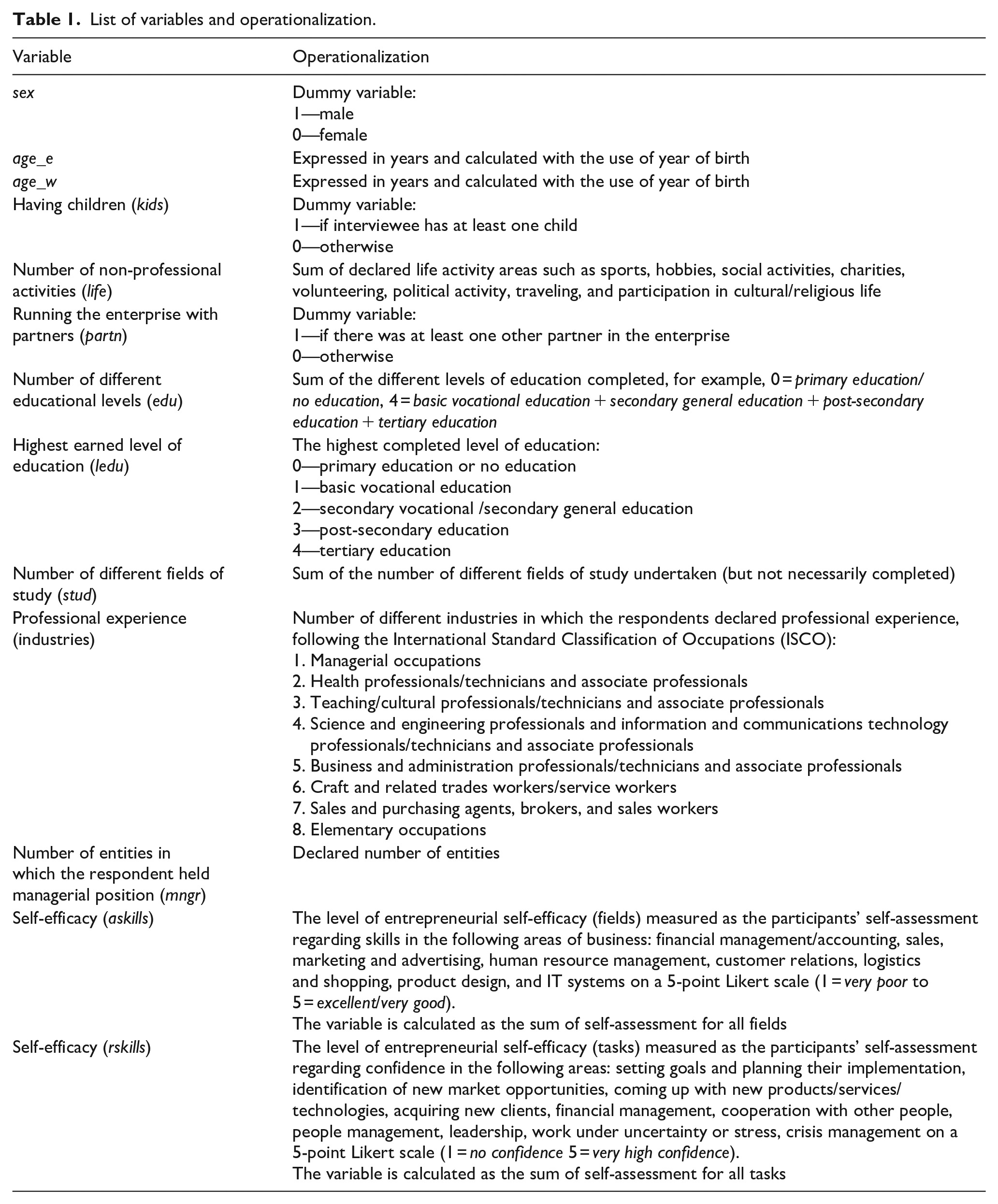
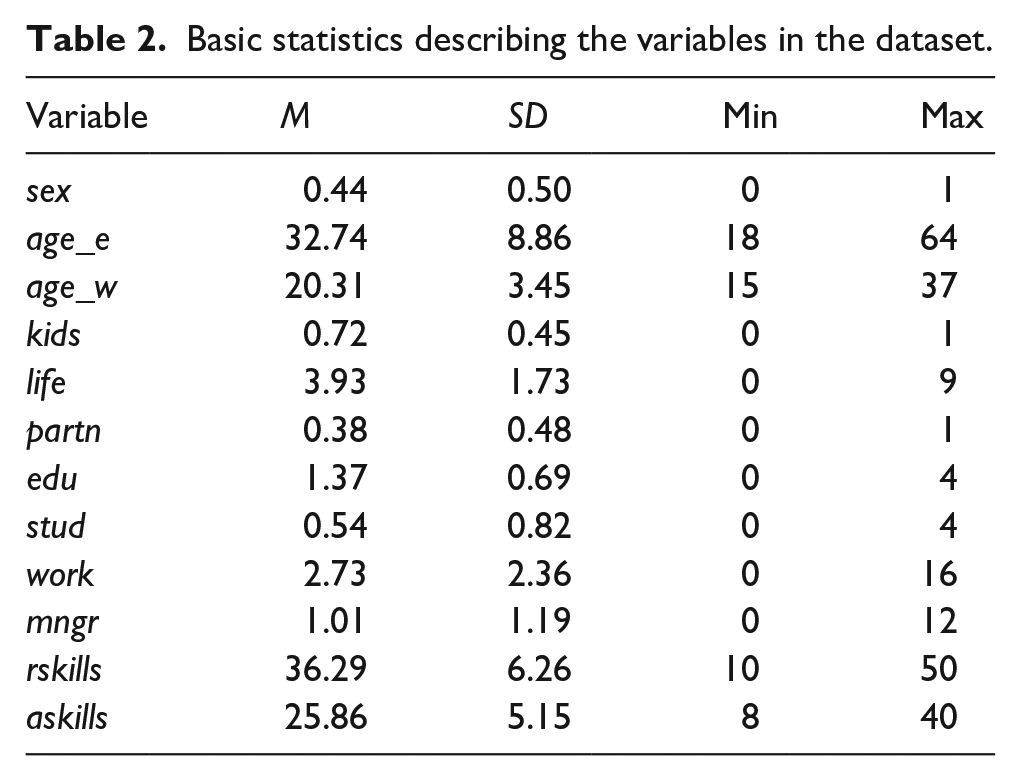
Table 2 presents the basic statistics that describe the variables in our dataset—their means, standard deviations, minima, and maxima. Table 3 shows the correlation matrix.
Basic statistics describing the variables in the dataset.
Correlations of variables.
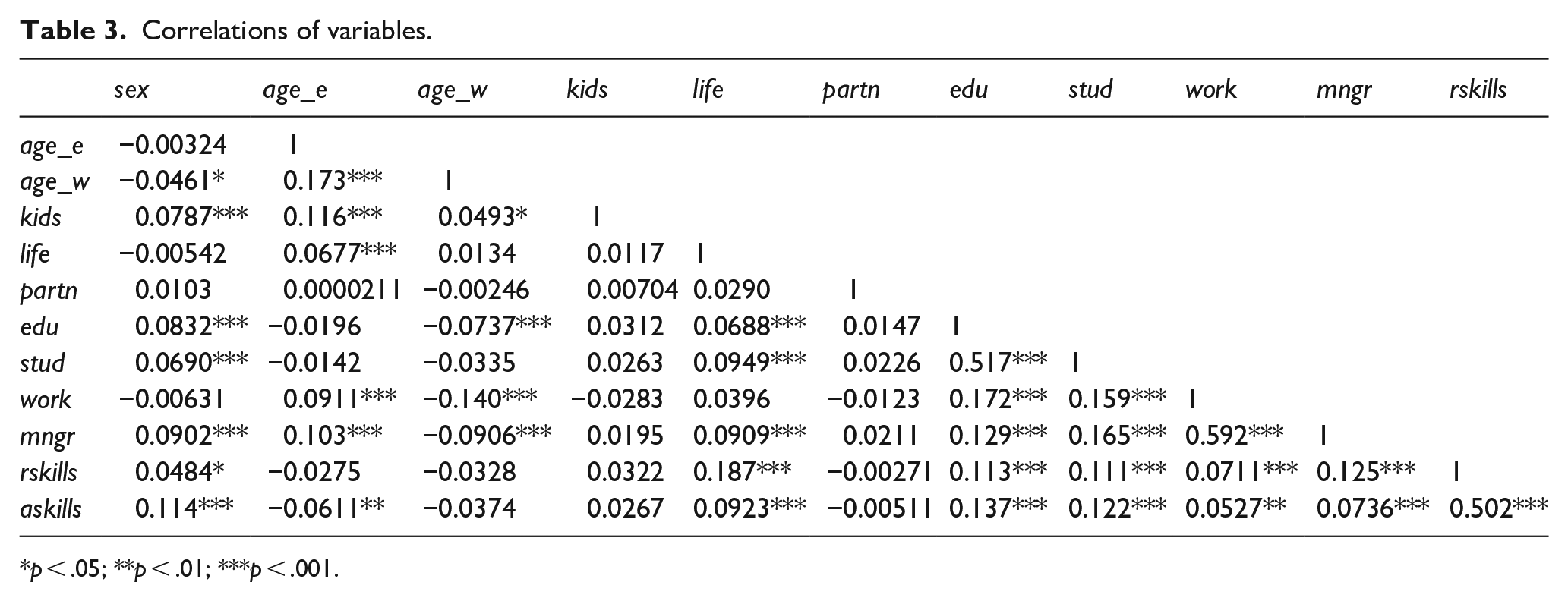
p < .05; **p < .01; ***p < .001.
Analysis and results
Our dataset allowed us to test the hypotheses using the Cox proportional hazard model. The results of the estimation are shown in Table 4. The dependent variable is the yearly risk of business termination. Hence, negative values of a parameter indicate a factor that contributes to a more sustainable enterprise. Column (1) presents the

and are equal to
Results of the estimation.
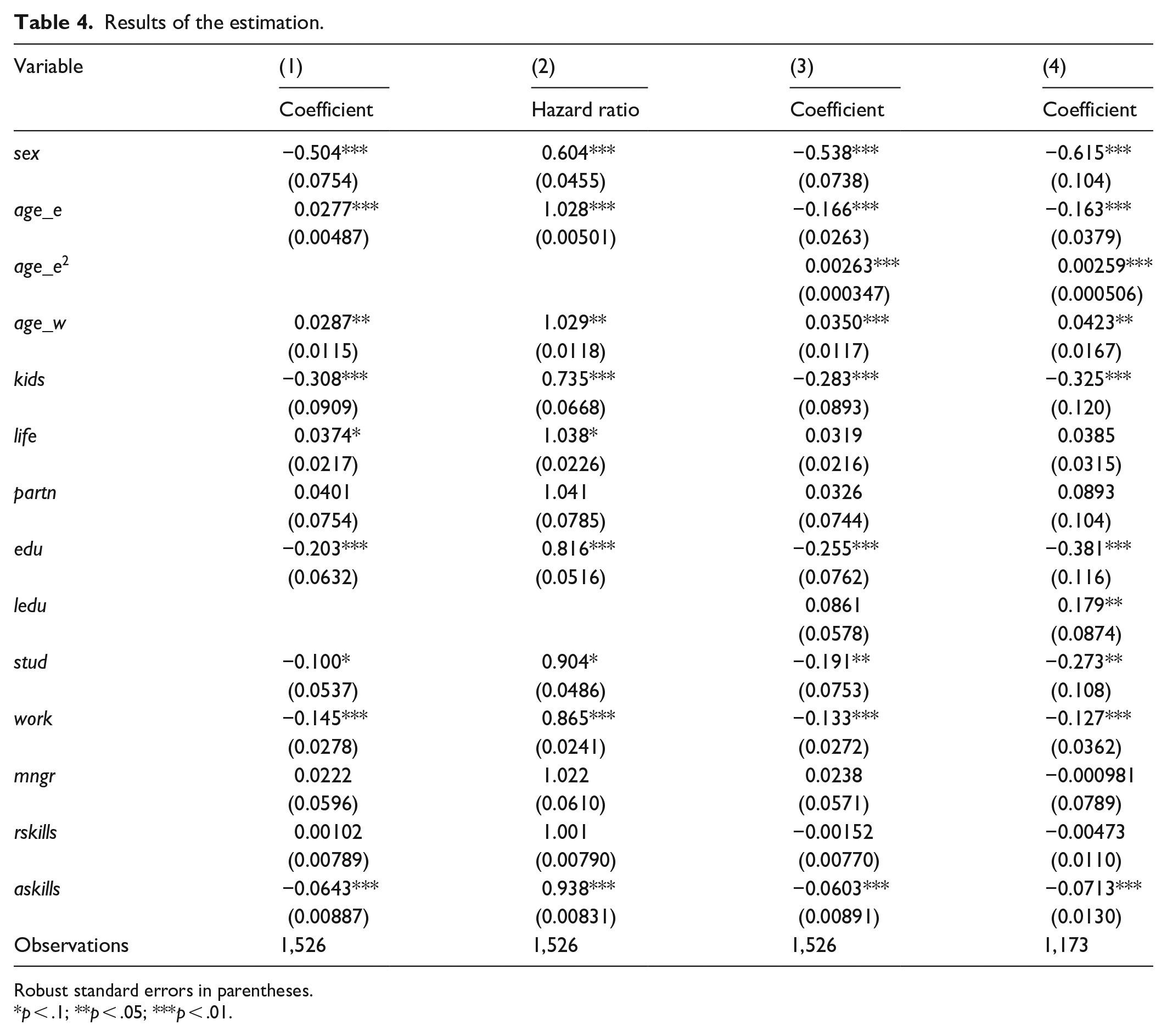
Robust standard errors in parentheses.
p < .1; **p < .05; ***p < .01.
The survival model shows that men (variable sex = 1) tend to build significantly more sustainable businesses in comparison to women. This difference is high, with males having close to double the chances of survival as entrepreneurs in comparison to females. This may be explained, after Boden and Nucci (2000), by the fact that, in general, female entrepreneurs are more constrained in terms of the amount and quality of human capital that they gained while employed. At the same time, however, many studies conclude that businesses led by women are not more likely to go out of business (e.g., Kalleberg & Leicht, 1991). The striking difference between male and female business survival in our study may also be justified, at least partly, by the cultural context. The country where the study was conducted is one where the traditional family model still dominates; therefore, it often happens that women stop their entrepreneurial career to stay at home and raise their children, and afterwards, they chose what in their view is the less risky option of being an employee.
Our results indicate that the age of first professional activity has a statistically significant impact on the chances of business survival. People who started their first paid jobs at an earlier age, no matter whether as an employee or entrepreneur, tend to run more sustainable businesses and have greater chances of business survival. We are, however, cautious about drawing conclusions concerning the causal effect between variables. In our view, the age of starting the first earning activity should be treated more as a symptomatic variable. First earning activities at a lower age most likely indicate an underlying drive to earn money and that, in general, the individual is more active than average in the professional field (the general propensity to work and earn a living). Such people may tend to work harder and be more focused on economic success, which may increase their chances of being a successful entrepreneur.
The results show that businesses started at an earlier age tend to be characterized by a lower probability of failure. Hence, we speculated that there may be a certain age at which it is optimal to start a business, since gaining experience may be crucial for business success. In order to verify this, we also ran an estimation that included age in both linear and quadratic terms. The results presented in Column (3) confirm that both proved to be statistically significant. The resulting optimal age turned out to be around 31.
Having children, irrespective of number, proved to be a statistically significant determinant. In general, people with children turned out to be more long-term entrepreneurs who were able to run businesses over extended periods. Surprisingly, this result cannot be attributed purely to age, since in our analysis, we control for this covariate using age in both linear and quadratic terms. Our interpretation of this phenomenon is a self-selection one. People who have children may tend to avoid ventures that are particularly risky; thus, having children may be correlated with longer lived businesses, on average.
On the other hand, the number of areas of non-professional activities (life) turned out to have no statistically significant impact on the likelihood of entrepreneurial success. The same holds true for the number of partners (partn) in the company.
In turn, education seems to have a strong impact on the risk of failure. In our study, we measure education with two indicators. One (edu) is the total number of all completed levels of education. For example, a person who graduated with a bachelor’s degree (level 5) after a general secondary school (level 3) will have edu = 2. If the same person, before going to general secondary school, also completed a vocational school at the lower secondary level (level 1), he or she will have edu = 3. Hence, besides measuring merely the highest level of education, this indicator also measures the diversity of experience at different educational institutions. According to our findings, this indicator has a strong and statistically significant impact on the chance of entrepreneurial success. Figure 1 shows the theoretical survival function at different levels of edu that result from our Cox proportional hazards regression. It can clearly be seen that having the most diverse educational path can more than double the chances of success, which is in line with our first hypothesis in this study. We cannot say the same about only the level of education. In Column (3) we included both ledu and edu, with the latter measuring only the highest level of education attained. This variable proved to have no statistically significant impact on the probability of entrepreneurial success.
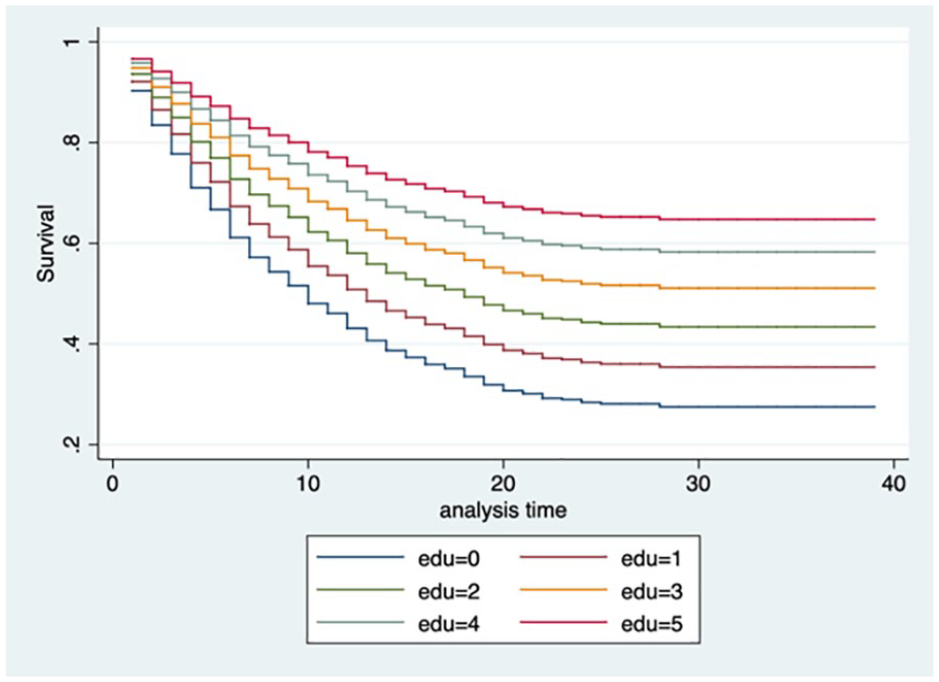
Survival function for different totals of all completed levels of education (edu).
In order to further investigate the role of the breadth of education, we also included another indicator (stud). It refers only to graduates at a higher level and measures the number of different degrees. Our results show that it also has a statistically significant impact on business survival. Figure 2 shows that this variable has an effect on entrepreneurial survival, although this impact is not as pronounced as in the case of the number of total educational levels.
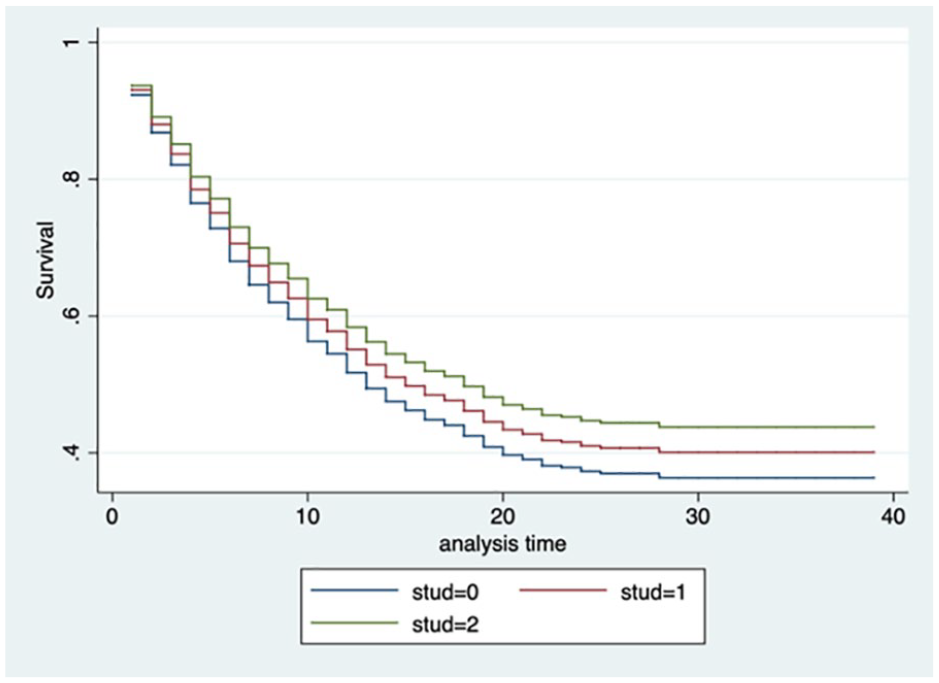
Survival function for the total number of different degrees at higher level (stud).
We also found that the breadth of professional experience has a statistically significant impact on the chances of business survival. Therefore, Hypothesis 2 of our study has been confirmed. If an individual had been employed in a large number of companies (nfwork), it tended to diminish the risk of failure. Figure 3 shows the risks of failure linked with the different number of workplaces. Like Boden and Nucci (2000), we found that managerial experience has a negligible impact on the chances of entrepreneurial success. The number of companies where an individual held a managerial position (mngr) proved not to be significantly correlated with the sustainability of a business, which is against our Hypothesis 3.
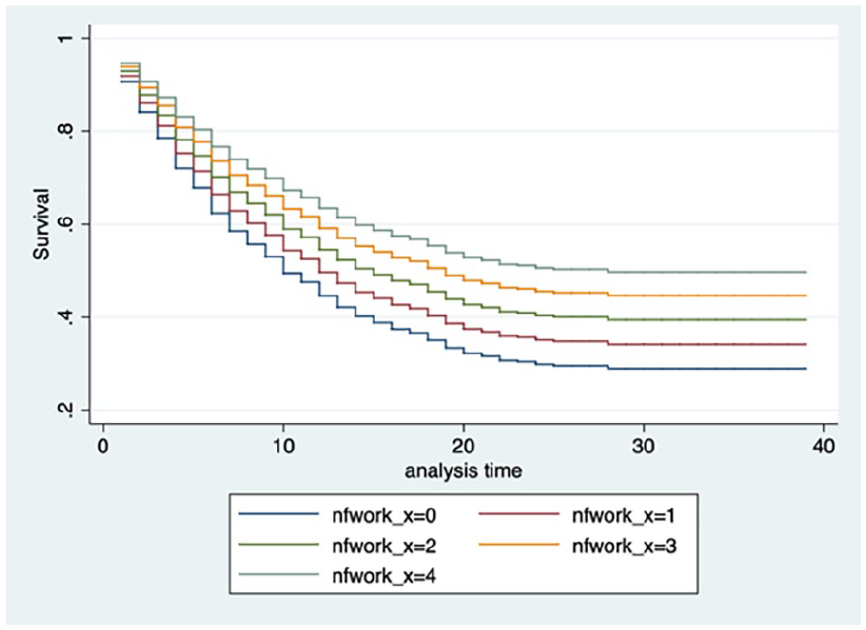
Survival function for the different number of workplaces.
Our study shows that one of the measures of entrepreneurial self-efficacy (askills) has a strong and statistically significant impact on the probability of business survival, while the other (rskills) does not demonstrate a significant correlation. Thus, it turns out that high self-efficacy in “tangible” areas such as finance, logistics, marketing, and sales contributes to entrepreneurial success, while “soft” skills, like leadership or crisis management, are not equally as important as the success factors. Therefore, our fourth hypothesis was too general as it has been proved only partly.
Discussion and implications of the study
Advancing knowledge on business survival has become critical, as a large number of firms are not able to survive their first years on the market, but at the same time, the “mortality rate” declines with time (Audretsch, 1997). It is not only interesting but also useful to know what makes some entrepreneurs have a better chance of continuing their ventures than others, in particular, if we relate it to the predispositions for business start-up and extract the essence of both business entry and survival. Therefore, the aim of the study was to investigate the determinants of business survival that are already verified for business entry within a well-established entrepreneurship theory. Our theorizing drew upon Lazear’s theory of entrepreneurship, basing on elements of which we developed four hypotheses regarding the probability of business survival.
In the light of our findings, breadth of education not only influences the propensity to start a business, as Lazear’s theory states, but also positively influences the chances of a business surviving. Whatever the level of education, strengthening the heterogeneity of education should be seen as one of the main factors that enhance entrepreneurial activities that last. For Lazear, breadth of professional experience also matters for aspiring entrepreneurs. Likewise, according to our results, the breadth of professional experience has a significant impact on business survival, but only if we relate it to industry experience, and not managerial experience. Therefore, it seems that diversity and breadth of knowledge gained through education or experience in various industries become key determinants of the start-up and survival of a business. What also counts in entrepreneurial careers is self-efficacy, which is additionally taken into consideration in some follow-up studies of Lazear’s theory (e.g., Tegtmeier et al., 2016). However, the belief in hard and tangible skills contribute more to business survival than soft skills.
Returning to the question raised in the title of this article: is it the survival of the fittest or of the jacks-of-all-trades?, we may answer that having broad knowledge and diverse experience is positively correlated with being successful in entrepreneurial ventures that last, in particular, if knowledge and experience are backed by high self-efficacy. Therefore, it is not only “natural selection” that is responsible for somebody becoming an entrepreneur and successfully continuing to be one, but also what he or she learns within the educational system and through experiences. In this sense, the study has important implications for entrepreneurship education. In order to be able to “produce” more successful entrepreneurs, as educators we need to provide a learning environment that increases the variety and scope of skills and knowledge; we also need to expose students to diverse experiences related to the entrepreneurial profession.
Apart from the implications for research and education, our study offers also some practical business indications. Knowing the ex-ante human capital-related characteristics of successful founders is informative, as the results might be advisory for aspiring entrepreneurs or entrepreneurs already following an entrepreneurial path. They demonstrate that pursuing education and having a breadth of professional experience is key for both business start-up and its continuation. Completing education, followed by being active in a business environment, should help develop stronger entrepreneurial skills and knowledge that are indispensable for entrepreneurial success. Moreover, the study might be helpful for managers considering becoming entrepreneurs, as they should try to gain experience in diverse industries if they plan to survive on the market.
Conclusion
Lazear’s theory of entrepreneurship indicates that individuals with diverse sets of skills and experience are more likely to launch their own business, but it is silent about how the same characteristics influence business survival. This study extends Lazear’s theory of entrepreneurship by considering not only business start-up but also business survival. We expand this theory by verifying whether breadth of education and professional career also contribute to the likelihood of entrepreneurial success. According to our findings, the breadth of education impacts the propensity to start a business, but it also increases the chances of business survival. The breadth of professional experience turned out to have a significant impact on business survival, but this result did not hold for extensive managerial experience.
Therefore, in the light of our results, we claim that Lazear’s theory can be expanded to incorporate some new issues that were not previously acknowledged, which we believe is one of the implications of our research. We also believe that the article makes a methodological contribution as we offer quite detailed guidelines in terms of applying the proportional hazard method in business survival.
Limitations of the study and future research
Our study has a range of limitations. Business termination does not necessarily mean business failure. Although cases of selling a company in Poland are relatively uncommon, they do contribute to the cases of business termination. Similarly, some businesses are closed because of retirement or the voluntary choice of a different career path. In order to at least partially address this limitation, we ran an additional regression, the results of which we reported in Column (4) of Table 4. In this regression, we included only those former entrepreneurs who declared that they had closed the business because of problems with financial liquidity, sales, employees, or because they were tired of running the business. Hence, the definition of “unsuccessful” entrepreneur was narrowed down only to cases of self-reported, forced business exit. All the main results proved to be robust to this change. 1
Another limitation of our study is the fact that we use business continuation as the main indicator of success. We chose this approach to provide the maximum reliability of data. Self-reported financial data are known to be unreliable, since interviewees may be reluctant to share sensitive data with an anonymous interviewer. The same is unlikely to happen with information about the years when the business was started and terminated, since these data are not perceived as confidential. However, it would clearly be interesting to run a similar study where the success of an entrepreneur would be confirmed not only by how long the firm lasts, but also by its financial success. It could form an avenue for further research.
Despite any limitations, we hope that the results of this study can help to build research for future investigations on entrepreneurial survival, as well as any other investigations aimed at extending Lazear’s theory of entrepreneurship. One possible direction for future work could be extending the study by measuring the success of companies related to their financial results or taking into consideration other measurements of business survival.
Footnotes
Declaration of conflicting interests
The author(s) declared no potential conflicts of interest with respect to the research, authorship, and/or publication of this article.
Funding
The author(s) disclosed receipt of the following financial support for the research, authorship, and/or publication of this article: This work was supported by the National Science Centre in Poland under Grant “New approach to Lazear’s entrepreneurship theory in context of entrepreneurial success and failure” (OPUS, DEC-2016/23/B/HS4/01759).
