




Abstract
This study aims to analyze status, trends, and possible future research areas in the literature on “disability and work.” It is an in-depth analysis of articles related to this field, published during 1991–2017, in journals included in the Science and Social Sciences Citation Index. Bibliometric methods helped to describe evolution in publications, the most representative contributors, methods applied, main concepts and theories, and topics explored (content analysis). A co-word analysis allowed to create knowledge maps on topics and identify potential venues for future research. The contribution is threefold. First, it contributes to knowledge advancement concerning disability in workplaces, opening new possibilities to discover important research areas. Second, it offers conceptual, theoretical, and methodological suggestions for future research. Third, it has practical implications related to inclusive strategies and initiatives in the workplace which human resource practitioners can use to promote the participation of workers with disabilities improving their labor experience.
Introduction
The World Report on Disability (World Health Organization [WHO], 2011) estimated that more than a billion people live with some form of disability representing about 15% of the world’s population. According to the Progress Report on the implementation of the European Disability Strategy (2010–2020), “it is expected that, by 2020, approximately 120 million Europeans will have a disability” (European Commission, 2017). Any person at some point in their life may experience a disability, which can affect various aspects of their life. For instance, people with disabilities (PwD) face different obstacles such as discrimination and unemployment (Konrad et al., 2013; Schur, 2003), which hinder their full inclusion in society, even in developed countries (United Nations [UN] Department of Economic and Social Affairs, 2018).
According to the latest data from the International Labor Office (ILO), there are 470 million PwD at the labor age, but they experience discriminatory barriers in their access to employment (O’Reilly, 2007). PwD have the right to work on an equal basis with others, and the Employment Equality Directive prohibits discrimination in employment. However, the employment rate of PwD (48.7%) remains much lower than that of people without disabilities (72.5%). International organizations continue to work to achieve, by 2030, full and productive employment and decent work for all women and men, including PwD, and equal pay for work of equal value according to Goal 8 of the United Nations (UN Department of Economic and Social Affairs, 2018). It could be useful to carry out more academic research to gain greater knowledge which can be beneficial for companies and society, and achieve an effective social and labor inclusion of PwD.
Therefore, the research on “disability and work” is not a minor issue. However, even though PwD are a growing demographic group, they have received little research attention compared to other types of diversity in organizations such as race, ethnicity, gender, and culture, which have been studied more widely (e.g., Zanoni, 2011). Dwertmann (2016) affirmed that “empirical research on the topic of disability is extremely limited, especially in top-tier management journals.” With this affirmation in mind, we have reviewed the literature on “Disability and Work,” and we have observed that this research area has been of greater interest in scientific literature since 1990 when the Americans with Disabilities Act (ADA) regulated workers with disabilities in the workplace (Kruse & Schur, 2003), although previous research on disability can be found. In the field of organizational sciences, we find the seminal work of Stone and Colella (1996) focused on a model of factors that affect the treatment of individuals with disabilities in organizations. But, although Dwertmann (2016) referred only to the literature of “top-tier management journals,” we highlight that PwD as a labor force has also been explored by different research streams related to organizational studies and the human resource area. Consequently, disability in workplaces includes many exploratory variables (social, labor, economic, legal, and medical factors) that add great complexity because of its interdisciplinary character. As a result, the literature on this topic covers many different issues of interest which have received particular attention, such as employment, unemployment, and the labor market (Bush & Tassé, 2017; Campolieti et al., 2009; Konrad et al., 2013; Schur, 2003), models, theories, and concepts of disability (Mulvany, 2000; Thomas, 2014), accommodation in workplaces (Kruse & Schur, 2003), and other interesting research themes.
We have found some reviews on disability (Dwertmann, 2016; Procknow & Rocco, 2016; Ren et al., 2008), that are based on specific aspects. A meta-analysis of experimental studies on the effects of disability on human resource judgments (i.e., hiring decision, performance expectation, and performance evaluation) was carried out to examine and elucidate the ambiguous results of the analyzed works (Ren et al., 2008). A different study revised aspects such as the examination of methodological challenges and possible solutions regarding research on disability in the workplace (publications from 1996 to 2015; Dwertmann, 2016). Another review (Procknow & Rocco, 2016) focuses on exploring disability issues in human resource development, limiting the study sample only to the publications of the Academy of Human Resource Development (AHRD). The limitation of all these reviews is that their investigations are based on a small sample of articles.
According to the reviews found, we identify a lack of studies offering an interdisciplinary overview of disability in workplaces and the evolution of the most relevant contributions. Top-level works related to this field could provide more visibility to the PwD group. They could contribute to their effective socio-labor integration as well as motivate both academics and editors of the main journals to publish research studies of quality useful to consolidate this discipline. Furthermore, we believe that a study sample with a broader size and time limit can first, provides an overview of all the concepts and topics examined and, second, helps to identify potential new research and methodological directions, and third, complement, improve, and advance previous work.
The aim of this article is to examine the status, trends, and potential future research areas in the field of disability and work, in journals included in the Science Citation Index (SCI) and Social Sciences Citation Index (SSCI) from 1991 to 2017. The importance of this study lies in the fact that it is of interest to many people. To the best of our knowledge, this is the first study with an interdisciplinary approach that has used a combination of bibliometric indicators and methods, such as content analysis and visualization of knowledge maps that have helped us achieve our aim. The combination of methodologies and theories and the crossing of different disciplines in research can provide academics and employers with different perspectives to allow them to deal with the inclusion of disability in the workplace.
The article is structured as follows. Section “Methodology” presents the methodology used. Section “Findings” shows the findings in several subsections related to publication activity, the main concepts and theories, categorization of the articles by topics through content analysis, and performs co-word analysis of the literature on disability and work. The last section includes the discussion of the findings in terms of a description of the field evolution, the conclusions, limitations, proposals for future research, and the contribution of this research.
Methodology
This study has been designed to fill in the gaps from previous reviews and offers an overview of research on disability and work published in the most relevant journals. Therefore, it aims to examine the status, trends, and potential future research areas in the field of disability and work, from 1991 to 2017 to present a general outlook of all the topics investigated, with an interdisciplinary and comprehensive approach. The design of the methodological process was organized into stages which are explained in the following sections.
Sample and data collection
Previous reviews analyzed samples limited in size, time, and sources of information and considered only specific sectors (Dwertmann, 2016; Procknow & Rocco, 2016; Ren et al., 2008). We would like to broaden the vision in this field by extending the sample size and time limit of the analysis and adding different disciplines to the study. For the representation of disciplines, we took into account the first Journal Citations Reports (JCR) category of each article offered by the Web of Science (WOS) database (Figure 1). The ADA was published in 1990, so we have considered it appropriate to observe the evolution of publications from that time on (1991–2017). Most research articles examining the field of disability have not been published in high-quality research media (Cavanagh et al., 2017; Dwertmann, 2016). We think that analyzing high-level studies related to this field could give more visibility to PwD to favor their labor inclusion and encourage academics to carry out higher quality research. So, we have examined journals indexed in the JCR of the SCI and the SSCI which are available in Clarivate Analytics’s WOS database. We have chosen JCR because this index has become the most robust database available as it tops the largest list of leading peer-reviewed journals, with the largest set of subject categories in Social Sciences receiving millions of citations annually (Rosas et al., 2011). WOS is used as a research tool supporting a broad array of scientific tasks across diverse knowledge domains (Li et al., 2018). It is employed in bibliometric studies in Social Sciences as it adds value when the research question is interdisciplinary (Bramer et al., 2017; Navarrete-Cortes et al., 2010; Rosas et al., 2011).
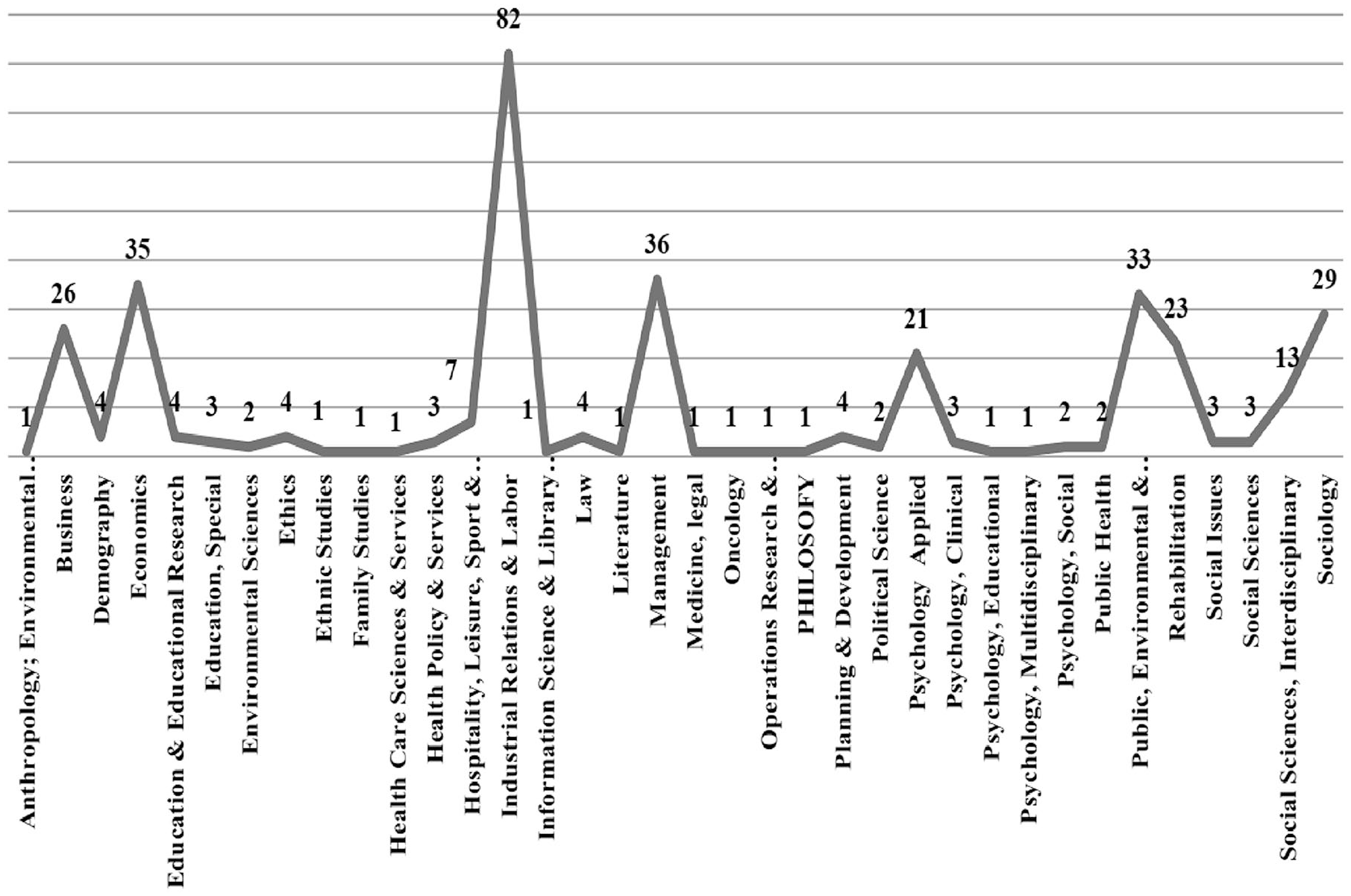
Number of articles per categories (first category of JCR of each article; 1991–2017).
In the first stage, we have looked at publications only categorized as “articles” (core collection, basic search, and full document). We excluded from the search “proceedings papers,” “books,” “book chapters,” and “meeting abstracts” among other works with limited impact compared to journals (McDonnell et al., 2017; McWilliams et al., 2005). The search patterns (option “topics” of WOS) used were “Disability and work,” “Disability and firm,” “Disability and business,” “Disability and company,” “Disability and Human Resources,” “Impairment and Work,” and “Impairment and firm” (terms related to disability in the workplace). As a result, a total of 1,661 articles were obtained. Subsequently, in the second stage, these articles were reviewed for their abstract and title to exclude the studies that were not tightly focused on workers with disability (e.g., papers on purely medical issues such as prevalence of illnesses or rehabilitation not related to the workplace, legal discussions, economic issues about disability insurance, and accessible tourism among other non-labor issues). Each article was verified to identify if they belong to JCR and those not listed were removed (about 4%). This process yielded a list of 360 articles published in 149 journals included in the selected subject categories. The ordered index of the 360 articles that make up this research is provided as Supplemental Material.
Methods of analysis
Bibliometric indicators based on quantitative techniques enable the understanding of the dynamism of a research field and the productivity of different institutions, countries, and authors (Callon et al., 1995). Studying the dynamics of science is important because it provides the necessary clues to understand how fields are changing, their structure, and the beginning and subsequent growth of new fields of research (Gupta & Bhattacharya, 2004). Furthermore, they facilitate an objective analytic approach, such as the co-word technique that identifies the relationships (co-occurrences) of keywords that appear together in academic publications (Guerras-Martin et al., 2014). We have applied bibliometric techniques, such as publication activity indicators and the co-word technique, which serve as a complement to the content analysis. We have used different software packages. First, from WOS, we have exported the references as plain text to Bibexcel, and this, in turn, generates data files that can be imported into Excel for further processing, providing the frequency distribution for the activity indicators (Persson et al., 2009). Bibexcel combined with other programs, for the visualization of the results obtained, allows the representation of social networks between terms or co-words (Bonacich, 2008; Gupta & Bhattacharya, 2004). We chose Vosviewer software (version 1.6.6, released on 23 October 2017) by extracting the files directly from WOS allowing for more sophisticated visualizations and the inclusion of mathematical algorithms that show the density of the co-word clusters (Van Eck & Waltman, 2009). The co-word analysis was performed using “keywords of authors” and the “keyword plus” (provided by WOS) of all the reviewed articles in WOS. To carry out the analysis, a similarity measure called the association strength (Van Eck & Waltman, 2009) or proximity index (Rip & Courtial, 1984) was used by Vosviewer. The proximity index between two key terms is proportional to the ratio between, on one hand, the observed number of their co-occurrences and, on the other hand, the expected number of their co-occurrences.
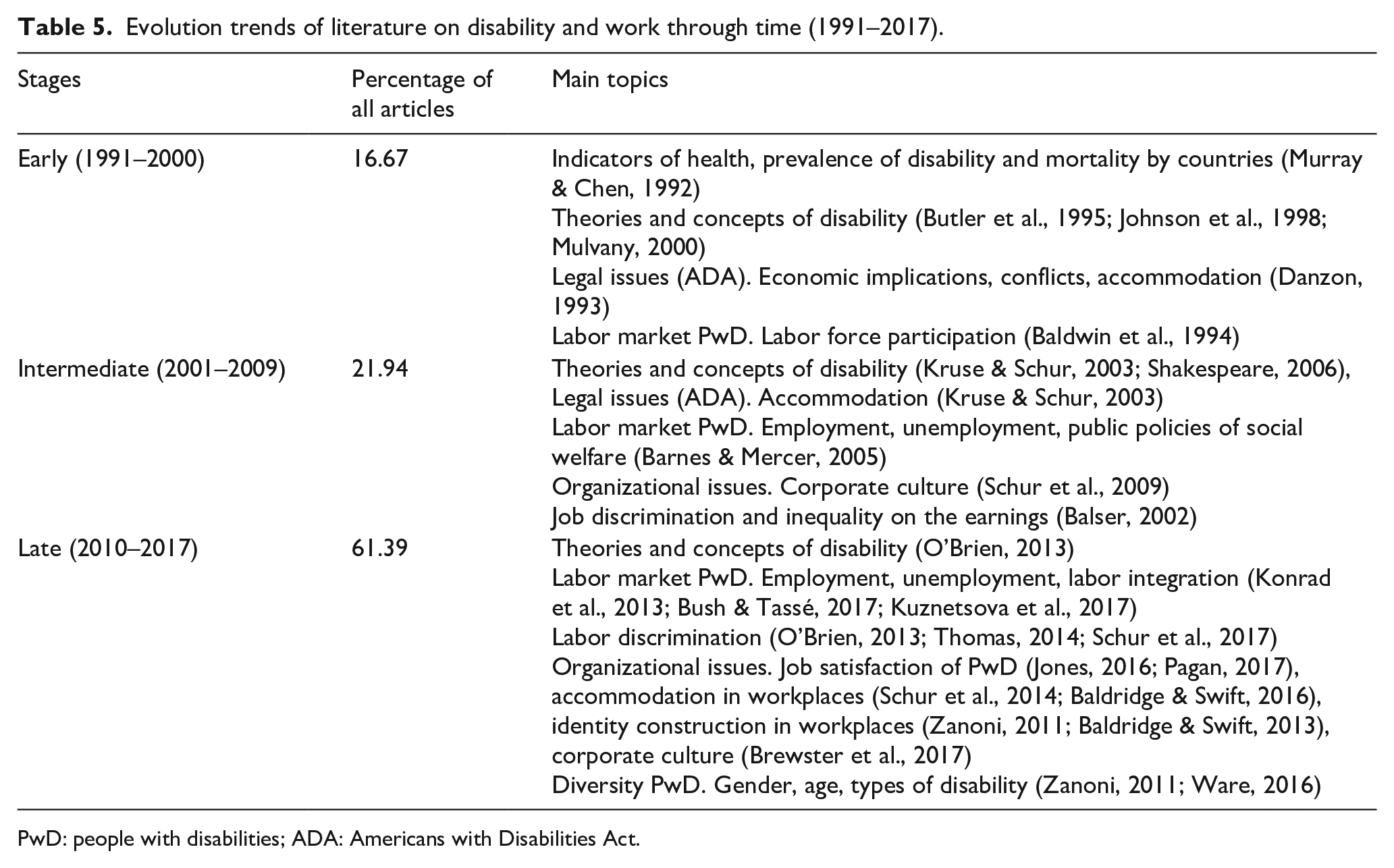
To create and edit the maps through Vosviewer, a threshold with a minimum number of five occurrences per keyword has been chosen (in this case, the optimal number of occurrences to achieve the most representative relationships of the publications studied). Figure 3 (in section “Research trends in disability and work. Co-word analysis”) shows the main keywords of the analysis carried out and the visualization of the density of each keyword, in each cluster of a different color, using the scheme red-green-blue-yellow-fuchsia-turquoise. Red corresponds to the largest cluster and turquoise corresponds to the smallest. The density determines the weight or importance of each keyword within the group. A higher density corresponds to greater weight and a greater number of co-occurrences within the cluster. In addition to visualizing the clusters, the analysis of co-words carried out offers the possibility of glimpsing how the trends in the research on “Disability and Work” have changed throughout the period studied. The results of this analysis organized by stages are shown in Table 5 (in section “Research trends in disability and work. Co-word analysis”). In each of the time periods, the main topics are investigated, and the percentage of corresponding publications are collected.
Bibliometric tools serve as a suitable complementary technique to content analyses (Guerras-Martin et al., 2014). The combination of full-text analysis and traditional bibliometric methods serves to improve the efficiency of methods at the individual level (Glenisson et al., 2005). Thus, content analysis is a research methodology aimed at formulating valid inferences from data, applicable to its context to provide knowledge, new perspectives, representation of facts, and a practical guide to action (Krippendorff, 1990). It can be quantitative or qualitative, and it is a systematic and rule-guided method used to study the content of textual data to make sense of it (Mayring, 2004). Following Krippendorff (1990), Mayring (2004), and the rules of systematization (ordered process applicable to all units) and objectivity (reliability and validity), we subjected each of the 360 articles to a three-step process: (1) data reduction, (2) data disposition and transformation, and (3) results and conclusions.
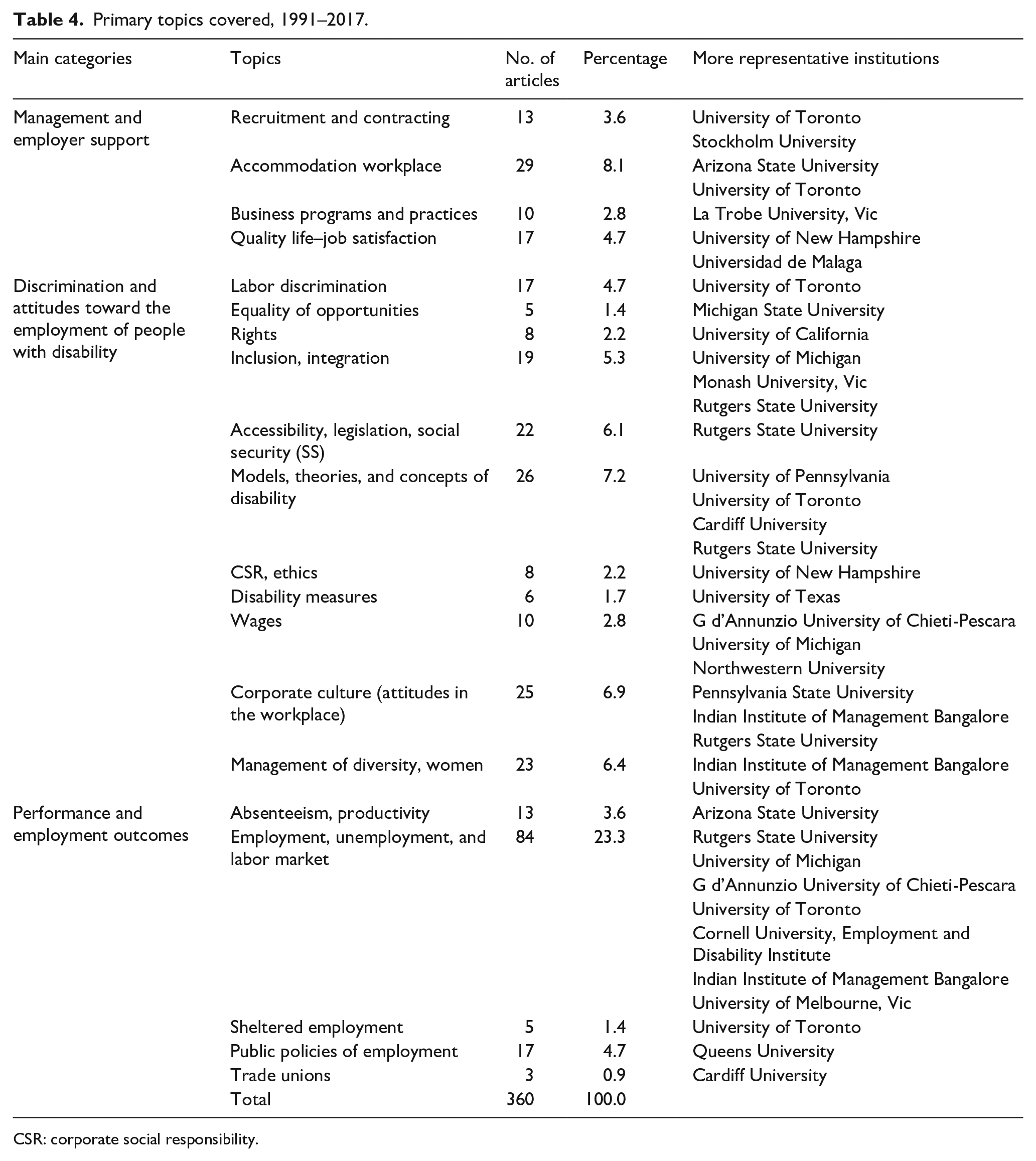
To reduce the data while preserving their meaning, the deductive thematic criterion of categorization was chosen, that is, starting from previously established categories (Krippendorff, 1990). This technique allowed us to link and codify the grouping of topics of the 360 articles to the categories previously established by Cavanagh et al. (2017), in the article “Supporting workers with disabilities: a scoping review of the role of human resource management in contemporary organisations.” These categories are (1) management and employer support, (2) discrimination and attitudes toward the employment of PwD, and (3) performance and employment outcomes. The organization and transformation of the results is offered in Table 4. Following the criterion of exclusivity, each article was placed as an exclusive category, representing the principal focus study (Tesch, 2013). The above process allowed the quantitative count by frequencies (Bardin, 1991) and the identification of the most representative institutions by topics.
Regarding the reliability and validity of the study, we are guided by what was established by Krippendorff (1990). Two of the authors analyzed the articles separately. Then, they compared each other’s work to check the consistency of the coding for each topic and the corresponding categories. The resulting intercoder agreement was robust enough, showing 90.6% agreement, and the pending discrepancies (9.4%) were resolved through discussion. In addition to the content analysis practiced, the review of the main concepts and theoretical questions provides a detailed insight into the use of the different theories used and their evolution, which guides the research on workers with disabilities, focusing on the main theoretical trends, the emerging theoretical lines of scientific research, as well as the practical implications derived from them.
After analyzing the content that helped classify the articles by different topics, we were interested in knowing how the contents of the reviewed articles were linked to the interpretation and identification of emerging research areas. We employed the co-word technique previously explained to highlight the relationship between articles and themes, through the comparison and classification of publications according to the occurrence of pairs of similar words (Bhattacharya & Basu, 1998). The findings are shown in the following section.
Findings
Publication activity of literature on disability and work: evolution, contributors, and methodological issues
In the first years, there are few articles related to disability in the workplace. In fact, the first publications were focused mainly on economic issues (e.g., accommodation costs or insurances of disability). The ADA appears in the year 1990 and marks the beginning of the growing interest in this research field.
To describe of the quantitative evolution and the structure the literature, some indicators of the publication activity were calculated. Figure 2 shows the annual total of articles on disability and work selected for the period 1991–2017. In total, there are 149 different journals that have published 360 articles.
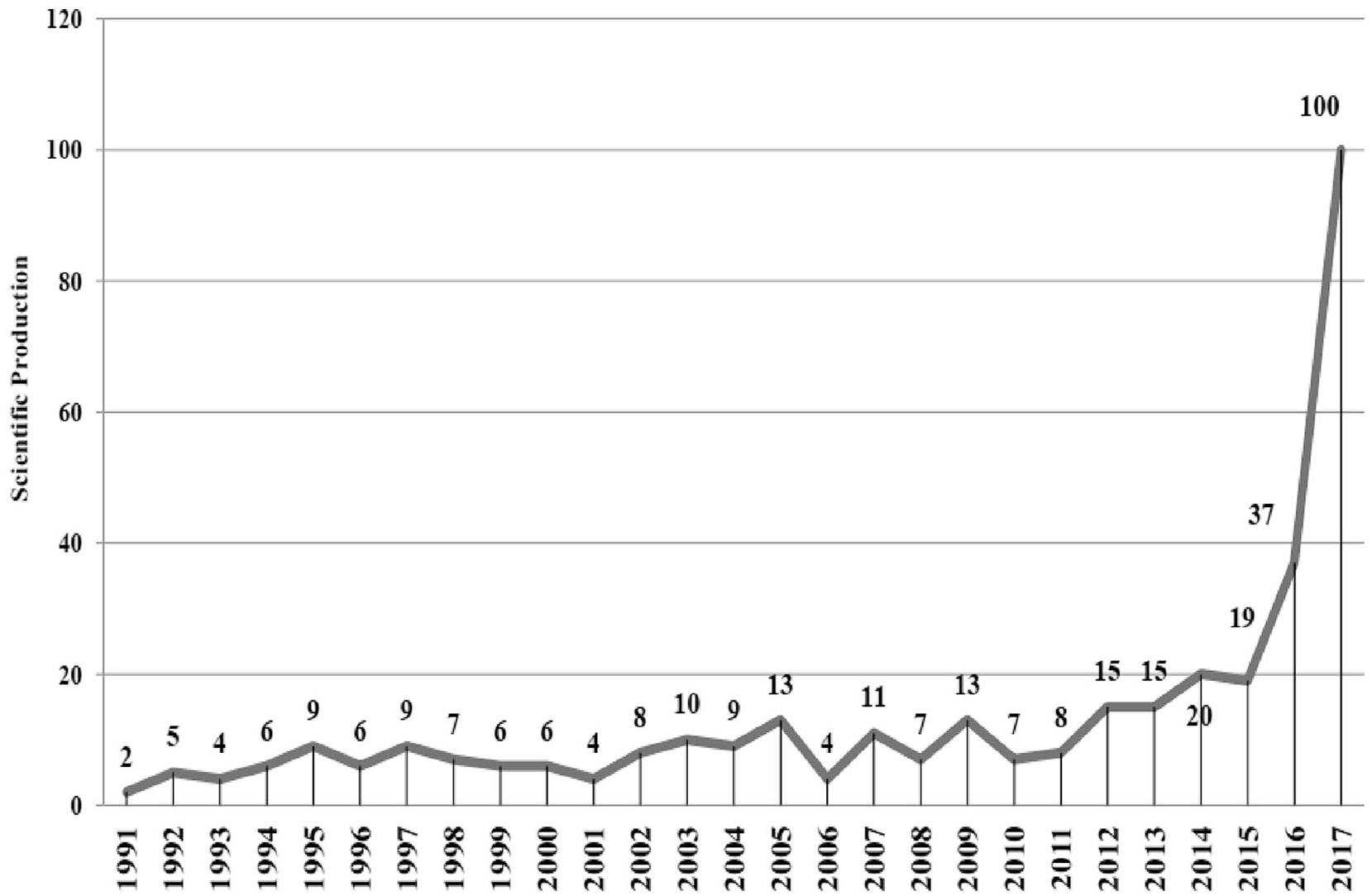
Total number of articles per year (1991–2017).
Figure 2 shows that the research on work-related disability has been growing in recent years. Specifically, the publication production presents two peaks in 2005 and 2009, and it is from 2012 when it progressively increases until reaching the highest production level in 2017. The significant increase in articles in the most respected journals in recent years may suggest a greater number of studies with higher quality and can also demonstrate the continuous evolution of research on workers with disabilities, constituting a new paradigm within academic research.
As for the relevant journals, a total of 19, of the 149 studied (Table 1), represent almost half the scientific production analyzed (45.3%). Among the top five journals with the most publications, only one journal appears in the first quartile of JCR (Journal of Human Resources in the second position, journal impact factor [JIF] 6.531), while the first in the list is in the fourth quartile (Employee Relations Law Journal, JIF 0.051), and the rest are in the second and third quartile, with JIF less than 2.2. Table 1 also shows the information related to the different categories where these journals of JCR are framed (i.e. the journal impact factor in 2017), highlighting the interdisciplinary nature of the field.
Journals that have published at least five research articles related to disability and work (1991–2017).
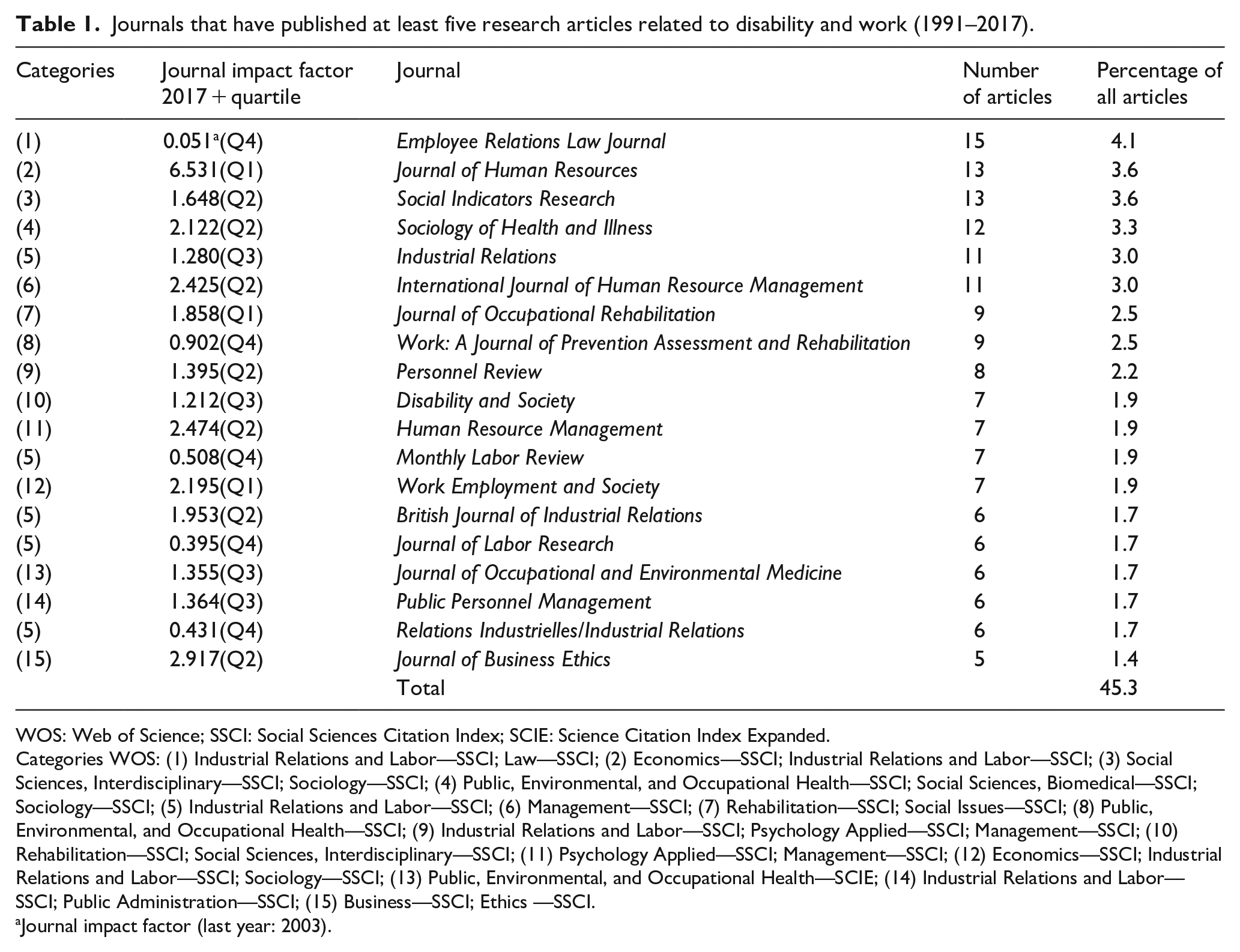
WOS: Web of Science; SSCI: Social Sciences Citation Index; SCIE: Science Citation Index Expanded.
Categories WOS: (1) Industrial Relations and Labor—SSCI; Law—SSCI; (2) Economics—SSCI; Industrial Relations and Labor—SSCI; (3) Social Sciences, Interdisciplinary—SSCI; Sociology—SSCI; (4) Public, Environmental, and Occupational Health—SSCI; Social Sciences, Biomedical—SSCI; Sociology—SSCI; (5) Industrial Relations and Labor—SSCI; (6) Management—SSCI; (7) Rehabilitation—SSCI; Social Issues—SSCI; (8) Public, Environmental, and Occupational Health—SSCI; (9) Industrial Relations and Labor—SSCI; Psychology Applied—SSCI; Management—SSCI; (10) Rehabilitation—SSCI; Social Sciences, Interdisciplinary—SSCI; (11) Psychology Applied—SSCI; Management—SSCI; (12) Economics—SSCI; Industrial Relations and Labor—SSCI; Sociology—SSCI; (13) Public, Environmental, and Occupational Health—SCIE; (14) Industrial Relations and Labor—SSCI; Public Administration—SSCI; (15) Business—SSCI; Ethics —SSCI.
Journal impact factor (last year: 2003).
Institutions (universities and research institutes) from 28 countries have produced the total number of publications. The rank of institutions contained in Table 2 corresponds to those that have contributed to scientific production with at least three publications. There are 24 universities and 1 institute representing 32.6% of the total number of published articles in the time period considered in this study.
The 25 institutions that produce the most disability and work research articles, 1991–2017.
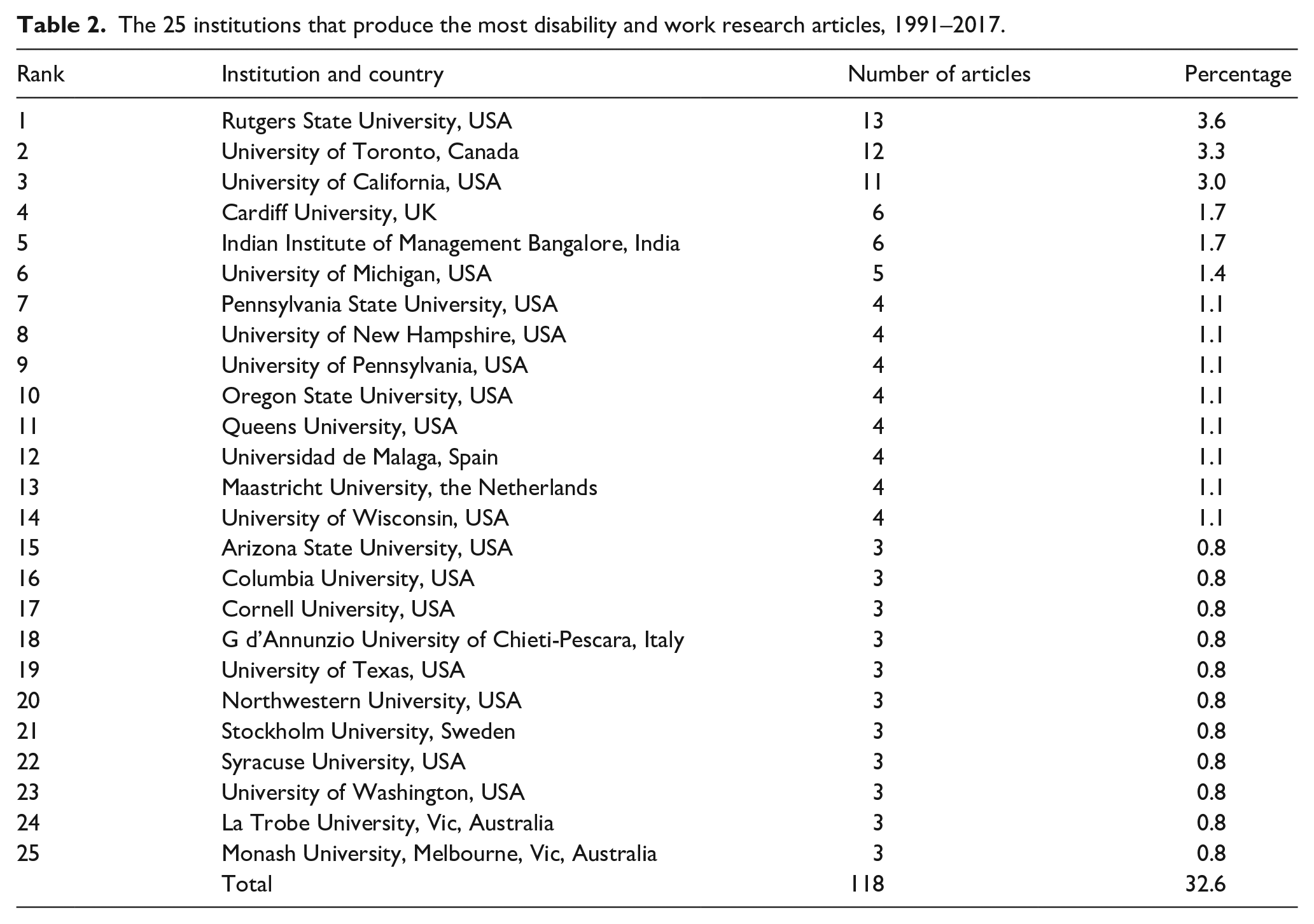
The most prolific institution is Rutgers State University, USA, with 3.6% of all published articles, followed by the University of Toronto, Canada (3.3%), and the University of California, USA (3%). Cardiff University, UK, and the Indian Institute of Management Bangalore, India, are placed fourth and fifth in the ranking, both with 1.7%, respectively. The other universities on the list have contributed less than 1.5%. These institutions are located in only 9 of the publication-producing countries, although the contributors are 28 countries in total. The different legal and social frameworks in developed and developing countries have different consequences. Disability assessments in developing country populations are exceedingly rare, and they are likely to contain serious biases and limitations compared to greater control in developed countries (Murray & Chen, 1992). Results from the World Health Survey indicate higher disability prevalence in lower income countries than in higher income countries, and the people who have a low income or are out of work have a higher risk of disability (WHO, 2011).
The ninth recommendation of the last World Report on Disability (WHO, 2011) indicated the following:
A critical mass of trained researchers on disability needs to be built. Research skills should be strengthened in a range of different disciplines, (. . .) International learning and research opportunities, linking universities in developing countries with those in high-income and middle-income countries, can also be useful.
However, despite this affirmation, there is more empirical literature in developed than in developing countries, where studies published in peer-reviewed journals are limited (Mizunoya & Mitra, 2013). Therefore, we have decided to explore the productivity of the contributing countries. To do this, we have considered the country of the institution of the first author of each article. To distinguish the type of economy of each country, we considered as a reference to the World Economic Outlook Database of the International Monetary Fund (2020 April), which divides the countries into advanced economies and emerging market and developing economies. The results showed a greater number of publications in developed countries of advanced economies. The rankings were the United States (44.2%), the United Kingdom (10.8%), Canada (8.6%), Australia (6.9%), Spain and the Netherlands (both with 4.2%), and Sweden (3.1%). Within emerging and developing nations, only India stood out with the highest production with 1.9% (equal to that of Norway, a developed economy). The rest of the emerging and developing countries (Brazil, Russia, Croatia, South Africa, Iran, and Poland), and the developed ones, except Italy (1.7%), showed a percentage lower than 1.5% (Belgium, Denmark, France, Switzerland, Israel, Germany, Finland, Japan, Lithuania, New Zealand, Slovakia, and South Korea). The articles published by emerging and developing country institutions are collaborations with institutions from high-income countries, usually American and European.
We verified that 24.2% of the scientific production studied has been carried out by only 20 authors of a total of 768. Despite the results regarding institutions and countries, the most productive author of the top 10 is from India (Kulkarni, 2.2% of the total). The following have less than 2%: Campolieti, Schur, Blanck, Baldwin, Baldridge, Kruse—from American Universities, and the rest produced less than 1.5% (Pagan-Rodriguez, Univ. Málaga, Spain; Agovino, Univ. Naples Parthenope, Italy; Bartram, Monash Univ., Australia).
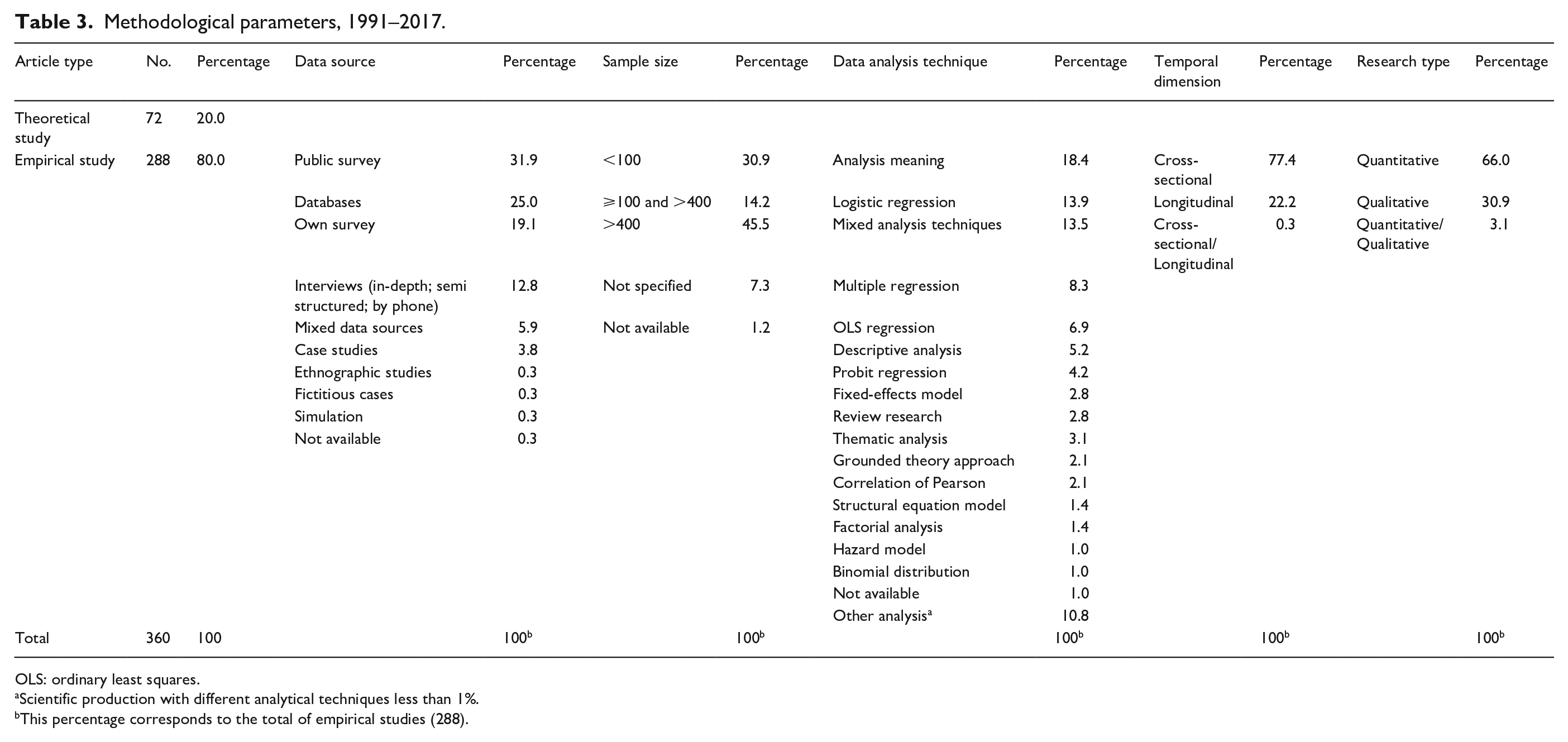
To identify the methodology employed in the literature on disability and work, all the articles in this study were reviewed. Our classification includes aspects related to data sources, research settings, sample size, and so on. Table 3 contains information on these methodological parameters.
Methodological parameters, 1991–2017.
OLS: ordinary least squares.
Scientific production with different analytical techniques less than 1%.
This percentage corresponds to the total of empirical studies (288).
This field of research shows rigorous work which tends clearly toward empirical studies (80% of the 360 articles in total). The rest (20%) were theoretical contributions. Most of all the empirical studies are quantitative (66%), and almost a third is qualitative (30.9%), a method that is common in sociological approaches (Lysaght et al., 2017; Mik-Meyer, 2016a). A minority (3.1%) combines both research methods, so as to reinforce the results of the performed research (Kuo & Kalargyrou, 2014; Schur, 2003). Studies that analyzed issues such as wage comparisons between workers with and without disabilities (Anand & Wittenburg, 2017; Malo & Pagan, 2012) or employment and unemployment of PwD (Agovino & Rapposelli, 2017) used quantitative methods.
As for the methods of gathering information, the most common source is the use of secondary data extracted from national public surveys (31.9%) and databases (25%) with high-quality information from usually large and random samples. Both are of crucial importance because most countries worldwide do not have specific registers or surveys dedicated to workers with disabilities and homogeneous global data (Cho & Hummer, 2001).
Other source data explored are interviews (12.8%) or mixed data in the same research (5.9%). Case studies, ethnographic studies, fictitious cases, or simulations were often used in qualitative studies with small sample sizes, on topics such as the stigmatization of PwD (Thomas, 2014).
As for the size of the sample used, 45.5% of quantitative studies had a size exceeding 400 observations. It is generally thought that multivariate analysis requires a greater sample size to obtain reliable results. However, 30.9% of articles reviewed were qualitative studies with sample sizes of less than 100 observations. Accordingly, the observed sample size is suitable for each analysis technique used.
Table 3 shows the highest percentage (analysis of meaning 18.4%) of the data analysis technique, and this, together with thematic analysis and the grounded theory method, is used in qualitative studies (Mik-Meyer, 2016b). In the last year studied, 2017, new and appropriate techniques have been incorporated for qualitative studies such as the snowballing sampling techniques or life stories (Randle & Hardy, 2017; Spiegel et al., 2017), although these represent a minority compared to the total contributions (in “other analysis,” Table 3).
An incipient tendency to triangulate qualitative and quantitative data analysis techniques was found (Kuo & Kalargyrou, 2014; Schur, 2003), to enrich the study, reinforce the results obtained, and achieve rigorous conclusions. Table 3 shows 13.5% of the articles employ mixed analysis techniques containing several quantitative combinations (Agovino & Rapposelli, 2017) or qualitative techniques (Mik-Meyer, 2016a) for a single investigation.
The rest of the statistical models mostly use different regression models in quantitative studies (logistic regression, multiple, ordinary least squares [OLS], probit) that explain the influence of different factors, decisions, or probabilities on issues regarding workers with disabilities, such as accommodation in the workplace (Baldridge & Swift, 2016) or salary issues (Anand & Wittenburg, 2017).
The studies regarding workers with disabilities are dominated by cross-sectional research (only 22.2% are longitudinal studies). Longitudinal studies through quantitative or qualitative methods are useful to research PwD unemployment duration (Agovino & Rapposelli, 2017) or wage differentials (Malo & Pagan, 2012), among other labor issues.
Conceptual and theoretical issues
Many of the studies reviewed are devoted to the definition of concepts such as “disability,” “impairment” (Butler et al., 1995; Johnson et al., 1998), and other terms within the field of health. These concepts are necessary to frame the individuals with disabilities within the legal limits established by the ADA with the aim of receiving protection in matters such as “reasonable accommodation” in workplaces (Schur et al., 2014). There are other definitions of “disability,” although one of the most widely used in research is the one provided by the ADA: “physical or mental disability that substantially limits one or more important life activities.” This conceptualization responds to a socio-political vision of disability, due to the interaction of the individual with their environment. It is far from the medical vision, where the disability is presented as a medical anomaly located in the individual (Kruse & Schur, 2003). From a sociological perspective, “disability” is considered a social construct (O’Brien, 2013; Shakespeare, 2006), which stigmatizes the person and hinders their labor and social participation (Barnes & Mercer, 2005; Schur et al., 2017), and as a result, individuals experience challenges and barriers, such as difficulty in finding employment (Jones, 2016; Kruse, 1998), earning low salaries (Malo & Pagan, 2012), or working part-time (Schur, 2003; Schur et al., 2009). Durkheim’s framework of functionalism serves to explain the position of the PwD as individuals excluded from the social division of labor and, thus, dependent, and socially deviant (Barnes & Mercer, 2005). In addition, the beneficial influence of religion has been examined, and considered a social resource that can encourage the rehabilitation and recovery of the person who belongs to a religious group (Idler & Kasl, 1992). Symbolic interactionism and Goffman’s work sustain the presentation of the “self” in society, showing stammering as an example of a stigma that is only a consequence of social interaction (Acton & Hird, 2004).
Like the concepts, the theoretical models have undergone an evolution in time that is reflected in the articles that are part of this research. The medical model sees disability as an individual problem within the person who must take responsibility for their rehabilitation (Kruse & Schur, 2003; Procknow & Rocco, 2016), and therefore, it is tackled from a microapproach. This model is challenged by the social model. Here, the problem is caused by a society that creates social, economic, and cultural environments and incapacitates the PwD, and therefore, all studies related to this model contain a macroapproach. Individuals with disabilities must be empowered and claim their rights to achieve social and labor inclusion (Barnes & Mercer, 2005; Fevre et al., 2013; Procknow & Rocco, 2016). Other emerging studies deal with “ableism,” a concept that is based on the social model. It is used to conceptualize the marginalization of PwD in workplaces. For them, it represents the negative connotation that implies not having full capacity for work and is linked to a totally institutionalized discourse of the resulting lower productivity (Jammaers et al., 2016).
One study emphasizes the need to incorporate other more evolved theories, such as the “sociocultural model of disability.” A cultural sociological perspective involves the analysis of “the basic components of culture, including concepts such as codes, narratives, and systems of classification that give meaning to the phenomenon.” It allows other orientations to come into sharper focus by providing a fuller understanding of disability (Gray, 2009).
In addition to the social theory on which the analyzed articles are based, but with a macroapproach, we find the theory of social identity. It represents a person’s self-knowledge, in relation to the values of membership to a group (Baldridge & Swift, 2013). Work is crucial when it comes to building our own identity and that of others. This theory is used in the case of elderly unemployed with disabilities to understand identity management processes through their personal experiences (Riach & Loretto, 2009). Likewise, employees build their social and class identity with their sociodemographic characteristics (gender, disability, and age) in organizational settings of diversity, to understand the unequal power relations (Zanoni, 2011). In identity formation, the self-perceptions of PwD are used to examine the effects of the onset and the continuous experience of disability (Galvin, 2005).
An interesting qualitative study provides a theoretical perspective on the combination of bureaucratic control and identity regulation of minority employees, such as workers with disabilities in organizations. It specifies that employees are not passive agents. They are involved in organizational controls through engagement, which can create an opportunity for microemancipation (Zanoni & Janssens, 2007). Another qualitative study indicates that group and organizational identities are constructed from multiple interrelated discourses in organizations, where different groups compete to shape the social reality to serve their interests. These discursive practices and language are therefore used as a means of social control and power. The “place” takes on special importance when it comes to adequately accommodating different demographic types such as people with physical disabilities. Building designs can exclude and segregate groups of people by establishing differences or hierarchies (Brown & Humphreys, 2006).
Other theories with a macroeconomic approach such as the economic theory of human capital formulated by Becker are used to compare the investment in education with investment in health capital and how it affects labor market outcomes (Campolieti & Krashinsky, 2006). Expectations of higher income as a result of investment in higher education result in a lower income level for graduates with disabilities (Zarifa et al., 2015).
Various organizational theories with a macroperspective are supported by different frameworks such as organizational justice and the human resource strategy. The organizational justice framework emphasizes the equity between what the workers contribute and what they receive from the organization that serves to establish a relationship between the perception of injustice at work and the perception of disability discrimination concerning the assignment of work, compensation, and opportunities for professional development (Villanueva-Flores et al., 2017).
Institutional theory and subsequent neo-institutional theory highlight the pressures exerted by the institutional powers through rules and regulations that impact organizational management practices. These have been used to indicate the response of Norwegian companies to public policies of labor inclusion of PwD, showing the need for advisory and financial support from employers concerning inclusive corporate policies (Kuznetsova et al., 2017). This theory, combined with the theory of strategic human resource management, served to analyze how Canadian multinational company managers were able to structure strategic responses to institutional pressures to achieve strategic objectives (Konrad et al., 2013).
The career theory indicates the influence that the organization can exercise on the workers with disabilities. Employers and human resource practitioners can help them by taking initiatives (e.g., equal footing, inclusion programs or non-discriminatory use of language) to eliminate barriers in the development of their career (Kulkarni, 2016) and fostering a supportive corporate culture (Brewster et al., 2017; Schur et al., 2009). Employees with disabilities can also commit themselves to develop their careers proactively, developing strategies (e.g., maintaining a positive mentality or application of new skills) that lead them to professional success (Kulkarni & Gopakumar, 2014).
In general, the analyzed theories highlight the discrimination, barriers, and lack of rights experienced by PwD. Some theories based on ethical, economic, social, and environmental values of organizations, such as corporate social responsibility (CSR), are studied from a macroapproach. These theories try to change the stereotyped and negative vision of the PwD as a workforce, generating inclusive environments for people with intellectual disabilities (Crowther & Duarte-Atoche, 2014), and improving the image of the company with the disclosure of inclusive practices of disability (Segovia-San-Juan et al., 2017). The new alternative theory of the firm based on the common good proposes several principles such as the following:
(1) It would be more proper to speak of ‘‘members’’ of the firm rather than ‘‘own-ers’’; (2) firm members pursue both economic and non-economic goals, and self-interest is neither exclusive nor overiding; (3) the firm is better understood as a community of persons working together; and (4) the purpose of the firm is to contribute to the common good, that is, the material and moral development of members through work. (Sison, 2007)
It indicates, as an example, a special employment center that provides employment for PwD, who comprise more than 90% of the company’s employees (Sison, 2007, p. 4). The philosophical theory of virtue is used in organizational studies to suggest the use of ethical management behavior that supports the prosperity of employees and the organization (Barclay et al., 2012). The interaction of the individual’s own moral framework, as well as the social environment in which they are operating, can be used to predict individual ethical behavior and treatment by employers and their agents (human resource representative, co-worker, or supervisor), within a framework of ethical behavior toward individuals with psychiatric disabilities (Barclay & Markel, 2009).
According to Cavanagh et al. (2017), it is necessary to find solutions to employ workers with disabilities, maximizing performance and minimizing accommodation costs. Considering the model of factors affecting the treatment of individuals with disabilities in organizations by Stone and Colella (1996), 38 executives participated in a study to provide several recommendations of different types (educational, policies, programs, practices, management, and external) to improve the employment of PwD (Lengnick-Hall et al., 2008).
Due to the interdisciplinary nature of this research topic, it is also necessary to include administrative and organizational theories in disability research, to achieve equality for workers with and without disabilities in workplaces.
The management by values approach would be valid for employers to understand business management as the balance of economic values, emotional values, and ethical values, with focus on people (employees with disabilities, in this case), which can become an opportunity for competitive advantage and success. The shared and well-adjusted values in a company build harmony and trust among the stakeholders that participate in the organization (Dolan & Garcia, 2002). The choice of such values can be beneficial for PwD if they focus on eliminating barriers, following the guidelines of the United Nations Convention on the Rights of Persons with Disabilities, 2006 (Verdugo et al., 2017).
Focusing on people and not on results can be ethical, sensitive, and profitable. If workers (PwD) feel integrated, the results will be beneficial for the organization (Blanchard et al., 1997). Likewise, the resource-based theory (Barney, 1991; Grant, 1991) values the PwD as a unique and differentiated intangible of each organization. Employing PwD offers a competitive advantage to companies that can help to increase their profitability and reputation (Houtenville & Kalargyrou, 2012).
Trends and future research of literature on disability and work
This section aims to describe the key trends surrounding the discipline of disability in the workplace and identifies potential research areas. For this purpose, the articles are grouped into categories, and then, a co-word analysis is performed to recognize links among topics and emerging areas of study.
Research topics on disability and work. Content analysis
Some previous contributions (Dwertmann, 2016; Ren et al., 2008) reviewed different topics in the literature on PwD, but, in general, there is no accepted categorization of topics related to research on disability and work. The content analysis carried out allowed us to identify the topics that emerge from the research. We employed the categories proposed by Cavanagh et al. (2017) for coding and grouping the topics. Table 4 illustrates the distributions of the articles by main categories and topics. In addition, Table 4 shows the most representative institutions for each topic, except when an institution published less than two articles in a particular area.
Primary topics covered, 1991–2017.
CSR: corporate social responsibility.
The most common subject in the literature on disability and work was employment, unemployment, and the labor market (23.3%), followed by accommodations in the workplace (8.1%), models, theories, and concepts of disability (7.2%), attitudes in the workplace, corporate culture (6.9%), management of diversity, women (6.4%), and accessibility, legislation, and social security (SS; 6.1%).
The first group, called “management and employer support,” encompasses the literature related to employers’ efforts to meet PwD workplace needs, such as workplace accommodations (Baldridge & Swift, 2016), aspects related to their hiring (Araten-Bergman, 2016), employment programs necessary to undertake their work (Cavanagh et al., 2017), attain job satisfaction (Pagan, 2017), and a good quality of life. Second, the category “discrimination and attitudes toward the employment of PwD” covers issues regarding discrimination and stigma experienced by PwD, at both a social and labor level. This category includes rights such as equality of opportunities and inclusion or socio-labor integration (Lysaght et al., 2017), and encompasses issues such as salary differences (Anand & Wittenburg, 2017) and gender or diversity in general (Zanoni, 2011).
Likewise, within this second category, there are articles regarding legislation, accessibility, or SS (Spiegel et al., 2017), discrimination suffered or the ill-treatment of employees with disabilities (Fevre et al., 2013), as well as the treatment of PwD by colleagues and employers and their attitudes in the workplace, which is part of the corporate culture in companies regarding disability (Schur et al., 2009). Some of the articles analyzed are devoted to socially responsible behavior toward workers with disabilities (Segovia-San-Juan et al., 2017).
In addition, university graduates with physical disabilities reported greater access discrimination than their peers without disabilities, which reduced their job satisfaction (Perry et al., 2000). The co-workers of PwD in a Danish organization compare them with people they also perceive as different (redheads, homosexuals, and so on), suggesting that disability is at the same time a discursive category (Mik-Meyer, 2016b). Employees with disabilities have been discursively constructed as less capable and productive workers. However, despite the negative expectations of lower productivity, they can build positive identities in the workplace through discursive practices against ableism in organizations (Jammaers et al., 2016). They can also construct positive identities in the case of experiencing professional success, after having acquired the condition of disability (Baldridge & Kulkarni, 2017).
“Performance and employment outcomes,” includes issues related to PwD’s situation in the labor market (Ettner et al., 1997; O’Brien, 2013), sheltered employment for them (Hemphill & Kulik, 2017), as well as the management of public policies and trade unions to favor the employment of workers with disabilities (Vall Castelló, 2017). In addition, the results of absenteeism and labor productivity are presented in some articles (Lysaght et al., 2017; Malo & Pagan, 2012).
Research trends in disability and work. Co-word analysis
The analysis of co-words carried out offered a total of six clusters. The density map of six clusters is presented in Figure 3. An additional analysis shows the evolution of trends in literature over the period of time studied.
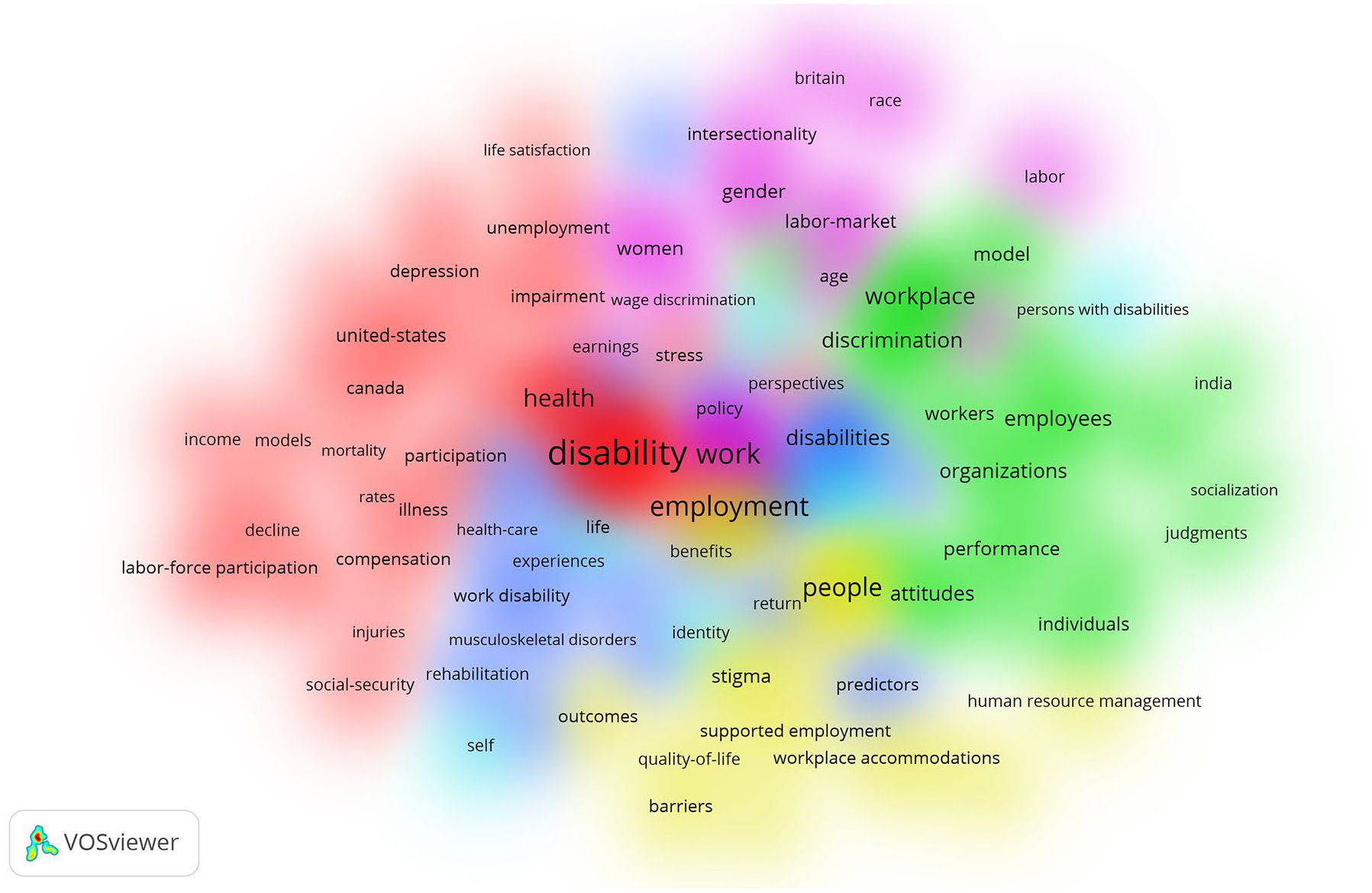
Visualization of cluster density of literature on disability and work, 1991–2017.
As may be expected, given the nature of our database search, all the clusters are related to each other. An effort was made to break down and classify the articles by highlighting the main category, to discern the trends and gaps in the literature on PwD in the workplace.
The first cluster identified (red; Figure 3), which we will call “Macro level aspects of disability,” includes works with big data volume. It covers studies from the United States, Canada, and European countries. Through longitudinal data, it was revealed that disability benefits are not associated with a large increase in the non-participation of older Canadian workers (Campolieti, 2004). The theoretical and social perspectives on human needs support the importance of participation in paid employment for the well-being of PwD, although the impossibility of fully developing their work potential can lead to labor-related issues like stress (Konrad et al., 2013).
Using data from national surveys, some US publications reviewed different indicators by countries regarding health, disability, mortality, and prevalence of different diseases and analyzed the differences in their definitions and measures (Murray & Chen, 1992). Some research examines the labor supply of veterans with disabilities and the decrease in employment and labor participation rates compared to previous years (Rutledge et al., 2016).
The link between disability and poverty is also important, and studies confirm a correlation between the two keywords. A study using data from the US current population study found that PwD have a higher poverty status than individuals without disabilities (Brucker et al., 2015). Likewise, the disadvantaged position in the labor market and the duration of unemployment were explained by the interaction of their characteristics in employment and the use of diverse policies (Agovino & Rapposelli, 2017; Riach & Loretto, 2009). Many studies showed different approaches to determining income poverty among PwD through direct indicators of hardship (Rose et al., 2009).
A key reason for poverty among this vulnerable group of people is the high unemployment rates. The link between macroeconomic conditions and self-reported disability was analyzed, to confirm that individuals reporting a disability are significantly more likely to be unemployed, underemployed, or entirely outside of the labor market (O’Brien, 2013). Similarly, it was proved that psychiatric disorders (e.g., depression disorder) reduce employment rates among men and women, and reduce work hours, affecting the earnings of workers with disabilities (Ettner et al., 1997).
Some European studies used longitudinal data to analyze the effect of disability onset on life satisfaction for German individuals in different domains such as health or jobs that influence the levels of well-being of PwD (Pagan-Rodriguez, 2012). Besides, trends in the provision of employment of PwD were examined, exploring the differences between the Italian regions (Agovino & Rapposelli, 2017).
All the articles related to this first cluster employ highly dependable public surveys that include all types of disability and a quantitative methodology using large samples, which ensures reliable results. However, among the developing countries analyzed, we only found two studies with these characteristics; both were carried out in Russia. Despite the existence of studies on workers with disabilities in different countries at the individual level, we did not find comparative studies between different countries (developed and developing), which can provide information on the differences existing at the territorial level. The difficulty of finding homogeneous data as well as the different definitions and measures may explain this circumstance. This first cluster is dominated by the Sociology (37% of the studies). Then, Industrial Relations and Labor and Social Science stand out (19% each), as well as Economics, in a smaller amount (9%). The rest of the disciplines of the works studied reached a very small percentage (Management, Business, Demography, and Political Science—4% each).
The second cluster “Management of Disability in workplaces” (green; Figure 3) includes different aspects such as the discrimination suffered by the PwD and the accommodation necessary in the workplace (Cavanagh et al., 2017; Kruse & Schur, 2003); forms of employment, such as working from home, part-time work, and flexible working hours; and the utility offered by technology (Campolieti et al., 2009; Schur, 2003). Using quantitative methods, it was proved that workplace accommodations are positively perceived by PwD since they reduce the discrimination suffered (Konrad et al., 2013).
Some contributions analyze inequality in organizations. A study showed that employees with disabilities who worked in organizations with grievance procedures were more likely to perceive discrimination. Thus, using these formal mechanisms is not useful to change material conditions of inequality. Organizations should adjust the procedures to make them more responsive to disability-related issues (Balser, 2002). The analysis of a sample of Canadian workers with disabilities demonstrated that despite disability, legislation inequality in accommodations remains and generates higher levels of insecurity among workers in more precarious conditions of labor (Shuey & Jovic, 2013).
Negative attitudes and effects of disabilities on human resource judgments (e.g., hiring decisions or performance evaluations) in workplaces toward the job and company were reviewed (Ren et al., 2008). Some studies examined the good opinions of consumers regarding workers with disabilities in business (Kuo & Kalargyrou, 2014) or interactions between co-workers in companies (Mik-Meyer, 2016b). The influence of work and management perceptions on the company’s corporate culture was studied (Jones, 2016), to conclude that the role of corporate culture can help reduce the negative consequences of inequality (Schur et al., 2009). The influence of cultural variables for employees with disabilities (Schur et al., 2009) and successful case studies with an inclusive corporate culture of PwD (Sison, 2007) have been studied.
Articles from India using quantitative methods confirmed that PwD are a source of untapped human resources and that most employers are not very proactive in hiring PwD (Lengnick-Hall et al., 2008). Qualitative analysis has been used to explore careers of PwD, which tend to experience less professional success than workers without disabilities, although many of them manage their careers proactively using strategies based on positive attitudes, such as learning to acquire new skills (Kulkarni, 2016; Kulkarni & Gopakumar, 2014). The socialization of PwD in workplaces was presented as a crucial process for both the employee and the employer. Co-workers and supervisors exert an integrating influence conducted in an appropriate manner to avoid lower work performance (Kulkarni & Lengnick-Hall, 2011).
The articles related to this second cluster combine qualitative, quantitative, and meta-analysis methods that complement each other to achieve in-depth knowledge of the various issues of disability in workplaces. However, we found a very small number of studies highlighting the positive contributions PwD can make to the workplace. The dominant discipline of this cluster is Management (32%), followed by Industrial Relations and Labor (28%) and Psychology Applied (10%). To a lesser extent, Business and Sociology (7% each) and the rest of the disciplines with a percentage lower than 4% (Social Sciences, Ethics, Interdisciplinary, and Hospitality, Leisure, Sport and Tourism).
The third cluster “Occupational factors of health and disabilities” (blue; Figure 3) shows the link and experiences between factors of health and their management at the labor level. Here, “accommodations” refers to the support that the employer must provide for the health and development of the employee’s work. Occupational health care is an important issue to consider. However, the literature indicates there is little knowledge and support regarding accommodations for PwD from employers, who are more concerned about their associated costs than suitability for the employee with disabilities (Baldridge & Swift, 2016). This issue also depends on the types of disabilities (physical, mental, and intellectual) of the working-age adults (Cavanagh et al., 2017). Nevertheless, research on accommodations affirms that the costs and benefits for workers with and without disabilities are similar (Schur et al., 2014).
A quantitative analysis confirmed the importance of occupational factors in the onset of the illness and absence by sickness. It also revealed that more women than men return to work earlier since their income is generally lower and the insurance covers only between 70% and 80% of the salary (St-Arnaud et al., 2007). The return to work and the rehabilitation also requires policies that adequately manage the necessary adjustments (Ville, 2005). Ethnographic and biographic studies were used to analyze PwD experiences related to health care and chronic illness, to achieve the best knowledge concerning their significance and consequences (Charmaz & Olesen, 1997).
This third cluster gathers qualitative and quantitative methods of research that help to understand how different occupational health factors influence the work of PwD. We highlight Management (23%) as the discipline that dominates this cluster. They are followed by Industrial Relations and Labor, Psychology Applied, Sociology, and Social Science (15% each). Finally, Public, Environmental, and Occupational Health also stands out with 8% of works studied.
Employment is the essential keyword in the fourth cluster “Toward employment of PwD” (yellow; Figure 3) and represents one of the most important areas of study. Cluster 4 gathers the keywords linked with barriers and difficulties experienced in this topic. Employment is an integrating element that allows the person to participate in society, even under the format of volunteering (Campolieti et al., 2009). However, PwD have serious difficulties in finding and keeping a job (Stone & Colella, 1996). Part-time employment is considered a barrier to access employment (Schur, 2003), also in the case of young school leavers (Janus, 2009). Temporary work and underemployment are related to the well-being of PwD in Canadian organizations (Konrad et al., 2013).
Stigma is also considered a barrier to employment. Some authors revised the concept of stigma introduced by Goffman to associate it with the experiences of workers with autism or Down syndrome (Bush & Tassé, 2017; Thomas, 2014).
Another important barrier can be a co-worker reaction, as peers may help the PwD with the implementation of workplace accommodations, or keep a negative attitude (Peters & Brown, 2009). Some people with psychiatric disabilities “have been assisted in securing paid employment through such programs as supported employment, but job retention is low” (Mandiberg & Warner, 2012, p. 1740).
The studies in this cluster are theoretical (mainly on “stigma”) and also empirical quantitative (on employment) and qualitative (on barriers) methods. We found very few studies on sheltered employment, trade unions, and public policies for workers with disabilities. Management, Business, and Industrial Relations and Labor (25% each) are the most representative disciplines of this cluster, followed by Sociology (17%) and Psychology Applied (8%).
The fifth cluster “Diversity of PwD in the workplace” (fuchsia; Figure 3) includes keywords contained in articles that investigate the diversity and its management in organizations, and the intersection of disability, race, age, and gender (Zanoni, 2011); for instance, women with disabilities are considered a subgroup that suffer high discrimination and a disadvantaged position among the group of PwD (Rose et al., 2009; Woodhams & Danieli, 2000). The intersectionality from different perspectives was studied, researching topics such as dyslexia, paid work, and mothering (Skinner & MacGill, 2015) or entanglement of race, class, and gender in feminist politics with disability (Ware, 2016).
In Britain, employment law utilizes an individual medical model of disability, which conflicts with traditional collective approaches favored by trade unions. This issue has implications for employees with disabilities and union representatives who must resort to strategies to negotiate this difference included in diversity (Foster & Fosh, 2010).
Besides, young people with disabilities face a labor market that marginalizes them, with a high probability of being employed part-time, being unemployed, or even with much lower earnings compared to youths without disabilities who usually work full time and have higher wages (Zarifa et al., 2015).
This cluster presents theoretical and empirical analysis with qualitative and quantitative methods. Although studies on different types of diversity in relation to disability were found, these are still very few. Little research has analyzed aspects regarding the different labor consequences according to the type of disability experienced by various subgroups of PwD that suffer high vulnerability, or the support of the trade unions in this matter. Thus, we can highlight Sociology (30%) as the predominant discipline. Management follows (20%). Other disciplines are Social Science, Women’s Studies, Ethnic Studies, Industrial Relations and Labor, and Psychology Applied (10% each).
In the sixth cluster, “Identity construction of PwD” (turquoise; Figure 3), the sociological perspective is predominant.
Many people with illness (e.g., AIDS) have learned to adapt their identities when they wish to return to work as well as cope with the effects of the change (Ghaziani, 2004). PwD’s identity construction includes the well-being of the person, and the definition of self and social position. Such construction has been investigated with panel data regarding the domains of satisfaction before and after the onset of disability in terms of global life satisfaction of workers with disabilities (Pagan-Rodriguez, 2012) or the exploration of the level of job satisfaction of employees with and without disabilities (Jones, 2016; Pagan, 2017).
This cluster gathers a small number of works. We found that qualitative studies focused on the identity of PwD, while quantitative studies analyzed the levels of job satisfaction of workers with disabilities. Only Sociology (50%), Social Sciences (33%), and Industrial Relations and Labor (17%) are represented in this cluster.
Finally, the analysis of co-words carried out allows us to observe the evolution of the trends in the research on “Disability and Work” throughout the period of time studied. The results of this analysis organized by stages are shown in Table 5.
Evolution trends of literature on disability and work through time (1991–2017).
PwD: people with disabilities; ADA: Americans with Disabilities Act.
The first stage (1991–2000) contains works that analyze the ADA and the economic cost of employers to include PwD in their company. We also found conceptual publications of the term “disability” and mainly on the theory of the social model of disability. Other studies present indicators of health, the prevalence of disability, or labor participation of PwD. Secondary data sources, such as general public surveys, are used in this case, due to the heterogeneity of data by country or the absence of specific surveys on PwD. This difficulty in research and its merely descriptive nature may be the reason for the disappearance of these topics in the next stage.
In the intermediate stage (2001–2009), there is less interest in economic issues, and an incipient concern to investigate social issues and claim rights for PwD, such as equal pay, public policies on social welfare, and inclusive corporate cultures.
Social and organizational issues are settled in the last stage (2010–2017). Most of the topics are related to the search for a better adaptation of PwD to the workplace. Other important issues are the research of various subgroups that make up the collective of employees with disabilities (by gender, age, health condition, type of disability, and so on).
Recurrent themes in the three stages that can help in the consolidation of the discipline on disability and work are the theoretical and conceptual aspects and all approaches related to the labor market.
The themes that emerged in the last two periods, usually underexplored, are presented in the next section as areas for future research.
Discussion and conclusion
The study of disability in the workplace is a highly complex research area from the organizational and human resource perspective, involving social, economic, political, legal, and medical factors. It requires a wide variety of tools and methods that help, first, to understand the phenomenon, and second, to manage it adequately and productively for all parties involved.
To achieve our purpose, the combination of bibliometric techniques and content analysis has been used for the first time in this field of study. We have used the most reliable and interdisciplinary database of relevant publications, first, to provide an overview of the structure of the field studied since previous reviews were carried out according to specific criteria or examining limited samples. The review of the main theories and concepts was useful to observe the evolution of the literature and discover some gaps that have not been investigated or explored in this interdisciplinary field of study. The content analysis showed the range of thematic categories that encompass the articles studied.
Having started from the mentioned categorization previously established by Cavanagh et al. (2017), and after carrying out the co-word analysis, the categories that emerged from the formation of the clusters were shown by displaying the knowledge maps. This same technique also allowed the identification of changes in research trends and the emergent new lines that are still underdeveloped.
The review of the articles in the literature on “disability and work” for the 26 years covered by this study (1991–2017) suggests that in recent years, there has been a clear tendency toward a social focus. The first years examined show an explosion of articles concerned with clarifying the regulations related to this topic, mainly the ADA (the United States) and the different implications that it entails (costs, conflicts, claims, and so on), all with a marked economic character. Other European studies deal with demonstrating inequalities and discrimination (salaries, access to employment, and working conditions) experienced by workers with disabilities.
Of the many categories included in the studies analyzed, each of them contains a limited number of works, which allows us to affirm that it is an expanding scientific interdisciplinary research topic. It should be noted that 27.8% of the studies analyzed have been published in the last year of study (2017), which gives an idea of the growing academic interest in this field. Despite this, results show a lower presence of authors with a high production in this research subject. According to Lotka’s law (Ausloos, 2013), this suggests that disability and work is an emerging research area to be developed in the future.
We have also verified Dwertmann’s (2016) argument. There is little empirical literature on “disability and work” in top-tier management journals, so it would be desirable to conduct more quality research publishable in frontline journals. Furthermore, our analysis of the publications in the main journals showed that the literature on “disability and work” is an interdisciplinary field of research. Analyzing only management journals does not provide a complete overview of the field of study. Therefore, this literature can benefit from the intersection of different disciplines in the same investigation.
Through this bibliometric investigation, we observed that although all the articles studied were included in JCR, few journals appear in the first quartile of the list. The most respected journals should be more interested in publishing studies on workers with disabilities to provide greater visibility to this type of diversity, which is increasingly growing worldwide.
There is a growing trend of research from emerging and developing countries on workplace disability (India, Brazil, Russia, Croatia, and so on). These studies are limited because these countries have more limited resources and health care than developed ones. According to the WHO (2011), more collaborations between institutions in developed and developing countries are necessary to promote more research on all the dimensions covered by this scientific field that help to understand and develop the phenomenon of disability in a homogeneous way in all countries globally.
Regarding the methodology, empirical works predominate. A large number of quantitative studies are cross-sectional. Academics should carry out a more longitudinal research to test the evolution of the variables and if the causality between them changes over time to adopt appropriate policies. Qualitative studies help understand what it means to have disability in the workplace. However, there are few papers that combine quantitative and qualitative methods. Due to the interdisciplinary nature of the topic, the triangulation of different methodologies would be useful in establishing human resource strategies and policies, as well as the recruitment and development of employees, all of which seek to incorporate appropriate inclusive practices within organizations.
An important issue is the limited availability of reliable, specific, and homogeneous global data. This fact presents a disadvantage in carrying out international comparative research that would be useful in implementing effective public policies. Addressing this limitation could help both workers with disabilities and employers in organizations. The concepts and theories of the articles analyzed are key aspects to guide research on disability. Considering the revised definitions, and from a descriptive point of view, free of social stereotypes, we present our own concept of “disability” as “the product of the interaction of the individual’s health condition with their personal factors (sex, age, and type of disability) and their contextual factors (obstacles, barriers in participation, employment, and accessibility).” We believe that the distinction of the individual’s personal factors represents an interesting contribution to academic research, since the interaction between each of these personal factors with the different contextual factors produces different consequences that can occur at different levels. Therefore, it would be necessary to carry out different studies that cover the intersection of each of these personal and contextual factors in depth.
We consider that this definition may support this work and other future studies of the literature on “disability and work” because it is in workplaces where these personal and contextual factors interrelate in a clear way. Likewise, all these interrelationships converge in multiple research disciplines, which attempt to shed light on this interdisciplinary and emerging field of research.
The sociological perspective considers disability as a social construction and observes the relationship of the PwD with a disabling society that hinders their participation in different aspects of life. Research linked to this perspective, on one hand, shows negative issues related to discrimination in the workplace. Most studies take the framework of the social model of disability.
On the other hand, some sociological theories are used in a positive approach to explain the different management processes in the workplace. For instance, social identity theory (at the internal individual level) and career theory (at the corporate level) consider that employers and human resource professionals should implement initiatives and strategies to eliminate barriers that help in the career development of employees with disabilities.
The same issue is also contemplated at the institutional level (institutional and neo-institutional theory), demanding financial support for employers and effective policies of social-labor inclusion.
All theories based on ethical questions (e.g., CSR, the theory of the firm based on the common good, and virtue theory) help to positively change the stereotyped image of the PwD and promote inclusive working environments. It also contributes to improving the performance and reputation of organizations. This trend is still nascent and corresponds to the last years analyzed.
We identified a gap in the human resource management literature where very few articles positively highlight the skills and added value that PwD can bring to workplaces. Besides, we propose integrating administrative and organizational theories (e.g., management by values approach and resource-based theory) to obtain a greater and better academic knowledge of the different aspects related to disability. The formulation of new theories or the combination of several theories of different disciplines can lead this neglected area toward the mainstream of organizational research. The study of the participation of PwD is convenient for academic research because it can provide a direct view of the needs and demands of that group through their personal experiences in organizations.
Regarding the thematic categories obtained after content analysis, some works on disability and labor issues highlight the negative connotations associated with PwD due to the financial cost involved (e.g., absenteeism, performance, and productivity). In contrast, there are a small percentage of positive publications (2.2%) on workers with disabilities that correspond to aspects related to ethics and CSR. We strongly encourage and challenge scholars to increase this type of studies.
Future lines of research and limitations
The co-word analysis allowed the formation of six clusters, with different thematic categories. From each of them, we draw the following conclusions about the gaps found to develop future research lines on disability and work.
Concerning Cluster 1, “Macro level aspects of disability,” future research should consider the country level, making comparisons between different countries (developed and developing). Public surveys should be used with validity, reliability, and, whenever possible, with homogeneous data. In addition, scholars should be focused on examining each type of disability (physical, mental, sensory, and cognitive) because they have different consequences in the workplace. The topics covered by this cluster are dominated in first place by the sociological discipline, followed by Industrial Relations and Labor, Social Sciences, and Economics discipline. Future research could be enriched if other different disciplines were incorporated, due to the interdisciplinary nature of the literature on “Disability and Work.”
Regarding the second cluster, “Management of Disability in workplaces,” future research lines should focus on the understanding that the accommodation of disability in workplaces and the performance of PwD is sustainable. Human resource practitioners with success stories of inclusive PwD practices should provide researchers with information about their experience and establish synergies to enable them to acquire greater knowledge in this field.
Triangulation of quantitative and qualitative research methods as well as the use of biographical works, case studies, or interviews would allow the knowledge of positive strategies to be incorporated into the organizational corporate identity culture by human resource professionals. Addressing staff perceptions is important to eradicate negative, discriminatory, and stereotyped attitudes in workplaces. The disciplines that dominated these topics are Management, Industrial Relations and Labor, and Psychology Applied. In the future, other perspectives that provide knowledge about PwD in the workplace should be considered such as Sociology or Social Sciences.
The potential research areas drawn in the third cluster “Occupational factors of health and disabilities” could be developed using qualitative and quantitative research analysis on policies and strategies of health care and prevention (services of health and prevention in companies, accommodations, and return to work), depending on different types of disability or demographic factors (sex and age), which employers could apply to support employees with disabilities. Management stands out as the largest discipline, although the rest of the disciplines present almost the same percentages. In the future, research on the least studied disciplines should be carried out.
According to studies in Cluster 4, “Toward employment of PwD,” future research could explore public policies regarding human resource at the government level, sheltered employment, and intermediation of trade unions to promote labor market participation of vulnerable groups, eliminating barriers and stigmas associated with different types of disabilities. The subject of employment of PwD is dominated by the discipline of Industrial Relations and Labor, Management, and Business. In future research, the psychological and sociological disciplines could also offer different points of view.
In the fifth cluster, “Diversity of PwD in the workplace,” we identify that there is a need for a deeper study of the intersection between different diseases or disabilities and their effects at the labor level for the subgroups of PwD with double marginalization (women, young people, race discrimination, and mental disorders). Moreover, it would be interesting to investigate other issues related to the support provided by trade unions, and the implementation of diversity practices and integration policies of those subgroups to achieve equality. The sociological discipline and Management are more related to these diversity issues. More research is needed across specific disciplines on subgroups of PwD.
As for the last cluster, “Identity construction of PwD,” future research in this area could examine different policies and strategies, such as adaptations in workplaces or occupational health services that help consolidate the social position and well-being of PwD, so they can build their identities in the same way as other workers. The construction of the identity of PwD is mainly dominated by Sociology in this cluster. For future work, the psychological and organizational management perspectives can contribute to help disabled workers.
We want to highlight that the content analysis and the co-word technique have been complementary analysis methods for this investigation. As a result, we can observe a different classification of topics in both methods. As an example, using the co-word technique, we identify emerging research lines such as occupational health factors (Cluster 3) and the construction of PwD identity in Cluster 6 (also detected when reviewing the theory of social identity). This combination of methods, therefore, has allowed us to specify and detect even more research topics which enrich the analysis.
The evolution of trends on “Disability and work” presented topics with an economic focus in the first period. This trend disappeared in the following stages. Later, the investigation focused on organizational and social issues. Less examined topics have been identified as new avenues for further research. Such topics are related to issues such as the socialization of employees with disabilities in organizations (Kulkarni & Lengnick-Hall, 2011), strategies to be followed by the PwD to find employment (Kulkarni, 2016), supported employment (Hemphill & Kulik, 2017), the development and learning of PwD to become entrepreneurs (Bagheri & Abbariki, 2017), and studies on deficiently studied predictors of employment of minorities with disabilities, such as autism and intellectual disability (Lysaght et al., 2017).
This work has some limitations. The conclusions presented here refer to the review of articles included in the Core Collection database of the WOS. Although this is considered to be the most complete and relevant database, undoubtedly, other collections could be used in future bibliometric investigations, and, once compared, they could confirm or expand knowledge on this matter to continue advancing in this field.
The combination of methods used has allowed us to achieve the aim of this research, identifying problems and gaps in the disability and work literature and opportunities for further works. Future bibliometric research on this topic could include another set of indicators, such as co-citation analysis that would complement this study and could provide a systematic description of the field structure.
Contribution
Organizational and business research on PwD still represents an emerging research area that has been addressed from different disciplines. Unlike previous bibliometric studies limited by the information sources analyzed, through this work, we were able to identify, by using an interdisciplinary and comprehensive approach, a wide range of topics, theoretical frameworks, and methods from which the study of PwD has been addressed. This article also enables us to acknowledge the state of the field as well as propose future research lines that help consolidate disability in the workplace as a research discipline.
Due to the interdisciplinary nature of the topic, we highlight the fact that it is necessary not only to combine methodologies and theories but also to integrate different disciplines which can provide academics and employers with different perspectives from which to address the inclusion of disability in the workplaces for their effective incorporation.
Likewise, we have contributed with our own concept of disability (explained in the discussion and conclusion section) highlighting the different factors that influence it to guide future academic studies, based on the interdisciplinary nature of the field.
This study has practical implications regarding potential inclusive strategies and successful initiatives in the workplace and recommends the collaboration of researchers and human resource practitioners to improve the performance of workers with disabilities in the workplace.
Finally, it also has political implications for world governments. Achieving increased employability of PwD in companies, sheltered workplaces, or support for PwD entrepreneurs contributes to the generation and circulation of wealth and can alleviate economic pressure concerning disability benefits in public social insurance systems.
Supplemental Material
sj-pdf-1-brq-10.1177_2340944420972715 – Supplemental material for Trends and opportunities in research on disability and work: An interdisciplinary perspective
Supplemental material, sj-pdf-1-brq-10.1177_2340944420972715 for Trends and opportunities in research on disability and work: An interdisciplinary perspective by M Ángeles Jurado-Caraballo, Cristina Quintana-García and Mercedes Rodríguez-Fernández in Business Research Quarterly
Footnotes
Acknowledgements
The authors thank the anonymous referees for their helpful comments and discussions on earlier versions of this work. The views in this manuscript are solely the responsibility of the authors.
Declaration of conflicting interests
The author(s) declared no potential conflicts of interest with respect to the research, authorship, and/or publication of this article.
Funding
The author(s) disclosed receipt of the following financial support for the research, authorship, and/or publication of this article: This study was funded by Grant of the University Lecturer National Formation Programme of the Spanish Ministry of Education, Culture and Sport. Call published by Resolution of 19 November 2015 (BOE of November 27), University of Malaga, Department of Economics and Business Administration (grant number reference FPU15/01546).

Supplemental material
Supplemental material for this article is available online.
References
Supplementary Material
Please find the following supplemental material available below.
For Open Access articles published under a Creative Commons License, all supplemental material carries the same license as the article it is associated with.
For non-Open Access articles published, all supplemental material carries a non-exclusive license, and permission requests for re-use of supplemental material or any part of supplemental material shall be sent directly to the copyright owner as specified in the copyright notice associated with the article.
