




Abstract
This article examines the role of networks and global value chains (GVCs) and how they influence emerging economy small- and medium-sized enterprises’ (EE-SMEs) internationalization. Drawing on the insights, experiences, and perspectives of entrepreneurs and senior managers of small- and medium-sized enterprises (SMEs) that have originated from China, the study adopts qualitative approach and examines nine firms’ internationalization. We find that Chinese born-global manufacturing SMEs benefit from networks with quick insidership position into GVCs, but suffer from various obstacles that hinder their further development. The findings further indicate that network ties substantially facilitate EE-SMEs’ internationalization, but also restrict their future global development, as their low position within the GVCs impedes further business development and capability building. The case firms’ lower position within the GVCs weakens the networks’ influence on their GVC upgrading. The research identifies key enablers of GVC engagement and obstacles of GVC upgrading of the case firms which play an important role in the EE-SMEs’ internationalization.
Introduction
The role of small- and medium-sized enterprises (SMEs) has been noted to be important for the economic development of both developing and developed markets. Due to this, SMEs have been attracting considerable research interest (Coviello, 2015; Park & Ghauri, 2011; Radulovich et al., 2018). In particular, with the increasing importance of emerging economies on the global stage, the internationalization of emerging economy small- and medium-sized enterprises (EE-SMEs) is receiving increasing attention from scholars and practitioners (e.g., Choksy, 2015; Choksy et al., 2017; Lew et al., 2016; Musteen et al., 2014; Tian et al., 2018).
The study of EE-SMEs has contributed significantly to the extant internationalization literature (e.g., Lew et al., 2016; Tian et al., 2018; Zhang et al., 2016; Zhou et al., 2007). Due to globalization, network capitalism is on the rise and economic activities are taking place in diverse business networks organized under complex value chain relationships (David & Halbert, 2015; Mudambi, 2008; Mudambi & Puck, 2016). However, previous studies do not fully consider the influence of these business networks integrated in global value chains (GVCs; Choksy, 2015; Coviello & Munro, 1997). Specifically, it is not clear whether SMEs that are operating at a low value-added position in the GVCs are able to exploit benefits from networks in their internationalization process (e.g., Buckley & Ghauri, 2004; Choksy et al., 2017; Gereffi, 2019). In addition, EE-SMEs, although benefiting from their quick participation in GVCs, suffer from various problems, including fragile linkages with external markets, weak technological innovation, and limited financing (Khan et al., 2015) which can discourage the EE-SMEs’ internationalization and post-internationalization growth.
Relatively a limited number of studies have investigated the networks-oriented internationalization of EE-SMEs from the GVCs’ perspective. GVCs refer to a network of inter-firm relationships that bind sets of firms into larger economic groups (e.g., Sturgeon, 2001, p. 10; Mudambi, 2008). The concept of network in both the GVC and the international business (IB) literature shares common characteristics as both emphasize the dynamic business exchange relationships between two or more actors forming social and business connections. The GVC literature focuses on the buyer–supplier networks and how formal governance structures in GVCs shape knowledge exchange and capability development of suppliers’ firms in such networks (Gereffi, 2019). Thus, GVCs offer important opportunities for the acquisition of knowledge and learning to resource-constrained SMEs, which in turn help these firms enter foreign markets (Coviello, 2006; Ellis, 2011; Gereffi, 2019). In contrast to the firm-centric view of organization agency (strategies, actions, capabilities) prevalent in both strategy and IB literature, the GVC literature views an organization’s agency as interlinked with buyer networks in GVCs. For example, Choksy et al. (2017) identified three network strategies through which SMEs in disadvantaged positions (those belonging to weak institutions or power-asymmetric relations or low value-added function position) survived in GVCs. First, one strategy is for the supplier to earn the buyer’s trust and legitimize their capabilities in highly power-asymmetric GVCs. Second, SMEs engage in diversifying from existing buyer networks whereby the future prospects are low. Instead, these SMEs integrate into multiple GVCs where these SMEs can earn decent profits. Finally, SMEs cater to a mix of business models and function in multiple GVCs to maintain their profitability and survival.
On the contrary, the networks literature in IB focuses on informal interpersonal ties to include ethnic, kinship, and friendships’ ties (e.g., Boisot & Child, 1996). The integration of insights drawn from GVCs is important due to the fine slicing of value chain activities which offer opportunities for firms based in both developing and emerging economies to become part of the GVCs (Buckley & Ghauri, 2004; Choksy, 2015; Mudambi, 2008). Furthermore, in some emerging economies, such as China, the collective business environment values unique social norms and relationships, such as guanxi that has a crucial and strategic value for knowledge acquisition, relationship building, risk control, and mistrust alleviation (Murray & Fu, 2016; Zhou et al., 2007).
There are additional gaps in the EE-SME internationalization literature. The extant networks internationalization literature is mostly based on isolated facets or ambiguous conceptualization. Chen and Wu (2011) define networks as guanxi, excluding other social relationships. Hohenthal et al. (2014) define network as a “system of interrelated actors” (p. 10). This will include customers, suppliers, as well as interpersonal networks, such as family and friends (Evers & Knight, 2008; Zhou et al., 2007). In addition, certain scholars refer to networks mainly as inter-firm relationships (Teixeira et al., 2013), as well as dyadic business relationships between two exchange partners (e.g., Anderson et al., 1994). However, some scholars have called for a broader perspective of networks (Puthusserry et al., 2019; Sedziniauskiene et al., 2019). Thus, in this article, we refer to network as both formal and informal exchange relationships between two or more partners which also include informal interpersonal relationships, such as ethnic and friendship ties. Also, some investigations around network and internationalization of SMEs are based on a single-case study and could be anecdotic or inconclusive (Schweizer, 2013; Zhou et al., 2007).
Internationally oriented companies’ engagement in network relations is multifaceted and diverse (Ellis, 2011; Idris & Saridakis, 2018), while different networks and their relative strength affect firms’ internationalization differently and dynamically (Lew et al., 2016; Sandberg, 2014). Extant research also indicates that network ties with domestic and foreign network partners can also hinder SMEs’ internationalization and further development due to over-embeddedness in the networks as well as liability arising from certain network relations (cf. Mort & Weerawardena, 2006; Yamin & Kurt, 2018). In addition, extant literature provides insufficient insights regarding whether all SMEs benefit equally through networks’ ties (e.g., Lew et al., 2016; Oehme & Bort, 2015; Sandberg, 2014) and to what extent their position within the GVCs influences the internationalization process of SMEs based in emerging markets (Choksy, 2015). It is in such contexts that Johanson and Vahlne (2009) note, “insidership in relevant network(s) is necessary for successful internationalisation, and so by the same token there is liability of outsidership” (p. 1411). SMEs originating from emerging markets may face a considerable challenge in establishing a central position in foreign market networks since these firms generally lack international experience and originate from weak institutional environments. The integration of network insights drawn from the GVCs and IB perspectives provides a much fine-grained understanding about the SMEs’ internationalization process.
Based on the above gaps and limited understanding about the way that EE-SMEs utilize various network relationships and their ties within the GVCs, this study aims to investigate networks’ influence on EE-SMEs’ internationalization, by answering the following questions: What are enabling and constraining factors for EE-SMEs’ internationalization process; particularly, how network relationships and their position within the GVCs affect EE-SMEs’ internationalization? The study conceptualizes networks as the formal (business) networks composed of suppliers, customers, business partners, and competitors, and the informal (social) networks based on cultural, ethnic, and social ties (Coviello & Munro, 1995; Lew et al., 2016; Zhang et al., 2016). Based on the preceding discussion, the study attempts to answer these questions through the empirical examination of nine Chinese SMEs’ internationalization and their subsequent post- internationalization development.
Our study contributes to the internationalization and network literature in important ways. First, we integrate the internationalization and network perspectives with insights drawn from GVCs and document the internationalization process of EE-SMEs. To this end, the study provides important insights in identifying that networks substantially facilitate EE-SMEs’ internationalization, but also restrict their future global development, as their low position in the GVCs impedes knowledge acquisition and capability building. The GVC context also weakens the networks’ influence on market selection and entry mode. The study further identifies several key enabling factors in the GVC engagement of EE-SMEs (e.g., entrepreneurial networks, networking channels, and overseas customers) and restraining factors in the GVC upgrading of those SMEs (e.g., weak network ties with cooperative peers and weak power in the GVCs and insufficient institutional supports) in the EE-SMEs’ GVC and internationalization context. Thus, the study demonstrates that, for post-internationalization growth of EE-SMEs, their configuration of GVC and network capabilities in the GVCs matters even after their inception into GVCs.
Conceptual background
Internationalization process of SMEs
The Uppsala model rationalizes firms’ internationalization as a process, emphasizing their gradual, experiential, and incremental knowledge acquisition and integration that lead to increasing market commitment and involvement in foreign markets (Johanson & Vahlne, 1977). However, the model has been criticized for its failure to explain the international trajectory of certain types of organizations, such as born-global firms who internationalize at an early stage or from inception (Andersen, 1993; Knight & Cavusgil, 2004). Research suggests that the process approaches are mainly applicable to large traditional manufacturing firms (Coviello & Munro, 1995) and might not explain the rapid rise of the so-called born-global firms. The internationalization process model was later revisited with the inclusion of networks, proposing that a firm’s insidership (embedment into a business relationship web) in related networks is a key success factor for its internationalization, as the relationships with various players could achieve knowledge transfer and creation of new knowledge (Johanson & Vahlne, 2009).
Business networks (e.g., the relationships between suppliers and customers) create an experiential learning–commitment driving mechanism, providing firms the learning enablers to enter new foreign markets and form new relationships (Johanson & Vahlne, 2003). Scholarly studies accentuate the importance of formal business networks in firms’ capability building and market seeking (Aaboen et al., 2013; Johanson & Vahlne, 2009). However, scholars have paid increasing attention to the importance of social networks behind the internationalization of SMEs (e.g., Ellis, 2011; Zhou et al., 2007). For example, Zhou et al.’s (2007) empirical study shows that home-country social networks mediate firms’ internationalization through knowledge sharing of market opportunities, learning, trust, and so on. Nevertheless, Coviello and Munro (1997) believe a series of formal and informal networks, though facilitating and driving firms’ internationalization process could also inhibit their development in various forms.
The internationalization process model proposes “knowledge” as a major incentive for firms to accelerate their overseas commitments and thus their internationalization (Johanson & Vahlne, 1977, 2009). Such proposition is behaviorally oriented, emphasizing the proactivity and initiative of entrepreneurs in international opportunity identification and knowledge seeking (e.g., Schweizer et al., 2010). McDougall and Oviatt (2000) also emphasize the important role of entrepreneurs in initiating and accelerating firms’ internationalization. However, the extant literature has established that various entrepreneurial factors, such as entrepreneurial orientation and cognition, significantly affect entrepreneurs’ performance and learning (Lumpkin & Dess, 1997). Entrepreneurial orientation consists of factors like innovativeness, risk taking, proactiveness, and competitive aggressiveness, while entrepreneurial cognition is the “knowledge structures” possessed by entrepreneurs in making assessments, judgments, or decisions concerning opportunities (Lumpkin & Dess, 1997). Other factors of entrepreneurial orientation and cognition are also pivotal to firms’ absorptive capacity, including entrepreneurs’ prior knowledge (Cohen & Levinthal, 1990; Park, 2010), perception of psychic distance and “openness” (Dichtl et al., 1990; Hagen & Zucchella, 2014), risk tolerance (Dib et al., 2010), and attitude toward globalization (Cavusgil & Knight, 2015). Chinese SMEs’ internationalization process is significantly affected by entrepreneurial spirit (Cardoza & Fornes, 2011) and network ties (e.g., Lew et al., 2016). Only when a firm properly digests and utilizes the complementary resources introduced by foreign counterparts could it enhance its international competitiveness (Idris & Saridakis, 2018). These studies highlight the important role of entrepreneurial orientation in facilitating the internationalization and capability development of EE-SMEs.
Scholars subdivide firms’ internationalization into two types based on its orientations: outward and inward internationalizations. The former refers to firms’ search and sales in foreign markets, and alliance formation and development with foreign partners, whereas the latter to their utilization of various resources gained through networks, such as managerial skills, innovation, and technology (Idris & Saridakis, 2018). As such, firms’ outward internationalization is opportunity oriented, stimulating firms to seek potential benefits from opportunities available in international markets (Ireland et al., 2001), while inward internationalization is performance driven, enabling firms to build internal capability and enhance performance with the knowledge, skills, and capitals that they gain internationally (Buckley et al., 2002). The connection between inward and outward internationalizations is critical to firms’ international success, and the former could be preparatory for the latter. Therefore, network relationships help SMEs build internal capability that facilitates their faster and more profitable outward internationalization (e.g., Zhang et al., 2016). Such an inward–outward connection needs to be sustained to maintain firms’ dynamic capability and international competitiveness (Hagen & Zucchella, 2014).
However, disruption or disconnection could occur for different reasons. For example, firms might not participate in network collaborations, especially home-country peer-to-peer cooperation, because of negative attitudes, risky gains, or concerns over long-term sustainability and dark side effect of network relationship (e.g., Abosag et al., 2016). Furthermore, although firms could gain market knowledge through learning and sharing with international partners, the extent of such knowledge acquisition is dubious for certain firms like Chinese SMEs who mainly act as low value-adding producers without direct involvement in market activities and low position within their GVCs. Thus, their capability building through international networks might be limited. It is also doubtful if firms’ learning from one market is conducive to another since rapidly internationalizing SMEs largely develop or adapt their products as required by specific markets (Knight et al., 2004). The role of network is extremely important in the internationalization of SMEs, and therefore below we discuss network ties and their vital role in the process of internationalization of SMEs.
Network relationships and SMEs’ internationalization
Network plays an important role in the internationalization of SMEs and firms can derive important resources, such as knowledge and learning from network relationships (Lew et al., 2016; Musteen et al., 2010; Zhang et al., 2016; Zhou et al., 2007). Social capital (SC) strongly influences the inter-organizational network relationships (Adler & Kwon, 2002; Lew et al., 2013). When it comes to business, SC is regarded as a profitable resource, facilitating firms’ business operations, internal functioning, and value creation through resource exchanges (Puthusserry et al., 2019; Tsai & Ghoshal, 1998). Firms’ ability in developing dense SC could expedite their creation of intellectual capital (e.g., innovation) and new value propositions which play a vital role in internationalization (Lew et al., 2013; Nahapiet & Ghoshal, 1998).
Extensive research has studied the internationalization of SMEs through the utilization of SC (Ellis, 2011; Johanson & Vahlne, 1992; Puthusserry et al., 2019). The knowledge and resource sharing through networks could bring reciprocal and even multiplied benefits for different players in the transaction (Nahapiet & Ghoshal, 1998; Uzzi, 1997). SMEs’ lack of resources (e.g., market experience and knowledge) pushes them to seek complementarity and supplementation from network relationships (Khan & Lew, 2018; Schweizer, 2013), which supposedly have extensive influences over different stages of firms’ internationalization, such as market selection, entry mode, and process pace and pattern (Schweizer, 2013). Also, SMEs’ flexible behaviors and adaptability make them appropriate network members. Therefore, it is crucial to investigate how network relationships facilitate SMEs’ utilization of SC for resource complementarity and supplementation as these firms enter in foreign markets.
Nevertheless, some skeptics question the actual effectiveness of networks. As aforementioned, “knowledge” is the major purpose and benefit of network relationships. Nevertheless, access to networks does not necessarily guarantee knowledge acquisition and transfer. Whether firms could effectively absorb and utilize the knowledge positively is determined by its absorptive capacity (e.g., Cohen & Levinthal, 1990). Negative motivations, such as individualistic attitudes and historical distrust might arise due to competition among SMEs, which in turn prevents them from forming real cooperative relationships. However, to increase their international competitive advantages, firms need to develop and manage multiple ties both at home and abroad for effective global operations (Ellis, 2011). Therefore, it is important to comprehend which negative factors (e.g., competition and individuality) prevent EE-SMEs’ knowledge acquisition from their respective market networks. As mentioned earlier, economic activities are increasingly being coordinated across value chain networks. These networks are dispersed across the globe, thus offering important opportunities to SMEs to become part of the GVCs and develop their capabilities for rapid internationalization. Buciuni and Mola (2013) argue that although international networks are considered a critical resource for internationalization, the focus is limited to resource sharing processes rather than on mechanisms that support or hinder the coordination of network interactions. The majority of the literature considers networks as given and the inter-dependent relations that support or hamper small firm connection and coordination are rarely understood (Johanson & Kao, 2010). This is in line with Coviello and Munro’s (1995) recommendation that “given that their (entrepreneurial firms) future opportunities emanate largely from network relationships, more attention should be paid to how and with whom these relationships are established” (p. 59). Furthermore, Coviello (2006) and Johanson and Kao (2010) also suggest that research should focus more on the network per se rather than limiting the analysis to firm strategy and international success. Below, we discuss the GVCs’ perspective in the context of SMEs’ internationalization.
The GVCs’ perspective and SMEs’ internationalization
When studying firms’ utilization of networks, it is necessary to consider a country and firm’s linkage with foreign markets, namely, the insertion into GVCs through which economic activities take place through diverse network relationships (Mudambi, 2008; Sturgeon, 2001), which inevitably has deep implications for SMEs’ internationalization process since small firms are becoming important suppliers to large firms from developed markets (Arudchelvan & Wignaraja, 2015; Mudambi & Puck, 2016; United Nations Conference on Trade and Development, 2010). GVC framework has five main components: (1) input–output of the value chain, (2) geography of relevant actors involved in the chains, (3) governance, (4) upgrading, and (5) institutions (Gereffi & Kaplinsky, 2001; Kaplinsky & Morris, 2001).
The input–output component explains the different types of functions/activities performed in the chain from the conception of the product to its distribution and consumption (Gereffi & Kaplinsky, 2001). Functions within GVCs can be categorized as either low value added or high value added (Mudambi, 2008). The low value-added activities are less knowledge intensive and barriers to entry in these activities are low, creating tremendous competitive pressures for firms who are engaged in the activities of such low value chains. Due to low barriers to entry and high levels of competitive pressure, the profit is also low in such chains. In contrast, high value-added activities have the capacity to earn high profits. According to the geographical component of the GVC framework, all activities in GVCs are spatially distributed among actors operating in geographically distant locations. Some of the firms (mostly from developed economies) have secured high value-added functions, while the majority of the firms in developing economies are competing in production-oriented functions. EE-SMEs largely “operate in, low value-added manufacturing and services activities, where entry costs are lower and not capital intensive,” and their GVC participation is generally through intermediary contributions to exports (Organisation for Economic Co-operation and Development and The World Bank, 2015, p. 3).
The governance component focuses on the dynamics of power in chains, powerful actors, and how these actors exercise their power. Governance is defined as a process through which powerful actors (especially the global buyers) in the chain set, measure, and enforce parameters of productions for their suppliers (Ponte & Gibbon, 2005, p. 5). Lead firms from developed markets have been coordinating and orchestrating value chain relationships with small producers from developing and emerging markets by dictating what, how, when, and how much to produce (e.g., Gereffi, 2019; Humphrey & Schmitz, 2002; Mudambi, 2008). Chinese SMEs not only demonstrate weak competitive capability in contrast to global giants in R&D, marketing, and brand development (Cardoza & Fornes, 2011), but also potentially have several other liabilities, including smallness and newness which hinder the rapid internationalization of these firms. Obviously, their business relationships with overseas customers are rather asymmetric, with the latter commanding much stronger power over the former. Humphrey and Schmitz (2000) use the term “quasi-hierarchy” to describe such a relationship where one firm is obviously subordinated to another. Participating in quasi-hierarchical GVCs facilitates manufacturers’ rapid upgrading of products and processes. However, it also impedes their progress into the functions of design and marketing (Humphrey & Schmitz, 2000). SMEs’ initial insertion into GVCs clearly has paradoxical implications: their indirect exports engender the insertion but impede further development because of the limited accumulation in international experience or relationships (Khan et al., 2015). As such, Chinese SMEs’ market knowledge acquisition may be limited by their asymmetric network relationships with global partners.
While the concept of governance is important, the fundamental question that GVC scholars ask is how the governance of GVC impacts the developmental outcomes for small suppliers operating in a developing country. These developmental outcomes in GVCs are termed as “upgrading.” Gereffi (1999) defines upgrading as “an organisational learning process to improve the functional position of firm or nations in international trade networks” (p. 39). These improvements represent supplier shifts from a low value-added to a higher value-added role in supply chains (Bair & Gereffi, 2003).
Extant research on SMEs’ networks and internationalization has focused on how networks help SMEs in market decisions, international opportunity identification, and entry modes (e.g., Puthusserry et al., 2018; Tian et al., 2018; Zhang et al., 2016). However, network quality and a firm’s position in the value chain must be examined in order to develop a much fine-grained view about the internationalization of SMEs. As aforementioned, initial insertion into GVCs suggests that Chinese SMEs’ market choices were rather passive, as they were “sought” by developed countries’ multinational enterprises (MNEs) who control core knowledge and key know-how. Also, their entry modes were predetermined by their GVC take-off node, for example, low-end producers relying on cheap labors and materials and scale productions. Therefore, it is disputable how networks could influence their market decisions and entry modes. More scholars observe that SMEs’ market entry mode is dependent on the insertion and adaptive to support firms’ extant business relationships (Agndal & Chetty, 2007; Forsgren et al., 2005; Hilmersson & Jansson, 2012; Puthusserry et al., 2018). Ojala (2009) also found that the linkage of entry mode and network relationships is insignificant. In this vein, it is likely that networks’ influence over EE-SMEs’ market selection and entry mode and global growth is insignificant due to their low GVCs’ positions.
The final component of the GVC framework is institutions. The GVC literature shows that manufacturers from developing countries extensively utilize home-country informal institutions in the form of multifaceted networks for production integration (Gereffi, 2019). Chinese SMEs are strongly dependent on informal networks for business opportunities, labor management, and relations with local authorities (Cardoza & Fornes, 2011). Their attempts to shift upward to higher value-added activities increase the need to generate market-end network collaborations (Lew et al., 2016). It is a process of deepening international involvements and commitments, such as market and product diversifications, which are more influenced by the strength rather than the size of international network relationships (Zimmerman et al., 2009). Therefore, it is expected that Chinese SMEs will endeavor to strengthen rather than expand their existing international networks to diversify globally.
However, being imbedded but positioned at the lower end in GVCs, EE-SMEs face the challenge of being “locked into a race to the bottom” by heavy dependency on wage minimization, labor negligence, environment violation, and tax evasion (Avrigeanu et al., 2010). To move further up GVCs, firms also face the channel conflicts with existing buyers who exert “life and death” control over them (Avrigeanu et al., 2010; Hoque et al., 2016). Therefore, although firms might realize the imperative to upgrade to higher GVC position, their strong dependency on and fear of losing the buyers could substantially curb their initiatives, which hinders these firms’ future global growth and realization of international opportunities. Therefore, it is worthwhile to investigate how network relationships with international customers hamper Chinese SMEs’ further ascent in GVCs as these firms rapidly internationalize.
In summary, the above literature review on the internationalization process of EE-SMEs (i.e., networks’ ties and position within the GVCs) indicates that network relationships have substantial influence on firms’ internationalization process, both positively and negatively. It seems that networks’ impacts are manifold, and firms’ network utilization is highly contextual and situational according to various market and firm-specific factors (e.g., Puthusserry et al., 2018; Yamin & Kurt, 2018). Similarly, although GVCs offer opportunities for learning for firms based in emerging and developing economies, but at the same time such ties also constrain these firms’ further development and global growth opportunities due to being stuck in market-based and low value chain relationships (e.g., Mudambi, 2008). Based on the conceptual background and identified gaps in the literature, this study’s key aim is to examine the internationalization process of Chinese manufacturing SMEs by drawing key insights from the networks and GVCs’ perspectives.
Research context and methods
The context of this study is Chinese SMEs’ internationalization. As indicated above, we study their internationalization from network and GVCs’ perspectives. We adopted a purposive sampling method to serve the research purpose of exemplifying or illustrating typical Chinese SMEs with a focus on an in-depth investigation of their international trajectories from the network and GVCs’ perspectives. The study is exploratory, based on nine cases. A qualitative data collection method is adopted through in-depth semi-structured interviews, aiming to gather the essential contextual and situational data from the interviewees’ perspective.
Chinese SMEs
Since the economic reform in the early 1990s, the Chinese economy started shifting from a strong dependence on state-owned enterprises to private ones, with SMEs playing an increasingly important role (Lew et al., 2016). SMEs represent over 60% of China’s gross domestic product (GDP) and around 80% of its employment (The World Bank, 2012). Chinese manufacturers, who have largely focused on low-end mass production with modest entry positions in GVCs are now faced with the imperative of building dynamic capabilities and upgrading their skills (Liu et al., 2009). As emphasized by all interviewees in this study, Chinese manufacturers are experiencing rising wages and material costs, and labor loss induced by an aging population and the development of second- and third-tertiary cities. Furthermore, the global financial crisis and recession have shrunk overseas consumption and buying powers, which increases the production costs of export-oriented manufacturers who rely heavily on scale production. In addition, large foreign buyers are moving production to other low-cost countries. Therefore, a shift away from the heavy reliance on cheap components toward more value-adding activities is becoming imperative for Chinese SMEs.
SMEs in the Chinese industry sector (e.g., manufacturing) comprise small enterprises with 20–300 employees and medium ones with 300–1,000 employees (National Bureau of Statistics, 2011). The business model of most Chinese manufacturers in GVCs is original equipment manufacturing (OEM) or original design manufacturing (ODM) where the manufacturers are not involved in sales/marketing activities, but rather produce components or products sold indirectly to markets and under the names of the customers, which is different from own brand manufacturing (OBM) where manufacturers are in control of not only production but also the design, sales, and branding of the products (Gereffi, 2019).
Data collection and analysis
This study utilizes qualitative in-depth multiple-case study approach. Seven Chinese manufacturing SMEs (Group A firms) were purposively selected for the study, based on several shared characteristics: early internationalization, long establishment (over 6 years), and extensive overseas sales (over 50%). However, to investigate the alternative, two more manufacturing SMEs (Group B firms) were selected who did not internationalize until over 6 years after inception. To ensure data quality, six of the nine interviewees who represented one company, respectively, were the company founders or owners, while the other three were senior managers who had worked closely with the owners for a long period of time (over 4 years) and knew the companies’ histories and decision-makings well.
The nine case firms occupy seven different manufacturing industries: furniture (Firm A, Firm B, Firm G), home ceramics (Firm C), home lightings (Firm D), decors and arts (Firm E), handicrafts and mirrors (Firm F), precision instruments (Firm H), and hardware and components (Firm I). All firms are labor intensive and sell indirectly (through wholesalers or agents) to foreign markets. Their business models are mainly OEM or ODM, except Firm H (OBM). The firms are from four major industrial cities in south-eastern China, Dongguan, Zhongshan, Meizhou, and Fuzhou, all famous for export-oriented manufacturing. Purposively, the heterogeneous industries and locations were chosen to eliminate homogeneous firm behaviors that might be induced by product homogeneity or geographical proximity.
The extant literature has not established a framework to conduct such a study, but the research purpose necessitates in-depth interviews with participants, which are qualitative and exploratory examinations of case firms’ development histories and their engagement with international markets. The qualitative data provide a chronological flow of case firms and are used to investigate the event–consequence dynamics between networks and firms’ internationalization (Miles & Huberman, 1994). It is a longitudinal scrutiny of the firms’ major evolvements under the influence of networks, such as firms’ decision to internationalize, market selections, and entry modes, product and market diversifications, with perspectives and interpretations based on the direct experiences of business owners or senior management. For cross-comparison among the firms, the interviews were built around a structure that included two sets of questions:
(a) General information: six close-ended questions of firms’ establishment and evolvement, including dates of inception and internationalization, inceptive and present size, initial and current products and markets, and percentages of inceptive and current foreign sales. These were used to establish each firm’s basic condition and major changes.
(b) Specific information: twelve open-ended questions with probes into relevant network relations through firms’ inception, major changes, these firms’ positions within their GVCs, and prospects, aiming to examine how different networks had influenced the firms’ internationalization and their potential roles in firms’ further international developments.
The data collection and analysis were conducted according to the protocols set forth by Miles and Huberman (1994). Prior to the interviews, the above questions were sent to each interviewee via email, alongside a detailed explanation of the study purpose through email, social media, or phone calls. Such communications also served to clarify certain details of the interviewees, including their job positions and tenures. A reasonable interval (at least 5 days) was given before each actual interview proceeded, mainly through phone calls. The interviews were conducted from 17 June to 10 August 2017, with each lasting around 40–80 min, followed by email or social media communications for explanatory details when needed. However, two interviews were conducted through email because Firm H’s sales manager was at the time on a business trip in several African countries, and Firm I’s owner was tied up by product development. Both interviewees answered all the questions through email, informed to be as “open and chatty” as possible, followed by further inquiries and discussions through phone call, email, and social media as needed.
The second set of questions was discussed as open-endedly as possible and new questions were asked as the interviews progressed such as how these firms have benefited through their engagement with global buyers and their current positions within the value chains as well as potential global growth opportunities. For example, the questions were not asked successively in the listed order, but rather followed the interviewees’ chain of thoughts. Nevertheless, all questions were covered before an interview ended. To minimize the researcher’s presupposition, bias, or conceptual orientations, interviewees were asked to explain the dynamics or details they had observed between networks and their international developments. All the preludes, interviews, and follow-ups were conducted in the interviewees’ native Chinese language which were then translated into English. The telephone interviews were recorded and then transcribed for analysis. The two interviews conducted through the mix of emails, phone calls, and social media were analyzed in written form.
The data were analyzed iteratively with the open-ended and inductive theory building coding scheme (Miles & Huberman, 1994; Strauss & Corbin, 1998). Throughout the analysis process, we made reference to the extant literature (e.g., networks and GVC literatures) as new categories and themes emerged such as enablers and constraining factors related to networks and firms’ position within the GVCs. We also compared the themes across the case firms in order to find similarities and differences (e.g., Pla-Barber et al., 2018).
Findings: roles of networks and GVCs
Overview of case firms
The nine case firms are summarized in Table 1. The case firms are of different ages, with some established in the early 1990s (e.g., Firm I in 1992, Firm A in 1993), when China was in the prime of its open-door policy and quickly developing as the world’s fastest-growing exporter. However, some others founded in the early 21st century (e.g., Firm C in 2003, Firm F in 2010), when China entered the World Trade Organization (WTO) in 2003 and increased its integration into the world’s economy, witnessing dramatic growth specifically in its international trading sector. Most firms’ sizes from inception to date have increased, except Firm C which has suffered decreased employment. Nevertheless, most firms like Firms A and B, although currently being bigger than at inception, emphasized that during their primes they were much larger. For example, Firm A, currently with 550 employees, at its peak had around 2000.
Summary of case firms.
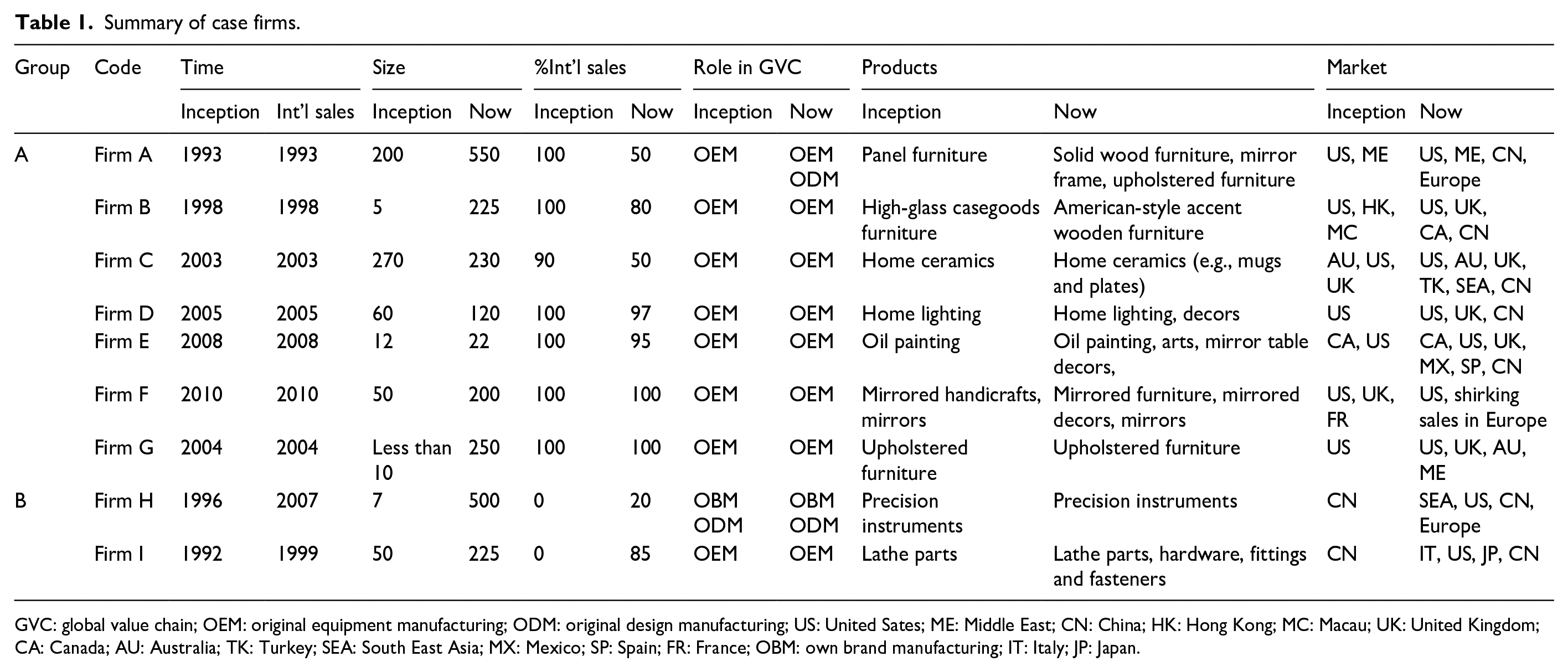
GVC: global value chain; OEM: original equipment manufacturing; ODM: original design manufacturing; US: United Sates; ME: Middle East; CN: China; HK: Hong Kong; MC: Macau; UK: United Kingdom; CA: Canada; AU: Australia; TK: Turkey; SEA: South East Asia; MX: Mexico; SP: Spain; FR: France; OBM: own brand manufacturing; IT: Italy; JP: Japan.
All firms are in the labor-intensive manufacturing sector with strong reliance on cheap materials and labors, and scale production. They stressed the difficulties associated with labor loss, rising wages, decreasing international sales, and narrowing profit margins. The initial and current markets of most firms are western developed countries, with domestic sales added for most firms except F and G. All firms have been trying to streamline and automate their production, but the furniture manufacturers (e.g., Firms A, B, F, and G) found it challenging, while manufacturers of smaller or supporting products (e.g., Firms C, H, and I) have increasing levels of automation.
From inception to date, their roles in the GVCs have barely changed, mainly OEM. Only two of the sample firms serve as ODM that gives the Chinese suppliers more control over R&D and design activities (see Table 1 and Figures 1 and 2). However, most case firms do not own brands or direct sales in the markets, except Firm H who operates largely as OBM and in certain cases as ODM. This has implications over the GVC position of the Chinese small suppliers. As shown in Figures 1 and 2, the small suppliers are indirectly linked to major buyer and they have limited control over the strategic decisions of GVCs. These decisions are mainly orchestrated by the brand owner who passes on the responsibilities of orchestration to intermediaries (Gereffi, 2019; Humphrey & Schmitz, 2002). These intermediaries then have diverse governance mechanisms over firms from emerging and developing economies that are mostly located in lower GVC positions (Lee & Gereffi, 2015).
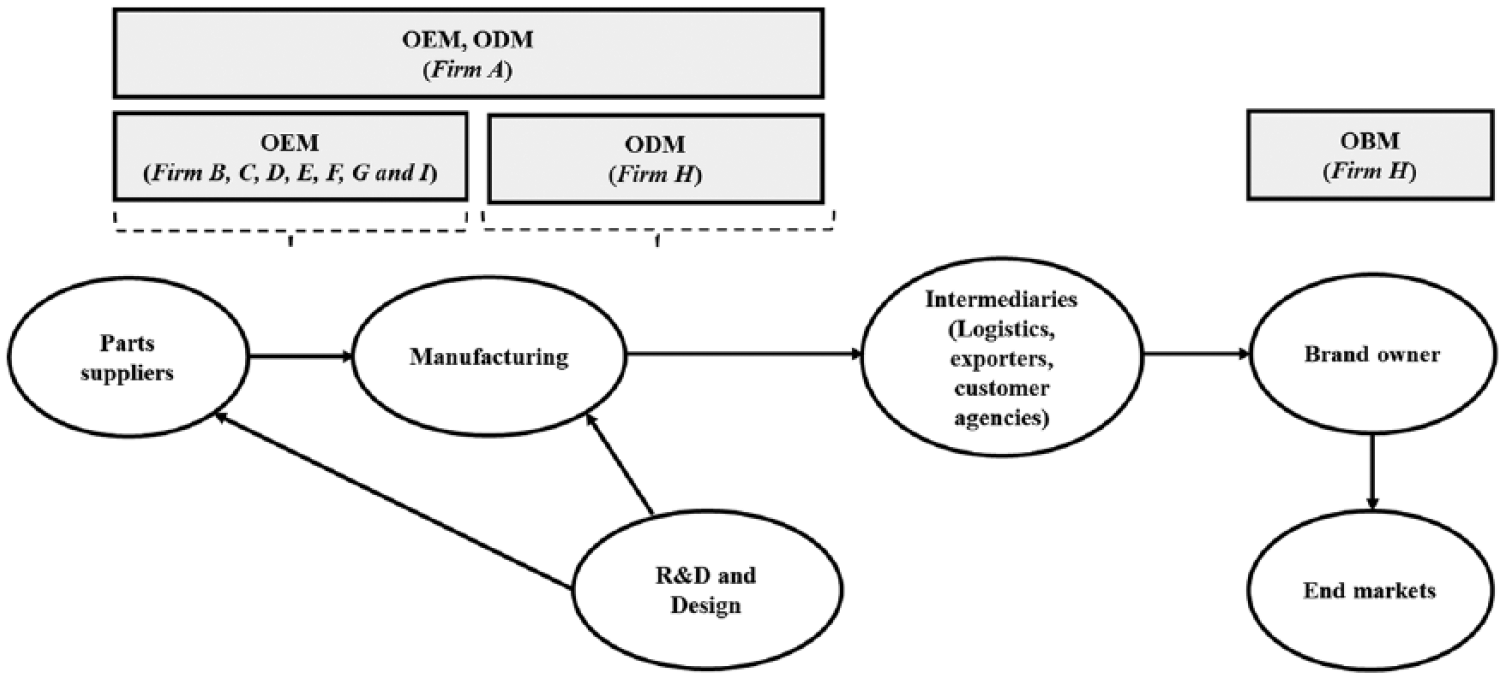
Chinese case suppliers’ positions in GVC.
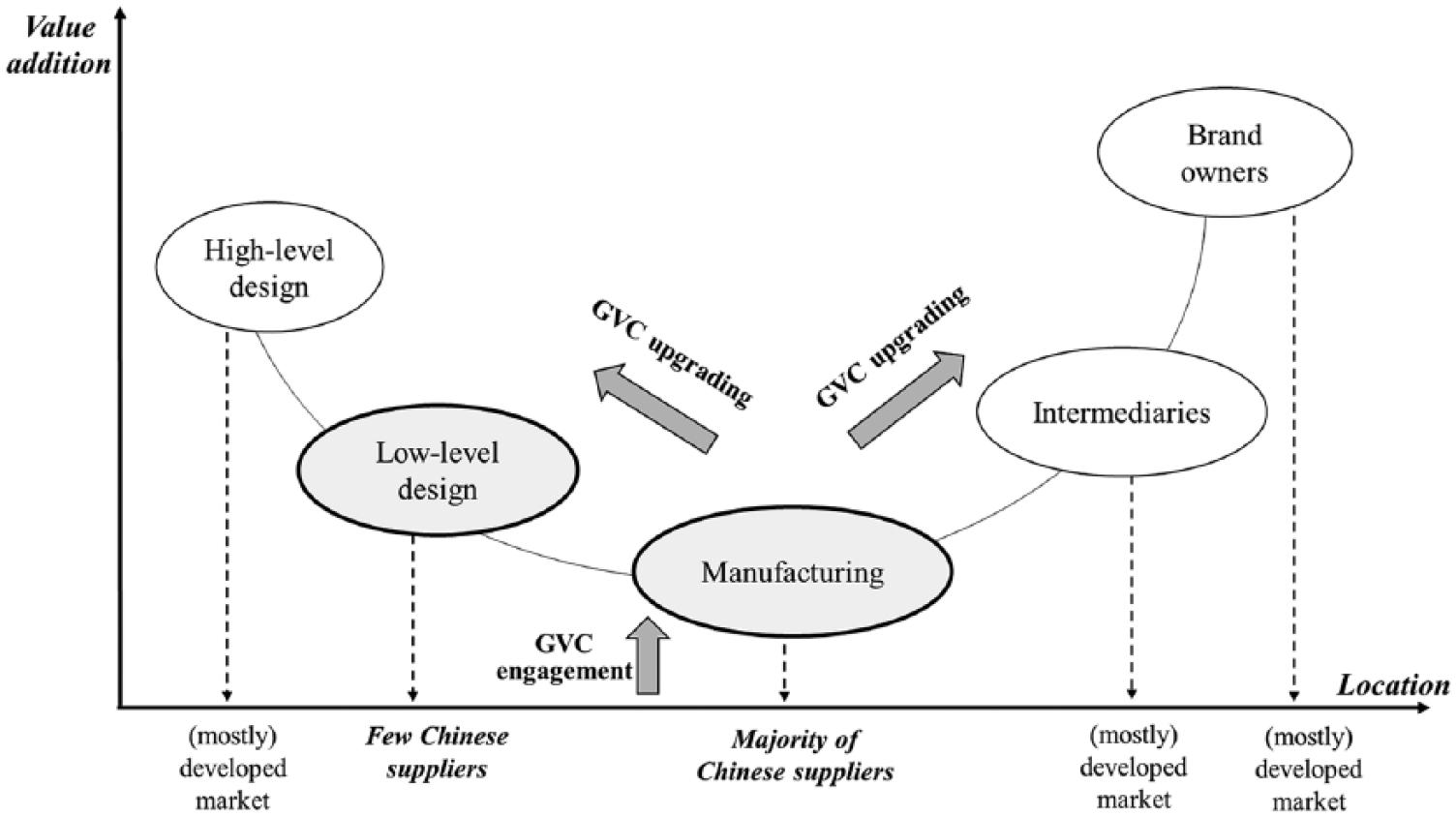
Understanding Chinese suppliers’ upgrading towards high value addition positions in GVC.
Role of networks in facilitating internationalization
Role of informal networks in accessing GVCs
A strong direct connection was found between entrepreneurs’ prior work experience, entrepreneur’s personal networks, and internationalization patterns of Group A firms. Repeatedly, interviewees emphasized the “natural” evolvements of the owners’ career path moving from a manager or senior salesperson to creating their own businesses in the same or similar sectors. For example, Firm C’s owner started working in an international ceramics trader in the late 1980s before he created the company in 2003, producing and selling home ceramics. As the interviewee (Owner) said: “He (the father/owner) had been working in the industry for so long that building his own company just came naturally.”
Firm A’s owner started working in international trading companies from 1979 and established his own in international sales in 1993. The founders of all the other five Group A firms created their businesses in a similar situation, with prior similar experiences of international orientation. Such experiences equipped the entrepreneurs with industry knowledge, network connections (e.g., suppliers, sales agencies, overseas buyers, etc.), and market opportunities. Being active players in the networks helped them acquire the necessary knowledge and resources for the births of their companies with quick internationalization.
The personal network relationships with overseas contacts or customers acquired by entrepreneurs through prior experiences also embedded them into certain markets and GVCs more easily. For instance, Firm C’s owner met a friend through prior employment, who immigrated to Australia and became one of the company’s first overseas customers. Connection with this customer linked Firm C’s owner to a GVC. Such facilitation was also witnessed by some other firms like Firms D, E, and G whereby firms engaged in their first international market via participation in a GVC.
However, it is not applicable to firms like Firms B, F, and I: The market then had just been opened up so businesses were thriving. We didn’t have to specifically look for customers. Agencies did that. We were only an OEM factory so customers came to us and we were just supplying what they wanted. (General Manager of Firm B)
The above quotes indicate that the entrepreneur’s personal networks played a boundary spanning role in providing entrepreneurs access to GVCs. This shows that personal networks are complementary to participating in GVCs: We basically only do indirect sales so all was determined by market demands. Foreign companies were here to exploit favourable policies and cheap labours, a large group of domestic suppliers were founded to serve these foreign buyers. (Owner of Firm I)
Firm D’s owner also said the industry is “market directed,” so their market selection and diversification were “directed by customers”: American market has wide and mature purchasing channels in China, so it is not difficult (to enter the American market) . . . customers would come to you . . . It (product diversification) is to slowly adapt to customers’ requirements and (foreign) designers’ concepts. Overall, it is directed by the markets. (Owner of Firm D)
Building networks through trade fairs and the internet
Companies contact with overseas customers through various domestic and international trade fairs, and value such methods as extremely important to understand market and industry trends, expand customer base, or, simply, just to “open the minds:” In the past five years, we have been to different countries (for trade fairs) . . . The most important reward is expanding entrepreneurs’ mind. Mostly large customers are found through trade fairs. (Owner of Firm C) We chose America as our initial market because our boss went to the American High Point show. (Sales Manager of Firm A)
The owners of both Firms E and F emphasized the importance of using trade fairs to “get customers’ contacts,” “promote products” and learn about product and market trends. Such opinion is echoed by other firms like D, B, F, G, and H, who have extensively attended both domestic and international trade fairs such as the Canton Fair and fairs in America, Germany, and so on.
Although the internet has enabled firms to operate much more easily and economically in the global markets, its use in sales promotion or channel diversification is limited, because of product types and production scale (furniture firms, e.g., Firms A, B, and F), lack of technical knowledge and support (e.g., Firm C), or concerns over design protection (e.g., Firm G). The internet is viewed more as a tool to acquire product and market information and to network with customers. For example, Firm C’s owner uses social media such as WhatsApp and WeChat to maintain informal contacts with customers.
Strong network ties with overseas customers
All case firms emphasize the importance of customer relationships in facilitating a company’s international development through the acquisition of product and market knowledge, potential new customers, and opportunities. Firm F’s owner visits his American customers annually: “They (customers) tell us what products are populous for the year, what are the trends, and what products from us sell well. All these are very helpful for our innovation and R&D.” Firm A has acquired some new customers through their overseas suppliers of raw materials. Firm E admitted that good relationships with customers help the company to stay in tune with market trends: We were mainly sustained by some large American importers, who took up around 70-80% of our total sales. This is OEM. They give us the orders, designs, and even materials, and we just do as told. (Sale Manager of Firm A)
However, the strength or quality of customer relationships seems to be of importance. For example, Firm D believes that the major help they could get from customers is about market and product knowledge, while Firm A as aforementioned has benefited much more from overseas networks, including market expansions. Firm F said that, because most of their customers were of medium- to high-end markets, the company got to enter the market segment easily with higher-end products instead of competing with low-end sellers. Firm G said that their relationships with customers were built on mutual benefits and shared ideas, making the company more proactive in learning about markets. All firms mentioned that longer and stronger relationships with customers help make business easier. As Firm C’s owner said, “Good relationships with customers increase our mutual understanding of things, and customers’ tolerance of certain problems or conflicts.”
Most case firms believe that keeping an informal relationship, or adding more “personal” touch to customer relations, helps make business easier and more pleasant: We Chinese like to make it (relationship) personal. They might be customers originally, but as time goes by they become our friends; being friends for long they become our customers again. This is a very good virtuous cycle. (General Manager of Firm B) Though there’s cultural difference between the east and the west, they (customers) are also human beings with emotions, so being in contacts often helps in better maintaining a long-term cooperation. (Owner of Firm F)
Upgrading barriers and SMEs’ post-internationalization growth
Our empirical results show that SMEs’ inability to upgrade and engage in activities of higher value chains within their respective GVCs inhibits their post-internationalization growth. In line with the GVC literature, we identified a number of barriers that inhibited SMEs’ upgrading and in turn their post-internationalization growth. These barriers are divided into GVC structure, quasi-hierarchical GVC, and weak home institutions.
GVC structure: emergence of competitors after the inception of GVC engagement
All Group A firms started internationalization from inception, or rather they were established with the specific purpose of exports, which comprised over 90% of their initial sales. They mostly exported through agents, participating in GVCs indirectly. Their initial foreign markets were largely developed countries such as America, Canada, and United Kingdom. From inception to date, they have been mainly operating as OEM/ODM with limited market activities. Obvious changes, however, are seen with market and product diversifications as most companies are now selling to wider markets with more product categories. Another obvious change with most firms is the diminishing foreign sales proportions and the increasing domestic sales. As expressed by all nine case firms, since global buyers are shifting to cheaper manufacturing countries like India and Vietnam, they were facing more pressure on market and product diversifications, while domestic sales to the large and growing Chinese market was a promising choice. Most firms except F have seen a decreasing proportion of international sales. For example, Firm A started with 100% overseas sales which have now dropped to 50%. However, Firm F, whose products were “born” for overseas niche markets, finds it impossible to sell domestically. However, Firm G has chosen to remain completely foreign oriented due to a fear of being emulated by domestic competitors.
Chinese enterprises are now increasingly downgrading and disarticulating from GVCs originating from developed markets. Furthermore, they are diversifying to other markets including linking in regional and local value chains (regional and local value chains) and investing in upgrading efforts toward those value chains. Competing in regional and local value chains gives Chinese enterprises competitive edge against the global low-cost suppliers in India and other emerging economies. Furthermore, local value chains provide them with more opportunities of upgrading and value capture.
The two Group B firms show different internationalization speeds and patterns. Firms H and I currently have 20% and 85% foreign sales revenue, respectively, though both firms were established at a similar time and despite Firm I’s much shorter internationalizing time (Firm H in 1996; Firm I in 1992). Firm H is an OBM manufacturer with its own brands and basic sales forces in foreign markets, but still largely sells through local agents, while Firm I is OEM, completely dependent on intermediaries with no direct market activities. Both Group B firms targeted domestic markets initially, but have increasing international sales. They took 7 (Firm I) and 11 (Firm H) years to internationalize. In overseas markets, both firms sell through agents. While Firm H has its own brands, Firm I is a typical OEM manufacturer. As shown in Table 1, although firms in Group B have taken an incremental route to internationalization, they have increasing commitment toward foreign markets and linking with GVCs.
As all firms, except Firm H, which operates largely as OBM as OEM producers, their foreign market entry mode is uniformly the same, that is, indirect sales through agents.
Quasi-hierarchical GVCs
Power relations with major customers in GVCs
Although customer relationships generate important benefits for firms’ IB development, they seem to also bring negative effects that prevent firms’ upgrading and deeper commitment toward international market entry. When asked if they would consider establishing overseas branches or brands, firms in Group A protested because of potential conflicts with existing customers: We don’t know the market as much, and our customers have done very well there. (General Manager of Firm B) We don’t consider such option because it would cause conflicts with current customers. (Owner of Firm E)
Therefore, low bargaining power and higher dependency upon customers appear to be a major reason firms which play an OEM or ODM role in GVCs refrain from moving further up the value chain. It makes firms reluctant to change their existing business models.
The case of Firm H (OBM) in Group B supports the importance of bargaining power in GVCs. Firm H internationalizes much less than Firm I (20% vs 85% of overseas sales), though the former sells mainly its own brands, while the latter operates the same as Group A firms, namely, OEM production at low end of GVCs and sales through agency without direct market activities. Firm H’s initial targeted markets are geographically and culturally close Asian countries such as South Korea with lower-priced and lower-standard products, and has now expanded to American and European markets, though sales in the latter markets are currently low. Although internationalization speed of Firm H is relatively slower than case firms in Group A, incremental internationalization of Firm H seems to have enabled the firm to build a better market footing and engage in GVC position. As shown in Table 1 and Figure 1, Firm H has fewer power dependency issues or bargaining power conflicts with powerful buyers as an OBM than OEMs.
However, Firm H experiences difficulties in managing downstream markets in GVCs. For instance, the firm’s overseas sales still largely depends upon its local agents because of the case firm’s lack of local market knowledge (e.g., language, culture, local service, etc.). Regarding such market development issues, Sales Manager of Firm H mentions, We basically sell through agents because our products are relatively technical and need after-sales services in different cities . . . We don’t know the local languages or other problems, and we would need the time and money to build up the social networks.
This indicates the importance of market development capability, including local market knowledge, network development, and distribution channels in foreign markets.
Foreign market maturity
Another obvious obstacle for all case firms in growing internationally is the maturity of foreign markets. Global buyers with strong domination of the market have established substantial linkages with first-tier suppliers of developed markets, which in turn present significant challenges for firms of developing economies in effectively competing with these first-tier suppliers: It’s not realistic, because foreign brands are already very mature with various advantages, including brand recognition and sales channels. All these are not possible for a small company (like us). (Owner of Firm D) We basically wouldn’t consider it. Firstly, we are not familiar with the markets, secondly the existing customers have been doing very well and maturely. (General Manager of Firm B)
Even Firm H finds it difficult to expand into more developed markets like America and Japan, because “domestic (Chinese) products are far behind in technique compared to those of America and Europe . . . so we mainly target overseas markets with low price demand.”
Supplier’s home institutions hinder GVC upgrading and internationalization
Lack of capital and market resources
Obvious hindrances to firms’ further market internationalization and upgrading, as pointed out by all the case firms, are the lack of capital and market resources, even for firms older than 20 years (e.g., Firms A, H, and I): We don’t stand a chance financially compared to those big (foreign) names, so we have no advantage at all and wouldn’t consider competing in this way. (General Manager of Firm B) To create our own brand overseas, we need a series of acquisition. For example, we need to have local warehouse and sales (staff and channels). (Owner of Firm F)
Such opinions were largely echoed by other firms like Firms C, D, and E, and even both Group B firms.
Difficulty in maintaining cooperative networks and institutional support
Although the literature projects that SMEs’ flexibility and lack of resources will lead these firms to cooperate with each other, our study shows that protectionism and mistrust of professional networks that are also competing in the same industry will hamper a firm’s willingness to upgrade in GVCs. For example, the owner of Firm F said that the lack of collaboration with peers was derived from the fact that the industry entry barriers in the OEM position are low. Therefore, a firm’s main priority is to protect existing OEM (and at times ODM) capabilities from competitor networks rather utilizing and learning new capabilities: By just glancing at our products, they (competitors) could do almost anything we are doing, so it does not benefit us to get too close with them. (Owner of Firm F)
Other firms supported such an attitude for similar reasons. Firm E said that the company was initially built in Shenzhen but moved to Dongguan only because the products were easily copied by peers in the area. Such distrust and protection extend from peer-to-peer relationships to relationships with suppliers who could potentially become competitors. Firm D believes that the traditional industrial businesses in China are mostly in malignant competition instead of constructive communication. Mistrust among peers also diminishes the benefits of institutional relationships or supports (e.g., trade unions). Most firms perceive institutions as merely channels of obtaining industrial information, such as trends, policies, and events, instead of a means to connect or communicate with peers.
Market penetration opportunity at home
Chinese SMEs’ internationalization diverges from traditional paths, showing parallel expansion at home and abroad or even utilization of overseas markets as a springboard for further home growth. For instance, most Group A case firms experienced a decrease in international performance but an improvement in domestic sales, and they were paying more attention to the domestic market: The domestic (market) is different because it is rising, and to us there are many advantages. Firstly, the market is huge; secondly, we are familiar with it. Also, the capital environment is relatively safe. In other words, the domestic (market) is full of potential. (General Manager of Firm B) For factories in the Pearl-River Delta, there are only two ways. First is to divert the risks by operating both domestically and internationally. The Chinese market with its huge population promises huge consumption power . . . second is to upgrade ourselves through developing certain levels of product and market abilities. (Sales Manager of Firm A)
In summary, the findings showcase that networks have both positive and negative impacts on SMEs’ internationalization, and firms’ identification and utilization of network relationships are highly situational and contextual, mediated by various factors.
Discussion and conclusion
Role of network and GVCs in the internationalization of EE-SMEs
In line with the aim of understanding the internationalization of EE-SMEs from the network and GVCs’ perspectives, this study provides several interesting findings. First, firms gain various resources (e.g., product designs and market trends) through networks, facilitating their initial internationalization (e.g., Ellis, 2011; Johanson & Vahlne, 2009; Yamin & Kurt, 2018). The network relationships of firms, especially customer relations, facilitate their use of SC, helping them learn about markets, designs, and sales. This compensates for and supplements their lack of foreign market knowledge and resources. This echoes the literature’s findings that firms seek resource complementarity and supplementation through network relationships (Khan & Lew, 2018; Schweizer, 2013). The SC gained through networks helps firms in their value creation, including product development, firm performance, and market diversifications. However, such benefits vary due to the quality of SC. Stronger relationships with more important customers benefit firms much more than otherwise, echoing findings from extant research (e.g., Tsai & Ghoshal, 1998).
However, these SMEs’ further development and growth are impeded by upgrading barriers within the value chains, including lower position within GVCs, quasi-hierarchical governance structure, and SMEs’ home institutions (e.g., Gereffi, 2019). These upgrading barriers and lower value chain position substantially hinder these firms’ further development and international competitiveness compared to the mature foreign market, indicating the importance for EE-SMEs to develop and nurture significant network relationships as these firms rapidly internationalize. The extensive network relationships that entrepreneurs had established through prior experience provide firms with quick market entrance. This supports Johanson and Vahlne’s (2009) study that insidership position facilitates firms’ successful internationalization. However, although the market context (e.g., large MNEs’ global sourcing and exploitation of local firms’ capabilities) enabled these firms’ quick insertion in GVCs, their customer relationships are rather asymmetric with foreign customers controlling high value-added activities, which limits these firms’ market knowledge acquisition and subsequently restricts their further internationalization and global growth. This echoes Humphrey and Schmitz’s (2000) theory about a quasi-hierarchical GVC relationship which impedes the upgrade and progress of the subordinate firms, and thus EE-SMEs’ initial GVCs’ insertion limits their acquisition of market experience. Therefore, the major contribution of the GVC framework in the context of Chinese SME internationalization is to explain how certain networks, when understood through the lens of GVCs’ structure, governance, and SMEs’ home institutions, can hamper SMEs’ post-internationalization growth. These findings somewhat speak to the observation made by Yamin and Kurt (2018) noting that “not all networks are the same nor do all network relationships necessarily engender trust and commitment or to the same extent” (p. 3).
Nevertheless, the findings further indicate that negative factors (e.g., concerns over competition, resource sharing, and design protection) prevent firms from forming real cooperation with home-market players, including peers and suppliers. Although scholars propose that networks largely influence firms’ market selection and entry mode, the study shows insignificant relevancy, as Chinese SMEs are at the low end of GVCs and their more powerful customers control the production sourcing and market structure (e.g., Gereffi, 2019). Based on these findings, we suggest the following propositions:
Proposition 1. Strong network ties of EE-SMEs (e.g., entrepreneur’s networks, networking channels, and overseas customers) facilitate these firms’ GVCs’ engagement as well as foreign market entry, whereas weak competitive position of EE-SME in GVCs and weak home institution support hinder the upgrading of their GVC position and post-internationalization growth.
Proposition 2. The configuration of GVCs affects the internationalization scope of EE-SMEs. Being stuck in a low position within the GVCs hinders EE-SMEs’ GVC upgrading. Thus, for their post-internationalization growth, their configuration of GVC and network capabilities in the GVCs matters even after their inception of the GVCs.
Implications for research and practice
Conceptual implications could be drawn from this study. First, existing studies of how EE-SMEs utilize network relationships in their internationalization have largely neglected the configuration of GVCs in which EE-SMEs are participating (Buckley & Ghauri, 2004). Studies are rare which have integrated networks and GVCs’ perspective in examining the enabling and constraining factors which influence the internationalization of SMEs, and thus this study provides a much fine-grained view of both enabling (e.g., network ties) as well as constraining (e.g., low-level position of these firms within the GVCs) in the international opportunity identifications and future market scope (e.g., Johanson & Vahlne, 2009; Yamin & Kurt, 2018). Meanwhile, our study is in line with the recommendations of Coviello and Munro (1995), Coviello (2006), and Buciuni and Mola (2013) in focusing more on the coordination and interactions of networks and how these interactions (governance and input–output structures) shape the growth of SMEs. In particular, the uniqueness of our study resides in the fact that it contributes to extant literature on networks by highlighting how certain networks can inhibit SME internationalization (e.g., Yamin & Kurt, 2018). Second, extant networks’ investigations are largely based on a single or a few factors, but this study implies that firms, even of similar characteristics, could form different types of networks’ ties most befitting their situations. The findings also highlight the important role of entrepreneurial networks and networking channels in the identification of international opportunities and this finding is consistent with the recent network studies which have highlighted the role of entrepreneurs in the SME’s internationalization (e.g., Ibeh et al., 2018; Khan & Lew, 2018; Schweizer et al., 2010).
Several managerial implications could also be drawn from this study. First, international entrepreneurship has decisive influence over firms’ international development and network utilization. Therefore, cultivating such factors (e.g., experience, innovation, etc.) could positively facilitate firms’ internationalization (Khan & Lew, 2018). Second, negative factors that prevent firms from cooperation with home-market network players should be minimized, probably through better institutional management and supports. Third, networks have substantial influence over firms’ capacity building, and the firms should actively seek to form and nurture constructive network relationships with various players. Fourth, EE-SMEs are disadvantaged historically due to GVC asymmetry, so their future internationalization might need stronger financial and institutional supports for capability building.
In sum, the findings of this study demonstrate the extant literature’s postulation that networks have substantial and positive influences on firms’ internationalization (Ellis, 2011; Puthusserry et al., 2018; Tian et al., 2018; Zhou et al., 2007). Networks facilitate firms’ quick insertion into the global markets, support their value creation, and engender resource complementarity and supplementation, though such benefits are mediated by the quality of SC derived from network ties and relationships with their value chain partners. Specifically, entrepreneurial factors largely affect firms’ internationalizations, while negative firm-specific factors like mistrust and individuality prevent firms from gaining the benefits of home-market networks (Yamin & Kurt, 2018). Furthermore, from the fresh angle of GVCs, networks’ influence over firms’ market selection and entry mode is overstated academically. Through GVCs, economic activities are being shaped by complex network capitalism, which provides not only opportunities but also challenges for the internationalization of SMEs based in emerging markets. Thus, SMEs possessing unique network ties and entrepreneurial orientation could leapfrog and benefit from being part of GVCs (e.g., Gereffi, 2019). Networks are double-edge swords that also restrict and hamper firms’ knowledge acquisition and thus further internationalization, that is, duality of networks (e.g., Ellis, 2011; Yamin & Kurt, 2018). In this vein, the study calls for a more careful investigation when it comes to network–internationalization interactions in the EE-SMEs’ context. Figure 3 summarizes the identified enablers of GVCs’ engagement and hindering factors of upgrading within the GVCs based on the case firms’ findings. Overall, this study integrates GVCs and networks’ perspectives and by doing so provides a much fine-grained understanding about the mechanisms through which networks affect SMEs’ internationalization.
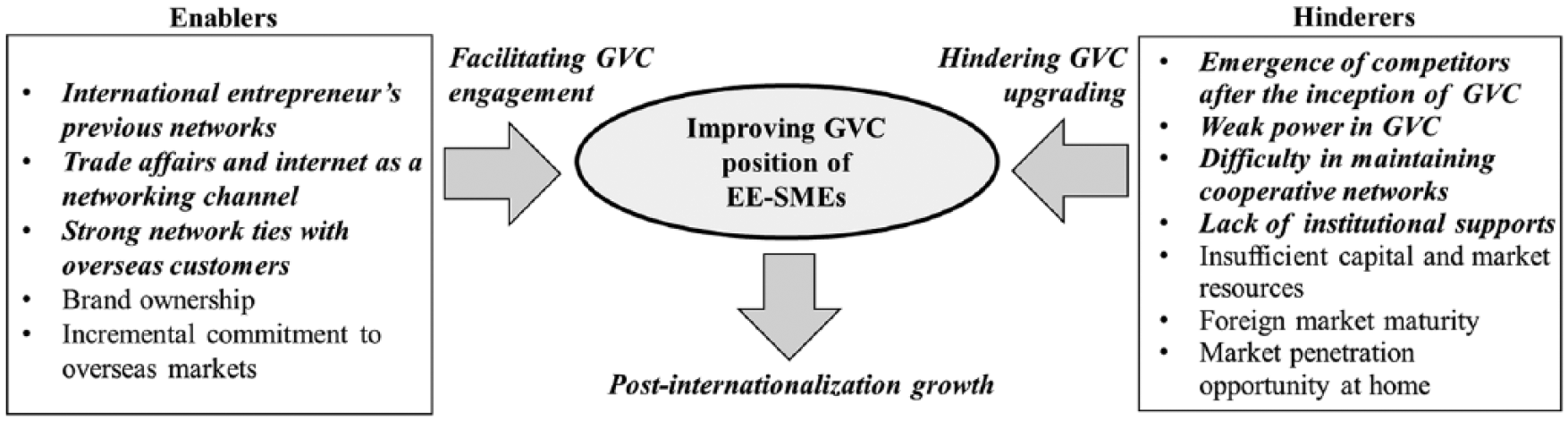
Enablers of GVC engagement and hindering factors of GVC upgrading.
Limitations and future research
This study is not without limitations. The main drawback is that the research is based on labor-intensive manufacturers. Due to this, the findings might not be applicable to other types of firms, such as technology-intensive ones. To increase the generalizability, future studies need to include more diversified samples of EE-SMEs drawn from various sectors ranging from low to high technology intensity. Future studies could also conduct large-scale surveys and longitudinal studies. Studies are also needed which can integrate the governance structure of GVCs and examine how SMEs use their GVCs’ position and network ties and realize international opportunities. Such studies could also integrate the effectuation process (e.g., Galkina & Chetty, 2015; Sarasvathy et al., 2014) in order to provide much deeper insights about the types of SMEs and their internationalization process. There is also a scope to examine the micro-cognition and decision-making of entrepreneurs and how they identify relevant networks for the identification of international opportunities (e.g., Foss & Pedersen, 2019). Since network ties and firms’ position within the GVCs may enable and constrain the identification of international opportunities and successful entry into foreign markets, future studies should focus on both enabling and constraining factors and under what conditions SMEs’ can overcome barriers to foreign market entry. As Ellis (2011) notes, “the recognition of international exchange opportunities is a highly subjective process, shaped by entrepreneurs’ existing ties with others. These idiosyncratic connections both promote and constrain international exchange” (p. 100). Thus, future studies could focus on providing a balanced view around the nature of the network ties and GVCs’ connections and how such ties facilitate the choice of market selection as well as the mode of internationalization of EE-SMEs. Lastly, the integration of institutions with a network-based view would provide important insights about the enabling and constraining factors behind the internationalization speed of SMEs from developing and emerging economies.
Footnotes
Declaration of conflicting interests
The author(s) declared no potential conflicts of interest with respect to the research, authorship, and/or publication of this article.
Funding
The author(s) disclosed receipt of the following financial support for the research, authorship, and/or publication of this article: This work was supported by Hankuk University of Foreign Studies Research Fund.