




Abstract
The use of salience as a tool to determine which stakeholders matter may lead to the marginalization of some stakeholder groups. As a normative theory, salience is problematic because it uproots stakeholder theory from its moral foundations. As a descriptive theory, its prevalence has found mixed support in literature. In order to overcome these limitations, scholars have recommended grounding stakeholder theory in ethics of care. These recommendations have largely been normative but still lack empirical support. We present the case of Escuela Social Ana Bella to show that, particularly when dealing with marginalized stakeholders, stakeholder theory rooted in ethics of care has considerable explanatory power. We find that firms can engage with fringe stakeholders when the decisions of managers are informed by emotions. We also find that this engagement can have the power to transform the beneficiary stakeholder group to an extent where they may become, paradoxically, salient stakeholders for the firm.
Introduction
Globally, 35% of women have experienced some sort of physical or sexual violence (García-Moreno et al., 2013). In the European Union (EU), according to a study conducted on 42,000 women in 28 EU member states, it is estimated that 33% of women have suffered some sort of physical or sexual violence (European Union Agency for Fundamental Rights, 2014). At the same time, attention to corporations’ actions to benefit the larger community around them under the umbrella of corporate social responsibility (CSR) has increased exponentially over the recent years (Margolis & Walsh, 2003; Mazutis & Slawinski, 2015).
Despite the increased awareness and attention directed toward both these phenomena, there is little intersection between the two, both in academic literature and in practice. There are not many examples of companies that have taken up the cause of domestic violence and sexual abuse, and made attempts to support and aid the victims, although the importance of such actions has been emphasized in prior literature (de Jonge, 2018). This oversight derives, in our opinion, from the use of the descriptive tool of stakeholder salience to determine which stakeholder groups “really matter” to an organization. This determination, based on calculations of the legitimacy, power, and urgency of stakeholder claims, tends to exclude groups who may be referred to as “fringe” stakeholders, as a result of low salience.
It is in this context that, a few years ago, Danone initiated a CSR program in partnership with the Ana Bella Foundation called ESAB (Escuela Social Ana Bella [Ana Bella Social School for Women Empowerment]), which was designed to help victims of domestic abuse. In this case, the measurement of salience for the beneficiary stakeholder group yields a result in contrast to what we would expect on the basis of the ideas of stakeholder salience. Women victims of domestic violence do not have a particularly legitimate stake in the resources of the company, their power over the company is weak, and the urgency of their plight is high only from their own perspective, not from the perspective of the firm. How, then, is a firm able to engage with a stakeholder group with such low levels of salience for the firm?
The answer, in our opinion, lies in the ethics of care (Burton & Dunn, 1996; Liedtka, 1996; Wicks et al., 1994). As discussed by Wicks et al. (1994), a feminist reinterpretation of stakeholder theory “returns the focus in conversations about stakeholder theory to the central moral questions inherent in the meaning of organizations and makes those issues the crux of the matter” (p. 494). However, the arguments laid out in these works take on a normative guise and present recommendations for grounding stakeholder theory in ethics of care. Beyond the normative recommendations, there is little evidence that stakeholder theory, grounded in ethics of care, has the descriptive power to explain the actions of a company engaging with fringe stakeholders.
The research objective of the study is an attempt to understand whether a venture like ESAB can be viewed better in terms of stakeholder engagement grounded in ethics of care. The research question following on from this attempt is, therefore, “how does a firm effectively engage with fringe stakeholders?” In answering this question, we need to explore the motivations of the decision makers in undertaking the project at the initiation stage. In addition, if we are to consider the effectiveness of this engagement strategy, rooted in ethics of care, we argue that this effectiveness needs to be seen from the impact of the program on the intended beneficiaries.
We begin by looking at literature dealing with the role of salience in stakeholder theory while highlighting that a disproportionate attention to salience leads to a perceived separation between the “business” and “ethical” realms, leading to marginalization of certain stakeholder groups with low salience. We then look at literature presenting the normative arguments for grounding stakeholder theory in ethics of care and highlight the identifying attributes of such grounding. Following that, we consider literature discussing the challenges of power imbalances in stakeholder engagement and the unique difficulty of effective stakeholder management in such a climate. Following that, we present the case of ESAB as a situation where corporate resources were diverted to the cause of such a marginalized stakeholder group, an approach that, from a theoretical perspective at least, renders instrumental theories of stakeholder engagement devoid of explanatory power. After discussing the data collection and analysis methods, we present our findings in terms of both the identifying attributes highlighted and the empowering effects of the stakeholder engagement demonstrating its effectiveness. A discussion of these findings relative to prior literature is presented. We conclude with the major theoretical contributions of the article, managerial implications, and limitations of our study and offer possible avenues for further research.
Literature review
Stakeholder salience
In the literature relating to stakeholder theory, one of the key challenges in effective stakeholder management has been the question of defining which stakeholders matter (Donaldson & Preston, 1995; Parent & Deephouse, 2007; Phillips, 1997). The purpose of this question is to determine the stakeholders that organizations need to direct their resources toward. One of the most popular tools for determining “relevant” stakeholders was presented by Mitchell et al. (1997), who proposed the concept of stakeholder salience. The authors argued that stakeholder salience is determined by the degree to which a stakeholder group has legitimacy to its claims, the urgency of its claims, and its power to affect the organization. These three factors combine to reflect how salient a particular stakeholder group is for an organization.
Over the years, this idea of determining stakeholder salience has become increasingly popular (Griffin, 2017). Although there has been significant discussion of the concept in terms of theoretical development (Phillips, 2003), empirical research based on the framework has not been proportionately adequate (Parent & Deephouse, 2007). Most studies that have attempted to verify the claims of the theory have found limited support for it (Richter & Dow, 2017). For example, Parent and Deephouse (2007) used comparative case studies to test the attributes of stakeholders that led to managerial attention to their causes. They found that the focus of management was primarily directed toward the attribute of power and concluded that “power is usually necessary for stakeholders to be identified by managers” (p. 7).
The problems with salience
The strongest support for the propositions comes from Agle et al. (1999), who tested whether CEO perceptions of power, legitimacy, and urgency lead to a higher perceived salience of stakeholder groups by the CEOs. They also empirically tested the relationship between perceptions of salience and corporate performance, where performance included economic as well as social performance measures. Data analysis found support for the first part of the study, indicating that CEO perceptions of attributes of salience affect their perceptions of salience of the stakeholder group. However, little support was found for the relationship between salience and performance.
In view of the mixed empirical support for the theoretical underpinnings, the question is raised of whether the model presented by Mitchell et al. (1997) is of a descriptive or a normative nature, whereby descriptive models describe the world as it is, while normative models recommend how they “should” be. The original theoretical article separates the normative “identification” of a stakeholder from the descriptive assessment of “salience” (Mitchell et al., 1997, p. 853). However, Agle et al. (1999) observe that the terms “stakeholder” and “someone who really counts” (who has salience) are not yet synonymous and therefore recommend a “persistent and persuasive linking of these terms in the normative discourse of our society” (p. 522). This observation suggests that “salience” as a construct, at least in the minds of academics, has taken on a more normative role rather than the descriptive one it was originally intended to have. The normative tinge of the model is problematic because it separates stakeholder theory from its initial moral foundations and takes an amoral approach to determining the stakeholder groups that deserve an organization’s attention and resources.
The problem with the idea of the three attributes taking on a more normative role in academic discourse is that it recommends a model for managers to apply in order to determine what groups organizational resources should be diverted toward. Resultantly, as Derry has argued, “resources, responsiveness, and responsibility are directed to those . . . who have clout” (Derry, 2012, p. 256). She argues that such a direction for stakeholder theory in fact moves away from the moral underpinnings that the theory was originally based upon by separating the business and moral realms. Her argument is that the decision of managers regarding the relative legitimacy, urgency, and power of diverse stakeholder groups “does not necessarily lead to greater moral sensitivity or firm ethical grounding” (p. 257).
There are several points on which prior literature has disagreed with the normative and descriptive utility of the use of salience to determine relevant stakeholder groups. In terms of salience as a descriptive tool, the evidence supporting the perspective is mixed, and the normative view of the theory has been criticized since it moves stakeholder theory away from its value-laden foundations.
Grounding stakeholder theory in ethics of care
A perspective that allows us an alternative view of stakeholder relations is that of feminist ethics (Burton & Dunn, 1996; Liedtka, 1996; Wicks et al., 1994). To realign stakeholder theory with its initially intended foundations, researchers have stressed that the theory needs a moral grounding that “recognize(s) the inherent relatedness of individuals and groups composing the stakeholder network” (Burton & Dunn, 1996, p. 145). Feminist ethical theories, particularly the ethics of care (Gilligan, 1993, 2014), seem particularly suitable as a moral foundation for stakeholder theory. A care-based, feminist interpretation of the stakeholder relations of a firm would “acknowledge that the individual and the community, the self and the other, are two sides of the same coin and must be understood in terms of each other” (Wicks et al., 1994, p. 483). This kind of a realignment is necessary if we agree that “the final ‘raison d’être’ of positive states and practices is the overall well-being of the stakeholders” (Meyer, 2015, p. 175).
The idea of ethics of care can best be understood in contrast with other, more traditional ethical theories, particularly ethics of justice described by Kohlberg. Kohlberg emphasizes that the highest level of moral development resolves moral dilemmas by appealing to overarching principles of justice and fairness in a rational and impartial manner (Blum, 1988; Fraedrich et al., 1994; White, 1992). In contrast, ethics of care “adds feeling to reason, speaks about right and wrong in terms of what is appropriate to particular circumstances, and focuses on our responsibilities to others” (White, 1992, p. 52).
According to Burton and Dunn (1996, pp. 140–141), there would be a number of differences in our understanding of the firm and its relationships if we were to ground stakeholder theory in an ethics of care. First, relationships with stakeholders would need to be seen more as cooperative, “caring” types of relationships rather than being bound by contractual agreements to discourage exploitation. Second, the relationships would need to be seen as concrete, rather than vague, abstract groups. Instead of lumping distinct suppliers into an abstract stakeholder group called “suppliers,” we would need to be sensitive to the impact of our actions on each specific supplier within that group. Third, emotions would play a central role in informing decision making by managers. Finally, more attention would need to be paid to the firm’s obligations to others rather than the rights of the firm. In addition to these differences, the authors present a supplementary recommendation for decision making under this conceptualization that is particularly relevant for this study. They suggest that “special attention be given to the least advantaged members of the moral community” (Burton & Dunn, 1996, p. 143).
Thus, stakeholder theory, grounded in the feminist ethics of care, does root the theory in solid moral foundations, as was initially intended. Suggesting that there may be more than one “normative core” of the stakeholder theory, it is Freeman (2001) himself who states that “one normative core of a stakeholder theory might be a feminist standpoint one, rethinking how we would structure ‘value creating activity’ along principles of caring and connection” (p. 45). However, literature grounding stakeholder theory in ethics of care is a normative/prescriptive exercise. In addition, while it presents a view of stakeholder theory that is more consistent with its original moral underpinnings, there is little empirical evidence to suggest that the view may be considered a descriptive tool for looking at how managers actually make decisions related to stakeholder engagement.
Stakeholder, power imbalances, and empowerment through care
To yield effective outcomes of stakeholders, a unique challenge when dealing with marginalized stakeholders is that power asymmetries in relationships provide poor contexts for effective stakeholder engagement (Dawkins, 2014; Mena et al., 2010). As has been described above, it is particularly relevant for stakeholder engagement rooted in ethics of care to have relationships based on mutual trust rather than enforcement of contractual obligations. Power imbalances within stakeholder relations become an impediment to such relationships of trust (Civera et al., 2019; Greenwood & Van Buren, 2010).
Narayan-Parker (2005) suggests that a view of empowerment based on agency would suggest that empowerment is a learning process that leads to change. She presents three critical aspects of the empowerment process: first, that the origins of empowerment and the learning process are critical for individuals to feel empowered; second, it is developmental in the sense that it represents a change from a previous state of belief to a new one; finally, that empowerment is relative, not only to a previous state but also to others in the reference group (pp. 22–23).
Hardy and Leiba-O’Sullivan (1998) argue that literature dealing with empowerment does not sufficiently discuss the implications of power on the empowerment process, which they suggest could be a potential pitfall for the failure of empowerment initiatives. Similarly, Mosedale (2005) identifies the different forms of power that are critical in the empowerment process of women in particular. In addition to the dimensions of the traditional understanding of power as “power over” which focus on “clearly understood conflicts between people,” she discusses three other forms of power specifically related to the issue of women’s empowerment: power to, power within, and power with: (1) “power to” refers to a form of power that “increases the boundaries of what is achievable for one person without necessarily tightening the boundaries of what is achievable for another party”; (2) “power within” refers to “assets such as self-esteem and self-confidence,” which are a necessary component of achieving anything; (3) finally, “power with” refers to collective action and is said to be achieved by “creating opportunities for women to spend time with other women reflecting on their situation.” In the article, we focus on these three forms of power to better understand the empowerment process of participating women.
Research questions
As presented, the overarching question this article addresses is, “How do firms effectively engage with marginalized stakeholders?” There are, however, two distinct components of this question. The first deals with how such engagement can be explained theoretically. The second question, as seen from the literature of ethics of care, puts the focus on the recipient and deals with the effectiveness of the engagement.
To answer the first question, we consider whether stakeholder theory grounded in ethics of care can be used to explain how firms engage with marginalized stakeholders. As discussed previously, there are normative arguments for grounding stakeholder theory in ethics of care. However, there is little empirical evidence to show that stakeholder theory grounded in ethics of care has any descriptive power. We, therefore, seek to answer this fundamental question, “Does stakeholder theory grounded in ethics of care explain the behavior of a firm when engaging with marginalized stakeholders?” Our focus is not on the normative or prescriptive implications of such grounding, which has been addressed in prior literature, but on whether stakeholder engagement, in certain cases, can be better understood using the lens of ethics of care rather than stakeholder salience. If so, and contrary to the instrumental line imbedded in the salience approach to stakeholders, it would suggest that stakeholder theory grounded in ethics of care has, at least in some instances, more explanatory power than stakeholder salience.
Second, the article seeks to determine whether such engagement leads to better results for the intended beneficiaries. We do this, as required in an ethics of care approach, by focusing on the impact on the empowerment of the intended beneficiaries, rather than on the firm. This is also in line with the recommendation of Derry (2012) to flip the conversation regarding stakeholder theory prioritizing the recipient agents, not the firm. To respond to this second question, the article therefore primarily focuses on the benefits generated by a business for society and not on the benefits that the organization enjoyed.
Method
ESAB case
ESAB, the focal organization for the purpose of this article, is a joint venture between Danone, a multinational engaged in the foods business, and the Ana Bella foundation, a nongovernmental organization (NGO) dedicated to the care and empowerment of women who have suffered gender violence. At ESAB, women who have undergone violence from intimate partners receive personal and professional training through individual coaching, empowerment workshops, and an opportunity with a “trampoline” job to reintegrate into the labor force.
ESAB was created jointly in 2011 by Danone’s Ecosystem Fund, the Ana Bella Foundation, and Momentum Task Force as an outsourcing partner. Of particular note, for the purpose of this article, is the fact that the board of directors was composed of one man and three women as the final approving authority. This fact, while not confirmatory evidence for the use of feminist ethics in the decision-making process, does potentially indicate a potential explanation for the unconventional, care-based approach to decision making.
Since inception, ESAB’s main client is the dairy product company Danone, and in 4 years it has enabled more than 300 women to train and have an opportunity with a “trampoline” job which can be used as a stepping stone for better career opportunities. The women participating in the program were hired as ambassadors at points of sale in large supermarkets. Their job was primarily to organize the vending points, offer promotional products to customers, and respond to customer queries.
Two particularly distinctive aspects of the project set it apart from other similar projects. First, the project does not simply provide a job opportunity to participants in the program; it also offers them periodic personal and professional trainings to instill a sense of development in them. Second, the jobs given to the participants are those of brand ambassadors of Danone at points of sale, in contrast to similar programs offering jobs with lower visibility. This higher degree of visibility becomes, as we shall discuss in the “Findings” section, very important for the participating women’s empowerment process.
Data collection and analysis
In this research, we were interested in developing an understanding of the rationale and the consequences of the program and particularly its impact on the participating women. Specifically, when assessing its societal benefits, we were interested in investigating whether and how the participants themselves saw any benefit from their association with the program. Given the focus on the subjective experiences of the women, we adopted a phenomenological paradigm to conduct the research.
A total of 46 semi-structured interviews, with an average length of around 45 min each, were conducted between June and September 2014. We divided the sample into two groups: 25 women who had suffered violence from their former partners (ambassadors) and 21 managers (5 men and 16 women) who were directly involved in the project. The managers identified refer to a broad category of stakeholders involved in the implementation, monitoring, and control of the project. This includes managers from Danone, elected managers in public institutions, civil servants, and personnel from the Ana Bella Foundation. All the individuals interviewed were directly involved in the project in their roles as supervisors, auditors, internal consultants, trainers, or representatives of the public sector monitoring the project. Each of these different profiles provides a very different perspective of violence and its psychological consequences. This allowed us to triangulate the findings, as these two points of view can be considered complementary; they help to explain in greater detail all the complexity and breadth of the phenomenon studied. With a few exceptions, all the interviews were carried out by a single interviewer, with the same semi-structured script. Considering the sensitive nature of the discussion, the interviews of the participants to the program were always conducted in person where only the interviewer and interviewee were present to establish a climate of trust.
Due to the nature of the study, there was an important ethical risk of delving too deep into the negative experiences of the victims, making them remember painful episodes of their personal experiences during the interview. To overcome this limitation and thus avoid a violation of privacy, it was made clear before beginning that the interview could be suspended or canceled at any time at the request of the respondent.
The interviews were recorded and later transcribed by an independent organization, ensuring the minimization of potential implicit bias in the transcription phase. The transcribed qualitative data from the 46 interviews were analyzed using the Atlas.ti software (Muhr & Friese, 2004). By means of this analysis of the data obtained, it was possible to contrast, check, and compile the results by conducting the text analysis in four stages, as proposed by Miles and Huberman (1994). This comprises (1) simplification of the data to make the text corpus manageable, (2) segmentation based on grammatical criteria, (3) categorization and open coding of each thematic unit constructed on the basis of the opinions stated on the same topic and coded in verbal labels, and (4) analysis of the resulting categories structured in a meaning map.
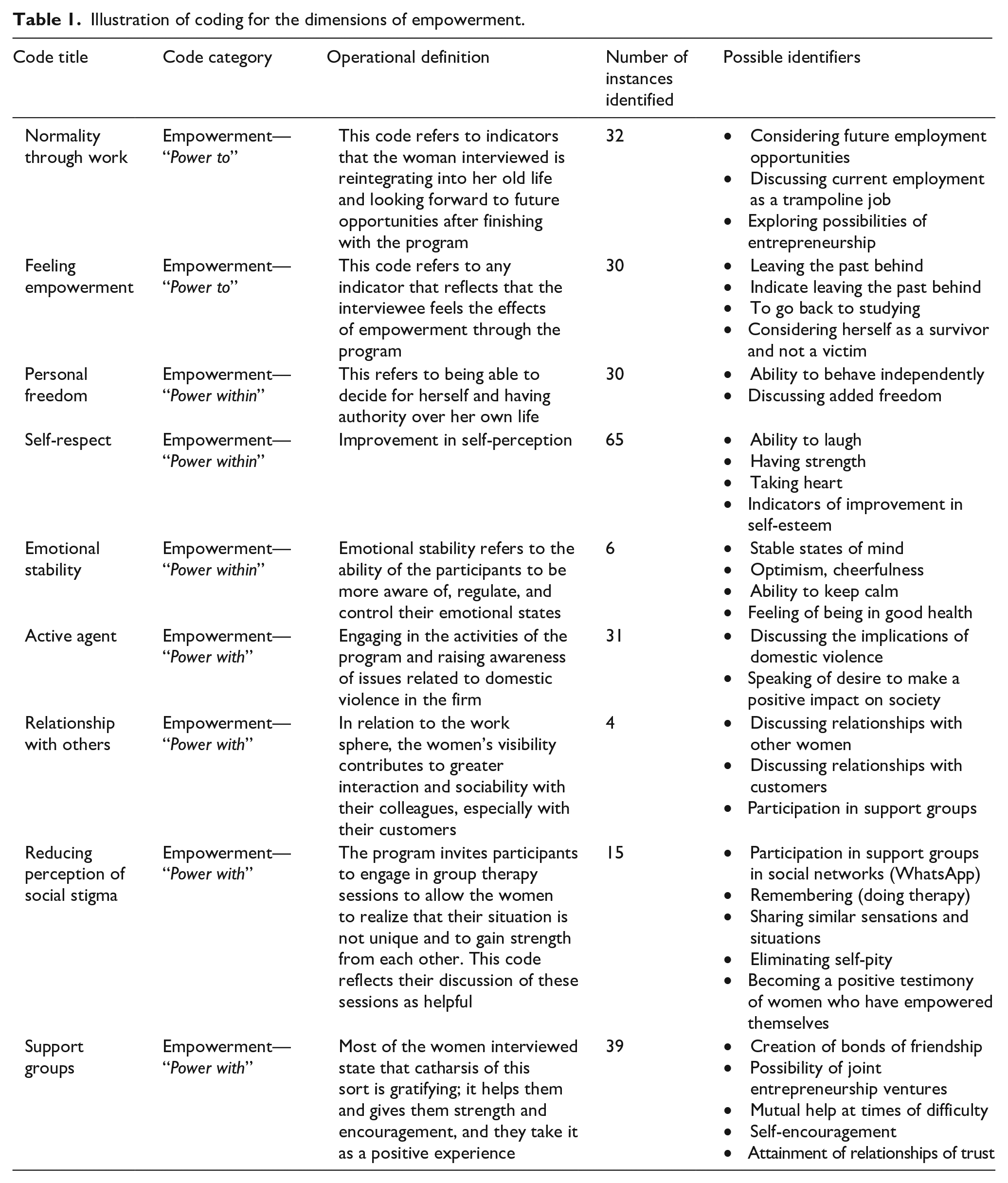
This text analysis process of the interviews initially involved creating a total of 42 analytical codes, nine of which were related to the empowering benefits of the participating women. These nine codes were grouped into three streams of empowerment based on the three dimensions of power identified by Mosedale (2005) as being particularly relevant to women’s empowerment. In addition, we found three codes related to risks and threats to the participating women, which were grouped together, and three codes relevant to the business end of the program. These related to the business case, the initial decision-making process, and the difficulties associated with engaging with a fringe stakeholder group. Table 1 shows the nine codes related to empowerment to illustrate the coding process.
Illustration of coding for the dimensions of empowerment.
Findings
On stakeholder engagement
First, to explore whether the case of ESAB’s engagement with victims of domestic abuse reflects a descriptive case of stakeholder engagement rooted in an ethics of care, we draw attention to the identifying attributes presented by Burton and Dunn and verify that they are visible in the presented case. According to Burton and Dunn (1996, pp. 140–141), there would be a number of differences in our understanding of the firm and its relationships if we were to ground stakeholder theory in an ethics of care. The first attribute identified by the authors suggests that relationships with stakeholders would be expected to be rooted in care rather than controlled through contractual obligations. The interactions between the managers and the women participating in the program demonstrated his underlying aspect of care in the relationship. This is indicated by the concerns of the different managers dealing with the participants: The last thing we want is to make them dependent on us and we do our utmost to avoid it. That said, they do not feel abandoned once their job as brand ambassadors has ended. (Manager 10)
The concern that managers had in dealing with the stakeholders was founded not on fulfillment of the requests of the participants, but the managers’ own assessments of what would help the women the most: I do not like paternalism because it is bad for the women. It is a bit like with children—if you mollycoddle them or do not bring them up right, things work out badly. (Manager 6)
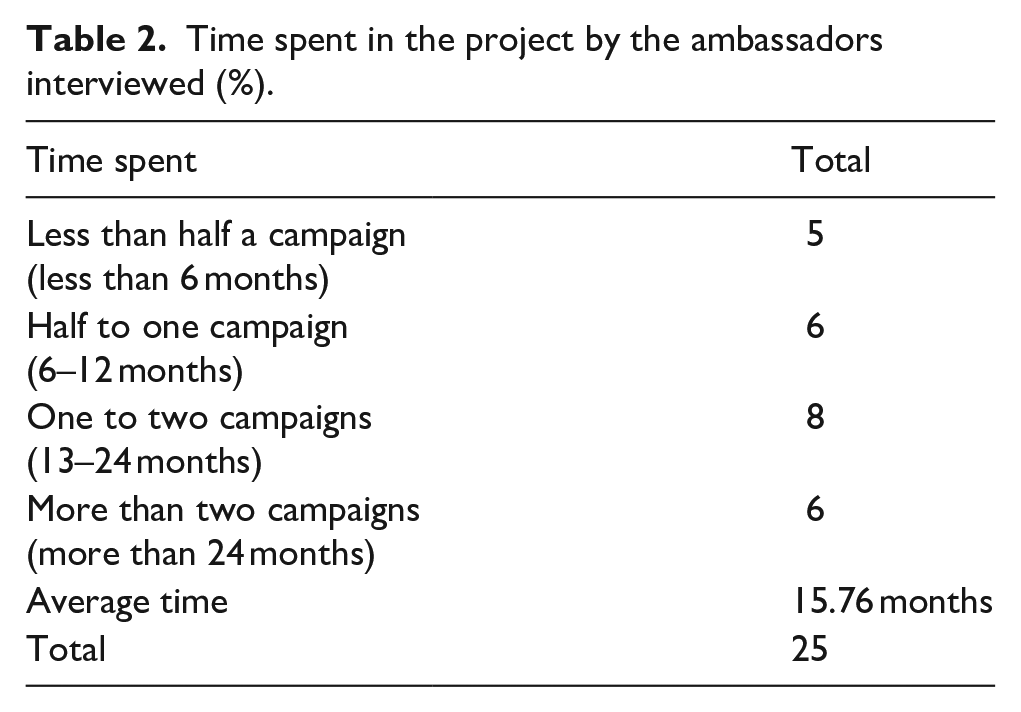
The second attribute identified by Burton and Dunn is that these relationships would need to be concrete and focused on the individuals, rather than abstract and lumped together. During our study, we found that while there was an initially envisioned timeline for the program, the individual women did not all go through the program in a predetermined cycle. There were women who stayed with the program for less than 6 months, and there were others who stayed for more than 2 years. This shows the flexibility of the program to cater to the needs and requirements of each of the women who became a part of it. This tailoring of the program to suit the requirements and needs of the participants demonstrates that rather than creating an “assembly line” of treatment, the relationship of each of the participants with the program is unique and much more concrete. Table 2 shows the different participants of the program and the duration of their participation in the program.
Time spent in the project by the ambassadors interviewed (%).
Third, the authors argue that emotions would play a key role in decision making for a company that envisions stakeholder relations grounded in ethics of care. As presented below, according to a manager of the program, a Danone employee was presented with the idea of the program initially and was said to be “moved” by the discussion. The person discussing the original decision said that they gathered together “good” people who wanted to “push it forward.” These terms are all indicative of the emotional content of the inputs considered while deciding on the issue. Non-verbal cues from the people involved in the decision-making process for the program also indicated the centrality of emotions and feelings during the startup stage: The initial idea emerged from the sales department. Then we met X [a Danone employee], and the idea was presented. X was really moved and got in contact with the Ana Bella Foundation. She then said “how nice it would be if we could help battered women to find a first job.” I reckon that in this project we gathered together good people who really wanted to push it forward. Otherwise, it would have never seen the light of day. (Manager 14)
The last characteristic identified by Burton and Dunn (1996) in connection with a grounding of stakeholder theory in ethics of care relates to focusing on the obligations of the firm toward others rather than the rights of the firm over others. Evidence of this can again be found in the quotes relating the initial decision-making process. As the Danone employee is reported to have said, “how nice it would be if we could help battered women to find a first job.” This reflects concern about the benefits that the firm can provide to an external group, rather than an instrumental view to determine how the action could help the firm obtain benefits from the stakeholder group.
In addition, Burton and Dunn suggest that stakeholder engagement rooted in care would result in particular attention paid to stakeholders that require the most aid, rather than the ones that benefit the firm the most. In this case, engagement with victims of domestic violence was guided by a desire to help the stakeholder group that would benefit most from the firm’s intervention rather than considerations of whether the firm could benefit from such engagement.
CSR programs designed to cater to the needs of marginalized stakeholder groups are difficult to engage with not only because of the low level of stakeholder salience but also because the underlying issues are alien, remote, and complex. It becomes difficult to raise consciousness about the issues when the decision makers lack a clear understanding of the related problems: This [working with battered women] is a sensitive topic [and] these are complicated issues. They are a taboo, particularly when the board of directors is composed only of men. (Manager 10)
Once the individuals making decisions became interested in helping, they were faced with organizational capability limitations. The firm, structured as a corporation, could not function as a tool to benefit the focal stakeholder group due to structural constraints. This led them to attempt to partner with an entity that is better designed to focus solely on the betterment of the group: Quite frankly, I think the interests of ESAB clash with the interests of Momentum and Danone, because we as part of the Foundation want the women to take this job as a springboard to the labor market. (Manager) I start from the premise that CSR in a firm isn’t the same as in an NGO and you can’t be 100% altruism. (P37, manager)
In addition, the firm did not have a well-defined grasp of the complexities related to the issue and could not forge ahead on its own if it wanted to have a real impact. While it had the monetary resources and its large infrastructure in place to help these women, it needed specific expertise related to the issues and difficulties faced by the women and potential actions that could effectively help them. To overcome this, it collaborated with the Ana Bella Foundation, a widely recognized NGO that stands at the forefront of psychological rehabilitation of victims of domestic abuse.
On effectiveness of program
Regarding the subject of the effects of the program on the intended beneficiaries, in many of the interviews with the participating women, it was apparent that they usually discussed their “starting position” when they entered the program. This discussion usually occurred at the beginning of the interview, suggesting that the participating women saw the program as a transformative experience: I had stopped working because the company closed and I was laid off. I had two children and then there was the separation. Things seemed utterly hopeless. (Ambassador 3)
Some women interviewed reflected more on their psychological state to voice their concerns and worries at the time they joined the program. One of these symptoms of an abusive relationship is the low confidence the women display in themselves and their personal abilities. The relationships of violence, both physical and verbal, inflicted by their former partners eventually take their toll on the women’s state of mind: I was shattered. I didn’t look people in the eye, I didn’t trust anyone. You retreat into your shell, you do nothing, you stay in, nothing matters. (Ambassador 12)
In addition to the physical violence endured by the women, the repeated verbal assaults add to their feelings of desolation: You’re useless, you can’t do anything, you’re going to wind up scrubbing floors. (Ambassador 1) You’re bombarded with “You’re a shit, you’re worthless, you’re this and that, nobody likes you . . .” It really hurts your self-respect. (Manager 8)
The participation of women survivors of gender violence in the labor market in the form of a job with a certain amount of social visibility is capable of conferring social recognition, resulting in their psychological improvement. Work may provide economic independence and a sufficient income level to lead a decent life for them and their dependents: I’ve worked all my life. Circumstances had it that I stopped working for my ex-husband. This was an opportunity because I’d been out of work for months and I said “I’m going to grab onto this.” (Ambassador 18)
Work also provides personal dignity and recognition. It helps to build greater personal self-respect and facilitates the development of personal relationships. In the case of women who have been victims of violence, the importance of having a job is even greater, as it becomes an instrument to rebuild their own life and have a new personal beginning: It is vital that a victim of domestic violence and any woman for that matter has a job. Financial independence is key. One of the main reasons why women are ill-treated by their partners or become dependent on them is because they have no earnings of their own. (Manager 5) I liked it because I’d been out of the employment scene for some time and I thought it would be more difficult for me, but it was like riding a bike: once you know how to, you never forget. Because I had experience working with the public, selling products, so I felt really good about it. (Ambassador 8)
Greater psychological empowerment occurs when the women work with prestige brands, well-known and highly valued by consumers, insofar as this prestige helps to improve their own self-respect. Unlike invisible jobs (mainly in cleaning, the catering industry, and the black economy), this opportunity to work with the public as Danone brand ambassadors provides a certain amount of “added value” by representing a prestige brand: Working with the public in a job where people look up to you does much more for battered women than an invisible job. (Manager 6) I’d never worked in this before in my life. As I said before, what I used to do was cleaning houses or farm work. This is loving life. (Ambassador 9)
The job opportunity afforded by ESAB was considered a “trampoline.” It is not a job in the ordinary sense, but rather a 2-year program in which the women receive professional and personal training aimed at enhancing their employability and enabling them to start looking for another regular job with longer hours, higher wages, or more potential, or that is more in line with their personal expectations, thus leading to an improvement in the women’s welfare.
By participating in the ESAB project, women survivors of gender violence are also empowered psychologically through an attitude improvement. An improvement occurs in aspects concerning self-respect, self-perception, personal autonomy, emotional stability, and self-confidence: I feel much better, and my life is my life. It’s up to me what I do—financial matters aside, because money only stretches so far—but I don’t depend on anybody, or on what anybody says or wants. I mean, my life is my life and I’m motivated. I’m motivated about what I do, about life, my daughters, my home . . . And I didn’t use to be that way. (Ambassador 14)
As a contribution to psychological empowerment, one of the main indicators is recovering their own image, which involves getting dressed up or taking care of their appearance to go to work, smiling more often, and feeling stronger and more buoyant: The women had let themselves go. Now they have to take care of their appearance because of the nature of the job. So we help them see themselves in a more positive light and feel better about their appearance. That makes them feel more highly valued. (Manager 11)
If one of the consequences of abuse was a feeling of worthlessness, after taking part in this program many of these women have been able to get back in the saddle, improve their state of mind, free themselves, find themselves, feel good about themselves, and accept themselves the way they are, without any misplaced residual feeling of guilt. They were also conscious of change within them as a consequence of their participation in the program: I was eager to find out who I was, what I lacked to make me whole and what I was capable of. There was a before and after in the process. (Ambassador 10)
When women who have suffered violence by their former partners get a job, they interact with other people, work with the public, stop hiding away, and also look after themselves again, which increases their self-confidence. Most of the women interviewed take a positive view of the achievements they have made in this relational sphere through working as Danone brand ambassadors: I’ve always tried to communicate with customers and so far I’ve had no problems in that respect—in fact, quite the opposite. They come to me. (Ambassador 4) It was a huge help because I was really down, and it helped me loads. Also it’s been a lovely experience and it’s helped me. I have to admit it helped me. Psychologically too, just talking to people, they help you, they encourage you, you get back on top. (P4, woman)
Another important psychological benefit for women survivors that is provided by the ESAB program is the possibility of coming into contact with other women who have experienced similar situations. This may lead them to establish relationships, either of self-help or of hetero-help: At first you think “I’m a freak, I’m on my own,” or “nobody listens to me,” or “they don’t understand me,” and when you see these people you say: “we’re sharing an experience, we’re together in this and we understand one another,” and that’s really positive. (P6, woman) Talking to the other women has been very valuable to me. It helps you and it makes you feel stronger too. (P3, woman)
These three dimensions of empowerment do not necessarily occur in a linear and cumulative process, but are dynamically interrelated. In this way, social relationships are important for feeling happy, and the better a person feels, the more capable she is of establishing better-quality social relationships in different aspects of life. Similarly, when a woman has high self-confidence, she pursues the goals she sets herself, including work-related ones more effectively.
The results obtained show how the project has been very positive for the psychological empowerment of the women who have participated in it. The assessment made by the ambassadors goes beyond the strictly economic dimension: It was a wonderful experience, which helped me a great deal. (Ambassador 20)
According to them, this program has acted as a “lifesaver” and has represented a benefit that exceeds mere financial gain. For them, this opportunity has been a unique challenge and experience in their lives, a possibility of “emotional anchorage,” and also a sort of therapy enabling them to feel stronger and more valued: It was a unique experience. It was a therapy and also a life challenge. I am happy I joined. Thanks to the Danone job, many women can lead a decent life. (Ambassador 15)
On unintended benefits to the firm
Once the program was under way, and as an unintended offspring of the project, the firm found that there were a number of benefits from engaging in it. In addition to the potential reputational benefits that the firm could enjoy, these beneficial outcomes of investing in the project fall into two categories. The first dimension deals with the dedication of the participating women in their role as employees of the company. The second one can be seen in terms of the effects of their participation on the company itself. In contrast with the traditional understanding of instrumental benefits of CSR, the benefits did not come from the reputational benefits of engaging in CSR, but due to the presence of the participating women in the firm: If you have a model and a hypothesis, that’s good news. If you validate your hypothesis, that is even better. When your expectations are surpassed, that is best of all. If that hadn’t been the case, we wouldn’t have been employing these women for the last three years. From the business standpoint, I couldn’t be happier. (Manager 14)
The interviews revealed that the ambassadors are usually more committed individuals, contributing greater professionalism and less absenteeism and therefore generating less employee turnover. Furthermore, women who have suffered violence are stronger when it comes to coping with adversity, as a result of which they appear to become more involved with the job and value it more highly: Women who have suffered domestic violence are used to working under pressure and coping with things that other women are spared. We prize the good things in life more and that is especially true of the job. (Ambassador 9)
Another effect brought about by the hiring of this type of ambassador is changes in some dynamics within the company. Programs of this sort have helped to raise companies’ awareness of a social problem such as gender violence. In a way, they have contributed to the humanizing of labor relations and the establishment of an ethical climate: The brand ambassadors showed us how we should see a group of women who had suffered, how to show greater empathy and understand them better. This has made us much more aware of the issues. (Manager 18)
Discussion
As exposed above, this article aims to address two distinct components of the research question: first, exploring whether stakeholder engagement rooted in ethics of care can be considered a descriptive theory, whereby it can explain the actions of mangers in certain cases; second, whether such engagement is effective in leading to better outcomes for the targeted beneficiary stakeholder group.
In regard to the first component, as we have alluded to previously, the consideration of “who really counts” (Mitchell et al., 1997) basing the decision-making process on the calculation of salience results in exclusion of some stakeholder groups who could benefit considerably from interventions by the firm. As Derry (2012) suggests, this idea of an amoral measurement of salience for determining which stakeholders matter divorces the world of ethics and the world of business, creating a fictional separation between the two, where no such separation is necessary. This is particularly relevant in cases of firms engaging with fringe stakeholders.
In such cases, where the “rational” decision-making tool of measuring salience falls short of providing guidance to decision makers, we have shown how the emotional judgments of these decision makers come into play. Decision makers and managers are moral beings who are informed by their values and emotions in their decision-making process, as is demonstrated in the case illustrated above. As a consequence, grounding stakeholder theory in ethics of care results provides not just a normative argument but also a descriptive tool to describe how managers make decisions regarding engagement with fringe stakeholders. Emotions of care, thus, certainly play a role in managerial decisions.
In the normative domain, our analysis reinforces the problematization of salience too because it uproots the debate from values, emotions, and ethics, leading to what is described as the separation thesis. Seeing stakeholder theory through the moral lens of ethics of care allows us to overcome the issue of the separation thesis, as it allows us to view managers as moral, emotional beings engaged in business. It also allows us to go back to the more inclusive understanding of stakeholder theory, in terms of firms giving back to society rather than what skeptics may deem as higher order self-interest.
In terms of salience as a descriptive theory, the idea ceases to be an aid in situations like the one exposed above, where the company needs or simply wants to engage with fringe stakeholders. Understanding stakeholder theory through the lens of ethics of care additionally leads to a more complete understanding of how managers make decisions when engaging with fringe stakeholders, rooted in their emotions and considerate of the effects of their actions on the beneficiary group. The findings of the study therefore suggest that an understanding of stakeholder relations grounded in ethics of care can be considered complementary to the ideas of salience. In certain situations, where a firm’s stakeholder engagement cannot be explained by the salience of these stakeholders, a grounding in ethics of care can better explain these engagements.
It should also be noted here, for clarification, that the findings of the study do not suggest that managerial intentions are always, or even primarily, altruistic, or that their actions are only guided based on their considerations of potential effects on society. The case and its findings point to the fact that managerial intentions need not be considered binary in nature. While the managerial roles that managers play affect the underlying intent of their actions, based on an economic institutional logic, people in the roles of managers can have complex intentions. These intentions, as the case presents, can be rooted in a concern for care for society too or a particular stakeholder group in society.
With regard to the second component of the research question raised by the article, regarding the benefit of the program on the intended beneficiaries, our approach used empowerment as the relevant metric and found how salience was created by virtue of the engagement itself. In this regard, we must refer to Mitchell et al. (1997) who discuss the possibility of salience being dynamic. The authors focus primarily on the actions of the stakeholder group in acquiring additional attributes of salience. For instance, they discuss the possibility of aligning with other stakeholder groups to enhance power and so gain higher levels of salience. However, the case presented in our study shows the enhancement of salience by virtue of the firm’s intervention, rather than actions taken by the stakeholder group. It is thus interesting to see how the findings of the case highlight the transformative journey of empowerment by the participants of the program. This transformative experience is conceptualized well as a journey because the women interviewed repeatedly discussed a “starting point” of their experience and contrasted it with their current situations, which is an identifying attribute of empowerment as described by Narayan-Parker (2005).
To graphically discuss our findings, Figure 1 represents the impediment created when using the idea of the three dimensions of salience to decide which stakeholders a firm engages with. Panel A1 in the figure shows the engagement of a firm with a salient stakeholder. In this case, since the stakeholder group scores highly in all three aspects of power, legitimacy, and urgency, the firm is able to pass over the stakeholder salience threshold and engage with the group. The stakeholder, in turn, due to its power over the firm, bestows some benefit to the firm. This benefit may occur in terms of higher revenues, reputational benefits, lower costs, or lower risks, among others.
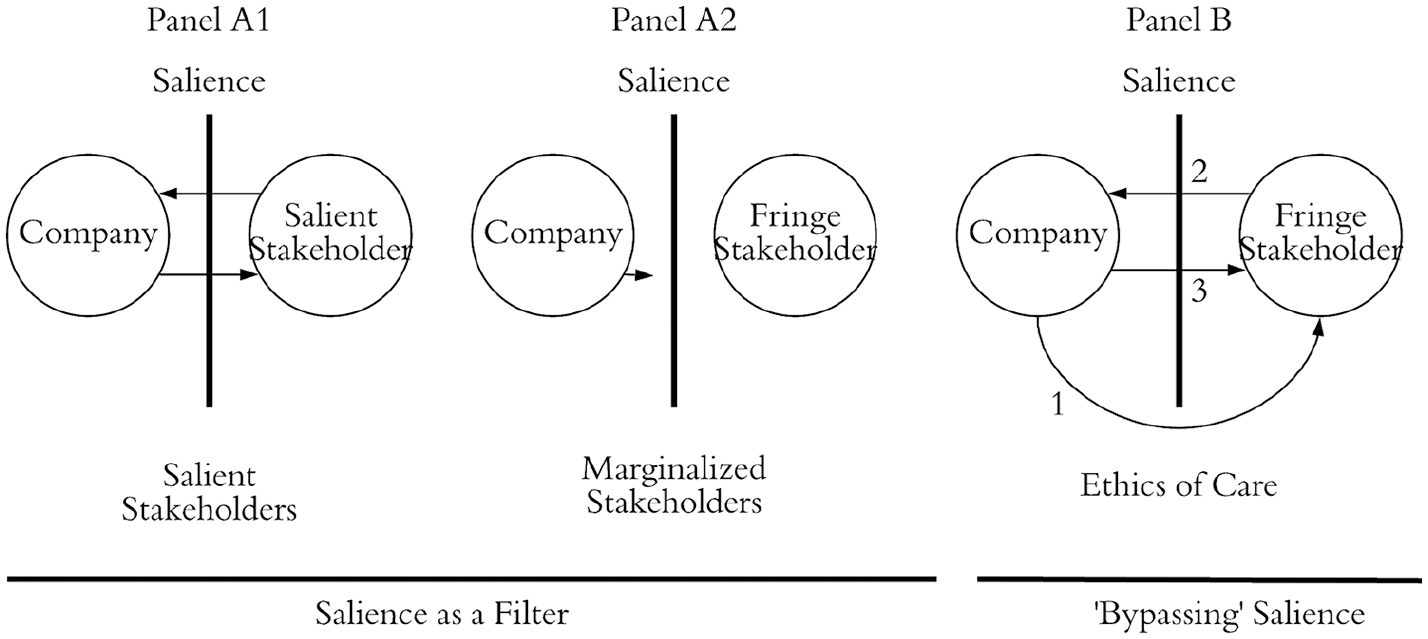
Decision making under salience and ethics of care.
Panel A2 in the figure shows the barrier to the firm’s engagement with a fringe stakeholder. Since this is a case of a fringe group, the barrier of salience does not allow the firm to engage with it, and the stakeholder group remains marginalized. This highlights the central concern with the idea of salience taking on a normative role. If managers believe that the best determinant for deciding which stakeholders to engage with is salience, they are not able to engage with the group, thus stripping stakeholder theory of its initially intended moral foundations.
Panel B represents the case of grounding stakeholder theory in an ethics of care. In this case, in line with the findings of the study, the managers decide to first engage with the fringe stakeholder based on emotional and moral considerations. Since their decision making is informed by their emotions in this case, they are able to bypass the barrier of salience. Engagement with stakeholders grounded in emotions and care is represented by the arrow labeled 1 and is highlighted by the findings related to the first research question. If this engagement is effective, the salience of these stakeholders is enhanced and, as we have proved for the case of ESAB, they provide unforeseen benefits to the firm. This transformation is represented by the arrows labeled 2 and 3, whereby the firm can engage with these stakeholders now based on their salience for the firm, as a result of the enhancement of the power attribute of the stakeholder group. Once these benefits accrue to the firm, a mutually beneficial relationship is established, transforming a fringe stakeholder group into a salient one.
While Mitchell et al. (1997) discuss the possibility of salience being dynamic, they focus primarily on the actions of the stakeholder group in acquiring additional attributes of salience. For instance, they discuss the possibility of aligning with other stakeholder groups to enhance power and so gain higher levels of salience. However, interestingly, the case presented shows the enhancement of salience by virtue of the firm’s intervention, rather than actions taken by the stakeholder group.
Conclusion
Theoretical contributions of the ESAB case
The study was undertaken to understand the two-pronged question of how a firm could effectively engage with a fringe stakeholder group. The first aspect of the question addressed how this engagement could be explained in terms of understanding why a firm would engage with such a stakeholder group. The second aspect of the question dealt with the effectiveness of this engagement, in terms of benefits for the focal stakeholder group. There has been considerable criticism of the usage of the three attributes of salience, legitimacy, power, and urgency as a tool to determine what stakeholder groups a firm should engage with. As a normative ideal, it has been criticized because it uproots stakeholder theory from its initially intended moral foundations, and as a descriptive theory, the evidence to support it has been limited.
As an alternative, as has been recommended in prior literature, we suggest grounding stakeholder theory in feminist ethics rooted in care. Previous literature on the topic deals with the normative aspects of such an approach, suggesting that such grounding reconnects stakeholder theory to its value-laden roots. However, empirical evidence to demonstrate the explanatory power of the idea remains scarce. In response to the previous criticism, the first major contribution of this article is that it clearly presents evidence that the idea of stakeholder theory grounded in ethics of care is not merely a normative ideal that firms and managers “should” strive toward, but can explain the behavior of managers in certain situations. The difficulty has always been related to the question of whether managers ever actually engage in stakeholder relations based on an ethic of care “in practice.”
As has been presented in the “Findings” and “Discussion” sections, this case presents all the identifying attributes described by Burton and Dunn regarding stakeholder engagement rooted in ethics of care. Consequently, this lends credence to the idea of stakeholder theory grounded in ethics of care having descriptive power to explain how managers make stakeholder engagement decisions, particularly in the case of marginalized stakeholders.
Second, the study shows the positive outcomes for the stakeholder group when a firm engages with a marginalized group based on care. As has been discussed extensively in previous literature, there is a perceived barrier between the realms of morality and business in the minds of both practitioners and academics. It has been suggested that a possible remedy to show that the two realms do not exist in perpetual separation is to share stories of managerial action grounded in the morality of the managers (Derry, 2012). While there are ample instances of such behavior, little attention is paid to such cases, which perpetuates the myth of the separation thesis. This article seeks to provide evidence in that under-researched direction where instrumental and rational calculations do not take a leading role in corporate decision making.
Third, there has been an acknowledgment in prior literature that salience is not a fixed characteristic, but can be dynamic. However, the focus of prior literature has been on the actions of stakeholder groups that can enhance their salience for the focal firm. This case presents evidence that the actions of the firm itself can also lead to enhancement in the salience of marginalized stakeholder groups.
Managerial/Practical implications
The central way in which the study expands our understanding of managerial decision making, and therefore recommends a course of action for managers, is that managers can, and do, make their decisions based on their emotions, values, and concern for others. While this idea may be against a narrow definition of the managerial function rooted in an economic institutional logic, it nonetheless is practiced in organizations. As shown in the “Findings” section, in a case of engaging with marginalized or fringe stakeholder groups, the ESAB case shows that it can be beneficial for managers to let their own humanity to guide their actions. This can allow managers to look at a broader range of stakeholder groups and use their institutional positions to positively influence groups that they care for, without necessarily damaging corporate interests. Based on the relative success in the transformative effects of the program, managers could then benefit from engaging with other organizations that have a more nuanced appreciation of the challenges faced by intended beneficiaries.
While it was not the core focus of this study, the findings clearly show that there were significant benefits that the firm derived from this particular CSR program. Generating instrumental benefits from engaging in CSR practices is difficult to achieve in practice. We contend that it may be easier for firms to be perceived as authentic when they are, in fact, authentic. The managerial recommendation stemming from this idea is that rather than looking for the business case for engaging in any particular CSR program, along the lines of “self-interest seeking with guile” (Williamson, 1975, p. 255), it may be more beneficial to search for the “societal case” of the program. Instrumental benefits may emerge from the actions of the firm, but they should not be the driving force for meaningful action.
Limitations and future research
There are some limitations to our study that future studies should try to overcome. One of the limitations of our research is that the data were collected at one point in time, rather than at different phases of the project’s development. Future research may benefit from longitudinal studies that seek to flesh out the process related to similar decision making by managers. Another limitation is that the effects on intended beneficiaries of the program were focused solely on the empowerment aspect of development. If ethics of care, as stated, focus on the beneficial impacts generated upon the (fringe) stakeholders, there are other facets of human development that were not considered as part of this research. Future research may look at a broader set of improvements that were yielded as a result of similar programs.
Finally, while we have briefly considered benefits of stakeholder engagement rooted in ethics of care to the firm itself, it was not a core area of interest for this research project and, moreover, an unexpected outcome. Consequently, the breadth and depth of the benefits accrued to the firm as a result of these forms of non-instrumental engagements have not been completely fleshed out. Future research can focus on the benefits that firms can generate as a result of their engagement with a marginalized stakeholder group.
Footnotes
Appendix 1
Declaration of conflicting interests
The author(s) declared no potential conflicts of interest with respect to the research, authorship, and/or publication of this article.
Funding
The author(s) disclosed receipt of the following financial support for the research, authorship, and/or publication of this article: The research presented in the research article was funded by the Institute of Social Innovation at Esade Business School. We also received partial funding at initial data collection and analysis stage of the project by Danone Ecosystem Fund.