




Abstract
This research focuses on the role of gender and physical attractiveness in judging severity of unethical workplace behavior. Scenarios with possible ethical dilemmas (commonly referred to as “gray areas” of behavior) were displayed to 4,483 subjects. Our findings show that “gray area” behavior was evaluated as more ethical if performed by male employees compared with women. We also found that attractiveness moderated the connection between gender and tolerance toward unethical work behavior. People judge more severely the same unethical action by plain-looking employees rather than attractive-looking employees, in accordance with the attractiveness-leniency effect—but only for women perpetrators. The physical attributes of men were not found to be relevant. We explore a number of explanations for this discrimination based on Expectation States Theory and Social Role Theory.
Introduction
Unethical behaviors can cause severe damage to organizations, the economy, and society as a whole (Jacobs et al., 2014). Organizational unethical behavior is defined as actions taken by a member of the firm in violation of accepted norms (Kish-Gephart et al., 2010; Rest, 1986). Ethics has attracted much attention in the organizational literature, with previous studies mostly concerned with antecedents of (un)ethical work behaviors (e.g., Jacobs et al., 2014; Keller et al., 2007) or their consequences to the firm (Fu et al., 2016; Oliver et al., 2012; Orlitzky et al., 2003). However, less attention has been given to the evaluation and judgment process of managers, who must often make decisions as to whether employees are complying with or violating ethical standards and organizational rules. Understanding perception of ethical behavior is crucial since it is vulnerable to wide interpretation and judgmental biases. For example, selective disclosure of product information by a retailer may or may not constitute ethical infraction. On one hand, all relevant information may be contained in the agreement terms. On the other, a manager may argue that this omission impedes optimal consumer decision-making, representing an ethical violation.
Decision-making in ambiguous situations often leads to biases and heuristics (Greenberg & Shtudiner, 2016; Klein, 2016a; Kruglanski & Gigerenzer, 2011; Shtudiner et al., 2017a, 2017b). Therefore, managers evaluating employee behaviors may be influenced by irrelevant attributes such as employee characteristics. Based on Expectation States Theory (EST; Correll & Ridgeway, 2006) and Social Role Theory (SRT; Eagly & Karau, 2002; Seidman, 2016), we suggest that expectations of ethical behavior are influenced by employee gender and physical appearance. According to EST, individuals who participate in a problem-solving group, in which members are not familiar with each other’s capabilities, form a set of expectations regarding the skills of the other group members. The skills are evaluated according to the status characteristics of the group members. The more the members of a group are assessed as having a higher status, the more they are assessed as having the ability and skills to assist the group. Since the new members are not aware of the true abilities of the other members, they rely on external, prominent, and often nominal characteristics (Correll & Ridgeway, 2006). Therefore, attributions that are irrelevant for assessment such as gender, race, and physical appearance may affect the evaluation process. Concomitantly, we will argue that in a new situation, where managers need to evaluate the severity of unethical work behaviors, they will rely on employee gender and appearance as status characteristics.
To understand the expected characteristics of each gender, we will rely on SRT. According to SRT, society attributes different roles to men and women (Eagly & Karau, 2002; Koenig & Eagly, 2014). Males are expected to hold agentic roles, which imply higher status. This is compared with women who are expected to behave with communal characteristics. Therefore, whereas males are expected to be more entrepreneurial and proactive, women are expected to be more sympathetic and comforting. But what happens when gender norms are violated in scenarios of unethical behavior? Although unethical behavior should be evaluated on equal terms regardless of perpetrator gender, since male behavior is more associated with aggression, which may conceal some “gray behaviors,” it may be expected that viewers will be more tolerant toward male unethical behaviors. Indeed, women are expected to conform to accepted social norms. As such, violation of their ideal gender roles (referred to as injunctive norms by Cialdini & Trost, 1998) will be met with increased perception of guilt—as demonstrated by Eagly and Karau (2002) in the case of female leaders.
While the relationship between perpetrator gender and bystander response has received minor research attention (e.g., Paláu & Rivera-Cruz, 2014), we argue that this connection is moderated by perpetrator physical appearance. According to EST, any attribution that can be easily observed and indicates clear differentiation between interactants will have the strongest influence during judgment processes (Ridgeway, 1991). Aside from gender, an attribution that can serve as a status characteristic is physical attractiveness (PA). PA was found to influence individual judgment processes in multiple settings such as the labor market (Kantor et al., 2015; Maestripieri et al., 2017; Parrett, 2015; Ruffle & Shtudiner, 2015), trustworthiness (Wilson & Eckel, 2006; Wolbring & Riordan, 2016), and penalties for crimes (Sigall & Ostrove, 1975). A common thread in these studies is the notion that attractive people possess a positive attribution. Or as Dion et al. (1972) put it, “What is beautiful is good.” Indeed, the impact of attractiveness is consistent with the attractiveness-leniency effect. This effect suggests that “physically attractive targets are less likely to be perceived as guilty compared with less attractive targets” (Swami et al., 2017). However, some studies found that the connection between PA and judgmental consequences has a differing effect on men and women (Parrett, 2015; Ruffle & Shtudiner, 2015). As such, PA may impart a premium for men, but a penalty for women and vice versa. Based on previous studies, we suggest that the evaluator will be less tolerant toward female rather than male unethical work behaviors. However, this connection will be moderated by perpetrator physical appearance. As such, the beauty premium and the penalty for lack of beauty will be stronger for female perpetrators.
This research contributes to the existing literature in several ways. First, to the best of our knowledge, this is the first study that focuses on the impact of attractiveness on judgment of unethical behavior in the workplace. Studies have demonstrated the attractive-leniency effect in other environments, such as criminal-sentencing in the courtroom (e.g., Stewart, 1985) or perceptions of student plagiarism (Swami et al., 2017), but have not explored this phenomenon in the work context. Second, since our scenarios relate to “gray area” behaviors (ethically inconclusive cases), ambiguity of any ethical norm violation exists. Therefore, variables such as attractiveness and gender can impact judgment. Third, we rely on social theories such as EST (Correll & Ridgeway, 2006) and SRT (Eagly & Karau, 2002; Eagly & Wood, 2012) to interpret the amount of tolerance toward unethical work behaviors. Therefore, this study contributes both to sociology and the ethics literature.
As noted, understanding individual characteristics that affect processes of ethical evaluation and the effect of irrelevant factors on the formation of judgments has thus far attracted minor research attention. However, shedding light on such intervening characteristics has practical implications since organizations often demand that their managers guide, train, and monitor employee behaviors. Managers are thus required to confront and deal with employee unethical behaviors. However, monitoring employees can be contaminated by bias, especially due to physical appearance and gender. With human resource departments recognizing this reality, intervening methods can be devised to highlight objective standards of evaluation.
The remainder of the article is organized as follows: “Theoretical background and hypotheses” section provides theoretical background on unethical work behaviors and the effects of gender and attractiveness. Next, the experiment design and procedure are presented. In the “Results” section, we show the empirical evidence. Finally, a discussion is undertaken in the last section.
Theoretical background and hypotheses
Unethical work behaviors
Ethical business behavior was defined by Lewis (1985) as the ability of the firm to adhere to moral norm, rules, standards, and principles or codes determined by the organization to be guidelines for morally sound behaviors. Unethical behavior, therefore, represents a violation of these codes and moral norms. Ethical standards are not merely determined by the members of the organization; they result from rules and norms embedded in the larger social community (Vardi & Weitz, 2016). In contrast to counterproductive actions, workplace deviance, and antisocial behavior, unethical work behaviors do not necessarily intend to harm the organization or its stakeholders (Kaptein, 2008). In the case of selective disclosure of product information, the seller may not view this sort of concealment as deviant behavior—even if the customer may have felt it was a violation of social norms. On the other hand, less serious forms of workplace deviance (e.g., gossiping, social media browsing, etc.) are not necessarily branded unethical as much as counterproductive work behaviors (Kish-Gephart et al., 2010).
Unethical work behavior can also be somewhat distinguished from illegal activity. The latter represents a violation of the law, while unethical behaviors may skirt around trespassing over legal statutes. Compared with illegal deeds, unethical activity may take the form of violation both of formal and explicit rules as well as informal and implicit organizational norms of behavior (Kaptein, 2008). Even so, an overlap exists between these two terms. For example, stealing a pension payment from the elderly is both illegal and unethical. However, a pharmaceutical company sponsoring a vacation for physicians in an attempt to promote its product may not be a punishable offense in the legal sense but is still viewed as ethically dubious to say the least (Kish-Gephart et al., 2010).
Since the mid-1980s, scholars have attempted to model ethical decision-making processes (e.g., Rest, 1986; Treviño, 1986). The common models show that (un)ethical behavior derives from cognitive elaboration of situational factors and anticipated consequences of actions (Rest, 1986). When faced with morally ambiguous dilemmas, the individual proceeds through a series of deliberative stages that can be described as a multidimensional phenomenon affected by previous behavior and accumulated learning (Paláu & Rivera-Cruz, 2014). The authors found that individuals may alter their evaluation of the intensity of a moral situation according to the specific situation and local norms. For example, they demonstrated that subjects consider deception to be unethical behavior. However, under certain circumstances, such as providing information for credit institutions or for government documents, they are willing to make an exception and engage in deception.
In contrast to criminal activity, unethical work behavior may be more or less tolerated by managers. Since ethical evaluation is subjective and may be compromised by unrelated factors, a manager may tolerate one employee’s misbehavior, while punishing the identical behavior in another employee. An important element in the clarification of ambiguous situations in the workplace is the organization’s ethical climate (Shafer, 2015; Victor & Cullen, 1987, 1988). However, non-organizational factors may also affect ethical judgments as well (Gino & Galinsky, 2012). In our study, we focus on two attributes that were found to intervene in several work-related decision-making processes but were given relatively minor research attention: employee gender and PA (Parrett, 2015; Ruffle & Shtudiner, 2015).
Gender as a status characteristic and its connection to judgment of unethical behaviors
Although unethical work behavior is a widespread phenomenon (Kaptein, 2008), it is not easily observable and is often morally blurred. Because managers are required to make a decision about inconclusive situations, they may lean on status characteristics. As noted, EST (Ridgeway & Walker, 1995) posits that when new group members are placed in unfamiliar problem-solving scenarios without knowing each other’s capabilities, they tend to develop a set of performance expectations for one another. While these expectations are not exactly conscious and rely on intuition, they are influenced by status characteristics. Status characteristics symbolize the amount of prestige and power that any member holds relative to other members lacking these characteristics (Correll & Ridgeway, 2006; Kalkhoff & Thye, 2006; Ridgeway, 1991). Status characteristics represent attributes that can be easily observed in and differentiated between group members, with one prominent status characteristics being gender. Thus, men tend to be considered more competent than women as well as more valuable since they possess more resources (Correll & Ridgeway, 2006). SRT explains that men are associated with agentic characteristics, which are connected to higher levels of assertiveness, confidence, and entrepreneurship. Women, on the other hand, are ascribed more communal traits such as affection, gentleness, and nurturance (Blakely & Dziadosz, 2015; Eagly & Karau, 2002). Since agentic characteristics are more valued in our society as markers of workplace qualification, men tend to have more power and higher status compared with women. This, in turn, may influence gender-based evaluation of unethical behaviors.
Previous studies on the connection between gender and ethical decision-making reveal mixed findings (Kish-Gephart et al., 2010; Meriac et al., 2009; Paláu & Rivera-Cruz, 2014). In their meta-analysis, Kish-Gephart et al. (2010) reported greater frequency of unethical choice-making among men as compared with women. However, this connection was weak and insignificant after controlling for moderator variables. Even so, when focusing on ethical work behaviors, many studies confirmed higher women’s workplace ethical scores (Kirkcaldy et al., 1992; Lynn, 1991; Wahn, 2003). For instance, Wahn (2003) compared willingness of male and female librarians to engage in unethical work behaviors. She found that men reported greater willingness to engage in unethical actions of a competitive nature. Men also reported greater willingness to conform to unethical organizational norms (Wahn, 2003). As such, we argue that tolerance toward unethical behavior is likely to be lower for women, especially in workplace scenarios. This is further supported by the social expectation that women should be more nurturing and community-minded, while men are expected to show more initiative and be more utilitarian-minded. As such, it can be predicted that less tolerance and greater severity will be shown toward women’s unethical work behaviors, since they are in violation of their expected social role. Therefore, the first hypothesis can be framed as:
Attractiveness as a moderator between gender and tolerance toward unethical behavior
Since status characteristics are defined as easily detectable and differentiable, PA can be defined as a status characteristic as well (Webster & Driskell, 1983; Wolbring & Riordan, 2016). Indeed, people tend to connect PA with qualifications and consider attractive individuals as more compatible with high-value traits as compared with their less attractive counterparts (Wolbring & Riordan, 2016).
Although there is no common agreement on the definition of beauty, there is scholarly consensus that attractiveness affects organizational evaluation and judgment processes from earning potential to prospects of promotion (Hamermesh & Biddle, 1994; Mobius & Rosenblat, 2006; Parrett, 2015; Ruffle & Shtudiner, 2015; Shtudiner & Klein, 2019). Previous studies suggested that PA serves as a premium for the holder, while unattractiveness results in a penalty (e.g., Biddle & Hamermesh, 1994; Ruffle & Shtudiner, 2015). Nevertheless, unethical work behavior has yet to be investigated in the context of attractiveness. Even so, a connection between PA and trust was found. Willis and Todorov (2006) found that individuals judge the trustworthiness of faces in haste (i.e., within 100 ms) and this impression is rarely alterable even with more time. Others have suggested that attractive individuals are evaluated as more trustworthy. For example, Sigall and Ostrove (1975) found that the physical appearance of criminal defendants affected the degree of tolerance and clemency shown for their crimes. Thirty years later, Noor and Evans (2003) found that individuals with asymmetrical facial features were associated with negative personality traits such as being neurotic, less agreeable, and less conscientious. Thus, the tendency to mistrust unattractive individuals may reside in deeply embedded behaviors, with people predisposed to connect physical appearance to personality traits.
Although attractiveness was found to impact organizational decision-making processes, it often exerted different effects on women compared with men (Parrett, 2015; Ruffle & Shtudiner, 2015). Ruffle and Shtudiner (2015) showed that attractiveness (as reflected in a CV with the candidate’s attached photo) contributed positively for male applicants, while its effect was negative on callback chances for female candidates. On the other hand, Parrett (2015) found that attractive waitresses earn higher tips compared with their less attractive counterparts. However, PA did not affect the tips of male staff.
As noted, EST explains that with more than one characteristic we use an aggregation process to weigh positive and negative attributions. For example, white women and black men were found to have a lower status when compared with white men (Ridgeway, 1991). However, this aggregation is rarely simple, since it depends on the assumptions regarding the role of each characteristic and its perceived value by the society. Since PA is connected to higher trust levels, we posit that the tolerance toward unethical behaviors will be lower if perpetrated by unattractive workers. Wilson & Eckel (2006) designed a laboratory trust game in which trustors viewed trustee photos and found that attractive trustees were perceived as more trustworthy than their unattractive counterparts, enabling them to earn more money in the first stage of the experiment. However, attractive trustees were also expected to return more money in the second stage than they actually did, which produces a beauty penalty when positive expectations are not attained. This violation was treated with even more severity for women as it violates an expected gender role. Similarly, we expect role violation to translate into more severe punishment. As shown by Eagly and Karau (2002), violations of prototypical expectations (e.g., by engaging in unethical behaviors) will lead to more severe repercussions for women as they defy stereotypical expectations. On the other hand, since each status characteristic has an individual effect, we suggest that attractiveness level will reduce penalties against women who engage in unethical behaviors. Therefore, respondents will tolerate unethical activities by attractive women to a greater degree than plain-looking females. As for men, the picture is more complicated. Since agentic social traits tend to be attributed more to males (Eagly & Karau, 2002), their physical appearance may be less likely to influence behavioral evaluations. Indeed, Heflick et al. (2011) showed that women were judged to be immoral if they focused on their appearance, while participants were indifferent to men engaging in the same behavior. The level of moral attribution was unchanged if the focus was on physical appearance or performance. Likewise, we can argue that attractiveness level will influence judgment of unethical behaviors conducted by women, but not by men—who will be judged indifferently regardless of their attractive or plain-looking status. We hypothesize that unethical work behaviors will elicit the least tolerance toward plain-looking women and most tolerance toward attractive women. However, unethical work behaviors by men will be registered with general indifference toward level of PA. Therefore, our second hypothesis can be framed as follows:
Experimental design and procedure
Selection of attractive and plain-looking photos
The experiment included two dichotomous stimuli (PA: high–low; gender: male–female). To select the photos of attractive and plain-looking males and females to be included in the survey, 62 student subjects were asked to rate 30 photos. The photographs were taken from the site http://www.faceresearch.org. Students were asked to rate the photos using two dimensions: attractiveness and ethnicity. Attractiveness was measured on a scale from 1 to 9, where 1 equals “definitely not attractive” and 9 equals “definitely attractive.” Although attractiveness is the current research focus, ethnicity plays a role since considerable evidence suggests discrimination against Jews of North African and Middle Eastern origin (i.e., Sephardim) as compared with those of European origin (i.e., Ashkenazim). Ethnicity was measured on a scale from 1 to 9, where 1 equals definitely Sephardi and 9 equals definitely Ashkenazi. After excluding photographs rated as strongly identifiable with either Ashkenazi or Sephardic ethnic groups, a collection of images with the highest and lowest attractiveness ratings were selected and used in the survey.
Based on this pre-test study, we chose the photos with the highest and lowest ratings of attractiveness. To strengthen the reliability of our analysis, four photos for each category (attractive male / plain-looking male / attractive female / plain-looking female) were selected. As such, we had 16 different versions of the questionnaire on ethical judgments, which differed from each other in the photo that appeared (in each version only one photo was appended). The selected photos were categorized into two groups of attractiveness (“Physical Attractiveness,” 0 = plain looking, 1 = attractive) and gender (“Photo Female,” 0 = male, 1 = female). An independent-sample t test was conducted to compare the differences in PA judgments between good-looking and plain-looking photos. A significant difference was found in the attractiveness score between attractive (M = 6.59, SD = 1.44) and plain-looking (M = 2.93, SD = 1.26) conditions, t(1,127) = 5.94, p < .00.
Participants
Participants included 4,602 students (53% male and 47% female) from multiple universities in Israel and across a diverse range of academic disciplines. The average age of participation was 26.21 (SD 5.16). From 4,602 subjects, we excluded 119 as they failed to complete the questionnaires. Therefore, the final number of participants was 4,483.
Measures
Dependent variable—tolerance toward unethical work behaviors
Participants were presented with a questionnaire with a photo of a male or female. The photo was followed by a series of 18 short scenarios (the same photo applied to each of the 18 scenarios). We define unethical behavior quite broadly, from deliberate violations of company policies to providing unreliable information to clients and co-workers. Scenarios were designed to represent a wide variety of unethical behaviors (see Appendix 1).
The scenarios were developed through content validity. Each scenario presented different unethical behavioral scenarios carried out by the individual depicted in the image. The participants were asked to read the scenarios and rate the degree to which they perceived this behavior as acceptable on a scale from 1 (not acceptable at all) to 9 (very acceptable behavior). Our main dependent variable was tolerance toward unethical behavior conducted during work, such as disclosure of privileged information from a client (unethical work behavior). Lower score for each scenario indicates that this person was less tolerant toward the unethical behavior described in the scenario. On the other hand, a higher score for the same unethical behavior indicates that the subject was more tolerant, since he saw this behavior as common and acceptable. This variable was calculated for each evaluator as the mean of his evaluations.
Scenarios were divided into three categories: (1) unethical work behaviors (α = 0.903); (2) minor crimes (α = 0.802); and (3) unethical sexual behavior. Scenarios 1–11, Appendix 1, relate to unethical work behaviors, Scenarios 12–17 relate to minor crimes, and Scenario 18 relates to unethical sexual behavior. Our main goal was to measure perception of unethical work behaviors and, therefore, our analysis will only focus on the first scenario category. 1
Control variables
Work/academic ethical culture
Previous studies indicated the role of organizational culture in influencing unethical behaviors (e.g., Kish-Gephart et al., 2010). When the atmosphere in the firm facilitates unethical behaviors, employees are more willing to behave unethically, indicating consensus agreement that unethical behaviors are tolerable. To evaluate participant appraisal of levels of unethical behaviors in their workplace/academic institution, ethical environment was measured by two variables. First, by asking: “On a scale of 1–9, indicate how important honesty is in your workplace?” The scale ranged from 1 (not at all) to 9 (very much). Higher degree indicated the higher importance of honesty in the participant’s organization. We named this variable work ethical culture.
The second variable, academic ethical culture, measured moral assessment of unethical behaviors in academic institutions. As opposed to work ethical culture, we asked, “In your opinion, what is the percentage of students in Israel who do not behave according to academic ethics?” This was scaled from 1 (not many) to 9 (all students). Therefore, higher degree indicated perception of greater amount of academic misbehavior.
Demographic variables
Demographic variables were also considered. Trevino and Weaver (2003) suggested that older individuals, with more life experiences, may operate at higher levels of moral reasoning compared with younger people. To avoid this influence, we controlled the age of the respondents (“age”). We also controlled for respondent socio-economic status, as studies found that upper-class individuals behave more unethically compare with lower-class persons (Piff et al., 2012). We measured their status through their income (“Income”), measured on a scale from 1 (below average income) to 9 (higher than the average income).
Results
Connection between gender, PA, and tolerance toward unethical work behaviors
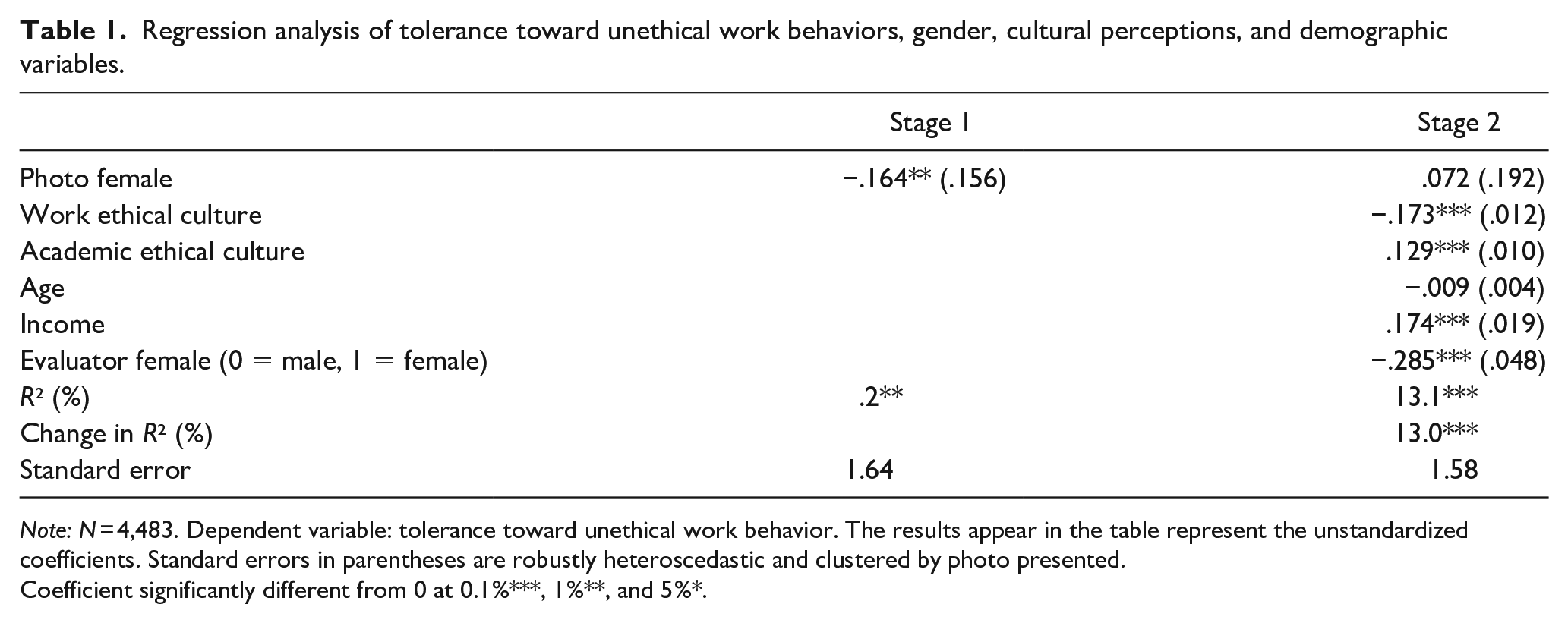
As noted, our first hypothesis was that participants will be less tolerant toward unethical work behaviors conducted by women compared with the same behavior conducted by men. Based on Becker’s (2005) suggestion, we made a two-stage hierarchical multiple regression with tolerance toward unethical work behavior assessment as the dependent variable, with a higher score translating into higher tolerance toward unethical behavior. In the first stage, the gender variable was entered, while in the second stage control variables were also included. The second stage included organizational-cultural ethics variables, indicating how the evaluators appraise the ethical culture in their organization and in academic institutions, as well as the demographic variables of the evaluators.
The results, shown in Table 1, display a connection between gender and the tolerance toward unethical behavior. The result of Stage 1 indicates that gender has a significant effect when presented alone, F(1, 4481) = 10.505, p < .01. The coefficient for the photo female variable is negative and significant (β = −.164, t = −5.575, p < .01). It shows that respondents judged the same behavior with less tolerance when carried out by a female perpetrator compared with male perpetrator, supporting Hypothesis 1. The effect was not significant when cultural (work ethical culture and academic ethical culture) and demographic variables were included, indicating that the connection between gender and unethical work behaviors may be intervened by other factors.
Regression analysis of tolerance toward unethical work behaviors, gender, cultural perceptions, and demographic variables.
Note: N = 4,483. Dependent variable: tolerance toward unethical work behavior. The results appear in the table represent the unstandardized coefficients. Standard errors in parentheses are robustly heteroscedastic and clustered by photo presented.
Coefficient significantly different from 0 at 0.1%***, 1%**, and 5%*.
Introducing cultural and demographic variables explained an additional 13% of variance of tolerance toward unethical work behavior for gender. These changes in the explained variance were significant, F(6,4476) = 113.99; p < .001. The coefficient for the work ethical culture predictor was negative and significant, suggesting that the more participants value workplace honesty, the less they tolerate unethical behavior (β = −.173, t = −14.05, p < .001). In contrast, participants who claimed that higher percentages of students engage in unethical academic activities were characterized by greater tolerance of unethical work behaviors (β = .129, t = 12.96, p < .001). Higher tolerance was found in participants who had higher income (β = .174, t = 15.02, p < .001). Finally, the evaluator’s gender had a significant impact on the tolerance toward unethical work behaviors (β = −.285, t = 5.92, p < .001). The coefficient was negative, indicating that female evaluators shows less tolerance toward unethical work behaviors compared with male evaluators.
Connection between gender and tolerance toward unethical behavior with PA as a moderator
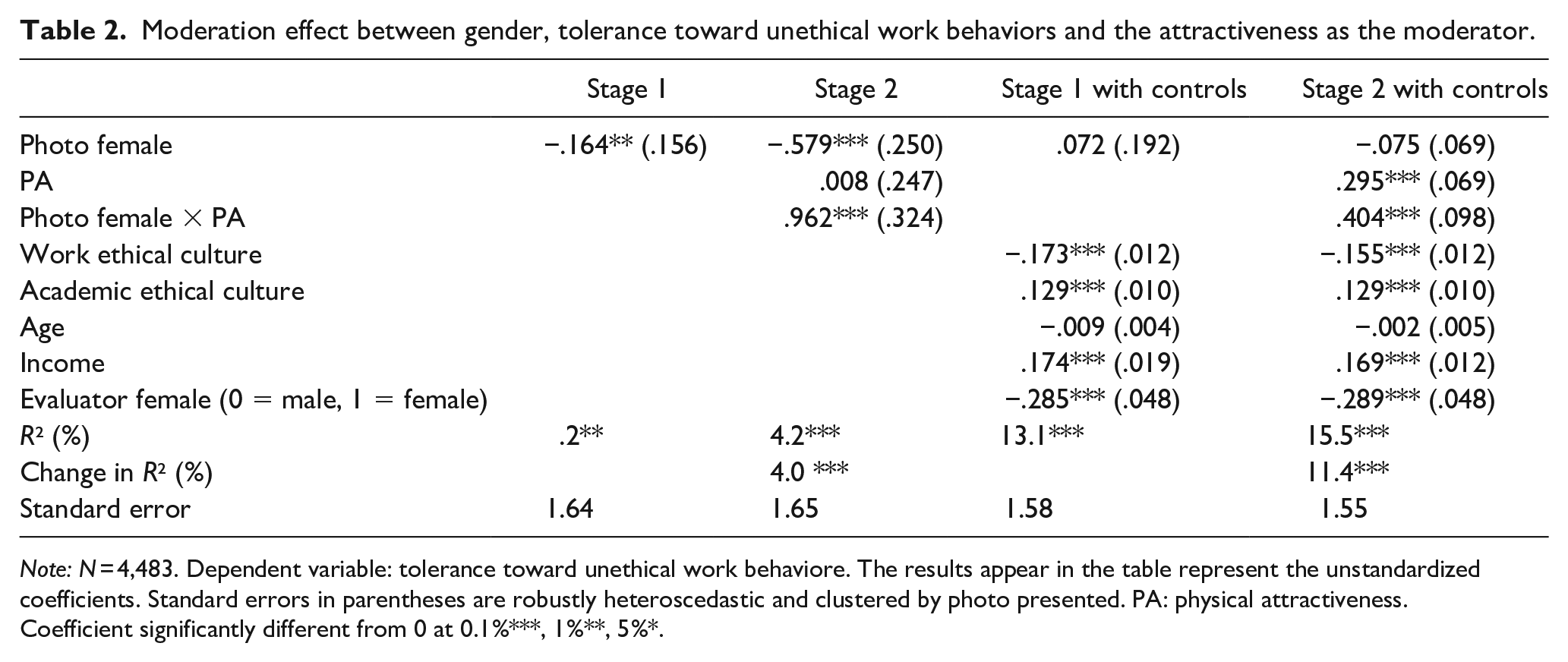
The second hypothesis claimed that PA moderates the connection between gender and the tolerance toward unethical behavior. Women will receive a penalty for their misbehavior if they are plain-looking, but their penalty will be reduced if they are attractive. This influence will be less prominent for men, as participants will be indifferent to attractiveness of men. To examine this hypothesis, we conducted a hierarchical multiple regression with tolerance toward unethical work behavior assessment as the dependent variable (higher score translating into higher tolerability toward unethical work behaviors). In the first stage, we included gender of the perpetrator as the independent variable, and in the second stage, we added the moderator (PA) and the interaction between the IV (gender) and the moderator (PA). We also carried out both stages with control variables. The results of the interaction analyses are shown in Table 2.
Moderation effect between gender, tolerance toward unethical work behaviors and the attractiveness as the moderator.
Note: N = 4,483. Dependent variable: tolerance toward unethical work behaviore. The results appear in the table represent the unstandardized coefficients. Standard errors in parentheses are robustly heteroscedastic and clustered by photo presented. PA: physical attractiveness.
Coefficient significantly different from 0 at 0.1%***, 1%**, 5%*.
The results of the regression in Stage 2 (without controls) reveal that PA moderates the connection between gender and the tolerance toward unethical work behavior. The main effect coefficient of gender was significant (β = −.579, t = 8.244, p < .001), while PA failed to be significant (β = .008, t = .119, p = .905). The interaction between gender, PA, and tolerance toward unethical work behavior was significant (β = .962, t = 9.62, p = .001), supporting Hypothesis 2.
Adding the control variables (Stage 2) highlights a slightly different picture. The main effect for gender failed to be significant (β = −.075, t = 1.075, p = .282). However, the coefficient of the main effect for PA was significant (β = .295, t = 4.263, p < .000), which shows that evaluators are more tolerant toward unethical behavior conducted by an attractive perpetrator compared with a plain-looking perpetrator. The coefficient of the interaction variable was also positive and significant when the control variables were included (β = .404, t = 4.115, p < .001). The change in R2 of the model with the moderator and the interaction term is significant in comparison to the model without the moderator, with and without controls, F(3,4479) = 66.75, p < .000, ∆R2 = 4.0 without controls; F(8,4474) = 104.20, p < .000, ∆ R2 = 11.4 with controls.
Figure 1 shows the mean tolerance toward unethical work behavior in the four conditions (male/female, attractive/plain). According to Figure 1, based on a factorial analysis of variance (ANOVA) test, respondents were the least tolerant of plain-looking women (M = 2.92, SD = 1.63) compared with attractive/plain men and attractive women. On the other hand, respondents were maximally tolerant of actions conducted by attractive women (M = 3.88 SD = 1.64). The difference between the two conditions of women was significant, t(2224) = 13.95, p < .00. Mean differences of judgment of unethical work behaviors were similar for attractive and plain-looking men, M = 3.49 SD = 1.50 and M = 3.50 SD = 1.81, respectively; t(2225) = .117, p = .907. The effect size for the two male groups (d = 0.00) was small, according to Cohen’s (1988) convention for a small effect (d = .20). In contrast to women, the appearance of men had no impact on the tolerance toward unethical work behavior. Therefore, the connection between physical appearance and evaluation of unethical work behaviors can be seen as primarily applying to the group of female perpetrators.
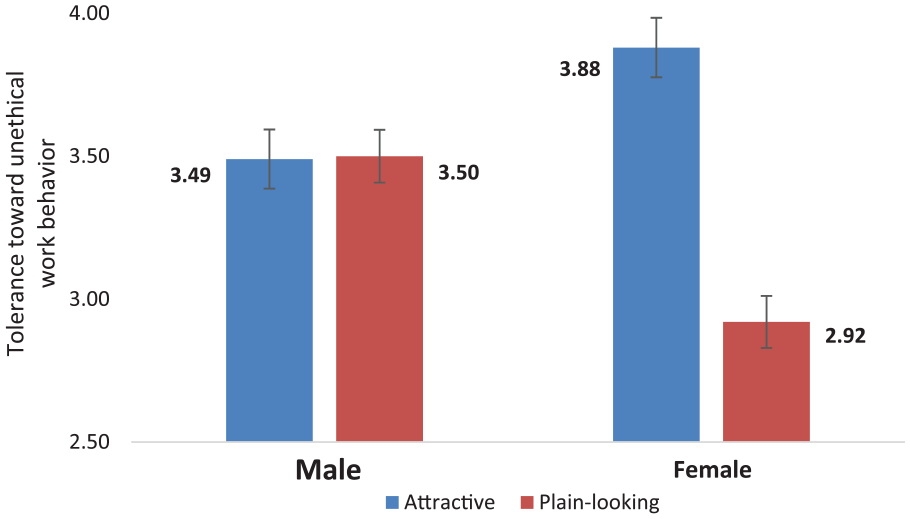
Mean differences of tolerance toward unethical work behavior by attractiveness and gender of perpetrator. 1 = not ethical at all, to 9 = very reasonable behavior. The black vertical lines represent the 95% confidence interval.
Since the coefficient of evaluator’s gender was significant in Tables 1 and 2, we also wanted to test a three-way interaction and conducted another hierarchical multiple regression, with perpetrator’s gender, PA, and evaluator’s gender as independent variables. The three-way interaction coefficient failed to be significant. The results are presented in Appendix 3.
Discussion
The high costs of unethical behavior are well documented. As such, many organizations implement ethical codes and moral standards to guide interpretation of vague situations. However, since human judgment is often affected by subjective elaboration, it is vulnerable to effects of irrelevant factors (Klein, 2016b). This research shows that both employee gender and PA may intervene in the tolerance toward unethical work behavior. In comparing employee gender, the same unethical behavior was perceived as more acceptable when performed by men. Our findings also show that the same unethical action is evaluated with less tolerance if conducted by plain-looking employees as compared with their attractive counterparts. In addition, PA was found to moderate the connection between gender and the tolerance of unethical work behaviors. The same behavior was interpreted as more acceptable if carried out by attractive women and found to be most offensive if performed by a plain-looking female. On the other hand, the connection between attractiveness and gender did not appear for men, since attractiveness had a negligible effect on the respondent perception in regard to male misbehavior.
The findings that respondents perceived men’s behavior as more ethical could indicate a gender bias. Even so, a majority of studies did not report significant gender differences in ethical behavior (Jaffee & Hyde, 2000; Kish-Gephart et al., 2010; Meriac et al., 2009; O’Fallon & Butterfield, 2005). In the research that does point to a connection between gender and ethical behavior, the results show that women behave more ethically, including in workplace contexts (Paláu & Rivera-Cruz, 2014; Spector & Zhou, 2014; Wahn, 2003). This bias suggests that gender serves as a status characteristic, not only during group-problem solving processes, but also in blurrier situations such as unethical behavior. Since unethical behaviors are open to interpretation, gender may function as an intervening factor in the determination ethical code violations. The fact that men are socially expected to be more affirmative (Ridgeway, 1991) may encourage more lenient unethical work behavior evaluation. This may account for respondents finding men’s behavior more tolerable than women’s.
The discrepancy between our and previous findings on women’s ethical behavior may also be explained by SRT (Eagly & Karau, 2002; Koenig & Eagly, 2014). This theory argues that both genders are defined by their own social roles (descriptive norms), as well as ideal gender roles (injunctive norms) that are determined by society. Those who violate their prescribed social gender roles may be punished for this deviation. Expectations for women are generally based on communal attributions such as behaving morally and taking care of others. As such, women may invite severe social penalties for defying stereotypical attributions; that is, taking on organizational leadership roles (Blakely & Dziadosz, 2015; Eagly & Karau, 2002). Men, on the other hand, are socially expected to be more assertive, entrepreneurial, and controlling. Their social role does not obligate them to necessarily conform to ethical standards, and so violation of these moral laws is not perceived as a failure to adhere to ideal gender expectations. As such, they will not be treated as severely as rule-breaking women and are mostly exempt from social penalties.
Women were found to be stricter in their judgment indicating that gender also affected the evaluators. They extended less tolerance toward unethical work behaviors than men. This may be indicative of strong female social role identification. Thus, they conform to their defined communal characteristics, prioritizing the welfare and moral well-being of others. Internalizing this role, they are punished for unethical behaviors with more severity. As Cialdini and Trost (1988) explain, internalization of ideal (injunctive) norms translates into obligation to conform and punish those who do not comply with social expectations. Therefore, women felt a greater obligation to adhere to ethical behaviors and punish violators. Surprisingly, we did not find an interaction between perpetrator gender, PA, evaluator’s gender, and tolerance toward unethical work behaviors. Based on Pleck’s (1995, 1981) gender role strain paradigm, we expected that women would respond more strictly toward ethical behavior violations by fellow women, while men would extend more tolerance regardless of gender. Future research should continue to explore if indeed evaluator gender does not moderate the connection between perpetrator gender and tolerance toward unethical work behaviors.
As noted, PA may function as a status characteristic, providing valuable resources for its holder (Correll & Ridgeway, 2006; Ridgeway, 1991; Wolbring & Riordan, 2016). As such, attractive employees are granted more tolerance for their unethical behaviors compared with their plain-looking counterparts. Since PA makes no real contribution to the ability to engage in or avoid unethical behavior, it is evidence of a silent assumption, indicating that this attribution carries with it some social significance (Correll & Ridgeway, 2006). Indeed, previous studies have shown that people tend to connect PA with trust, sociability, and altruism (Griffin & Langlois, 2006; Wolbring & Riordan, 2016). Attractiveness was also found to be financially well-compensated (Biddle & Hamermesh, 1998; Hamermesh & Biddle, 1994; Parrett, 2006, 2015). Attractive employees receive more tips, demand and bill higher rates, and generally earn more than average-looking individuals. Our study is among the first to find that even in the case of ethical evaluations, where judgment should be impartial and objective, PA serves as an influential status characteristic.
Since both PA and gender are status characteristics, it is clear why higher punishment was meted out to plain-looking women. According to EST and the aggregation assumption, multiple characteristics should be combined to form an aggregated expectation of individual performance (Correll & Ridgeway, 2006). It is unclear why the same aggregation was not found for the positive side of the equation: We should expect that the highest tolerance will be shown toward attractive males (i.e., who possess two positive status characteristics). Yet the fact that attractive women elicit the most tolerance for unethical behaviors suggests that the aggregation assumption is more complex than simply combining attributions based on positive or negative impact. The physical appearance of female employees has a higher premium, even neutralizing the negative gender effect. Thus, women are judged by their physical appearance more than men (Heflick et al., 2011; Wolbring & Riordan, 2016), an exclusively female status characteristic. As such, participants were indifferent to unethical behavior committed by males—attractive or plain-looking. However, this factor exerted a tremendous effect on the evaluation of women, a phenomenon that merits further exploration in future studies.
Limitations, future research, and conclusions
This research has several limitations. The first limitation concerns the method used to examine unethical behavior—the employment of illustrative scenarios. While this method is common in ethical research (O’Fallon & Butterfield, 2005; Weber, 1992), it has faced several criticisms based on the problem of generalizability and social desirability bias. O’Fallon and Butterfield (2005) explain that this method allows for manipulation of variables of interest, while controlling for environmental factors. They nevertheless highlight problems concerning this technique. Ultimately, future research should be accompanied by fieldwork. This can assess the reaction of interviewees toward candidates who discuss their experience with unethical work behaviors in an employment context, measuring the progress and promotion of employees flagged by their managers as having engaged in unethical behaviors. In addition, validating questionnaires to measure ethical climates and cultures is useful. While fieldwork can add to our understanding of factors intervening in ethical judgment, using real-life samples has its own limitations and methodological challenges. Mostly, in field study it is more difficult to isolate factors that affect ethical judgment from other parameters. Therefore, our ability to truly grasp ethical judgment through field research faces other reliability challenges. Future studies could also explore whether the scenario ambiguity is serving as a moderator during evaluation of unethical work behaviors.
It is important since “gray area” ethical behaviors are perceived in subjective interpretation. This question exceeded the scope of the current study.
Even so, while the effects of unethical behavior are documented in the literature, only a few studies have focused on intervening factors during the interpretation of (un)ethical behavior, especially in work contexts. Our results highlight the possibility that judgment of unethical behavior is vulnerable to unrelated factors due to the complexity of truly classifying ambiguous situations. This is especially relevant to the recruitment process, which serves as a gatekeeping mechanism for organizations. Many organizations apply selection tools such as integrity tests to screen out applicants predisposed to engage in unethical, counterproductive, unsafe, illegal, and other deviant work behaviors (Oliver et al., 2012). Recent critiques of the recruitment process argue that during selection managers are influenced by unrelated factors that can bias judgments (Klotz et al., 2013). Our findings extend previous studies and suggest that managerial bias may affect more than the hiring process—it can also intrude into work routines. Managers are constantly required to judge employee behavior and decide if an action was borderline ethical or a moral code violation (Solinger et al., in press). These findings indicate that in the workplace, perception is seldom indifferent to physical appearance, especially female worker appearance. Managers should understand the role of both gender and attractiveness as it affects evaluation of unethical behavior.
Another contribution of our study to the ethics literature is the application of EST and SRT in analyzing the ethical judgment process. Understanding that both gender and attractiveness are status characteristics is important in any setting. However, our results suggest that attractiveness can have a positive or negative impact when judging severity of unethical workplace behavior. Even so, managers should note that the same status characteristic is more prominent in evaluation of female (rather than male) employees. Managers must be vigilant against “double standards” in evaluating the same behavior differently based on employee gender and attractiveness. This may cause prejudice and discrimination in the workplace, which harms mostly women. These results also highlight how women are punished more severely for contradicting their expected social role, as they tend to identify with their communal characteristics and judge unethical behavior more stringently.
In addition to gender and attractiveness, we also measured participant appraisal of levels of unethical behaviors in their own institution, and its effects on the tolerance toward unethical behavior. The influence of ethical cultures in the workplace and academy on participant perception of severity of unethical behaviors supports previous studies suggesting that the organizational ethical climate is a primary factor predicting how members will confront unethical dilemmas (Shafer, 2015; Shin, 2012; Treviño et al., 2014). Since ethics are defined by informal expectations, the norms embedded in the organization have a strong impact on judgment of unethical behaviors. A positive ethical climate can create organizational norms that strongly discourage participating in unethical behavior and reduce the amount of immoral actions in the organization. In contrast, a normative atmosphere characterized by moral laxness results in greater justification for unethical behavior. Such a negative climate may alter the internal states of a potential wrongdoer (Gino & Galinsky, 2012). Thus, organizations that do not actively discourage unethical behavior will find their managers hard-pressed to recognize situations as unethical (Rest, 1986).
In this study, we focused on the evaluation process and the factors that intervene during behavioral assessment. While this study explores two attributions, other factors—both on micro and macro levels—may have an effect on organizational evaluation. Correll and Ridgeway (2006) suggested other factors such as rewards and punishments, which can also influence how managers decipher unethical behaviors. To conclude, ethical behavior is not only critical for the organization and its employees, but it has a contiguous effect on society. Defining what is behaviorally unacceptable can start in the organization, and these delineations must be monitored lest they infect external stakeholders and society.
Footnotes
Appendix 1
Appendix 2
Declaration of conflicting interests
The author(s) declared no potential conflicts of interest with respect to the research, authorship, and/or publication of this article.
Funding
The author(s) received no financial support for the research, authorship, and/or publication of this article.