




Abstract
We blend the institutional and social identity theories to explain why foreign companies may endure a differentiated treatment compared to domestic ones. We extend the “liability of foreignness” (LOF) reasoning to the moral domain. Using a survey experiment in Algeria and France, we examine whether observers judge similarly or differently the same ethical and unethical practices by manipulating the doers’ origin. Each treatment corresponds to a specific combination of company behavior (ethical vs. unethical) and company origin (no origin mentioned vs. domestic origin vs. foreign origin). We found that company origin matters for the ethical and some unethical scenarios. However, the foreignness consequences in the moral domain are not always consistent with a simplistic application of LOF-based arguments, leading us to consider a more complex picture than initially expected. In the Algerian sample, we found that foreign companies can even benefit from an advantage compared to domestic ones.
Introduction
Are all companies created equal before the judgment of lay observers? Although most individuals support an ideal of equal treatment for similar (wrong)doings, it has been acknowledged that domestic and foreign companies are not always treated in same way. Interestingly, the seminal work of Zaheer (1995), who coined the “liability of foreignness” (LOF), emphasized that multinational companies can be seriously disadvantaged in foreign markets. The LOF includes the
additional costs that firms operating outside their home countries experience above those incurred by local firms. These costs originate in limited local knowledge, local stakeholders’ discriminatory attitudes and the difficulties of managing organizations whose subunits are separated by time and distance. (Nachum, 2013)
Eden and Miller (2004) proposed a “more structured analysis of the [LOF] concept” by decomposing it into three hazard groups: unfamiliarity hazards, relational hazards, and discriminatory hazards. Costs from unfamiliarity hazards emerge because foreign companies lack knowledge and experience of the host-markets compared to local companies. Costs resulting from relational hazards arise because of higher intra-organizational costs (parent–subsidiary relation) and inter-organizational costs (firm and suppliers, partners, competitors’ interactions) (Denk et al., 2012; Eden and Miller, 2004). The discriminatory hazards reflect the costs incurred and revenues forgone by the foreign companies because of discriminatory treatment by host country stakeholders. Both unfamiliarity and relational hazards are assumed to decrease over time by building trust and market knowledge.
Interestingly, anecdotal evidence supports that many foreign companies endure a differentiated and unfavorable treatment in host countries compared to domestic counterparts. For instance, in some countries, some hightech companies have been the victims of a prejudicial and well-orchestrated campaign of negative publicity. This disadvantage becomes even more obvious when one considers that domestic counterparts were not delivering better services on the incriminated points, but remained unscathed during the public scrutiny (Chang, 2013; Ro, 2014). In United States, the European companies Alstom and Siemens have been more harshly sanctioned for their wrongdoings than domestic counterparts (Riché, 2016). Although when they are implemented for a long time and have developed adequate capabilities and adhered to local institutional norms, foreign companies might suffer from a discriminatory treatment. Our study aims to address theoretically the why of this outcome and test experimentally whether this foreign toll affects moral judgment by manipulating only one variable across treatments, that is, the firm origin.
Inspired by the work of Ro (2014) (see also Dabic et al., 2014, for a review of the theoretical foundations of the research on the strategy of multinational companies), we blend the institutional theory and social identity theory to show how the foreignness status, especially in the context of a corporate crisis, impacts differently the legitimacy of involved companies according to their perceived origin. We expose the rationale by which foreign companies are at a higher risk of losing legitimacy and test it thanks to a simple and conservative experimental design on the moral dimension of the foreign toll. Given the myriad of factors at play and the quasi-impossibility of running a natural experiment, isolating the specific effect of foreign origin on moral judgment is challenging. In this article, we make a first step in this direction. We focus on the sensitiveness of moral judgment of ethical and unethical actions at the company level to a possible LOF effect.
We examine whether lay observers judge similarly or differently the same ethical (e.g., corporate social responsibility [CSR] initiatives) and unethical actions (e.g., corruption, pollution) when the doers are domestic companies or foreign ones. We use an experimental survey instrument that involves the random manipulation of the company origin, helps us eliminating confounding factors, and decreases the likelihood that participants infer what the research question is. Exploring the simple effect of origin on moral judgment is important because it can strongly influence the ease of obtaining and maintaining the “social license” to operate. Beyond compliance with formal regulations, companies frequently need this “license.” Moreover, public reactions are likely to impact other crucial decisions for the company operations such as obtaining necessary authorizations and permits, recruiting, or getting resource access (Haslam et al., 2019; Prno & Slocombe, 2012).
Our contributions are fourfold. First, on the theoretical and conceptual dimension, we mobilize the institutional and social identity theories to clarify why foreign companies are likely to endure a discriminatory treatment, especially in a crisis context, regardless of their efforts to conform to the local institutional conditions. Our study adds to the existing literature by addressing more specifically the identity-based dimension of the LOF, without ignoring the capability-based dimension that has benefited from more research. Second, we also enrich the small and emerging literature on the effect of origin (LOF) in the ethical or moral domain (e.g., Crilly et al., 2016; Maher & Singhapakdi, 2017). We extend the LOF to the moral domain by adopting a social intuitionist perspective to investigate how onlookers judge similar actions by similar doers that only differ by their origins. Third, on the methodological dimension, we suggest that simple and economical experimental designs (Croson et al., 2007; see also Barreiros Porto & Da Silva Soyer, 2018, for an application to foreign considerations related to brand naming) allow to investigate the identity-based dimension of LOF. More precisely, in order to investigate a possible effect of foreignness-related concerns on moral judgments, participants were randomly assigned to various treatments and exposed to a domestic-sounding company denomination, a foreign-sounding company denomination, or a neutral company denomination (i.e., without any indication regarding the company origin). This experimental strategy, where only one parameter is modified, allows to detect whether the manipulated variable has any causal impact on participants’ judgment. To our knowledge, the potential of the experimental method has not been applied to examine the possible effects of foreignness on moral judgments. We found empirically that the foreign status does not systematically constitute a toll, leading us to consider a more complex picture than initially expected. In some contexts, the foreign status can even become an advantage, but this outcome is far from systematic and deserves further investigations. Fourth, we achieve our study in two countries, a developing country and a developed one. A first survey experiment was conducted in Algeria considering French companies as foreign ones. To date, most studies on foreignness have considered developed countries. In Algeria, several domestic and foreign companies have CSR practices and are also involved in scandalous behaviors that question their legitimacy. Moreover, using Algerian participants enriches the analysis by partially addressing the concerns raised by not studying human nature only on the basis of Western, educated, industrialized, rich, and democratic (WEIRD) samples (Henrich et al. 2010; see also George et al., 2016). Nevertheless, in order to avoid driving conclusions based on such a unique sample and given the specific, paradoxical, and not-so-old relationship between the former colony, Algeria, and the colonizer, France, we conducted a similar survey in France considering Chinese companies as foreign counterparts. Indeed, Algerian companies are not common in France and we posit that considering Chinese ones is much more realistic and appropriate.
The remainder of the article is organized as follows. Section “Theoretical framework and main hypotheses” explains conceptually how judgment of ethical and unethical behaviors is likely to be influenced by the company’s origin and formulates two main hypotheses. Section “Experimental design” describes the empirical strategy. Section “Results and implications” provides the main results, discusses them, and draws some policy and managerial implications. Section “Conclusion” concludes and indicates paths for future research.
Theoretical framework and main hypotheses
Following Ro (2014), we blend the institutional and social identity theories to explain why legitimacy is more difficult to maintain for foreign companies compared to domestic ones, especially in case of an organizational crisis. The institutional theory asserts that the legitimacy of a company is a crucial issue, even more when this company is suspected or accused of unethical behaviors. A useful distinction is between pragmatic legitimacy, based on the self-interested calculations of a company’s constituencies, and cognitive legitimacy, based on taken-for-grantedness such as a shared culture (Suchman, 1995). Scholars have widely used the institutional theory to explain how the foreignness status impacts the legitimation process (Kostova et al., 2008; Kostova & Zaheer, 1999; Ro, 2014). Several researchers (Hymer, 1976; Mezias, 2002; Zaheer, 1995; Zaheer & Mosakowski, 1997) have found convincing evidence that companies setting up operations abroad are at a disadvantage relative to domestic companies with respect to several aspects of doing business.
The LOF lies on gaps in institutional logics between foreign and domestic companies. By adapting and conforming to local institution norms, companies, regardless of their origin, increase their legitimacy (DiMaggio & Powell, 1983; Meyer & Rowan, 1977). The increasing globalization and the presence of foreign companies in host countries since decades allow them to develop specific capabilities and adjust their institutional logics. As a result, the existing gaps between foreign companies and host environments are narrowed (Kostova et al., 2008). 1 Despite this isomorphic convergence between domestic and foreign companies, constituencies in host countries continue to distinguish and treat differently companies according to their domestic or foreign origins (Kostova & Zaheer, 1999). Consequently, it seems obvious that other legitimacy-related factors relevant to foreign companies are not well taken into account in the traditional institutional theory (Kostova et al., 2008; Ro, 2014).
A convincing argument that goes beyond the prevailing explanation in the institutional framework is offered by the social identity theory (Ro, 2014). The social identity theory posits that individuals are naturally inclined to identify and categorize individuals (including themselves) or companies on the basis of similar and dissimilar attributes with certain groups (Tajfel & Turner, 1985). This social identification and categorization simplify the surrounding world by proposing an in-group versus out-group dichotomy (Hogg & Abrams, 1998) but can be manipulated (Lequin et al., 2019). In-group favoritism and out-group prejudice are assumed to be inevitable consequences of this categorization. Entities belonging to the same group tend to downplay (exaggerate) the harmful actions of fellow group members (out-group members). At the same time, they exaggerate (downplay) the beneficial actions of in-group members (out-group members) (Ma et al., 2012). A natural, salient, and socially constructed criterion of categorization of companies in the host country is to distinguish them according to their national origins (Hogg & Terry, 2000; Ro, 2014; Salazar, 1998) argues that this identity-based social categorization leads individuals to develop perceptions, attitudes, and behaviors toward foreign companies that are different from domestic ones. Consequently, the foreign and domestic groups are legitimated on different grounds.
Ro (2014) argues that foreign companies can reach similar levels of pragmatic legitimacy than domestic counterparts by acquiring or developing adequate capabilities. At the same time, foreign companies suffer a deficit in cognitive legitimacy, due to their foreign status. Hymer (1976) anticipated this outcome more than 40 years ago:
National firms have the general advantage of better information about their country: its economy, its language, its law, and its politics. To a foreigner, the cost of acquiring this information may be considerable. But note that it is a fixed cost (. . .). Of a more permanent nature is the barrier to international operations arising from discrimination by government, by consumers, and by suppliers. (. . .) What is important is the fact that in given countries, foreigners and nationals may receive very different treatment. (emphasis added; pp. 34–36)
Under normal circumstances, the reached level of pragmatic legitimacy is enough to allow the operations of foreign companies and sustain profitable transactions with constituents. Nevertheless, in the case of an organizational crisis, the identity-based legitimacy is more solicited than the capability-based legitimacy. Indeed, a crisis context pushes stakeholders to reassess the legitimacy of involved companies, using the nationality as the most prominent and salient attribute (Ro, 2014). Given that the organizational resilience results mainly from cognitive legitimacy and much less from pragmatic legitimacy, the relative deficit of foreign companies in cognitive legitimacy exposes them to a higher vulnerability to negative events. This shortcut through identification clearly puts the foreign company at a legitimacy disadvantage. Individuals in the host country “become less motivated to search and process information that may mitigate the negative-impression building process after the crisis (. . .) and rather allow the bias about foreign firms dictate the judgment.” Unlike foreign companies, domestic counterparts enjoy a more favorable treatment, as an in-group member, and are evaluated with a different and more forgiving standard.
Given our interest in understanding how outside observers will judge the same (wrong)doing by foreign companies and domestic counterparts, we briefly expose and situate the social intuitionist perspective on moral judgment to draw our main hypotheses. Moral judgments can be defined as evaluations (good vs. bad) of the actions or character of a person or entity that are made with respect to a set of virtues held to be obligatory by a culture (Haidt, 2001). From a rationalist perspective, moral judgments are caused by conscious moral reasoning and reflection, a process that involves careful, rational thinking and the consistent application of general moral rules or principles (Kohlberg, 1969). This model has been challenged by the social intuitionist perspective that posits that most moral judgments are often not made on the basis of a conscious reasoning but are the result of quick, automatic, intuitive, and affective processes. Moral intuitions correspond to “the sudden appearance in consciousness of a moral judgment, including an affective valence (good-bad, like-dislike), without any conscious awareness of having gone through steps of searching, weighing evidence, or inferring a conclusion” (Haidt, 2001, p. 818). These automatic evaluations (intuitions) are strongly influenced by social and cultural factors and moral reasoning frequently occurs ex post in order to rationalize the intuition-driven judgments. Even if they are almost irrelevant to the situation being judged (Haidt, 2001, 2007; Reich et al., 2020), contextual or situational factors, such as the victim origin, the language used to describe the situation or the way in which it is formulated (Geipel et al., 2015; Hayakawa et al., 2017), can subconsciously interfere with moral judgment. In our specific context, we posit that moral judgment by local audiences of a host country can be unduly influenced by the domestic versus foreign origin of the judged company. In the case of organizational crisis, this possibly differentiated judgment will challenge the legitimacy of the company and question whether a given company will get and retain its “social license to operate” (Nielsen, 2013). 2
Based on the preceding discussion, we formulate our main hypothesis:
Moreover, according to the category diagnosticity theory (Skowronski & Carlston, 1989), people form impressions of others by categorizing others as either good or bad based on diagnosticity judgments. Some behaviors can be more useful for making certain judgments about others, as they can provide more information about a person than other behaviors. When processing information and forming impressions of people, negative information is considered more useful than neutral or positive information because they are more diagnostic (Baumeister et al., 2011; see also Ahluwalia, 2002). For example, to be judged as bad, doing few bad things can be enough, whereas to be judged as good, a person must be good all the time. Consequently, regarding the valence of behaviors, bad has a stronger impact on human brains than good. This “negativity bias” corresponds to the tendency to assign negative behaviors more salience in perception, more weight in judgments and assessments over positive ones and “respond to them more strongly” (Pfarrer et al., 2010, p. 1135). Folkes and Kamins (1999) assert that the “negativity bias” individuals experience when evaluating peoples’ moral actions also applies to their evaluation of companies’ behavior. They argue that
immoral actions are more diagnostic of negative traits than moral actions are of positive traits (. . .) Information that a firm has acted in an unethical way should provide stronger evidence of the firm’s characteristics than does information that a firm has acted in an ethical way. (Folkes and Kamins, 1999)
Therefore, we formulate our second hypothesis:
Experimental design
We use an experimental survey with a 2 × 3 between-subjects factorial design (Table 1). Each treatment corresponds to a specific combination of company behavior (ethical vs. unethical) and company origin (no origin mentioned vs. domestic origin vs. foreign origin).
Experimental design.

To ensure a high level of realism, we designed company denominations that explicitly evoke their origins (Verlegh & Ittersum, 2001). Each questionnaire includes three scenarios (Weber, 1992) that are related to the three basic dimensions of CSR: economic, social, and environmental. Short stories about hypothetical situations allow the controlled manipulation of the unique relevant variable (e.g., company origin through its denomination) while retaining contextual realism. The findings frequently exhibit good internal and even external validity if they are perceived as real and plausible to the respondents (Finch, 1987). Each participant is confronted to a unique treatment combining either three ethical or unethical behaviors performed by either a company without any mention of its origin or a domestic company or an obviously foreign company. For sake of comparison, the considered ethical behaviors are the refusal of similar unethical behaviors: (1) accepting bribes, (2) making loud and unpleasant noise that disturbs the neighborhood because it is profitable, and (3) selling customers’ personal data without their consent. Even if this strategy deprives us from some insights, in order to preserve a reliable comparison basis, we decided to select a do-no-harm action rather than a do-good action (see Crilly et al., 2016). These scenarios correspond to realistic situations in the considered host countries, namely, Algeria and France. They mimic cases that are frequently reported in Algerian newspapers regarding the wrongdoings or good deeds of companies operating in the country. For instance, Algeria has been repeatedly ranked among countries with important levels of corruption affecting all domains of everyday life (Boyer, 2017; Cheriet, 2013; Jolly, 2001). In order of importance, we expect Algerian participants to be more sensitive, in order of importance, to bribery, illegal sale of personal data, and finally noise pollution (Catlin et al., 2017). The scenarios used in France are similar, except regarding the adjustment of monetary values. After reading the scenarios, respondents in both countries were asked to judge the morality of the presented behaviors on a 7-point Likert scale, ranging from 1 (completely moral) to 7 (completely immoral). Consequently, a lower note indicates a more favorable judgment.
The scenarios were pretested on a sample of individuals, who were not included in the final sample to improve understanding and readability. We notably enhanced some terms and formulations that were likely to be misunderstood and kept a reasonable length. We also assessed whether the domestic and foreign sounding denominations of companies’ names work well. In both countries, individuals were solicited on a voluntary basis to respond to a paper and pencil questionnaire. The Algerian questionnaires were administered on a random basis to a convenience sample in Algiers, in French, which is commonly used in everyday life and business. A total of 382 individuals (64% men, 34% women) completed questionnaire in February 2019, with a mean age of 36 years. The French survey was conducted in Avignon (South of France) in October and November 2019 among a convenience sample, composed of 245 individuals approached on a random basis (41% men, 59% women) with a mean age of 29 years. Even if convenience samples raise suspicions among some scholars, this view is not always justified, especially when the researcher is interested in examining how a population of lay observers will express a moral judgment on a given behavior. For instance, Mullinix et al. (2015) performed two studies of how experimental treatment effects obtained from convenience samples compare to effects produced by population samples. Their results “reveal considerable similarity between many treatment effects obtained from convenience and nationally representative population-based samples.” They argue that their results “bolster confidence in the utility of convenience samples.”
In order to test the effect of company origin on moral judgment, we used three treatments (Table 1), namely, a control treatment (T1) with a company but without any mention of the company origin, a treatment T2 mentioning in each scenario a company with an obviously domestic denomination, and a treatment T3 mentioning in each scenario a company with an obviously foreign denomination. In the Algerian study, while the domestic denominations were KADDOUR.DZ, ALGERIE_MATERIAUX, and DJAZAIR.COM, we chose French sounding denominations as foreign ones (i.e., DUPONT.FR, FRANCE_MATERIAUX, FRANCE.COM) as the majority (18.4% 3 ) of foreign companies doing business in Algeria originate from France (2124 companies in 2018). However, the legacy of the French colonization and the deadly Liberation War that led to the Algerian independency may affect moral judgment of Algerian citizens regarding French companies, but in an ambiguous and paradoxical way. On one hand, France remained a long time in Algeria and profoundly influenced the Algerian culture. As a result, French companies share similarities with Algerian companies, such as the use of the French language in many day-to-day operations and a legal system inspired from the French one. On the other hand, French companies may be discriminated through the use of the Arabic language in official documents, because of religious elements in everyday life of Algerian individuals and may suffer from the negative image due to the colonial past. Hence, we cannot predict how the French-Algerian legacy will impact the moral judgment of behaviors of French or Algerian companies by Algerian residents. In the French study, the domestic companies’ denominations were exactly the same as in the Algerian study (i.e., DUPONT.FR, FRANCE_MATERIAUX, FRANCE.COM). However, for the foreign companies’ denominations, we chose Chinese sounding ones (WANG, CHINA_MATERIALS, and SHENZHEN.COM). Indeed, a symmetric design of the Algerian study would be awkward given that, unlike Chinese companies, Algerian ones are not common in France.
Results and implications
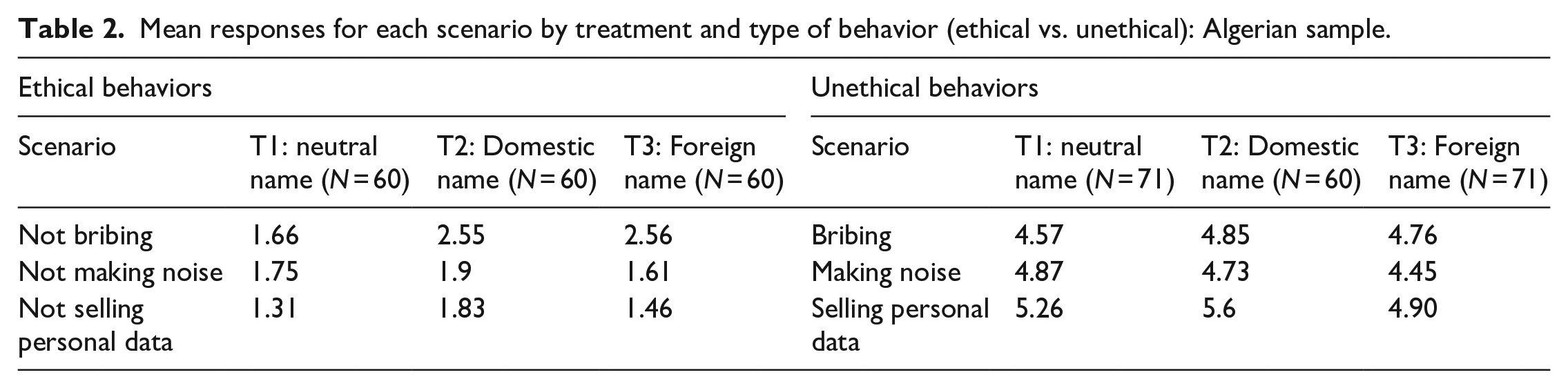
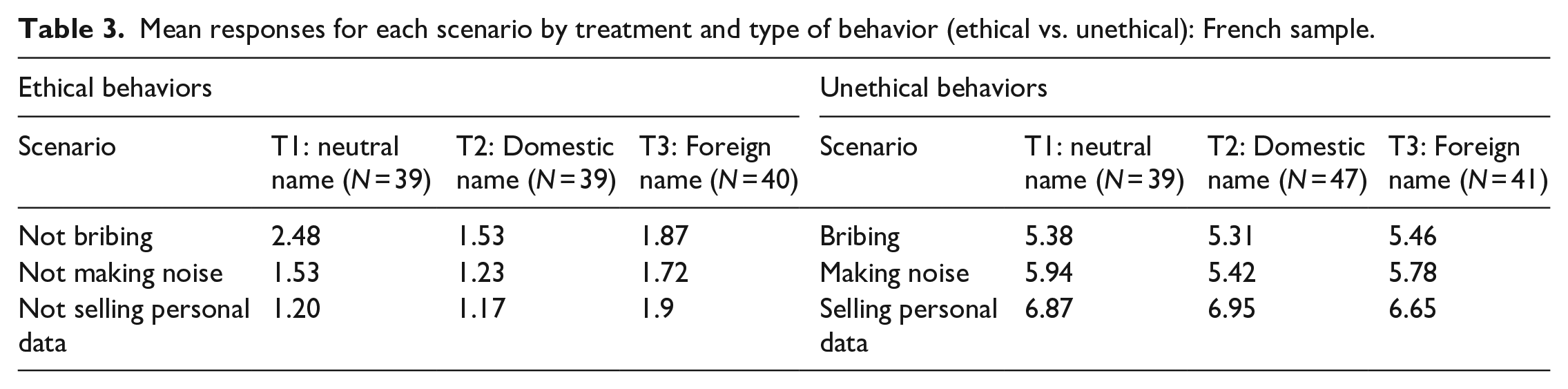
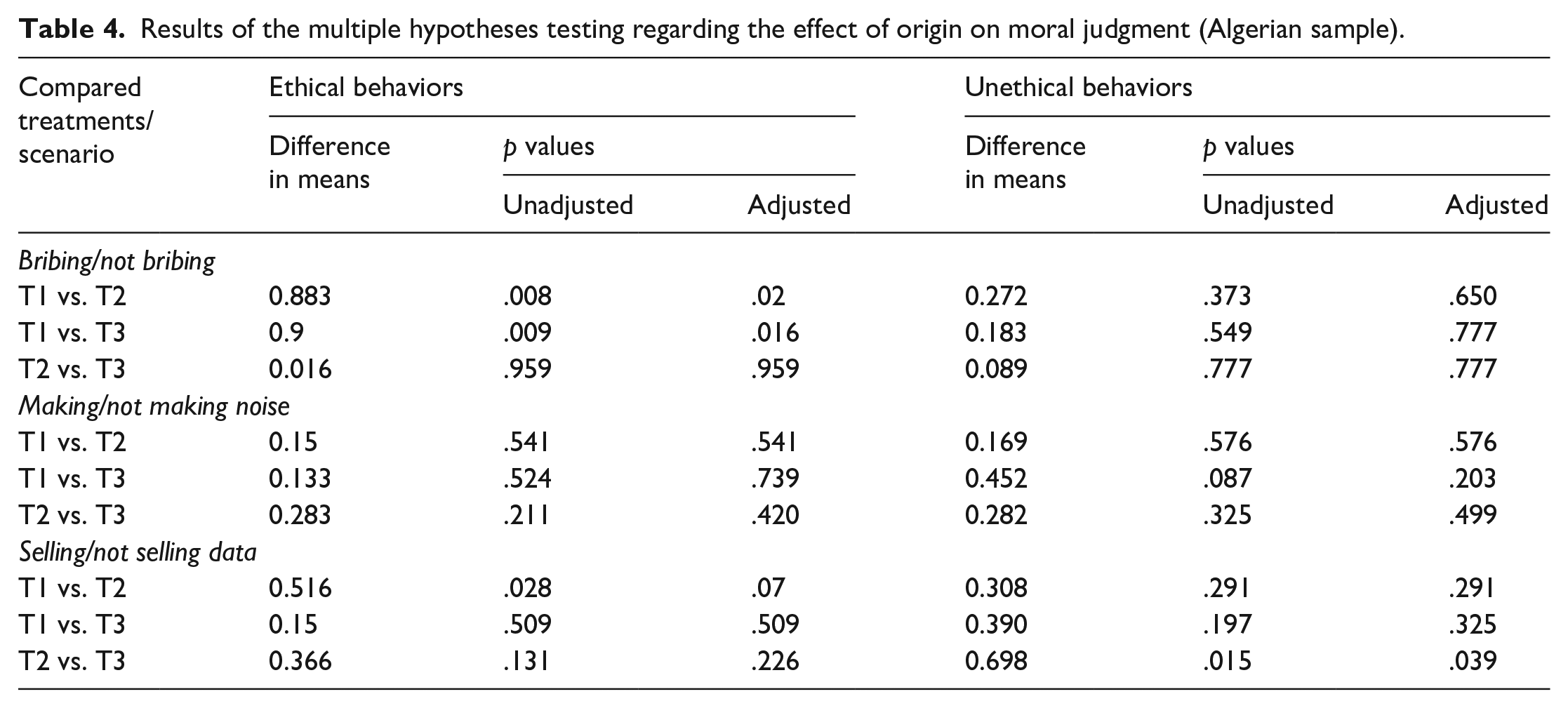
The mean responses regarding moral judgment of (un)ethical behaviors by treatment are provided in Tables 2 (Algerian sample) and 3 (French sample). We also report the significance of a multiple hypotheses testing (Tables 4 and 5) using the MHTEXP procedure developed by List et al. (2019).
Mean responses for each scenario by treatment and type of behavior (ethical vs. unethical): Algerian sample.
Mean responses for each scenario by treatment and type of behavior (ethical vs. unethical): French sample.
Results of the multiple hypotheses testing regarding the effect of origin on moral judgment (Algerian sample).
Results of the multiple hypotheses testing regarding the effect of origin on moral judgment (French sample).
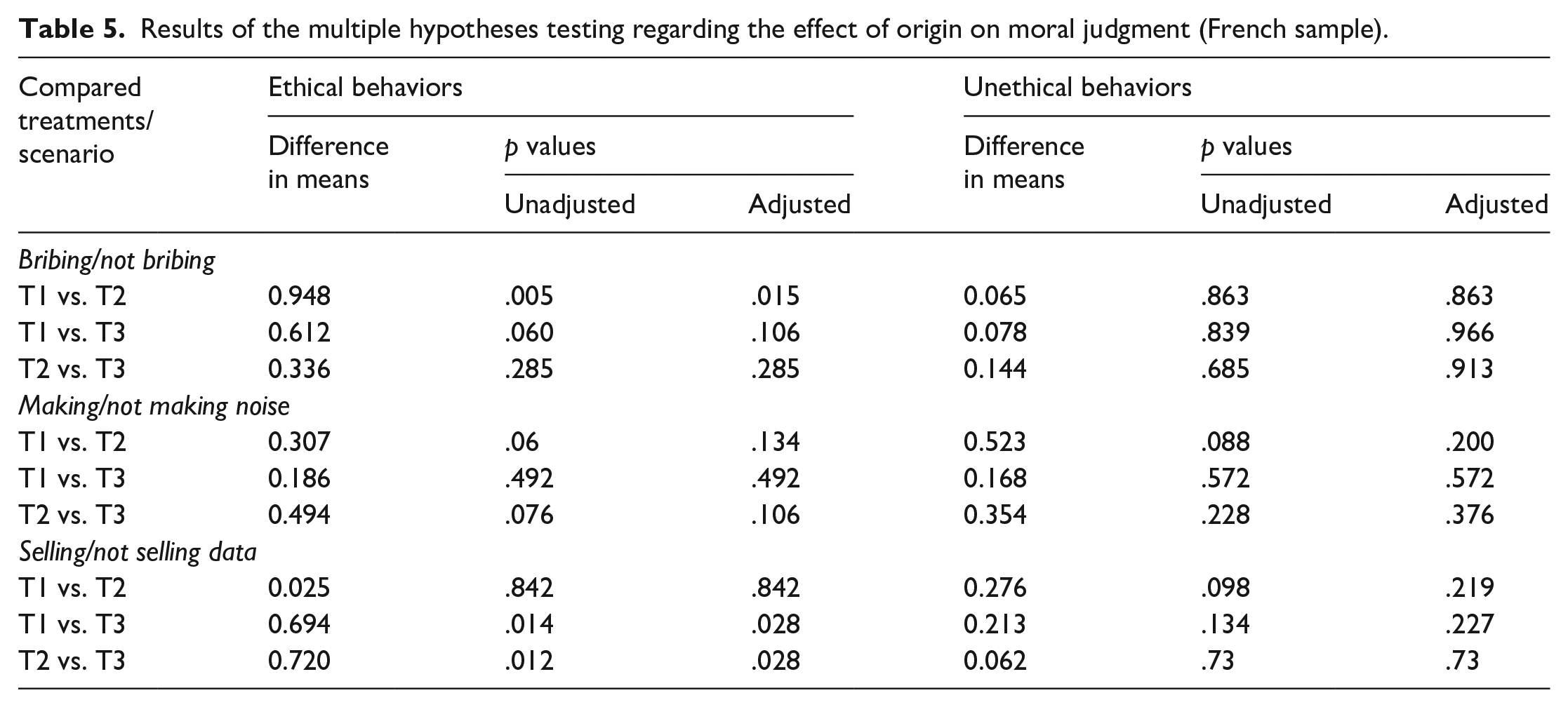
First, our hypothesis H1 is partially supported: while moral judgment is found to be different according to company origin in the case of ethical behaviors, foreign companies are not necessarily judged less positively, compared to domestic ones. In addition, the results are different across samples. In the Algerian sample, the neutral denomination is judged more favorably than the others. For the refusal of bribes, the foreign company is judged as the domestic one (2.56 vs. 2.55; adjusted p value = .95), and less favorably than the neutral company (2.56 vs. 1.66; adjusted p value = .016). As for the refusal of making noise, all companies are judged almost similarly (1.75, 1.9, and 1.6; all p values are not significant). Regarding the refusal to sell personal data, the neutral company is judged as the foreign company (1.31 vs. 1.46; p = .509) but more favorably than the domestic one (1.31 vs. 1.83; adjusted p value = .07). In the French sample, however, the results are quite different. For the refusal of bribes, the neutral denomination is associated with harsher moral judgment (2.48) compared to both the foreign origin (1.87; adjusted p value = .106) and domestic one (1.53; adjusted p value = .015). Regarding the refusal to make unpleasant noise, the results are consistent with the LOF hypotheses, since foreign companies (1.72) are judged less positively than domestic ones (1.23) and the multiple hypotheses testing suggests that this difference is close to the conventional level of statistical significance (adjusted p value = .106). Finally, regarding the refusal to send personal data, the results are also consistent with the identity-based discrimination hypothesis, since foreign companies are judged less positively (1.9) than neutral (1.20) and domestic ones (1.17) and these differences are significant when controlling for multiple hypotheses testing (p = .028). In sum, the identity-based predictions are supported for two scenarios out of three in the French sample.
Second, our hypotheses H2 stating that the discrepancy in judging a foreign and a domestic company is more pronounced for unethical actions than for ethical CSR ones is not supported. Unlike ethical scenarios, the multiple hypotheses testing shows that there is no significant difference in terms of moral judgment of unethical actions. Moreover, this result holds in both studies, in Algeria and France. In other words, when it turns to unethical practices, it seems that individuals, in both Algeria and France, do not give much importance to the company origin. An exception to the previous results relates to selling personal data in the Algerian study for which we found a significant difference between treatments T2 and T3 albeit opposite to our identity-based prediction. Indeed, a foreign company is judged less severely (4.90) than a domestic one (5.6) (adjusted p value = .039).
Moreover, we also run ordered probit estimations in order to examine the effect of the company origin on moral judgment controlling for individuals’ age, gender, education level, and income. Some descriptive statistics are provided in Tables 6 (Algerian study) and 7 (French study). Estimation results are presented in Tables 8 and 9 for the Algerian study and Tables 10 and 11 for the French study. We also report marginal effects for outcome 1, corresponding to the most favorable judgment (completely moral). Overall, the results of our estimations are rather consistent with those obtained using the multiple hypotheses testing. Below, we analyze the results in relation to each hypothesis, considering the Algerian study followed by the French one. The results related to socio-demographic variables do not allow to draw clear-cut regularities and are inconclusive. In order to avoid further complicating matters and obscuring the discussion, we reported the raw results, but we do not discuss them in detail.
Descriptive statistics regarding variables used in estimation (Algerian sample).
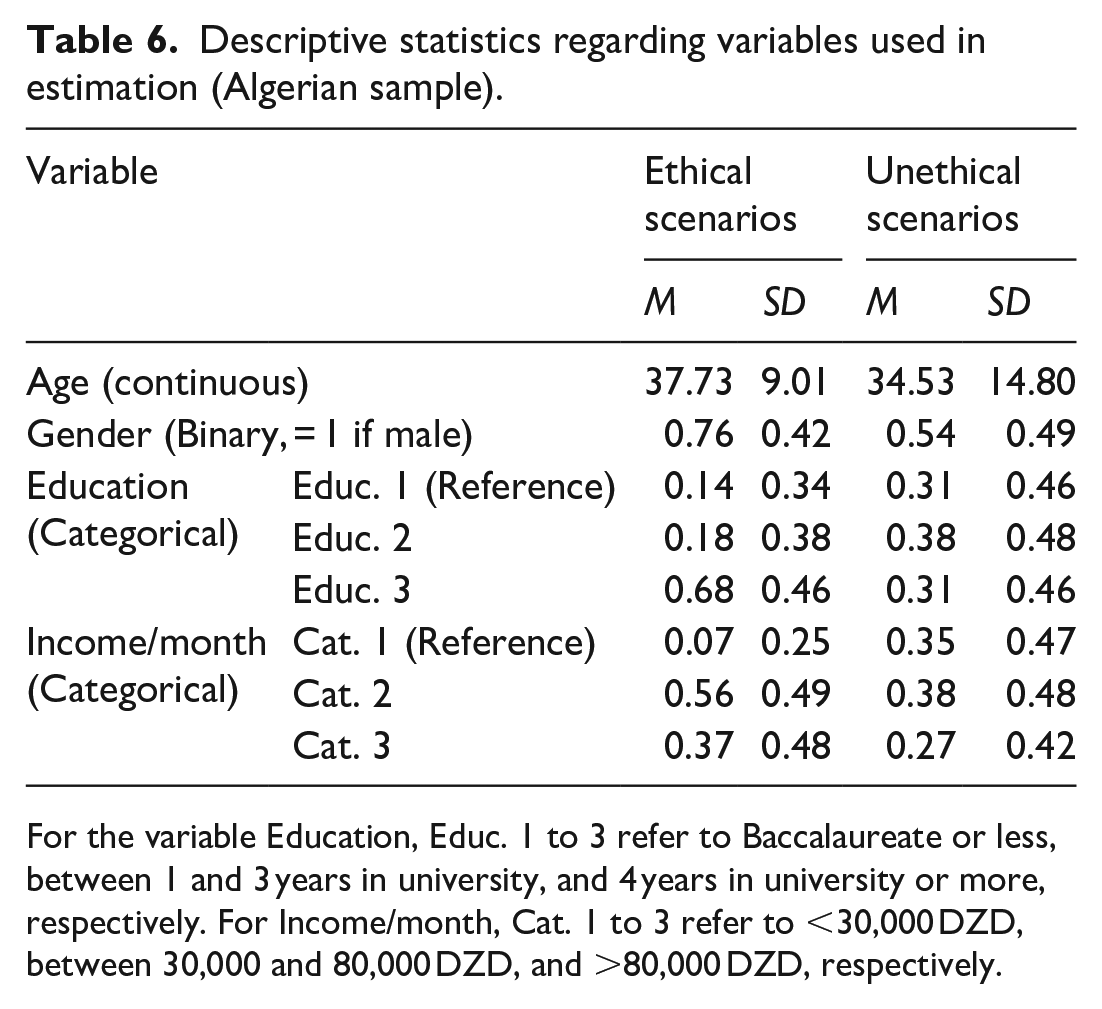
For the variable Education, Educ. 1 to 3 refer to Baccalaureate or less, between 1 and 3 years in university, and 4 years in university or more, respectively. For Income/month, Cat. 1 to 3 refer to <30,000 DZD, between 30,000 and 80,000 DZD, and >80,000 DZD, respectively.
Descriptive statistics regarding variables used in estimation (French sample).
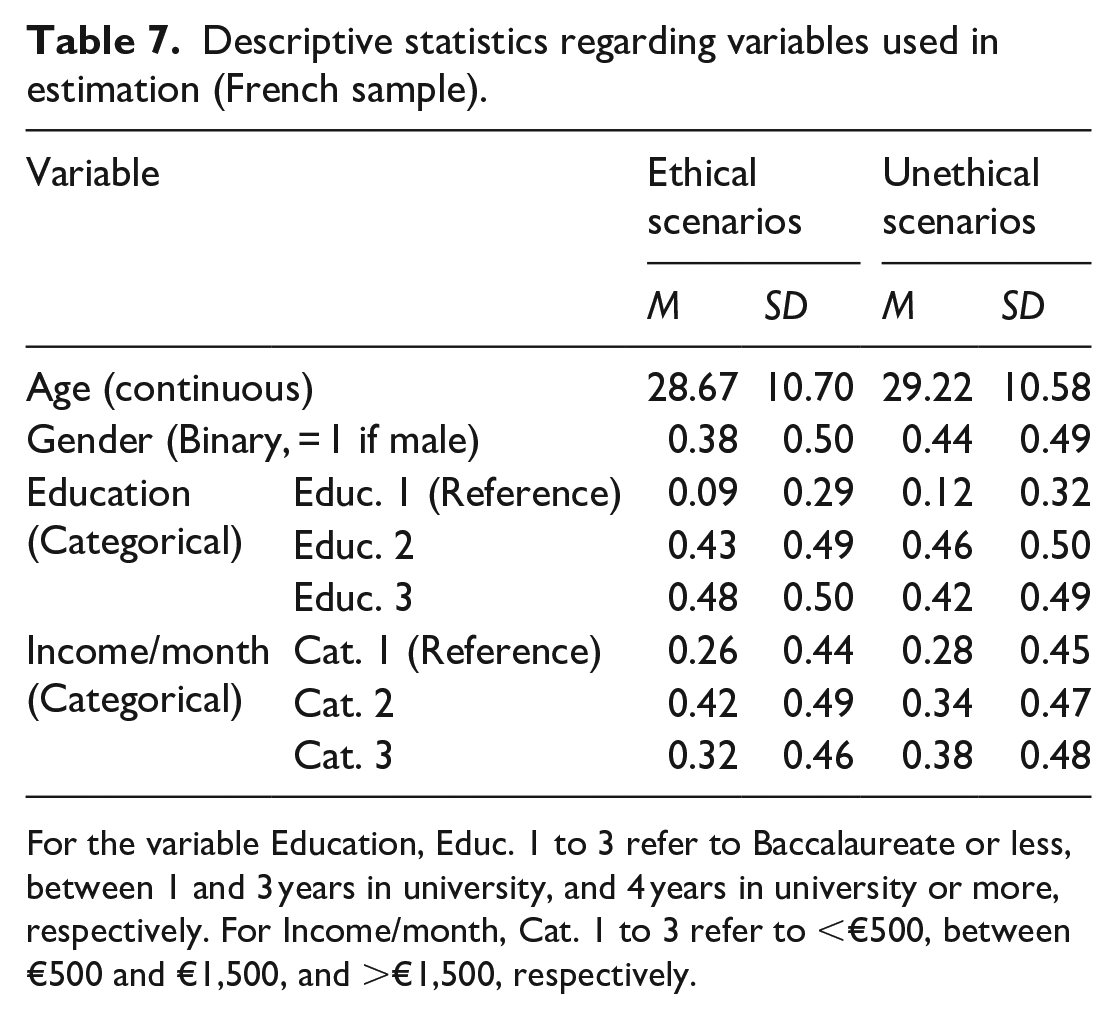
For the variable Education, Educ. 1 to 3 refer to Baccalaureate or less, between 1 and 3 years in university, and 4 years in university or more, respectively. For Income/month, Cat. 1 to 3 refer to <€500, between €500 and €1,500, and >€1,500, respectively.
Ordered probit estimation of the effect of company origin on moral judgment by scenario (Ethical behaviors—Algerian study).
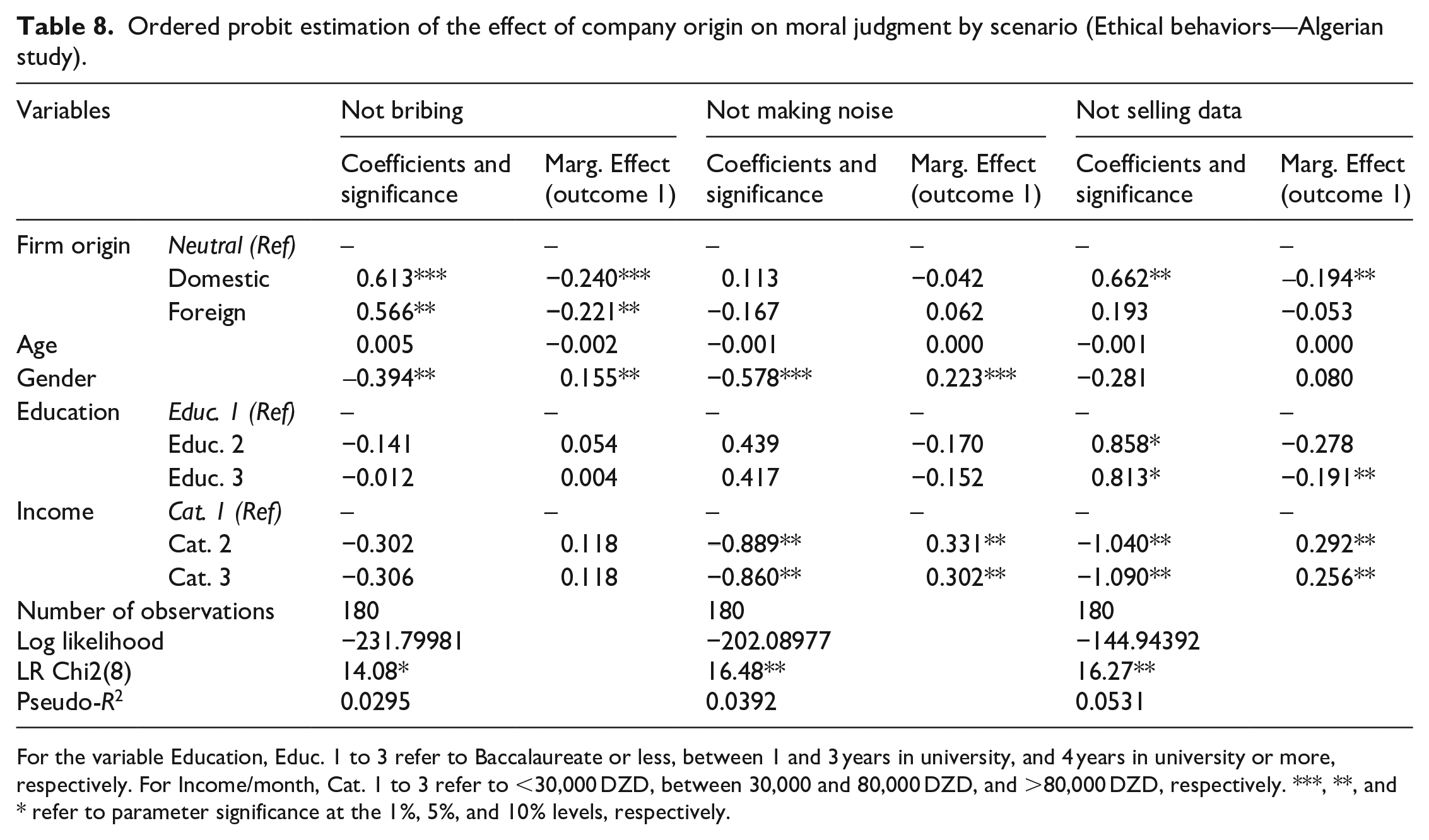
For the variable Education, Educ. 1 to 3 refer to Baccalaureate or less, between 1 and 3 years in university, and 4 years in university or more, respectively. For Income/month, Cat. 1 to 3 refer to <30,000 DZD, between 30,000 and 80,000 DZD, and >80,000 DZD, respectively. ***, **, and * refer to parameter significance at the 1%, 5%, and 10% levels, respectively.
Ordered probit estimation of the effect of company origin on moral judgment by scenario (Unethical behaviors—Algerian study).
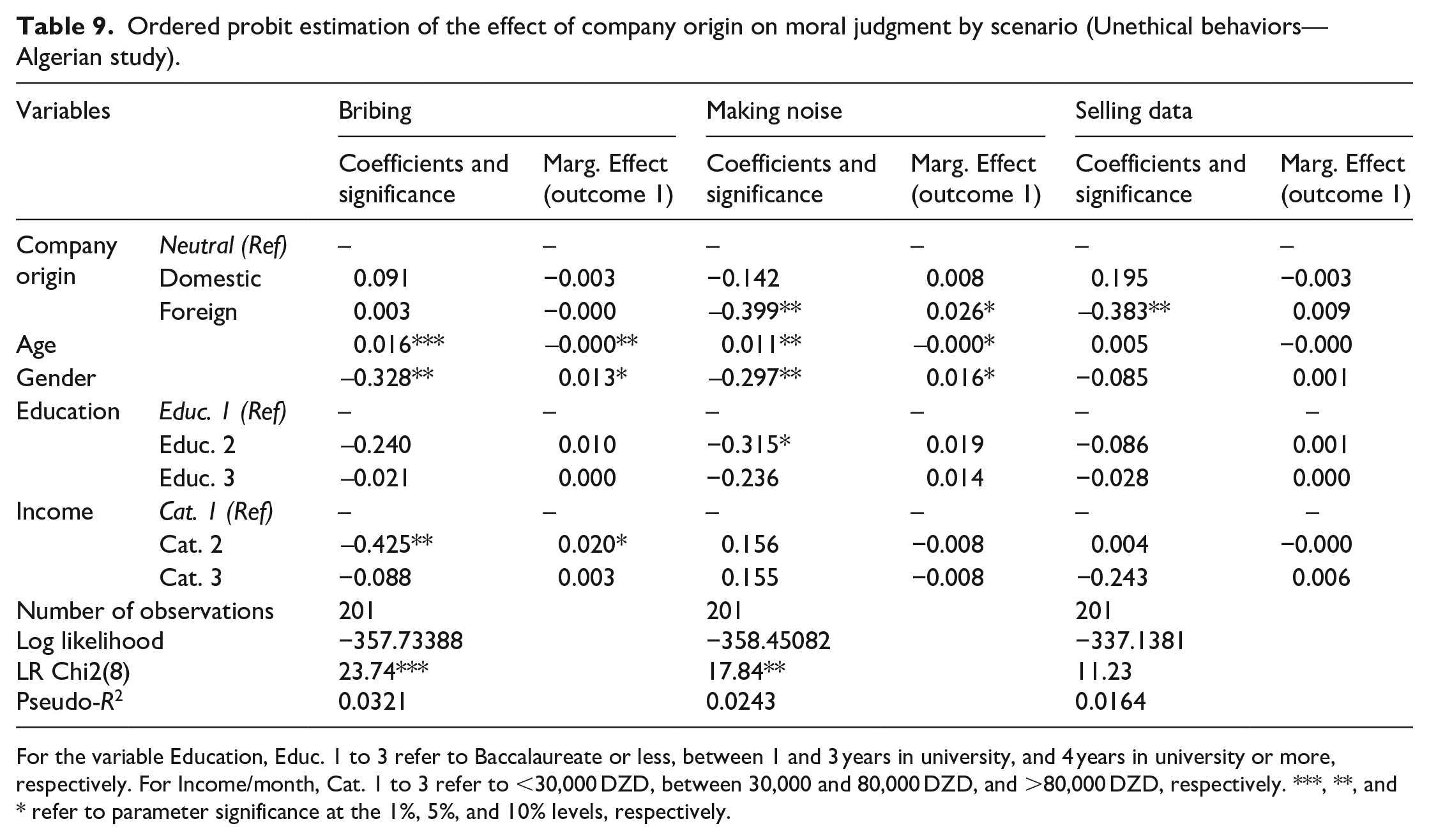
For the variable Education, Educ. 1 to 3 refer to Baccalaureate or less, between 1 and 3 years in university, and 4 years in university or more, respectively. For Income/month, Cat. 1 to 3 refer to <30,000 DZD, between 30,000 and 80,000 DZD, and >80,000 DZD, respectively. ***, **, and * refer to parameter significance at the 1%, 5%, and 10% levels, respectively.
Ordered probit estimation of the effect of company origin on moral judgment by scenario (Ethical behaviors—French study).
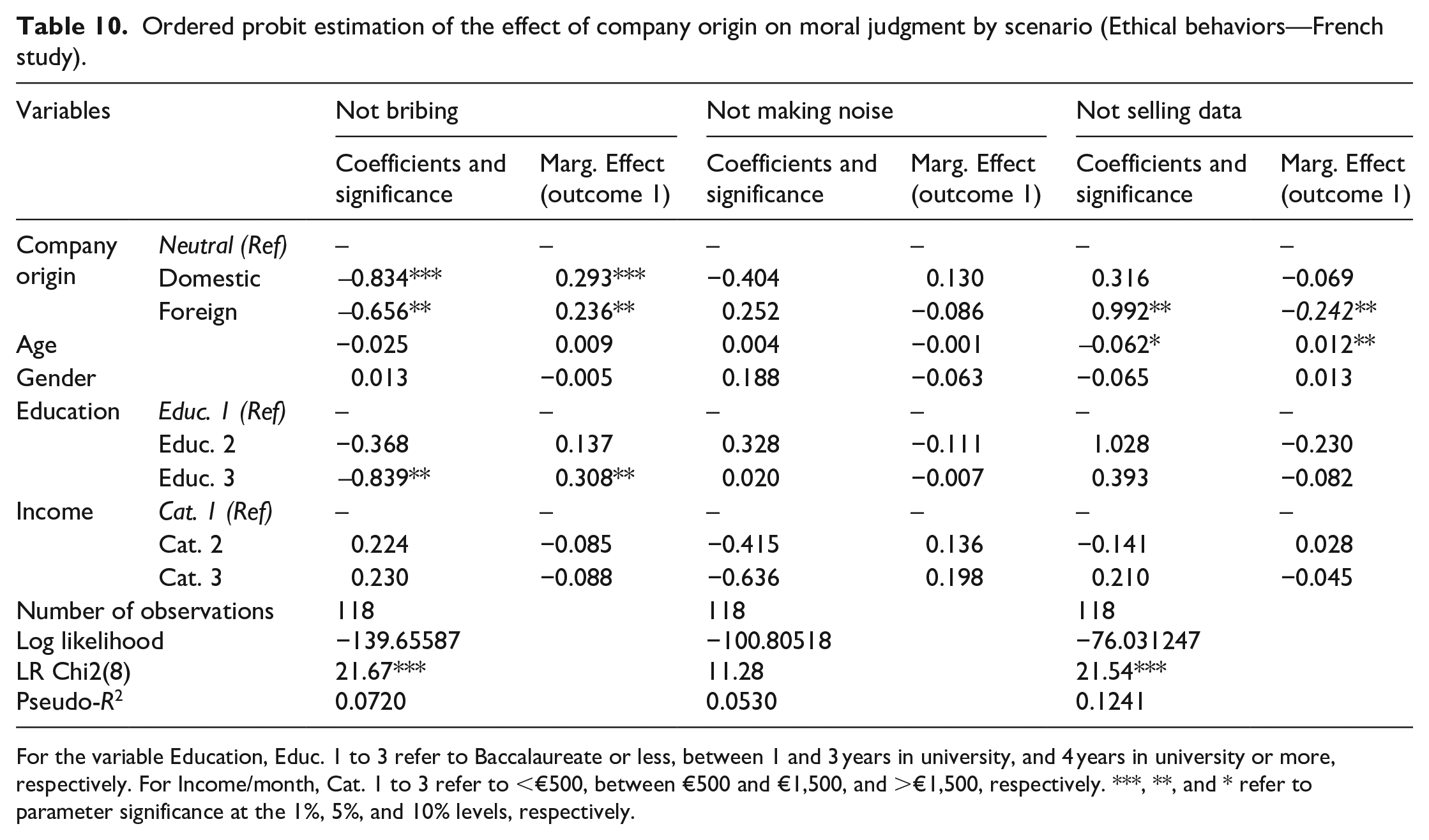
For the variable Education, Educ. 1 to 3 refer to Baccalaureate or less, between 1 and 3 years in university, and 4 years in university or more, respectively. For Income/month, Cat. 1 to 3 refer to <€500, between €500 and €1,500, and >€1,500, respectively. ***, **, and * refer to parameter significance at the 1%, 5%, and 10% levels, respectively.
Ordered probit estimation of the effect of company origin on moral judgment by scenario (Unethical behaviors—French study).
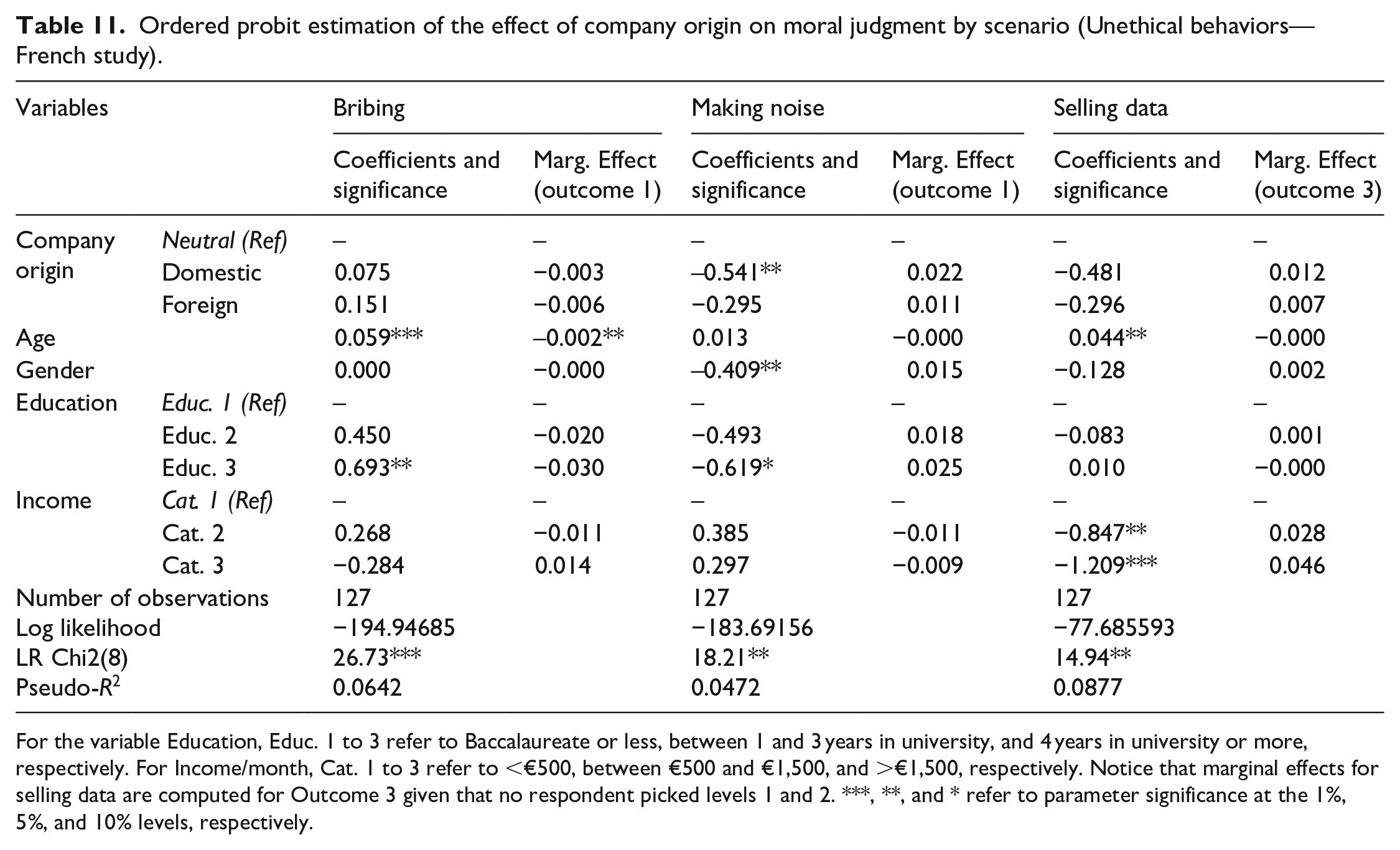
For the variable Education, Educ. 1 to 3 refer to Baccalaureate or less, between 1 and 3 years in university, and 4 years in university or more, respectively. For Income/month, Cat. 1 to 3 refer to <€500, between €500 and €1,500, and >€1,500, respectively. Notice that marginal effects for selling data are computed for Outcome 3 given that no respondent picked levels 1 and 2. ***, **, and * refer to parameter significance at the 1%, 5%, and 10% levels, respectively.
In the Algerian study, our estimations suggest that company origin has an impact on moral judgment for both ethical and unethical practices. Regarding ethical behaviors, on one hand, not bribing is perceived to be relatively less moral for a domestic (T2) and foreign (T3) company compared to the neutral company (T1). Marginal effects suggest that participants are 22.1 (respectively, 24) percentage points less likely to choose the most favorable judgment when the company is foreign (respectively, domestic) compared to the neutral treatment. On the other hand, not selling personal data is judged as less moral for a domestic company, compared to a neutral one. Participants are, indeed, 19.4 percentage points less likely to choose the most favorable judgment in this case when the company is domestic, compared to the neutral treatment. Regarding unethical behaviors, our estimation suggests that foreign companies are judged less severely than neutral companies (T1) for both making noise and selling personal data. In terms of marginal effects, Table 9 shows that participants are 39.9 (respectively, 38.8) percentage points more likely to pick the most favorable judgment regarding making noise (respectively, selling data) when the company is foreign, compared to the reference treatment. In sum, similar to the multiple hypotheses testing, our hypothesis H1 is partially supported in the Algerian study, since company origin is found to be significant in some cases, but not in the direction predicted by the identity-based LOF. Moreover, our hypotheses H2 is not supported, since we did find support that discrepancy in judging a foreign and a domestic company is more pronounced for unethical actions compared to ethical ones.
Hence, unlike our identity-based LOF predictions, we found in some scenarios an advantage for foreign companies compared to domestic ones in Algeria. These unexpected effects can be due to development degree of the foreign country compared to that of the host country that can interfere with identity-based LOF effects. Companies from developed countries can be perceived as applying higher ethical norms than domestic counterparts in developing countries, regardless of location (Grolleau & Mzoughi, 2005). Possible wrongdoings can be perceived as the result of domestic pressures, transforming unethical behaviors into normal ways of doing things locally. Interestingly, several Algerian managers (informal debriefing after the survey administration) indicated that foreign companies are often contaminated by the business-as-usual methods of domestic counterparts.
In the French study, the results reported in Table 10 (respectively, Table 11) suggest that company origin has an impact on the moral judgment of the refusal to bribe and sell personal data (respectively, making noise). Indeed, not bribing is found to be more moral for foreign and domestic companies, compared to the control treatment (neutral origin). In terms of marginal effects, not bribing by domestic (respectively, foreign) companies is 29.3 (respectively, 23.6) percentage points more likely to be judged as completely moral, compared to the neutral treatment. However, regarding not selling data, foreign companies are judged less positively than the neutral treatment. The refusal to sell personal data by foreign companies is found to be 24.2 percentage points less likely to be judged as completely moral. On the opposite, regarding making noise, domestic companies are judged less severely, compared to the control treatment. In sum, our hypothesis H1 is also partially supported in the French study, given that company origin is found to significant in some cases, but without being systematically consistent with identity-based LOF predictions. Again, our hypothesis H2 is not supported.
Given the surprising nature of our findings, let us speculate on some explanations. Ma et al. (2012) argued on empirical ground that in-group favoritism is extended to out-group members who share a similar culture. In their words, “consumers project their national identity to the similar nations” and are more willing to buy foreign products from culturally similar countries.” They are “semi-in-group” members, unlike culturally different countries who are treated as out-group members (Ma et al., 2012; see also Mendoza et al., 2019, about the variations in the LOF according to the geographical focus of internationalization). Moreover, experimental evidence supports a negative relationship between social distance and positive and cooperative behavior (Ahmed, 2007). Following this line of reasoning, we assume that the effect of foreignness on ethical judgment is moderated by the cultural distance between the country of origin of the foreign company and its host country. This factor could be the reason why individuals in the Algerian study judge less severely foreign affiliates from France, a country that is culturally close and has strong historical ties with Algeria, 4 while the situation is different for French participants when judging Chinese companies. Moreover, French companies are likely to benefit from a positive moral image attached to the perception of their operations in France, especially compared to the negative moral image of Algerian companies. Consequently, they can even be viewed as victims of the domestic environment (isomorphic pressures) that contaminates them by forcing them to adopt questionable practices. In these specific circumstances, we suggest that this foreign identity can generate a positive moral discrimination. Our study stresses the need for further research and suggests that much remains to be achieved by considering how foreignness affects various dyadic relationships, mixing, for instance, cultural distances and development levels for the host and foreign countries considered.
As suggested above, it seems relevant to consider the role of the development level differential (between the host country and the foreign country) on ethical judgment. At the individual level, the same (un)ethical behaviors performed by an individual are likely to be weighted and judged differently as a function of his income characteristics (Olson et al., 2016). If we apply the same reasoning to multinationals, the same un(ethical) choices performed by a foreign subsidiary will be judged differently as a function of the level of income of its country of origin. Indeed, various groups of countries can be distinguished notably (but not exclusively) according to their development level (e.g., G7, G20) and this parameter can interact with the foreignness status to generate more nuanced in-group and out-group members (see also Mendoza et al., 2019).
In short, our experimental results suggest that the effect of foreignness in the moral domain can be more complex than initially expected. It constitutes an important extension of identity-based foreignness issues in line with the recent contributions stressing the double-edged nature of foreignness (Edman, 2016; Taussig, 2017). In the moral domain, being foreign can constitute an asset for some companies, when the foreignness pushes host residents to be more lenient with foreign companies that make an ethical misstep and a liability for others when the foreignness pushes host residents to be more severe with foreign companies that make an ethical misstep. In some cases, it can make sense to emphasize the foreign origin, whereas in other circumstances, it can be more appropriate to remain discreet regarding this origin. This categorization is not definitively fixed and can evolve over time and across domains. We argue that all foreign companies are not created equal before the moral judgment of host citizens. Their moral judgments are likely to be situation- and perspective-dependent. Rather than adopting a one-size-fits-all approach, extending the effect of foreignness to the moral domain requires a case-by-case examination. Some likely candidates have been suggested such as the overlap level between the two considered origins (e.g., shared history, common language, or religion) where some foreign companies may have both in-group and out-group characteristics, while other foreign countries are more considered as completely out-group members. The development level of the origin country and its overall moral image can also serve as indicators of how moral transgressions will be considered in the host countries, either as the result of the contamination by local counterparts or as an identity feature. A practical implication of our results is that signaling directly the origin of a company, though its denomination is not a choice without consequences. This decision, regardless of other considerations, can sometimes influence subsequent moral judgment of its behaviors, and indirectly its perceived legitimacy and license to operate.
Conclusion
The present research is a first step in examining the effect of identity-based foreignness on moral judgment. It contributes to the LOF literature in several ways. First, our findings suggest that the origin of the company affects moral judgment of both ethical and unethical behaviors, but not necessarily as predicted by a simplistic application of the LOF argument. In the Algerian context with French companies, ethical actions are judged more favorably for neutral and foreign companies than domestic ones. We speculated that this effect can be related to the perceived morality of companies in their country of origin, making a wrongdoing more likely to be perceived as the result of a contamination by the local environment. Nevertheless, this result in favor of foreignness does not hold when considering Chinese companies in a French context, suggesting the effects of foreignness are certainly more complex than initially expected, especially when various combinations of development levels are intertwined. Our results also raise issues regarding the judgment of unethical behaviors as it is more lenient for foreign companies compared to domestic ones. To the best of our knowledge, our findings are the first to suggest that the identity-based LOF effects in the moral domain can be reversed in some contexts, particularly when the foreign company corresponds to a developed country operating in a developing country. This finding is consistent with recent contributions emphasizing the possible advantages in some circumstances of being foreign (e.g., Edman, 2016; Taussig, 2017). 5 Nevertheless, we caution the reader to not over-generalize from our results before considering other combinations of countries and alternative empirical methods. Moreover, our results apply only to the ethical domain, regardless of other considerations. When the capability- and identity-based LOF effects are examined at a more aggregate level, it is likely that the often-cited finding of the literature, that foreign companies are disadvantaged, remains supported.
Our research also suggests a preventive, innovative, and low-cost strategy, namely the company denomination, to get more favorable moral judgments regarding ethical/unethical behaviors, ceteris paribus. For instance, an additional finding of the Algerian study is that getting a neutral denomination—in the sense of not suggesting a given origin for the company—can be a good way to get more favorable moral judgments related to ethical actions, ceteris paribus. This finding has potentially important implications for choosing denominations for both domestic and multinational companies who want to do business in Algeria (Farrow et al., 2018). In other words, managers have to be very careful when choosing the company denomination, beyond obvious marketing considerations. Rather than simply choosing a domestic or foreign sounding name, we suggest to test various denominations without ignoring the permanence of this effect over time. Once again, managers work with words and choosing an adequate denomination can be a good way to get more favorable moral judgments related to ethical/unethical actions, at least in some environments.
Our survey experiment has several limitations. We considered only two host countries but a larger sample with more combinations of host and foreign countries is a natural extension to get more generalizable findings. In addition, we do not measure moral judgment in a real-world situation. Other parameters are also likely to interfere and influence how company origin and foreignness will impact judgment and performance such as the company size or family dimension (Fernández-Olmos et al., 2016). Extending the analysis to non-profit organizations can also enrich the analysis regarding the effects of foreignness. Data from a well-designed lab or field experiment where onlookers are incentivized to judge and punish offenders can refine the analysis and reinforce our study validity. Moreover, investigating some moderating variables (e.g., presence duration of the company in the host country) will allow us to enrich the analysis. Rather than providing definitive replies, our contribution constitutes a stepping stone that paves the way to further research on this fascinating topic.
Footnotes
Declaration of conflicting interests
The author(s) declared no potential conflicts of interest with respect to the research, authorship, and/or publication of this article.
Funding
The author(s) received no financial support for the research, authorship, and/or publication of this article.
