




Abstract
Over the last decade, the European Union has faced multiple crises that have affected the direction and the nature of the integration process. This study focuses on the challenges posed by the Belarusian-EU border crisis (2021) and the proposed travel restrictions towards Russian citizens (2022) in the context of the Nordic-Baltic EU member states. The study addresses their impact through the double prisms of regionality and level of governance. The study looks at how national elite narratives on borders and the movement of people travel to the supranational context, in this case the European Parliament. While the Parliament is often overlooked in favour of the Council or the Commission, this study regards it as an effective analytical bridge between domestic and supranational decision-making levels. To achieve its empirical goals the study relies on governments’ official communiques, while the parliamentary analysis is based on pre-vote debates and Parliament’s roll-call votes. The article finds that, while the national narratives highlight a growing convergence of governmental narratives in adopting or justifying restrictive bordering measures, the EP debates and votes highlight the relevance of ideology and partisanship when it comes to the issue and the growing significance of the gap between mainstream and non-mainstream forces.
Introduction
Over the last decade, the European Union (EU) has faced multiple shocks of exogenous and endogenous origin, narrated as crises, that have affected both the direction and the nature of the integration process. One such shock is the movement of people across borders, oftentimes in the form of migration. Along the EU's eastern border, the movement of people has recently been characterised by contrasting narrative framing. Different moral lenses and related narrations have been applied to the crisis around the Belarusian border and the access of Russian visa holders vis-à-vis the reception of Ukrainian refugees in the context of Russia's full-scale invasion. A key step to make sense of these dynamics and processes is to shed light on the way they are framed in terms of narratives and debates and to understand how the EU response is justified and constructed.
This article will focus on the narrative representations of the Belarusian border crisis (2021) and the travel ban towards Russian citizens (2022). In particular, we will be looking at the combined perspective of Nordic and Baltic Member States’ (MS) (NB6) elites 1 reflecting domestic narratives emerging from the two events and the European Parliament’s (EP) regional groupings as an expression of the supranational dimension of the EU decision-making. Aware of the tight connection between national debates and supranational decision-making, the paper addresses the impact of these two challenges on the elite’s narratives and crisis framing in connection to the policy-making context of the EP.
Hence, the aim of this paper is to assess how national narratives travel to the supranational level, in this instance the EP. At the national level we assess governmental narratives, while at the EU level both ruling and opposition parties are represented. We are interested to see whether the latter internalise governmental narratives (in the name of national interest) or diverge ideologically (in the name of partisanship). Notwithstanding the fact that, stricto sensu and given its prerogatives in the two cases analysed, the EP primarily connotes as an institutional conveyer of interest, rather than a decision-maker in purely legislative terms. Adding the supranational level allows us to assess the impact of exogenous narratives on the process of consolidation of national narratives and to test the degree of cross-contamination between different national narratives. While the resolutions and the debates analysed should be understood primarily as the Parliament’s voice, rather than its contribution as EU co-legislator, juxtaposing them to the governmental narratives contributes to unveil a bi-directional network of informal nodes connecting decisions and narratives and triggering patterns of cross-national convergence and ideological polarisation. In the context of the EU institutional triangle, the EP constitutes a good choice of investigation as it is the only directly elected supranational institution, where both national and ideological interest are identifiable. Furthermore, the EP has more libertè de manoeuvre than other institutions and - unlike the Council - its votes, debates, and procedures are transparent, and the decisions are not unanimous.
Previous studies analysing EP votes on domestically sensitive issues have provided empirical support for the influence of national interests on Members of the EP’s (MEPs) voting behaviour (Faas 2003; Raunio and Wagner 2020; von Achenbach 2017), also in the context of policies related to the area of freedom, security and justice (Frid-Nielsen 2018) within which our cases fall. In the context of the challenges posed by the Belarusian border crisis and the travel ban towards Russian citizens, aspects related to policies of securitisation of national (and European) borders are likely to be more directly affected by regionality and geographical distance than those related to migrants and travellers’ rights and normative aspects of bordering. It is the aspect of bordering which connects the two crises analysed. Our focus is on how elites narrate these processes. The relative importance of national and partisan affiliations in determining MEPs' voting stance and coalition patterns remains uncertain, given the exceptional nature of the crisis.
The study combines two levels of analysis. The axes that define our analytical prism consist of regionality (Nordic vs Baltic) and level of governance (national vs supranational). Our study compares national and supranational narratives and how narratives travel from the national to the supranational level in the context of the two crises to address the following research questions: In the context of decision-making in times of crisis, how are domestic governmental narratives reflected in supranational parliamentary attitudes in the Nordic and Baltic contexts? Which factors are behind variances, among Nordic-Baltic legislators, at the supranational level?
The Belarusian border crisis along the external EU border erupted in the summer of 2021 following threats by the Belarusian president Lukashenka to let migrants move unrestricted through the country towards the EU. It soon became clear that Minsk instrumentalized the movement of migrants from the Middle East, through organised ‘tourist trips’ and the easing of Belarusian visa rules in an attempt to pressure the EU to end sanctions put in place in reaction to the fraudulent presidential elections of 2020 and ensuing crackdown on protesters. In Lithuania, the annual unlawful border crossing used to fall somewhere around 70 cases, in June 2021 such crossing amounted to around 470, and more than 2600 in July (Thebault and Dixon, 2021). The influx of migrants gave rise to a number of responses in the MS bordering Belarus (Latvia, Lithuania, and Poland), mostly concerned with reinforcing the border region to counteract the movement of instrumentalized migrants (Bakker 2022).
As for the travel ban towards Russian visa holders, following Russia’s full-scale invasion of Ukraine in February 2022, the Baltic states and Poland have been among the main proponents of stricter measures towards Russian citizens travelling to the European Union. A position well epitomised by the words of the Estonian Prime Minister Kaja Kallas: “visiting Europe is a privilege, not a human right”. The Baltic proposal had two main targets: ending the EU regime of visa facilitation towards Russian citizens and banning short term tourist visas. While the former was endorsed by the EU in the summer 2022 and consensually adopted by the MS, the latter proved more controversial. Given the growing pressure on their land border, in the fall 2022 - despite the lack of EU-wide agreement - Riga, Vilnius, Tallinn, and Warsaw decided on a regional policy of non-recognition of previously issued visas. Such a measure was justified with the argument that “the majority of visas have been issued to Russian citizens before Russia’s full-scale aggression in Ukraine, under different geopolitical conditions and considerations.” 2 Following the unilateral move, Finland also implemented non-recognition of previously issued visas. In this case, similarly with COVID-19, instead of sanctioning the unilateral move, the Commission’s aim seemed primarily to find a way to incorporate the exception in the Schengen acquis and to reduce at a minimum the related inconsistencies.
While this article does not formulate hypotheses, given its exploratory nature, it expects narratives and attitudes to display a varying intensity proportional to the perceived distance from the centre of events, to reflect the varying degree of domestic (or partisan) significance of the issues at stake, and to capture the tension between securitisation and humanitarian action in both crises. The primary goal of this study and the aspiration that we derive from its results are to shed light on the dynamics of circulation and fusion of cross-level elite narratives in the context of EU decision-making and, more broadly, to contribute to the academic debate on European (integration) studies in times of crises.
Narrating crisis
The paper relies on political narratives to assess elite framing of events at national and supranational levels. A political narrative is a tool through which to represent one’s conception of the world, it is created through political action and emerges from formal political forums or informal political groups (Shenhav 2006). Political narratives thus convey a political message supporting one particular interpretation of events through the action of turning “events into stories” (Garcia 2017, 341). Hence, “‘controlling the narrative’ means political advantage and the ability to frame political processes according to one’s views” (Groth 2019, 2). Shenhav (2006) maintains that political narratives can provide a full representation of the political reality, however, this does not prevent the coexistence of more than one narrative claiming alternative ‘real’ representations of the world. Due to its articulating features, it shares many overlapping distinctions with the action of framing which is an integral part of political communication, consisting of a diagnostic as well as a prognostic component (Loizides 2009). As our data consists of governments’ official communiques the full range of political frames (such as the opposition’s frames) are not present making the study of such frames less fruitful in this instance.
It is useful to place the study in the context of a theory of crisis. Crisis is a common conception of modern society, and perhaps even more so in the context of the European Union (Voltolini et al., 2020; Zeitlin et al., 2019). Linguistically, crisis links two concepts, on the one hand critical in the sense of an event that qualifies as a crisis, on the other hand, critique referring to the interpretation and response of the critical event (Fassin 2021). Building on Foucault’s governmentality, Lawrence (2014) argues that a crisis is a technique of government operating through the process of constructed discourse. In this reading, a crisis is not so much a naturally pre-existing state, but the result of a “politically charged discursive construction of events that functions as a technique for affirming or altering our understanding of how government can and should operate” (2014, 192). The different articulations of crisis produce a form of path dependency which determines the level of politicisation of the event (Voltolini et al., 2020). Adding to that, the relevance of a critical event for the political organisation serves as an additional contingent factor. Thus, the aim of inquiry revolves around the question of social construction, that is, how events come to be problematized.
This is not to say that situations cannot be critical or catastrophic in their own accord. However, the discursive label of crisis is an action of political opportunity in that the action of crisis discourse creates contingency for reactions, as well as determining the extending, reinforcing or shifting of the status quo. We would also like to acknowledge that the perspective here is on the political process of crisis framing, yet it simultaneously recognizes that perceptions and experiences of violence and (never-ending) crisis modes from those subjugated to crisis framing tend to be excluded from the perspectives that emerge from state-oriented data as we rely on.
As a means of bridging the national and EP narratives, we focus on the themes of securitisation and humanitarianism. For the sake of this paper we draw inspiration from the Copenhagen School definition of securitisation as an speech act by political actors where the action to securitise an issue is to label events as existential threats. However, the full understanding of securitisation comes from more recent theorisation on the topic, which understands securitisation not only as a speech act, but also as practices (Léonard and Kaunert 2022). Furthermore, it reconceptualises security as a continuum, ranging from normalcy to worrisome to risk to existential threats (Abrahamsen 2005). Humanitarianism on the other hand is conceptualised as solidarity and protection of refugees or other displaced people. Yet, we also recognise that the type of humatiarianism that has emerged in the EU is a minimalistic humantiarianism in which people on the move are seen as victims and deserve to be protected, but they tend to be viewed as victims of smugglers rather than as victims of war (Hansen et al., 2021).
The critical events included in this study concern the theme of borders. Borders and border studies is a broad and rich field and we will not be able to cover it in all its details. Nonetheless, a brief introduction to the field of study; borders have increasingly been conceptualised as ever-changing (Parker and Vaughan-Williams 2012), and multiscalar sites of border knowledge, practice, and politics (Laine 2016; Cobarrubias 2020; Perkins and Rumford 2013). Thus, border conceptualizations have shifted from a line demarcating a territorial area to understandings of borders as a social and political construction (Lybecker et al. 2018; Ranjan, 2018). Furthermore, borders are, despite being everchanging, also ever-present in that they leave traces after they are gone (Green 2018). As such, historic borders often tend to affect how current borders are perceived and practised. The focus here is on governmental border communication as a means to unpack how governments narrate border policies and permeability “providing accountability over governmental decision-making about the boundaries of the state and […] the boundaries of the EU” (Brändle and Eisele 2023, 598).
Adding to that, the EU’s border making adds to the complexity in that different types of borders are in effect at the same time, the national border is contingent on the supranational border that is the external border of the EU, particularly noticeable within countries whose national borders coincide with the external EU border (Leutloff-Grandits 2023). The movement of bodies considered in this study occured across the external border of the EU, thus, contributing to the possible entanglement and layering of different types of borders (national and supranational) in the constructed narratives.
National versus Supranational levels of governance
For the sake of this study, as we look at the division of labour between the EU and its MS, we will focus on two main aspects that relate to the Belarusian border crisis and the travel ban towards Russian citizens. When it comes to the former we will be looking into asylum and repression of illegal migration and smuggling. As far as the latter is concerned, the EU visa policy and Schengen regime will be discussed.
Art. 79 and 80 of the Treaty on the Functioning of the European Union (TFEU) establish shared responsibilities for migration and asylum between the EU and its MS under the subsidiarity principle. 3 The EU supports national efforts in managing immigration, fostering integration, addressing irregular migration, and forming readmission agreements with third countries. MS retain authority for concrete actions. Additionally, the treaty (art. Six TFEU) cites the protection of human health, including in migration and asylum, as a Union competence to coordinate and supplement MS. In the Schengen context, the EU establishes admission requirements, including family reunification, for non-EU individuals, while MS decide admission quotas. Regarding asylum and illegal migration, the European Council, representing MS' executives, sets strategic priorities aligned with the Dublin regulation. The Council then outlines action plans, mandates negotiations with non-EU countries, and provides guidelines for illegal migration management. The legislative framework, subject to EP approval, usually follows the ordinary legislative procedure.
Efforts to address national imbalances in implementing legislation have progressed in the context of finalising the Pact on Migration and Asylum 4 . Despite this, national authorities primarily handle migration flows, asylum requests, and illegal migration, with the EU playing a supporting role. This support, executed through the European Border and Coast Guard Agency (FRONTEX) at MS' request, involves border checks and identity verification. The EU sets priorities, plans actions, negotiates with non-EU countries, enacts legislation, and defines programs, while MS implement and follow common EU procedures.
A similar pattern of national implementation and European coordination applies to the Schengen regime and the EU visa policy. Under the ordinary legislative procedure, the Commission initiates policy, the European Council adopts legislation and coordinates policy in the Schengen area, and the EP co-legislates and exercises democratic oversight. Post-COVID19 disruptions and temporary border controls have led to a more lenient approach by the Commission, de facto accepting the fait accompli. According to Montaldo (2020) “despite the recent trend towards a strengthened role for the EU in the management of external borders, the response to the COVID-19 crisis took the shape of merely non-binding Commission guidelines […] aimed at coordinating actions already taken individually by the MS in that respect.”
The two cases analysed in this article represent clear examples of deviations from the normality of decision-making and, as such, they have been framed by most of the still limited literature discussing them directly. While political science and sociology scholars have focused on dynamics, actors, and triggering factors, legal scholars have debated the legality of Member states’ unilateral actions in the light of the EU and national legislation and of the international legal framework related to human right protection. In particular, critical legal literature highlights how the indiscriminate use of non-targeted travel bans and of border pushbacks by EU Member states and their toleration by the supranational institution might severely undermine the credibility of the EU as a norm-based polity. Ganty et al. (2023) stress how citizenship-based bans are incompatible with the existing EU law and how amending those laws in order to include this possibility would go against the EU Treaties and the Charter of Rights. They maintain that, in spite of the “exceptional circumstances” acknowledged by the European Commission itself, the Member states’ unilateral actions to prevent Russian citizens’ entry would qualify as an “impermissible discrimination”. In this context, worth mentioning are the words of EU’s chief diplomat Josep Borrell who, in order to introduce the political agreement reached by the EU foreign ministers, stressed exactly those “exceptional circumstances” when discussing the unilateral bans introduced by the Baltic states and Poland. In the words of Borrell, “given the challenging implications for the bordering countries, we acknowledge that measures can be taken at the national level, to restrict entry into the EU in conformity with the EU Schengen Border Code” (Brzozowski 2022).
This study bridges a conceptual and methodological gap in examining the European response to emergencies by integrating national and supranational levels, moving beyond the predominant focus on the intergovernmental dimension (Raunio and Wagner 2020; Kaunert et al., 2015; Larsén, 2017). Given shared responsibilities between Brussels and national capitals and the complementary nature of both levels in addressing policy competences related to migration, asylum, and free movement, it evaluates the alignment between domestic/governmental and European/supranational positions, capturing polarisation along national or partisan lines.
Exceptionality of the EP
After the 2019 European elections, the EP consists of 751 MEPs from 27 MS. Despite the substantial number of legislators, they are organised into only seven party groups, 5 indicating the Chamber’s aggregative potential along partisan lines. The major party groups have shown significant continuity and organisational structure across successive parliamentary terms.
Academic literature depicts MEPs torn between national and European loyalties, balancing allegiance to their national parties, influencing re-election and future national careers, and European party groups, crucial for pursuing policy goals and parliamentary careers (Costello and Thomson 2016; Meserve et al., 2017).
Concerning the power balance between MEPs' two principals, scholars highlight the central role of European party groups in shaping affiliated MEPs' voting behaviour, evident in high intra-group voting cohesion. Early studies emphasised this influence, likening the EP to a traditional parliament, but recent research offers a more nuanced perspective. According to Koop et al., (2018), MEPs' loyalty to their party group primarily depends on their prospects for re-election, which are determined mainly in the national arena and conditional on their national party's support and electoral success. Additionally, the visibility of European issues as domestic matters influences a national party's willingness to monitor and control MEPs. Empirical analysis conducted by Whitaker et al., (2017) supports the critical impact of policy visibility and the electoral significance of issues on MEPs' considerations and voting behaviour.
Shackleton's (2017) recent study suggests that post-Lisbon Treaty reforms are steering the EP toward a parliamentary government model, where executive power flows through elected representatives. This shift, alongside strong party group cohesion, has normalised coalition patterns and policy contestation in the EP, marked by a left-right divide. Despite national characteristics remaining relevant, inter-group dynamics show a progressive institutional spill-over. However, the weak electoral connection between party groups and the electorate (Faas 2003), makes the EP a relatively soft chamber with MEPs influenced by various factors like policy preferences, national interests, party policies, and European affiliations.
National allegiances often override partisan ones in votes on nationally sensitive issues, especially those with economic implications for MS. The EP's multi-partisan, multinational, and multilingual nature requires MEPs to navigate pressures from the Councils, Commission, interest groups, civil society, and national parties. This tension between national interest and partisan coherence impacts both internal cohesion and coalition patterns within party groups, making the EP an imperfectly independent institutional actor.
Despite its institutional limits, this article focuses on the EP to contrast national and supranational ones for three key reasons. Firstly, amid criticism of Brussels for lacking leadership in the Belarusian border crisis and Russian citizens' visa issue, and MS acting unilaterally, MEPs were the first to call for effective European coordination, proposing concrete measures to bridge efforts between individual MS and Brussels. Secondly, the idea of a powerless EP overlooks significant changes brought by the Lisbon Treaty, enhancing the EP's power vis-à-vis the Council. The Assembly has shown greater activism in extending the ‘community method’ to areas predominantly following intergovernmental lines, like police and judicial cooperation (Braghiroli 2014; Farrell and Héritier 2007). Even in areas where the Council remains the primary decision-maker (Bressanelli and Chelotti 2019; Trauner and Ripoll Servent 2016), the Parliament's influence has grown in shared and supporting competences. 6 Recent research indicates that in areas related to the handling of illegal migration and asylum, the Parliament has frequently challenged the Council's positions and effectively played a role in shaping the EU's response (Krotký 2023; Maricut 2017). Thirdly, the EP's unique role and direct legitimacy through EU citizens' votes make its voice significant. As the only directly elected supranational institution, it reflects the vox populi (Braghiroli 2015), especially on contentious issues like migration and asylum (Krotký and Kaniok 2021). Studies show the EP's greater inclination than the Council to adopt value-oriented stances, offering more freedom of action in non-legislative instruments such as resolutions.
Specifically, this article focuses on the EP's activities and debates during emergencies. Recent studies on MEPs’ voting behaviour and attitudes in times of crisis have covered the recent financial (Roger et al. 2017) and migration (Högenauer, 2017) crises, the COVID-19 pandemic (Braghiroli 2022), democratic backsliding inside the EU (Chiru and Wunsch 2023), and the consequences of Russia’s full-scale invasion of Ukraine (Braghiroli 2023; Holesch and Zagórski 2023). Their main institutional foci of these studies were either the way MEPs’ voted on the crisis or the way they narrated it, thereby highlighting supranational patterns of cooperation and competition and national versus partisan principal-agent dynamics. In particular, both Braghiroli (2022) looking at MEPs’ votes and Högenauer (2017) looking at parliamentary debates identify party affiliation and perceived closeness of the crisis as the two key predictors of parliamentary variation. Almost all the studies mentioned above highlight how crises characterised by high levels of fragmentation among MS are likely to spark cross-national (and, possibly, nationally-polarised) debates at the EP level, without - however - identifying a clear connection between governmental domestic narratives and parliamentary debates or supranational coalition patterns.
Taking stock from these lessons learnt, our article explores intra-EU regionalism's implications on the EP dynamics in times of crisis, navigating between domestic and supranational levels. While capturing regional dynamics is challenging due to MS’ informal groupings, EP voting patterns reveal a degree of geographical coherence, especially on issues with varying regional significance. Evidence of that has been recently highlighted in the Parliament’s response to the COVID-19 crisis. According to Braghiroli (2022) such grouping is “characterised by a flexible membership and shifting borders, reflecting the nature of the issue at stake.” Notably, strong coordination among NB6 has been identified in EU decision-making, especially in intergovernmental settings like the Councils. According to Rūse (2014) “the NB6 cooperation […] involved its participants in exchanging information and coordinating positions before the EU Council meetings. The network is highly informal. […] The strength of regional cooperation in the field of EU policies refers to mutual exchange and, where the policy preferences of the participating countries converge, the coordination is followed by framing of the joint positions.” 7
Based on the scholarly literature discussed above, this study will empirically assess the coherence between national debates and supranational decision-making by assessing the goodness of fit between national elite narratives and EP debates. The degree of match and/or mismatch will be assessed along partisan and national/regional lines in the context of the NB6. Regarding the voting alignments and the narrative patterns highlighted by the debates of national delegations, this study expects cross-national patterns of cooperation to reflect the varying degrees of domestic relevance in the votes, capturing the tension between regional scalability and national interest, as well as the balance between preserving national sovereignty and the need for collective action.
Data and method
To achieve its empirical goals the study will rely on two stages of analysis. First, we will collect governments’ official communiques including speeches by PMs and analyse them by means of political narratives analysis. Second, once central narrative components are identified at the national level, the narrative patterns highlighted are juxtaposed with the EP debates and tested in the light of the legislators’ voting behaviour and coalition patterns in the EP, in order to capture the tension between partisanship and nationality. The parliamentary analysis will be based on pre-vote debates and roll-call votes available in the EP minutes.
National data: Identifying narratives via governmental communiques
Frequency of governmental communiques from the national governments.

The data was collected from respective governmental website: Republic of Estonia government (EEGOV), Cabinet of Ministers Republic of Latvia (LVGOV), Government of the Republic of Lithuania (LTGOV); Government of Denmark (DKGOV); Government of Finland (FIGOV); Government of Sweden (SEGOV). The search function was used to search for press releases and other forms of communiques. For the Belarusian border crisis, the search words ‘Belarus’ and ‘border’ were used respectively in combination with the timeframe June 1 2021 - February 28 2022. For the travel ban on Russian visa holders, we searched using the word combinations ‘Russia/n visa’, ‘Russia/n tourist’, and ‘Russia/n travel’. The search has been conducted in the English and Scandinavian languages when it comes to Swedish, Danish and some Finnish samples and in English when it comes to the Estonian, Latvian, Lithuanian, and Finnish ones. The data was sorted and coded using the software MAXQDA. The program was subsequently used to organise the compilations of codes to conduct a manual narrative analysis of the data.
The frequency of communication differed across the included cases, where distance to the external EU border is believed to constitute a determining factor. Despite this, Latvia and Denmark remain outliers. In the Latvian case, it is puzzling that the government did not have more extensive communication on the event as findings on media coverage shows no such discrepancies between the three Baltic cases (Hagelin 2023). It should be noted that communication from the Ministry of Interior and Foreign Affairs respectively include additional coverage of the event. To protect the uniformity of data collection and the consistency of the comparison neither are included here. In the case of the latter, no communication on either the Belarusian border crisis or the proposed suspension of Schengen visas issued to Russian tourists was identified either in English or in Danish. However, there were two communiques from the Danish Ministry of Foreign Affairs but they are likewise not included for sake of uniformity. 8 Based on the content and nature of the material, we can safely assume that the quantity of governmental communication does not necessarily equal relevance, although it might signal political urgency or policy priorities.
Parliamentary data: Roll-call votes and debates
The part of the analysis that focuses on the supranational context of the study focuses on two key dimensions of the legislative and policy-shaping process in the EP: the way MEPs vote and the way they narratively justify their decisions. The parliamentary debates in the EP and the legislators’ votes that introduce them are assessed through the lenses provided by the central narratives identified at the national level, in order to capture their goodness of fit and the tension between partisanship, nationality, and regional trends.
Roll-call votes
In assessing the initial response of MEPs to the two crises specific roll-call votes (RCVs) can be identified. The issue of the weaponisation of migration by the Lukashenka regime and the EU response has been primarily addressed in the “JOINT MOTION FOR A RESOLUTION on the situation in Belarus after 1 year of protests and their violent repression” 9 (RC-B9-0482/2021) approved on October 6, 2021. Unlike in the case of the EU-Belarus border crisis, the issues related to travel restrictions towards Russian citizens, removal of visa facilitation, and non-recognition of existing visas (visa ban) have not been addressed in any joint motion subject to vote. The only instance in which a recorded vote was held concerning Russian citizens’ asylum and protection right in the context of the ongoing repression is Amendment 10 to the “JOINT MOTION FOR A RESOLUTION on 1 year of Russia’s invasion and war of aggression against Ukraine” (RC-B9-0123/2023) approved on February 15, 2023. The study analyses 10 votes on amendments to the final texts (respectively, nine related to the situation in Belarus and one to the response to Russia’s invasion of Ukraine) and one final text, which covers a wide array of dimensions related to the two crises. 10
Both Motions were jointly put forward by a coalition including RE, EPP, ECR, S&D, and the Greens-EFA. The final texts were overwhelmingly supported by the three largest party groups, reflecting the idea of a “grand coalition." Each proposed amendment, whether approved or rejected, can be seen as an attempt to either deviate from the mainstream position embodied by the initial text or shift its ideological balance.
A roll-call vote - unlike other procedures (i.e. show of hands or electronic votes) - is a voting procedure in which each legislator's voting choice is recorded individually and identified by name in the minutes of the session. 11 RCVs represent only a portion, roughly one-third, of the votes cast in the plenary. Roll-call votes are usually called by political groups within the parliament. 12
To capture MEPs' voting stance and overall voting trends, the study relies on an overview of the votes and a comparison of cohesion within NB6 national delegations and party groups in different voting contexts. Cohesion measures are calculated on final votes and amendments.
To measure cohesion, the study uses agreement index (AI) by Attinà (1990), which takes into account “yes" votes, “no" votes, and abstentions. The index is as follows
Where Yi denotes the number of ‘yes’ votes expressed on a given vote (i), Ni the number of ‘no’ votes and Ai the number of abstentions. The index ranges from 0 to 1, with one indicating complete agreement within a group and 0 indicating an equal split between the voting options.
EP debates
Parliamentary debates are generally held in the EP prior to the final vote on motions for resolution or independently from votes, on matters of key relevance. The pool of material analysed includes vote explanations (pre-vote debates), oral interventions in debates, and one-minute speeches. 13 Some of them are directly related to the RCVs analysed, others are not directly connected to them, but cover the same topics, within the given timeline. The number of speakers, time allocated to each speaker, and their order are regulated by art. 171 of the Rules of Procedure. 14
The selection process for the material to be analysed is based on three successive steps undertaken by the authors. First, all parliamentary debates addressing EU-Belarus relations and Russia’s invasion of Ukraine were identified within the defined timeline. Second, statements given, during the debates, by members of the NB6 delegations were recorded. Third, statements directly related to the two crises discussed in the article were coded and analysed. 15
Recorded statements on Russia’s invasion of Ukraine comply with the following features. They contain references to ‘Russian people’, to presence or absence of collective responsibility, and/or need to protect/to sanction them. Recorded statements on the situation in Belarus comply with the following features. They contain references to migration and/or migrants in relation to EU or MS borders and the Belarusian regime.
In total 46 statements have been recorded: 19 related to the situation in Belarus and 27 to the response to Russia’s invasion of Ukraine (see Appendix I).
Recorded statements are used to identify central narratives in the parliamentary context. Statements are assigned to matching narratives through a non-exclusive sorting process, thereby aiming to capture the widest possible range of connotations (i.e. securitization vs humanitarian action) when it comes to the two crises analysed.
Parliamentary debates are seen, in this study, as the way in which MEPs justify, frame, and/or give meaning to their voting choices (manifested in the RCVs). The goodness of fit between national narrative components and supranational narratives is assessed both in terms of regionality (Nordic vs Baltics) and across the levels of government (National vs Supranational) by juxtaposing domestic and parliamentary narratives.
The timeline of the analysis overlaps with the one of the governmental communiques and goes from July 2021 to summer 2023 for the Belarus–EU border crisis and from February 2022 to summer 2023 for the response to Russia’s invasion of Ukraine.
Components of national narratives
The national narratives are generally consistent across the cases included, centring around a few key narrative components: conceptualising the event, conceptualising the border, border security responsibilities, and border security measures. There are obvious differences in the frequency of communiques published, giving away that there is a discrepancy in the political primacy of the events studied here. As noted earlier, a narrative of crisis is a political articulation based on the centrality of the event (Voltolini et al., 2020).
The frequency of communication suggests the, perhaps obvious, pattern that the closer one is to the border, the more frequent is the politicisation of the movement across the border. However, the case of Latvia is puzzling in terms of the low frequency of communication. While there is communication from other outlets other than the government, we would still expect governmental communication on the topic. Regardless, for the Nordic-Baltic context, the pattern still emerges that states most affected by movement of people, be they conceived as illegal migrants or indolent Russian tourists, tend to communicate the most frequently concerning the event. Yet, despite a slight contrast between the Nordic and the Baltic states in terms of engagement, such differences are not as stark as one might first suspect based on the frequency of communication alone. In terms of content, the two sub-regions overlap almost perfectly. What one can observe is a difference in the time elapsed between event and response, where the Baltic states tend to be more proactive in their communication on border security. Here one can assume that traces of old borders, such as described by Green (2018), play a role in the type and timing of event articulation and narrative interpretations.
Conceptualising the event
A central aspect is the narrative component formulating what the event is about. Although such conceptualisations per definition remain contested, in as much as all narrative conceptualisations of an event remain legitimate from a narrative point of view, given the nature of the events included here, there are legal, as well as moral limitations, to what ought to be considered. It is also worth mentioning that although there are variations of narrative interpretations in Europe regarding internal and external borders, and the movement of migrants across said borders, there has been up to now, with some exceptions such as Hungary, an overall narrative consensus on matters related to the Belarusian border crisis and Russia’s war in Ukraine. Perhaps more so on the latter compared to the former. Especially so in the NB6 region due to its proximity to the crises and its perpetrators – both geographical and historic. Thus, although there are slight variations to conceptualisations of situational descriptions, these are mere nuances in the grand picture. Hence, consistent in the national narratives, is the component concerned with consistent detailing and explaining of the events with an emphasis on the responsibilities of the ‘Other’ across the border: Minsk in the case of the Belarusian border crisis, and the limiting of access to tourism for Russian visa holders while Russia is engaging in war in Ukraine.
Conceptualising the border
Part of the communication concerns a conceptualisation of the border, this includes the action of naming of the border, or, in other words, identifying what the border is being envisioned to represent. Moreover, the conceptualisation of the border includes locating the border, whether the location is envisioned as a borderline or other forms of geospatial understandings.
The MSs located along the Schengen border are in a peculiar situation with overlapping border narratives in that the border simultaneously denotes the nation-state border as well as the external EU border. These two overlapping borders are present in governmental communication which emphasises the border as the nation state border, yet also stresses the fact that it is the border of the EU – denoted as “our shared Schengen space” (Joint Statement 07.09.22). The implication of the latter is the understanding that events occurring at the external border of the EU is the responsibility of all MS, not just the ones located at the border. Narratives emphasize the border, and in particular various border fortifications, as necessary protective measures securing the countries at the border as well as the entire EU. In some instances, the conceptualisation is stretched further to incorporate NATO, or “the democratic community” (LVGOV 23.08.21), such notions are primarily voiced by Estonia.
The border is at times conceptualised as a line, as exemplified by the argumentation that refugees cannot be stuck ‘in-between borders’, rather, migrants are either on one side or the other of the border “[t]here is no such thing as an area between borders. These people are in the territory of Belarus and trying to illegally enter the territory of the European Union” (EEGOV 16.11.21). Yet more frequently, the border takes on conceptualisations of much broader dimensions, such as when the Baltics and Poland, or Finland respectively and collectively are represented to constitute a protective barrier for the EU.
Border security responsibilities
The utmost central narrative component concerns various forms of responses or solutions to the increased movement of people across the borders. While these have been separated here as border security responsibilities and border security measures, these are in practice more often than not intertwined. The distinction is made in an attempt to bring clarity to the different aspects of responses that are envisioned and brought into practice. There is a strong emphasis from the affected border MSs to more evenly share the responsibilities for the security of the EU across all MS and not just those located at the external border. Thus, there is a call for a shared responsibility, with three levels emerging: the national, the regional, and the supranational (EU). The first is referenced in terms of the immediate securing of territorial integrity, and is often portrayed as a responsibility taken out of necessity and for the protection of the rest of the EU: “As the border states of the EU, we must keep Europe safe” (EEGOV 08.09.22).
Regional cooperation is narrated as having developed in a similar line: a response born out of necessity. While there is indeed material cooperation and support among the regionally affected actors, such as Lithuania receiving building materials for the production of border fences during the Belarusian border crisis, the key aspect of the regional cooperation centres around shared advocacy for improved solutions. This is mirrored in the call for increasing “The Government considers it important that the EU clearly defines the legal framework for the asylum and return procedure and reception conditions in which the MS can act in situations of instrumentalisation. It must be clear at every stage of the process what is required of a Member State and what the rights and obligations of an asylum seeker are.” (FIGOV 17.02.22) “In the EU we need to use this momentum to rethink our approach towards the protection of our borders. We firmly believe that the protection of the European external border is not just the duty of individual MS but also the common responsibility of the EU. Hence, proper political attention should be paid to it on the EU level and sufficient funding allocated.” (Joint Statement; LVGOV 23.08.21)
Border security measures
The narrative component on border security measures concern concrete reactions to the events, with the aim to limit entry of people into the respective countries through operative, legal, diplomatic and economic means. Operative measures include bolstering border fortifications stretching from the construction of a physical border fence and/or wall to more technological solutions increasing border surveillance. It also includes the allocation of personnel to assist with border management, such as the state police and the national armed forces. The diplomatic means to engage with third countries from which migrants originate or transit in order to slow down the flow of people from the source. Such solutions are frequent in the Baltic narratives in relation to the Belarusian border crisis, but not in relation to the suggestion and implementation of the ban of Russian tourists. Both of these tend to occur on a national level, although appeals emerged from the most primary border MS to coordinate diplomatic means on an EU level.
Various legal means constitute the most encompassing measure as it determines what other measures may be implemented. When it comes to legal measures to attain border security there is a contrast between the Nordic and the Baltic, where the latter implemented more far-reaching legal amendments following the border crisis with Belarus than its northern neighbours. Once again, this may be explained through relative distance to the primary border crossing sites although such notions did not have any apparent effect among the Baltic states. And as a matter of fact, although not implemented in practice as of yet, Finland also investigated and approved legal amendments that would allow for a more coherent and fast-tracked responsibility for preparedness in the case of increasing influx of migrants: “[t]he project assesses the means of the current legislation that can be used to prepare for and respond to such hybrid influencing” (FIGOV-B 16.12.21). Although some of the legal amendments that followed in the tracks of the instrumentalized migration crisis had a set duration, they contributed to a re-articulation of narratives pertaining to border security by altering what measures are conceivable in the instance of migratory pressures. For example, the Latvian government approved de facto push-backs of migrants: “[...] the government order stipulates that in cases where the State Border Guard, the National Armed Forces and the State Police find an illegal crossing of the Latvia-Belarus border, they shall order the persons to return to the country from which they have crossed the border and take the necessary measures to ensure that the persons comply with the order. In cases where the State Border Guard finds that a person has illegally crossed the border between Latvia and Belarus, it has the right to use physical force and special means in order to return the person immediately to the state from which he or she has illegally crossed the State border.” (LVGOV 11.08.21)
Restrictive measures, such as sanctions, remain a broadly relied upon response to both events. These emerge primarily from the EU, yet regional efforts exist, often concerning the advocacy for more encompassing EU commitments. Most notably, regional restrictions are marked by a desire to trail ahead, such as the initiative by the Baltic states and Finland to implement more encompassing “national temporary measures based on common approach” (3B+PL, 07.09.22) in an attempt to limit the entry right of holders of Russian Schengen visas. The argumentation emphasises how “[s]anctions must be reflected in the everyday lives of ordinary Russians. It is not right that while Russia kills civilians in Ukraine, Russian tourists travel freely in Europe'' (FIGOV 13.09.22). Overall, the narratives that have followed in the wake of both the Belarusian border crisis and the travel ban of Russian holders of Schengen visas have pushed the limit for what means are conceivable and acceptable to counteract and limit the movement of people.
Summarising national narratives from the perspective of securitisation and humanitarianism highlights a prevalence of the former over the latter. Conceptualisations of events tend to fall into constructions of various degrees of existential threats, hence indicating a focus on securitisation rather than humanitarianism. In this instance, the Belarusian border crisis is a good example. Although the event involved people on the move, national communication focused almost exclusively on the political structures that enabled migrants at the Baltic borders, and which aimed to justify a less permeable border towards Belarus. Furthermore, conceptualisations of the border and security measures at the border add to the theme of securitisation in that their inherent logic poses a threat towards the survival of the nation and its territorial integrity. Any humanitarian perspectives do not extend beyond the minimalistic humanitarianism previously identified in the EU (Hansen et al., 2021).
Analysis of the RCVs
Belarus-EU migration crisis
Votes on Belarus-related issues during the 9th parliamentary term fall into two clusters (Figure 1. The first, from 2020 to 2022, primarily addresses the repression of protests following the 2020 fraudulent elections. The second, coinciding with Russia's invasion of Ukraine, discusses Belarus's role as a co-aggressor. All RCVs related to the migration crisis are in the first cluster. Frequency of votes of Belarus-related topics (all the plenary days with at least one RCV). Source: elaboration of data available at https://mepwatch.eu/.
Resolution RC-B9-0482/2021 approved on October 10, 2021 directly addresses the issue of “the instrumentalisation of migrants and refugees by the regime” and “hybrid warfare aimed at intimidating and destabilising the EU” and the need for “MS to adopt a common approach” to guarantee “strong and effective protection of the EU’s external borders”. This appears coherent with the connotation of three central components identified in the context of the national narratives: conceptualisation of the event, of the border, and of the border security responsibilities.
The voting patterns in Figure 2 show the over-consensual nature of the vote. The overwhelming support for the joint motion goes far beyond the four groups that proposed the text (EPP, S&D, RE, and Greens), with all the political forces in the parliament supporting it by a large majority (with the exception of the Left group). The positive votes account for 95% of the participating MEPs. This voting pattern appears in line with the idea of a ‘grand coalition’ and a consensual decision-making in the EP. Support for RC-B9-0482/2021 by national delegation. Legend: GREEN = ‘for’, RED = ‘against’, BLUE = ‘abstention’, GREY = ‘no show’. Source: Data elaborated via https://mepwatch.eu/.
Nordic-Baltic MEPs generally align with the general tendency. Except for Ždanoka, the chairwoman of the Latvian Russian Union, none of the 75 NB6 legislators oppose the resolution. AI scores for the final vote show the Lithuanian delegation as the most internally coherent (score of 1), while Estonia and Denmark are the least coherent within the NB6 due to the number of abstentions.
When looking at the nine amendments, each one, whether approved or rejected, represents a proposed shift from the mainstream EP position (embodied by the initial text) or an attempt to change its ideological balance. Accordingly, all amendments analysed are proposed by groups outside the initial ‘grand coalition' (ECR, ID, or Left) or by ideologically coherent factions within it (S&D vs EPP).
Amendments analysed can be categorised dichotomically, in relation to the central narrative component of border security measures: either prioritising an ‘humanitarian’ logic or a logic of ‘securitization’. Tendentially, the ones proposed by the left conform to the former, while those proposed by the conservatives conform to the latter. Unlike the final text, all the amendments appear to be politically polarised and display a high degree of partisanship. Given the lack of centripetal cross-partisan dynamics, all the amendments are eventually rejected by the cross-fire of the opposing forces.
None of the Nordic-Baltic groupings is immune to high ideological polarisation in the votes (Figure 3). Despite the domestic relevance for crisis-involved countries like Latvia or Lithuania, significant political contestation is observed. The three most nationally coherent delegations are those not directly affected by the crisis (Denmark, Estonia, and Finland). While ideological considerations prevail, we cannot entirely dismiss the influence of considerations related to national interest, with all six NB6 delegations consistently showing higher coherence than the EP average. Internal coherence of the Nordic-Baltic national delegations on the nine amendments to RC-B9-0482/2021 (based on Attinà’s AI) Source: own computation.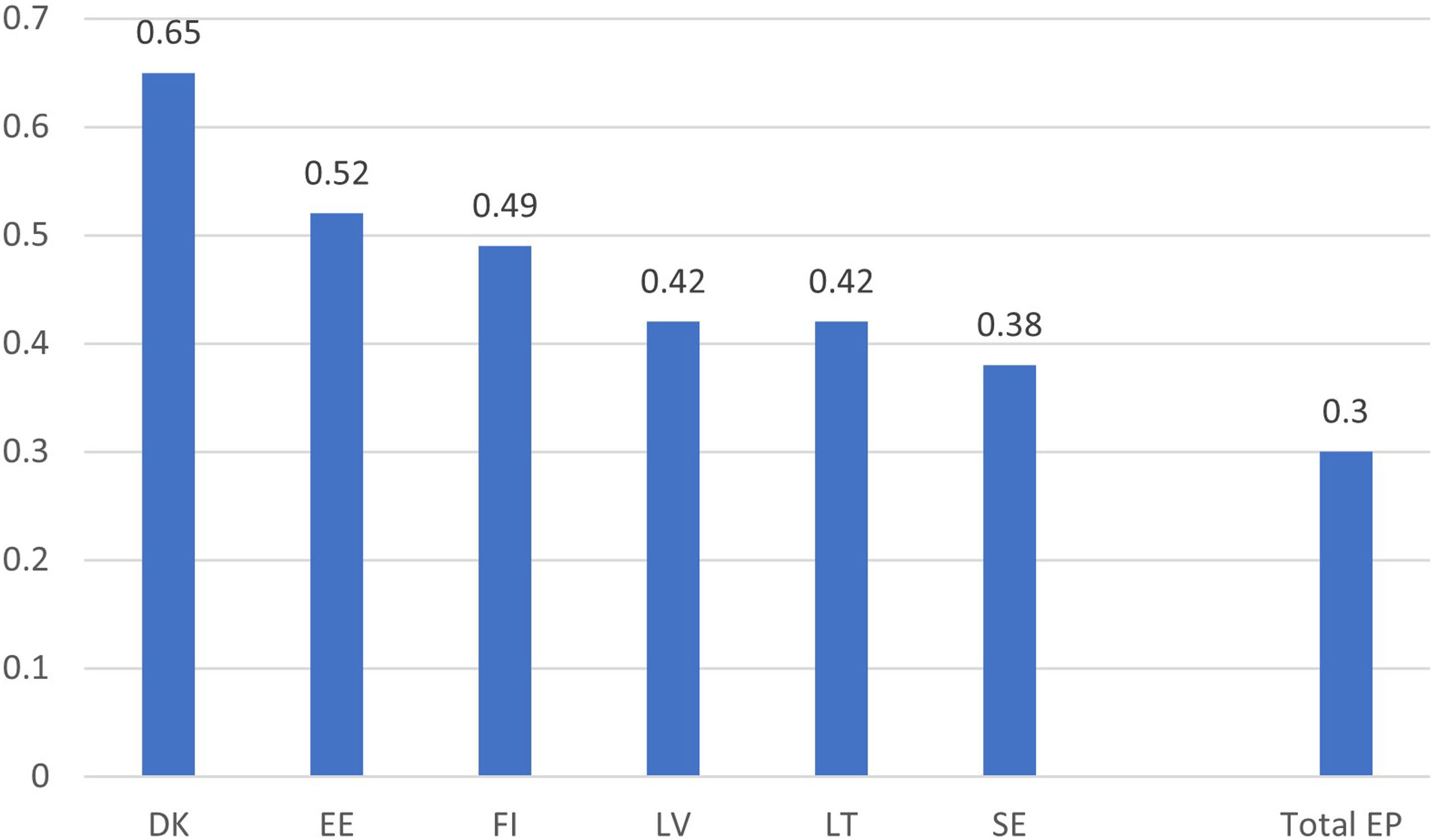
To understand intra- and inter-delegation dynamics, we now examine two ideologically-polarised amendments on border security measures - one aligning with ‘humanitarian' logic and the other with the logic of ‘securitization.'
Amendment nr. Six to RC-B9-0482/2021 submitted by MEP Pineda on behalf of The Left Group goes as follows 18a. Urges the Polish, Latvian and Lithuanian authorities to immediately end the state of emergency they have imposed as a way to impede adequate assistance to people seeking international protection and allow for unmonitored action by border authorities
The amendment faults national authorities for hindering adequate humanitarian support to reach migrants and asylum seekers and for failing to provide them with humanitarian protection.
EP voting dynamics show clear partisan patterns, with S&D and Left group’s legislators strongly in favour, and other forces opposing the amendment. Nordic-Baltic delegations generally align with ideological lines (see Figure 4). S&D and the Left group support the addition, while conservatives and moderates oppose it. Exceptions exist, like Estonia's two Social-democratic MEPs, but these often result in abstentions rather than direct opposition to the group's position. Support for RC-B9-0482/2021 (Am. 6) by national delegation.Legend: GREEN = ‘for’, RED = ‘against’, BLUE = ‘abstention’, GREY = ‘no show’. Source: Data elaborated via https://mepwatch.eu/.
Amendment nr. Four submitted by MEP Fotyga on behalf of the ECR Group goes as follows: [...] expresses respect for the efforts of Latvian, Lithuanian and Polish border guards working under extreme pressure for weeks to secure the EU’s external borders; strongly believes that the current hybrid attack on the EU requires more unity and solidarity within and among the MS, and between political leaders and opinion makers, as this is the best means to strengthen our resilience;
The amendment backs national efforts to secure borders against a 'hybrid attack' and calls for increased EU support to the MS. In terms of securitisation, EP voting dynamics follow a partisan pattern, with EPP, ECR, and ID strongly in favour, while progressives and leftists oppose it. Nordic-Baltic delegations generally align with ideological lines (see Figure 5 Support for RC-B9-0482/2021 (Am. 4) by national delegation. Legend: GREEN = ‘for’, RED = ‘against’, BLUE = ‘abstention’, GREY = ‘no show’. Source: Data elaborated via https://mepwatch.eu/.
Situation of Russian citizens and civil society after February 2022
The distribution of Russia-related votes held in the 9th EP can be clustered according to a clear dividing line: February 2022 (see Figure 6). The RCVs held before that date primarily addressed political repression, engagement between Moscow and Brussels, and Russia’s interference. After the start of the war, the conflict dominated all the votes. Frequency of votes of Russia-related topics (all the plenary days with at least one RCV) Source: Data elaborated via https://mepwatch.eu/.
Despite the EP's active role on Russia-related matters, no vote occurred on texts addressing the rising flow of Russian citizens leaving their country and the EU response. 16 The sole recorded vote on Russian citizens' asylum and protection rights was for Amendment 10 to RC-B9-0123/2023, approved on February 15.
Amendment nr. 10 submitted by MEP Wallace on behalf of The Left Group goes as follows: demands that the EU MS protect and grant asylum to Russians and Belarusians being persecuted for speaking out against or protesting the war, as well as Russian and Belarusian deserters and conscientious objectors
While assessing the match with some of the central themes identified at the national level proves challenging, given the limited material available, the amendment directly refers to asylum and protection for Russian citizens critical towards the war and towards mobilised citizens seeking refuge. The timing is also relevant as it comes after Russia’s partial mobilisation and the unilateral non-recognition of Schengen visas by bordering MS. The amendment's proponent, Irish MEP Wallace, is known for controversial views on Ukraine's resistance, consistent criticism of the EU (and NATO), and is seen by many as a Russia-friendly legislator.
The voting dynamics follow an imperfect partisan logic, with an ad-hoc coalition of EPP, Greens, and Left supporting the amendment and the others opposing it. The fact that the EPP and the radical left vote together is extremely relevant, but dissent within the former is signalled by the high abstention rate (28%). Despite the domestic relevance of the issue and the controversial proponent, the Nordic-Baltic delegations vote almost perfectly along ideological lines (see Figure 7). An exception is the unanimous vote against the amendment by the Estonian delegation, as the EPP-affiliated legislator was absent. In Lithuania, close to 50% of the delegation was absent, likely due to the controversial nature of the vote. Support for RC-B9-0123/2023 (Am. 10) by national delegation. Legend: GREEN = ‘for’, RED = ‘against’, BLUE = ‘abstention’, GREY = ‘no show’. Source: Data elaborated via https://mepwatch.eu/.
In both pools of RCVs analysed there seems to be an imperfect, but clearly noticeable connection between MEPs’ voting behaviour and their national party’s inclusion or exclusion from government at home. Overall, legislators affiliated to ruling domestic parties appear more likely than their ‘opposition’ counterparts to mimic the position of their governments and - overall - to support the mainstream position embodied by the consensual final text endorsed by the EP ‘grand coalition’, instead of sponsoring ideologically-polarised amendments away from that consensus. In line with this reasoning and as highlighted by the analysis above, amendments tend to reflect more the nature of supranational partisanship within the EP rather than to reproduce national government versus opposition dynamics supranationally.
Analysis of the parliamentary debates
Frequency of MEPs’ relevant statements.

As we focus on the region, statements from the Baltics MEPs are prevalent vis-à-vis their Nordic counterparts in debates on both crises. This trend is particularly visible when it comes to Lithuanian legislators’ statements about the Belarus-EU migration crisis. Most of the relevant statements are expressions of the largest party groups: EPP, S&D, and RE. Additionally, worth discussing is the original language of the statements. While most of Estonian and Lithuanian declarations were delivered in English, the majority of Latvian, Danish, Finnish, and Swedish statements were in the respective national languages.
Belarus-EU migration crisis
In the context of the Belarus-related votes, two distinct dimensions that informed legislators’ narratives can be identified: the nature of the crisis and the type of EU response to it. While these appear generally consensual among MEPs, the discussion on border security responsibility and security measures is more nuanced.
Nordic and Baltic MEPs tend to depict the Belarus-EU border crisis as a weaponization of migration the main responsible of which is Belarus’ ruler Aleksander Lukashenka whose “contempt for human rights” and “human life” is often mentioned by the legislators. Finnish MEP Henna Virkkunen (PPE) defines the crisis “a cold-blooded hybrid operation, with which Belarus aims to destabilise the whole of Europe.” Latvian MEP Inese Vaidere (PPE) calls it “not a refugee crisis, but a hybrid war.” Various MEPs refer to migrants being “manipulated” by the Belarusian regime “at the cost of their lives in order to achieve Lukashenko’s cynical political interests” (U. Paet, EE-RE). The instrumentalization of human suffering is a recurrent narration in the conceptualisation of the crisis: “if you use human beings, children, as weapons in your political game, if you steal young men and women’s freedom […] you act as a terrorist” (K. Karlsbro, SE-RE).
When it comes to the conceptualisation of the border, the nation-state and the external EU borders often overlap and references to “our borders" is used interchangeably to encompass both, one, or the other as the context demands. MEP Juozas Olekas (LT-S&D) denounces the attacks as being “against the borders of Lithuania, Latvia, Poland and the EU”. MEPs, including nationalists and eurosceptics, more often mention the EU external border than their national borders, emphasising a shared EU responsibility for border security. References to “protection” and “defence” of a border perceived as “weak” and “permeable” through which migrants are “actually pushed across” (I. Ijabs, LV-RE) is a function of the perceived distance of the crisis, with Baltic MEPs leading the way. Nordic radical-left MEPs frequently characterise the border in negative terms as a deliberate obstacle preventing refugees from finding safety.
The border is often defined also in civilizational terms, as a tool to protect “the EU, our way of life, our values, our solidarity” (R. Terras, EE-EPP). References to the “Belarusian border” are often coupled with threatening narratives, while “our borders” relate to the idea of protection and security.
Defining the crisis and border nature shapes how security responsibilities are narrated in line with the notion of Europe under attack. If framed as an attack or war, emphasis is on repelling the threat, prioritising securitisation over a humanitarian response for instrumentalised migrants.
Conservative Latvian and Lithuanian MEPs are the most vocal advocates for physical barriers funded through the EU budget and active frontier protection, including repressive actions. They stress the need to augment national border guards' presence with enhanced powers and increased FRONTEX personnel deployment. According to MEP Inese Vaidere (LV-EPP) more legal flexibility is a necessity “to respond strongly to such hybrid attacks in the long term as well.” Nordic conservatives or moderates appear generally more reticent about the physical barriers; nevertheless, they do not fundamentally contest the securitization paradigm and often lend their endorsement to it.
While the narrative component on securitisation appears prevalent, the debate concerning the humanitarian dimension of the crisis appears clearly across the debates, but is also polarised between those advocating the Union’s responsibility to protect the migrants and those who claim otherwise. The pressure for a de-securitisation of the border comes almost exclusively from leftist Nordic MEPs who tend to stress the need to prioritise humanitarian action instead of sealing the EU frontiers 17 . A recurrent theme is that the EU cannot behave like Belarus’ dictator: “Do we want to compete with Lukashenko in a race to the bottom on human rights?” (N. Villumsen, DK-Left). The response from many Baltic MEPs asserts that the most effective way to deter future arrivals and, ultimately, to protect migrants’ lives is “not creat [ing] false hopes, which would lead to much bigger suffering, with much bigger numbers of potential victims” (A. Kubilius, LT-EPP). Overall, Baltic delegations show convergence on a consensus-oriented narrative about border security and responsibility, transcending partisan divisions. In contrast, Nordic MEPs exhibit more pronounced partisanship, with conservatives aligning closely with Baltic counterparts, while progressives prioritise humanitarian considerations.
It is noteworthy that both Nordic and Baltic MEPs support a more direct involvement of the EU and its agencies, in conjunction with national authorities, both in terms of physical presence and financial support for the necessary border infrastructure. This perspective is intrinsically linked to and semantically justified in the light of the characterization of the crisis as distinctly European in nature and to the narrated overlapping on nation-state and EU external borders.
After Russia's invasion of Ukraine, MEPs shifted focus on Belarus as a co-aggressor, also in terms of instrumentalization of migration. In October 2022, MEP Marina Kaljurand (EE-S&D) linked the flow of Russian citizens to the EU to the EU-Belarusian migration crisis, describing it as instrumentalization of migration as “we have already seen this along the Belarusian-Lithuanian border.”
Situation of Russian citizens and civil society after February 2022
When it comes to the identification of central themes around Russian citizens in the context of Moscow’s war it is possible to identify two phases (and related narrations). The dividing line between the two seems to coincide with summer 2022 when the heinous crimes committed by the Russian forces were uncovered and the growing flow of Russian refuseniks touched its apex with the announcement of the partial mobilisation. The conceptualisation of the crisis directly affects the way in which the border at the centre of it is framed, along with the security measures and its centre of responsibility.
During the first phase, from February to summer 2022, most of the relevant NB6 statements seem to identify the Russian civil society either as Putin’s victim alongside with Ukrainians or as a vector of resistance against the regime. The idea of clear separation between Russian leadership and people is prevalent among the MEPs and made explicit in many statements: “the Russians don’t want the war. The one who wants it is Mr Vladimir Vladimirovich Putin” (N. Torvalds, FI-RE). References to protests and repression in large Russian cities are frequent and across delegations and party groups.
Among Baltic delegations, a recurring central narrative is the belief that Russian civil society bears the primary responsibility for opposing the war and challenging Putin's regime: “we should fully expect and, when possible, encourage the Russian people to take that responsibility seriously” (S. Mikser, EE-S&D). A connection is drawn between “Ukrainian victories on the battlefields” and “the help of ordinary Russians protesting on the streets” (A. Kubilius, LT- EPP), with both seen as integral to de-Putinisation.
The border, whether physical, ideological, or civilizational, is framed as an intermittent filter. While MEPs call for the complete isolation of Russia, including socio-economic and cultural aspects, we noticed a general propensity to maintain engagement with the ‘healthy' part of civil society as a vector of resistance: “Keep Russia down, Kremlin cronies out and the Russian people close” (P. Auštrevičius, LT-RE). This implies a border that is open for crossing to “those fighters who were forced to run away from Russia” (A. Kubilius, LT-EPP) and “those seeking refuge in Europe, deserters and civil society” (M. Björk, SE-Left).
In the second phase, the characterisation of the crisis changes quite visibly and the idea of Russian civil society playing an active role against the regime is portrayed as increasingly naive. The sense of disappointment is particularly visible among the Baltic delegations that increasingly target the alleged passivity of ordinary Russians as the root of the problem: “disinformation has made the Russian nation sick, as evidenced by the widespread support for the horrific war in Ukraine” (I. Vaidere, LV-EPP). The reference to a disease is a frequent theme: “[Russia] must be isolated, just like cancer cells are isolated by medical doctors” (R. Juknevičienė, LT-EPP). The distinction between the regime, the country, and its people appears much more blurred, while references to protesters and civil society significantly decline.
This directly affects the characterisation of borders and proposed border security measures aimed to isolate not only Russia, but also its citizens: “I believe there should be no international sports competitions with Russian sportsmen, no EU visas to Russian citizens and further” (A. Ansip, EE-RE) While direct references to the unilateral non-recognition of Schengen visas are rare, idea of a shared responsibility for the crimes committed by the Russian state appears to gain traction: “It is very right that the European Union stopped issuing visas to Russian citizens […] now is not the time for tourism of Russian citizens in the European Union” (M. Kaljurand, S&D - EE).
In this second phase, Baltic MEPs dominate discussions, while Nordic contributions dwindle. Even with regard to the Baltic-led non-recognition of Schengen visas, Nordic criticism remains absent or unexpressed. In May 2022, MEP Marianne Vind (DK-S&D), the only Nordic legislator to speak, aligned with Baltic colleagues, advocating “transport route blockades to halt Russia's Ukraine war”.
Regarding partisanship, two key observations arise. First, Nordic-Baltic MEPs, although appearing more vocal due to geographical proximity and historical context, generally align with their group leadership and core members on the issue. Second, within the broad ideological spectrum, differences between left and right primarily involve nuanced distinctions. Interestingly, non-mainstream or radical MEPs tend to converge towards the mainstream narrative, especially after summer 2022. Notably, Nordic left MEPs exhibit less criticism towards Ukraine and the EU compared to their continental counterparts. However, they maintain a humanitarian approach towards ordinary Russian citizens across both phases.
A chapter apart relates to Baltic MEPs representing Russophone minorities, as their positions diverge, to varying degrees, from the prevailing mainstream narrative. While Yana Toom (EE-RE) and Nils Ušakovs (LV - S&D) joined the condemnation of Russia's invasion, the stance of Tatjana Ždanoka (LV - NI) is more critical of Western and Ukrainian leadership, leading to harsh criticism in her home country. Ušakovs' position aligns with the predominant narrative of the first phase of the crisis, advocating for a clear distinction between Russia's leadership and its people, along with increased EU support for independent Russian-language media. Toom and Ždanoka's positions differ more significantly from the mainstream. Toom expresses disappointment with a narrative shift and unilateral actions by certain countries, emphasising the need from the side of the EU to address unintended consequences towards Russian citizens and Russian speakers. Ždanoka's stance sets her apart, with references to Soviet times and the USSR as the “liberator of the Baltic states”, and the alleged victimisation of Russian speakers.
Concluding considerations
The primary objective of this study was to assess elite narratives of borders and the movement of people through the double prisms of regionality and level of governance. In order to evaluate, in the context of the two crises, the convergence and degree of similarity between EUropean and Nordic-Baltic domestic level, we collected and analysed governments’ official communiques as well as EP pre-vote debates and RCVs.
The identification of parliamentary patterns and narratives well complements the study of the national level of analysis as it deepens the focus on national (or sub-regional) differences, but also adds to the impact of partisanship and ideology which, given the domestic focus on governmental positions, would have been otherwise neglected or underestimated. This also gives an opportunity to hear and amplify the voices of national opposition forces through the debates and voting patterns of the EP. Accordingly, the first (domestic) level of analysis has highlighted a few central narrative components: the conceptualisation of the events and the border, and border security responsibilities and measures. These components have served as our semantic compass to assess the overlap between national and supranational narratives.
In line with our expectations, the convergence between the national and supranational narratives, across the two sub-regions, appears very significant. The differences between Nordic and Baltic governments and legislators appear to be more in terms of intensity and proactiveness, than in terms of directionality or polarisation. Accordingly, sub-regional differences, as far as the definition of the border as a physical, ideological, or civilizational limes is concerned, can be explained primarily by the relative distance from the centre of the crisis. A secondary, but not irrelevant, factor appears related to intensity and proactiveness is partisanship and ideology as highlighted by the analysis of the parliamentary debates. Both the government communiques and the parliamentary debates converge in framing crises (as exogenously originated) and borders (as both national and EUropean at the same time).
Overall, the analysis of the national narratives on the border security responsibilities and border security measures appears coherent with what emerges from the parliamentary debates and voting patterns. In particular, the latter highlights how in the debate on the Belarus-EU border crisis the primary emphasis is on securing the border and only in the second place comes the humanitarian dimension related to the ‘responsibility to protect’. While this trend is more evident in the Baltic context (i.e. justifying collective pushbacks) and less pronounced in the Nordics, neither in the EP nor at national level a clash of positions or open criticisms, from one shore to the other of the Baltic sea, emerge.
National narratives and parliamentary debates and voting patterns also appear generally convergent when it comes to limiting the access of Russian nationals to the EU. The EP analysis highlights a growing emphasis on Russian citizens’ responsibilities starting from summer 2022. This coincides with the growing relevance of the issue in the national narratives highlighted by the analysis of the governmental communiques. Starting from that point in time, the emphasis on increasing restrictive measures has visibly grown and progressively overlap with the idea of securing the national and EU border. While the national narratives highlight a growing convergence of governmental narratives in adopting or justifying such measures, the EP debates and votes highlight the relevance of ideology and partisanship when it comes to the issue and the growing significance of the gap between mainstream and non-mainstream forces.
This attempt to assess the overlap between national and supranational narratives of borders and the movement of people, through the prism of regionality and level of governance can serve as a stepping-stone for further research seeking to decode elites’ framing of and behaviour in critical situations where both domestic concerns and European general interest are at stake.
Footnotes
Declaration of conflicting interests
The author(s) declared no potential conflicts of interest with respect to the research, authorship, and/or publication of this article.
Funding
The author(s) received no financial support for the research, authorship, and/or publication of this article.
Notes
Appendix
Table A1
Statements used in the analysis of the parliamentary debates.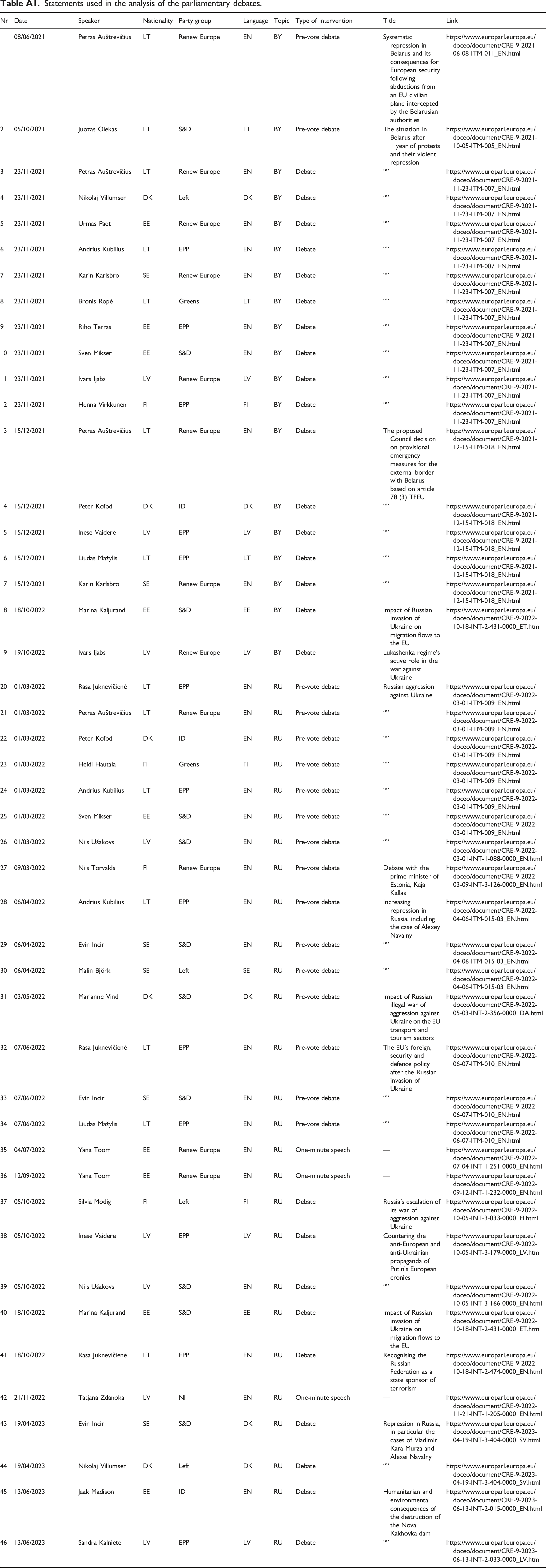
Nr
Date
Speaker
Nationality
Party group
Language
Topic
Type of intervention
Title
Link
1
08/06/2021
Petras Auštrevičius
LT
Renew Europe
EN
BY
Pre-vote debate
Systematic repression in Belarus and its consequences for European security following abductions from an EU civilian plane intercepted by the Belarusian authorities
https://www.europarl.europa.eu/doceo/document/CRE-9-2021-06-08-ITM-011_EN.html
2
05/10/2021
Juozas Olekas
LT
S&D
LT
BY
Pre-vote debate
The situation in Belarus after 1 year of protests and their violent repression
https://www.europarl.europa.eu/doceo/document/CRE-9-2021-10-05-ITM-005_EN.html
3
23/11/2021
Petras Auštrevičius
LT
Renew Europe
EN
BY
Debate
“”
https://www.europarl.europa.eu/doceo/document/CRE-9-2021-11-23-ITM-007_EN.html
4
23/11/2021
Nikolaj Villumsen
DK
Left
DK
BY
Debate
“”
https://www.europarl.europa.eu/doceo/document/CRE-9-2021-11-23-ITM-007_EN.html
5
23/11/2021
Urmas Paet
EE
Renew Europe
EN
BY
Debate
“”
https://www.europarl.europa.eu/doceo/document/CRE-9-2021-11-23-ITM-007_EN.html
6
23/11/2021
Andrius Kubilius
LT
EPP
EN
BY
Debate
“”
https://www.europarl.europa.eu/doceo/document/CRE-9-2021-11-23-ITM-007_EN.html
7
23/11/2021
Karin Karlsbro
SE
Renew Europe
EN
BY
Debate
“”
https://www.europarl.europa.eu/doceo/document/CRE-9-2021-11-23-ITM-007_EN.html
8
23/11/2021
Bronis Ropė
LT
Greens
LT
BY
Debate
“”
https://www.europarl.europa.eu/doceo/document/CRE-9-2021-11-23-ITM-007_EN.html
9
23/11/2021
Riho Terras
EE
EPP
EN
BY
Debate
“”
https://www.europarl.europa.eu/doceo/document/CRE-9-2021-11-23-ITM-007_EN.html
10
23/11/2021
Sven Mikser
EE
S&D
EN
BY
Debate
“”
https://www.europarl.europa.eu/doceo/document/CRE-9-2021-11-23-ITM-007_EN.html
11
23/11/2021
Ivars Ijabs
LV
Renew Europe
LV
BY
Debate
“”
https://www.europarl.europa.eu/doceo/document/CRE-9-2021-11-23-ITM-007_EN.html
12
23/11/2021
Henna Virkkunen
FI
EPP
FI
BY
Debate
“”
https://www.europarl.europa.eu/doceo/document/CRE-9-2021-11-23-ITM-007_EN.html
13
15/12/2021
Petras Auštrevičius
LT
Renew Europe
EN
BY
Debate
The proposed Council decision on provisional emergency measures for the external border with Belarus based on article 78 (3) TFEU
https://www.europarl.europa.eu/doceo/document/CRE-9-2021-12-15-ITM-018_EN.html
14
15/12/2021
Peter Kofod
DK
ID
DK
BY
Debate
“”
https://www.europarl.europa.eu/doceo/document/CRE-9-2021-12-15-ITM-018_EN.html
15
15/12/2021
Inese Vaidere
LV
EPP
LV
BY
Debate
“”
https://www.europarl.europa.eu/doceo/document/CRE-9-2021-12-15-ITM-018_EN.html
16
15/12/2021
Liudas Mažylis
LT
EPP
LT
BY
Debate
“”
https://www.europarl.europa.eu/doceo/document/CRE-9-2021-12-15-ITM-018_EN.html
17
15/12/2021
Karin Karlsbro
SE
Renew Europe
EN
BY
Debate
“”
https://www.europarl.europa.eu/doceo/document/CRE-9-2021-12-15-ITM-018_EN.html
18
18/10/2022
Marina Kaljurand
EE
S&D
EE
BY
Debate
Impact of Russian invasion of Ukraine on migration flows to the EU
https://www.europarl.europa.eu/doceo/document/CRE-9-2022-10-18-INT-2-431-0000_ET.html
19
19/10/2022
Ivars Ijabs
LV
Renew Europe
LV
BY
Debate
Lukashenka regime's active role in the war against Ukraine
20
01/03/2022
Rasa Juknevičienė
LT
EPP
EN
RU
Pre-vote debate
Russian aggression against Ukraine
https://www.europarl.europa.eu/doceo/document/CRE-9-2022-03-01-ITM-009_EN.html
21
01/03/2022
Petras Auštrevičius
LT
Renew Europe
EN
RU
Pre-vote debate
“”
https://www.europarl.europa.eu/doceo/document/CRE-9-2022-03-01-ITM-009_EN.html
22
01/03/2022
Peter Kofod
DK
ID
EN
RU
Pre-vote debate
“”
https://www.europarl.europa.eu/doceo/document/CRE-9-2022-03-01-ITM-009_EN.html
23
01/03/2022
Heidi Hautala
FI
Greens
FI
RU
Pre-vote debate
“”
https://www.europarl.europa.eu/doceo/document/CRE-9-2022-03-01-ITM-009_EN.html
24
01/03/2022
Andrius Kubilius
LT
EPP
EN
RU
Pre-vote debate
“”
https://www.europarl.europa.eu/doceo/document/CRE-9-2022-03-01-ITM-009_EN.html
25
01/03/2022
Sven Mikser
EE
S&D
EN
RU
Pre-vote debate
“”
https://www.europarl.europa.eu/doceo/document/CRE-9-2022-03-01-ITM-009_EN.html
26
01/03/2022
Nils Ušakovs
LV
S&D
EN
RU
Pre-vote debate
“”
https://www.europarl.europa.eu/doceo/document/CRE-9-2022-03-01-INT-1-088-0000_EN.html
27
09/03/2022
Nils Torvalds
FI
Renew Europe
EN
RU
Pre-vote debate
Debate with the prime minister of Estonia, Kaja Kallas
https://www.europarl.europa.eu/doceo/document/CRE-9-2022-03-09-INT-3-126-0000_EN.html
28
06/04/2022
Andrius Kubilius
LT
EPP
EN
RU
Pre-vote debate
Increasing repression in Russia, including the case of Alexey Navalny
https://www.europarl.europa.eu/doceo/document/CRE-9-2022-04-06-ITM-015-03_EN.html
29
06/04/2022
Evin Incir
SE
S&D
EN
RU
Pre-vote debate
“”
https://www.europarl.europa.eu/doceo/document/CRE-9-2022-04-06-ITM-015-03_EN.html
30
06/04/2022
Malin Björk
SE
Left
SE
RU
Pre-vote debate
“”
https://www.europarl.europa.eu/doceo/document/CRE-9-2022-04-06-ITM-015-03_EN.html
31
03/05/2022
Marianne Vind
DK
S&D
DK
RU
Pre-vote debate
Impact of Russian illegal war of aggression against Ukraine on the EU transport and tourism sectors
https://www.europarl.europa.eu/doceo/document/CRE-9-2022-05-03-INT-2-356-0000_DA.html
32
07/06/2022
Rasa Juknevičienė
LT
EPP
EN
RU
Pre-vote debate
The EU’s foreign, security and defence policy after the Russian invasion of Ukraine
https://www.europarl.europa.eu/doceo/document/CRE-9-2022-06-07-ITM-010_EN.html
33
07/06/2022
Evin Incir
SE
S&D
EN
RU
Pre-vote debate
“”
https://www.europarl.europa.eu/doceo/document/CRE-9-2022-06-07-ITM-010_EN.html
34
07/06/2022
Liudas Mažylis
LT
EPP
EN
RU
Pre-vote debate
“”
https://www.europarl.europa.eu/doceo/document/CRE-9-2022-06-07-ITM-010_EN.html
35
04/07/2022
Yana Toom
EE
Renew Europe
EN
RU
One-minute speech
---
https://www.europarl.europa.eu/doceo/document/CRE-9-2022-07-04-INT-1-251-0000_EN.html
36
12/09/2022
Yana Toom
EE
Renew Europe
EN
RU
One-minute speech
---
https://www.europarl.europa.eu/doceo/document/CRE-9-2022-09-12-INT-1-232-0000_EN.html
37
05/10/2022
Silvia Modig
FI
Left
FI
RU
Debate
Russia’s escalation of its war of aggression against Ukraine
https://www.europarl.europa.eu/doceo/document/CRE-9-2022-10-05-INT-3-033-0000_FI.html
38
05/10/2022
Inese Vaidere
LV
EPP
LV
RU
Debate
Countering the anti-European and anti-Ukrainian propaganda of Putin’s European cronies
https://www.europarl.europa.eu/doceo/document/CRE-9-2022-10-05-INT-3-179-0000_LV.html
39
05/10/2022
Nils Ušakovs
LV
S&D
EN
RU
Debate
“”
https://www.europarl.europa.eu/doceo/document/CRE-9-2022-10-05-INT-3-166-0000_EN.html
40
18/10/2022
Marina Kaljurand
EE
S&D
EE
RU
Debate
Impact of Russian invasion of Ukraine on migration flows to the EU
https://www.europarl.europa.eu/doceo/document/CRE-9-2022-10-18-INT-2-431-0000_ET.html
41
18/10/2022
Rasa Juknevičienė
LT
EPP
EN
RU
Debate
Recognising the Russian Federation as a state sponsor of terrorism
https://www.europarl.europa.eu/doceo/document/CRE-9-2022-10-18-INT-2-474-0000_EN.html
42
21/11/2022
Tatjana Zdanoka
LV
NI
EN
RU
One-minute speech
---
https://www.europarl.europa.eu/doceo/document/CRE-9-2022-11-21-INT-1-205-0000_EN.html
43
19/04/2023
Evin Incir
SE
S&D
DK
RU
Debate
Repression in Russia, in particular the cases of Vladimir Kara-Murza and Alexei Navalny
https://www.europarl.europa.eu/doceo/document/CRE-9-2023-04-19-INT-3-404-0000_SV.html
44
19/04/2023
Nikolaj Villumsen
DK
Left
DK
RU
Debate
“”
https://www.europarl.europa.eu/doceo/document/CRE-9-2023-04-19-INT-3-404-0000_SV.html
45
13/06/2023
Jaak Madison
EE
ID
EN
RU
Debate
Humanitarian and environmental consequences of the destruction of the Nova Kakhovka dam
https://www.europarl.europa.eu/doceo/document/CRE-9-2023-06-13-INT-2-015-0000_EN.html
46
13/06/2023
Sandra Kalniete
LV
EPP
LV
RU
Debate
“”
https://www.europarl.europa.eu/doceo/document/CRE-9-2023-06-13-INT-2-033-0000_LV.html
Author biographies