



Abstract
The article analyses the evolution of European diplomacy over two decades, to assess the impact of the European External Action Service (EEAS) creation alongside consecutive waves of enlargement. Data is drawn from two original datasets about European Union (EU) member states’ diplomatic representations within the EU and across the globe. It shows that member states have maintained and strengthened their substantial diplomatic footprint across the EU’s territory, expanding it to include new members and making Brussels a diplomatic hub also for non-member countries. In parallel, and despite the establishment of the EEAS, member states have maintained and even increased their networks of diplomatic representations across the globe, alongside more numerous and more politically active EU Delegations (EUDs). At the same time, member states have been reducing their diplomats’ numbers, as the cases of Austria, France, Germany and Italy show. This delicate balancing act has been made possible not only by contemporary technological developments, but also by European cooperation, as in the case of EUDs hosting member states’ representations in non-member countries, a development referred to as co-location. Therefore, whereas the continued presence of national embassies on the ground could be interpreted as detracting from the EEAS, the existence of EUDs contributes also to other, more indirect but certainly novel, forms of diplomatic cooperation under a single European roof.
Introduction
This article analyses the evolution of European diplomacy, and more particularly of the European Union’s (EU) and its member states’ networks of diplomatic representations during the last two decades, marked by profound changes. The aim is to assess how member states have deployed their diplomats in a changing European and global context, by considering the reach and depth of their diplomatic networks, and their evolution across time, in comparison to the increasing diplomatic network of the EU.
The Treaty of Lisbon and the creation of the European External Action Service (EEAS) radically altered the set-up of the EU’s foreign affairs system, not only in Brussels but also beyond EU borders with the establishment of EU Delegations (EUDs). This occurred as the EU nearly doubled its membership, with the 2004, 2007 and 2013 enlargements. These developments have been analysed from a number of perspectives, ranging from EU foreign affairs more generally (see for instance Costa, 2019; Missiroli, 2010; Smith, 2013) to the EEAS (Balfour et al., 2015; Smith et al., 2016) to specific examples of diplomatic cooperation on the ground in third countries (Baltag and Smith, 2015; Bicchi and Maurer, 2018; Maurer and Raik, 2018). Much less has been written on the evolution of EU member states’ diplomatic networks in parallel to and because of the EU’s enlargement and the set-up of the EEAS and EUDs. While the analytical focus in the literature has tended to privilege an EU-centric approach, this article aims to complement this with an analysis of how member states’ national diplomacies have changed alongside the EU, both within the EU territory and across the globe. To what extent (and in what ways) have changes within the EU foreign policy structure been reflected in changes to member states’ national diplomatic networks, across Europe and beyond? How has European diplomacy as a whole evolved over the last 20 years and what does that suggest in relation to future developments?
The purpose here is to trace the evolution of European diplomatic networks within the EU and beyond the EU borders, in order to show how the macro-picture has changed during two decades of turbulent times. The article focuses on data generation and exploratory analysis, rather than hypotheses confirmation. Identifying specific causal mechanisms will be the next step and requires in-depth interviewing and further qualitative and quantitative analysis. Rather, the aim here is to identify the main quantitative dimension of European diplomatic networks, namely the number of European representations (member states’ embassies and EUDs), and assess its variation across time, while proposing a number of plausible explanations. To that effect, we examine diplomats’ numbers and budget for four countries (Austria, France, Germany and Italy). We thus aim to build on similar analyses of the past (Balfour et al., 2015; Manners and Whitman, 2000) and to systematise the data on which they relied. Once set alongside the academic debate and the establishment of the EEAS, the evolution in these figures shows a number of important patterns for current debates about the future of diplomacy, the EU and international politics more generally, as we are going to explore.
In this article, we define a diplomatic network as the set of diplomatic representations maintained by a member state or by the EU across the globe. 1 The data presented here pertains to bilateral relations only, between each actor and the hosting country, 2 and comes from two original datasets on diplomatic representations of EU current and prospective member states, as well as of the EC/EU. The first dataset includes data on diplomatic representations within the EU territory from the Diplometrics dataset, 3 updated using Europa World Factbook data. It focuses on representation within the EU, outlining diplomatic networks for 2001, 2009 and 2018. 4 The second dataset is devoted to representation outside the EU and uses data derived from EEAS documents, supplemented with data from the Diplometrics Diplomatic Representation dataset and Europa World Factbook data. While the main data source excludes countries not recognised by all EU member states, it has the advantage of presenting official data, collected on a 6-monthly basis over the period 2001–2018, which differs from alternative datasets on diplomatic representation. 5 As data on each member state is only available from the accession date, it is complemented by the two other sources for pre-accession data. The two datasets were not merged, as the variety of sources would make comparison between representations inside and beyond EU borders less reliable. The primary goal of this article is thus to show the evolution across time and given changes to the EU’s set-up within the two datasets of European diplomatic networks, as well as to compare the evolution of diplomatic representations within the EU and outside its borders. To put it differently, we track two political phenomena, through the use of two original datasets: 1) diplomatic representation of both member states and non-member states inside the EU; 2) diplomatic representation of member states and the EU outside the EU.
Three main trends emerge from the evidence presented. First, the period of the ‘big bang’ enlargement of 2004, which brought 10 new member states to the EU, engendered a wave of new diplomatic representations within Europe with the goal of weaving together the new diplomatic shape of the continent. This new set of embassies scattered across Europe partially fizzled out in the following decade, but member states continue to maintain a significant diplomatic focus within the EU’s territory, where most of their overall diplomatic footprint is located. Second, the creation of the EEAS and of EUDs across the globe has not reduced individual member states’ diplomatic representations beyond the EU’s borders. Contrary to expectations, the Europeans’ diplomatic network has marginally but surely expanded over the last two decades, even while the network of EUDs was consolidating. Third, this expansion has been supported by contrasting trends in member states’ human resources. The numbers of member states’ diplomats seem to be declining, as a more in-depth analysis of Austria, France, Germany and Italy shows. The increasingly thin distribution of diplomats supports member states’ global reach thanks not only to technological means, but also to creative – and once again EU-centred – solutions such as co-locations, in which EUDs host member states’ diplomatic representations.
These trends add to the existing literature in a number of ways. They confirm the argument that established relations between EU member states differ from diplomatic contacts with non-EU countries. Diplomacy of EU members and by EU members is a key component in the EU framework, and Brussels is a diplomatic hub. There are gains to be found at the margins, however, where member states have discovered that cooperation can thrive even without diplomatic contacts in capitals. Beyond EU borders, the EU’s effort at creating a diplomatic network of its own through EUDs has not limited the territorial ambitions of member states. ‘Being there’ remains a key quality of contemporary diplomacy, even when it is down to a single person per diplomatic representation. Territory maintains a continuing and in fact increasing importance in member states’ diplomatic considerations, even at a time of budget cuts, information abundance and increased technological means. As we are going to see, however, the existence of EUDs has engendered new forms of cooperation that have contributed to sustaining a reduction in diplomats’ (not embassies’) numbers.
The article is organised as follows. In the next section, we provide an overview of the literature on the evolution of diplomacy, and European diplomacy in particular. The third section focuses on the Europeans’ diplomatic network within EU borders, including third country representation to the EU. In the fourth section, we analyse European diplomatic networks beyond EU borders, across time and in relation to the establishment of the EEAS. In the final section, we analyse the human resources underpinning member states’ global reach, by focusing on personnel numbers and budget for four ministries of Foreign Affairs, as well as the existing co-locations of EUDs and national representations in non-EU countries.
European diplomacy: the scholarly state of the art
The literature on diplomacy, and European diplomacy in particular, is undergoing a revival, but scholarly arguments seem to suggest contradictory developments. Analyses of diplomacy – a fashionable research topic again, largely due to the ‘practice turn’ in International Relations (IR) – seem at odds with globalisation studies, which suggest that virtual means of communication are detracting from the relevance of territorial reach and physical presence. For their part, institutional analyses have highlighted the changing nature of the EU foreign policy system in response to the Europeanisation (and ‘Brusselisation’) of foreign policy and the creation of the EEAS, on average suggesting a deepening of member states’ reliance on cooperation within the EU. Therefore, there are contrasting arguments about how member states’ diplomatic networks should evolve, in a context of expanded EU membership and strengthened EU diplomatic presence.
The resurgent interest in diplomacy has been driven by scholars tracking its developments and describing specific historical examples (Berridge, 2010; Black, 2010; Cooper et al., 2015; Cross, 2007; Goff, 2015; Hall, 2010; Murray et al., 2011; Sharp, 2011; Sofer, 1988). This interest has received further impetus from the more recent ‘practice turn’ in International Relations, which has highlighted diplomacy’s theoretical contribution (Bicchi and Bremberg, 201; Neumann, 2016; Pouliot, 2016; Pouliot and Cornut, 2015). In fact, practice approaches have turned diplomacy into a flagship research topic in which to showcase their original perspective. In particular, many scholars in the practice perspective have pointed to the crucial role of ‘frontline diplomacy’ (Cooper and Cornut, 2019) and to the need for diplomats to be on the ground in order to hone their skills (Kuus, 2015).
Globalisation studies, however, seem to challenge the role of territoriality, by implication suggesting that traditional embassies may go extinct. Drawing on arguments about the crisis of territoriality (e.g. Maier, 2000), this perspective points to the limitations of traditional embassies, citing financial constraints, advances in IT and communications, as well as vulnerability to irregular warfare (cf. Scott-Smith, 2017). Many scholars have also stressed the importance of digital changes for public diplomacy (Copeland, 2015; Cornut and Dale, 2019). This perspective points to a global trend towards an apparent reduction in the number of embassies, which can no longer compete with alternatives. Alex Oliver, who directs the Diplomatic Index at the Lowy Institute, for instance, argued that ‘embassies are now usually the slowest way to get information, unable to compete with lightning-fast media reporting and exhaustive country analyses prepared by NGOs and risk consultancies’ (Oliver, 2016). Economic and financial constraints impose further limitations to the diplomatic machine, especially when alternatives exist to the expensive choice of maintaining an embassy.
There are thus conflicting expectations about the future of diplomatic representations on the ground, seen as a redundant expense from the perspective of globalisation, but also as an important site for tracing the direction of foreign policy from a practice perspective. These are not resolved in the literature on European diplomacy, which actually further complicates the picture with the creation of the EEAS.
Within European diplomacy, bilateral relations among member states are known to have a different quality from those between EU member states and third countries (Bátora and Hocking, 2009). This has been explained primarily by the degree of economic and political integration achieved through EU membership (Bátora, 2005), which has created a need for regular consultation and exchange, part of which occurs through traditional diplomatic means (Paschke, 2005). While foreign ministries and diplomats still have a role to play in bilateral ties between EU member states, this is often about facilitating ties between ministries or in Brussels, given the density of intra-EU relations and cooperation within the EU’s political system. The cross-boundary nature of some EU policies also creates the need for direct dialogue between member state authorities. Therefore, a core part of an EU member state’s diplomatic activity in other EU member states lies in coordinating and promoting a state’s positions within EU decision-making processes (Bátora and Hocking, 2009: 177–178). Diplomacy among EU member states thus has a slightly different quality to diplomacy beyond EU borders, not only justifying an emphasis on peaceful means, 6 but also suggesting a different type of communication and involvement among participants.
In this vein, two views about the relevance of intra-EU diplomacy co-exist. On the one hand, the ‘domestication’ of intra-EU diplomacy, at least in the period prior to the Lisbon Treaty, seems not to lead to a reduction of diplomatic resources (here in terms of staff deployed) in embassies within the EU (Bratberg, 2008). Rather, intra-EU embassies serve as hubs which can connect various national subject ministries with their relevant counterparts in another EU member state alongside other innovations in bilateral intra-EU diplomacy which circumvent embassies entirely (Uilenreef, 2014).
On the other hand, EU foreign affairs seem to have undergone a ‘Brusselisation’ (Allen, 1998), meaning that policy formulation, decision and implementation are increasingly conducted by officials based in Brussels. Especially in the 1990s and after, the physical and psychological locus of national decision-making in EU foreign policy seems to have shifted to Brussels-based intergovernmental institutions (Thomas and Tonra, 2012). Indeed, there is also a theoretical case to be made for a centralisation of EU diplomacy to occur (Austermann, 2014: 70–96). All of this would suggest a more limited relevance of diplomacy in EU member states’ capitals, given the amount of work conducted in Brussels.
Beyond EU borders, the creation of the EEAS, with the related upgrade of EUDs, has sparked a renewed interest in the way the EU is contributing to innovation in the age-old institution of diplomacy (Adler-Nissen, 2014; Bicchi, 2014; Bicchi and Maurer, 2018; Edwards, 2014; Hofius, 2016; Koops and Macaj, 2015; Spence and Bátora, 2015). The expectation across the literature has generally been that the EEAS and the EUDs were going to have a clear and significant impact on EU external relations, including on member states’ diplomatic networks. Not only ‘the existence of national embassies is seriously threatened in third countries where the EU has a genuine European approach’, but also the ‘network of “EU embassies” is going to get more intense and diversified, dealing [. . .] more and more with CFSP affairs’ and thus challenging tasks traditionally undertaken by national embassies (Morisse-Schillbach, 2005: 123). While some work has been done on charting the evolution of the networks of EUDs and the reasons underpinning this (Austermann, 2014; Duquet, 2018), limited research analyses how member states develop and integrate within the complex EU foreign policy system. The work in Balfour et al. (2015) stands as an exception and a recent continuation of the debate kick-started by Manners and Whitman (2000). This perspective should instead be further developed, as member state foreign policy continues to be relevant despite radical changes in the EU’s diplomatic system (Hadfield et al., 2017).
Therefore, contrasting arguments exist about how member state diplomatic networks should evolve. While globalisation and European cooperation are expected to detract from the need to deploy diplomats abroad, European cooperation also requires diplomats, and not just in Brussels, to appreciate the local context, as suggested by practice approaches in IR. This article thus aims to take up the challenge set by these works in providing an empirical assessment at the macro level as to the actual evolution of European diplomatic networks over the last two decades. As the next sections demonstrate, the evidence collected suggests the continuing relevance of diplomatic representations for member states and the EU, especially within EU borders, but at the price of a thinning in the numbers of diplomats deployed.
Diplomatic representation inside the EU
The first argument explored here through empirical evidence concerns the evolution of diplomatic representations within EU borders. As this section shows, we observe an intensification of the intra-European diplomatic network in parallel to the EU’s enlargement rounds, which is partially reversed after enlargement. In parallel, ‘Brusselisation’ of foreign policy making appears to affect third countries seeking to interact diplomatically with the EU and its member states.
Chart 1 provides an overview of representations of (original and post-2004) EU member states in other member states only, across time. It shows the high density of intra-EU representation of the EU’s member states, where even the EU’s smallest members such as Malta or Luxembourg maintain embassies in close to half of EU member states. At the same time, the EU’s larger member states are represented in every single EU member state.

Representation of EU-28 countries in EU-28 member states over time.
Considering the evolution of this intra-EU representation over time further points to the distinctive nature of intra-EU diplomacy, as the EU’s eastern enlargement rounds coincided with an across-the-board increase of intra-EU representation from a total of 603 in 2001 to a maximum of 699 in 2009. The increase of bilateral representation ahead of the EU’s enlargement rounds is indicative of countries’ desire to be directly informed about and able to shape the EU enlargement process. Of particular relevance here, both ‘old’ and soon-to-be EU member states increased the number of their representations in the other grouping. The desire for information and influence at the time of the EU’s enlargements thus went both ways.
The number of intra-EU embassies has remained relatively high. Nonetheless, it has declined from this peak to 661 in 2018. While large EU member states have refrained from reducing their intra-EU representation, the bulk of the reduction in intra-EU embassies was made by medium-sized ‘old’ EU member states. The number of representations of post-2004 member states instead is comparably more stable, with the even newer members Romania and Croatia (as well as the prior member Ireland) bucking the trends and minimally increasing their representation still.
These developments may indicate a partial move away from consultations through embassies in favour of more direct exchanges between ministries or officials based in Brussels, thereby confirming the trend towards increasing ‘Brusselisation’ (Juncos and Pomorska, 2011: 1100–1103). Cost-saving innovations such as establishing ‘roaming’ ambassadors responsible for multiple countries or embedding officials within other countries’ ministries may also account for some of the changes observed (Mattelaer, 2019: 10). Overall, while the ongoing robustness of intra-EU diplomatic ties initially observed by Bratberg (2008) is no longer a given, member states’ intra-EU diplomatic representation still remains very robust. Ultimately, bilateral representations in other member states complement Brussels-based processes, rather than entirely being replaced by them (Mattelaer, 2019: 12).
‘Brusselisation’ arguably happens in relation to third countries too. Despite ongoing debates as to the status of the EU in the international system (Duquet and Wouters, 2015), the EU is not only recognised by other actors as a regular participant by accepting EUDs to them, but also and more directly through third countries’ official diplomatic missions accredited to the EU. In 2018 there were 163 non-EU countries accredited with a mission to the EU, 7 of which 159 had their seat in Brussels or its environs. These do not include other kinds of representative offices, of entities (such as regions) not recognised as sovereign countries or international organisations.
In comparison to other world capitals, 8 Brussels was one of the major hubs of global diplomacy in 2018 with 186 missions (159 official third country representations to the EU in Brussels plus 28 EU member state permanent representations), comparable to national capitals such as Washington, DC (177), but also exceeding Beijing (165), Tokyo (153), Delhi (149) and Moscow (147). When considering diplomatic representation to other EU member states, then, only London (164), Berlin (160), or Paris (155) reach similar levels of local diplomatic representation, if we bracket Brussels as the parallel site for bilateral embassies to Belgium. Vienna (153) is in a similar position, as one of the several sites of the United Nations and other relevant international organisations. Lastly, Geneva (183) closely matches Brussels’ formal status given the presence of international organisations there. Outside of Europe only New York City (195) hosts a larger number of bilateral delegations, given that it serves as the main United Nations headquarters.
The ‘Brusselisation’ of third state representation to the EU is thus closely tied to the evolution of the EU and its foreign policy making. 9 While 146 countries were already present in Brussels around the time of the introduction of the Treaty of Maastricht in 1993, this further increased to 180 at the time of the Lisbon Treaty in 2009, to reach the current 186. The increasing foreign policy activity of the EU has thus not just favoured increased diplomatic contacts between EU member states, in Brussels and across the EU, but has also established Brussels as a key hub for diplomatic activity of third countries in Europe – and in the world more generally.
The European diplomatic network outside the EU
Even though EU member states’ diplomatic networks are much less dense outside of Europe, there has been a small but consistent expansion of their diplomatic networks across the globe since 2009, contrary to expectations (see e.g. Balfour et al., 2015: 199). This is not a simple linear increase, however, as the networks’ specific location and reach has shifted in line with member states’ re-prioritisation and re-direction of their diplomatic representations.
Chart 2 provides an overview of the evolution of the size of each EU member state’s diplomatic network (and that of the EEAS) over time, measured by the number of bilateral embassies in non-EU member states. Several observations emerge. First, the EU’s own network of EUDs has risen considerably over time from the original EC offices in 2001. By 2018, the EEAS diplomatic reach rivalled that of the member states with the largest bilateral diplomatic networks, France, Germany and the UK. Second, with a few notable exceptions, most member states have increased the size of their diplomatic networks. This rise is particularly pronounced in member states having joined since 2004, as well as the UK, Spain and Luxembourg. Sweden is the country with the largest absolute increase of its diplomatic network, with 16 new embassies since 2009. Running counter to this trend, a handful of countries, namely the Netherlands, Greece, Bulgaria and Denmark have instead reduced the size of their extra-EU diplomatic networks, to different degrees. Overall the total number of EU-28 embassies outside of the EU has risen from 1525 in 2009 to a total of 1606 (excluding the EUDs) in 2018. The overall trend clearly defies the expectations that member states would delegate functions to EUDs, close representations outside the EU or rely uniquely on technological means.
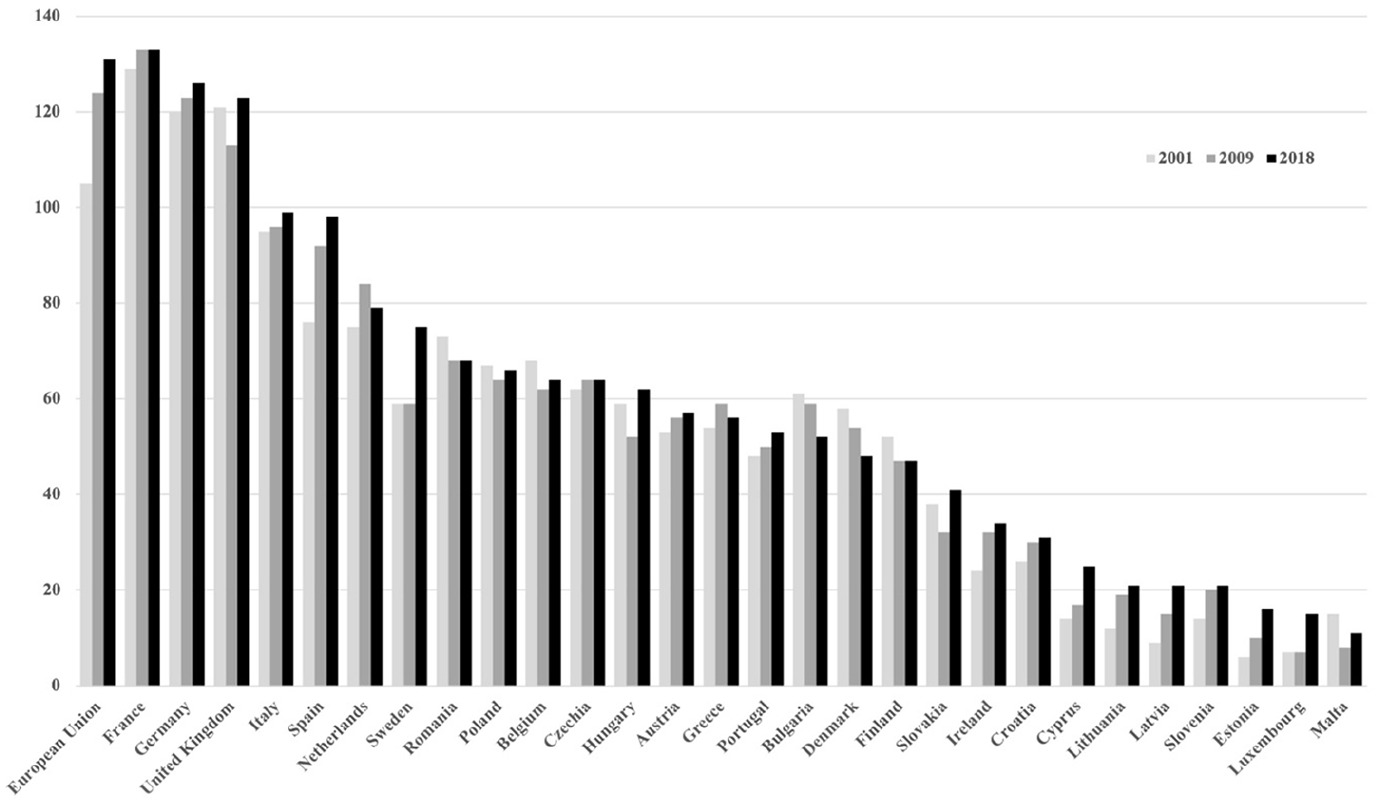
Representation in non-EU-28 countries of EU-28 member states over time; 2001 EU data relates to European Commission representative offices.
While increases in the overall size of the diplomatic networks have been particularly pronounced for many member states joining the EU since 2004, others also made important adjustments to their diplomatic networks, some through lateral changes, by closing one embassy here and simultaneously opening another there. The data presented in Table 1 provides indexed overviews of changes from 2009 to 2018 to member states’ diplomatic networks. The first index considers changes to the overall size of a member state’s diplomatic network by calculating the average proportion of annual changes for the observed time period (number of embassies opened/closed in relation to the total size of the diplomatic network in the previous year). So as to also capture the fact that some member states regularly close an embassy to allow for the parallel opening of another, an averaged index of lateral volatility is also calculated (embassy closures/openings within the same year in relation to the total network size in the previous year). These indices are then added to make the total volatility of member state diplomatic networks comparable.
Volatility of diplomatic networks between 2009 and 2018.

Strikingly, most of the volatility in member states’ diplomatic networks is indeed due to changes to their overall size, rather than lateral moves of embassy openings and closures. Indeed, many member states have not undertaken any lateral changes whatsoever. In fact, it is not surprising that countries with an already large diplomatic network, such as France or Germany see less of a need to make any changes. These are rather made by many of the EU’s post-2004 member states, together with countries such as Luxembourg and Sweden. This is not a rule, though, as Romania hardly made any changes to its diplomatic network. Overall, the data suggests that the post-Lisbon period has indeed been a moment of adjustment for many member state diplomatic networks, leading to many increases in size and a few lateral moves.
The observed changes paint a picture of the Europeans’ collective diplomatic footprint across the globe in 2018 as outlined in Map 1. The map considers both member state embassies and EUDs collectively in third countries, testifying to Europe’s extensive diplomatic reach. While the number of EU member states’ embassies in any one third country varies significantly, overall there are only very few countries in which no European diplomatic presence exists. At the same time, there are very few capitals in which all 28 member states and EUDs are represented, namely Beijing, Moscow and Washington, DC. From a regional perspective, the Europeans’ diplomatic footprint is limited in Africa and, to an extent, in Latin America. Despite figuring more prominently in contemporary EU discourses and policy initiatives, African countries have not seen many European diplomats, partly also due to the difficult security situation on the ground in some of them.

Size of the EU’s diplomatic network by partner country in 2018 (maximum 28 member states + EUD).
This snapshot of the European diplomatic network is the result of the individual changes described above. Map 2 traces these changes in third countries and shows how those changes in the diplomatic networks of individual EU member states have altered the collective reach of EU diplomacy. In fact, it is possible to observe a clustering effect in certain places, with countries like Myanmar, Qatar, the United Arab Emirates (UAE), India, Kazakhstan and Somalia being increasingly in the focus of EU diplomacy. Other centres of current or expected economic growth have also seen slight increases. As our dataset shows, in the cases of Myanmar, UAE and Somalia member states have followed in the footsteps of the EUD establishing a presence there. Overall, most of these expansion patterns can coincide with either global economic trends – as expected by existing research (Smith, 2018) – or relevant political developments in the countries at hand.

Change in the EU’s diplomatic network by partner country between 2009 and 2018 (EU-28 + EUD).
Second, the overall increase in diplomatic representations has been accompanied by a moderate withdrawal from other parts of the world. Parts of the African continent stand out as areas from which member states have seemingly disinvested in diplomatic terms. Again, part of the reason lies in the politics (or rather, the conflicts) that characterise these places, such as Sudan or Yemen. Outside of Africa a decrease in the EU’s diplomatic representation can also be seen in Central America and Venezuela. This last case is one to be monitored further given the volatile economic and political situation in the country and the EU’s divided reaction to it (Schade, 2019: 340–341). In fact, disinvesting from diplomacy on the ground is paralleled by an increase in diplomacy from capitals, when attempts at solving the crisis take place.
Overall, the data shows the global reach of European diplomacy outside the EU, a trend which is further expanding. Given the observed pattern of diplomatic representation following economic and political trends, diplomatic territorial reach appears to still be relevant, despite expectations to the contrary. This is in line with previous analyses of the evolution of European diplomatic networks (Rijks and Whitman, 2007: 36–37) but counter to part of the globalisation studies. Moreover, extra-EU diplomatic representation of the EU and of its member states is in constant flux and likely to evolve further in line with global conflicts, economic developments and ongoing European integration on diplomatic matters. What needs to be assessed is the shape of this continuing trend towards global representation, and what kind of commitment in terms of human resources it expresses.
Expanding the diplomatic network, but cutting diplomats’ numbers
The observed constant and even expanding size of the diplomatic networks of the EU’s member states outside of the EU stands in contrast to the persistent average decline of diplomats’ numbers in EU foreign ministries. The phenomenon acquired further momentum in relation to the 2008 financial crisis, but is more ancient than that. This section examines the development of staffing trends in four EU countries, namely France, Italy, Austria and Germany. 10 The observed trends suggest that, with the partial exception of Germany, the Europeans’ global reach is occurring with limited staff in diplomatic representations. A very large number of embassies seems to rely on very few diplomats. This raises the question of how diplomatic services manage their countries’ globalist aspirations. The latter part of this section thus explores a by-product of the EUDs’ creation, namely co-locations, which increasingly allow individual diplomats to go solo or semi-solo to the far corners of the globe.
France is a key example of this evolution, matching a reduction in diplomats’ numbers with an increase in other forms of employment and in (more volatile) budgetary means. Despite sporting one of the biggest diplomatic services in the world, France has cut the number of diplomats by 39% between 1980 and 2017 (Vaïsse, 2018: 41) although with intermittent variations in this overall trend (Morisse-Schillbach, 2005: 114). Almost half of reductions occurred over a 10-year period between 2007 and 2017 (Saint-Geours and Kessler, 2018: 280), thus starting before the 2008 financial crisis. Diplomatic officials with a permanent contract, in particular, decreased from 8732 in 2007 to 5759 a decade later. Reduction in diplomats’ numbers has been paralleled and partially offset by an ever-increasing use of locally hired staff (Kessler and Charillon, 2018: 265–266).
Employment has stabilised at around 13,500 personnel overall in 2020. However, in line with a wider reform of public services in France, a further total cut by 5.7% is due by 2022, with roughly half of these cuts to occur abroad this time (Commission des Affaires Étrangères, 2019: 7–8). Given that these cuts include not only a personnel, but also a monetary target, it is likely that this will further translate into shifts from more expensive senior career diplomats to other types of employment (Saint-Geours and Kessler, 2018: 285). It is telling that this figure is below the 10% cut in staff envisioned by the reform of public administration, thanks to the recognition that the Foreign Ministry was already ‘at the bone’, as a former Secretary General commented in a parliamentary hearing in 2019 (Maurice Gourdault-Montagne in Commission des Affaires Étrangères, 2019: 31). The announcement of these further personnel cuts in 2018 contrasted with the announcement of a significant increase of French development cooperation funding, thereby underlining a shift away from traditional diplomatic resources towards what French president Emmanuel Macron has termed ‘agile diplomacy’ (Semo, 2018).
Italy is another example of a drastic downward trend in foreign ministry employment figures accompanied by an increase in the budget. According to the ministry’s own data (MAECI, 2015: 35, 2018: 35), the number of staff with a permanent contract within its Ministry of Foreign Affairs has declined from 5166 in 2005 to 3789 in 2018. The country’s diplomatic corps has also decreased from 994 diplomats in 2005 to 977 in 2017. The latter figure masks, however, that this had reached a low of 909 diplomats in 2010. Like France, Italy is also showing a parallel increase in the budget with more money devoted to initiatives (development aid and initiatives for Africa in particular) and a contracting or stagnating budget for human resources and other expenses (MAECI, 2018: 28).
Austria follows a similar trend to the ones observed above. 11 According to its Ministry of Foreign Affairs (BMEIA, 2010: 243, 2019: 216), there has been a long-term decline in staffing. While in 1983 Austria employed 1453 persons at the ministry (BMAA, 1983: 220–221), in 2009 there were 1307 personnel employed across all categories and by 2018 this number had further declined to 1125. This decline is even more pronounced for the positions held abroad. While in 2009 there were 751 such positions, by 2018 this had declined to 537. Accordingly, there has not been room for manoeuvre in terms of changes to Austria’s diplomatic network. The adaptations observed here ultimately represent specific choices of consecutive governments, with individual diplomats posted abroad taking on more and more responsibilities. 12 At the same time, the Ministry’s budget, which includes Austrian development cooperation and certain social policies targeted at migrants to Austria, has also seen a gradual increase on average, with the additional money flowing largely into development cooperation and international initiatives (BMEIA, 2019: 218).
The German case is somewhat exceptional. At first, the country experienced an expansion in numbers, given the country’s reunification in 1990 and its increasingly global role. Reunification led to an increase in staffing of about 700 posts or 10% of existing staff, who numbered 6990 employees in 1990 (Regelsberger, 2005: 135). At the time, however, the government also committed itself to quickly reducing the number of all public officials working for the federal government back to its pre-reunification figures, despite the country’s expansion in size. Between the years of 1996 and 2012 this required ‘the greatest effort’ at the Foreign Ministry (Bundesregierung, 2018: 3), with an overall effect of shrinking staff numbers beyond target. In the mid-2000s, total employment reached lows of around 6500 (Bundesregierung, 2006: 4). In 2017 it stood at around 6860, which was still below 1990 levels (Bundesregierung, 2018: 9). Around 300 posts had been slashed in representations abroad, compared to 1990.
Since 2017, the tide has turned, with the ministry increasing the budgeted positions to around 7190 in the 2019 budget (Bundesregierung, 2019: 105) and the overall number of staff to 11,836 in 2019 (Bartonek, 2020: 199). Nonetheless, budgetary shortages remain severe, with the Ministry finding it increasingly difficult to react to temporary demands due to crisis situations and a 2019 internal review recommending a further important increase in the number of diplomatic positions (Brössler, 2019). This recommendation also needs to be seen in light of the country’s difficulty in hiring local staff compared to the UK or France given that German is not a global language (Bundesregierung, 2018: 7–8). 13 In addition, much as in the other cases observed, personnel developments are detached from the Foreign Ministry’s budget which has doubled in size between 2006 and 2018, mainly because of increased demand for peace and stability, as well as the so-called migration crisis (Brockmeier, 2018).
Therefore, Europeans’ diplomatic reach has been slowly but surely expanding, while staff numbers seem to be decreasing on average, posing an analytical puzzle. A number of factors concur to explain this paradox. As the theoretical section has highlighted, technological advancements in communication and related changes to the gathering of information have justified a more reduced diplomatic footprint on the ground. The facilitation of information gathering and communication through new technologies has pushed the ‘dematerialisation’ of diplomacy (Commission des Affaires Étrangères, 2019: 13), with a direct reduction of the diplomats’ material presence.
Alongside this well-researched phenomenon, we would like to suggest that there are other factors too, directly related to the EEAS creation. While several countries compensate with a clever tweaking of human resources, such as the increased use of local staff for France and the UK (Kessler and Charillon, 2018: 266), the simultaneous accreditation to multiple countries (Rijks and Whitman, 2007: 38) or even, in the case of Germany, the sheer acceptance of constant understaffing (Brössler, 2019), there is also a European dimension to the persisting presence of bilateral diplomatic representations in non-EU countries, alongside EUDs.
Firstly, as has been noted by other researchers, there is an increasing burden sharing between EU embassies on the ground (see for instance Baltag and Smith, 2015), with EU diplomats often able to act as key nodes of the Europeans’ diplomatic network (Bicchi and Maurer, 2018: 11). The very presence of an EUD and of European diplomats’ meetings helps small member states to gain valuable information not obtainable otherwise, and provides contacts within a third country, thereby reducing the necessity for a local embassy with large staffing figures (Duquet, 2018).
Moreover, European diplomatic cooperation includes a material aspect, as one of the most relevant trends observed for facilitating diplomatic presence through the existence of EUDs is co-location. This occurs when diplomatic representations share premises and certain resources, in a variety of different arrangements. Bilaterally this has been practiced extensively by the Nordic countries (Rhinard et al., 2013: 43). In the EU context, EUDs have dramatically expanded the practice of hosting member states’ diplomatic representations. Since the advent of the EEAS and EUDs, this option has become available, with national embassies embedded within EUDs’ premises and occasionally sharing services (from security to air conditioning). While it seemed likely that this proposition would be more attractive for small member states with relatively limited diplomatic resources (Lequesne, 2015: 48–49), the key benefactors of this co-location practice have instead been large EU member states such as France and Germany, as Table 2 shows. Notably, two of the countries having reduced the size of their diplomatic network overall (Denmark and the Netherlands) have also made use of co-location. The EEAS itself has benefitted from this practice, with EUDs hosted on the premises of the UK’s embassy in Iraq and Sri Lanka, a matter to be revisited with Brexit. This trend is going to continue, as there are currently more co-location arrangements being negotiated.
Embassy co-location with EUDs.

Therefore, while member states did not reduce their diplomatic networks in response to the establishment of EUDs, they did cut their diplomats’ numbers while relying on EUDs for material services on the ground. Member states have continued to cherish and even expand their global reach beyond EU borders, to the point of doing so with limited human resources. Co-location is one way in which this has been made possible. This is relevant, from the perspective of European cooperation, as co-location brings into close proximity diplomats from the EEAS and from national representations. In fact, given EUDs’ composite staffing, ‘European houses’ in co-location host officials with a whole variety of mandates and of opportunities to interact. Even if European representation was not directly strengthened by an exclusive diplomatic mandate to EUDs to represent member states, European cooperation might emerge stronger by fostering closer relations in a European environment.
Conclusions
This article has brought to evidence fresh data about European diplomatic networks, highlighting major transformations in the way in which the Europeans organise their diplomatic contacts, both within the EU and across the globe. These trends have identified a number of patterns, which are relevant to current debates. Two in particular stand out.
First, EU enlargement thickens the fabric of European diplomacy across the continent, as well as in Brussels, making the European continent diplomatically unique. EU’s enlargements since 2004 have created new diplomatic representations across the European continent and even though this trend has partially faded, European diplomatic networks remain thick across the EU’s territory. Access to the EU club brings a higher level of diplomatic contacts, especially at the time of enlargement/accession but also after the initial period. Brussels is a key diplomatic site, to the point of ‘Brusselisation’ of third country representation in Europe. The quantity of diplomatic ties on the European continent and in Brussels thus underpins the unique quality of diplomatic cooperation across the EU. The challenge for future research thus becomes to identify how this thick diplomatic life relates to and complements contacts between officials from other national ministries. A possible way forward is through the analysis of specific sectors, such as ‘science diplomacy’. 14
Second, diplomatic representations across the globe have maintained and even increased their relevance, despite an apparently shrinking pool of diplomats. While the creation of the EEAS in 2010 transformed the network of European Commission representation into EUDs and expanded its numbers to reach the level of France, Germany and the UK, this has not led to a reduction in member states’ diplomatic representations beyond EU borders. On the contrary, most member states have maintained and even partly expanded their diplomatic network, responding to political and economic concerns, albeit with a diminished pool of human resources. Member states’ constant attention to their diplomatic footprint speaks to the continued relevance of territorial representation. Having a diplomatic outpost on the ground, even if it might be held by a single person, clearly still brings advantages. The continued relevance of diplomatic outposts across the globe highlights a key field of analysis, which we have begun to address here with a focus on Austria, France, Germany and Italy, but deserves further research. In the cases explored, diplomatic representations’ numbers, as well as budget availability for specific instruments, have increased, but diplomats’ numbers have declined, with the partial exception of Germany. To put it differently, there has been an investment in structures and in projects, rather than human resources.
Therefore, this picture suggests a scenario in which diplomacy is profoundly changing, in ways that counter expectations of diplomacy’s slide into irrelevance but take on board globalists’ attention to new forms of diplomatic engagement and further stress the role of European cooperation (and of the EEAS in particular). Diplomats representing member states and the EU are relying on a variety of technological means, which facilitate communication as well as forecasting and scenario planning. They are also embedded in vital forms of European cooperation that bring material and ideational benefits, from information sharing to voice amplification to reduced costs in handling diplomatic outposts. The Lisbon Treaty has opened the way to many forms of diplomatic cooperation under a single European roof, which are definitely worth analysing. But amid much change, one aspect is constant: European diplomacy’s reach and quality remains unmatched.
Footnotes
Declaration of conflicting interests
The author(s) declared no potential conflicts of interest with respect to the research, authorship and/or publication of this article.
Funding
The author(s) received no financial support for the research, authorship, and/or publication of this article.
