



Abstract
As the literature on small state foreign policy predicts that smaller states of the international community attempt to enlarge their influence by seeking a constructive status or proving their adherence to positive norms, the cases in which small states use a negative image to better their international position are almost completely neglected. The article aims to assess how the status of Visegrád countries in interstate society changed since their accession to the European Union in light of the generally negative perception of their governments’ ideological background connected to different kinds of populism and nationalism. Using the GDELT Database, the number of government-level interactions initiated towards the Czech Republic, Hungary, Poland, and Slovakia was analysed in a European context between 2004 and 2020. The results of the inquiry showed a drastic decrease in the interactions initiated towards the four countries between 2004 and the mid-2010s with a slightly higher ratio of confrontative interactions than in the case of other small and middle-sized states. Data show that Hungary, governed by populist parties since 2010, witnessed the smallest drop in attention in the last decade. These results defy the expectations of the small state literature and suggest a more complicated relationship between international status and the image of small states.
Introduction
Despite the institutionalisation of politics and the emergence of equalizing norms in the European Union (EU), small member states face a number of challenges compared to their larger counterparts (Panke, 2010; Thorhallson and Wivel, 2006). While various mechanisms of the integration contribute to increasing security and influence for small states, the general deficiencies deriving from limited material capacities can still undermine their leverage and force them to implement innovative foreign policy strategies, including virtual enlargement (Chong, 2010), or status-seeking (Neumann and De Carvalho, 2015). All of these strategies are based on creating a positive international image and system-supporting and stabilizing behavior (Wohlforth et al., 2018).
While these strategies have been observed in the Baltic (Park and Jakstaite-Confortola, 2021) or the Scandinavian countries (Leira, 2015), the foreign policy of the Visegrád Four (V4) countries (the Czech Republic, Hungary, Poland, and Slovakia) has not been analysed from this perspective. The main reason behind this phenomenon is that the perception of these Central European countries has been shaped by the rise of populism, nationalism, and other negatively assessed political ideologies that are not considered system-supporting. Several governments in the four countries, most notably the Orbán government in Hungary (2010-), the Morawieczki government in Poland (2015–2023), the Babiš government in the Czech Republic (2017–2021), or the Fico government in Slovakia (2012–2018) have been designated as populist, nationalist, or nativist by the international discourse (Cadier and Szulecki, 2020; Hadiz and Chryssogelos, 2017; Kazharski, 2018; Mansbach and Ferguson, 2021: 239–240), which, according to general and academic expectations, should lead to a diminishing status or even isolation (Zgut-Przybylska, 2023).
Nevertheless, some empirical evidence indicates that despite their negative image, the V4 managed to enlarge their influence in the European Union. The EU Coalition Explorer 2020 report of the European Council on Foreign Relations showed that while Hungary and Poland rank 1st and the 2nd most disappointing partners in the EU, they are the 4th and 8th most contacted (Busse et al., 2020). While the Czech Republic (9th most disappointing) and Slovakia (18th) have a better image, they are least favoured as a coalition partner (11th and 13th most contacted respectively). While being led by populist or nationalist governments, Poland and Hungary managed to become more popular partners – the first edition of the Coalition Explorer in 2017 ranked them as only 4th and 10th most contacted (ECFR, 2017). These results indicate a mismatch between diplomatic practice and the theoretical expectations towards status-seeking of small states.
The present study aims to solve these contradictions by providing an empirical analysis focusing on how the international status of the V4 has changed in the international society since 2004. Bulding on the study of Wohlforth et al. (2018), the paper connects the social understanding of international status to state-level interactions which will be analysed in two ways – the quantitative intensity of one’s relations (being contacted) and the collaborative nature of these interactions (being valued positively). The main argument of the paper is that the generally perceived negative image of the V4 did not necessarily lead to a diminishing role in international relations.
To solve this research puzzle, we used the qualitative data analysis method and the database provided by The GDELT Project. 1 This dataset includes media articles in all languages as coded data which observe various types of interactions between different actors between 1979 and the present day. We argue that a successful strategy of status-seeking or a tendency of isolation can be translated to increasing or decreasing number of observable bilateral interactions between the governments of the V4 and other states. Moreover, the GDELT Database differentiates between cooperative and confrontational interactions, 2 the ratio of which can be used to track the changing perception of the Visegrád countries. Consequently, we excluded secret diplomacy and any kind of transnational interaction which involves a non-state entity.
The timeframe of the research was narrowed down to the period between 2004 and 2020 because we wanted to exclude international shocks like the COVID-19 pandemic and the Russian aggression against Ukraine, which could be investigated more adequately using other research designs. An important limitation of the research and the used database is that (besides differentiating between their cooperative and confrontative nature) it does not focus on the quality of interactions, just their quantity. In itself, the higher number of interactions does not mean that a country has more meaningful or substantial relations with other countries, nor does it suggest that the given government’s strategy was more successful. A difference between the number of interactions only tells us about the various degrees of willingness and interest on the part of members of the international community to engage various states. Connecting the research with the vocabulary of IR, we aim to analyse the “status” of states and not their “reputation”. 3
In the first part of the article, we investigate the related literature with a special emphasis on connecting the discourses of virtual enlargement and populism. Next, we provide a detailed description of the methodology of our research, followed by the identification of the main results and their interpretation. The article ends with a conclusion and a reflection on the research questions and the results of the investigation.
Status-seeking with a negative image
It is considered to be a truism that state size 4 predominantly shapes the power and importance of states. 5 Even if there are several theoretical research programs in IR with the analysis of a tremendous amount of case studies which aim to prove that small and middle-size states can play key roles in politics on both the regional and global levels, the attention of scholars, think-tankers, and the general public focuses mostly on great powers. Consequently, smaller members of the international community often find themselves in the blind spot of observers, unable to be recognized as important players in the context of an international crisis or an issue. They are usually viewed according to two age-old stereotypes (Thürer, 1998): either through a romanticised view of small states as being innovative and progressive, or on the basis of power politics, casting them as prisoners of weakness, the objects of power politics with no real agency (Chong, 2010: 385; Katzenstein, 1985: 190; Nairn, 1997: 147).
Naturally, several small states attempt to defy such a secondary status in international politics. As Iver B. Neumann and Benjamin de Carvalho argue, status-seeking is “a central motivation behind the policies of small states”, even to a greater extent than behind those of greater ones (Neumann and De Carvalho, 2015: 1-2). Besides security or profit-seeking, another motivation could be if there is tension between how the state sees itself and how it is perceived. This notion is especially important in the region of the chosen case study, Central Europe, where state identities and the relations between states have been heavily shaped by tensions produced by the discrepancy between the present reality and various historical periods of former national glory.
There have been a few studies which tried to identify specific strategies for small states to seek better status for themselves. The already cited work by Neumann and de Carvalho, the main source of small states' status-seeking strategies, argues that the primary way in which small states are identified to seek a better status is through proving their usefulness to great powers, be noticed in matters of international peace and security, and be acknowledged as a morally good and reliable partner (ibid). Analysing Lithuania’s foreign policy, Ausra Park and Gerda Jakstaite-Confrontola highlighted the importance of social creativity strategies and social mobility to be used as a tool to prove the worth of the country (Park and Jakstaite-Confortola, 2021). Using a different vocabulary, Alan Chong argued that small states engage in virtual enlargement strategies to become more important members of the international community, mostly through three methods: the promotion of national political economy potential, the articulation of a national model of good governance, and diplomatic mediation (Chong, 2010).
Nevertheless, the argument can be made that these traditional narratives about the possible status-seeking strategies of small states overemphasize positive attention. Naturally, resource-scarce entities do want to create a positive image in general, but as Haugevik and Sending explain (Haugevik and Sending, 2020), the overlying logic is connected to becoming visible and distinct. In their comparative investigation of Nordic states’ foreign policies, they arrive at the conclusion that this “attention-seeking game” is motivated by competition for “access to and attention from significant other states to advance their national interests” (ibid, 117). To identify which strategy or projected image works the best this endeavour depends on the context – the perceived expectation from the significant other state and the possible competitive advantages of the state.
From this perspective, a populist or nationalist image can serve as a particular form of status-seeking (especially if we connect the notion of status to interactions). First, it definitely raises the attention devoted to the specific state, which could be considered a foreign policy goal in itself. This is true even in the Trans-Atlantic community – while a national populist government can be considered to be a threat to common values and interests (Biscop, 2018), such an image can be seen as a way to enlarge one’s influence, especially in a community where actual isolation of a country would be extremely difficult to implement. Moreover, such negative attention on the international level can be translated into domestic political gains. As the example of Hugo Chávez shows (Sagarzazu and Thies, 2019), engaging in rhetorical battles with great powers can be used in convincing the national constituency that their leader stands up against the global elites and is an important player in global politics. Moreover, negative branding in topics like migration can be seen as a tool for deterring asylum-seekers and immigrants (Gammeltoft-Hansen, 2017).
Second, due to the nature of decision-making in the North Atlantic Treaty Organization and the European Union and the incentives to find a compromise creates an environment in which a government can think that a threat of veto in politically sensitive questions (legislation regarding the protection of LGBTQ rights and refugees, questions related to gender politics) can better its negotiating position. It is not surprising that even in negotiations of high importance, EU member states generally prioritise their own national (often domestic) preferences over institutional outcomes (Slapin, 2011: 2). As expulsion threats are not really credible, the veto power can be a relatively safe and useful tool in the hands of small states (Ibid, 6).
Third, if populist forces are perceived or expected to strengthen in various partner countries, a government of a small state might perceive that signalling populist traits might better fit other states’ expectations than projecting traditional traits of good governance. This process is especially observable after the election of Donald Trump, not just in terms of building relations with the United States, but also in terms of the alteration of the international political context. As Mansbach and Ferguson argue, the outcome of the 2016 elections “accelerated a global revival of nationalism and reversed long-term American and European domestic and foreign policies” (Mansbach and Ferguson, 2021: 54). For a specific period, it seemed that political capital can be accumulated on the international level by becoming populist ahead of the current.
Populism in the Central European context
As the paper focuses on status-seeking with one kind of negative image, namely national populism, further conceptualisation needed for the term, especially since despite its popularity, it remained a heavily fractured and contested term (Sagarzazu and Thies, 2019: 206). According to Enyedi (2016: 10) its main definition as an ideology, strategy, or political style includes several key elements: the differentiation between the normatively positive, group of the “people” and corrupt “elites”; the demand for direct participation of the people in the government, and criticism toward organized populism or consensus-based decision-making. Taggart (2004: 272-276) on the other hand enlists five main components: hostility towards representative politics, identifying with a heartland, the lack of core values, reaction to an extreme crisis, and adoption of new political formats.
Besides the fuzzy nature of the term, another aspect which complicates the study of populism is that it can be viewed as a “distinctive reaction to the social dislocations of globalisation”, thus its actual manifestation can heavily be altered by the “local, regional, and historical context” (Hadiz and Chryssogelos, 2017: 400). In order to vilify the national and international elites, populist discourse reflects on and uses existing historical discourses in a specific political and cultural context (Cadier and Szulecki, 2020: 993-995), making populist parties’ policies inseparable from their particular national environment. For example, “in contemporary Europe”, argues Taggart (2004: 270), “populism most visible presence has been with the far right”, mixing “with an agenda of anti-immigration, hostility to taxation and ethnic regionalism”.
Several particular attributes of Central European populism have been identified by scholars. First, Anna Kende and Péter Krekó (2020) argue that the unstable nature of national identities (both culturally and territorially) and the consequent socially permissible nature of the harsh treatment of various minority groups paves the way for populist movements to be more extreme than in Western Europe. Secondly, it is highly successful: according to Zsolt Enyedi (2016: 20), populist or authoritarian parties in the V4 and Austria have managed to gain 40% of public support in the early 2010s. Illiberal populism was so successful in Hungary that it inspired right-wing populist parties all over the continent (Mudde, 2016: 28). Thirdly, the post-communist legacy, the effects of the emigration towards Western European countries after accession to the EU, and the social frustration of not reaching Western living standards can be mentioned as specific elements of the political context on which populist forces could build, even if they shared many of the attributes of their Western European and American counterparts (Mansbach and Ferguson, 2021: 239-241, Taggart 2004: 277). Analysing the case of Poland, Dyduch and Müller (2021) argued that populist governments try to re-nationalise (and de-Europeanize) their politics, reverting their transformation taking place after the regime change and EU accession.
How populist governments shape their foreign policy is a debated question. On the one hand, some authors (like Chryssogelos, 2021) argues that populist parties in power do not implement a foreign policy which is radically different from the foreign policy of non-populist parties. He concludes that due to the heterogeneity among populist movements, the strategic culture of each state (and the perception of this strategic culture by the populists) matters more than the designation of their ideology. Agreeing with the idea that “there is no single populist foreign policy”, Verbeek and Zaslove (2017: 395). Identified four different patterns among populist governments, depending on the ideology attached to populism, which can vary to a great extent on the political spectrum. As they conclude, in order to identify the effects of this phenomenon on either foreign policy or international relations, further empirical research is needed (Verbeek and Zaslove, 2017: 400).
On the other, many authors analysed how populist politicians centralise decision-making in this area as well (ibid) and how they change the strategic discourses in foreign policy, e.g., by antagonising transnational elite groups and by constantly proving to the domestic audience that it fights for national sovereignty (Wojczewski, 2020). Consequently, populist governments might conduct a more confrontative foreign policy for “domestic consumption” (De Moraes, 2023; Song and Velsaco, 2022). In more general terms, Cadier and Szuleczki made the point that populist parties strengthen some historical narratives which practically define what choices are politically “possible” or “legitimate” for the government, thus “delimiting the realm of the possible” (Cadier and Szulecki, 2020: 995-996). Consequently, in a community like the EU where foreign and security policy is partly conducted in close consultation with each other, the rise of populist parties can undermine joint action and identity as they seek re-nationalisation, disengagement, circumvention, and resistance (Dyduch and Müller, 2021).
Regardless of actual or perceived foreign policy changes, right wing populism and related ideologies (nationalism or nativism) certainly damage the image of countries. Several researchers observe a downgrade of foreign relations of states led by populist governments either through the isolationist instincts (Hsieh, 2018) of populist parties or the isolation of the given country by its international partners (Zgut-Przybylska, 2023), which, according to our conceptual framework, should directly undermine its international status. The ideology is often conceptualised as a “pathology”, a sickness undermining democracy (Sagarzazu and Thies, 2019: 206), a description which shows the perception of the contagious nature of populism, a threat to mainstream parties (Mudde, 2016). Even if we agree with the critics of the term like László Andor (2020: 26), who argue that it is merely a label which puts nationalist, authoritarian, far-right, or neo-fascict movements under the same umbrella, calling someone populist remains a political slur.
While it is beyond the scope of the present research paper to analyse the domestic politics of the Central European countries and decide which parties and governments can be called populist, one can easily observe that the image of the V4 has been attached to populism in the literature practically since their EU accession. According to Buzalka (2007), the 2005–2006 elections in the region showed the “durable pedigree” of populism in Central Europe. Authors of the booklet published in 2007 entitled Democracy and Populism in Central Europe (Martin et al., 2007) already talked about a populist backlash and a Central European-type of populism. More recently, national populism has been analysed in the V4 after the 2015 migration and refugee crisis (Stojarová, 2018), researching its attributes and effects on various topics (Itrich-Drabarek and Kisiel, 2020; Kim, 2022). While pointing out the divide between its members, a Politico article called the Visegrád cooperation the “not so-fantastic 4” (Bayer and Cienski, 2022), which clearly shows the problems of the brand and its members.
Methodology
According to mainstream small state theory, the negative image of the V4 could potentially undermine their status-seeking activities and could result in decreasing diplomatic activity, or even isolation. To test this assumption, the database of the GDELT Project was analysed to find empirical evidence of either increasing or decreasing intensity in relations between the Visegrád countries and other members of the international community.
To achieve this aim, we constructed a dataset of all bilateral interstate interactions that (1) are directed towards Visegrád countries, and (2) express verbal confrontation or cooperation. In other words, we investigated the instances when a government expressed a desire to cooperate with the Visegrád countries or engage in confrontation with them. We used the original coding of the GDELT Project. The whole database included 1,268,161 elements, which constituted the basis of the analysis.
Since the absolute number of observable interactions has been constantly increasing (due to the tremendous growth of transnational online media), we mostly used the relative number of interactions among the EU group. This method allowed us to identify the change in the international position of the V4 compared to other small and larger states. To simplify the dataset, we investigated all current members of the European Union and Great Britain in retrospect as well. 6
While in most cases, the V4 countries’ score was compared with each other or the EU average, three control groups of states were used for contrast – the four major countries (Germany, France, Italy, and the United Kingdom), the Baltic states (Estonia, Lithuania, and Latvia), and the Benelux countries (Belgium, the Netherlands, and Luxemburg). The inclusion of each group serves different purposes. Comparing the score of major countries and that of the V4 is an opportunity to interpret the extreme values of the latter group if they are far away from the EU average and to reflect on the differences between small and large states. The second and third group comprises small states with a better image than the V4. The Benelux group includs long-established members of the EU, while the Baltics includes countries which, similarly to the V4, joined the integration in 2004. With these control groups, one can better understand the difference between “old” and “new” member states, as well as between two groups of states which both joined in 2004.
The next step in the research was to operationalize the research question (how has the international status of the V4 changed in the international society) and to set up sub-research questions which includes both quantitative and qualitative dimensions of status:
RQ1: Has the sum of cooperative and confrontational interactions expressed by governments in the direction of the V4 increased or decreased between 2004 and 2020 in relative terms?
RQ2: Has the ratio of confrontational interactions in all interactions changed between 2004 and 2020?
RQ3: Is there a correlation between the various aspects of size and the number of interactions towards specific states in the European interstate society, and are the V4 outliers in this perspective?
RQ4: Are there any visible differences between the V4 countries?
Results and interpretations
RQ1: The main tendencies of aggregate interactions towards the Visegrád countries
In general, data from the GDELT Database show that the V4 have never had an outstanding role in the international community, but their share in bilateral relations have decreased since the 1990s. Even distribution of interactions (regardless of the geopolitical importance or the size of states) would mean that each state has a 3.7% share in the analysed community. For a group consisting of four countries, the same value should be 14.8%. The V4 collectively has never reached this share since they acceded to the EU (see Figure 1), only between 1990 and 1997, as well as in 2000. We can observe a clear and drastic drop in the share of interactions towards the V4 countries during the three decades from 18.7% in 1990 to around 5% in the late 2010s. The collective share of the Visegrád countries and the major countries in all interactions (1990–2020).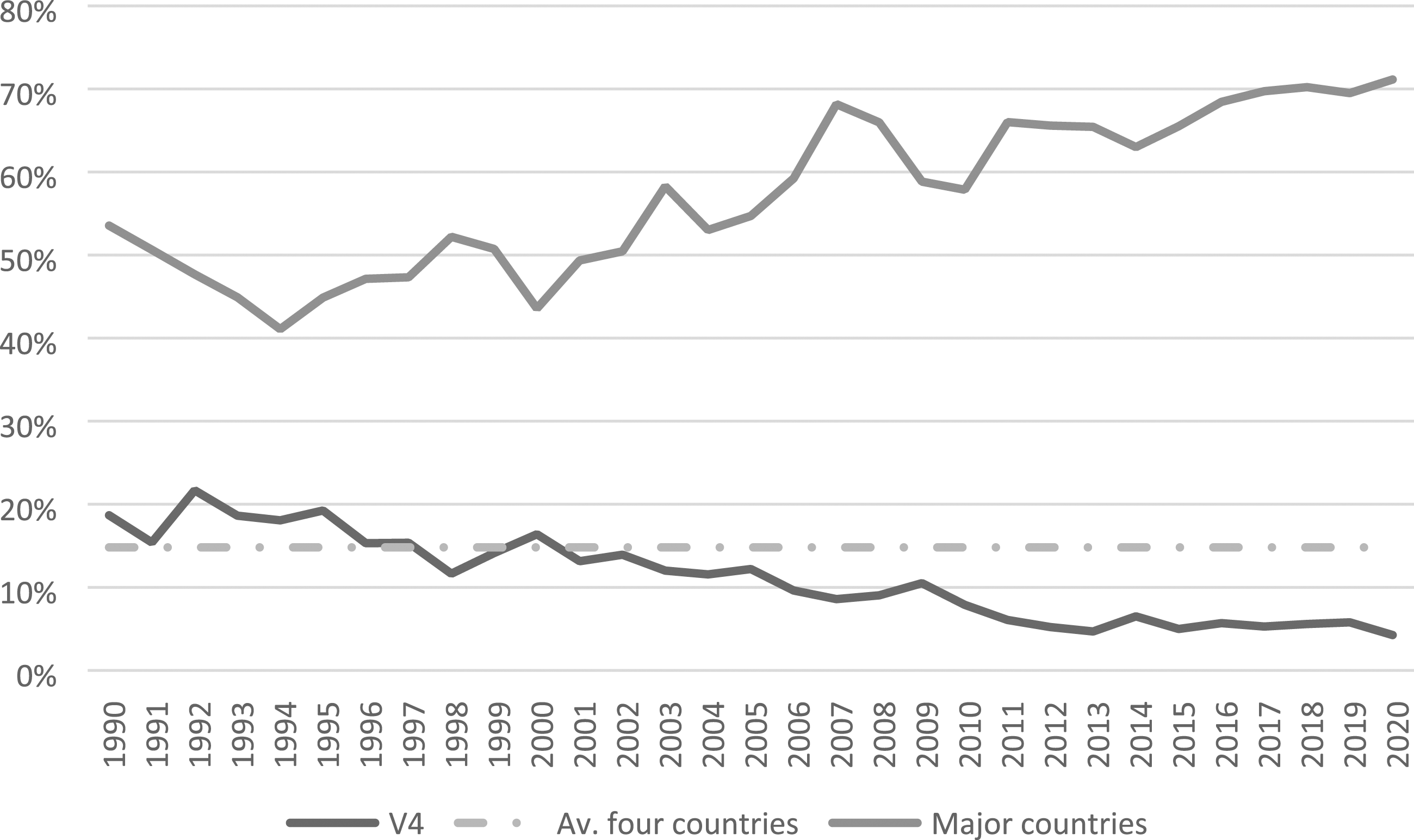
Nevertheless, in themselves, these data do not necessarily mean that the V4 lost its attractive power, especially if we compare their case with the four biggest countries in the analysed community (Germany, France, Italy, and the UK). Figure 1 shows that the collective ratio of these major countries gradually increased since the 1990s from the range of 40%–50% to above 60% in the 2010s. This dataset suggests that in the last 10 years, 60%–70% of all state-level interactions were initiated towards only four states, and the remaining 30%–40% were shared among the rest. If we exclude the major countries, the average share falls to 1.07%–2.18%, depending on the year, which is 4.28% and 8.72% for a group of four average countries.
Such a concentration of interactions could suggest a general dominance of bigger countries in international interactions (which will be further analysed in relations with RQ3), or the dominance of media attention towards interactions towards greater states. This tendency, which would mean that the V4’s weight decreased independently from their actions, would be in line with the theoretical expectations that the position of small states is determined by systemic tendencies beyond their control.
Nevertheless, as Figure 2 shows, the drop in the share of interactions towards the V4 is noteworthy even after the exclusion of major countries. After the regime change, the four Central European states had a collective share above 15% until 1997 (and again in 2000), after which their score gradually decreased to around 5% by the early 2010s and remained on this level ever since. This phenomenon can indicate that after the end of the Cold War, post-Communist states were perceived exceptionally important given their democratic transition. Nevertheless, as their Euro-Atlantic integration was completed, they became “regular” states. Similar tendencies can be observed with Croatia (whose struggle for independence and legitimacy translated into a high ratio of interactions between 1991 and 1997), and the Baltic states as well.
7
The share of the V4 and a group of four average non-major countries in all interactions (1990–2020).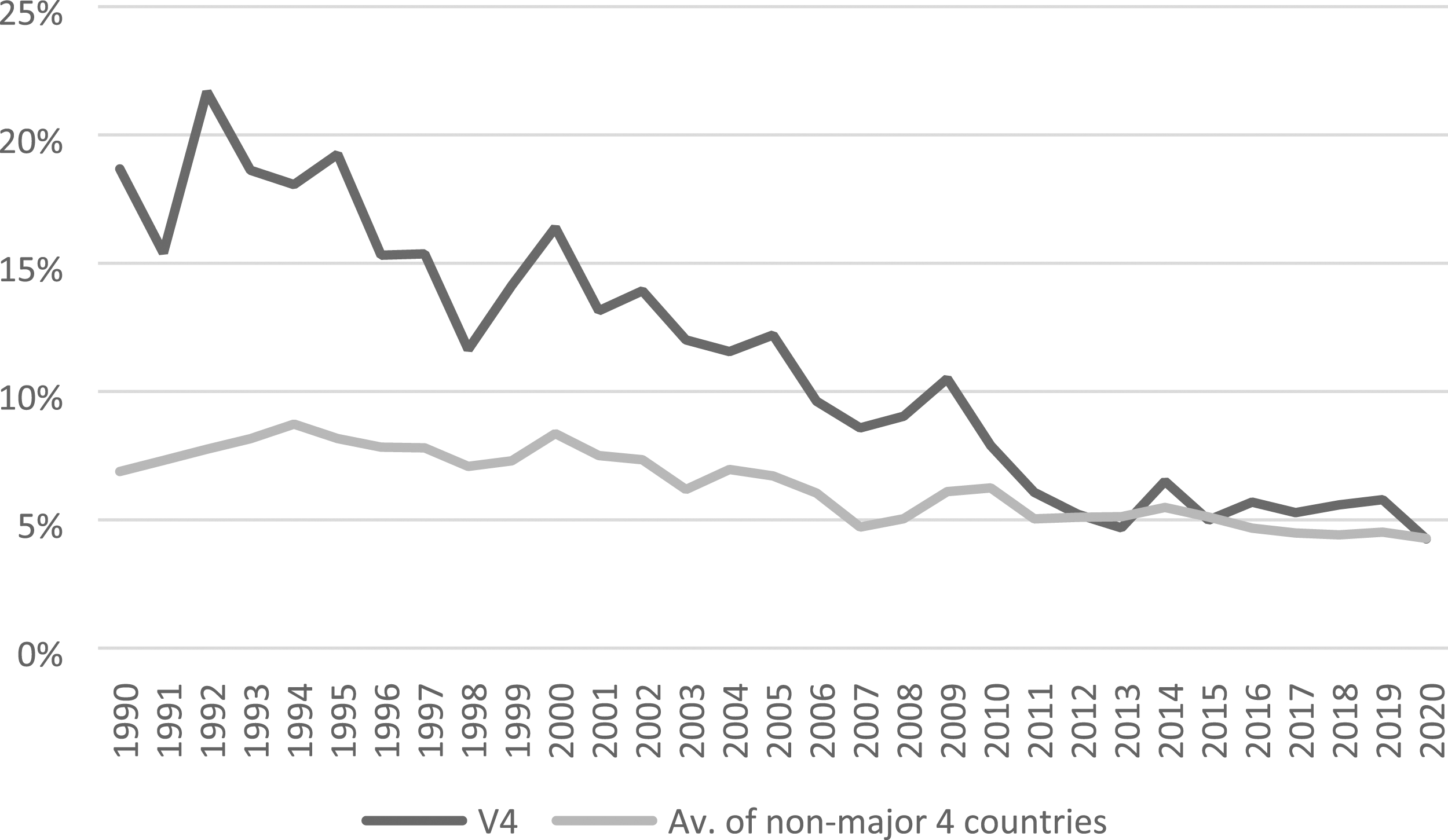
Alternatively, the decreasing number of bilateral interactions can hypotactically be attributed to the multilateralization of maintaining relations with the V4 (or the multilateralization of relations between the V4). Even if such an effect exists, it could only explain the difference between pre- and post-accession periods, but not the dynamics years after accession.
That being said, the drop of the relative share in interactions slowed down and even stopped in the 2010s and remained in the range between 4% and 7%, usually slightly above the average. This means that during the period of an increasingly negative image, no strategic change is detectable. Smaller spikes did take place on a yearly basis, but available data from the late 2010s do not constitute a tangible trend so far. If differences can be identified between the different countries (see the section focusing on RQ4), these data could suggest that the governments of the Visegrád countries, despite their general negative image, managed to stop the decrease in the number of interactions directed towards them.
Comparing the overall share of the V4 to other country groups (Figure 3) reveals further dynamics. The distance between the average of non-major countries and that of the V4 is quite fluctuating. The four Central European states managed to stay above this value until 2010 or, in the second half of the decade, to remain relatively close to it (or even slightly surpassing it in 2019). This tendency confirms that the general drop in the attention devoted to the V4 countries has clearly taken place since accession, but it highlights that the low point in terms of interactions was the first half of the 2010s, after which there was a slight relative increase. Given the effects of the migration and refugee crisis in 2015 on the image of the V4, these data contradict the general expectation about the necessity to use a positive image in status-seeking. The average share of specific country groups in all interactions (1990–2020).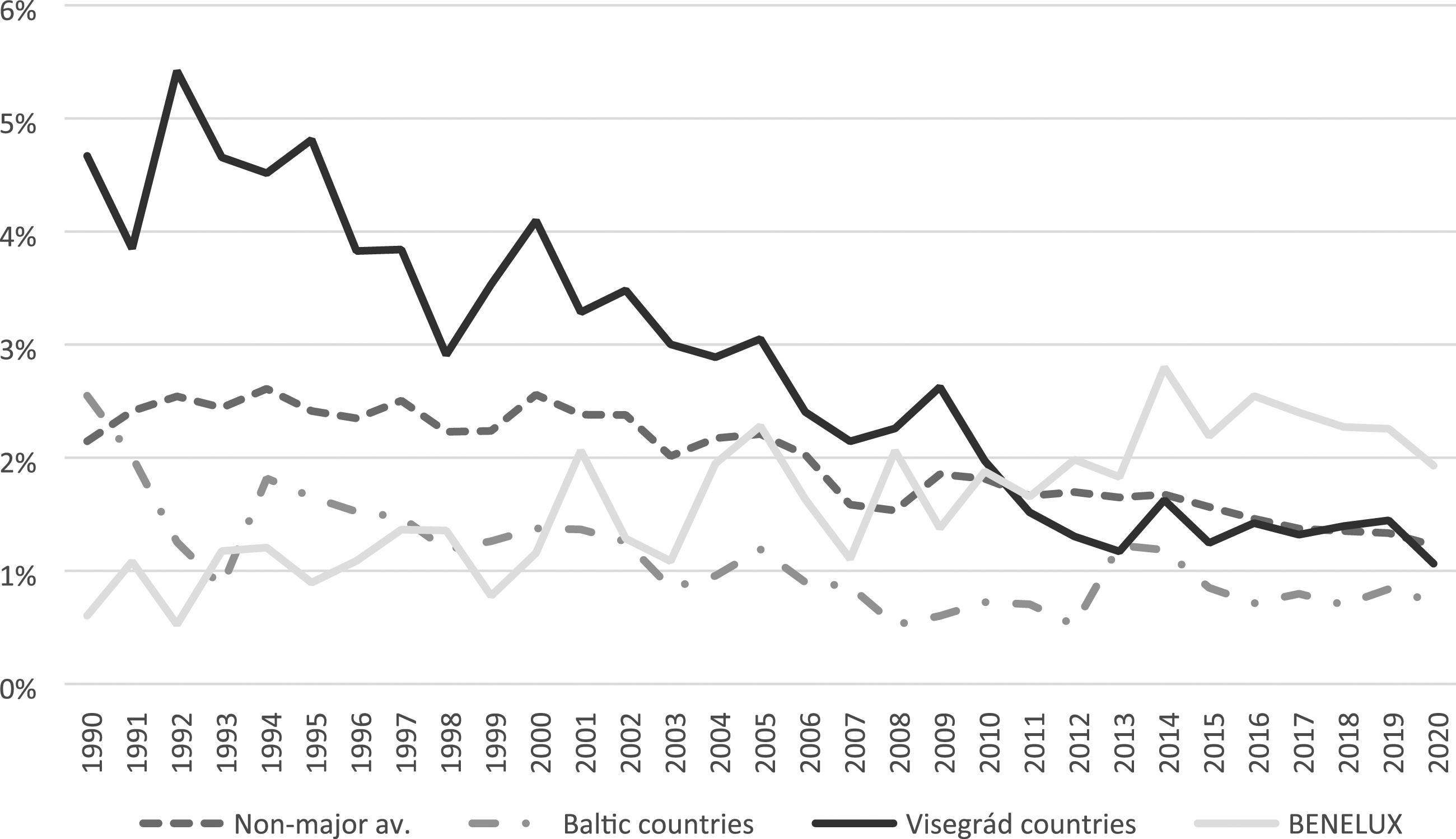
This observation is partly valid in comparison with other groupings in the EU. The Visegrád states’ average outperformed that of the Baltic states and the Benelux states until 2010, nevertheless, in the next decade, they fell behind the latter. Data suggest a clear growing tendency on behalf of Belgium, the Netherlands, and Luxembourg in the long term, with less than a three-fold increase in average interactions between 1990 and 2020. In the meantime, the Baltic states’ average score remained under 2% throughout the whole period (except for the early 1990s), nevertheless, there was a clear convergence between them and the Visegrád countries by the 2010s. The V4 still remains slightly above the Baltic states, but the difference became minor (0.5%–1%).
While theoretically it would be possible that the increase of interactions towards the V4 is due to the increase in confrontations, data do not support this hypothesis. The share of the V4 in both cooperative and confrontative interactions remained to be very close to each other. As Figure 4 shows, between 1990 and 2020, there is no systematic difference between the two datasets. Generally, the V4 share of cooperative interactions has been slightly higher than that of confrontative interactions except for a handful of years (1991, 1996–1998, 2001, 2006, 2015, 2020). While this tendency suggests that interactions towards the V4 are neither more cooperative nor more confrontative than towards other states, differentiating between major and non-major countries leads to a slightly different interpretation. The share of the V4 in confrontative and cooperative interactions (1990–2020).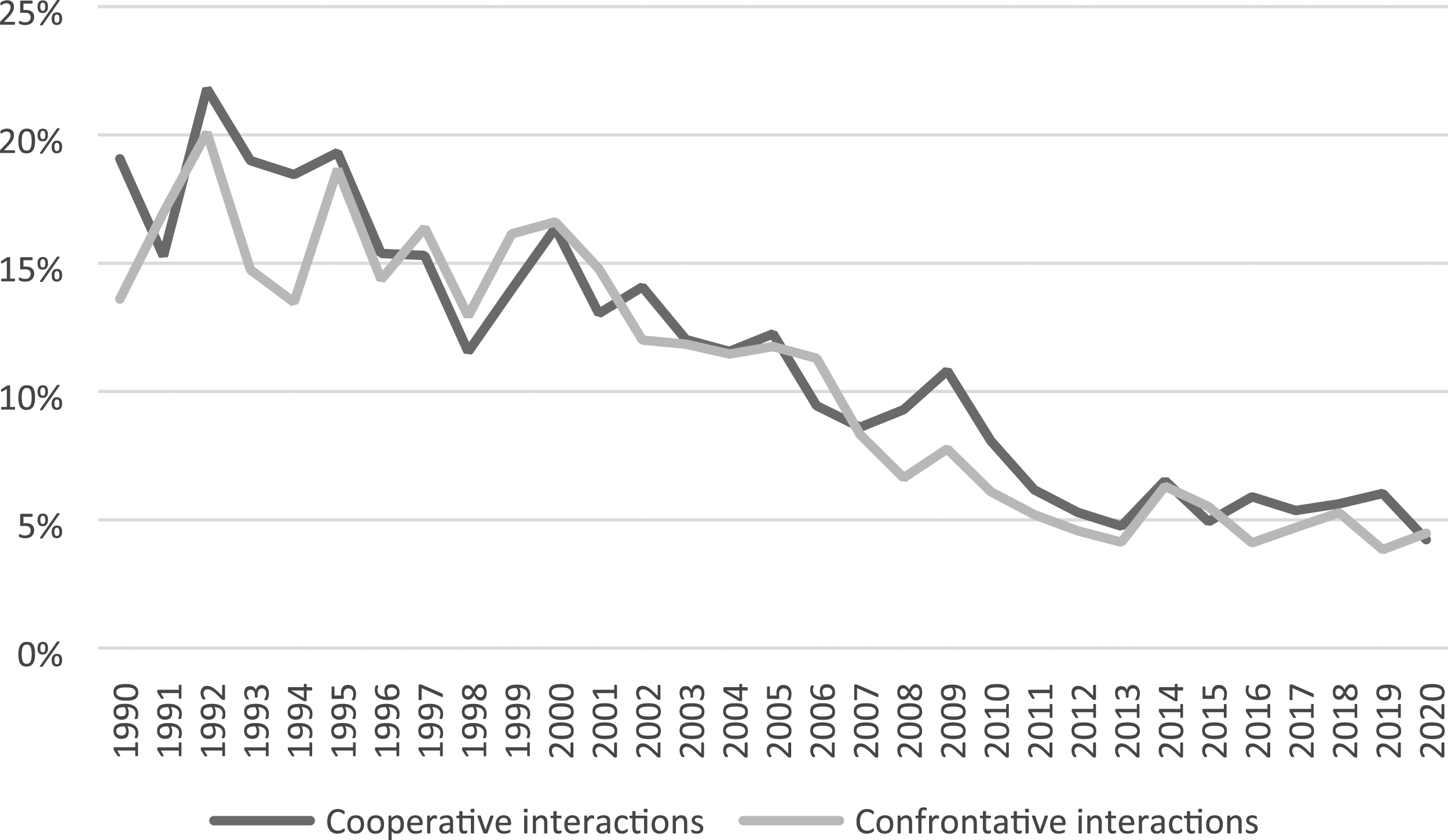
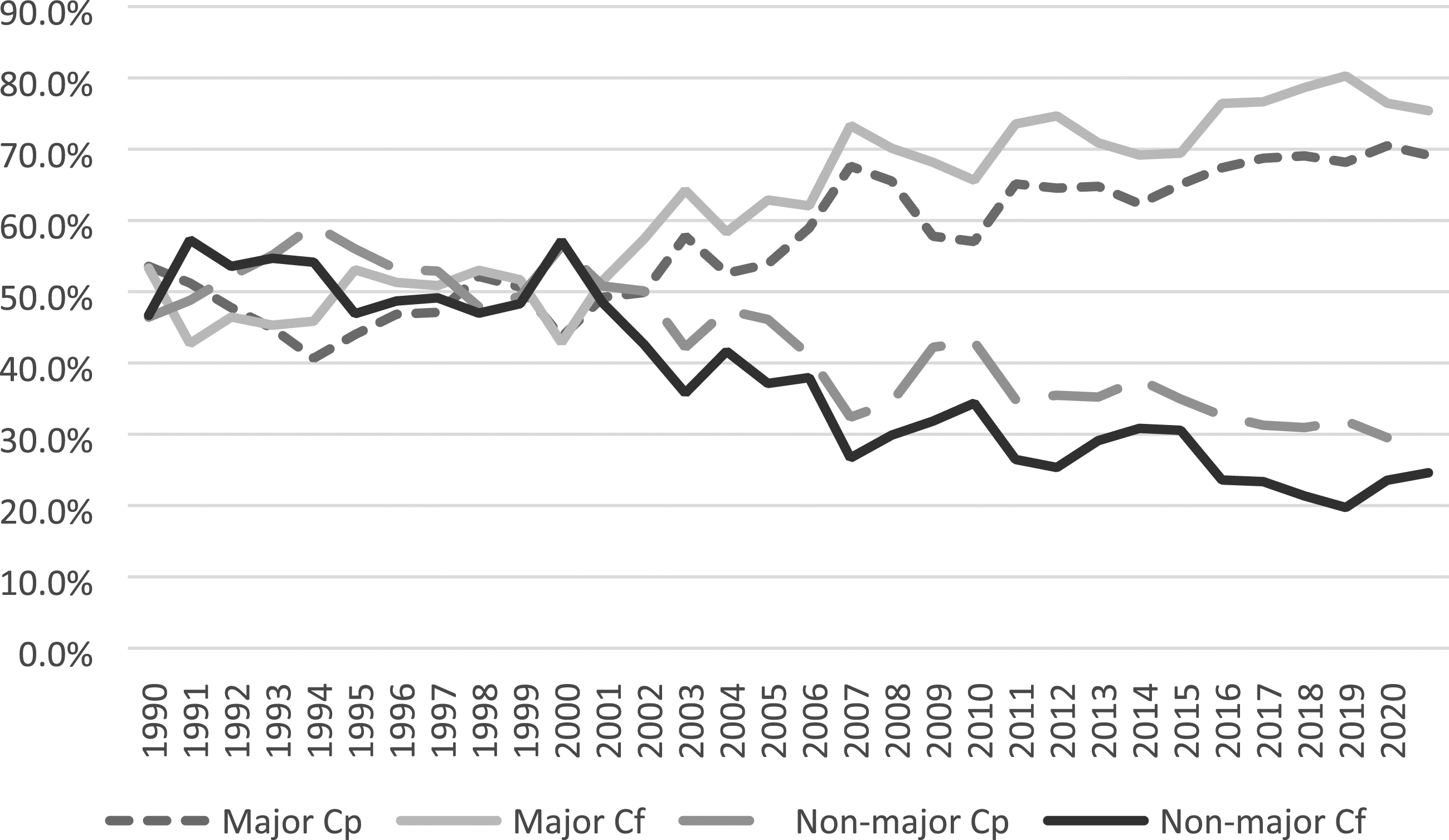
Data indicate that the share of cooperative and confrontative interactions correlate with both size and other state-level variables. As Figure 5 shows, a clear difference can be seen between major and non-major countries when it comes to their share in cooperative and confrontational interactions in the 21st century. States of the former category have had a higher share in confrontative interactions, sometimes with even a 10-percentage point difference. Contrarily, non-major states’ share in cooperative interactions has constantly been higher than their share in confrontative relations. This observation still suggests the importance of state size in not just the number of interactions but in the composition of these interactions as well. In this context, the data of the V4 is closer to the general tendency of the non-major group, nevertheless, the difference between the four states’ share in the two kinds of interactions has been much smaller. Moreover, the number of years when the share of the V4 in confrontative interactions surpassed their share in cooperative interactions could be considered much bigger than what is expected from an average non-major country. Consequently, size is not the only explanatory variable from this perspective. The share of major and non-major countries in cooperative and confrontational interactions (1990–2020)
8
.
RQ2: The changing ratio of confrontational interactions
The ratio of confrontational interactions, which shows the extent to which the interactions expressed towards a state, or a group of states were conflictual, is a key indicator of the possible impact of the negative image on the status of the V4. Due to the nature of the European Union as a cooperation format, one can expect this ratio to be relatively small. Indeed, between 1990 and 2020, only 10.2% of all verbal interactions towards EU member states have been confrontational. Nevertheless, this ratio has not been steady during these three decades – the general tendency to observe is the growing ratio of confrontational interactions from the range of 5%–7% in the 1990s to the range of 9%–12% since the mid-2000s. Another interesting tendency is that until 2014, the confrontational ratio of the biggest states was higher than the overall average, nevertheless, since the 2010s, this expectation has not been realized.
The average of the V4 in this regard (see Figure 6) moved largely in accordance with the EU average after 2004,
9
mostly staying below it. The four country’s average confrontational ratio surpassed that of the EU during only 5 years: 2004, 2006, 2015, 2018, and 2020. Two out of these 5 years took place during the period when populist-labelled governments were in power in the Czech Republic, Poland, and Hungary, while another year (2015) witnessed populist parties in government in Poland, Slovakia and Hungary. The higher confrontational ratios coincided with the debates surrounding the refugee and migration crisis, as well as various debates about the rule of law in the V4. The average confrontational ratio in the EU and the V4 (2004–2020).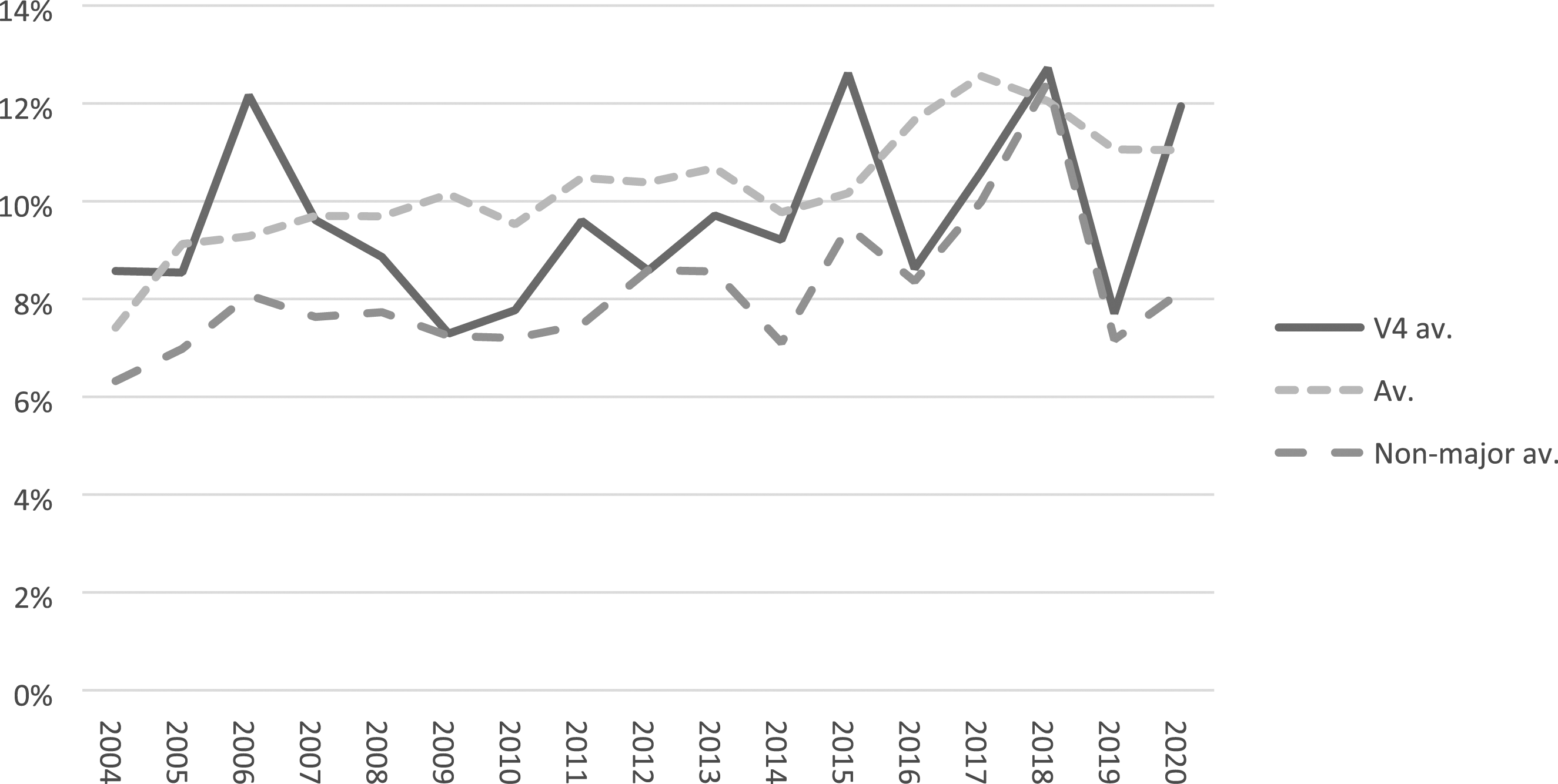
Moreover, the comparison of the non-major average and the V4 average shows that the mean confrontational ratio of the four Central European countries has almost always been higher than that of all small- and medium-sized countries. As can be predicted, major states generally have a higher confrontational ratio (2018 being the only exception according to the data) than non-major ones. Except for a few spikes, the V4 has stayed between the two. This phenomenon clearly indicates the negative image of the V4. On the other hand, the data from 2016 to 2018 suggest parallel tendencies between the V4 and the non-major average, which could potentially mean that the four countries’ extreme values moved the non-major average to a significant extent. In the last years, the confrontational ratio of the V4 sky-rocketed, moving to 150% of the non-major average, which clearly shows the effects of the perception of populism.
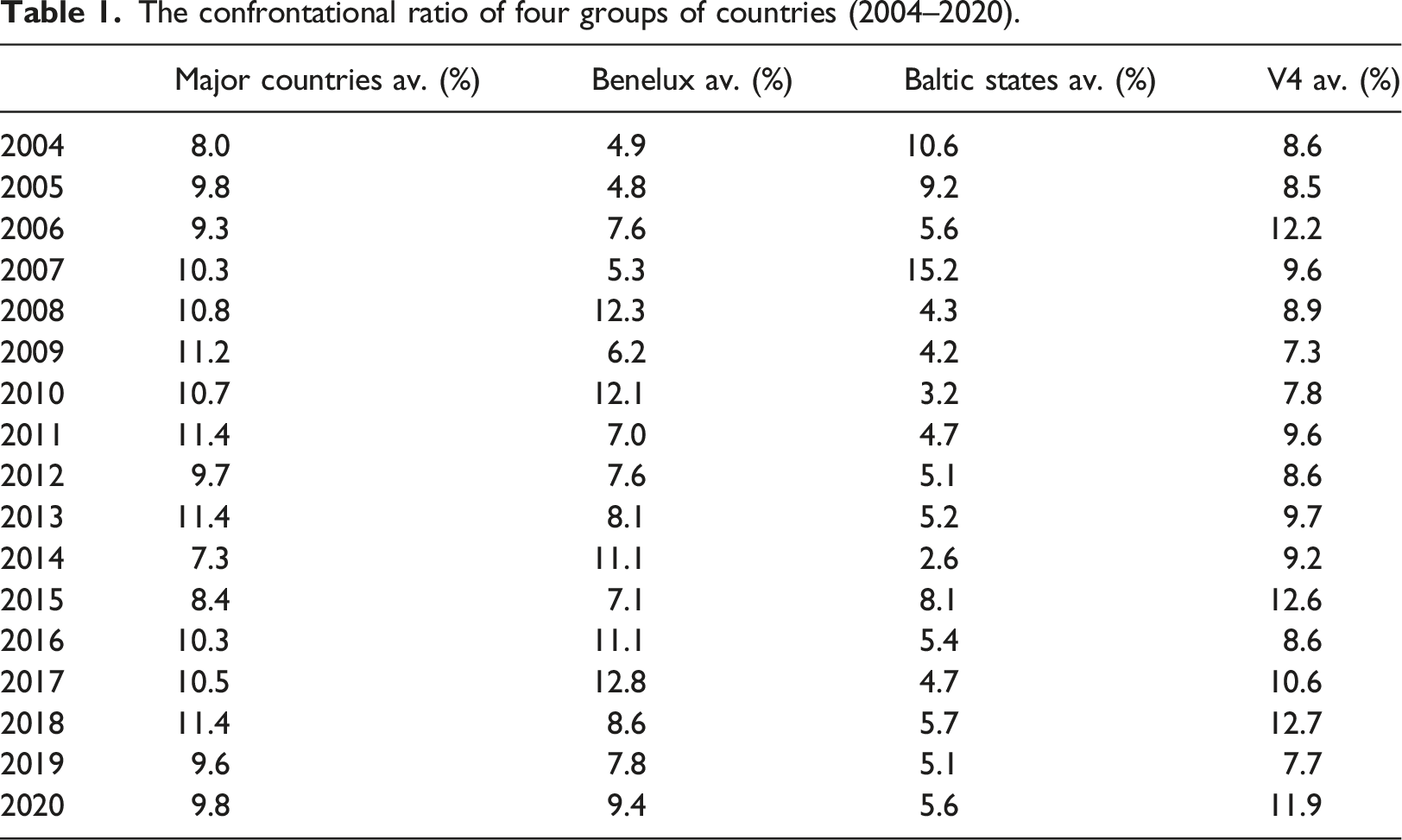
This conclusion is supported if we compare the confrontation ratio of the Visegrád countries with specific country groups. In 2015, 2018 and 2020, the four countries’ ratio surpassed that of the three other groups. The difference is especially striking in 2015 when the V4’s average was four or five percentage points higher than in the other groups. Since 2011, there were only 2 years (2016 and 2019) when the Visegrád countries did not have the highest or second highest score, while this was true for three out of the 7 years between 2004 and 2010. Since 2015, the confrontational ratio of the V4 was mostly higher than that of major countries (except for 2 years), whereas this was only observable in 2004 and 2006 before that.
The confrontational ratio of four groups of countries (2004–2020).
RQ3: The correlation between size and the number of interactions
As was discussed in the literature review, most researchers and the general public largely connect importance with size, which suggests that bigger countries should have generally more interactions towards them than smaller ones. Empirical data analysed in the GDELT Database also suggests that such a causal relationship exists, as the group of major European countries had more interactions. Nevertheless, these data in themselves do not help us identify the specific dimension of state size which might cause closer attention and bigger engagement in the international society. Further investigation can reveal if size is a better explanatory variable than the observed negative image of the four countries.
Correlation between the number of interactions and various dimensions of size.
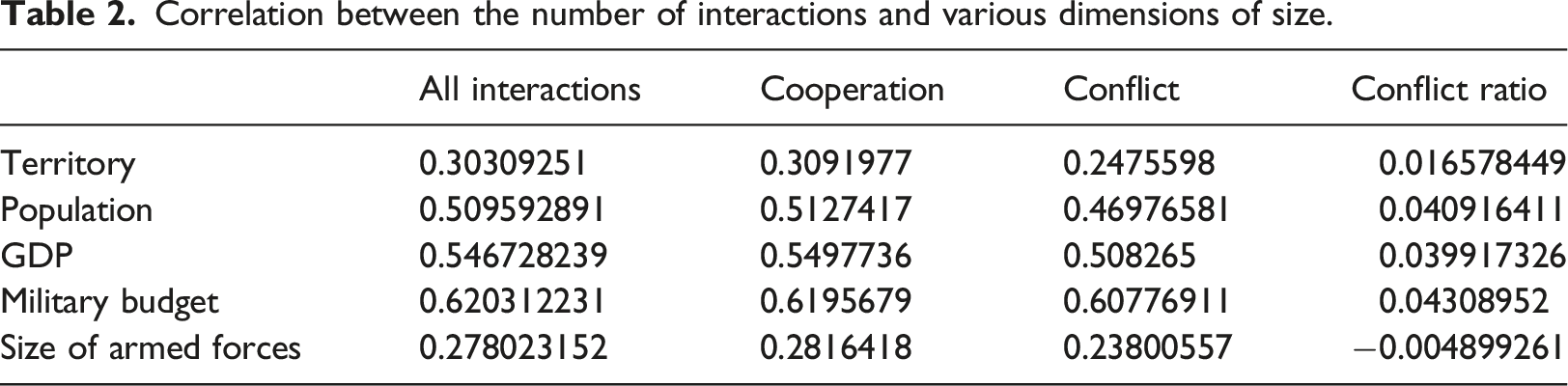
Apart from the size of the military budget, the GDP of European countries (and, to a smaller extent, their population) show a moderate correlation with the number of interactions. Intuitively it is also predictable that the correlation coefficient between cooperative interactions on the one hand and population and the GDP size on the other is higher than with conflictual interactions. It is noteworthy that the difference between the correlation between cooperative and conflictual interactions is the smallest regarding the size of the military budget. It seems that spending more on defence is in moderate alignment with both friendly and hostile engagement.
When it comes to the correlation between the conflict ratio and the different dimensions of size, the picture is much less clear. The coefficient in all cases is very low, which suggests a basically non-existent effect of size on the ratio of conflictual interactions in all interactions. This finding suggests that politics shape the nature of relations between states, and one cannot predict that smaller states enjoy a better image than their bigger counterparts just because of their size. Consequently, states do have agency in this regard, allowing status-seeking strategies to actively shape the nature of interstate interactions.
Bearing in mind these viewpoints, it is worth analysing the interaction data of the Visegrád countries in parallel with their relative size. Data (Figure 7) suggest that until the early 2000s, the share of the four states in all interactions was higher than any dimensions of relative state size. The fact that the military budget showed the strongest correlation with interactions should have been bad news for the V4, as this is the measurement in which they are the smallest. Nevertheless, their share in all interactions was constantly higher than their relative military size until 2020, caused both by the drop of the former and a slight increase in the latter. The share of the Visegrád countries in all interactions and their relative size
11
.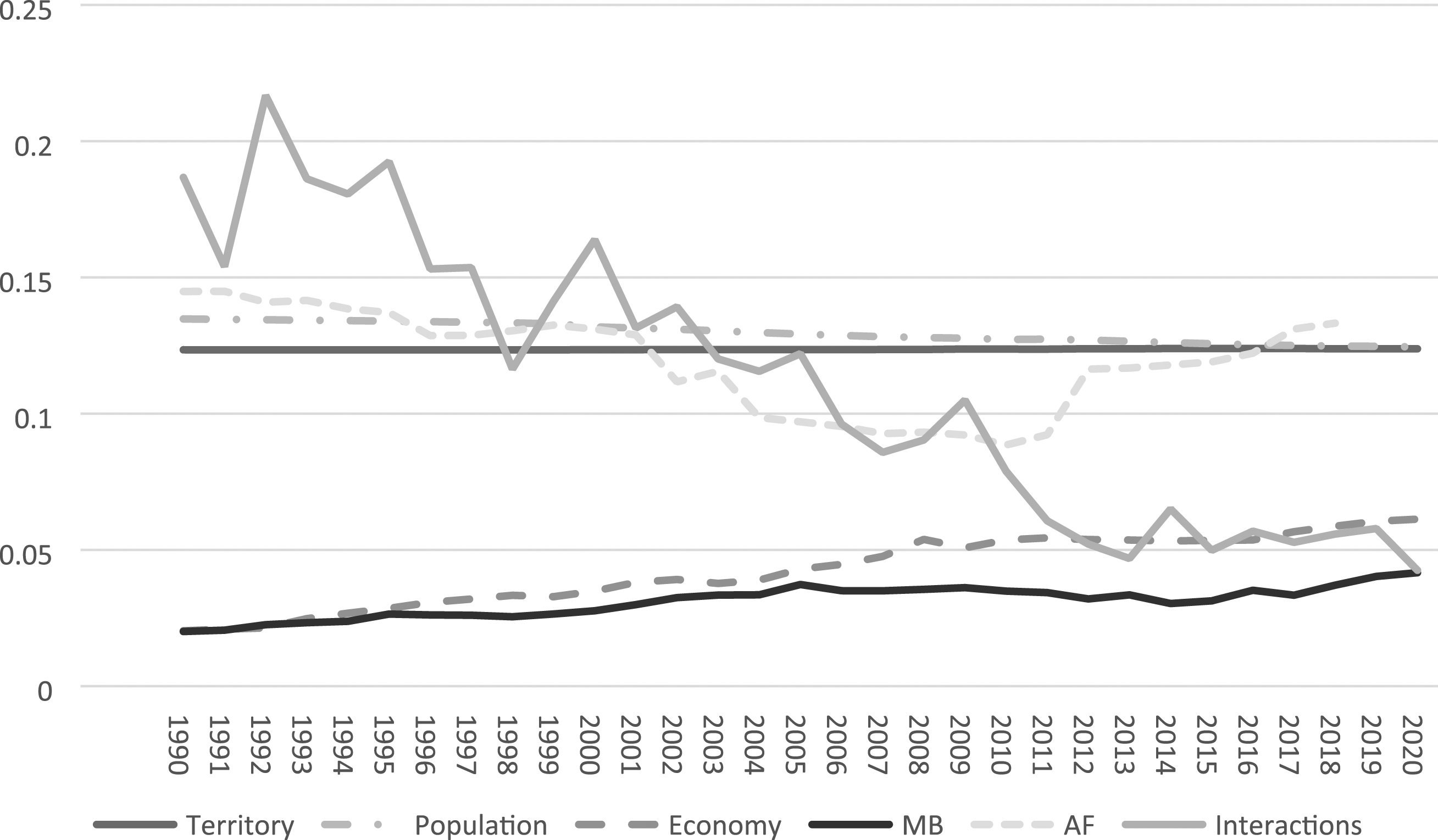
The drastic decrease in the share of all interactions between 1990 and 2020 identified previously is not explained by a change in any dimensions of relative size. Two out of the five indicators, namely the economic weight and military budget, increased since the 1990s, showing an opposite trend than interactions (even if on the European level, these two measurements show the strongest correlation with interactions). The territorial share remained constant, while the remaining two dimensions of size, population and the size of armed forces, behaved differently. The former showed a slight decrease, but not to the scale and intensity of the drop in all interactions, while the relative size of armed forces shrank until the early 2010s after which it increased in the last decade. The latter might show convergence with the share in all interactions in the first period but cannot explain the continuation of losing interest later.
All these observations indicate that the dynamics of interactions expressed towards the Visegrád countries can be attributed to political developments, including their status-seeking activities and their possible negative image. Change in the economic position of the four states or their weight in the military balance of power in the region does not explain the drastic decrease in the relative interest towards them.
RQ4: Differences between the Visegrád countries
Given all these findings, it should not be surprising that individually, the four countries’ share in all interactions show substantial differences. Compared to the average, the four countries can be put in three different categories based on the intensity of interactions expressed towards them. First, Poland surpassed the average 17 out of the 31 years between 1990 and 2020, which was outperformed only by the four biggest countries. 12 The Czech Republic can be placed in the next tier of states with 10 above-the-average years (alongside Croatia, Greece, and Spain), while Slovakia and Hungary follow with four each (similarly to Ireland and slightly surpassed by Bulgaria). Five other states (Austria, Belgium, Finland, Lithuania, and Sweden) reached the average only once, while the remaining nine countries never managed to do it (Cyprus, Denmark, Estonia, Latvia, Luxemburg, Malta, the Netherlands, Portugal, and Romania).
As was already shown, the share of the four countries in all interactions decreased substantially in the post-accession period (see Figure 8). In 2004 and 2005, they still had 11.6% and 12.2% share, which fell to 7.9% by 2010 and 4.3% by 2020. The comparison of individual countries shows that the temporary spikes in the interactions towards the V4 as a group was not due to systemic tendencies but rather a sudden increase in the intensity of interactions vis-á-vis one or two of them, e.g., the Czech Republic in 2009 or Poland and the Czech Republic in 2014. The share of Visegrád countries between 2004 and 2020.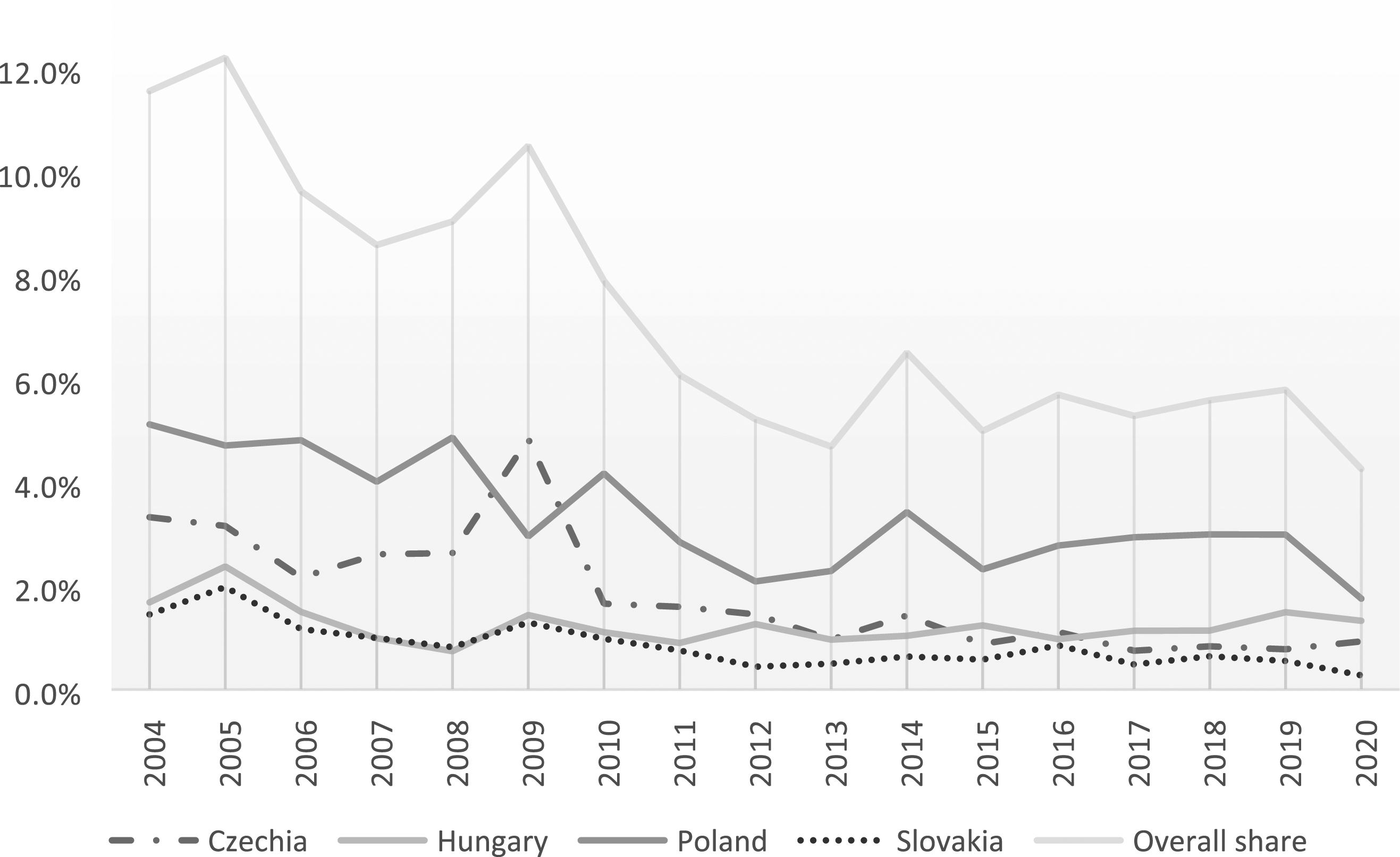
Somewhat surprisingly, despite the general downward tendency, Hungary’s drop was maybe the least sharp. Out of the four states, Hungary suffered the smallest decrease in its relative share after accession: its 2020 share (1.3%) is only 21.3% smaller than its 2004 share (1.7%). The same ratio is 65.8% for Poland, 72.2% for the Czech Republic, and 81.6% for Slovakia. Given the national populist perception of the Orbán-government, these data contradict the expectation of the effects of a negative image on a country’s overall interactions.
When it comes to the four states’ relative position vis-á-vis each other (see Figure 9), there has been a clear dominance of Poland, the biggest country in the group. Generally, Warsaw had been the target of the most outreach among the V4. Except for 2009, its share in all interactions towards the V4 has been between 38% and 55%. Until the mid-2010s, the Czech Republic had the second largest share since accession, except for 2009, when Prague stole first place from Poland, reaching as high as 46%. Nonetheless, after a transitional period between 2013 and 2016, Hungary managed to surpass the Czech Republic with a share surpassing 20%, and later even 30% in 2020. This change coincided with the rise of the populist government of Babiš in the Czech Republic. Interestingly, by 2012, Hungary was closer to the tail-ender Slovakia (which held, except for 2008, the last position after 2004) than to the Czech Republic, but since 2012, there has been a clear upward trend in the country’s share. The share of the Visegrád countries in all interactions toward the group.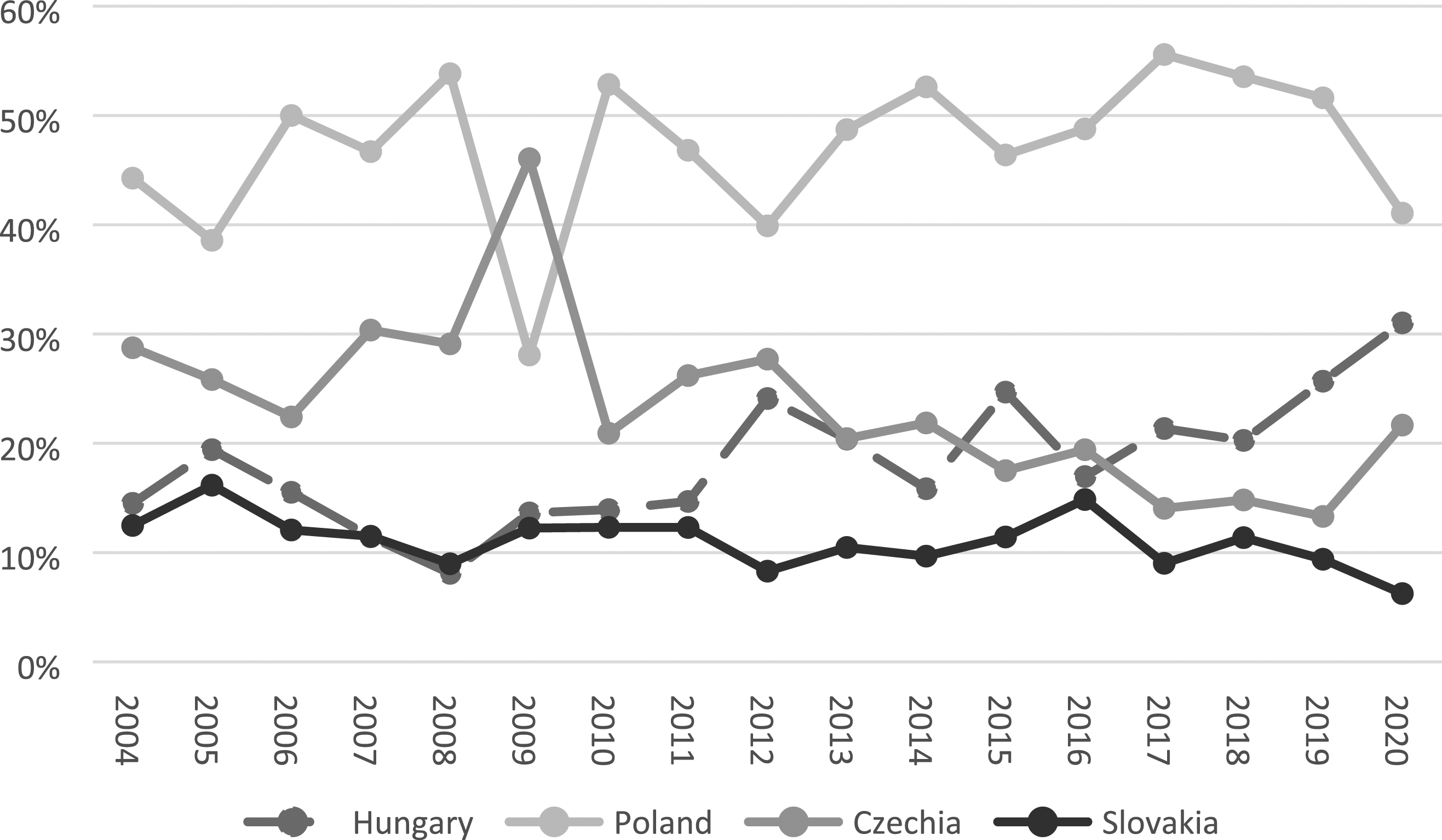
This increase in the interactions towards Hungary took place after Fidesz rose to power in 2010, although not instantly. Hungary did not only manage to better its position in the V4 but also maintained its share of interactions in the EU as well, while even producing a limited increase. between 2010 and 2020 (1.1%–1.3%), Meanwhile, all other Visegrád countries suffered a substantial drop. In the V4 context, the second half of the last decade was positive for the Czech Republic and Hungary, while the share of Poland and Slovakia decreased. These tendencies certainly complicate our understanding of the effects of a populist image on a country’s international position.
While the general tendencies in the shares of the four countries in all interaction towards the V4 group is largely mirrored by the tendencies in their shares in cooperative interactions, the picture is more confusing when it comes to confrontative interactions. As Figure 10 shows, Poland’s position is slightly less dominant, as the Czech Republic surpassed its share in 2009, 2012, and 2020 too. Moreover, Warsaw’s score was equal to Slovakia in 2009 and to Hungary in 2012, the latter even surpassing the largest Visegrád country’s share in 2020. The share of the Visegrád countries in all confrontative interactions toward the group.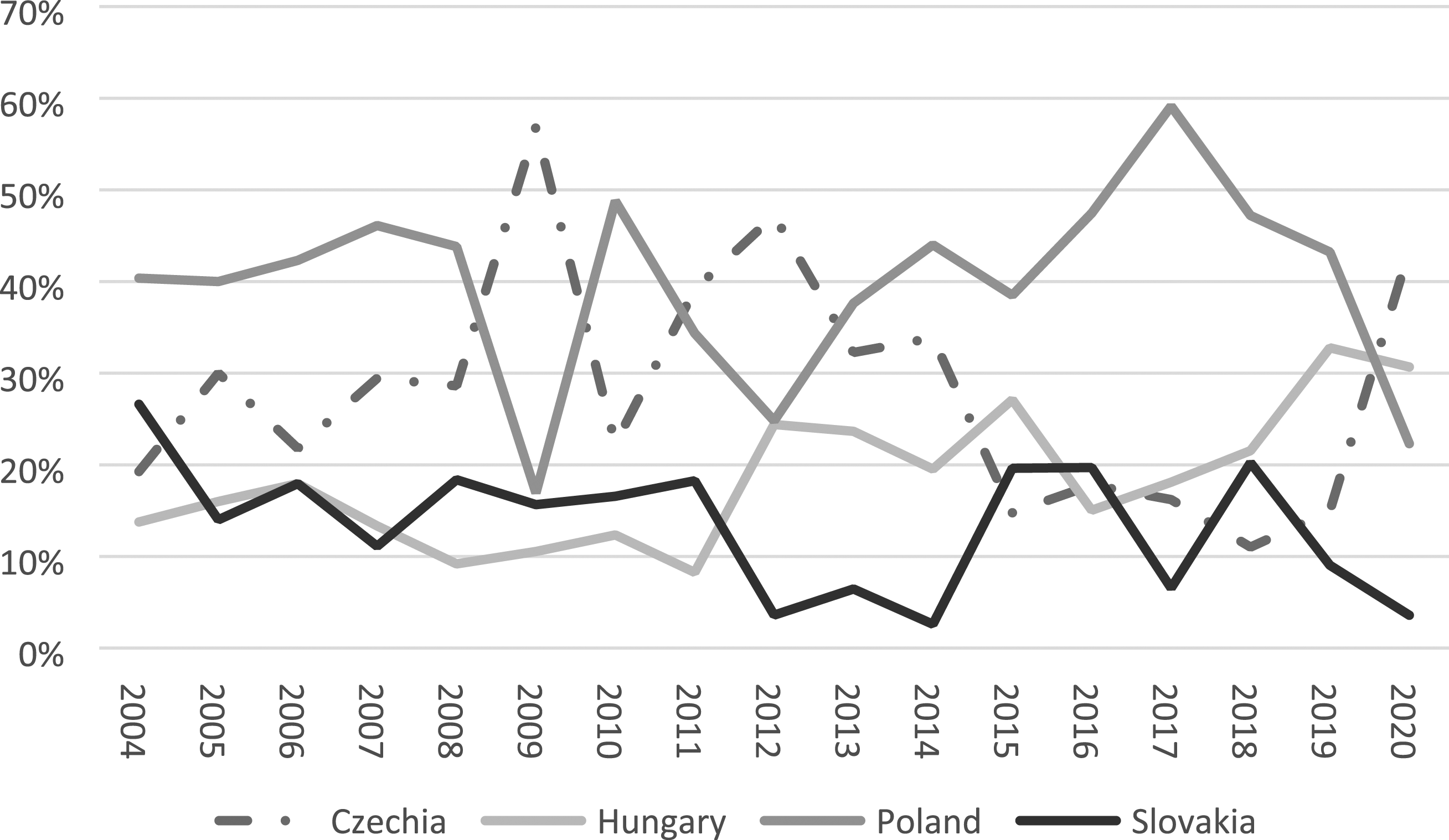
Contrary to theoretical expectations, Hungary has never had the highest share in confrontative interactions toward the V4 in the post-accession period, nevertheless, an increase after 2010 is visible as well. Until 2011, Hungary’s score had often been lower than Slovakia’s, which only happened later once in 2016. Despite that year, between 2012 and 2020, Hungary’s share in confrontative interactions is growing, although it was mostly in the second or third position. In the case of the Czech Republic, the populist period after 2017 did produce 2 years with high values, but the country had a more confrontational period between 2011 and 2014.
The confrontational ratio of the Visegrád countries (2004–2020) (with above the average values highlighted with bold).
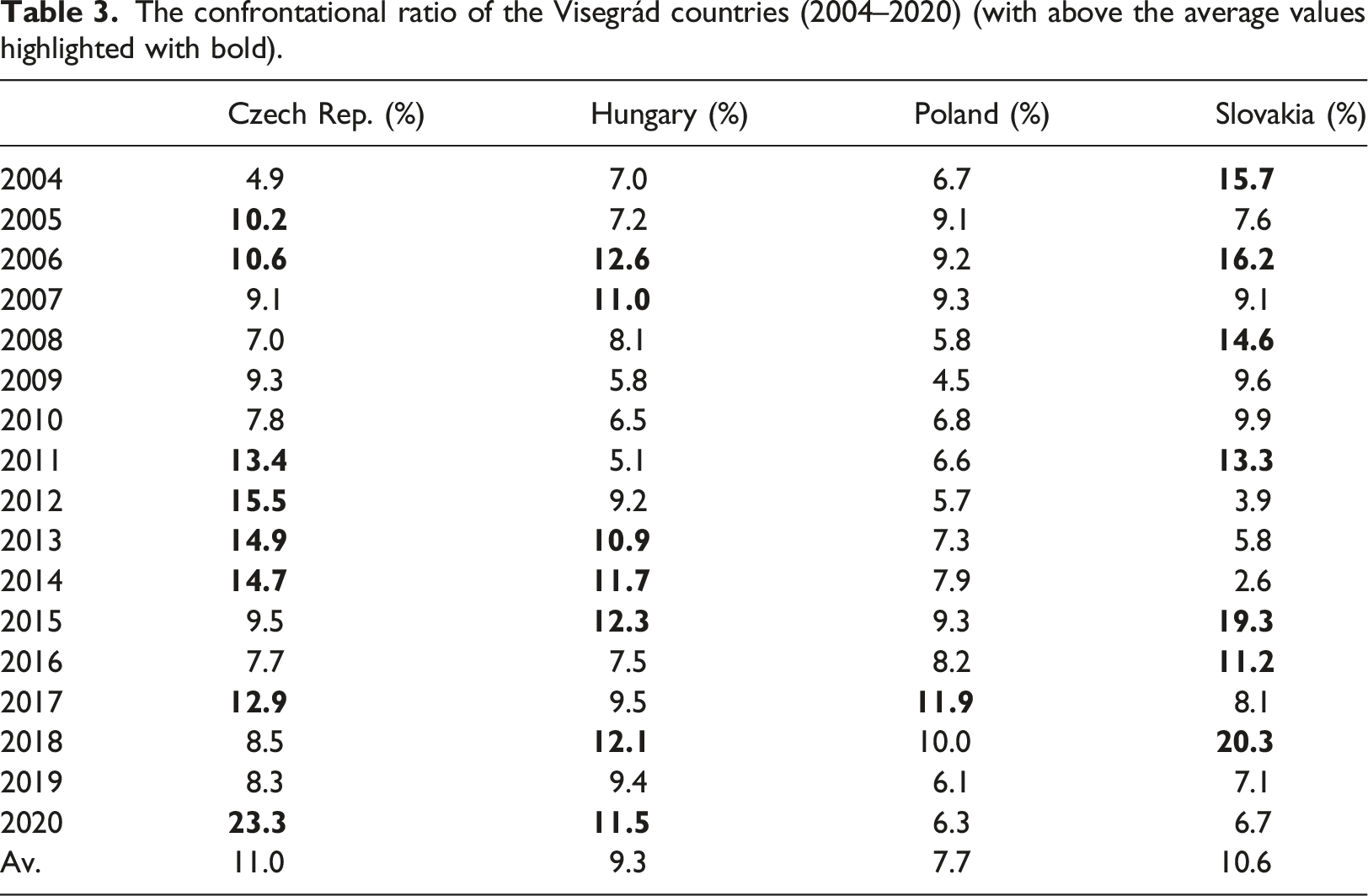
All these data suggest that the generally perceived negative image of a country does not necessarily result in a higher confrontational ratio. In all cases, we can see a slight increase in the share of confrontational interactions not just in Central Europe but the whole group under analysis, which makes it difficult to point out the importance of a populist image. In the case of Hungary, it is clear that the 2010s generally showed a higher confrontational ratio, but when it comes to Poland, the PiS party’s dominance did not coincide which such a rise. Moreover, in the case of the Babiš government, most years showed relatively less confrontational period, especially compared to the mid-2010s, during the Sobotka government.
Conclusion
The empirical analysis of the GDELT database has led to several tangible research results regarding the changing international status of the V4 since 2004. First of all, the aggregate number of interactions initiated towards the V4 (RQ1) shows a drastic drop after 2004. Their share decreased until the early 2010s, after which we can see stabilisation with even a slight increase. While this drop in interactions can partly be explained by systemic and size-related developments (i.e., the growing concentration of state-level interactions toward the great powers), the four Central European countries underperform the average of non-major European states too.
When it comes to the nature of these interactions (RQ2), results show that the Visegrád countries had a slightly higher confrontational ratio than the average of non-major countries. Although this difference has not been of strategic size, it definitely grew recently compared to other country groups, especially after 2015. These results indicate that the Visegrád countries have generally received more verbal confrontations than other European countries of similar size, a possible effect of their negative populist image after the migration crisis. These tendencies suggest that the general decrease in attention towards the V4 was coupled with a slightly negative change in their perception.
The analysis of the correlation between various aspects of state size and the number of interactions supports the observation that politics matter. Results indicate that among the five most traditional measurements, the military budget showed the strongest correlation with the number of all interactions. This observation underlines the general realist notion that in the 21st century, military power is still regarded as the source of importance and political weight in the international system. That being said, the empirical investigation of the Visegrád countries showed that the tendencies regarding the relative size of their military budget and the number of interactions did have different trajectories – based on their defence capabilities, Visegrád countries should have received fewer interactions. Such a situation indicates that the intensity of interactions towards the four countries has been shaped predominantly by political developments and not their military power or economic performance.
Last but not least, the research identified key differences between the four countries (RQ4). On the one hand, the material inequality between Poland and the other Visegrád countries led to different levels of attention devoted towards them. Warsaw has by far been the country with which states interacted the most in the group, while the Czech Republic had held the second position until the mid-2010s, after which Hungary took it over. Budapest managed to slightly better its position both in the Central European and the EU context, while the share of confrontational interactions towards Budapest increased since the 2010s.
These results provide an explanation regarding the contradictions between theoretical expectations regarding small state foreign policy and empirical evidence. On the one hand, data shows that the international status of a small state – observed through the quantity and nature of its interactions (based on Wohlforth et al., 2018) – is certainly in correlation with size, but only to a limited extent. Politics, status-seeking, and the image acquired by small states do matter in this regard. On the other, the correlation cannot be simplified to assume that the more positive the image the better its status internationally. In the case study of the V4 countries, we can clearly see that the negative image connected to the rise of populism and nationalism did not cause a definite decrease of state-level interactions initiated towards these countries. In addition, the stabilization of the share of relative interactions in the second half of the 2010s coincided with fiercer debates regarding the rise of populism in Central Europe. This is especially true for Hungary, which suffered from the smallest relative drop in interactions in the group, despite its troublemaker status.
While definite causality can hardly be proved with the case study of four countries, the research suggests that the populist image did not cause a definite decline in the international status of the V4 countries. The only country regarding which we can clearly see a negative effect was the Czech Republic with a clear and substantive decrease in its relative position even inside the Visegrád cooperation. While the populist image did not have any detectable effect on the situation of Poland, one can even argue that Hungary’s relative weight even improved – even if at the expense of a higher confrontational ratio. Consequently, our empirical data show that a negative image of populism does not necessarily lead to isolation or a diminishing international standing.
Bearing in mind its limitations, 14 our research has substantial implications on the literature of status-seeking. Small states can enlarge their status internationally not necessarily through the representation of constructive values such as defending international peace and security, respect of international law, or facilitating cooperation. Consequently, contrarily to Wohlforth et al. (2018), differentiating between different kinds of interactions could lead to better understanding of small state foreign policy, especially given that a harsher image does not deprive them of the possibility to conduct status-seeking. These results open the possibility for further research on negative image-building and small states’ leverage in creating novel status-seeking strategies.
Footnotes
Declaration of conflicting interests
The author(s) declared no potential conflicts of interest with respect to the research, authorship, and/or publication of this article.
Funding
The author(s) disclosed receipt of the following financial support for the research, authorship, and/or publication of this article: This project has received funding from the European Union’s Horizon 2020 research and innovation programme under the Marie Skłodowska-Curie grant agreement No. 945361.