



Abstract
Objective. Childhood overweight/obesity is a serious global public health issue, demanding parental involvement to reverse trends. Despite fathers’ crucial parenting roles, research on fathers and childhood overweight/obesity is limited. This scoping review examines the literature on fathers’ nutrition knowledge and feeding practices with childhood overweight/obesity. Methods. Following the Preferred Reporting Items for Systematic Reviews and Meta-Analyses (PRISMA) guidelines, and Arksey and O’Malley (2005) framework, multiple databases were searched. Eligible father-child related studies focused on fathers’ nutrition knowledge, feeding practices, and childhood overweight/obesity. Results. Of 26 eligible articles, 52% originated from the United States, and 44% focused on father-child dyads. Most studies were cross-sectional (64%) and survey-based (68%). Further, 11.5% assessed fathers’ nutrition knowledge, and child feeding practices (53.4%). Conclusion. Literature on fathers’ nutrition knowledge and feeding practices concerning childhood overweight/obesity is limited. Scaling-up fathers’ inclusion in childhood nutrition research is encouraged for the design of holistic interventions.
Introduction
The World Health Organization (WHO) regards childhood obesity as one of the most alarming public health issues of the 21st century across the globe. 1 The rapid rise of overweight and obesity across continents has been of grave concern and aptly described by the World Bank as “a ticking time bomb,” as children across the globe are not spared. 2 Childhood overweight and obesity often leads into adulthood and could result in noncommunicable diseases such as diabetes, cardiovascular diseases, and cancer.1,3
It is reported that 39 million children below 5 years of age were overweight/obese in 2020, and this was attributed to unhealthy eating and little or no physical activity, as well as low socioeconomic status, food insecurity, food processing, and education. 1 According to Partnership for a Healthier America (PHA), 1 out of 3 children and adolescents in America were either overweight or obese, with the rate in the past 40 years among 6 to 11 year old children having quadrupled (4.2%-17.4%) across all racial, ethnic, social and economic groups. 4 Also, the WHO reports that over 75% of overweight children live in developing countries and notes that in the last 20 years, the growing trend has almost doubled in Africa. 5 These rising trends in the prevalence of childhood overweight or obesity are attributed to socio-economic status, fast-changing dietary practices, and an increasing sedentary lifestyle.6,7
Childhood obesity is the outcome of a complex interaction of several factors such as biological, ecological environments, food insecurity, socioeconomic status, ethnicity, and family.8,9 Also, the development of the child starts with the family, and poor family functioning contributes to unhealthy parent feeding practices. 10 Research has established the relationship between parent feeding behaviors and weight status, and child body mass index (BMI). 11
Further, the significance of fathers’ nutrition knowledge on child nutrition in terms of diet diversity and nutrition practices is documented.12-14 That is to say, the higher the nutrition knowledge of the father the better the nutrition practices and child dietary diversity. In another study, sound nutrition knowledge of caregivers, including fathers, is linked with the prevention of child obesity and other metabolic disorders. 15 Conversely, it is reported elsewhere that, children of parents with higher nutritional knowledge scores were more likely to be overweight or obese, and calls for further studies in the development of nutritional disorders among young children. 16
Though child caregiving is traditionally thought to be the burden of mothers alone, practically, the involvement of fathers is crucial for the proper development of the child, as they also encourage healthy eating and physical activity. 17 A study by Smith et al, 18 indicates that fathers’ presence was associated with decreased odds for overweight, with the mothers attesting that fathers encouraged healthier eating practices. The significant roles of fathers in modeling healthy diets for their children is further highlighted with a variety of paternal factors such as fathers’ own dietary intake said to be associated with children’s dietary intakes and weight outcomes.19,20
Across different cultures of the world, a father’s role in child feeding varies. 21 For instance, in some cultures in Africa, fathers are mainly providers of food for the family, with primary caregiving and feeding of the child more the responsibility of the mother. 12 In the Nordic countries, such as Sweden and Norway, household food work and child feeding responsibilities are increasingly associated with fathers and are no longer exclusively that of mothers, though much still remains with mother. 22 On the other hand, in developed countries such as the United States, fathers are reported to be more involved in child feeding, including preparing food and directly feeding the child. 23 The relative father involvement in child feeding, in terms of food purchasing, menu decisions, feeding, controlling, among others, is attributed to societal norms, gender roles, urban residential status, and high educational status among others.24-26 Also, mothers are more responsible for child feeding and care at early the early stages (from birth to 2 years) than fathers, as these are periods of breastfeeding and complementary feeding. 27
Further, evidence from Sato et al showed that children whose fathers were highly involved in caregiving had decreased odds of overweight, and employed mothers with high paternal involvement in caregiving had a 30% reduced odds of childhood overweight or obesity.28,29 Thus, policies that leverage shared child caring could help families to raise children with healthy weight.28,30,31
Despite the influence of fathers on child feeding practices and overall welfare of their children, little attention has been paid to their contribution,12,24 with research around fathers influence on childhood obesity being scarce.32-34 The limited studies around fathers’ involvement in childhood overweight/obesity have led to the non-inclusion of fathers in interventions. 35 The otherwise inclusion of both mothers and fathers at the family level has shown to be successful in producing weight loss in the short and long-term.36-39
Therefore, this scoping review sought to examine the extent to which research has been conducted on fathers’ nutrition knowledge and child feeding practices as determinants of overweight and obesity among children (2-18 years).
Materials and Methods
This scoping review was designed with reference to the Preferred Reporting Items for Systematic Reviews and Meta-Analyses (PRISMA) guidelines for scoping reviews, 40 as well as the Arksey and O’Malley’s 41 5 stage framework. Therefore, our review identified the research question, identified relevant studies, selected eligible studies, charted the data, and collated, summarized, and reported the results. The protocol for this scoping review has not been registered.
Identifying the Research Question
The focus of our review was to examine the extent to which the association of fathers’ nutrition knowledge and child feeding practices and child overweight/obesity have been studied. Our research question was what is the extent of literature available on fathers’ nutrition knowledge and child feeding practices and the association with child overweight/obesity?
Identifying Relevant Studies
Our search strategy was to explore varied research databases, 40 in order to avoid or limit the tendency of missing out on relevant resources. A research Librarian from the University of North Carolina at Greensboro was consulted, who guided and lead the search effort. We searched in PubMed, CINAHL, PsycINFO, and Health source consumer edition. In each of these databases we ensured that the search string contained the key words of the study title, featuring father (father or paternal or “male caregiver” dad) AND nutrition knowledge and feeding practices (nutrition knowledge, feeding pattern or feeding practices or feeding style or food habits or eating behavior) AND overweight/obesity (overweight or obesity or BMI or body mass index or weight status) AND child (child or children or childhood or pediatric) (Supplemental Table). For instance, with PsycINFO, we placed “fathers’ nutrition knowledge and feeding practices” in the first search space, followed by “feeding habits OR eating behavior” in the second space, and then “childhood overweight/obesity OR BMI” in the third search space. Filters were then used to select the date range (2000-2023) and scholarly peer-reviewed articles. Our decision to limit the search to the 2000 to 2023 range was to ensure that a substantial body of literature was included that was relevant to scholarly work and reflected nutritional trends of the 21st century. Fathers in this study referred to all male caregivers, including biological, and foster or adoptive fathers, as well as stepfathers and grandfathers. 42
A total of 2371 files were obtained from the search effort in all databases, which were exported into the Zotero referencing software for the removal of duplicates, and title screening. At this stage, 93 articles were retained for further screening and selection in line with the eligibility criteria (Figure 1).

Flow diagram of the article selection and screening process.
Selecting Eligible Studies
Peer reviewed studies that were published from 2000 to 2023 were considered for inclusion. This scoping review was focused on studies that featured fathers only or both fathers and mothers in relation to nutrition knowledge, feeding practices and overweight/obesity of children (2-18 years). Studies that focused on father related childhood overweight/obesity determinants other than those of nutrition knowledge and child feeding practices were excluded. Systematic review, literatures review and other review articles were also not considered for inclusion.
The 2 authors applied the exclusion and inclusion criteria to screen the articles by reading the abstracts (Figure 1). The authors also read the full articles in some instances to arrive at the decision to include or to exclude a particular article. In these cases, authors read the full article to ensure that information not provided in the abstract was not missed. 43 The authors first did the screening independently, after which they came together to compare their items and where there was disagreement, they deliberated to build consensus. As shown in Figure 1, 93 articles were retained after duplicate removal and title screening, and then after abstract and full text reading, 50 and 23 articles respectively, were eliminated, resulting in the retention of 20 articles. The authors then conducted an additional search, by reviewing the reference lists of the eligible articles, and suggested article headings upon opening related articles on journal pages. This process led to the inclusion of 6 extra articles, resulting in the final sample of 26 articles. The year range of this scoping review (2000-2023) coincided with the global COVID-19 pandemic, which emerged and peaked between 2019 and 2022, with human activities virtually brought to a halt. This could partly explain the number of eligible studies identified during the period of this scoping review.
Charting the Data
In line with standard procedure, data charting was jointly done by the authors, 44 with a clearly designed data charting form, 40 using an excel spread sheet. This form guided the extraction of relevant information from the selected articles. The form was used to focus the extraction on article demographics (title, year of publication, journal, country/region), participant characteristics (father focus or parent focus featuring fathers, age range of children, and race/ethnicity of participants), and study methodologies [research design and research methods (quantitative, qualitative, or mixed methods), and data collection methods (survey, focus groups, and interviews)].
The authors piloted the designed form on randomly selected studies of 4 each from the pool of articles included in the study. 45 Inconsistencies detected were deliberated, and the form was edited as needed and finalized for the extraction exercise. The selected files were then distributed among the authors to independently extract the relevant information. Regular meetings were arranged such that issues that needed attention from individual reviews, including decisions on what to consider or not, and appropriate classification of parameters such as race/ethnicity were deliberated.
Collating, Summarizing, and Reporting the Results
Data that were extracted on the excel spreadsheet was exported into SPSS version 28 for coding and management. The 2 authors independently coded the data and followed with comparing what they individually produced. This ensured an enhancement of the integrity of the findings, as discrepancies were discussed and resolved. Univariate analysis was then utilized to summarize the data in frequency tables, established patterns, and described the findings. Frequency tables were presented under the following headings, article demographics, participant characteristics, and study methodology. The authors also reviewed the findings of the studies, and extracted the key findings, which were also reported.
Ethical Approval and Informed Consent
This scoping review did not require ethical approval and informed consent.
Results
Our review included 26 studies published between the years 2000 and 2023 and met the eligibility criteria. We found that the year 2017 had the highest publications [4 (15.4%)], followed by 2015 and 2022, with 3 (11.5%) publications each. Also, 2 (7.7%) studies each were published in 2001, 2005, 2008, 2011 and 2023, and the least published years were 2013, 2014, 2016, and 2020, with 1 publication each (Table 1). The majority 13 (57.7%) of the studies originated from the United States, followed by Australia, with 3 (11.5%) publications. Also, Norway and UK had 2 (7.7%) publications each, and Canada, China, Costa Rica, Jamaica, and Vietnam had 1 publication each in the period of review (Table 1).
Article Demographics—Year of Publication and Origin of Article.
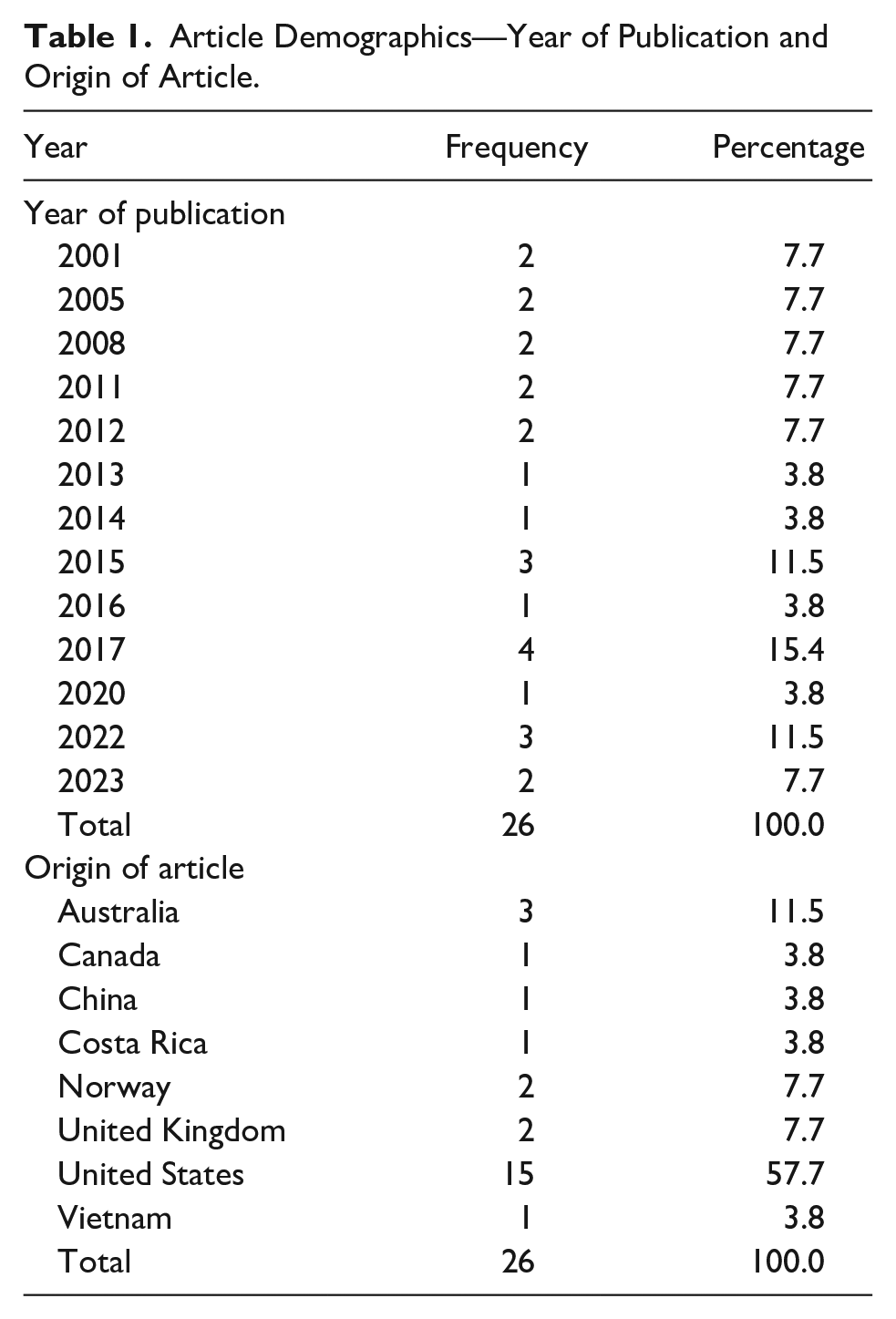
Further, of the 26 articles included in our study, the highest [4(16%)] were from Appetite, followed by the Obesity journal with 3(12%) (Table 2).
Article Demographics—Journal of the Article.

As shown in Table 3, 42.3% of the 26 studies were exclusively focused on fathers, while 57.7% were focused on both fathers and mothers. Also, 38.5% of the studies included children aged 2 to 5 years, while 34.6% had children 12 to 18-years, and 26.9% of the articles featured children aged 6 to 11 years.
Participant Characteristics.
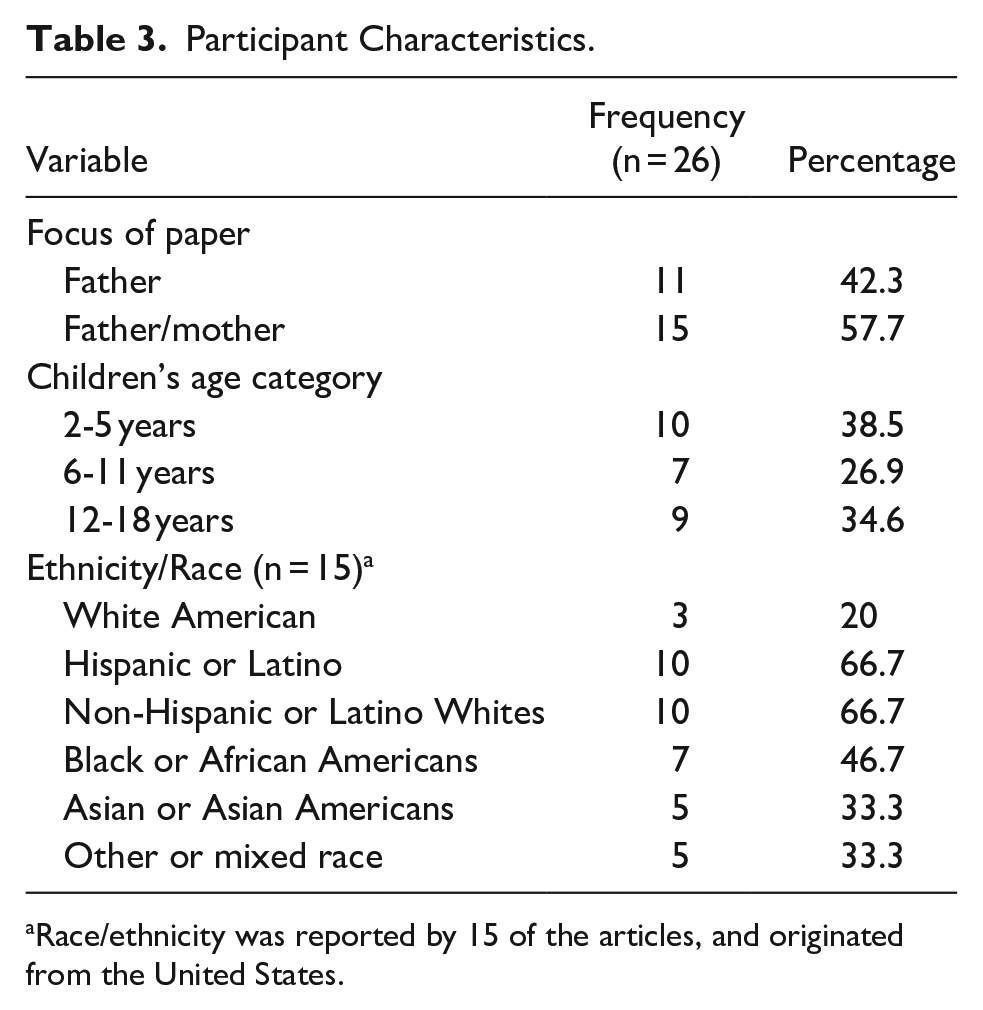
Race/ethnicity was reported by 15 of the articles, and originated from the United States.
We found that 15 out of the 26 articles reported the race/ethnicity of the respondents, and these articles were those that originated from the United States. Of the 15, only 3 (20%) of the articles included White Americans, while 10 (66.7%) included Hispanic or Latino groups, and similarly, 10 (66.7%) had Non-Hispanic or Non-Latino whites in their study. Also, 7 (46.7%) of the 15 articles that reported on ethnicity/race included Black or African Americans, while 5 (33.3%) had Asian or Asian American participants, and 5 (33.3%) of the articles included other racial or mixed ethnic backgrounds (Table 3).
Further, the methodologies of the articles were also considered, focusing on the study design, the research methods, and the data collection methods (Table 4). The majority (65.4%) of articles were cross-sectional studies, followed by longitudinal studies (23.1%), and 7.7% were explorative and interpretative studies. Also, only 1 study was found to be a community-based intervention (Table 4). The vast majority (88.5%) of the selected articles used quantitative method studies, while 11.5% were qualitative (Table 4). Furthermore, upon a review of the data collection methods, most (69.2%) were surveys, whereas 2 (7.7%) studies each were interviews and semi-structured interviews respectively. The use of secondary data sources was found in 2 (7.7%) of the articles, while the use of focus group discussion, and survey/observation methods were found in 1 study each (Table 4).
Study Methodology.

We also reviewed the findings of eligible articles to ascertain their coverage of the main parameters of the research question (Table 5) including father nutrition knowledge, and father child feeding practices, as well as fathers BMI and involvement in child feeding, in relation to childhood overweight/obesity. Of the 26 articles in this study, 3 (11.5%) reported the involvement of fathers in child feeding and the influence on their child weight status.18,29,46
Various Studies and Key Findings.
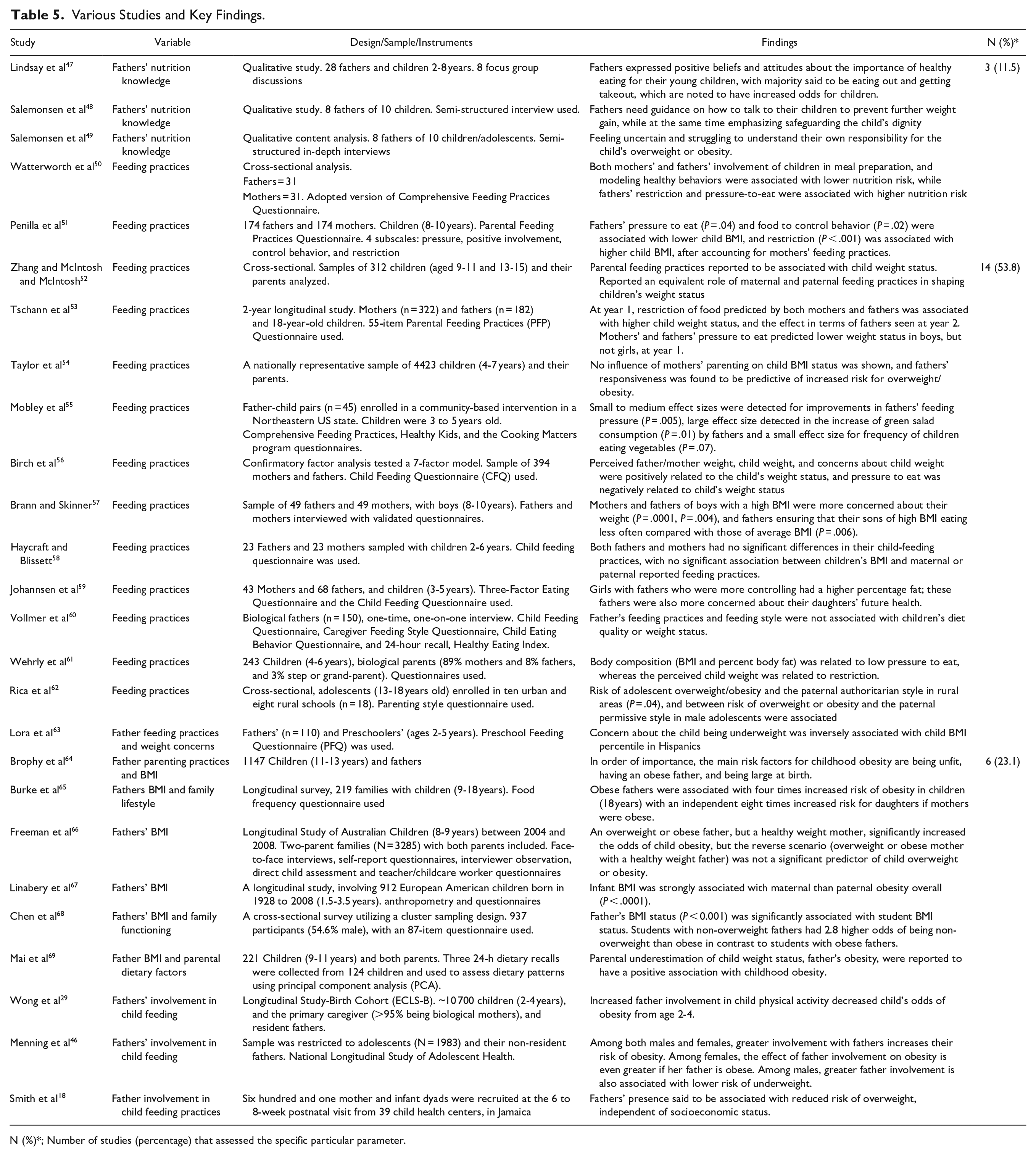
N (%)*; Number of studies (percentage) that assessed the specific particular parameter.
Further, only 3 (11.5%) of the sampled articles reviewed assessed father nutrition knowledge and established the relationship with overweight/obesity.47-49 Fathers’ child feeding practices in relation to the weight status of children from 2 years into adolescence was the focus of the majority (53.4%) of the studies.50-63 These studies focused on pressure to eat and restriction. For instance, several of the studies focused on pressure to eat and its association with childhood overweight/obesity.50,55-58 Some of the studies also looked at fathers restriction of children’s food intake and how that could influence overweight or obesity of their children.50,51,59-61 Further, 23.1% of the articles focused on establishing the father BMI and Child BMI relationship44,47-49,55,56,62,63 (Table 5).
Discussion
Several studies note that fathers’ involvement in child feeding practices and the changing role of fathers in childhood obesity is understudied.32,33,35 The rationale behind this scoping review was to assess the extent of literature on fathers’ nutrition knowledge and their child feeding practices in relation to childhood overweight and obesity. Consistent with earlier reviews,26,35 our study found only 26 eligible studies, which were published between 2000 and 2023. We found a low rate of publications on fathers’ nutrition knowledge and child feeding practices, and child overweight/obesity, across the period under review. The highest number of publications seen in a single year (2017) was 4, with the majority of the years having only 2 publications each, while some of the years saw no publications at all. Our review was global in scope, and to arrive at this low rate reflects earlier concerns highlighted by Davison et al and Morgan et al. The years 2019 to 2021 saw the impact of the COVID-19 pandemic on all human activities across the globe.70,71 This could also have accounted for the 0 publications in 2019 and 2021, respectively, and only 1 in 2021. Of the publications identified, over 50% of them originated from the United States, with the remaining spread across a few geographical areas, including Australia, Europe, North America, and Asia, with Africa and other parts of the globe missing out. This trend could be attributed to the fact that childhood overweight and obesity prevalence rates were generating much concern in the United States between the years 2000 and 2010, gaining the attention of researchers. 7 The trends have persisted to-date. 72 The vast disparity in the number of studies between developing and developed countries, especially the United States, could be due to differences in societal norms and cultures in relation to fathers’ roles in childhood feeding. 58 For instance, in most parts of Africa, fathers are less involved in child feeding, 24 and are mostly not included in child nutrition research. 73 We also found that close to 90% of the sampled articles were published in nutrition and public health related journals, and of these, 23.1% were found in obesity related journals. This is understandable, as the outcome variables of most of these studies had to do with overweight and obesity.
Eleven out of the 26 articles included in our study were focused on father-child dyads, while the rest were father/mother focused. This supports the evidence that fathers are understudied in terms of child nutrition and overweight/obesity.33,35 Our review focused on children in age groups of 2 to 5 years, 6 to 11 years, and 12 to 18 years. This is justified, as high overweight and obesity prevalence rates are reported among these child age groups. 3 Also, all the 15 articles that originated from the US also reported on the ethnicity or race of the respondents, with the vast majority predominantly of the minoritized ethnic or racial groups, while just a few had White American participants. This is in contrast to the findings of an earlier review, with a higher percentage of articles found to have White Americans included compared with minority ethnic groups. 74 However, the high inclusion of ethnic minorities (Hispanic or Latino and Black or African Americans) in child obesity research is not surprising, as the highest prevalence of child obesity in the US is reported to be among these minority ethnic groups. 75
We found that the majority (65.4%) of studies were cross-sectional, with only 6 (23.1%) being longitudinal studies. This highlights the weaknesses of most literature which does not include more rigorous study designs. 76 The high cross-sectional studies versus less longitudinal studies recorded in our scoping review reflects the findings of other earlier reviews.77,78 Further, the vast majority (88.5%) of the articles included in this study employed quantitative methods, with the remaining few being qualitative, and none of them found to have employed mixed methods. This meant that the vast majority were expected to use surveys as data collection methods, with few to use qualitative data collection methods such as interviews and focus group discussion, thus missing out on richer, thicker descriptions of the role of fathers in child feeding. However, the findings of this study is in line with health research, which is said to be limited in the use of mixed methods, 79 despite its known strengths and benefits. In our review, none of the sampled articles used a randomized controlled trial (RCT) design, which further exposed weakness of current research in relation to fathers’ nutrition knowledge and child feeding practices and childhood overweight/obesity. This is not particularly surprising though, as it is in alignment with an earlier systematic review report. 35
With regard to child feeding practices, 3 of the studies reported the involvement of fathers in childcare, feeding and physical activity, and established that fathers’ involvement was associated with lower risk of childhood overweight and obesity. These suggest that interventions or social policies that target father-mother collaborated child feeding and caring could promote children with healthy weight. 28
On fathers’ nutrition knowledge, our review indicates that it is a limited area of research as only 3 of the sampled articles had fathers’ nutrition knowledge as a featured variable, expressed as a determinant of childhood overweight/obesity. Nutrition knowledge is recognized as an indicator of health literacy and said to relate to health outcomes. 80 Also, the significance of fathers nutrition knowledge for child feeding is documented.12,13 Despite this, our review showed that studies around fathers’ nutrition knowledge and childhood obesity are limited. In addition, the few studies enlisted here could not clearly establish the father’s nutrition knowledge and the child’s BMI relationship.47-49 These studies were qualitative in design, and could not statistically determine the association between fathers’ nutrition knowledge and childhood BMI.
Out of the 26 eligible articles, the investigation of fathers’ child feeding practices in relation to the weight status of children (2-18 years) was featured in 14. This aligns with the Khandpur et al 78 review of evidence on fathers’ child feeding practices, which suggests that literature around this is limited. The focus of these studies has been pressure to eat and restrictive child feeding, with pressure to eat said to be associated with decreased child BMI by a number of studies.50,51,56,61 Whereas, some of the studies documented restrictive child feeding as being associated with increased child BMI.51,53
Some of the studies also reported on fathers’ BMI with child weight status. Almost all the studies that sought to establish the father’s BMI and child’s BMI relationship noted that increased father’s BMI was positively associated with child’s BMI.65,66,69 One of the studies also posited that the higher odds of the child’s obesity was more related to the mother’s BMI than the father’s BMI. 67
The significance of fathers’ influence on child feeding behaviors and the prevention of childhood obesity is highlighted though fathers are said to be underrepresented in research and interventions focusing on this area are scarce. 73 Based on current research on fathers’ feeding practices and the influence on childhood overweight/obesity, the inclusion of fathers in early feeding interventions is encouraged as father/mother interventions proved to be more efficacious.77,81
Further, with the few studies on fathers’ nutrition knowledge and childhood BMI unable to establish clear relationships, future studies to further explore this area are recommended. However, based on the current findings, nutrition interventions could focus on fathers, with the aim of improving their nutrition knowledge, feeding practices, and child nutritional outcomes.
It is important to recognize, however, that father’s influence on child feeding likely varies across age ranges. For instance, while nutritional requirements change from childhood to adolescence, caregiver’s influence on eating behavior may decline.27,82 This review found fathers to have significant influences on their children at specific age ranges 2 to 5 years, 54 6 to 11 years, 51 and 12 to 18 years.52,53 However, none of the studies assessed father’s influence across various child age ranges to determine the relative influences of their involvement in child feeding, as such, this could be further explored in future research.
This scoping review, with a focus on fathers’ nutrition knowledge and feeding practices in relation to childhood BMI, is the first of its kind to the best of our knowledge. It followed the existing protocols and standards 40 to unravel the extent of work on fathers’ nutrition knowledge and feeding practices, and their relationships with child BMI. Thus, it brought to the forefront the need for more research in this area.
Despite its numerous strengths this study has some limitations. The approach of scoping reviews simply focuses on the documentation of the breadth and depth of available literature and does not come with a critical analysis of the quality of the studies. The publication period of 2000 to 2023 meant that studies that were published prior to 2000 and eligible could have been missed being added. The demands of the scoping review required teamwork to limit errors, especially when it comes to data screening and charting. The fact that only 2 authors were involved in this work brought with it the possibility of missing some studies or specific parameters of eligible studies that should have been extracted for analysis.
Conclusion
The focus of this scoping review assessed the extent of literature on fathers’ nutrition knowledge and child feeding practices in relation to overweight/obesity of children aged 2 to 18 years. We conclude that this area of nutrition research designed to focus on father-child dyads is still limited, as only 26 related articles were found to have been published between the years 2000 and 2023. Most of these articles were cross-sectional in design. We recommend that fathers should be involved more in nutrition research, particularly more experimental designs. More evidence on fathers’ influence on childhood nutrition and obesity, would pave the way for the inclusion of fathers in household nutrition intervention programs.
Supplemental Material
sj-docx-1-gph-10.1177_2333794X241263199 – Supplemental material for Fathers Nutrition Knowledge and Child Feeding Practices Associated with Childhood Overweight and Obesity: A Scoping Review of Literature From 2000 to 2023
Supplemental material, sj-docx-1-gph-10.1177_2333794X241263199 for Fathers Nutrition Knowledge and Child Feeding Practices Associated with Childhood Overweight and Obesity: A Scoping Review of Literature From 2000 to 2023 by Siddique Gbanha Bawa and Lauren Haldeman in Global Pediatric Health
Supplemental Material
sj-pdf-2-gph-10.1177_2333794X241263199 – Supplemental material for Fathers Nutrition Knowledge and Child Feeding Practices Associated with Childhood Overweight and Obesity: A Scoping Review of Literature From 2000 to 2023
Supplemental material, sj-pdf-2-gph-10.1177_2333794X241263199 for Fathers Nutrition Knowledge and Child Feeding Practices Associated with Childhood Overweight and Obesity: A Scoping Review of Literature From 2000 to 2023 by Siddique Gbanha Bawa and Lauren Haldeman in Global Pediatric Health
Footnotes
Author Contributions
SGB and LH brainstormed and jointly conceived and designed this scoping review. SGB and LH collaborated to search and select articles, chart, and extract data from selected articles. SGB did the descriptive analysis of the data and commented on the results as well as the discussion. SGB drafted the manuscript, which was reviewed by LH. LH proofread the manuscript and gave final approval, and SGB agreed to be accountable for all aspects of the work, ensuring integrity and accuracy.
Availability of Data and Materials
All relevant data of this scoping review are incorporated in the report. The resource from which the findings of this review were generated can be made available upon request from the corresponding author.
Declaration of Conflicting Interests
The author(s) declared no potential conflicts of interest with respect to the research, authorship, and/or publication of this article.
Funding
The author(s) received no financial support for the research, authorship, and/or publication of this article.
Ethics Approval and Consent to Participate
Not applicable.
Consent for Publication
Not applicable.

Supplemental Material
Supplemental material for this article is available online.
References
Supplementary Material
Please find the following supplemental material available below.
For Open Access articles published under a Creative Commons License, all supplemental material carries the same license as the article it is associated with.
For non-Open Access articles published, all supplemental material carries a non-exclusive license, and permission requests for re-use of supplemental material or any part of supplemental material shall be sent directly to the copyright owner as specified in the copyright notice associated with the article.
