



Abstract
Objective. This study aimed to investigate the association between motor coordination (MC), cardiorespiratory fitness (CRF), and academic achievement (AA) among school students aged 11 to 13 in the West Bank/Palestine. Methods. A total of 252 students were assessed through tests measuring gross and fine motor coordination (Flamingo balance, plate tapping, and other tests). The CRF was evaluated by the 3-minute step test, while AA was measured using grade point average (GPA) and subject-specific grades. Results. A significant correlation was recorded between MC, CRF, and AA (P = .00), rs range (0.436-0.718); Students who engaged in physical activity demonstrated better MC, CRF, and AA compared to their inactive counterparts (P = .00, Cohen’s d ranged between 0.53 and 1.35). Conclusion. Enhanced MC and CRF significantly impacted AA, with effect sizes ranging from moderate to large. Promoting physical activity interventions is vital to improve MC and CRF which could positively improve academic achievement among school students.
Keywords
Introduction
Children in schools face numerous academic challenges regarding AA, placing both students and parents under constant pressure to improve AA. 1 Students’ AA can be influenced by factors such as socioeconomic status, parental education level, the student’s cognitive, physical, psycho-motor, or emotional development, and other educational and environmental factors.2,3 Good motor coordination and cardiorespiratory fitness (CRF) are also important factors that may positively contribute to academic achievement4,5 which is the scope of our study.
Children’s motor coordination development involves the integration of various body systems, including sensory, musculoskeletal, cardiorespiratory, and neurological systems. It encompasses their ability to interact effectively with the environment. 6 Motor coordination is defined as the capacity to efficiently control the degrees of freedom of the various segments that are involved in the motion and activate multiple muscles at the appropriate time and with the proper amount of force so that a smooth, efficient, and accurate motion occurs. 7 Despite the fact that approximately 6% to 13% of school-age children face motor coordination difficulties, problems pertaining to fine and gross motor coordination are often disregarded as developmental concerns. 8 Moreover, there has been recent contemplation regarding motor coordination, suggesting that it encompasses more than merely the overall motor development of children.7,8 It has been postulated that there exists a correlation between motor coordination scores and AA in children, 9 particularly in the context of elementary school, a child’s motor skill performance serves as a predictor of AA. 9
Related similar studies have demonstrated a beneficial relationship between CRF with AA.2,10,11 Physical fitness is an important health indicator both in childhood and later in life, the cardiorespiratory element of physical fitness has been shown to improve mental and physical health in children. 4 As a result, it is predicted that improvements in AA may result from the advantages of CRF on brain anatomy, function, plasticity, and cognition.12,13
Children in elementary school represent a significant proportion of the global population, the number of elementary schools in the West Bank (Palestine) is constantly increasing because the Palestinian population is relatively young, with more than one-third of the population under the age of 15, and children aged 0 to 14 years constitute 38% of the total population, 14 comprising a growing population group that necessitates further research.
The significance of this research lies in simulating the educational contextual factors in Palestine considering the region’s unique challenges and circumstances. The Palestinian economy remains vulnerable in the face of socio-political instability. 15 Economic challenges may have a negative impact on the availability of high-quality teaching materials, infrastructure, and technology in schools. Given the limited available resources, there is a need for feasible and cost-effective measures that can enhance both the health and academic achievement of school students. There is growing evidence that motor coordination and cardiorespiratory fitness are vital contributors to AA in school students.2,6,10,11,16 However, in Palestine, research in this specific field remains limited, therefore, this study aimed to investigate the association between motor coordination, cardiorespiratory fitness, and academic achievement among school students aged 11 to 13 years.
Methods
Study Design
A cross-sectional study was conducted on the association of motor coordination and cardiorespiratory fitness with academic achievement among school students (11-13) years in the West Bank/Palestine.
Participants
A stratified random sampling method was used to select participants from various schools located in the cities of Jerusalem and Ramallah. The sample was divided into 2 groups, namely males and females. Each group consisted of an equal number of male and female students from the sixth, seventh, and eighth grades
The inclusion criteria encompassed the following conditions: students who had a minimum attendance rate of 90% during the academic year (regular school attendance), students who did not receive additional educational support such as private lessons, participants whose parents or guardians provided informed consent for their child’s involvement in the study, and students enrolled in grades 6 to 8 (11-13 years) residing in the West Bank/Palestine. Conversely, the exclusion criteria included: students with a clinical diagnosis of cardiovascular or any other disease that could hinder the research investigations, students who did not express willingness to undergo evaluation, and/or parents or guardians who were unwilling to provide consent by signing a consent form.
Outcome Measures
Demographic and clinical characteristics questionnaire
Data on age, gender, grade, address, diagnosed disease (cardiovascular, musculoskeletal, and others), parent education level, and anthropometric measurements (such as the student’s weight and height) were collected. In addition, information on sports participation and the types of sports practiced has been obtained.
Motor coordination and physical fitness measures
Flamingo balance test
The Flamingo Balance Test, which measures total body balance, is part of the Eurofit Testing Battery. This one-leg balance test assesses both dynamic balance and leg, pelvic, and trunk muscle strength. 17 The balance position is held for as long as possible, up to 60 seconds, and a stopwatch is used to record the amount of time spent on the beams. The reliability was found excellent for this test (0.84-0.98). 17
Plate tapping test
The Plate Tapping Test (Reaction Tap Test) is a valid and reliable test that uses an alternating tapping action to assess upper body reaction time, hand-eye coordination, and speed. 18
Procedure: Participants are seated around a table with 2 metal plates. Each plate is 20 cm in diameter and 80 cm apart in the center of the table. The dominant hand is placed on a 10 to 20 cm rectangular plate in the center of the table. The participant’s task is to quickly execute 25 touches on the circular plate with their dominant hand. Their score is determined by the time it takes to complete this set of 25 touches. This procedure is repeated twice, with the best outcome documented. 18
Alternate Hand Wall Toss (AHWT)
The AHWT is a valid coordination test 19 in which a ball is thrown from one hand in an underarm motion against a wall distanced 1.2 m and caught with the opposite hand at a set distance from the wall. The total number of repeating catches is recorded for 30 seconds.
Scoring is based on the total number of successful catches in 30 seconds, excellent > 35, good 30 to 35, average 20 to 29, fair 15 to 19, poor < 15. 19 The reliability of the coordination test Hand Eye was found as 0.875. 20
Modified bass test of dynamic balance
It is a valid test 21 for assessing dynamic balance, and it is performed by jumping to and from tape markers along a course with both feet in alternating order, this is repeated with alternate foot hopping and retaining a static stance for 5 seconds at each station. The result is recorded as a success or failure. 21 The reliability of the test was recorded as 0.75. 22
Cardiorespiratory fitness measure
The 3-minutes step test (3MST)
It is used to assess exercise capacity based on heart rate (HR) mean post-exercise results. The age- and sex-specific HR mean post-ex reference range provided allows for the assessment and monitoring of submaximal exercise-induced changes in the cardiovascular system and, as a result, a given individual’s physical fitness. 23 The 3MST involves stepping on and off a 20 cm single-step device as many times as possible in 3 minutes without using any handles. The 3MST is valid and feasible in children. 24
Academic achievement (AA)
Academic achievement was measured using students’ grade point average (GPA) scores at the end of the previous year and the current year, as well as the rate of subjects: mathematics, language (Arabic), and language (English).
Study procedures
The study was conducted between January and May 2023, and the enrollment procedure for the participating students was carried out in collaboration with 4 schools located in the cities of Jerusalem and Ramallah in the West Bank/Palestine.
Prior to the start of data collection, written informed consent was obtained from the school management teams as well as the parents of the school students. A convenience sample of 4 schools in Jerusalem and Ramallah city was drawn from those who agreed to participate in the study. Consequently, a stratified random sample was used for selecting the participants with even numbers as listed in the students’ files. The sample was distributed equally into 2 groups, males and females, each group had the same number of male and female students from the sixth, seventh, and eighth grades.
The parents of the participating students completed demographic data, and the questionnaires were collected along with the signed consent form. Information about height, weight, and outcome measures was completed by the first author.
A pilot study was conducted in January 2023 to ensure that the questionnaires and outcome measures used in this study were understandable and valid for achieving the research objectives. Ten students took part in this pilot study, and the results showed that all of the questions were clear and that no further changes were required.
Prior to the tests, participants were given a thorough explanation of the purpose and procedure. They were given specific instructions on how to conduct the tests correctly, efficiently, and consistently. Practice trials were provided to participants to familiarize them with the tests. The measurements took place between 9:30 and 11:30 am to minimize the potential impact of fatigue during the school day.
Data analysis
Data were analyzed by using the statistical package for Social Sciences (SPSS) version 26. Scale variables were presented as mean and standard deviation (SD), while categorical variables were presented as frequencies. The relationship between motor coordination, cardiorespiratory fitness, and academic achievement variables was assessed using the Mann-Whitney Test, Kruskal-Wallis Test, and Spearman’s rank correlation coefficient. Additionally, multiple linear regression was employed to investigate the association between motor coordination, cardiorespiratory fitness, and academic achievement (current year GPA). The regression coefficient (β), P-values, and 95% confidence interval (95% CI) were reported. Statistical significance was set as P < .05, and the effect size was determined based on Cohen’s guidelines for interpreting the effect size are as follows: 0.2 = small effect, 0.5 = moderate effect, 0.8 = large effect. 25
Ethical approval and informed consent
Ethical approval was obtained from the research ethical committee at Al-Quds University (Ref No: 274/REC/2023), which complies with the Helsinki Declaration. All parents or guardians of the participants and the participating schools were informed about the study’s objectives, and a written consent form was obtained.
Results
A total of 252 students were recruited from the sixth, seventh, and eighth grades, with an equal distribution of 50% males and 50% females. All participants were free from any diseases, hearing or mobility impairments, or speech difficulties. The average age of both males and females was 12 ± 0.82, and there was no significant statistical difference between the 2 groups in terms of age (P > .05). Similarly, there were no significant differences between the 2 groups regarding weight, height, and body mass index (BMI) (P > .05). Table 1.
Lifestyle and Anthropometric Characteristics of the Participants (n = 252).
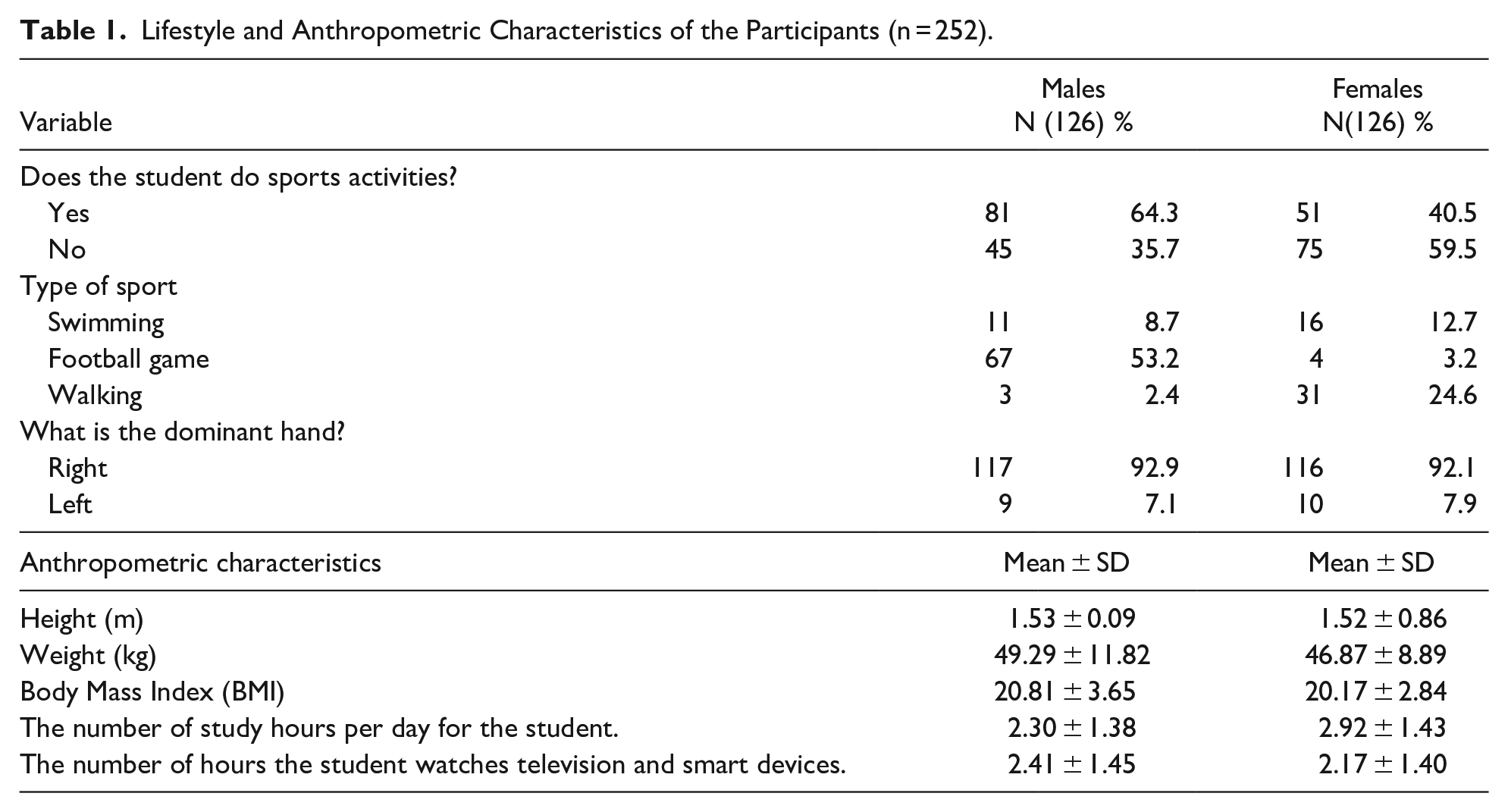
Regarding the participants’ lifestyle, 64.3% of males engaged in sports, whereas only 40.5% of females participated in sports activities. Among males, football was the most popular game, with a participation rate of 53.2%. In contrast, walking was the most prominent physical activity among females, with a rate of 24.6%. Significant statistical differences were found between the 2 sexes in terms of the number of study hours per day, with females spending more hours studying (P = .00). However, no significant differences were recorded between the 2 groups regarding the number of hours spent watching television and using smart devices (P = .18). Table 1.
The average scores of AA variables demonstrated significant differences between males and females (P < .05), with females achieving higher scores across all variables. Regarding the cardiorespiratory fitness test and flamingo test, there were significant differences between the 2 groups (P < .05). However, no significant differences were observed between males and females in the Modified Bass Test of Dynamic Balance, plate tapping, and AHWT Test as illustrated in Table 2.
The Mean Values of Academic Achievement, Coordination and Cardiorespiratory Fitness for Both Groups (n = 252).
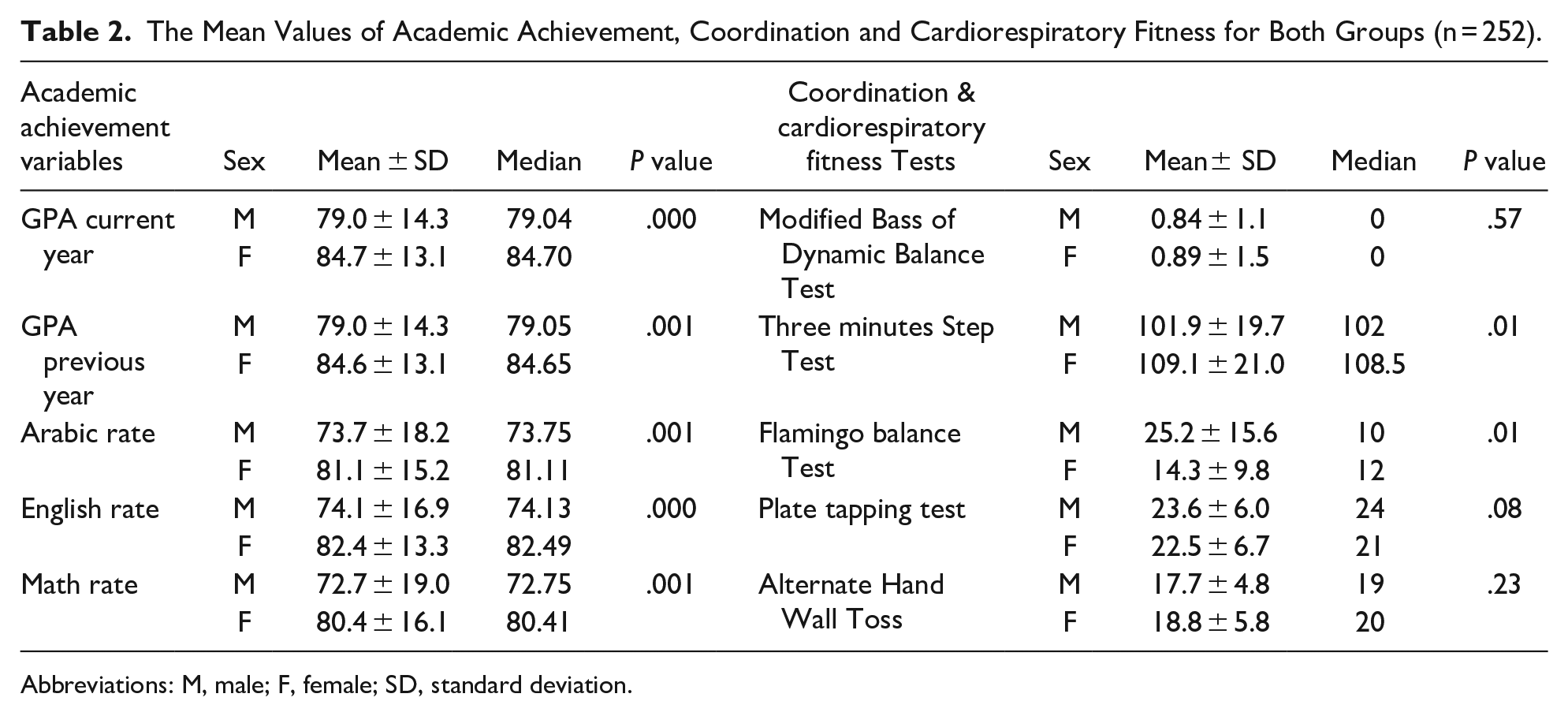
Abbreviations: M, male; F, female; SD, standard deviation.
Also, our results showed that there was a significant difference in academic achievement, coordination, and CRF tests between the groups of students according to participation in sports activities where students who engaged in sports activities recorded better results (P = .000), and Cohen’s d ranged between (0.53 and 1.35), indicating moderate to large effect size (Table 3).
The Mean Values of Academic Achievement, Coordination and Cardiorespiratory Fitness for Both Groups According to Sports Activities (n = 252).

Our results showed that there were significant correlations between the motor coordination and cardiorespiratory fitness tests with all academic achievement variables (GPA current year, GPA previous year, Arabic rate, English rate, and Math rate (P = .00, and R2 ranged between .436 and .718) indicating moderate to strong correlation. As shown in Table 4.
Correlation Between Coordination, Cardiorespiratory Fitness, and Academic Achievement (n = 252).

rs: Spearman’s correlation coefficient; GPA: Grade point average.
Also, a significant correlation between the Modified Bass Test of Dynamic Balance and AHWT (rs = −.705, P = .00) was recorded, indicating a strong association between gross and fine motor coordination tests.
Multiple linear regression analysis was conducted to predict the association of the Modified balance, AHWT, the 3MST, the number of study hours per day for the student, and the grade point average (GPA) current year. Model 1 showed a negative correlation between GPA and Modified balance (β = −.65-, P = .00). After controlling AHWT in model 2, a positive correlation between AHWT and Modified balance (β = .47. P = .00). The result indicated that significant correlation was recorded between Modified balance, AHWT, the 3- MST, the number of study hours per day for the student, and GPA (P < .05). As shown in Table 5.
Multiple Linear Regressions; Predictors of Academic Achievement (Current GPA) (n = 266).

Discussion
The purpose of this study was to investigate the association between cardiorespiratory fitness and motor coordination with academic achievement among school students (11-13 years).
Regarding the lifestyles of the participants, it is worth noting that the majority of students involved in sports in this study were males, accounting for 64%, and 40% of females, which is relatively low for this young age group. These findings are consistent with similar studies that show a growing trend toward sedentary lifestyles among school-age children,26,27 and physical activity levels are declining over time for both males and females, with females aged 12 and 13 experiencing a greater decline.28,29 Findings that were described in a Meta-Analysis study on correlates of motor competence in children and adolescents as a concern for females as their PA declines more than boys over adolescence. 30
However, our findings showed that females recorded higher grades across all academic achievement variables; this might be related to that they spent more hours studying. Also, this could be attributed to that female students are more self-disciplined, 31 and prioritize academic preparation more than male students, and they are more concerned with pleasing adults such as parents and teachers.32 -34
Based on sports participation, our findings revealed a significant difference in academic achievement, cardiorespiratory fitness, and coordination (P = .00). Male and female students who participated in sports recorded higher scores compared to their peers who did not participate in sports activities. Similar results were found in research conducted with elementary school students in the USA, demonstrating that participation in sports activities had a favorable impact on AA. 35 Likewise, participation in sports requiring more complex motor skills, which was directly related to an improvement in academic achievement as found in a longitudinal study in school students in Japan 36 ; Conversely, the study indicated that quitting sports was associated with a decrease in academic achievement, along with a reversal of cardiorespiratory fitness. 36
The primary argument supporting the association between physical activity (PA) and AA from a neurophysiological perspective is that PA directly and positively impacts the brain and nervous system. PA improves brain functionality by increasing blood flow, improving glucose and lipid metabolism, and thus improving concentration and cognitive abilities3,35 -37
Regarding the CRF results in our study show that male students performed better on the 3-minute step test than females (P = .01), which is consistent with findings from a study conducted by Pojskic and Eslami et. al in children and adolescents in Bosnia and Herzegovina, 29 stated that males had significantly higher CRF than females between the ages of 11 and 14. This could be due to sex differences in body fat tissue and lean body weight composition, as well as differences in hemoglobin content between pubertal males and females, which is a critical component of the sex-based variations in CRF. 38
Furthermore, the results of this study revealed a significant difference between sexes on the flamingo test (P = .01), with males scoring higher. A similar study addressed the associations between gross motor coordination and academic achievement in elementary school children in Portugal 6 found that males had significantly higher average levels of gross motor control and fitness than females, which could be attributed to males engaging in more physical activity and sports than females. 39
The findings of our study support our hypotheses about the association between AA, CRF, and motor coordination. Both male and female students recorded a significant correlation between the CRF test and various academic indicators such as the GPA, English language rate, and Math rate. Results that are consistent with the findings of systematic reviews, indicated that all included studies confirmed the beneficial effect of cardiorespiratory fitness on academic achievement. 10 Additionally, similar studies in Brazil 40 and Portugal 16 in school students (11-14 years) revealed that improving cardiorespiratory fitness is a vital contributor to improved academic achievement. This could be attributed that maintaining a consistently high CRF improves brain structure and function; consequently, these improvements contribute to enhanced attention and memory abilities in students, as well as improved vasculature in the cerebral cortex.10,11,16,40
Moreover, we found a significant correlation between motor coordination (Gross and fine motor tests) and various academic achievement indicators. A similar study 41 conducted with Spanish school children indicated a positive relationship between motor coordination and AA. Also, a longitudinal study in Finland found that better motor coordination is an independent predictor of better academic achievement among school students. 42 This could be related to that coordinated exercise activates the cerebellum, improving coordination skills and influencing motor activities. Furthermore, the frontal lobes are important for both motor coordination and cognitive function. 6
In our study, significant correlations were observed in the plate tapping test and AA (P = .00), suggesting the involvement of various brain regions associated with attentional control, visual processing, response selection, and planning.8,43 This underscores the importance of coordinated movements during plate tapping, as they contribute to enhanced information processing and retention in the academic setting. 1 Similar results were recorded in a study conducted with Brazilian children indicating a positive and significant relationship between AA and motor skills particularly in activities requiring interlimb coordination. 9
In this study, the results of the linear regression model indicated that a significant correlation was recorded between Modified balance, AHWT, 3-MST, the number of study hours per day for the student, and GPA (P < .05). Consistent with a similar study, 9 a significant relationship was found between AA and total motor performance, indicating that a one-point increase in body coordination enhanced the likelihood of strong AA by 12% (95% CI: 4.4-21%). Furthermore, another study in Portugal highlighted the regression results, suggesting that children with insufficient motor coordination had a higher likelihood of having low AA than those with normal or good motor coordination. 6 These findings emphasize the independent significance of each component of physical fitness concerning AA.1,4,6
Additionally, our results demonstrated a significant correlation between gross and fine motor coordination. These outcomes align with other studies that have shown significant correlations between fine and gross motor abilities in school students.6,8,44,45 Results highlight that regular motor coordination and cardiorespiratory fitness screening programs in schools must be implemented and integrated into existing health programs. 46
A potential limitation of this study is that we used a convenience sample and a sample size calculation was not performed. Additionally, the cross-sectional study design does not allow for the establishment of a true causal relationship. More prospective and intervention studies are needed to better understand the cause-and-effect relationship between cardiorespiratory fitness and motor coordination with academic achievement among school students.
Conclusions
Our results revealed that there was a significant correlation with a size effect ranging from moderate to large between academic achievement, motor coordination, and cardiorespiratory fitness among school students (11-13 years). Notably, students who engaged in physical activity and sports demonstrated better coordination, cardiorespiratory fitness, and academic achievement compared to those who did not participate in such activities with an effect size ranging from moderate to large. Our findings support interventions aimed at improving motor coordination and cardiorespiratory fitness in schoolchildren. These interventions benefit physical health, cognitive development and AA. Regular assessments of students’ physical abilities are required to put this proactive approach into action. Furthermore, the findings of our study can be used for early evaluations, allowing for the early detection of potential academic challenges in students.
Supplemental Material
sj-docx-1-gph-10.1177_2333794X231207311 – Supplemental material for Cardiorespiratory Fitness, Motor Coordination, and Academic Achievement in School Students (11-13 years)
Supplemental material, sj-docx-1-gph-10.1177_2333794X231207311 for Cardiorespiratory Fitness, Motor Coordination, and Academic Achievement in School Students (11-13 years) by Wafa Tanineh and Hadeel Halaweh in Global Pediatric Health
Supplemental Material
sj-docx-2-gph-10.1177_2333794X231207311 – Supplemental material for Cardiorespiratory Fitness, Motor Coordination, and Academic Achievement in School Students (11-13 years)
Supplemental material, sj-docx-2-gph-10.1177_2333794X231207311 for Cardiorespiratory Fitness, Motor Coordination, and Academic Achievement in School Students (11-13 years) by Wafa Tanineh and Hadeel Halaweh in Global Pediatric Health
Footnotes
Acknowledgements
We would like to thank all of the students and parents who participated in this study; also, we are thankful for all participating schools
Author Contributions
WT and HH contributed to the study design, analysis, and interpretation of data. WT contributed to the acquisition of data and drafted the initial manuscript; HH critically revised the manuscript. Both authors gave approval for the final version.
Declaration of Conflicting Interests
The author(s) declared no potential conflicts of interest with respect to the research, authorship, and/or publication of this article.
Funding
The author(s) received no financial support for the research, authorship, and/or publication of this article.

Supplemental Material
Supplemental material for this article is available online.
References
Supplementary Material
Please find the following supplemental material available below.
For Open Access articles published under a Creative Commons License, all supplemental material carries the same license as the article it is associated with.
For non-Open Access articles published, all supplemental material carries a non-exclusive license, and permission requests for re-use of supplemental material or any part of supplemental material shall be sent directly to the copyright owner as specified in the copyright notice associated with the article.
