




Abstract
Objective of the present study was the assessment of the effect of a systematic community intervention offered at an early age to 32 children with autism spectrum disorder (ASD), 2 to 5 year after completion of treatment while attending public school classes. The intervention had been offered at a community Day Centre and lasted 3 years. On assessment all children showed clinical improvement and significant results on Childhood Autism Rating Scale (CARS) and Vineland Adaptive Scales and 13 scored below criteria for autism on Autism Diagnostic Observation Scale-2 (ADOS-2). Most performed adequately at school whilst 12 required academic assistance. No major disruptive behavior difficulties were reported.
Introduction
The successful admission of a child with an early diagnosis of ASD, after intensive therapeutic intervention, to a school program for children with typical development, may be taken as a criterion of satisfactory psychosocial development. 1
The question however exists whether despite the admission to a mainstream school some children with an early diagnosis of ASD continue to present characteristics of the disorder such as difficulties in social interaction and in cognitive functions for example, language. Focusing on this problem Fein et al 2 addressed the question whether subtle deficits still existed in individuals with optimum outcome (absence of any significant symptoms of autism, normal intellectual range). They compared 34 individuals with optimum outcome with 44 individuals of high functioning autism and 34 individuals with typical development of 8 to 21 years of age with a battery of tests and questionnaires. That study showed that the 34 individuals with definite prior diagnosis of autism and optimum outcome were not presenting anymore the characteristics of the disorder. However, the authors commented, it is possible that subtle difficulties in social interaction and in cognition might not be ruled out.
Children with ASD who receive therapeutic intervention in community settings outside of experimental programs may present with varying clinical outcome3,4 reports however on their advancement in mainstream classes are scarce. A parent reported outcome study 5 on 80 children at 6 to 8 years attending school classes showed that 20% presented with “optimal outcome” while most exhibited various problems (language, social difficulties requiring use of medication, special support in class). Another study on the stability of clinical diagnosis of autism from an early age to school years having been offered a variety of interventions showed that 73% continued to meet criteria for autism. 6 Starr et al 7 reviewing previous studies commented that children with ASD who had been offered early intervention may continue to experience difficulties in school requiring ongoing assistance.
The current naturalistic study was conducted at the Day Centre for Children with Developmental Disorders in Messolonghi, which is a state funded health facility providing diagnostic evaluation and therapeutic interventions to children with a variety of developmental delays including ASD. 8
Τhe present study’s primary aim was to assess the long-term effect of a community-based early intervention program on autism symptoms in a group of young children attending regular school classes. More specific was the question whether substantial clinical gains had been achieved from time “one”—admission to the treatment program at an early age, to time “two”—follow-up while attending regular school classes. An additional aim of the study was to assess participants’ primary school adjustment and language skills.
Method
Participants
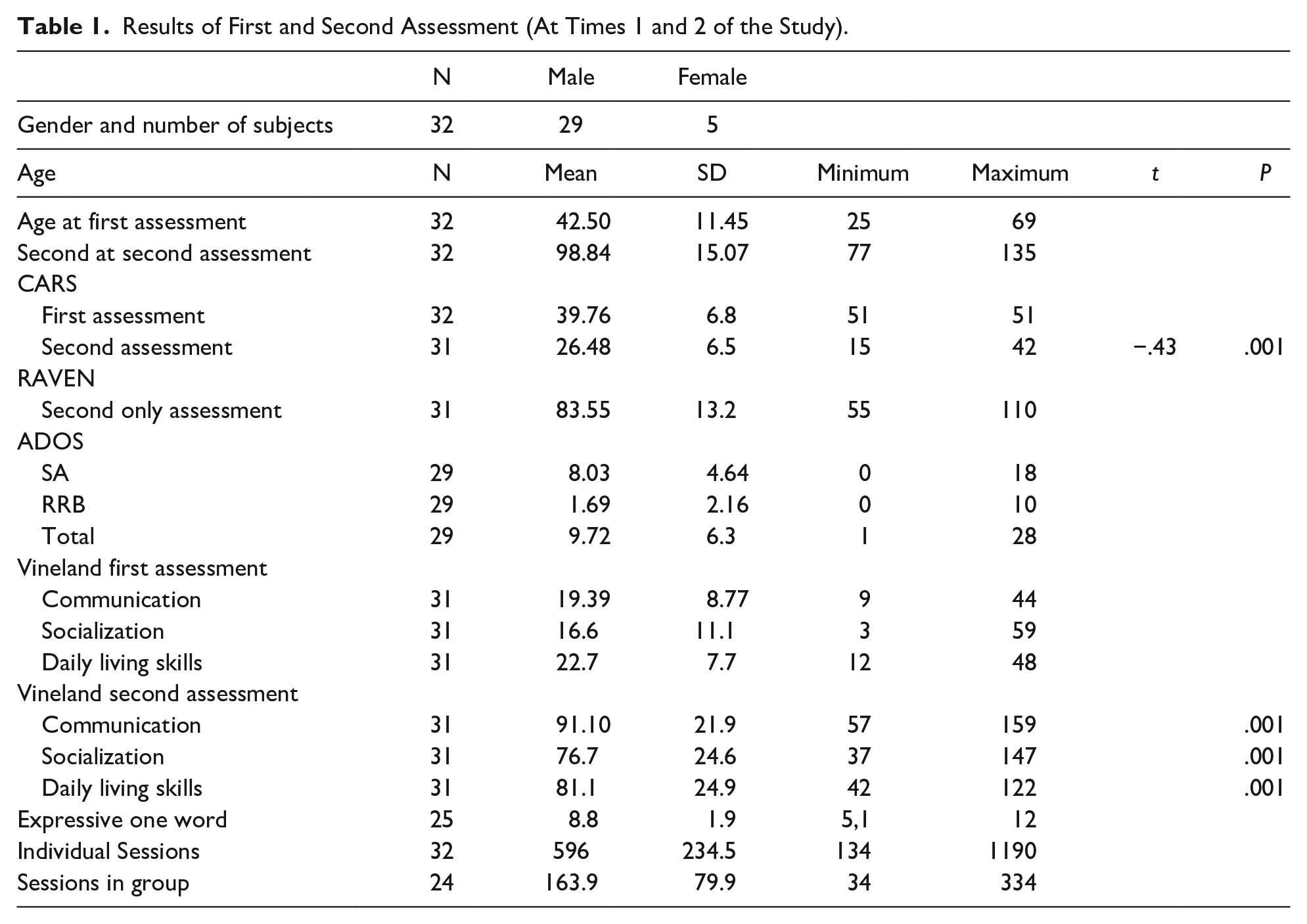
Thirty two children diagnosed with ASD were selected among those referred consecutively to the Day Treatment Program considered able to attend primary school classes from an original sample of 52. The study group became the sample of the present investigation (Table 1). The original 52 children had entered the same treatment program and it was in the course of time that 20 (38,5%) of them were excluded from the study having been considered unable to proceed to mainstream classes on account of severe autistic symptoms associated with intellectual disability. Twenty seven subjects were boys. Their age ranged from 25 to 69 months at the beginning of intervention. The diagnosis was made by 2 experienced child psychiatrists on the DSM-IV criteria (autistic disorder, and pervasive developmental disorder not otherwise classified) 9 and was confirmed subsequently by observations of the multidisciplinary team. At the time of the initial assessment the CARS and Vineland questionnaires were filled (Table 1).
Results of First and Second Assessment (At Times 1 and 2 of the Study).
Intervention
Following a few initial sessions of getting acquainted with the environment and the therapists the child entered a program of systematic behavior, speech, and occupation therapy. In the application of the program the principles of Applied Behavior Analysis (ABA) (material and social reinforcement) 10 were used and procedures of Pivotal Response Treatment (following the initiative of the child) 11 were followed. For speech-language therapy the innovative program Phoneme Touch and Say 12 was used which has been found effective in children with ASD. 13 Basic characteristic of Phoneme Touch and Say was the imitation by the child of the pronouncement of phonemes while observing the therapist positioning her fingers on different parts of the mouth with specific cues for every phoneme. A friendly environment aiming at the affective engagement of the child helped everyone attend with eagerness. At the same time issues on the management at home were addressed by the social worker with parents. The treatment hours per week varied from 4 to 6 depending on whether parents could keep appointments. At the completion of 2 years of individual therapy sessions the children begun to attend socialization activities in small groups which might be combined with further individual sessions for 1 year. For the socialization group activities of the guidelines of a manual by the Greek Ministry of Education were followed. 14 The next stage of treatment involved the preparation of the children to enter grade 1 regular school program. Special preparatory group sessions were held with emphasis on language (phonemic awareness, lexicon, graphim-phonim association, blending). Throughout the children attended preschool child centers or kindergarten in their local communities. At the completion of the program the children entered grade 1 schools in their communities.
Assessment at Time Two
A follow-up assessment was arranged, at time “two” of the study, 2 to 5 years after termination of the intervention at the treatment Center and admission to school programs. The children were attending grade 2 to 5 regular classes. Each child with a parent was invited at the Day Centre, for a thorough assessment which included clinical and measures described below. At the same time the social worker of the team contacted the child’s teacher over the telephone with parental permission to inquire about the child’s academic performance and behavior in the classroom and the school grounds. Previous contacts with schools for consultation on behavior difficulties had been made for 3 children (2 for ADHD and 3 for temper outbursts).
Measures
Initial and Follow-up Assessments
Childhood autism rating scale (CARS)
It is a questionnaire which provides an estimate of the severity of autism and has been widely used in autism research. 15 It has been shown to have good sensitivity and specificity for ASD in preschool age children. 16
Vineland adaptive scales second edition (Vineland)
It is a standardized semi-structured caregiver report instrument for assessing adaptive behavior in 4 domains: Communication, Daily Living Skills, Socialization and Motor Skills. 17 In the present study 3 domains were used: communication, socialization, and daily living skills. The Vineland has been used extensively in autism research. 18
Clinical Assessment by Child Psychiatrist
For the follow-up assessment the child was seen jointly with the parent by the child psychiatrist and alone. Information about his/her progress and behavior since he/she had been discharged from the Centre was taken. In the assessment the guidelines of DSM-IV were followed.
Additional Assessment Measures
Raven progressive matrices (non-verbal IQ)
The choice of a non verbal IQ test was made in order to avoid confounding the results by language deficits in the assessment of intelligence in autism. 19
Autism diagnostic observation scale-2 (ADOS-2)
This is a semi-structured child observation used for the direct assessment of communication, social interaction and play or imaginative use the present study. The ADOS-2 was conducted and coded by a trained and certified professional (Lord et al 20 ).
Clinical evaluation of language fundamentals (CELF 4)
This is an individually administered assessment tool which addresses language content, structure, and use. 21 In the current study 3 sub-tests were used: Recalling Sentences, Formulated Sentences and Word Structure that provide a good indication of language deficits.
Expressive one word picture vocabulary test: Revised (EOWPVT)
The test provides a standardized measure of expressive vocabulary which indicates the school level of the child. 22
Results
Clinical Outcome Profile
Thirteen children did not carry the diagnosis of autism anymore whilst 12 presented with mild and 7 with distinct symptoms of autism. On the ADOS-2 13 children (40.6%) did not have the diagnosis of autism anymore. It was observed that children of older age were more likely to be free of anxiety while performing on the test. The main characteristic that distinguished the children with features of autism present was difficulty in forming relationships with peers (Table 1).
The results on CARS indicated significant clinical improvement on all subjects (sign 2-tailed P < .001). On the 3 scales of Vineland the improvement was significant (P < .001)(repeat meas.) and a comparison of the present figures of the same scales with the standard values of the subjects according to their age showed no significant differences. The absence of any difference between the present values of Vineland scales and the standard values according to age indicates that this scale scored the children close to normal values for their ages (Table 1).
Raven Progressive Matrices: the mean score for the total sample was 83.55. Of note was that 2 subjects presented with an IQ bellow 75 (Table 1).
On the CELF-4 a wide scatter on this language test was observed with values ranging from 1 to 99. The lowest values presented by those with most serious symptoms of autism. Six subjects scored low in all 3 scales (first-fourth percentile) suggesting language deficits. (Table 2) These children experienced also pronounced academic difficulties in class.
Language Measures.

Expressive one Word Picture Vocabulary test—Revised (EOWPVT) mean 8.84.The cores in the test were within their chronological ages of the children indicating acquisition of adequate vocabulary by most of them.
The therapy sessions of both individual and group socialization varied and there was no significant association between clinical outcome and number of sessions. No significant association was observed between scores on ADOS-2 and individual therapy sessions either. A trend of a negative correlation however was observed between ADOS-2 and individual therapy sessions (Spearman 2-tailed P = −.063) in that higher number of sessions was associated with lower scores on ADOS-2. Younger age at the initiation of treatment was associated with increased number of individual therapy sessions (Spearman 2-tailed P < .005) indicating longer period of treatment.
In order to identify variables possibly associated with the positive outcome the sample was divided in 2 groups: Group “one” (ADOS-2 negative) (13 subjects) and Group “two” (ADOS-2 positive) (19 subjects) and compared on outcome measures. No significant differences were observed between the Groups. However it was noticed that Group “one” started treatment at a younger age (P = .082).
School Outcome Profile
All children were placed in regular classes upon teachers’ evaluation while 13 (40.6%) of them were also assigned to receive support by a teacher’s aide, and among them 2 to attend part-time integration classes. A few children particularly among those with even mild symptoms of autism presented with academic difficulties including language and math particularly in problem solving. According to information provided by parent interviews and teacher oral reports, behavior in class overall was reported to be not exceedingly difficult to handle. There were only 3 (9.4%) children who had consistent difficulties following class rules. Disruptive behavior was shown initially by 8 (25%) children but their behavior improved substantially over time. Four children presented with symptoms of comorbidity conditions (2 ADHD requiring pharmacotherapy, and 2 anxiety). Persistent minor social interaction difficulties were experienced by 3 children. As far as participants’ language skills are concerned 6 children showed low percentile. They also scored in Expressive one Word Picture Vocabulary Test close to the grade level they were attending. (Table 2) No significant correlations were detected between gender, age of intervention onset, number of individual and group sessions and IQ and language skills scores at follow-up. In addition we observed no significant difference between children who lost autism spectrum diagnosis at follow-up compared to children who retained the diagnosis in gender (P = 0.900), age of intervention onset (P = .612), CARS baseline score (P = .652), and number of individual (P = .186) and group (P = .975) therapy sessions.
Discussion
The present naturalistic study showed that a sample of children with autism spectrum disorders who received systematic intervention at an early age presented with significant remission in autism symptoms and improvement in adaptive functioning and adjusted relatively well in mainstream school classes. The academic performance for most children was satisfactory but a number among them experienced varying academic difficulties requiring assistance by a teacher’s aide. Behavior difficulties were transitory and not serious. It is noted that 13 (40.6%) children scored below the mark for autism on ADOS-2 (loss of diagnosis of autism). Two children were on medication for ADHD. Behavior difficulties were transitory and no serious. A few children experienced difficulties relating to peers. The current findings provide valuable knowledge regarding the long-term outcome of autism early intervention programs, given that so far most research has focused on short-term outcome. 23 According to the same study 23 early intervention led to a decrease in autism severity and improvement in adaptive functioning, while 2 out of 21 children who received ESDM intervention at age 6 lost autism diagnosis. Moreover according to an earlier review 24 3% to 25% of ASD individuals eventually lost their diagnosis over the years. The high percentage of children no longer meeting ASD diagnosis criteria in the current study may in part be attributed to our sample’s characteristics given that we excluded children with greater cognitive deficits who failed to enter the sample directed to typical schools.
The question may be raised whether the observed improvement during the school years might be related to the early systematic intervention or to a spontaneous improvement which related to maturity associated with advancing age of the children and to their exposure to school environment. While the possibility of improvement associated with maturity might not be ruled out the observations of the present study point to elimination of symptoms of autism already at the completion of the systematic intervention at the Day Centre before entering public school.
This study has several limitations. It enrolled a small sample and due to its naturalistic inception and did not include a control group. In addition certain weaknesses related to the program may also be noted. The project included children that were referred at the beginning of the operation of the program (Day Centre) whilst it was going through its formative stages and staff was still under training. At that time several children with autism were referred at relatively advanced age. Despite these weaknesses the study highlights the importance of early preschool systematic intervention and later adjustment to regular school for a large proportion of children diagnosed with ASD early in their live. Nevertheless it should be stated that some children who continued to experience difficulties in school would require further assistance by services to deal with developmental challenges.
Conclusion
Several children with ASD referred at an early age to a community systematic treatment program may respond with important clinical improvement which will allow them to attend regular public school classes. Some among them may require further assistance for persisting academic difficulties. A substantial proportion of children may not curry the diagnosis of autism anymore.
Footnotes
Acknowledgements
The authors acknowledge the contribution of Efi Koumanioti to statistics and G. Touliatos for organizing the assessment program.
Authors’ Note
The content is solely the responsibility of the authors, and does not necessarily represent the official views of the Day Centre for Developmental Disorders
Author Contributions
SK conceived the idea, designed and conducted the study, wrote the manuscript. KK wrote and revised the manuscript. IF conducted the study. MG conducted the study. EP conducted the study. AK designed and conducted the study.
Declaration of Conflicting Interests
The author(s) declared no potential conflicts of interest with respect to the research, authorship, and/or publication of this article.
Funding
The author(s) received no financial support for the research, authorship, and/or publication of this article.
Consent Requested by the Parents
The project was discussed by the Consent Committee and approved, number 4 (2018). The parent(s) of every child signed a form approving the research project. The forms are kept.
