




Abstract
Current approaches to longitudinal assessment of children’s developmental and psychological well-being, as mandated in the United Nations Sustainable Development Goals, are expensive and time consuming. Substantive understanding of global progress toward these goals will require a suite of new robust, cost-effective research tools designed to assess key developmental processes in diverse settings. While first steps have been taken toward this end through efforts such as the National Institutes of Health’s Toolbox, experience-near approaches including naturalistic observation have remained too costly and time consuming to scale to the population level. This perspective presents 4 emerging technologies with high potential for advancing the field of child health and development research, namely (1) affective computing, (2) ubiquitous computing, (3) eye tracking, and (4) machine learning. By drawing attention of scientists, policy makers, investors/funders, and the media to the applications and potential risks of these emerging opportunities, we hope to inspire a fresh wave of innovation and new solutions to the global challenges faced by children and their families.
Introduction
Recognition of the early years as a domain of global importance and the inclusion of specific child development indicators in both the Sustainable Development Goal framework 1 and the United Nations Secretary General’s Global Strategy for Women’s, Children’s and Adolescents’ Health 2 have refocused attention on critical “windows of opportunity” for intervention within a life course perspective. The need to ensure that children meet their developmental potential, in the context of rapidly falling child mortality, has inspired the “thrive” agenda within the Global Strategy. However, tracking developmental progress longitudinally is expensive and time consuming, with few existing, valid methods available effectively to measure and monitor at a population level in low-resource settings. 3 Currently, some low- and middle-income countries relay on data collected every 3 to 5 years using Demographic and Health Surveys (DHS) and UNICEF’s Multiple Indicator Cluster Surveys (MICS). These tools use a standardized methodology to assess health and well-being, and their outputs can support the monitoring of child health and development. Broadly, the MICS measures developmental potential through the Early Child Development Index (ECDI), which is composed of 4 domains: language/literacy, numeracy, physical, socioemotional, and cognitive development. 4 The ECDI exists as one of many tools with the development of indicators to monitor child development globally remaining an ongoing area of research. 5 Approaches such as these rely on self-report by respondents and observations by trained enumerators. The responses are influenced by social desirability of respondents, training level and professional background of enumerators, and adequate cultural and contextualization of the measures.
First steps toward meeting the need for assessments of children’s developmental and psychological well-being include the National Institutes of Health’s (NIH) Toolbox, 6 which comprises a validated set of freely available measures that can be used to quickly (2 hours or less) assess cognitive, sensory, motor, and emotional function in a diverse range of contexts. 6 All measures are available electronically for use on an iPad. Rather than requiring highly trained research staff to simultaneously monitor time, record responses, and interact with the child, these electronic assessments simplify test administration and reduce cognitive load, thereby improving data accuracy. Although the NIH Toolbox, and other app versions of psychometric tests, are well described,6-8 little has been written about how technological innovations might benefit other child assessment methodologies. The challenge is that many of the issues of interest are best examined through methods that require manual collection and coding of unstructured data. Additionally, the cost of this type of research continues to climb outside of low- and middle-income countries, making the need for new approaches a global imperative. Such demands impede scaling up the method for widespread use in research, and are impractical to consider within large-scale service delivery monitoring, evaluation, and learning activities.
The approaches we present emerge directly from our experience in the 2015 Jacobs Foundation conference on “eKIDS: Technologies for Research and Intervention With Children and Youth.” This meeting brought together leaders in child development, intervention, and technology in a workshop format to explore how technologies can meet the needs for better Maternal, Newborn, and Child Health (MNCH) research and intervention. We chose a number of innovation and technologies in order to focus with more depth. The review is not a comprehensive list of new technologies but rather a detailed review of a select few promising technologies. The authors declare no competing interest or involvement in the companies, products, and technologies discussed. The approaches we chose based on the meeting are (1) affective computing, (2) ubiquitous computing, (3) eye tracking, and (4) machine learning. Table 1 presents a short summary of each approach and outlines how it fits into our conceptual guide.
Technologies of Interest, Examples From Relevant Literature, and Research/Assessment Applications.

Abbreviation: ADHD, attention deficit hyperactivity disorder.
Affective Computing
Although not a new concept, recent advances in speech recognition and processing power now make affective computing principles useful in applied or everyday settings. Affective computing is about how machines can be used to understand, interpret, and respond to human emotion. 9 Machine-based recognition of people’s emotional state relies on a variety of cues, including voice tone, facial gestures, breathing rate, and galvanic skin responses.
Relevance to Child Health and Development
The trajectory of a child’s social-emotional development is strongly influenced by their early environment. Unstimulating environments that are emotionally, socially, and physically unsupportive are known to affect brain development. 17 Linear growth is often used as a proxy for measuring the complex interplay between child and environment due to robust evidence of the long-term consequences of stunting on health. 18 No equivalently simple measure is available to assess early social-emotional development. Acoustic features of a verbal interaction between mother and child such as pitch, speed, vocal rhythm, and turn taking may predict attachment style and can shed light on disrupted affective communication.19,20 Affective computing technology that could be trained to recognize these patterns might make it possible to gauge social-emotional development from a simple audio sample.
Application
The work of Mehl and colleagues, 21 whose electronically activated recorder (EAR) yields valuable acoustic logs of people’s day to day experience, is one example of how affective computing could be put to good use. Laughter, arguments, and silence all can be coded from the EAR data. The Language Environment Analysis (LENA) system is a similar approach targeted at understanding the home environment and childcare of children (LENA Foundation). A small audio recorder is worn by the child throughout the day and environmental audio periodically sampled. These audio data are loaded into the LENA system and are immediately translated into information about the environment of the child. A growing body of evidence exists around the use of LENA as a new methodology to assess language development.22,23 Furthermore, future work could permit automatically classifying affective state as inferred from the recorded vocal expression. Affective computing principles applied to techniques such as the EAR and LENA hold huge potential as natural ethnographic tools. They provide practical, scalable means to gather data that were previously too invasive and tedious to collect, and then code and transform them into information about the child’s social affective environment. In addition, the automation of these tools rely on means that their application no longer needs to be restricted to research settings; it is possible to deploy these tools for longer with larger groups, as exemplified in the Providence Talks program in the United States (http://www.providencetalks.org/). A limitation of the approach might be that different cultures express emotion through language in nuanced ways. Without access to recourses, the potential use cases may not be applied systematically to the global population of children (Figure 1).
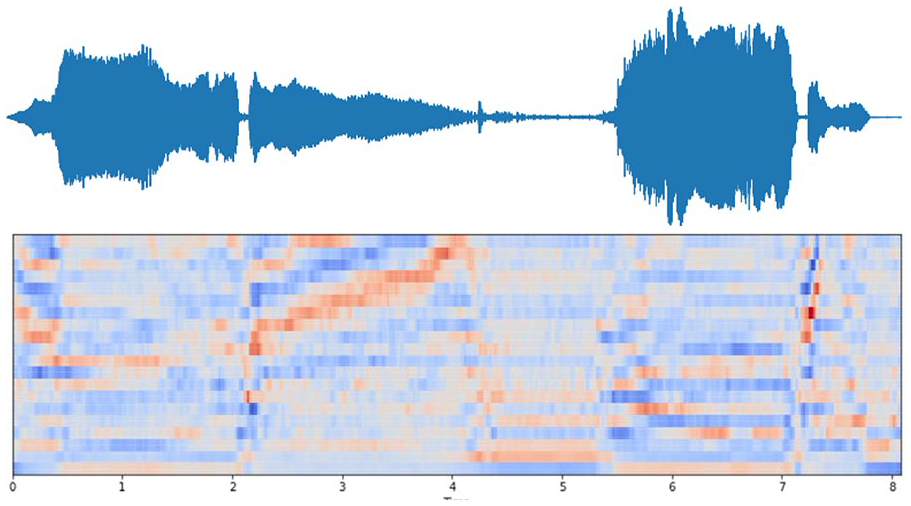
Laughing (top) visualized as a raw wave form and (bottom) representing Mel Frequency Cepstral Coefficients (MFCCs), which are a feature of audio signals that are widely used in automatic speech and speaker recognition.
Ubiquitous Computing
The concept of ubiquitous computing 24 draws on the successive shrinking of room-sized computers to devices so small and easy to use that they disappear from awareness. Personal desktop computers, mobile phones, and wearables (Fitbit, iWatch) illustrate the device ubiquity spectrum. The imagined endpoint is inexpensive, low-energy, miniaturized Internet-connected devices that are pervasively available in the environment to complete everyday tasks. One example is a smart city sensor network that detects areas of high pollution. 25 Together these networked sensors and devices provide the opportunity to monitor and respond to changing environments and contexts in real time.
Relevance to Child Health and Development
Identification of persistent neighborhood conditions that moderate efficacy of early nurturing care interventions offers a pathway to enhance intervention impact and sustainability. Poor infrastructure, elevated violence, overcrowding, and environmental toxicity such as pollution may seriously compromise maternal child functioning and health. 26 Current caregiver-focused models commonly overlook contextual factors. Intensive assessment methods are critical to understand community contexts by tapping conditions and processes in neighborhoods and households. 27 These tools also offer the opportunity for insight into both the patterns and, when combined with affective computing, the emotional quality of caregiver and child interactions. Other advantages of the approach are its ecological validity and scalability, that is, small devices that measure the amount of light in crèche could easily be deployed widely and provide evidence of the lighting conditions in the room without worrying that the lights are only being turned on when a monitoring visit takes place.
Application
Ubiquitous computing may offer an affordable community-level solution to the real-time monitoring of the environments in which children are growing, learning, and playing. These data could enable decision makers to locate and monitor environments not supportive of positive life trajectories for children and inform targeted interventions to improve environments in which children live. Using a wireless sensor network, Salathe et al 28 were able effectively to track the proximity of students during a typical day at school and map social networks through close proximity patterns. This enabled the authors successfully to model the spread of influenza-type diseases via individuals who come into close proximity of one another. Similar approaches are being developed to feasibly monitor child-caregiver proximity across the day in rural, low-resource settings (Figure 2).29-31 The use of ubiquitous computing for child health comes at the increased risk of data being exposed through security breaches of seldom updated embedded devices.32,33

A child wearing a proximity beacon to estimate time spent with caregiver.
Eye Tracking
Remote eye tracking technologies use infrared light reflections to estimate a person’s direction of gaze. Low-cost eye-tracking cameras can be integrated with computer displays for unobtrusive data collection on eye movements and visual fixations during everyday screen-viewing situations.
Relevance to Child Health and Development
Problems in neurocognitive development are common in children with birth complications, and in settings with high levels of poverty, undernutrition, parental psychosocial problems, and stress. Efforts to study and manage these problems require accessible measures of developmental outcomes. Traditional tests of visual function (eg, acuity and perimetry), attention, and learning in infants and young children rely on manual assessments of children’s visual fixations to pictorial stimuli, and as such, are costly and difficult to standardize.
Application
Fully automated rapid tests have been developed for assessing infant visual function, attention, and sequence learning.13,34,35 Field tests support the technical feasibility and robustness of eye tracking–based testing of infants in high- and low-resource settings. For example, Forssman et al 35 piloted the use of infrared eye tracking as an alternative to standard cognitive tests in assessing and monitoring early neurocognitive development in children in low-resource settings in rural Malawi. Similar studies have been documented in other low-resource countries.36-39 In addition to the research assessing cognitive development in groups of children, eye tracking may have utility as a diagnostic tool in the assessment of specific neurodevelopmental problems in individual children. Recent studies have, for example, shown promise in the use of this technology in assessing visual (resolution) acuity, 13 autism spectrum disorders, 40 and attention deficits. 14 If these tests can be incorporated into routine health checkups, they may offer a practical solution for large-scale screening of neurocognitive problems in children.
Machine Vision
One of the most elusive and persistent shortcomings of computers has, until recently, been their inability to process visual data and derive feature patterns from these images. Although even a child can tell you whether or not a photograph contains a dog, image classification has remained a stubborn challenge in computer science. Artificial Neural Networks (ANNs) were originally developed to mimic the human brain. Dendrites receive inputs, and based on these inputs, they produce an output through an axon to another neuron. ANNs were not very effective at these visual recognition tasks. The discovery of Deep Neural Networks, (DNNs), ANNs manipulated to contain multiple layers between the input and output, are, however, very good at this task and have propelled rapid advances in the field over the past 5 years. The rate at which DNNs continue to improve at tasks such as visual recognition are accelerated over this time, although there is concern that these current methods will soon begin to plateau.
A suite of modeling techniques uses multiple processing layers to extract constructs from data by learning increasingly abstract representations of the original data. 41 Deploying the huge amount of visual data now available online, such DNNs are able to process images and accurately predict the content and objects contained in the image. 15 For instance, deep neural nets have been shown to achieve an accuracy of 97.5% when asked to recognize the gender of a person in an image. 42 These advances have, however, been found to have significant bias due to the Western slant inherent in many of the training dataset. 43
Relevance to Child Health and Development
Positive and frequent caregiver-child interactions are fundamental to healthy child development. Practices of physical care and attending to the infant’s basic needs establish a caregiver-child relationship that will influence the social, emotional, and cognitive development of the child. The quality of the caregiver-child bond correlates positively with developmental outcomes of social competence and emotion regulation. 44 The relevance of the field of machine vision to child health and development lies in the opportunity to automatically code, detect, and monitor the world as experienced through the eyes of the child. Applied to tasks such as the automatic analysis of video containing children undertaking tasks of interest and detection of syndromic disorders through facial image analysis, many time-consuming tasks that previously required specialist training could be handed off to machines and routinized.16,45,46
Application
Assessment of this relationship currently generally requires specialized, highly skilled practitioners who painstakingly review and code videos of caregiver-child interactions frame by frame. 47 This intensive, unscalable approach would be revolutionized by advances in the field of computer vision. Video footage of such interactions that previously has been coded would need to be located in order to create as large a training dataset as possible. These data then could be leveraged to train a classifier on what different types of interactions look like (using the labels already assigned to the footage by skilled human coders). Once trained, new unlabeled video footage could be fed into the classifier and automatic coding of the interaction performed. This approach offers enormous potential for research in the field of child and adolescent development. Adaptation of systems designed to compete in the Emotion Recognition in the Wild (EmotiW) challenge could be a starting point (https://sites.google.com/view/emotiw2019). The aim of this challenge is to assign 1 of 7 emotions to actors in scenes extracted from popular style movies. The winning entry in 2014 achieved a test set accuracy of 47.67%. 48 MNCH furthermore can be used to characterize material contents and quality of settings in which children live (Figure 3). 49

Wearable camera captures from top left (a child at play, dental hygiene and a homework session outside) and what an automated object detection algorithm identified.
Another example of the application of machine vision to child health is through the use of Google StreetView and other visual data sources about the built environment.50,51 Using these data, it has been demonstrated that income, education, unemployment, health, and crime in London could be predicted with an average classification accuracy of 62% (minimum 47%; maximum 72%). 52
Risks and Ethical Considerations
The methods and approaches described so far cannot be discussed in a balanced way without reference to both the ethical and contextual challenges rapid changes in technology create. The approaches described here are increasingly straining current ethical frameworks, often resulting in case-based decision-making by Researchers and Ethics Committees partially due to the fact that they run ahead of appropriate legislation. 53 The Emanuel framework for ethical biomedical research states that to be ethical, research must (1) be a collaborative partnership, (2) have social value, (3) be scientifically valid, (4) allow for the fair selection of participants, (5) have a favorable risk-benefit ratio, (6) undergo independent ethical review, (7) require informed consent, and (8) maintain ongoing respect for participants. 54 Classic guidelines such as these are now beginning to be updated to include further protection for participants in the era of biomedical big data analytics, where insights can be generated from social media feeds, personal health monitoring platforms, home sensors, smart phones, and online forums and search queries. 55 One example is the Ethics Framework for Big Data in Health and Research that lays out a set of clear processes for recognizing and resolving issues arising from research with these types of data. 56 Significantly, this framework raises the challenges associated with informed consent as the foundational ethical pillar for these types of data and explores alternative ethically acceptable alternatives such as the principles of respect for persons and social license.
One clear risk to collecting these types of data are privacy concerns that could result from a study data breach. Culturally appropriate approaches to describing these types of data collection and consulting with families are needed to assure understanding and agency for consent and participation.30,57 Finally, thoughtful solutions are needed to inform how best to act on information revealed from these data. Acute risk of harm, like detection of abuse and maltreatment in a home, require carefully considered risk management protocols.
Ethical Approval and Informed Consent
No ethical approval or informed consent were needed for this study as there was no primary data collection, chart review, or secondary data analysis.
Discussion and Conclusion
Population-based data on child development is essential to improve the lives of children globally and to substantively advance the thrive agenda in the Global Strategy for Women’s, Children’s and Adolescents’ Health 58 as well as to measure progress in meeting Sustainable Development Goals 4.2. Current efforts in this regard include the development of a birth to 3-year population-based measurement framework by the World Health Organization, UNICEF, and UNESCO, the Global Scales of Early Development, and the NIH Toolbox. While such paper-based analogue tools provide much of the functionality required for population-level monitoring and support, these approaches will always be limited by human resources, appropriate in country expertise, time costs, and data quality challenges. These efforts would be strengthened greatly by new technologies such as those discussed in this article, which offer the ability to rapidly analyze and code unstructured data at scale.
While collecting these data maybe be beyond the scope of academic research studies, it is increasingly feasible for many large technology companies. Fields, such as genomics, can show the way with examples of both the potential and challenges of public-private partnerships available. 59 MNCH practitioners, researchers, funders, and policy makers should not ignore this opportunity but rather advocate for collaboration between the owners of these sociobehavioral datasets and the global health community. Managing the potential conflicts of interest between the research objectives, platform user’s expectations of data privacy, questions of ownership, wariness toward the commercialization of public sector health data and company objectives of maximizing profits are limitations to this approach. 60
Rather, global agencies and policy makers such as World Health Organization will need to take a lead through, for example, the eHealth Observatory and related initiatives to ensure ethical, sustainable development of tools that can be scaled up from use in small research studies to routine implementation at the population level. For researchers and implementation partners, the call is to engage meaningfully with these new technologies and grapple with the translation and adaption of these tools, particularly for use in low-resource settings. Opportunity also exists for clearer coordination of efforts that ensure diffusion of local innovation to the global community. The rate of change is a significant risk to this agenda as it will take a concerted effort from all concerned parties to remain abreast of a landscape that is changing at an accelerating pace. To be successful, a balance needs to be found that acknowledges the opportunities, recognizes the risks, and plans for a future that is yet to be invented.
Footnotes
Author Contributions
AvH: Contributed to conception and design; contributed to acquisition, analysis, and interpretation; drafted manuscript; gave final approval; agrees to be accountable for all aspects of work ensuring integrity and accuracy.
JL: Contributed to design; contributed to acquisition, analysis, and interpretation; drafted manuscript; critically revised manuscript; gave final approval; agrees to be accountable for all aspects of work ensuring integrity and accuracy.
MJRB: Contributed to conception; contributed to interpretation; critically revised manuscript; gave final approval; agrees to be accountable for all aspects of work ensuring integrity and accuracy.
CMW: Contributed to conception; contributed to interpretation; critically revised manuscript; gave final approval; agrees to be accountable for all aspects of work ensuring integrity and accuracy.
BAK: Contributed to conception; contributed to interpretation; critically revised manuscript; gave final approval; agrees to be accountable for all aspects of work ensuring integrity and accuracy.
SS: Contributed to design; contributed to interpretation; critically revised manuscript; gave final approval; agrees to be accountable for all aspects of work ensuring integrity and accuracy.
SG: Contributed to conception; contributed to interpretation; critically revised manuscript; gave final approval; agrees to be accountable for all aspects of work ensuring integrity and accuracy.
RH: Contributed to design; contributed to interpretation; critically revised manuscript; gave final approval; agrees to be accountable for all aspects of work ensuring integrity and accuracy.
LB: Contributed to conception; contributed to interpretation; critically revised manuscript; gave final approval; agrees to be accountable for all aspects of work ensuring integrity and accuracy.
MT: Contributed to conception and design; contributed to acquisition, analysis, and interpretation; drafted manuscript; critically revised manuscript; gave final approval; agrees to be accountable for all aspects of work ensuring integrity and accuracy.
Authors’ Note
Rob Hughes is now affiliated to the Clean Air Fund, London, UK.
Declaration of Conflicting Interests
The author(s) declared no potential conflicts of interest with respect to the research, authorship, and/or publication of this article.
Funding
The author(s) disclosed receipt of the following financial support for the research, authorship, and/or publication of this article: This study was supported by the Jacobs Foundation (Grant ID: CH-8034).
