




Abstract
Introduction:
Recommender systems are technology-based systems that generate recommendations or guide users to relevant information. This study is a scoping review aiming to describe what is known about the recommender systems for obesity prevention according to systematic reviews on this topic.
Methods:
This scoping review adheres to the Preferred Reporting Items for Systematic Reviews and Meta-Analyses extension for Scoping Reviews (PRISMA ScR) guideline. Out of 148 records labeled as reviews in the database and online searches until October 2023, 10 reviews fulfilled the inclusion criteria according to the Population, Concept, and Context framework: Population (human), Concept (recommender systems), and Context (obesity prevention). Bibliographic, population, concept, and context characteristics, and topics addressed in reviews were charted and synthesized using relative frequencies or described narratively. An overlap that occurs when the same primary studies are included in multiple reviews was assessed as the overall Corrected Covered Area (CCA: 0%–5% low overlap to ⩾15% very high overlap).
Results:
The reviews were published between 2017 and 2023 and included 308 primary studies. The overlap in primary studies among the 10 reviews was low (CCA = 1.29%). The reviews described the recommender system properties (n = 8) or their implementation (n = 2) in any (n = 6) or specific populations (e.g., elderly; n = 4) and focused on nutrition (n = 9) and physical activity (n = 4) within obesity prevention context. The topics addressed in reviews were recommendation generation (i.e., technical system properties; n = 9), health content (e.g., nutritional advice; n = 7), and implementation (i.e., system evaluation and user application; n = 5). The evidence gaps included the need for new system development and evaluation (n = 8) and a focus on diverse health contexts (n = 4).
Conclusion:
Evidence from past reviews suggests that despite the existence of several technical solutions, there is yet no consensus on how to generate the most accurate nutrition recommendations in the obesity prevention context. Future studies addressing system and user outcome evaluation are needed to identify the optimal parameters for any long-term behavior change in recommender system users.
Introduction
Recommender systems are technology-based systems designed to predict and suggest content that users might like based on their preferences, behavior, or other data. 1 By generating recommendations, such systems guide users to relevant information and consequently aim to influence user choices, decisions, and behavior. 1 Decision-making process can also be influenced by digital nudging mechanisms generated by the recommender systems via user interface elements. 2 In general, recommender systems utilize sophisticated algorithms to process vast amounts of data and consequently develop personalized recommendations through different technical solutions, such as filtering methods. 3 Thus, recommender systems can be viewed as digital interventions that incorporate elements of nudging mechanisms within the digital environment. 1
Due to technological advancement, all online interactions these days require people to make choices and system designers need to consider the behavioral effects of user interfaces. 2 While recommender systems were traditionally associated with organizational and business applications, such as guiding people’s purchasing behavior, the societal applications of these systems have emerged in terms of their effects on health.2,4,5 For example, apps and wearables can provide recommendations and individually tailored feedback on physical activity levels and thus are designed to remind and motivate their users to increase their own activity levels. 2 Another example could be aligning healthy food choices with user preferences and integrating visual progress indicators or social comparison elements (e.g., a message that ‘90% of other users selected this option’) that might motivate users to adhere to recommendations. 6 Existing health recommender systems target health promotion and disease prevention with the aim to promote healthy lifestyles as well as health service use to support healthcare offers.4,5,7,8 In general, health recommender systems have the potential to enhance the user experience by increasing efficiency, effectiveness, trustworthiness, and enjoyment of digital health offers and interventions 9 and support the self-management of health conditions. 10 However, the real-world impact of health recommender systems is still unclear, and evaluation studies of user-centered implementation are needed in this relatively new field.7,10
Due to rising obesity rates 11 and a wide range of diseases related to overweight and obesity, 12 new solutions are needed to address this global health challenge. Health recommender systems have the potential to contribute to obesity prevention by guiding their users to healthy food choices and promoting behavior change required for a healthy lifestyle, such as enhancing physical activity. 13 These systems could especially target user engagement, motivation, and uptake of digital offers via weight loss apps. While such apps already use gamification and tailored messages, they could benefit from recommender systems designed to increase user engagement with the apps to effectively contribute to weight loss and its longer-term maintenance. 14
This study is performed within an ongoing scoping review of primary studies on the application of recommender systems in the field of obesity prevention. 15 The literature searches identified the relevant primary studies and also other systematic reviews on this topic. Since reviews were excluded from the ongoing scoping review of primary studies, 15 this study was conducted to assess the evidence reported in these past reviews. Specifically, this study is a scoping review that aims to describe what is known about recommender systems for obesity prevention according to the existing systematic reviews on this topic. The objectives of this scoping review are (1) to identify primary studies included in all reviews to supplement the literature searches for the ongoing scoping review of primary studies 15 and to assess the overlap in primary studies among the reviews, (2) to describe the reviews based on the Population, Concept, and Context (PCC) framework, including population, concept (i.e., recommender systems) and context (i.e., specific aspects of obesity prevention) characteristics, (3) to map the topics addressed in the reviews and (4) to identify evidence gaps in the current state of knowledge in this field. The overlap in primary studies among reviews needs to be assessed in reviews of reviews to identify the risk of bias due to redundant reviews. When the overlap is high and the same primary studies are included in multiple reviews, then the newer reviews are redundant and do not contribute any new evidence to the field because the primary studies in these reviews were already included in the older reviews. The overlap assessment is thus necessary to identify and potentially remove such redundant reviews.
Methods
Protocol and reporting
This scoping review is based on a registered protocol 15 and adheres to the Preferred Reporting Items for Systematic Reviews and Meta-Analyses extension for Scoping Reviews (PRISMA-ScR) guideline. 16 The PRISMA-ScR checklist is reported in Supplemental File 1. The scoping review design was selected because it is an appropriate design for describing or mapping the relevant literature in a specific field according to the framework for scoping studies. 17
Eligibility
Eligibility was defined according to the PCC framework and other study characteristics (i.e., review type, study type, language, and availability in full text; Table 1).
Eligibility criteria.

Information sources
The information sources for this scoping review were 7 databases (MEDLINE and PsycINFO via Ovid, Web of Science, CINAHL via Ebsco, Scopus, ACM Digital Library, and IEEE Xplore), bibliographies of the included studies, and Google Scholar.
Search strategy
A librarian (LC) developed the search syntax, calibrated it following a team discussion, and conducted the search in all databases from inception to 13 October 2023. Two researchers (LS and KKDS) also conducted online searches in Google Scholar and screened the bibliographies of the included studies.
The search syntax was developed based on the PCC criteria (Table 1). Synonyms and MeSH headings related to the “concept” (e.g., “recommender systems” or “digital nudging”) and the “context” (e.g., nutrition or overweight or obesity or “physical activity”, or “sedentary behavior”) were combined with the Boolean operator “AND.” The full search strategy for MEDLINE is reported in Supplemental File 2.
All search hits were imported into EndNote20 (Clarivate, Philadelphia, USA) and deduplicated. Studies with the term “review” in any field were identified using the smartgroups function in EndNote and stored in a separate EndNote library for screening.
Study selection
The studies were screened for eligibility in titles, abstracts, and full text by one researcher (KKDS). The reasons for exclusion were confirmed by another researcher (LS).
Data charting
Two researchers (LS and KKDS) charted the data into a self-developed spreadsheet in Excel 10 as quantitative categories (e.g., publication year) and qualitative author statements (e.g., review conclusions according to review authors). The qualitative statements were processed into predefined categories (e.g., health focus of the recommender systems on “nutrition,” “physical activity (PA),” or “both”) or categories that were inductively identified in the extracted data (e.g., evidence gaps identified in review conclusions).
Data items
Data items included review bibliographic characteristics (e.g., publication year, author region, review type, and number of primary studies included in review), PCC characteristics, and topics addressed in reviews (e.g., review aim, recommender system description and implementation, and review conclusion).
Critical appraisal of individual sources of evidence
Critical appraisal of included sources of evidence is optional in scoping reviews. 16 Such appraisal is applicable if the effectiveness of health interventions is assessed. This scoping review aimed to describe and map the field of recommender systems for obesity prevention. Thus, the critical appraisal was not done because the effectiveness of health interventions was not assessed in this scoping review.
Identification of primary studies and overlap in primary studies among reviews
The primary studies included in each review were manually identified by screening each review, located online, imported to EndNote by one researcher (LS), and checked by another researcher (KKDS). To assess the overlap in primary studies among the 10 reviews, all primary studies included in all reviews were manually entered into the Graphical Representation of Overlap for OVErviews (GROOVE) tool 18 by one researcher (LS) and checked by another researcher (KKDS). The overlap was quantified using the overall corrected covered area (CCA: low overlap of 0%–5% to very high overlap of 15% or more 18 ) in GROOVE.
Data synthesis
The processed data were synthesized using descriptive statistics (e.g., relative frequencies in Excel 10) or described narratively.
Results
Included studies
Among 1269 records from 7 databases, 146 were identi-fied as reviews using EndNote. Two more studies were located in online searches via Google Scholar. Out of the 148 screened records, 10 studies3,4,8,19–25 (n = 8 systematic reviews3,4,8,19,20,22,23,25 and n = 2 scoping reviews21,24) fulfilled the inclusion criteria (Table 1) and were included in this scoping review (Figure 1). A list of excluded studies is reported in Supplemental File 3.

Study selection (PRISMA-ScR flowchart).
The included reviews were published between 2017 and 2023, originated from Europe (n = 6), Asia (n = 2), and Australia or South America (n = 1 each), and included 8–72 primary studies (Supplemental File 4).
Objective 1: Primary studies included in the 10 reviews and their overlap
There were 308 primary studies published between 2003 and 2023 included in the 10 reviews (Supplemental File 5). The overall overlap in the primary studies was low among the 10 reviews (CCA = 1.29%) because most primary studies were included in only one review. Overall, 282 primary studies (92%) were included in n = 1 review, 20 (6%) in n = 2 reviews, and 6 (2%)26–31 in n = 3 reviews. None of the primary studies were included in 4–10 reviews.
Furthermore, there was no very high overlap between any review pairs, indicating that none of the 10 reviews were redundant. The overlap in most review pairs was low (in 42/45 review pairs) or moderate (in 2/45 review pairs). The highest overlap of 12% was detected in 1/45 review pairs3,25 (Figure 2). Since the overall risk of bias due to redundant reviews was deemed to be low in this scoping review, the data from all 10 reviews were included in the data synthesis.

Overlap in primary studies between review pairs.
Objective 2: PCC characteristics of the 10 reviews
The reviews focused on different PCC characteristics (Figure 3). The populations (i.e., recipients of recommendations) included in reviews were either any humans (in n = 6 reviews) or specific subgroups (in n = 4 reviews) based on setting (e.g., workplace), age (e.g., elderly), or clinical status (e.g., people with diabetes mellitus). The concepts described in reviews were recommender system properties (in n = 8 reviews) or system implementation (in n = 2 reviews). The context of obesity prevention in reviews was focused on nutrition (in n = 9 reviews) or PA (in n = 4 reviews).

Population, concept, and context characteristics of the 10 reviews.
Objective 3: Topics addressed in the 10 reviews
The topics addressed in the 10 reviews were clustered into 3 main categories that were identified in the data (Figure 4). These included recommendation generation (i.e., technical system properties in n = 9 reviews), recommendation health content (e.g., nutritional advice in n = 7 reviews), and recommendation implementation (i.e., system evaluation and user application in n = 5 reviews).

Topics addressed in the 10 reviews.
Recommendation generation was described in reviews in terms of technical properties, including currently available system types and techniques to generate various aspects of recommendations, data types to train the recommender systems, and platforms to deliver the recommendations to users (Figure 4). In general, the reviews focused on describing the methodological and technical knowledge rather than finding the overall consensus as to which of these methods could generate the most accurate recommendations.
Recommendation health content in the obesity prevention context was described in reviews in terms of the specific focus, content, and target behavior (Figure 4). The general focus in reviews was on nutritional advice alone or general advice on a healthy lifestyle, including nutrition and PA. The reviews also mentioned that recommender systems could contribute to behavior monitoring (e.g., dietary intake or PA) in any population or in people with chronic diseases.
Recommendation implementation was addressed in terms of the recommender system evaluation and user application (Figure 4). The reviews pointed out that it is crucial to assess if and how accurately the recommendations generated by different recommender systems can target obesity prevention. Various suggestions were made on how to evaluate the systems to compare the system strengths and weaknesses. The reviews also reported that user application is rarely evaluated or evaluated with heterogeneous methods, meaning that the short- and long-term effectiveness of recommendations in the obesity prevention context is unclear.
Objective 4: Evidence gaps in the 10 reviews
The evidence gaps identified by the authors of the 10 reviews were clustered into 3 main categories (Figure 5), including the need for new system development (in n = 8 reviews), the need for system and user evaluation (in n = 8 reviews), and the need to focus on diverse health contexts (in n = 4 reviews).
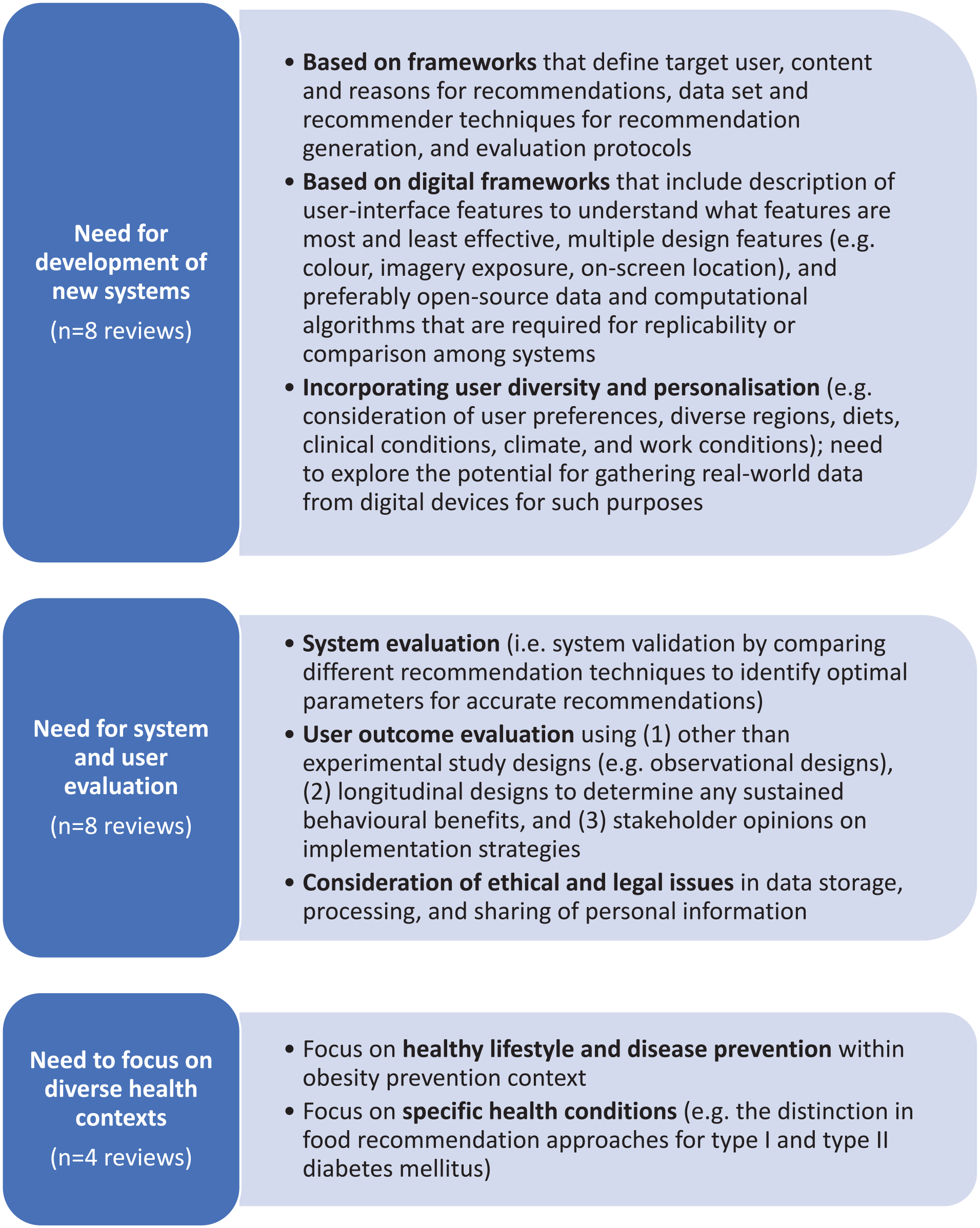
Evidence gaps identified by the authors of the 10 reviews.
The suggestions for the new system development in reviews included the use of frameworks, and specifically digital frameworks, to generate recommendations. The frameworks could be used by developers to consider the target user characteristics, content details, and evaluation protocols for recommender systems, while the digital frameworks could be useful to specify the technical methods to generate recommendations. User diversity and personalization were identified as important issues in the context of new system development.
The reasons for system and user evaluation in reviews were to identify the optimal parameters for accurate recommendations and to better understand the user outcomes, including longer-term health benefits and implementation strategies of the recommender systems. Ethical and legal issues were also mentioned because data storage, processing, and sharing of personal information need to be considered in recommender systems designed to modify human behavior and thus affect human health.
The reviews also mentioned the need to focus on diverse health contexts in obesity prevention. New recommender systems could focus broadly on healthy lifestyle promotion and disease prevention, with obesity prevention being one aspect of the holistic concept of health. However, new recommender systems are also needed for narrow populations, such as people with chronic diseases who may require specific recommendations depending on their condition.
Discussion
Summary of evidence
This scoping review summarized the findings in 10 reviews with systematic methodology on recommender systems for obesity prevention that were published between 2017 and 2023.3,4,8,19–25 The unique contribution of this review is that the topics of interest in this field were mapped, evidence gaps for future research were identified, and the primary studies included in the past reviews were inspected. The reviews predominantly described the technical system properties to generate recommendations targeting nutrition for any human population. The evidence gaps included the need for new system development and evaluation and a focus on diverse health contexts. The risk of bias due to redundant reviews was low due to the low overall overlap in the primary studies included in the 10 reviews.
Importance of recommender systems for obesity prevention
In general, the integration of digital technologies into health promotion measures has received considerable attention due to their potential to address public health challenges,32,33 such as the global increase in obesity-related diseases. 12 Recommender systems have the potential to help users make more informed choices about their PA or diet and thus influence health behavior in different digital contexts, including social media, mobile applications, and online shopping settings. 2
This review shows that various technological solutions (e.g., system types, techniques, and data to train the systems) are already available to generate the recommendations. The past reviews mainly described the technical system pro-perties and provided suggestions on how to evaluate the systems to identify their strengths and weaknesses.4,22,25 These suggestions could be used by system developers before their products are distributed to the users. Interestingly, based on evidence presented in reviews published until 2023, no strong consensus emerged as to which of the available technical solutions could generate the most accurate recommendations. In fact, despite the focus on a common topic (recommender systems for obesity prevention), the overlap in primary studies included in the 10 reviews was surprisingly low, suggesting that the field is highly heterogeneous in terms of the available technical solutions and health outcomes to be targeted by the recommender systems. In fact, there is a higher focus on the technical properties of recommender systems (e.g., gamification features and tailored messages in apps) but a lower focus on the health and behavior content of these systems (e.g., user engagement and motivation) that need to be carefully targeted in design and development phases to improve user uptake and effectiveness of existing systems in obesity prevention context. 14 Collaborations between technical and health experts could advance this relatively new and highly complex field.
While the health content of recommender systems in the obesity prevention context was mentioned in most reviews,8,19–24 system implementation in users was rarely described or evaluated.8,21 In general, the evaluation of health recommender systems is a complex process due to a high methodological heterogeneity regarding the sample sizes that can range from individual persons to several thousands of users, use duration that can range from a single session to several years, and outcome measures, including accuracy, engagement, clinical or behavioral effects, and participant perspectives. 10 Thus, the human experience of using recommender systems is not yet well understood in terms of system usability, engagement with the system, and short- and long-term effectiveness of recommendations in the obesity prevention context.
Evidence gaps
The past reviews provided useful suggestions for future research and recommender system development. In general, the evidence presented in the reviews published up to 2023 could be used in practice, especially by system developers and health researchers interested in testing the systems in human users. For example, the past reviews provided suggestions on how to evaluate the systems based on their technical properties and their implementation for users via health studies with various designs. However, the existing evidence is insufficient to speculate about the impact of recommender systems on health outcomes in users in real-world settings and on health policymaking. Future research in this field could focus on the evidence gaps identified in the past reviews, including the need for new system development, system, and user outcome evaluation, and focus on diverse health contexts in the field of obesity prevention, such as the promotion of healthy lifestyle or addressing nutritional needs depending on clinical, cultural, and geographic factors.
The reviews suggest that frameworks and digital frameworks should be used to guide the development and evaluation of new recommender systems, in terms of defining target populations, health outcomes, and technical system properties.8,24,25 In particular, given the rapid advancements in artificial intelligence and machine learning (ML), the contributions and future potential of these technologies need to be explored within the context of recommender systems for obesity prevention. 34 These technologies could potentially improve the recommendation accuracy, personalization, and overall system effectiveness and thus add considerable value to obesity prevention as they continue to transform the field. 35
System and user outcome evaluation is needed to identify optimal parameters for accurate recommendations.3,4,8,20–24 Health recommender systems are evaluated using computational methods without user data more often than using human data. 7 Based on limited user evaluation, it is unclear if recommender systems tested in experimental studies could contribute to any long-term and sustained behavior change in real life.20–22,24 Addressing these gaps is required to better understand if and how recommender systems could contribute to lasting behavior change and long-term health benefits in their users and to prevent misinformation and potential harm associated with unregulated content. 10
This review also highlights the challenge related to the broadness of the obesity prevention field that needs to be incorporated into the new recommender systems. ML is a promising method that could be used to predict obesity by identifying unfavorable lifestyle factors and to determine the likelihood of developing health conditions resulting from overweight and obesity. 34 Thus, on the one hand, the recommender systems could address the broader context of a healthy lifestyle, including recommendations regarding a healthy diet and other relevant behaviors, such as PA promotion. On the other hand, recommender systems also need to consider user diversity and personalization, including personal preferences or needs related to cultural, geographical, and clinical factors.4,21,22 However, the personal preferences of users are rarely considered in the design and development of recommender systems. 7 The real-time data collected by wearable sensors or online ratings could be used to develop personalized feedback and to assess the interconnectivity in decisions made by different users that could improve the accuracy of recommendations. The latest information technologies using such individual sensors and online data could contribute to greater personalization in the form of decision support systems in managing healthy lifestyles or treating health problems according to individual health profiles. 35 However, the ethical and legal issues behind data storage, processing, and sharing need to be addressed in future research to enhance the integrity and trustworthiness of the systems. 23 Of particular importance are issues related to the design and evaluation of recommender systems, including user privacy, fairness, trust, and preventing bias, transparency of algorithms and guidelines on user consent, and manipulation and personal autonomy.36,37 Since manipulation and deception due to incorrect content could affect user knowledge, critical thinking, and personal identity, the use of recommender systems could have widespread negative consequences not only for the users but also the society as a whole.37,38
Strengths and limitations
The strength of this scoping review is that the research topics related to recommender systems for obesity prevention were identified in reviews published until 2023. These topics can assist researchers who develop such systems or plan to test their implementation on users.
There were several limitations in this scoping review. First, only a small number of reviews published until 2023 were included. These reviews were identified and excluded from the ongoing scoping review of primary studies. 15 Thus, this scoping review of reviews extends the findings of the ongoing review 15 in terms of identifying research gaps to be assessed in future research and providing a further source of potentially relevant primary studies in addition to the electronic literature searches (i.e., the 308 primary studies that were included in the 10 reviews). Other relevant reviews with systematic methodology10,14 have been published in this highly dynamic field since the completion of this scoping review. Since the field of recommender systems for obesity prevention is evolving rapidly, new reviews incorporating the most current literature could focus on the latest technical advancements, emerging trends, and innovations in this area and, once a sufficient volume of primary studies is available, attempt to evaluate the user experience of such systems. Second, narrow terms were included in the search syntax, such as “recommender systems” and “obesity prevention.” Thus, reviews that used broader terms, such as “ML approaches” or “healthy lifestyle” were either not identified in the search or excluded during screening due to a lack of focus on the key inclusion criteria for this scoping review.7,34,35 However, the strength of this narrow approach is that the most relevant studies that primarily address any aspects of recommender systems for obesity prevention were identified in this broad field. Third, the literature search was conducted in large international databases. Thus, a publication bias cannot be ruled out, especially in this highly dynamic field in which authors may publish their results in local journals that may not be included in the international databases. Fourth, the quality of the included reviews was not appraised because the reviews addressed technical system properties rather than the effectiveness of such system use (i.e., if recommender system use prevents obesity). Finally, this review has a broad focus on recommender systems for obesity prevention without addressing any technical system properties in detail. Future reviews are required to contrast different technical solutions as the field rapidly evolves.
Conclusions
This scoping review summarized the findings in 10 reviews with systematic methodology on recommender systems for obesity prevention. The reviews predominantly described the technical system properties to generate recommendations targeting nutrition for any human population. The evidence gaps identified in the 10 reviews included the need for new system development and evaluation, and a focus on diverse health contexts. The risk of bias due to redundant reviews was low due to the overall low overlap in the primary studies included in the 10 reviews.
Future research requires collaborations between technical and health experts to advance this complex field. Despite the existence of several technical solutions, there is yet no consensus on how to generate the most accurate nutrition recommendations in the obesity prevention context. Future studies addressing system and user outcome evaluation are needed to identify the optimal parameters for any long-term behavior change in recommender system users.
Supplemental Material
sj-docx-1-smo-10.1177_20503121251348374 – Supplemental material for Recommender systems for obesity prevention: Scoping review of reviews
Supplemental material, sj-docx-1-smo-10.1177_20503121251348374 for Recommender systems for obesity prevention: Scoping review of reviews by Karina Karolina De Santis, Lisa Stiens, Lara Christianson and Sarah Forberger in SAGE Open Medicine
Supplemental Material
sj-docx-2-smo-10.1177_20503121251348374 – Supplemental material for Recommender systems for obesity prevention: Scoping review of reviews
Supplemental material, sj-docx-2-smo-10.1177_20503121251348374 for Recommender systems for obesity prevention: Scoping review of reviews by Karina Karolina De Santis, Lisa Stiens, Lara Christianson and Sarah Forberger in SAGE Open Medicine
Supplemental Material
sj-docx-3-smo-10.1177_20503121251348374 – Supplemental material for Recommender systems for obesity prevention: Scoping review of reviews
Supplemental material, sj-docx-3-smo-10.1177_20503121251348374 for Recommender systems for obesity prevention: Scoping review of reviews by Karina Karolina De Santis, Lisa Stiens, Lara Christianson and Sarah Forberger in SAGE Open Medicine
Supplemental Material
sj-docx-4-smo-10.1177_20503121251348374 – Supplemental material for Recommender systems for obesity prevention: Scoping review of reviews
Supplemental material, sj-docx-4-smo-10.1177_20503121251348374 for Recommender systems for obesity prevention: Scoping review of reviews by Karina Karolina De Santis, Lisa Stiens, Lara Christianson and Sarah Forberger in SAGE Open Medicine
Supplemental Material
sj-xlsx-1-smo-10.1177_20503121251348374 – Supplemental material for Recommender systems for obesity prevention: Scoping review of reviews
Supplemental material, sj-xlsx-1-smo-10.1177_20503121251348374 for Recommender systems for obesity prevention: Scoping review of reviews by Karina Karolina De Santis, Lisa Stiens, Lara Christianson and Sarah Forberger in SAGE Open Medicine
Footnotes
Author note
The results of this scoping review were presented as a poster at a scientific conference (Gesundheit – gemeinsam, Dresden, Germany, 8–13.09.2024). 39

Ethical considerations
This research did not involve any human participants. Thus, ethical approval or informed patient consent was not required and is not applicable.
Author contributions
KKDS conceptualized the study, developed the methodology, conducted the literature searches in Google Scholar, selected the studies, extracted, processed, and analyzed the data, visualized the results, wrote the first draft of the manuscript, and reviewed and edited the manuscript. LS selected the studies, extracted, processed, and analyzed the data, and reviewed and edited the manuscript. LC conducted the literature searches in bibliographic databases and reviewed and edited the manuscript. SF acquired funding, conceptualized the study, developed the methodology, and reviewed and edited the manuscript.
Funding
The author(s) disclosed receipt of the following financial support for the research, authorship, and/or publication of this article: This study was conducted within the HealthyW8 project funded by The European Union grant from the European Health and Digital Executive Agency (HaDEA), project number: 1010806. The funder had no influence on the content of this study. The publication fee for this article was covered by the Leibniz Science Campus Digital Public Health Bremen – LSC DiPH, Bremen, Germany.
Declaration of conflicting interests
The author(s) declared no potential conflicts of interest with respect to the research, authorship, and/or publication of this article.
Guarantor
KKDS
Supplemental material
Supplemental material for this article is available online.
References
Supplementary Material
Please find the following supplemental material available below.
For Open Access articles published under a Creative Commons License, all supplemental material carries the same license as the article it is associated with.
For non-Open Access articles published, all supplemental material carries a non-exclusive license, and permission requests for re-use of supplemental material or any part of supplemental material shall be sent directly to the copyright owner as specified in the copyright notice associated with the article.
