



Abstract
Background. Cyberbullying is a serious issue among adolescents, but little is known about how demographics are associated with mental health conditions and violent behaviors. The present study examined the association of cyberbullying victimization with mental health conditions and violent behaviors among adolescents, specifically examining potential differences by sex and race. Methods. National data obtained from a representative sample of 9th to 12th grade students (N = 15 465) in the United States were examined using bivariate and logistic regression analysis. Results. More than 15% of students reported cyberbullying victimization. Females were twice as likely to report victimization than males, and non-white students were 50% less likely to report cyberbullying victimization. Cyberbullying victimization was significantly more likely in students who reported depressive symptoms, suicidal ideation, suicide planning, carrying a weapon, and engaging in a physical fight. These associations were more pronounced in males. Conclusions. Our findings show that female and white adolescents are at increased risk of being cyberbullied. However, negative mental health outcomes and violent behaviors are more pronounced in males, indicating potential negative effects of being a cyberbullying victim based on sex. We envisage the best way to combat cyberbullying is to develop programs that are sensitive to potential demographic differences to empower students based on individual risks.
More than 90% of US adolescents report going online daily, with over 70% reporting using at least two social media platforms on which they spend most of their online time. 1 Although the Internet can be an asset in facilitating communication, education, and entertainment, its benefits may be overshadowed by a myriad of social and health consequences including cyberbullying.2,3
Cyberbullying has been defined as repeatedly and intentionally harassing and mistreating others using electronic devices. 4 Both traditional and cyberbullying stem from power imbalance between perpetrators and victims. Explained by the Power and Control Model, perpetrators seek control over victims by employing intimidation, threats, and harmful language. 5 Although similar, cyberbullying differs from traditional bullying in that the victim does not necessarily know the perpetrator’s identity, the content can spread rapidly and be easily preserved, and the aggression is not limited to a place or time, making cyberbullying inescapable.6,7 The anonymity and the limited contextual cues associated with the virtual environment can reduce social accountability, decrease adolescents’ emotional inhibition, and increase their tendency to engage in interpersonal conflict. 8 About 20% to 56% of youth report being cyberbullied at least once in their lives.2,4,9-11 Cyberbullying has been associated with a host of negative outcomes including depression, anxiety, stomach pain, sleep disturbance, and academic difficulties.11-13 Preliminary evidence also suggests a link between bullying victimization and violent behavior.14,15
The proliferation of social media and technology necessitates a greater understanding of the demographic variation (eg, sex, race) in cyberbullying victimization and its association with important health outcomes, including mental health conditions, such as depression, and violent behaviors. The current research on cyberbullying victimization has produced contradictory evidence regarding these demographic differences, further supporting the need for research that is done with large national samples rather than location-specific populations. For example, while some studies find no significant differences by sex, 16 a number of studies have established that being a female is a significant predictor of victimization.11,17,18 Patchin 4 found that adolescent girls are significantly more likely than boys to have experienced cyberbullying in their lifetimes. In addition, the few epidemiological assessments of cyberbullying by race show inconsistent findings. 19 While some studies suggest that white students are disproportionately affected by cyberbullying, 20 other studies suggest that minority adolescents are more likely to experience diverse forms of bullying compared with whites. 21 More important, the existent literature has not examined these demographic differences by negative outcomes such as mental illness and violent behaviors, which are serious public health issues by themselves, but when combined with cyberbullying victimization, the impact could be exacerbated. Thus, understanding cyberbullying victimization within these demographic variations is important to ameliorate the associated negative effects and to create targeted interventions aimed specifically at those most at risk.
Using a nationally representative sample from the 2015 Youth Risk Behavior Survey (YRBS), the present study examined the association of cyberbullying victimization with mental illness and violent behaviors among American high-school students. The following research questions were addressed:
Based on previous research, we hypothesized that cyberbullying victimization would be significantly associated with the health outcomes examined. However, the analyses of sex and race differences were exploratory as existing literature is inconclusive.
Methods
Participants and Procedure
The study analyzed data from the 2015 YRBS, collected biennially by the Centers for Disease Control and Prevention (CDC) with students in grades 9 to 12 in national public and private schools. The survey monitors priority health risk behaviors that contribute to the leading causes of morbidity and mortality among youth. The 2015 YRBS data were collected from 15 506 students, with a 60% overall response rate. 22
Trained data collectors and teachers administer the questionnaires. Students anonymously and voluntarily complete the questionnaire on computer-scannable sheets. All responses are confidential and de-identified. 22 A weight is applied to each student record to adjust for nonresponse and the distribution of students by grade, sex, and race in each jurisdiction. The primary sampling units consist of counties, groups of smaller adjacent counties, or subareas of large counties. There was a total of 53 primary sampling units. 22
Measures
Study questions and responses have been adopted from the original 2015 YRBS codebook. 22 Being Cyberbullied was assessed using a single dichotomized question: “Have you ever been electronically bullied? (count bullying through e-mail, chat rooms, instant messaging, websites, or texting;” yes/no). Mental illness was assessed using the variables of depressive symptoms, suicide ideation, and suicide planning. Participants reported their depressive symptoms by responding to the following question: “During the past 12 months, did you ever feel so sad or hopeless almost every day for 2 weeks or more in a row that you stopped doing some usual activities?” (yes/no). Suicide ideation was assessed using: “During the past 12 months, did you ever seriously consider attempting suicide?” (yes/no). Suicide planning was captured by: “During the past 12 months, did you make a plan about how you would attempt suicide?” (yes/no). The violent behaviors of physical fight and weapon carrying were examined using the following items: “During the past 12 months, how many times were you in a physical fight?” and “During the past 30 days, on how many days did you carry a weapon such as a gun, knife, or club?” Responses for both items were collapsed to 0 for none and 1 for 1 or more times. Demographic variables included age, sex, race, and ethnicity. 22
Data Analysis
To account for complex survey design, all analyses were conducted by svyset operations in Stata 14.0. Taylor series linearization was applied to adjust for unbiased estimation of standard errors. All commands were applied with weighted data to account for nonresponse and oversampling. The race variable in the logistic regression analysis was dichotomized for 2 reasons. First, existing literature suggests a racial disparity in peer victimization, with inconsistent findings when comparing white versus racial minorities.21,23 Second, using the original dataset from the CDC, all non-white races were less associated with cyberbullying victimization when compared with whites, with the exception of American Indians who show similar association as whites. However, this racial group makes up less than 1% of the sample. To assess whether dichotomizing race would significantly affect results, the original race variable with the different racial groups was used in initial bivariate analyses. Results were consistent with the existing literature showing disparity in cyberbullying victimization between whites and other races,20,21,23 so a dichotomized race variable was used for the logistic regression analysis.
Bivariate associations between demographics, mental illness, and violent behaviors with cyberbullying victimization was estimated using an adjusted Wald’s test (degrees of freedom corrected by accounting for the complex survey design). The use of the standard Pearson χ2 test in complex designs would be inappropriate due to correlation among units within the same cluster. 24 To determine which variables were predictors of cyberbullying victimization, a complex-sample-design-based logistic regression model was estimated using demographic variables such as sex, race, ethnicity, and age. Stratified regression models by sex and race were run to avoid misspecification. Bonferroni correction was used to adjust P values for these multiple comparisons. Interactions were also included in the analyses to examine if the mental illness variables interact with the violence variables and predict cyberbullying victimization. None were found significant and thus were not added to the model.
Ethical Approval and Informed Consent
CDC’s institutional review board approved the protocol for the national YRBS. For details, please see the complete protocol in Reference 22.
Results
Sample Demographic Characteristics
Of the 15 465 participants, 51.3% were male, the majority were older than 15 years (63.6%), white (54.5%), and not-Hispanic/Latino (77.8%). Before collapsing, the non-white group distribution (45.5%) was made of American Indian or Alaska Native (0.6%), Asian (3.8%), African American (13.6%), Native Hawaiian or other Pacific Islander (0.6%), Hispanic/Latino (9.9%), multiple-Hispanic/Latino (Hispanic/Latino ethnicity and one of the races above; 12.3%), and multiple non-Hispanic/Latino (2 or more races from above; 4.6%).
Variables Associated With Cyberbullying Victimization
Overall, 15.5% of the sample (n = 2268) reported cyberbullying victimization. We found a significant bivariate association between cyberbullying victimization and sex, race, and ethnicity. About 68% of victims were female, while females made 48.7% of the total sample and 45% in the non-victim group. Sixty-four percent of victims identified themselves as white, while whites made up 54.5% of the total sample and 53% in the non-victim group. Similarly, 82.4% of victims identified as non-Hispanic/Latino (Table 1). All of these associations were found to be significant.
Weighted Statistics for Demographic Variables With the Total Sample and by Victimization Status a .

Abbreviation: CI, confidence interval.
Cutoff for significance P ≤ .05; *P ≤ .01, **P ≤ .001.
Among victims, approximately 60% reported having depressive symptoms, which is a significantly higher proportion than that of the overall sample (29.8%). Nearly 40% of the victims reported having thoughts about suicide compared with 17.6% in the total sample. About one third of the victims reported having made suicide plans compared with 14.5% in the overall sample (Table 2). These associations are also significant.
Percentages of Mental Health Conditions and Violent Behaviors by Cyberbullying Victimization Status a .
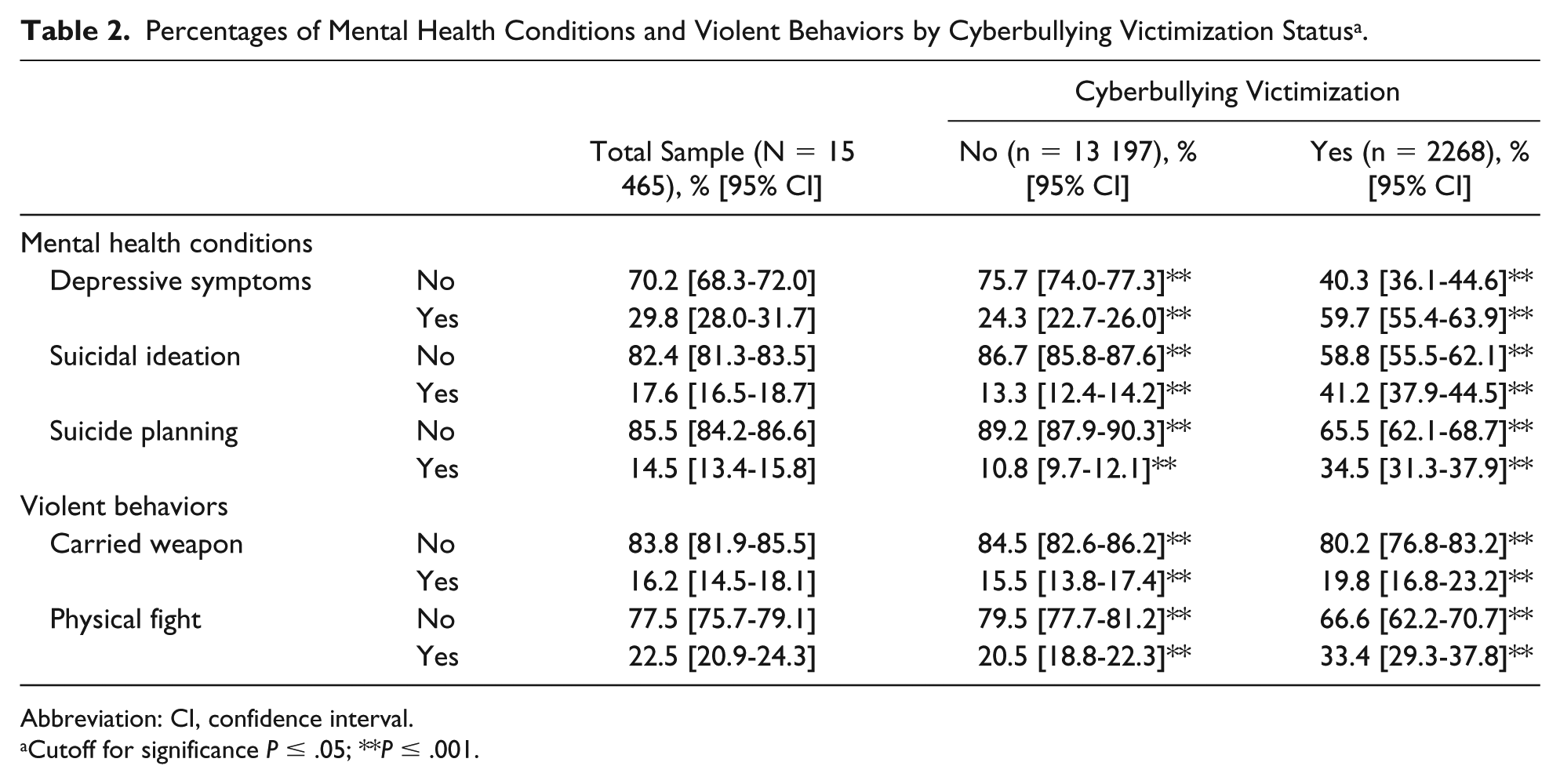
Abbreviation: CI, confidence interval.
Cutoff for significance P ≤ .05; **P ≤ .001.
Being cyberbullied was also found to be significantly associated with violent behaviors. Of students who reported victimization, 20% reported carrying a weapon, which is a significantly higher proportion than that of the overall sample (16.2%). Similarly, over 33% of victims reported engaging in a physical fight, a significant difference than the proportion in the overall sample (22.5%; Table 2).
Multivariate Models of Cyberbullying Victimization
A logistic regression model of cyberbullying victimization was run. This model included the demographic and the health-related variables. The resulting model did not have multicollinearity issues and fit the data adequately. The results showed that females were nearly 2.5 more likely to be cyberbullied than males, and non-white students were 50% less likely to experience cyberbullying victimization. Depressive symptoms, suicidal ideation, suicide planning, carrying a weapon, and engaging in a physical fight were all associated with higher odds of being cyberbullied (Table 3).

Abbreviations: OR, odds ratio; CI, confidence interval.
A logistic regression model of cyberbullying victimization with the mental health conditions and violent behaviors interaction terms as additional predictors was also conducted, but the interactions were not found to be significant. This model was therefore not reported.
Cutoff for significance P ≤ .017 (Bonferroni correction); *P ≤ .01, **P ≤ .001; ***P ≤ .05.
Referent groups are female, non-white, Hispanic, and ≤15 years.
The logistic regression model stratified by sex showed differences in how mental illness and violent behaviors were associated with cyberbullying victimization. Females with suicidal ideation had twice the odds of reporting cyberbullying victimization compared with females with no suicide ideation. However, this association was not found among males. Conversely, suicide planning and carrying weapons were significantly associated with cyberbullying victimization only among males (Table 3).
The logistic regression model stratified by race showed that carrying weapons significantly predicted cyberbullying victimization only among non-white students. In addition, while non-white females had a 1.9 odds ratio of being cyberbullied, their white counterparts had a 2.6 odds ratio. All mental illness variables were significant for both whites and non-whites (Table 3).
Discussion
This study offers a broader view of the association between cyberbullying victimization and mental illness and violent behaviors among American adolescents. By using the nationally representative YRBS data and delineating the association by sex and race, results present a more nuanced view of the demographic variations among victims and the correlates to negative health outcomes. Overall prevalence of cyberbullying victimization in this study (15%) is comparable with the findings in the literature.2,4,25 However, victimization was higher among females and white students. Supporting our hypothesis, findings from this study show higher reported rates of depressive symptoms, suicidal ideation, suicide planning, weapon carrying, and physical fights among victims of cyberbullying compared with both the total sample and non-victims. Except for suicidal ideation, these associations were more pronounced in males, indicating a significant negative effect of being a victim of cyberbullying by sex.
Consistent with other findings, the current study shows that females are more likely to be cyberbullied.19,26,27 The gender gap might be explained by girls’ propensity to engage in indirect bullying (eg, spreading rumors) in contrast to boys’ tendency for direct bullying (eg, hitting).27,28 This distinction makes the Internet an ideal medium for females to express and receive interpersonal aggression. The gendered pattern may also be explained by cultural stereotypes where males refrain from reporting victimization as doing so might undermine their sense of masculinity. 29 In addition, it has been found that females view cyberbullying as a serious problem 30 and to be more hurtful than males, 31 which might encourage reporting victimization. On the other hand, this disparity could be a reflection of gender differences in Internet use as girls are more likely to spend their online time interacting with others on social media platforms whereas the greater proportion of boys make intense use of online games. 32 Moreover, while Notar et al 16 reported no gender difference in cyberbullying victimization, some reported that boys are more likely to be cyberbullied.33,34
We also found that white students reported a larger percentage of cyberbullying victimization compared with their non-white peers. This is in line with the findings from the literature. A meta-analysis of 105 studies on peer victimization found that in the United States, Caucasian youth experienced more peer victimization than ethnic minorities. 35 Similarly, in a study examining the impact of cyberbullying on mental health in a multiethnic sample, Caucasians reported the highest prevalence of victimization. 36 Findings, however, are not conclusive. For example, Moore et al 26 found that minorities in a sample of middle school students (N = 855) in a southeastern US school were more likely to be cyberbullied, although we cannot know if reported cyberbullying occurred within or across racial groups. One explanation for this discrepancy may lie in the definitions of cyberbullying, which may vary across cultures. What could be considered teasing and funny banter in one minority group might be perceived as bullying by another group. It could also be that members of racial/ethnic majority groups develop perceptions of global privilege and entitlement, which might lower the threshold of “pain tolerance” when bullied online where such privileges do not necessarily transfer. In addition, the inconsistency of the relationship between race and cyberbullying victimization might be a function of the racial diversity at the local setting as opposed to the national level. For example, Caucasian students experience more bullying than African American students when they are minorities in school settings, whereas African American students experienced twice the amount of race-based victimization than Caucasian students when in settings with more diversity. 23 This may also manifest in cyberbullying. Therefore, school-based intervention programs against cyberbullying should be sensitive to the intersectionality of school diversity and race, especially in schools with considerable interracial populations.
As hypothesized, findings from this study are in line with previous research suggesting detrimental consequences of cyberbullying victimization,11,12,25,37 especially related to mental health conditions, such as depression, and violent behaviors. It is estimated that depression affects 1 in 8 adolescent each year, and the number of adolescents who experienced major depressive episodes increased by nearly a third from 2005 to 2014. 38 It is plausible that cyberbullying might exacerbate this public health concern. In this study, there was a higher-than-expected proportion of victims with depressive symptoms (60% vs 30% in the total sample); suicidal ideation and suicide planning were also more prevalent among victims. Literature suggests that being cyberbullied might be associated with strong negative feelings, sometimes even higher rates than victims experiencing traditional bullying. 39 Cyberbullying victims are likely to feel isolated, dehumanized, and helpless, 40 leading to an increased risk for suicide ideation.41,42 Alternatively, the associations between mental illness and cyberbullying victimization create a vicious cycle. Studies suggest that adolescents experiencing depressive symptoms tend to compensate for their emotions by finding refuge in the Internet where they manage to develop an alternative reality but also become more exposed and vulnerable to cyberbullying. 39 Longitudinal research is needed to establish directionality between cyberbullying victimization and mental illness to curb the high rates of depression and suicidality among adolescents.
Similarly, youth violence is a significant public health issue. 43 In this analysis, we found a higher-than-expected percentage of weapon carrying and physical fights among cyberbullying victims compared with the total sample. One study suggests that bullying and violence perpetration and victimization often co-occur among adolescents. It is hypothesized that victims tend to transfer their negative experiences toward others. 44 The need to protect one’s self may also explain why bullied individuals might engage in violent behaviors more than non-bullied individuals as their perception of safety changes. 44 It could also be that victims who reported carrying weapon were also offenders of cyberbullying. Liang et al 45 demonstrated that those involved in bullying perpetration showed antisocial and violent behaviors. While studies suggest an overlap between cyberbullying perpetration and victimization as one experience might prompt the other,6,46 the YRBS data did not include questions on bullying or cyberbullying perpetrations so this hypothesis cannot be examined in this study.
Findings of this study also show differences in both mental illness and violent behaviors by sex. The logistic regression model indicated that while females in general had twice the odds of being cyberbullied, males with depressive symptoms had significantly higher odds of also reporting cyberbullying victimization compared with their male counterparts with no such symptoms. This association was stronger in males than females. This may imply that girls have better coping skills, 47 and that boys internalize their negative feelings, making them feel more helpless. Many studies indicate that men are less likely to seek help due to gender roles, 48 which may begin during identity construction in adolescence. Certain traditional values associated with masculinity, such as emotional restraint and independence, discourage men from seeking help for negative symptoms, specifically for mental illness. 49 Furthermore, males in this sample were significantly more likely to report violent behaviors. These findings could be related to one another. We also found that non-white males who carried weapons were more likely to be cyberbullied compared with males who did not carry any weapon. While this analysis cannot assess the directionality of those relationships, it is an important finding that suggests the need for anti-cyberbullying programs that provide safe zones for boys to seek help and voice their mental health concerns.
Finally, it is noteworthy that for females, suicidal ideation was significantly associated with cyberbullying victimization, while this association was not found among males. Conversely, suicide planning was significantly associated with cyberbullying victimization only among males. Suicidal ideation and suicidal planning are 2 steps in a continuum of behaviors that may end with suicide. These behaviors may vary, are not mutually exclusive, 47 and tend to operate differently by sex. 50 While females report more suicidal ideation, males commit suicide at a rate 5 times that of females. This seemingly paradoxical phenomenon may be explained by other suicide risk factors associated with each sex, such as males having higher rates of access to firearm and being less likely to engage in protective behaviors such as help-seeking. 47 Current suicide prevention programs ought to focus on these sex differences to target their communication effectively.
Limitations
Although this study offers an important addition to the literature, several limitations must be recognized. Due to the cross-sectional analysis, causality cannot be established. Future research is needed using prospective designs to establish temporality of the association between cyberbullying victimization and mental health conditions and violent behaviors. The study variables were self-reported, which might have caused misreporting, although YRBS questions generally demonstrate good test-retest reliability. 51 Also, secondary analyses are limited by the types of questions and responses provided in the original codebook. As such, the dichotomous scales used to assess study variables and the lack of details about socioeconomic status and specific online activities may have concealed important nuances and precluded a dose-response relationship. In addition, this study analyzed data from 2015, so interpretation of findings should consider recent measures to improve user safety, such as the anti-bullying tools introduced by Facebook. 52
Overall, this study reveals the complexity of cyberbullying and demonstrates that victimization may affect mental health conditions and violent behaviors differently based on the victim’s sex and race, calling for more research to design-targeted interventions.
Footnotes
Author Contributions
MA provided substantial contribution to the conception of this article, data acquisition, analysis, and in drafting this article; SB contributed to the drafting of this article and revised it critical for important intellectual content; TD designed and performed the analysis and helped with data interpretation.
Declaration of Conflicting Interests
The author(s) declared no potential conflicts of interest with respect to the research, authorship, and/or publication of this article.
Funding
The author(s) disclosed receipt of the following financial support for the research, authorship, and/or publication of this article: Publication of this article was funded in part by the Temple University Libraries Open Access Publishing Fund.
