




Abstract
Perinatal loss, including fetal and infant death, is a devastating experience for parents, resulting in long-term adverse physical and psychosocial outcomes. However, little is known about what services might best support grieving parents. We aimed to understand the role of professional bereavement photography in assisting the grieving process of parents who have lost a fetus or infant, by examining the perspectives of bereaved parents, professional photographers, and health care professionals. Twenty semistructured interviews were conducted, and interview transcripts were analyzed using modified grounded theory. Twenty-three individuals participated, including 6 bereaved parents, 8 photographers, and 9 health care professionals. Analyses generated 5 major themes describing ways in which the photographs were valuable to parents: validation of the experience, permission to share, creation of a permanent and tangible legacy, creation of positive memories, and moving forward after the loss. Hospitals should consider incorporation of professional bereavement photography services into palliative care and bereavement programs.
Introduction
Perinatal loss, which encompasses fetal, neonatal, and infant death, is a devastating and traumatic experience for parents, resulting in increased risk for long-term adverse physical and psychosocial outcomes.1-5 The death of a fetus or infant is a loss unlike any other, 6 and its social, emotional, and spiritual burden has been greatly underestimated. 7 Parents also suffer from the social stigma and culture of silence that surrounds perinatal loss.7-10 Despite these negative outcomes, little is known about what services might best support grieving parents.
Perinatal palliative care programs have gained prominence in the past decade to address the unique needs of families caring for fetuses and infants who may die. 11 Although bereavement care is considered essential to palliative care, large variations exist among the types of services offered by providers and hospitals.6,11,12 Previous studies addressing perinatal bereavement interventions have found that the majority of bereaved parents endorse photography of their child and family.13-15 However, very few studies have examined the specific ways in which bereavement photography, whether occurring while the child is still alive or after death, may be beneficial to parents in the grieving process.16-18 Existing data suggest that photography can aid in memory-making, memorialization, and validation; however, these are primarily survey-based studies of mothers.16-18
Thus, our objective was to understand the role of professional bereavement photography in assisting the grieving process of parents who have lost a fetus or infant. These findings are essential to informing the development of comprehensive, family-centered programs to support parental bereavement.
Methods
This narrative qualitative study recruited participants in 3 categories: bereaved parents, professional photographers, and health care professionals. All participants were recruited using a nonprobability purposive sampling strategy. Contact was made with a photographer well-known in the Seattle pediatric palliative care community. She was approached about individuals whom she thought would be willing to participate, and she obtained their permission prior to sharing their contact information. Participants were then approached by telephone and given background information about the study, according to a preapproved telephone contact protocol.
Inclusion criteria for bereaved parents included having experienced a third trimester fetal demise or loss of an infant within the first year of life and having received professional bereavement photography services while the child was alive or at the time of the loss. Photographers were recruited from 1 of 2 organizations that provide free, professional photographs to families with children facing life-threatening conditions: Soulumination and Now I Lay Me Down to Sleep (NILMDTS). Health care professionals were recruited from local organizations with the goal of achieving a heterogeneous representation of professionals involved in pediatric, neonatal, and palliative care. Inclusion criteria for health care professionals included clinical or professional experience, in any of the health care–related professions, caring for families who had lost a fetus or infant within the first year of life. Health care professional participants were not necessarily the providers of parent participants. Participants with limited English proficiency were excluded.
In-depth semistructured interviews were conducted in person by the primary investigator (FDR). All parent participants were queried regarding preferences to participate in interviews alone or with their coparent. Based on parental preference, some interviews were conducted with both parents together, while others were conducted with individual parents. Standard interview guides were used for each category of participant (Supplementary Table 1, available online). Questions were open-ended with prompts when necessary. Questions were nondirective and allowed for positive, negative, or neutral responses. For example, participants were not asked about why photographs were beneficial but rather were asked about whether they perceived the photographs helped parents with the grieving process. Parents were asked to describe their experience of loss in as much detail as they felt comfortable. They were then asked questions about the experience of the photography shoot; the meaning, uses, and importance of the photographs; and whether they found the photographs beneficial in the grieving process. Questions for photographers focused on their experiences with parents and the content of the photographs. Interviews with health care professionals focused on their perspectives about whether these photographs were beneficial to families, and about their experiences with professional photography services at their respective institutions. Interviews lasted 45 to 90 minutes and were digitally audio-recorded and transcribed verbatim.
Interview transcripts were analyzed using the constant comparative method within modified grounded theory, in which narratives were repeatedly read in order to identify themes.19,20 The transcripts were first read multiple times to identify statements of interest and were then read more closely to identify emerging themes using an open-coding approach. Transcripts were hand-coded and reread several times after an initial coding scheme was developed. This iterative process was repeated until the coding scheme was fully developed. Saturation, or the point at which additional interviews no longer generate meaningful new themes, was used to guide the sample size and was felt to have been achieved after interviews with 23 participants (6 bereaved parents, 8 photographers, and 9 health care professionals). Codes were organized into major themes and subthemes. Coding was led by the primary investigator (FDR) with critical review of the final coding scheme by senior investigators LMY and JFB. All participants who were approached agreed to participate. No incentives to participate were offered; and all participants, especially parents, expressed gratitude for the opportunity to share their stories.
Ethical Approval and Informed Consent
Ethical approval was obtained from the University of Washington Human Subjects Review Committee (Institutional Review Board Number 41765). All participants provided written informed consent.
Results
A total of 23 individuals participated, including 6 bereaved parents, 8 photographers, and 9 health care professionals. Of the parents, 1 experienced a fetal loss and 5 experienced neonatal or infant losses (Table 1). Only one parent was able to take her child home for his last days of life and photographs were taken at that time; all others had photographs taken at the hospital. At the time of the interview, none of the families had experienced a previous or subsequent fetal, infant, or child loss. The number of years from the death to the time of interview ranged from 2 months to 9 years. The category of health care professionals included 3 nurses, 2 social workers, 1 chaplain, 1 child life specialist, 1 grief support consultant, and 1 pediatrician. The photographers included 2 from NILMDTS and 6 from Soulumination, and several photographers had personal or family experiences with photography in the setting of perinatal loss.
Study Participants: Parents.

Causes of death are parent-reported and not corroborated with medical records.
Qualitative analyses generated 5 major themes: validation of the experience, permission to share, creation of a permanent and tangible legacy, creation of positive memories, and moving forward after the loss. Although the perspectives of parents were considered most central to the findings, all themes, and nearly all subthemes, were echoed in the perspectives of photographers and health care professionals.
Validation of the Experience
Parents consistently identified the photographs as an essential means of validating their experience, including validation of their baby’s existence, their identity as parents, and their child’s place in the family unit (Table 2):
Validation of the Experience: Subthemes and Illustrative Quotations.

It’s a validation of being a parent . . . that this person was here on this planet, and that he lived. He was here very briefly, he had a huge impact on our lives, and that presence is recognized and celebrated in the pictures. (Mother)
The photographs may have been the only means available to parents to authenticate the reality of their baby’s existence: He was here, and the pictures celebrate that, you can’t take that away. Even though he’s not here you can’t take that away, that he was here, and he was part of our family, and a beautiful looking kid. (Mother)
Parents found this was particularly important, as all had experienced either fetal death or only a short period of their child’s life, and few family members and friends had the opportunity to meet their child: I think in part because when a baby dies, it might be the immediate family, there might be other siblings, but, you know, nobody knows this person . . . but this person is obviously an incredibly important part of your life, and having the pictures lets everybody know, lets you realize and remember that yes, this is a real person, this is your baby, this is your family. (Mother)
In addition, the photographs confirmed parental identity and validated the child’s place in the family unit through the language of inheritance and family resemblance: All those pictures that are at certain angles where the both of them are facing the same . . . they look exactly alike. You can tell in all of them that they’re related. (Mother)
Permission to Share
Families and health care professionals felt that the photographs provided permission to share, as they facilitated difficult conversations, enabled the creation of narratives, and helped siblings understand the loss (Table 3). As aesthetically pleasing and professionally created images, the photographs provided parents opportunities to share their child and initiate conversations with others:
Permission to Share: Subthemes and Illustrative Quotations.

That’s one way to introduce the subject, because it’s always a little like, “When do we tell them we have a dead child?” Because it’s not the easiest thing to bring up, yet it’s really important for us because he’s still so much of our family. (Mother)
Photographs facilitated desired opportunities to share stories and memories, and enabled the creation of narratives: It’s constructing a narrative about it, sharing stories. . . . And it’s hugely, hugely healing. We see those families cope better, later, and these are the ones . . . that are more happy, years later, than the families who try to forget, shove things in drawers. (Health care professional)
In addition, parents were able to share their child with family members who were not present, including siblings who were born later or were too young to remember. Parents greatly valued this function of the photographs, which enabled them to talk about the loss and the meaning of the child’s death with their other children: I totally think it helped [our oldest son], just like it helped us, no question about it. He was really young but I think it definitely helped him to know, “Hey, I have this brother,” who he talks about to this day. . . . We’ll bring him up here and there, or say how he’s watching us doing something, so we definitely still talk about him as a family. But we’re sure it helped [him] to kind of understand what happened, and that he died so he’s not here with us but he’s still with us in spirit. (Photographer, who personally experienced the death of her second child at birth)
Sharing photographs, and the memories that accompany them, allowed other children in the family to understand and talk comfortably about their deceased sibling. This, in turn, helped them develop and maintain a sense of individual and family identity that incorporated the memory of their sibling: At his last daycare, I went in and helped share pictures with him to his classmates so that he could have that voice about it, because for him it’s a different dynamic. It’s not only his brother, but it’s his twin brother. And for us it’s really important for him to have the opportunity to incorporate the twin identity, you know, we always say, “You’re a twin, you’re a twin, you’re a twin,” but that he can say when he’s comfortable, “Yeah, that’s part of who I am, I am a twin, and even though my brother died that doesn’t change anything.” So we use it as a way to allow him to verbalize it. (Mother)
Creation of a Permanent and Tangible Legacy
Participants highlighted the ways in which the photographs created a permanent and tangible record, captured irreplaceable moments and small details, relieved the fear of forgetting, and created a family legacy (Table 4). The permanency of photographs provided parents assurance that the memory of their child would exist well beyond their child’s brief existence:
Creation of a Permanent and Tangible Legacy: Subthemes and Illustrative Quotations.
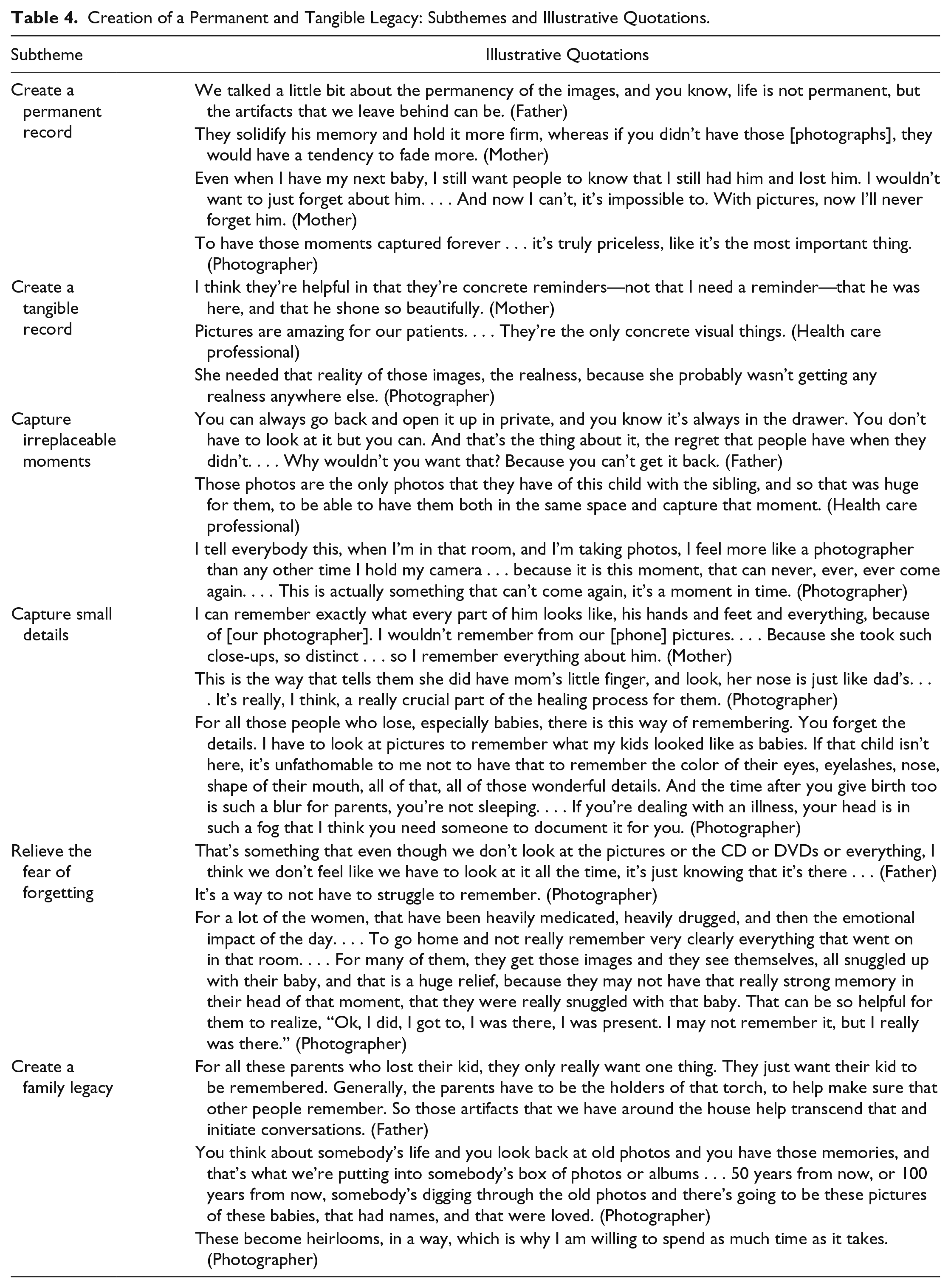
This was the only way, we don’t have any other option. . . . It was either this, or rely on our memory, and I think we both felt that we wanted something more permanent than just our memory of him. (Father)
The photographs were among the only tangible things parents had once their baby died: They can still love this child and remember the child in a more tangible way, by looking at those images, by seeing their hands holding the baby. (Photographer)
For one father, the photographs were the “most precious thing.” Because parents left the hospital without a child, the photographs took on an increased importance, often becoming their most valuable and irreplaceable possessions: I just know that when they take those photos [home], it’s like they’re actually taking a part of their child that they otherwise would not have. (Health care professional)
Moreover, parents valued the photographs for their ability to capture irreplaceable moments that would never be possible again: Knowing that this is my only chance to ever take a picture with him. . . . I would never get that second chance again . . . it’s a guarantee . . . (Mother)
Parents also highlighted the importance of the photographs in capturing small details about their child’s appearance that were often difficult to remember, because they only spent a few moments with their baby, or were sleep-deprived and/or clouded by medications: We look at his nose, and he’s got the same nose as the other kids, his hair. . . . And if it was just in my memory I wouldn’t have that, because I don’t, I can’t remember much about that day. If it wasn’t for the photos, I don’t know what I would remember, really. . . . It’s a comfort to us. (Father)
As such, photographs provided reassurance and comfort to parents, and relieved their fear of forgetting: I can see his whole body in some of them, I can see his fingers, and toes, and face. And I just know that he totally existed and that I don’t have to hold him so tightly in my mind and remember every little ounce of him. I can just relax because I know I have those photos. (Mother)
Finally, as permanent and concrete artifacts, the photographs contributed to the creation of a family legacy: [If] the child died while they were [in the hospital], in that case, the photographs are a hugely important part of their legacy. (Health care professional)
Creation of Positive Memories
The experience of taking the photographs also created positive memories, by providing a special occasion for the family, a sense of normalcy, opportunities to hold the baby, and time spent together as a family, even for parents who had experienced a fetal loss (Table 5):
Creation of Positive Memories: Subthemes and Illustrative Quotations.
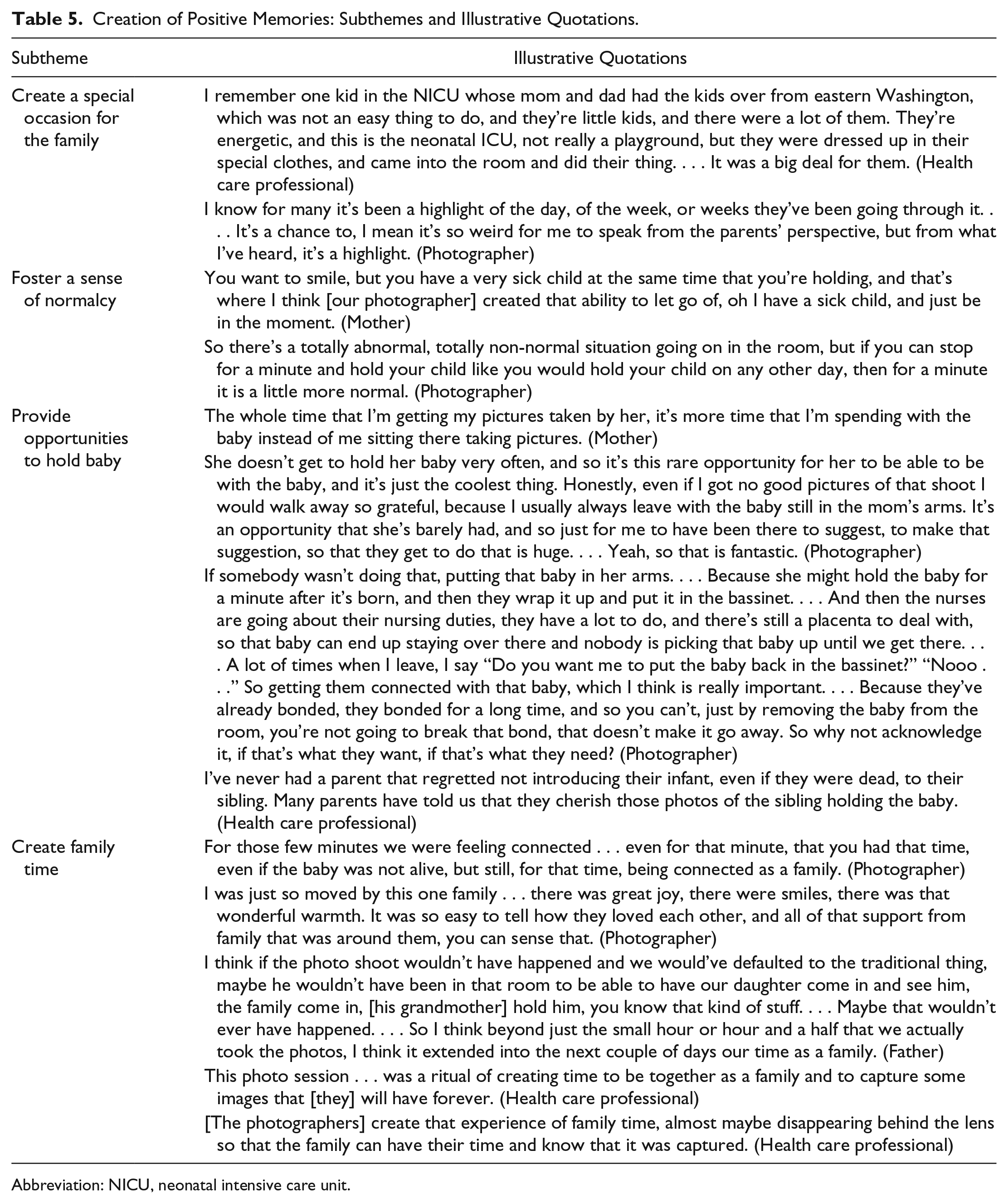
Abbreviation: NICU, neonatal intensive care unit.
We look at [the photographs] and it was a good day. . . . The sadness never goes away, so the photographs can never erase that. It can diminish it, lessen it. . . . But for us, we look at them and smile. (Mother)
The experience represented a special occasion for the family that often brought more joyful emotions: They are choosing at that moment to grieve and to celebrate, and to honor that life, so there can be more smiles in the room than tears. (Photographer)
The opportunity to have photographs taken also fostered a sense of normalcy for parents, who felt that family portraits are things that “normal” families do: [Our photographer] had the knack of transporting us into an environment of normalcy, where we were just living hospital, hospital, hospital, but when she came in it was like, oh this is what normal people do, that’s right, you have photographs of your children taken whether it’s at Sears or JC Penney, you know. . . . There was a gift in that moment of just creating a very normal moment for us. (Mother)
In addition, participants consistently emphasized how important it was for parents to have the opportunity and be encouraged to hold their baby, especially if parents were initially hesitant: She wanted me to hold him, and I was really afraid. . . . I thought he was so fragile he could die if we were to move him very much. . . . And she convinced me to hold him, which I’m glad she did. (Mother)
Parents greatly cherished the time spent together as a family while the photographs were being taken: It was also one of the few times that we had all 5 of us together, because we had 2 young kids still at home. . . . So it was a very rare and special moment . . . it was this time for our entire family to be together. . . . I think at the moment, it was very cherished, and even looking back . . . that was a good day for us. (Mother)
Moving Forward After the Loss
Finally, the photographs helped parents move forward after the loss through a variety of mechanisms, including keeping the memory of the child alive, acting as anchors to continuing relationships, providing the freedom to grieve, allowing movement between stages of grief, and facilitating acceptance (Table 6). The presence of this theme did not seem to differ based on time since the death.
Moving Forward After the Loss: Subthemes and Illustrative Quotations.

The photographs helped parents keep their child “alive” through the conversations, stories, and memories they evoked: I think it’s keeping them alive, too. I mean so much of their personality is captured by these photographs, but I think it’s a way to . . . keep them alive and legitimize the parent doing that when they show it to someone who wasn’t involved, years down the line. (Health care professional)
They enabled parents to maintain connections with their child, and acted as anchors to continuing relationships, allowing the bond between parent and child, or sibling and child, to continue: I think it’s overall helped our whole process of grieving. It’s been easier for us to talk about and to help our kids. And also understand, because that’s a continuing process of understanding and evolving perspective on what it means to have a dead sibling, or a dead twin, or a dead child. (Mother)
In addition, parents found the meanings of the photographs, and the way they related to them, evolved over time, as a manifestation of whichever stage of grief they were currently experiencing: What are the stages of grief . . . it’s not linear, they skip around, it’s circular. . . . I think acceptance is the last one, but I occasionally get angry again, and then I’ll have a weird dream where you’re in that disbelief part, and you’re like wait, did this really happen? And you wake up and you’re like, oh yeah it did . . . these pictures are helpful in going through those stages, whatever they may be. (Mother)
The photographs also gave parents the permission to grieve—to feel and express all the different emotions of sadness, anger, resentment, joy, and pride. Many parents found that expressing these emotions, facilitated by the photographs, enabled them to move forward following the loss: At first they did make me cry a lot . . . but I think that is a part of grieving. If I didn’t cry. . . . I would probably . . . still be feeling like I didn’t get it all out. So they made me cry more in the beginning, which I think is good because it helped me to cry less later on. (Mother)
Although participants acknowledged that “acceptance” was never truly reached, to many families, acceptance represented a delicately balanced state where they were able to integrate the loss of their child into their life and move forward in a healthy way—both acknowledging the finality of the loss and celebrating their child’s life. Several participants discussed the role of the photographs in helping parents move toward this equilibrium: I feel like her pictures are like, positive ones . . . they make me feel like I can accept that he’s gone . . . (Mother)
Discussion
A central goal of perinatal palliative care is to provide support to families in circumstances where a fetus or infant is expected to die. Bereavement photography has been used as a way to support families in these circumstances, although little evidence exists to guide this practice. Among our study sample, parents who experienced a perinatal loss valued professional photographs for a number of unique reasons, including validation of the experience, permission to share, creation of a legacy, creation of positive memories, and moving forward. The families, health care professionals, and photographers interviewed in our study held similar supportive beliefs about the role of bereavement photography.
Social theory has identified several problems unique to fetal and infant loss, including parents’ fear of losing the few memories they have of their child, as well as societal pressures to forget and move on. 21 Parents also suffer from the ambiguities surrounding perinatal loss, including ambiguities about what has been lost, about one’s identity as a parent, and about societal and family membership of the baby.7,9,22-24 Many parents feel disenfranchised in their grieving process, as they feel their grief is not socially recognized or legitimized by health care providers and society.7,9,10,24 Our findings mirror and expand on results of prior limited survey literature, suggesting the various functions of bereavement photographs may help address these challenges, and are also consistent with previous studies that found that bereavement photography can support parents in memory-making, memorialization, and validation.16,18
Our findings are highly relevant in the context of contemporary grief theories, which emphasize the importance of continuing bonds between the living and the deceased.25-27 As vehicles of memory, photographs help parents keep memories alive and maintain relationships with their child.28,29 Moreover, current bereavement theory highlights the importance of talking about traumatic experiences and constructing narratives related to the loss as a way to contextualize, find meaning, integrate the experience, and move beyond it.26,30-32 Photographs, and the conversations, memories, and narratives associated with them, may help bereaved parents and their other children come to terms with the loss. 28
This study addressed bereavement photography from multiple perspectives. It uniquely included parents who had photographs taken when their child was still alive, in contrast to previous studies, which have focused on postmortem photography.16-18 The use of rigorous qualitative analyses provides a more comprehensive understanding of the different functions of bereavement photography compared with prior survey studies. We also incorporated perspectives of fathers, as well as photographers and health care professionals, who have worked with hundreds of families who have experienced perinatal loss. We identified nearly identical themes and subthemes in all interviews, suggesting our findings may have external validity.
There are limitations of this study, notably a small sample of parents, which may limit the socioeconomic, racial/ethnic, and cultural diversity of the perspectives presented herein. We acknowledge the potential for selection bias as we used a volunteer, nonprobability sampling strategy, as was necessary for the nature of the research question. Parents who agreed to be interviewed likely had positive perspectives regarding the photographs. We cannot assume photographs benefit all families; for example, some cultures do not allow postmortem photography, and some families may not be comfortable with this practice. The bereavement needs of individual families vary tremendously and should be supported in a personalized and family-centered manner.
In conclusion, among our study sample, parents who experienced a perinatal loss valued bereavement photography in coming to terms with their loss. Previous research has identified key components of perinatal bereavement interventions, including validating the baby’s existence, facilitating parents’ expression of grief, providing a framework for social support, and assisting in memory-making.11,13 Our findings suggest that bereavement photography can support parents across all of these categories, providing compelling evidence that supports further research and consideration for the widespread incorporation of professional bereavement photography services into palliative care and hospital programs.
Supplemental Material
GPH_Sup_Table_1_FR – Supplemental material for Professional Bereavement Photography in the Setting of Perinatal Loss: A Qualitative Analysis
Supplemental material, GPH_Sup_Table_1_FR for Professional Bereavement Photography in the Setting of Perinatal Loss: A Qualitative Analysis by Faustine D. Ramirez, Jori F. Bogetz, Megan Kufeld and Lynn M. Yee in Global Pediatric Health
Footnotes
Acknowledgements
We would like to thank Soulumination and Now I Lay Me Down To Sleep. We also thank Professor Daniel Hoffman from the University of Washington Department of Anthropology for guidance in the design and conceptualization of this study. We are appreciative to the healthcare professionals and photographers who took valuable time to share their perspectives and experiences with us. We are grateful for the openness, trust, and courage of the bereaved parents who shared their experiences and stories of their children with us.
Author Contributions
FDR conceptualized and designed the study, collected data, carried out the initial analyses, drafted the initial manuscript, and reviewed and revised the manuscript.
JFB and LMY supervised analyses and interpretation of data, and substantially reviewed and revised the manuscript.
MK contributed to study design, collected data, and critically reviewed the manuscript for important intellectual content. All authors approved the final manuscript as submitted and agree to be accountable for all aspects of the work.
Declaration of Conflicting Interests
The author(s) declared no potential conflicts of interest with respect to the research, authorship, and/or publication of this article.
Funding
The author(s) disclosed receipt of the following financial support for the research, authorship, and/or publication of this article: Dr. Ramirez received funding from the NIH, through UCSF-CTSI Grant Number TL1-TR001871, and from the University of Washington Mary Gates Endowment. Dr. Yee is supported by the NICHD K12 HD050121-11. The contents are solely the responsibility of the authors and do not necessarily represent the official views of the funders. The funding organizations were not involved in the design and conduct of the study, collection, analysis, and interpretation of the data, or preparation, review or approval of the manuscript.
Supplemental Material
Supplemental material for this article is available online.

References
Supplementary Material
Please find the following supplemental material available below.
For Open Access articles published under a Creative Commons License, all supplemental material carries the same license as the article it is associated with.
For non-Open Access articles published, all supplemental material carries a non-exclusive license, and permission requests for re-use of supplemental material or any part of supplemental material shall be sent directly to the copyright owner as specified in the copyright notice associated with the article.
