



Abstract
The aim of this article was to investigate the use of exergaming in promoting exercise behavior among children and to examine the impact of the intervention on participants’ exercise self-efficacy, in addition to assessing physiological changes. A sample of 55 children enrolled in the Family Fit program, where participants were categorized into 2 groups: healthy weight and overweight. Measures were taken at baseline, after the 7-week program, at the 12-week follow-up, and at the 24-month follow-up. Positive changes in exercise self-efficacy were significant for the overweight group, while the healthy weight group maintained their exercise self-efficacy. At the 24-month follow-up, 97% children reported being interested in participating in a future fitness program, and 96% children who did not play sports before the intervention started practicing sports. Exercise self-efficacy is a predictor of physical activity, and incorporating exergaming in a structured program may lead to increased self-efficacy in participants.
Introduction
Since the 1980s, the number of children aged 6 to 11 years that are considered overweight has nearly tripled to almost 19% of the population. 1 Utilizing the Centers for Disease Control and Prevention (CDC) accepted cutoff points for overweight and obesity, data from the 2005-2006 National Health and Nutrition Examination Survey show that in children aged 6 to 11 years, 33% are either obese or overweight (≥85th percentile of CDC growth charts), 17% are obese (≥95th percentile), and 11.4% are severely obese (≥97th percentile). In 2007, the national cost of obesity was estimated to be in excess of $117 billion, which did not include the 25 million children that were currently overweight or obese. 2 And while there are significant differences associated with race and gender, the larger problem remains—childhood obesity is spiraling out of control.
Significant societal and technological changes have also occurred over the past 30 years. The ways in which people, especially children, engage in their environments has changed, as has the technology. Today, it is possible to work from home, play at home, and even shop at home. Dramatic increases in technology have greatly facilitated the popularity of video and computer gaming systems, and they are now practically household items. It is estimated that the average child spends at least 1 hour and 13 minutes each day playing video games 3 and several hours watching TV, thus making it much less likely that they will actively play or engage in physical activity outside the home.
Self-efficacy is an important factor in assessing or predicting physical activity. Self-efficacy is the belief in one’s own ability to learn or perform a sport or physical activity at a certain level. 4 This belief is a particularly important aspect of motivation in adolescents because it may be part of the reason they may or may not choose to participate in a sport or physical activity. When people doubt their ability to perform a certain task, they may forego participating altogether. Conversely, when someone is willing to try an activity or want to learn, they often exert more effort, persist longer when faced with difficulties, and even achieve higher levels of performance. As one’s ability to perform well increases over time and they become more confident in their ability to best their competitors, their subsequent performance is enhanced.
One of the latest advancements in the video gaming industry, the creation of interactive video games, may hold a key in helping combat the sedentary tendencies of children and provide motivation for continued physical activity, and there have been some significant findings that illustrate the importance of this emerging field of research. Video games were once considered as a sedentary contribution to obesity; however, with new developments in the gaming industry requiring actual human movements, interactive video games have become a potential tool used in the promotion of physical activity.5-7 Also, research demonstrates that children who perceive they have higher capabilities have higher participation rates in physical activity. 8
There is some preliminary evidence to suggest further investigation in whether playing interactive video games leads to a direct contribution to physical activity or involvement in sports. A study examining the physical activity level of participants aged 13 to 15 year found that children playing interactive video games expended significantly more energy than those playing sedentary video games. 9 There is also evidence to support the use of interactive video games to increase self-esteem and self-efficacy through skill building and prosocial behavior. 10 According to research, positive experiences such as a successful victory in an interactive video game encourages higher levels of self-efficacy regarding the player’s abilities and promotes future participation in playing sports.
Currently, this area of research is rather new since the majority of evidence gathered has been based on the negative effects of sedentary video games. 11 In a 4-year study conducted in Ontario, Canada, 1492 students from 8 high schools participated in a cohort-sequential project to investigate youth lifestyle choices. The results indicated an association between sport interactive video game play and more participation in sports over time. 12 By participating in exergaming, individuals may be able to enhance their beliefs in their capabilities to conduct a variety of exercises (self-efficacy) through facilitation of mastery experiences. This in turn may provide the necessary motivation to lead a more physically active lifestyle.
Methods
The purpose of this study was to assess if exergaming is successful in enhancing real exercise self-efficacy and if exergaming is successfully retained as an exercise practice among children in the study. We also checked the feasibility, logistics, and effectiveness of interactive video games when implemented as part of an adolescent fitness intervention program and to further evaluate how interactive video games affect children’s perceived exercise-related attitudes and behaviors.
Design
This was a longitudinal pilot study with repeated measures for 55 children ages 6 to 12 years. Biometric assessments and pilot-tested surveys (for language clarity and appropriateness in this population) were administered at 3 time points: before the beginning of the program (baseline), at the end of the program (final), and 12 weeks after the program was completed (12-week post). To assess continued participation in exergaming and sports activity, a 24-month follow up was conducted after the 12-week assessment.
Participants were queried at pretest and posttests using a survey instrument that included items and scales adapted from published validated surveys. Both overweight/obese children (N = 42) and normal weight children (N = 18) were included. Participants in the Family Fit program were enrolled in a 7-week program at the Xrtainment Zone in Redlands and Loma Linda, California. The program comprised 7 weekly sessions. Each session had 2 components: a 45-minute nutrition education workshop and 45 minutes of exergaming activities such as Jackie Chan’s Fitness Studio, Wii Sports, or rock-climbing.
Family Fit Program
This intervention program used the Family Fit curriculum developed by the Beaver Medical Group Health Education Program. It is a 7-week program in which participants and their parents learn about basic nutrition and making healthy food choices. Before or after each nutrition class, participants are allowed and encouraged to play various interactive video games offered at Xrtainment Zone. Enrollment in the Family Fit program also entitled participants to a membership in the Xrtainment Zone for the duration of the program. Each program participant was highly encouraged to use the Xrtainment Zone facility free of charge during the intervention program.
Measures
Outcome measures were changes in exercise self-efficacy, retention rate of a 7-week Family Fitness program, likelihood to engage in physical activity, heart rate of participants (using Polar heart rate monitors) during exergaming, and duration of exergaming activity (in minutes).
Data Analysis
The exercise self-efficacy (ESE) score was computed based on a modified version of Bandura’s survey instrument, which was a questionnaire containing 18 items with a scale ranging from 0 to 10, with 10 as the maximum positive response. The ESE index was calculated by summing responses for all 18 items.
A paired t test (untransformed ESE variables) as well as nonparametric tests (related samples sign and Wilcoxon signed rank) were used to assess if there was significant change after the program. The Friedman repeated-measures test was also used to assess if there is significant change over time.
For the 24-month follow-up, a survey was developed to assess program interest, continued engagement in exergaming, and subsequent participation in sports and activities. Results of specific questions were analyzed using nonparametric statistics.
Results
Retention
Can interactive video games be successfully incorporated into a structured program, as evidenced by successful recruitment and retention? Sixty children were recruited into the program. Five were excluded because they fell outside of the study parameters for age, and 15 were excluded because they did not attend at least 5 of the 7 weeks of the structured program. Therefore, 40 children completed the program and met the study parameters, resulting in a 73% completion rate.
Exercise Self-Efficacy
Regarding ESE, there was a statistically significant change over time (paired t test: 10.25 [1.34, 19.16], P < .05; Sign test: M = 8, P < .5; Wilcoxon signed rank test: S = 177, P < .05; Friedman repeated measures: χ2 = 8.35, P < .05). See Table 1.
Exercise Self-Efficacy Change Following Exergaming Intervention Study.

A paired t test by baseline body mass index (BMI) categories (healthy vs risk/obese) showed a significant change in ESE after the program (P < .01) for the overweight and risk group. The healthy BMI group did not show this change but, rather, maintained their healthy ESE (see Table 2).
Exercise Self-Efficacy Change and BMI Categories Following Exergaming Intervention Study.

Abbreviations: BMI, body mass index; CI, confidence interval; df, degrees of freedom.
Exergaming Interest and Engagement in Sports 2 Years Later
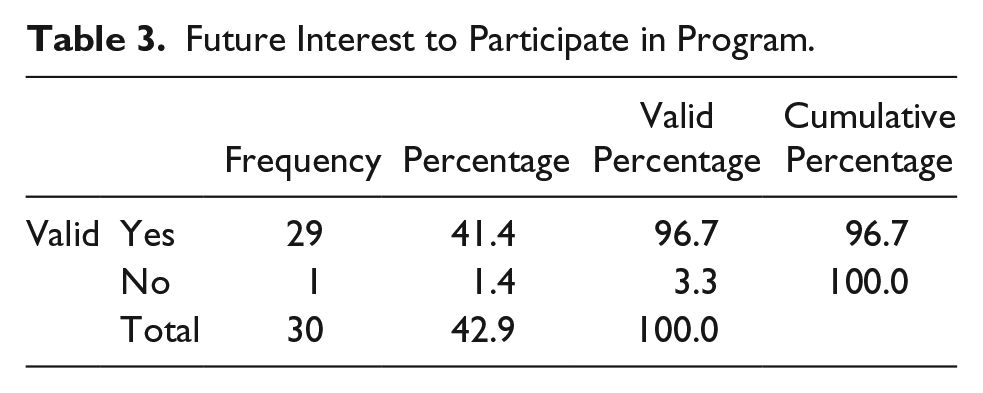
Participants in the study were contacted 24 months after the completion of the program to assess program interest, continued engagement in exergaming, and subsequent participation in sports and activities. When asked about future interest to participate, 29 out of 30 kids said they would participate (see Table 3). Furthermore, 23 out of 24 kids who did not play a sport before participated in one afterward (see Tables 4 and 5).
Future Interest to Participate in Program.
Participated in a Sport Following the Program.

Chi-Square Tests (Odds of Participating in Sport).

Three cells (75.0%) have expected count less than 5. The minimum expected count is .17.
Computed only for a 2 × 2 table.
Binomial distribution used.
Discussion
The results from this pilot study are more promising than what was anticipated and confirmed the initial theory that exergaming can help motivate kids who are typically sedentary to be more active. Despite a poorer and more transient population along with transportation challenges, children were able to convince their parents to be committed to the 7-week program in addition to the 12-week follow-up session. The Family Fitness Program is also offered at a nearby health clinic; however, without the exergaming component, their retention rates are historically around 60%. In this study, incorporating exergaming into the same structured program resulted in a 73% completion rate; this was lower than completion rates noted in the literature where retention was approximately 84% and more.13-15 Therefore, access to exergaming served as an incentive for participants to adhere to the program.
As previous reported regarding exercise self-efficacy, ESE among adolescents was one of the strongest predictors of motivation and exercise adherence. 4 Exergaming affects one’s ESE through enhanced mastery of skills and increased confidence, which subsequently improves exercise motivation and adherence (see Figure 1). In this study, the overweight kids had a significant improvement in their ESE over time, whereas the healthy weight kids just maintained their ESE. This underscores the importance of ensuring that in health interventions, we need to consider the effects on both groups and ensure that both groups maintain high levels of ESE.
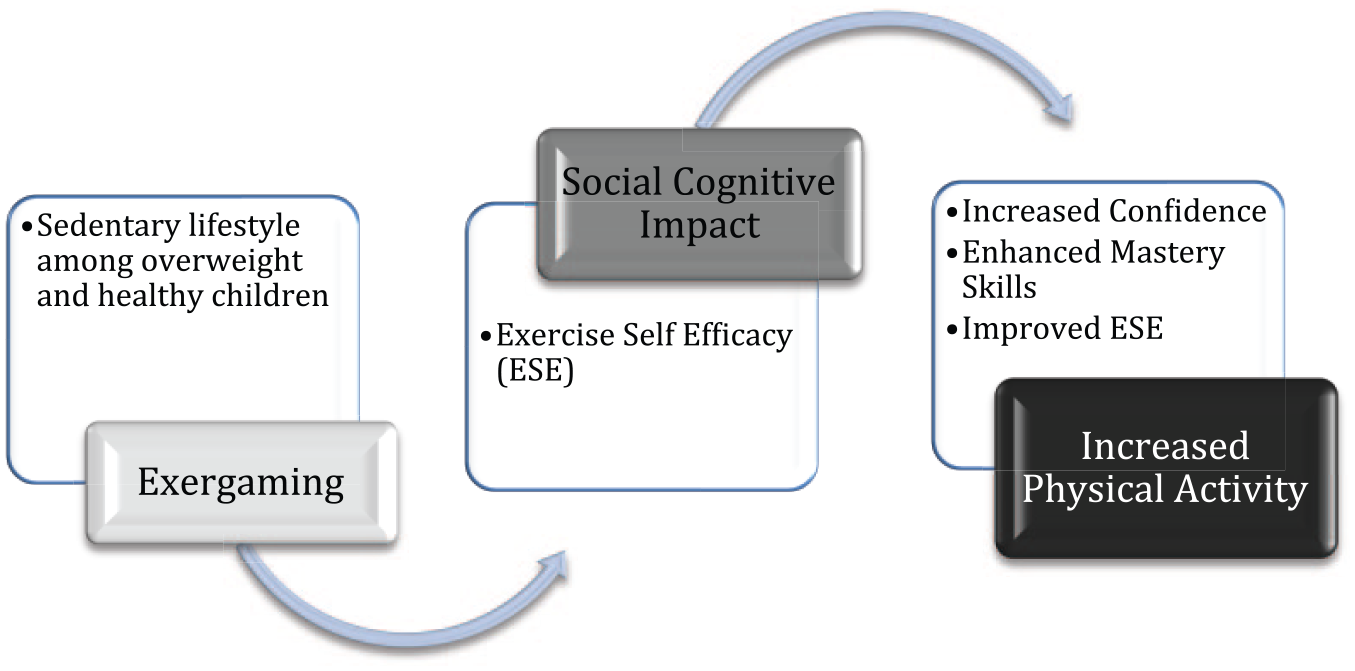
Impact on exergaming.
The 24-month follow-up survey showed promising results regarding the exergaming intervention as well. Out of the initial 55 participants, 30 responded to a telephonic follow-up. Nearly all (96.7%) reported they would participate in a similar program again. However, perhaps the most significant finding was that 23 of the 24 kids who had not previously participated in a sport or activity started to after the program. Swimming and soccer were among the most popular activities reported.
After the program, participants continued to engage in exergaming. Owning an exergaming system and playing it 24 months later were significantly related (χ2 = 8.684, P < .01). Of children that did not own an interactive game previously, 9 (47%) currently play the game (McNemar test; P < .01). This suggests that after the program, the kids found a way to get access to gaming despite financial and transportation challenges. In fact, 6 of them purchased an interactive game (McNemar test; P < .05).
Limitations
There are several potential limitations to this study. The sampling size is an important consideration because it may be difficult to apply results to a larger population. Recruitment was limited to students from local schools and referrals from local medical groups; thus, it may be difficult to generalize the results. However, as this is a new field of study, we felt that those numbers were enough to generate hypotheses and confirming other studies on the association of exergaming and self-efficacy for sports and exercise retention.
There were also several confounding factors that needed to be considered. Due to the popularity of the Wii gaming system, participants may already have had a Wii at home and had experience playing it. As a result, participation and excitement in exergaming may have been due to its novelty. Having a wide variety of games available at the Xrtainment Zone (such as Sony EyeToy, Jackie Chan Studio Fitness, etc) helped prevent problems with children being bored with games that they have already mastered.
Our survey included social cognitive questions that are subject to self-reporting bias. Because all participants are minors, there was no way to assure that parents were not present when the youth took the surveys, thus potentially influencing testing results. Mono-method bias could be ruled out as we collected self-report as well as observational physical activity data. There was also the possibility of testing threats to validity as taking the pretest may have “primed” subjects to influence the posttest response. However, since there was significant time between measurements (baseline, 7 weeks, and then 12 weeks post) this concern is minor.
Furthermore, participants may be actively involved in other fitness-related or extracurricular activities outside of this study, which could bias the results.
Due to the nature of this study that was primarily observational in nature and it was meant to be a pilot to assess feasibility, it was not possible to control for every confounding factor. Where possible, confounding factors were minimized during the implementation phase or were controlled for in the data analysis phase.
Conclusion
The findings from this study support that exergaming is effective in encouraging other types of nongaming physical activity. Understanding how children are motivated to participate in physical activity is essential to designing intervention programs. Strategies need to include physical self-worth, sports competence, and psychosocial issues.
There is little doubt that exergaming leads to increased fitness levels and thus may be one of the next gateways to fitness. Although exergaming alone will not win the battle against childhood obesity, engaging them in exergaming may increase the likelihood that they are going to be physically active. Schools should have exergaming centers where students could practice physical exercise and have fun whenever they have breaks on their school days or for use in after school activities.
The industry should also be motivated to develop more machines that could be purchased at reasonable prices, and families could use them at home, and both children and parents could use them.
Another possibility is to invent machines that are effective and low cost that can transform energy into electricity. Those devices will only function with electricity produced by a small generator connected to the pedals. So a kid could play and generate energy, which could even be applied to another purpose like charging their cell phones, Ipads, and computers.
Author Contributions
HDS: Contributed to conception and design; contributed to analysis; drafted the manuscript; critically revised the manuscript; gave final approval; agrees to be accountable for all aspects of work ensuring integrity and accuracy.
MDB: Contributed to conception and design; contributed to analysis; drafted the manuscript; critically revised the manuscript; gave final approval; agrees to be accountable for all aspects of work ensuring integrity and accuracy.
FMG: Contributed to analysis; drafted the manuscript; critically revised the manuscript; gave final approval; agrees to be accountable for all aspects of work ensuring integrity and accuracy.
SM: Contributed to conception and design; contributed to analysis; drafted the manuscript; critically revised the manuscript; gave final approval; agrees to be accountable for all aspects of work ensuring integrity and accuracy.
Footnotes
Declaration of Conflicting Interests
The author(s) declared no potential conflicts of interest with respect to the research, authorship, and/or publication of this article.
Funding
The author(s) received no financial support for the research, authorship, and/or publication of this article.