



Abstract
Breast-feeding is the best method of feeding infants. In some cases, formula milk can be a suitable alternative, so this study aimed to compare the safety and nutritional adequacy of commonly available formula milks in the Iraqi market. An observational study for the commonly available formula milks was conducted in the largest supermarkets of Baghdad, Iraq, during January-March 2015. The macronutrient and micronutrient contents as presented in the label of each type of formula milk was compared with the standard requirement of formula milk according to the European Society for Paediatric Gastroenterology, Hepatology and Nutrition (ESPGHAN) guidelines. Dielac formula milk is the commonest formula milk in the Iraqi market, with the lowest price when compared with other formula milks. All infant formula milks (Similac, Guigoz, and S-26 Gold) except Dielac have the mandatory contents within the specified ranges, according to the ESPGHAN guidelines. Dielac lacks more than 1 of the major mandatory contents besides lacking all optional contents in its formula. Guigoz formula milk lacks the optional ingredients arachidonic acid, docosahexaenoic acid, and nucleotides. Similac milk was supplemented with a higher-than-specified level of nucleotides, and its
Introduction
Breast-feeding is the best and safest way for feeding infants and results in optimum growth, health, and development of infants. 1 In rare cases, formula milk can be used as an alternative as, for example, in the case of infants with diseases such as galactosemia or lactase deficiency, when the mother has medical problems such as active infectious diseases, or if the mother is unwilling to breast-feed her child1,2 because of her busy work schedule or because of difficulties in breast-feeding. 3 Actually, in Iraq, most mothers prefer to feed their infants with formula milk rather than breast milk, and thus, feeding using formula milk is very common practice. 4 However, formula milk is not as safe as breast milk, 5 so it is important to select a suitable infant formula based on the infant’s individual needs and medical condition. 2 There are a wide variety of available formulas in the market; such diversity is confusing to both parents and physicians, 6 which renders the decision of choosing the best formula more difficult. Besides, advertisement for formula milk not only in the form of physician-targeted promotion, 7 but also in illegal forms, such as direct-to-consumer (mothers) advertisement, which is allowed in developing countries,8,9 may further complicate the scientific decision 10 of choosing the best formula milk.
This study was designed to compare the nutritional contents and determine the safety and nutritional adequacy of commonly available formula milks in the Iraqi market.
Methods
An observational study was conducted in Baghdad, Iraq, during January-March 2015. Large supermarkets in different areas in the west, east, and center of Baghdad were visited to note the available types of ordinary (non–specially designed) infant formula milk. A total of 10 different formula milks were seen: Similac, Guigoz, Dielac, Gold S26, Liptomil, Novalac, Celia, Hero baby, Primalac, and Nectalia. However, only the most commonly available (that present in at least 50% of the visited supermarkets) were included in this study. They were Similac, Guigoz, Dielac, and Gold S26 formula milks. All the included formula milk cans were carefully photographed from different views with the help of a Samsung mobile camera to ensure clear and accurate documentation of the composition of each formula’s milk according to the manufacturer’s label. The information in these pictures was converted into written data using Microsoft Office 2007 Word.
The macronutrient and micronutrient contents of each type of formula milk are expressed as the amount per 100 kcal of formula milk. Then, these content data were compared with the standard requirement for formula milk according to the European Society for Paediatric Gastroenterology, Hepatology and Nutrition (ESPGHAN) guidelines. 11
Results
Table 1 shows the manufacturer and country of origin for the commonly available formula milks in the Iraqi market. Dielac formula milk is the commonest formula milk, with the lowest price when compared with other formula milks.
Manufacturers of Different Formula Milks.

Table 2 shows the macronutrient contents of all studied formula milks. The type of protein in most infant formula milk was whey dominant protein; only Similac contained partially hydrolyzed whey protein. Fat source in all infant formula milk was vegetable oil, except in Dielac, in which fat material was a combination of milk fat and vegetable oil. As regards carbohydrates, lactose was the major carbohydrate in all types of formula milk, except Dielac, in which refined sugar was added to lactose.
Macronutrient Contents of Different Formula Milks.

Table 3 shows that all infant formula milks except Dielac have all the mandatory content within the specified range according to the ESPGHAN guidelines. Dielac lacks more than 1 of the major mandatory content besides lacking all optional contents in its formula. Guigoz formula milk lacks the optional ingredients such as arachidonic acid (AA), docosahexaenoic acid (DHA), and nucleotides. Similac milk was supplemented with a higher-than-specified level of nucleotides, and its
Comparison of Macronutrient and Micronutrient Contents Among Different Formula Milks With the Standard Requirement, According to the ESPGHAN Guidelines.
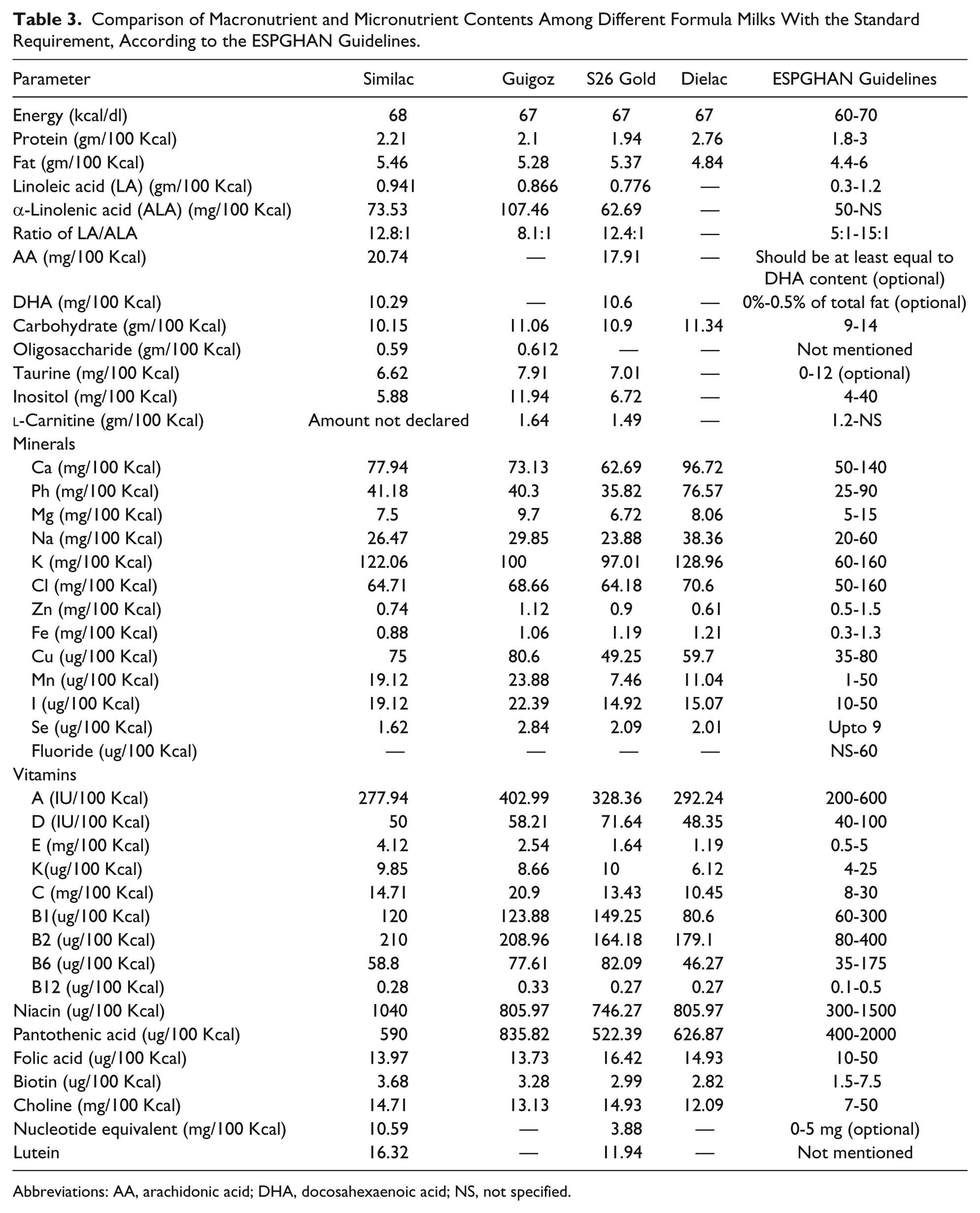
Abbreviations: AA, arachidonic acid; DHA, docosahexaenoic acid; NS, not specified.
Discussion
It is well known that breast-feeding is the best way to ensure an infant’s health, and no marketed formula milk can resemble breast milk completely 12 ; however, many guidelines have been created to set specific minimum and maximum limits for both macronutrients and micronutrients in formula milk to make it as close as possible to breast milk to ensure safety and nutritional adequacy of formula milk for infants. 13 Although studies done in developed countries found that there was no significant difference among marketed formula milks, 14 other studies in developing countries found a significant difference in composition among marketed formula milks.15,16 Furthermore, it was found in one study that some of the marketed formula milks were fortified with either a higher- or lower-than-specified level of micronutrients, according to standard guidelines. 17 So this study aimed to compare the nutritional composition of commonly available formula milks in the Iraqi market according to the ESPGHAN guidelines, which was recommended by Owens et al, 2 which stated that the nutritional composition of all infant formulas must meet the global standards as recommended by the ESPGHAN guidelines.
Regarding macronutrients, this study showed that the source of protein in all studied formula milks is cow’s milk protein, which is acceptable and allowed by the ESPGHAN guidelines. All studied formula milks were supplied with either skimmed milk or non–fat milk that have protein content similar to that of whole milk, which is usually casein-dominant protein.18,19 Additionally, all studied formula milks were enriched with whey protein to make them whey dominant, may be because whey-dominant formulas are easily digestible and closer to breast milk. In contrast, casein-dominant formulas take longer to digest. 20
This study showed that Similac formula milk was fortified with partially hydrolyzed whey protein. In this regard, some studies stated that partially hydrolyzed formulas are designed to help prevent allergies in healthy infants at risk of developing allergy20,21; however, the Food and Drug Administration raised doubts about the advantages of hydrolyzed formula milk proteins in infants with allergy or those with risk of allergy. 22 Partially hydrolyzed formula milk protein has no advantages over intact protein formula milk in healthy term infants. They simply increase the cost of formula milk, 23 and this is similar to what was found in this study: Similac formula milk is one of the most expensive formula milks in the Iraqi market.
Regarding the second macronutrient—the fat—this study showed that the source of fat in most infant formula milk was vegetable oil (palm, coconut, soya, sunflower, rapeseed oil, and oleic acid), which is similar to that found in other countries. Most infant formulas available on the market contain plant oils as the only source of fat.24,25 The ESPGHAN guidelines recommend that when bovine or vegetable oil are used trans fatty acid contents should not exceed 3% of total fat contents; however, the trans fatty acid contents were not declared by any studied formula.
Vegetable oils especially palmitate, when hydrolyzed by lipase, becomes free palmitate in the intestine. Free palmitate can form complexes with calcium, and these complexes are poorly absorbable. The formation of these complexes may reduce the amount of energy available from fatty acids and reduce calcium absorption because of bound calcium being excreted from the intestine.14,26 Because Similac formula milk lacks palmitate in its vegetable oil content, it may result in higher absorption of calcium; but this advantage may be futile because Similac formula milk is fortified with low amounts of vitamin D when compared with the other formula milks studied, except Dielac.
Regarding the last macronutrient, the carbohydrate, this study showed that lactose was the main source of carbohydrates in most of the formula milks studied. According to the ESPGHAN guidelines, lactose is the preferred carbohydrate source because it is the dominant digestible carbohydrate and has an important effect on infant gut physiology.
In other formula milks, maltose and maltodextrin were added to lactose as a carbohydrate source, both of which are mentioned as acceptable carbohydrates according to the ESPGHAN guidelines. However, it was found that there was a nonsignificant difference in safety or benefit between lactose-only formulas or formulas using a combination of lactose and maltodextrin. 27
Furthermore, this study showed that refined sugar was added to lactose as a carbohydrate source only in the case of Dielac formula milk. Sucrose is not recommended by the ESPGHAN guidelines because of the severe adverse effects of dietary fructose supply in early infancy, which may cause death in infants with fructose intolerance. 28 This means that the safety of Dielac formula milk, because of its content of refined sugars (sucrose), is questionable when fed to infants during their first 6 months of life. Thus, it is not recommended to be marketed in Iraq as infant formula.
The second part of this study focuses on the micronutrients in different formula milks, which can be divided into mandatory or essential and optional contents.
Linoleic acid (LA) and α-linolenic acid (ALA) are well-known polyunsaturated fatty acids that are considered as precursors for endogenous synthesis of AA and DHA, respectively. Also, both LA and ALA may have a small role in the growth and development of infants.29-31 Because animals lack the capacity to synthesize LA and ALA, these must be obtained from dietary sources to avoid deficiency. 32 Deficiency of LA leads to poor growth, fatty liver, skin lesions, and reproductive failure, whereas ALA deficiency may cause reduced vision as well as impaired cognition and behavior. 32 So this means that any formula milk that lacks both of them is not suitable for growth and development of the infant.
Regarding inositol, it has a lot of biological functions such as regulation of cell osmolality, 33 mediation of cell signaling, 34 formation of the neural system, 35 production of pulmonary surfactant phospholipids, 36 and host defense. 37 Some studies showed that the level of inositol in formula milk is lower than that in breast milk. 38 However, inositol can be synthesized endogenously, but it is unknown whether endogenous synthesis is sufficient in the absence of exogenous administration. The effect of not fortifying formula milk with inositol is unknown. 28
In regard to the optional ingredients, DHA, AA, taurine, and nucleotides, this study showed that only Similac and S26 Gold formula milks were fortified with optional ingredients. DHA and AA are the 2 major long-chain polyunsaturated fatty acids in human milk, and they are fundamental components of the cell membrane and play an important role in neurite growth and signal transmission. 42 However, there is some controversy about the benefits of DHA and AA on neurocognitive and retinal development.43,44
Although DHA and AA can be synthesized from LA and ALA, it was found that infant formulas lacking DHA and containing only LA and ALA (precursors of AA and DHA) may not be effective in meeting the full nutritional requirements of infants, which may be a result of insufficient endogenous production of AA and DHA from LA and ALA. 30
Regarding taurine and nucleotides, both are considered as optional ingredients by the ESPGHAN guidelines. There is some controversy about the role of nucleotides in improving body immune response and lowering the incidence of diarrhea, 14 but nucleotide supplementation increases weight gain and head growth in formula-fed infants. Therefore, nucleotides may be conditionally essential for optimal infant growth in some formula-fed populations. 45 This study showed that Similac formula milk failed to obey the ESPGHAN guidelines because it had a higher-than-accepted limit of nucleotides. Many studies focused not only on the benefits but also on the safety of nucleotides. Some studies agreed with the ESPGHAN guidelines of considering that fortification of formula milk with 5 mg/100 kcal of nucleotides was safe,45,46 whereas other studies found that supplementation of formula milk with up to 10.78 to 16 mg/100 kcal was safe47,48; so this means that Similac formula milk, which was supplemented with nucleotides, with a concentration of 10.36 mg/100 kcal, is not preferred but may be considered safe.
Regarding oligosaccharides, which were added to Similac and Guigoz only, the ESPGHAN guidelines does not mention anything about such contents, may be because of the lack of convincing evidence for their benefit; however, they are safe in concentrations up to 0.8 mg/100 kcal. 28
Luten, which is another ingredient that is not mentioned by the ESPGHAN guidelines, has no benefit in regard to infant growth, but it was found to be safe in low concentrations. 49 So formula milks such as Similac and S26 Gold can be considered as safe in regard to luten addition.
This study also showed that Dielac formula milk is the commonest form of formula milk in the Iraqi market; this may be because of its low cost, and this may be one of the strategies adopted by Nestlé to expand sales of formula milks in markets of low-income countries by building factories in poor countries such as Vietnam.
50
However, Dielac formula milk may be insufficient for infant growth because it lacks many of the essential and optional ingredients such as LA, ALA, DHA, AA, and nucleotides. Dielac formula milk may predispose infants to risk of infections because it lacks
In this study, it was found that Guigoz formula milk, although it contains all essential nutrients within the specified range of the ESPGHAN guidelines, lacks optional ingredients. Besides, its high cost, which is comparable to that of other formula milks that contain all optional ingredients, makes it a nonpreferable option. Whereas Similac formula milk has all the essential and optional nutrients according to the ESPGHAN guidelines, there are some concerns regarding its safety because of the nucleotide and
Only S26 Gold formula milk contains all the mandatory and optional ingredients within the specified range of the ESPGHAN guidelines. Thus, it may be the most suitable formula milk available in Iraqi markets that can be used for feeding infants.
This study is the first one to be done in Iraq and the Middle East, but it has some limitations. For example, the conclusions of the study depend on comparing different products according to declared amounts of nutrients by the manufacturer without directly measuring these nutrients. The second major limitation is the lack of follow-up of the growth and general health of infants who were fed such formula milks. So it is recommended that follow-up studies of the health and growth of infants who consume S26 Gold formula milk are done.
It is recommended by the author that the Iraqi ministry of health and Iraqi syndicate of pharmacists apply strict guidelines for monitoring formula milks in the Iraqi market and also withdraw Dielac formula milk from the Iraqi market to avoid any tragic consequences for Iraqi infants.
Conclusions
In conclusion, no formula milk can resemble breast milk. However, S26 Gold formula milk is the most acceptable infant formula milk in the Iraqi market, whereas Dielac formula milk is insufficient for infant growth and not safe to be used for infants <6 months of age. Thus, Dielac is the worst formula milk, and it should be withdrawn from the Iraqi market.
Footnotes
Acknowledgements
The author gratefully acknowledges the valuable advice of Professor Gorege Kent.
Declaration of Conflicting Interests
The author declared no potential conflicts of interest with respect to the research, authorship, and/or publication of this article.
Funding
The author received no financial support for the research, authorship, and/or publication of this article.