




Abstract
Keywords
Introduction
Background and Aim of This Study
Barely any topics in human existence are discussed from such diverse perspectives and disciplines as aging. Aging as an individual and facing the unavoidable biological process of decline—inherent in every living being—promotes fears, desires, and hopes (Brunton & Scott, 2015; Rupprecht et al., 2021) and encounters with social role expectations, changes in everyday habits, the restriction of participation and involvement, and leads to the difficulty of relocating oneself in society (Sano & Kyougoku, 2016). Aging thus becomes a topic that lies at the intersection of individual biological processes, social expectations, and developmental tasks in the sense of adapting to new situations. The question of what successful or satisfied aging can be is not easy to define. While talking about successful aging, the focus is no longer exclusively on maintaining physical and mental health (Ayalon & Tesch-Römer, 2018). Rather, the focus is on active participation in life, good psychological adaptability in terms of achieving acceptance, and coping with the psychological and physical changes that inevitably occur (Kasten & Kochesfahani, 2018; Kim & Park, 2016; Rowe & Kahn, 1997). In this regard, predictors that initiate a successful aging process should be identified from midlife onward (Bouling & Dieppe, 2005). These include life satisfaction, mental and psychological health, personal growth, independence, self-esteem, goals, social activities, and social networks (Bouling & Dieppe, 2005). Basal values such as purposefulness, success, and security, as well as stimulation, acceptance, and openness to change, have a significant influence on the quality of life (Caprara et al., 2007). A basic prerequisite for this process is the achievement of acceptance with regard to the existing limitations or losses. To date, there are few systematic studies that have included aspects of acceptance and value orientation in the aging process (Cosco et al., 2013; Laidlaw, 2013; Szabó et al., 2017). Nevertheless, in the clinical context, meta-analyses have demonstrated the effectiveness of acceptance- and value-oriented interventions in relation to physical and mental illness during aging (Kishita et al., 2016). By applying interventions such as acceptance and commitment therapy, greater psychological flexibility is achieved through a nonjudgmental and accepting approach to discomfort and by aligning goals with personal values.
Positive effects from the use of acceptance and commitment therapy have also been described for the management of chronic pain in older adulthood (Alonso et al., 2013; Lunde & Nordhus, 2009). Case studies related to depression and suicidality in older age have demonstrated the positive effects of acceptance and values-based practices in terms of improved flexibility, coping with stressors, and building new value complexes (Roberts & Sedley, 2016). Barnow et al. (2019) identified acceptance as a protective strategy of emotion regulation within the framework of the selective optimization and compensation model in aged individuals. Value orientation and acceptance acquire significance in this context (Butler & Ciarrochi, 2007). In the presence of unavoidable situational constraints, personal goals can be changed in the sense of an accommodative self-evaluative process so that a buffering effect on negative emotions occurs (Bailly et al., 2012).
Factors such as physical attractiveness, productivity, spirituality, meaningfulness, and relationships are important characteristics of a successful aging process (Phelan et al., 2004) and can be described as dynamic, similar to aging itself. To maintain a good quality of life, dimensions such as psychological resources and resilience, social interactions, and flexible adaptability to changing goals are recognized (Bailly et al., 2012; Fernandez-Ballesteros et al., 2011). In recent years, a trend reversal in approaching the research domain of contented aging has been noticeable, which no longer focuses on the management of disease processes in elderly people but rather on the promotion of successful aging from midlife onward (Bouling & Dieppe, 2005). Vaillant and Mukamal (2001) were able to identify psychosocial predictors of successful aging from 50 years onward by establishing relationships with mental and physical health, attachment stability, perceived control of emotional and physical health, social and socioeconomic status, and the presence of positive coping mechanisms. For example, a positive age identity can be achieved by feeling younger despite increasing age. Subjective age bias (Weiss & Lang, 2012) is considered a good indicator of psychological well-being and high self-esteem (Grah et al., 2018; Weiss & Lang 2012; Westerhof & Barrett, 2005).
Most societies are experiencing an increasing movement toward esthetic surgical procedures. In 2020, 24.5 million cosmetic surgeries were performed worldwide, with the leading nations being the USA and Brazil (Michas, 2022). In addition to the media presence of beauty ideals, this trend is due to factors such as low life satisfaction, low self-esteem, low self-assessed attractiveness, few religious beliefs, and television viewing among women (Furnham et al., 2012). Kasten and Kochesfahani (2018) discussed the intertwining of cultural values with body satisfaction and self-perception in a comparison of middle-aged Brazilian and German women.
In the context of an aging society, this study aimed to investigate the impact of values on body acceptance, which, based on previous research in this area, is also considered central to overall life satisfaction (Sánchez-Cabrero et al., 2019, 2020). In our understanding, the total desire for physical change measured by the number of desired changes in one’s own body in the questionnaire can be seen as a tendency of overall body acceptance. Therefore, we were mainly interested in different independent latent factors as potential accentuations in different values predicting the total desire for physical change, with more desire for change indicating less body acceptance. The following hypotheses were tested within a SEM framework:
(1) There is a significant positive association between the subjective age of a person and their desire for physical change.
(2) There is a significant negative association between the subjective attractiveness of a person and their desire for physical change.
(3) There is a significant negative association between the quality of one’s chosen formative relationship and their desire for physical change.
(4) There is a significant positive association between materialism and the desire for physical change.
(5) There is a significant negative association between conservatism and the desire for physical change.
(6) There is a significant negative association between religiosity and the desire for physical change.
Methods
To investigate the relationship between body acceptance and individual value attitudes, a survey using self-report questionnaires was conducted. We recruited older adults via snowball sampling. To obtain healthy older people with a variety of ages as defined by Raithel et al. (2009), we requested that university students invite their parents to participate in this study. Older subjects (75+) were approached for the study by contacting senior citizens' associations. After written informed consent was given, the questionnaires were distributed and returned to the project team in a sealed envelope so that the participants could choose the time and setting to complete them whenever they wanted. Data collection took place over a period of 3 months (April–June 2019). Analyses of the data were conducted using SPSS statistical and analysis software (IBM Corporartion, 2013) and R (Rosseel, 2012).
Ethical Considerations
This study was approved by the ethics committee of the University of Klagenfurt (2018-023). Participation in the study was voluntary. Participants were informed about the aims and procedures of the study and gave written informed consent. They were able to abandon the study at any time without giving reasons and without further consequences.
Instruments
The first part of the questionnaire aimed to collect sociodemographic variables of the examined persons, such as gender, age, educational and professional status, religiosity, marital status, and income. Additionally, participants were asked about their subjective, perceived age, which should be determined independently of their actual biological age. The Austrian Values Questionnaire (AVQ; Renner, 2003) was used to record their value attitudes. The AVQ is a culture-specific instrument based on a lexical approach to capture differently expressed value attitudes (Renner, 2003). The author describes the instrument as a valid and reliable way to determine attitudes in five different main categories (intellectuality, harmony, religiosity, materialism, and conservatism) of values that would show satisfactory correlations with other established value scales (Renner, 2003). The questionnaire has a total of 54 items and each represents a value that is then assigned to one of the five main categories and 13 subcategories (cosmopolitanism, culture, community, family, love of life, faith, grace, property, success, hedonism, nationalism, defense, and duty) of values. The response format is a 5-point Likert scale ranging from strongly disagree to strongly agree; thus higher scores indicate a stronger agreement (Renner, 2003). The last part of the questionnaire contains questions on the subjective assessment of current attractiveness compared to the past and on partnership quality for those participants who are currently living in a partnership. Using six items, the German version of the Quality of Marriage Index (QMI-D) was used to assess partnership quality on a multilevel Likert scale (Zimmermann, 2015). To define our outcome variable “desire for physical change,” subjects were presented with schematic male and female bodies and ticked a list of 22 different body parts, from hair to calves, of what they would like to change about their own bodies. Every body part included a closed response format represented by a casket to possibly check (count as 1, an empty casket counts as 0). The values on this variable can range from 0 to 22.
Results
Description of the Dataset
Data from 187 participants were analyzed in this study (N = 187, n = 113 women, n = 70 men, and n = 4 people who did not provide information about their gender), with an average age of 60 years (SD = 9), with the youngest participants being 49 years old and the oldest 85 years old. The age group distribution (Raithel et al., 2009) is shown in Table 1.
Absolute and Relative Frequencies of the Four Age Groups in the Investigated Dataset.

All participants were German-speaking. Additional sociodemographic data are shown in Table 2.
Sociodemographic Data of the Dataset.

Note. N = total number of complete answers.
The monthly household income, including all income from self-employed and nonself-employed work, alimony, allowances, and similar benefits, available to individuals after the deduction of taxes and social security contributions, averaged €2,891 (SD = 1,622.43; n = 180). First, the net equivalent income according to the OECD scale was calculated from the monthly household income and the household size (M = €1,861.39; SD = 1,117.06; n = 180). This income is below the average Austrian earnings of approximately €2,286 per month (Statistik Austria, 2022b). Following Lampert et al.’s (2014) scoring, a variable of education, occupational group, and net equivalent income was calculated to capture the socioeconomic status (SES). After categorizing this variable, 34.8% (n = 61) of subjects were classified as having a low socioeconomic status, 50.3% (n = 94) as having a medium socioeconomic status, and 15.0% (n = 28) as having a high socioeconomic status.
Subjective Age
The mean subjective age was 51 years (SD = 10). Overall, n = 148 persons felt younger than they truly were (88.2% of the sample), n = 17 felt the same age as they were (9.6%), and only n = 4 persons felt older (2.3%). Of n = 9 people, the difference could not be calculated due to missing values. On average, the 169 people in the dataset felt 9 years younger than they actually were (SD = 7). Men and women did not differ significantly from each other in the difference between subjective and chronological age (t(176) = 0.845, p = .399). Thus, there was no systematic relationship between gender and the difference between the subjects’ real and subjective ages.
Attractiveness
Regardless of age, 32 people in the sample felt as attractive as before (29.9%). The tendency to feel more attractive than before was found in a total of 38 people (35.6%). In contrast, 37 people (34.6%) reported tending to feel less attractive than before. A total of n = 80 persons omitted this question.
The Desire for Physical Change
The participants were asked what they would like to change about their body. The values for this variable can range from 0 to 22. In our sample, values for a desire for change ranged from 0 to 9, with M = 1.199 and SD = 1.462. Only one person did not answer the body change questions.
Value Orientation
Table 3 shows the descriptive data of the five main categories of the AVQ. Harmony and intellectuality were most noticeable within the sample. Religiosity had the widest range of values and the highest variance.
Main Categories of the Austrian Value Questionnaire.
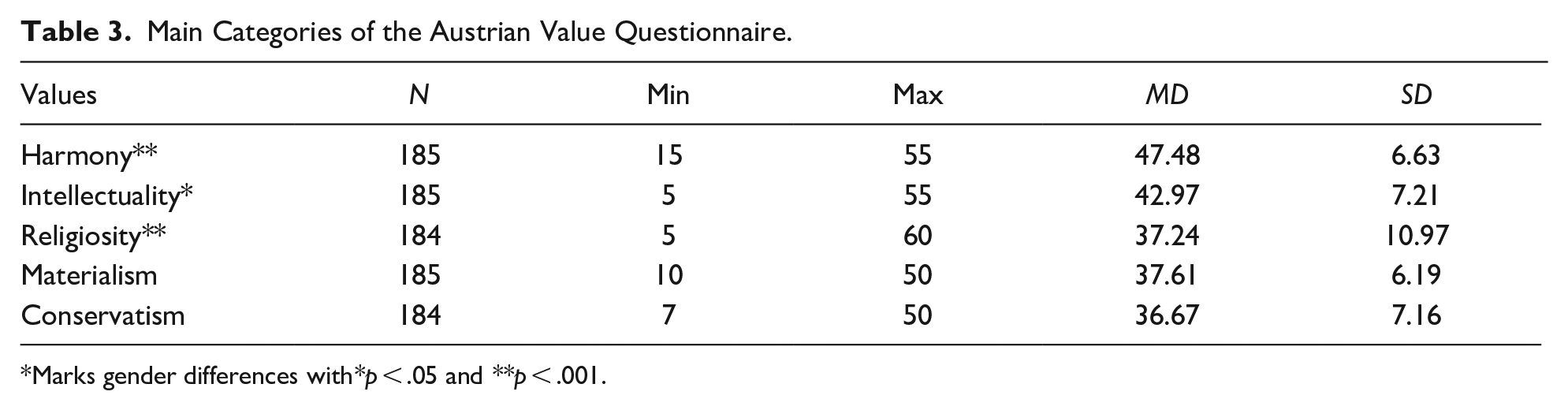
Marks gender differences with*p < .05 and **p < .001.
With regard to the classification of age groups, single-factor variance analyses showed no differences in the upper categories of the AVQ. Only conservatism showed significant differences between subjects aged from 40 to 54 (M = 3.64) and those from 65 to 75 years old (M = 4.02; F(3, 168) = 2.673, p < .05). Looking at the subscales, the highest mean values are found for cosmopolitanism, faith, and nationalism. Defense, duty, and grace, on the other hand, have the lowest mean values. The subcategory faith shows the greatest variance. The exact mean values and standard deviations can be found in Table 4.
Subscales of the Austrian Value Questionnaire.

Marks gender differences with*p < .05 and **p < .001.
Significant gender differences were found in the main category of religiosity. Women had a significantly higher mean value (Mwomen = 39.88, SDwomen = 9.949; Mmen = 33.67, SDmen = 10.627; t(178) = −3.97, p < .001. In accordance with that result, men and women differed significantly in the subsequent subscales. Women had higher values in faith (Mwomen = 29.88, SDwomen = 7.652; Mmen = 25.29, SDmen = 8.423; t(178) = −3.77, p < .001) and grace (Mwomen = 10.09, SDwomen = 2.410; Mmen = 8.38, SDmen = 2.498; t(177) = −4.57, p < .001). These results were further supported by differences in religious affiliation (χ2 (1) = 7.596, p < .01, ϕ = .207).
Furthermore, male and female participants differed significantly in the domain of harmony. Women yield higher values than men (Mwomen = 48.60, SDwomen = 5.833; Mmen = 46.52, SDmen = 5.965; t(179) = −2.306, p = .022). A closer look at the subscales shows that only the subscale love had no significant gender difference. Women had higher values on community (Mwomen = 12.78, SDwomen = 1.609; Mmen = 12.22, SDmen = 1.455; t(176) = −2.330, p < .05) and family (Mwomen = 18.31, SDwomen = 1.796; Mmen = 17.23, SDmen = 3.059; t(179) = −2.996, p < .01).
Partnership Quality
Partnership quality did not differ between men and women (t(153) = 1.757, p > .05) or among the age groups (F(3, 150) = 1.779, p > .05). Figure 1 shows the course of partnership quality based on the age groups.

Partnership quality.
Partnership quality correlated with the subscales and main categories of the AVQ. Specifically, it had correlations with nationalism (r = .174, p < .05), defense (r = .231, p < .01), and duty (r = .161, p < .05). Moreover, the main category conservatism correlated with partnership quality (r = .218, p < .01).
Structural Equation Model Predicting Desire for Physical Change
This section contains the results that are mainly based on our structural equation model with different hypotheses and assumed associations between the items and the latent factors as well as between the different latent factors and our dependent latent factor desire for physical change (see Figure 2).

Structural equation model predicting desire for physical change.
In addition to the examination of the hypotheses, the statistical analysis also comprised further explorative statistics, such as the relations between other latent factors and the dependent variable desire for physical change. Here, we tested every path as a part of our overall SEM framework. First, the specific items of the used value questionnaire were significantly associated with the five subscales of the questionnaire (harmony, intellectuality, religiosity, materialism, conservatism), ranging from β = .194 to.939, with every single coefficient corresponding to p < .05. The latent factor quality of the relationship consists of six different items that also significantly represent the factor with values ranging from β = .827 to .969, with p < .01. The focus of the analysis is our main model, shown in the figure above, which was significant χ2(1,912) = 4,650.582, p < .01. Subsequent relevant fit indices had the following values: CFI = 0.675, GFI = 0.968, RMSEA[0.084;0.091] = 0.088, RMR = 0.147.
Contrary to our first hypothesis, there was no significant association between the subjective age of a person and their desire for physical changes (β = .021, p = .779). Nevertheless, the coefficient showed a tendency toward more demand for change with increasing subjective age. Additionally, the link between the subjective attractiveness of a person and their desire for physical changes was not significant (β = −.133, p = .172), although it indicated that the desire for physical changes became more intensive with a reduction in self-perception of individual attractiveness. The quality of the partnership relationship seemed to be conversely connected to one’s physical change desires, even though it was not significant (β = −.123, p = .138). However, the results of the first three hypotheses clearly indicate the assumed tendency toward less body acceptance with less subjective attractiveness, less experienced relationship quality, and with greater subjective age. On the basis of these results, we can maintain our fourth hypothesis with a significant positive association between materialism and the desire for physical changes with β = .230, p = .016. Different from materialism and consistent with our hypothesis, there was a significant negative association between conservatism and the number of desired physical changes (β = −.221, p = .044), indicating that a higher orientation in values connected with conservative beliefs, behaviors, and attitudes was linked to fewer change desires in our sample. Further latent factors indicating different potential value accentuations in a person showed the following associations with the desire for physical change: intellectuality (β = −.136, p = .184), harmony (β = .091, p = .440), and religiosity (β = .220, p = .011). These factors provide the first indications of the potential sophisticated relationships and contexts that could be investigated further in future studies (Table 5).
Covariation Matrix of All Analyzed Variables.

p < .05. **p < .01. ***p < .001.
Discussion
Aging as an unavoidable biological process challenges many different facets of life, and the scientific focus has recently shifted toward its successful management. Therefore, this study aimed to investigate the relationships among individual values, conceptually related constructs, and body acceptance. The 187 participants involved in the current study were predominantly female, between 49 and 85 years old, and had an average income below the Austrian mean income (Statistik Austria, 2022b).
The first hypothesis, which postulated a significant positive association between the subjective age of a person and their desire for physical change, could not be maintained. Nevertheless, subjective age bias was observed in our study, as almost 90% of all participants felt younger than they actually were. Since this phenomenon has been widely studied and explained as a factor contributing to higher psychological well-being and self-confidence (Blöchl et al., 2021; Grah et al., 2018; Teuscher, 2009), it should be examined whether subjective age bias can represent an actual resource. Alternatively, the perception of “being younger” could constitute a positive value by distinguishing oneself from possibly more frail peers in the sense of social identity. This question could be addressed in future research.
Regarding the second and third hypotheses, the results support the assumed tendency toward lower body acceptance with less subjective attractiveness and lower experienced relationship quality, although the associations were below the threshold for significance. Moreover, partnership quality was linked with the values of nationalism, defense, duty, and conservatism. Although the direction of the effect is unclear, it might be that people with a desire to uphold traditional values also have a need to maintain commitments, which seems to result in higher partnership quality at an older age. A similar effect was also found in previous research (Givertz et al., 2009; Kalmijn et al., 2004). Of course, it is also possible that these people are more likely to stick to a partnership because a breakup is associated with a perceived loss of social prestige. In 2020, the proportion of divorced marriages lasting 25 years or more was only 13.5% in Austria (Statistik Austria, 2022a). From this point of view, it is clear that divorces are filed less frequently at older ages and that individuals hold on to relationships if they have been in them for a long time. Interestingly, no significant differences between women and men or between the different age groups concerning relationship quality could be observed.
In addition to those conceptual variables, value orientation was another focus of the current study. In accordance with our hypotheses, we observed a significant positive association between materialism and the desire for physical change and a significant negative association with value conservatism. Thus, a lower desire for physical change might arise due to a greater extent of value commitment and conservative attitudes and behaviors. In contrast to the two previous postulates, hypothesis six, that is, religiosity corresponds negatively with a desire for physical change, confronts us with a challenge. Indeed, the results showed a significant association with the desire for physical change, but in an inverse manner, as expected. In our preliminary considerations, we assumed that through faith in a higher authority, the process of physical degradation, as well as the endurance of earthly finitude, are made bearable. Strong evidence has been found in the literature of the relationship between religiosity and well-being in terms of contented aging and the endurance of body-related states of suffering (e.g., Chen et al., 2015; Cohen & Koenig, 2003). In contrast to those findings, faith does not seem to be regarded as a resource in our sample. It may be conceivable that, in the context of these results, a higher degree of conformity is inherent in the attachment to faith convictions.
Assuming that cosmetic surgery is an indicator of a desire for physical change, there may be evidence from past research supporting an association between conformity and lower body acceptance. For instance, conformity and a positive body image have been identified as crucial predictors of cosmetic surgery instead of the level of self-esteem (Farshidfar et al., 2013). As mentioned above, materialism also corresponds positively with the desire for physical change, and therefore, might further increase the likelihood of undergoing a cosmetic surgery intervention. Krause (2018) additionally emphasized that acts of beauty should be seen in the context of social values and conformism. From a sociopsychological perspective, higher conformity could also lead to an increased desire for change with regard to a supposedly imperfect body. Accordingly, it would be interesting to investigate the aspect of conformity as a moderator variable on the association between religiosity and the desire for physical change in future studies.
In addition to materialism, conservatism and religiosity, other values—which were not covered in our previous hypotheses—showed interesting results. Cosmopolitanism, faith, and nationalism emerged as salient, highly expressed values in the study. How does this fit in with the previous considerations? Cosmopolitanism is part of the intellectuality scale and comprises an open and tolerant attitude toward new knowledge and insights. Hence, this subitem resembles the trait “openness to experience” of the Big Five personality dimensions. This has been found to accompany subjective well-being in many studies (e.g., Dong & Ni, 2020) and thus is a recognized protective factor against psychological stress.
The current results suggest that certain values predict body acceptance, which has different implications. On the one hand, ACT theory focuses on the individuality of values and the discovery and pursuit of them, rather than normative values. On the other hand, individual values seem to play a greater role in the acceptance of physical change processes in our sample. It is important that these values are congruent with the individual's beliefs. Therefore, it is of great relevance to encourage individuals early on to be in touch with the values that are important to them to promote psychological flexibility.
Implications for Practice
Our paper adds several findings to the literature. First, we found that the acceptance of the aging body plays a pivotal role in psychological well-being in older people. In our study, this could be found at the age of 50. Furthermore, psychological well-being can be enhanced by living according to one’s own values. As those values are individually distinct, it seems to be important to be able to know one’s own values and live accordingly. Hence, it is of great relevance to start early prevention programs to enhance and maintain psychological well-being over the lifespan and to prevent the individual from developing mental health issues in the future. In doing so, health psychology interventions not limited to clinical populations need to be developed. It would also be conceivable to build lifelong, values-based attitudes, which should be addressed in youth, for example, in values education.
Limitations
The subjective age bias—as already mentioned—might set a limitation on our findings. In our study, almost 90% of the participants felt younger than they actually were. This is a higher proportion than in a study by Teuscher (2009), where 67.7% of the study population felt younger than their chronological age. This tendency has been the subject of many studies (Armenta et al., 2018; Blöchl et al., 2021; Pinquart & Wahl, 2021). As the share of people with a younger perceived age in our study is extremely high, it could limit the findings to a group of older people who feel younger than their chronological age. The selection process might play a role in our study. It took some time to fill out the questionnaire and, due to the self-assessment format, considerable cognitive skills to understand and adequately complete the questions. Hence, it is possible that participants who could not muster the strength to do so or who did not understand the questions did not participate. Furthermore, according to Raithel et al. (2009), the age groups were not selected in a balanced way. It was clearly more difficult to find participants over the age of 65. This can also be due to several reasons, such as interest and existing restrictions. The gender distribution of our participants was not equal (117 women, 70 men). This bias might limit our study. Nevertheless, our hypotheses were not gender-related, and the calculations about gender differences were only for descriptive reasons—we presume the generalizability of our findings. Additionally, in cross-sectional studies, it must always be kept in mind that differences across age groups may be due to cohort effects.
Further Directions
As already described, it is now important to use the present results to design possible interventions that start at an earlier age. Thus, it should no longer be a matter of treating given limitations and psychological challenges but of ensuring that an accepting and values-oriented life is possible despite the previously mentioned limitations. The extent to which such measures can already be used in early adulthood should also be investigated. The cross-sectional design of our study provides little insight into the direction of the effect of individual outcomes. Thus, it is necessary to conduct longitudinal studies that follow age cohorts over many years to investigate individual pathways in more detail. Previous longitudinal studies on contented aging have not included the topics of acceptance and values thus far (e.g., Byles et al., 2019; Kok et al., 2016). Our study could be a first step in understanding the influence of values on contented aging. In addition, qualitative approaches are needed to learn more about what successful aging, perceived age, or body acceptance mean for the individual and how they can be promoted on the basis of acceptance-based and value-oriented considerations.
Conclusion
Changing demands in modern society have led to a shift in psychotherapy, which increasingly focuses on the identification of predictors of successful aging processes. As this study has shown, individual values as well as subjective attractiveness and relationship quality are related to body acceptance, which in turn may buffer age-related difficulties. Thus, it seems reasonable to highlight the importance of one’s own value congruence in life and the necessity for values-directed interventions. Especially in the geriatric setting, those interventions should be considered from midlife onward to support psychological flexibility and a values-oriented life despite age-related limitations.
Footnotes
Declaration of Conflicting Interests
The author(s) declared no potential conflicts of interest with respect to the research, authorship, and/or publication of this article.
Funding
The author(s) received no financial support for the research, authorship, and/or publication of this article.
Research Ethics
The study was approved by the ethics committee of the University of Klagenfurt (2018-023).
