




Abstract
Aging has been a major issue for experts, policymakers, and even the general public in recent years. There is a growing body of evidence highlighting the role of personality traits in the health of older adults, but this evidence is still in its infancy. This study aimed to investigate the role of the big five personality traits in predicting the mental health among older adults. In this cross-sectional study, 150 community-residing older adults were selected and completed the Ten Item Personality Inventory, Multidimensional Scale of Perceived Social Support, Adult Hope Scale, and Short-Form Health Survey. According to the results, extraversion and openness to experience can explain 11% of the variances of hope, extraversion and conscientiousness account for 16% of the variances in perceived social support, and all the big five personality traits together predict 34% of the variances in the health-related quality of life. Given the role of personality traits in predicting the mental health of older adults, counselors and psychologists working with these people can pay attention to the personality traits of older adults in designing their psychological, educational, and research programs to achieve more desirable outcomes.
Keywords
Introduction
Aging is a continuous process and leads to a gradual decrease in physiological functions, which in turn reduces the functional capacity of the person (Foroughan et al., 2021). Aging has been a major issue for experts, policymakers, and even the general public in recent years. By 2050, 21% of the world’s population is projected to be over 60 years old (World Health Organization [WHO], 2015). In Iran, population aging is one of the most important health issues and statistical indicators show that the population of older adults is increasing. According to the latest population and housing census in 2016, the population of people over 60 years is 9.3%, accounting for 7 million people in the country (Saeidimehr et al., 2016). With the rapid growth of the population of older adults, it is more critical to pay attention to their problems and issues. To better understand the health issues during old age, it is necessary to address the role of various psychological and behavioral variables and concepts in the formation of the mental well-being of older adults (Zarit & Zarit, 2011). The relationship between personality traits and mental health in older adults is becoming a popular field of study for researchers (Bedaso & Han, 2021).
A personality trait is a relatively stable, consistent, and enduring internal characteristic. The study of consequences and effects of personality traits on the physical and mental health of people has a long history in behavioral sciences and biomedicine (Smith & Spiro, 2002). The construct of personality can be explained based on various models, one of the most valid of which is the big five personality traits model, in which each person's personality is assumed to consist of five underlying and pervasive factors, including Extroversion (E), Agreeableness (A), Conscientiousness (C), Emotional Stability (ES), and Openness to experience (O) (Costa & McCrae, 1988). Recent views on gerontology have explored the potential of different personality dimensions that can affect a person's psychological state (Curtis et al., 2015). For example, studies have reported that high scores of the agreeableness dimension are significantly associated with higher levels of mental well-being in older adults (Day et al., 2010). In general, a significant number of studies have examined personality traits in older adults and highlighted the relationship between personality traits and sexual functions and behaviors (Allen & Desille, 2017), depression (Koorevaar et al., 2013), physical activity (Artese et al., 2017), suicidal ideation and reasons for living (Segal et al., 2012), psychological well-being and social participation (Herero & Extremera, 2010) in older adults. Personality traits, as an underlying factor, are an important predictor of mental health in older adults, and as a result, old age can be a good period for studying personality traits (Rossi et al., 2014).
One of the important sources of adaptation and coping with stressful conditions in old age is the amount of support and attention that older adults receive from family members and relatives. Perceived social support is defined as perceived access to support when needed (Saleh Manijeh et al., 2021). Given the changes in social networks associated with developmental changes (such as retirement, risks of death and illness, etc.), perceived social support may be particularly important for older adults (Hirsch & Cukrowicz, 2014). In particular, studies have suggested that variables related to social support (i.e. perceived social support, relationship satisfaction, level of social activity, and willingness to seek social support) are positively associated with extraversion and conscientiousness (Swickert et al., 2002). In another study (Swickert et al., 2010) found that extraversion, emotional stability, and openness to experience predict overall social support.
Hope is one of the important psychological variables and has been shown to play a vital role in increasing the well-being and positive performance of older adults (Halama, 2010). Hope is related to life goals and expectations of achieving positive outcomes as a result of one’s efforts. The basic level of hope remains relatively stable over time, which makes it comparable to a personality trait (Vrbova et al., 2017). Aging is associated with some psychological and physical changes that go beyond the question of time and life; Issues such as children leaving home, the death of a spouse, disability, especially retirement, and limited social relationships are some of these changes that can reduce life expectancy in older adults (Sadri Damirchi et al., 2017). Based on our knowledge, no study has directly addressed the relationship between personality traits and hope in older adults. However, studies have implied that hope is positively related to five personality factors. For example, researchers have found that hope has a negative relationship with neuroticism but a positive relationship with extraversion, conscientiousness, and agreeableness (Day et al., 2010; Halama & Dedova, 2007).
In recent years, health-related quality of life has received worldwide attention (Ping et al., 2020). By definition, this concept refers to the perceived effects of mental and physical health on each individual's ability to lead a productive life (Bowling, 1995). Thus, health-related quality of life is a multidimensional concept and an important outcome measure in old age (Helvik et al., 2016) and may be considered as a subjective assessment of various areas of functioning or life in general. Since personality refers to a person's relatively stable willingness to interpret and (re)act in a particular way in different situations, it is reasonable to assume that personality may play a role in determining the health-related quality of life (Van Straten et al., 2007). One study (Van Straten et al., 2007) found that higher levels of introversion and neuroticism reduced the quality of life in postmenopausal women. Another study on people with significant brain damage (Kim et al., 2013) also showed that some personality traits such as neuroticism have a negative relationship with the reduced overall quality of life, while extroversion, agreement, and conscientiousness have a positive relationship with quality of life.
As one of the Asian countries, Iran has a collectivist culture. Thus, the Iranian culture is very similar to the culture of eastern societies. In this culture, feelings of togetherness and family support are more valuable than in Western countries. Accordingly, concepts such as optimal physical and mental functions can have important implications for older adults in Asian cultures because the cultural expectations in these societies place a high value on family cohesion, the fate of children, respect for older adults, and maintaining their independence in personal life (Rostami et al., 2022). Cultural norms in Asian societies emphasize that older adults should be respected, cared for, and supported by family members. Negative emotions such as isolation, abandonment, and anger, which are positively associated with the feeling of loneliness, can reduce the hope in older adults for a meaningful life (Luo & Waite, 2014). Besides, in these societies, diseases are connoted with social and cultural perceptions of aging and relationships with family and friends. Suffering from debilitating diseases followed by a decrease in health-related quality of life in Asian older adults can severely reduce their psychological health because they value independence and consider illness as an additional burden on others and family members, especially in situations with low family cohesion and weak social support (Rostami, 2018). Furthermore, Iran is a Muslim country where prevalent religious teachings attach a great weight to hope for the future (Kashanimovahhed et al., 2020). Osafo et al. (2013) suggested that religion is a source of hope that can increase older people’s ability to tolerate problems and give an acceptable and tolerable meaning to their sufferings and hardships. Accordingly, the present study focuses on the role of variables that have a significant cultural value. Although studies have highlighted the significance of variables of hope, perceived social support, and health-related quality of life, conducting such cultural studies can contribute to developing knowledge and comparability of findings in this field.
Given the worrying growth of the older adult population in Iran, it is essential to pay more attention to the mental health of this group. There is a growing body of evidence highlighting the role of personality traits in the health of older adults, but this evidence is still in its infancy, especially in Iran. To our knowledge, except for a few studies that have focused on negative variables such as stress and hypertension (Kakavand & Damercheli, 2017), and interpersonal problems (Najarian & Abdi, 2020) in older adults, no study to date has addressed the role of big five personality traits in predicting positive variables such as perceived social support, hope, and health-related quality of life. To this end, this study aimed to investigate the role of personality traits in predicting perceived social support, hope, and health-related quality of life in older adults.
The two following hypotheses were developed and tested in this study:
There is a positive and significant relationship between perceived social support and health-based hope and quality of life in older adults.
Each of the big five personality factors can predict perceived social support, hope, and health-related quality of life in older adults.
Participants and Procedure
The present study was conducted using a descriptive-correlational design. The research population included all community-residing older adults living in Urmia, Iran, in October 2021. Based on the multi-stage sampling method, the sample of 150 older adults were selected as follows: First, the city of Urmia was divided into five parts (north, south, east, west and center) and then two regions (municipality) were randomly determined from each of the five parts of Urmia. Next, between two to four neighborhoods were selected from each municipal regions and the samples were selected by referring to the municipal social houses, the daycare centers and parks. Finally, by removing incomplete questionnaires, the data of 150 samples were collected and analyzed. The inclusion criteria were being at the age of 60 and older, having no cognitive problems according to the Abbreviated Mental Test Score (AMTS; Foroughan et al., 2017), having no severe and disabling physical illnesses. Furthermore, the exclusion criteria were the unwillingness to participate in the study and incomplete questionnaires.
Among the 150 older adults, 60.7% of the respondents were men; 84% were married and 52% were illiterate. In addition, Analysis of the respondents’ occupations showed 52.5% were self-employed. The respondents’ mean age was 66.91 ± 8.83 years (see Table 1).
Demographic Description of the Sample.

Note. N = 150.
Measures
Multidimensional Scale of Perceived Social Support (MSPSS): This 12-item scale measures the level of perceived social support of older adults from three sources (family, friends, and significant other) based on a 7-point Likert-type scale (strongly disagree to strongly agree). Higher scores indicate higher levels of perceived social support .The validity and reliability of the original version the MSPSS have been reported as acceptable (Zimet et al., 1988). In Iran, the validity of the MSPSS was confirmed by factor analysis (Salimi et al., 2009). Besides, the reliability of the scale for the three dimensions of social support perceived from family, friends, and significant others in life was reported to be 0.86, 0.86, and 0.82, respectively. In this study, the reliability of the MSPSS by Cronbach’s α method was reported to be 0.88.
Adult Hope Scale (AHS): AHS has 12 items, 8 of which are used and the other 4 items are lie detectors that are not scored. Of these 8 items, 4 items measure agency thinking (agent component: items 2, 9, 10, and 12) and 4 items measure pathways thinking (pathway component: items 1, 4, 6, and 8). The items are scored on a 5-point Likert-type scale from 0 to 4, with items 3, 7, and 11 are scored in reverse. Higher scores indicate more life expectancy in the respondent and vice versa (Snyder et al., 1991). Extensive studies have addressed the convergent and divergent validity of the AHS, and a meta-analysis reported the internal consistency of the scale as 0.82 (Hellman et al., 2013). In Iran, the total Cronbach’s α of the AHS was reported to be 0.91 (Oraki et al., 2019). In this study, the reliability of the AHS by Cronbach’s α method was estimated to be 0.72.
Short Form Health Survey (SF-12): SF-12, which is widely used in various studies, has eight dimensions that are divided into two subscales of physical and mental health. The items are responded to by either yes or no and also on a multi-point Likert-type scale. Items 1, 8, 10, and 11 are scored in reverse. A high score indicates a better quality of life. The validity and reliability of the SF-12 in previous studies have been confirmed for both the English (Ware et al., 1996) and Iranian (Montazeri et al., 2005) versions. In this study, the reliability of SF-12 was estimated as 0.85 by Cronbach’s α method.
Ten-Item Personality Inventory (TIPI): TIPI is a 10-item scale to assess older adults’ personality in big five personality traits. Each of the 10 items measures 2 traits, and each factor is scored by 2 items based on an 8-point Likert-type scale (1: strongly disagree to 7: strongly agree), with the total score ranging from 10 to 70 (Gosling et al., 2003). To date, several studies have assessed the psychometric properties of this instrument in different countries. Internal consistency coefficients for all subscales in the original version were more than 0.55. The obtained Cronbach's alpha coefficients varied from 0.40 to 0.73 (Gosling et al., 2003). In Iran, the Persian version of the ten-item instrument showed acceptable psychometric properties to measure the big five personality traits in older adults in terms of test–retest reliability (r = 0.76; p < 0.01) and convergent validity (r = 0.426; p < 0.01) (Azkhosh et al., 2019). In this study, the reliability of the tool using the Cronbach’s α method for the overall personality score was 0.75.
Procedure
As this study was conducted during the COVID-19 pandemic and social distancing restrictions, the researchers referred to the daycare centers of older adults, the municipal social houses and parks and presented medical evidence indicating that the researchers were not infected with COVID-19. They explained the goals of the study and its procedure to managers and officials of these centers and obtained permission to conduct the study by observing social distancing requirements and avoiding face-to-face conversations. Then, they distributed the questionnaires to older adults individually. Researchers completed questionnaires for all respondents in the form of interviews to ensure that they fully understood the questions and clarified any possible ambiguities and issues. It is noteworthy that before the distribution of the main questionnaires, the abbreviated mental test (AMT) was administered to the respondents and only those with a score of higher than 6 remained in the study. The researchers tried to have the questionnaires completed by the respondents in a suitable and calm place along with friendly communication. They also tried to resolve any ambiguity for the respondents by explaining the objectives of the study and clarifying complex questions. Before the distribution of the questionnaires, informed consent was obtained from the respondents and they were told that their information would be kept confidential. The collected data were analyzed using SPSS-25 and G*Power software.
Results
Before performing the statistical analysis, the data were screened and univariate outliers were identified by the box plot, but no respondent was excluded. Multivariate outliers were also identified by Mahalanobis statistic and the data of 1 respondent whose Mahalanobis distance was greater than the χ2 value (χ2 = 12.51) based on degrees of freedom (there were 5 predictor variables in this study) and the confidence level was 0.01 were removed as multivariate outliers. Thus, the statistical analysis continued with data from 149 respondents. The alpha value (α) was greater than 0.004 for all respondents. The descriptive statistics and correlation coefficients for the research variables are presented in Table 2:
The Descriptive Statistics and Correlation Coefficients for the Research Variables.

Note. M = mean; SD = standard deviance; MSPSS = multidimensional scale of perceived social support; SF-12 = health survey-short form; AHS = adult hope scale; TIPI-TOT = 10-item personality inventory; TIPI-E = extroversion; TIPI-A = agreeableness; TIPI-C = conscientiousness; TIPI-ES = emotional stability; TIPI-O = openness to experience.
p < .05. **p < .01.
As shown in Table 2, MSPSS has positive and significant correlations with SF-12 (r = 0.376), AHS (r = 0.348), TIPI-E (r = 0.318), TIPI-C (r = 0.275), TIPI-ES (r = 0.117), TIPI-O (r = 0.193), and TIPI-TOT (r = 0.354). Furthermore, SF-12 has positive and significant correlations with AHS (r = -0.424), TIPI-A (r = 0.207), TIPI-E (r = 0.215), TIPI-C (r = 0.469), TIPI-ES (r = 0.355), TIPI-O (r = 0.293), and TIPI-TOT (r = 0.592). Moreover, AHS has positive and significant correlations with TIPI-E (r = 0.166), TIPI-TOT (r = 0.384), and TIPI-TOT (r = 0.339). However, no significant relationship was found between MSPSS and TIPI-A (r = -0.072). Similarly, AHS did not show any significant correlations with TIPI-C (r = 0.085), TIPI-ES (r = 0.153), and TIPI-A (r = 0.034).
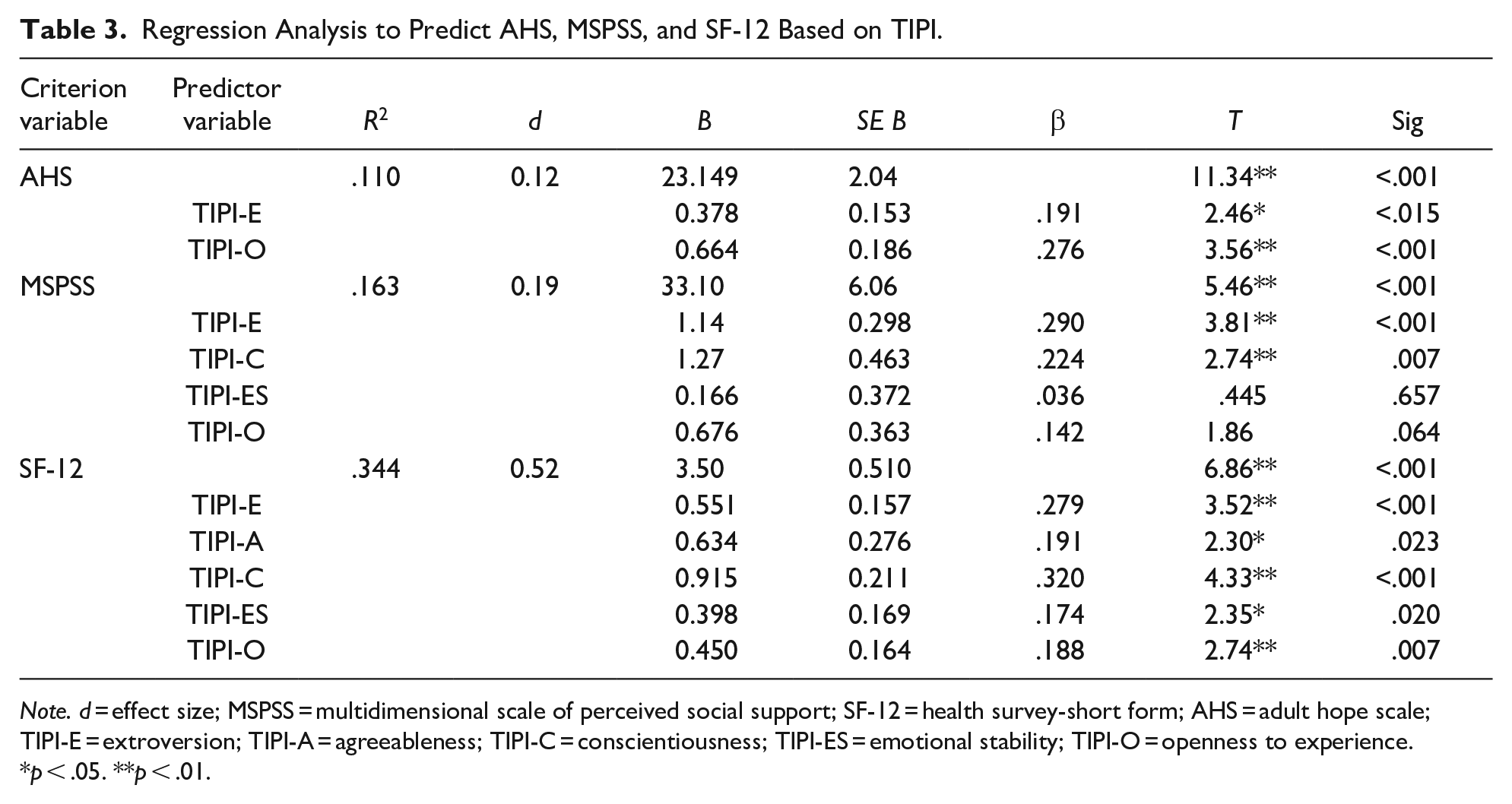
Analysis of the normal distribution of the variables, taking into account the skewness and kurtosis in the range (−1 to +1) showed that the skewness and kurtosis were within the acceptable levels for all variables in question. To check the non-collinearity of the predictor variables in the model, if the tolerance index is smaller than 1 and greater than 0.40 and the variance inflation index (VIF) is less than 10, the multiple nonlinearity assumption is established (Tabachnick & Fidell, 2013). The results showed that tolerance coefficients varied from 0.64 to 0.94 and the variance inflation index from 1.06 to 1.57. Thus, the multiple nonlinearity assumption was established. The Durbin–Watson statistic was used to investigate the assumption of error independence. The values close to 2 for this statistic indicate the independence of the errors. The Durbin–Watson statistic in the present study was equal to 1.71. After establishing the assumptions, the conceptual model of the study was tested. Table 3 summarizes the results of regression analysis to predict. MSPSS, SF-12, and AHS based on personality traits.
Regression Analysis to Predict AHS, MSPSS, and SF-12 Based on TIPI.
Note. d = effect size; MSPSS = multidimensional scale of perceived social support; SF-12 = health survey-short form; AHS = adult hope scale; TIPI-E = extroversion; TIPI-A = agreeableness; TIPI-C = conscientiousness; TIPI-ES = emotional stability; TIPI-O = openness to experience.
p < .05. **p < .01.
As shown in Table 3, the predictive variables (TIPI-E, TIPI-A, TIPI-C, TIPI-ES, and TIPI-O) were entered into the model using the Enter method. The results indicated that the models were able to explain 11% of the variances in AHS (R2 = .110), 16% of the variances in MSPSS (R2 = 0.163), and 34% of the variances in SF-12 (R2 = 0.344). Besides, the effect size was small for the two variables of AHS (d = 0.12) and MSPSS (d = 0.19) but stronger for SF-12 (d = 0.52). In addition, the regression coefficients for the predictor variables indicated that the two variables of TIPI-E (β = 0.191; t = 2.46) and TIPI-O (β = 0.276; t = 3.56) were significantly correlated with higher the AHS scores. Moreover, TIPI-E (β = 0.290; t = 3.81) and TIPI-C (β = 0.224; t = 2.74) were significantly correlated with higher the MSPSS scores. However, TIPI-ES and Openness to experience, did not contribute significantly to explaining the variances in MSPSS. In addition, TIPI-E (β = 0.279; t = 3.52), TIPI-A (β = 0.191; t = 2.30), TIPI-C (β = 0.320; t = 4.33), TIPI-ES (β = 174; t = 2.35), and TIPI-O (β = 0.188 and t = 2.74) had significant correlations with higher the SF-12 scores.
Discussion
The findings showed a positive and significant relationship between perceived social support, hope, and health-related quality of life in older adults, indicating that higher levels of social support and hopefulness can improve the quality of life in older adults, as confirmed in other studies (De Maria et al., 2020; Goldzweig et al., 2016; Kong et al., 2021; Madhi & Najafi, 2018). This finding implies that social support can protect against the adverse effects of stress caused by negative life events on mental and physical health. The extent to which a person receives or believes that they receive support from others (perceived social support) may help them feel more in control of the situation and cope with existing problems with a greater sense of self-efficacy and hope. Social support also leads to greater emotional disclosure and processing of negative events that have positive consequences for the quality of life (both physical and psychological dimensions) (e.g., lower levels of depression and anxiety, better access to health care, etc.) (Szkody et al., 2021; Xu et al., 2020). Furthermore, according to Snyder’s theory of hopefulness, people with positive thinking who try different ways to reach their goals and take effective decisions will have a higher quality of life. The present study also showed that personality traits can predict perceived social support, hope, and health-related quality of life in older adults. The findings of regression analysis indicated extraversion and conscientiousness were significantly correlated with higher levels of perceived social support, but openness to experience and emotional stability could not account for the variances in perceived social support, as confirmed by similar studies in the literature (Swickert et al., 2002, 2010). Concerning the role of extroversion in explaining perceived social support, it can be argued that extroverts have extensive communication with others when faced with stressful events and can easily receive social support (Selvarajan et al., 2016). Older adults with high levels of extraversion spend more time on face-to-face social interactions and can more easily evoke the emotions of others, behave more receptively, have a larger social network, and also have a higher perception of social support (Dumitrache et al., 2018). Furthermore, conscientiousness indicates responsibility, planning, and discipline in activities and has a reciprocal relationship with perceived social support. While, to its nature and positive consequences, conscientiousness attracts the attention of others and promotes the social relations of older adults, at the same time, increasing social relations to maintain the quality of relations further enhances conscientiousness and keeps the person in the relationship (Hill et al., 2014). The results of the study also indicated that openness to experience in older adults was not correlated with perceived social support. Accordingly, it can be argued that people with high openness to experience avoid others due to non-observance of communication customs or unconventional relations (Swickert et al., 2010). In fact, people with higher levels of openness to experience are looking for diverse experiences, while to receive perceived social support, it is necessary to establish long-term relationships. In addition, openness to experience is usually lower among older people (Costa & McCrae, 1988).
Analysis of the big five personality traits in older adults indicated that the dimensions of extraversion and openness to experience can explain a percentage of the variances in hope, implying that extraversion and openness to experience have a positive and significant relationship with hope in older adults. This finding has been also reported in other studies (Di Fabio et al., 2018; Halama, 2010). Accordingly, given that extroversion refers to positive emotions, high energy in life, and liveliness, it can be a source of dynamic and active thoughts that increase the level of hope in older adults (Halama, 2010). Extraversion and openness to experience are also associated with extensive communication and a person's readiness to face events that may occur in the future. Thus, the person is ready to undergo various interpersonal challenges and interactions and looks at them as new experiences. Accordingly, this open view of different experiences and interactions makes the person optimistic about the world around them. This means that someone who has an open and unbiased view of the surrounding environment is more likely to have a positive attitude and therefore higher levels of hope (Chioqueta & Stiles, 2005). Therefore, older adults with higher levels of extroversion and openness to experience look at the future and environmental events with more flexibility.
The findings of the present study also suggested that all big five personality traits have a positive and significant relationship with health-related quality of life among older adults, as indicated in other studies in this field (Bal & Sahin, 2011; Moatamedy et al., 2020; Takeshita et al., 2015). To account for the relationship between extroversion and health-related quality of life, it can be argued that extroverts are more inclined to experience positive emotions and engage in relationships with peers. They also tend to use adaptive coping skills, and these behaviors together improve the quality of life in older adults. In fact, extroverted older adults have characteristics such as high resistance to stress and illness, greater control over life, satisfaction with their activities, and receptivity to new ideas and changes (Gheitanchi & EbrahimiMoghadam, 2016). Furthermore, people with high agreeableness usually tend to use more effective coping skills; this means that they tend to hide their problems less than others and have more positive reassessments in different situations. In addition, older adults' participatory and altruistic behaviors make them considered potential friends by those around them, which in turn expands their interactions and quality of life (Branje et al., 2004). Conscientiousness as another personality trait was found to have a significant relationship with the health-related quality of life in older adults. Conscientiousness can affect emotional and psychological well-being (Rassart et al., 2013). Older adults with a high level of conscientiousness usually follow the principles of health care, such as regular check-ups, visits to the doctor, or exercise, and preventive care such as not consuming sugar, fat, etc. to increase their health continuous and lead to a higher level of quality of life (Rassart et al., 2013). Accordingly, a study (Van Straten et al., 2007) showed that conscientiousness is associated with health-related quality of life. Besides, the findings of this study concerning the relationship between emotional stability and health-related quality of life were consistent with similar studies that indicated that emotional stability is associated with better quality of life (Cohrdes & Mauz, 2020). Thus, it can be argued that older adults who have achieved emotional stability and peace of mind and avoid impulsivity and nervousness have better adaptation and satisfaction with their lives (Cohrdes & Mauz, 2020). The data in the present study also suggested that there was a positive and significant relationship between openness to experience and health-related quality of life in older adults. This is to say that the older adults who are more open to new experiences have stronger short-term and working memory and better daily performance skills. They are also more open to new experiences, ideas, and values, leading to better daily functioning in older adults and consequently higher quality of life (Gregory et al., 2010).
Conclusion
The findings of this study provide some insights into the impact of personality traits on perceived social support, hope, and health-related quality of life in older adults, and expand our understanding of the relationships between these variables. Accordingly, extroversion, conscientiousness, extroversion, openness to experience, and all the big five personality traits, can predict part of the variances in perceived social support, hope, and health-related quality of life in older adults. Taking into account the cultural aspects of Iran and Asian countries, the findings reported in the present study on the significant role of perceived social support, health-related quality of life, and hope can have some cultural implications for improving the mental health of older adults. Since the present study is one of the first studies focusing on the role of the five big personality factors on the mental health of older adults in Iran, its findings can pave the way for conducting similar studies in the future to increase insight and knowledge in this field.
Limitations
This study was conducted with some limitations. The participants in this study were only included older adults living in the community of Urmia city, so caution should be exercised in generalizing findings to older adults living in nursing homes in Urmia and other cities in Iran. Thus, future studies can focus on larger samples including older adults living in nursing homes. The second limitation of this study, like most studies, was the use of self-report instruments could affect the obtained correlations. In fact age-related changes in cognitive and communication functions in older adults can have significant effects on the questionnaire response process (Knäuper et al., 2016). Although this study tried to reduce the effects of this type of bias as much as possible through interviews and personal conversations with the respondents, the researcher did not have full control over this issue. The third limitation in this study was the unequal number of male and female participants (60.7% of the respondents were men), which may have affected the outcomes reported in this study. Thus, future studies can control gender by employing an equal number of both male and female people.
Footnotes
Acknowledgements
The authors would like to appreciate the contribution of older adults, students, and faculty members to completing this research project.
Declaration of Conflicting Interests
The author(s) declared no potential conflicts of interest with respect to the research, authorship, and/or publication of this article.
Funding
The author(s) received no financial support for the research, authorship, and/or publication of this article.
Ethics Approval
The study was performed in accordance with the ethical standards as laid down in the 1964 Declaration of Helsinki and its later amendments or comparable ethical standards.
