



Abstract
Qualitative Content Analysis (QCA) is a widely used method in nursing research for analysing textual data. Numerous authors have provided comprehensive explanations of this approach, including step-by-step guidelines. The coding methods employed in QCA are typically categorised as deductive, inductive, or a combination of both, often referred to as the abductive or hybrid technique. However, the hybrid coding technique remains under-utilised within nursing research. Further, trustworthiness, a cornerstone of qualitative research, has been extensively discussed in the literature, with reflexivity identified as a key component of ensuring rigor and credibility. This paper presents an example from nursing research where a hybrid coding technique was applied to analyse data. The authors also detail the reflexive practices adopted by the first author, who shared a close cultural relationship with the participants and data. These practices were critical in addressing potential biases and ensuring the trustworthiness of the research. Overall, this paper provides insights into the practical application of hybrid coding within the QCA framework, contributing to a deeper understanding of its utility in nursing research.
Keywords
Background
In nursing research, qualitative content analysis (QCA) is extensively employed to analyse textual data, from semi-structured interviews, open-ended interviews, focus groups, and other word-based data forms (Graneheim et al., 2017; Lindgren et al., 2020). QCA can be applied to analyse manifest content, latent content, or both. Manifest content relates to the visible and distinguishable aspects of data, while latent content involves exploring contextual nuances and underlying meanings (Erlingsson & Brysiewicz, 2017; Kondracki et al., 2002; Shreier, 2019).
Types of QCA, step-by-step guides, explanations of key concepts, and comprehensive guidelines have been documented in the literature by numerous authors (Bengtsson, 2016; Elo et al., 2014; Elo & Kyngäs, 2008; Erlingsson & Brysiewicz, 2017; Graneheim & Lundman, 2004; Hsieh & Shannon, 2005; Vears & Gillam, 2022). More recently, Dahlberg et al. (2024) offer a comprehensive description and demonstration of conducting qualitative meaning analysis within the framework of QCA, while Nicmanis (2024) provides an introductory guide to performing reflexive content analysis.
Building on these foundational works, discussions in the literature have explored the flexibility of QCA in deriving categories either from the data or pre-existing concepts. However, relying solely on data-driven or concept-driven categories may leave portions of the data unaccounted for (Yuwono & Rachmawati, 2024). To address this, a hybrid coding technique that integrates both deductive and inductive methods has been proposed (Vanover et al., 2022). This approach seeks to establish a coding framework that is both structured and focused, while remaining grounded in the empirical data. It aims to represent the data authentically, minimising researcher bias and avoiding the imposition of preconceived interpretations. Nonetheless, scholarly opinions regarding its application remain divided.
While some authors advocate for combining these methods, others, such as, Mayring (2020) caution against their integration due to epistemological differences and challenges in maintaining rigor and transparency within the coding framework. This tension highlights an ongoing debate in qualitative research. In contrast, authors such as Shreier (2019), Kuckartz (2019), and Forman and Damschroder (2007) support using a hybrid approach. Shreier (2019) justified their stance by providing an example of Acar and Uluğ (2016) study, where the main categories were developed from the interview questions, and the subcategories were developed inductively. Some authors described this research approach as an abductive coding, where the researcher alternates between inductive and deductive coding techniques. Ultimately, the decision on whether to use a combined coding technique may depend on the research question, the type of data, and the preferences of the researcher (Kuckartz, 2014). Some scholars recommend beginning with one coding type, either deductive or inductive, and transitioning to the other to maintain analytical structure while remaining responsive to the data (Skjott Linneberg & Korsgaard, 2019).
Further, the process of hybrid coding is closely tied to the concept of reflexivity, that is a growing component of all research and has been critical in qualitative research (Jamieson et al., 2023). Providing nuanced judgments requires researchers to maintain transparency by explicitly reporting their reflexive practices. Reflexivity plays a vital role in ensuring the accuracy and credibility of these judgments (Darawsheh, 2014; Patton, 2014). It involves recognising how subjective factors, such as past experiences, existing knowledge, underlying assumptions, and the sociohistorical and political context, influence a researcher’s engagement with the research process and decision-making (Olmos-Vega et al., 2023). Braun and Clarke (2021) emphasise that reflexivity can be applied to both inductive and deductive data analysis methods, making it especially relevant for hybrid coding techniques. The implementation of reflexive practices is well-documented in the literature, with Olmos-Vega et al. (2023) offering a comprehensive guide on incorporating reflexivity at every stage of the research process. Additionally, Nicmanis (2024) discusses the role of reflexivity within the QCA framework for data analysis, further highlighting its importance in enhancing the credibility and depth of qualitative inquiry.
Although, QCA has commonly been used in nursing research, little guidance is available on hybrid coding and the role of reflexivity in hybrid coding. This paper provides an exemplar of a nursing research study that explores knowledge and individual risk perception of ischemic heart disease among Indian migrants living in Australia, employing hybrid coding and reflexivity within the framework of qualitative content analysis.
Exemplar of Using QCA
A mixed method study was undertaken to examine Ischaemic Heart Disease (IHD) risk factors’ knowledge and perceptions of Indian migrants living in Australia. Data were collected through an online survey and semi-structured individual interviews.
Philosophical Framework
The lead author of this study is an Indian immigrant who has been residing in Australia for the past 17 years. She is a registered nurse specialising in cardiac care and currently undertaking doctoral studies. Her Indian heritage significantly shaped her interest in this research area and informed the approach to data collection. Given her close connection with the culture and context under study, a hermeneutic viewpoint was chosen (Regan, 2012). Those with a hermeneutic viewpoint seek to establish a close connection with study participants and interpret the data to reveal different levels of meaning (Graneheim et al., 2017). Further, Krippendorff (2013) describes qualitative content analysis (QCA) as a hermeneutic approach to text analysis. Epistemologically, its interpretivist nature emphasises the process of meaning-making through systematic interpretation. This approach involves an ongoing dialogue with the data, allowing researchers to uncover deeper insights and contextual understanding (Graneheim et al., 2017). However, recognising the vast diversity within Indian migrants in Australia, it became evident that a shared subjective experience with participants across the entire spectrum was not feasible. Therefore, the use of critical realist epistemological and ontological lens became essential for the researcher to present a window into the underlying reality of the data through a process of abstraction and synthesis (Leung & Chung, 2019).
Type of QCA Used in This Study
Thematic Content Analysis, a type of QCA as described by Kuckartz (2014) was applied in this study, allowing coding to be data-driven, concept-driven, or a combination of both. This method systematically analyses topics and subtopics to identify conceptual abstractions and is widely utilised across various disciplines, including nursing (Mayring, 2014).
While perceptions of heart disease have been studied in the past, exploring these perceptions among Indian migrants represents a novel area of research. To address this, a mixed or hybrid coding technique was employed, integrating both inductive and deductive coding methods. Deductive coding facilitated the application and expansion of existing theories derived from studies on other populations, whereas inductive coding allowed for the identification of unique themes and insights specific to the Indian migrant population . Further, reflexivity was employed as a critical analytical approach throughout the data analysis process, given the data analyst’s close cultural connection to the data (Nicmanis, 2024).
Application of Hybrid Coding in Qualitative Content Analysis
The following section provides a detailed description of the process that was followed while conducting QCA using hybrid coding technique in this study. Figure 1 provides an overview of the coding process
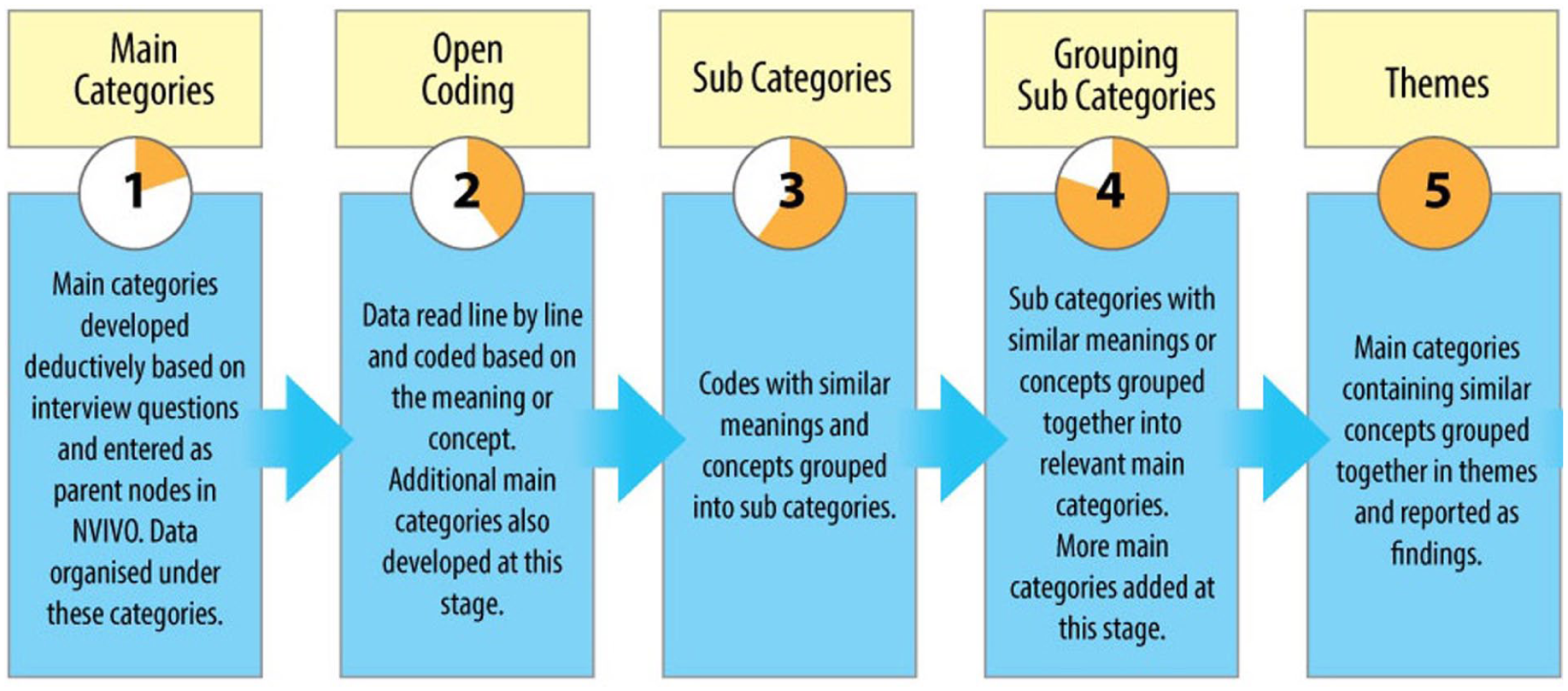
Steps of qualitative content analysis applied in this study.
Development of Main Categories Through Deductive Coding
The exemplar study aimed to explore the perceptions of Indian migrants residing in Australia regarding their personal risk of developing ischaemic heart disease (IHD). Data were collected in English as well as multiple Indian languages (Punjabi, Hindi, Urdu) representing the three main Indian language groups in Australia. In the preparatory phase (Schreier et al., 2019), of the qualitative content analysis (QCA), interview data from all 20 semi-structured interviews were transcribed by the researcher. The first author was a native speaker of these languages, who transcribed all data in the original interview language. This decision was also influenced by the first author’s ability to comprehend the cultural contexts within the dataset, leveraging her cultural background as an advantage. The transcription was done manually due to the multiple languages used in the interviews. Further, a pure verbatim protocol for transcription was followed. The first author engaged in reflexivity and maintained a reflective journal throughout all stages of the data analysis, drawing on their shared background with the participants to deepen insights into the cultural context. Both latent and manifest data analysis was determined as the best approach, based on understanding the cultural context embedded in the data. Each interview was considered a unit of analysis (Graneheim & Lundman, 2004). Although the researcher became familiar with the material during the data collection and transcription process, the entire dataset was read multiple times to ensure deep acquaintance with the content (Roller, 2019).
After becoming familiar with the data, the initial phase involved deductively formulating main categories derived from the interview questions. These categories were entered into NVivo (Lumivero, 2023) as parent nodes to support systematic organisation and maintain focus on the research objectives. The corresponding coding framework featuring only the main categories is displayed in Table 1.
Deductively Developed Main Categories and Descriptions.

Development of Subcategories Through Inductive Coding
Once the data were organised using deductive codes, open coding was conducted. The deductive codes served as the main categories, while subcategories were generated through open coding. Data that did not fully align with the original main categories were recoded inductively, and new main categories were developed accordingly (Swain, 2018; Xu & Zammit, 2020). For example, the barriers and motivators of behaviour change were not the direct questions during the interviews; instead, these main categories were added inductively to the coding frame. During this phase, the data were read repeatedly and coded as new codes emerged, based on the meanings conveyed in the content.
Due to a large data set, a pilot coding frame was developed where the coding frame was tested on a segment of the dataset to assess exclusiveness, consistency, ease of use, and any overlapping (Erlingsson & Brysiewicz, 2017; Schreier et al., 2019). The coding was performed by a single researcher. The trial codebook was then discussed with the second and third authors of this article before applying it to the rest of the data. Certain categories were not described adequately and were not easy for the reader to understand. The codebook was revised to reflect these changes.
Furthermore, open coding was conducted as a cyclical and iterative process. As additional data were analysed, new inductive codes continuously emerged. This required revisiting the earlier coded interviews and recoding segments to align with the newly developed codes. Codes with similar meanings or concepts were subsequently grouped into subcategories (Lindgren et al., 2020). NVIVO (Lumivero, 2023) was used to arrange the main categories and subcategories. All categories were numbered with level headings to demonstrate hierarchy. Each main category and subcategory were defined to explain what was included in that category (Forman & Damschroder, 2007). Tables for each main category were developed, which included all subcategories, codes and raw data coded for those subcategories. Table 2 provides an example of the coding frame, showing one main category and subcategories, Table 3 provides an example of inductive codes along with corresponding segments of text.
Illustration of a Main Category Derived Deductively and Subcategories Identified Inductively.

Example of Inductive (Data-Driven) Codes with Corresponding Text Segments.

The transcripts included in the trial coding frame were coded again 2 weeks later by the first author to assess the coding frame’s completeness and consider whether it sufficiently captured the data. The same procedure as the first round of coding was followed. The second-round coding was quite similar to the first coding frame; only some minor changes were required. Therefore, the trial coding frame was applied to the rest of the data. Open coding was used to develop new main categories, as needed, to categorise the data. Some additional subcategories were developed to include new codes in the main coding frame.
Theme Development
In the next phase, we combined subcategories that conveyed similar meanings, were closely related, or exhibited overlapping patterns in the coded data (Shreier, 2019). This grouping process enabled us to generate condensed meanings and facilitated the development of themes from the extensive and diverse dataset under analysis. For some subcategories, themes were identified at this stage; however, others required further abstraction before theme development could be completed (Schreier et al., 2019). Direct quotes from the interview data were used as evidence to support each theme, and the themes were clearly labelled to enhance reader comprehension (Vaismoradi et al., 2016). Table 4 shows that the sub-categories altered heart function, fatality of heart disease, perceived prevalence of heart disease, and need for symptom awareness were combined to form the revised sub-category ‘understanding of heart disease’. The revised subcategories were further grouped together to develop a theme.
Example of Grouping Subcategories to Develop a Theme.

The findings were presented as overarching themes, each supported by direct quotations from the data. Some themes emerged from predefined main categories, with associated subcategories reported as sub-themes. Other themes were developed by grouping main categories that shared conceptual similarities. The final thematic map of the study is presented in Figure 2.

Final thematic map.
Trustworthiness and Reflexivity
The concept of trustworthiness in qualitative studies, including within the framework of QCA, has been well-documented in the literature (Elo et al., 2014; Graneheim & Lundman, 2004; Stahl & King, 2020; Tong et al., 2007). Trustworthiness in both positivist (deductive content analysis) and non-positivist (inductive and hybrid content analysis) approaches has also been explored in the literature (Cho & Lee, 2014; Elo et al., 2014; Graneheim et al., 2017; Krippendorff, 2013).
In this study, to ensure the data audibility, all records, including meeting notes, the researcher’s journal for documenting variations, and log files, were securely stored along with the interview data and transcripts (Lincoln & Guba, 1985). A comprehensive description of the study settings and relevant population was documented to enhance transferability and thereby strengthen the trustworthiness of the study. Further, detailed description of the methods was developed to ensure dependability and repeatability of the research findings (Moon et al., 2016). An audit trail with all the details of the data collection and analysis process was kept maintaining conformability. It also included observation notes, journals, calendars, interview notes, and drafts of the interpretation process. A full written description of the coding process, such as why the codes are established and explain the meaning of the themes was provided in the codebook (Elo et al., 2014).
The researcher recognised that their close relationship with participants shaped the collaborative nature of knowledge production in the study. To navigate this dynamic, they engaged in ongoing reflexive practice throughout the research process, critically examining how their positionality and relational context informed data interpretation (Olmos-Vega et al., 2023). For instance, during the first interview, the participant was a senior nurse, and the researcher refrained from asking many follow-up questions or seeking clarification to avoid appearing inappropriate. The entry from the reflexive journal is below: I have just finished the first interview it was 40 minutes long. I was too worried about asking the questions written in my interview guide and did not ask follow up questions. The participant was also a senior nurse and older than me, so I did not want to come across as disrespectful. I will share this interview transcript with my supervisors before conducting another interview.
However, upon reflecting on this experience, the researcher acknowledged the importance of their role as a researcher and to use the interview guide but also use probing questions if necessary and adjusted their approach. The researcher engaged in reflexivity throughout the data collection process, which facilitated critical reflection on their perspectives, acknowledgement of potential assumptions, and more effective communication of participants’ experiences (Olmos-Vega et al., 2023). Subsequently, they conducted thorough interviews with participants who were older or more professionally experienced without encountering similar challenges.
Further, to mitigate the risk of selective coding, the researcher engaged in reflective practice to acknowledge personal biases, documenting these reflections in a journal before coding each interview. For instance, during this process, the first author recognised strong assumptions regarding the perceptions of individuals from her state in India, the open coding was more challenging as the researcher was attracted to the quotes from participants from her native state. A reflexive journal note is below: I feel like I keep going back to the Punjabi interviews and most of my example quotes came from these interviews. It could be because of my connection to the language, culture and people of Punjab. I need to go back to all interviews from other states to ensure my approach is rigorous.
Further, the relationship of the researcher with the culture facilitated the interpretation of the data from an Indian cultural context. The reflexive journal notes from the researcher read: I am enjoying analysing this data as I feel like I belong to these people and the culture, I often have to check the context when I am talking to my non-Indian friends or colleagues, but I know exactly what the participant means for example, I don’t need to ask why when they said as we cannot say no to the food when someone offers it to us.
Discussion
The primary aim of this study was to assess IHD risk factors knowledge and explore perceptions of personal susceptibility to IHD among Indian migrants. As discussed earlier, QCA was selected as the most suitable method for data analysis due to its alignment with the study’s epistemological and ontological foundations, as well as its compatibility with the nature of the data and research objectives.
In this study, a hybrid coding technique was employed to analyse qualitative data derived from semi-structured interviews. The main categories were developed deductively, based on the structure of the interview questions, while subcategories and codes emerged inductively from the data itself. This hybrid approach of integrating both deductive and inductive coding allows researchers to maintain alignment with predefined research objectives while remaining open to novel insights that arise organically from participant responses.
Using interview questions as the foundation for main coding categories facilitates a structured and focused analysis, enabling researchers to systematically organise data while maintaining alignment with the study’s objectives (Ruslin et al., 2022). Hybrid coding is particularly advantageous in research employing semi-structured interviews or structured questionnaires with open-ended responses. While interview questions provide a coherent structure, the integration of open coding enables the capture of participants’ voices and the identification of unanticipated codes and themes.
This approach is especially beneficial for novice researchers, as it mitigates the analytical complexity commonly associated with large qualitative datasets. By offering a clear analytical framework, hybrid coding reduces cognitive load and enhances both the rigour and transparency of the coding process.
Moreover, hybrid coding serves a critical function in theory-testing studies. The deductive component provides a structured coding schema for examining pre-established constructs, while the inductive element facilitates the exploration of emergent data, thereby enriching theoretical understanding (Fereday & Muir-Cochrane, 2006). Furthermore, combining codes can facilitate the exploration of complex questions and phenomena in qualitative research, and may also contribute to theory development (Vila-Henninger et al., 2022).
Hybrid coding extends beyond the modification of procedural steps; it represents a reiterative and reflexive analytical process in which researchers continually oscillate between deductive, theory-driven frameworks and the inductive construction of codes grounded in the data (Timmermans & Tavory, 2012). This dynamic engagement requires the analyst to navigate structured expectations while remaining open to novel patterns and themes, enhancing both conceptual depth and analytic flexibility. The simultaneous interaction with theoretical constructs and empirical data is an essential characteristic of the hybrid coding technique within qualitative content analysis.
Looking ahead, hybrid coding should be employed as a context-sensitive strategy within the broader framework of qualitative data analysis methodologies. Its application ought to be guided by the specific requirements of the research question, the characteristics of the data, and the epistemological and ontological orientations of the study, rather than adopted as a universal approach for all qualitative content analyses. The development of a step-by-step guide would serve as a valuable resource for researchers seeking to implement this technique across diverse fields of qualitative inquiry.
Conclusion
QCA is a widely used data analysis method in nursing research, offering a systematic yet flexible approach. This paper presented an example of integrating inductive and deductive coding techniques, highlighting the potential of hybrid coding techniques, which remain underutilised in nursing research. The authors shared their experience with QCA using a hybrid coding technique, demonstrating its application and highlighting the relevance of reflexivity. To address the limitations associated with isolated approaches, further studies incorporating hybrid coding and explicit reflexivity are essential. Overall, this paper offers insights into the use of hybrid coding within the QCA framework, contributing to the broader understanding of its application in nursing research.
Footnotes

Ethical Considerations
Ethics approval was obtained from Edith Cowan University’s ethics committee before the study (REMS NO: 2021-02449-KAUR).
Author Contributions
KK: conceptualisation, writing original draft; MAQ: supervision, writing – review and editing; AR: supervision, writing – review and editing; NM: supervision, writing – review and editing; RS: supervision, writing – review and editing.
Funding
The authors received no financial support for the research, authorship, and/or publication of this article.
Declaration of Conflicting Interests
The authors declared no potential conflicts of interest with respect to the research, authorship, and/or publication of this article.
Author Biographies
Dr.
Dr.
Dr.
Dr.