



Abstract
Researchers are increasingly using qualitative health methodologies to inform patient-centered healthcare practice. However, in doing so, they are often dismissing the inherent subjectivity of qualitative research to conform to quantitative standards of objectivity. Acknowledging that all aspects of research inquiry are influenced by situated researchers, I explore the co-use of interpretive description (ID), an applied qualitative health methodology, and reflexive thematic analysis (RTA), a thematic analysis approach that foregrounds researcher subjectivity. By examining the philosophical foundations, use of theory, analytical strategies, and indicators of research quality between ID and RTA, I conceptualize a methodologically coherent approach to their co-use that remains transparent about, and values, researcher subjectivity and reflexivity. This article also includes accessible explanations of complex methodological and philosophical concepts, practical examples for operationalizing reflexivity, and 22 guiding questions to support researchers in the coherent co-use of ID and RTA.
Keywords
Introduction
Qualitative research is increasingly challenging the evidence-based medicine (EBM) hierarchy as the gold standard for informing best-practice patient care (Centre for Evidence-Based Medicine, 2021; Miller & Jones-Harris, 2005). Indeed, patient-centered healthcare practice, which prioritizes patient experiences, needs, and values, is a qualitative construct necessitating qualitative knowledge (Centre for Evidence-Based Medicine, 2021; European Society for Research, 2024). In response to this need, qualitative health methodologies have been developed to address health-related questions and are increasingly being used to shape clinical practice and health policy (Díaz Crescitelli et al., 2019; Pope & Mays, 2020).
The rise of qualitative research in health emerged alongside critiques of the biomedical model in the 1970s and 1980s, gaining significant traction in the 1990s as scholars pushed for broader, more contextually grounded understandings of health and illness. Influential voices such as Arthur Kleinman, whose work on illness narratives challenged biomedical reductionism (Kleinman, 1988), and feminist sociologist Ann Oakley, who foregrounded the role of gender and subjectivity in health research (Oakley, 2005), laid essential foundations. Trisha Greenhalgh has been particularly instrumental in advocating for the inclusion of qualitative research within EBM, arguing that lived experience and narrative should be central to understanding patient care (Greenhalgh & Taylor, 1997; Greenhalgh et al., 2016). This momentum was further supported by the institutionalization of qualitative methodologies through journals like Qualitative Health Research and contributions from theorists such as Kathy Charmaz, whose constructivist grounded theory helped reshape methodological thinking in health contexts (Charmaz, 2006). These efforts have been bolstered by parallel movements in medical humanities and health sociology, which together have expanded the boundaries of what counts as valid evidence in healthcare research (Jones, 1999; Lupton, 1994).
Acknowledging pivotal voices that have advocated for and influenced contemporary understandings of researcher positionality, subjectivity, and reflexivity in qualitative research (e.g., Braun & Clarke, 2022; Charmaz, 2006; Oakley, 2005), qualitative health methodologies continue to face challenges in endorsing the principle of subjectivity alongside their relevance and validity with EBM. Rooted in the quantitative pursuit of objectivity, researcher subjectivity has long been perceived as skewing, contaminating, and biasing outcomes, thereby rendering them unreliable and invalid (Pannucci & Wilkins, 2010). However, all researchers are situated in specific contexts, with their positionality (e.g., experiences, perspectives, and knowledge) shaping all aspects of scientific design-making, regardless of methodology (Braun & Clarke, 2021a; Poirier et al., 2023). Importantly, attempts to “control” this researcher influence overlook the fundamental subjectivity of qualitative research and the ontological and epistemological positioning that guides qualitative health inquiry. Consequently, such efforts may not only be perceived as naïve but also as profoundly impacting the transparency and accountability of researchers in the research process and outcomes.
One central concept guiding this discussion is methodological integrity, defined as the alignment between the ontological and epistemological foundations of the research, the methodology adopted, and the methods used to gather and analyze data. Methodological integrity ensures that research decisions and interpretations are justified, defensible, and aligned with the overarching philosophical stance of the study (Morse, 1997; Patton, 2023).
Situating the Author and Purpose of the Paper
My search for an applied qualitative methodology began with my PhD research which explores how mental healthcare experiences can be more positive and supportive for transgender (trans) youth. The project aims to develop practical guidance for mental healthcare services and practitioners in the care of trans youth. Given the social justice orientation and the marginalized population involved, it is essential to adopt a critical stance and engage meaningfully with positionality and reflexivity (Braun & Clarke, 2021a). I found that traditional social science methodologies (e.g., grounded theory, phenomenology, and ethnography) were not well-suited to this purpose, as they often prioritize theoretical abstraction over clinical application and may not fully embrace researcher subjectivity. Instead, I sought an approach aligned with my critical, practice-oriented aims. Interpretive description (ID; Thorne, 2016; Thorne et al., 1997) emerged as most appropriate due to its applied focus, methodological flexibility, and constructionist orientation (described in more detail below).
However, ID’s emphasis on researcher reflexivity as a means of managing researcher influence did not fully align with my understanding of qualitative research as inherently subjective. To address this, I chose to also draw on Braun and Clarke’s (2006, 2022) reflexive thematic analysis (RTA), which explicitly embraces and foregrounds researcher subjectivity as a central component of knowledge production. In exploring whether other researchers had used both ID and RTA, I found a growing number of recent studies claiming to use both approaches. However, many did not clearly explain how they maintained methodological integrity or upheld the foundational principles of each approach. Few also engaged meaningfully with researcher positionality or reflexivity.
This paper, therefore, aims to explore and demonstrate how ID and RTA can be coherently integrated within applied qualitative health research. I argue that when aligned philosophically and situated within a critical orientation, ID and RTA are methodologically compatible. This argument is developed through an exploration of alignment and divergence across four key areas: (i) philosophical positioning, (ii) explanatory theory and analytical approach, (iii) data generation and analysis process, and (iv) indicators of research quality. Where divergences exist, I offer practical strategies for maintaining coherence and integrity in their co-use. I hope this discussion—offering my conceptualization of their co-use—serves as a useful starting point for others conducting applied, critical qualitative health research that foregrounds the inherency of researcher subjectivity.
Background
Interpretive Description: The Methodology
Interpretive description (ID) is a flexible qualitative methodology for the applied and practice fields (Thorne, 2016; Thorne et al., 1997) and was developed to address the specific needs of applied nursing research questions (Thorne, 1991). Thorne and colleagues argued that while quantitative approaches are designed to establish generalizable patterns and relationships, they are not intended to capture the complexities and contextual nuances of individual health experiences. Similarly, traditional qualitative approaches (e.g., ethnography, grounded theory, and phenomenology), with their roots in the social sciences, are purposefully designed to prioritize theoretical understanding and conceptual development rather than direct practical application in clinical settings (Thorne et al., 1997). ID, therefore, offers an inductive approach to qualitative research that focuses on the practical application of research findings. It does this by focusing on both understanding and interpreting phenomena, and exploring how the findings can be used to improve health practice and patient outcomes (Thorne, 2016; Thorne et al., 1997).
ID draws upon elements of traditional qualitative methodologies but diverges from their rigid, predefined rules; resulting in an approach that is adaptable to the research question, context, population, and clinical audience (Thorne, 2016; Thorne et al., 1997, 2004). Grounded in applied, real-world problems, while also acknowledging the constructed and contextualized nature of knowledge, ID explores common and individual health experiences to generate relevant and meaningful outcomes for applied practice. First published in 2008 and now in its second edition, Sally Thorne’s book Interpretive description: qualitative research for applied practice offers a comprehensive and flexible framework for conducting impactful research in applied health sciences (Thorne, 2016). The following quote from her book articulates ID’s overall purpose: “an interpretive description product will reflect assumptions about what an ideal future might look like… [which is] derived from the identification of a problem in the real world that deserved something better” (Thorne, 2016, p. 192).
Reflexive Thematic Analysis: The Method
The origins of thematic analyses as a group of methods are thought to have their beginnings in content analysis (Braun & Clarke, 2016). Despite being largely un-proceduralized until relatively recently, thematic analyses have long been cited by researchers as their qualitative analysis method (Braun & Clarke, 2006). In response to this, Braun and Clarke published their now widely adopted “Using thematic analysis in psychology” (Braun & Clarke, 2006), which provided practical and useable guidelines for conducting their approach to thematic analysis. Braun and Clarke’s approach, as its most basic, offers a flexible and recursive six-phase process for “developing, analysing and interpreting patterns across a qualitative dataset, which involves a systematic process of data coding to develop themes” (2022; p. 4). Since their seminal 2006 paper, Braun and Clarke have refined their approach to thematic analysis (see Braun & Clarke, 2016, 2019, 2021a, 2021b, 2023) and, in 2022, published their book “Thematic analysis: A practical guide” outlining what they now call reflexive thematic analysis (Braun & Clarke, 2022).
The key aspect of RTA that demarcates it from other approaches is the centrality of researcher subjectivity and reflexivity (Braun & Clarke, 2019, 2022). RTA acknowledges that the researcher’s personal experiences, knowledge, and disciplinary perspectives inevitably shape the analysis and interpretation of the data and is therefore used as an analytic tool in the process (Braun & Clarke, 2019, 2022). This means that high-quality RTA is dependent on thoughtful, engaged, and critical researcher reflexivity about their choices and practices (Braun & Clarke, 2022). Through this emphasis on reflexivity, RTA is firmly positioned as a “Big Q” qualitative approach (Braun & Clarke, 2022). “Big Q” approaches view meaning and experience as socially and contextually constructed, rejecting positivist notions of objectivity, generalizability, and hypothesis testing (Braun & Clarke, 2022; Kidder & Fine, 1987). Importantly, RTA offers flexibility within the analysis method, including flexibility with the researcher’s philosophical and theoretical approach, and the processes for coding and theming data (Braun & Clarke, 2006, 2019, 2021a, 2022). This means that RTA can be used with and alongside various qualitative methodologies that are philosophically and conceptually aligned (Braun & Clarke, 2021a, 2022).
Exploring Conceptual Coherence and Methodological Integrity
While ID and RTA can be compatible, their coherent co-use requires careful consideration of several important differences. Most notably, ID conceptualizes reflexivity as a strategy to mitigate researcher influence, promoting distance from subjective interpretation (Thorne, 2016). In contrast, RTA treats research subjectivity as central—not incidental—to knowledge production (Braun & Clarke, 2022). This difference is not merely semantic; it reflects divergent views of how meaning is constructed and interpreted and has important implications for the integration of ID and RTA.
These and other points of divergence and alignment are explored in the following sections which describe key aspects of ID and RTA. Where divergences are noted, practical solutions are offered to effectively integrate the two approaches in a way that maintains methodological integrity.
Philosophical Positioning: The “Ologies” and “Isms”
I begin this section by first acknowledging the often-confusing variation in language used to describe a researcher’s philosophical positioning (i.e., the underlying philosophical assumptions that guide research). For example, “philosophical” is commonly used interchangeably with “theoretical,” and common variations of “positioning” include “orientation,” “paradigm,” “framework,” “foundation,” and “approach,” depending on the literature that is being read. For clarity, I use the term “philosophical positioning” here to refer to a researcher’s understanding of what reality is (i.e., ontology) and how knowledge is produced (i.e., epistemology). Ontology and epistemology are, therefore, the legs upon which a researcher’s philosophical positioning stands. A researcher’s philosophical positioning forms the foundation of their research methodology. However, unlike quantitative traditions that are inherently positivist, qualitative research encompasses a wide range of philosophical positionings. Many of these positionings are methodologically incompatible with one another (Madill, 2015) and should therefore be recognized and explicitly stated (Braun & Clarke, 2022; Malterud, 2016). While acknowledging that there is no definitive way to conceptualize the various philosophical positionings (Patton, 2002), the mapping in Figure 1 reflects my understanding of ontology and epistemology, philosophical positionings, and associated methodological approaches. Simplified map of the “ologies,” philosophical positioning, and associated research methodology. *Constructionism represents a critical epistemology. Experiential epistemologies such as phenomenology are also relevant here.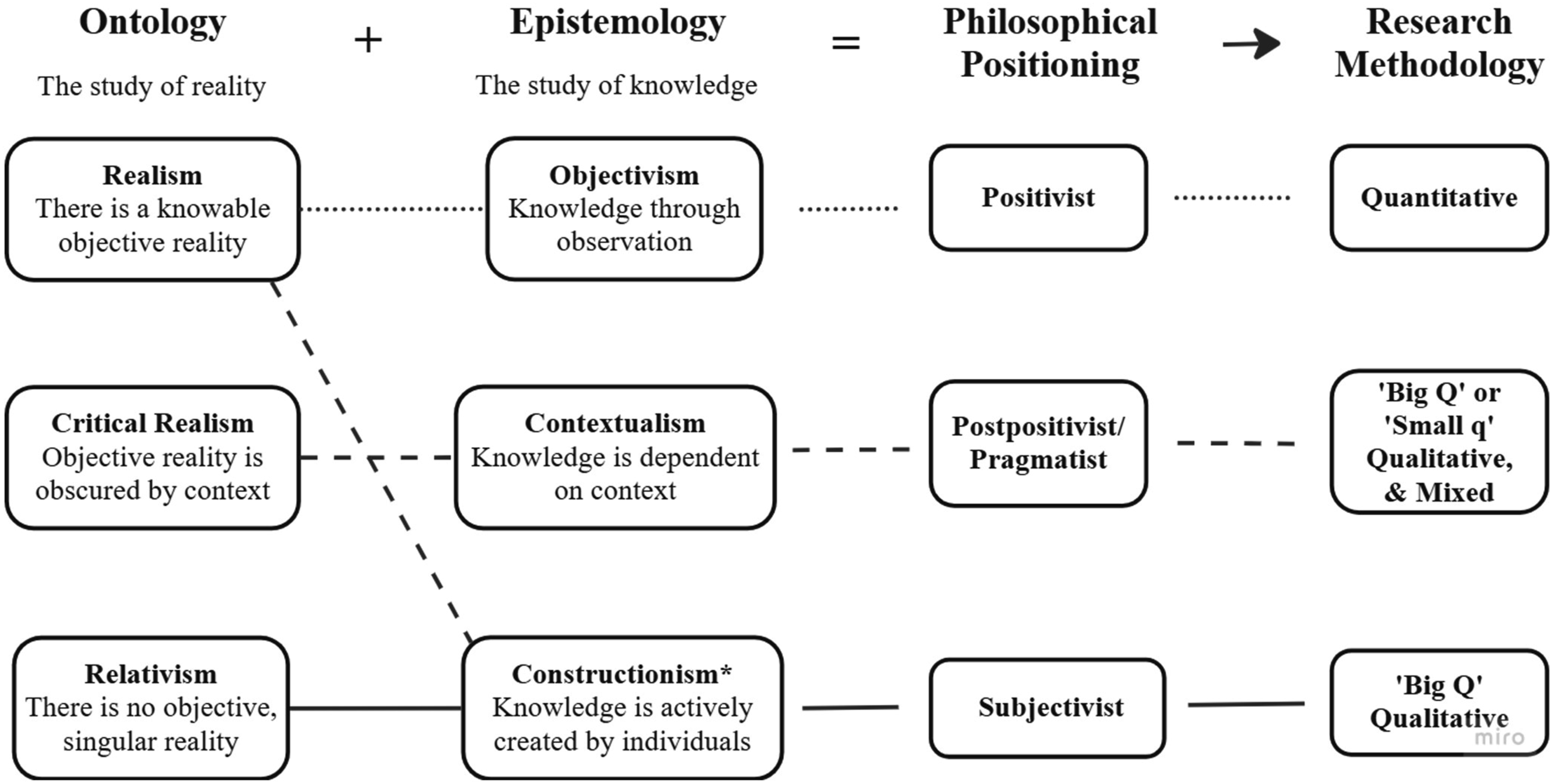
Key ideas from naturalistic inquiry, a qualitative methodology for education research (Lincoln & Guba, 1985), form the philosophical foundation of ID (Thorne, 2016; Thorne et al., 2004). Naturalistic inquiry rejects the idea of objective truth and instead focuses on the context, subjective meaning, interpretation, and the inseparable relationship between researchers and participants in knowledge production (Lincoln & Guba, 1985). Founded on this philosophical stance, ID, therefore, acknowledges the existence of multiple subjective and contextual realities, all shaped by the participants, the researcher, and the interaction between them (Thorne, 2016; Thorne et al., 2004). This means that ID aligns with epistemologies like contextualism and constructionism (see Figure 1).
Similarly, RTA can be used across various epistemologies, provided they follow “Big Q” qualitative approaches that prioritize researcher subjectivity (Braun & Clarke, 2006, 2022). For example, experiential approaches such as phenomenology focus on how individuals describe and interpret their experiences and realities, while critical approaches such as constructionism explore how power, culture, and social structures shape those experiences and meanings (Braun & Clarke, 2022; Willig, 2022). This philosophical flexibility is a key strength of RTA that makes it adaptable to qualitative methodologies that are philosophically aligned (Braun & Clarke, 2021a, 2022).
While experiential approaches such as phenomenology can be used with RTA, ID emphasizes the constructed and contextual nature of knowledge, as well as the researcher’s role in shaping “constructed truths” (Thorne et al., 2004, p. 6). Therefore, philosophical alignment between ID and RTA falls within critical approaches such as constructionism, because purely experiential orientations that take meaning at face value are less suited to the contextualized, interpretive, and socially constructed focus of ID (Thorne, 2016).
Explanatory Theory and Analytic Approach
This section explores the use of explanatory theory in ID and RTA. Explanatory theory, including models and frameworks, describes and explains social, psychological, and health phenomena. While philosophical positioning and explanatory theory are discussed separately in this paper, it is important to note that they can exist on a continuum, with some theories fitting both roles. For example, feminist theory, as a philosophy, understands knowledge as based on gendered social structures, while also being used as a framework for understanding gender inequality (Butler, 2007; hooks, 2015). Broadly, explanatory theory can guide qualitative research in two ways. A priori theory shapes the research and analysis from the outset, framing the way data are explored and themes developed (Flick, 2023)—aligning with deductive, theory-driven approaches. Comparatively, post hoc theory is applied after analysis to provide explanatory insights, aligning with inductive, data-driven approaches (Flick, 2023).
ID was developed to complement existing qualitative methodologies by offering an approach specifically tailored to the applied health context, where the primary goal is practical application rather than theory generation (Thorne, 1991, 2011, 2016). In particular, Thorne (2011) critiqued the overuse of a priori theory in qualitative analysis, arguing it limits clinical application and “skews interpretive capacity” (p. 448). Based on its understanding of multiple constructed realities, ID posits that a priori theory cannot capture all possible realities and analysis must instead be grounded in the data (Thorne, 2016; Thorne et al., 2004). As a result, ID uses theory inductively for providing explanatory power to the outcomes, while grounding research in the disciplinary evidence-base to guide analysis (Thorne, 2016; Thorne et al., 1997). RTA, on the other hand, is flexible with explanatory theory, accommodating both inductive and deductive approaches (Braun & Clarke, 2022). In practice, an ID project using RTA aligns when the analysis remains inductive and data-driven rather than deductive and theory-driven.
For example, a deductive analysis approach might begin with a predetermined coding framework informed by a health or psychological theory, for example, the Health Belief Model (HBM; Rosenstock, 1974). The qualitative data would then be deductively coded into constructs of the HBM coding framework (e.g., perceived barriers and self-efficacy). While this deductive approach is valid using other methodologies, it is incompatible with ID. In contrast, an inductive, data-driven analysis allows themes and meaning to be critically constructed by the researcher, without the predefined boundaries of a priori theory that may limit breadth and nuance. Constructs of the HBM could then be explored for interpretive insights following the inductive analysis.
Importantly, theories can inform the design, development, and ethical conduct of research, as well as help determine the analytical approach. For example, researchers may draw on social justice frameworks or equity theories to ensure their research addresses issues of power and equity and does not inherently exclude marginalized groups. The key distinction lies in using theory as a set of guiding principles rather than as a prescriptive template that predetermines what will be found in the data.
Data Generation and Analysis Process
Both ID and RTA prioritize flexibility over prescriptive guidelines to analysis (Braun & Clarke, 2006, 2022; Thorne, 2016; Thorne et al., 2004). This section explores analytic alignment and divergence to propose a strategy that is adaptable to both ID and RTA within a critical orientation.
ID and RTA are each compatible with a range of data sources, and both emphasize immersion in the data before coding (Braun & Clarke, 2006, 2022; Thorne, 2016). They also highlight the importance of time and patience for the analysis process, recognizing the recursive and evolving nature of coding, the organization of themes based on shared meaning, and the need for researchers to let go of preliminary thematic structures in order for more interpretive and meaningful outcomes to be shaped (Braun & Clarke, 2006, 2021a, 2022; Thorne, 2016; Thorne et al., 1997, 2004). Perhaps most importantly, both ID and RTA prioritize the critical interpretation of data within context (Braun & Clarke, 2022; Thorne, 2016). For these reasons, both approaches caution against the uncritical use of qualitative analysis software, which can create deterministic and inflexible coding structures, and shallow, prematurely finalized analyses (Braun & Clarke, 2022; Thorne, 2016).
Regarding the writing and presentation of findings, Braun and Clarke (2022) describe that latent theme writing that uses data extracts analytically to provide a “rich interpretive account” (p. 138) is commonly associated with critical and inductive approaches. This aligns with Thorne et al. (2004), who state that data extracts should “substantiate and clarify the analytic logic without the burden of accountability for the conclusions themselves” (p. 8). The writing and presentation of findings, therefore, should go beyond description and include a critical interpretation of meaning that is not achievable from the presentation of data extracts alone.
Some divergence is, however, apparent in ID’s recommendation of verification strategies, such as theoretical sampling (concurrent data generation and analysis) and constant comparative analysis, which involves systematically comparing new data with previously collected data to refine categories and deepen interpretive insight (Strauss & Corbin, 1990; Thorne, 2016; Thorne et al., 1997, 2004). Borrowed from grounded theory, these strategies support purposive sampling decisions based on analytical insights and aim to explore variation within the sample and the dataset (Strauss & Corbin, 1990). Thorne (2016) advocates for their use to acknowledge that knowledge is socially constructed and may manifest in diverse ways that warrant exploration. In contrast, while RTA is flexible and non-prescriptive, the first phase of analysis is deep engagement and familiarization with the data, prioritizing reflexivity (Braun & Clarke, 2006, 2019, 2022). To maintain the key features of both approaches, a sequenced and concurrent data collection and analysis may be undertaken, beginning with immersion in individual cases (e.g., transcripts) followed by a comparative process across cases. It is imperative, however, that researcher reflexivity remains central throughout, ensuring that patterns and meaning are co-constructed through systematic comparison and subjective, critical interpretation.
Furthermore, both ID and RTA emphasize the researcher’s role in constructing outcomes, reinforcing the idea that themes do not passively emerge from the data (Braun & Clarke, 2019, 2022; Thorne, 2016; Thorne et al., 2004). However, the two approaches do differ in their emphasis on researcher reflexivity and the role this plays in knowledge production. While ID acknowledges that achieving “objectivity” in qualitative research is naïve, it also attempts to account for perceived bias (Thorne et al., 1997) and cautions against over inscription of self in the reflexivity process (Thorne, 2016). In contrast, researcher subjectivity is the cornerstone of RTA, embracing researcher subjectivity and rendering “bias” a moot concept (Braun & Clarke, 2019, 2022). Consolidating these differences within a critical orientation can be approached as a dynamic process that ultimately enhances both interpretation and practical applicability. Reflexive journaling and discussions can help researchers critically engage with the subjectivity they bring to the research, while concurrently maintaining accountability to participant voices. When embedded within the sequenced analysis strategy, this iterative reflexivity process can produce findings that remain both meaningfully co-constructed and applicable in the applied context.
These differences raise an important consideration about whether ID can evolve to more explicitly embrace the co-construction of meaning, without compromising its integrity. While ID traditionally frames reflexivity as a tool for managing and mitigating researcher influence, the methodology is also philosophically foregrounded in the contextual and constructed nature of knowledge (Thorne, 2016). This allows for a more centralized role of subjectivity, especially when ID is situated within a critical constructionist paradigm. Within such a framing, subjectivity becomes a resource rather than a risk. This evolution does not undermine ID’s integrity but rather enhances its alignment with applied research contexts that require transparency, accountability, and researcher reflexivity as part of knowledge co-production. As Thorne (2016) states, ID is a flexible and evolving methodology—making it amenable to integrating insights from contemporary critical approaches like RTA, provided these align with ID’s purpose of generating practical, contextually grounded knowledge. Researcher subjectivity and reflexivity is further addressed in the following section.
Operationalizing Reflexivity in Practice
Given the centrality of reflexivity to qualitative health research using both ID and RTA, it is important to move beyond abstract discussions of reflexive practice. In this section, I briefly describe what reflexivity is and provide excerpts from my reflective PhD journal to illustrate examples of reflexivity in practice. In doing so, I discuss how reflexive journaling and critical self-examination can be systematically employed to enhance both transparency and analytical depth.
Reflexivity is the ongoing process of critical reflection on one’s positionality and subjectivity throughout the research (Berger, 2015; Finlay, 2002). Positionality refers to our disciplinary background, culture, political, and religious ideologies, life experiences, and values—factors that shape how we see and engage with the world (Berger, 2015; Finlay, 2002). Subjectivity refers to our decisions throughout the research process, the challenges we face, our analytical insights, and the sociopolitical contexts that influence our work (Lazard & McAvoy, 2020). Braun and Clarke (2022) usefully describe these two categories as personal and functional reflexivity, respectively. While conceptually distinct, they are interconnected. For example, my disciplinary background inevitably informs my analytical insights and how I interpret my findings.
Throughout my PhD (ongoing at the time of writing this article), I have used reflective journaling and discussion to capture my thoughts, feelings, assumptions, and reasoning across various aspects of the research process. These reflections have covered a wide range of topics including my reasoning and decision-making around cohort selection; personal experiences of mental healthcare; my personal and professional values of equity, justice, and allyship; my positioning as an educated, white, queer woman; insights gained through engagement with trans youth and trans peer researchers; the ethics application and review process; challenges and discomforts in qualitative interviewing; and moments when my perspectives were challenged. Importantly, reflective journal entries were written candidly and are minimally edited to maintain authenticity (Braun & Clarke, 2022). Below are two excerpts with commentary on how they have informed the conduct, analysis, and outcomes of my PhD research.
Excerpt 1
I interviewed my first psychiatrist a few days ago. I was nervous—what is it about psychiatry that is so intimidating? The concept of psychiatric power come up quite quickly, which I found interesting. Perhaps it was the elephant in the room? Either way, it was an important and illuminating discussion, and very topical for my project—I'm grateful that it come up without prompting. Despite being nervous, it was the most comfortable interview I've done, making me feel like I’d overcome some self-doubt. It also challenged some of my perspectives. Primarily around gatekeeping for access to medical gender affirming care. But the narrative with this psychiatrist was that it’s always the best approach. I’m really interested to explore this with other MHPs (mental health practitioners), and psychiatrists in particular, given their (real/perceived) position of power in this space. When transcribing the interview and immersing myself in the data, it was also apparent that there are parts of the discussion where tone was lost and meaning has the potential to be obscured in the transcribed text. This was more common around sensitive topics (i.e., gatekeeping medical care, youth autonomy and self-determination) where the interview was more conversational, and where the co-construction of meaning was more obvious. When writing and interpreting these data, it will be important to include my own voice from the transcription to ensure that the co-construction of meaning is present.
This excerpt captures several key reflections: first, on overcoming nervousness and building confidence for future interviews and, second, on engaging critically with the concept of psychiatric power and gatekeeping, and shaping future interviews around these topics—in-line with the sequenced analysis strategy identified above. Finally, and in-line with my critical, social constructionist paradigm, I note that my own voice is essential for meaning-making in the analysis, interpretation, and writing of data, particularly where tone and meaning has the potential to be obscured.
Excerpt 2
Ethics haven’t provided feedback on my engagement with MHPs, including protecting their wellbeing, privacy, and autonomy in the study. Perhaps their focus on trans youth has resulted in the oversight of potential risk among adults/professionals participating in the research. Two months later: Today I received consent from a trans MHP, which will be such a valuable intersecting perspective for my project. I am, however, mindful of needing to be sensitive and respectful of this person's identity, which is both the research topic and their lived experience. Having worked with lived experience researchers, I learned about the emotional and cognitive toll of people drawing on their lived experience to inform their work, and the unthoughtful expectation of this from their cisgender colleagues. I am also aware that care and consideration will be needed to protect the anonymity of this practitioner in the writing and publication of findings including their data. I have organized a reflective PhD supervision to discuss this prior to the interview.
These two excerpts capture my reflections on the importance of prioritizing the well-being and anonymity of all participants, including considerations that may have been missed in the formal ethical review. I draw on my prior experience working with peer researchers, which informed my engagement with reflective PhD supervision to ensure the interview was approached with care and sensitivity. These excerpts also show how reflections can connect and inform each other over time.
Indicators of Research Quality
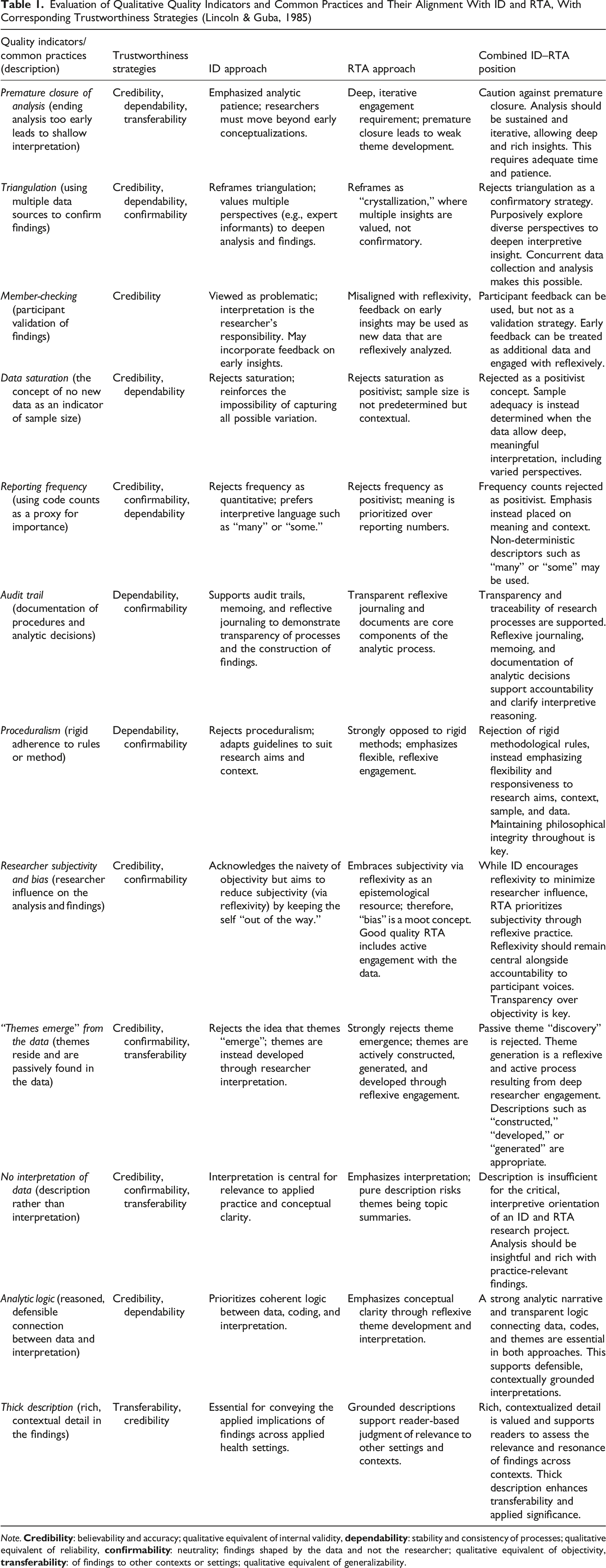
Evaluation of Qualitative Quality Indicators and Common Practices and Their Alignment With ID and RTA, With Corresponding Trustworthiness Strategies (Lincoln & Guba, 1985)
Note.
Overall, indicators of quality and integrity are largely consistent across the two approaches. Both ID and RTA emphasize flexibility and adaption to the research context, provided that decisions are philosophically coherent, logical, justified, and defensible (Braun & Clarke, 2006, 2021a, 2022, 2023; Thorne, 2016; Thorne et al., 2004). To produce high-quality findings, deep, critical, and interpretive engagement with the data is needed; and this takes time, patience, and reflexivity (Braun & Clarke, 2022; Thorne, 2016; Thorne et al., 2004). As described above, RTA foregrounds researcher subjectivity and creativity as a valuable resource, shaping rather than distorting outcomes (Braun & Clarke, 2019, 2022). This diverges from ID’s purpose of reflexivity for mitigating researcher influence (Thorne, 2016). Reflecting on my reasoning for using RTA within an ID study—being that subjectivity is inherent and unavoidable in qualitative research, and should therefore be acknowledged, described, and valued—transparency over objectivity is key. Structured, reflexive practice that is transparent about the researcher’s positionality in subjective meaning-making ensures that the findings remain co-constructed and true to participant voices.
Following the logic of co-constructed meaning, both approaches reject the idea of themes residing in the data that are waiting to “emerge” and instead emphasize the researcher’s role in actively co-constructing findings (Braun & Clarke, 2006, 2019, 2022, 2023; Thorne, 2016; Thorne et al., 2004). Reporting frequency of codes and the concept of data saturation (i.e., informational redundancy) are also rejected across the two approaches, both conflicting with subjective, critical qualitative approaches (Braun & Clarke, 2016, 2021a, 2021b, 2022; Thorne, 2016). Finally, methods of confirmability are also reframed (see Table 1). For example, rather than confirming the findings with participants via member-checking, participant feedback on preliminary outcomes can be a useful way to gain further insight from participants that can then be included and critically analyzed alongside the primary dataset (Braun & Clarke, 2022; Thorne, 2016; Thorne et al., 2004).
Summary and Conclusion
The discussion presented in this paper highlights how an applied qualitative study using ID and RTA can be methodologically coherent when the underlying foundations and principles of the two approaches are carefully considered. While several recent studies have used both approaches, this is the first article to conceptualize how they may be appropriately integrated while preserving their integrity and purpose.
In summary, an ID study using RTA should be situated within a critical philosophical positioning such as constructionism. The disciplinary evidence-base should inform the study design and data analysis, and theory should be used inductively (i.e., post hoc) in the analysis to provide explanatory power to the outcomes. A range of data sources can be used, and sample size should be informed by the richness and depth of analysis rather than predetermined by concepts like data saturation. The recursive and evolving nature of analysis requires researchers’ time and patience, and preliminary thematic structures should be set aside for more critical, reflexive, and interpretive themes to be developed.
To prioritize both constant comparative analysis (ID) and deep reflexive immersion in the data before coding (RTA), a sequenced data generation and analysis strategy can be undertaken. This includes concurrent data collection and immersion in individual cases (e.g., transcripts) as they are gathered. Coding also occurs during data collection, allowing for maximal variation—the purposeful exploration of alternative ideas and perspectives—across the dataset. Researchers must also critically reflect on their positionality and subjectivity and engage with tools such as reflexive journaling and discussion throughout all study processes. Furthermore, reflexive engagement with the data should remain central to the research process while researchers concurrently ensure accountability to participant voices.
Questions Guiding Researchers in the Co-Use of ID and RTA
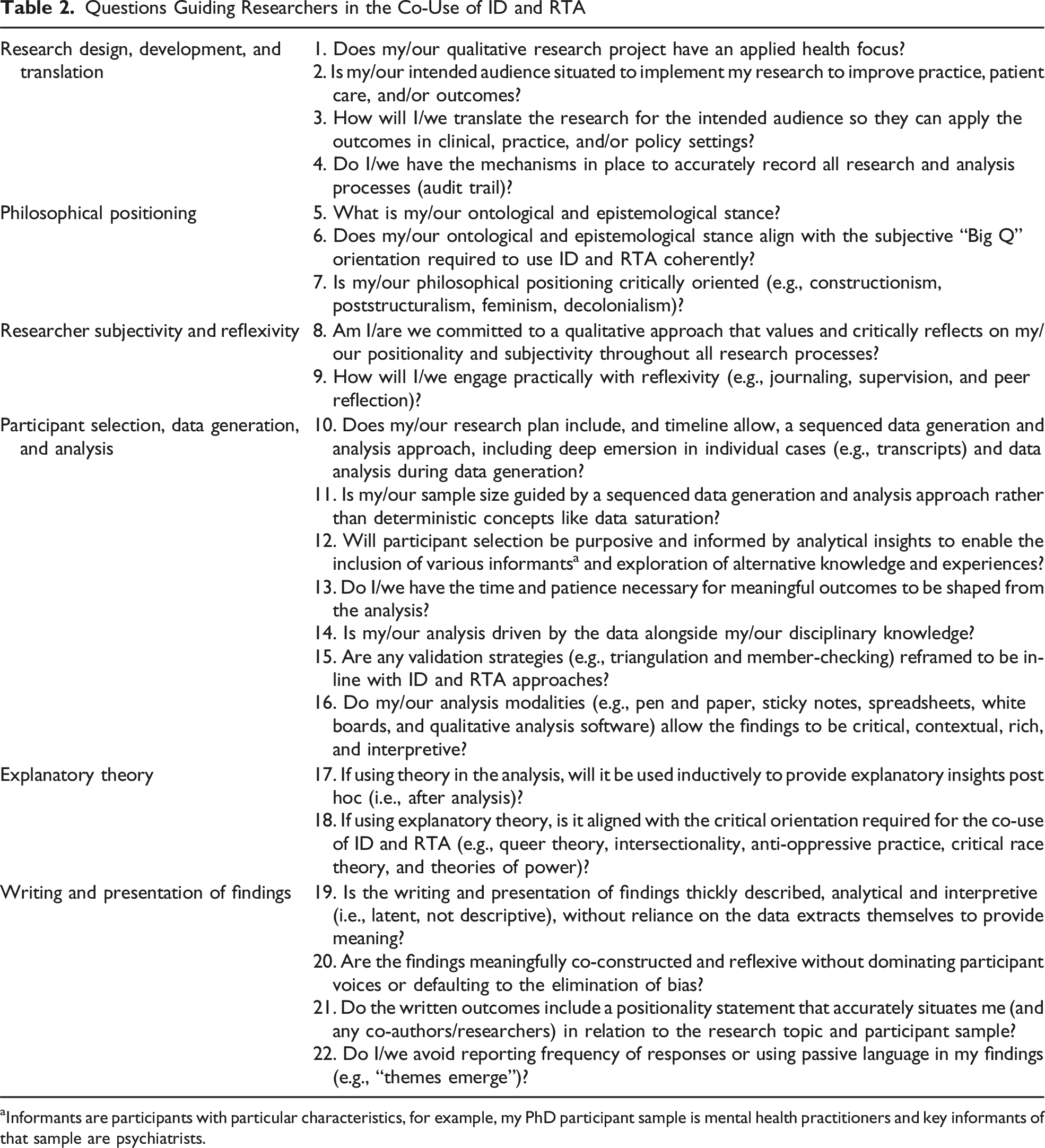
aInformants are participants with particular characteristics, for example, my PhD participant sample is mental health practitioners and key informants of that sample are psychiatrists.
Footnotes
Acknowledgements
I would like to acknowledge my PhD supervisors, Milena Heinsch and Justin Canty, for their confidence in my ability to undertake this article independently. I also thank my friend and fellow PhD candidate, Grace Sultani, for her support and for providing a valuable space to discuss and refine my ideas. Additionally, I would like to acknowledge Sally Thorne, Virginia Braun, and Victoria Clarke for their insightful and accessible work on interpretive description and reflexive thematic analysis, which has greatly enriched the writing process.

Ethical Considerations
No ethical approval was sought for the conduct or writing of this article because it does not include human or animal participants.
Author Contributions
Jessica Wilson conceptualized, drafted, refined, and finalized this paper as sole author.
Funding
The author disclosed receipt of the following financial support for the research, authorship, and/or publication of this article: This work was supported by the Australian Government Research Training Program.
Declaration of Conflicting Interests
The author declared no potential conflicts of interest with respect to the research, authorship, and/or publication of this article.