



Abstract
Family violence is a serious public health issue with significant health consequences for women and children. Enhanced Maternal and Child Health nurses (EMCH) in Victoria, Australia, work with women experiencing family violence; however, scholarly examination of the clinical work of nurses has not occurred. This qualitative study explored how EMCH nurses work with women experiencing abuse, describing the personal and professional challenges for nurses undertaking family violence work. Twenty-five nurses participated in semi-structured interviews. Using interpretive description methodology has enabled an insight into nurses' family violence work. Threads of practice identified included (1) Validating/Reframing; (2) Non-judgmental support/Safeguarding and (3) Following/Leading. The nurses highlighted the diversity of experience for women experiencing abuse and nurses' roles in family violence nurse practice. The research contributes to understanding how EMCH nurses traverse threads of practice to support women experiencing family violence.
Keywords
Introduction
Intimate partner violence is any behaviour within a past or current intimate relationship that causes harm to those in that relationship. It can include physical, emotional or psychological harm (Australian Institute of Health and Welfare, 2019). Perpetrators of intimate partner violence may use controlling or dominating behaviour, including emotional, sexual and physical abuse, and harassment that can worsen over time (Family Safety Victoria, 2020). The terms intimate partner violence, domestic violence and family violence may be used interchangeably (Stubbs & Wangmann, 2017). In Victoria, Australia, ‘family violence’ is used in legislation and policy documents, setting it apart from other Australian jurisdictions and countries such as New Zealand, the United Kingdom, Canada and the United States.
Family violence is a serious public health issue with significant health consequences for women and children (Brown et al., 2020). In Australia, police are called to a family violence incident every 2 minutes; 12 women per day are hospitalised due to violence and every 9 days, a woman is killed by a current or ex-partner (Department of Social Services, 2019). The violence often begins during pregnancy and may increase in severity into motherhood (García-Moreno et al., 2015) and is one of the leading causes of death and injury for childbearing women (Breiding et al., 2014).
Family violence during pregnancy is associated with risks to the foetus, child and mother (Howard et al., 2013). It has a negative impact on the experience of motherhood and parenting (Hooker et al., 2016). More than 1 million Australian children are affected by family violence (Australian Institute of Health and Welfare, 2019). Children exposed to violence are at higher risk for emotional and behavioural problems, poorer language development and impaired cognitive development (Cutuli et al., 2016). Children do not have to directly witness the family violence for there to be negative outcomes (Wathen & MacMillan, 2013).
Maternal and Child Health service in Victoria, Australia
The Maternal and Child Health (MCH) service works with parents and early years' services, promoting healthy outcomes for children (0–6 years) and their families (Department of Health and Human Services, 2019b). MCH nurses are triple qualified in Nursing, Midwifery, and Child, Family and Community -Nursing, providing consultations where parents can discuss their concerns, parenting experiences and optimise their child’s health, growth and development. The MCH service is a free, universal service with almost 100% engagement with families from birth and nearly 65% at 3.5 years of age (Department of Health and Human Services, 2019d).
The Royal Commission into Family Violence (State of Victoria, 2016) generated increased interest and focus on screening, identifying and supporting women experiencing family violence. The universal nature of the MCH service means that MCH nurses are uniquely positioned to ask women about family violence, offer support and strategies, assist with safety plans, refer to specialist agencies and often receive the first disclosure of family violence. MCH nurses screen all women for family violence at the 4-week maternal health and well-being consultation if it is safe to do so and at other times if clinically indicated (Department of Health and Human Services, 2019c). Nurses ask the following questions, ensuring that the woman is alone when asked:
Are you in any way worried about the safety of yourself or your children?
Are you afraid of someone in your family?
Has anyone in your household ever pushed, hit, kicked, punched, or otherwise hurt you?
Would you like help with this now?
Despite this clinical requirement, research indicates low family violence screening rates by MCH nurses (Hooker et al., 2020; O’Doherty et al., 2016; Taillieu et al., 2021). Although all MCH nurses completed training in the Common Risk Assessment Framework (CRAF) (Department of Health and Human Services, 2007) in 2009, this has not equipped them with effective family violence practice tools and skills (Hooker et al., 2020). Researchers have explored this reluctance to screen women for family violence (Taft et al., 2015), identifying that MCH nurses may lack confidence (Taillieu et al., 2021) and have received limited family violence education and training (Hooker et al., 2021). The Multi-Agency Risk Assessment and Management Framework training (Family Safety Victoria, 2020) updated and expanded the CRAF in 2020 after this study was undertaken.
Enhanced Maternal and Child Health program
The Enhanced Maternal and Child Health (EMCH) program runs in parallel with the MCH universal service, responding assertively to the needs of families with children at risk of poor outcomes. The EMCH program is a nurse home visiting program of up to 20 hours per family (up to 22 hours for rural families). EMCH clients are often highly complex, presenting with multiple, concurrent issues, with more than 25% referred to the EMCH program with mental health issues and more than 20% experiencing family violence (Adams et al., 2019). Despite the high rates of family violence among EMCH clients, very few studies have explored the EMCH program and the nurse’s role in responding to women and children subjected to abuse.
The Study
This research is part of a larger study, comprising sequential quantitative and qualitative data collection and analysis, exploring how the EMCH program supports women experiencing family violence. There are three parts to the overall study:(i) a state-wide service-mapping of the EMCH program; (ii) interviews with 25 EMCH nurses to explore how they support women experiencing family violence and (iii) interviews with 12 MCH nurse managers to analyse how they support nurses undertaking family violence work. This paper reports on aspects of part (ii) of the study.
Aim
To explore how nurses encountered the clinical presentation of family violence, how they described their role and the personal and professional challenges that arise in undertaking family violence work.
Methodology
An Interpretive Description approach (Thorne, 2016) guided the research design, participant sampling, and data collection, and has enabled a rich description of the experience from the nurses' viewpoint. Interpretive Description takes an inductive analytic approach to capture themes and patterns, answer clinical questions about everyday practice and inform clinical understanding (Thorne, 2016). By sharing clinical stories, nurses have explored their role in the story. This method of gaining insight is familiar to nurses, as story-telling is a relational activity that gathers others to listen, empathise, reflect critically and problem solve (Riessman, 2012). Stories are co-constructed and negotiated between the people involved to capture nuanced, complex and multi-layered understandings of the phenomenon (Etherington & Bridges, 2011).
Setting and sample
Details of Participants and Interviews.

Data Collection
Interview Questions.
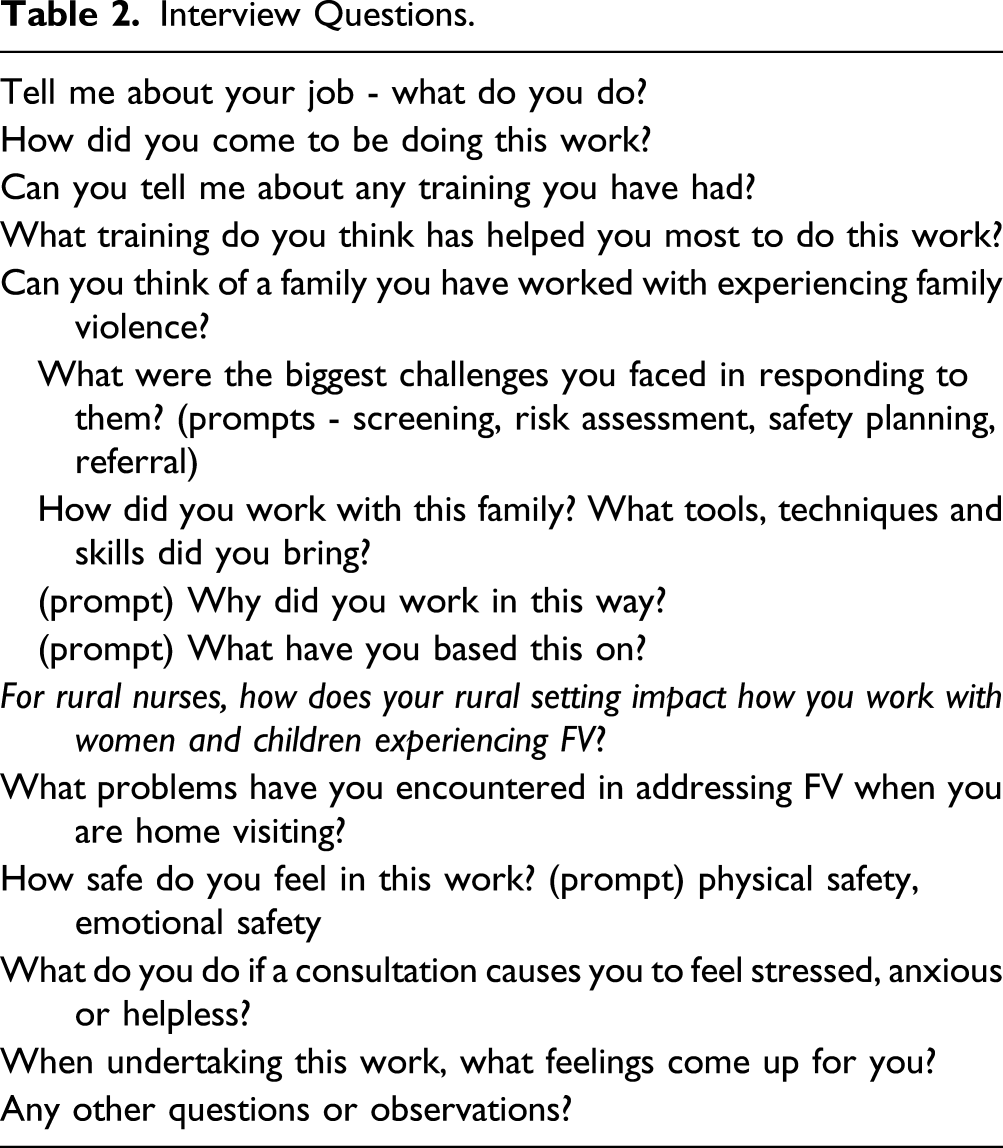
Most interviews were conducted face-to-face, with two by telephone, over 3 months in 2019/20. The interviews were digitally recorded and transcribed using NVivo Transcription (QSR International, 2020). The first author checked the transcriptions to ensure fidelity to the audio recording. Demographic information was collected; however, the participants' identities were not included in the data analysis. Nurses and clients have been given pseudonyms.
Data Analysis
Data derived from semi-structured interviews were analysed using reflexive thematic analysis, a six-phased process developed by Braun and Clarke (2006). The first author conducted and transcribed the interviews, so the content was familiar on first coding. The first author generated preliminary themes from the interview guide; inductive coding identified other themes. Using an NVivo codebook ensured consistent coding (QSR International, 2020), and the first and co-authors reviewed codes and interpretations over several iterations. The analysis focused on the nurses' exploration of their roles working with women experiencing abuse.
Reflexivity
Reflexivity involves making the research process a focus of inquiry and adds credibility to qualitative research (Carolan, 2003). As an insider researcher (Leslie & McAllister, 2002), the first author is known by nursing colleagues as a researcher who is also an MCH nurse and previous MCH nurse manager. The first author brings an insider’s understanding of nurses' language and terminology, work conditions, and the MCH and EMCH programs' professional and operational workings. Their connection to the field enables access to EMCH nurses and managers to facilitate participant recruitment and has guided the interview guide’s creation (Aronowitz et al., 2015).
Journaling has enabled rigour, reflection and self-awareness throughout the study, supported by frequent supervision and consultation with colleagues and supervisors. The journaling has framed an awareness of the researcher and the participants' social, personal and cultural contexts, enabling insight into how these contexts impact the ways we interpret our world (Etherington, 2004). This reflexivity has informed the research design, interviewing and data analysis. Journaling also enabled exploration of the role the researcher plays in the co-construction of the story. The researcher creates the context for the story-telling by deciding what will be investigated, formulating a research question, and selecting the participants, establishing whose story will be told (Murray, 2009). Methods to avoid possible role/ethical conflict included reinforcing to participants that the interviewer was acting in the role of researcher and not an MCH nurse.
Ethics
The research has been approved by the La Trobe University Human Ethics Committee (Ethics approval number 22227) and the Department of Health and Human Services (HHSD/19/129427). The joint approval ensures consideration of ethical issues, such as risk and safety, data storage and security, privacy and disclosure, and informed consent (Wang & Geale, 2015).
The interviewer (first author) is an experienced clinical supervisor and ensured that the nurses and nurse managers were provided with resources and support if they experienced any distress due to the interviews. Support services might have included the Nurse and Midwife phone support line, Employee Assistance Program or referral to family violence support services if the nurse became distressed by discussing a personal experience of family violence. Another member of the research team, an experienced EMCH nurse and clinical teacher, was available to take calls from participants to discuss their experience after the interview; however, this did not eventuate.
Findings
The nurses told stories about women experiencing family violence, reflecting on their various roles at different times. Analysis revealed the following threads of nursing practice: (1) Validating/Reframing; (2) Providing non-judgmental support/Safeguarding and (3) Following/Leading.
Validating/Reframing
Nurses understood their first responsibility was to validate the woman’s story. As Coral said, ‘They want to be listened to. I think that’s a huge thing. And believed. Yes, we get it’. Sharon reflected on the need to listen and wait, ‘I think sometimes they like to be heard but without the pressure to do anything. Because often, you know, it takes them a while to realize that they do need to leave and leaving is huge, isn’t it’? Working with women in rural locations, Cassie said, The mums are aware that their husbands are controlling and manipulative, but they're in positions where they've got a lot to lose … the mum could move out, but it will mean they have to sell the house, their car, and they don't want to go and live in a different wherever. (Cassie)
Nurses highlighted the importance of naming violent behaviours, especially when they are not physical, such as controlling behaviour. In these cases, the nurses validated the woman’s experience, listening carefully and with empathy, ‘listening, not judging’ (Penny) and ‘being present and having some empathy and understanding’ (Grace).
Beth told a story of a young woman (Asra) experiencing sexual and reproductive coercion. Beth recognised her vulnerability, as Asra came from a refugee background. Asra’s husband threatened her with deportation and the loss of her children if she did not comply with his demands. She had three children under 3 years of age, against her will. The woman was frightened, and she also carried the burden of cultural expectation, which led her to fear judgment from her community. Beth reflected, ‘… the thing that really worried me was that she didn’t see it as violence or marital rape. She just thought that was her culture. And that’s just something that happens’. Beth described how she validated the woman’s experience; however, she then reframed the story, ‘We spoke a little bit more about controlling behaviour. I just saw it wash over her face. That she came to realize - this is not OK’. Beth described what followed: So that was a really long visit. I stayed there for about two hours, and we spoke a lot about safety. I was trying to help her see the little escalations that had been occurring since the new baby came home. (Beth)
Beth’s reflected that her initial role in this scenario was to validate Asra’s story; however, she moved from validation to reframing and reflecting via a dynamic thread of nursing practice. The segue from validating to reframing enabled a discussion about risk and safety planning, assisting Asra to gain insight into the situation’s escalating danger, including the threat to her children and herself.
Nurses acknowledged the woman might not view her relationship as abusive or minimise the abuse, being in a pre-contemplation stage. Many nurses used the language of ‘stages of change’, affirming that a woman may be reluctant to disclose at different times. Coral spoke about how it felt when a woman did not disclose family violence, but the nurse suspected it. ‘They work hard not to disclose’. Milly also talked about knowing the boundaries of how far to go ‘when they don’t want to disclose. If they don’t want to, you can’t push them to it’.
By validating and then reframing behaviour as family violence, the nurse is helping the woman to explore what a respectful or healthy relationship looks like. In this way, nurses supported women to understand that they were experiencing family violence and then ‘helping them gradually walk that path’ (Amanda).
Beth witnessed and validated the young refugee woman’s story and reframed it to offer Asra a new perspective of her experience. Beth reflected that this was a pivotal moment for Asra, disclosing for the first time outside of her community and for the first time to a health professional. Beth’s initial role validating the woman’s experience developed when she reframed the story, enabling conversations about safety and risk along a dynamic thread of nursing practice.
Providing Non-Judgmental Support/Safeguarding
Nurses aimed to be non-judgmental in their response to women; however, they are also mandated to notify Child Protection services if they are concerned for a child’s safety. In the story above, Beth notified Child Protection, which had a negative impact on her relationship with Asra. Beth spoke about the delicate balance between ‘risk and relationship’. Another nurse, Nancy, reflected on moving between providing non-judgmental support and the nurse’s mandated safeguarding role and ‘keeping the child in mind’. ‘We need to be mindful of the children, their safety, and when we have to intervene’. Nurses spoke of a ‘holding space’, with the thread of practice becoming taut with increasing risk and responsibility.
Some nurses described strategies to influence the woman’s choices, such as highlighting the children’s risk and convincing them that change is needed. Betty recounted, ‘Often you can see the light bulb moment when you bring in the child and what might be happening for a child’. Nancy spoke of the challenge of maintaining engagement with the family and balancing that with concern for the child: And you should be non-judgmental, but the other thing is not to go too soft, just because you want to stay there. There's a bit of a balance there. Like you, you want to stay in. But, well, you know, this little child. This child is being neglected. Like it's all right for my colleague to say, "I think we need to go softly, softly". I would say, "I think we've gone softly, softly enough". (Nancy)
Nurses traversed professional and personal boundaries, caring for clients and worrying about them. As women moved through stages of change and sometimes remained in dangerous environments, nurses felt anxious about the risk to the woman and child. I can't watch the news anymore. If I hear of a mother or child that has been killed, I wait to hear what suburb, dreading it. Is that one of our clients? You're on high alert. And then I feel awful for feeling relieved that it's not one of ours. (Rachel)
Clinical supervision was often referred to as maintaining balance when stretching these taut threads of practice. I know when I was working as an enhanced nurse. It depends on how close the tears are to the surface. If they just started like that, I feel like they're just below the surface. I'm only just holding them in. And so that's where supervision is so critical. (Cindy)
Following/Leading
Nurses sometimes struggled to achieve collaborative practice, which respects and fosters the client’s strengths. A strengths-based perspective views the client as the expert in their experience, requiring a shift from the nurse as expert and ‘fixer’ to collaborator. When ‘walking beside the woman’, nurses spoke of starting with the woman’s priorities and having the woman determine her own pace. The nurses spoke of sometimes following, sometimes leading, but striving to accompany the woman on her journey. Doris spoke about ‘meeting the family where they’re at and hearing what they want … and that’s a moving target that changes’. Penny said, ‘I think probably it is more walking that journey … and getting them ready to make that next step’. Many nurses spoke in this way of ‘walking with’ or ‘walking beside’ families, using the language of a journey, ‘a journey that families cannot make quickly’ (Doris).
Zoe described a slightly different approach, where she sought to motivate a young woman towards change, leading her in the journey. She's a young mum of 22, and she's got three little children. And I actually knew her through my daughters. No, she didn't always admit violence. She said, oh, no, no, we're okay. But then you would hear back that he was being very violent, and then she would say, yes, things aren't good. But he had very much a hold on her. And basically, three babies later, she finally left him. But he still controls her by the phone, through the children, you know, because they organize picking up with the kids. So, he's still very much in control of her. (Zoe)
When asked about her role in this story, Zoe said, ‘to listen to her, and help her imagine a different future’.
Some nurses admitted to using strategies to motivate change in the woman, such as mentioning the impact on the children or speaking bluntly about the woman’s risk. Nurses recognised that using strategies to inspire change in the woman can be counterproductive, alienating the woman and causing her to disengage from the nurse relationship. Doris described the need for self-awareness, ‘It’s also about tuning into yourself and making sure that you’re not trying to rush the family’, and the challenge of holding back, letting the woman take the time she needs. Maintaining engagement and maintaining a rapport and maintaining that, you know, that connection with them whilst helping them slowly come around to that understanding. And it can be a really, long, slow walk. It can be frustrating and challenging. (Doris)
Other nurses in this study spoke of the patience required to walk with the woman, accompanying the woman on her journey. When the chaos gets overwhelming, some nurses will turn to fixing – ‘I’ve been in that house, and it’s just been putrid. I’ve taken the baby’s washing home, washed it, dropped it off the next day to them. It’s not just personality, it’s nurses, we help’. This impulse to ‘fix’ things harks back to an earlier biomedical model of nursing care – nurse as ‘expert’ and ‘fixer’. Zoe said, ‘I am much more of a hands-on person that really, really enjoys helping mums. To support families and just to make their life a little bit happier’. Suzie described one of her colleagues, ‘She was a great soldier of a nurse … if she needed something, you know, she was resourceful in getting what she needed (material aid for the client)’. However, Coral reflected on how a focus on ‘fixing’ can disempower the woman, increasing her sense of shame and dependence – ‘We want to get crackin' on those needs. And sometimes that’s the worst thing you can do’.
Nurses spoke of their frustration with the time-limited nature of the EMCH program, which is limited to 20 hours per family. They felt they had to focus their efforts on referral and safety planning and what could be achieved in a relatively short time. In contrast, the nurses reflected that the woman often sought continuity of relationship with the same nurse. The nurses spoke of needing to set boundaries with other agencies, ‘we’re not the police, we’re not the cavalry’, but also worried that the woman might ‘fall between the cracks’ when referring a woman to another agency. Nurses also noted that women might enter the EMCH program, be discharged and re-engage when their situation changes, in a revolving door of engagement/re-engagement.
Nurses highlighted the importance of letting the woman know that they can help when she needs it and that making a change may take time. Most nurses felt they could offer women appropriate responses, suitable to their readiness to disclose and accept support. This dynamic and sometimes tenuous thread of practice required patience, walking alongside the woman, requiring perceptive clinical judgment to assess risk and identify the need for guidance.
Discussion
This study is the first qualitative study to explore Australian EMCH nurses’ diverse roles in supporting women experiencing abuse. Women have different needs at different times, and the EMCH nurse’s role is necessarily dynamic in response. This study has identified threads of nursing practice, with nurses modifying the focus and nature of their work as the woman’s needs change. (Figure 1) Conceptual model: Threads of nursing practice.
Researchers argue that validation is the first element of the health care practitioner’s response to a family violence disclosure (Malpass et al., 2014). Health care practitioners must listen but also believe, acknowledge and validate the woman’s experiences (Bacchus et al., 2016; Spangaro et al., 2016; Tarzia et al., 2020). In this study, nurses did not hesitate to ‘call out’ coercive or controlling behaviours as family violence, understanding that emotional abuse is often a precursor to physical abuse (Taillieu et al., 2021). Nurses validated the woman’s experience but then moved along the practice thread to interpret and reframe the woman’s story. By reframing and offering a new perspective, nurses moved beyond validation to explicitly name perpetrator behaviour as violence, working with the woman to review her situation, assess risk and enhance safety.
Women subjected to family violence identify healthcare providers as professionals they trust with disclosure (García-Moreno et al., 2015; Kalra et al., 2021). Some healthcare professionals are reluctant to enquire about family violence, whether for systems-level issues, such as lack of time or resources (Sprague et al., 2012) or more personal barriers, such as lack of education or training programs (Eustace et al., 2016; Finnbogadóttir & Dykes, 2012; Hooker et al., 2020).
Our study confirmed that EMCH nurses aim to practice a woman-centred approach, supporting the woman to decide her pathway to safety (García-Moreno et al., 2015). Woman-centred practice entails the nurse listening to the woman with empathy, without judging, responding to her needs and concerns, validating her experience, enhancing safety, and providing support and follow-up (World Health Organization, 2014). A woman-centred response requires skilful personal communication skills to achieve a rapport that enables trust (Brijnath et al., 2020; Cuthill & Johnston, 2019; Goodman et al., 2016). The first time a woman discloses is a fragile moment, with the nurse needing to sensitively connect with the woman when she may be feeling shame.
Nurses moved along this practice thread – validating, interpreting, reframing and revalidating when new elements emerge. This dynamic response required reflective practice, and nurses valued clinical supervision as an opportunity to regulate and reflect on their role and ensure that their practice was responsive to the woman’s changing needs. Regular clinical supervision also supports the safety of the nurses undertaking emotionally charged work, enabling them to reflect on boundaries (Jarrett & Barlow, 2014) and provide increased self-awareness (Shea et al., 2019).
Women experiencing family violence need time, encouragement and ongoing support to enable disclosure (Hooker et al., 2020), including inquiring about their needs. Women appreciate ongoing, sustained engagement from their healthcare provider (Hooker et al., 2020), and increasing trust over time can improve disclosure and safety planning (Brijnath et al., 2020; Taft et al., 2015). Women want healthcare providers to be sensitive, compassionate, and non-judgmental and respect their decisions. They want an emotional connection and practical support through action and advocacy tailored to their changing needs (Tarzia et al., 2020). The development of a therapeutic nurse–client relationship, built on a foundation of acceptance, trust and strong rapport, is at the core of sustained home visiting programs with vulnerable populations (Duffee et al., 2017; Jack et al., 2016). This relationship may facilitate nurse home visitors' abilities to ask about family violence and other significant social issues and increase clients' comfort levels in disclosing family violence (Cuthill & Johnston, 2019; Jack et al., 2012). Nurses in this study affirmed other research findings that establishing rapport was an essential first step in identifying violence, leading to more effective support for women, including safety planning.
Nurses struggled with the dual role of providing non-judgmental support and surveillance. They used clinical supervision to explore this dynamic thread of practice, particularly their fear that the relationship with the woman would be undermined when they fulfilled the mandated role of reporting to Child Protection services. This mindful consideration of the multiple roles nurses fulfil is essential to safe, professional practice. Although nurses clearly understood the mandated requirement to make a child notification if there is a risk to the child and made notifications when required, they regretted losing trust when a notification was made. Nurses recognised that damage to the relationship between the nurse and the client could limit future disclosure of abuse, as described in other research (Davidov et al., 2012; Jack et al., 2021). Nurses spoke of balancing risk and relationship, traversing this practice thread as the woman’s situation changed and risk was reassessed.
For women experiencing family violence, decision making is not linear, and women report experiencing turning points on the journey brought about by internal and external influences (Chang et al., 2010). This nursing thread of practice is dynamic, with nurses responding to the woman’s readiness to make decisions about her life. By listening to the woman closely, with empathy, without judging, nurses can offer women appropriate responses, suitable to the woman’s readiness to disclose and accept assistance. However, nurses in the study often spoke of their concerns for the woman’s safety and worked with the woman to enhance her safety by identifying a safety plan. They highlighted the importance of supporting the woman in reaching higher stages of change when she was ready, such as contemplation when the woman identifies and labels her experience as abuse, or preparation where the woman may enact change (Reisenhofer et al., 2019).
For women who disclose and are not ready to act, informational support is most effective, coupled with emotional support (Jack et al., 2021). Nurses are in a position of privilege with the women, and EMCH nursing work requires reflective practice, acknowledging this imbalance of power. Attempts to motivate the woman to change, although well-intentioned, can be interpreted by the client as coercive or threatening and may be counterproductive, alienating them and causing them to disengage from the EMCH program (Janczewski et al., 2019; McTavish et al., 2019).
Practice Implications
There are practice implications for each of the nursing practice threads – validating and reframing, following or leading, and providing non-judgmental support while also safeguarding. Nurses aspire to fulfil the breadth of these roles; however, there are limitations imposed by the EMCH program, which does not enable nurses to engage with women over a more extended period. Research is needed to evaluate this short-term home visiting program’s efficacy, compared with longer-term sustained home visiting programs, for which there is an evidence base.
Nurses need regular practical training in active listening to enable more effective validation and reframing of the women’s stories. This thread of practice requires insight and the ability to reframe the woman’s story in culturally safe and accessible language. High-level communication skills and culturally safe practice requires ongoing training and supervision.
Personal and clinical skills training in woman-centred practice will enable the nurses to work with the woman to identify and achieve goals. The skills to accompany the woman on her journey, without leading or following, needs regular access to quality clinical supervision, so the nurse can explore her practice, ensuring it is woman-centred and not dominated by the nurse’s priorities. Clinical supervision is also critical to allow the nurse to explore the tension between providing non-judgmental support for the woman and safeguarding the child.
The new EMCH program guidelines (Department of Health and Human Services, 2019a) introduced around the time of these interviews address some of the old program’s limitations by developing a systems model approach that better supports nurses to undertake family violence work. The new guidelines articulate the scope of the EMCH program, the model of care and program delivery. More work is needed to integrate the program administratively, such as safely incorporating the Family Action Plan as a living document into the clinical documentation tool.
Confidence to screen for family violence and support women experiencing abuse increases with regular up-to-date education and training in family violence practice (Hooker & Taft, 2021). There is a correlation between the number of hours and recency of MCH nurses’ training and feelings of being well prepared to complete family violence work (Hooker et al., 2021). Research has found that some rural nurses feel less confident undertaking family violence practice, with fewer referral options (Hooker et al., 2021). Developing a model of care for rural nurses that takes account of the reduced access to specialist family violence services may improve clinical practice and reduce stress on nurses.
Attention needs to focus on improved clinical guidance, referral pathways and collaborative engagement with other services that can support a longer-term view of the woman’s experience.
Strengths and Limitations
This study has been strengthened by interviewing 25 nurses with diverse experiences and backgrounds, from rural and urban Local Government Areas, working in advantaged and disadvantaged areas. The nurses had the opportunity to speak fully of their experiences, with interviews averaging 45 minutes.
Most nurses knew the interviewer, which could be viewed as both a strength and a limitation. This relationship may have introduced an element of social desirability bias. Instead of choosing responses that reflect their true feelings, nurses may have given more socially desirable answers (Grimm, 2010). However, the heterogeneity of responses would indicate that the nurses spoke frankly from their perspective. The nurses appreciated that their responses would be reported anonymously, as they wanted to be truthful in their answers without fear of recrimination.
Conclusion
This study examined how EMCH nurses in Victoria, Australia, encounter the clinical presentation of family violence. The nurses highlighted the diversity of experiences for women experiencing family violence and the range of roles in family violence nursing practice. Nurses identified the personal and professional challenges working with women experiencing family violence, describing dynamic threads of nursing practice.
This research contributes to our understanding of Australian families experiencing additional challenges and how to support those experiencing family violence. The insights gained from this interpretive description approach may inform the development of clinical roles, nurse education and skill development, and clarify professional boundaries and supports to improve the experience of EMCH nurses working with families and improve outcomes for women and children.
Footnotes
Acknowledgements
The National Plan to Reduce Violence against Women and their Children is dedicated to the countless women and children who are victims and survivors of violence, to those who are left to rebuild, and to those who have lost their lives. It is for the women whose stories continue to inspire our work and drive us to do more. (Department of Social Services, 2019, p. 4). We want to thank the nurses who participated in this study and their work with families. We also wish to acknowledge the work of anonymous peer reviewers and editors whose comments and suggestions helped improve and clarify this manuscript.
Declaration of Conflicting Interests
The author(s) declared no potential conflicts of interest with respect to the research, authorship, and/or publication of this article.
Funding
The author(s) received no financial support for the research, authorship, and/or publication of this article.
