



Abstract
Introduction
Brucellosis is one of the most prevalent infectious diseases in the world that infects humans directly through contaminated livestock or indirectly through animal products and induces high medical and economic damage annually.
Objective
Using geographic information system (GIS) software to determine the hot spots of brucellosis and the spatial correlation and type of disease distribution.
Methods
We extracted the incidence cases of the disease from 2016 to 2020 in this retrospective cross-sectional study using the disease registration system of Ardabil University of Medical Sciences. The interpolation method (IDW) was employed for spatial analysis and disease distribution and determination of hotspot points, Moran I and General G analysis were used to determine spatial autocorrelation at a significant level (P < 0.05). GIS software 10.4.1 was applied to determine areas.
Results
2679 cases of brucellosis were diagnosed in the province during the study that 96.97% were Iranian, 2.95% Azerbaijani, and 0.08% were Iraqi. 40.5% of patients were female and 59.5% were male. The highest number of infected cases was reported in 2020 with 29.2% and the lowest number was reported in 2016 with 16%. Rural areas had a high prevalence in terms of distribution and the north of Aslanduz and the central part of Sarein were determined as two significant rural areas of the disease. The trend of disease was increasing from east to west of the province.
Conclusion
Brucellosis is very widespread in rural areas in Ardabil Province. Ardabil University of Medical Sciences is required to take practical and educational measures to control this disease in high-risk centers. It is expected to take measures in order to educate villagers.
Introduction
Brucellosis is one of the most prevalent zoonosis infectious diseases in the world that infect humans directly through contaminated livestock or indirectly through animal products and induces high medical and economic damage annually. 1 Brucellosis is caused by a pathogenesis agent that is a small, Gram-negative aerobic, immobile, capsule-free, capsule-free, bacillus called Brucella that six species have been identified so far 2 and two species are very prevalent in Iran: Brucella melitensis and B. abortus. 3 The incubation period of this disease is 1–2 months, which is followed by extended fever, body aches, night sweats, general weakness, and arthralgia. 4 Consuming raw milk or unpasteurized cheese infected with a bacterial agent and to some extent, contact with infected animals transmit human infections. 5 Farmers, shepherds, slaughterhouses, butchers, and veterinarians have been considered high-risk professions. 6 The disease is detected in many parts of the world, but the Mediterranean region, Arabian Peninsula, Indian subcontinent, and parts of the central and southern United States reported the highest cases.7,8 Iran reports the mean prevalence rate of the disease as 21 per 100,000 people, but the prevalence of the disease has been reported from 1.5 to 107.5 per 100,000 people in different geographical regions.9,10 Brucellosis is one of the most prevalent zoonotic diseases that causes more than 611 deaths and its yearly mortality rate is nearly 971,000 people. 11 This disease is still endemic in Iran. Iran has the fourth rank in the world and first rank in the Eastern Mediterranean region in terms of Brucellosis outbreak.12,13 There are some new methods to identify the high-risk locations for outbreak of the disease such as using geographic information system (GIS) software that can help to manage the disease, develop preventive plans, and control the diseases by providing a map of disease distribution, determining the spatial-temporal correlation, and determining the disease hotspots.14,15 We used GIS software to determine the prevalence of Brucellosis in one of the endemic provinces of Brucellosis in northwestern Iran. In this study, the GIS software was applied to determine the hot spots of the disease and the spatial correlation and type of disease distribution.
Material and Methods
Studied Area
Ardabil province is located in the northwest of Iran which has geographical coordinates of 47.8911°E and 38.4853°N. This province is a mountainous region with cold and snowy winters and moderate summers and most people operate in the livestock and agriculture fields (Figure 1). According to the announcement and the statistics of Iran's Health Ministry and Medical Education, Ardabil province is one of the provinces with a high prevalence of Brucellosis (unpublished).
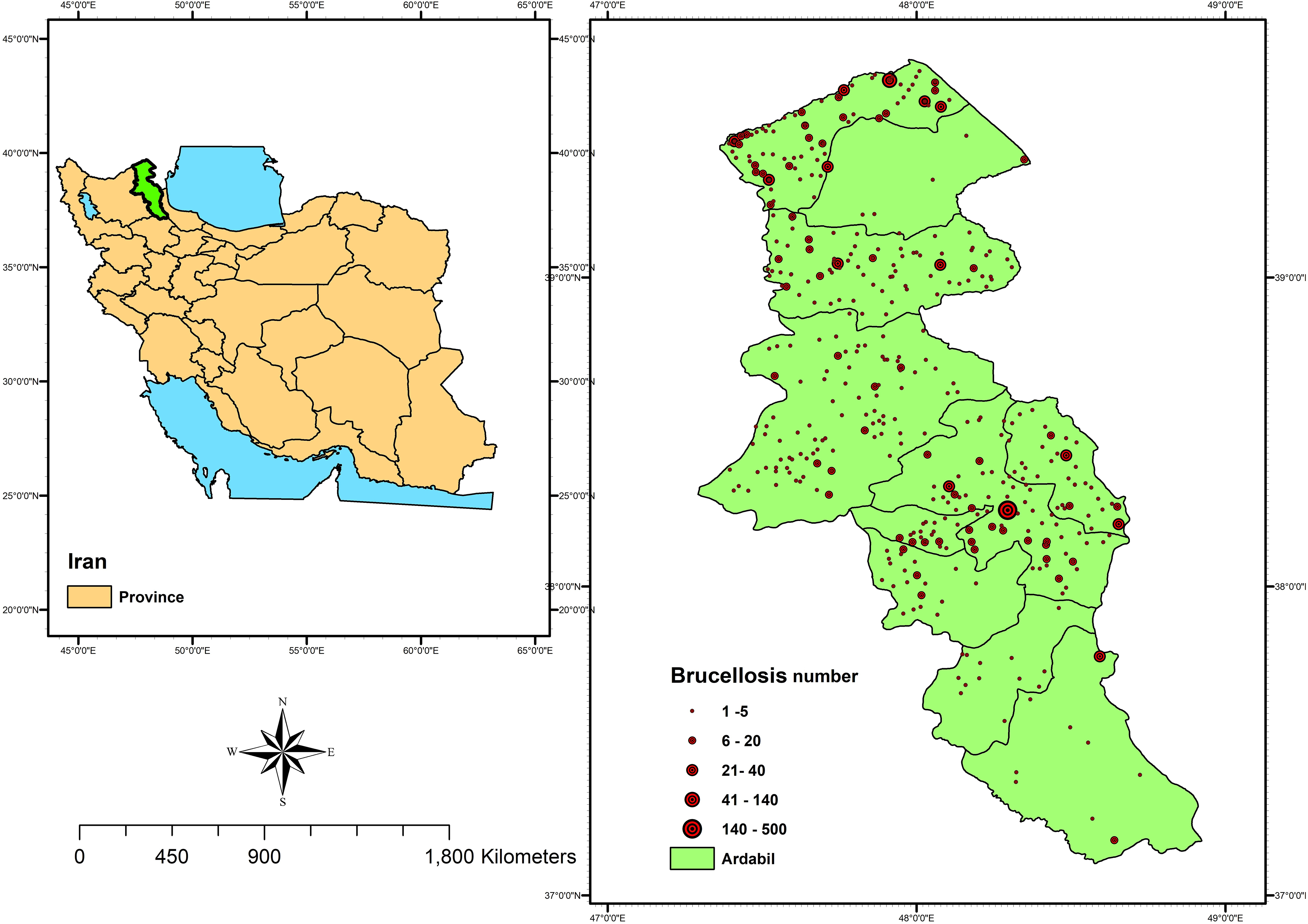
Frequency and distribution of Brucellosis in Ardabil province, Iran (2016–2020).
Statistical Analysis
This study was a retrospective cross-sectional research and we extracted the cases of the disease from 2016 to 2020 from the Brucellosis disease registration system of Ardabil University of Medical Sciences and studied them in terms of annual prevalence. The interpolation method (IDW) specialized for mountainous regions was employed for spatial analysis and disease distribution and determination of hotspot points, and Moran I and General G analysis were used for spatial autocorrelation at a significant level (P < 0.05).To determine the regions with higher and lower clusters of the disease, the following formula was used to calculate them. All these processes were performed by applying GIS 10.4.1 software (Esri, Redlands, CA, USA).

Ethics Approval and Consent to Participate
The study was approved by the Ethics Committee of Ardabil University of Medical Sciences (IR.ARUMS.REC.1398.351). Permission to conduct the study was obtained from this committee and all patients had signed an informed consent form and all methods were performed in accordance with the relevant guidelines and regulations by including a statement in the Ethics approval.
Results
Epidemiological Factors
2679 cases of brucellosis were diagnosed in the province during the study that 96.97% were Iranian, 2.95% Azerbaijani, and 0.08% were Iraqi. 40.5% of patients were female and 59.5% were male. The highest number of infected cases was reported in 2020 with 29.2% and the lowest number was reported in 2016 with 16% which indicates that the incidence of brucellosis has increased significantly in recent years. This disease increases from May at the same time as the birth of livestock and approaches its maximum rate in August (Figure 2).

The monthly frequency of Brucellosis cases in Ardabil province, Iran.
Spatial Analysis
Distribution
All 10 counties of the province were infected with brucellosis and Ardabil country with 37.3% had the most cases during the study and Khalkhal and Kowsar with 0.4 and 0.5%, respectively, had the lowest rate. 69.2% of patients lived in rural regions, 24.5% in urban, and 6.3% in nomadic regions.
Hot Spots
The results of IDW interpolation analysis explain that there are two hotspot regions in Ardabil in terms of the prevalence of Brucellosis. Aslanduz country is a high-risk region in the north of the province and its risk of infection is between 13 and 15%. There is a small hot spot in the center of the province in Sarein with the risk of infection of 11–13.5%. Studying the disease trend in the province reveals that the regions that ended in the East Azerbaijan province have a high disease trend, which includes the central parts of Aslanduz, Ingot district of Garmi, Moradlu, and central districts of Meshkinshahr that are regions with high-risk of disease prevalence (Figure 3).

Trend and inverse distance weighting (IDW) results of brucellosis diseases in Ardabil province, Iran.
Spatial Correlation
The results of spatial correlation by Moran I (0.0900) and General G high/low clustering method (0.0821) additionally indicate that the disease distribution has a significant clustering and high clustering pattern, respectively (Figure 4 and Table 1).
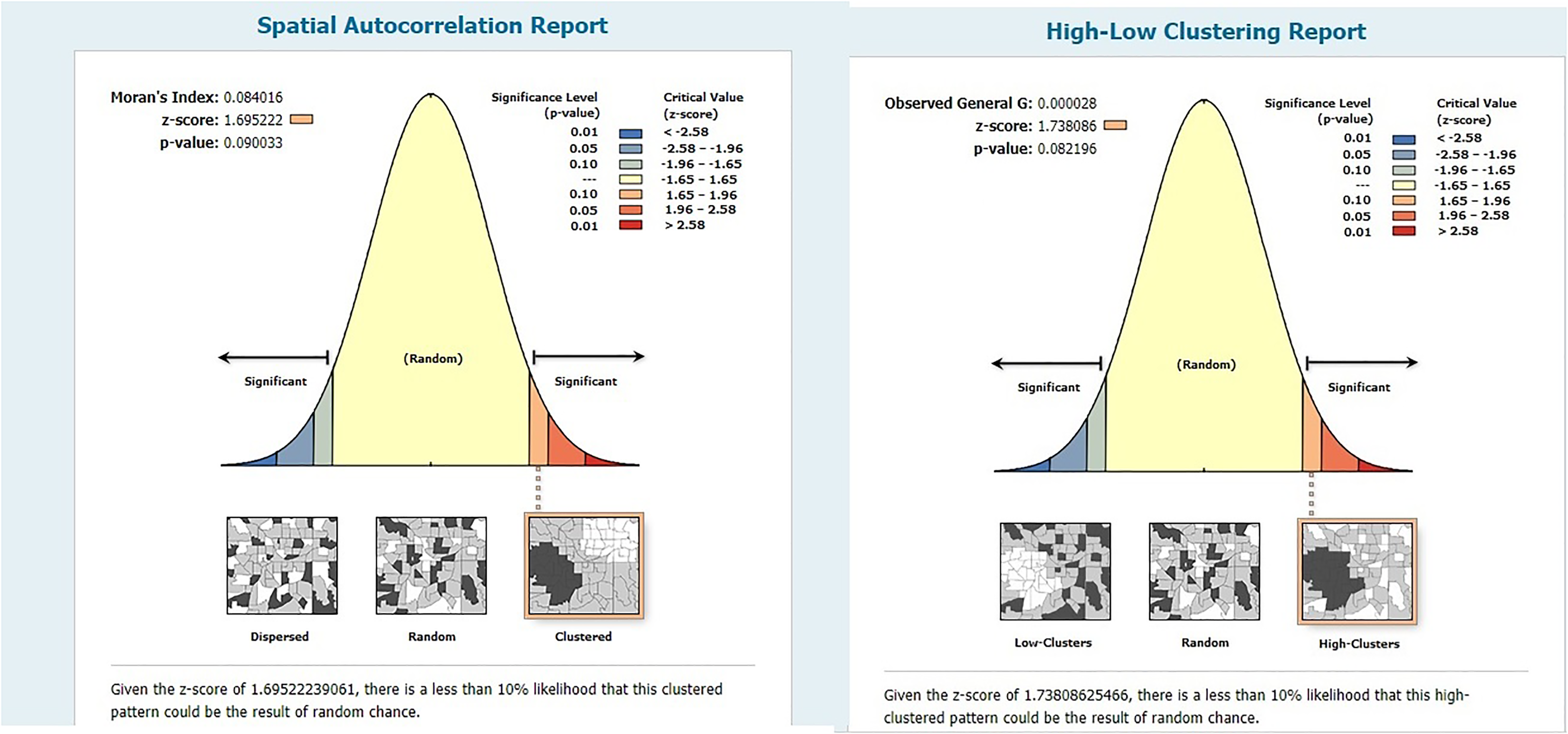
Moran's I autocorrelation and general G factor analysis of Brucellosis cases in different counties of Ardabil province, Iran.
The results of hot-spot and autocorrelation analysis of Brucellosis in Ardabil province Northwest of Iran.

Discussion
Brucellosis is one of the most common zoonotic diseases in Iran. Medical services have increased and improved in recent years, but 2679 patients have been reported during the study period in Ardabil province located in the northwest of Iran which is increasing. Men with 59.5% reported the highest incidence of Brucellosis in this study, which was similar to the results achieved by various studies, including studies conducted by Sadeghian et al. in 2019 16 and Deno et al. in 2010 17 have reported that men have the highest incidence rate. Most of the men in Ardabil work in animal husbandry or in butchers and slaughterhouses, 18 hence, they are threatened with more risks in terms of facing livestock, accordingly, men are more prone to be infected with zoonotic diseases such as Brucellosis. We observed most cases in June through August. In general, spring and summer have the highest cases of the disease and the lowest cases were observed in fall and winter. Spring and summer have the most breeding and lactation in livestock and of course, producing livestock and dairy products and the amount of contact with livestock is higher in these seasons, consequently, these seasons have the most cases of the disease. This is in agreement with the findings achieved by many other researchers.19,20
Rural regions had more than 69% of patients with Brucellosis in Ardabil province. Accordingly, we can state that Brucellosis in this province causes a problem in rural areas. Villagers’ lifestyles who operate in animal husbandry and agriculture and also direct contact with livestock, consuming dairy products that are traditionally prepared by themselves show that it is normal to observe the most cases of the disease in rural regions.21,22 There were more than 85% of infected cases in rural regions in Arak, which is much higher than the results achieved by this study, 23 and Isfahan's rural regions also showed the highest number of cases, so the incidence of the disease in the rural population had been about 10 times of the urban population. 19 The results of additional studies in the world prove that a direct relationship is observed between the country's livestock population and their infection with human disease in many countries.24,25
Spatial analysis of brucellosis revealed that the disease had a spatial nature and was distributed in clusters in the northwest of the studied region. Previous research also reveals the cluster distribution of Brucellosis in Iran and other parts of the world. 26 The results achieved by interpolation analysis of brucellosis in this study explained that there are two important centers of the disease in the province, both located in rural regions in the north and center of the province. The north of Aslanduz is the most dangerous center in terms of Brucellosis infection transmission with the risk rate of infection transmission between 13.5% and 15%. This center is a region with high and more traditional animal husbandry and 50% of the inhabitants are nomads with many livestock. Other studies, including studies conducted in China 27 and the Republic of Azerbaijan, 28 have revealed that high-risk centers in terms of diseases have a direct relationship with the number of cattle kept in the region and depend completely on the job. The east to west of the province has an increasing trend of incidence of Brucellosis, which needs health and educational interventions in these areas.
Conclusion
Brucellosis is very widespread in rural areas in Ardabil and two significant rural hot spots of the disease were identified in the north of Aslanduz and the central district of Sarein. Because of our findings, we recommend that Ardabil University of Medical Sciences take practical and educational measures to control this disease in these two regions. As the results of this study explain, there is a higher incidence trend of the disease in the areas with the common border with East Azerbaijan province, therefore, coordination with Tabriz University of Medical can be a useful strategy to prevent the spread of the disease. Moreover, since brucellosis is a zoonotic disease, the animals should be vaccinated against this disease to perform veterinary measures areas.
Footnotes
Acknowledgements
The authors thank Ardabil Health Central and all hospital staff for enabling this study.
Data Availability Statement
The datasets generated and/or analyzed during the current study are not publicly available due to the Ethics Committee of Ardabil University of Medical Sciences restrictions but are available from the corresponding author upon reasonable request.
Declaration of Conflicting Interests
The author(s) declared no potential conflicts of interest with respect to the research, authorship, and/or publication of this article.
Funding
The author(s) disclosed receipt of the following financial support for the research, authorship, and/or publication of this article: This work was supported by the Ardabil University of Medical Sciences (grant number 238).
