




Abstract
What we already know
South Korean government announced a shift in COVID-19 control measures to “living with COVID-19” starting November 2021, making various efforts to return to daily life.
What this article adds
The South Korean government may have invested much effort in reducing COVID-19 phobia, but it has not adequately addressed psychological phobia
The South Korean government should thus focus on reducing psychological phobia.
Introduction
The first case of COVID-19 was reported in Wuhan, China, in December 2019, and was declared a global pandemic in March 2020 by the World Health Organization (WHO).1,2 In South Korea, the first confirmed COVID-19 case was reported in January 2020, and over 17 million confirmed cases have been reported as of May 2022. This represents approximately 32% of South Korea's population (51.78 million); even considering duplicate cases, one out of four South Koreans has been infected. 3
In 2020, South Korea was lauded for its early success in containing COVID-19 through drive-thru testing, self-isolation, telecommuting, and volunteering by healthcare workers, all without any city lockdowns.4–6 Other containment strategies included mandatory indoor and outdoor mask-wearing; limiting the number of persons at private gatherings; restrictions on store hours; online classes for primary, secondary, and high schools; and social distancing.7,8 Despite these policies, South Korea faced a fourth wave of COVID-19 in March 2022. The number of new monthly cases that month represented a 46.3-fold increase from 214 858 in January 2022 to 9 960 904 in March 2022. 3 As COVID-19 continued to spread, South Koreans experienced various adverse social effects, such as COVID-19 fear, depression, and loneliness.9–12 COVID-19 phobia was identified as a significant cause of stress, depression, and loneliness; identifying and responding to the associated factors were considered necessary steps for maintaining mental health during the pandemic. 13 People accumulated knowledge and information about COVID-19 for their own COVID-19 prevention efforts, as well as for taking a defensive attitude toward COVID-19 and complying with prevention practices. 14
When South Korea surpassed a 70% vaccination rate in November 2021, the government announced a shift in COVID-19 control measures to “living with COVID-19” including plans for phased relaxation of limitations on personal gatherings and normalization of returning to work and school encouraging the return to daily life and including plans for phased relaxation of limitations on personal gatherings and normalization of returning to work and school. However, the beginning of the fourth wave in March 2022 halted this shift. Many have voiced concerns about the government's phased implementation of the “with COVID-19” policy. The WHO announced that the COVID-19 pandemic would continue until less than half of the world's population had been infected. Based on this announcement, various research organizations and professional groups are opposing the COVID-19 mitigation policy. 15 A high vaccination rate is critical to the success of the “with COVID-19” policy's effectiveness, but with the continued emergence of new variants, it is challenging to keep up with effective vaccines.16,17
Moreover, implementing “living with COVID-19” will lead to increased social activities of asymptomatic patients among the younger population, and a sharp increase in COVID-19 spread is anticipated. 18 Since the government views the younger population as a potential risk factor for the “with COVID-19” policy, college students have varying opinions on whether the government should ease its COVID-19 policy. According to a recent mobile survey of 2159 college students in October 2021, the percentage of students who responded that they were “concerned about” or “looking forward to” the advent of “with COVID-19” were similar at 47.7% and 52.5%, respectively. 19 The primary reasons for agreeing with easing the COVID-19 policy were quality of classes, expectations about college life, and socializing with friends. The primary reason for disagreeing with easing the policy was fear of being infected with COVID-19.20,21 As one of the factors that influenced the younger generation's positive or negative view of the COVID-19 policies, COVID-19 phobia has a direct and indirect impact on COVID-19 knowledge, attitude, and prevention practice.21–23
For the government to successfully implement its “with COVID-19” policy, factors such as profiles of different age groups, sociocultural factors, and local healthcare environments must be considered. In particular, agreement or disagreement with the policy among the younger population, who are at risk of being asymptomatic patients, is likely to significantly influence the spread of the virus. Therefore, identifying the factors associated with agreement or disagreement among the younger population is necessary so that the government can consider these findings when implementing the “with COVID-19” policy.
The objective of the present study was to identify agreement/disagreement with the government's COVID-19 mitigation policy among South Korean college students and its correlation with COVID-19 phobia, knowledge, attitudes, and practice to better understand their impact on government policies.
Method
Study Design
The present study was a cross-sectional study designed to identify the impact of COVID-19 phobia, knowledge, attitudes, and practice on agreement/disagreement with government COVID-19 mitigation policy among South Korean college and graduate students. The survey period was between April 5 and 16, 2022, and the study population consisted of undergraduate and graduate students currently attending university in South Korea (Supplementary Figure 1).
Data Sample and Data Collection
The minimum sample size for the survey was calculated using G*Power 3.1, with an F test, multiple linear regression analysis with nine independent variables, 95% confidence interval, and 5% error range. The calculation result showed that the minimum sample size needed for the study was 172. The survey area was the entire South Korea, and respondents were balanced by region.
With the ongoing fourth wave of COVID-19 in South Korea, the survey was conducted online for efficiency and to prevent viral spread. Due to the nature of online surveys, a nonprobability sampling method was used, and the participants were sampled by convenience sampling. A Google form was used for the online survey. A URL for the survey was sent to candidates to request their consent and inform them of how to participate in the survey. Those who took part in the survey shared the URL with others to continue the survey by snowball sampling. For this survey, we sent the survey URL to approximately 700 students, and we analyzed the data from 460 students who provided normal responses, resulting in a response rate of 65.7%.
Study Instrument
The survey instrument for the present study was developed to investigate the impact of COVID-19 phobia, knowledge, attitudes, and practice on agreement/disagreement with the COVID-19 mitigation policy among South Korean college and graduate students. To measure agreement/disagreement with the COVID-19 mitigation policy, which was set as the dependent variable, the response to the question “Do you agree with the government's COVID-19 mitigation policy?” was coded as “No (0)” or “Yes (1).”
The latent variables were COVID-19 phobia, knowledge, attitude, and prevention practice. COVID-19 phobia was measured using the COVID-19 Phobia Scale (C19P-S). 24 C19P-S is an instrument consisting of a total of 20 questions with 100 possible points, covering COVID-19 phobia in four domains: Psychological—six items (30 possible points); Psychosomatic—five items (25 possible points); Social—five items (25 possible points); and Economic—four items (20 possible points). The reliability and validity of C19P-S have been verified for South Koreans.25,26 The other latent variables (COVID-19 knowledge, attitude, and practice) were measured using the COVID-19 knowledge, attitude, and practice (KAP) scale. The COVID-19 KAP scale consisted of six, three, and four items, respectively.
Four healthcare experts constructed the questionnaire through meetings based on the verified indicators above. The final version of the questionnaire was completed by testing the reliability and validity of the instrument through a pilot study conducted on 36 participants.
Statistical Analysis
Analyses of the sociodemographic characteristics of the participant and descriptive statistics of the major measurement variables, along with exploratory factor analysis (EFA), were performed using IBM SPSS 26. For the EFA model, Cronbach's α was used to identify the reliability of the observed factors. Moreover, principal component analysis (PFA) of observed factors was used, and varimax rotation, an orthogonal rotation method, was used. Sample accuracy was identified by the Kaiser–Meyer–Olkin (KMO) measure of sampling, while the goodness-of-fit of factors were identified using Bartlett's test of sphericity.
The study model and path analysis of structural equations were verified using AMOP 26.0. Maximum likelihood (ML) estimation was used as the model estimation method, while analysis was performed using bootstrapping (B-S). B-S was performed with 2000 iterations of sampling, with replacement under a 95% confidence interval.
The absolute fit measure assessed the goodness of fit (GoF) of the study model, incremental fit measures, and the Hoelter index, using χ2 statistics, the GoF index (GFI), root-mean-square residual (RMSR), and root-mean-square error of approximation (RMSEA) as absolute fit measures and the Tucker–Lewis index (TLI), normed fit index (NFI), and comparative fit index (CFI) as incremental fit measures. Moreover, Hoelter's statistic was used with a significance probability of 5% and a significance level of 1% to test the adequacy of the sample size.
Ethical Considerations
All components of this survey were approved by the institutional review board (IRB) of Yonsei University (IRB document number: 1041849-202204-SB-078-01). Written informed consent was obtained from all respondents prior to data collection. In particular, we drew attention to respondents’ right to refuse the survey request on the first page of the online survey form.
Results
Demographic Characteristics of Participants (n = 460)
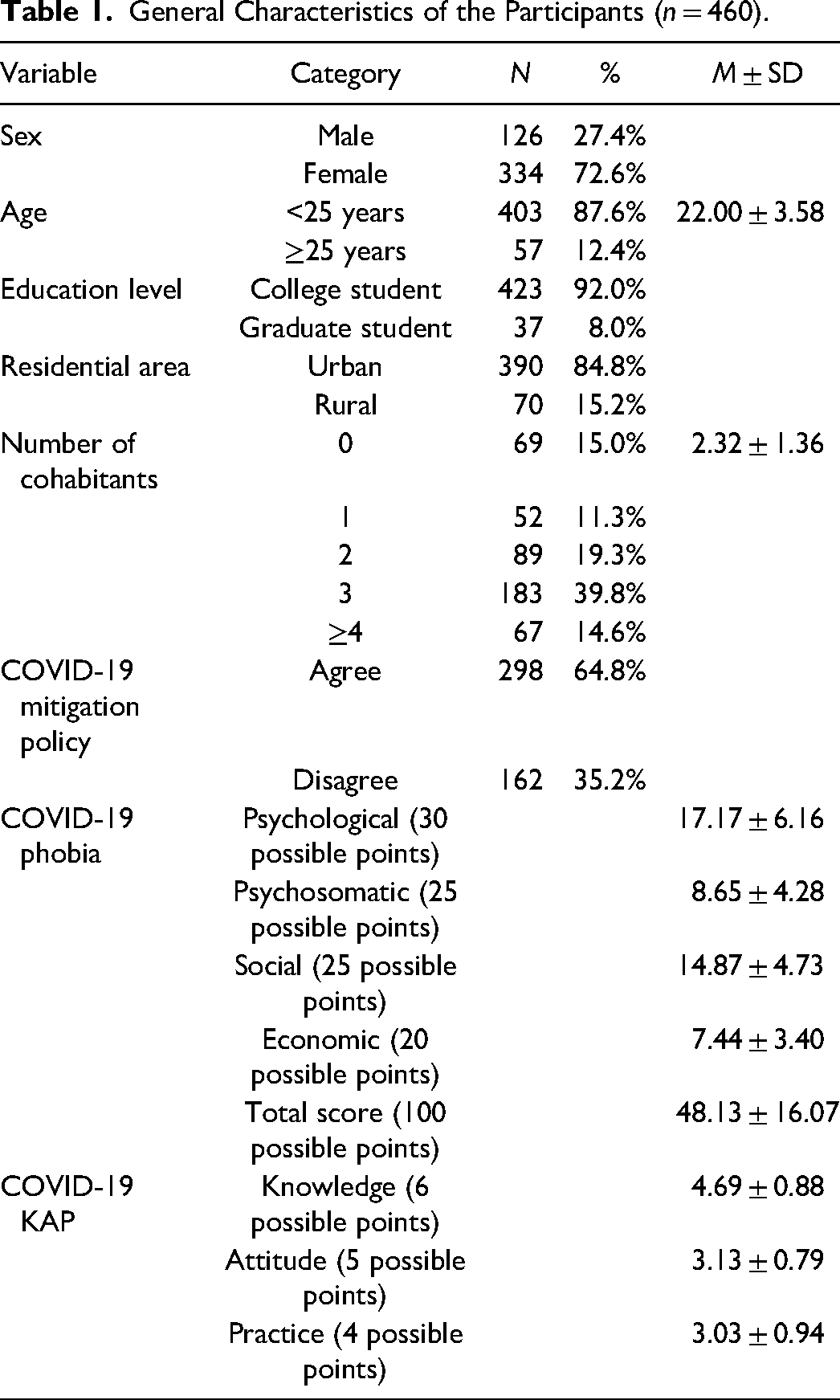
Respondents included 334 women (72.6%) and 126 men (27.4%), and their mean age was 22 years. Among them, 423 (92.0%) were college students and 37 (8.0%) were graduate students (Table 1). More respondents lived in urban areas (84.8%) than rural areas (15.2%). Sixty-nine respondents (15.0%) lived alone, and the mean number of cohabitants was 2.32. An overall 64.8% of respondents approved of easing in the COVID-19 policy. Measurement of COVID-19 phobia using the C19P-S showed a mean score (±SD) of 48.13 (±16.07) out of 100 points. The mean COVID-19 KAP scores were 4.69 (±0.88) out of 6 points, 3.13 (±0.79) out of 5 points, and 3.03 (±0.94) out of 4 points, respectively.
General Characteristics of the Participants (n = 460).
Reliability and Validity of Valid Factor Analysis
Cronbach's α, KMO, and Bartlett's test of sphericity were used for the validation of factor analysis for the latent variables (COVID-19 phobia, KAP) (Supplementary Table 1). The latent variable (COVID-19 phobia) consisted of four domains, with Cronbach's αs of .863, .850, .789, and .808 for the psychological, psychosomatic, social, and economic domains, respectively. The KMO was .863, .850, .758, and .751 for the psychological, psychosomatic, social, and economic domains, respectively. Moreover, the four domains of COVID-19 phobia showed Bartlett's significance level of ≤5%.
With respect to COVID-19 KAP, Cronbach's α was .685, .629, and .435, respectively, and the KMO was .575, .570, and .636, respectively. Moreover, the COVID-19 KAP showed a Bartlett's significance level of ≤5%.
Goodness-of-Fit of Structural Equation Model
To test the GoF of the structural equation model, CMIN, GFI, RMR, and RMSEA were used as absolute fit measures, and TLI, NFI, and CFI were used as incremental fit measures. The Chi-square of CMIN was 2306 (p < .001), while CFI, RMR, and RMSEA were .755, .306, and .088, respectively. For incremental fit measures, TLI, NFI, and CFI were .651, .610, and .683, respectively. Hoelter's test for adequacy of sample size for the structural equation showed a minimum sample size of 112 and 117 at a significance level of 5% and 1%, respectively.
Structural Equation Model
For estimation of structural equation path analysis, the present study used ML estimation with 2000 iterations of B-S resampling (Table 2).
Path Estimates for Research Model by ML and B-S Bootstrap.

*<.05.
**<.05.
***<.001.
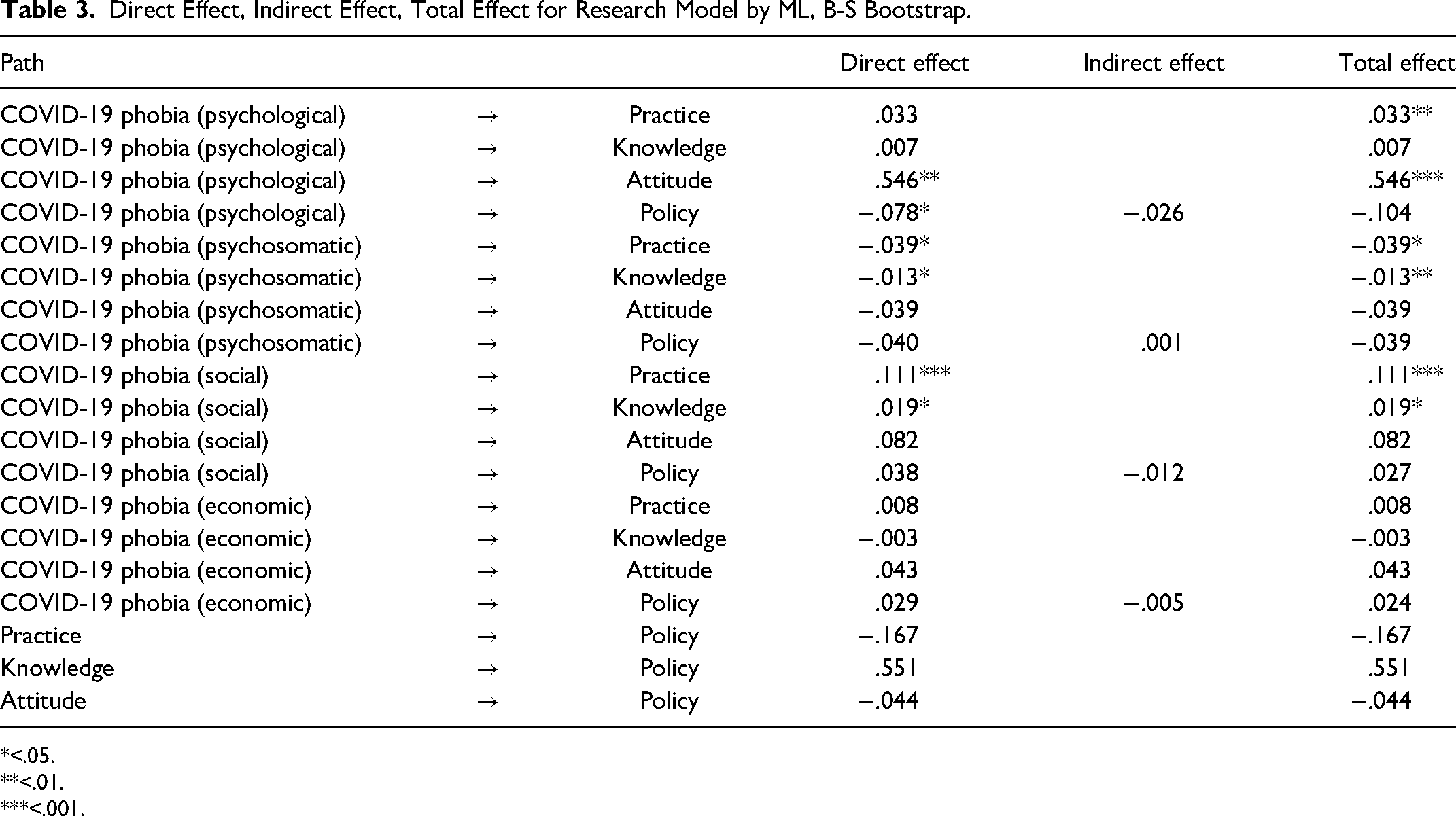
For COVID-19 phobia (psychological) PH_1, COVID-19 practice (β = .033, p < .05) and COVID-19 attitude (β = .546, p < .001) appeared as significant paths. Moreover, for COVID-19 phobia (psychosomatic) PH_2, COVID-19 practice (β = −.039, p < .001) and COVID-19 knowledge (β = −.013, p < .01) appeared as significant paths.
The impact of COVID-19 phobia, KAP on agreement/disagreement with the COVID-19 mitigation policy was checked by direct, indirect, and total effects (Table 3). The results showed that COVID-19 phobia (psychological) had a significant direct effect on agreement/disagreement of −.078 (p < .05).
Direct Effect, Indirect Effect, Total Effect for Research Model by ML, B-S Bootstrap.
*<.05.
**<.01.
***<.001.
Discussion
The objective of the present study was to identify the impacts of COVID-19 phobia, KAP on agreement/disagreement with the government COVID-19 mitigation policy among South Korean college and graduate students during the fourth wave of COVID-19, as the South Korean government was implementing the “with COVID-19” policy by gradually easing COVID-19 prevention measures, such as those mandating or promoting social distancing, quarantine pass, restrictions on store hours, telecommuting, and online classes.
Given the spread of COVID-19, the survey was conducted online. With respect to the characteristics of the participants, there were more women (72.6%) than men (27.4%). This may be because most participants belonged to departments that traditionally have more female students. A study that surveyed 1003 respondents in April 2022 reported that 69.0% of the respondents approved the easing of the policy, which is similar to the present study's findings. 27
The mean COVID-19 phobia score was 48.13 out of 100 possible points, similar to the score reported in another study using the C19P-S for Koreans.24–26 Calculation of Cronbach's α and test of sphericity results confirmed that C19P-S was a valid scale for college and graduate students, who were the respondents in the present study. Compared to another study that investigated C19P-S for Koreans, the mean COVID-19 psychological and social phobia scores in this study were 17.17 and 14.87 points, respectively, which are higher than those in existing research. Such findings could be attributed to increased psychological and social phobia during the fourth wave of COVID-19 where daily confirmed cases exceeded 400,000. The mean psychosomatic and economic phobia scores were 8.65 and 7.44, respectively, which were lower than in previous studies. Economic phobia may have been lower than in previous studies because the respondents in the present study were students, most of whom do not participate in economic activities in South Korea. 24
Structural equation results showed that COVID-19 practice, which includes avoiding crowded places, wearing masks, ventilating indoor spaces, and social distancing, increased significantly when COVID-19 psychological phobia increased (β = .033, p < .05). According to one study, an increase in COVID-19 phobia, particularly psychological phobia, is known to increase COVID-19 prevention behaviors, especially during a “wave” of rapid spread. 23 However, some studies have also claimed that high COVID-19 practice among South Koreans is a phenomenon resulting from the policy direction set by the government. 28 The South Korean government, through the Korea Disease Control and Prevention Agency, has continued to implement COVID-19 practice-related control policies since 2020, including mandatory indoor/outdoor mask-wearing, a ban on gathering of four to six or more people in public places, social distancing of at least 2 m, and indoor ventilation campaign. In particular, the mask mandate and ban on gathering in public places represent strong policies that impose fines for violations. Thus, most South Koreans complied with these rules. COVID-19 practice may thus have maintained high levels in part or in whole because of these factors rather than phobia.
Furthermore, the results showed that individuals’ COVID-19 attitude about themselves or their families becoming infected with COVID-19 increased as COVID-19 psychological phobia increased. The present study measured the perceived probability of becoming infected with COVID-19 and the severity. This study’s findings showed that an increase in psychological phobia regarding COVID-19 led to thoughts of a higher probability of becoming infected, and the severity also increased in cases where infection occurred. Such findings were similar to results reported in various studies that used the COVID-19 scale and COVID-19 KAP scale. One study reported a stronger correlation between phobia and COVID-19 attitude according to education level, income level, and sex. Future studies must investigate this further. 21
In contrast, an increase in COVID-19 psychosomatic phobia led to a decrease in COVID-19 practice and attitudes. Psychosomatic phobia consists of experiencing abdominal pain, chest tightness, shakiness, and sleep disorder due to COVID-19. According to one study, in cases of somatic expression of symptoms due to COVID-19, people experience social isolation and practice self-isolation in a heightened state of fear. 29 In such cases, a person is more likely to spend time alone, which could cause a lower frequency of complying with COVID-19 practice and higher likelihood of a lower attitude. Future studies are needed on the possibility of mutual causality between the COVID-19 KAP scale and psychosomatic phobia.
Among the domains of COVID-19 phobia, a stronger psychological phobia was associated with significant disagreement with the COVID-19 mitigation policy, whereas psychosomatic, social, and economic phobias did not impact agreement/disagreement with the COVID-19 mitigation policy. According to one study, psychological phobia responded most strongly among COVID-19 phobia domains to younger age (largest in this age group), whereas other phobias responded less in younger people than in other age groups. 30 The participants in the present study were college students who had recently entered adulthood, placing them at the age when psychological phobia responds most strongly to COVID-19 phobia, which may have influenced disagreement with the COVID-19 policy. In contrast, COVID-19 economic phobia did not have an impact, likely due to students’ lack of economic activity. Another study that used the C19P-S to investigate phobia reported that economic phobia was highest among those aged 40 to 59 years, who are most economically active. 31
The present study had some limitations. First, because the study was designed as a cross-sectional study, it had limitations in explaining the causal relationships. Future studies should use the same instruments to establish time-series data that can explain causal relationships. Second, because the study used an online survey format, there is a high likelihood of non-sampling error. Future studies should collect data through face-to-face surveys. Third, the students who participated in the survey were from specific departments in specific schools and may not be representative of the entire target population. In the future, questions similar to those in the Korean youth panel data should be added for nationwide collection of sample data, including students and non-students. Lastly, During the COVID-19 era, a survey was conducted through the Internet with a response rate of 65.7%. While the situation has since improved and normalcy has resumed, a future retrospective study may require a high response rate via face-to-face surveys.
Conclusions
The South Korean government may have invested much effort in reducing COVID-19 phobia, but it has not adequately addressed psychological phobia. Fears of psychological, psychosomatic, and social domains were found to have a significant effect on the COVID-19 mitigation policy.
The South Korean government planned to ease existing COVID-19 restrictions as it transitioned to the “with COVID-19” policy. However, many in South Korea have voiced concerns about this easing. In particular, South Korean college students not only showed concerns about transitioning from online lectures to offline lectures but also experienced heightened phobia. For college students to agree with the easing of COVID-19 policy under such circumstances, the South Korean government should thus focus on reducing COVID-19 phobia, especially psychological phobia. Korea’s robust IT infrastructure and high smartphone penetration rate, combined with the fact that most students frequently use social media on their smartphones, presents an opportunity for the government to disseminate accurate information about COVID-19 and other infectious diseases. The Korea Centers for Disease Control and Prevention can leverage popular platforms such as SNS campaigns and YouTube shorts to connect with schools and engage with young people, ultimately promoting the spread of correct knowledge and awareness about these important public health issues. KakaoTalk and social media, both popular among South Korean college students, could be used to help reduce COVID-19 psychological phobia and share correct information about COVID-19.
Supplemental Material
sj-docx-1-hme-10.1177_23333928231175801 - Supplemental material for Impact of COVID-19 Fear on COVID-19 Policy Support Among University Students in South Korea
Supplemental material, sj-docx-1-hme-10.1177_23333928231175801 for Impact of COVID-19 Fear on COVID-19 Policy Support Among University Students in South Korea by Hocheol Lee, Sanggon Nam and Eun Woo Nam in Health Services Research and Managerial Epidemiology
Supplemental Material
sj-docx-2-hme-10.1177_23333928231175801 - Supplemental material for Impact of COVID-19 Fear on COVID-19 Policy Support Among University Students in South Korea
Supplemental material, sj-docx-2-hme-10.1177_23333928231175801 for Impact of COVID-19 Fear on COVID-19 Policy Support Among University Students in South Korea by Hocheol Lee, Sanggon Nam and Eun Woo Nam in Health Services Research and Managerial Epidemiology
Footnotes
Acknowledgments
This work was supported by the Basic Science Research Program through the National Research Foundation of Korea (NRF) funded by the Ministry of Education (NRF-2021R1C1C2005464).
Author Contributions
HL and EWN designed and conceptualized the study. HL performed the statistical analysis and visualization. All authors contributed to the interpretation of the results; and drafting, revision, and final version.
Data Accessibility
The data that support the findings of this study are available from the corresponding author upon reasonable request.
Declaration of Conflicting Interests
The author(s) declared no potential conflicts of interest with respect to the research, authorship, and/or publication of this article.
Ethical
All components of this survey were approved by the institutional review board (IRB) of Yonsei University (IRB document number: 1041849-202204-SB-078-01). Written informed consent was obtained from all respondents prior to data collection. In particular, we drew attention to respondents’ right to refuse the survey request on the first page of the online survey form.
Funding
The author(s) disclosed receipt of the following financial support for the research, authorship, and publication of this article: This work was supported by the Basic Science Research Program through the National Research Foundation of Korea (NRF) funded by the Ministry of Education (NRF-2021R1C1C2005464).

Supplemental Material
Supplemental material for this article is available online.
Author Biographies
References
Supplementary Material
Please find the following supplemental material available below.
For Open Access articles published under a Creative Commons License, all supplemental material carries the same license as the article it is associated with.
For non-Open Access articles published, all supplemental material carries a non-exclusive license, and permission requests for re-use of supplemental material or any part of supplemental material shall be sent directly to the copyright owner as specified in the copyright notice associated with the article.
