




Abstract
Background
Despite the fast growth of the workforce comprising health economics (HE), outcomes research (OR), and market access (MA) professionals, little is known about their earnings determination. Only three studies have examined their earnings and none has considered the number of hours worked, traditionally a critical component of income determination models.
Objectives
(i) Estimate an indicator of annual earnings of HE/OR/MA professionals, comparing male versus female and U.S. versus non-U.S. earnings levels, and (ii) assess the magnitude of the effect of selected human-capital and job-related covariates on their annual earnings determination.
Methods
The study used 2019 self-reported survey data from a sample of 304 HE/OR/MA professionals registered in the HealthEconomics.com global subscriber list. A two-way classification model with multiple replications was used to identify and test earnings variations of HE/OR/MA professionals across genders and locations. An earnings determination function using ordinary least squares was used to identify disparities in response to covariates including average workweek, human-capital stock, and job-related variables by gender and location.
Results
Substantial earning disparities were observed between HE/OR/MA professionals living in the U.S. and those living in other countries. Non-U.S. respondents exhibited earnings gaps of 44.7% in wages/salaries and 46.8% in total earnings relative to their U.S. counterparts with greater gaps for women than men. The female earnings gap outside the U.S. was considerably greater than in the U.S. Holding a graduate degree; working in a pharmaceutical or biotechnology firm; age, a proxy for experience; and working remotely impacted earnings differentials across different subgroups.
Conclusions
The findings of this paper shed light into the nature and composition of earnings of HE/OR/MA professionals across genders and locations. Exploring the dynamics of earning disparities by gender and location has increased in relevance given the rapidly-changing and uncertain job market environment driven by the COVID-19 pandemic.
Keywords
What is Already Known About This Subject
Despite the fast growth of the workforce comprising health economics (HE), outcomes research (OR), and market access (MA) professionals, and their contribution to the health sector worldwide, little is known about the determination of their earnings.
Previous studies explored the earnings of U.S. health economists in academia but did not include outcomes research or market access professionals or those living outside the U.S..
What This Study Adds
This study compared annual earnings of HE/OR/MA professionals by gender and location and assessed the magnitude and importance of the effect of selected human-capital and job-related covariates on the determination of these earnings.
The number of hours worked by respondents was considered, a significant variable in income determination models not included in previous analyses.
This study explored whether working in pharmaceutical or biotechnology firms and working remotely affected earnings.
Introduction
Following up on a pioneering survey conducted three decades ago, 1 Cawley and Morrisey 2 argue that health economists’ earnings are worth studying because of the relatively recent emergence of the domain; the assortment of educational attainment levels exhibited by its workforce; and the diffusion of that workforce throughout the private sector, government, and academia. The conceptualization of health economics as a marriage between economic theory/methods and healthcare practices, 3 the diversity of academic disciplines involved in relevant decision-making and policy-formulation processes, the prevalence of gender disparities in job perceptions and attitudes, and the interplay of multiple institutional forces in heterogeneous markets throughout the world are additional reasons why the earnings of health economists and related professionals deserve closer analysis.
Despite the fast growth of the health economics and related workforce, and its contribution to health sectors across continents,4–9 little is known about how earnings are determined. Two studies geared toward U.S. academicians estimated log earnings as a function of education, experience, type of employer, and research productivity;2,10 unfortunately, the definition of health economists was narrow and professionals outside the U.S. were not considered. Another study estimated log earnings as a function of age, education, type of work performed, primary job level, and employer's main area of operations; 11 while it expanded the sample to include outcomes research and market access professionals both in and outside the U.S., and estimated separate functions for men and women to account for gender disparities, it restricted earnings to wages and salaries, which portrayed only a partial view of total earnings. Another study also identified variables associated with higher salaries. 12 However, none of these studies included the number of hours worked by respondents, which is often a significant variable in income determination models. 13
This article sought to accomplish two objectives: 1) estimate two indicators of annual earnings of health economics (HE), outcomes research (OR), and market access (MA) professionals, comparing simultaneously their male versus female and U.S. versus non-U.S. earnings levels, and 2) assess the magnitude and importance of the effect of number of hours worked, human-capital, and job-related covariates on the determination of their earnings. Implicit in this second objective was to explore how, if any, identical covariates affected earnings by gender and location.
Included among the job-related covariates were working in pharmaceutical/biotechnology firms and the ability to work remotely. Exploring these characteristics might have special implications due to the effects of the COVID-19 pandemic on the health-sector workforce. The pharmaceutical/biotechnology industry has experienced substantial growth related to the development of treatment and vaccines, with a potential impact on job opportunities, 14 and the practice of working remotely has been adopted by multiple firms across continents. 15
Methods
Data were gathered during April-July 2019 by HealthEconomics.com from members of its global subscriber list. (HealthEconomics.com is a comprehensive network that connects people with resources, ongoing research, and employment and educational opportunities; it serves as a worldwide link to the health economics, outcomes research, and pharma market access stakeholder communities.) Respondents voluntarily provided information about annual earnings received from their professional work, country of residence, number of hours worked, and gender. They also provided information regarding two human-capital indicators (highest academic degree attained and age) and three job-related variables (employer's main area of operations, number of persons supervised, and number of days per week allowed to work remotely).
The earnings measure used included wages and salaries expressed in U.S. dollars. Hourly input was recorded as the average number of hours per week reportedly worked throughout the year and age was coded in years. The highest academic degree attained categories were baccalaureate (BA and BS), master's (MA, MS, MBA, and MPH), doctoral (PhD, MD, and PharmD), and other. The categories for employer's main area of operations were pharmaceutical/biotechnology firm, contract research or consulting organization, academia, medical device firm, managed-care (insurance and pharmacy benefit) organization, and other (healthcare providers and government, health-technology assessment, and marketing/communications/advertising agencies). Number of persons supervised and number of days per week worked remotely were self-explanatory.
Earnings Levels and Related Variables
A two-way classification model with multiple replications was designed to identify and test HE/OR/MA professionals’ earnings variations. One classification distinguished men from women (i = 1, 2), while the other separated professionals living in and outside the U.S. (j = 1, 2). Within each gender-location cell, n ij replications were observed. The model was capable of testing both gender and location earnings differences simultaneously and independently of each other; it also allowed testing for gender-location interaction effects. The design has been applied successfully to pharmacists 16 and HE/OR/MA professionals.11,17
The linear additive model was as follows:

The cutoff level for statistical significance was established at p = .10.
Earnings Determination Function
An earnings determination function was formulated and tested using ordinary least squares. The dependent variable was defined as annual wages and salaries. Separate equations with identical covariates were estimated for each cell, a total of four equations, to compare the signs, magnitude, and statistical significance of the coefficients. The purpose was to identify disparity patterns by gender and location.
Respondents’ annual earnings were estimated, separately for each gender-location cell, as a function of average workweek, human-capital stock, and job-related variables, as follows:

The dependent variable was logged to reduce the impact of outliers and allow interpretation of relative differences.11,18 At any level of semilog earnings, an addition of 0.693147 units to the value of the dependent variable doubled the amount of earnings; conversely, a subtraction of 0.693147 units from the value of the dependent variable cut earnings by one-half.
The coefficients for average number of hours worked per week (β ji ) were expected to be positive. This relationship is particularly relevant for healthcare professionals19–22 because it may reveal earnings differences that otherwise might be attributed to human-capital or job-related covariates. Furthermore, decisions to work more or fewer hours are sensitive to age,23,24 the second human-capital covariate in the model. Working fewer hours may seem attractive to younger women, giving them more time to care for their children and possibly older or disabled family members; it also may be attractive to older workers of both genders, allowing them to supplement pension income.25,26
Educational attainment, the first human-capital covariate, was a dichotomous variable assigned a value of 1 if respondents had attained a graduate (doctoral or master's) degree, 0 otherwise. Since more education increases the ability to earn income, positive coefficients (λ 1 ) were expected. 27 The coefficients for age (λ 2 ) also were expected to be positive because age commonly is a proxy for experience. 18
The matrix of job-related characteristics consisted of three covariates. Employer's main area operations was assigned a value of 1 if respondents worked in a pharmaceutical/biotechnology firm, 0 otherwise. The coefficients of this covariate (φ 1 ) were hypothesized to be positive; biopharmaceutical firms’ workers usually receive higher pay than their counterparts employed in other areas. 28 Number of persons being supervised was anticipated to have positive coefficients (φ 2 ); supervising more persons requires greater responsibility, and supervisors usually are paid accordingly. The third job-related covariate, average number of days per week allowed to work remotely, was viewed as a compensating differential; if workers trade off this job advantage for income, 29 the coefficients (φ 3 ) would be negative.
Results
A total of 304 HE/OR/MA professionals provided answers to all relevant questions (see Table 1), which compared favorably with similar studies.30–32 Of these, 162 were men (53.3%) and 142 were women (46.7%), while 201 lived in the U.S. (66.1%) and 103 lived outside the U.S. (33.9%). The gender breakdown was similar for both locations. The regional composition of respondents living outside the U.S. was as follows: Europe, 74 (71.8%); Asia, 13 (12.6%); North America other than the U.S., five (4.9%); South America, five (4.9%); Oceania, four (3.9%); and Africa, two (1.9%).
Number of Observations and Estimated Mean and Standard Deviation Values of HE/OR/MA Professionals’ Annual Wages and Salaries (in U.S. Dollars) by Gender and Location, 2019.

Mean wage-and-salary differences between genders: F = 1.77 (not statistically significant).
Mean wage-and-salary differences between locations: F = 81.91 (p ≤ .001).
Gender-location interaction effect: F = 0.88 (not statistically significant).
Earnings Levels and Related Variables
The estimated earnings mean and standard deviation values, by gender and location, reported by respondents are presented in Table 1 for wages and salaries along with results of the linear additive model. There were no significant differences between men and women, but HE/OR/MA professionals living in the U.S. earned higher levels of income than those living outside the U.S. There was no significant gender-location interaction effect. On average, U.S. women earned 98.1% (earnings gap of 1.9%) of the wages and salaries earned by U.S. men, non-U.S. men earned 60.0% (earnings gap of 40.0%), and non-U.S. women earned 48.7% (earnings gap of 51.3%).
The estimated values of the means and standard deviations (or percentage composition) of the variables appearing in the earnings determination equations are presented in Table 2. Men and women in each location reported approximately the same number of hours worked per week, but respondents of both genders living in the U.S. worked slightly longer hours than those living outside the U.S. In the U.S. women showed relatively more doctoral degrees and about the same percentage of master's degrees than men, but outside the U.S. men showed relatively more doctoral degrees and fewer master's degrees than women. Within each location both genders exhibited similar age means, but U.S. respondents were older, on average, than their non-U.S. counterparts.
Estimated Mean and Standard Deviation Values of Variables Hypothesized to Influence HE/OR/MA Professionals’ Annual Earnings by Gender and Location, 2019.

Proportionately more men than women in each location, and more U.S. than non-U.S. residents, worked in pharmaceutical/biotechnology firms; conversely, proportionately more non-U.S. than U.S. residents worked in contract research or consulting firms, with no gender differences within either location. Both within and outside the U.S., proportionately more male than female respondents worked as supervisors; the percentage of male supervisors did not change much by location, although there were relatively more female supervisors in the U.S. than outside the U.S. The average number of persons being supervised, however, showed a different pattern: the mean number of employees per supervisor outside the U.S. exceeded the U.S. mean, and while in the U.S. the average number of persons being supervised was similar for men and women, outside the U.S. the number was greater for male than female supervisors.
Working remotely was a common practice for HE/OR/MA professionals everywhere. Almost nine out of every ten respondents confirmed that they followed this practice. U.S. respondents, especially women, worked remotely more often than respondents living outside the U.S.
Earnings Determination Function
The estimated least-squares coefficients, standard errors, and levels of significance of the covariates in the earnings determination model are presented in Table 3. All F ratios were significant and the adjusted R2 values suggested a better fit for men living in the U.S. and women living outside the U.S. than for the other two groups.
Estimated Least-Squares Coefficients, Their Standard Errors (in Parentheses), and (Two-Tail) Levels of Significance of Covariates in the Wage-and-Salary Earnings Model by Gender and Location, 2019.

*Statistically significant (p ≤ .01).
Statistically significant (p ≤ .05).
Statistically significant (p ≤ .10).
None of the coefficients for the covariate measuring number of hours worked per week was statistically significant; respondents’ hourly input was not a relevant factor affecting earnings. The coefficients for attaining a graduate degree were significant for men residing outside the U.S.; on average, the wages and salaries of non-U.S. men who possessed a graduate degree were 3.91 times higher compared to non-U.S. men without a graduate degree. The graduate education coefficient for non-U.S. women's wages and salaries also was significant; the wages and salaries of these women, on average, were 36.2% higher than those of their counterparts without a graduate degree.
Earnings coefficients for age were significant for men living in the U.S. and women living outside the U.S. One year older meant an average increase of 1.6% in wages and salaries for U.S. men; for non-U.S. women, an additional year of age represented an increase of 3.1% in wages and salaries.
The coefficients for working in a pharmaceutical/biotechnology firm were significant for all categories except men living outside the U.S. Compared to their same gender and location peers who worked in other areas of operations, respondents who worked in pharmaceutical/biotechnology firms reported 56.4% higher wages and salaries if they were men residing in the U.S., 59.6% higher wages and salaries if they were women residing in the U.S., and 58.3% higher wages and salaries if they were women residing outside the U.S.
The coefficients for the covariate recording number of persons under one's supervision showed that, other things equal, for each person under one's supervision, U.S. men exhibited an additional 2.2% in wages and salaries, whereas non-U.S. women received an additional 5.6% in wages and salaries. Women living in the U.S. also showed a significant coefficient in the wages-and-salaries equation. The significant coefficient, however, had a negative sign; according to this estimate, female respondents living in the U.S. experienced an average drop of 5.0% in wages and salaries for each person being supervised compared to non-supervising U.S. women.
Working remotely exerted a major positive influence on earnings. Each day per week worked remotely was associated with increases of 7.3% in wages and salaries for U.S. men, 8.5% in wages and salaries for U.S. women, and 17.2% in wages and salaries for non-U.S. women. The significant coefficient for non-U.S. men suggested that they earned 23.8% lower wages and salaries for each day worked remotely.
Sensitivity Analysis
A sensitivity analysis was conducted to check the robustness of the initial empirical findings. First, a different, more comprehensive earnings measure that included wages and salaries, bonuses, and commissions was used. (Descriptive statistics for this measure by gender and location are shown in Appendix Table 1.) Bonuses and commissions accounted for 17.2% of total earnings, and this fraction did not vary much between genders or between locations. Regression results using this comprehensive earnings measure are presented in Appendix Table 2. Overall, the equations showed similar patterns of F ratios and adjusted R2 values, and the estimated coefficient estimates were consistent with the core results. One notable exception was the magnitude of the estimated coefficients for the pharmaceutical/biotechnology-firm covariate, which were consistently larger than those of the core results. This suggested that, while workers’ earnings in these firms were much higher than in firms in other areas of operations, a substantial portion of total income was in the form of bonuses and commissions; this pattern seemed to be present for both genders and in both locations.
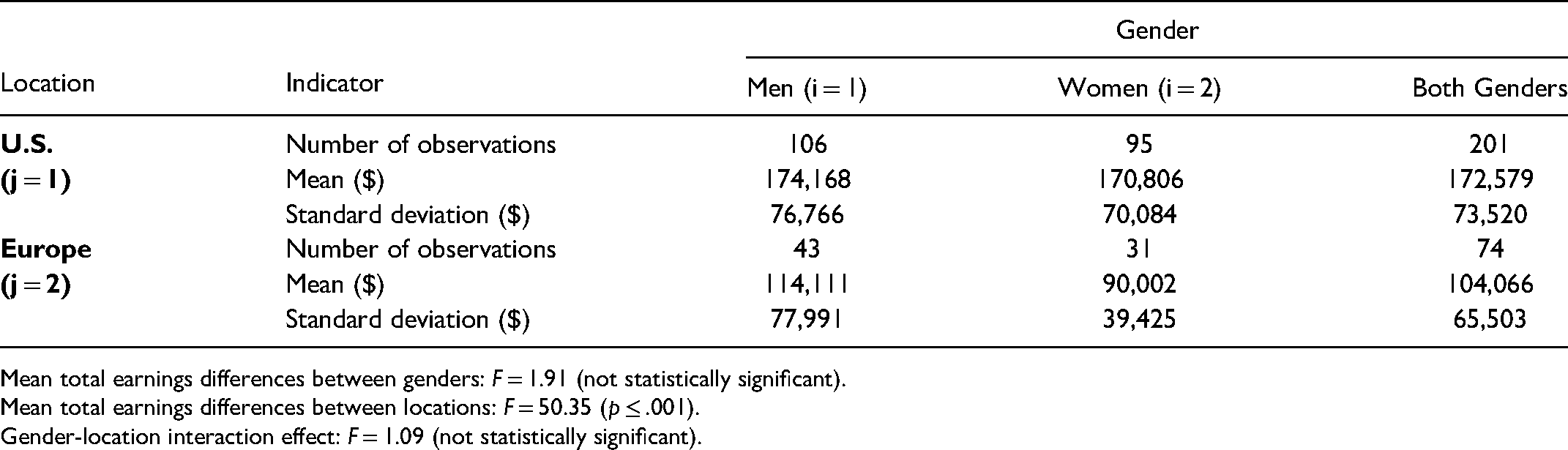
Second, the initial U.S. to non-U.S. pay gap had raised a cause for concern. Since the largest portion of the non-U.S. sample reported living in Europe (71.8%), the initial wages-and-salaries model was estimated solely for European respondents. Descriptive statistics and results of the linear additive model are presented in Appendix Table 3 and regression results are presented in Appendix Table 4. The results of the second part of the sensitivity analysis also were consistent with the core results. However, the coefficients were estimated with less precision, most likely due to the drop in sample size.
Discussion
HE/OR/MA professionals in the sample earned, on average, $146,466 annual wages and salaries. Substantial earnings disparities were observed between HE/OR/MA professionals living in the U.S. and those living in other countries. U.S. participants earned $172,579, much more than the $95,507 earned by participants outside the U.S. In comparison, Cawley, Morrisey and Simon 10 reported equivalent earnings of $161,974 for U.S. health economists. (Earnings were converted to 2019 dollars using the CPI Inflation Calculator from the U.S. Bureau of Labor Statistics.) Although both figures are similar, there were some important differences between the participants of both studies. Most of the participants (69%) in Cawley, Morrisey and Simon 10 were employed in academia, compared with only 5% of the current sample. Moreover, while all participants in the other sample held doctoral degrees, only about one-half (57%) of participants in the current sample held doctoral degrees.
When both genders were taken together, non-U.S. respondents exhibited earnings gaps of 44.7% in wages and salaries relative to their counterparts living in the U.S. The gaps were greater for women (50.3% in wages and salaries) than for men (40.0% in wages and salaries). In contrast with earlier studies that found gender differences in earnings,10,11,17 no significant disparities between men's and women's earnings were observed here. One exception was the study by Cawley and Morrisey; 2 although the authors examined only the earnings of U.S. academicians, they also did not find any statistically significant gender differences. Within location, however, the female earnings gap outside the U.S. (18.7% in wages and salaries) was considerably greater than in the U.S. (1.9% in wages and salaries).
The most confounding evidence from this paper was the absence in statistical significance of the coefficients for number of hours worked per week, which contravened findings elsewhere.13,18 Perhaps the covariate was not properly identified or the number of hours was not uniformly reported by participants; in any event, the coefficients suggested that the respondents’ hourly input was not associated with their earnings.
Attaining a graduate degree only influenced the non-U.S. respondents’ earnings. The earnings differentials due to a graduate degree was hefty, and the impact on wages and salaries was greater for non-U.S. men than women. The annual percentage increase in earnings related to age, a proxy for experience, was greater for non-U.S. women than men. This result was consistent with Cawley and Morrisey, 2 who found that earnings for academicians rose with experience.
The size of the three significant coefficients of the pharmaceutical/biotechnology-firm covariate suggested that workers’ earnings in these firms were much higher than in firms in other areas of operations, which accorded with previous findings.11,17 The statistical significance of the number-of-persons-being-supervised coefficients for U.S. men and non-U.S. women, plus the negative sign of the coefficient for U.S. women's wages and salaries, abate the efforts to establish a meaningful pattern for this covariate. In comparison, Cawley and Morrisey 2 found that those with administrative appointments in U.S. academia earned more than the rest. Finally, all but one coefficients of the average-number-of-days-worked-remotely covariate exhibited significance and a positive sign, which contravened the hypothesis that working remotely was a compensating differential. On the contrary, it was associated with higher earnings, and the impact was greater for non-U.S. women than for U.S. residents of both genders. The only classification showing evidence of a compensating differential was men living outside the U.S., and the reduction in wages and salaries was substantial.
Judging by the significant coefficients, F ratios, and adjusted R2 values, the model explained earnings determination of U.S. men and non-U.S. women better than for the other two classifications, which was not consistent with previous findings. 11 Although both articles identified different sets of covariates, there was incongruity here compared to the earlier study.
Limitations
This study relied on a small, convenient sample that might have not been representative of the worldwide HE/OR/MA professionals’ population. Thus, results may not be fully extrapolated to the global HE/OR/MA community. The data were cross sectional, consequently inadequate for detecting changes over time in earnings as well as variables hypothesized as their determinants. Reported values were not validated for accuracy by employers; therefore, data reporting lacked uniformity and might have contributed to the absence of statistical significance of some coefficients.
Earnings reported by participants were not adjusted for variations in purchasing power, inflation rates, tax structures, or other market conditions across or within locations. In addition, countries other than the U.S. exhibited heterogeneity in government networks and regulations, education and healthcare delivery systems, and cultural practices and settings that might have affected the interpretation of some covariates. Furthermore, since all participants in the sample had jobs, their responses might have been subject to a selection bias. 32
Another limitation was the omission in the earnings determination function of covariates found to be significant throughout the literature. The availability and extent of fringe benefits and/or information on non-work sources of income would have provided a broader dimension of household income that might have explained further the earnings determination process. Additional human-capital variables might have increased the F ratios and adjusted R2 values in the equations, and identification of other job-preference variables and/or job-satisfaction variables might have allowed the measurement of additional compensating differentials and established tradeoffs between earnings and other variables.
Conclusion
The findings of this paper have shed some light into the composition of earnings reported by HE/OR/MA professionals throughout the world. In contrast with previous studies, no significant gender differences in earnings were revealed, although major disparities appeared in the statistical significance, direction, and magnitude of the effect of human-capital and job-related covariates on men's and women's earnings. Earnings differences between respondents living in and outside the U.S. were ubiquitous. The paper also raised some questions in terms of what was left unexplained, especially the absence of statistical significance of the work-input covariates’ coefficients and lack of gender-location uniformity in goodness of fit and patterns of significance. These questions need be addressed in future research.
In the changing and uncertain environment of the COVID-19 driven job markets across continents, exploring the dynamics of earnings by gender and location acquires enhanced relevance. Despite its limitations, the paper has important implications for workforce administrators and HE/OR/MA professionals. Understanding motivations to work and the configuration of earnings, as well as the influence of various covariates in the earnings determination process, may allow institutions to provide incentives and disincentives that promote workers’ productivity, satisfaction, and retention.
Footnotes
Authors’ Contributions
All authors contributed equally to the conceptualization of the study design. IP and MC conducted the statistical analyses of the data. All authors contributed equally to the interpretation of the results and manuscript preparation.
Declaration of Conflicting Interests
The author(s) declared no potential conflicts of interest with respect to the research, authorship, and/or publication of this article.
Ethical Approval
This research was exempt because respondents remained anonymous throughout the study.
Funding
The author(s) received no financial support for the research, authorship, and/or publication of this article.
Informed Consent
Informed consent was obtained from all individual participants included in the study when they answered the survey questions.

Author Biographies
Appendix
Estimated Mean and Standard Deviation Values of HE/OR/MA Professionals’ Annual Total Earnings (Wages and Salaries, Bonuses, and Commissions, in U.S. Dollars) by Gender and Location, 2019. Mean total earnings differences between genders: F = 2.45 (not statistically significant). Mean total earnings differences between locations: F = 70.33 (p ≤ .001). Gender-location interaction effect: F = 1.40 (not statistically significant). Estimated Least-Squares Coefficients, Their Standard Errors (in Parentheses), and (Two-Tail) Levels of Significance of Covariates in the Total-Earnings (Wages and Salaries, Bonuses, and Commissions) Model by Gender and Location, 2019. *Statistically significant (p ≤ .01). Statistically significant (p ≤ .05). Statistically significant (p ≤ .10). Estimated Mean and Standard Deviation Values of U.S. and European HE/OR/MA Professionals’ Wages-and-Salaries Earnings Model, in U.S. Dollars) by Gender and Location (U.S. and Europe), 2019. Mean total earnings differences between genders: F = 1.91 (not statistically significant). Mean total earnings differences between locations: F = 50.35 (p ≤ .001). Gender-location interaction effect: F = 1.09 (not statistically significant). Estimated Least-Squares Coefficients, Their Standard Errors (in Parentheses), and (Two-Tail) Levels of Significance of Covariates in the Wage-and-Salary Earnings Model by Gender and Location (U.S. and Europe), 2019. *Statistically significant (p ≤ .01). Statistically significant (p ≤ .05). Statistically significant (p ≤ .10).
Location
Indicator
Gender
Men (i = 1)
Women (i = 2)
Both Genders
Number of observations
106
95
201
Mean ($)
212,419
207,846
210,257
Standard deviation ($)
104,090
107,661
105,552
Number of observations
56
47
103
Mean ($)
126,689
93,972
111,760
Standard deviation ($)
99,485
47,644
81,416
Number of observations
162
142
304
Mean ($)
182,784
170,155
176,885
Standard deviation ($)
110,090
106,581
108,471

Variable
Term
Estimated Least-Squares Coefficients,
Living in the U.S.
Living Outside the U.S.
Men
Women
Men
Women
α
10.5512
10.5366
9.4124
9.3204
β
0.0046
0.0146
−0.0079
−0.0019
λ1
0.1108
0.0841
1.1967*
0.2667
λ2
0.0146*
0.0074
0.0355†
0.0308*
φ1
0.5470*
0.5915*
0.4805
0.5128‡
φ2
0.0292*
−0.0319
0.0184
0.0596*
φ3
0.0970*
0.0849‡
−0.1278
0.1576*
17.78*
4.37*
2.85*
6.71*
0.490
0.177
0.168
0.427
Location
Indicator
Gender
Men (i = 1)
Women (i = 2)
Both Genders
Number of observations
106
95
201
Mean ($)
174,168
170,806
172,579
Standard deviation ($)
76,766
70,084
73,520
Number of observations
43
31
74
Mean ($)
114,111
90,002
104,066
Standard deviation ($)
77,991
39,425
65,503

Variable
Term
Estimated Least-Squares Coefficients,
Living in the U.S.
Living in Europe
Men
Women
Men
Women
Constant
α
10.5426
10.5050
9.997
10.70
Number of hours worked per week
β
0.0037
0.0149
0.00485
−0.00911
Graduate degree
λ1
0.1036
0.0749
1.204†
−0.0461
Age
λ2
0.0157*
0.0065
0.0116
0.0202†
Pharmaceutical or biotechnology firm
φ1
0.4475*
0.4674*
0.494
0.0988
Number of persons supervised
φ2
0.0219*
−0.0485‡
−0.0312
0.0416
Average number of days worked remotely
φ3
0.0703*
0.0819‡
−0.178
0.0511
F statistic
18.71*
4.01*
1.52
1.61
Adjusted R2
0.505
0.161
0.0704
0.1126