




Abstract
Aim:
To investigate differences in attitude toward physical activity in normal-weight, overweight, and obese adolescents.
Materials and Methods:
We conducted a cross-sectional survey carried out in 2009/2010. It concerned randomly selected schoolchildren of colleges of Sousse in seventh and ninth grade. The sample was composed of 4003 schoolchildren. A questionnaire was used to evaluate habits and perception of physical activity, and we took anthropometric measurements of height and weight.
Results:
Among schoolchildren who performed a recommended level of physical activity, there was no significant difference in perceptions according to weight status. However, among those who did not practice physical activity, obese participants had significantly less positive perception. Overweight and obesity significantly increase the risk of negative perception of physical activity practice among participants who do not do the recommended level of physical activity. However, this association becomes non significant among those who practice recommended level of physical activity. The same findings were observed after adjustment by age and sex.
Conclusion:
Negative attitudes among inactive children may favor the development of a vicious circle perpetuating physical inactivity among normal-weight and overweight children.
Introduction
Obesity and physical inactivity are often positively associated in the literature 1 among children. According to the World Health Organization, approximately 60 minutes of moderate-intensity activity per day or equivalent is needed to prevent the transition from normal-weight to overweight or obesity status among children. 2
Increasing prevalence of overweight and obesity in youngsters worldwide 3,4 suggests that children are becoming less active and do not meet these recommendations.
However, attitude toward physical activity 5 and perceived lack of physical competence 6 are important predictors of engaging in physical activity. Even in children, obesity has a clear measurable negative impact on self-esteem, perceived athletic competence, physical appearance, and global self-worth. 7
So obtaining better understanding of benefits and barriers of being physically active perceived by youngsters of different degrees of overweight may help in developing physical activity interventions for overweight and obese adolescents. 8
In fact, the cardiovascular and metabolic consequences of pediatric obesity have been extensively studied, 9 but less attention has been paid to investigating the impact of obesity on physical functioning and disability in children. The purpose of this study was to investigate differences in attitude toward physical activity in normal-weight, overweight, and obese adolescents.
Materials and Methods
Study Design
This study was part of an assessment of the prevalence of chronic disease risk factors in a community-based intervention program conducted in 2009 in the region of Sousse, Tunisia, with school component. We conducted a cross-sectional survey carried out in 2009/2010.
Study Population
The study concerned pupils of colleges of Sousse in seventh and ninth grade. The participants were randomly selected from all colleges of the delegations of Sousse Jawhara, Sousse Erriadh, and M’saken, which represent 16 colleges. The sample was composed of 4003 schoolchildren.
Data Collection
We have used an Arabic and pretested self-administered questionnaire. It was administered in classes with the presence of trained medical doctors to assist children filling out the questionnaires.
The questionnaire was used to evaluate habits and perception of physical activity.
Anthropometric measurements of height and weight were obtained using a standardized protocol from each participant during interview and clinical examination. Body weight was recorded to the nearest 0.1 kg using a portable electronic scale. Standing height is measured with the participants in barefeet to the nearest 0.5 cm.
Variables Definition
Participants who practice 60 min/d of physical activity were defined as physically active.
Definition of overweight and obesity
Body mass index was computed as the ratio of the body weight to the body height squared expressed as kg/m2. To define overweight and obesity among schoolchildren, we used the recent international cutoff values of BMI according to age and sex. 10
Statistical Analysis
Associations between categorical variables were tested by χ2 test. We used binary logistic regression to evaluate association between weight status and perception of physical activity. Dependent variables were perception of physical activity. Weight status was the independent variable in univariate analysis, and then we adjusted with age and sex. All data analyses were conducted using SPSS 10.0 statistical software. All statistical tests were 2-tailed, and P values <.05 were considered statistically significant.
Ethical Consideration
Because of the young age of the studied population, this investigation was undertaken with respect of the rights and integrity of people. Parents gave their consent, and they were able to refuse their children’s participation. We used an anonymous questionnaire that did not contain the name or the address of schoolchildren.
Results
The mean age of participants was 13.36 ± 1.28 with 48.3% of boys. Prevalence of overweight and obesity was 17.9% and 5.7%, respectively. There was no difference in practice of recommended level of physical activity according to weight status. It was 12.2%, 12%, and 8.7% among normal-weight, overweight, and obese participants, respectively (P = .30).
Among schoolchildren who performed a recommended level of physical activity, there was no significant difference in perceptions according to weight status. However, among those who did not practice physical activity, obese participants had significantly less positive perception (Table 1).
Distribution of Perception of Practicing Physical Activity by Weight Status and Physical Activity Practice Among Schoolchildren in the Region of Sousse During the 2009/2010 School Year.

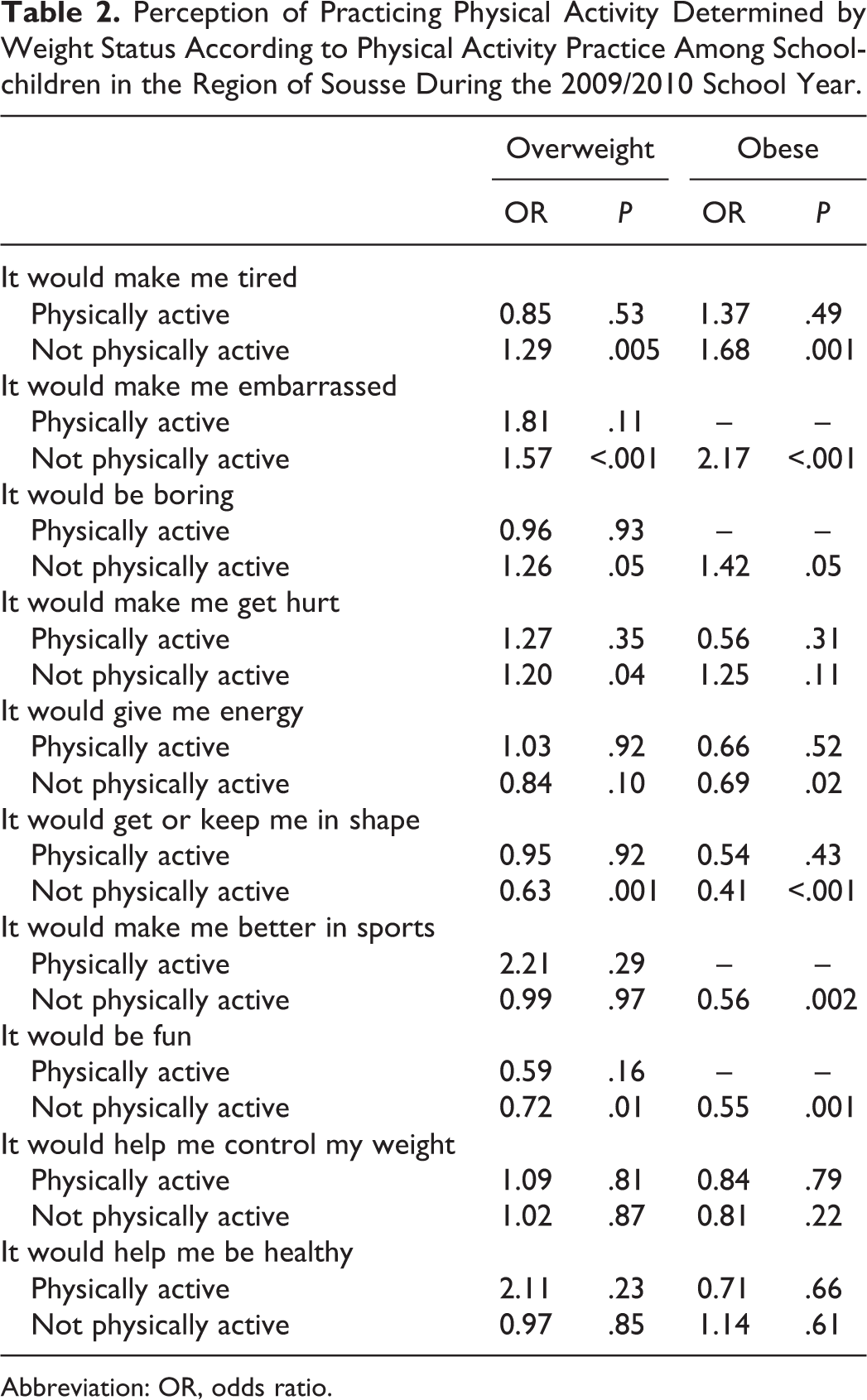
Overweight and obesity significantly increase the risk of negative perception of physical activity practice among participants who do not do the recommended level of physical activity. However, this association becomes non significant among those who practice recommended level of physical activity (Table 2). The same findings were observed after adjustment by age and sex (Table 3).
Perception of Practicing Physical Activity Determined by Weight Status According to Physical Activity Practice Among Schoolchildren in the Region of Sousse During the 2009/2010 School Year.
Abbreviation: OR, odds ratio.
Perception of Practicing Physical Activity Determined by Weight Status, Adjusted by Age and Sex, According to Physical Activity Practice Among Schoolchildren in the Region of Sousse During the 2009/2010 School Year.

Abbreviation: OR, odds ratio.
aaOR: adjusted OR for age and sex.
Discussion
This study further demonstrates that obese adolescents have a less positive attitude toward physical activity compared to normal-weight counterparts. However, after stratification by practice of physical activity, there is no long difference in attitudes according to weight status even after adjustment for sex and age.
According to Deforche et al, 11 overweight and obese adolescents show lower sport participation and have a less positive attitude toward physical activity in comparison with their normal-weight counterparts.
Benefits and barriers toward physical activity more frequently perceived by overweight and obese adolescents are specifically related to their weight problem. This is also due to the fact that obese children had higher perceived difficulty with several activities of daily living, were less engaged in sports, and had lower physical performance than normal-weight or overweight children. 12 Morano et al 13 stated that overweight and obese participants, when compared with normal-weight peers, reported lower perceived and actual physical competence, higher perceived body fat, and greater body dissatisfaction. Body dissatisfaction mediated all the associations between body mass index and the different aspects of physical self-perception in boys but not in girls. The same pattern of results was found for physical self-perception as a mediator of the relationship between BMI and body dissatisfaction. In conclusion, obesity proved to have adverse effects on both motor performance and physical self-perception.
Indeed, being part of a team and having opportunities to demonstrate skills in front of friends and family may be particularly challenging and thus highly discouraging for obese children. 12
A multicomponent activity program not based merely on a dose–effect approach enhances adherence of the obese children and has the potential to increase their lifelong exercise skills. Rather than focusing entirely on diet and weight loss, findings support the inclusion of interventions directed toward improving perceived physical ability that is predictive of subsequent physical activity. 14
When promoting physical activity in overweight and obese adolescents, we should focus on decreasing these weight-related barriers. 15 In fact, different studies didn’t find differences in leisure time physical activity (excluding sport) among obese and normal-weight children, but the sport index was higher in the normal-weight compared to the overweight and obese adolescents. 11,16,17
A few limitations of our study can be acknowledged. Assessment of practicing recommended level of physical activity was self-reported. However, we trained interviewers to standardize data collection and the use of accelerometer is difficult in our context among such a large sample size.
We didn’t distinguish between leisure time physical activity and sport practice. Nevertheless, it appears that if children practice physical activity, they will enjoy and have better attitude and confidence.
Negative attitudes among inactive children may favor the development of a vicious circle perpetuating physical inactivity. Interrupting this concatenation of events is a central issue for promotion of physical activity among normal-weight and overweight children.
Footnotes
Declaration of Conflicting Interests
The author(s) declared no potential conflicts of interest with respect to the research, authorship, and/or publication of this article.
Funding
The author(s) disclosed receipt of the following financial support for the research and/or authorship of this article: This project was funded by “UnitedHealth Group” and by the Research Unit “Santé UR12SP28”: Epidemiologic transition and prevention of chronic disease.